
From Africa Palace to AfricaMuseum


Baruch College, City University of New York, New York, NY 10010, USA
Arts 2025, 14(6), 168; https://doi.org/10.3390/arts14060168
Submission received: 20 October 2025
/
Revised: 1 December 2025
/
Accepted: 3 December 2025
/
Published: 8 December 2025
(This article belongs to the Special Issue Restitution Beyond Repatriation: Rethinking African Tangible Heritage in Twenty-First Century Museums)
Abstract
In 1897, King Leopold II of Belgium opened the Brussels International Exposition, which, in the Palace of the Colonies, showcased objects and people from the Congo Free State. They were displayed as the property of the King, who was the founder and sole owner of the Congo Free State from 1885 to 1908. The Palace of the Colonies was a combination of classically inspired imperial architecture and references to the Congo. The exposition was a huge success. As a result, the King built Africa Palace, a permanent ethnographic museum dedicated to his idea of Congo. It was located adjacent to his palace in Tervuren, now a suburb outside of Brussels. In 2018, the museum reopened as AfricaMuseum. This paper examines the inherent colonial frame of AfricaMuseum, both physically and ideologically, that continue to limit a significant socio-political shift for the museum, and the contemporary art pieces by Congolese and Burundian artists that have been tasked with the heavy lifting in shifting the narrative.
1. Introduction: The Congo: A Belgian Invention
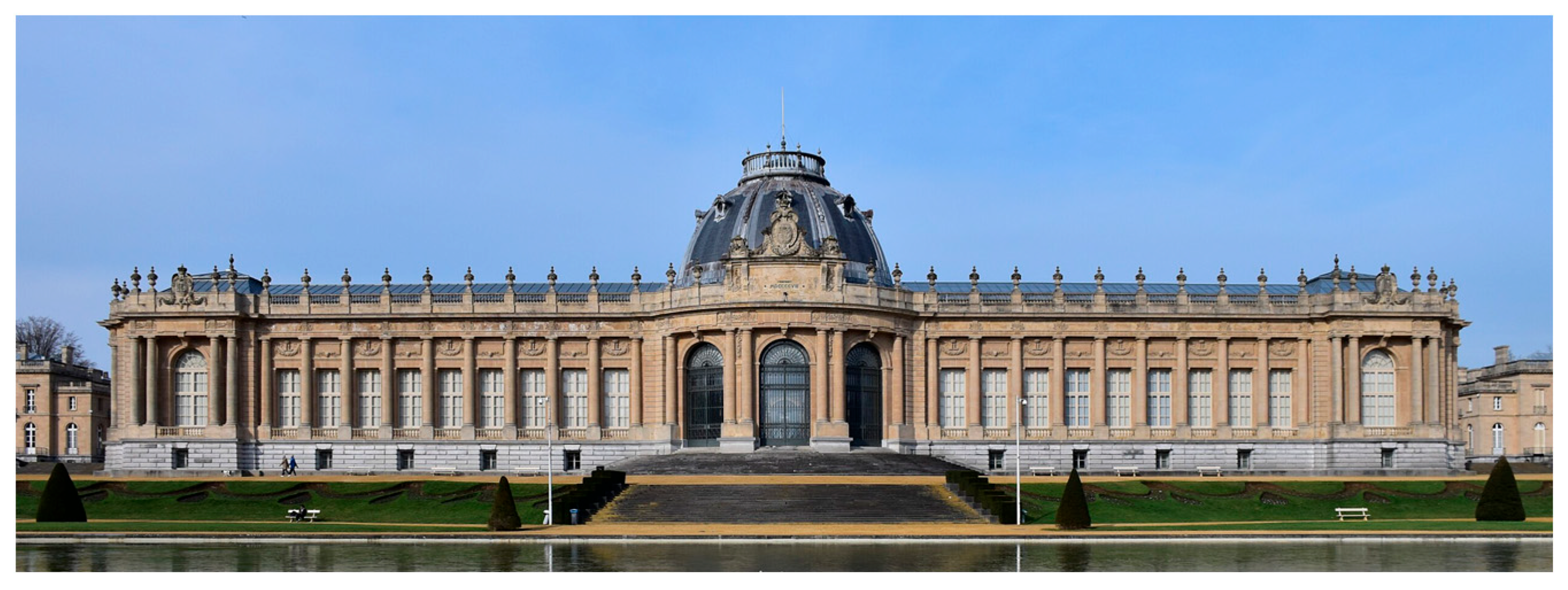
In 1897, King Leopold II of Belgium opened the Brussels International Exposition, which, in the Palace of the Colonies, showcased objects and people from the Congo Free State. These objects and people were displayed as the property of the King, who was the founder and sole owner of the Congo Free State from 1885 to 1908.1 The exposition was a huge success. As a result, the King built Africa Palace, a permanent ethnographic museum dedicated to his idea of Congo. It was located adjacent to his palace in Tervuren, now a suburb outside of Brussels (Figure 1). In 2018, the museum reopened as AfricaMuseum. This paper examines the inherent colonial frame of AfricaMuseum, both physically and ideologically, that continue to limit a significant socio-political shift for the museum, and the contemporary art pieces by Congolese and Burundian artists that have been tasked with the heavy lifting in shifting the narrative.2
The idea of the Congo as a homogenous cultural entity is a Belgian invention. Through the jurisdiction of King Leopold II, the Congo was defined through imposed geographical and cultural borders and exploited for its natural resources. King Leopold’s ownership of the Congo Free State was sanctioned at the Berlin Conference of 1884–1885, a meeting of colonial powers that concluded with the signing of the General Act of Berlin, an agreement regulating European colonization and trade in Africa during the New Imperialism period. Leopold’s goals were three-fold: to Belgianize the European presence in his new “international” colony, to secure a cheap labor force to assist in pacification, administration and economic exploitation, and to carry on these tasks under the guise of inter-national humanitarianism, one of the central themes of the Berlin Act. The existing social and political structures were broken, long-established authorities were subverted, and trade was placed wholly in European hands. Rubber became the primary commodity for Leopold and his Congo became synonymous with explicitly brutal practices to control and enforce the rubber quotas.3
Through the capital gains from the Congo Free State, Leopold embarked on urban projects, which served to justify the monetary rewards from the Congo for both the King and Belgium.4 As such, much of the built environment was shaped by Leopold as father of the nation and using paternalistic imagery to legitimize his role in Belgian’s history. In 1904, Roger Casement published his report that detailed the abuses in the Congo Free State. Leopold’s terror in the Congo was well-documented in critical and satirical publications. One cartoon, from 1904, depicts Leopold laying the first stone for the National Basilica of the Sacred Heart in Brussels demonstrating the hypocrisy of the Belgian Catholic church (Figure 2). The event is attended by passive bishops and racial stereotypes of Congolese with maimed limbs, a result of the brutal policies of the Force Publique, a military force comprising former military officers and mercenaries. They wear heavy ribbons of the sacred heart.
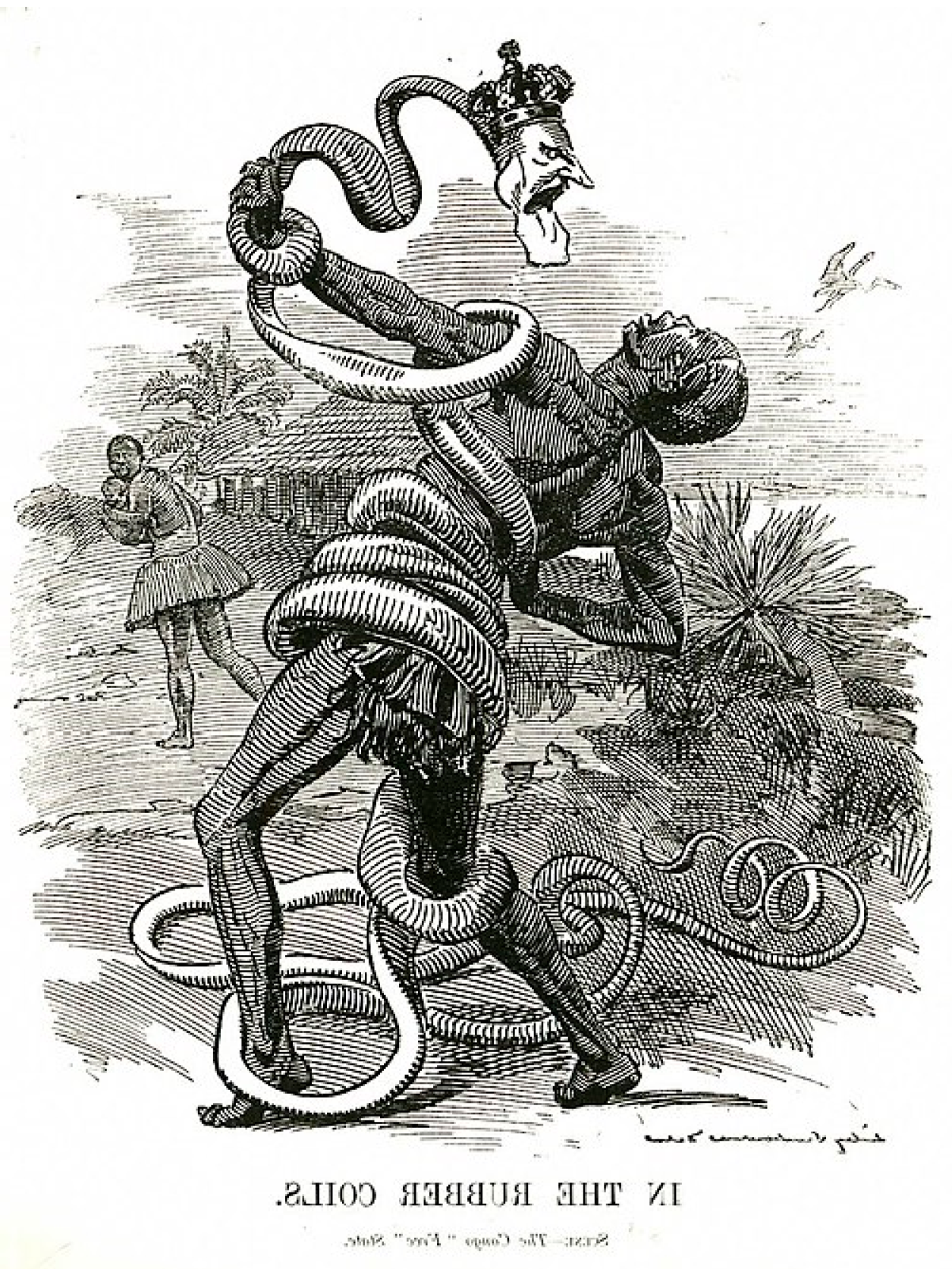
A Punch cartoon from 1906 exposes Leopold as an imperial snake overpowering a Congolese rubber collector (Figure 3). International pressure in 1908 forced Leopold to turn his possession over to the country of Belgium and the Congo became the Belgian Congo. Leopold insisted that Belgium pay him over 45.5 million francs to reimburse him for his contributions in adding to the country’s urban landscape.5 The project that has evolved and weathered extensive controversy and scrutiny in the past one hundred years is the Africa Palace. From its inception, the goal of Africa Palace was to promote the colony with the Belgian public and publicize the King’s benevolence toward the people of the Congo.
2. Leopold’s Museum
The Palace of the Colonies was a combination of classically inspired imperial architecture and oblique and overt references to the Congo. The palace was designed by Alfred-Philibert Aldrophe (1834–1895) and was inspired by the Petit Trianon at Versailles. In the Hall of Great Cultures, Georges Hobé, drawing upon Belgian Art Nouveau, used African bilinga wood to evoke the Congolese forest. The addition of Hobé’s Art Nouveau forest and village capitalized on the popularity of what Debora Silverman called “imperial modernism,” the complex relationship between modernist aesthestics and imperial power structure (Silverman 2011, p. 140).6 She traces the ties of the profits from the Congo to style coup de fouet (whiplash style) an early name for this new form of artistic expression, which was inspired by the sinuous lines of the rubber vines and the chicotte, the imperial flogging whip made of hippopotamus hide (Silverman 2011, p. 142). The classical gardens were created by French-landscape architect Elie Lainé (1829–1911). Inside, Belgians were shown taxidermied animals and export products such as coffee, cacao, and tobacco. Visitors gawked at the objects taken from the Congolese people under the guise of relieving—voluntarily or otherwise—the newly converted “natives” of their “fetish” objects by missionaries who established posts throughout the region (Wastiau 2000, p. 21). In the French-inspired classical gardens, three Congolese villages were built in which sixty Congolese lived for the duration of the exhibition. A fourth village was named Gijzegem, after the Flemish commune, a school where Father Van Impe wanted to prove that “civilizing” the Congolese was possible. The peak period, when visitors numbered more than 40,000 per day, coincided with the period in which the Congolese “villages” were on view.7 The Palace of the Colonies at the Brussels International Exposition was a huge success. As a result, the King founded Africa Palace, a permanent ethnographic museum dedicated to his idea of Congo. It was located adjacent to his palace in Tervuren, now a suburb outside of Brussels.
Leopold leaned on Neoclassicism for many of his building projects to enforce the prestige of the monarchy.8 This, French architect Charles Girault (1851–1932) designed an eclectic Neoclassical façade for Africa Palace. The spandrels on the two side wings are stamped with Leopold’s monogram. The construction was paid for from the profits of the royal private domain of the Congo. Two years prior to the opening of the museum, Leopold turned over possession of Congo to Belgium. He died in 1909, one year before the museum was completed. His son, King Albert I, inaugurated the new Musée du Congo in 1910. Soon after it was open to the public, Africa Palace was renamed Musée du Congo and served as a museum and scientific institute as well as a means for Leopold II to attract investors for his financial exploits in the Congo.9 In the 1960s, after independence of Congo from Belgium, the focus expanded to include the entire Congo Basin as well as Central, East, and West Africa. The collection rapidly outgrew its initially modest space. By Royal Decree, the museum was renamed the Musée royal du Congo belge in 1952. After Congo independence in 1960, it was renamed, again, as the MRAC (Musée royal de l’Afrique centrale) and KMMA (Koninklijk Museum voor Midden-Afrika). The last two names underscore the museum’s contents as the property of the royal family and the Belgian public. The name changes reflect the socio-political relationship between Belgium and the Congo as well as the political and linguistic schisms between the French-speaking Walloons in the south and the Dutch-speaking Flemish in the north. As the MRAC/KMMA, the museum focused on the former Belgian empire, which at different stages encompassed the rule of Congo, Rwanda, and Burundi. In the current reinstallation, AfricaMuseum, the main focus is on Congo, with references to Rwanda, and occasional mentions of Burundi. Display texts here and there refer to “Africa” and “African,” despite the specific regional focus, which also calls into question the current name of the museum, AfricaMuseum, that subsumes this specific region of Africa as representative of the whole of the continent. The name is also now in English in order to assuage Belgium’s linguistic issues.
3. AfricaMuseum
After Leopold relinquished ownership, the museum continued, through all of the name changes, to function as a display of colonial imagination, a framework that is used to analyze the ways colonization serves as a tool that normalizes dispassion and appropriation. Colonial museums, in general, and Musée du Congo specifically for Belgium, are a “powerful and handsome trophy” of conquest and control (Wastiau 2000, p. 18). Many continue to resemble a cabinet of curiosities or wonders. In Tervuren, Congolese weapons were displayed to highlight the successful campaigns of pacification of the indigenous people. Bantu and Arabic objects were also exhibited to document Begium’s “liberation” of the Congo from systems of slavery and other forms of violence. The items taken from Congo were categorized by Belgian-determined ethnic borders, which underscored the administrative control of the territory and the people. In the early twentieth century, the museum continued to rely heavily on the missionaries to acquire not only objects, but information pertaining to the traditional usage of the objects and their geographic origin. But this information was often collected without the cooperation of the Congolese themselves raising concerns about cultural appropriation and the unequal power dynamics between colonizer and colonized. The collection was primarily presented as scientific, supported by the Belgian government through financial sponsorship. These Congolese objects were displayed adjacent to exhibitions highlighting missionary work, colonial medical organizations, and sculptures by Herbert (1863–1919) that represented types or categories of indigenous people from the region (Figure 4) (Schouteden 1942, pp. 33–34).
Some of the objects were also presented as art, a term loosely applied to African objects. African art and culture have been historically understood within art historical scholarship and the EuroAmerican popular imagination. Presenting Congolese objects on pedestals and within glass vitrines as well as using the terminology of the Western historiography of art history stripped them of the spiritual, ritual, and historical significances. Additionally, photographs of the Congolese sites posited the cultural artifacts as fetish objects. These photographs, expertly lighted, floated the objects in a decontextualized space and, through the systems of commodification, severed the cultural object from the original value defined by a specific social and cultural framework (Okwunodu Ogbechi 2014, p. 75).
In 2005, the museum mounted La mémoire du Congo, le temps colonial (The Memory of the Congo in the Colonial Period). The exhibition was one of the first attempts to address the brutal history of Belgium and the Congo in an institution that was pivotal in official national denial and the most visible and provocative embodiment of the ‘great forgetting’” of Belgium’s role in Africa—a role that lasted long after Leopold II’s death in 1909 (Silverman, p. 146). In 2013, the museum closed for extensive renovations to address the problematic exhibitions and historical narratives. The goal was to rehang the permanent exhibitions, many of which still adhered to the early twentieth century scenography described above, deconstruct the art displays, and create a new visitor’s center that was to provide transparency of the colonial historiography of the museum. Under the leadership of Director Guido Gryseels, re-thinking the museum began through a series of discussions with various advisory committees. This advisory model was ostensibly based upon Amy Lonetree’s chapter “Museums as Sites of Decolonization; Truth Telling in National and Tribal Museums” that asked for a shift in museum decolonization from the perspective of the colonizer to the colonized (Lonetree 2009, p. 323). Lonetree outlines two general models: “the multi-vocal model” and “the community-based model”. The first involves many stakeholders, including indigenous communities, in project design and implementation. The second tends to give the floor to community representatives to produce a project from their own cultural perspectives. First, Gryseels established the RMCA, the Royal Museum of Central Africa, as a ‘contact zone,’ a place where working groups comprising members of African diasporic communities in Belgium took part in conversations with RMCA staff well before the closing of the museum in 2015. These groups were formally integrated into the museum organization as COMRAF (Comité de concertation Musée Royal de l’Afrique Centrale-Associations Africaines) in 2004 (Vanhee 2016, p. 7).
COMRAF selected six professionals to advise the museum staff to work with staff at the museum in rethinking wall texts and object labels as well as the history and historiography of the Congo and the Congolese presented in object-centered displays. Hein Vanhee, a curator and historian at the museum during the restoration, wrote of this collaboration as a means to go “beyond occasional consultations” and emphasized that “radically inclusive methods require full participation in both the creative process and the decision making” (Vanhee). Strategically, COMRAF featured prominently in the museum’s promotion of the renovation process at national and international levels, solidifying the impression that the RMCA was transforming, through the application of practices integral to New Museology, into a leading post-colonial museum. New Museum theory, in the 1960s, underscored a social education role for museums. As the theoretical framework of New Museology developed, museum practice led to a greater stress on institutional reflexivity within museums as critical scholars and practitioners sought to deconstruct and move past old visions of the museum as an elite, authoritative, and monolithic space. New Museum theory addressed the contested politics and ideologies of museum exhibition. But as Lonetree herself acknowledges, decolonizing museum practice is a long process that occurs in stages, after significant activist work. Vanhee noted that with the COMFRAF group of six the museum staff could “forge a shared understanding [emphasis Vanhee’s] of specific episodes or moments of the (colonial past) […]” (Vanhee). The Congolese and Congolese-Belgian activists who were members of COMRAF expected to serve as diasporic experts, but, as they described, only functioned as passive actors in the renovation who could offer opinions but not make decisions. The group of six was selected in 2016 after the renovation had already begun. This suggested that their input was to validate the decisions that had already been made, rather than proposing their own ideas (Tansia 2019). Laura Nsengiyumvam (b. 1987), a Belgian artist of Rwandan origin and an original member of the six, noted that museum personnel kept telling the press that the museum is being renovated in collaboration with the diaspora, which she asserted was not true (Nsengiyumva n.d.) Her experiences were countered by Bruno Verbergt, the operational director of public services at the museum, in an open letter [article] in Knack, a Dutch-language weekly news magazine in Belgium (Vergergt 2018).10 Vergergt’s article is comprehensive in addressing the objections of Nsengiyumva and Toma Muteba Luntumbue (b. 1963), Congolese artist and art historian, to the decolonizing process. He acknowledges that the decision-makers in the museum paid too little attention to societal changes. Vergergt underscores that he and others at the museum are open to criticism. But doubles down that those criticisms should not have been shared publicly by those whose histories are actually represented in the museum. He simply cannot have it both ways. The need to defend the museum in a public forum is an example of the fundamental ways in which the idea of collaboration did not work.
The COMRAF’s call for a fundamental redistribution of power and resources was, apparently, too radical in calling for the actual decolonizing of the museum. For example, the new exhibition highlights the violence perpetrated by the Leopoldian and Belgian administration in Congo but does not address how that violence relates to the social and cultural project of colonialism, in which the museum itself is enmeshed. AfricaMuseum is silent on the continued interference of the Belgian state and international corporations in the Congo after 1960. Instead, the museum notes only that “the post-colonial history of Burundi, Congo, and Rwanda is dominated by complex, tragic, and controversial conflicts” (AfricaMuseum).
In order to decolonize, Ama Biney asserts that decolonizing is first and foremost in the field of knowledge (Biney 2016, p. 342). It is about who produces the knowledge and how this knowledge is disseminated, through which channels, because “coloniality survives colonialism” (Biney 2016, p. 344). Biney reminds us that “…despite the formal end of colonial rule, “coloniality,” the enduring system of colonial power that remains in a reconfigured form of domination, control and exploitation of the rest of the world in authority, economics, knowledge, subjectivity, gender, sexuality and nature by the countries of the North over the countries of the South” (Biney 2016, p. 352). Decolonizing museums is about the lens we use to view these domains of knowledge and know-how. It is notable that African students and scholars have been conducting research in the past decades both in Western universities and in domestic institutions that address these issues. The six members of COMRAF also felt that the renovation process insufficiently acknowledged Africans’ long history of studying, analyzing, and representing their own societies (Limond-Mertes 2019, p. 52). It was clear that the staff at the museum was inattentive to the fundamental asymmetries inherent to the relationship between institutions and the communities whose heritage they continue to detain and display. In light of this disparity, Anne Wetsie Mpoma, one of the six, asks important questions:
How can we create a new exhibition with the same staff who have often been working on these objects for several decades? And what about the interpersonal or interprofessional power relationships that develop between independent experts from diasporas and scientific staff who enjoy a privileged status within the museum institution? Can we really replace the usual relationships of domination and submission with relationships of co-creation under these conditions?.(n.d. p. 7)
It is telling that the collaboration between the museum and Wetsie Mpoma and her colleagues ended before the museum reopened (Luntumbue 2015, p. 2). I also want to point out that the museum still refers to the five-year closing as a renovation. While this does imply the process of improving something that is broken or outdated, it also points to a simple modernization of the permanent exhibition, rather than an attempt at a systematic deep-dive into reassessing the production of a new narrative. In “Neocolonial Collaboration,” Robin Boast argues that, for museums to transcend their coloniality, they would have to go beyond the ‘engagement’ advocated by the New Museology and recognize that the institutional conceptualization, structures, and practices of the museum would have to be ‘completely redrafted’ (Boast 2011, p. 62).
4. The Frame of the Museum
If AfricaMuseum were to transcend its coloniality, it would have to be rehoused in a new architectural space. The Neoclassical Leopoldian buildings are preserved by Onroenrend Erfgoed, the Flanders Heritage Agency. The museum was not permitted to remove any of the colonial statues and symbols that are built into its very walls. It is perhaps an apt metaphor for a country, as I indicated earlier, in which colonialism is integral to its very infrastructure. Many of Belgium’s palaces and monuments were funded by the extraction of raw materials from the Congo through exploitative human labor. In order to try to circumvent the visual narrative of a European palace that houses a colonial collection, Stéphane Beel Architects, a temporary association led by Beel with landscape architect Michel Desvigne and Arup for the structural modifications, was commissioned to construct a separate entrance pavilion in the International Style. The result was a glass and steel box on stilts that houses the reception desks, cafeteria, workshop spaces and visitor facilities (Figure 5).
It appears as an awkward and sterile appendage that attempts to assuage an outdated form of cultural authority (De Wachter 2018). The original building is visible from Beel’s addition in order to underscore a link between the two seemingly disparate forms. The addition connects to the original building via a disconcerting run of three straight flights of stairs and a 100 m long corridor, a tunnel of stark white light and polished concrete. This corridor holds one artifact: a 22.5 m-long pirogue that ferried King Leopold III down the Lualaba River in 1957. On the wall is black text in Dutch and French, and English: Everything passes except the past. The phrase refers to Belgian sociologist Luc Huyse’s book Alles gaat voorbij, behalve het verleden (Huyse 2006), which addresses the ramifications of colonialization and occupation. Huyse’s book was the inspiration for the 2019 project “Everything Passes Except the Past” organized by the Goethe-Institute in Brussels in association with the Goethe-Institutes in Barcelona, Bordeaux, Lisbon, and Turin. The goal was to address “colonial history and its impact on present-day cultures” and to “raise awareness of power structures past and present and propose ways to overcome them (Haeckel 2021).
Off of this corridor is a large gallery for temporary exhibitions. Visitors walk through the corridor to enter the older building’s basement, which has been claimed as a gallery space named Sidelined. Sidelined is an open-storage depot (see Figure 6), which holds objects that have, literally, been sidelined from the main galleries. Open Storage, which was first implemented in Canada in the 1970s, implies that the public is the real “owner” of the museum collections and therefore should have the right to have full access to them. Initially, the open storage model was considered radical and represented efforts to move away from the typical established museum model. It was an effort to redefine the museum’s whole meaning. However, at AfricaMuseum, Open Storage is simply a basement room to which many of the sculptures epitomizing colonial aesthetics of racist stereotypes, previously installed in the central rotunda and other spaces in the museum, have been relegated. The larger pieces are displayed together on a raised platform surrounded by a metal fence. The bust portrait types are placed in metal shelving similar to what is used in archives. The museum is emphatically emphasizing that they have been removed from the privileged position of white pedestals and vitrines. Herbert Ward’s sculptures were moved to this space as well as Paul Wissaert’s iconic Leopard-Man of Stanley Falls (1913), which depicts an African man wearing a hooded leopard skin tunic and holding claw blades looming over a sleeping figure about to attack (Figure 6) [This is the figure Belgian author Hergé appropriated for his 1931 comic strip Tintin in the Congo].
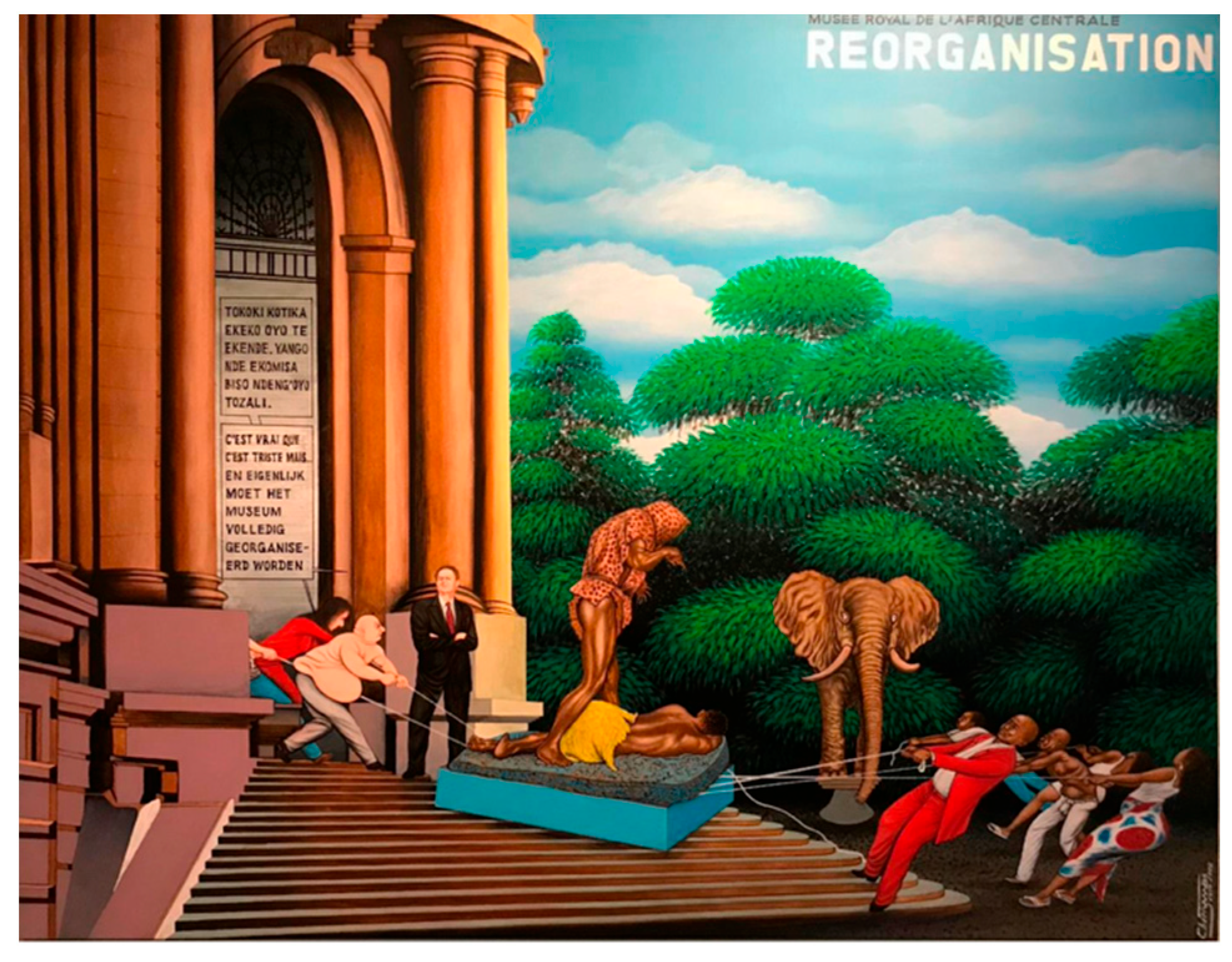
Wissaert’s sculpture became a point of contention between the museum and the COMRAF in the decisions regarding which objects should remain on display in a transparent historiography and which should be removed completely from public view. The issue prompted one of the first uses of contemporary art used as a tool of interrogation of museum collection and display practices.11 In Réorganisation (2002), Congolese artist Samba wa Mbimba N’zingo Nuni Masi Ndo Mbasi, known professionally as Chéri Samba, (b. 1956) centers the Leopard-Man of Stanley Falls in a post-colonial game of tug-of-war on the steps of the museum. A group of Congolese pull the statue out of the museum and whites pull it back in (Figure 7). The two groups are presided over by Gryseels.
The original painting is on display in the Sidelined gallery (See Figure 6). It functions as a signifier that the museum is open to criticism; it is clearly labeled as a commission. The gallery is presented as a compromise in the tug-of war over Leopard-Man of Stanley Falls. The statue remains in the museum. Visitors can continue to stare at the terrifying figure while the presence of the painting attempts to assuage any discomfort they may feel. Before entering Girault’s original building, the museum explains, in several underground galleries, its history as a scientific institution and, an attempt for full transparence, describes the collecting policies of the late nineteenth and twentieth centuries. In decolonizing efforts, museums seek approval by highlighting problems with colonial collections. AfricaMuseum acknowledges the collecting practices but still does not underscore that the collection itself is a witness to genocidal practice (Deliss 2021, p. 59).12
As visitors leave the depot, they move up and into the museum/palace (Figure 8).
Unfortunately, this formal decision makes it seems as if one is rising from underground into civilization. At the top of the stairs, a large reproduction of Réorganisation serves another formal purpose as the gateway between the old, Beel’s addition, and the new, Leopold’s colonial palace. At this point, the architectural organization suggests two different paths visitors may take through the museum. One path, to the left, leads visitors into a small rotunda that faces Leuvensesteenweg (Leaven Stone Road). Another takes visitors to Afropea, a room dedicated to Sub-Saharan African diaspora in Belgium.
In the small rotunda, visitors encounter a view of the Elie Lainé grounds that continues to situate this Congolese narrative within a nineteenth century architectural landscape. In Afropea, historical documents, photographs, and personal objects are used as traces of the long historical arc from Leopold’s human zoos to present-day activism. The majority of the rooms, which surround an inner courtyard, still display pieces from the original collection, albeit with text labels with additional contextual information, such as Ritual and Ceremonies, Minerals, Language and Music, and Landscapes and Biodiversity. The 2018 installation added the Resource Paradox, focusing on human relationships with the land in Central Africa from extraction to urbanization, and the Imagery room featuring colonial era propaganda and photographs of nineteenth and twentieth century Congolese people. This room serves to disrupt the stereotypical depictions Leopold and Belgium’s version of the Congo. In between Afropea and the rooms dedicated to Landscape and Biodiversity is a full-sized robot crossing guard similar to those found in Kinhasha, formerly Leopoldville. Here the crossing guard functions as a separation between the rooms dedicated to the social sciences and those assigned to the scientific disciplines. While the robot is familiar figure in Kinshasa, in AfricaMuseum it functions as a contemporary, but unfamiliar, art piece for the majority of the visitors. It is both a familiar and unfamiliar object dependent upon the visitor. Afropea also has two additional contemporary art pieces installed as a permanent fixture in the museum. A piece by Burundian Aimé Ntakiyica (b. 1960) and an additional Chéri Samba are included in this narrative. From Afropea, visitors walk into the Lieux de mémoire—the Memorial Hall. Alternatively, visitors may directly access to the Memorial Hall as they rise from the basement galleries. According to the museum, the contemporary artworks were added to the spaces in the museum that still retain an overt colonial tenor.13
5. Counter Narratives
During the renovation, several contemporary artists from the former Belgian colonial diaspora were invited to add pieces to the nineteenth century palatial space. As of 2018, the Memorial Hall truly functions as a lieux de mémoire as defined by Pierre Nora in 1989 (Nora 1989, pp. 7–24). This Lieux de mémoire in AfricaMuseum is a physical place or object which acts as container of memory. Through Aimé Ntakiyica’s interventions, the hall now acknowledges and commemorates the deaths of Congolese people. But their memory still performs only as shadows that haunt the neoclassical hall that lists 1508 names of white Belgian men who died in the Congo Free State between 1876 and 1908. The names were added to the wall of the museum in between the two world wars in an effort to counter the rise in Flemish nationalism that threatened the Francophone Belgiam government.14 Ntakiyica’s piece addresses the intimate connections between Burundian, Congolese, and Rwandans with AfricaMuseum. As a young student in Belgium, Ntakiyica participated in school trips and believed, to some extent, that his past was the caricatures depicted at the museum and in Herme’s Tintin in the Congo. As an adult, noticing objects in the museum that once belonged to his own family, he created Histoire de famille. Arbre généalogique, no 1 (Family History. Genealogy Tree, no 1) (2016). The piece was not commissioned by AfricaMuseum. It was first presented at the Dak’Art Biennale of 2016 where Ntakiyica presented 120 glass jars filled with yarn were labeled with names of members of his family. Ntakiyica reclaims identity for those objects removed from familial and historical context. But his point is much deeper than simply naming the un-named. His project addresses the construction of identities similar to the way he was exposed at a young age to a constructed Burundi identity via the museum. He is both a product of Burundi and Belgium. Histoire de famille includes the Burundian names and the Flemish names from his family tree. One of the names, that of his father, ties him and history to Burundi,15 while the inclusion of the yarn and Van Essche, his wife’s surname, bind him to a Belgian identity.
The historical narrative of Histoire de famille is as important as the final exhibition. Ntakiyica challenges the classification process imposed in colonial museums by releasing control of the installation. He does not specify how the installation should be mounted. He gives museum staff agency in those decisions asking them to become active participants in the narrative. This practice has several implications. First, it reflects Ntakiyica’s own ideologies on identity, which, as noted above, he describes as multiple: he has his own notions of his identity in addition to the identity imposed upon him by others. Secondly, this mirrors the construction of the Burundian, Rwandan and Congolese identities at the museum. Histoire de famille is displayed near a photograph of Ntakiyica’s uncle, which is owned by the museum, underscoring the intimate relationship between the artist and the museum that purchased his work for its reopening.
In the Memorial Hall visitors encounter a memorial listing the 1508 Belgians who died in the Congo Free State between 1876 and 1908 (Figure 9). On the opposite window, Congolese artist Freddy Tsimba (b. 1967) mounted Ombres (Shadows). Tsimba was the artist-in-residence at the museum in 2016. His piece commemorates the deaths of twenty-four Congolese who died in Belgium between 1876 and 190816 But it also references the uncountable numbers of Congolese who died under Leopold’s and Belgium’s colonial practices. Ombres (Shadows) is as subtle as the Belgian colonial memorial is pompous (Figure 10). When the sun shines, which is not often in Belgium, the names are projected onto the opposite wall. This devastating contrast underscores that only for a short time are the names of the Congolese dead visible within the larger framework of Belgian colonial practice. This is the first instance of a contemporary art piece by a member of the African diaspora in AfricaMuseum tasked with addressing a permanent reference to the colonial space in which the museum is housed. The shadows signal an absence that, as suggested by Elaine Sullivan, engage in “nkisi logic,” a reference to the Congolese nkisi figures that attract and hold spirits (Sullivan 2020, p. 56).17 Tsimba draws upon Congolese power to challenge the predominance narrative of Belgian colonialism that remains in the museum. These shadows also underscore the specter of colonialism that continues to cast its shadow across Belgium. To that point, Leopold’s presence, in forty-five monograms and several statues, remains on the grounds as well as in the grand rotunda.
Leopold II as AfricaMuseum
The statues of Leopold II were added to the infrastructure of the building throughout the twentieth century to underscore nationalist identity and the ideologies of the colonial state, which focused on self-governance and nation building, economic development, and cultural identity after European imperialism. The museum, and particularly the Grand Rotunda, continues to read as Leopold’s own mini-Versailles (Couttenier 2010, p. 13). Prior to the renovation, the Grand Rotunda was the entrance to the museum. Visitors continue to enter the space and look up into the white-washed dome marked with silver garlands and the double Ls of Leopold’s insignia below an image of his crown. In the center of the room, they stand on a marble mosaic of the five-pointed star that was the symbol of the Congo Free State. This star is surrounded by a green garland and fastened together by Leopold’s crown.
Four larger than life-sized statues, by Belgian Arsène Matton (1873–1953) (see Figure 4), protected by Onroenrend Erfgoed, remain in classical niches. This configuration dates to the Greco-Roman period in which notable figures were placed in aediculas, a niche treated as a miniature temple or shrine, in civic spaces. The four are personifications of Belgium: Belgium bringing well-being to the Congo; Belgium bringing security to the Congo; Slavery (representing Belgium releasing the Congolese from Arab slavery); and Belgium bringing civilization to the Congo. The smaller statues by Ward, now relegated to the Sideline gallery, were placed at the foot of the niches in 1930.18 These figures represent stereotypical ideas of “Congo-Vision,’ to borrow Barbara Saunders’s analysis of the space (Saunders 2005, p. 80). Ward created fantasy versions of Belgian Congolese subjects: The Tribal Chief, Making Fire, The Idol-Maker, and The Artist (see Figure 4). These images were installed at or below eye-level to the visitor. This deliberate positioning of both groups forced visitors to look down upon the depictions of the Congolese and up at the larger-than-life statues of Belgian benevolence.
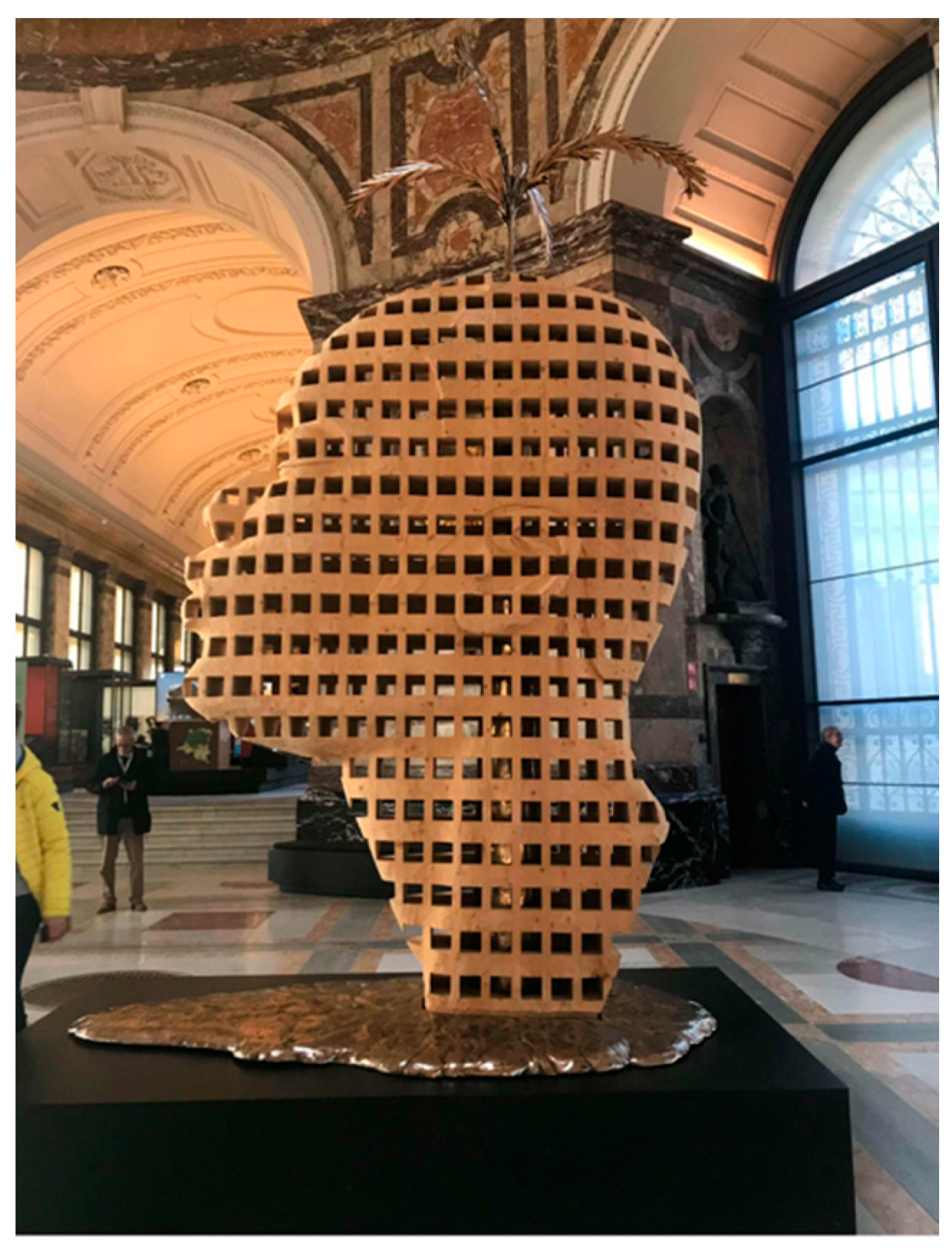
In order to counter the weight, both literally and figuratively, of the Leopold II, Congolese artist Aimé Mpane’s piece Nouvelle Souffle ou le Congo Bourgeonnant/New Breath or Burgeoning Congo, 2019 was selected by jury to be added to the rotunda prior to the re-opening of the museum. New Breath is a monumental openwork wooden statue (Figure 11).
New Breath rises from a pool of metal that is visible as it moves up through the open lattice. It emerges at the top transformed into a crown of four palm fronds. He has transformed the palm, a symbol throughout the museum as a sign of colonial dominance, into one of regrowth reaching for the light at the top of the dome.
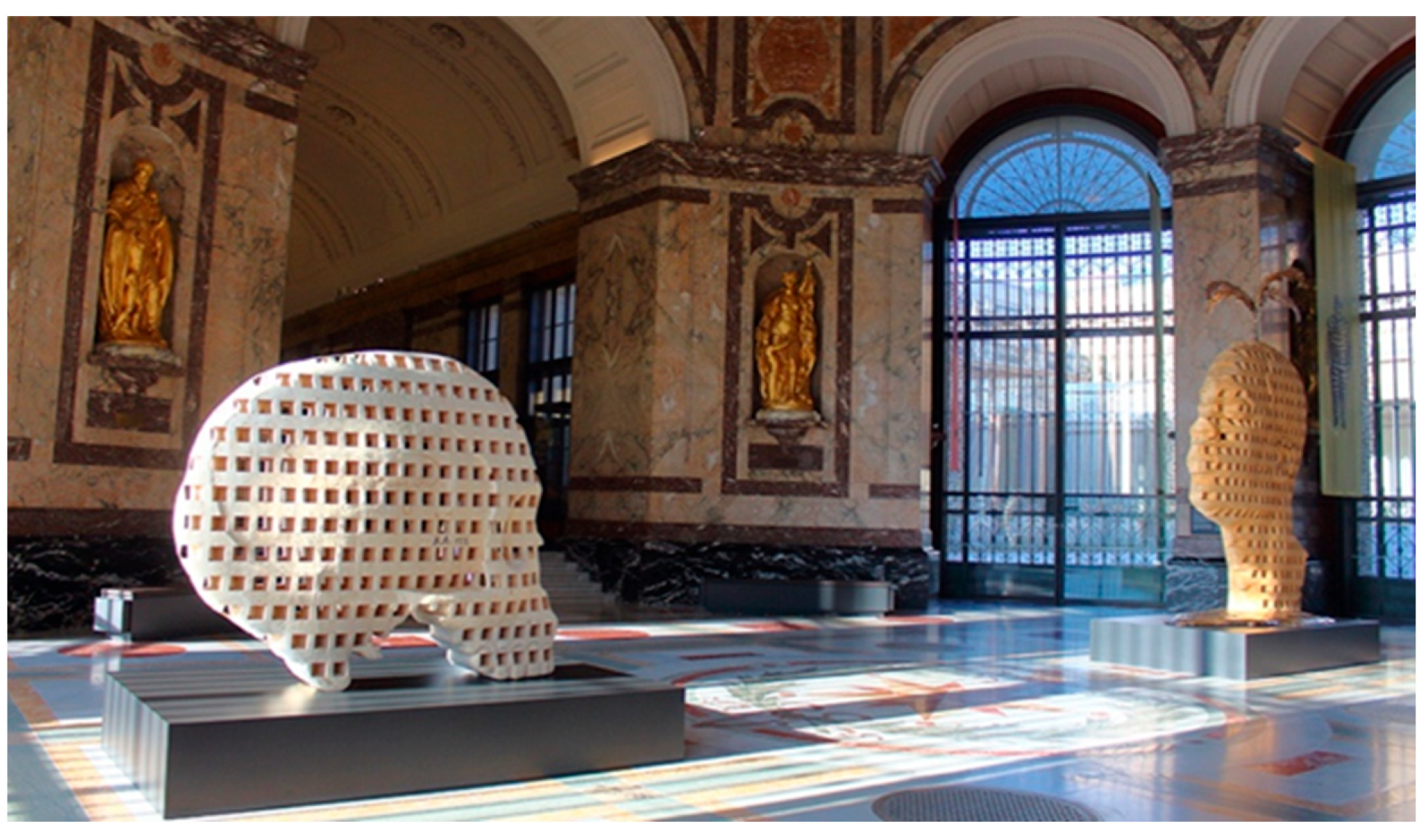
In February 2019, the United Nations Working Group of Experts of African Decent visited the museum. They concluded that the reorganization of the museum had not gone far enough. Among other issues, the presence of Matton’s four statues and other colonial artifacts undermined efforts to decolonize the space.19 Mpane was asked to add to the installation in the Grand Rotunda. He created two new pieces. The first, Crane de Lusinga/Skull of Chief Lusinga to the space (2019), faces New Breath (Figure 12). The second addition, in collaboration with Belgian artist Jean Piere Müller (b. 1967) is a series of veils that hang throughout the space titled RE/STORE (2020).20
Skull of Chief Lusinga refers to the raid by the Belgian officer Emile Storms on the village of Lusinga in 1884, an expedition during which the chief’s head was cut off. His head was taken to Belgium and kept at the RMCA until 1964 before being relocated to the Royal Belgian Institute of Natural Sciences.21 Lusinga’s skull has become the symbols of the 649 unidentified skulls in the collection In contrast to the warm wood of New Breath, Skull of Chief Lusinga is constructed of a stark white wood that is compressed into a flat silhouette. It is missing the lower jaw. In choosing the chief’s skull and the flattened form, Lusinga’s skull became a symbol of transparent and public discussions of the Belgian brutality. Mpane’s two statues face each other; one referring to the death and violence of the past, the other to dignity and the promise of the future.
Mpane’s collaboration with Müller on RE/STORE interrogates the role of Matton’s gold statues that visually dominant the Grand Rotunda as well as twelve additional smaller statues in side alcoves.22 The two artists designed semi-transparent veils that hang over the statues. Each veil is a different muted color with a black ink print of an image that forces visitors to connect the two images—the statue and the veil. The title of the work RE/STORED is play on words in English—the common language of the museum that also is a reminder of the fraught political relationship between Dutch and French—and French, the language of colonial Belgium.23 He refers to the restoration of the museum, which was not a complete critique of its colonial identity, the French word staure, which refers to window blinds, and store, in English, meaning to keep or preserve and one of a museum’s primary roles. Since only Ward’s statues were relocated to the Sidelined Gallery, the veils serve to symbolically store them behind a screen, relegating them to a new type of space and undermining their dominance in the rotunda. Mpane underscores that the museum is attempting a new understanding of heritage and collection practices (Sullivan 2020, p. 158). One can still see a ghostly image of the statue from beneath the veil. The statues assert their presence, but only if viewed from the side.
For example, the veil Civilisation RE/STOREd is placed over Matton’s Belgium brings civilization to the Congo. Matton’s sculpture depicts a Belgian priest. He holds a small Congolese boy in his left arm and cradles an older boy’s head who stands to his right. This figure is a concrete depiction of a priest, but also an allegorical figure of Belgium as a paternal (bon père) figure for the colonized child, e.g., the Congolese) (Stanard 2017, p. 132). The veil, designed by Mpane, features a Nkosi figure from the northern Congo region. Nkosi are objects empowered by spirits of a deceased person. They house a hostile spirit to hunt down transgressors at night. It is pierced with iron blades that indicate the number of times that community members called up the spirit to intervene for them. Mpane was inspired by a Nkosi figure that had had its spiritual bundle of medicine removed from its torso and head, a key element to the power it once held. In order to restore its power, Mpane added new knives, but instead of piercing the Nkosi figure, these knives point out. The aggression is from the Congo toward Belgium, specifically the priests, who brought a different type of civilization, erasing the Congolese. Mpane’s figure symbolically returns power to the Nkosi figures, which were condemned as fetish objects by the Catholic church and displayed as such for the 1897 Palace of the Colonies and in the subsequent manifestations from Musée du Congo through the MRAC (Musée royal de l’Afrique centrale)/KMMA (Koninklijk Museum voor Midden-Afrika). It is an issue with which AfricaMuseum continues to struggle: how should the museum exhibit objects from the Congo without continuing to fetishize them? Mpane uses a Nkosi figure to symbolically slash the fetishized body of the Congolese and their ritual objects.
Müller’s veil Battle with a Snake, is placed over Ernest Wynants’s (1878–1964) sculpture of the same name. In Wynants’s battle, the Congolese man is victorious, holding the snake securely and beating it to death with a rock. The Congolese triumphs over the perils of the natural world. Müller appropriated Edward Linley Sambourne’s Punch cartoon (see Figure 3) in which a Congolese man is about to be devoured by a snake with Leopold’s head. Wynant’s piece underscores the strength of the defeated Congolese by the King, while Sambourne’s cartoon underscores that it was the King and colonialism that the Congolese had battled. Müller’s Rubber Man covers Wynants’s L’Afrique féconde/Fertile Africa (1924). Wynants’s piece depicts a woman carrying a basket full of fruits and grains on her head. Sullivan points out that this is one of the few direct references to what Congo offers Belgium (Sullivan 2020, p. 182). Müller covers up her figure with the original trade image of the Michelin Man, a man made from rubber tires. The boom in rubber trade followed the invention of the pneumatic tire in 1888 and led to the ‘rubber fever’ in Congo, which in turn added to Leopold’s, and eventually Belgium’s, coffers. Mpane adds the same abstract eye pattern to the background of all of his veils. Thus, the veils also serve as a warning: “we [Congolese] are watching you [Belgians].” He emphasizes the role of the gaze in colonial practice. Ward’s statues, as discussed prior, were passive objects below those of Matton’s. Belgians looked and the Congolese were looked at.
Müller added images at the bottom of the four veils that obscure Matton’s statues. The images all homonyms of colon or colón: colonizer. He printed a detail of a fluted column, an outline the large intestine, a detail of Baroque column, an image of the colón, Costa Rican currency, and a second detail of a fluted column. These smaller details are less overt that the printed images above. This forces visitors to slow down and look, to make connections among the disparate symbols throughout the AfricaMuseum of early twentieth century objects from the Congo, photographs of the Congolese, the renovations for new AfricaMuseum and the interrogations by the contemporary artists. They provide additional contexts for Belgian colonial history. As noted by Sullivan, the abstract eyes of Mpane’s veils and the more realistic ones in Müller’s watch the visitor take in the installation and the changes in the Grand Rotunda (Sullivan 2020, p. 177).
6. Conclusions
Due to the palatial frame of colonialism, the museum remains a colonial time capsule. Wwtsi Mpoma questions whether decolonizing the museum was ever possible. In his assessment of the renovation, artist and curator Luntumbue maintains that the museum should have been demolished or, at the least, reframed as museum of Belgian history (Debrauwer 2018. I provide, two examples of what I consider an unsuccessful and a successful way to address a problematic architectural frame. This first is the Museum aan de IJzer, a museum dedicated to the history of the Flemish soldiers of the Belgian Army during the First World War. The museum, located in Diksmuide, West Flanders, has had a controversial history. The museum originally opened in 1992. It was housed in the IJzertoren, a memorial tower dedicated in 1930 to Flemish-speaking soldiers who died in World War I. After the war, Flemish nationalists were disillusioned when Belgium did not grant Flemish independence as promised by King Albert (in exchange for fighting for Belgium). In the 1940s, some Flemish collaborators sided with Nazi Germany, which promised to grant Flemish autonomy from French-speaking Belgium after German victor. Those opposed to the Flemish—fascists bombed of the IJzertoren, which had become a powerful symbol of the collaboration. A new, taller tower was built shortly after by those same Flemish-fascists in show of triumphant nationalist endurance. In 2012–2013, the museum underwent renovations for the centennial of WWI. The renovation had to address the complex history of the IJzertoren, which had been a symbol of Flemish pride but, later, in the 1980s–1990s, associated with the far-right Vlaams-Blok party. The IJzerbedevaartcomite, overseeing the project, debated, for several years, whether to create a new, neutral museum space. Ultimately, they installed a new, but I believe inadequate, scenography in the tower that attempts to address the entirety of the Flemish nationalist movement from the nineteenth century to 2014. Externally, the committee took the approach that was also utilized for AfricaMuseum. The entryway to the museum was rerouted so that original pathway no longer directed visitors toward the tower through series of overt, and problematic, symbols of the Flemish Movement. A small black building was added that forced visitors to approach from the side. While a relatively small gesture, it does serve to somewhat neutralize the approach to the site. And again, similar to AfricaMuseum, a few lone contemporary art installations were placed throughout the twenty-four-story tower in an attempt to disrupt the overtly Flemish nationalist rhetoric.24
My second example is the Whitney Plantation, located outside New Orleans.25 The complex is located at the site of a former 200-acre Haydel plantation that produced indigo, sugar, and rice from 1752 until emancipation. The mission states that, under the official name of the Whitney Institute, it was founded to educate people about the history and legacy of slavery in the United States. At the center of the complex is a monument that names the many enslaved people that had to make the plantation their home. Extensive archival research uncovered the African names and origins of the people who lived on the plantation. The Haydel mansion remains on the property. It is empty. No ornate wallpaper, silver platters, luxurious textiles or period furniture remain. Only in scale does it remind visitors of the wealth of the Haydel family due to the labor of the enslaved. Instead, two small cabins and the remains of the sugar kettles are used to demonstrate the daily life of the enslaved workers. The memorial underscores that it is the history of the people who worked for the Haydels around which the narrative of the former plantation pivots. Art by Contemporary Black artists from the United States are exhibited in the old chapel and in the visitor’s center. They add to the historicity of the site, but do not serve to do the heavy lifting.
The above examples may have provided an appropriate course of action in the re-address of AfricaMuseum. But, as noted above, due to Flemish heritage laws, it was impossible to alter Leopold’s palace museum. Mpoma underscores that while €65 million was dedicated to the refurbishment of Leopold’s building, only €5 million was earmarked to content. Arguments in favor of the inequality in funds were practical, not ideological: the building was falling into disrepair, and it was a matter of protecting it (p. 3). Against top-down decision making, any disruption to the ideological frame of the museum would be hampered by the emphasis on the physical frame.
The artistic interventions in AfricaMuseum do destabilize the overarching original colonial narrative, but the coloniality remains in reconfigured forms of domination and control. Mpane, Muller, Ntakiyica, and Tsimba’s work make the sincere interrogation of the space. But no matter how powerful their work it, the palatial architecture remains. They promote a form of restitution beyond mere object return, by challenging museum colonial displays and coloniality in former imperial centers. During the renovation, artist and activist Laura Nsengiyumva (b. 1987), a Belgian artist of Rwandan origin, as a member of the Working Group during the renovation, proposed PeoPL. PeoPL focused on the deconstruction, not the critique, of colonial ideology. PeoPL was ice sculpture of a statue of Leopold II, the famous equestrian state of the former king at the Place de Trône in Brussels. Her choice of this statue, in this site, questioned “the image of Leopold II in the Belgian public space and the aura of idolatry that often still surrounds his figure” (Nsengiyumva n.d.). Nsengiyumva suggested that the duration of the opening exhibition, PeoPL would slowly melt, heated by the heat of the surrounding bodies of the diverse peoples of Belgium. For the artist, the gradual melting symbolizes the slow shift in mentalities toward decolonial practice. Cultural sociologist Véronique Clette-Gakuba explained PeoPL as a process of dismantling, proposing a gesture of restitution that took visitors out of the conservation/destruction duality (Nsengiyumva n.d.). PeoPL could be construed as a compromise between the artistic interventions of Mpane, Muller, Ntakiyica, and Tsimba and Luntumbue’s call for destruction. Nsengiyumva initially wanted to perform PeoPL at the Africa Museum itself. But, according to the artist, museum personal objected to the piece (Nsengiyumva n.d.). As she describes, an unnamed senior member of RMCA, pointed out the radical, too radical, nature of the project by asking her “Would you like us to melt your father?” (Debrauwer 2018).26 That question serves to underscore how large Leopold II and his palace that cages the Congo still loom over Belgian history and culture.
Funding
This research received no external funding.
Institutional Review Board Statement
Not applicable.
Informed Consent Statement
Not applicable.
Data Availability Statement
No new data were created or analyzed in this study.
Conflicts of Interest
The author declares no conflicts of interest.
| 1 | Lieutenant Théodore Masui was a key individual in the removal of objects from the Congo. He later organized the Congo Free State at the Brussel’s World Fair. |
| 2 | For other academic and critical reviews of the renovation of AfricaMuseum see, among others (Debrauwer 2018; Miller 2019; Wetsi Mpoma n.d.; Hassett 2020; Van Beurden 2021) and the dossier “Decoloniser l’espace publique,” coordinated by BAMKO, which contains a wealth of interviews and articles on the subject. |
| 3 | Leopold’s atrocities in the Congo have been well documented in Vangroenweghe (1986); Friedmann (1992); Hochschild (1998); and (Zana-Etambala 2020, pp. 71–72). |
| 4 | These include the Jubelpark/Park du Cinquantenaire and Memorial Arcade (1852–1880) that was commissioned for the 1880 National Exhibition to commemorate the 50th anniversary of the Belgian Revolution and independence. The complex contains the Royal Museum of the Armed Forces and Military History and the Art & History Museum (formerly the Cinquantenaire Museum). The Monument to the Belgian Pioneers in the Congo was added to the Belgian commemorative landscape to honor the Congo Free State and the Belgian pioneers—soldiers—who brought “civilization” to the Congo. Leopold also financed Antwerp Centraal Station (1895–1905) and the Basilica of the Sacred Heart (begun in 1905), which was established to commemorate the 75th anniversary of the Belgian Revolution. |
| 5 | Sambourne’s caricature was published the same year as E.D. Morel’s Red Rubber, that exposed the genocidal actions of Leopold II’s Congo Free. After Leopold was forced to sell the Congo Free State to Belgium, he burned the entire archive of the Congo Free State in order to hide his horrific practices. |
| 6 | The relationship between modern aesthetics and imperial power structures is not clear on whether modernism arose from a crisis in colonialism or was a sophisticated from of cultural imperialism itself (Jameson 2016). |
| 7 | Seven of the individuals died of from the cold and wet summer. They were buried in unconsecrated grounds reserved for adulterers and suicides. In 1953, their bodies were moved to St. John the Evangelist cemetery in Tervuren. A ceremony acknowledging their deaths was incorporated into the opening of the renovated AfricaMuseum. |
| 8 | Tony Bennett has addressed the emergence in the 19th century of institutions, such as large public exhibitions, arcaded buildings, art museum, natural history, as ways to mark and transmit message of power. They also serve to underscore the Western perception of disparities between Western nations and non-European civilizations with the former in a superior position and the latter positioned as “primitive peoples” outside history to occupy a zone between “nature and culture” (Bennett 1995). |
| 9 | Prior to 1962, French was the default language of Brussels. After 1962, the names of all institutions are in both French and Dutch. |
| 10 | For the full article see https://www.knack.be/nieuws/africamuseum-naast-een-renovatie-van-het-gebouw-is-er-ook-een-renovatie-van-de-geest-nodig-is/ (accessed 16 November 2025). |
| 11 | |
| 12 | Ciraj Rassool in conversation with Clémentine Deliss, January 2019. |
| 13 | Africamuseum.be. https://www.africamuseum.be/de/about_us/history_renovation (accessed 16 September 2025). |
| 14 | |
| 15 | In 1961, Jean-Baptiste Ntakiyica, the artist’s father, was accused of participating in the assassination of Crown Prince Louis Rwagasore who was recently elected Prime minister of Burundi. Rwagasore was supported by the UPRONA (Unité et progress national), which was opposed to Belgian rule. J-B Ntakiyica was a member of the Belgium supported Burundi Christian Democrat party (PDC), whose own Christian Democrats were in power at the time. J-B Ntakiyica’s execution was the event that prompted Ntakiyica’s family to fell Burundi (Poppe 2015, p. 158). |
| 16 | The names were compiled by Mathieu Zana Etambala and Maarten Couttenier, two researchers at AfricaMuseum. They include Congolese who were brought to the Antwerp World Exposition in 1894; second, those who were brought to Tervuren during the Colonial Exposition of 1897; and third, those who were brought to the small village of Gijzigem (Sullivan 2020, p. 59). |
| 17 | Sullivan (2020, p. 80). The concept of “nkisi logic” was introduced by B. Jewsiewicki and A. Roberts (Jewsiewicki and Roberts 2023, p. 6). |
| 18 | Ward worked for the Congo Free State for two years. Many of his sketches and later sculptures were based upon his time in-country. He completed the statues in 1912. Sarita Sanford, Ward’s widow, donated them to the museum in 1930. It is telling when some of these statues were added to the infrastructure of the museum. While the museum was created to highlight Leopold’s Congo Free State, Ward’s statues were added well after The Congo Free State became the Belgian Congo during a period of rising interest in in the colonies. See Stanard (2011, p. 54). |
| 19 | Statement to the media by the United Nations Working Group of Experts on People of African Descent, on the conclusion of its official visit to Belgium, 4–11 February 2019. https://www.ohchr.org/en/statements-and-speeches/2019/02/statement-media-united-nations-working-group-experts-people-african (accessed on 17 July 2015). |
| 20 | The entirety of the project can be found on Müller’s website. https://www.jeanpierremuller.be/re-store (accessed 17 September 2025). |
| 21 | AfricaMuseum hosts HOME: a research project on human remains in Belgian collections on its website. The project addresses the issue of human remains in the collection, which were first raised in the Congo exhibition of 2001. https://www.africamuseum.be/de/research/discover/news/home1 (accessed 17 September 2025); The museum also explains the murder of Chief Lusinga. https://www.africamuseum.be/en/learn/provenance/storms (accessed 17 September 2025). |
| 22 | It is beyond the scope of the article to analyse the very complex juxtapositions between each statue and veil. For more details see Müller’s website. https://www.jeanpierremuller.be/re-store (accessed 20 September 2025). |
| 23 | For details on Mpane’s interest in this language word play, see Sullivan (2020, pp. 157–58). |
| 24 | |
| 25 | https://whitneyplantation.org/history/ (accessed 26 November 2025). |
| 26 | PeoPL was exhibited in Brussels on 6 October 2018 at Nuit Blanche. In Bruno Vergergt open letter [article] in Knack, it appears that Nsengiyumva’s unnamed museum official was Vergergt himself (Vergergt 2018). |
References
- Bennett, Tony. 1995. The Birth of the Museum. London: Routledge. [Google Scholar]
- Biney, Ama. 2016. Unveiling White Supremacy in the Academy. Africology: The Journal of Pan African Studies 9: 383–90. [Google Scholar]
- Boast, Robin. 2011. Neocolonial Collaboration: Museum as Contact Zone Revisited. Museum Anthropology 34: 56–70. [Google Scholar] [CrossRef]
- Couttenier, Maarten. 2010. No Documents, No History’: The Moral, Political and Historical Sciences Section of the Museum of the Belgian Congo, Tervuren (1910–1948). Museum History Journal 3: 13. [Google Scholar]
- Debrauwer, Lotte. 2018. Ontervredenheid bij Afro[Belgen rond nieuw Africamusem: ‘De renovatie vergeet de essentie’. Knack. October 6. Available online: https://www.knack.be/nieuws/ontevredenheid-bij-afro-belgen-rond-nieuw-afrikamuseum-de-renovatie-vergeet-de-essentie/ (accessed on 10 October 2025).
- Deliss, Clémentine. 2021. Walking Through: Thoughts on the Metabolic Practices of Museums. In Alles Vergeht ausser der vergangenheit/Everthing Passes Except the Past: Decolonizing Ethnograohic Museums, Film Archives, and Public Space. London: Geothe Institute, Sterberg Press. [Google Scholar]
- De Wachter, Ellen Mara. 2018. Has Belgium’s Newly Opened Africa Museum Exorcized the Ghosts of its Colonial Past? Frieze. December 11. Available online: https://www.frieze.com/article/has-belgiums-newly-reopened-africa-museum-exorcized-ghosts-its-colonial-past (accessed on 6 June 2025).
- Friedmann, K. Elkholm. 1992. Catastrophe and Creation: The transformation of an African culture. London: Routledge. [Google Scholar]
- Haeckel, Jana. 2021. Introduction. In Alles Vergeht ausser der vergangenheit/Everthing Passes Except the Past: Decolonizing Ethnograohic Museums, Film Archives, and Public Space. London: Geothe Institute, Sterberg Press. [Google Scholar]
- Hassett, Dónal. 2020. Acknowledging or Occluding “The System of Violence”?: The Representation of Colonial Pasts and Presents in Belgium’s AfricaMuseum. Journal of Genocide Research 22: 26–45. [Google Scholar] [CrossRef]
- Hochschild, Adam. 1998. King Leopold’s Ghost. New York: Houghton Mifflin. [Google Scholar]
- Huyse, Luc. 2006. Alles gaat voorbij, behalve het verleden. Amsterdam: van Gennep. Leuven: Van Halewyck. [Google Scholar]
- Jameson, Fredric. 2016. The Modernist Papers. London: Verso Books. [Google Scholar]
- Jewsiewicki, Bogumil, and Allen Roberts. 2023. Exploring Present Pasts: Popular Arts as Historical Studies. In Oxford Encyclopedia of African History. Oxford: Oxford University Press, p. 6. [Google Scholar]
- Limond-Mertes, Arnaud. 2019. Un espace de démonstration du “génie du colonialism. Interview with Elikia M’Bokolo. Ensemble! 99: 49–55. [Google Scholar]
- Lonetree, Amy. 2009. Museums as Sites of Decolonization; Truth Telling in National and Tribal Museums. In Contesting Knowledge: Museums and Indigenous Perspectives. Edited by Susan Sleeper-Smith. London: University of Nebraska Press, pp. 322–38. [Google Scholar]
- Luntumbue, Muteba T. 2015. Rénovation au Musée de Tervuren: Questions, défis et perspectives. L’Art Même 65: 15–17. [Google Scholar]
- Miller, Donata. 2019. ‘Everything passes, except the past’: Reviewing the renovated Royal Museum of Central Africa (RMCA). Science Museum Group Journal 12. [Google Scholar] [CrossRef] [PubMed]
- Nora, Pierre. 1989. Between Memory and History: Les Lieux de Mémoire. Representations 26: 7–24. [Google Scholar] [CrossRef]
- Nsengiyumva, Laura. n.d. The Day When I (Almost) Melted (Your Father). The challenged of the Working Group of Decolonisation. Eye-to-Eye. Available online: https://eye-to-eye.online/laura-nsengiyumva/ (accessed on 14 October 2025).
- Okwunodu Ogbechi, S. 2014. Transcultural Interpretation and the Production of Alterity: Photography, Materiality, and Mediation in the Making of “African Art”. In Art History and Fetishism Abroad. Edited by Gabrielle Genge and Angela Stercken. Bielefeld: Transcript Verlag, pp. 71–90. [Google Scholar]
- Poppe, Guy. 2015. The murder of Burundi’s prime minister, Louis Rwagasore. Afrika Focus 28: 156–164. [Google Scholar] [CrossRef]
- Saunders, Barbara. 2005. Congo-Vision. In Science, Magic and Religion: The Ritual Processes of Museum Magic. Edited by Mary Bouquet and Nuno Porto. New York: Berghahn Books, pp. 75–115. [Google Scholar]
- Schouteden, H. 1942. Guide illustré du Musée du Congo belge. Tervuren: Museum of the Belgian Congo, pp. 33–34. [Google Scholar]
- Shelby, Karen. 2014. Flemish Nationalism and The Great War. New York: MacMillan. [Google Scholar]
- Shelby, Karen. 2017. Belgian Museums of the Great War: Politics, Memory, and Commerce. New York: Routledge. [Google Scholar]
- Silverman, Debra. 2011. Art Nouveau, Art of Darkness: African Lineages of Belgian Modernism, Part I. West 86th: A Journal of Decorative Arts, Design History, and Material Culture 18: 139–81. [Google Scholar] [CrossRef]
- Stanard, Matthew. 2011. Selling the Congo: A History of European Pro-Empire Propaganda and the Making of Belgian Imperialism. Lincoln: University of Nebraska Press. [Google Scholar]
- Stanard, Matthew. 2017. ‘Boom! Goes the Congo’: The rhetoric of control and Belgium’s late colonial state. In Rhetorics of Empire: Languages of Colonial Conflict after 1900. Edited by Martin Thomas and Richard Toye. Manchester: Manchester University Press, pp. 121–41. [Google Scholar]
- Sullivan, Elaine. 2020. Petit á Petit: Contemporary Art in Decolonial Horizons in Belgian’s Africamuseum. Ph.D. dissertation, University of California, California, LA, USA. [Google Scholar]
- Tansia, Tracy. 2019. Changing the narratives in renovating the AfricaMuseum. A conversation with Gillian Mathys, Margot Luyckfasseel, Sarah Van Beurden, Tracy Tansia. Africa Is a Country. April 29. Available online: https://africasacountry.com/2019/04/renovating-the-africamuseum (accessed on 8 August 2025).
- Van Beurden, Sarah. 2021. Museums, Exhibitions, and Monuments: Congo in the Belgian Public Sphere. Brussels: UGent for the Chambre des représentants de Belgique. [Google Scholar]
- Vangroenweghe, Daniel. 1986. Du sang sure les lianes. Léopold II et son Congo. Paris: Didier Hautier Publisher. [Google Scholar]
- Vanhee, Hein. 2016. On Shared Heritage and Its (False) Promises. African Arts 49: 1–7. [Google Scholar] [CrossRef]
- Vergergt, B. 2018. AfricaMuseum: ‘Naast een renovatie het gebouw, is er ook een renovatie van de geest nodig is’. Knack. October 11. Available online: https://www.knack.be/nieuws/africamuseum-naast-een-renovatie-van-het-gebouw-is-er-ook-een-renovatie-van-de-geest-nodig-is/ (accessed on 14 October 2025).
- Wastiau, Bruno. 2000. ExitCongoMuseum. Tervuren: Royal Museum for Central Africa. [Google Scholar]
- Wetsi Mpoma, Anne. n.d. Quand le temple dédié à la colonisation belge fait peau neuve. Bruxelles: BAMKO ASBL.
- Zana-Etambala, Mathieu. 2020. Veroverd, bezet, gekoloniseerd. Gorredijk: Sterk & De Vreese, pp. 71–72. [Google Scholar]
Figure 1.
AfricaMuseum (Reproduced by permission from Titus Maes).

Figure 2.
Ashavérus (Didier Dubucq), “King Leopold of the Belgians laying the first stone of the National Basilica of the Sacred Heart.” Les Corbeaux. 15 October 1905 (The work is in the public domain).
Figure 2.
Ashavérus (Didier Dubucq), “King Leopold of the Belgians laying the first stone of the National Basilica of the Sacred Heart.” Les Corbeaux. 15 October 1905 (The work is in the public domain).
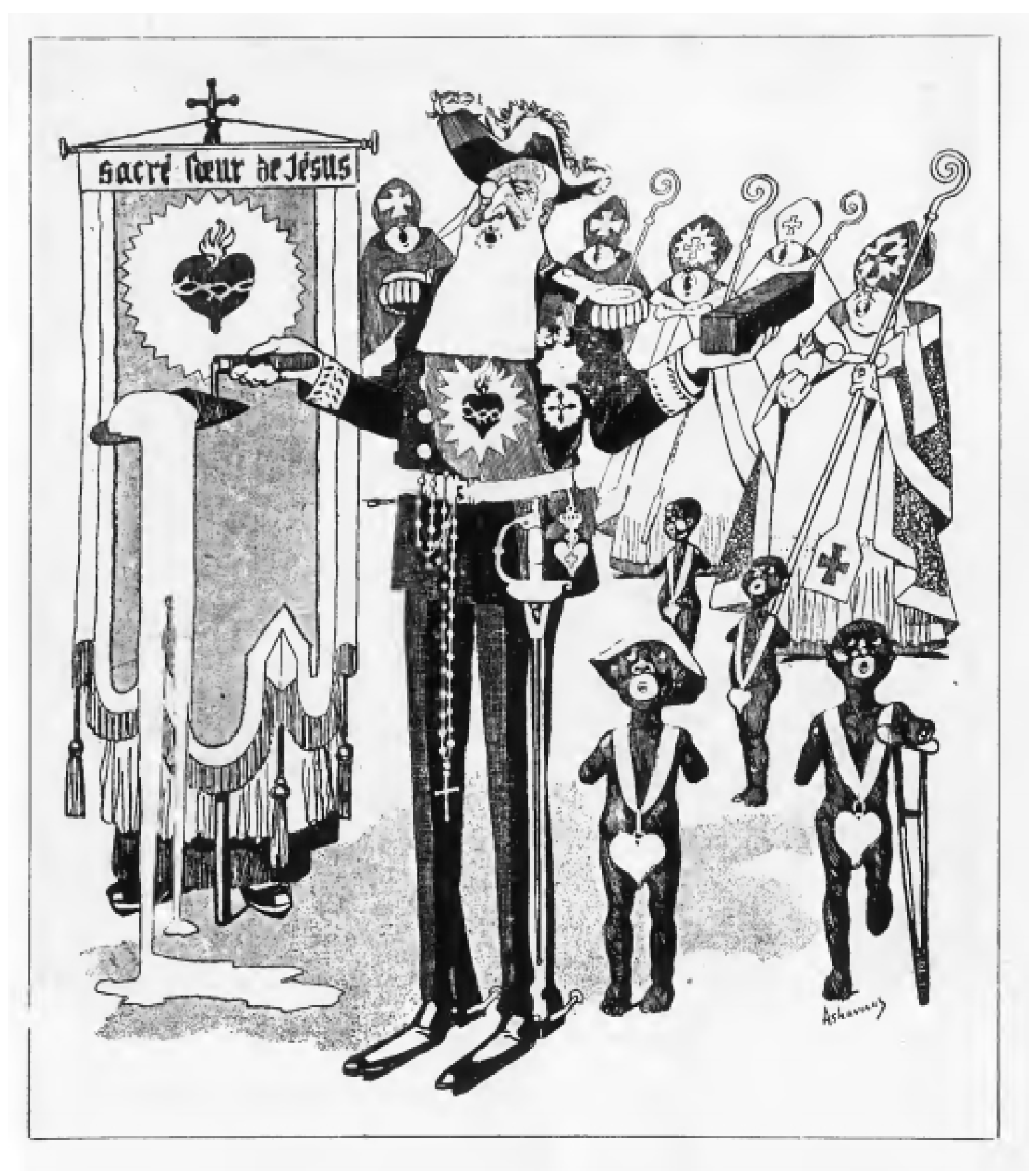
Figure 3.
Edward Linley Sambourne. “In the Rubber Coils. Scene: The Congo Free State” Punch. 28 November 1906 (The work is in the public domain).
Figure 3.
Edward Linley Sambourne. “In the Rubber Coils. Scene: The Congo Free State” Punch. 28 November 1906 (The work is in the public domain).

Figure 4.
Herbert Ward, The Tribal Chief, 1908. Installed in 1930 (Author photograph).
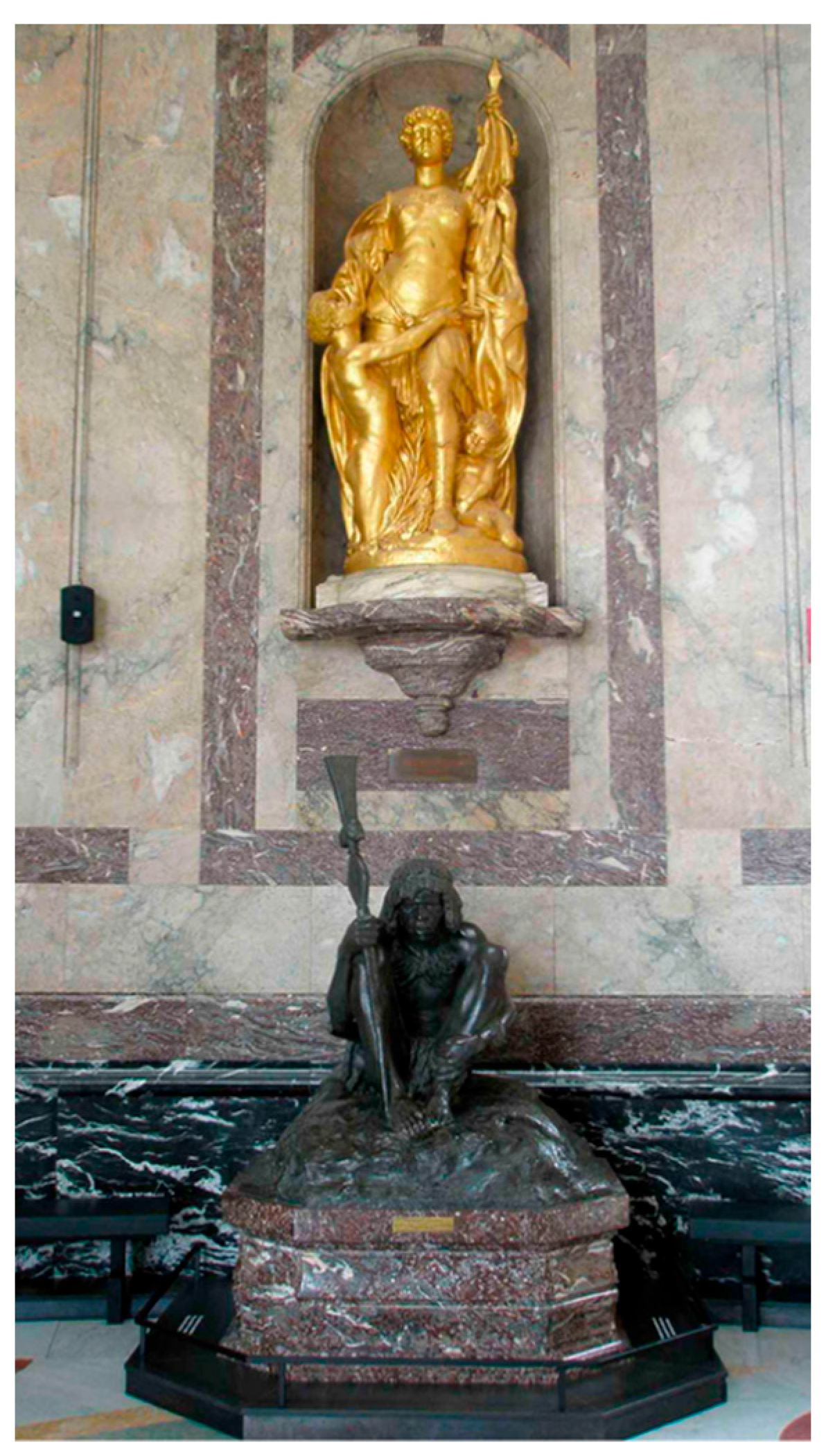
Figure 5.
Stéphane Beel Architects. “Stéphane Beel Royal Museum for Central Africa, Tervuren,” HIC Arquitectura. 14 November 2018. Photographs by Luca Beel. The scenography is the work of Niek Kortekaas and Johan Schelfhout. https://www.domusweb.it/en/architecture/2018/11/05/royal-museum-of-central-africa-reshaped-dealing-with-belgiums-colonial-history.html accessed 10 September 2025 (Reproduced by permission from S. Beel).
Figure 5.
Stéphane Beel Architects. “Stéphane Beel Royal Museum for Central Africa, Tervuren,” HIC Arquitectura. 14 November 2018. Photographs by Luca Beel. The scenography is the work of Niek Kortekaas and Johan Schelfhout. https://www.domusweb.it/en/architecture/2018/11/05/royal-museum-of-central-africa-reshaped-dealing-with-belgiums-colonial-history.html accessed 10 September 2025 (Reproduced by permission from S. Beel).
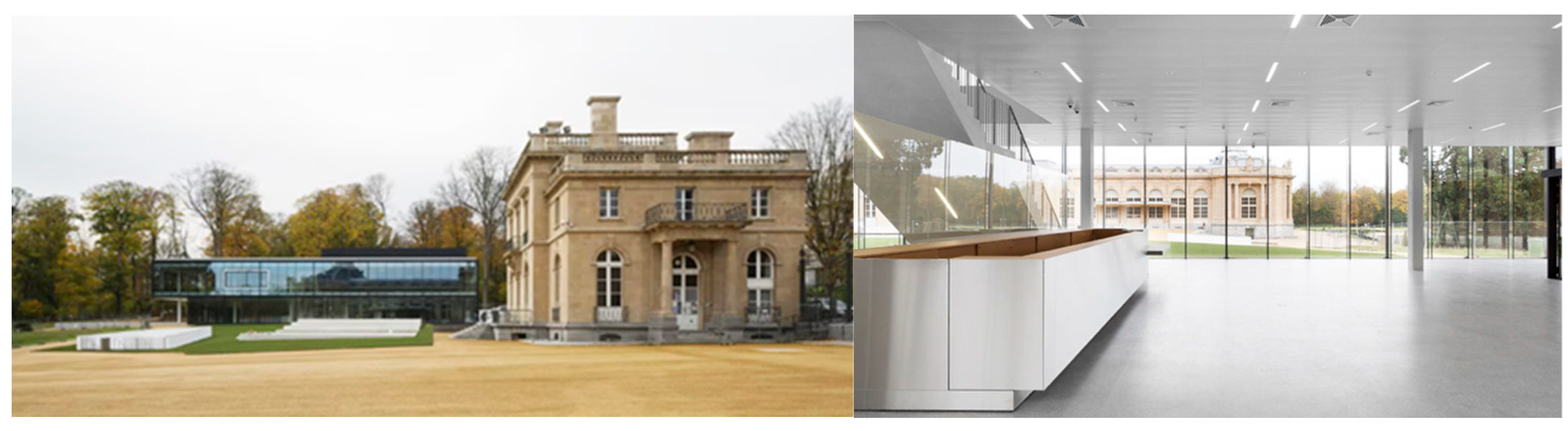
Figure 6.
(left) Paul Wissaert, Leopard-Man of Stanley Falls, 1913. Against far wall: Chéri Samba Réorganisation, 2002. Ethnographic busts and Belgian colonial figures are on the right (Author photograph).
Figure 6.
(left) Paul Wissaert, Leopard-Man of Stanley Falls, 1913. Against far wall: Chéri Samba Réorganisation, 2002. Ethnographic busts and Belgian colonial figures are on the right (Author photograph).
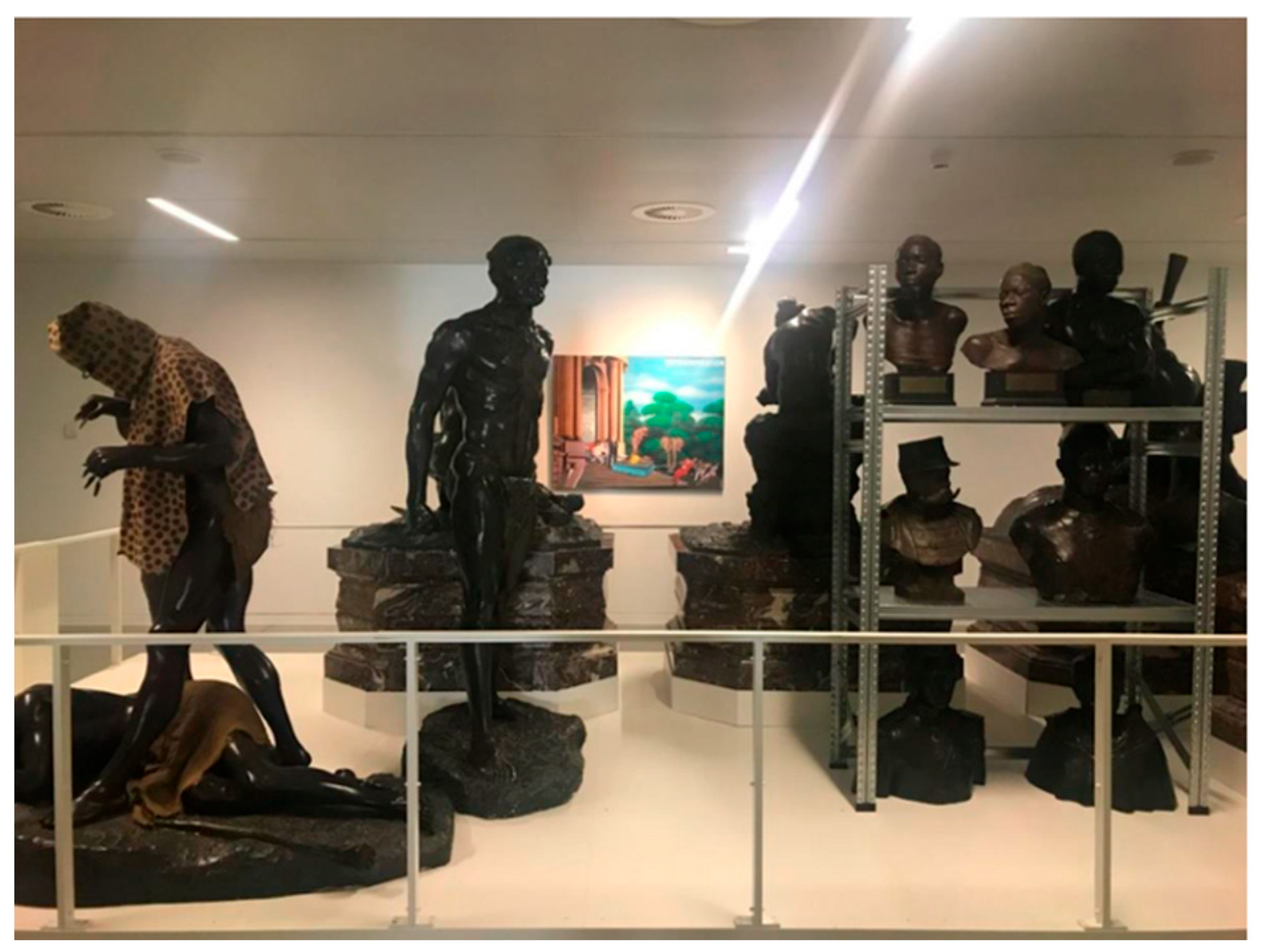
Figure 7.
Chéri Samba Réorganisation, 2002. Oil on canvas (Author photograph).

Figure 8.
Section of renovation and extension. “Stéphane Beel Royal Museum for Central Africa, Tervuren,” HIC Arquitectura. 14 November 2018. https://www.domusweb.it/en/architecture/2018/11/05/royal-museum-of-central-africa-reshaped-dealing-with-belgiums-colonial-history.html accessed 10 September 2025 (Reproduced by permission from S. Beel).
Figure 8.
Section of renovation and extension. “Stéphane Beel Royal Museum for Central Africa, Tervuren,” HIC Arquitectura. 14 November 2018. https://www.domusweb.it/en/architecture/2018/11/05/royal-museum-of-central-africa-reshaped-dealing-with-belgiums-colonial-history.html accessed 10 September 2025 (Reproduced by permission from S. Beel).

Figure 9.
The Memorial Hallway. Belges Mort au Congo. Belgen in Congo overleeden. Leopold’ double L insignia is visible on the lower left (Author photograph).
Figure 9.
The Memorial Hallway. Belges Mort au Congo. Belgen in Congo overleeden. Leopold’ double L insignia is visible on the lower left (Author photograph).
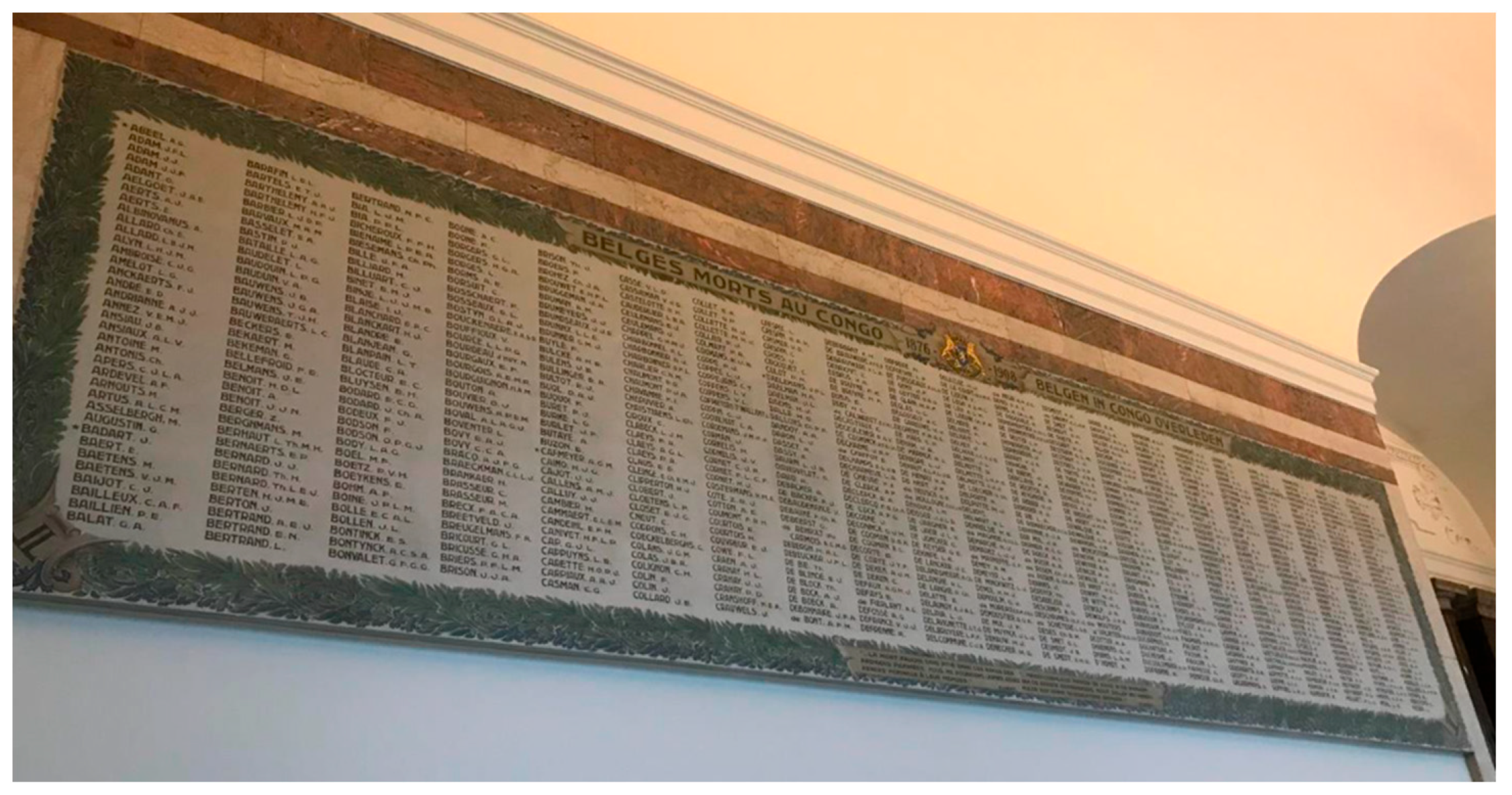
Figure 10.
Freddy Tsimba, Ombres (Shadows), 2016 (Author photograph).
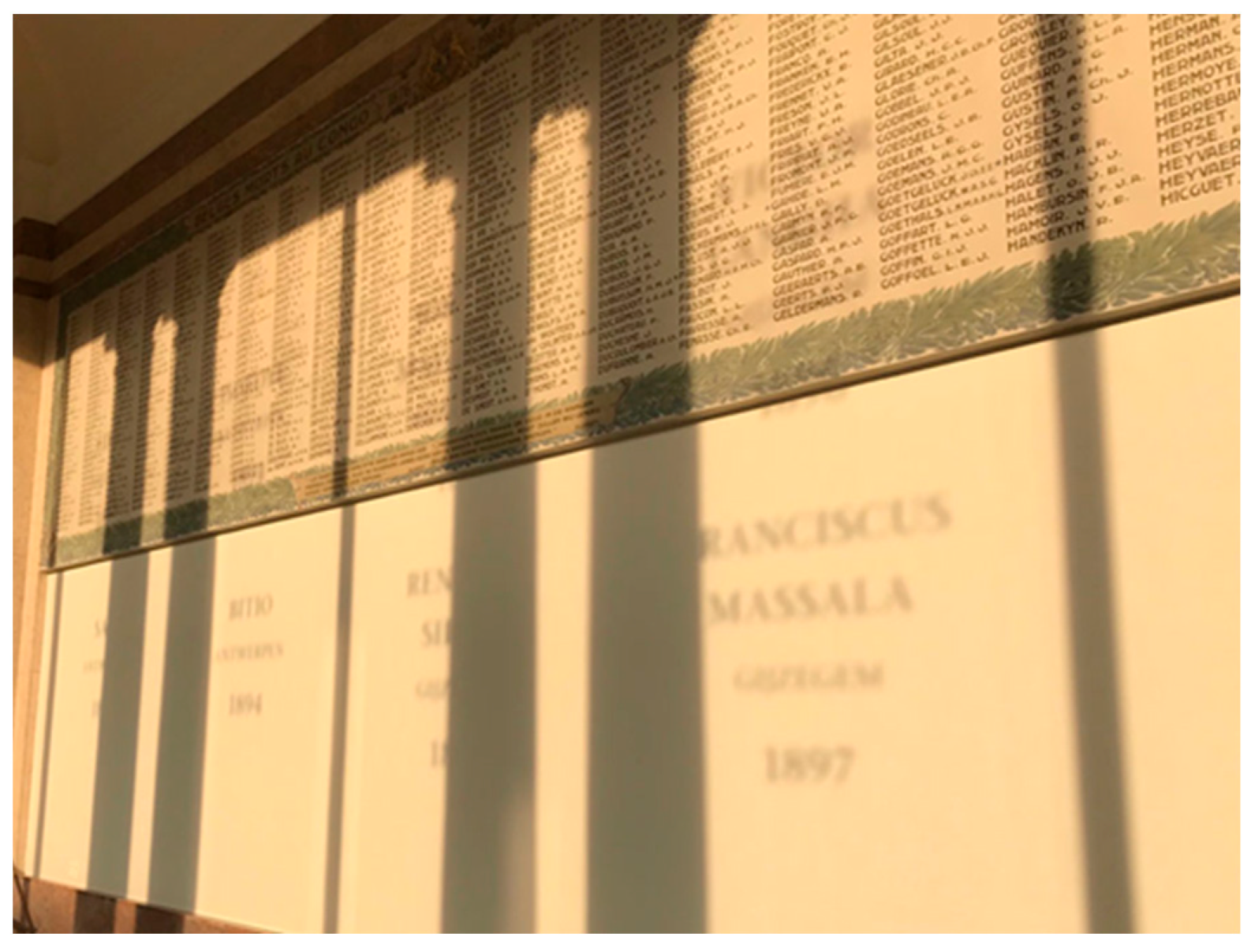
Figure 11.
Aimé Mpane, Nouvelle Souffle ou le Congo Bourgeonnant/New Breath or Burgeoning Congo, 2018 (Author photograph).
Figure 11.
Aimé Mpane, Nouvelle Souffle ou le Congo Bourgeonnant/New Breath or Burgeoning Congo, 2018 (Author photograph).

Figure 12.
Aimé Mpane, Crane de Lusinga/Skull of Chief Lusinga Iwa Ng’ombre, 2019 (Author photograph).
Figure 12.
Aimé Mpane, Crane de Lusinga/Skull of Chief Lusinga Iwa Ng’ombre, 2019 (Author photograph).

Disclaimer/Publisher’s Note: The statements, opinions and data contained in all publications are solely those of the individual author(s) and contributor(s) and not of MDPI and/or the editor(s). MDPI and/or the editor(s) disclaim responsibility for any injury to people or property resulting from any ideas, methods, instructions or products referred to in the content. |
© 2025 by the author. Licensee MDPI, Basel, Switzerland. This article is an open access article distributed under the terms and conditions of the Creative Commons Attribution (CC BY) license (https://creativecommons.org/licenses/by/4.0/).
Share and Cite
MDPI and ACS Style
Shelby, K. From Africa Palace to AfricaMuseum. Arts 2025, 14, 168. https://doi.org/10.3390/arts14060168
AMA Style
Shelby K. From Africa Palace to AfricaMuseum. Arts. 2025; 14(6):168. https://doi.org/10.3390/arts14060168
Chicago/Turabian StyleShelby, Karen. 2025. "From Africa Palace to AfricaMuseum" Arts 14, no. 6: 168. https://doi.org/10.3390/arts14060168
APA StyleShelby, K. (2025). From Africa Palace to AfricaMuseum. Arts, 14(6), 168. https://doi.org/10.3390/arts14060168
Note that from the first issue of 2016, this journal uses article numbers instead of page numbers. See further details here.