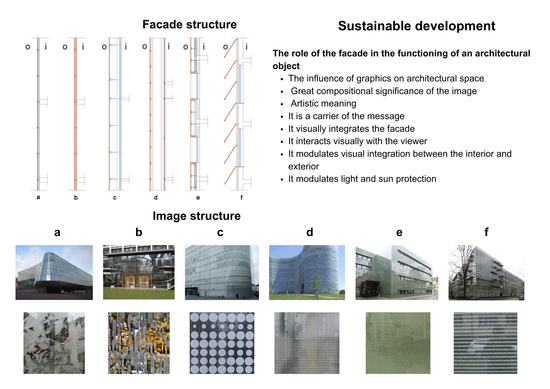
Abstract
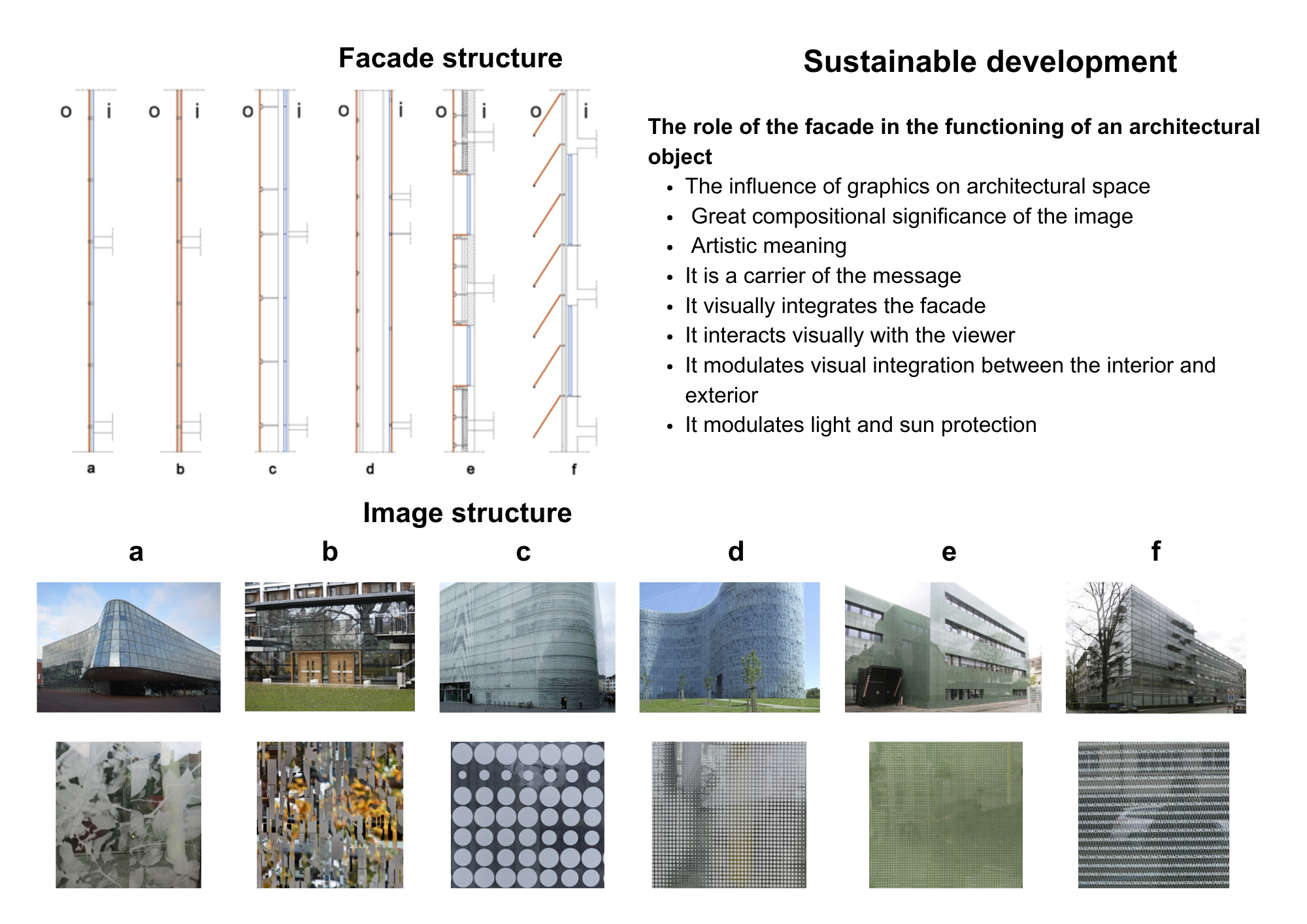
One of the key concerns for present-day society is the need to build the environment in which we live in a sustainable way, using green solutions, but without losing the aesthetic values. The following study proves that, when applied in the right way, façade graphics support sustainability. Art glass placed inside the envelope significantly influences a number of aspects related to how a building functions, improving the quality of a given architectural space’s properties. Façade graphics have a considerable effect, as they control the intensity of light penetrating to the interior and provide support sunlight protection. Façade graphics act as a cover that controls how images filter through from the inside to the outside and from the outside to the inside. The graphics may be used to show messaging directed at the public. Art glass located in the external partition has a significant impact on several aspects of the functioning of an architectural object. In the preliminary examination, a few factors that determine the scope of such effect were identified, including the structure of the glass layer and of the image. The objective of this publication is to determine to what degree the structure of an image on glass, and the artistic means associated with it, influence the scope of the visual effect of a glass partition, as well as its functional properties, and how important for the reception of architectural space are the artistic values of glazing, in terms of its form, dynamics, composition, and colours, as well as the means by which the applied image impacts its surroundings. These means result from selection of suitable execution techniques and strategies for shaping the partition. The research concerns aspects of interconnection between graphics and the architectural space; its artistic, compositional, integrating, and covering role. The work is important in further research on the use of facade graphics in the utility and visual aspect.
1. Introduction
The 2030 sustainability agenda adopted by all members of the United Nations in 2015 set out 17 objectives that need to be accomplished to ensure the development of a sustainable society living in a sustainable environment (The 17 Goals 2024). These objectives directly refer to the creation of the architectural spaces in which we live and function. One of the manifestations of applying sustainability principles is the correct and effective use of building materials. The priorities are environmental values, adopted in order to improve the quality of life, which support the effective use of the architectural space, ensuring a reduced use of fossil fuels and CO2 emissions.
Façade graphics on glass are a product of cooperation between artists, engineers, and architects. They are made using advanced technologies applied in the fields of materials science, construction, and design technology of machines. The value of such graphics is based on the complexity of technologies used and the multidisciplinary character. Their application in an architectural space is just as complex, since each project does not only have individual artistic qualities, but also utilises the possibilities offered by façade graphics in an original way. The façade structure in combination with the method of placing the image has been adopted as the main defining factor. The image structure is also considered to be an important variable.
The past three decades have seen the emergence of façade systems that enable the placing of large-scale graphics on glass in the façade of a building, which provides additional functional benefits that increase user comfort. They also act as sunlight protection for the building, reducing direct exposure to sunlight of the building’s interior, which protects the space against excessive overheating in hot weather. Non-transparent graphics control the penetration of dispersed daylight as well as reducing UV transmission.
Graphics have a compositional and artistic function in a building. They integrate and add variety to the simple shape of a building, acting as a modern detail. They may emphasise the organic or geometrical shape of an architectural structure. They may reduce such shapes with the use of contrast. Graphics often convey a message and are part of complex structures of visual communications linked to the building’s form and function. They modulate the flow of the image from the inside to the outside and from the outside to the inside.
The academic papers published so far on the functioning of glass in architecture can be divided into several trends.
The analysis was centred on:
- -
- Technical and technological aspects linked to the functional and environmental features of the façade;
- -
- Compositional and artistic aspects;
- -
- Message in architecture.
The phenomenon of transparency in architecture and art has been described by Rowe and Slutzky (1963). They introduced the terms of literal transparency and phenomenal transparency, analysing works from the history of art and comparing them with examples from modernist architecture.
One of the collective works that discuss transparency in architecture is the paper edited by Valeria Tatano (Tatano et al. 2008). It includes a number of chapters related to the function of glass: color, compose, draw, civide, isolate, shape, bring, protect, recycle, and play. Each of the authors invited to take part in this publication discuss an allocated area of the main subject, which is the function of glass in an architectural space.
Technical and environmental aspects, as well as new technologies, were discussed in a monograph by Celadyn (2004) and Wigginton (1997).
There have been studies that thoroughly examined each aspect of the façade’s functioning in the public space, namely a study by Gregory (2008) on the façade as a partition that provides specific thermal conditions and Timo (2019), who examined the glass façade in terms of visual integration between the interior and exterior.
Glass is treated as one of the materials functioning in architecture that introduces such values as colour, texture, graphics (Zumthor 2006).
The important part of the studies consisted of those looking at the perception of architecture. In his papers, Ghomeishi (2021) introduces a set of essential terms to determine a building’s façade. These are originality, complexity, transparency, and how a piece of work fits in each given space. The author also establishes terms to determine traits of materials used in architecture, including appearance, articulation, colour, texture, and form.
Another important group of papers are those linked with examining transparency in architecture conducted by Brzezicki (2014, 2021). These papers analyse phenomena related to the perception of transparency in architecture as part of the viewer–architectural structure relationship. The papers examine matters at the interface between geometric optics, cognitive psychology, and the psychology of architecture. As an example of research on visual phenomena, the papers written by Lipowicz-Budzyńska (2020, 2021, 2023) can be quoted. She investigates various aspects of façade graphics on glass analysis of the image and its message, compositional matters, and optical phenomena such as moiré patterns1 occurring between several layers of graphics placed on glass.
A paper by Bell and Kim (2009) is an important work. They have newly defined the importance of the aesthetic potential of glass in architecture, analysing the latest projects by the most innovative architects. They emphasise the compositional and artistic importance of a glass façade.
Another significant research is that conducted by Wala (2012). It deals with the composition, and the scope of perception and creation of an image in architecture. The vast majority of the analysed examples constituted buildings in which transparent colourless construction glass was used; however, in the chapter entitled Glass façade, and the subchapter Decorativeness, the author mentions art glass structures.
Ample literature is available in the form of monographs and academic papers, from the area of architecture history and theory, regarding historical structures made of glass, for example Ishida (2020) and Elkadi (2016). Most of the literature is about structures in which transparent glass was used, and mention only façade graphics. The only exception are the books by Andrew Moore, who emphasises the artistic and technological aspects of the presented works (Moor 1989, 1997, 2006).
An important part of the paper is the part that aims to establish how much the façade and image structure influence the functional properties of the glass partition or the scope of its visual impact. With modern technologies, it is possible to use glass with large-scale graphics in a new context, which makes it possible to determine anew its role in architecture.
2. Case Study Analyses Results
In order to support sustainability in architecture and the construction industry, glass is expected to be used more widely in urban surroundings (Extending Glass 2022), as it has a considerable eco-friendly potential. One of the ways of caring for user comfort in the architectural space is using art glass in architecture, including façade graphics.
Art glass placed inside the envelope significantly influences a number of aspects related to how a building functions, improving the quality of a given architectural space’s properties.
The article discusses projects that are examples of various functions linked to the structure of the glass layer and that of the image. The analysed buildings included those in which covering functions of the glass façade are used, which affects controlling façade’s visual integration, as well as sunlight protection and heating of the interior.
The article does not provide examples of a combination of graphics and semi-transparent photovoltaic coatings, which currently account for less than 0.2% (Park et al. 2019) of all laminated photovoltaic glass panels.
The research material was limited to the implementation of facades in traditional construction, excluding structures made of structural glass, which, based on research on positive architecture, were considered to evoke negative emotions (Bedon and Mattei 2021).
The architectural structures referred to in this article have been made over the past three decades. Due to the global nature of artistic phenomena, which also affect art glass, no limit was placed on the territory of the analysis.
2.1. Single-Layer Coatings—Graphics Placed on One Layer
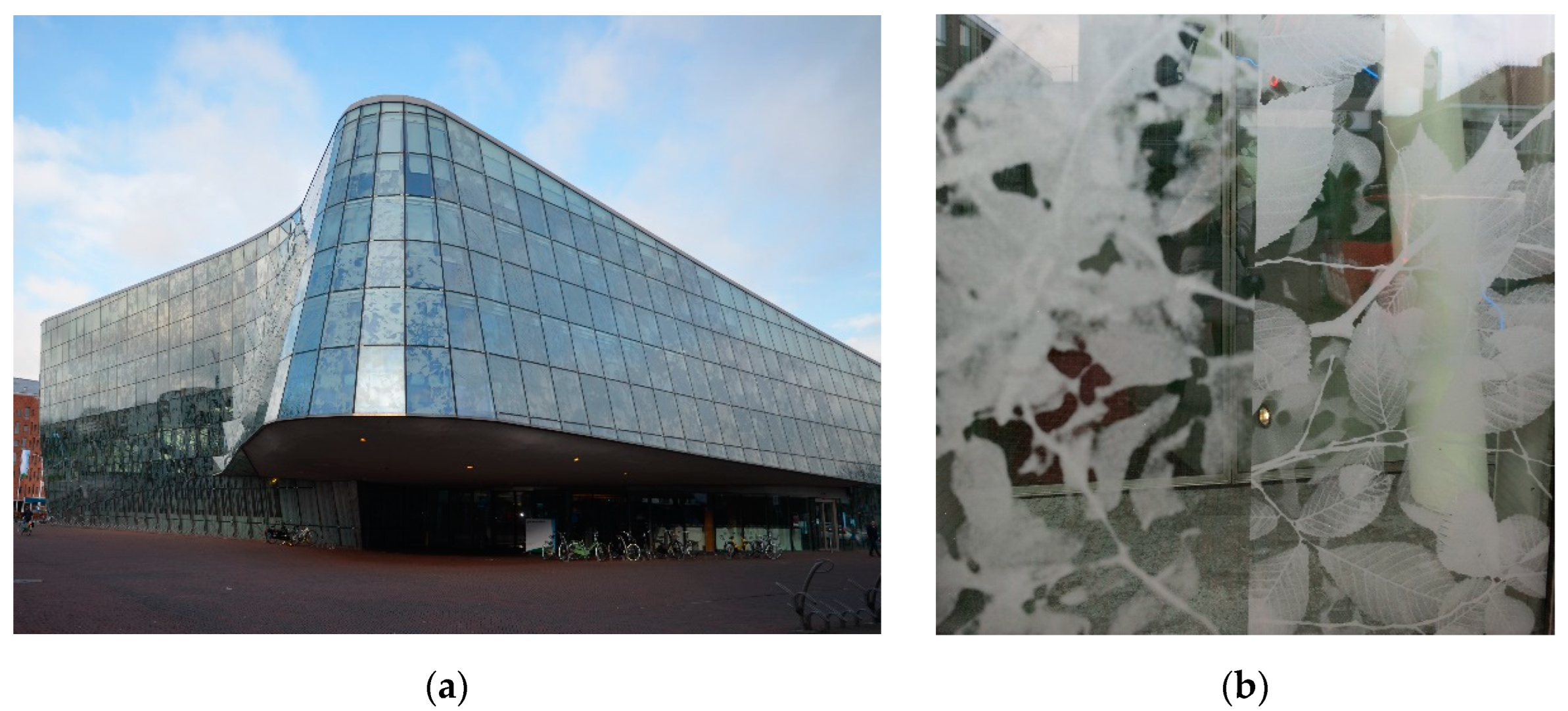
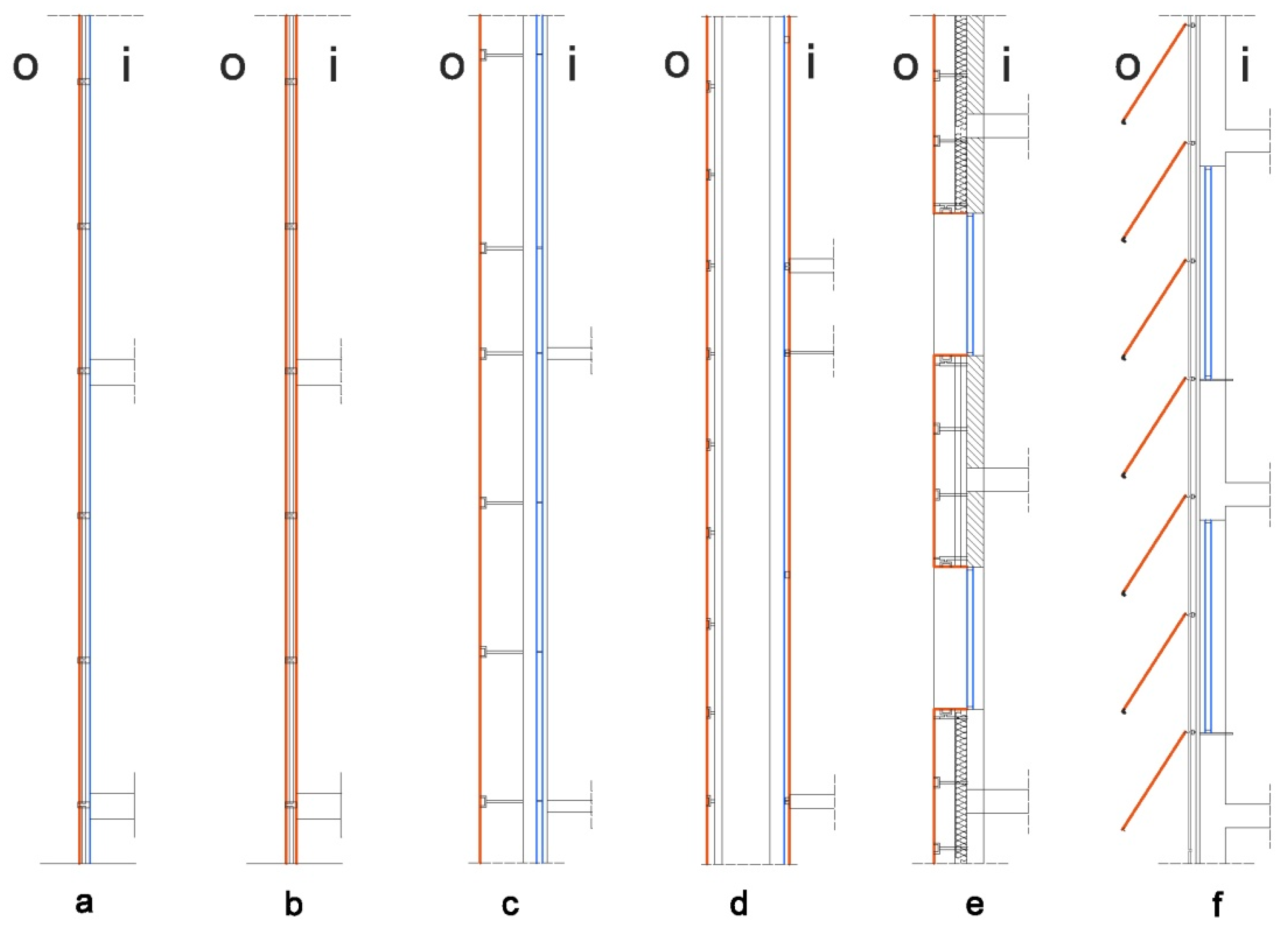
The simplest and, at the same time, the most common form of the outer surface is those in which the artistic layer is only applied on a single layer of the glass (Figure 1a). An example of such a façade can be seen in a town hall in a Dutch village of Alphen aan den Rijn (Erick van Egeraat Associates, Completion: 2002; the façade with a parametric shape is composed of 835 glass panels, a screen-printed image, and tampered glass) (Townhall Alphen 2024). The glazing consists of two float glass layers, with a screen-printed white image on its external pane. Organic plant motifs in the form of scaled-up pieces of deciduous trees cover the entire façade (Figure 2a). The image is composed of many shots combined into a whole. It has been made denser in the corners, which are more at risk of being affected by sunrays (Richards 2006). The white printed image provides partial sunlight protection. An enamel layer applied on the outside makes the glass surface matte in places, reducing its reflectance and preventing glare (Richards 2006). The plant motifs (Figure 2b) used in the town hall’s façade are a reference to the eco-friendly policies of the local authorities (Zabrocka 2021). The modern shape of the building, together with the innovative solutions, are a marketing tool used to build the authorities’ image, and they also act as a distinctive landmark for the town. From afar, the printed white image is seen as an organic pattern that covers the building. Only when one moves closer can the plant motifs, made up of photographed leaves, be discerned. A non-uniform texture of the print provides contrast for the modern interior, built of plain surfaces. The silver colour of the image is a link to the white walls on the staircases and the steel structure, at the same time contrasting with the dark shades of the floors. The glazing ensures that seeing directly through it is not possible and also acts as partial sunlight protection supported by shutters. The printed image controls the heat penetrating into the building; it also acts as partial sunlight protection, ensuring a more shaded interior with more comfortable conditions.
Figure 1.
Typology of research material, division according to the structure of the glass coating; O = outside, I = inside. (a) Single-layer coating, Town Hall of Alphen aan den Rijn [Erick van Egeraat Associates, 2002]; (b) double-layer coating, Kendrew Quadrangle Café [MJP Architects, Alexander Beleschenko, 2010]; (c) double-layer glazing—graphics on one layer, Forum Confluentes [Benthem Crouwel Architects, 2014]; (d) double-layer glazing—graphics on two layers, Cottbus Technical University Library [Herzog and de Meuron, 2004]; (e) glass cladding, Institute for Hospital Pharmaceuticals [Herzog and de Meuron, 1998]; (f) mobile layers, SUVA [Herzog and de Meuron, 1994]–the graphic layer on the glass is marked with red (own study).
Figure 2.
Town hall of Alphen aan den Rijn, The Netherlands [Erick van Egeraat Associates, 2002]. (a) Compositional relations—the shape of the building and the form of the printout on the glass, the facade of the building from the main entrance side, (b) detail of graphics (photos by Alina Lipowicz-Budzyńska).
2.2. Double-Layer Coatings—Graphics Placed on Two Layers
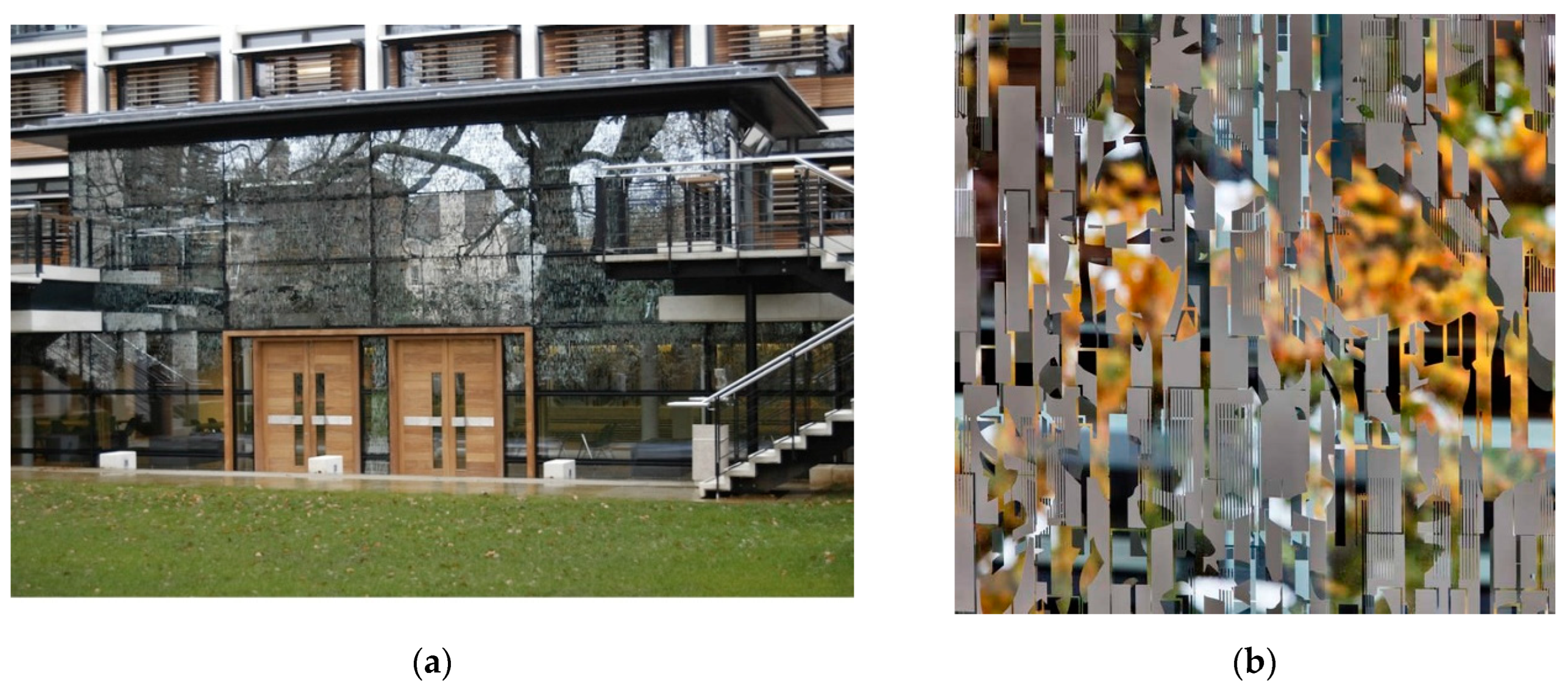
A more advanced arrangement is glazing composed of two glass layers, on which façade graphics have been placed (Figure 1b). One of the examples of this is the Kendrew Quadrangle Café, located on a university campus (MJP Architects; Artist: Alexander Beleschenko; Completion: 2010, Graphic area: 16.0 m2, screen printing). The façade consists of two glass layers in a post and beam framework with horizontally situated rectangles. In the top part, starting at the height of 150 cm, both glazing layers have been covered with a layer of geometric patterns consisting of simple shapes, including rectangles, semicircles, ovoid shapes, and arrangements of parallel lines (Figure 3a). The components make up a compact structure. The graphic layer becomes denser the higher one looks. The boundary between the two areas is uneven and rugged. The outer panes have a mirror coating, while the inner layer of the glazing is coated with white enamel.
Figure 3.
Kendrew Quadrangle Café, Oxford, Great Britain [artist: Alexander Beleschenko, MJP Architects, 2010]. (a) View of a glass facade at dusk, (b) detail of graphics (photos by Alexander Beleschenko).
There are screen prints on both glass layers, the white and mirror layer, which overlap, creating unique visual effects. The coating reacts to light in a particular way. When the sunlight penetrates it, sections of the mirrored layer cast a shadow onto the thin white paint layer, thus enriching the image with additional mobile graphic values, making it more expressive. The graphics on the glazing, with their fine vertical geometric elements, create a compact texture that adds lightness to the elevation. They provide a spatial curtain, which changes its properties depending on how the light falls on it (Figure 3b). The glass layer controls the visual integration of the space on both sides of the façade. At the sitting level, the glazing is a transparent partition giving an uninhibited view of the yard, but then it becomes gradually denser towards the top, making the image more difficult to understand. The mirror layer, reflecting the sunlight, protects the interior against excessive heat. After dark, the glazing acts as a curtain for the lit interior, and it makes the elevation more uniform.
2.3. Double-Layer Glazing with Buffer Space—Graphics Placed on One Layer
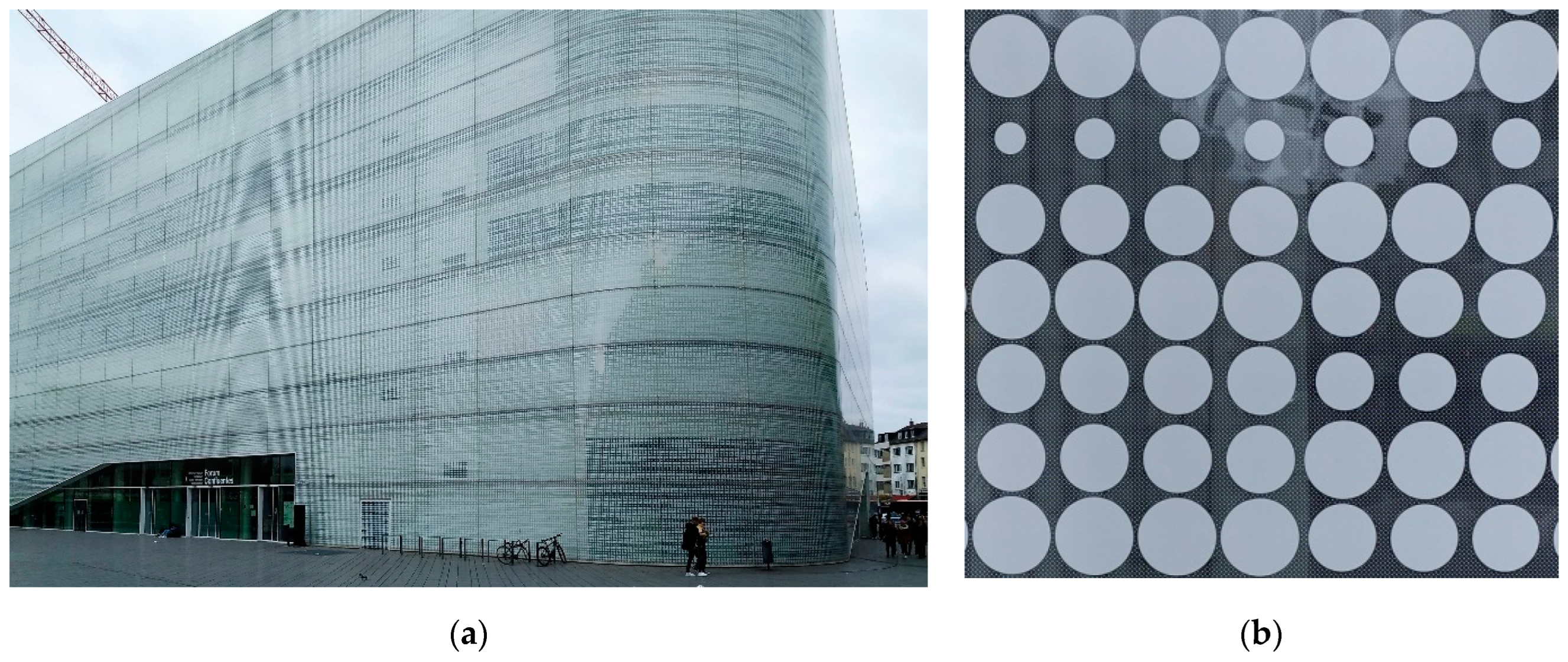
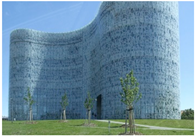
In fully glazed structures, it is a common structural solution to use glass as the building’s skin (Figure 1c). A layer covered with an image is placed at a distance from the proper glass façade. An advantage of this is the ability to conceal the façade structure inside the buffer area. An example of such a solution can be seen in the Forum Confluentes building (Architects: Benthem Crouwel Architects; realization: 2013; graphic area: 8200 m2, screen printing, Forum Confluentes 2021), a cultural centre located in Koblenz, Germany. The facade is bent (Brzezicki 2018), composed of an external layer made of laminated glass (structural glass; 2 × 10 mm safety glass, VSG and semi-toughened glass, TVG) (Forum Confluentes 2021) on which a graphic layer is placed, with another glass layer at a distance more than 30 cm, without any print on it. In curved corners of the building, glass panels had been bent.
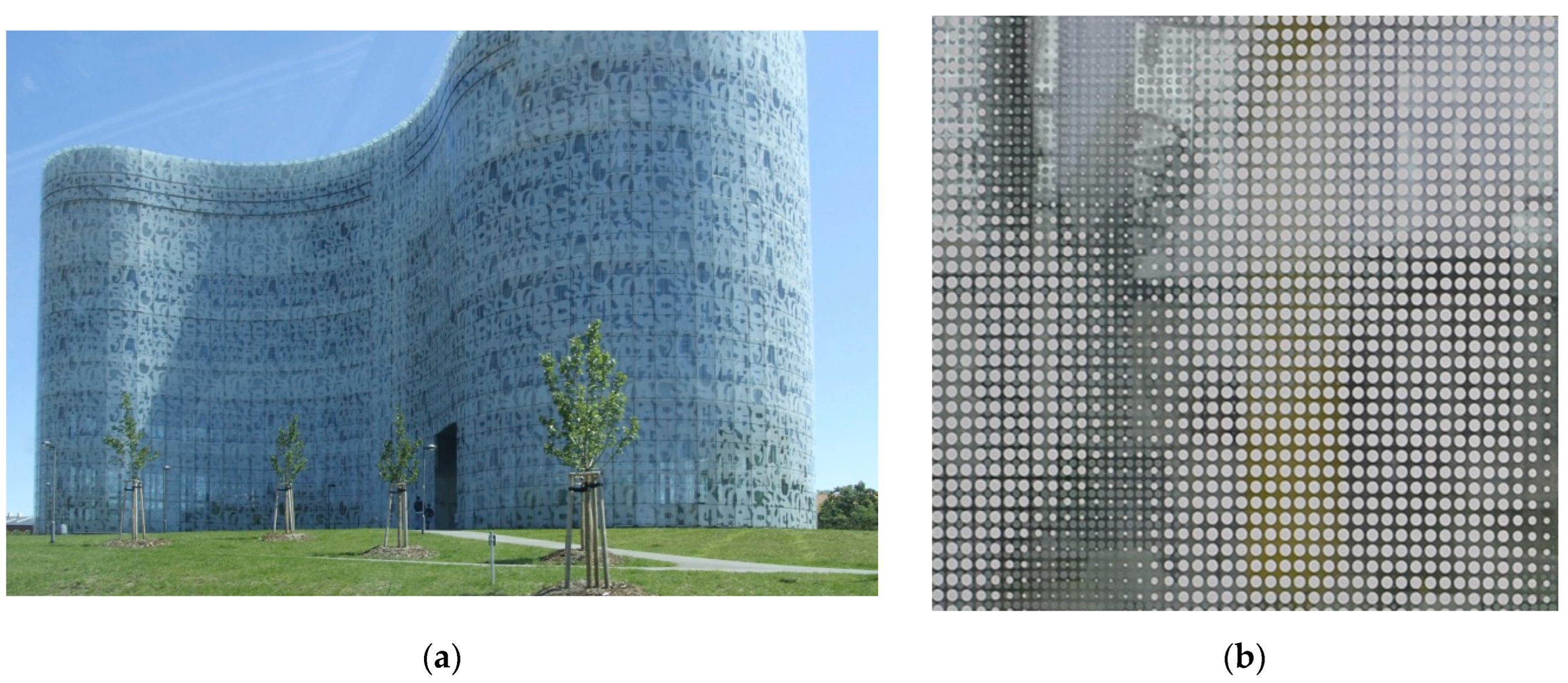
The image is made up of two rasters of different sizes (Figure 4b); the one in the background is fine and dense with the components measuring 1 mm, and the other one is much larger, with the diameter of its elements between approximately 2 and 9 cm. The bigger components of the image are set in rows in ascending and descending order, forming horizontal smudges. The artistic layer integrates the elevation visually and conceals structural divisions in the building. The vast geometrical elements of the raster form a subtle organic texture. Horizontal smudges encircle the building, making its shape visually longer.
Figure 4.
Confluentes Forum, Koblenz, Germany [Benthem Crouwel Architects, 2013]. (a) View of a glass facade at dusk, (b) detail of graphics (photos by Alina Lipowicz-Budzyńska).
The image present on the glass creates independent divisions and sets the rhythm (Figure 4a), and the elevation’s divisions are almost invisible. The ornament becomes the element that visually materialises the glass partition and controls the integration of spaces on either side of the glazing. The space existing between the two separated glass surfaces acts as a buffer, protecting the interior against temperature fluctuations and excessive sunlight penetration. It is in this space that the structure of the front glazing layer is situated, making its outside surface smooth, with no visible divisions. From a distance, the façade is seen as a single surface with an organic texture surrounding the building.
2.4. Double-Layer Glazing with Buffer Space—Graphics Placed on Two Layers
The term ‘double-layer glazing’ was applied to arrangements in which the image had been placed on two separated glass layers (Figure 1d). An example of this can be seen in the building of the Cottbus Technical University Library (Herzog & de Meuron Architects; Realization: 2004; graphic area: 5800 m2, screen printing, Cottbus Library 2022). The elevation is composed of two glass layers with a distance of approximately 50 cm between them. On the outside of the façade glazing, made using the classic steel post and beam construction method, a glass façade with point-mounted glass panels has been added. The structural part of both layers is concealed inside the space between the glass panels. Both layers are covered with a printed image on one side in the form of a fine white raster.
The designers’ assumption was to create a new formula building with a form beyond associations. It was supposed to be a place of communication with an open formula (May 2017). The graphical design related to this idea is made up of alphabetical systems from different language groups overlaid on one another (Laube and Widrig 2016). Seen from a distance, the printed layers create arrangements that resemble writing (Figure 5a).
Figure 5.
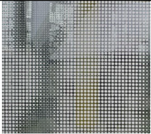
The Cottbus Technical University Library [Herzog & de Meuron, 2004]. (a) Façade seen from 10 metres away, (b) double-glazed façade (photos by Alina Lipowicz-Budzyńska).
In double-layer arrangements consisting of images made of a raster and set in a certain order, graphical interference processes occur (moiré effect), such as line or shape arrangements resulting from fine raster elements being overlaid on one another (Figure 5b). The image changes with the viewing angle, creating an active layer sensitive to change of position relative to the façade. The shape of the visual effects created depends on the form of glazing as the image carrier (Amidror 2007). The perception of this phenomenon depends individually on the properties of the recipient’s visual system (Muñoz and Alda 2002).
A façade covered with a screen print image is an original graphical design that identifies an architectural structure (Lushington et al. 2016). The graphics constitute a modern ornament; it is a reference to the building’s intended use, and it inspires and encourages observers to look for meaning. Seen from afar, the printed image is a clear lettering pattern that makes up a composition consisting of horizontal strips.
In two-layer arrangements consisting of images built of a raster set in a specific order, graphical interference processes occur, with arrangements of lines or figures resulting from overlapping of fine raster elements (Figure 5b). The image changes with the viewing angle, creating an active layer, sensitive to the change of position relative to the façade. The use of opaque materials ensures that a partition is provided, which makes the space invisible from either side and protects against sunlight. The use of large glazed facades in library buildings is one of the trends observed in contemporary projects. The reasons behind this are energy efficiency and lower electricity costs due to reduced use of artificial lighting. A modern office building consumes around 30% of the total energy consumption for electric lighting. However, in a public library, the illumination index can be as high as 45% (Edwards 2011). The problems with overheating inside the building caused by intensive use, with protection against excessive sunlight, have been solved by using a double glass façade covered with a printed image. This technology provides maximised use of daylight and the ability to use waste heat for heating during winter and ventilation in summer. The distance between the two glass surfaces acts as a buffer. The ventilated area stabilises temperature inside the building, protecting the interior against temperature fluctuations resulting from excessive sunlight penetration, or against sudden temperature drops in winter when the weather becomes colder quickly (Budzyńska 2014). With the buffer area between the glass layers, the reduction in passing sunlight and protection against overheating of rooms is much more effective compared to single-layer coatings. The structure of the façade also provides one extra function in the form of sound insulation.
2.5. Glazing as Building Cladding
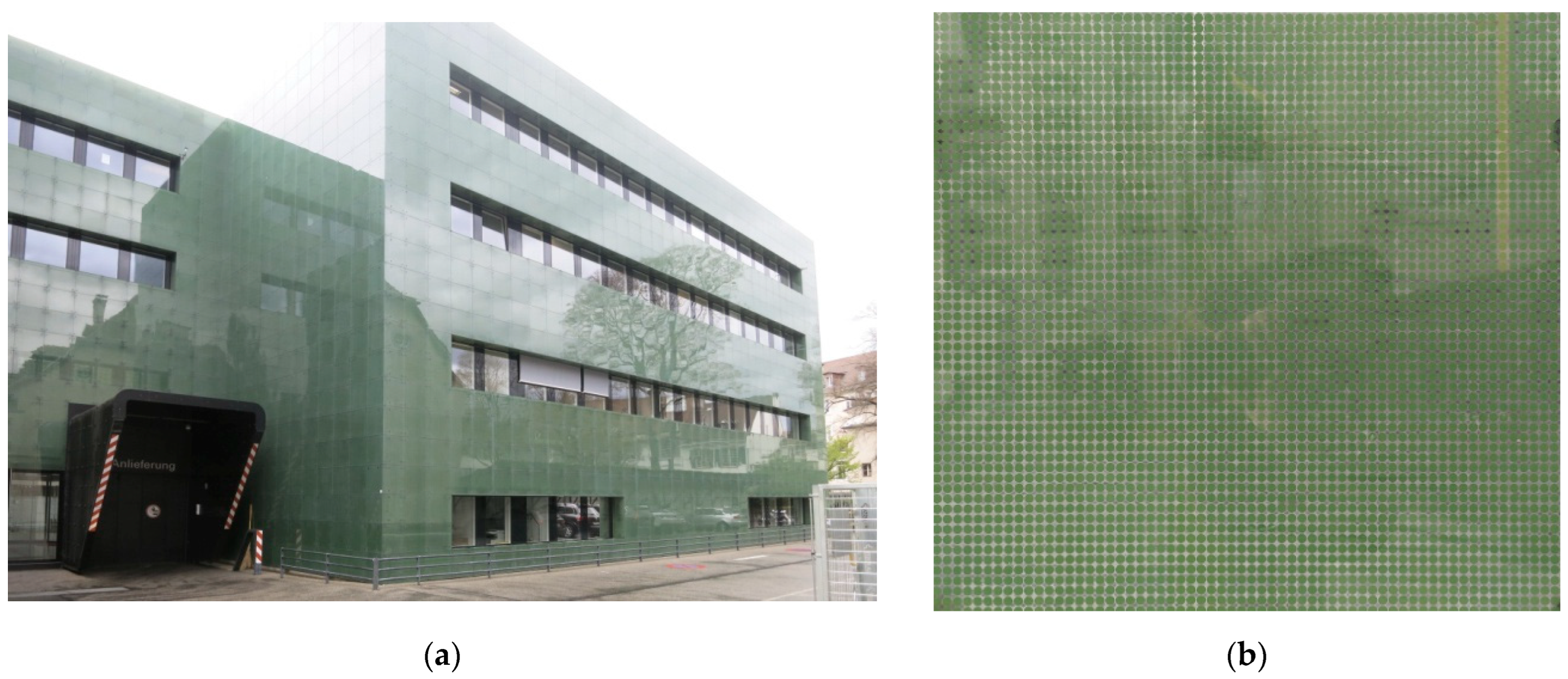
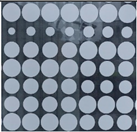
One interesting spatial solution is to use glass as cladding, i.e., covering an architectural structure only on the wall surfaces excluding windows (Figure 1e). An advantage of this solution is that it can be applied in existing structures built with traditional methods. Depending on the adopted solution, panels may be attached directly to the wall as an installation or be at a distance, forming a ‘fleshy’ coating (Figure 6a) and a buffer. An example of this can be found in the building housing the Institute for Hospital Pharmaceuticals (Architects: Herzog & de Meuron Architects; Realization: 1998; graphic area: no data available, print, Mack 2008) located in Basel, Switzerland. The object, with its modern shape, contrasts with the surroundings of the historic buildings built from the 17th to the end of the 20th century. The body of the building creates a system of semi-closed courtyards, in the centre of which is an atrium (Herzog and de Meuron 1997). From the side of the street, a rectangular form was erected, covering the entire complex and referring to the building line. The building’s façade is formed by glass separated by approximately 30 cm from the thermal line of the building (Institute for Hospital Pharmaceuticals 2022). The printed layer consists of spots, spaced regularly in rows and columns (Figure 6b). The colour of the glazing refers to the purpose of the building and emphasizes its connection with the plant world, herbalism and herbal medicine.
Figure 6.
Institute for Hospital Pharmaceuticals, Basel, Switzerland [Herzog & de Meuron, 1998]. (a) Part of the building from the side of the street, (b) structure of the facade and image (photos by Alina Lipowicz-Budzyńska).
The glazing forms a semi-transparent partition letting the light in. In this building, a light curtain wall is covered with white perforated sheet metal. The two layers, the printed one and the perforations, overlap, creating visual interferences. As lighting changes throughout the day, depending on the incidence angle, it affects the transparency of the partition, and hence the reception of the entire building. The light, as it travels through the glass façade, stops at the screen-print layer and at the white perforated sheet metal layer, exposing visual interferences between the two layers. The glass layer makes the building’s façade spatial, and the graphic work enriches it by adding mobile visual graphic elements, which can be classified as visual communication. The ventilated space between the wall and façade acts as a buffer, which provides temperature stability for the cladding (Meron 2022).
2.6. Graphics in Mobile Shells
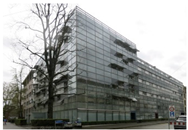
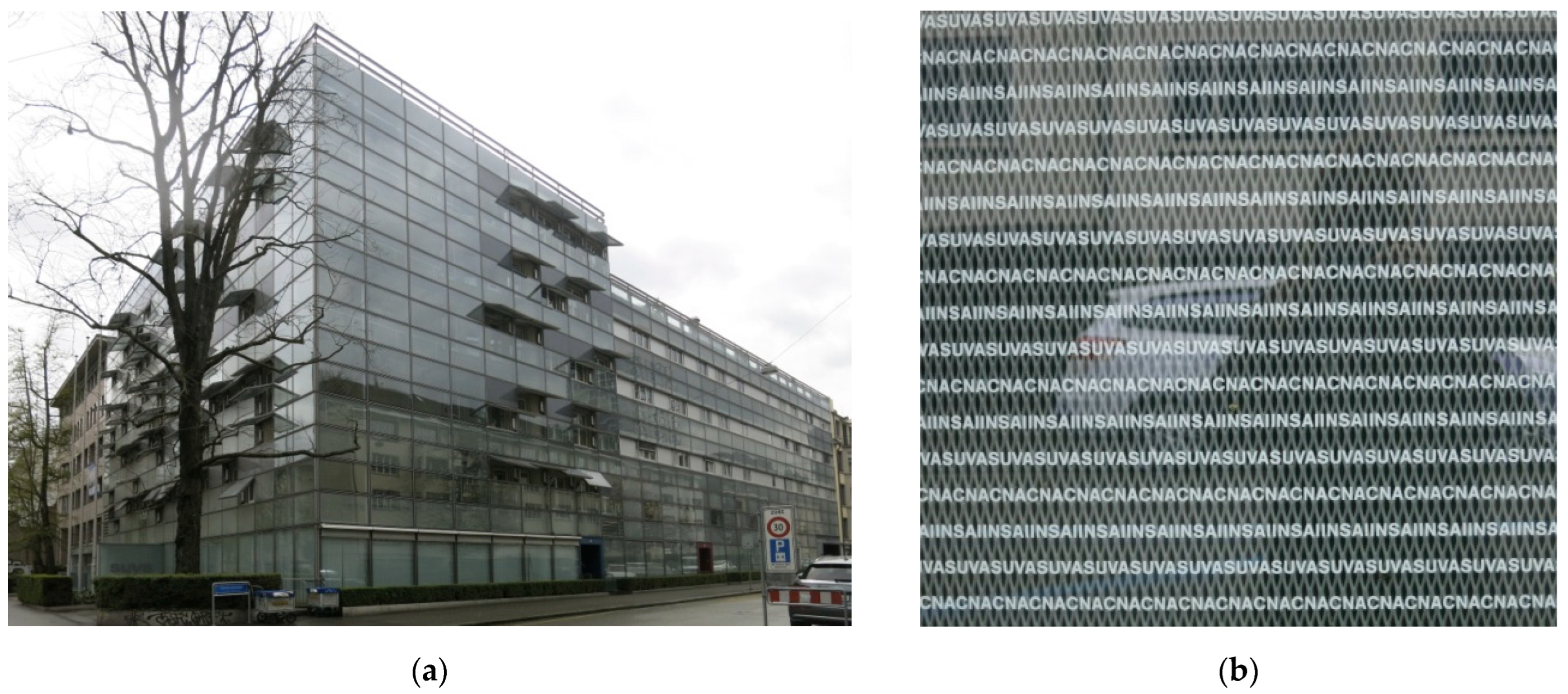
The combination of a louvre layer (Figure 1f) with an image having a texture structure is an interesting solution to protect buildings from sunlight. This has been used in the façade of the SUVA (Architects: Herzog & de Meuron Architects; Realization: 1993; screen printing, Rüegg 1994) division office in Basel, Switzerland, where a new part was added to a 1950s building (Leatherbarrow 2009). From the third floor, the office building changes its function into a residential one (Puglisi 2008). The glass façade integrates the two parts, giving them a coherent modern character resulting from multiplied lettering graphic elements being combined with horizontal elevation divisions. The glass layer is moved away from the actual wall of the building. The glazing consists of horizontal strips of glass with three different optical and physical properties (Figure 7a). On each floor, the part of the glass panels going up to the sill is covered with screen print graphics; then, above and along the window openings, transparent glass is present. Over the windows strip, there are panels made of insulating prism glass (Wigginton and Harris 2002), which are part of the sunlight protection system. The screen print covered panels are computer controlled, and they open automatically when the interior temperature reaches a certain level. They can also be opened separately. The graphics on the screen-printed area are made up of the company’s logo replicated in rows (Figure 7b). The purpose of the text is informational, and it is part of the company’s image strategy, as well as the process of developing its identity. The repeated small text can only be read when one moves close to the façade. The texture of the graphics visually integrates the glass surface it is printed on, covering the building standing behind the façade. Transparent glass strips, without any print on it, are highlighted visually and create rhythm in the façade. The graphics here act to conceal various glass types and support the prism glass in its insulation and sunlight protection functions. The system provides the possibility of active control of the energy in the building (Bonham 2020). In winter, the outer skin is completely sealed and the energy of 1.2 W/m2K can be conserved (Wigginton and Harris 2002). The movable elements of the façade enable ventilation of the buffer space between the façade and the building. Thanks to the structure of the façade and the way movable parts are attached, sunlight protection is maintained when the panels are open.
Figure 7.
SUVA Office, Basel, Switzerland [Herzog & de Meuron,1994]. (a) Part of the building from the side of the street, (b) structure of the facade and image (photos by Alina Lipowicz-Budzyńska).
3. Discussion
The examples used in the paper were classified depending on the structure of the glass façade and the location of the graphical layer therein.
They were divided into the following types based on the structure and the number of layers: single-layer coating, double-layer coating, double-layer glazing—graphics placed on one layer, double-layer glazing—graphics placed two layers, glass as cladding and mobile layers.
It was noted that a glass façade covered with graphics has certain functions in a building, directly influencing how comfortable a space is to use. The role of art glass placed inside the external partition of a building depends largely on the structure of the façade’s coating and on the image. Artistic features, the shape, dynamics, composition, and colours, play an important part in how an architectural space is seen by observers.
Glass coated with graphics as a façade material has unique properties that can be useful for the sustainable development of architectural space. Façade graphics can provide pro-ecological solutions to many problems, taking into account aesthetic values as one of the conditions for the principles of sustainable development:
- -
- Takes an active part in shaping the composition of the building by providing such elements: texture, colour, line, plane, figurative values (Section 2.1);
- -
- Facade graphics can be a carrier of a message with specific content and can be used in the creation of the regional marketing and identification of the place (Section 2.2);
- -
- Art glass with a specific articulation can become an integrating factor of the glass façade, losing its divisions (Section 2.3);
- -
- A glass façade covered with graphics supports the building’s solar protection and interior protection against overheating (Section 2.4);
- -
- The façade acts as a curtain, modelling the possibility of visual integration on both sides of the partition (Section 2.5);
- -
- Graphics placed on two layers of glass, under favourable visual circumstances, can be a source of visual interference, changing with the location of the observer. Such systems can replace multimedia facades, are much cheaper to produce and use, do not require an electricity connection, and are therefore an ecological solution (Section 2.6).
The above-mentioned factors do not occur in buildings where other materials, such as transparent building glass, brick, laminate, sheet metal, and plaster, are used on the façade.
4. Materials and Methods
The analysis to determine the effects on the sustainability of the architectural space was conducted on buildings covered with façade graphics that were created using screen printing or digital printing. Each of the projects has individual traits. One trait that all the images have in common is their textured character. The structure of the glass façade, or of the image, was assumed to be an important variable factor. The research material includes architectural objects with different construction and locations of the façade graphics, such as a single-layer coating, double-layer coating, double-layer glazing with buffer space—graphics placed on one layer; double-layer glazing with buffer space—graphics placed on two layers, glass as cladding and mobile shells. Out of 17 objects, six were selected for a more detailed analysis: Town hall of Alphen aan den Rijn, Toronto, Canada; Kendrew Quadrangle Café, Oxford, UK; Confluentes Forum, Koblenz, Germany; Library in Cottbus, Germany; Institute for Hospital Pharmaceuticals, Basel, Switzerland; SUVA Office, Basel, Switzerland.
Due to the complex nature of the investigation, a number of themes and several research methods were applied:
- -
- Case study;
- -
- In situ research concerned with image structure, artistic means and techniques used, relationship between image and space;
- -
- Review of prestigious academic publications, complemented with designer interviews and opinions, as well as data from professional journals or manufacturer websites;
- -
- A digital image analysis to establish the extent of enamel coverage;
- -
- An analysis to establish the extent of visual integration between the interior and the exterior; the investigation was conducted in situ, and surveys were used;
- -
- Review of material, critical analysis, synthesis;
The building selection criteria:
- -
- Completed in the past three decades;
- -
- The analysis focused on buildings in Europe;
- -
- Stylistically varied façades, made with the use of graphic techniques;
- -
- Façade structure belongs to one of the six above-mentioned categories;
- -
- All are public utility buildings;
- -
- In-situ—large majority of the buildings were assessed on site.
The research material includes documentation in the form of photographs, drawings, sketches, measurements, analyses, charts.
The analysis of façade graphics included questions related to both art and architecture. It was conducted taking into consideration the environmental and cultural context. For each project, a description was made about its individual articulation in connection with:
- The history of the place where it was created;
- The shape of the building;
- The character of the image and its structure.
Image analysis covered the following aspects:
- -
- Image shape and character;
- -
- Image structure (components of size, shape, element repeatability);
- -
- Composition (arrangement, dominant direction);
- -
- Colour;
- -
- Light modification using graphics;
- -
- Placement on glass layers, spacing between the layers;
- -
- Dominant visual phenomena, interactions between graphical layers.
The collected information was synthesized in two tables:
Table 1 includes:
Table 1.
The summary of data on selected architectural objects.
- -
- Information about the image (analysis of graphics on glass);
- -
- Information about the façade partition/message (façade data/message);
- -
- Research on the integration between the interior and the exterior and averaged percentage coverage of glass by image (image analysis).
Table 2 contains research and analyses of:
Table 2.
The synthesis of the researched issues concerns the entire research material.
- -
- Compositional importance of the image in the building;
- -
- Research on the impact of graphics on the visual integration of the facade, taking into account the divisions of the facade glazing (compositional integration of the image);
- -
- Research on visual relationships between images—applies to double-layer facades (visual interaction between image layers).
For each of the buildings, a description was made about the impact of the image on the reception of the entire building, and the impact of the graphics and image structure on the functional properties of the façade.
The image of each of the buildings was analysed in terms of its composition in relation to the shell of the building, integration of the image with the façade structure, and visual interactions between the layers.
The concealing functions of the façade were considered to be an important functional property, and they were examined. An analysis of the material collected earlier was conducted to determine the visual integration between the interior and the exterior.
Two values were adopted:
- -
- Integration of the external image with the interior, assessed from the inside of the building (FI);
- -
- Integration of the internal image with the exterior, assessed from the outside of the building (FO).
The values were measured on a scale of 1 to 5:
- -
- Fully impeded (1)—if the image cannot be seen on the other side; there is no visual integration between the building’s interior and exterior;
- -
- Poor (2)—if the image penetrates through the graphics to a small degree without being recognisable;
- -
- Impeded (3)—if the outline of the image can be seen;
- -
- Slightly impeded (4)—if the image is distorted but nevertheless seen quite clearly;
- -
- Full (5)—the image can be seen without any interference; full visual integration is achieved.
The analysis was conducted in situ, in daylight, with the lights on inside the building. An analysis of the percentage coverage of glass was carried out using a calculation method on an image in a façade sample measuring 50 × 50 cm. If an image was not spread evenly, three shots were selected and averaged. The images were analysed using two raster graphics editors, Photoshop and GIMP. The number of pixels in the image covered with a given colour, relative to the number of pixels in the whole of the sample, was established digitally. In this way, the exact percentage of enamel on the surface of the analysed image was measured. The final summary tables, included in the publication, show data synthesised from partial tables.
5. Conclusions
The study has revealed unique properties of glass facades covered with graphics, and the fact that they influence the aspects that define the building’s sustainability. It can be confirmed that a skillful use of façade graphics supports the building visually, as well as improving the comfort of using an architectural space.
The structure of the graphics and the artistic means selected define several visual aspects affecting the composition of the façade, as well as the entire body of the building. Important aspects of how a façade functions in an architectural space include image integration, visual integration between the interior and exterior, and the interaction between the image and the user. The last of these factors is present to such a degree only in the façade graphics of buildings in which the image has been placed on both planes.
5.1. Compositional Importance of an Image
The shape and structure of an image are important in the reception of the body of the building. In a project where distinct graphical elements of the façade are similar in shape to the building’s form, we are dealing with a visually coherent work with strong articulation (Section 2.1). Graphics composed on two layers of glass create a subtle pattern corresponding to the divisions of the façade (Section 2.2). Occasionally, and somewhat surprisingly, vast geometrical shapes, such as a raster, form a subtle organic texture, a kind of veil (Section 2.3). In buildings which have an organic form, an image of a similar nature completes it. The organic character of an image can be obtained from larger elements of that shape. The image is undisturbed thanks to the structure of the building hidden in the buffer space (Section 2.4). An image in glass creates independent divisions and sets a new rhythm for the façade. Uniform layers, made up of a raster, may form an element that will make the façade spatial (Section 2.6). In all of these cases, graphics constitute an important artistic feature that integrates with the building’s shape.
5.2. Message
One of the aspects related to the presence of façade graphics in architecture is the creation of narratives or messaging. Research has shown that images on glass are used to present complex visual communication structures, the purpose of which is to convey a specific message. The ways in which images are built and the techniques used to prepare the graphics are both linked to the strategy selected to create the metaphor, and they are integrated with the compositional values of the entire building. In architectural structures covered in their entirety with façade graphics, the shape of the building will usually be very simple, and treated as the background upon which the image is presented.
Metaphors in lettering are connected both with the literary form of expression as well as with the artistic intervention. It has been noted that metaphors are often applied in lettering graphics when the intention is to make the message harder to understand. In the research material, the following strategies are mentioned: linear multiplication, text size reduction (Section 2.6), texture creation, and total graphic transformation (Section 2.4) rendering the message impossible to understand.
Lettering motifs are important in the creation of the image and identity of the space, as well as its visual identification related to the purpose of the building.
In abstract images, geometric shapes play the key role. The metaphor is created by invoking associations in the viewer connected with the given kind of visual properties.
5.3. Compositional Integration of the Image
An important function of façade graphics is the visual integration of a glazed building. Integration is largely dependent on the façade’s structure and the applied type of elevation system. If artistic measures in the image are properly selected, the graphics may form a texture that will take the viewer’s attention away from the rectangular divisions of an elevation system. The buildings analysed in this paper represent different image building strategies. In two cases, the images were made up of graphical elements placed against a background made up of a fine raster. In the first case (Section 2.1), which is the most complex one, the background is combined with geometrical elements made of non-transparent surfaces and transparent ones enclosed by lines of various width. In the second example, the spatial image located on two glass layers hides the orthogonal divisions of the façade (Section 2.2). In the third example (Section 2.3), a background made of a fine raster has been joined with arrangements of circles in different sizes formed by non-transparent surfaces. Elements arranged linearly form horizontal strips over the entire elevation.
The combination of two image scales—the background and larger geometrical elements—enabled visual integration of the façade. In both cases, the graphics become the dominant feature in the arrangement, and they visually integrate the glass surface. An image built in this way has worked well as a cover for the structural divisions of the building located behind the façade.
Another type of image was used in the two-layer façade with buffer space (Section 2.4). The shape of the graphics, that is a reference to a writing style, has been made of a raster with the size of 1–2 mm. With the use of two screen print layers, this solution has also proved to be effective, both in terms of visual integration and in terms of sunlight protection. Where a two-layer arrangement is used in a building (Section 2.2) in which the façade acts as the buildings skin or as cladding (Section 2.5), the building’s structure has been mostly concealed inside the buffer space created between the two glass layers. On the outside, glass is point-mounted. This ensures that the building’s façade is smooth and visually lighter, without visible divisions in the post and beam structure.
On the other hand, a texture made up of fine elements (Section 2.6) in combination with the post and beam system does not perform well as an integrating factor for the elevation. The application of such texture combined with transparent glass intensifies existing divisions.
5.4. Visual Interaction
One important phenomenon occurring in a two-layer image is visual interferences existing between the two image layers. This happens naturally in facades where the image has been placed on two layers of glass (Section 2.2 and Section 2.4). Additionally, it may occur in glass cladding in which one of the layers is the glass and the other is the cladding (Section 2.5). These solutions make it possible to create spatial, active layers that change as the observer moves. The enamel layer is a unique decorative element, in which the reception depends on where one is relative to the façade’s plane. In the described phenomenon, the image changes with the viewing angle and the user/viewer enters an active integration with the image. As they move along, they see changing interference arrangements. A visually changing layer adds another attractive feature to the façade. The effect is amplified in mirror layers (Section 2.2).
5.5. Integration between the Interior and the Exterior
One of the functions of façade graphics is controlling the visual integration between the external and internal space; in each of the examples, it is manifested slightly differently. An applied ornament is the controlling factor for the integration of spaces on both sides of the glazing. In an image in which three types of transparency coexist (Section 2.1) (surfaces without a layer—transparent areas; image covered with a fine raster—semi-transparent surfaces, and non-transparent graphical elements fully covered with an opaque layer), the integration depends on the distance to the façade. In close proximity to the façade, integration happens in the most complete way in those areas that are fully transparent, and this is the kind of surface that the observer will be focusing on. At a distance of a few meters, when most of the surface is of a fine raster, partial integration will occur through this layer, and the interference will be coming from the non-transparent surfaces.
Visual integration is best controlled in a two-layer shell (Section 2.4). The spatial image composed of a raster makes sure that the space is actively protected from viewing on both sides.
5.6. Sunlight Protection
Placement of a light enamel layer made using screen-printing in the external layer of the glazing provides sunlight protection and stops the space from overheating. A light, opaque screen-print layer reflects sunlight, providing a more shaded interior at the same time.
The degree of density of non-transparent layers in an image plays an important role here. This is especially crucial in single-coating structures (Section 2.1), in which the artistic coating is placed on a single glass surface. Sunlight protection is formed using white and light-coloured coatings.
Functional properties are more developed in buildings in which art glass has been placed on two separated glass layers (Section 2.2 and Section 2.4). In such buildings, the space created between the two planes of glass being at a distance from each other acts as a buffer. With simultaneous sunlight protection, the ventilated space stabilizes temperature inside the building. The buffer space between the glass layers makes the reduction of light going through, and heating protection in the rooms, much more effective when compared to single-layer coatings. An additional advantage of using a buffer is better sound insulation.
In mobile coatings (Section 2.6), either the louvre type or mobile panels, sunlight protection might be controlled. On cloudy days, the movable louvre elements are opened to increase light access. Movable shading panels may be slightly opened in order to bring more light into the rooms. The way the panels are directed allows the user to open them without losing sunlight protection.
The possibilities provided by façade graphics are not only connected with the aesthetics of the image on glass and its integration with the architectural space, but also with conscious formation of particular functional properties of the glass layer. It is a real challenge for a designer to be able not only to handle the visual aspects, but also to use them within a given space.
The compiled material, which is a synthesis of earlier studies, demonstrates that two factors, façade structure and the structure of the graphical image in the façade, determine the façade’s functional relevance.
Following the analysis, it was established that the most effective, in visual and functional terms, was the two-layer façades covered with screen-print image formed out of a raster. This created a spatial layer with strong articulation in which visual interference phenomena occur. Due to the buffer space, the façade provides more possibilities with regards to visual integration between the interior and the exterior, as well as temperature stability. Additionally, placement of an image on two glass layers increases the efficiency of sunlight protection.
The possibilities given by façade graphics are shown in subsequent projects, and it is important that the architects consciously apply the particular functional properties of the glass layer. It is a real challenge for an architect to handle not only the visual aspects, but also their use in a given space.
Funding
This research was funded by Bydgoszcz University of Science and Technology.
Institutional Review Board Statement
Not applicable.
Informed Consent Statement
Not applicable.
Data Availability Statement
The original contributions presented in the study are included in the article, further inquiries can be directed to the corresponding author.
Acknowledgments
The presented research is a continuation and extension of research from 2020, which was published by the Publishing House of the University of Technology and Life Sciences in Bydgoszcz under the name Grafika fasadowe na szkle i jej znaczenie użytkowe [Facade graphics on glass and its functional significance].
Conflicts of Interest
The author declares no conflicts of interest.
Note
| 1 | Moiré pattern—observed in graphics, in raster images appearing in the press and on the screens of electronic devices. It is especially spectacular when seen in graphics placed on two separated glass layers, as seen in the objects: The Cottbus Technical University Library and Institute for Hospital Pharmaceuticals. |
References
- Amidror, Isaac. 2007. The Theory of the Moiré Phenomenon: Volume II Aperiodic Layers. Dordrecht: Springer Science & Business Media, pp. 67–83. [Google Scholar]
- Bedon, Chiara, and Silvana Mattei. 2021. Facial Expression-Based Experimental Analysis of Human Reactions and Psychological Comfort on Glass Structures in Buildings. Buildings 11: 204. [Google Scholar] [CrossRef]
- Bell, Michael, and Jeanine Kim. 2009. Engineered Transparency. The Technical, Visual and Spatial Effects of Glass. New York: Priceton. [Google Scholar]
- Bonham, Mary Ben. 2020. Bioclimatic Double-Skin Façades. New York: Routledge. Available online: https://books.google.pl/books?id=4Ru_DwAAQBAJ&printsec=frontcover&hl=pl&source=gbs_ge_summary_r&cad=0#v=onepage&q&f=false (accessed on 25 April 2021).
- Brzezicki, Marcin. 2014. Perception of transparency in contemporary architecture. In Visual and Cognitive Aspects. Wrocław: Oficyna Wydawnicza Politechniki Wrocławskiej. [Google Scholar]
- Brzezicki, Marcin. 2018. Studies on glass facades morphologies. In Glass in Architecture and Structural Engineering. Hoboken: Wiley, vol. 2, pp. 113–20. [Google Scholar] [CrossRef]
- Brzezicki, Marcin. 2021. Disturbance of transparency in the architecture of contemporary glass façades. Part 1. Architectus 1: 77–84. [Google Scholar] [CrossRef]
- Budzyńska, Alina. 2014. Screen printing on glass—A discreet charm of monochromatism. Glass World 9: 4–9. (In Polish). [Google Scholar]
- Celadyn, Wacław. 2004. Przegrody Przeszklone w Architekturze Energooszczędnej [Glass Partitions in Energy-Efficient ARCHITECTURE]. Kraków: Wydawnictwo Politechniki Krakowskiej. [Google Scholar]
- College Café Oxford. 2022.
- Cottbus Library. 2022. Available online: https://www.herzogdemeuron.com/index/projects/complete-works/151-175/166-cottbus-library.html (accessed on 18 June 2022).
- Edwards, Brian. 2011. Sustainability as a Driving Force in Contemporary Library Design. Library Trends 60: 190–214. [Google Scholar] [CrossRef]
- Eekhout, Mick, Walter Lockefeer, and Dries Staaks. 2010. Design and Build of a Warped Tram Station Roof in Delft. In Challenging Glass 2—Conference on Architectural and Structural Applications of Glass. Edited by Freek Bos, Christian Louter and Fred Veer. Delft: TU Delft. [Google Scholar]
- Elkadi, Hisham. 2016. Cultures of Glass Architecture. London: Taylor & Francis Ltd. [Google Scholar] [CrossRef]
- Extending Glass Usage in Support of the Sustainable Development Goals. 2022. Available online: https://www.springernature.com/gp/researchers/the-source/blog/blogposts-communicating-research/extending-glass-usage-in-support-of-the-sdgs/20145140 (accessed on 30 February 2022).
- Forum Confluentes in Koblenz. 2021. Available online: https://www.baunetzwissen.de/glas/objekte/kultur/forum-confluentes-in-koblenz-3537311 (accessed on 25 April 2021).
- Forum Confluentes, Koblenz, Naturinspirierte Neugestaltung des Zentralplatzes, Innentrennwände für großzügiges Foyer mit TG-PROTECT® in Szene gesetzt. 2022. Available online: https://www.thiele-glas.de/referenzen/forum-confluentes-koblenz/ (accessed on 18 October 2022).
- Ghomeishi, Mohammad. 2021. Aesthetic preferences of laypersons and its relationship with the conceptual properties on building façade design. Journal of Asian Architecture and Building Engineering 20: 12–17. [Google Scholar] [CrossRef]
- Gregory, Rob. 2008. Key Contemporary Buildings: Plans, Sections and Elevations. London: Laurence King Publishing. [Google Scholar]
- Herzog and de Meuron. 1997. El Croquis 84. Herzog & de Meuron 1993–1997. Edited by Fernando Márquez Cecilia and Richard Levene. Madrid: El Croquis Editorial, p. 192. [Google Scholar]
- Institute for Hospital Pharmaceuticals, Rossettiareal, Basel. 2022. Available online: https://arquitecturaviva.com/works/instituto-de-farmacia-hospitalaria-rossettiareal-3 (accessed on 20 June 2022).
- Ishida, Aki. 2020. Blurred Transparencies in Contemporary Glass Architecture: Material, Culture, and Technology. London: Routledge. [Google Scholar]
- Laube, Agnès, and Michael Widrig. 2016. Archigraphy: Lettering on Buildings. Basel: Birkhäuser, p. 124. [Google Scholar]
- Leatherbarrow, David. 2009. Architecture Oriented Otherwise. New York: Princeton Architectural Press, p. 55. [Google Scholar]
- Lipowicz-Budzyńska, Alina. 2020. Visual Interference in the Glass Facade. IOP Conference Series: Materials Science and Engineering 960: 042079. [Google Scholar] [CrossRef]
- Lipowicz-Budzyńska, Alina. 2021. Articulation of facade graphics and techniques of its implementation. IOP Conference Series: Materials Science and Engineering 1203: 022016. [Google Scholar] [CrossRef]
- Lipowicz-Budzyńska, Alina. 2023. Façade art glass in three contexts: Urban landscape, elevation of the building and its interior. IOP Conference Series: Materials Science and Engineering 603: 042051. [Google Scholar] [CrossRef]
- Lushington, Nolan, Wolfgang Rudorf, and Liliane Wong. 2016. Entwurfsatlas Bibliotheken. Basel: Birkhäuser, p. 109. [Google Scholar]
- Mack, Gerhard. 2008. Herzog & de Meuron 1997–2001. The Complete Works. Basel, Boston and Berlin: Birkhäuser. [Google Scholar]
- May, Eva. 2017. Wissenschaftliche Bibliotheken und Stadtentwicklung: Konzepte—Trends—Analysen. Wiesbaden: Verlag; Dinges&Frick, p. 60. [Google Scholar]
- Meron, Yaron. 2022. Graphic Design and Interactivity: Still a Paradigm Shift for Graphic Designers? Available online: https://commdesignacademic.org (accessed on 10 April 2022). [CrossRef]
- Moor, Andrew. 1989. Contemporary Stained Glass. London: Michaell Beazley Publisher. [Google Scholar]
- Moor, Andrew. 1997. Architectural Glass Art. London: Reed International Books Limited. [Google Scholar]
- Moor, Andrew. 2006. Colours of Architecture. London: Octopus Publishing Group. [Google Scholar]
- Muñoz, Pedro, and Javier Alda. 2002. Visual perception of the Moiré effect. Ophthalmic and Physiological Optics 19: 427–30. [Google Scholar] [CrossRef] [PubMed]
- Park, Jeeyoung, Dirk Hengevoss, and Stephen Wittkopf. 2019. Industrial Data-Based Life Cycle Assessment of Architecturally Integrated Glass-Glass Photovoltaics, D. Hengevoss, and S. Wittkopf. 2019. Industrial Data-Based Life Cycle Assessment of Architecturally Integrated Glass-Glass Photovoltaics. Buildings 9: 8. [Google Scholar] [CrossRef]
- Puglisi, Luigi. 2008. New Directions in Contemporary Architecture: Evolutions and Revolutions in Building Design Since 1988. Chichester: Wiley. [Google Scholar]
- Richards, Brent. 2006. New Glass Architecture. New Haven: Yale University Press, p. 184. [Google Scholar]
- Rowe, Colin, and Robert Slutzky. 1963. Transparency: Literal and Phenomenal. Perspecta 8: 45–54. [Google Scholar] [CrossRef]
- Rüegg, Arthur. 1994. Herzog & de Meuron. Das neue SUVA-Haus in Basel 1988–1993. Erweiterung und Umbau Eines Steinernen Geschäftshauses von 1950. Luzern: Edition Architekturgalerie. [Google Scholar]
- Tatano, Valeria, Christina Conti, Massimo Rossetti, Antonio Musacchio, Anna Faresin, Luca Siragusa, and Elisabetta Carattin. 2008. Oltre la Trasparenza. Rome: Riflessioni sull’impiego del vetro in architettura Officina. [Google Scholar]
- The 17 Sustainable Development Goals. 2024. Available online: https://sdgs.un.org/goals (accessed on 25 April 2024).
- Timo, Carl. 2019. Deep Skin Architecture. In Design Potentials of Multi-Layered Architectural Boundaries. Kassel: Springer Vieweg. [Google Scholar]
- Townhall Alphen aan den Rijn. 2024. Available online: https://www.octatube.nl/en_GB/project-item.html/projectitem/108-stadhuis-alphen-aan-den-rijn (accessed on 25 February 2024).
- Wala, Ewa. 2012. Szkło we Współczesnej Architekturze [Glass in Contemporary Architecture]. Gliwice: Wydawnictwo Politechniki Śląskiej. [Google Scholar]
- Wigginton, Michael. 1997. Glas in der Architektur. Stuttgart: Deutsche Verlags-Anstalt. [Google Scholar]
- Wigginton, Michael, and Jude Harris. 2002. Intelligent Skins. Oxford: Butterworth-Heinemann, pp. 137–39. [Google Scholar] [CrossRef]
- Zabrocka, Marta. 2021. City Hall—Erick van Egeraat, Alphen aan den Rijn. [Google Scholar]
- Zumthor, Peter. 2006. Thinking Architecture. Basel: Birkhauser. [Google Scholar]
Disclaimer/Publisher’s Note: The statements, opinions and data contained in all publications are solely those of the individual author(s) and contributor(s) and not of MDPI and/or the editor(s). MDPI and/or the editor(s) disclaim responsibility for any injury to people or property resulting from any ideas, methods, instructions or products referred to in the content. |
© 2024 by the author. Licensee MDPI, Basel, Switzerland. This article is an open access article distributed under the terms and conditions of the Creative Commons Attribution (CC BY) license (https://creativecommons.org/licenses/by/4.0/).