
Review

Legislating the Unwritten (Fundamental Rights-Based) Refusal Ground in European Criminal Law

by
István Szijártó
Faculty of Law, University of Pecs, 7622 Pecs, Hungary
Laws 2026, 15(4), 72; https://doi.org/10.3390/laws15040072
Submission received: 14 April 2026 / Revised: 6 July 2026 / Accepted: 9 July 2026 / Published: 14 July 2026
(This article belongs to the Section Criminal Justice Issues)

Abstract

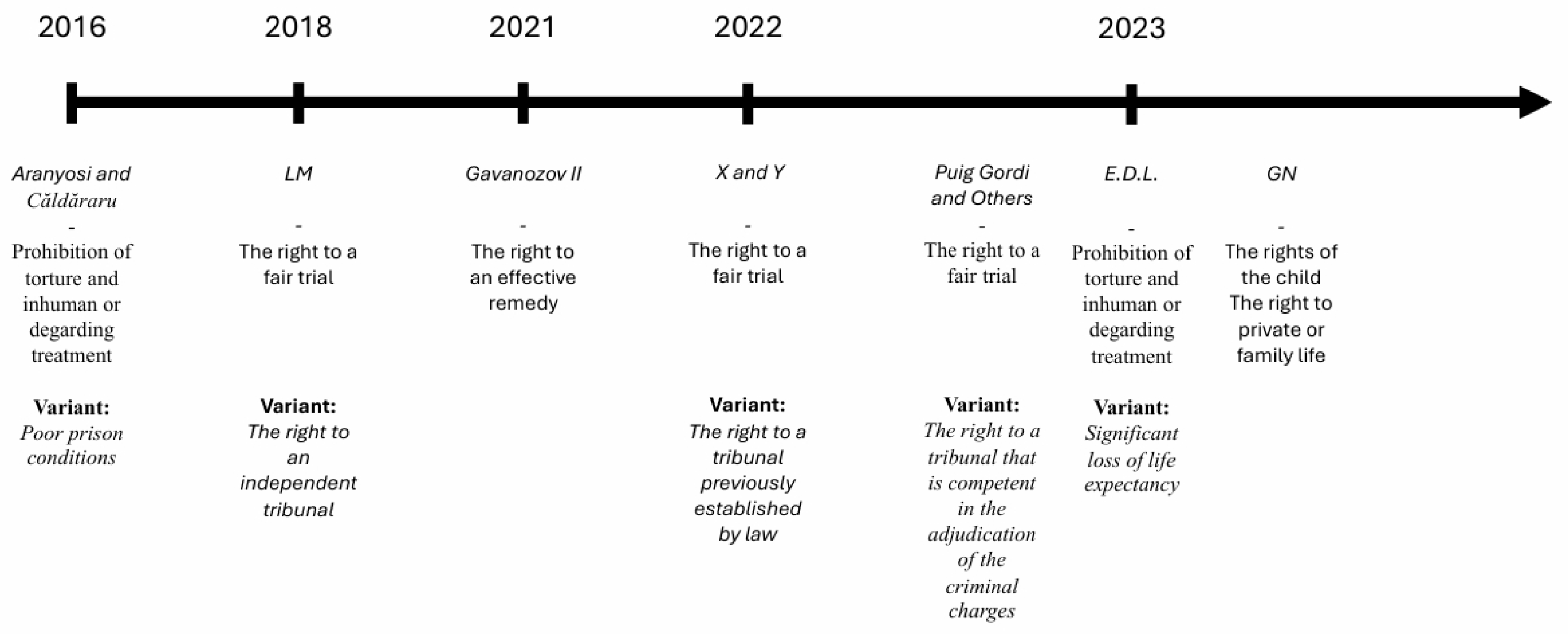
This article provides a comprehensive overview of the case law of the European Court of Justice related to the rebuttal of the principle of mutual trust in the process of judicial cooperation in criminal matters. It analyses ten judgements of the Court, which were delivered in preliminary ruling procedures that concerned the ground for refusal—established by the Court in its jurisprudence, hence referred to as unwritten ground—in cases when the execution of the judicial decision would have possibly jeopardised the protection of fundamental rights. This article provides a thorough analysis of the cases, shedding light on the gradual extension of the scope of the unwritten refusal ground, the Court’s resolve to protect the original structure of the Aranyosi test, the exceptional derogations from this resolve, and the various procedural aspects of carrying out the Aranyosi test. It argues that the rules governing the application of the unwritten refusal ground have been clarified, so much so that they may be ready to be translated into secondary legislation. As such, the aim of this article is to provide a legislative proposal for implementing the unwritten refusal ground into secondary sources of EU law based on the case law analysis.
Keywords: European arrest warrant; refusal ground; fundamental rights; Article 1(3); Aranyosi test European arrest warrant; refusal ground; fundamental rights; Article 1(3); Aranyosi test