1. Introduction
Technological change no longer serves as an external backdrop to labour law. It has become a primary medium through which labour is organised, assessed, priced, disciplined, and rendered legally legible. On digital platforms and increasingly in conventional workplaces, AI and algorithmic systems do not merely support management; they assign tasks, determine pay, rank workers, monitor performance, impose penalties, and shape the set of economic options available to workers. Hence, the legal issue is not solely whether a worker counts as an employee or an independent contractor. A more fundamental problem is that the worker’s ostensible autonomy is itself technologically mediated, while the legal categories designed to vindicate rights presuppose a different structure of control.
The Future of Jobs Report 2025 identifies technological change, geoeconomic fragmentation, economic uncertainty, demographic shifts, and the green transition as major pressures reshaping work and labour markets (
World Economic Forum 2025). These pressures interact and reinforce one another, rendering existing regulatory frameworks simultaneously inadequate. Technology supplies the infrastructure of algorithmic control, from AI-driven dispatch and biometric monitoring to affective computing and automated deactivation. Geoeconomic fragmentation generates divergent regulatory responses, enabling cross-jurisdictional platform companies to exploit differences in classification rules, transparency duties, and worker protections. As the
International Labour Organization (
2021) has shown, workers performing comparable algorithmically mediated labour in different countries face vastly different levels of protection; responses remain uneven and are still developing across much of the Global South (
International Labour Organization 2021). The EU Platform Work Directive and China’s plural regulatory approach represent relatively advanced responses, yet significant divergence persists even between these two systems.
Economic uncertainty further shapes the picture. It makes platform work structurally attractive as an income buffer for workers excluded from standard employment, yet at the same time it weakens their bargaining power and their ability to contest algorithmic decisions. When alternatives in the labour market are limited, the cost of challenging a deactivation, a disputed rating, or the refusal of an unfavourable assignment becomes prohibitively high. Demographic shifts and internal migration concentrate these vulnerabilities among younger workers, migrant workers, and those excluded from formal social insurance. In China, the 299.73 million migrant workers who account for a large share of the platform labour force are systematically disadvantaged compared to urban employees when it comes to initiating formal dispute procedures, accessing social insurance, or benefiting from collective representation (
National Bureau of Statistics of China 2025). The green transition adds a further dimension: low-carbon transport, green logistics, shared mobility, charging-infrastructure maintenance, smart-city services, and urban environmental data work increasingly rely on platform-mediated coordination, algorithmic dispatch, and task-based labour. These jobs support public or quasi-public infrastructures, but they often lack stable employment status and the corresponding labour protection. Consequently, the absence of adequate labour rights generates costs that extend beyond individual workers. It also undermines the social and institutional foundations of the green transition itself.
These pressures expose a structural gap within existing legal frameworks. Internationally, the ILO’s core labour standards offer an important but limited normative foundation: they predate platform work and do not directly address the mechanisms of algorithmic management, biometric surveillance, or platform classification strategies. Nationally, labour law systems across jurisdictions remain heavily dependent on employment status as the main gateway to protection, a threshold that platforms have learned to circumvent. At the firm or platform level, the interaction between contractual form, algorithmic architecture, and legal classification creates spaces in which existing legal categories are outpaced by market practices. The problem is therefore not simply the emergence of new legal questions but a growing disconnect between workers’ lived conditions and the legal mechanisms intended to protect them. Closing this gap requires reconsidering not only who is protected but also what labour rights must protect against.
This article takes algorithmic management as the focal point through which these developments acquire legal significance. It develops two related analytical concepts. Mediated autonomy describes a condition in which workers retain a degree of practical choice, while technological systems pre-structure incentives, visibility, opportunities, risks, and legal status. Algorithmic subordination refers to the resulting form of labour control: indirect, continuous, informationally asymmetric, and legally fragmented dependence on data, code, ratings, predictions, and automated decisions. Together, these concepts allow the article to pose a more precise question than the usual classification debate: not whether platform workers are abstractly autonomous or subordinated, but how autonomy and subordination are jointly produced through technical and legal means, and what this implies for the content priorities of labour rights.
The article then addresses three questions. First, how does algorithmic management shift the baseline on which labour rights have traditionally operated, and why do existing frameworks miss this transformation? Second, what does China’s emerging regulatory approach reveal about the possibilities and risks of legal innovation beyond the employment/civil contract binary, and how does it compare with EU and other global responses? Third, what should labour rights prioritise when they must extend beyond traditional labour law into private law, data protection, AI regulation, and the philosophy of technology?
This study has two objectives: to explain how algorithmic management alters the practical conditions under which labour rights are exercised and enforced and to assess whether China’s functional regulatory approach, read against the EU framework and the newly adopted ILO Convention No. 193, can support a control-sensitive model of labour protection. Methodologically, the article adopts a comparative legal and interdisciplinary approach, combining doctrinal and conceptual analysis with quantitative contextual data and existing empirical research. The legal analysis draws on international, EU, Chinese, and selected US instruments and judicial decisions; the contextual analysis draws on official labour-market statistics, peer-reviewed survey research, published worker-centred field studies, and an empirical study of 3016 Chinese platform-labour judgements. These materials are used to contextualise and corroborate the legal analysis rather than to establish an independent causal relationship between algorithmic management and particular labour-market outcomes. The article does not conduct an original survey, new interviews, or an audit of proprietary source code. It therefore limits its claims to the design and effects of algorithmic management documented in publicly available regulatory rules, judicial findings, official statistics, and existing empirical research.
Existing scholarship has made important contributions to parts of this question.
Rosenblat and Stark (
2016) show how ride-hailing platforms use information asymmetries to maintain indirect control while presenting drivers as entrepreneurs.
Wood et al. (
2019) analyse the tension between autonomy and algorithmic control across global gig work on multiple continents.
Kellogg et al. (
2020) map the mechanisms of algorithmic control as a new contested terrain.
Duggan et al. (
2020) examine algorithmic management as a central feature of app-work employment relations.
Ajunwa et al. (
2017) document the expansion of workplace surveillance beyond traditional supervision. Chinese scholarship has developed parallel debates on platform employment status, labour subordination, and algorithmic power (
Xie 2022;
S. Tian 2022;
Y. Tian 2022;
Wang 2023;
Xiao 2018). This article builds on these debates, but shifts focus from the classification question to the baseline question: not whether workers are employees, but how algorithmic management changes the conditions under which any labour rights can be effectively claimed.
The argument proceeds in five steps.
Section 2 introduces the concepts of technological mediation and mediated autonomy.
Section 3 formulates algorithmic subordination, covering its biometric and affective dimensions.
Section 4 analyses the limits of existing legal frameworks at international, national, and firm levels.
Section 5 uses China as a case study of legal innovation, compares it with the EU path, and situates both within the global regulatory landscape.
Section 6 proposes new content priorities for future labour rights.
2. Technological Mediation, Classification, and Worker Autonomy
Autonomy occupies a central place in both private law and platform economy discourse. The two vocabularies reinforce each other in ways that matter for labour rights. Private law typically starts from the autonomous legal subject: parties are presumed capable of contracting, assessing risks, exchanging promises, and managing their own affairs. Platform companies deploy a similar lexicon, describing platform work as flexible, entrepreneurial, and self-directed. Workers are said to be free to log in or out, accept or reject tasks, and set their own working rhythms. This apparent convergence between private-law autonomy and platform-economy autonomy allows platforms to present their governance of labour as merely facilitating free individual choices. The legal difficulty is that this convergence is partly manufactured.
Platform workers may indeed enjoy forms of flexibility absent from standard employment, and some genuinely value the possibility of combining platform work with family responsibilities, study, or migration. It would be too simple to describe them as purely coerced or purely controlled. The more subtle point is that their autonomy is not exercised in an open field. Rather, it unfolds within an environment designed by platforms: software interfaces, algorithmic ranking systems, pricing rules, task allocation mechanisms, customer rating systems, incentive schemes, deactivation rules, and terms of service. Each element shapes what choices appear available, what consequences follow from each choice, and how choices are legally characterised. The freedom to log in or out, when subject to surge pricing, order-acceptance rate monitoring, and rating-dependent income, is a freedom whose practical content is largely determined by the platform’s technical architecture rather than by the worker’s independent judgement.
Worker-centred research supplies the empirical grounding without which mediated autonomy would remain a purely theoretical construct. Cross-national studies find that platform workers often value scheduling flexibility even as they experience algorithmic task allocation, ratings, and income volatility as mechanisms of control. A similar pattern appears in fieldwork among Chinese food-delivery riders, where dispatch systems, delivery deadlines, customer ratings, and penalties reorganise the labour process without continuous personal supervision. These findings are consistent with mediated autonomy: discretion remains real, but its scope, value, and consequences are structured in advance by the platform (
Chen 2020).
The philosophy of technology provides a useful vocabulary for this problem. The instrumentalist view treats technologies as neutral tools wielded by pre-existing human agents. Against this, theories of technological mediation show how technologies help constitute the very subjects who use them.
Ihde (
1990) analyses how technologies mediate human-world relations by constituting what can be perceived and acted upon.
Verbeek (
2005,
2011) argues that technologies configure moral action by shaping what appears possible, desirable, risky, or normal. Technologies do not merely constrain or enable pre-given choices; they help produce the practical field within which choices are made.
Winner (
1980) adds a more specific claim. His argument that artefacts have politics suggests that the design of technical systems can settle normative questions without appearing to do so. Platform algorithms exhibit this structure with unusual clarity. An algorithm that routes orders to riders who maintain high acceptance rates does not command the rider to accept tasks. It simply makes acceptance the condition under which a rider remains economically visible. The normative content—be responsive, be fast, and do not decline—is not articulated as a rule. It is embedded in the architecture.
Verbeek and Winner illuminate two different dimensions of the same problem. Verbeek helps explain why workers come to see certain platform behaviours as normal or unavoidable, even when those behaviours involve long hours, unsafe speeds, or degrading treatment. This interface configures the practical field of action so that certain paths appear as natural responses to circumstance rather than as the results of managerial decisions. Winner, by contrast, shows how platform architectures encode asymmetries of power into arrangements that appear merely technical and can therefore survive legal challenge. The platform did not command the rider to ride dangerously; it simply set a delivery time that made dangerous speed the condition of a positive rating. Together, the two accounts demonstrate why algorithmic management cannot be reduced either to private consent or to external coercion. It is a form of technologically organised action in which the worker remains an agent, but the conditions of that agency are designed by another party.
Ian Hacking’s work on classification adds a dimension particularly relevant to labour law. In “Making Up People”, Hacking argues that classifications of persons do not simply name pre-existing kinds; they interact with the classified and can bring new ways of being a person into existence (
Hacking 1986,
2006). This generates looping effects: people may respond to the categories applied to them, and those responses can in turn modify the category itself (
Hacking 2007). Hacking’s examples are drawn from clinical, psychiatric, and social-scientific contexts. The analogy to platform labour must be drawn carefully: a delivery rider is not a clinical subject, and labour law does not operate through medical expertise. The point is structural rather than substantive. Classifications open up possibilities for action, self-description, institutional treatment, and resistance. Applied to platform work, this insight reveals a dynamic that conventional labour law analysis tends to miss.
Platform labour is saturated with classifications: independent contractor, partner, courier, self-employed operator, worker in a new form of employment, high-performing rider, low-acceptance driver, risky account, or deactivated user. These labels do not merely describe workers after the fact; they actively shape access to rights, income, reputation, dispute procedures, and self-understanding. A worker classified as an entrepreneur is invited to see risk as self-chosen business risk and to organise self-protection accordingly. A worker labelled low-performing may adjust behaviour to preserve algorithmic visibility, accepting conditions that a recognised employee could contest. A worker whom the law classifies as not fully meeting employment status is placed in a zone where labour rights are partial, negotiable, or mediated through written agreements rather than statutory protections. The classificatory power exercised by platforms and by law thus helps constitute the practical conditions under which those workers live, work, and claim rights.
Algorithmic management classifies workers continuously through data, while law classifies them intermittently via status tests. These two systems interact in ways that are strategically significant for platforms and systematically disadvantageous for workers. Platform classifications influence legal appearances: flexibility, task choice, multiple-app use, and formal self-employment can be presented as evidence against employment status. Legal classifications then feed back into platform design: if platforms know that certain indicators of command increase the risk of employment recognition, they replace direct commands with ratings, nudges, incentives, and dynamic rankings. Empirical evidence from the UK Supreme Court judgement in
Uber BV v. Aslam (
2021) illustrates this clearly: Uber had structured its contractual and operational framework to present drivers as independent contractors while retaining practical control through the app. The Court’s analysis of the gap between contractual form and operational reality is precisely the looping effect that Hacking’s framework predicts: Uber designed its platform partly in response to employment-law classification rules, and that design itself became evidence for courts to assess. Similar dynamics have emerged in platform-work proceedings across several EU member states and before the Court of Justice.
This is the additional value of the concept of mediated autonomy. It differs from economic dependency because its primary mechanism is not merely market reliance on a single client. A worker may use multiple platforms and still experience mediated autonomy if each platform structures choice through the same technical logic. It differs from constrained autonomy because the constraint is not a fixed organisational rule but a dynamic system that reconfigures the choice environment in response to worker behaviour and legal pressure. And it differs from the familiar paradox of autonomy in gig work by emphasising the co-constitutive interaction between technical design and legal classification. Mediated autonomy names a condition in which workers’ choices are both real and manufactured: real because workers act within the system and bear the consequences, yet manufactured because the system classifies, ranks, incentivises, and legally frames those actions in advance.
Crucially, mediated autonomy is a scalar and relational concept. It does not imply that workers lack choice, are unable to exit, or are uniformly subordinated. Its intensity increases as platform design narrows practical alternatives, makes access to income dependent on opaque metrics, and shifts risk onto workers while preserving the appearance of formal discretion. The legal consequence is therefore not the automatic reclassification of platform workers as employees but closer scrutiny of the structure and degree of control, together with the attachment of worker-facing rights directly to the technical systems through which that control is exercised. Labour rights that presuppose the old baseline may persist in formal terms but become progressively less effective in practice.
3. Algorithmic Management as Algorithmic Subordination
Algorithmic management describes the use of data-driven systems to perform core managerial functions: task allocation, performance evaluation, pricing, monitoring, discipline, and termination. The term is descriptive; it names a technique.
Lee et al. (
2015) show that such management strongly affects workers’ perceptions of fairness, trust, and control.
Duggan et al. (
2020) identify it as a central feature of app-based work, shaping employment relations, task assignment, and performance management.
Kellogg et al. (
2020) analyse its mechanisms, namely restriction, recommendation, recording, rating, replacement, and reward, as a new contested terrain of organisational control. What the descriptive literature leaves open is the normative and legal question: under what conditions do these mechanisms constitute a form of control that labour rights should address?
This article proposes the concept of algorithmic subordination as a legal and normative interpretation of algorithmic management. Algorithmic subordination refers to labour control exercised through data, code, ratings, rankings, predictions, nudges, incentives, and automated decisions, rather than through direct personal command. It is subordination because it places the worker in a structure of dependence: access to income, reputation, and future work opportunities hinges on behaviour that conforms to platform requirements. It is algorithmic because control operates through technical systems that are often opaque, dynamic, and difficult to challenge through ordinary legal procedures. The concept does not imply that every platform worker is an employee or that every algorithmic system constitutes impermissible control. Its function is to identify when technical management reaches a threshold of dependence, opacity, and power asymmetry that makes labour rights normatively appropriate, even where traditional employment status is absent.
Algorithmic subordination differs from traditional managerial subordination in several respects, each with direct legal significance. One difference concerns the indirectness of control. Traditional subordination relies on relatively visible commands: a supervisor instructs a worker to perform a task at a given time and place, which simultaneously establishes the worker’s obligation and signals the employer’s control. Algorithmic subordination, by contrast, operates through incentive architecture. A platform need not command a driver to work during peak hours if dynamic pricing and ranking systems make that choice economically compelling. This indirectness matters for legal purposes because most employment status tests look for evidence of direct command or supervision, and platforms have become adept at restructuring their relationships to avoid such evidence while retaining practical control.
Another difference lies in the structure of information asymmetry. Traditional employment relationships also involve information asymmetries, but those concern business conditions and future planning. Algorithmic management produces an asymmetry that directly affects the rules governing a worker’s own performance and income. Workers typically do not know how their data are weighted in allocation decisions, how ratings influence future opportunities, how sanctions are triggered, or how the pricing system responds to their patterns of availability.
Rosenblat and Stark (
2016) document this asymmetry in the Uber context, showing how the platform withholds information about demand, surge pricing, and competitor availability from drivers while using that information to shape driver behaviour to its advantage. This informational structure is a general feature of algorithmic labour management because algorithmic systems derive their managerial value precisely from the data-processing capacity that workers cannot replicate or scrutinise.
A third distinguishing feature is continuity. A human supervisor can be present only episodically, while a worker may operate autonomously for long stretches. Algorithmic systems can monitor and evaluate workers continuously and incorporate the results of monitoring into future allocations, ratings, and income. A worker’s acceptance rate, cancellation rate, delivery time, customer feedback, location, route, and response patterns may all become inputs into decisions affecting access to work, remuneration, and continued platform participation. This continuity has implications for working time; the boundary between being on task and being available but unmonitored effectively disappears. It also has a psychological dimension, because knowing that every action is recorded and scored is itself a form of managerial presence.
Finally, algorithmic subordination is legally fragmented. Platform companies often distribute responsibility across contracts, subcontracting arrangements, labour service companies, platform rules, and technical systems in ways that make it difficult to identify a single employer, a single contract, or a single decision-maker against whom rights can be claimed. In China, platform work may involve the platform company, employment cooperation enterprises, labour outsourcing arrangements, individual contractors, and workers classified as not fully conforming to the circumstances for establishing a labour relationship (
MOHRSS et al. 2021). In the UK, gig economy litigation has repeatedly confronted the use of agency arrangements, substitution clauses, and mutual obligation denials to obscure employment relationships (
Adams-Prassl 2018,
2019). This fragmentation is not accidental: it is a governance strategy that distributes risk across the value chain while concentrating operational control in the platform.
According to these four features, each mechanism contributes to algorithmic subordination when it generates dependence (the worker depends on platform access for income), informational asymmetry (the worker cannot understand or predict the rules governing their own situation), continuity (the system operates without interruption), and legal fragmentation (responsibility is dispersed across multiple entities and instruments). The legal question is not whether a platform uses algorithmic management, but whether the algorithmic management system creates a structure of dependence and control that justifies the application of labour rights.
Affective computing and biometric surveillance represent an undertheorised yet legally consequential dimension. Since
Picard’s (
1997) foundational articulation of affective computing as systems that relate to, arise from, or influence human emotion, such technologies have migrated from research laboratories into commercial deployment across recruitment, logistics, and workforce management. Their defining characteristic is that the worker’s body is constituted as a managerial interface: whereas conventional monitoring concerned observable behaviour and measurable output, affective systems interrogate emotional states through facial expression, vocal prosody, ocular movement, posture, and physiological signals processed by probabilistic algorithms.
This shift reframes managerial judgement. The worker is evaluated not only as a task performer but also as an affective subject whose emotions may be rendered productive, risky, deviant, or commercially valuable.
McStay (
2018) documents how emotional AI constructs infrastructures for interpreting and acting upon inner states at scale. Independent research has corroborated widespread deployment across sectors and jurisdictions, raising substantive concerns regarding both scientific validity and discriminatory impacts (
AI Now Institute 2019;
Barrett et al. 2019). In automated recruitment interviews, systems score facial micro-expressions and vocal tone to generate competency ratings. Logistics employ fatigue detection systems as both safety tools and performance monitors. In each case, affective data produce a further layer of subordination: workers must manage not only conduct, time, and output, but also visible and audible emotional signals parsed by algorithms. Hence, the EU Artificial Intelligence Act’s restriction on workplace emotion recognition is not merely a data-protection measure; it acknowledges that systematic affective inference applied to employment decisions constitutes a form of labour control that demands specific regulation (
European Parliament and Council 2024b).
The concept of algorithmic subordination therefore explains why traditional legal categories are under pressure without requiring the conclusion that every platform worker is an employee. Labour law’s classic indicators of subordination, such as personal dependence, economic dependence, and organisational integration, are transformed in form. Personal subordination appears as rating dependence. If labour law continues to look for the old forms while the substance has migrated into new technical arrangements, it will systematically under-regulate a growing share of the workforce. Even when platform workers do not meet the full test for employment status, algorithmic subordination alone may justify labour rights that cannot be reduced to ordinary contract law.
The EU Platform Work Directive is significant precisely because it decouples the question of algorithmic management from the question of employment status. Directive (EU) 2024/2831 requires transparency, human oversight, safety, accountability, and contestation in relation to automated monitoring and decision-making systems, applicable to platform workers regardless of their formal classification (
European Parliament and Council 2024a). This represents a legislative recognition that algorithmic management itself is a proper object of labour regulation.
4. The Limits of Existing Legal Frameworks
Understanding the insufficiency of existing legal frameworks requires attention not only to gaps within each body of law but also to structural deficits arising from their interplay. Labour law emphasises status and subordination; private law, consent and formal autonomy; data protection, lawful processing and transparency; and AI regulation, risk classification and system design. Algorithmic management cuts across all four, yet none addresses its full reality, and their combination leaves systematic gaps where worker vulnerability is highest.
The first and most fundamental limit is labour law’s dependence on employment status as the primary gateway to protection. Employment status triggers wage protection, working-time limits, social insurance, dismissal protection, and collective rights. Yet platform work shows that labour-relevant control can operate even where full employment status is legally uncertain or denied. Platforms avoid visible command (fixed schedules, direct supervision) while retaining practical control over access to work, pricing, performance evaluation, and deactivation. When protection hinges exclusively on status classification, algorithmic control remains legally effective yet normatively unregulated. Comparative evidence confirms this is not hypothetical. In the United States, the classification of Uber and Lyft drivers as independent contractors has been the subject of ongoing litigation and legislative battles in California and Massachusetts without producing stable protection. In the United Kingdom,
Uber BV v. Aslam (
2021) established worker status, but platforms have since restructured operations. In Australia, reforms to address sham contracting have been met with platform arguments that algorithmic management does not constitute employment. The status gateway has become a strategic battleground, not a reliable trigger for protection.
Private law provides supplementary resources but is structurally inadequate as a primary framework for platform work. Contract law treats the parties’ agreement as the central source of legal obligation, yet platform work rests on standard-form contracts that workers accept digitally, often without reading, in conditions of practical compulsion. These contracts define workers as independent contractors, allocate risks to workers, reserve wide discretion for platforms, and authorise unilateral changes to platform rules. Standard-terms control doctrines, which exist in Germany, France, China, and other civil law systems, can strike down particularly egregious clauses, but they operate clause-by-clause and cannot address the overall power asymmetry between platforms and workers. A second structural limit is that private law constructs remedies as individual claims against identifiable defendants. Algorithmic subordination, however, is not a set of discrete wrongs perpetrated against individual workers: it is a structural organisation of labour that affects groups of workers through general rules, dynamic algorithms, and platform-wide incentive systems. The data that matter are collective: not the specific rating given to one worker on one occasion, but the systematic relationship between rating patterns, order allocation, and income outcomes across the worker population. Individual litigation may correct specific abuses without altering the underlying control architecture (
National People’s Congress 2020).
The opacity of algorithmic management compounds both limits. Legal remedies require claimants to identify a wrong, prove causation, and link loss to a legal duty. Where a worker knows only that orders or ratings have dropped or income fallen, without knowing whether this stems from algorithmic ranking, customer feedback, hidden penalties, market demand, or platform experimentation, the preconditions for a claim become hard to satisfy. This opacity is not incidental: platforms have structural incentives to maintain it, as transparency would expose the extent of practical control and supply workers with information usable in classification disputes.
Data protection law addresses the transparency and informational asymmetry problems directly. Application of the EU General Data Protection Regulation (GDPR), particularly Article 22 on automated decision-making (
European Parliament and Council 2016), and of China’s Personal Information Protection Law (PIPL) of 2021 to platform work has generated meaningful protective resources: data protection authorities in Germany, the Netherlands, Italy, and Spain have issued guidance and taken enforcement action against platforms that process worker data unlawfully. Data protection law, however, confronts structural limits in the workplace. Where workers depend economically on employers or platforms, consent becomes structurally fragile. Even formally explicit consent to biometric or affective monitoring may amount to practical coercion since refusal risks exclusion from the platform. Moreover, emotional inference often relies on probabilistic models that translate bodily signals into conclusions about motivation, honesty, attention, or suitability, conclusions that workers cannot review or contest. The informational remedies offered by data protection thus fail to address the power dimension inherent in biometric and affective monitoring (
National People’s Congress 2021).
AI regulation represents the most recent and, in some ways, the most ambitious attempt to address these problems. The EU Artificial Intelligence Act classifies several employment-related AI systems as high-risk and further prohibits, subject to limited exceptions, AI systems used to infer emotions in workplaces (
European Parliament and Council 2024b). These provisions directly respond to some of the most serious risks identified in this article. But AI regulation does not automatically create enforceable labour rights. A risk-management duty imposed on a system provider or deployer must still be translated into worker-facing rights, institutional procedures, remedies, and collective voice. Without that translation, AI regulation may improve system design without improving worker protection: a compliant high-risk system may still be one that workers cannot meaningfully contest, understand, or influence through collective mechanisms.
At the international level, Convention No. 193 marks a significant development. It applies broadly to digital platform workers irrespective of their formal employment classification, requires classification to be determined primarily by the factual circumstances in which work is performed and remunerated, and establishes obligations concerning the disclosure and responsible use of automated systems, written explanations, review of specified adverse decisions, appropriate human involvement, personal data protection, dispute resolution, and the allocation of responsibility between platforms and intermediaries (
International Labour Organization 2026, arts. 2, 9, 13–16, 21, 24). These provisions directly address several of the concerns identified in this article and confirm that algorithmic management has become a legitimate and necessary object of international labour regulation.
Nevertheless, the Convention leaves several significant questions unresolved. Its scope is confined to digital labour platforms and does not extend to algorithmically managed work in conventional workplaces. Its obligation of responsible use remains framed at a relatively general level; it neither expressly prohibits workplace emotion recognition or biometric surveillance nor requires worker participation or co-determination in the design and deployment of automated systems. Its practical significance will also depend on ratification, domestic implementation, and effective enforcement. At the regional and domestic levels, the EU Platform Work Directive, China’s functional regulatory approach, and California’s Proposition 22 and its aftermath address different dimensions of the problem while leaving others unresolved. Convention No. 193 should therefore be treated as a new international baseline rather than a complete regulatory settlement. Labour-rights frameworks must continue to be redesigned around the technological and classificatory structures through which control is exercised.
5. Legal Innovation in China: A Global Case Study
China’s regulatory response to new forms of employment offers an instructive case, not as a ready-made model, but as an ongoing effort to govern labour relations beyond the traditional binary of employment versus civil contracts. Its functional contribution lies in a shift: rather than conditioning protection on a prior determination of employment status, regulation has begun to address remuneration, rest periods, algorithmic rules, platform liability, and occupational risks within the broader category of ’new forms of employment’. The strengths and weaknesses of this approach are directly relevant to current global regulatory debates.
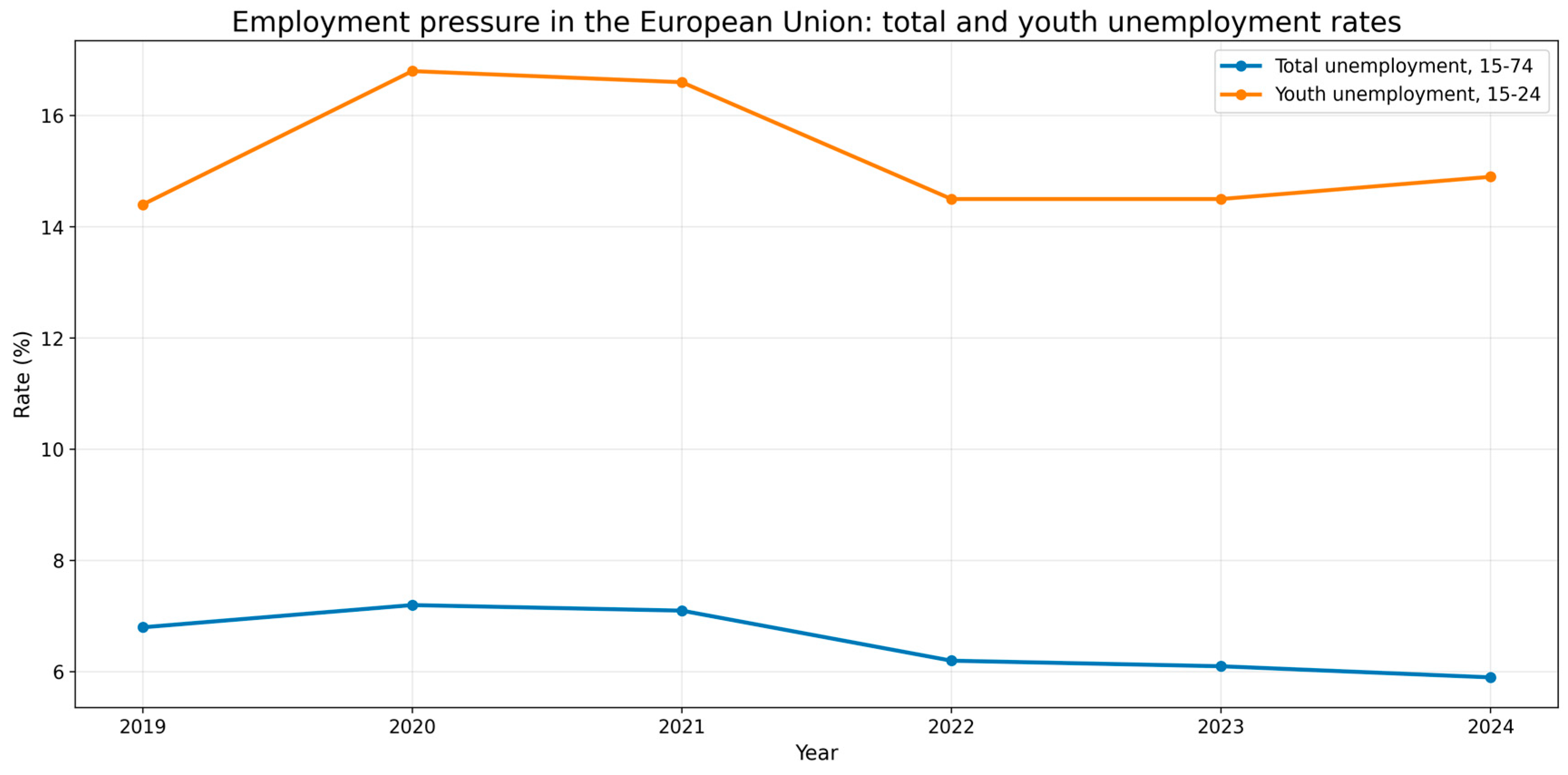
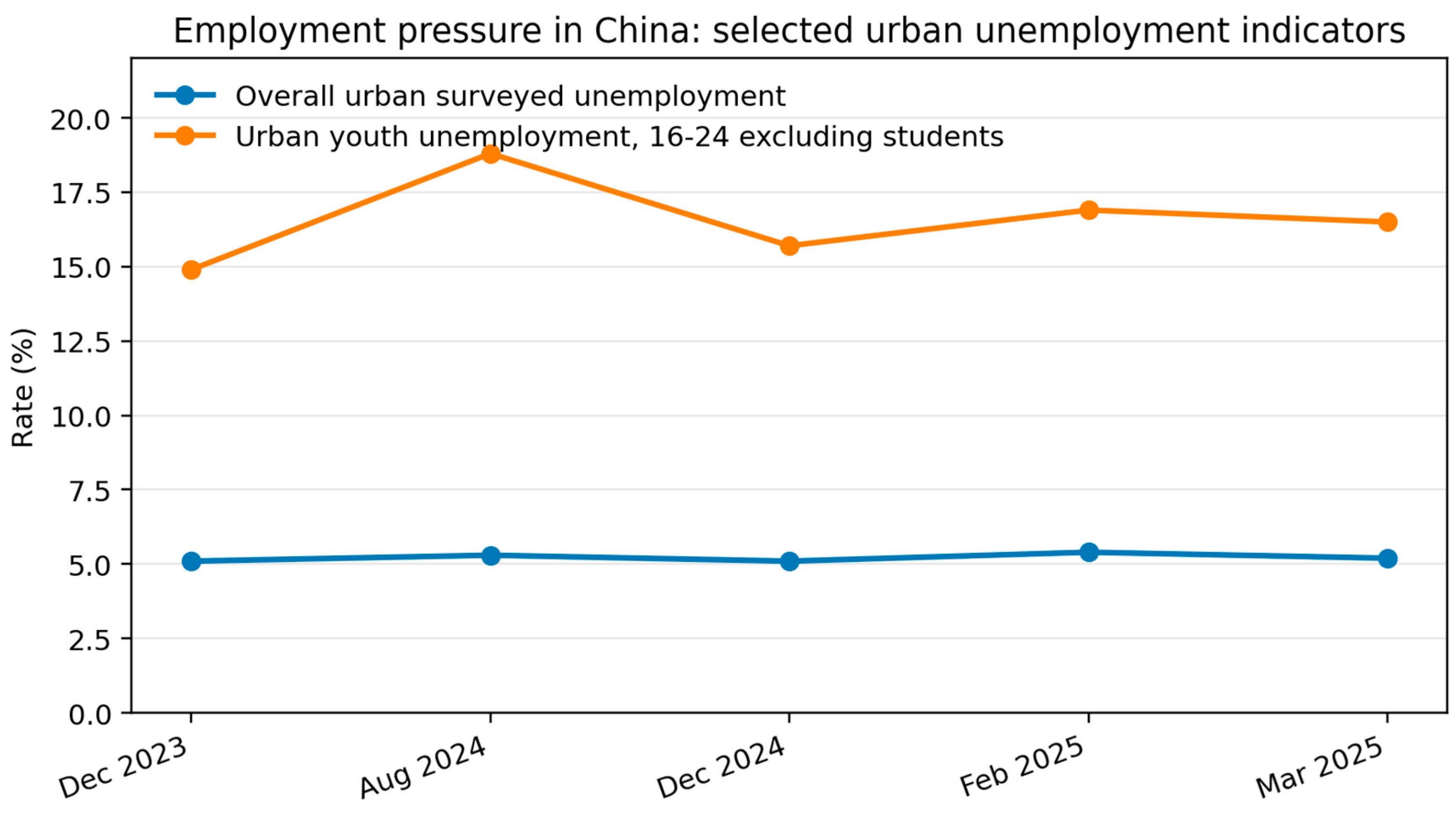
The following two figures offer a deliberately limited comparative snapshot of employment pressure. They are not intended to prove a direct causal link between unemployment and platform work. Instead, they show why algorithmically mediated work becomes appealing across different jurisdictions when younger workers face weaker labour market prospects than the general workforce.
Figure 1 and
Figure 2 present these comparative trends in numerical order.
Figure 1 and
Figure 2 support a comparative, not merely national, claim. In the EU, total unemployment fell to 5.9 per cent in 2024, yet youth unemployment stayed much higher at 14.9 per cent. In China, the overall urban surveyed unemployment rate remained close to 5 per cent, whereas youth unemployment under the revised methodology stayed above 15 per cent and reached 18.8 per cent in August 2024. These figures thus reveal a shared structural pattern: labour market pressure on early-career workers consistently exceeds general labour market pressure. This helps explain why platform work serves as an income buffer in different jurisdictions, while simultaneously weakening workers’ ability to challenge algorithmic ratings, task allocation, and deactivation decisions. The broader Chinese labour-market and digital-economy context is summarised in
Table 1.
The 2021 Guiding Opinions on Safeguarding the Labour Security Rights of Workers in New Forms of Employment (
MOHRSS et al. 2021) establish a three-tier framework. First, where conditions for an employment relationship are met, enterprises must sign labour contracts, and full legal protection applies. Second, where those conditions are not fully satisfied, but the enterprise exercises labour management over workers, written agreements are encouraged, creating a zone of partial protection. Third, where individuals operate as independent freelancers, civil law governs. This framework marks an important acknowledgement: not all platform work fits the classical binary, and labour management may generate obligations even without full employment status. Yet a serious ambiguity remains. Managerial authority today operates through algorithmic allocation, scoring, time pressure, and reward systems, but not visible human commands. If “labour management” is limited to visible commands, platforms can migrate into the middle or civil categories while retaining functional control, turning the framework into both a protective device and an avoidance channel. The three regulatory categories and their principal legal consequences are summarised in
Table 2.
The 2023 Guidelines on Rest and Labour Remuneration (
MOHRSS 2023a) introduce a doctrinal innovation in working-time law: working time includes accumulated order-taking time, with due allowance for waiting, service preparation, and physiological needs, and management time when platforms require workers to remain online or accept regular management at designated times and places. This reformulation treats working time as technologically mediated rather than confined to direct human supervision. By contrast, most pre-Directive jurisdictions applied working-time protection only to workers satisfying employment-status tests, typically counting only task-execution time. The Chinese Guidelines extend protection to the structural conditions of platform availability, rejecting the narrow counting of task moments as compensable work. The 2023 Guidelines on Publicity of Labour Rules (
MOHRSS 2023b) go further: labour rules now include not only written rules and contract terms but also algorithmic rules governing service organisation, dispatching, and labour management, which must meet standards of legality, fairness, transparency, explainability, and good faith, protecting workers’ rights to know and participate. This definitional move treats algorithmic rules as labour rules, refusing the platform’s claim that algorithmic systems are purely technical. Together with the 2022 Algorithmic Recommendation Provisions (
CAC et al. 2022), which require platforms to protect remuneration, rest, and leave rights and improve algorithms for order allocation, pay, time, and sanctions, a two-level governance framework emerges: platforms must align algorithms with labour-rights standards and make them legible to workers and regulators.
Table 3 summarises the resulting shift from civil-contract governance toward algorithmic labour governance.
Chinese judicial practice shows both the progress and limits of the functional approach. An empirical study of 3016 platform-related labour dispute judgements found that platform work has deepened the ambiguity and concealment of labour relations, that judges diverge substantially in how they select and weigh subordination factors, and that inconsistent interpretive approaches have produced uneven outcomes for workers with otherwise similar situations (
Wang and Qin 2025). The doctrinal difficulty is not the absence of a checklist; platform control appears through dispersed indicators—algorithmic dispatch, pricing power, ratings, subcontracting, and deactivation—none of which alone resembles traditional command, yet together they structure a worker’s practical dependence as thoroughly as any employment relationship.
The
Supreme People’s Court’s (
2024) guiding cases address this instability. Guiding Case No. 237 held that courts should determine the legal relationship by actual work performance, not the parties’ civil label. Relevant factors include: the worker’s autonomy over time and workload; the degree of control over the labour process; compliance with work rules, algorithmic rules, and discipline; work continuity; and the ability to decide transaction prices. Where actual work exists and the enterprise exercises dominant labour management, a labour relationship should be recognised (
Supreme People’s Court 2024). Explicit recognition of algorithmic rules as subordination evidence reflects the control-sensitive logic defended here.
The 2024 guiding cases issued by the Supreme People’s Court (SPC) address this instability. Guiding Case No. 237 held that courts should determine the legal relationship by actual work performance, not the parties’ civil label. Relevant factors include: the worker’s autonomy over time and workload; the degree of control over the labour process; compliance with work rules, algorithmic rules, and discipline; work continuity; and the ability to decide transaction prices. Where actual work exists and the enterprise exercises dominant labour management, a labour relationship should be recognised (
Supreme People’s Court 2024). Explicit recognition of algorithmic rules as subordination evidence reflects the control-sensitive logic defended here.
The 2025 typical cases show a complementary protective strategy through tort and insurance reasoning even when employment status is contested. In a food-delivery case, obtaining a health certificate under enterprise instruction was held within the insured business. In another, occupational injury benefits were held not to bar a separate tort claim (
Supreme People’s Court 2025). These decisions demonstrate functional protection built through insurance and platform-responsibility reasoning, yet they also reveal its limit: protection remains fragmented unless connected to enforceable rights against algorithmic control itself.
Before turning to the EU–China comparison, it is useful to isolate the specific workplace technologies through which biometric and affective control enters labour governance, since these technologies cut across both systems and raise regulatory questions that neither has yet fully resolved.
Biometric and affective technologies ought to be understood as cross-cutting techniques of labour governance rather than be relegated to a separate technical appendix. Facial recognition, emotion recognition, voice analytics, wearable sensors, and behavioural biometrics differ in their technical form, yet they share a common legal function: they extend managerial observation beyond conduct and output to encompass bodily identity, fatigue, attention, stress, and inferred emotional states. This is why any comparison between the EU and China must consider not only platform status and algorithmic transparency but also the emerging line between legitimate safety monitoring and impermissible affective surveillance.
Table 4 compares the principal EU and Chinese regulatory approaches across these dimensions.
In contrast to China’s approach, the EU framework highlights the former’s distinctive character and limitations. The EU Platform Workers Directive (2024/2831) centres on the correct determination of employment status, introduces an employment presumption, and builds algorithmic governance rules on top of a status-clarification framework. The EU Artificial Intelligence Act, meanwhile, adds risk classification, designates employment-related AI systems as high-risk, and restricts workplace emotion recognition. Together, they create a dual framework: status determines who is protected, while algorithmic governance rules determine how. China’s approach differs structurally—it does not rely on an employment presumption but instead experiments with functional protection, attaching rights to specific labour issues across the employment/civil divide. Its advantage is the ability to offer some protection without first settling the status question; its disadvantage lies in the risk that partial protection becomes normalised as a permanent equilibrium.
The divergence between the EU and Chinese approaches reflects a broader phenomenon: geoeconomic fragmentation. Platform companies operating globally encounter varying classification rules, algorithmic transparency duties, biometric data restrictions, and collective voice obligations across jurisdictions, creating opportunities for regulatory arbitrage. As the ILO has documented, regulatory responses to platform work remain uneven worldwide, with many jurisdictions still developing basic frameworks (
International Labour Organization 2021). Beyond the EU and China, other major platform-labour markets, including countries in South and Southeast Asia, Latin America, and Sub-Saharan Africa, adopt approaches that differ considerably in scope and enforcement capacity, often prioritising minimum income and social insurance over algorithmic management and transparency. Consequently, workers in less regulated jurisdictions bear disproportionate costs from the regulatory fragmentation driven by geoeconomic forces. The case for international convergence around a core principle that algorithmic control over labour should trigger labour-rights obligations regardless of employment status is therefore not only normatively compelling but practically urgent.
6. New Content Priorities for Labour Rights
If algorithmic governance produces mediated autonomy and algorithmic subordination, conditions that geoeconomic fragmentation, economic uncertainty, demographic pressures, and the embedding of platform labour into green and digital infrastructure both intensify and globalise, then future labour rights must be redesigned around structures of technological control. This paper argues that when decisions about wages, working hours, rest periods, and continued employment are made by algorithmic systems rather than identifiable human managers, those substantive rights require a new procedural and informational infrastructure to remain effective. The nine priorities outlined below provide that infrastructure.
Developing such rights demands interdisciplinary engagement that labour law alone cannot provide. Algorithmic transparency draws on computer science, platform engineering, and information law to identify meaningful and accessible information. Contestation and human review rely on administrative law, procedural fairness, and AI governance to define workable and enforceable procedural rights. Biometric and affective data minimisation looks to data protection law, medical ethics, and human rights law for categorical protection of bodily and emotional data. Emotional privacy draws on privacy theory, phenomenology, and feminist labour studies to preserve the opacity workers need for dignity and integrity at work. Collective participation in platform governance borrows from industrial relations, democratic theory, and organisational sociology to enable collective voice in fragmented, non-standard, digitally mediated work. No single discipline can substitute for labour law, but a labour law that fails to engage with them will remain structurally unprepared for the compound pressures reshaping the world of work.
- (i)
Meaningful algorithmic transparency. Workers are entitled to algorithmic transparency that is genuinely informative. Where automated systems govern task allocation, income, performance assessment, and platform access, workers must receive meaningful information about the criteria, weightings, and conditions that produce those outcomes, including their practical effects across the worker population. The operative standard is worker-centred: information is adequate only when it enables a worker, representative, inspector, or court to understand why a specific outcome occurred and whether it was fair.
- (ii)
Explanation and contestation. Workers are entitled to explanation and contestation for individual automated decisions. Deactivation, downgrading, penalisation, bonus deprivation, or exclusion from task allocation should each be accompanied by comprehensible reasons and access to a genuine challenge procedure, one that permits the submission of counter-evidence rather than merely registering an objection returned to the same system that issued the original decision.
- (iii)
Substantive human review. Human review must be substantive rather than nominal. A competent reviewer must have the authority to examine facts, override automated outcomes, and provide reasoned decisions, particularly for deactivation, major disciplinary measures, and decisions affecting access to social protection.
- (iv)
Predictable and fair remuneration. Remuneration rules must be stated in advance, comprehensible, stable over defined periods, and subject to prior notice before material change. Workers who cannot predict their income cannot plan responsibly or absorb temporary earnings shocks.
- (v)
Safe work and working time. Platform design choices that induce excessive working hours or unsafe speed, including delivery time estimates, order-acceptance requirements, and surge incentives, should be subject to occupational health and safety review. Availability and waiting time that the platform requires should count as working time.
- (vi)
Biometric and affective data minimisation. Biometric and affective data warrant categorical protection rather than case-by-case balancing. Facial templates, voiceprints, fatigue indicators, and inferred emotional states are qualitatively distinct from ordinary performance data. Their processing for productivity assessment or disciplinary purposes should be presumptively prohibited, with the burden of justification resting on the employer or platform.
- (vii)
Emotional privacy and affective autonomy. Workers retain a right to emotional privacy and affective autonomy. Employers retain a legitimate interest in the quality of customer interactions; they do not thereby acquire a right to continuously infer workers’ emotional states from physiological signals and convert those inferences into income, opportunity, or reputational scores.
- (viii)
Access, correction, and surveillance limits. Workers must have practical access to the data held about them in usable formats, together with rights to correct inaccurate records, limits on excessive surveillance, and safeguards against discriminatory or manipulative uses of data in allocation and pricing.
- (ix)
Collective participation in platform governance. Foundationally, workers need collective rights in platform governance. Individual remedies after harm has occurred are structurally insufficient: isolated workers face high transaction costs, limited information, and little capacity to identify systemic patterns. Workers or their representatives should be consulted on the design and revision of dispatch rules, remuneration formulas, rating systems, deactivation policies, and monitoring systems before deployment. Where existing classification rules exclude platform workers from collective bargaining, platform councils or sectoral representation bodies may provide an alternative vehicle. The objective is not worker veto over every technical decision, but democratic and labour-sensitive governance of systems that determine access to income and work.
Together these rights constitute a procedural and substantive framework adapted to algorithmic workplaces. Without collective infrastructure, they risk collapsing into individualised after-the-fact remedies; with it, they can shape the conditions under which algorithmic control is designed and exercised.
7. Conclusions
The compound pressures identified by the Future of Jobs Report 2025 include technological change, geoeconomic fragmentation, economic uncertainty, demographic shifts, and the green transition. These pressures are reshaping the conditions under which labour becomes visible, valuable, controllable, and legally classifiable. Algorithmic management is where these pressures become legally concrete. A platform worker may retain genuine discretion over whether and when to accept work, yet the platform designs the incentives, visibility rules, information environment, and consequences that give those choices their practical meaning. Existing legal categories were largely built for more visible and personal forms of managerial control.
This article has argued that an adequate response requires rethinking the content priorities of labour rights, not merely extending existing categories to new workers. Mediated autonomy does not deny worker agency or equate all platform work with coercion. It identifies a relational condition in which real choices are pre-structured by technical systems that organise incentives, opportunities, risk, and legal classification. Algorithmic subordination captures the form of control that may result when this structuring becomes dependent, opaque, continuous, and legally fragmented. The concepts are therefore complementary but not interchangeable: mediated autonomy describes the structured field of choice, whereas algorithmic subordination identifies the threshold at which that structure justifies labour-rights obligations.
The global dimension of this argument carries normative weight. Regulatory divergence across the EU, China, the United States, and the Global South creates a fragmented landscape that platform companies exploit, with workers in less regulated jurisdictions absorbing the costs. The convergent logic of the most advanced approaches points toward principles capable of supporting international convergence. That logic holds that algorithmic management is itself a proper object of labour regulation and that algorithmic rules are labour rules. The ILO’s core labour standards provide a necessary but insufficient foundation. Extending them to algorithmic management would require new instruments addressing transparency, worker data rights, biometric monitoring, and collective platform governance. This is politically difficult but not unprecedented, as ILO Conventions No. 189 and No. 188 demonstrate.
China’s experience offers a valuable but cautionary lesson. Its contribution lies in showing that labour rights can attach to algorithmic control as a mode of governance rather than to employment status as a threshold. Its risk lies in the possibility that flexible intermediate categories, without robust evidentiary rules and meaningful collective participation, normalise weaker protection as a permanent condition rather than a transitional one. The lesson for global regulatory debates is not that China’s framework should be transplanted, but that the functional approach is both feasible and necessary, and that its institutional risks are addressable through careful design.
The nine content priorities proposed here are not a comprehensive code but a framework for reconstructing labour rights around the structure of technological control. They supply the procedural, informational, and collective infrastructure without which traditional protections cannot be effectively claimed when consequential decisions are made within opaque technical systems. The future of labour law lies not only in extending old categories to new workers but also in rebuilding legal protection around the technological mediation of work itself.