Article

Good Faith at Sea: Non-Refoulement, Maritime Interdiction and Malaysian Practice Under International Law


by
Mohamad Syafiq Bin Sulaiman
1,2,* and
Jeong Chun Phuoc
2
1
Faculty of Business, Economics and Social Development, Universiti Malaysia Terengganu, Kuala Nerus, Kuala Terengganu 21030, Terengganu, Malaysia
2
Faculty of Law and International Relations, Universiti Sultan Zainal Abidin, Kampus Gong Badak, Kuala Nerus, Kuala Terengganu 21030, Terengganu, Malaysia
*
Author to whom correspondence should be addressed.
Laws 2026, 15(5), 106; https://doi.org/10.3390/laws15050106
Submission received: 22 June 2026 / Revised: 11 August 2026 / Accepted: 20 August 2026 / Published: 26 August 2026
(This article belongs to the Section Human Rights Issues)

Abstract

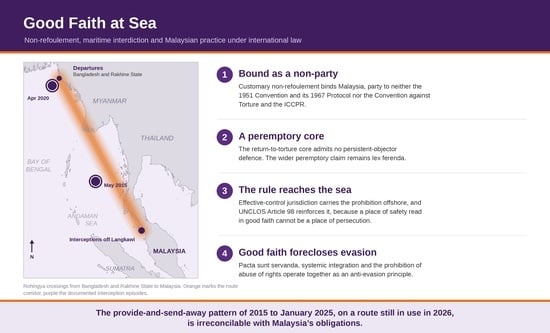
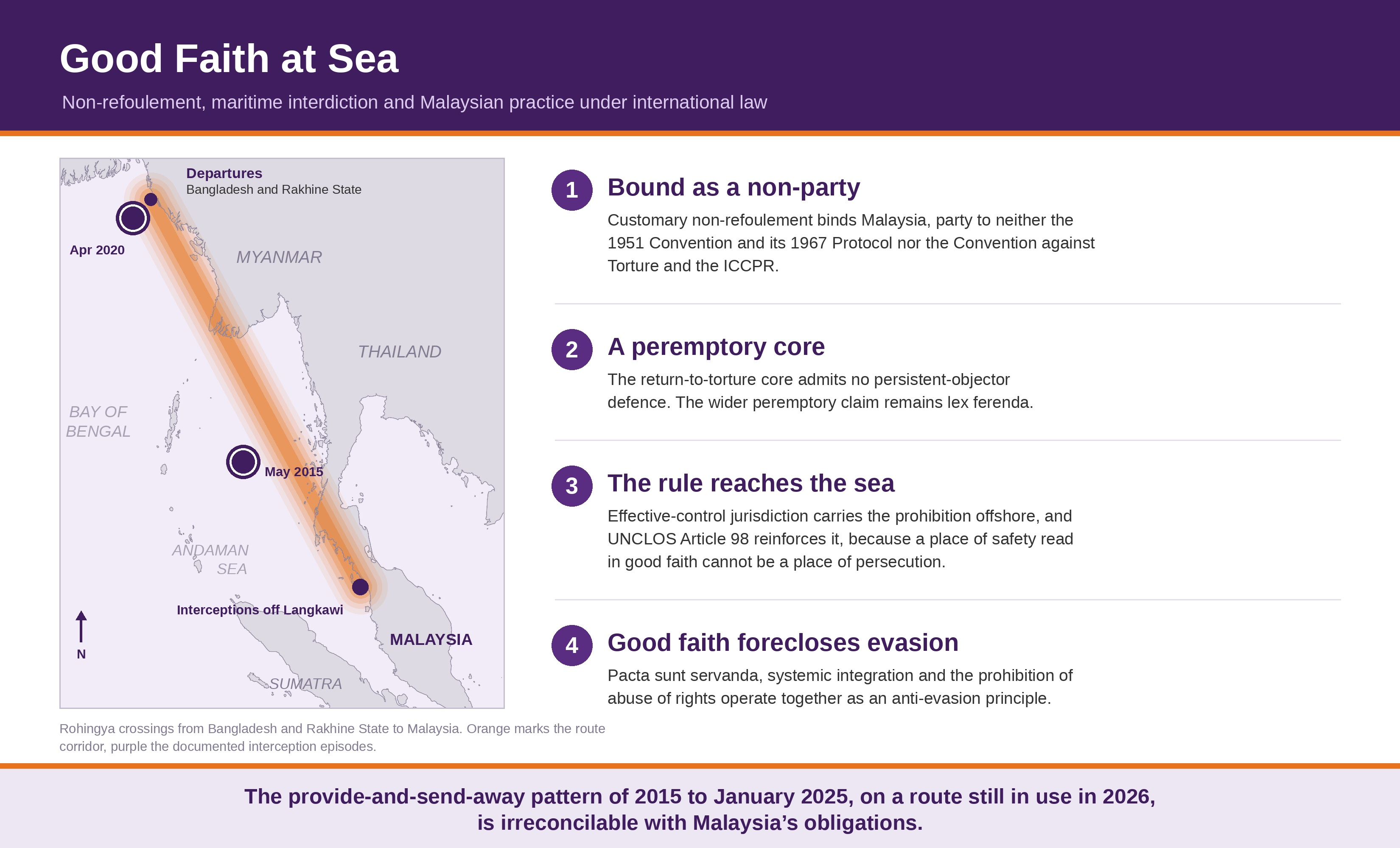
Malaysia intercepts and turns back Rohingya vessels in the Andaman Sea while party to neither the 1951 Refugee Convention, its 1967 Protocol, the Convention against Torture, nor the International Covenant on Civil and Political Rights, and the doctrinal literature on non-refoulement at sea, being largely European and Australasian, leaves this non-party setting under-examined. The article makes three contributions. First, through doctrinal analysis ordered under Article 38(1) of the Statute of the International Court of Justice, it establishes that the customary prohibition of refoulement binds Malaysia and that its return-to-torture core is best treated as peremptory, admitting no persistent-objector defence. Second, it shows that the prohibition reaches conduct at sea through effective-control jurisdiction and that the rescue duty under Article 98 of the United Nations Convention on the Law of the Sea reinforces rather than displaces it, because a place of safety read in good faith cannot be a place of persecution. Third, it develops good faith, through pacta sunt servanda, systemic integration, and the prohibition of abuse of rights, as an anti-evasion principle. Assessed against these standards, the provide-and-send-away pattern documented from 2015 to January 2025, on a route that remained in use into 2026, is irreconcilable with Malaysia’s obligations.

Graphical Abstract

1. Introduction

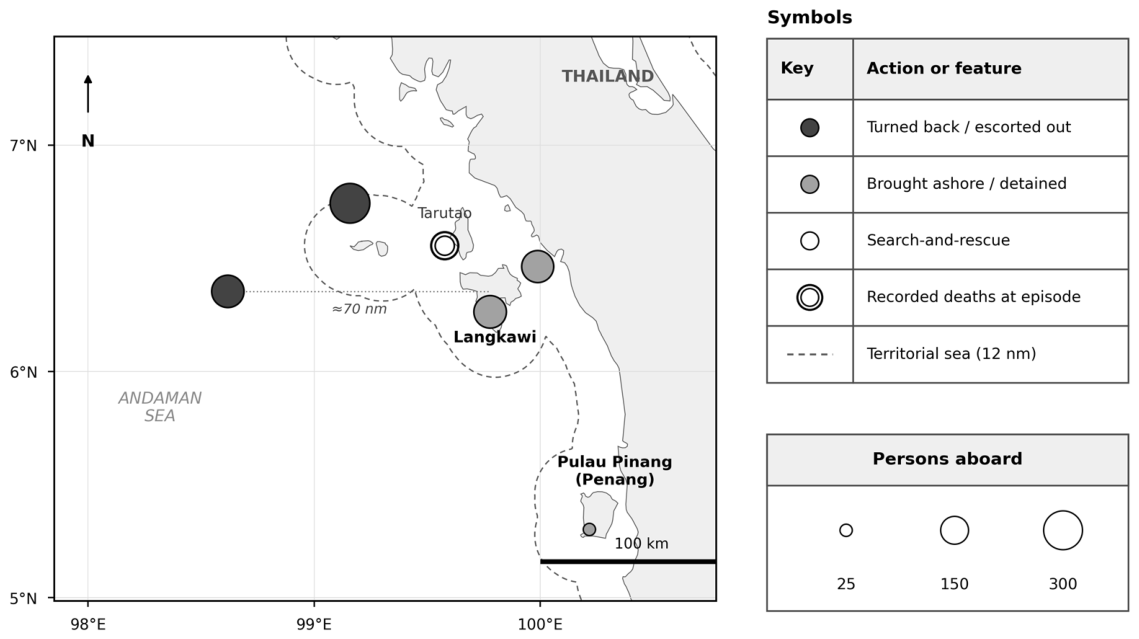
On 16 April 2020, a Royal Malaysian Air Force aircraft sighted a boat carrying approximately 200 Rohingya some 70 nautical miles west of Langkawi. The navy intercepted it well within Malaysia’s exclusive economic zone, far beyond the territorial sea. Its crew provided food to those aboard and escorted the vessel back out to sea rather than bringing anyone ashore. No formal transfer to Myanmar occurred, but the interdiction denied those aboard disembarkation, screening, and delivery to a place of safety, exposing them to the very risks that the maritime and non-refoulement regimes are designed to prevent. Whether international law forbade this conduct is the question this article addresses. This article approaches this question through the lens of good faith because Malaysian turn-backs are framed as rescue, provisioning, and non-arrival rather than as return. The source-of-law analysis shows that Malaysia is bound, and the jurisdictional analysis shows where the obligation attaches. Good faith explains why maritime distance and humanitarian vocabulary cannot be used to accomplish at sea what international law forbids on land.
Article 33(1) of the 1951 Convention relating to the Status of Refugees prohibits the expulsion or return of a refugee “in any manner whatsoever to the frontiers of territories where his life or freedom would be threatened” on Convention grounds, and Article 42(1) places that prohibition beyond the reach of any reservation.1 Malaysia has not acceded to that Convention, its 1967 Protocol, the Convention against Torture, or the International Covenant on Civil and Political Rights, the two instruments that extend the prohibition to any person facing a real risk of torture or cruel, inhuman, or degrading treatment.2 Therefore, those treaty texts cannot answer whether Malaysia is bound when the Malaysian Maritime Enforcement Agency intercepts a boat of Rohingya asylum seekers in the Andaman Sea, provisions it, and escorts it back to international waters.
Malaysia is bound by two doctrinal bases. The first is the source-of-law question. Although Malaysia is not bound by Article 33 qua treaty, it is bound by the customary norm of non-refoulement that Article 33 reflects, and the better view is that the return-to-torture core of that norm has attained peremptory status. The second is the operational question. Non-refoulement does not stop at the coastline. It reaches a state that exercises effective control over persons at sea, whether through the de jure control of a flag vessel or the de facto control of an interdiction, and the law of the sea reinforces rather than displaces that obligation (Trevisanut 2014).3
Good faith, expressed through pacta sunt servanda, the Article 31 interpretive rule, and the prohibition of the abuse of rights, connects Malaysia’s formal non-party status to its substantive obligation at sea.4 Malaysian practice is the apt setting for the question because the documented sequence of interception, provisioning, and escort to the open sea is structured as precisely an indirection.
The doctrinal literature on non-refoulement at sea is overwhelmingly European and Australasian, built on Mediterranean interdiction jurisprudence and Pacific offshore-processing cases (Gleeson 2017; Moreno-Lax 2012). Southeast Asia, where no regional refugee instrument parallels the 1969 Organisation of African Unity Convention or the 1984 Cartagena Declaration, and where the non-interference principle of the ASEAN Charter constrains collective responses, has received far less doctrinal attention (Espenilla 2010; McNevin and Missbach 2018). That distance is not accidental. Davies traces it to the good-neighbourliness reading of ASEAN non-interference and the appeal to Asian values, rationales that together have legitimised rejection over protection (Davies 2008).
The doctrinal conversation in this journal reflects the same imbalance, examining pushbacks (Bochenek 2023), externalisation (Fourer et al. 2020), the safe-country concept (Pulvirenti 2025), and border control at a distance (Allinson 2025); however, its Asian cases reach Thailand and India rather than the Andaman approaches to Malaysia (Nguyen 2023; Alexander and Singh 2022).
This gap is significant. Malaysia hosts one of the largest registered Rohingya populations in Southeast Asia. As of February 2026, the Office of the United Nations High Commissioner for Refugees recorded approximately 215,600 refugees and asylum seekers in Malaysia, overwhelmingly from Myanmar.5 The state hosts that population without a refugee statute, without accession to the governing Convention, and against a documented record of maritime pushbacks. That record is neither closed nor historical. Malaysian forces again provisioned and turned back Rohingya vessels off Langkawi in January 2025, and the crossing grew deadlier into 2026. Malaysia is therefore a critical case for testing whether the customary prohibition and the good faith that conditions its performance reach a non-party.
The analysis first establishes the source-of-law status and extraterritorial reach of non-refoulement and then reads the law of the sea, good faith, and Malaysian practice against that obligation. The doctrinal outline is functional rather than a survey. It sets out only the source, reach, and maritime rules needed to test Malaysia’s turn-backs under good faith. The methodology is doctrinal (Hutchinson 2013) and is ordered under Article 38(1) of the Statute of the International Court of Justice, as the section on Methodology and Analytical Framework details.6
Non-refoulement is not a single rule but a group of related obligations, and the analysis distinguishes three legal components of non-refoulement. The refugee-law strand, drawn from Article 33 of the 1951 Convention, prohibits return where life or freedom would be threatened on Convention grounds, subject to the exceptions in Article 33(2). The human-rights strand, drawn from the prohibitions of torture and arbitrary deprivation of life, prohibits return to a real risk of torture, cruel or inhuman treatment, or death, and admits no exception. The maritime strand, drawn from the law of the sea, governs assistance, disembarkation, and delivery to a place of safety.
The refugee-law and human-rights strands bind Malaysia as custom, the torture core binds it as a peremptory norm, and the maritime strand binds it by treaty under UNCLOS and SOLAS. Good faith conditions the interpretation and performance of all three aspects. This distinction matters because a proposition that holds for the torture core does not always hold for the broader refugee-law norm.

Methodology and Analytical Framework

The method applied in this article is doctrinal legal research which refers to a systematic exposition and application of the rules governing the problem (Hutchinson 2013), and the analysis is ordered by the sources listed in Article 38(1) of the Statute of the International Court of Justice, which directs the Court to apply “international conventions”, “international custom, as evidence of a general practice accepted as law”, “the general principles of law recognized by civilized nations”, and, as subsidiary means, “judicial decisions and the teachings of the most highly qualified publicists”.7
Each section corresponds to a rung of that framework. Section 2 identifies the customary prohibition and its peremptory core under Article 38(1)(b) and situates the Islamic doctrine of amān as corroborative material bearing on the general principles contemplated by Article 38(1)(c). Section 3 tests the jurisdictional reach of the prohibition through judicial and quasi-judicial decisions as subsidiary means under Article 38(1)(d). Section 4 applies the treaty obligations Malaysia has accepted under Article 38(1)(a), Section 5 deploys good faith as a general principle conditioning performance and interpretation, and Section 6 assesses Malaysian practice against each strand in turn.
Three methodological commitments follow. First, the two-element methodology codified in the International Law Commission’s 2018 Draft Conclusions governs every customary claim, so assertions of practice and opinio juris are anchored to depositary records, official statements, and documented conduct rather than to scholarly consensus alone. Second, the evidentiary base for Malaysian practice is confined to documented episodes and reported ministerial statements, and where an argument turns on exact wording, the reporting source rather than an official transcript carries it. Third, the analysis distinguishes throughout between what binds Malaysia as treaty law, as custom, and as a peremptory norm, because the exceptions available differ across those strata. The limitations that follow from these commitments are set out in the Conclusions.

2. The Customary and Peremptory Status of Non-Refoulement

Because Malaysia is not bound by Article 33 as a treaty term, the customary status of non-refoulement is dispositive in this case. If the norm is customary, it binds Malaysia directly under the orthodox principle that a treaty provision may bind a non-party when it reflects a customary international law rule.8 If not, those direct treaty anchors fall away, and the collateral obligations Malaysia has assumed under UNCLOS, SOLAS, and the child- and disability-rights conventions apply only obliquely.
Table 1 distinguishes between the instruments binding Malaysia and those that do not.

2.1. The Formation of Customary International Law

The International Court of Justice fixed the two elements of customary international law in the North Sea Continental Shelf, requiring practice accompanied by opinio juris, a sense of legal obligation rather than habit alone.9 The Court has since reaffirmed this in Nicaragua and later cases.10 The International Law Commission codified the same methodology in its 2018 Draft Conclusions (Wood and Sender 2024).11
Where a state’s practice is inconsistent with a rule it professes to accept, the Nicaragua principle treats that conduct as a breach rather than as evidence of a new rule, provided that the state defends itself by appealing to exceptions within the rule.12 This principle governs the assessment of Malaysian practices.

2.2. Non-Refoulement as Established Custom

Non-refoulement satisfies the two-element test. The practice element rests on near-universal treaty participation, regional restatement in the 1969 Organisation of African Unity Convention and the 1984 Cartagena Declaration, and successive Executive Committee Conclusions (Chetail 2014, pp. 54–57).13 The opinio juris element rests on the acceptance Da Lomba describes as virtually unbroken, including by states not party to the 1951 Convention or Protocol (Da Lomba 2004, p. 7). A state’s silence may evidence acceptance as law where it was “in a position to react and the circumstances called for some reaction”.14 The 2001 Declaration of States Parties and the 2016 New York Declaration provide evidence, rather than create, the customary rule.15 Therefore, non-refoulement is customary and applies to Malaysia as a non-party whose conduct at sea must be assessed against it.
The weight of scholarly authority agrees, including a parallel two-element assessment of Australia’s maritime turn-backs that reaches the same conclusion (Lauterpacht and Bethlehem 2003, pp. 149–50; Goodwin-Gill et al. 2021, chaps. 5–7; Costello and Foster 2016; Mansfield 2015). Hailbronner’s and Hathaway’s dissents have not prevailed (Hailbronner 1986; Hathaway 2010).

2.3. The Peremptory Status of the Torture-Based Core

Whether non-refoulement has crystallised into a peremptory norm is more contested. Allain, Costello, and Foster make the stronger case for peremptory status (Allain 2001), while Goodwin-Gill, McAdam, Dunlop, and Imam Supaat caution that the supporting practice has not reached the Article 53 threshold. The Commission’s 2022 Draft Conclusions on Peremptory Norms omitted non-refoulement from the illustrative list while preserving the possibility, leaving the broad refugee-law norm short of established peremptory status (Tladi 2024).16
The better view distinguishes the refugee-law strand from the torture strand. Article 33 is subject to the exceptions in Article 33(2); thus, the broader refugee-law norm is customary but not peremptory. The torture strand is different. It derives from the absolute prohibition of return to torture, and the strongest lex lata case for peremptory status follows from the peremptory status of the prohibition of torture itself and supporting regional authority. The International Court of Justice has recognised torture as a peremptory norm in Belgium v. Senegal, and the Inter-American Court has treated human-rights non-refoulement as a peremptory norm that gives practical effect to the prohibition of torture.17
This point can be simply made. A peremptory prohibition of torture would be defeated if a state could return a person to a real risk of being tortured. The peremptory claim is therefore confined to the return-to-torture core, while the wider refugee-law claim remains lex ferenda. If the torture core is peremptory, the persistent-objector defence is unavailable under Draft Conclusion 14 (Tladi 2024, pp. 175–78).18
The persecution and torture strands overlap without merging, and the relationship requires precision. Torture inflicted for a Convention reason is paradigmatic persecution, and the severest forms of persecution will often meet the threshold of torture or of cruel, inhuman, or degrading treatment. The two categories nonetheless differ in structure. Persecution requires a nexus to race, religion, nationality, membership of a particular social group, or political opinion, and an accumulation of measures that individually fall short of torture can constitute it. Torture under Article 1 of the Convention against Torture requires “severe pain or suffering, whether physical or mental”, intentionally inflicted for a proscribed purpose with official involvement, and its prohibition protects any person without any nexus requirement.19 The exception structures differ accordingly, because Article 33(2) qualifies the refugee-law strand on security grounds while the human-rights strand admits no exception at all. That asymmetry is why the peremptory claim can attach to the return-to-torture core but not to the wider refugee-law norm, since a norm cannot be peremptory in its entirety while part of its content remains derogable under the very instrument that codifies it.
For the Rohingya, the strands converge on the facts. The International Court of Justice found in The Gambia v. Myanmar that the rights of the Rohingya to protection from acts of genocide were plausible and that a real and imminent risk of irreparable prejudice existed.20 Return to Myanmar therefore exposes those intercepted to harm that satisfies the persecution standard and reaches the torture threshold at once, so the population at issue sits within the intersection where the customary rule and the peremptory core operate together. The distinction between the strands matters not because it weakens the prohibition here but because it fixes what Malaysia can and cannot invoke against it, a point developed in Section 6.6.
Malaysia cannot rely on persistent objections. A state may escape a customary rule by persistently and publicly objecting from the moment of its emergence. Malaysia cannot invoke this defence for two independent reasons. First, the torture core is peremptory, and the defence does not run against it. Second, as to the wider norm, Imam Supaat’s study finds no evidence that Malaysia has ever formally objected to or denied the principle of non-refoulement, and the affirmative record points the other way (Imam Supaat 2013). In its Initial Report to the Committee on the Rights of the Child, the Malaysian Government stated that it “has always observed the customary international laws in this area” and that “[p]ersons entering Malaysia claiming to be refugees have always been given assistance on humanitarian grounds”, an official statement squarely incompatible with persistent objection.21 Moretti reaches the same conclusion for the region as a whole, observing that Thailand, Malaysia, and Indonesia invoke exceptions to non-refoulement rather than denying the rule, a posture that implicitly recognises its existence and applicability (Moretti 2018, pp. 10–19).
A sceptic might point to the courts that have accepted the customary prohibition while leaving room for persistent objection, as Lambert observes of Hong Kong jurisprudence. Yet, that reasoning cannot run against the peremptory torture core, which admits no opt-out (Lambert 2021). The customary prohibition binds Malaysia on both strands, absolutely on the torture core and subject only to internal exceptions on the refugee-law norm. Custom supplies the baseline obligation, and good faith becomes the operative principle.

2.4. The Islamic Doctrine of Amān as Supporting Authority

The Islamic legal tradition contains a protective institution, amān, the grant of safe-conduct by which a person from outside the polity receives the protection of life and property, and its classical elaboration converges with the customary prohibition. It is not a binding source of international law, and Section 6.1 examines it fully, where it operates as a living element of Malaysia’s own legal order. Its significance at this point is comparative. Taken with cognate institutions in other principal legal systems, the doctrine evidences the general principle of protection that Article 38(1)(c) of the Statute of the Court contemplates (Shebaita 2025), and a protective conviction shared across legal cultures corroborates, though it cannot alone establish, the acceptance and recognition that Article 53 of the Vienna Convention requires for the return-to-torture core. McNair’s classic formulation captures the register intended here, because the international judge applies not the concrete manifestation of a principle in different national systems but the general concept of law underlying them.22

3. The Extraterritorial Reach of Non-Refoulement

Establishing that the prohibition binds Malaysia does not, by itself, extend to conduct on the high seas. Jurisdiction provides the answer. The better view, now backed by the weight of international authority, is that jurisdiction follows effective control and not territory.

3.1. Effective Control as the Basis of Jurisdiction

The seminal authority is the Grand Chamber judgment in Hirsi Jamaa and Others v. Italy. Italy intercepted approximately 200 migrants on the high seas and returned them to Tripoli. The Court held unanimously that whenever a state “through its agents operating outside its territory exercises control and authority over an individual, and thus jurisdiction”, it must secure to that individual the relevant Convention rights and freedoms, so the applicants fell within Italian jurisdiction.23 The Court found the applicants “under the continuous and exclusive de jure and de facto control of the Italian authorities” throughout.24 In Medvedyev and Others v. France, the Grand Chamber confirmed the principle from the law-enforcement side, holding that a state that intercepts a vessel and takes charge of those aboard exercises “full and exclusive control” over them, “at least de facto”, so they fall within its jurisdiction.25
The Court also rejected Italy’s rescue characterisation, found a violation of Article 3 in the applicants’ exposure to ill-treatment in Libya and chain-refoulement, and held for the first time that collective expulsion under Protocol No. 4, Article 4, applies extraterritorially (den Heijer 2013; Giuffré 2012).26
Here, Hirsi Jamaa is invoked as a persuasive authority on the general principle that effective control triggers jurisdiction and the non-refoulement duty, not as a source of obligation for Malaysia or a rule confined to European systems.
The Human Rights Committee applies the same standard in General Comment No. 31, under which the duty to respect and ensure Covenant rights extends to anyone within the state’s power or effective control and bars return to a real risk of irreparable harm.27 The Committee on the Rights of the Child extends this to children attempting to enter a state’s territory, and the Human Rights Committee extends the right to life to those whom a state is positioned to protect, including persons in distress at sea.28 The Committee has since applied that standard to a concrete maritime emergency, finding in A.S. v. Italy that persons aboard a sinking vessel on the high seas fell within Italy’s jurisdiction through the special relationship of dependency created by its contact with the vessel and its obligations under the law of the sea. However, the parallel communication against Malta was held inadmissible for non-exhaustion, and both decisions drew separate opinions contesting the jurisdictional test’s scope.29
The Office of the United Nations High Commissioner for Refugees adopts the same criterion in its 2007 Advisory Opinion on the extraterritorial application of non-refoulement, where the decisive test is not the person’s presence on the state’s territory but the state’s effective control and authority over that person.30 Wider scholarship reaches the same conclusion, locating a state’s obligations in the de facto sphere of its power over those it rescues or controls at sea (Gammeltoft-Hansen 2011; Tiedemann 2021).
Subsequent jurisprudence in 2025 confirms the same effective control reasoning while exposing its limits in the proxy-interdiction setting. In A.R.E. v. Greece, the European Court found “a systematic practice of pushbacks” by Greek authorities at the Evros land border. It held that a summary return without an effective remedy violated Articles 3 and 13 of the Convention, the first occasion on which that systematic practice was characterised as such.31 In contrast, in S.S. and Others v. Italy, the Court declared a claim arising from a Libyan-led interception by a coastguard that Italy had funded, trained, and supported inadmissible, holding that financial and technical support alone did not bring the maritime area under Italy’s effective control or decisive influence, and declining to read jurisdiction functionally on the facts (Moreno-Lax 2020).32
The Malaysian conduct under examination here is materially different from the proxy interdiction in S.S. The Malaysian Maritime Enforcement Agency intercepts Rohingya boats with its own vessels, takes control of the boats and those aboard, provisions them, and escorts them out of Malaysian waters. This conduct falls within the orthodox effective-control rule of Hirsi Jamaa rather than the contested proxy periphery, because the controlling state acts through its own organs at the point of interception. Jurisdiction crystallises once the intervening unit takes charge, whether by boarding, orders, force, or towing, the exact pattern of a Malaysian intercept (Galani 2025).
This classification matters. A turn-back is a positive act of removal, not a failure to rescue. Malaysian turn-backs therefore do not sit at the proxy-interdiction boundary. They fall inside the direct-control cases involving boarding, escort, detention, transfer, or compelled navigation. The scholarship locates the duty in the state’s factual connection to those in peril; therefore, effectiveness rather than formal territorial title triggers the obligation (Tzevelekos and Katselli Proukaki 2017).

3.2. Interdiction at Sea and the Committee Against Torture

The Committee against Torture applied the effective-control criterion to an interception at sea in J.H.A. v. Spain, the Marine I case. The communication was inadmissible because the complainant lacked authorisation; therefore, it contained no merits ruling on non-refoulement and must not be cited for one (see Wouters and den Heijer 2010).33 Its jurisdictional reasoning remains useful. The Committee rejected Spain’s jurisdictional objection because jurisdiction extends to “any territory in which it exercises, directly or indirectly, in whole or in part, de jure or de facto effective control”. Spain had “maintained control over the persons on board the Marine I from the time the vessel was rescued and throughout the identification and repatriation process” in Mauritania.34 The decision confirms that rescue plus control at sea engages the jurisdiction of the controlling state.

3.3. The Contrary Authority of Sale v. Haitian Centers Council

The principal authority against extraterritorial reach is the United States Supreme Court’s decision in Sale v. Haitian Centers Council. The majority held that Article 33 has no application to aliens interdicted on the high seas, reasoning that the text “cannot reasonably be read to say anything at all about a nation’s actions toward aliens outside its own territory”, while conceding that such conduct “may even violate the spirit of Article 33”.35 International authority rejects Sale. The Office of the United Nations High Commissioner for Refugees did so in the 2007 Advisory Opinion, and the Inter-American Commission on Human Rights in the Haitian Centre for Human Rights case.36
The textual objection that carries Sale is weak under Article 31(1) of the Vienna Convention. The phrase “in any manner whatsoever”, read in the light of the Convention’s protective object and purpose, admits no territorial limitation. Judge Pinto de Albuquerque’s concurrence in Hirsi Jamaa makes the same point by reference to the French verb refouler, and Ben-Nun’s archival research shows that the drafters were aware of maritime interception and treated humanity rather than geography as the qualifying criterion (Ben-Nun 2015, pp. 112–13).37 Sale is therefore an isolated national authority, not the custom binding Malaysia. Effective control identifies when the obligation attaches at sea. Good faith prevents the state from invoking maritime distance, rescue language, or non-arrival to deny the legal consequences of that control.

4. The Law of the Sea and the Non-Refoulement Obligation

A recurring argument treats the law of the sea as a self-contained regime that displaces refugee and human rights obligations once a vessel is characterised as a rescue case. The argument fails. International law recognises no regime that operates in isolation from the general law, and the law of the sea is no exception. Malaysia is a party to the United Nations Convention on the Law of the Sea, having ratified it on 14 October 1996. Therefore, its maritime obligations bind it as treaty law independently of its refugee-law non-party status, and they reinforce rather than displace the prohibition of refoulement.38

4.1. The Duty to Render Assistance

Article 98(1) of UNCLOS codifies a customary duty “to render assistance to any person found at sea in danger of being lost” and “to proceed with all possible speed to the rescue of persons in distress”.39 The duty is one of conduct qualified only by serious danger to the rescuing vessel, and no immigration or other exception attaches to it. Article 98(2) adds a cooperative search-and-rescue obligation, which grounds the regional disembarkation arrangements a compliant practice would require.40 The International Convention for the Safety of Life at Sea, to which Malaysia acceded in 1983, reinforces the duty, and its 2004 amendments confirm that assistance must be rendered regardless of the persons’ nationality or status, separating rescue from migration control (Barnes 2004; Papastavridis 2009). Malaysia is not a party to the Search and Rescue Convention; therefore, it and the cognate IMO Guidelines bear on Malaysia’s position only as evidence of the general regime within which the binding rescue duty operates.41
A subsidiary objection turns on the vessels’ statelessness and does not assist Malaysia. A vessel without nationality may be boarded under the right of visit in Article 110(1)(d) of UNCLOS.42 That right permits approach and inspection, not seizure of the vessel or the removal of those aboard, on which the Convention is silent (Coppens 2017). Statelessness removes the vessel’s flag-state protection, but meeting a vessel in distress generates the obligation the customary prohibition and the rescue duty supply rather than extinguishing it (Mann 2016).

4.2. The Place of Safety Requirement

The 2004 SOLAS amendments, along with the parallel amendments to the SAR Convention and the accompanying IMO Guidelines on the Treatment of Persons Rescued at Sea, mandate disembarkation at a place of safety within a reasonable timeframe. A place of safety is defined as “a location where rescue operations are considered to terminate”, where “the survivors’ safety of life is no longer threatened” and where “their basic human needs (such as food, shelter and medical needs) can be met”. The Guidelines confirm that an assisting ship should not be considered a place of safety “based solely on the fact that the survivors are no longer in immediate danger once aboard the ship”.43 Therefore, the maritime concept of a place of safety must incorporate the refugee-law prohibition of refoulement.
This incorporation follows from the interpretive rules of the VCLT. Article 31(1) requires that a treaty be interpreted “in good faith in accordance with the ordinary meaning to be given to the terms of the treaty in their context and in the light of its object and purpose”. Article 31(3)(c) requires account to be taken of “any relevant rules of international law applicable in the relations between the parties”, which is the principle of systemic integration.44 A location where a rescued person faces persecution or chain-refoulement cannot be a place of safety, because safety means more than survival at sea.
The Office of the United Nations High Commissioner for Refugees reads the regimes harmoniously, and recent international jurisprudence has reached the same result through systemic-integration reasoning (Treves 2010).45 The Guidelines record “[t]he need to avoid disembarkation in territories where the lives and freedoms of those alleging a well-founded fear of persecution would be threatened”, and they place questions of refugee and migratory status beyond the remit of the International Maritime Organization and the scope of the two conventions.46 The allocation confirms, rather than unsettles, this reading. Maritime instruments supply the procedural framework, while the customary prohibition, applicable between the parties under Article 31(3)(c), supplies the standard disembarkation must satisfy.
Where the vessel and those aboard are in distress, and the intercepting state assumes control, provisioning the vessel and escorting it back to the open sea is not the completion of a rescue but its abandonment. Such conduct is incompatible with the Article 98 rescue framework, read with SOLAS and the place-of-safety regime. The place-of-safety requirement supplies the operational form of compliance, and good faith supplies the interpretive discipline that prevents safety from collapsing into mere survival at sea.
The dangers of relabelling are well documented. An intercepting state has every incentive to present an interception as a rescue because the rescue characterisation appears to reduce its disembarkation and protection duties, which is precisely what good faith forecloses (Miltner 2006). The MV Salamis standoff shows this limit. A place of safety that satisfies the law must protect against return to danger, and a coordinating state cannot escape that standard by invoking its non-party status to the Search and Rescue Convention, whose disembarkation core binds regardless of membership (Mallia 2014).

5. Good Faith and the Performance of Obligations

Good faith does not create new obligations. It conditions the performance of duties that already bind Malaysia and forecloses its evasion by indirect means.

5.1. Malaysia’s Obligations Under the Vienna Convention

Malaysia acceded to the Vienna Convention on the Law of Treaties on 27 July 1994. The rules on which the argument relies therefore bind Malaysia directly as treaty law, and their customary character supplies an additional, not the sole, basis of application. The International Court of Justice has repeatedly treated Articles 31 and 32 as customary, and good faith is, in any event, a free-standing general principle of international law within the meaning of Article 38(1)(c) of the Statute of the Court (Kolb 2017).47 Article 2(2) of the UN Charter requires all members to “fulfil in good faith the obligations assumed by them in accordance with the present Charter”. The Court held in the Nuclear Tests cases that “[o]ne of the basic principles governing the creation and performance of legal obligations, whatever their source, is the principle of good faith”, though good faith is not itself a source of obligation where none otherwise exists.48
Article 26 of the Vienna Convention states the principle of pacta sunt servanda and binds Malaysia to perform in good faith every treaty in force, including UNCLOS and the Convention on the Rights of the Child. Article 31 governs the construction of these treaties and supplies the systemic-integration reading of the place-of-safety concept. Therefore, good faith conditions the performance and interpretation of the maritime and child-rights obligations Malaysia has actually undertaken, against the background of the customary prohibition of refoulement.
Malaysia has undertaken unreserved right-to-life obligations that reach the same result without the 1951 Convention. Malaysia acceded to the Convention on the Rights of the Child in 1995 without reservation to the right-to-life guarantee in Article 6 and ratified the Convention on the Rights of Persons with Disabilities in 2010 with reservations that do not affect the right-to-life guarantee in Article 10.49 The right to life, on the now-authoritative reading, entails a prohibition on return to a real risk of irreparable harm. For a state party to the Convention on the Rights of the Child, the source is more direct. The Committee on the Rights of the Child draws that prohibition from the Convention itself and holds that a state shall not return a child where substantial grounds show such a risk of the kind contemplated in Articles 6 and 37.50
The International Court of Justice restated the same reading in paragraph 378 of the 2025 Advisory Opinion on the Obligations of States in respect of Climate Change, where the Court, drawing on the right to life under Article 6 of the Covenant on Civil and Political Rights, held that “States have obligations under the principle of non-refoulement where there are substantial grounds for believing that there is a real risk of irreparable harm to the right to life in breach of Article 6 of the ICCPR if individuals are returned to their country of origin”. Malaysia is not a Covenant party; therefore, the Court’s reasoning does not bind it directly, but it confirms the right-to-life dimension of non-refoulement that Malaysia owes through the customary prohibition and the unreserved right-to-life guarantees it has accepted under the CRC and CRPD.51
Performed in good faith under Article 26, those unreserved guarantees are incompatible with a maritime practice that exposes children aboard intercepted vessels, and any persons with disabilities among them, to a foreseeable risk of death. Scholarship on the interplay between the refugee instrument and the child-rights regime reinforces this reading, treating the latter as the source of protection that the former leaves implicit for children (Schmahl 2026). This basis binds Malaysia through the child- and disability-rights guarantees in treaties it has ratified, independently of the customary characterisation. Good faith functions independently here, foreclosing the formalist division between honouring the right to life on land and defeating it at sea.

5.2. The Limits of the Interim Obligation Under Article 18

The interim obligation of Article 18 of the Vienna Convention obliges a signatory to “refrain from acts which would defeat the object and purpose of a treaty” until its entry into force or a clear indication of intention not to become a party.52 It does not bind Malaysia in relation to the 1951 Convention because Malaysia has neither signed nor acceded to that Convention, and the interim obligation attaches only upon signature. Therefore, the argument is not that Article 18 governs turn-backs but that Malaysia’s accession posture confirms the direction in which good faith runs. Across successive cycles of the Universal Periodic Review, Malaysia has received recommendations to accede to the Convention and its Protocol, noting some and accepting others in part in the fourth cycle without committing to accession.53 A state already bound by the customary core that the Convention reflects, and which keeps accession open as a policy question, cannot, in good faith, structure its maritime enforcement to defeat that core.54 The obligation to do the work remains the customary prohibition, performed in good faith under Article 26, interpreted under Article 31, and disciplined against abuse under UNCLOS Article 300, rather than the interim obligation of Article 18.

5.3. The Prohibition of Abuse of Rights

The anti-evasion function works through the prohibition of the abuse of rights, the corollary of good faith known as abus de droit, which classical authority treats as the unreasonable exercise of a right inconsistent with the duty to perform a treaty in good faith (Cheng 1987). For Malaysia, the principle finds positive expression in UNCLOS Article 300, which requires the good-faith fulfilment of Convention obligations and forbids the abuse of Convention rights.55 The principle forecloses the exercise of a legitimate power, here, maritime enforcement under the law of the sea, in a manner contrived to defeat the object and purpose of a concurrent obligation binding the same state. A state may not effect indirectly at sea a refoulement that is forbidden when performed directly on land. The principle applies directly because the conduct under examination is precisely an attempt at indirection. The sequence of interception, provisioning, and escort to the open sea is structured to present an enforcement action as a humanitarian one and expulsion as a non-arrival. Recent scholarship identifies the same conduct as the use of distance and indirection to evade a responsibility that, in law, still attaches (Gammeltoft-Hansen and Hathaway 2015; Allinson 2025).
Good faith rejects this characterisation and treats the conduct according to its legal effect. Malaysia’s public-health justification fails. The prohibition of return to torture is absolute and non-derogable, admitting no public-emergency exception. Good faith does not permit a state to convert a temporary public-health measure into a permanent denial of protection.56

6. Malaysian Practice Assessed

Two episodes anchor the assessment, the 2015 Andaman Sea crisis and the 2020 pandemic-era turn-backs, and they stand in a longer lineage that Section 6.2 sets out. Ministerial statements accompanying each supply evidence of the state’s position under the Nicaragua principle. Malaysia’s domestic framework is statutorily silent; thus, the customary prohibition is the operative source of obligation.

6.1. The Domestic Framework

Malaysia has no refugee statutes. The Immigration Act 1959/63 makes no distinction between refugees and undocumented migrants. Section 6(1) of the Act prohibits entry without a valid pass or permit, and Section 8(3)(m) deems any person without valid travel documents a prohibited immigrant, a definition that, by operation of law, captures every stateless Rohingya arrival into Malaysia.57 The Office of the United Nations High Commissioner for Refugees operates on administrative tolerance rather than statutory recognition, and a card issued by that office is not a valid pass or permit under the Act.
The Dokumen Pendaftaran Pelarian (DPP) registration system commenced on 1 January 2026 under a National Security Council directive to replace the registration conducted by that office, with the first phase rolled out on 1 June 2026 for refugees already held in immigration detention. This scheme is administratively significant. However, it does not alter the statutory position (Mahaseth and Banusekar 2022). The Human Rights Commission of Malaysia has described the directive on which the scheme rests as “a too late and too little approach” and has pressed for its public disclosure on transparency and rights-based grounds. Human Rights Watch reports that resettlement from Malaysia fell to approximately 1970 persons in 2025, down from 8627 the year before, and that roughly 21,000 persons remain in immigration detention without a statutory time limit.58
The domestic protection deficit is therefore acute, and such protection as exists is administrative, discretionary, and fragmented. The customary prohibition is accordingly the operative source of obligation. This pattern is not unique to Malaysia. India, a non-party that has enacted no refugee statute, has seen its courts give a measure of effect to non-refoulement that its legislature and executive have withheld (Alexander and Singh 2022).
Table 2 presents the registered population and the principal indicators of the deficit.
The Federal Constitution provides a domestic mechanism for giving effect to customary obligations, which has been underused. Article 5(1) provides that “[n]o person shall be deprived of his life or personal liberty save in accordance with law”. The deliberate choice of person rather than citizen extends the guarantee to non-citizens and, on its face, reaches a stateless Rohingya intercepted within Malaysian jurisdiction.59 The Malaysian courts have read life generously to include the right to live with human dignity and have construed the phrase in accordance with the law, after Sivarasa Rasiah, to require “a law that is fair and just”, with the doctrine of proportionality engaged through Article 8(1).60
The constitutional text does not confer a right of entry. It constrains the manner of exclusion. A state may decline to admit, but it may not effect a turn-back that consigns a person to a foreseeable risk of proscribed harm, which constitutes constructive refoulement through territorial denial. For a state in which Islam holds a constitutional position, the protective tradition of amān reinforces this reading from within Malaysia’s own legal culture.
No Malaysian court has yet applied Article 5(1) to a maritime pushback, and the point is therefore advanced as the better reading rather than as an established authority. The argument is at its strongest where interception occurs within Malaysian territorial waters or aboard a Malaysian public vessel, and it remains untested for interdictions in the exclusive economic zone or on the high seas, where the reach of constitutional jurisdiction is a distinct question from international law jurisdiction. It provides a route for receiving and vindicating the customary obligation in court rather than leaving it to administrative discretion, and is not an independent basis for constitutional jurisdiction over conduct beyond the territorial sea (Neo 2018; Sulaiman et al. 2021).
That tradition merits fuller statement, because it supplies the legal culture within which the constitutional argument operates. The relevant doctrine is amān, the grant of safe-conduct by which a person from outside the Islamic polity receives the protection of life and property for the duration of the grant. Shoukri reads the tradition’s concepts of protection as congruent with the 1951 Convention regime rather than opposed to it, and as capable of informing a contemporary protective practice (Shoukri 2011). Al-Dawoody and Rodenhäuser state the relationship precisely, since an indigenous Islamic protection framework can reinforce and complement the international prohibition without independently grounding it, because the basic concept that a person whose life is threatened must not be transferred to the persecutor exists in both fields of law (al-Dawoody and Rodenhäuser 2021). A protection whose stated purpose is the security of the person cannot be reconciled with returning that person to danger while the grant subsists.
Classical jurists worked out the doctrine in some detail. The foundational treatment is al-Shaybānī’s treatise on the law of nations, transmitted through al-Sarakhsī’s commentary and rendered into English by Khadduri, whose 1966 translation devotes a dedicated part to amān and whose 1955 monograph treats the musta’min’s rights specifically (Khadduri 1966, chap. VI, pp. 158–94; Khadduri 1955, chap. 15, pp. 162–69). Any free Muslim of full age could grant safe-conduct to an individual, and the grant, once made, bound the entire community to honour it, while the head of the polity could extend general protection to a town or a population. The protected alien, the musta’min, enjoyed the inviolability of life and property for as long as the protection lasted. That protection was not revocable at will. The majority of jurists allowed its withdrawal only where the protected person took up arms or turned to espionage, and even then required that the person be conveyed to a place of safety before the protection ended, so that withdrawal could not become a licence for return to danger (al-Dawoody 2011, pp. 131, 134–135). The prohibition on surrendering a protected person to those who would do harm is, as Abou-El-Wafa shows in a comparative study issued under the auspices of the United Nations High Commissioner for Refugees, the historical antecedent of what international law now calls non-refoulement, a convergence of principle rather than the transplant of one system into another (Abou-El-Wafa 2009).
Classical sources treat the obligation in mandatory terms. Returning a person who holds amān to a place where life or basic rights are at risk constitutes ghadr, treachery that the law forbids. Thus, the safe-conduct is not a courtesy but a covenant whose breach by return is itself a wrong (Malekian 2011). The obligation runs in both moral and legal registers, as confirmed by Abd al-Rahim, who treats the granting of asylum and the protection of migrants and refugees as a binding duty of states and individuals alike rather than an act of grace (Abd al-Rahim 2008, p. 15). The classical treatise literature is to the same effect. Hamidullah records that the protection of the musta’min carried a duty of safe return, so that even where the safe-conduct was withdrawn, the protected alien had to be allowed to reach safety before it lapsed (Hamidullah 1945). The tradition is hospitable, not hostile, to the stranger. al-Zuhili holds that peace and security, not war, is the established rule governing relations with non-Muslims, and that the honouring of covenants is a binding command equivalent to pacta sunt servanda. Thus, a Muslim-majority state is bound on its own tradition to keep faith with the obligations it has assumed (al-Zuhili 2005).
The maritime dimension of the doctrine gives it particular force in the present setting. Khalilieh shows that the classical law of the sea extended safe-conduct and immunity of persons and their property to those who travelled by water, so that the protection of the stranger was not confined to the land frontier but followed the traveller across the sea (Khalilieh 2019, pp. 44–60, 178–217). The principle has a concrete and early instance. The written safe-conduct that the Prophet granted to the people of Aylah, which guaranteed the security of their ships and their caravans by land and sea, is read by Khalilieh as a covenant in the fullest sense, an undertaking that bound the grantor to keep faith with those protected (Khalilieh 2019, pp. 45–46). On the classical view, the grant endured until the beneficiary regained a place of safety, which mirrors the prohibition on return to danger and anticipates, in substance, the place-of-safety requirement that the modern law of the sea imposes (Bashir 2018). The textual root of the duty is explicit rather than inferred, for Qur’an 9:6 itself commands, “Then deliver him to his place of safety” (Qur’an n.d.).61 The convergence is instructive. A tradition formed long before the 1951 Convention reached the same operative conclusion that the law of the sea reaches today, that a person taken under protection at sea may not be cast back into peril before safety is secured. The amān therefore corroborates not only the prohibition of return but the maritime form in which Section 4 locates it.
The primary sources speak in the imperative. Qur’an 8:74 counts among the true believers “those who gave shelter and aided” the persecuted who fled to them.62 The Organisation of Islamic Cooperation restated the tradition in Article 12 of the 1990 Cairo Declaration on Human Rights in Islam, which provides that every man, “if persecuted, is entitled to seek asylum in another country”, and that “[t]he country of refuge shall ensure his protection until he reaches safety, unless asylum is motivated by an act which Shari’ah regards as a crime”.63 The Organisation restated the provision in different terms in 2020, and the revised declaration no longer reproduces the asylum formula, so the 1990 text is cited as the instrument restating the classical tradition rather than as the Organisation’s current formulation.64 The provision parallels Article 14 of the Universal Declaration of Human Rights, which recognises the right “to seek and to enjoy in other countries asylum from persecution”, subject to the settled exceptions for non-political crimes and acts contrary to the purposes and principles of the United Nations.65 Abou-El-Wafa’s comparative study, issued with the Office of the United Nations High Commissioner for Refugees and opening precisely with these texts, treats the prohibition on surrendering a protected person as the tradition’s settled position (Abou-El-Wafa 2009).
For Malaysia, the tradition is not a historical abstraction but a living element of legal culture. Islam holds a constitutional position, and Islamic public law supplies a route by which the state can adopt a protective practice toward those seeking refuge, reinforcing rather than supplanting the customary obligation that already binds it (Kamali 1998). Hoffstaedter observes that the Office of the United Nations High Commissioner for Refugees has pursued an Islamic protective register in Muslim-majority states that have not joined the 1951 Convention, in the hope of opening a complementary space of protection grounded in Islamic law and practice, so that the tradition offers not only a doctrinal parallel but an alternative history of refuge on which a contemporary practice can draw (Hoffstaedter 2017). The protective reading of Article 5(1) of the Federal Constitution advanced above draws on the same tradition. Read with Section 2.3, these norms reinforce the emerging peremptory status of the return-to-torture core, because a prohibition recognised across legal cultures, and treated within the Islamic tradition as a covenant whose breach by return is itself a wrong, corroborates, though it cannot alone satisfy, the acceptance and recognition that Article 53 of the Vienna Convention on the Law of Treaties requires.

6.2. The Historical Precedent of 1975–1989 and the Comprehensive Plan of Action

Maritime turn-backs in the Andaman Sea are not new, because Malaysia stood as a principal first-asylum coast during the exodus from Vietnam, Cambodia, and Laos after 1975. In November 1978 the freighter Hai Hong anchored at Port Klang seeking permission to disembark 2500 Vietnamese, and UNHCR records that, when boat arrivals “escalated dramatically in 1979, with more than 54,000 arrivals in June alone, boat ‘pushbacks’ became routine and thousands of Vietnamese may have perished at sea as a result”.66 The United Nations Secretary-General convened an international conference in Geneva in July 1979, and a second conference in June 1989 adopted the Comprehensive Plan of Action (CPA), which coupled guaranteed temporary refuge and status determination in first-asylum states with third-country resettlement and monitored return (Robinson 1998; Davies 2008). When the CPA closed at the end of June 1996, the last camp in Malaysia had already been emptied without resort to push-backs, and the wider programme had resettled some 2.5 million people from the region since 1975.67
The fifty-year comparison is instructive in both directions. The operational formula has barely changed, because provisioning a vessel and pushing it back to sea in 1979 and providing supplies and escorting it out in 2015, 2020, and 2025 are the same manoeuvre under different names. The legal environment has changed almost entirely. The customary prohibition crystallised and its evidentiary base thickened, effective-control jurisdiction was affirmed in Hirsi Jamaa, the 2004 amendments gave the rescue duty its place-of-safety content, and Malaysia itself accepted the Vienna Convention, the child-rights guarantees, UNCLOS, and the disability-rights guarantees between 1994 and 2010. Conduct that in 1979 met a thin and contested framework now meets identifiable binding norms. The CPA also answers the capacity objection developed in Section 6.6, because it demonstrates that regional responsibility-sharing of the kind Article 98(2) contemplates has already succeeded once in these same waters (Davies 2008; Kneebone 2009). The CPA is a critical comparator rather than an unqualified model, because it combined protection with deterrence and screening, and its most relevant lesson lies in the sequence it imposed. Temporary refuge and status determination preceded any decision about resettlement or return, and return followed an assessment rather than replacing one. The precedent therefore lends no support to directing a vessel back to sea without any inquiry into the protection needs of those aboard.

6.3. The 2015 Andaman Sea Crisis

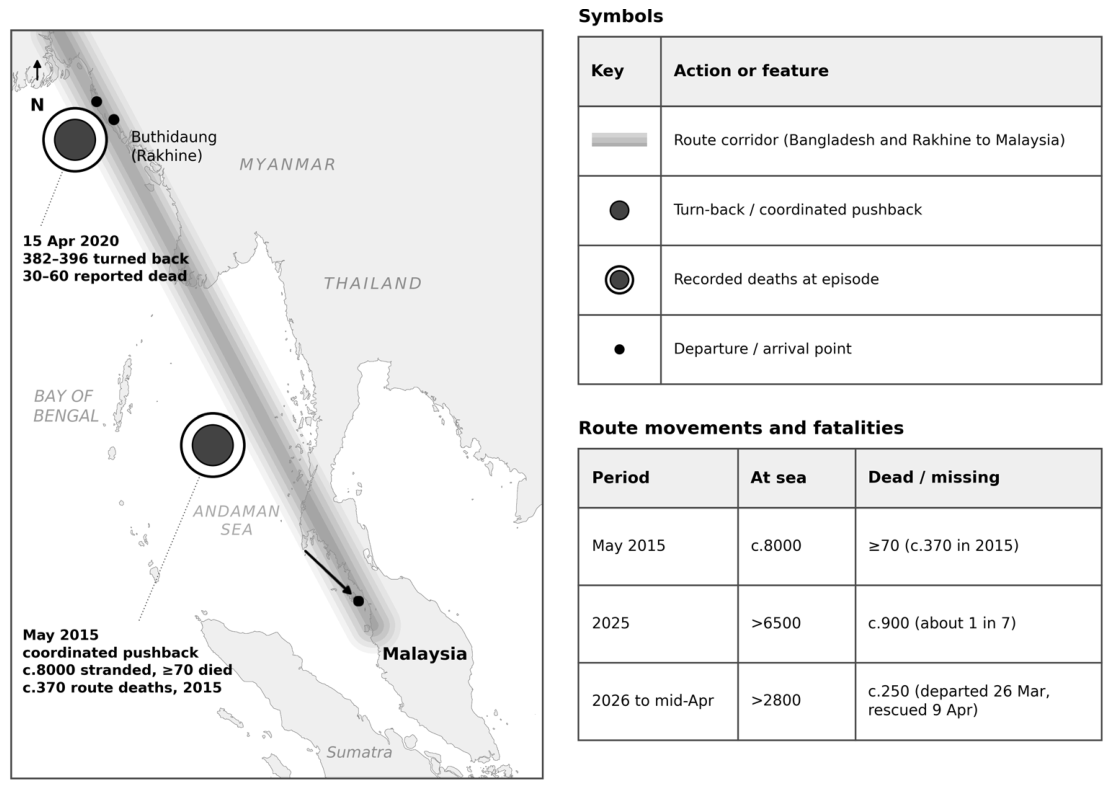
In May 2015, Thailand, Malaysia, and Indonesia coordinated push-backs that stranded an estimated 8000 Rohingya and Bangladeshis at sea across the Andaman Sea and the Bay of Bengal. At least 70 are believed to have died on the vessels abandoned at sea that May, and approximately 370 deaths were estimated along the route in 2015 (Gleeson 2017; Ní Ghráinne 2017).68 The operational policy was publicly announced. A senior officer of the Malaysian Maritime Enforcement Agency announced that the agency would provide provisions and send away all but unseaworthy and sinking vessels, and the Deputy Home Minister confirmed the policy, stating that the government could not welcome the arrivals and would send those who had landed back.69
The provide-and-send-away formula breaches the effective-control and place-of-safety requirements. It is an exercise of effective control that engages jurisdiction, and it is abandonment rather than the completion of a rescue. The episode also illustrates the Nicaragua principle. Malaysia defended its conduct by appealing to capacity and security rather than denying any obligation, thereby acknowledging the rule. The crisis ended with a partial change in policy. On 20 May 2015 Malaysia and Indonesia, through their foreign ministers, undertook to end the push-backs and to offer temporary shelter on the condition of international resettlement within one year (Gleeson 2017).70 This correction constitutes evidence of opinio juris because it concedes that the original conduct was untenable. Assessed by strand, the 2015 pattern breached the customary refugee-law prohibition by denying access to protection, engaged the peremptory core wherever return exposed those aboard to harm at the torture threshold, and abandoned the treaty duties of rescue and delivery to a place of safety.

6.4. The 2020 Pandemic-Era Turn-Backs

The 2020 episodes are more starkly documented. On 5 April 2020, the Malaysian Maritime Enforcement Agency intercepted a boat carrying 202 Rohingya and brought them ashore for quarantine. On 16 April 2020, a Royal Malaysian Air Force surveillance aircraft detected a boat carrying approximately 200 Rohingya, some 70 nautical miles west of Langkawi, well within the exclusive economic zone. The navy intercepted it, distributed food, and escorted it out of Malaysian waters.71 The day before, on 15 April 2020, the Bangladeshi coast guard took between 382 and 396 starving Rohingya from a boat that had been turned away from Malaysian waters, with survivors reporting at least 30 dead, a figure that one organisation placed closer to 60.72 The death toll is contested, and the range is reported rather than resolved. The ministerial statements are again probative. The Defence Minister stated that the Rohingya should know that if they came, they could not stay. The Prime Minister told the ASEAN Summit that Malaysia could no longer take more because its resources were stretched by the pandemic.73
The 16 April interception is the clearest instance of the prohibited pattern. It involved effective control far beyond the territorial sea, engaging jurisdiction on the Hirsi Jamaa reasoning. The authorities provisioned and escorted the vessel out rather than delivering those aboard to a place of safety, in breach of Article 98 and the SOLAS rescue framework. This conduct exposed the persons aboard to a foreseeable risk of death, engaging the unreserved right-to-life guarantees Malaysia performs in good faith under Article 26.
The pandemic justification does not hold; the prohibition admits no public emergency exception. All three strands were engaged at once, the customary prohibition through the turn-back itself, the peremptory core through the foreseeable exposure of a persecuted population to harm at the torture threshold, and the treaty strand through the breach of Article 98 read with the place-of-safety regime. The Malaysian practice belongs to a documented turn to pushbacks across several regions, which the scholarship treats as a standing violation of the prohibitions of refoulement and collective expulsion (Bochenek 2023).
The ministerial statements are reported by reputable media rather than in official transcripts, and where an argument turns on the exact wording, the reporting source, rather than an official record, carries it.74 The conduct itself, the interception and escort-out, is not in dispute, and it is the conduct rather than the rhetoric that constitutes the breach. A joint statement of the relevant United Nations agencies, the principal human rights organisations, and the Malaysian Bar characterised the conduct as a violation of the customary prohibition and the law-of-the-sea rescue duty. That reaction is not itself a state practice or opinio juris, but it shows that the conduct was legally contested.75

6.5. The Continuation of Practice into 2026

These two main episodes are not a closed historical record. The provide-and-send-away formula reappeared in January 2025. After detaining a boat of approximately 196 Rohingya that reached a Langkawi beach, the Malaysian Maritime Enforcement Agency located two further vessels carrying approximately 300 people, supplied them with food and water, and escorted them out of Malaysian waters to continue their journey.76 The conduct repeats the operational patterns of 2015 and 2020 and carries the same legal character. The practice in November 2025 provided a rare contrast. After a boat from Buthidaung, Myanmar, carrying approximately 70 people capsized at the Malaysia-Thailand maritime border, the Malaysian Maritime Enforcement Agency conducted a week-long search-and-rescue operation, recovering 36 bodies and rescuing 14 survivors. The episode shows that the operational alternative to provide-and-send-away exists within the agency’s own capability, which strengthens the doctrinal critique of the turn-back pattern.77 Interception of sea arrivals continued into 2026, with a further group of undocumented Myanmar nationals detained after landing in Penang in April of that year, an episode of landing and detention rather than turn-back, but a further indication that the route remained in use.78
Table 3 compiles the documented episodes from the 2015 crisis to the most recent arrivals. Figure 1 shows the interception episodes along the approaches to Langkawi.
The United Nations refugee agency recorded 2025 as the deadliest year on record for maritime movement in South and Southeast Asia, with close to 900 Rohingya reported dead or missing in the Andaman Sea and the Bay of Bengal, one in seven of the roughly 6500 who attempted to cross that year. It further recorded that more than 2800 had undertaken the journey by the middle of April 2026. Among them were the passengers of an overcrowded vessel that left Bangladesh on 26 March 2026 and reportedly capsized, leaving an estimated 250 missing, with nine survivors rescued on 9 April.79 Therefore, the doctrinal conclusions address an ongoing practice on a route on which people are still dying.
Figure 2 traces the route from Bangladesh and Rakhine State to Malaysia and marks the regional turn-backs.

6.6. Malaysia’s Sovereignty and Security Interests

The analysis accepts that Malaysia has legitimate interests in border control, transnational crime, and the security of the Andaman Sea corridor. Non-refoulement does not entitle a person at sea to unimpeded entry into the territory. A border policy that subordinates protection to enforcement can leave vulnerable migrants less safe rather than more (Oberoi and Taylor-Nicholson 2013).
Malaysia has a real interest in disrupting the smuggling and trafficking networks that profit from these crossings. This interest does not reach the people those networks carry. Acting against a smuggler and returning the smuggled to a foreseeable risk of harm are different acts in law, and the prohibition bears only on the latter. A regional practice that has treated the suppression of smuggling as the dominant objective (Moretti 2018) eliminates this distinction. Yet, enforcement against criminal facilitation need not impose refoulement on its victims.
The capacity argument is weightier on the facts and weaker in law. Malaysia hosts more than 215,000 registered refugees and asylum seekers without a statutory framework, as Table 2 records, and the fiscal and administrative strain of that burden is real. Capacity, however, is an argument about the scale of admission, integration, and long-term reception, not a licence to return a person to a real risk of irreparable harm. The return-to-torture core is non-derogable and admits no resource exception. Capacity bears on the responsibility-sharing contemplated by UNCLOS Article 98(2), not on the minimum standard that the prohibition sets for any single state.
National security is the strongest form of the objection, and contemporary jurisprudence answers it most clearly. Within refugee law, Article 33(2) lifts the protection of Article 33(1) only for a refugee whom reasonable grounds mark as “a danger to the security of the country” of refuge, or who, following final conviction for a “particularly serious crime”, “constitutes a danger to the community of that country”.80 The exception is exhaustive, individualised, and restrictively construed, requiring a determination directed at the particular person on evidence meeting a high threshold and proportionate to the danger found (Lauterpacht and Bethlehem 2003, pp. 128–40). A blanket practice of intercepting vessels and escorting them out to sea determines nothing about anyone. It cannot constitute an Article 33(2) judgment, because the provision presupposes the individualised assessment that a turn-back forecloses. Malaysia’s non-party status adds a further qualification, because the state cannot invoke Article 33(2) as a treaty entitlement while denying that the Convention applies to it. If the customary refugee-law rule carries a corresponding security exception, Malaysia must establish its customary content and satisfy it in the individual case, and generalised invocations of sovereignty, capacity, terrorism, or smuggling do not perform that legal work. The provision therefore operates as a restrictive benchmark, not as a freestanding defence.
The human-rights strand forecloses the security argument altogether. In Chahal v. the United Kingdom, the Grand Chamber held that the prohibition of ill-treatment “is equally absolute in expulsion cases” and that “the activities of the individual in question, however undesirable or dangerous, cannot be a material consideration”.81 Saadi v. Italy reaffirmed the rule against a concerted attempt to dilute it, holding that the concepts of risk and dangerousness “do not lend themselves to a balancing test because they are notions that can only be assessed independently of each other”.82 The contrary domestic authority is Suresh, where the Supreme Court of Canada declined to exclude deportation to face torture in undefined exceptional circumstances while accepting that “the better view is that international law rejects deportation to torture, even where national security interests are at stake”.83 The Committee against Torture states the same rule in terms that reach this case directly, defining deportation to include “rejection at the frontier” and “pushback operations (including at sea)”, requiring that each case “be examined individually, impartially and independently” with “a suspensive effect of the appeal”, and treating collective deportation without objective individual examination as a violation of the principle.84 Procedure carries the same weight in the Strasbourg case law, because Chahal holds that an effective remedy “requires independent scrutiny of the claim” and that this scrutiny “must be carried out without regard to … any perceived threat to the national security of the expelling State”, and Saadi declines to demand a higher standard of proof from those said to be dangerous.85 No public-emergency or security derogation attaches to the return-to-torture core. Malaysia’s security interest therefore operates within the prohibition, never against it. Screening aboard or ashore, individualised exclusion from durable admission, and prosecution of smugglers all remain open. Returning a boat of unscreened people to a foreseeable risk of proscribed harm does not.
ASEAN non-interference does not alter Malaysia’s obligation. The principle governs the conduct of one member state towards the internal affairs of another, and its good-neighbourliness reading has been invoked to legitimise rejection rather than protection (Davies 2008). This is irrelevant to the question here, which concerns a state’s treatment of persons within its own jurisdiction at sea, not its interference in the affairs of a neighbour. Non-interference may explain the absence of a collective regional response to crossings, but it cannot convert a non-derogable obligation owed to individuals into an optional one.
The prohibition constrains the manner in which sovereignty is exercised, not its existence itself. It forbids the return to persecution or torture but leaves the substantive admission decision to the state. The constraint is one of conduct and procedure, not of outcome. A practice that screened intercepted persons for protection needs, afforded a remedy before removal, and decoupled the rescue function from immigration enforcement would respect both the prohibition and the security interest. The deficit in Malaysian practice is not a want of jurisdictional capacity but a lack of procedure. Reconciling security and protection is an operational task rather than a doctrinal impossibility (Khairi et al. 2025).

7. Conclusions

Non-refoulement constrains Malaysia at sea in source and reach. First, the prohibition binds Malaysia as customary international law, notwithstanding its non-party status to the 1951 Convention and cognate human rights treaties, and its return-to-torture core binds as a peremptory norm that admits no persistent-objector defence. The wider peremptory claim remains lex ferenda. Second, the prohibition extends to Malaysian conduct at sea through the effective-control jurisdiction affirmed in Hirsi Jamaa and reflected in the binding customary framework. The law of the sea reinforces rather than displaces it, because a place of safety read in good faith cannot be a place of persecution. Third, the strands converge on the facts, because the persecution the Rohingya flee reaches the torture threshold, so the customary rule, the peremptory core, and the treaty duties of rescue point to the same conclusion, while remaining distinct in what each allows a state to invoke against it. National security supplies no general exception, because Article 33(2) operates through confined and individualised conditions within the refugee-law strand alone, and the torture core admits no security exception at all. Malaysia’s legitimate security interests therefore require individual screening and a procedure that suspends removal while the risk is determined, not collective turn-backs.
Good faith disciplines and interprets both the answers. Existing scholarship on the Andaman Sea has been largely descriptive and regional, but this analysis treats good faith as the principle that conditions the performance and interpretation of binding duties and forecloses their evasion by indirect means. Assessed against these standards, the pushbacks of 2015 and 2020 breach the customary prohibition and are irreconcilable with good faith. The Article 5(1) limb is advanced as the better reading, not settled authority, no Malaysian court having applied it to a maritime pushback, and the anti-evasion function of good faith remains untested in this context.
The analysis has limits that fix its claims. It is doctrinal, so it establishes the content of Malaysia’s obligations rather than measuring compliance empirically, and it resolves no individual status claim. The evidentiary base for the episodes rests on documented reports and ministerial statements carried by reputable media rather than official transcripts, the casualty figures remain contested and are reported as ranges, and the DPP registration scheme is new and evolving. The doctrinal implication is that a non-party’s maritime enforcement is enclosed by customary law, by treaty obligations the state has itself accepted, and by good faith, so the peremptory core forecloses the persistent-objector escape. The practical implication is that compliance requires procedure rather than admission, namely screening before removal and the decoupling of rescue from immigration enforcement. Beyond the doctrinal frame, future research should test these conclusions against the operational practice of the Malaysian Maritime Enforcement Agency and extend the comparison to Indonesia and Thailand.
Future work should address regional disembarkation and responsibility-sharing under Article 98(2) of UNCLOS, as well as procedural reform that decouples the rescue function from immigration enforcement. The 1989 Comprehensive Plan of Action, coordinating reception, processing, and resettlement for those who fled Vietnam, Cambodia, and Laos, remains the clearest precedent for such an arrangement in Southeast Asia, as Section 6.2 records (Davies 2008; Robinson 1998). Restoring this approach to the Andaman Sea, where the Bali Process has so far prioritised the suppression of smuggling over protection (Moretti 2018), would require sharing responsibility rather than shifting it (Kneebone 2009).

Author Contributions

Conceptualization, M.S.B.S. and J.C.P.; methodology, M.S.B.S.; investigation, M.S.B.S.; writing—original draft preparation, M.S.B.S.; writing—review and editing, M.S.B.S. and J.C.P.; visualization, M.S.B.S. and J.C.P. All authors have read and agreed to the published version of the manuscript.

Funding

This study did not receive any external funding.

Institutional Review Board Statement

Not applicable. This study is doctrinal legal research that did not involve human participants or animals.

Informed Consent Statement

Not applicable. This study did not involve human participants.

Data Availability Statement

No new empirical dataset was created or analysed in this study. The tables and figures compile publicly available legal, institutional, and media sources, each cited in full in the references.

Acknowledgments

This article forms part of the doctoral dissertation of the corresponding author, submitted in partial fulfilment of the requirements for the degree of Doctor of Philosophy at Universiti Sultan Zainal Abidin. The authors thank their respective institutions for academic support during the preparation of this article. Anthropic Claude Opus 5 was used to assist with creating tables, figures, proofreading, formatting, and editorial revision of the manuscript in accordance with the Laws template. The tool was used strictly as an assistant to the writing process, not as a replacement for the authors’ own judgment, analysis, or decision. The authors fully reviewed, verified, and edited all AI-assisted material and bear full responsibility for the accuracy and content of the manuscript.

Conflicts of Interest

The authors declare no conflicts of interest.

Abbreviations

Abbreviations used in this manuscript are as follows:
ASEANAssociation of Southeast Asian Nations
CATConvention against Torture and Other Cruel, Inhuman or Degrading Treatment or Punishment 1984
CRCConvention on the Rights of the Child 1989
CRPDConvention on the Rights of Persons with Disabilities 2006
DPPDokumen Pendaftaran Pelarian (Refugee Registration Document)
ECtHREuropean Court of Human Rights
ICCPRInternational Covenant on Civil and Political Rights 1966
ICJInternational Court of Justice
ILCInternational Law Commission
IMOInternational Maritime Organization
IOMInternational Organization for Migration
MMEAMalaysian Maritime Enforcement Agency
SARInternational Convention on Maritime Search and Rescue 1979
SOLASInternational Convention for the Safety of Life at Sea 1974
UNCLOSUnited Nations Convention on the Law of the Sea 1982
UNHCROffice of the United Nations High Commissioner for Refugees
VCLTVienna Convention on the Law of Treaties 1969

References

  1. Primary Sources 

    1. Treaties, Conventions and Protocols
    Charter of the United Nations, adopted 26 June 1945 (entered into force 24 October 1945) (‘UN Charter’).
    Convention against Torture and Other Cruel, Inhuman or Degrading Treatment or Punishment, adopted 10 December 1984, 1465 UNTS 85 (entered into force 26 June 1987) (‘CAT’).
    Convention on the Rights of Persons with Disabilities, adopted 13 December 2006, 2515 UNTS 3 (entered into force 3 May 2008) (‘CRPD’).
    Convention on the Rights of the Child, adopted 20 November 1989, 1577 UNTS 3 (entered into force 2 September 1990) (‘CRC’).
    Convention relating to the Status of Refugees, adopted 28 July 1951, 189 UNTS 137 (entered into force 22 April 1954) (‘Refugee Convention’).
    International Convention for the Safety of Life at Sea, adopted 1 November 1974, 1184 UNTS 278 (entered into force 25 May 1980) (‘SOLAS’).
    International Convention on Maritime Search and Rescue, adopted 27 April 1979, 1405 UNTS 97 (entered into force 22 June 1985) (‘SAR Convention’).
    International Covenant on Civil and Political Rights, adopted 16 December 1966, 999 UNTS 171 (entered into force 23 March 1976) (‘ICCPR’).
    Statute of the International Court of Justice, adopted 26 June 1945 (entered into force 24 October 1945) (‘ICJ Statute’).
    United Nations Convention on the Law of the Sea, adopted 10 December 1982, 1833 UNTS 3 (entered into force 16 November 1994) (‘UNCLOS’).
    Vienna Convention on the Law of Treaties, adopted 23 May 1969, 1155 UNTS 331 (entered into force 27 January 1980) (‘VCLT’).
    2. Cases
    Application of the Convention on the Prevention and Punishment of the Crime of Genocide (The Gambia v. Myanmar), International Court of Justice, Provisional Measures, Order of 23 January 2020, [2020] ICJ Rep 3.
    Border and Transborder Armed Actions (Nicaragua v. Honduras), International Court of Justice, Jurisdiction and Admissibility, [1988] ICJ Rep 69.
    Jurisdictional Immunities of the State (Germany v. Italy: Greece intervening), International Court of Justice, Judgment, [2012] ICJ Rep 99.
    Military and Paramilitary Activities in and against Nicaragua (Nicaragua v. United States of America), International Court of Justice, Merits, [1986] ICJ Rep 14.
    North Sea Continental Shelf (Federal Republic of Germany/Denmark; Federal Republic of Germany/Netherlands), International Court of Justice, Judgment, [1969] ICJ Rep 3.
    Nuclear Tests (Australia v. France), International Court of Justice, Judgment, [1974] ICJ Rep 253.
    Obligations of States in respect of Climate Change, International Court of Justice, Advisory Opinion, 23 July 2025.
    Questions relating to the Obligation to Prosecute or Extradite (Belgium v. Senegal), International Court of Justice, Judgment, [2012] ICJ Rep 422.
    Certain German Interests in Polish Upper Silesia, Permanent Court of International Justice, Merits, PCIJ Rep Series A No 7 (1926).
    A.R.E. v. Greece, European Court of Human Rights, No. 15783/21, Judgment of 7 January 2025.
    Chahal v. the United Kingdom, European Court of Human Rights (Grand Chamber), No. 22414/93, Judgment of 15 November 1996.
    Hirsi Jamaa and Others v. Italy, European Court of Human Rights (Grand Chamber), No. 27765/09, Judgment of 23 February 2012.
    Medvedyev and Others v. France, European Court of Human Rights (Grand Chamber), No. 3394/03, Judgment of 29 March 2010.
    Saadi v. Italy, European Court of Human Rights (Grand Chamber), No. 37201/06, Judgment of 28 February 2008.
    S.S. and Others v. Italy, European Court of Human Rights, No. 21660/18, Decision of 20 May 2025 (made public on 12 June 2025).
    Rights and Guarantees of Children in the Context of Migration and/or in Need of International Protection, Inter-American Court of Human Rights, Advisory Opinion OC-21/14, Series A No 21, 19 August 2014.
    The Institution of Asylum and its Recognition as a Human Right in the Inter-American Protection System, Inter-American Court of Human Rights, Advisory Opinion OC-25/18, Series A No 25, 30 May 2018.
    Haitian Centre for Human Rights v. United States, Inter-American Commission on Human Rights, Case 10.675, Report No 51/96, 13 March 1997.
    Sale v. Haitian Centers Council, United States Supreme Court, 509 US 155 (1993).
    Suresh v. Canada (Minister of Citizenship and Immigration), Supreme Court of Canada, [2002] 1 SCR 3, 2002 SCC 1.
    Lee Kwan Woh v. Public Prosecutor, Federal Court of Malaysia, [2009] 5 CLJ 631.
    Sivarasa Rasiah v. Badan Peguam Malaysia, Federal Court of Malaysia, [2010] 2 MLJ 333.
    Tan Tek Seng v. Suruhanjaya Perkhidmatan Pendidikan, Court of Appeal of Malaysia, [1996] 1 MLJ 261.
    A.S., D.I., O.I. and G.D. v. Italy, Human Rights Committee, Communication No 3042/2017, UN Doc CCPR/C/130/D/3042/2017, Views of 4 November 2020.
    A.S., D.I., O.I. and G.D. v. Malta, Human Rights Committee, Communication No 3043/2017, UN Doc CCPR/C/128/D/3043/2017, inadmissibility decision of 13 March 2020.
    J.H.A. v. Spain, Committee against Torture, Communication No 323/2007, UN Doc CAT/C/41/D/323/2007, decision under article 22(7), document issued 21 November 2008.
    3. Treaty-Body General Comments and Materials
    Committee against Torture, General Comment No 4 (2017) on the Implementation of Article 3 of the Convention in the Context of Article 22 (2017), UN Doc CAT/C/GC/4.
    Committee on the Rights of the Child, General Comment No 6: Treatment of Unaccompanied and Separated Children outside their Country of Origin (2005), UN Doc CRC/GC/2005/6.
    UN Committee on the Rights of the Child, Initial Report of States Parties Due in 1997, Malaysia (22 December 2006), CRC/C/MYS/1.
    UN Human Rights Committee, General Comment No 31: The Nature of the General Legal Obligation Imposed on States Parties to the Covenant (2004), UN Doc CCPR/C/21/Rev.1/Add.13.
    UN Human Rights Committee, General Comment No 36: The Right to Life under Article 6 of the Covenant (2018), UN Doc CCPR/C/GC/36.
    4. United Nations and Other International Documents
    Cairo Declaration on Human Rights in Islam, adopted 5 August 1990, annexed to UN Doc A/45/421–S/21797 (20 September 1990).
    Cairo Declaration of the Organization of Islamic Cooperation on Human Rights, adopted by Resolution No. 63/47-POL, Forty-Seventh Session of the Council of Foreign Ministers (Niamey, 27–28 November 2020).
    Declaration of States Parties to the 1951 Convention and/or its 1967 Protocol relating to the Status of Refugees (13 December 2001), UN Doc HCR/MMSP/2001/09.
    International Law Commission, Draft Articles on the Law of Treaties, with Commentaries (1966), UN Doc A/6309/Rev.1.
    International Law Commission, Draft Conclusions on Identification of Customary International Law, with Commentaries (2018), UN Doc A/73/10.
    International Law Commission, Draft Conclusions on Peremptory Norms of General International Law (Jus Cogens) (2022), UN Doc A/77/10.
    International Law Commission, Fragmentation of International Law: Difficulties Arising from the Diversification and Expansion of International Law, Report of the Study Group finalized by Martti Koskenniemi (2006), UN Doc A/CN.4/L.682; Conclusions of the Study Group, UN Doc A/CN.4/L.702.
    International Maritime Organization, Resolution MSC.153(78) (2004).
    International Maritime Organization, Resolution MSC.155(78) (2004).
    International Maritime Organization, Resolution MSC.167(78), Guidelines on the Treatment of Persons Rescued at Sea (adopted 20 May 2004).
    UN General Assembly, New York Declaration for Refugees and Migrants, A/RES/71/1 (19 September 2016).
    United Nations, Press Release REF/1147, Last Camp for Vietnamese Boat People in Malaysia Closed (25 June 1996).
    Universal Declaration of Human Rights, UNGA Res 217 A (III) (10 December 1948).
    5. UNHCR Materials
    UNHCR, 2025 Was Deadliest Year Yet for Maritime Movements of Rohingya Refugees, Briefing Note (17 April 2026).
    UNHCR Malaysia, Figures at a Glance (as at end February 2026).
    UNHCR, Advisory Opinion on the Extraterritorial Application of Non-Refoulement Obligations under the 1951 Convention Relating to the Status of Refugees and Its 1967 Protocol (26 January 2007).
    UNHCR, Legal Considerations on the Roles and Responsibilities of States in Relation to Rescue at Sea, Non-Refoulement and Access to Asylum (2022).
    UNHCR, Mixed Maritime Movements in South-East Asia: 2015 (2016).
    UNHCR, The Principle of Non-Refoulement as a Norm of Customary International Law (31 January 1994).
    UNHCR, The State of the World’s Refugees 2000: Fifty Years of Humanitarian Action (Oxford: Oxford University Press, 2000).
    6.
    National Legislation and Executive Materials
    Arahan Majlis Keselamatan Negara No 23 (Semakan 2023) (Malaysia), internal directive of the National Security Council, unpublished.
    Federal Constitution (Malaysia).
    Immigration Act 1959/63 (Act 155) (Malaysia).
  2. Secondary Sources 

  3. Abd al-Rahim, Muddathir. 2008. Asylum: A Moral and Legal Right in Islam. Refugee Survey Quarterly 27: 15–23. [Google Scholar] [CrossRef] [Scilit]
  4. Abou-El-Wafa, Ahmed. 2009. The Right to Asylum between Islamic Shari’ah and International Refugee Law: A Comparative Study, Arabic ed. Riyadh: Naif Arab University for Security Sciences, in Cooperation with UNHCR. Available online: https://www.unhcr.org/ar/5358d3996 (accessed on 18 August 2026).
  5. al-Dawoody, Ahmed. 2011. The Islamic Law of War: Justifications and Regulations. New York: Palgrave Macmillan. [Google Scholar]
  6. al-Dawoody, Ahmed, and Tilman Rodenhäuser. 2021. The Principle of Non-Refoulement under Islamic Law and International Law: Complementing International Legal Protection in Muslim Contexts. ICRC Humanitarian Law & Policy Blog, June 20.
  7. Alexander, Atul, and Nakul Singh. 2022. India and Refugee Law: Gauging India’s Position on Afghan Refugees. Laws 11: 31. [Google Scholar] [CrossRef] [Scilit]
  8. Allain, Jean. 2001. The Jus Cogens Nature of Non-Refoulement. International Journal of Refugee Law 13: 533–58. [Google Scholar] [CrossRef] [Scilit]
  9. Allinson, Kathryn. 2025. Shifting Responsibility on a Spectrum: The UK’s Responsibility for Externalised Border Control Operations. Laws 14: 85. [Google Scholar] [CrossRef] [Scilit]
  10. al-Zuhili, Wahbeh. 2005. Islam and International Law. International Review of the Red Cross 87: 269–83. [Google Scholar] [CrossRef] [Scilit]
  11. Barnes, Richard. 2004. Refugee Law at Sea. International and Comparative Law Quarterly 53: 47–77. [Google Scholar] [CrossRef] [Scilit]
  12. Bashir, Khaled Ramadan. 2018. Islamic International Law: Historical Foundations and Al-Shaybani’s Siyar. Cheltenham: Edward Elgar. [Google Scholar]
  13. Ben-Nun, Gilad. 2015. The British–Jewish Roots of Non-Refoulement and Its True Meaning for the Drafters of the 1951 Refugee Convention. Journal of Refugee Studies 28: 93–117. [Google Scholar] [CrossRef] [Scilit]
  14. Bochenek, Michael Garcia. 2023. The Persistent, Pernicious Use of Pushbacks against Children and Adults in Search of Safety. Laws 12: 34. [Google Scholar] [CrossRef] [Scilit]
  15. Cheng, Bin. 1987. General Principles of Law as Applied by International Courts and Tribunals. Cambridge: Grotius Publications. [Google Scholar]
  16. Chetail, Vincent. 2014. The Transnational Movement of Persons under General International Law: Mapping the Customary Law Foundations of International Migration Law. In Research Handbook on International Law and Migration. Edited by Vincent Chetail and Céline Bauloz. Cheltenham: Edward Elgar, pp. 1–72. [Google Scholar]
  17. Coppens, Jasmine. 2017. Interception of Migrant Boats at Sea. In ‘Boat Refugees’ and Migrants at Sea: A Comprehensive Approach. Edited by Violeta Moreno-Lax and Efthymios Papastavridis. Leiden: Brill Nijhoff, p. 199. [Google Scholar]
  18. Costello, Cathryn, and Michelle Foster. 2016. Non-Refoulement as Custom and Jus Cogens? Putting the Prohibition to the Test. In Netherlands Yearbook of International Law 2015: Jus Cogens: Quo Vadis? Edited by Maarten den Heijer and Harmen van der Wilt. The Hague: TMC Asser Press, vol. 46, pp. 273–327. [Google Scholar]
  19. Da Lomba, Sylvie. 2004. The Right to Seek Refugee Status in the European Union. Antwerp: Intersentia. [Google Scholar]
  20. Davies, Sara E. 2008. Legitimising Rejection: International Refugee Law in Southeast Asia. Leiden: Martinus Nijhoff. [Google Scholar]
  21. den Heijer, Maarten. 2013. Reflections on Refoulement and Collective Expulsion in the Hirsi Case. International Journal of Refugee Law 25: 265–90. [Google Scholar] [CrossRef] [Scilit]
  22. Espenilla, Jacqueline Joyce F. 2010. Injustice Ignored: A Case Study of the Irregular Sea Migration of the Rohingyan Boat People. Asia Europe Journal 8: 45–59. [Google Scholar] [CrossRef] [Scilit]
  23. Fourer, Margarita, Natalie Dietrich Jones, and Yusuf Ciftci. 2020. Offshore Processing Arrangements: Effect on Treaty Ratifications of Receiving States. Laws 9: 23. [Google Scholar] [CrossRef] [Scilit]
  24. Galani, Sofia. 2025. Human Rights Obligations in Maritime Search and Rescue. International and Comparative Law Quarterly 74: 33–60. [Google Scholar] [CrossRef] [Scilit]
  25. Gammeltoft-Hansen, Thomas. 2011. Access to Asylum: International Refugee Law and the Globalisation of Migration Control. Cambridge: Cambridge University Press. [Google Scholar]
  26. Gammeltoft-Hansen, Thomas, and James C. Hathaway. 2015. Non-Refoulement in a World of Cooperative Deterrence. Columbia Journal of Transnational Law 53: 235–84. [Google Scholar]
  27. Giuffré, Mariagiulia. 2012. Watered-Down Rights on the High Seas: Hirsi Jamaa and Others v. Italy (2012). International and Comparative Law Quarterly 61: 728–50. [Google Scholar] [CrossRef] [Scilit]
  28. Gleeson, Madeline. 2017. Unprecedented but Unfulfilled: Refugee Protection and Regional Responses to the Andaman Sea ‘Crisis’. Antropologi Indonesia 38: 2–20. [Google Scholar] [CrossRef] [Scilit]
  29. Goodwin-Gill, Guy S., Jane McAdam, and Emma Dunlop. 2021. The Refugee in International Law, 4th ed. Oxford: Oxford University Press. [Google Scholar]
  30. Hailbronner, Kay. 1986. Nonrefoulement and ‘Humanitarian’ Refugees: Customary International Law or Wishful Legal Thinking? Virginia Journal of International Law 26: 857–96. [Google Scholar]
  31. Hamidullah, Muhammad. 1945. The Muslim Conduct of State. Lahore: Sh. Muhammad Ashraf. [Google Scholar]
  32. Hathaway, James C. 2010. Leveraging Asylum. Texas International Law Journal 45: 503–36. [Google Scholar]
  33. Hoffstaedter, Gerhard. 2017. Refugees, Islam, and the State: The Role of Religion in Providing Sanctuary in Malaysia. Journal of Immigrant & Refugee Studies 15: 287–304. [Google Scholar] [CrossRef] [Scilit]
  34. Hutchinson, Terry C. 2013. Doctrinal Research: Researching the Jury. In Research Methods in Law. Edited by Dawn Watkins and Mandy Burton. Abingdon: Routledge, pp. 7–33. [Google Scholar]
  35. Imam Supaat, Dina. 2013. Escaping the Principle of Non-Refoulement. International Journal of Business, Economics and Law 2: 86–97. [Google Scholar] [CrossRef] [Scilit]
  36. Kamali, Mohammad Hashim. 1998. Islamic Law in Malaysia: Issues and Developments. Yearbook of Islamic and Middle Eastern Law 4: 153–79. [Google Scholar] [CrossRef] [Scilit]
  37. Khadduri, Majid. 1955. War and Peace in the Law of Islam. Baltimore: Johns Hopkins University Press. [Google Scholar]
  38. Khadduri, Majid. 1966. The Islamic Law of Nations: Shaybani’s Siyar. Baltimore: Johns Hopkins University Press. [Google Scholar]
  39. Khairi, Aizat, Afrizal Tjoetra, and Phaison Da-Oh. 2025. Navigating Security and Human Rights: The Malaysian Maritime Enforcement Agency’s Response to the Rohingya Refugee Crisis. JEBAT: Malaysian Journal of History, Politics and Strategic Studies 52: 413–30. [Google Scholar] [CrossRef] [Scilit]
  40. Khalilieh, Hassan S. 2019. Islamic Law of the Sea: Freedom of Navigation and Passage Rights in Islamic Thought. Cambridge: Cambridge University Press. [Google Scholar]
  41. Kneebone, Susan, ed. 2009. Refugees, Asylum Seekers and the Rule of Law: Comparative Perspectives. Cambridge: Cambridge University Press. [Google Scholar]
  42. Kolb, Robert. 2017. Good Faith in International Law. Oxford: Hart Publishing. [Google Scholar]
  43. Lambert, Hélène. 2021. Customary Refugee Law. In The Oxford Handbook of International Refugee Law. Edited by Cathryn Costello, Michelle Foster and Jane McAdam. Oxford: Oxford University Press, chap. 13. [Google Scholar]
  44. Lauterpacht, Elihu, and Daniel Bethlehem. 2003. The Scope and Content of the Principle of Non-Refoulement: Opinion. In Refugee Protection in International Law: UNHCR’s Global Consultations on International Protection. Edited by Erika Feller, Volker Türk and Frances Nicholson. Cambridge: Cambridge University Press, pp. 87–177. [Google Scholar]
  45. Mahaseth, Harsh, and Samyuktha Banusekar. 2022. Living in the Shadows: Rohingya Refugees in Malaysia. Asian Journal of International Law 12: 259–75. [Google Scholar] [CrossRef] [Scilit]
  46. Malekian, Farhad. 2011. Principles of Islamic International Criminal Law: A Comparative Search, 2nd ed. Leiden and Boston: Brill. [Google Scholar]
  47. Mallia, Patricia. 2014. The MV Salamis and the State of Disembarkation at International Law: The Undefinable Goal. ASIL Insights 18, no. 11. Available online: https://asil.org/insights/volume-18-issue-11/ (accessed on 18 August 2026).
  48. Mann, Itamar. 2016. Humanity at Sea: Maritime Migration and the Foundations of International Law. Cambridge: Cambridge University Press. [Google Scholar]
  49. Mansfield, James. 2015. Extraterritorial Application and Customary Norm Assessment of Non-Refoulement: The Legality of Australia’s ‘Turn-Back’ Policy. University of Notre Dame Australia Law Review 17: 8. [Google Scholar] [CrossRef] [Scilit]
  50. McNevin, Anne, and Antje Missbach. 2018. Hospitality as a Horizon of Aspiration (or, What the International Refugee Regime Can Learn from Acehnese Fishermen). Journal of Refugee Studies 31: 292–313. [Google Scholar] [CrossRef] [Scilit]
  51. Miltner, Barbara. 2006. Irregular Maritime Migration: Refugee Protection Issues in Rescue and Interception. Fordham International Law Journal 30: 75. [Google Scholar]
  52. Moreno-Lax, Violeta. 2012. Hirsi Jamaa and Others v. Italy or the Strasbourg Court versus Extraterritorial Migration Control? Human Rights Law Review 12: 574–98. [Google Scholar] [CrossRef] [Scilit]
  53. Moreno-Lax, Violeta. 2020. The Architecture of Functional Jurisdiction: Unpacking Contactless Control. German Law Journal 21: 385–416. [Google Scholar] [CrossRef] [Scilit]
  54. Moretti, Sebastien. 2018. Keeping Up Appearances: State Sovereignty and the Protection of Refugees in Southeast Asia. European Journal of East Asian Studies 17: 3–30. [Google Scholar]
  55. Neo, Jaclyn L. 2018. Incorporating Human Rights: Mitigated Dualism and Interpretation in Malaysian Courts. In Asian Yearbook of International Law, Volume 18 (2012). Leiden: Brill Nijhoff. [Google Scholar]
  56. Nguyen, Loi Thi Ngoc. 2023. Protecting the Human Rights of Refugees in Camps in Thailand: The Complementary Role of International Law on Indigenous Peoples. Laws 12: 57. [Google Scholar] [CrossRef] [Scilit]
  57. Ní Ghráinne, Bríd. 2017. Left to Die at Sea: State Responsibility for the May 2015 Thai, Indonesian and Malaysian Pushback Operations. In The Irish Yearbook of International Law, Volume 10, 2015. Edited by Fiona de Londras and Siobhán Mullally. Oxford: Hart Publishing, pp. 109–35. [Google Scholar]
  58. Oberoi, Pia, and Eleanor Taylor-Nicholson. 2013. The Enemy at the Gates: International Borders, Migration and Human Rights. Laws 2: 169–186. [Google Scholar] [CrossRef] [Scilit]
  59. Papastavridis, Efthymios. 2009. Interception of Human Beings on the High Seas: A Contemporary Analysis under International Law. Syracuse Journal of International Law and Commerce 36: 145. [Google Scholar]
  60. Pulvirenti, Rossella. 2025. From Solidarity to Exclusion: The ‘Safe Country’ Concept in UK Asylum Law and the Irony of Borders. Laws 14: 63. [Google Scholar] [CrossRef] [Scilit]
  61. Qur’an. n.d. Sahih International Translation. Reproduced in The Quranic Arabic Corpus. Available online: https://corpus.quran.com (accessed on 18 August 2026).
  62. Robinson, W. Courtland. 1998. Terms of Refuge: The Indochinese Exodus and the International Response. London and New York: Zed Books. [Google Scholar]
  63. Schmahl, Stefanie. 2026. The Interplay Between the 1951 Geneva Refugee Convention and the 1989 UN Convention on the Rights of the Child. Laws 15: 31. [Google Scholar] [CrossRef] [Scilit]
  64. Shebaita, Maged. 2025. The General Principles of Law Recognised by Civilised Nations in Islamic Law. Liverpool Law Review 46: 219–43. [Google Scholar]
  65. Shoukri, Arafat Madi. 2011. Refugee Status in Islam: Concepts of Protection in Islamic Tradition and International Law. London: I.B. Tauris. [Google Scholar]
  66. Sulaiman, Syafiq, Salawati Mat Basir, Abdul Majid Hafiz Mohamed, and Muhammad Afiq Ahmad Tajuddin. 2021. Non-refoulement and Right of Entry for Asylum-seekers. Pertanika Journal of Social Sciences & Humanities 29: 75–87. [Google Scholar] [CrossRef] [Scilit]
  67. Tiedemann, Paul. 2021. Are There Moral Duties toward Refugees? Considerations in Legal Ethics. Laws 10: 4. [Google Scholar] [CrossRef] [Scilit]
  68. Tladi, Dire. 2024. The International Law Commission’s Draft Conclusions on Peremptory Norms. Oxford: Oxford University Press. [Google Scholar]
  69. Treves, Tullio. 2010. Human Rights and the Law of the Sea. Berkeley Journal of International Law 28: 1–14. [Google Scholar]
  70. Trevisanut, Seline. 2014. The Principle of Non-Refoulement and the De-Territorialization of Border Control at Sea. Leiden Journal of International Law 27: 661–75. [Google Scholar] [CrossRef] [Scilit]
  71. Tzevelekos, Vassilis P., and Elena Katselli Proukaki. 2017. Migrants at Sea: A Duty of Plural States to Protect (Extraterritorially)? Nordic Journal of International Law 86: 427–69. [Google Scholar] [CrossRef] [Scilit]
  72. Wood, Michael, and Omri Sender. 2024. Identification of Customary International Law. Oxford: Oxford University Press. [Google Scholar]
  73. Wouters, Kees, and Maarten den Heijer. 2010. The Marine I Case: A Comment. International Journal of Refugee Law 22: 1–19. [Google Scholar] [CrossRef] [Scilit]
Figure 1. Malaysian maritime interception along the Langkawi approaches, 2015–2026. Episodes are plotted by location, scaled by the number of people aboard, and shaded by the actions taken. The outer ring is added over a symbol in the key. It marks deaths recorded at that episode and does not replace the action shown. The 16 April 2020 turn-back, approximately 70 nautical miles west of Langkawi, shows effective control exercised far beyond the territorial sea. Casualty figures are reported as ranges, where sources diverge. The locations are approximate.
Laws 15 00106 g001
Figure 2. The Bay of Bengal and Andaman Sea route from Bangladesh and Rakhine State to Malaysia, with regional turn-backs marked. The outer ring is added over a symbol in the key. It marks deaths recorded at that episode and does not replace the action shown. The shaded corridor traces the crossing in which 2025 became the deadliest year on record. Casualty figures are reported as ranges, where sources diverge. The route corridor is shown schematically.
Laws 15 00106 g002
Table 1. Malaysia’s status under principal international instruments.
InstrumentStatusKey DateRelevance to the Analysis
Refugee Convention 1951Not a party Article 33 binds Malaysia only as customary law
1967 ProtocolNot a party Extends the Convention regime; not binding qua treaty
Convention against Torture 1984Not a party Article 3 return-to-torture bar binds only as custom
ICCPR 1966Not a party Articles 6 and 7 right to life and freedom from ill-treatment bind only as custom
UNCLOS 1982PartyRatified 14 October 1996Article 98 rescue duty and Article 300 good faith; Article 310 declaration
SOLAS 1974PartyAcceded 19 October 1983, in force 19 January 1984Chapter V regulation 33 rescue duty
SAR Convention 1979Not a party Evidences the general search-and-rescue regime
VCLT 1969PartyAcceded 27 July 1994Articles 18, 26 and 31, good faith and interpretation
CRC 1989PartyAcceded 17 February 1995Article 6 right to life unreserved; Article 37 reserved
CRPD 2006PartyRatified 19 July 2010Article 10 right to life unreserved; Articles 15 and 18 reserved
Sources: UN Treaty Collection (depositary records) and the International Maritime Organization. The status is current as of the date of writing. A blank date cell denotes an instrument to which Malaysia is not a party.
Table 2. Registered refugee population and indicators of the domestic protection deficit in Malaysia.
IndicatorFigureReference Period
Registered refugees and asylum seekers215,600End February 2026
Of whom from Myanmar193,824End February 2026
Of whom Rohingya126,144End February 2026
Of whom children under 1864,680End February 2026
Resettlement departures86272024
Resettlement departures19702025
Held in immigration detentionc. 21,000November 2025
Irregular migrants arrested12,0002021
Irregular migrants arrestedc. 92,0002025
DPP phase one, detained refugeesc. 4000From 1 June 2026
Sources: UNHCR Malaysia, Figures at a Glance (registered population, end of February 2026); IOM (resettlement); Human Rights Watch (detention and arrests); Fortify Rights (DPP phase one). Detention has no statutory time limit, and access to the UNHCR has been suspended since 2019.
Table 3. Documented Malaysian maritime interception and rescue episodes, 2015–2026.
DateVessel and PersonsAction by Malaysian AuthoritiesOutcome
May 2015c. 8000 adrift regionallyCoordinated pushbacks with Thailand and IndonesiaAt least 70 died on abandoned May vessels, c. 370 estimated route deaths in 2015, partial reversal on 20 May 2015
5 Apr 2020202 Rohingya off LangkawiBrought ashore and detainedHanded to immigration
16 Apr 2020c. 200, 70 nm west of LangkawiIntercepted, provisioned and escorted outTurned back out of Malaysian waters
15 Apr 2020382–396 en route to MalaysiaEarlier turned away; taken in by Bangladesh30 to 60 reported dead
3–4 Jan 2025196 landed; c. 300 on two further boats196 detained; two boats provisioned and escorted outTurned back
6–17 Nov 2025c. 70 off TarutaoMMEA search-and-rescue operation36 bodies recovered, 14 survivors rescued
c. 17 Apr 202625 in northern PenangDetained ashoreHeld for investigation
Sources: as cited in Section 6.3, Section 6.4 and Section 6.5. Casualty figures are estimates and reported as ranges where authoritative sources diverge.
1
Convention relating to the Status of Refugees, adopted 28 July 1951, 189 UNTS 137 (entered into force 22 April 1954) (‘Refugee Convention’), arts. 33(1) and 42(1).
2
Convention against Torture and Other Cruel, Inhuman or Degrading Treatment or Punishment, adopted 10 December 1984, 1465 UNTS 85 (entered into force 26 June 1987) (‘CAT’), art. 3; International Covenant on Civil and Political Rights, adopted 16 December 1966, 999 UNTS 171 (entered into force 23 March 1976) (‘ICCPR’), art. 7. Malaysia is a party to none of these instruments.
3
Hirsi Jamaa and Others v. Italy, No. 27765/09 (ECtHR (GC), 23 February 2012), para. 81.
4
Vienna Convention on the Law of Treaties, adopted 23 May 1969, 1155 UNTS 331 (entered into force 27 January 1980) (‘VCLT’), arts. 18, 26 and 31. The customary status of arts. 31 and 32 is settled in the case law of the International Court of Justice. See Sovereignty over Pulau Ligitan and Pulau Sipadan (Indonesia/Malaysia), Judgment, [2002] ICJ Rep 625, para. 37.
5
UNHCR Malaysia, Figures at a Glance (as at end February 2026), recording some 215,600 registered refugees and asylum seekers, of whom some 193,824 are from Myanmar, including some 126,144 Rohingya.
6
Statute of the International Court of Justice, adopted 26 June 1945 (entered into force 24 October 1945) (‘ICJ Statute’), art. 38(1).
7
ICJ Statute, art. 38(1)(a)–(d).
8
North Sea Continental Shelf (Federal Republic of Germany/Denmark; Federal Republic of Germany/Netherlands), Judgment, [1969] ICJ Rep 3; Military and Paramilitary Activities in and against Nicaragua (Nicaragua v. United States of America), Merits, [1986] ICJ Rep 14.
9
North Sea Continental Shelf, para. 77.
10
Nicaragua, para. 207; Jurisdictional Immunities of the State (Germany v. Italy: Greece intervening), Judgment, [2012] ICJ Rep 99, para. 55.
11
International Law Commission, Draft Conclusions on Identification of Customary International Law, with Commentaries (2018), UN Doc A/73/10, Conclusions 2 and 9.
12
Nicaragua, para. 186.
13
UNHCR, The Principle of Non-Refoulement as a Norm of Customary International Law (UNHCR, 31 January 1994).
14
ILC Draft Conclusions on Identification of Customary International Law (2018), Conclusion 10(3).
15
Declaration of States Parties to the 1951 Convention and/or its 1967 Protocol relating to the Status of Refugees (13 December 2001), UN Doc HCR/MMSP/2001/09, para. 4; UN General Assembly, New York Declaration for Refugees and Migrants, A/RES/71/1 (19 September 2016), para. 67.
16
International Law Commission, Draft Conclusions on Peremptory Norms of General International Law (Jus Cogens) (2022), UN Doc A/77/10, Draft Conclusion 4 and Commentary; Draft Conclusion 23, the illustrative annex being without prejudice to the existence or emergence of other peremptory norms.
17
Questions relating to the Obligation to Prosecute or Extradite (Belgium v. Senegal), Judgment, [2012] ICJ Rep 422, para. 99; Advisory Opinion OC-25/18, The Institution of Asylum and its Recognition as a Human Right in the Inter-American Protection System, IACtHR Series A No. 25 (30 May 2018), paras. 98 and 181; Advisory Opinion OC-21/14, Rights and Guarantees of Children in the Context of Migration and/or in Need of International Protection, IACtHR Series A No. 21 (19 August 2014), paras. 211 and 225.
18
ILC Draft Conclusions on Peremptory Norms (2022), Draft Conclusion 14.
19
CAT, art. 1(1).
20
Application of the Convention on the Prevention and Punishment of the Crime of Genocide (The Gambia v. Myanmar), Provisional Measures, Order of 23 January 2020, [2020] ICJ Rep 3, paras. 56 and 75.
21
UN Committee on the Rights of the Child, Initial Report of States Parties Due in 1997, Malaysia (22 December 2006), CRC/C/MYS/1, para. 324, cited in Imam Supaat (2013, p. 93).
22
International Status of South-West Africa, Advisory Opinion, [1950] ICJ Rep 128, separate opinion of Judge McNair, p. 148.
23
Hirsi Jamaa, para. 74.
24
Hirsi Jamaa, paras. 77 and 81.
25
Medvedyev and Others v. France, No. 3394/03 (ECtHR (GC), 29 March 2010), para. 67.
26
Hirsi Jamaa, paras. 169–86.
27
UN Human Rights Committee, General Comment No. 31: The Nature of the General Legal Obligation Imposed on States Parties to the Covenant (2004), UN Doc CCPR/C/21/Rev.1/Add.13, paras. 10 and 12.
28
Committee on the Rights of the Child, General Comment No. 6: Treatment of Unaccompanied and Separated Children outside their Country of Origin (2005), UN Doc CRC/GC/2005/6, para. 12; UN Human Rights Committee, General Comment No. 36: The Right to Life under Article 6 of the Covenant (2018), UN Doc CCPR/C/GC/36, para. 63.
29
A.S., D.I., O.I. and G.D. v. Italy, Communication No. 3042/2017, UN Doc CCPR/C/130/D/3042/2017 (Human Rights Committee, Views adopted 4 November 2020), paras. 7.4–7.8; A.S., D.I., O.I. and G.D. v. Malta, Communication No. 3043/2017, UN Doc CCPR/C/128/D/3043/2017 (Human Rights Committee, inadmissibility decision adopted 13 March 2020), para. 6.9.
30
UNHCR, Advisory Opinion on the Extraterritorial Application of Non-Refoulement Obligations under the 1951 Convention Relating to the Status of Refugees and Its 1967 Protocol (26 January 2007), paras. 24 and 43.
31
A.R.E. v. Greece, No. 15783/21 (ECtHR, 7 January 2025), paras. 305–327 (finding a systematic practice of pushbacks by the Greek authorities and violations of arts. 3 and 13 of the Convention).
32
S.S. and Others v. Italy, No. 21660/18 (ECtHR, 20 May 2025), made public on 12 June 2025 (declaring the application inadmissible on Article 1 jurisdictional grounds and declining to read jurisdiction functionally where the impugned interception was conducted by the Libyan coastguard with Italian financial and technical support).
33
J.H.A. v. Spain, Communication No. 323/2007, UN Doc CAT/C/41/D/323/2007 (Committee against Torture, decision under article 22, paragraph 7, document issued 21 November 2008). The communication was declared inadmissible for want of standing, and the present reliance is confined to the jurisdictional reasoning.
34
J.H.A. v. Spain, para. 8.2.
35
Sale v. Haitian Centers Council, 509 US 155 (1993), pp. 159–88.
36
UNHCR, Advisory Opinion (2007), paras. 24 and 43; Haitian Centre for Human Rights v. United States, Case 10.675, Inter-American Commission on Human Rights, Report No. 51/96 (13 March 1997).
37
Hirsi Jamaa, Concurring Opinion of Judge Pinto de Albuquerque; VCLT, arts. 31(1) and 32.
38
United Nations Convention on the Law of the Sea, adopted 10 December 1982, 1833 UNTS 3 (entered into force 16 November 1994) (‘UNCLOS’). Malaysia ratified UNCLOS on 14 October 1996, with a declaration under art. 310.
39
UNCLOS, art. 98(1).
40
UNCLOS, art. 98(2).
41
International Convention for the Safety of Life at Sea, adopted 1 November 1974, 1184 UNTS 278 (entered into force 25 May 1980) (‘SOLAS’), chap. V, reg. 33 (Malaysia acceded 19 October 1983; the Convention entered into force for Malaysia on 19 January 1984); International Convention on Maritime Search and Rescue, adopted 27 April 1979, 1405 UNTS 97 (entered into force 22 June 1985) (‘SAR Convention’) (Malaysia is not a party); IMO Resolutions MSC.153(78) and MSC.155(78) (2004).
42
UNCLOS, art. 110(1)(d). The provision confers a right of visit over a vessel without nationality but is silent on its seizure.
43
IMO Resolution MSC.167(78), Guidelines on the Treatment of Persons Rescued at Sea (adopted 20 May 2004), paras. 6.12–6.13.
44
VCLT, art. 31(1) and (3)(c). On the rejection of self-contained regimes and the principle of systemic integration, see International Law Commission, Fragmentation of International Law: Difficulties Arising from the Diversification and Expansion of International Law, Report of the Study Group finalized by Martti Koskenniemi, UN Doc A/CN.4/L.682 (13 April 2006), and the Conclusions of the Study Group, UN Doc A/CN.4/L.702 (18 July 2006), Conclusions (16)–(19).
45
UNHCR, Legal Considerations on the Roles and Responsibilities of States in Relation to Rescue at Sea, Non-Refoulement and Access to Asylum (2022).
46
IMO Guidelines on the Treatment of Persons Rescued at Sea (2004), paras. 6.17 and 6.21.
47
VCLT, to which Malaysia acceded on 27 July 1994; ICJ Statute, art. 38(1)(c); Charter of the United Nations, adopted 26 June 1945 (entered into force 24 October 1945) (‘UN Charter’), art. 2(2).
48
Nuclear Tests (Australia v. France), Judgment, [1974] ICJ Rep 253, para. 46; Border and Transborder Armed Actions (Nicaragua v. Honduras), Jurisdiction and Admissibility, [1988] ICJ Rep 69, p. 105, para. 94.
49
Convention on the Rights of the Child, adopted 20 November 1989, 1577 UNTS 3 (entered into force 2 September 1990) (‘CRC’), art. 6 (Malaysia acceded 17 February 1995, no reservation to art. 6, though it has entered a reservation to art. 37, so the operative treaty hook for Malaysia is the unreserved art. 6); Convention on the Rights of Persons with Disabilities, adopted 13 December 2006, 2515 UNTS 3 (entered into force 3 May 2008) (‘CRPD’), art. 10 (Malaysia ratified 19 July 2010, reservations to arts. 15 and 18 only).
50
Committee on the Rights of the Child, General Comment No. 6 (2005), para. 27.
51
Obligations of States in respect of Climate Change, Advisory Opinion, ICJ (23 July 2025), para. 378.
52
VCLT, art. 18.
53
See Report of the Working Group on the Universal Periodic Review: Malaysia, 4th cycle, UN Doc A/HRC/56/11 (14 March 2024), recommendations 55.32 (Afghanistan, Spain), 55.33 (United States of America), 55.35 (Mexico), 55.36 (New Zealand) and 55.37 (France), each addressing accession to the Refugee Convention and its 1967 Protocol. In the addendum recording its position, UN Doc A/HRC/56/11/Add.1 (11 June 2024), Malaysia noted recommendations 55.32 and 55.35, and accepted in part recommendations 55.33, 55.36 and 55.37, in each case without undertaking to accede to the Convention or its Protocol. The outcome was adopted at the 56th session of the Human Rights Council on 5 July 2024. For the earlier representation of intent, see Statement of the Prime Minister of Malaysia at the General Debate of the 73rd Session of the United Nations General Assembly (New York, 28 September 2018), pledging to ratify all remaining core UN human rights instruments; and Foreign Policy Framework of the New Malaysia: Change in Continuity (Ministry of Foreign Affairs, Malaysia, June 2019).
54
Certain German Interests in Polish Upper Silesia, Merits, PCIJ Rep Series A No. 7 (1926); International Law Commission, Draft Articles on the Law of Treaties, with Commentaries (1966), UN Doc A/6309/Rev.1, commentary to art. 15 (now VCLT art. 18).
55
UNCLOS, art. 300.
56
CAT, art. 2(2); Committee against Torture, General Comment No. 4 (2017) on the Implementation of Article 3 of the Convention in the Context of Article 22, UN Doc CAT/C/GC/4, paras. 8–9; Saadi v. Italy, No. 37201/06 (ECtHR (GC), 28 February 2008).
57
Immigration Act 1959/63 (Act 155) (Malaysia), ss. 6(1) and 8(3)(m).
58
Arahan Majlis Keselamatan Negara No. 23 (Semakan 2023) (Malaysia), an internal directive of the National Security Council. The directive has not been published. Its existence and substance are described in the official and civil-society sources that follow. SUHAKAM (Human Rights Commission of Malaysia), Media Statement No. 12-2025: SUHAKAM Calls for Urgent Implementation of the National Security Council (NSC) Directive No. 23 (Kuala Lumpur, 17 February 2025), describing the directive as ‘a too late and too little approach’ and noting that a policy of public interest should not remain a state secret. See further Human Rights Watch, ‘Malaysia: New Refugee Registration System Raises Concerns’ (4 May 2026), reporting that only 1970 refugees were resettled from Malaysia in 2025, down from 8627 in 2024 following the United States Government’s refugee admissions suspension; that approximately 92,000 irregular migrants were arrested in 2025 compared with 12,000 in 2021; and that some 21,000 persons are held in immigration detention without a statutory time limit, with UNHCR access to those facilities having been suspended since 2019. See also Fortify Rights, ‘Malaysia: New Refugee Registration Scheme Must Protect Rights’ (Kuala Lumpur, 1 June 2026), reporting the launch of the first phase of the Dokumen Pendaftaran Pelarian scheme on 1 June 2026, focused on the registration of some 4000 refugees held in immigration detention, who are to be transferred to the Bidor Refugee and Asylum Seeker Special Separation Centre for screening.
59
Federal Constitution (Malaysia), art. 5(1). On the deliberate use of the word ‘person’ rather than ‘citizen’, and on the wide reading of ‘life’ to encompass the right to live with human dignity, see Tan Tek Seng v. Suruhanjaya Perkhidmatan Pendidikan [1996] 1 MLJ 261 (CA) and Lee Kwan Woh v. Public Prosecutor [2009] 5 CLJ 631 (FC).
60
Sivarasa Rasiah v. Badan Peguam Malaysia [2010] 2 MLJ 333 (FC), paras. 13, 19 and 20, holding that the expression ‘in accordance with law’ in art. 5(1) refers to a law that is fair and just, and that the doctrine of proportionality is engaged through art. 8(1).
61
Qur’an 9:6 (Sahih International translation): “And if any one of the polytheists seeks your protection, then grant him protection so that he may hear the words of Allah. Then deliver him to his place of safety. That is because they are a people who do not know.” See also Qur’an 16:91 (keeping covenants once confirmed) and 5:1 (fulfilling obligations).
62
Qur’an 8:74 (Sahih International translation): “But those who have believed and emigrated and fought in the cause of Allah and those who gave shelter and aided - it is they who are the believers, truly. For them is forgiveness and noble provision.”
63
Cairo Declaration on Human Rights in Islam (adopted 5 August 1990), art. 12, annexed to UN Doc A/45/421–S/21797 (20 September 1990). The English text registered with the United Nations is quoted.
64
Cairo Declaration of the Organization of Islamic Cooperation on Human Rights, adopted by Resolution No. 63/47-POL, 47th Session of the Council of Foreign Ministers (Niamey, 27–28 November 2020), art. 12, which addresses the rights of refugees and migrants without restating the 1990 asylum formula.
65
Universal Declaration of Human Rights, UNGA Res 217 A (III) (10 December 1948), art. 14.
66
UNHCR, The State of the World’s Refugees 2000: Fifty Years of Humanitarian Action (Oxford: Oxford University Press, 2000), chap. 4, pp. 79–105, recording the Hai Hong episode at Port Klang in November 1978, the escalation to more than 54,000 arrivals in June 1979, and the resort to routine push-backs.
67
United Nations, Press Release REF/1147 (25 June 1996), recording the closure of the last camp for Vietnamese boat people in Malaysia days before the end of the Comprehensive Plan of Action on 30 June 1996; UNHCR, The State of the World’s Refugees 2000, chap. 4, p. 102.
68
Casualty figures are contested and reported here as estimates. The estimate of approximately 370 deaths along the route across 2015 is recorded in UNHCR, Mixed Maritime Movements in South-East Asia: 2015 (2016), and the figure of at least 70 deaths on the vessels abandoned that May is given in UNHCR, ‘Abandoned at Sea’ (August 2015).
69
Associated Press, ‘Malaysia to Push Back Rohingya Unless Boats Are Sinking’ (Langkawi, 12 May 2015); CNN, ‘We Will Send Rohingya Back, Says Malaysia, amid Calls to Rescue Migrants’ (14 May 2015).
70
Joint Statement, Ministerial Meeting on Irregular Movement of People in Southeast Asia, Foreign Ministers of Malaysia, Indonesia and Thailand (Putrajaya, 20 May 2015). The undertaking to provide temporary shelter was given by Malaysia and Indonesia.
71
‘Royal Malaysian Air Force Foils Bid by 200 Rohingya in Boat to Enter Malaysia’, Malay Mail (Kuala Lumpur, 17 April 2020); ‘Home Minister: Malaysia Sent Rohingya Boat Away with Food as Borders Closed’, Malay Mail (Kuala Lumpur, 30 April 2020).
72
‘Bangladesh Rescues Hundreds of Rohingya Adrift at Sea’, Al Jazeera (16 April 2020); Human Rights Watch, ‘Malaysia: Allow Rohingya Refugees Ashore’ (18 April 2020); Fortify Rights, ‘Malaysia: Deploy Search and Rescue for Rohingya Boats, Ensure Safe Disembarkation’ (17 April 2020). The number taken off the vessel is reported as 382 by Human Rights Watch and 396 by Fortify Rights, and the death toll as at least 30 (Human Rights Watch) and up to 60 (Fortify Rights), the range being reported rather than resolved.
73
‘Ismail Sabri: Foreign Ministry Will Contact UNHCR about Rohingya Refugees’, Malay Mail (Kuala Lumpur, 9 June 2020); Prime Minister’s Office of Malaysia, Speech by Prime Minister Muhyiddin Yassin at the 36th ASEAN Summit (26 June 2020).
74
The ministerial statements are reported through Malay Mail, Al Jazeera, the Bangkok Post and cognate outlets rather than through official transcripts. Where an argument turns on exact wording, the reporting source is attributed.
75
Human Rights Watch, ‘Malaysia: Allow Rohingya Refugees Ashore’; UNHCR, IOM and UNODC, Joint Statement on the Andaman Sea (2020); Malaysian Bar, ‘Press Release: Refugee Interceptions and Detentions’ (28 January 2025).
76
Associated Press, ‘Malaysia Turns Away 2 Boats with Nearly 300 Rohingya Refugees after Dozens Landed on Island’ (Kuala Lumpur, 4 January 2025); Reuters, ‘Malaysia Turns Back Boats Carrying 300 Myanmar Migrants’ (Kuala Lumpur, 4 January 2025).
77
BERNAMA, ‘Langkawi Boat Capsize: Eleven Bodies Sent to Hospital, Two More Survivors Rescued’ (11 November 2025); Malaysian Maritime Enforcement Agency, statement of First Admiral (Maritime) Romli Mustafa, Director of MMEA Kedah and Perlis, on the conclusion of the search-and-rescue operation (17 November 2025); UNHCR and IOM, ‘Joint Statement: Tragic Loss of Life as Boat Carrying Rohingya Refugees Capsizes in the Andaman Sea’ (11 November 2025). For accessible corroboration of the location and casualty figures, see The Star, ‘Langkawi Capsized Boat: Six More Found, Tens Still Missing’ (10 November 2025), together with Associated Press and Agence France-Presse wire reports of November 2025. The vessel departed Buthidaung in Rakhine State and capsized at the Malaysia-Thailand maritime border near Tarutao island.
78
Associated Press, ‘Malaysia Stops Illegal Sea Entry of 25 Myanmar Migrants, Including Teens’ (Kuala Lumpur, 17 April 2026).
79
UNHCR, ‘2025 Was Deadliest Year Yet for Maritime Movements of Rohingya Refugees’, Briefing Note (Geneva, 17 April 2026). The casualty and departure figures are reported by UNHCR and reproduced here as reported.
80
Refugee Convention, art. 33(2).
81
Chahal v. the United Kingdom, No. 22414/93 (ECtHR (GC), 15 November 1996), paras. 79–80.
82
Saadi v. Italy, paras. 138–41.
83
Suresh v. Canada (Minister of Citizenship and Immigration) [2002] 1 SCR 3, 2002 SCC 1, paras. 75 and 78.
84
Committee against Torture, General Comment No. 4 (2017), paras. 4, 10, 13 and 18.
85
Chahal v. the United Kingdom, paras. 150–52; Saadi v. Italy, paras. 139–40.
Disclaimer/Publisher’s Note: The statements, opinions and data contained in all publications are solely those of the individual author(s) and contributor(s) and not of MDPI and/or the editor(s). MDPI and/or the editor(s) disclaim responsibility for any injury to people or property resulting from any ideas, methods, instructions or products referred to in the content.