1. Introduction
The European Arrest Warrant (EAW) is a judicial decision applied by EU member states during their judicial cooperation in criminal matters.
1 The EAW is based on the principle of mutual recognition that significantly increases the efficiency of judicial cooperation, since it allows the automatic recognition and execution of judicial decisions that are subject to the principle (
Mitsilegas 2018, p. 125).
2 Nevertheless, it also had adverse effects on the protection of fundamental rights due to this very same automatic process, since the EAW Framework Decision (EAWFD) does not provide the possibility to refuse the execution of a judicial decision in case it would violate a fundamental right of the concerned person (
Alegre and Leaf 2004, p. 203).
For a long time, the European Court of Justice seemed to disregard fundamental rights concerns submitted by national courts in connection with the EAW. Before 2016, only a select few cases concerned the protection of fundamental rights such as Gözütok and Brügge,
3 Advocaten voor de Wereld,
4 Melloni
5 and Radu.
6 The Court set aside fundamental rights concerns in all former cases on the basis that member states respect fundamental rights since they are all state parties to the European Convention on Human Rights (
Besselink 2014, p. 552;
Willems 2019, p. 470).
7 Later on, in its rather infamous Opinion 2/13, the Court referred to this phenomenon as the principle of mutual trust that requires member states to assume that fundamental rights are upheld when other member states apply EU law, including legal norms that regulate judicial cooperation in criminal matters.
8 This principle became the normative glue that allowed member states to continue judicial cooperation in criminal matters even though their criminal justice systems largely differ from each other (
Schwarz 2018, p. 125).
Even though, until 2014, the Court fended off every attempt of challenging the system of judicial cooperation in criminal matters based on the principle of mutual recognition for its adverse effect on the protection of fundamental rights, it also established in Opinion 2/13 that the presumption of mutual trust may be challenged in exceptional circumstances (
Rizcallah 2023, p. 261). Not long after rendering Opinion 2/13, the Court eventually confirmed that judicial cooperation in criminal matters may be suspended based on such exceptional circumstances. In its judgement dating from 2016 concerning joined cases Aranyosi and Căldăraru, it has allowed for the rebuttal of the principle of mutual trust due to fact that the concerned persons’ right to not be submitted to inhuman or degrading treatment was jeopardised by poor prison conditions in Hungary and Romania (
Marguery 2016, p. 944).
A variety of cases has been adjudicated by the Court since then. Consequently, the Court has step-by-step clarified various aspects of the process that may lead to the rebuttal of the principle of mutual trust in the field of judicial cooperation in criminal matters in the previous 10 years—a process that is referred to by some authors, such as Ceciliah Rizcallah or Leandro Mancano, as the ‘exceptional circumstances’ doctrine (
Rizcallah 2023, p. 261;
Mancano 2021, p. 696). Others see this process to be the first and most important form of institutional distrust that should increase the efficiency of cooperation while strengthening the protection of fundamental rights in European criminal law (
Mitsilegas 2020, p. 70;
Wischmeyer 2016, pp. 339–82;
Sicurella 2018, pp. 308–25). This article will refer to this phenomenon as an unwritten refusal ground for the EAW based on Article 1(3) EAWFD.
9The article aims to provide a comprehensive analysis of this unwritten refusal ground. It will showcase that the Court has crystallised various aspects of the novel refusal ground so much so that it might already be ready for translation into secondary legislation of the EU. Additionally, the article will present arguments that underline the importance of codification. It applies doctrinal legal research based on the case law analysis of ten relevant cases of the European Court of Justice supplemented with critical literature reviews. It focuses on four of the most important questions in connection with the unwritten refusal ground, notably which fundamental rights may give rise to the application of the refusal ground, whether it is possible to deviate from the two-prong test set out in joined cases Aranyosi and Căldăraru, who should trigger the Aranyosi test, and who should bear the burden of proof in the process.
The article will first examine the case law of the European Court of Justice in connection with the above questions, which will be implemented by their critical analysis. Then, the article will present arguments for the codification of the unwritten refusal ground along with a textual proposal for it.
The article represents a novel approach to the unwritten refusal ground based on Article 1(3) EAWFD in the English legal literature, as there has been no comprehensive analysis of the case law of the Court to date, which would consider ten preliminary rulings of the Court.
10 Such an overview is capable of integrating the Court’s jurisprudence and the findings of legal scholars about the novel refusal ground, which enables the article to present a legislative proposal for it that will potentially move forward the discussion about fundamental rights protection in connection with the EAW and judicial cooperation between member states as they stand now.
2. Findings
First, it is essential to briefly shed light on the importance of joined cases Aranyosi and Căldăraru, since they originally gave rise to the unwritten refusal ground that is based on Article 1(3) EAWFD. Additionally, legal scholars have already pointed out much of the debated issues in connection with the novel refusal ground after the rendering of this judgement. As such, joined cases Aranyosi and Căldăraru stand as the origin of the lively fundamental rights-based scholarly discussion that has been ongoing since 2016.
As foreshadowed in the introduction, it was in joined cases Aranyosi and Căldăraru that the European Court of Justice finally acknowledged that exceptional circumstances may halt judicial cooperation in criminal matters based on the principle of mutual recognition. The joined cases concerned an EAW that was issued by a Hungarian court to surrender a Hungarian individual located in Germany to continue the criminal procedure that was pending against them,
11 as well as another EAW that was issued by a Romanian court to surrender a Romanian individual located in Germany to execute a judgement that was previously passed down on them.
12 Both individuals challenged the execution of the EAW on the basis that the Hungarian and Romanian prison conditions were so poor that they would have potentially violated the concerned persons’ right not to be submitted to inhuman or degrading treatment. Both claims were based on judgements of the European Court of Human Rights (ECtHR) finding that Hungary and Romania have previously violated Article 3 of the European Convention of Human Rights (ECHR) due to poor prison conditions.
13 It is against this background that the Hanseatisches Oberlandesgericht in Bremen (Higher Regional Court of Bremen) has referred questions before the European Court of Justice for preliminary ruling concerning whether the surrender of the requested individual may be refused based on Article 1(3) EAWFD, and if so, what specific procedure shall be followed for that.
14The judgement of the Court has become widely known since then. Even though the Court emphasised the importance of judicial cooperation underpinned by the principle of mutual recognition, specifically stating that member states may not derogate from the refusal grounds laid down in the EAWFD,
15 it also acknowledged that judicial cooperation in criminal matters cannot lead to the violation of fundamental rights.
16 However, as a means to guarantee sufficient balance between efficiency of cooperation and the protection of fundamental rights, it has devised a detailed test to confirm whether fundamental rights are really at risk when executing the EAW. Later, this test was widely referenced by legal scholars as the Aranyosi test (
Peristeridou 2023;
Bárd and Ballegooij 2018;
Bonelli 2021). It consists of two phases/prongs to carry out. According to the Court, if an executing authority is in possession of evidence of a real risk of inhuman or degrading treatment of individuals in the issuing member state, it shall first find out whether systemic or general deficiencies exist in the issuing member states in terms of its prison system (first prong of the test).
17 The executing authority shall rely on objective, reliable, specific and properly updated information in its examination such as judgements of the international courts like the ECtHR, judgements of courts of the issuing member state and decisions, reports and other documents produced by bodies of the Council of Europe or under the aegis of the UN.
18However, especially because of the need to maintain an efficient system of judicial cooperation between member states, the finding of a real risk of inhuman or degrading treatment as evidenced by systemic or general deficiencies in itself is not enough for the refusal of the EAW.
19 In that case, the executing authority is required to make a further assessment about the specific case whether there are substantial grounds to believe that the concerned person will run a real risk of being subject to inhuman or degrading treatment in the issuing member state (second prong of the test).
20 To this end, the executing authority must request supplementary information from the issuing authority under Article 15(2) EAWFD about the detention conditions that the concerned person will be subject to.
21 If a real risk of exposure to inhuman or degrading treatment is confirmed, the executing authority shall postpone the execution of the EAW until such a risk can be discounted.
22 However, if the issuing authority fails to provide sufficient guarantees against inhuman or degrading treatment, the executing authority shall eventually refuse the execution of the EAW on the basis of Article 1(3) EAWFD.
23Multiple scholars have reflected on the above judgement in the last 10 years. They emphasise that the protection of fundamental rights has finally been facilitated by the Court in its judgement (
Anagnostaras 2016, p. 1703;
Ballegooij and Bárd 2016, p. 456). Not to mention the fact that a new line of cases originated from joined cases Aranyosi and Căldăraru. Although this judgement has indeed been revolutionary for the protection of fundamental rights in the field of judicial cooperation in criminal matters, scholars have correctly pointed out that it has resulted in more unanswered questions than answered ones. To begin with, it is unclear which fundamental rights may give rise to the unwritten refusal ground based on Article 1(3) EAWFD (
Anagnostaras 2016, p. 1691;
Gáspár Szilágyi 2016, p. 211). Additionally, especially in the line of cases concerning the right to a fair trial, both scholars and national courts challenged the two-prong structure of the Aranyosi test (
Gáspár Szilágyi 2016, p. 218;
Bárd and Ballegooij 2018, p. 361). Finally, there is no definitive rule laid down in connection with who should trigger the test and who should bear the burden of proof in connection with the test (
Gáspár Szilágyi 2016, p. 214;
Frackowiak-Adamska 2022, p. 137).
However, it is needless to say that the European Court of Justice has not sat idle after rendering its judgement in joined cases Aranyosi and Căldăraru. As described by Koen Lenaerts, the Court often applies a “stone-by-stone” approach when considering novel constitutional questions (
Lenaerts 2013, pp. 1350–51). This approach is clearly reflected in its case law relating to the unwritten refusal ground as well, as it extended its scope step-by-step, while also defining other important rules to follow when performing the Aranyosi test. In the following points, I will showcase this “stone-by-stone” approach, focusing on the above issues by analysing ten preliminary ruling procedures including joined cases C-404 & C-659/15 PPU Aranyosi and Căldăraru,
24 case C-220/18 PPU ML,
25 case C-216/18 PPU LM,
26 case C-128/18 Dorobantu,
27 joined cases C-354 & C-412/20 PPU L and P,
28 case C-158/21 Puig Gordi and Others,
29 joined cases C-562 & C-563/21 PPU X and Y,
30 case C-699/21 E.D.L.,
31 case C-261/22 GN,
32 and case C-852/19 Gavanozov II.
33However, before delving into the analysis of the jurisprudence of the Court, it is worth explaining why I chose to involve two cases, Gavanozov II and E.D.L., in the analysis that are not expressly related to the unwritten refusal ground. Above all else, I believe that cases Gavanozov II and E.D.L. display notable methodological parallels with the Court’s jurisprudence concerning the unwritten refusal ground based on Article 1(3) EAWFD.
Firstly, case Gavanozov II concerned the European Investigation Order instead of the EAW, and the refusal of the order’s execution was based on a written ground for refusal for the protection of fundamental rights.
34 Regardless of the differences in subject and grounds for refusal, the Court utilised a very similar reasoning as that applied during the Aranyosi test. Through careful consideration, the Court eventually concluded that the European Investigation Order may not be issued by a Bulgarian authority, because Bulgarian legislation was a priori in violation of the right to an effective legal remedy in connection with certain investigative measures,
35 which gave rise to substantial grounds to believe that the execution of the order would violate the concerned person’s fundamental rights.
36 This very same ‘substantial grounds to believe’, as an evidentiary benchmark, is utilised in the second prong of the Aranyosi test, which is why I believe that the conclusions of case Gavanozov II can be considered in line with the Court’s Aranyosi jurisprudence.
Secondly, case E.D.L. began with the consideration of the humanitarian ground for postponement of the execution of the EAW (
Montaldo 2024, p. 110). However, it was eventually the Court which concluded that should the risk of significant reduction of the life expectancy of the concerned person be unable to be mitigated with sufficient measures, the execution of the EAW shall be refused based on Article 1(3) EAWFD, the basis of the unwritten refusal ground in question (
Montaldo 2024, p. 113). Even though some scholars claimed that the judgement in E.D.L. relied on a completely different logic and legislative ground, I argue that the Court once again utilised the very same evidentiary benchmark that is applied in connection with the second prong of the Aranyosi test. Thus, I believe that its findings in this case are also relevant in connection with the unwritten refusal ground.
2.1. The Gradual Extension of the Scope of the Unwritten Refusal Ground Based on Article 1(3) EAWFD
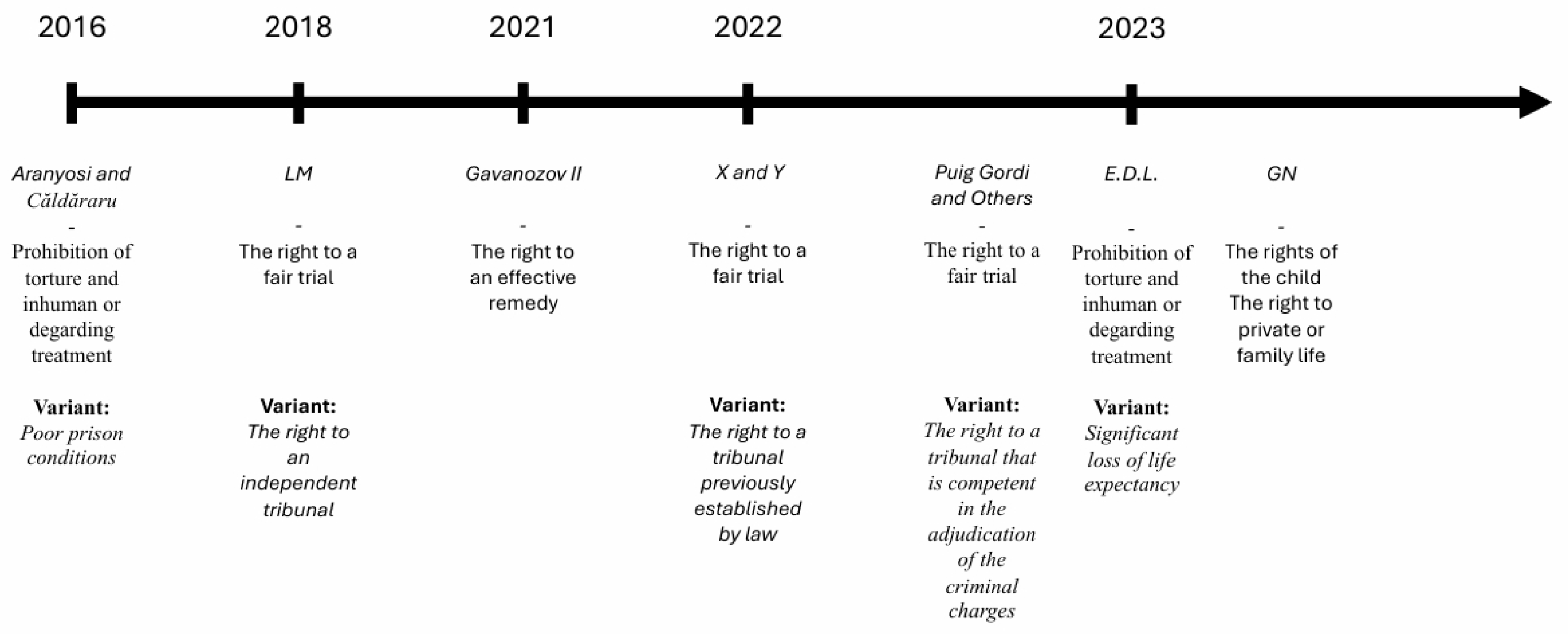
One of the most important questions in connection with the unwritten refusal ground is its scope. Scholars frequently brought up this issue. Additionally, the European Court of Justice has also dealt with the question in great detail in various preliminary ruling procedures. Based on the jurisprudence of the Court, it can be confidently stated that at least three fundamental rights fall into the scope of the refusal ground in question including the prohibition of torture, and inhuman or degrading treatment, the right to a fair trial and the best interests of the child. Moreover, the jurisprudence of the Court seems to suggest that three rights may be identified in connection with the right to a fair trial, which constitutes its core substance whose violation would rid the non-absolute fundamental right from its essence. As such, these rights can be considered variants that may give rise to the application of the refusal ground. Additionally, via the joint reading of further two judgements of the Court in line with its Aranyosi jurisprudence, the right to an effective legal remedy may be involved in the scope of the refusal ground, and another variant of the prohibition of torture and inhuman or degrading treatment may be identified.
As already well explained by the legal literature, the rebuttal of the principle of mutual trust in the field of judicial cooperation in criminal matters was first granted in joined cases Aranyosi and Căldăraru (
Gáspár Szilágyi 2016). In its judgement, the Court allowed to refuse the execution of the EAW if it would violate the concerned person’s right to not be submitted to inhuman or degrading treatment in the issuing member state due to poor prison conditions (
Mei 2017, p. 899). The Court argued that the prohibition of inhuman or degrading treatment is closely tied to human dignity. Thus, the prohibition is absolute, in that it cannot be constricted. As such, it regards this fundamental right as absolute.
37 Consequently, if it is jeopardised, the principle of mutual recognition should be suspended until sufficient guarantees are provided that it will be protected in the individual case.
38 The Court even clarified that prison conditions should be up to the minimum standards of detention conditions set by the European Court of Human Rights (
Mohay 2020, p. 87).
39It was not long after 2016 that the scope of the unwritten refusal ground was first extended to another fundamental right. The Court concluded in its judgement concerning case LM that the presumption of mutual trust may also be rebutted if a non-absolute fundamental right, namely the right to a fair trial is jeopardised (
Simonelli 2019, p. 334). The person concerned by the EAW claimed that the Polish judicial system was adversely affected by a legislative act which deprived Polish courts of independence.
40 The Court noted that the right to an independent tribunal is so important that it constitutes the essence of the right to a fair trial.
41 Thus, it decided that the execution of the EAW may be refused.
42 Based on this argument, it is assumed by scholars that the unwritten refusal ground based on Article 1(3) EAWFD may only be applied in connection with a non-absolute fundamental right, if the violation is so serious as to affect the essence or core of that right (
Bárd and Ballegooij 2018, p. 359;
Rizcallah 2023, p. 334;
Simonelli 2019, p. 334). This was reiterated in joined cases L and P (
Frackowiak-Adamska 2022, p. 124).
43 In the same line of cases, the Court found that denying the right to access to a tribunal previously established by law also adversely affects the essence of the right to a fair trial.
44 Thus, the improper appointment of judges to preside over a case, which may jeopardise the independence of the tribunal, constitutes another form of the violation of the right to a fair trial that gives rise to the application of this novel refusal ground.
45 Finally, in case Puig Gordi and Other, the Court further extended the interpretation of the essence of the right to a fair trial and stated that it may be violated if the accused is adjudicated by a court that manifestly lacks jurisdiction to do so.
46The scope of the refusal ground was further extended in another judgement of the Court delivered in case GN, where the Court acknowledged that execution may be refused if the best interests of the child are not observed under the detention regime of the issuing member state.
47Additionally, I argue that the scope of the unwritten refusal ground may be further extended if it is accepted that there is convergence between cases originating from joined cases Aranyosi and Căldăraru and cases Gavanozov II and E.D.L. in line with the above arguments highlighting the uniform evidentiary benchmark which was applied by the Court in all cases concerned. In case Gavanozov II, the Court considered the possibility of refusing the European Investigation Order due to legislation in the issuing member state that was in violation of the right to an effective remedy.
48 Moreover, in case E.D.L., the Court established that execution may also be refused due to the violation of the prohibition of torture and inhuman or degrading treatment if the concerned person faces a real risk of suffering serious, rapid, and irreversible decline in their state of health or a significant reduction in their life expectancy due to an illness (
Meulen 2024, p. 231).
49 Thus, the Court eventually concluded that the prohibition of torture and inhuman or degrading treatment may be violated in another setting as well. Accepting convergence between the above cases would be highly beneficial for the protection of fundamental rights, as the right to an effective remedy would be included in the scope of the unwritten refusal ground, and the prohibition of torture and inhuman or degrading treatment would be protected in another setting too.
To summarise, the scope of the unwritten refusal ground based on Article 1(3) EAWFD has been greatly extended in the last few years. If we accept the convergence in the case law of the Court, its application was considered in the case of four fundamental rights, including the prohibition of torture and inhuman or degrading treatment, the right to a fair trial, the right to an effective remedy, and the best interests of the child. Moreover, the Court recognised more than one form of violation of the former two. In the case of the prohibition of torture and inhuman or degrading treatment, it found that not only poor prison conditions may violate this fundamental right, but cases when the concerned person is so ill that their health may significantly deteriorate if the surrender is carried out as well. In case of the right to a fair trial, not only did the Court establish that execution shall only be refused if the essence of the non-absolute fundamental right is violated, but it also set a qualitative standard for the essence of that right, including at least the rights to an independent tribunal, a tribunal that was previously established by law and a tribunal that is competent in the adjudication of the criminal charges against the concerned person. These can also be seen as three forms of the violation of the right to a fair trial that may give rise to the application of the unwritten refusal ground.
The above overview was not completely linear. There is a figure below that demonstrates the development of the scope of the unwritten refusal ground based on Article 1(3) EAWFD for a better understanding of the Court’s “stone-by-stone” approach (see
Figure 1).
2.2. Challenging the Aranyosi Test
Several preliminary ruling procedures questioned the Aranyosi test itself. The referring courts intended to skip either the first or the second prong of the Aranyosi test while assessing whether the unwritten refusal ground can be applied. In case LM, the referring court asked whether the second prong of the Aranyosi test may be abandoned.
51 In joined cases L and P, the referring court inquired about the possibility to refuse the execution of the judicial decision considering the systemic and generalised deficiencies that existed in the issuing member state even though the concerned person did not express any specific concern regarding these issues. Hence, in this case, the referring court also called for the abandonment of the second phase of the Aranyosi test.
52 Finally, in case E.D.L., the referring court asked if execution may be refused based solely on the personal situation of the concerned person. Thus, it aimed to fast forward the Aranyosi test to the second phase without carrying out the first one.
53 In addition, scholars also called for a reformed Aranyosi test. Petra Bárd and Wouter Ballegooij note that maintaining the two phases of the Aranyosi test in case of the right to a fair trial puts an unfair burden on the concerned person who is incapable of proving that their right to a fair trial would be violated upon surrender. Instead, the scholars call for shifting the burden of proof, indicating that after ascertaining systemic or generalised deficiencies, the issuing member state should be responsible for proving that the right to a fair trial will be protected in the individual case (
Bárd and Ballegooij 2018, p. 361). Ceciliah Rizcallah also suggests reforming the burden of proof when carrying out the Aranyosi test. In addition to that, she also advocates for introducing an individual risk-based analysis that can consider systemic deficiencies as well (
Rizcallah 2023, pp. 268–70).
The Aranyosi test, established by the Court in joined cases Aranyosi and Căldăraru, constitutes a compromise between the efficiency of judicial cooperation and the protection of fundamental rights (
Marin 2017, p. 146;
Sicurella 2018, p. 311;
Mitsilegas 2020, p. 70). As already explained, the Aranyosi test consists of two phases, or rather, two tests to carry out. In the first phase, the executing authority needs to ascertain that there exist systemic or generalised deficiencies in the legal system of the issuing member state that can affect the protection of fundamental rights in individual cases (
Montaldo 2016, p. 991). Once that is confirmed, it must scrutinise—considering the specific circumstances of the individual case—whether the fundamental rights of the concerned person may be subject to violation in the issuing member state (
Martufi and Gigengack 2020, p. 284).
54 If the threat is confirmed, the executing authority has to postpone the execution of the judicial decision until sufficient guarantees that the threat is mitigated are provided (
Mitsilegas 2019, p. 428).
It is easy to comprehend that carrying out the Aranyosi test is a difficult task, since the executing authority needs to assess a criminal justice system other than that of its own member state (
Armada 2015, pp. 25–26). That may be the reason for the several challenges concerning its structure submitted by referring courts. However, the Court firmly stood its ground regarding its method for balancing the needs of efficiency and the protection of fundamental rights. In most of the observed cases, it turned down the requests of the referring courts to grant permission for the abandonment of either phase of the Aranyosi test. In case LM, it did so with a formal argument claiming that the automatic refusal of a EAW is only provided if the European Council determines a breach in the issuing member state of the principles set out in Article 2 TEU on which the principle of mutual trust rests.
55 However, in later cases, the Court also elaborated that the automatic refusal of the judicial decision once systemic or generalised deficiencies are found would bring the EAW mechanism—or any other cooperation system—to a stop.
56 Such a practice would bypass the European Council’s right to temporarily suspend the operation of cooperation systems. Moreover, it would result in the impunity of offenders, which harms the interests of criminal justice and victims’ rights.
57 Based on the former arguments, it can be stated that the Court is committed to upholding the exceptional characteristic of the refusal grounds, including the unwritten one as well. This was even reiterated in case Gavanozov II, where it noted that issuing a European Investigation Order that is a fortiori in violation of EU law is forbidden since it would render its refusal automatic, which goes against the exceptional nature of refusal grounds.
58However, there were two cases where the Court reconsidered its previous approach. In case E.D.L., it granted the possibility to carry out an analysis that seems to be based solely on the individual circumstances of the concerned person. Consequently, at first sight, it allowed the Court to skip the first phase of the Aranyosi test (
Meulen 2024, p. 226). Moreover, in case Gavanozov II, it chose to forbid the issuing of a European Investigation Order if it would order investigative measures that could not be challenged based on the criminal procedure code of the issuing member state. Thus, it allowed for the refusal of execution, or rather, forbade the issuance of judicial decisions after carrying out the first phase of the Aranyosi test (
Weiss 2022, p. 186).
In my opinion, the two judgements represent notably different approaches. In case Gavanozov II, the Court decided that the judicial decision shall not even be issued, since the legal system of the issuing member state is designed in such a way that every person who is subject to a specific investigative measure—such as the hearing of a witness—is deprived of their right to an effective remedy as there is no possibility for challenging that decision (
Szijártó 2022, pp. 49–50). It noted that in such a situation, the executing authority would be obliged to refuse the execution of every judicial decision ordering such an investigative measure. Instead, it decided that issuing such a judicial decision is in violation of EU law, since the automaticity of refusing these judicial decisions would oppose the very logic of the system built on the principle of mutual recognition.
59 Even though the Court chose to forbid the issuance of such judicial decisions, it can be derived from the judgement that the Aranyosi test can indeed be reduced to one phase—the first one in this case. According to the Court, if such a judicial decision is issued, the executing authority should refuse the execution after confirming that remedial rights are insufficient in the issuing member state. This fact constitutes the systemic or generalised deficiency in the issuing member state. I believe that, in this case, carrying out the first phase of the Aranyosi test would have been enough, since the executing authority would have found that the systemic or generalised deficiency affected every person. Thus, there is no need for analysing the specific circumstances of the individual case as the criminal procedure code excludes the right to an effective remedy for everyone. Hence, I believe that the Aranyosi test can indeed be reduced to its first phase if it shows that the violation of a fundamental right occurs regardless of the specific circumstances of the individual case.
As opposed to case Gavanozov II, the Court decided in case E.D.L. that the execution of the European Arrest Warrant can be refused if it would gravely affect the health of the concerned person.
60 It specifically noted that the executing authority must inquire about the detention conditions which will apply to the concerned person during and after the criminal procedure.
61 Thus, refusal may only take place if the executing authority cannot rule out the danger of violation of the fundamental right after surrender based on the information provided by the issuing authority.
62 Some authors considered this judgement as derogating from the original two-phase structure of the Aranyosi test (
Rizcallah 2023, p. 265;
Meulen 2024, p. 234). However, I believe that nothing in the judgement suggests that the executing authority should derogate from the standard Aranyosi test. Quite the contrary, I believe that the judgement describes a process identical to the Aranyosi test except for one aspect. Its phases are reversed. According to the Court, if a person concerned by an EAW is seriously ill which may result in the deterioration of their health upon surrender, the executing authority should make sure that it can be mitigated in the issuing member state. Consequently, the executing authority starts with finding that the personal situation of the concerned person makes them vulnerable to fundamental rights violations. However, the threat of violation would only materialise if the criminal justice system was constructed poorly in the issuing member state. Otherwise, it could provide sufficient guarantees for mitigating this threat. Even though I believe that the Aranyosi test was not changed in its core in case E.D.L., I also recognise that it constitutes a novel approach. Hopefully, in the future, the Court will address this issue in a clearer form and allow for swapping the order of the phases of the Aranyosi test.
In conclusion, the Court still favours to the original Aranyosi test when it comes to assessing the need to apply the unwritten refusal ground based on Article 1(3) EAWFD. However, in case Gavanozov II, it decided to abandon the second phase and in case E.D.L., it decided to swap the order of the two phases. Both cases demonstrate that derogating from the original form of the Aranyosi test has a remarkably high threshold. The second phase may be abandoned if the first test shows that the violation of a fundamental right is an objective fact, which is not dependent upon the specific circumstances of the case. On the other hand, swapping the order of the phases is possible if the individual risk factors are so significant that they may in themselves result in the violation of the fundamental rights of the concerned person. Both are very stringent criteria for derogating from the standard Aranyosi test. However, this strict approach is explained by the need to avoid the impunity of offenders.
2.3. Triggers and Burden of Proof
Finally, the Court has crystallised various procedural aspects of the unwritten refusal ground in its case law including the type of information that the executing authority should rely on when carrying out the first prong of the Aranyosi test (
Lazowski 2019, p. 441),
63 the obligations of the issuing and the executing authorities when communicating with each other (
Lazowski 2019, p. 442),
64 and even the right to issue another EAW after a refusal.
65 However, it has not yet addressed who should trigger the Aranyosi test and who should bear the burden of proof in the process in an unambiguous manner yet.
As regards the first unanswered question, which is who should initiate the Aranyosi test, it is important to emphasise that the Court never called for the execution of the Aranyosi test on the own initiative of the executing authority. Among the analysed preliminary ruling procedures, there were cases where the challenge towards the judicial decision gave rise to the Aranyosi test,
66 and there were cases where the executing authority carried out the scrutiny on its own initiative. In case ML, the facts of the case suggest that the executing authority requested additional information even without the notion of the concerned person.
67 In case Dorobantu, the executing authority also executed the Aranyosi test on its own initiative.
68 Moreover, in case Puig Gordi and Others, it also seems like the executing authority decided to stay the proceedings based on its own conclusion.
69 Altogether, I am still inclined to believe that the Court would rather opt for a solution that allows it to carry out the Aranyosi test only when it is requested by the concerned person, as the principle of mutual trust requires that the scrutiny should be performed on an exceptional basis.
70 Allowing executing authorities to scrutinise fundamental rights protection in the issuing member states on their own initiative would certainly oppose this exceptionality.
In regards to the second unanswered question, which is who should bear the burden of proof—an issue frequently brought up by scholars as well (
Bárd and Ballegooij 2018, p. 361;
Rizcallah 2023, pp. 268–70)—the Court has never addressed it in a direct form. First, it should be observed that it has never directly set out that the concerned person is responsible for proving that they would run a real risk of fundamental rights violation if the judicial decision was executed. I also do not believe that the responsibility is entirely on either of the authorities. Instead, the internal logic and two-prong structure of the Aranyosi test suggest that the burden of proof lies somewhere in between. The concerned person should be responsible for notifying the executing authority—as suggested above—about the possibility of a systemic or generalised deficiency in the issuing member state that could result in the violation of their fundamental rights. This is achieved by challenging the judicial decision. However, after the initial challenge of the judicial decision, the executing authority is obliged to assess this threat, since the duty to carry out the first phase of the Aranyosi test rests entirely on the executing authority, which needs to ascertain whether systemic or generalised deficiencies exist in the issuing member state. Meanwhile, in the second phase, it is up to the issuing authority to prove that the individual case will not be affected by the existing deficiency. Based on the mechanism set out by the Court, the second phase is for confirming whether a risk of fundamental rights violation exists in the specific case. For this, the executing authority needs to request additional information from the issuing authority. This process serves to guarantee that such a threat does not exist. Hence, the issuing authority takes the burden of proof, as it needs to provide information which proves that the original problem is mitigated. Thus, the two-prong structure of the Aranyosi test achieves a clear-cut division of the burden of trust for both the issuing and the executing authorities.
In conclusion, the case law of the Court now provides plenty of guidance for the application of the Aranyosi test. The current state of play is certainly better than it was when the Aranyosi test was first created. However, there are still unresolved questions that should be addressed more directly either in the case law of the Court or in legislation.
3. Discussion
The former overview of the relevant case law demonstrates that the Court indeed chose to apply a “stone-by-stone” approach when dealing with the above cooperation systems applying the principle of mutual recognition. Hence, even though there is no shortage of guidance for the application of the unwritten refusal ground, identifying the rules that govern the execution of the Aranyosi test is a difficult task, as they can be found in a number of judgements. Nevertheless, it is a very important objective to synthesise these layers of rules so that eventually they can be unified which would make the application of the Aranyosi test much easier.
In the following points, I will introduce my legislative proposal for the implementation of the novel refusal ground into cooperation systems related to the principle of mutual recognition. The proposal will incorporate the scope of the refusal ground, the structure of the Aranyosi test and other procedural rules that are already crystallised in the case law of the Court and other aspects that remain unsettled.
However, before delving into the analysis, it is worth considering why legislation is necessary. First and foremost, it is claimed that the jurisprudence of the Court on the unwritten refusal ground can be considered final (
Montaldo 2024, p. 111). This is underlined by case E.D.L. for example where the Court essentially opted for an entirely different ground for carrying out the initial analysis of the potential fundamental rights violation even though it could have decided to utilise the Aranyosi test in a straightforward manner. If it is accepted that the Court’s jurisprudence will not change in the future regarding the refusal ground, it may be concluded within reasons that unresolved issues should be regulated more precisely for which the most promising solution would be codification. Additionally, research suggests that codification enhances legal certainty, promotes uniform application and improves the predictability of law, which are all important aspects of the unwritten refusal ground in question (
McCaffrey 2013), especially considering varying practices regarding the refusal ground across member states (
Gilbert 2022;
Maher et al. 2022;
Martufi and Gigengack 2020). Finally, it is worth noting that harmonisation in the field of judicial cooperation in criminal matters is believed to increase mutual trust between member states which enhances the efficiency of mutual recognition (
Öberg 2019, pp. 252–53). Not to mention that the effects of such harmonisation are well documented in legal literature and include a more focused case law of the Court on the protection of certain fundamental rights and the convergence of the EU system of procedural guarantees in the criminal procedure with the ECHR system of guarantees (
Szijártó 2025, pp. 276–77). As such, it is without doubt that positive harmonisation carried out via the codification of the now unwritten fundamental rights-based refusal ground would greatly enhance the efficiency cooperation between member states while also safeguarding fundamental rights to a much greater extent in a more consistent and reliable manner.
3.1. The Scope of Application
When it comes to setting out a refusal ground for cases when the execution of a judicial decision would violate a fundamental right, it certainly comes first to map out the scope of its application. In other words, there needs to be a list of fundamental rights that are considered when applying the refusal ground. Naturally, the refusal ground would be applicable if any of the listed fundamental rights were up to the possibility of violation. Even though such a list can already be compiled of certain fundamental rights based on the above case law, the jurisprudence in and of itself is not enough to create a definitive list of fundamental rights for this purpose, since the Court identified fundamental rights which are relevant to the application of the unwritten refusal ground on an opportunistic basis. It cannot go beyond the subject of the preliminary ruling procedure that is pending before it.
Nevertheless, defining the fundamental rights that are relevant to the refusal ground would be highly beneficial for its application as it would unify case law in every member state. There is no other way to create such a list than considering the fundamental rights set out by the Charter of Fundamental Rights. I choose to adhere only to the Charter of Fundamental Rights, as the Court established that it takes precedence over the constitutions of the member states (
Bachmaier Winter 2015, p. 518). In addition, it is not necessary to refer to the European Convention on Human Rights, as the Charter itself sets out that any fundamental right laid down in it corresponding to a fundamental right laid down in the European Convention on Human Rights shall be interpreted in line with its equivalent in the Convention.
71 As such, there is one definitive list of fundamental rights which needs to be adhered to instead of a multitude of sources which would result in difficult practical application of the refusal ground.
It comes without question that every fundamental right laid down in Title I of the Charter (Dignity) should be listed in the refusal ground since every one of them originates from human dignity, which was referred to multiple times by the Court in its case law.
72 Apart from them, there is a multitude of fundamental rights defined in the Charter that are not affected—either directly or indirectly—by criminal justice. As such, it is easier to choose fundamental rights that can be affected by the criminal procedure rather than to exclude fundamental rights which are not relevant to the refusal ground.
Identifying relevant fundamental rights is made easier by the case law which already found several fundamental rights apart from those originating from human dignity. They include the right to a fair trial, the right to an effective remedy, and the rights of the child. From Title II of the Charter, (Freedoms) the right to liberty and security can also be identified as an important fundamental right that should be relevant to the refusal ground as the criminal procedure often constricts the liberty of the concerned person. It corresponds to Article 5 of the European Convention on Human Rights, which requires that detention should be lawful, while the person detained should be informed of their rights and obligations.
73 Additionally, the right to respect for private and family life may also be included as the criminal procedure especially tends to construct privacy rights of suspects and accused persons.
In my opinion, Titles III–V of the Charter (Equality, Solidarity, Citizen’s rights) do not contain any further fundamental rights that may be meaningfully infringed in the criminal procedure. As such, they do not contain any further fundamental rights that should be expressly included in the legislative proposal for the refusal ground (
Trechsel and Summers 2006).
On the other hand, every fundamental right laid down in Title VI of the Charter (Justice) should be relevant to the refusal ground even though the Court only established two of them as included in its scope. Hence, apart from the right to a fair trial and the right to an effective remedy, the presumption of innocence, the right of defence and the principle of ne bis in idem should also be considered as the basis of application of the refusal ground. It should go without question that in case of violation of the presumption of innocence or the right of defence, the refusal ground should be applicable. Their importance is demonstrated by the EU’s secondary legislation, which regulates certain aspects of the presumption of innocence and a variety of aspects of the right of defence such as the right to information, the right to be present at the trial, and the right to legal assistance.
74 Since the latter is already included in the refusal grounds in cooperation systems, it is unnecessary to include it here as well. On the other hand, the other fundamental rights should be incorporated in the scope of the refusal ground as being directly affected by criminal justice. Lastly, it should be noted that the principles of legality and proportionality of criminal offences and penalties may also be defined as the basis of application of the refusal ground. Even though they are defined by very different characteristics of the criminal justice systems of the member states, EU law has a common definition and requirement of proportionality which may be observed even in connection with the EAW and other judicial decisions based on the principle of mutual recognition (
Tridimas 2020, pp. 136–40).
At the same time, the scope of the refusal ground should not be understood as exhaustive. Given the dynamic nature of fundamental rights protection and the evolving case law of the Court, it is essential to preserve a degree of flexibility, allowing for the application of the refusal ground in situations where other fundamental rights—currently unforeseen—may be seriously at risk. Such an open-ended list of fundamental rights could draw attention on fundamental rights that are most likely to be infringed during the criminal procedure while simultaneously mitigating unforeseen violations that affect the fundamental rights laid down in Title III–V of the Charter that are considered to be less likely to be infringed in the criminal procedure.
3.2. The Reformed Aranyosi Test
Ceciliah Rizcallah called for a reformed Aranyosi test when proposing that the mandatory two-step test should be converted into an individual risk-based assessment (
Rizcallah 2023, p. 268). She argued that the individual risk of fundamental rights violation faced by the concerned person should be the standard for the application of the refusal ground. She argued that this would make the unwritten refusal ground more protective of fundamental rights, as the mandatory first phase of identifying systemic or generalised deficiencies in the legal system of the issuing member state—should those deficiencies not exist—would not stand in the way of acknowledging the individual risks that the concerned persons face. In addition, she claimed that it would be possible to consider these deficiencies even in an individual risk-based assessment (
Rizcallah 2023, p. 269).
In my opinion, the individual risk-based assessment would be a step in the right direction, albeit not in and of itself. It should be a fall-back option when the original Aranyosi test cannot provide a viable solution for the protection of fundamental rights as seen in case E.D.L. That case showed that the threat of fundamental rights violation may not only stem from systemic or generalised deficiencies in the legal system of the issuing member state, but also from the individual circumstances of the concerned person. However, even in that case, the Court emphasised that it should be scrutinised whether the violation can be avoided with sufficient measures in the issuing member state.
75 As such, the Court seems to be open for introducing the individual risk-based assessment in some form. However, it is sure that the Aranyosi test will not be entirely reworked. I believe that numerous cases before the Court have shown that systemic or generalised deficiencies are sufficient indicators for possible violations in the process of judicial cooperation in criminal matters. It is often impossible to find an individual risk that concerns a person sought by an EAW. For example, when the independence of the judiciary is jeopardised, the risk of the violation of fundamental rights does not originate from the individual circumstances of the concerned person. As such, an individual risk-based assessment may even be insufficient to identify that the concerned person runs a real risk of violation of their right to a fair trial. On the other hand, the express introduction of the individual risk-based assessment could more efficiently indicate a violation which may be derived from the individual circumstances of the concerned person. For example, in case GN, the threat of violation originated from the fact that the person sought by an EAW had a child with whom communication would have had been much harder if they were surrendered for the criminal procedure in another member state. In this case, proving that there exist systemic or generalised deficiencies in the legal system of the issuing member state prior to the individual risk assessment is contra-productive as the relationship between the child and the parent would be strained under these circumstances without any question. The real question is whether the issuing member state has any specific measure that can mitigate this harmful effect of the surrender and the following criminal procedure.
As such, instead of a completely reworked Aranyosi test, I believe that executing authorities should be given the possibility to start with either of the phases of the Aranyosi test. They should be allowed to decide which circumstances they assess first: the existence of systemic or generalised deficiencies or the individual risk that the concerned person faces. This margin of appreciation would also simplify the obligations of the concerned person, since without them challenging the judicial decision, the executing authority is not obliged to carry out the Aranyosi test—at least in my proposal. As a result, they could choose to claim that the risk of fundamental rights violation lies in their individual circumstances if systemic or generalised deficiencies cannot be found in the issuing member state.
Such a solution would be completely in line with the Court’s jurisprudence as it already recognised the possibility to reverse the steps in the Aranyosi test. It would also incorporate the proposal of Ceciliah Rizcallah to a certain extent, as the very idea of the proposal is to provide the possibility to choose between the two approaches.
Lastly, it should be allowed in exceptional circumstances to reduce the Aranyosi test to its first phase as was seen in case Gavanozov II. The executing authority should be allowed to refuse to execute the judicial decision if there are so significant deficiencies in the legal system of the issuing member state that they affect everyone regardless of the specific circumstances of the underlying case.
3.3. Procedural Rules
As a final point, some of the identified procedural rules guiding the execution of the Aranyosi test should be codified as well. The quality and the source of information which may be used in assessing the legal system of the issuing member state should be listed. It is also necessary to directly set out the obligation of communication between the issuing and the executing authorities as it is currently not expressly regulated in the cooperation systems.
In addition to that, it would be highly beneficial for all parties to the process to define the burden of proof and the triggering criteria to initiate the Aranyosi test. To avoid putting too much burden on the concerned person, it should be laid down that the concerned person is only responsible for challenging the judicial decision based either on systemic or generalised deficiencies or on their individual circumstances. The standard of proof should not exceed the balance of probabilities in this case, so it should be enough to prove that a fundamental rights violation is likely to occur. On the other hand, it should not be the responsibility of the executing authority to identify threats without such a claim. This would alleviate the burden both on the individual and the executing authority for different reasons. First, the individual would not have to meet unfair standards, while the executing authority would not have to constantly assess the protection of fundamental rights during judicial cooperation (
Armada 2015, pp. 25–26).
3.4. A Textual Proposal
Based on the above arguments, I propose the following rule to be implemented in cooperation systems based on the principle of mutual recognition. The proposal is essentially a refusal ground; however, it is quite detailed, which makes it stand out from other refusal grounds. As such, I believe that it should be placed in an individual article instead of the one where refusal grounds are normally regulated.
(1) The execution of the [judicial decision] shall be refused if there are substantial grounds to believe that its execution would violate the fundamental rights of the concerned person.
(2) Refusal of the [judicial decision] shall be specifically considered when the violation of one of the following fundamental rights laid down in the Charter of Fundamental Rights is at stake:
(a) human dignity;
(b) right to life;
(c) right to integrity of the person;
(d) prohibition of torture and inhuman or degrading treatment or punishment;
(e) prohibition of slavery and forced labour;
(f) right to liberty and security;
(g) respect for private or family life;
(h) the rights of the child;
(i) right to an effective remedy;
(j) right to a fair trial;
(k) presumption of innocence;
(l) right of defence;
(m) principles of legality and proportionality of criminal offences and penalties.
(3) In case of a fundamental right that may be limited, refusal may take place if the limitation of that right in the issuing member state is so grave that it would rid the right of its essence.
(4) The refusal of the [judicial decision] shall be considered on the concerned person’s initiative that they run a real risk of violation of any of their fundamental rights listed in section (2) of this article. The burden of proof on the concerned person shall not exceed the balance of probabilities.
(5) Upon the concerned person’s initiative, the executing authority shall examine the protection of the concerned fundamental right in the issuing member state. The execution of the [judicial decision] shall be refused if
(a) the executing authority finds that there are systemic or generalised deficiencies in the legal system of the issuing member state which make the fundamental rights of the concerned person susceptible to violation based on or regardless of the individual circumstances of the specific case, or
(b) regardless of whether there are systemic or generalised deficiencies in the legal system of the issuing member state, the individual circumstances of the concerned person make their fundamental rights susceptible to violation.
(6) When assessing whether there are systemic or generalised deficiencies in the legal system of the issuing member state, the executing authority may rely on information that is objective, reliable, specific and properly updated. Such information shall be obtained from judgements of international courts, judgements of courts of the issuing member state, or decisions, reports and other documents produced by bodies of the Council of Europe or under the aegis of the United Nations.
(7) When assessing whether the individual circumstances of the concerned person or the specific case make the fundamental rights of the concerned person susceptible to violation, the executing authority shall consult with the issuing authority to find out if sufficient guarantees can be provided to avoid such violation. The issuing authority shall provide information to the executing authority.
First and foremost, it must be noted that the above refusal ground is quite extensive. I believe that regulating the now unwritten refusal ground requires this much detail as it was already shown in the case law of the Court that it is a complex matter of utmost importance.
The first section defines the standard of proof needed for applying the refusal ground. It uses the term ‘substantial grounds to believe’, which is frequently relied on by the Court and other international courts such as the European Court of Human Rights and the International Criminal Court (
Mariniello 2015, p. 584). Based on the case law of the International Criminal Court, the standard of proof required for applying the refusal ground should be between ‘reasonable ground to believe’ and ‘beyond a reasonable doubt’ (
Mariniello 2015, p. 586). This would mean that evidence should suggest to the executing authority that the fundamental rights violation has a solid chance of occurring. However, it does not need to be completely sure. The second section maps out the scope of application of the refusal ground based on the arguments laid down in point 3.1. The third section concerns those fundamental rights which may be lawfully limited. It sets out that the refusal ground may only be applied in case of such a fundamental right if it is limited so much that it basically rids it from its essence. The fourth section concerns the initiation of the Aranyosi test for assessing the need to apply the refusal ground. It puts the obligation to challenge the judicial decision based on the balance of probabilities on the concerned person. As such, it sets a lower expectation for the burden of proof. The fifth section describes the Aranyosi test and the possibility of swapping the original order of the execution of its phases and even the possibility of entirely abandoning the second phase in exceptional circumstances with sufficient guarantees. Last, but not least, the sixth and the seventh sections define the information which may be used while executing the Aranyosi test and the obligation of the issuing and the executing authorities to communicate with each other.
To sum up, the legislative proposal intends to strike a delicate balance between the efficiency of cooperation and the protection of fundamental rights. As judicial cooperation in criminal matters is essential in an area of free movement in the EU, the cooperation should be suspended only if truly necessary, since it could result in the impunity of offenders. This is exactly why a high standard of proof is required in the first section of the refusal ground for its application. In addition to that, the automatic process of cooperation should not be frequently or even continuously suspended by the scrutiny carried out by the executing authority. This is precisely why the Aranyosi test should be carried out only on the well-founded request of the concerned person. However, their interests are protected by the lower burden of proof demonstrated by the fourth section. Finally, the multiple methods for carrying out the Aranyosi test provides a reasonable compromise between the Court’s approach and the recommendations of scholars. The fifth section of the refusal ground provides discretion to the executing authority to carry out the scrutiny as it sees fit in the specific case. Thus, I believe that the above proposal is flexible enough to cater for the opposing interests of judicial cooperation in criminal matters and the protection of fundamental rights.
Last, but not least, it should also be mentioned that some aspects of the unwritten refusal ground such as the meaning of the essence of a fundamental right and the question of what constitutes sufficient guarantees are still unresolved. Regarding the former, I believe that to find out what constitutes the essence of a fundamental right that may be limited, the case law of the European Court of Human Rights and—when available—the primary and secondary sources of EU law should be consulted. For example, when considering the essence of the right to a fair trial, the executing authority can adhere to the directives harmonising the rights of the suspect and the accused. As this issue was not dealt with by the Court, I believe that it should not yet be included in a legislative proposal, much like the question of sufficient guarantees. Instead, judicial authorities should be given discretion to deal with these questions on their own for now.
4. Conclusions
This article has provided a comprehensive and systematic analysis of the case law of the European Court of Justice concerning the unwritten refusal ground based on Article 1(3) EAWFD. By examining the Court’s jurisprudence alongside the relevant legal scholarship, it has demonstrated that the contours of this refusal ground have been progressively clarified through a “stone-by-stone” approach. As a result, key elements of the doctrine—such as its scope, the structure of the Aranyosi test, and several procedural aspects—have reached a high degree of maturity.
At the same time, the analysis has shown that important questions remain unresolved, particularly with regard to the triggering of the Aranyosi test and the allocation of the burden of proof. Moreover, while the Court’s case law reveals methodological parallels across different lines of jurisprudence concerning the protection of fundamental rights in judicial cooperation, these developments remain fragmented due to their distinct legal bases. This fragmentation contributes to legal uncertainty and may hinder the consistent application of fundamental rights safeguards across member states.
In light of these findings, the article has argued that codification of the unwritten refusal ground is both justified and desirable. Given that the Court itself appears to regard its case law in this area as relatively settled, further doctrinal development through judicial interpretation alone may be limited. Codification would therefore enhance legal certainty, promote uniform application, and provide clearer guidance to both issuing and executing authorities, while preserving the delicate balance between the efficiency of judicial cooperation and the protection of fundamental rights.
The legislative proposal put forward in this article seeks to reflect the existing case law as closely as possible, while addressing its remaining ambiguities and incorporating insights from academic literature. While certain aspects—such as the precise content of the “essence” of fundamental rights or the nature of sufficient guarantees—remain open to further judicial clarification, the proposed framework offers a structured and flexible basis for future legislation.
Ultimately, the codification of the unwritten refusal ground should not be seen as a departure from the Court’s jurisprudence, but rather as its natural continuation. By consolidating the achievements of the Court’s case law, it would contribute to strengthening both mutual trust and fundamental rights protection within the European area of freedom, security and justice.