

Legal Regulation of Sustainable Delivery of Government-Procured Public Elderly Care Services in China’s Moderately Aging Society: Dilemmas and Legalization Pathways


Abstract
1. Introduction
2. Theoretical Framework and Literature Review
2.1. Core Theoretical Foundation
2.2. Literature Review
3. Evolution of China’s Policy and Legal System for Government Procurement of Public Elderly Care Services in Recent 5 Years
3.1. Institutional Context of Government Procurement and Purchase of Services in China
3.2. Construction of Top-Level Legal and Policy Framework
3.3. Local Innovative Practice and Legal System Construction
4. Current Situation and Sustainability Assessment of China’s Government Procurement of Public Elderly Care Services
4.1. Overall Scale and Financial Input of Government Procurement of Public Elderly Care Services
4.2. Supply Structure and Service Coverage of Government Procurement of Public Elderly Care Services
4.3. Sustainability Assessment of Current Government Procurement System of Public Elderly Care Services
5. Legal and Institutional Dilemmas Restricting the Sustainable Delivery of Public Elderly Care Services Through Government Procurement
5.1. Fragmented Legal System and Insufficient Hierarchical Norms
5.2. Unsound Financial Guarantee Legal System and Insufficient Fiscal Sustainability
5.3. The Legal System’s Imperfect Service Standards and the Supply–Demand Mismatch
5.4. Defective Supervision Legal System and Insufficient Governance Sustainability
5.5. Unbalanced Regional Development and Insufficient Legal Guarantee for Equity
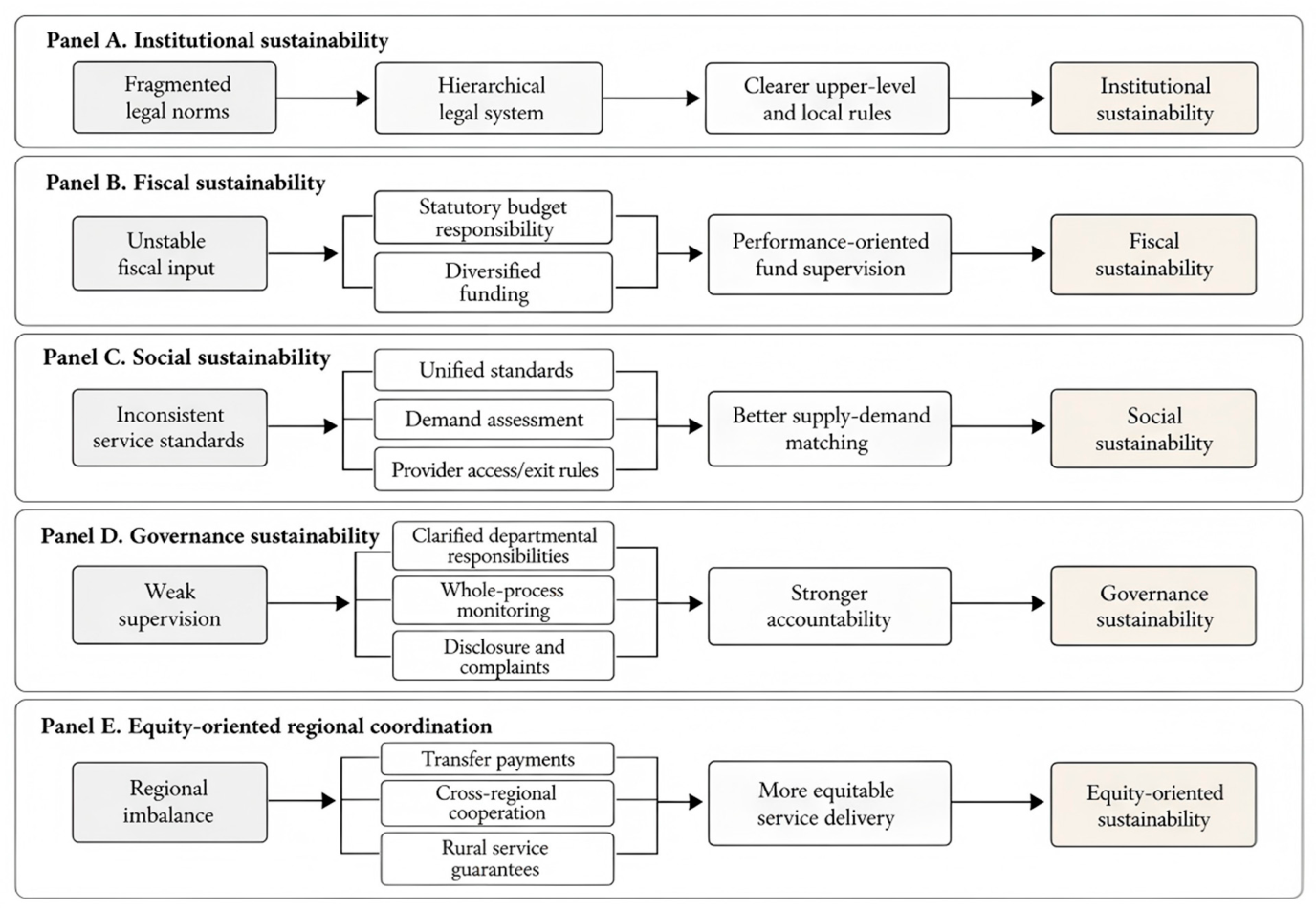
6. Discussion: Legalization Pathways for Sustainable Government-Procured Elderly Care Service Delivery
6.1. Construction of Hierarchical Legal System to Guarantee Institutional Sustainability
6.2. Improvement in Financial Guarantee Legal System to Realize Fiscal Sustainability
6.3. Improvement in Service Standard Legal System to Enhance Social Sustainability
6.4. Improvement in Whole-Process Supervision Legal System to Strengthen Governance Sustainability
6.5. Improvement in Regional Coordinated Development Legal System to Guarantee Equity
7. Conclusions
Author Contributions
Funding
Institutional Review Board Statement
Informed Consent Statement
Data Availability Statement
Conflicts of Interest
References
- Bovaird, Tony. 2007. Beyond engagement and participation: User and community coproduction of public services. Public Administration Review 67: 846–60. [Google Scholar] [CrossRef]
- Chong, Ka Chun, Hong Fung, Carrie Ho Kwan Yam, Patsy Yuen Kwan Chau, Tsz Yu Chow, Benny Chung Ying Zee, Eliza Lai Yi Wong, Maggie Haitian Wang, and Eng Kiong Yeoh. 2021. Long-term effectiveness of elderly health care voucher scheme strategies: A system dynamics simulation analysis. BMC Public Health 21: 1235. [Google Scholar] [CrossRef]
- Chu, Yaping, and Yunfei He. 2018. Research on the Influencing Factors of the Performance of Government Purchase of Home-Based Elderly Care Services. Journal of Yunnan Minzu University (Social Sciences) 35: 129–36. [Google Scholar]
- Fang, Shirong, and Jianyu Fu. 2021. Government Purchase of Public Legal Services in the Construction of a Law-Based Society. Social Sciences in Yunnan 3: 124–33. [Google Scholar]
- FitzGerald, Clare J., and J. Ruairi Macdonald. 2024. Public Contracting for Social Outcomes. Cambridge: Cambridge University Press. [Google Scholar]
- Fung, Valerie Lai-Hei, Angel Hor-Yan Lai, Carrie Ho-Kwan Yam, Eliza Lai-Yi Wong, Sian M. Griffiths, and Eng-Kiong Yeoh. 2022. Healthcare vouchers for better elderly services? Input from private healthcare service providers in Hong Kong. Health & Social Care in the Community 30: e357–69. [Google Scholar]
- Jensen, Michael C., and William H. Meckling. 1976. Theory of the firm: Managerial behavior, agency costs and ownership structure. Journal of Financial Economics 3: 305–60. [Google Scholar] [CrossRef]
- Ji, Wen. 2020. Remedy for Beneficiary Public in Government Purchase of Public Service Contracts: From the Perspective of Third-Party Beneficiary Contracts. Journal of Xinjiang University (Philosophy, Humanities & Social Sciences) 48: 33–42. [Google Scholar]
- Jiang, Gongqiong, Xiaosong Li, Kunyan Qu, and Xin Xiang. 2023. The Supervision and Legal Relations of Government’s Purchase of Elderly Care Services in China. China Health Law 31: 40–45. [Google Scholar]
- Jiang, Zhu, and Jia Chen. 2017. Research on the Incentive Compatibility Effect of Government Purchase of Services Based on “Three-Way Win-Win”. Local Finance Research 4: 52–56. [Google Scholar]
- Lam, Gigi. 2023. An evaluation of the pilot scheme on community care service vouchers for the elderly in Hong Kong. Home Health Care Services Quarterly 42: 142–53. [Google Scholar] [CrossRef] [PubMed]
- Le Grand, Julian. 2007. The Other Invisible Hand: Delivering Public Services Through Choice and Competition. Princeton: Princeton University Press. [Google Scholar]
- Li, Zhongsheng. 2017. The Urgent Need for Legal Support in Government Purchase of Public Services. People’s Tribune 12: 108–9. [Google Scholar]
- Lin, Xia. 2015. Authority Setting and Right Protection in Government Purchase of Public Services. Social Scientist 9: 53–56. [Google Scholar]
- Liu, Xiaozhou. 2018. Government Procurement of Services and the Modernization of National Governance. Journal of the Party School of the Central Committee of the C.P.C. 9: 50–56. [Google Scholar]
- Lu, Jianping, Tingting He, Guiwu Wei, Jiang Wu, and Cun Wei. 2020. Cumulative Prospect Theory: Performance Evaluation of Government Purchases of Home-Based Elderly-Care Services Using the Pythagorean 2-tuple Linguistic TODIM Method. International Journal of Environmental Research and Public Health 17: 1939. [Google Scholar] [CrossRef]
- Lu, Zhengnan, Yuting Zhang, and Lan Xu. 2022a. Anti-Risk Ability of Government Purchasing Elderly Care Services under the Coordination of Complex Network and GERT. Mathematical Problems in Engineering 2022: 9199998. [Google Scholar] [CrossRef]
- Lu, Zhengnan, Yuting Zhang, and Lan Xu. 2022b. Quality control decision of government procurement of elderly care service based on multi-index fusion of Pythagoras TOPSIS: Perspective of complex network. Managerial and Decision Economics 43: 1773–91. [Google Scholar] [CrossRef]
- Ma, Yuli. 2019. Study on the Optimization of the Evaluation Mechanism of the Government’s Affordable Service Quality under the View of Governance. Social Welfare 10: 3–7. [Google Scholar]
- OECD. 2011. Together for Better Public Services: Partnering with Citizens and Civil Society. Paris: OECD Publishing. [Google Scholar]
- OECD. 2015. Integrating Social Services for Vulnerable Groups: Bridging Sectors for Better Service Delivery. Paris: OECD Publishing. [Google Scholar]
- OECD. 2023. Health at a Glance 2023: OECD Indicators. Paris: OECD Publishing. [Google Scholar] [CrossRef]
- Pot, Anne Margriet, Josje Kok, Linda J. Schoonmade, and Roland A. Bal. 2024. Regulation of long-term care for older persons: A scoping review of empirical research. International Psychogeriatrics 36: 289–305. [Google Scholar] [CrossRef]
- Ren, Ji, and Jiaming Li. 2024. Legal Mechanism and Implementation Path of Government Purchase of Elderly Care Services. Journal of Liaoning University (Philosophy and Social Sciences) 52: 95–104. [Google Scholar]
- Shen, Suyan, Zhe Chen, Mengying Xue, Fang Li, and Ruixia Zhang. 2019. How to relieve stress in adult child caregivers of the older adults with disabilities: A survey study from the city of Nanjing, China. Social Work in Health Care 58: 291–303. [Google Scholar] [CrossRef]
- Silva, Luiz César, Isabel Maria Macedo, and Maria Thompson. 2024. Revisiting the debate on institutions, the state and institutional change: The relevance of institutional theory to public administration teaching. Teaching Public Administration 42: 73–94. [Google Scholar] [CrossRef]
- Singh, Vaishali. 2024. Role of institutions in public management: Developing case-based insights. Frontiers in Political Science 6: 1258811. [Google Scholar] [CrossRef]
- Song, Huan, Sihang Yu, and Tao Sun. 2020. Reducing the quality risk of elderly care services in government procurement from market-oriented private providers through ex ante policy design: Lessons from the principal-agent theory analysis. BMC Health Services Research 20: 1135. [Google Scholar] [CrossRef]
- Sun, Yin, Xudong Zhang, Yuehong Han, Bo Yu, and Haidan Liu. 2022. Evolutionary game model of health care and social care collaborative services for the elderly population in China. BMC Geriatrics 22: 616. [Google Scholar] [CrossRef] [PubMed]
- Wang, Dong, and Lei Wang. 2021. Interaction and Integration of Policy and Law in the Government Purchase of Elderly Care Service System: An Analysis from the Perspective of Legal Policy Science. Journal of Sichuan Normal University (Social Sciences Edition) 48: 99–107. [Google Scholar]
- World Health Organization. 2024. How Countries Finance Long-Term Care. Geneva: World Health Organization. [Google Scholar]
- Wu, Nan. 2015. Improving the Performance Evaluation of Government Purchase of Public Services by the Rule of Law. Journal of Jianghuai Forum 6: 155–58. [Google Scholar]
- Xu, Lan, and Yuting Zhang. 2021. A quality function deployment-based resource allocation approach for elderly care service: Perspective of government procurement of public service. International Social Work 64: 992–1008. [Google Scholar] [CrossRef]
- Yan, Yingchuan, and Jie Xu. 2024. Governance Path of Government Purchase of Elderly Care Services from the Perspective of the Rule of Law in the New Era: Taking Japan’s Practical Experience as a Reference. Chinese Journal of Gerontology 44: 5099–107. [Google Scholar]
- Yang, Fuwei. 2021. Contract Risks and Legal Governance of Government Purchase of Elderly Care Services. Contemporary Law Review 6: 109–20. [Google Scholar]
- Yeoh, Eng-Kiong, Carrie H. K. Yam, Ka-Chun Chong, Tsz-Yu Chow, Valerie L. H. Fung, Eliza L. Y. Wong, and Sian M. Griffiths. 2020. An evaluation of universal vouchers as a demand-side subsidy to change primary care utilization: A retrospective analysis of longitudinal services utilisation and voucher claims data from a survey cohort in Hong Kong. Health Policy 124: 189–98. [Google Scholar] [CrossRef]
- Yu, Xinxun. 2017. Legal Discussion on Government Purchase of Elderly Care Services in China: Regulation and Promotion. Journal of Sichuan Normal University (Social Sciences Edition) 44: 42–48. [Google Scholar]
- Zarychta, Alan, Michelle Elizabeth Benedum, Emily Sanchez, and Krister P. Andersson. 2024. Decentralization and corruption in public service delivery: Local institutional arrangements that can help reduce governance risks. Journal of Public Administration Research and Theory 34: 238–54. [Google Scholar] [CrossRef]
- Zhang, Jin. 2021. Improve the Public Elderly Care Service System and Improve the Efficiency of Public Elderly Care Services. China Economic Review 2021: 69–72. [Google Scholar]
- Zhang, Rui, and Huarong Zhang. 2024. Can Government Expenditure Improve the Efficiency of Institutional Elderly-Care Service?—Take Wuhan as an Example. Economics—The Open Access Open-Assessment E-Journal 18: 20220127. [Google Scholar]
- Zhang, Yige. 2019. The Solution to the Alienation and the Legalization of Government Purchasing Public Legal Service. Journal of Henan Normal University (Philosophy and Social Sciences Edition) 46: 98–105. [Google Scholar]
- Zhang, Yige. 2024. The Realization Path of the Rule of Law in the Government’s Purchase of Public Legal Services in the Context of the Construction of China under the Rule of Law. Journal of Henan Normal University (Philosophy and Social Sciences Edition) 51: 64–71. [Google Scholar]
- Zhang, Youliang, Shengkun Jia, and Jun Jia. 2016. Legalization of the Government Purchase of Public Services. Journal of Lanzhou University (Social Sciences) 44: 116–23. [Google Scholar]
- Zhang, Yuting, Lan Xu, and Zhengnan Lu. 2022. Research on the Vulnerability of Government Procurement of Elderly Care Services: A Complex Network Perspective. Complexity 2022: 2400751. [Google Scholar] [CrossRef]
- Zhao, Wenxi, and He Liu. 2026. Can better elderly care lead to a better quality of life? Evidence from China’s government purchasing of elderly care services policy. Applied Economics Letters 33: 791–95. [Google Scholar] [CrossRef]
- Zia ud din, Muhammad, Xu Yuan yuan, Naqib Ullah Khan, and Heesup Han. 2023. Linking local collaborative governance and public service delivery: Mediating role of institutional capacity building. Humanities and Social Sciences Communications 10: 906. [Google Scholar] [CrossRef]
- Zou, Huangcong. 2017. Research on the Legalization of the Undertaking Subject of Government Purchase of Public Services in China. Journal of the Party School of Hangzhou Municipal Committee of CCP 3: 20–27. [Google Scholar]

| Year | Policy/Legal Document | Key Content | Institutional Value |
|---|---|---|---|
| 2020 | Measures for the Administration of Government Purchase of Services (Ministry of Finance) | Standardized the scope, procedures, and supervision of the government purchase of services | Provides a unified regulatory basis for the government procurement of elderly care services |
| 2020 | Opinions on Establishing and Improving the Comprehensive Supervision System for Elderly Care Services (General Office of the State Council) | Clarified the full-process supervision framework for the government procurement of elderly care services | Establishes a foundation for multi-departmental, collaborative supervision |
| 2022 | Opinions on Promoting the Construction of the Basic Elderly Care Service System (General Office of the CPC Central Committee and General Office of the State Council) | Defined basic elderly care services; clarified government procurement as the core way to assume responsibility; emphasized universality, equity, and sustainability | Provides a top-level policy basis for list-based management and standardization at local levels |
| 2025 | Notice on Implementing the Project of Distributing Elderly Care Service Consumption Subsidies to Moderately and Severely Disabled Elderly (Ministry of Civil Affairs and Ministry of Finance) | Implemented the consumption subsidy system nationwide from 1 January 2026; transformed the model from “government assigned orders” to “elderly selected orders” | A major innovation in the sustainable operation mechanism |
| Sustainability Dimension | Core Evaluation Indicators | Current Status | Main Constraints |
|---|---|---|---|
| Institutional Sustainability | Legalization level; hierarchical norm completeness | Policy framework formed, but legalization level low; core provisions scattered in policy documents | Upper-level law too principled; lack of special administrative regulations; fragmented local rules |
| Fiscal Sustainability | Fiscal input growth; diversified funding mechanisms | Sustained growth (8.43% annually, 2019–2024), but mainly relies on general public budget | No rigid fiscal input mechanism; insufficient legal norms for social capital participation; weak fund use performance evaluation |
| Social Sustainability | Equity; accessibility; intergenerational solidarity | Service coverage expanded; 7.993 million beds; urban coverage: full; rural: >50% | Regional imbalance (east vs. west); urban–rural gap; service content limited (mostly basic care); lack of demand assessment mechanism |
| Governance Sustainability | Supervision clarity; accountability; information disclosure; beneficiary participation | Multi-departmental supervision framework exists, but whole-process quality supervision remains weak | Overlapping responsibilities; insufficient service quality monitoring; weak social supervision and complaint mechanisms |
Disclaimer/Publisher’s Note: The statements, opinions and data contained in all publications are solely those of the individual author(s) and contributor(s) and not of MDPI and/or the editor(s). MDPI and/or the editor(s) disclaim responsibility for any injury to people or property resulting from any ideas, methods, instructions or products referred to in the content. |
© 2026 by the authors. Licensee MDPI, Basel, Switzerland. This article is an open access article distributed under the terms and conditions of the Creative Commons Attribution (CC BY) license.
Share and Cite
Lin, Y.; Zhao, Y. Legal Regulation of Sustainable Delivery of Government-Procured Public Elderly Care Services in China’s Moderately Aging Society: Dilemmas and Legalization Pathways. Laws 2026, 15, 53. https://doi.org/10.3390/laws15030053
Lin Y, Zhao Y. Legal Regulation of Sustainable Delivery of Government-Procured Public Elderly Care Services in China’s Moderately Aging Society: Dilemmas and Legalization Pathways. Laws. 2026; 15(3):53. https://doi.org/10.3390/laws15030053
Chicago/Turabian StyleLin, Yuan, and Yue Zhao. 2026. "Legal Regulation of Sustainable Delivery of Government-Procured Public Elderly Care Services in China’s Moderately Aging Society: Dilemmas and Legalization Pathways" Laws 15, no. 3: 53. https://doi.org/10.3390/laws15030053
APA StyleLin, Y., & Zhao, Y. (2026). Legal Regulation of Sustainable Delivery of Government-Procured Public Elderly Care Services in China’s Moderately Aging Society: Dilemmas and Legalization Pathways. Laws, 15(3), 53. https://doi.org/10.3390/laws15030053

