1. Introduction
The United States has experienced a substantial increase in the proportion of older incarcerated adults over the past few decades, posing significant challenges to the correctional system. Scholars have attributed the growth of the aging prison population to the expansion of punitive criminal justice policies, including mandatory minimum sentencing, three-strikes laws, and habitual offender statutes implemented since the 1970s (
Rikard and Rosenberg 2007;
Scaggs and Bales 2015). These policies have lengthened prison terms and contributed to the aging of the prison population by keeping individuals incarcerated well into later life (
Brown and Brooke 2020). As a result, correctional institutions now house a growing number of older incarcerated adults who present a relatively low risk of recidivism.
The aging of the prison population has generated a range of correctional concerns, including the need for new prison construction, additional correctional staff, and specialized medical care. Older prisoners require higher levels of healthcare and accommodation, which substantially increases correctional expenditures and places growing fiscal pressure on federal and state governments (
Skarupski et al. 2018;
U.S. Department of Justice, Office of the Inspector General [OIG] 2020). Beyond these fiscal pressures, the continued confinement of older prisoners raises broader questions about proportional punishment and the limits of incapacitation, particularly when age-related decline reduces the crime-control benefits of imprisonment.
In response, some policymakers have proposed early release for older prisoners who pose a low risk to public safety as a means of reducing incarceration costs. Among these initiatives, the Project for Older Prisoners (POPS) provides an illustrative example of a programmatic response to the growth of the older adults prison population (
Scaggs and Bales 2015). Proponents of age-based and related early release mechanisms argue that expanding such programs could alleviate correctional overcrowding and reduce healthcare expenditures without increasing recidivism. However, critics contend that early release represents a politically and socially risky tradeoff between fiscal efficiency and public safety. The debate reflects broader tensions not only between cost containment and crime control but also the appropriate scope of punishment in aging populations.
Despite growing scholarly attention being paid to the rise of older incarcerated adults and associated correctional costs, prior research has largely focused on descriptive trends rather than systematically examining the conditions under which early release policies can be justified. In particular, empirical and theoretical work addressing how early release can be structured to protect public safety remains limited. This gap underscores the need for a more nuanced policy analysis that moves beyond cost considerations alone.
This study reviews trends in the growth of the older incarcerated population and the theoretical explanations underlying this development. It analyzes contemporary legal and policy responses to aging incarceration, including early release mechanisms based on age, medical condition, and broader compassionate criteria. Ultimately, it suggests that early release for older incarcerated adults can be a necessary and effective policy response when implemented under clearly defined conditions. By integrating theoretical perspectives on punishment and aging with existing empirical research on recidivism and correctional costs, this study seeks to identify the conditions under which release programs for older prisoners can be supported.
Accordingly, this study is guided by three research questions. First, when and why does the continued incarceration of older adults produce diminishing returns as a crime-control strategy? Here, diminishing returns refer to the point at which additional confinement yields progressively smaller crime-control benefits relative to the growing fiscal, medical, and normative costs associated with imprisonment in later life. Second, how do theories of punishment and life-course aging account for the reduced effectiveness of deterrence and incapacitation in later life? Third, under what conditions can early release policies for older incarcerated adults achieve cost reduction while maintaining public safety?
2. The Growth of the Older Incarcerated Population
2.1. Trends in the Older Incarcerated Population
The number of older prisoners and the proportion of older adults within the incarcerated population have increased since the late twentieth century. This trend must be understood in the context of the broader expansion of imprisonment that began in the 1980s. Between 1974 and 1985, the U.S. state and federal prison population grew rapidly, with the incarceration rate increasing from 102 to 201 per 100,000 residents, which signals the beginning of sustained sentence expansion and longer periods of confinement (
Bureau of Justice Statistics 1986). Although older adults constituted only a small share of incarcerated populations at the time, policy shifts generated cohorts of prisoners who would eventually age into older adulthood while incarcerated.
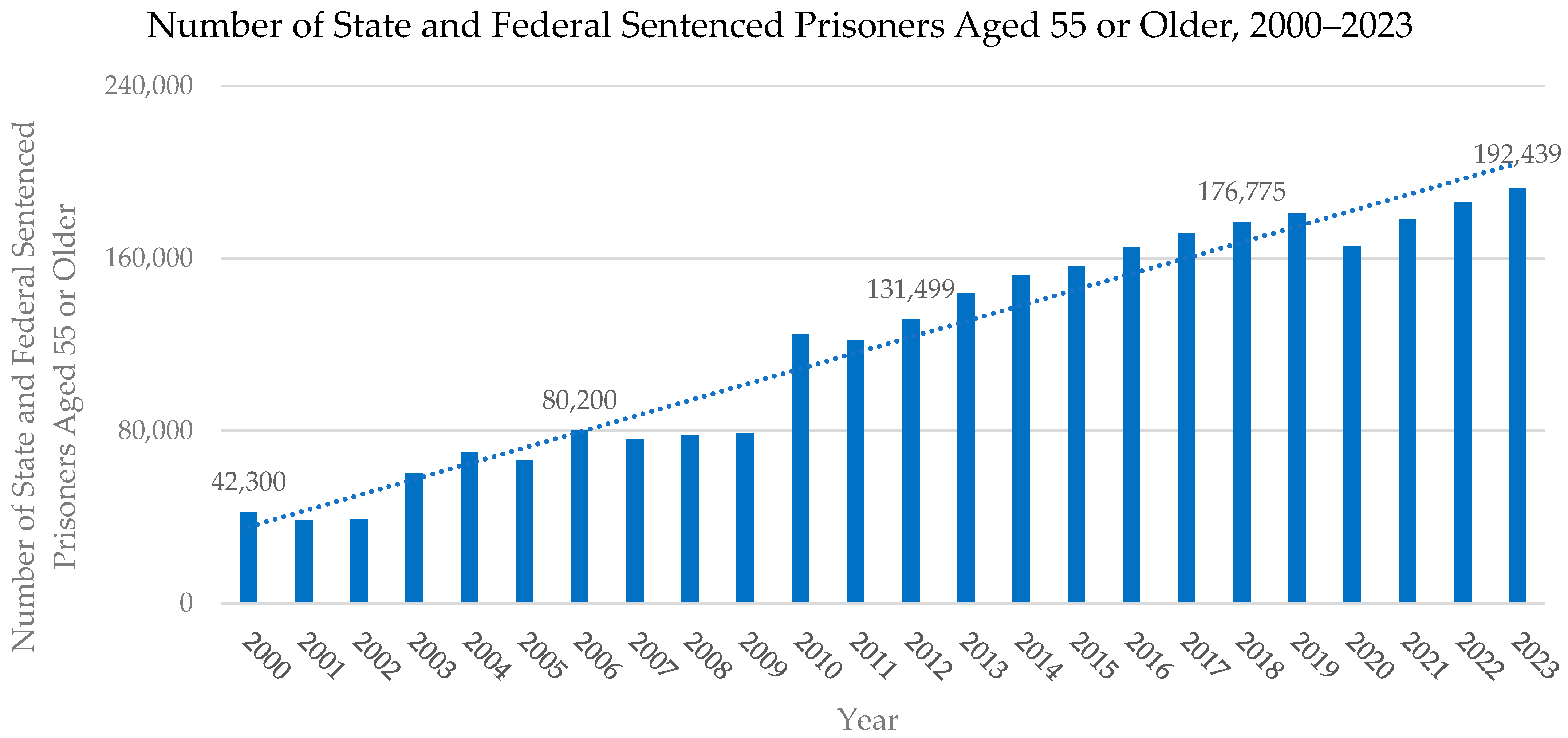
By the 1990s, measurable growth among the population of older prisoners had become evident. According to the Bureau of Justice Statistics, the number of state prisoners ages 55 or older sentenced to more than one year increased from 26,300 in 1993 to 44,230 in 2000, and reached 131,500 by 2013, which represents a rise from 3% to 10% of the total prison population over this twenty-year period (
Bureau of Justice Statistics 2001,
2015). During the same period, the imprisonment rate for individuals aged 55 or older more than tripled, increasing from 49 to 154 per 100,000 U.S. residents of the same age. Importantly, this increase was not driven solely by demographic aging. This increase reflects the admission of individuals who either entered prison at advanced ages or aged into this category while serving long sentences (
Bureau of Justice Statistics 2015).
At yearend 2023, correctional authorities in the United States had jurisdiction over approximately 1,254,200 individuals in states and federal prisons, reflecting a 2% increase from 2022 and accounting for 15% of the sentenced prison population (
Bureau of Justice Statistics 2024b). Within this population, 192,000 individuals aged 55 or older were serving sentences longer than one year, representing a 4% increase from 186,000 in 2022 (
Bureau of Justice Statistics 2024b). Notably, 96% of incarcerated individuals in 2023 were serving sentences exceeding one year.
Together, these data suggest that the aging of the incarcerated population reflects a durable structural change rather than a temporary demographic anomaly. Following the expansion of imprisonment in the 1980s, the number of incarcerated individuals aged 55 and older has continued to increase through 2023, making older prisoners an enduring component of the correctional system. These national trends raise critical questions about the long-term justification of incarceration as a crime control strategy in later life and vary substantially across states.
Figure 1 documents the national growth in the number of state and federal sentenced prisoners aged 55 or older from 2000 to 2023, illustrating the steady expansion of the older prison population over time.
2.2. State-Level Variation in Older Adult Incarceration: Florida and New York
State-level data further illustrate how the aging of incarcerated populations can intensify even under divergent incarceration trajectories. Florida and New York provide contrasting but complementary examples of this pattern. At the same time, cross-state comparison requires caution because there is no single standard for determining which incarcerated individuals are classified as older adults. Some states and policy frameworks use age 50, whereas others use 55, 60, or 65. Accordingly, the statistics discussed below are not always directly comparable across jurisdictions or policy contexts.
In Florida, the number of older incarcerated adults defined as individuals aged 50 or older has increased steadily over the past decade. According to the Florida Department of Corrections, the number of older adults in prison rose from 18,368 in 2012 to 22,458 in 2015, a 22.3% increase over three years, while their share of the total prison population increased from 18.3% to 22.7% (
Florida Department of Corrections 2016). More recent data indicate that this trend has continued. Between 2023 and 2024, the older incarcerated population increased from 24,601 to 25,502, which represents approximately a 3.7% increase in a single year (
Florida Department of Corrections 2024). Their share of the total prison population also rose from 28.9% in 2023 to 29.2% in 2024. As a result, older incarcerated adults constitute a growing share of Florida’s incarcerated population, showing that the long-term impact of sentencing practices and demographic aging within the state prison system.
A similar pattern of aging emerges in New York, although they define older inmates using a higher age threshold (60 years and older). According to the New York State Department of Corrections and Community Supervision (DOCCS), the total under-custody population declined by approximately 40% between 2011 and 2021 (
New York State Office of the State Comptroller 2021). However, during the same period, older inmates increased by 36%, while every age group under 60 decreased. The proportion of individuals aged 60 and older rose from 3.4% in 2011 to 7.6% in 2021, and the average age of individuals under custody increased from 37.2 to 40.5 years (
New York State Office of the State Comptroller 2021). This pattern likely reflects both the persistence of older and longer-term prisoners and the more rapid declines in younger and lower-level offender populations within a shrinking prison system. In New York, the overall prison population fell sharply over the past two decades, while the number of individuals incarcerated for drug crimes declined at nearly twice that rate, suggesting that decarceration was concentrated disproportionately among younger and lower-level groups (
New York State Office of the State Comptroller 2022). These shifts suggest that population aging within prisons may continue even in jurisdictions experiencing broader decarceration.
The Florida and New York cases highlight that aging incarceration is not simply a function of overall prison growth. Instead, it reflects state-specific sentencing practices, release policies, and demographic dynamics that concentrate incarceration among older age groups. These patterns point to the need for closer examination of how prevailing theories of punishment account for prolonged incarceration in later life.
3. Explaining the Growth of the Older Incarcerated Adults: Policy and Theory
3.1. Punitive Criminal Justice Policies
Prior research has identified multiple factors contributing to the growth of the older incarcerated population (
Aday and Krabill 2012). First, the U.S. population aged 65 and older has increased steadily over the past century, growing from 31.2 million in 1990 to approximately 55.8 million by 2020 (
U.S. Census Bureau 2001,
2025). While the expansion of the older adult population increases the pool of individuals who may age into later life, demographic change alone cannot explain the scale and pace of the older incarcerated population documented in correctional data.
The expansion of punitive criminal justice policies since the mid-1970s has been a primary driver of aging incarceration. In response to rising public concern about crime and political incentives favoring “tough-on-crime” approaches, federal and state governments increasingly prioritized incapacitation over rehabilitation (
Rikard and Rosenberg 2007;
Scaggs and Bales 2015). Key policy shifts included the adoption of mandatory minimum sentences, restrictions on parole eligibility, the enactment of three-strikes laws, truth-in-sentencing provisions, and the expanded use of life and life-without-parole sentences (
Tonry 2013;
Schartmueller 2020). Together, these reforms substantially lengthened prison terms and increased the likelihood that incarcerated individuals would remain confined into later life.
Punitive sentencing policies are rooted in classical theories of deterrence, which assume that individuals are rational actors who weigh the potential costs and benefits of criminal behavior (
Beccaria 1764;
Akers et al. 2017). Deterrence theory posits that crime can be reduced through sanctions that are sufficiently severe, certain, and swift. In this framework, punishment deters crime not only by discouraging reoffending among those who are punished (specific deterrence) but also by discouraging offending among others through the perceived risk of punishment (general deterrence). Beyond deterrence, punitive policies also serve critical roles, including incapacitation, retribution, and the maintenance of proportional justice. Indeed, empirical research has extended the basic deterrence model and highlighted its extensive role, including the rationality of individuals’ perceptions of punishment, the role of informal sanctions, and the functions of punishment in both formal and informal social controls (
Grasmick and Bursik 1990;
Piquero et al. 2011).
In the early 1970s, federal and state governments enacted mandatory minimum sentences for drug and other offenses. These laws require judges to impose an automatic prison period over at least a minimum amount of time, which expanded habitual offender penalties and increasingly restricted release opportunities. In 1984, Congress established federal sentencing guidelines, which aimed to reduce sentencing disparities. The guidelines resulted in harsh mandatory minimum sentences. During the same period, many states also adopted “three-strikes-you’re-out” laws, which gave extremely long prison sentences to offenders convicted of a third felony crime (
Tonry 2013). In the mid-1980s, many states also passed “truth-in-sentencing” and habitual offender laws, which require prisoners to serve around 85 percent of their sentences. The federal government’s abolition of parole in 1984, followed by similar reforms in many states, further reduced opportunities for early release (
Chettiar et al. 2012). Another important development was the expanded use of extreme long-term sentences, especially life without parole (LWOP). Since LWOP sharply limits any realistic prospect of release, it can contribute directly to the accumulation of people aging in prison.
The cumulative impact of these policies has been substantial. While these reforms contributed to the expansion of the overall prison population, policies that lengthened prison sentences also increased the likelihood that incarcerated individuals would remain imprisoned long enough to reach older ages (
Augustyn et al. 2020). As opportunities for parole declined, required time served increased, and extreme long-term sentences became more common, more prisoners remained incarcerated into later life (
Chettiar et al. 2012). Consequently, these sentencing reforms altered not only the size of the prison population but also their age composition. These reforms did not unfold uniformly across states. Instead, jurisdictions adopted different combinations of parole restrictions, sentence-enhancing laws, truth-in-sentencing provisions, and LWOP. Despite these differences, their cumulative effect was to sustain the growth of older prison populations over time. For example, in Missouri, the prison population grew sixfold between 1979 and 2001, largely as a result of tough-on-crime policies such as the abolition of parole (
Chettiar et al. 2012). Correspondingly, the proportion of older prisoners in Missouri increased from 7.9% in 2001 to 24.2% in 2024 (
Missouri Department of Corrections 2024). This example illustrates how sentencing reforms designed to control crime have produced long-term consequences for the age composition of prison populations.
3.2. Deterrence, Incapacitation, and Aging
A deterrence-oriented penal policy has played a central role in shaping the conditions under which prison populations have aged. Deterrence policies—based on mandatory minimum sentencing laws, truth-in-sentencing laws, and three-strikes laws—aim to discourage offending by increasing the severity and certainty of punishment. In practice, however, these measures have contributed not only to mass incarceration overall but also to the growth of the older incarcerated population, as individuals are more likely to remain imprisoned into later life.
Deterrence is, specifically, relevant to the issue of early release for older prisoners in two distinct ways. First, deterrence contributed to shape the structural problem of aging incarceration by extending prison time and reducing opportunities for release. Second, longer periods of confinement raise the question of whether deterrence remains effective for older inmates. As individuals reach older age, chronic and serious physical illnesses increase, requiring more medical services and specialized equipment in prison, thereby leading to a steep increase in sentencing costs. At the same time, as individuals age, rates of criminal offending decline sharply, consistent with age–crime patterns.
Hirschi and Gottfredson (
1983,
1985) claim that crime rates tend to peak in adolescence or early adulthood, then they decrease with age regardless of crime type, geographical region, and time period. According to their claim, the age-crime curves are shown as the shape of the “inverted J”. They suggested that older offenders are less likely to engage in serious criminal behavior and pose a lower risk of recidivism, which reduces the marginal benefits of continued incapacitation. Thus, older prisoners are a population with a lower risk of recidivism yet higher incarceration costs.
Thus, lengthy sentences may no longer meaningfully enhance deterrence when offenders have already aged out of crime-prone years. Although there is little empirical evidence on the deterrent effects of releasing older prisoners, this calls for a careful discussion of whether prolonged confinement in old age is justified in terms of both deterrence and policy effectiveness.
In sum, while deterrence and incapacitation may justify long sentences early in the life course, their effectiveness declines substantially as offenders age. In this context, continued incarceration of older individuals raises questions about whether punitive sanctions continue to serve their intended crime control purposes or instead produce diminishing returns.
4. Early Release as a Policy Response
4.1. The Project for Older Prisoners (POPS)
Early release policies have emerged as a targeted strategy for addressing aging incarceration. Following the abolition of parole in 1984, older prisoners serving long sentences could no longer be released early without legislative authorization, prompting the development of alternative release mechanisms. Against this broader policy backdrop, the Project for Older Prisoners (POPS) was developed in the 1980s. The POPS program sought the early release and social reintegration of older inmates who are no longer deemed to pose a significant threat to public safety (
Aday 2003;
Snyder et al. 2009). The program focuses on identifying older individuals eligible for early release and assisting with post-release reintegration through access to housing, employment, and social services (
Aday 2003).
Although direct recent information about POPS itself is limited, broader research on aging prisoners helps to explain why such programs have gained policy attention. Studies consistently show that older inmates experience significant health decline, incur high incarceration costs, and exhibit low rates of recidivism. They may also face substantial barriers to successful reentry, including difficulties with housing, continuity of care, and access to community-based support (
Onyeali et al. 2023;
Novisky et al. 2025). These patterns raise questions about the continued use of incarceration as a crime-control strategy in later life and underscore the policy relevance of structured early release programs for older prisoners.
4.2. Variation in State-Level Release Policies
Although POPS provides a structured framework, early release policies for older incarcerated adults vary considerably across states. At the federal level, an important point of reference is the First Step Act of 2018, a broad criminal justice reform that expanded access to compassionate release and reauthorized the Elderly Offender Home Detention Pilot Program. Among other changes, the Act amended 18 U.S.C. § 3582(c)(1)(A) to allow incarcerated individuals to seek compassionate release directly from the court after exhausting administrative remedies, while BOP continues to administer the federal Elderly Offender Home Detention Pilot Program.
At the administrative level, the BOP manages early release through both compassionate release procedures and the Elderly Offender Home Detention program. BOP guidelines traditionally identify age 65 or older as a relevant threshold in evaluating older adults for compassionate release considerations, though eligibility depends on a combination of serious medical conditions or functional decline that substantially limits self-care within a correctional setting. Meanwhile, home detention for elderly offenders envisions eligibility for those 60 or older who have served about two-thirds of their term, providing another federal reference point for understanding how age, health, and time-served intersect in early release policy.
Within this federal context, state-level policies exhibit substantial variation. Differences emerge not only in age thresholds but also in the weight assigned to medical vulnerability, time served, and administrative discretion. Notably, while provisions based on serious medical conditions are present in most jurisdictions, they are typically designed to address cases of terminal illness or extreme incapacity, rather than broader patterns of aging-related risk reduction (
Table 1). By contrast, age-based early release policies in some states allow consideration for inmates aged 50 or 55 and older regardless of specific medical diagnoses, whereas others impose additional eligibility restrictions such as sentence-served requirements or discretionary review (
Table 2). States also differ in how they integrate sentence completion requirements. While certain programs require inmates to have served fixed years of their sentence (e.g., 10 years or 20 years), others emphasize individualized risk assessment or institutional behavior records.
Table 1 and
Table 2 summarize the key dimensions of state-level early release policies based on their primary eligibility criteria, rather than statutory labels. Specifically,
Table 1 focuses on provisions in which eligibility is primarily defined by medical condition, whereas
Table 2 captures policies that specify explicit age-based thresholds. Because compassionate release is often implemented as a broader statutory framework that may incorporate both medical and age-based criteria in some states, it is not treated as a separate analytical category in these tables. Accordingly, the tables do not aim to provide an exhaustive classification of all early release mechanisms but rather a simplified comparison of dominant eligibility criteria across jurisdictions. Importantly, these categories are not mutually exclusive. Many states maintain both forms of release, although relatively few appear to define older-adult eligibility through a clear standalone age threshold. Together, the tables show that jurisdictions vary not only in whether they recognize aging itself as a basis for early release but also in how they combine medical vulnerability, time served, and discretionary review in determining eligibility. This variation illustrates the diverse legal pathways through which states manage and justify aging incarceration.
5. When Does Continued Incarceration Lose Its Utility?
5.1. Rising Correctional Costs and Diminishing Returns
As inmates age, the costs of incarceration increase, while the crime-control benefits of continued confinement diminish, with healthcare constituting the most significant source of fiscal strain. Under
Estelle v. Gamble (1976), correctional authorities are constitutionally required to provide adequate medical care, and the Eighth Amendment’s prohibition on cruel and unusual punishment has been interpreted to require humane conditions of confinement of aging prisoners (
Belbot 2014). This obligation entails the provision of age-related medical services such as wheelchairs, hearing aids, assistive devices, 24 h nursing coverage, and high-cost prescription medications, all of which substantially increase correctional expenditures for older inmates.
Empirical research consistently demonstrates that older prisoners experience significantly poorer health than younger inmates. Studies show that older incarcerated adults suffer disproportionately from chronic illnesses, infectious disease, substance related conditions, and psychological disorders (
Novisky et al. 2025). Data from the Survey of Prison Inmates indicate that more than 80% of prisoners aged 55 to 64 and nearly 90% of those aged 65 and older reported having at least one chronic medical condition, compared to approximately one-third of prisoners aged 18 to 24 (
Bureau of Justice Statistics 2020). Similarly, infectious diseases were reported by about 32% of state prisoners aged 55 to 64 and 24% of those aged 65 and older, while only about 10% of prisoners aged 18 to 24 reported an infectious disease (
Bureau of Justice Statistics 2020).
These health disparities translate into substantial fiscal pressures for correctional systems. Prior research estimates that older inmates are up to three times more expensive to incarcerate than younger prisoners due to healthcare and aging related needs (
Williams et al. 2012). The National Institute of Corrections has reported that states spend, on average, approximately
$70,000 per year to incarcerate individuals aged 50 and older, which is roughly three times the cost of incarcerating younger inmates (
McCarthy and Rose 2013). State-level data further illustrate this disparity. In Florida, the Department of Corrections estimated that the average annual medical cost for older adults in prison was approximately
$11,000 per prisoner, compared to
$2500 for inmates under age 50 (
Florida Department of Corrections 2016). Virginia Department of Corrections reported that accommodation costs for older incarcerated adults were approximately six times higher than those for younger inmates (
$5372 and
$795 annually) (
Virginia Department of Corrections 2011).
More recent data indicate that these cost pressures have intensified. In 2024, older incarcerated adults accounted for 29.2% of Florida’s total prison population, yet they represented 61% of all outpatients’ medical events, 56% of hospital admissions, and 63% of all inpatient hospital days (
Florida Department of Corrections 2024). Institutions with higher concentrations of aging inmates spent up to five times more per inmate on medical care and fourteen times more per inmate on prescription medications than facilities with younger populations (U.S. Department of Justice, Office of the Inspector General, as cited in
Florida Department of Corrections 2024). Virginia data also show that per capita medical expenditures in the Department of Corrections increased from
$7941 in FY 2020 to
$12,399 in FY 2024, and the report attributed these increases in part to the provision of medical care for an increasingly older inmate population with chronic illnesses and acute medical needs (
Virginia Department of Corrections 2024). These figures underscore that continued incarceration of older individuals generates escalating costs while yielding diminishing crime control returns.
Beyond healthcare, aging incarceration imposes substantial accommodation and infrastructure costs. Title II of the Americans with Disabilities Act (ADA) requires correctional institutions to provide reasonable accommodations to individuals with physical or mental disabilities, including mobility assistance, accessible housing, and specialized medical equipment (
McBride 2012). Because prisons were not designed to function as long-term care facilities, accommodating older incarcerated adults requires costly retrofitting, additional staffing, and specialized housing units. These cost pressures also indicate that any policy shift toward early release must be evaluated alongside the community-based health, housing, and support systems required to manage reentry in later life (
DiTomas et al. 2021).
5.2. Public Safety, Aging, and Recidivism Risk
Concerns about public safety often dominate debates surrounding the early release of older incarcerated adults. However, criminological theory consistently demonstrates that criminal behavior declines with age. The age–crime curve shows that offending peaks in adolescence or early adulthood and declines steadily (
Hirschi and Gottfredson 1983,
1985;
Akers et al. 2017). Empirical evidence further indicates that older offenders pose a lower risk of recidivism following release. Using an eight-year follow-up period, the United States Sentencing Commission found that only 13.4% of offenders aged 65 or older were rearrested after release, compared to 67.6% of offenders under age 21 (
U.S. Sentencing Commission 2017). Recidivism declined consistently across age groups and was observed across multiple measures, including rearrest, reconviction, and reincarceration. Subsequent evidence point in the same direction. Recent federal data show that recidivism risk is generally assessed as low among older prisoners: 83% of those ages 55 to 64 and 94% of those age 65 or older were classified in the minimum- or low-risk categories (
Bureau of Justice Statistics 2024a).
Patterns of reoffending also differ by age. Among federal offenders under age 30 who recidivated, 26.6% were rearrested for assault-related offenses, whereas among offenders aged 60 and older, the most common new charges were public order offenses, accounting for 23.7% of recidivating cases (
U.S. Sentencing Commission 2017). This shift in offense type suggests that even when older individuals do reoffend, their behavior tends to be less violent and poses a comparatively lower threat to public safety. Research on recidivism rates likewise shows that the likelihood of reoffending declines with age, particularly for sexual offenses, although the pattern varies across offender characteristics and risk profiles (
Smethurst et al. 2021).
Importantly, early release policies do not assume that all older incarcerated adults are inherently safe. Contemporary early release frameworks incorporate explicit exclusion and screening mechanisms to manage public safety risks. States commonly exclude individuals convicted of serious violent offenses, those with recent or repeated disciplinary infractions, or individuals assessed as posing a continued threat based on structured or discretionary risk evaluations (
Chiu 2010;
McCarthy and Rose 2013). Recent Policy reviews further emphasize that release decisions are typically contingent on a combination of advanced age, substantial time served, medical or functional decline, and demonstrated institutional compliance (
Nathan 2025). In this sense, early release operates as a conditional and selective policy tool, targeting individuals for whom aging has substantially diminished crime-control benefits while also requiring adequate reentry planning to ensure that reduced risk is matched by realistic post-release support.
5.3. Institutional and Policy Constraints
Although early release policies offer a potentially effective response to aging incarceration, they are not without limitations. One persistent challenge involves vague or inconsistently defined eligibility criteria. In many jurisdictions, statutory language relies on broad concepts such as “elderly,” “debilitation,” or “medical incapacity,” leaving substantial discretion to correctional administrators and parole authorities (
Chiu 2010). This discretion can produce uneven application across cases and jurisdictions, undermining transparency and predictability. Recent evidence from medical parole decision in Massachusetts further suggests that approval may depend heavily on the recommendations of institutional actors, including prison superintendents and correctional clinicians, rather than on formal eligibility alone (
Suh et al. 2025).
Another constraint concerns the limited use of evidence-based risk assessment tools specifically validated for older populations. Existing actuarial instruments are often designed around younger offenders and may overestimate the risk posed by older incarcerated adults, particularly those with age-related physical or cognitive decline (
Anno et al. 2004;
Monahan et al. 2017). As a result, risk assessments may inadvertently reinforce caution rather than accurately reflect diminished threat.
Political constraints also limit the practical use of early release. Even where older prisoners present relatively low public safety risk, release policies may encounter resistance rooted in punitive penal politics, retributive concerns, and broader pressures not to appear lenient on crime (
Kaushik and Currin-McCulloch 2023;
Chiu 2010). At the decision-making level, research further suggests that more punitive attitudes and greater perceived victim impact are associated with lower support for compassionate release (
Wylie et al. 2018). In practice, this means that formal statutory eligibility does not always translate into actual release, and discretionary actors may apply release mechanisms more restrictively than the legal framework alone would suggest (
Kaushik and Currin-McCulloch 2023).
Finally, reentry and supervision gaps present ongoing challenges. Even when early release is granted, older incarcerated adults often face barriers related to housing, healthcare continuity, and access to social services. Without targeted reentry planning and community-based support, early release may shift costs from correctional institutions to local health and social service systems rather than resolve them (
Aday and Krabill 2012). These limitations underscore that early release is not a panacea but rather a policy tool whose effectiveness depends on clear criteria, evidence-based decision-making, and coordinated reentry infrastructure.
6. Conditions for Supporting the Early Release of Older Incarcerated Adults
The preceding sections demonstrate that the continued incarceration of older adults often yields diminishing crime control benefits while imposing substantial fiscal, institutional, and humanitarian costs. At the same time, early release is not a risk-free or universally appropriate policy response. Rather than asking whether older incarcerated adults should be released as a categorical matter, the more analytically productive question concerns under what conditions early release can be justified and responsibly implemented. Drawing on the empirical evidence and policy analysis presented above, this section synthesizes three core conditions under which early release of older incarcerated adults is most defensible.
6.1. Clear and Structured Eligibility Criteria
First, early release policies require clearly articulated eligibility criteria that distinguish aging-related release from ad hoc or purely discretionary decision-making. As shown in
Table 2, several states have adopted age-based early release provisions that specify explicit age-based eligibility thresholds, often combined with additional requirements such as minimum time served and assessments of public safety. Age thresholds vary across states, generally ranging from approximately 50 to 65 years, reflecting different legislative approaches to defining aging within correctional populations.
In contrast, other jurisdictions rely primarily on medical or compassionate release mechanisms that focus on serious health conditions rather than explicit age thresholds (
Table 1). Although these statutes commonly allow release consideration for individuals suffering from terminal illness, severe medical deterioration, or permanent incapacitation, some states also incorporate aging considerations within medical release frameworks. For example, statutes in Oregon and Texas permit consideration of release for individuals described as elderly or permanently incapacitated. However, they do not specify a precise age threshold for eligibility.
Given this variation, the most defensible frameworks employ multi-pronged eligibility criteria that reflect both aging processes and principles of penal proportionality. These typically include the following:
Such criteria align release decisions with both retributive considerations and empirical evidence on aging and crime, reducing concerns that early release arbitrarily weakens punishment.
6.2. Evidence-Based Risk Assessment Tailored to Older Populations
Second, early release decisions should be grounded in risk assessment practices that are empirically validated for older offenders. According to criminological theories and empirical research results, age is a strong predictor of desistance, and recidivism declines across the life course, particularly for violent and sexual offenses (
U.S. Sentencing Commission 2017;
Steffensmeier et al. 2017). However, many existing risk assessment tools were developed using younger offender populations and may systematically overestimate the risk posed by older incarcerated adults (
Monahan et al. 2017).
Supporting early release requires assessments that explicitly account for age-related changes, including declining physical capacity, health-related limitations, and reduced opportunity structures for crime (
Miller et al. 2024). Evidence-based assessment does not imply unconditional release. Rather, it supports selective release, excluding individuals with persistent violence risk, recent serious disciplinary infractions, or credible indicators of continued danger (
McCarthy and Rose 2013). When risk evaluation is properly adjusted, early release can maintain public safety while avoiding unnecessary confinement of individuals whose risk has substantially diminished, particularly when release decisions are paired with realistic reentry planning and supervision capacity.
6.3. Targeted Reentry Planning and Supervision Capacity
Third, targeted reentry planning and supervision capacity are not secondary considerations but core conditions for the safe and effective implementation of early release policies for older individuals. As noted in
Section 5.3, older incarcerated adults often face significant barriers upon release, including limited family support, chronic health conditions, mobility impairments, and difficulties accessing housing or healthcare (
Onyeali et al. 2023). Without coordinated reentry planning, early release may simply transfer costs from correctional systems to community health and social service providers.
Therefore, effective early release frameworks integrate supervision conditions, healthcare continuity, and social support mechanisms. These may include medical parole supervision, linkage to Medicaid or Medicare, placement in assisted living or supportive housing, and reduced reliance on intensive surveillance strategies that are poorly suited to older populations. When reentry planning is treated as an integral component of early release rather than an afterthought, early release is more likely to achieve its dual goals of cost reduction and public safety.
7. Conclusions and Implication
This study reviews the growth of the older incarcerated population and evaluates the conditions under which early release policies may be justified as a rational and effective correctional response. Guided by three core research questions, this study suggests that continued incarceration becomes less justifiable as a crime-control strategy when age-related health decline, rising correctional costs, and reduced recidivism combine to reduce the incremental public safety benefits of continued confinement (RQ1). Drawing on theories of deterrence, incapacitation, and life-course, the analysis further indicates that the effectiveness of incarceration declines in later life as offenders age out of crime and the mechanisms underlying punishment lose their explanatory power (RQ2). Finally, this review suggests that early release programs for older incarcerated adults can reduce correctional costs without compromising public safety when they are selectively implemented through clear eligibility criteria, evidence-based risk assessment, and targeted reentry support (RQ3).
This study contributes to criminological theory by reinforcing a life-course perspective on crime and punishment. While deterrence and incapacitation frameworks have historically justified long sentences, their explanatory power diminishes as offenders age out of crime-prone years. The analysis presented here aligns with age–crime and desistance theories by suggesting that punishment regimes designed for peak offending periods may produce diminishing returns when extended into later life. More broadly, the study highlights the importance of incorporating aging and temporal dynamics into theories of punishment, rather than treating incarceration as a static intervention with uniform effects across the life course.
From a policy standpoint, this analysis underscores the need for a more differentiated approach to incarceration in later life. Early release should not be understood as a blanket remedy but as a targeted tool whose effectiveness depends on clear statutory criteria, validated risk assessment practices, and robust planning. Jurisdictions that rely exclusively on narrowly defined medical release may fail to address the broader structural drivers of aging incarceration, while programs that integrate age-based eligibility with risk screening are better positioned to align correctional practices with both fiscal and public safety goals.
Several limitations should be noted. First, this study draws on the existing literature and existing policy analyses, which limits the ability to assess the effects of early release policies. Second, although the analysis draws on national trends and some state examples, variation in statutory definitions, data quality, and reporting practices across jurisdictions constrain direct comparability. Third, the study focuses on age as a central dimension of risk reduction and punishment justification but does not fully account for how race, gender, or institutional conditions may interact with aging to shape release decisions and post-release outcomes. Future research would benefit from longitudinal designs that track released older individuals over time and from qualitative analysis that examines how decision-makers interpret and apply early release criteria in practice. In addition, more work is needed to operationalize the concept of marginal return more directly by examining whether additional years of incarceration in later life produce measurable public safety gains relative to rising healthcare, custody, and supervision costs. Longitudinal and quasi-experimental studies comparing older released and non-released prisoners could help to identify the point at which continued confinement ceases to generate substantial crime-control benefits. Future research should also examine older prisoners’ own preferences regarding release at very advanced ages, particularly where poor health, weakened social ties, and economic insecurity may complicate both the desirability and the feasibility of reentry.
In sum, older incarcerated adults represent a critical challenge for contemporary correctional systems. This study suggests that when continued confinement no longer meaningfully advances crime control objectives, early release that is implemented selectively and supported by evidence-based safeguards can serve as a rational, humane, and efficient policy response. Recognizing aging as a legally and criminologically relevant dimension of punishment is therefore essential for developing correctional policies that are both effective and just in an era of mass incarceration.
Author Contributions
Conceptualization, M.Y.; writing—original draft preparation, H.S.; writing—review and editing, H.S. and M.Y.; supervision, M.Y. All authors have read and agreed to the published version of the manuscript.
Funding
This research received no external funding.
Institutional Review Board Statement
Not applicable.
Informed Consent Statement
Not applicable.
Data Availability Statement
The data analyzed in this study are publicly available from the Bureau of Justice Statistics, Prisoners in 2000–2023 series.
Acknowledgments
During the preparation of this manuscript, the authors used OpenAI (GPT-5.3) to refine the grammar of the text. The authors carefully reviewed and edited the generated text and take full responsibility for the content of this publication.
Conflicts of Interest
The authors declare no conflicts of interest.
References
- Aday, Ronald H. 2003. Aging Prisoners: Crisis in American Corrections. Westport: Praeger. [Google Scholar]
- Aday, Ronald H., and Jennifer J. Krabill. 2012. Older and geriatric offenders: Critical issues for the 21st century. In Special Needs Offenders in Correctional Institutions. Edited by Lior Gideon. Newcastle-Upon-Tyne: Sage, pp. 203–33. [Google Scholar]
- Akers, Ronald L., Christine S. Sellers, and Wesley G. Jennings. 2017. Criminological Theories: Introduction, Evaluation, and Application. New York: Routledge. [Google Scholar]
- Anno, Jaye B., Camelia Graham, James E. Lawrence, Ronald Shansky, Judy Bisbee, and John Blackmore. 2004. Correctional Health Care: Addressing the Needs of Elderly, Chronically Ill, and Terminally Ill Inmates; Washington: Criminal Justice Institute.
- Augustyn, Rita A., Tusty ten Bensel, Robert D. Lytle, Benjamin R. Gibbs, and Lisa A. Sample. 2020. “Older” inmates in prison: Considering the tipping point of age and misconduct. Criminology, Criminal Justice, Law & Society 21: 37–57. [Google Scholar]
- Beccaria, Cesare. 1764. On Crimes and Punishment. Edited by Henry Pallouci. New York: Macmillan. [Google Scholar]
- Belbot, Barbara. 2014. Legal Rights of Prisoners. In The Encyclopedia of Criminology and Criminal Justice. New York: Springer, pp. 1–5. [Google Scholar]
- Brown, Melindy, and Joanne Brooke. 2020. An aging prison population. In Dementia in Prison. Edited by Joanne Brooke. New York: Routledge, pp. 1–20. [Google Scholar]
- Bureau of Justice Statistics. 1986. State and Federal Prisoners, 1925–1985; Washington: U.S. Department of Justice.
- Bureau of Justice Statistics. 2001. Prisoners in 2000; Washington: U.S. Department of Justice.
- Bureau of Justice Statistics. 2015. Aging of the State Prison Population, 1993–2013; Washington: U.S. Department of Justice.
- Bureau of Justice Statistics. 2020. Medical Problems Reported by Prisoners; Washington: U.S. Department of Justice.
- Bureau of Justice Statistics. 2024a. Federal Prisoner Statistic Collected Under the First Step Act; Washington: U.S. Department of Justice.
- Bureau of Justice Statistics. 2024b. Prisoners in 2023; Washington: U.S. Department of Justice.
- Chettiar, Inimai M., Will Bunting, and Geoffrey Schotter. 2012. At America’s Expense: The Mass Incarceration of the Elderly. New York: American Civil Liberties Union, pp. 12–38. [Google Scholar]
- Chiu, Tina. 2010. It’s About Time: Aging Prisoners, Increasing Costs and Geriatric Release. New York: Vera Institute of Justice. [Google Scholar]
- DiTomas, Michele, Dallas Augustine, and Brie A. Williams. 2021. Growing older: Challenges of prison and reentry for the aging population. In Public Health Behind Bars. Edited by Robert B. Greifinger. New York: Springer, pp. 63–87. [Google Scholar]
- Florida Department of Corrections. 2016. Elderly Inmates Annual Report; Tallahassee: Florida Department of Corrections.
- Florida Department of Corrections. 2024. Elderly Inmates Annual Report; Tallahassee: Florida Department of Corrections.
- Grasmick, Harold G., and Robert J. Bursik, Jr. 1990. Conscience, significant others, and rational choice: Extending the deterrence model. Law & Society Review 24: 837–61. [Google Scholar] [CrossRef]
- Hirschi, Travis, and Michael Gottfredson. 1983. Age and the explanation of crime. American Journal of Sociology 89: 552–84. [Google Scholar] [CrossRef]
- Hirschi, Travis, and Michael Gottfredson. 1985. Age and crime, logic and scholarship: Comment on Greenberg. American Journal of Sociology 91: 22–27. [Google Scholar] [CrossRef]
- Kaushik, Shivani, and Jen Currin-McCulloch. 2023. Dying for a change: A systematic review of compassionate release policies. International Journal of Prisoner Health 19: 47–62. [Google Scholar] [CrossRef]
- McBride, Katherine L. 2012. Elderly Offenders: An American Corrections Catch-22? Ph.D. dissertation, University of Kansas, Lawrence, KS, USA. [Google Scholar]
- McCarthy, Kevin, and Carrie Rose. 2013. State Initiatives to Address Aging Prisoners; Hartford: Connecticut General Assembly, Office of Legislative Research.
- Miller, Katherine E., Karen Shen, Yang Yang, Brie A. Williams, and Jennifer L. Wolff. 2024. Prevalence of disability among older adults in prison. JAMA Network Open 7: e2452334. [Google Scholar] [CrossRef] [PubMed]
- Missouri Department of Corrections. 2024. Offender Profile FY2024; Jefferson City: Missouri Department of Corrections.
- Monahan, John, Jennifer Skeem, and Christopher Lowenkamp. 2017. Age, risk assessment, and sanctioning: Overestimating the old, underestimating the young. Law and Human Behavior 41: 191–201. [Google Scholar] [CrossRef]
- Nathan, Rima. 2025. Why am I here: Redefining compassionate release to address the dementia crisis in prisons. Journal of Aging, Law & Policy 16: 3–24. [Google Scholar]
- National Conference of State Legislatures. 2024. State Medical and Geriatric Parole Database [Power BI Dataset]. Available online: https://www.ncsl.org/civil-and-criminal-justice/state-medical-and-geriatric-parole-laws (accessed on 19 January 2026).
- New York State Department of Corrections and Community Supervision. 2021. Under Custody Report: A Profile of New York State’s Incarcerated Population; Albany: New York State Department of Corrections and Community Supervision.
- New York State Office of the State Comptroller. 2022. New York State’s Aging Prison Population: Share of Older Adults Keeps Rising; Albany: New York State Office of the State Comptroller.
- Novisky, Meghan A., Stephanie G. Prost, Benjamin Fleury-Steiner, and Alexander Testa. 2025. Linkages between incarceration and health for older adults. Health & Justice 13: 23. [Google Scholar] [CrossRef]
- Onyeali, Rose, Benjamin A. Howell, D. Keith McInnes, Amanda Emerson, and Monica E. Williams. 2023. The case for transitional services and programs for older adults reentering society: A narrative review of US departments of correction and recommendations. International Journal of Prisoner Health 19: 4–19. [Google Scholar] [CrossRef] [PubMed]
- Piquero, Alex R., Raymond Paternoster, Greg Pogarsky, and Thomas Loughran. 2011. Elaborating the individual difference component in deterrence theory. Annual Review of Law and Social Science 7: 335–60. [Google Scholar] [CrossRef]
- Rikard, Robert V., and Ed Rosenberg. 2007. Aging inmates: A convergence of trends in the American criminal justice system. Journal of Correctional Health Care 13: 150–62. [Google Scholar] [CrossRef]
- Scaggs, Samuel J., and William D. Bales. 2015. The growth in the elderly inmate prison population: The role of determinate punishment policies. Justice Research and Policy 16: 99–118. [Google Scholar] [CrossRef]
- Schartmueller, Doris. 2020. Elderly inmates. In Routledge Handbook on American Prisons. Edited by Laurie A. Gould and John J. Brent. New York: Routledge, pp. 146–58. [Google Scholar]
- Skarupski, Kimberly A., Alden Gross, Jennifer A. Schrack, Jennifer A. Deal, and Gabriel B. Eber. 2018. The health of America’s aging prison population. Epidemiologic Reviews 40: 157–65. [Google Scholar] [CrossRef]
- Smethurst, Alex J., Jennifer Bamford, and Ruth J. Tully. 2021. A systematic review of recidivism rates of older adult male sex offenders. Applied Psychology in Criminal Justice 16: 23–51. [Google Scholar]
- Snyder, Cindy, Katherine van Wormer, Janice Chadha, and Jeremiah W. Jaggers. 2009. Older adult inmates: The challenge for social work. Social Work 54: 117–24. [Google Scholar] [CrossRef] [PubMed][Green Version]
- Steffensmeier, Darrell, Noah Painter-Davis, and Jeffery Ulmer. 2017. Intersectionality of race, ethnicity, gender, and age on criminal punishment. Sociological Perspectives 60: 810–33. [Google Scholar] [CrossRef]
- Suh, Michelle, Samantha Chao, Kristin Shanabrook, Jasdeep S. Kler, and Nicole Mushero. 2025. Key characteristics of medical parole applications in Massachusetts in 2022–2023. Scientific Reports 15: 39736. [Google Scholar] [CrossRef]
- Tonry, Michael. 2013. Sentencing in America, 1975–2025. Crime and Justice 42: 141–98. [Google Scholar] [CrossRef]
- United States Sentencing Commission. 2017. The Effects of Aging on Recidivism Among Federal Offenders; Washington: United States Sentencing Commission.
- U.S. Census Bureau. 2001. The 65 Years and Over Population: 2000; Census 2000 Brief No. C2KBR/01-10; Washington: U.S. Census Bureau.
- U.S. Census Bureau. 2025. Centenarians: 2020; 2020 Census Special Reports, C2020SR-02; Washington: U.S. Census Bureau.
- U.S. Department of Justice, Office of the Inspector General. 2020. The Impact of an Aging Inmate Population on the Federal Bureau of Prisons; Washington: U.S. Department of Justice.
- Virginia Department of Corrections. 2011. Older Inmate Population: Managing Geriatric Issues; Richmond: Virginia Department of Corrections.
- Virginia Department of Corrections. 2024. Annual Management Information Summary Report for the Fiscal Year Ending June 30, 2024; Richmond: Virginia Department of Corrections.
- Williams, Brie A., Marc F. Stern, Jeff Mellow, Meredith Safer, and Robert B. Greifinger. 2012. Aging in correctional custody: Setting a policy agenda for older prisoner health care. American Journal of Public Health 102: 1475–81. [Google Scholar] [CrossRef] [PubMed]
- Wylie, Lindsey E., Alexis K. Knutson, and Edie Greene. 2018. Extraordinary and compelling: The use of compassionate release laws in the United States. Psychology, Public Policy, and Law 24: 216–34. [Google Scholar] [CrossRef]
| Disclaimer/Publisher’s Note: The statements, opinions and data contained in all publications are solely those of the individual author(s) and contributor(s) and not of MDPI and/or the editor(s). MDPI and/or the editor(s) disclaim responsibility for any injury to people or property resulting from any ideas, methods, instructions or products referred to in the content. |