1. Introduction
The recognition of a clean, healthy and sustainable environment as a human right represents a legal innovation and a reconfiguration of the relationship between humanity, nature and sovereignty (
Bošnjak and Zajac 2023, p. 4). What began as a functional response to transboundary pollution has evolved into a normative project that seeks to humanise environmental governance and, conversely, to ecologies and human rights. Yet this transformation remains uneven. Across regions, the translation of environmental protection into enforceable rights continues to expose structural asymmetries in how law renders visible, or obscures, the violence of development and extraction.
Within this landscape, the African system of human and peoples’ rights occupies a distinctive and theoretically significant position. It remains the only binding regional human rights regime to enshrine the right to a satisfactory environment as a collective entitlement of ‘peoples’, thereby departing from the predominantly anthropocentric and individualised framing that dominates European jurisprudence (
Fadayeva v. Russia 2005;
Budeya v. Russia 2008;
Ivan Atanasov v. Bulgaria 2011). By grounding environmental protection in collective rights, the African Charter links ecological integrity to self-determination, subsistence, and development, and situates environmental justice within the historical and material conditions of postcolonial sovereignty.
The urgency of this collective approach has become most apparent in the context of Africa’s extractive economies. Transnational corporations, often headquartered outside the continent, operate through contractual and jurisdictional gaps that allow environmental devastation without legal consequence. The African Commission’s landmark decision in
SERAC v. Nigeria also known as Social and Economic Rights Action Center (SERAC) and Center for Economic and Social Rights (CESR) v Nigeria (
Social and Economic Rights Action Center (SERAC) and Center for Economic and Social Rights (CESR) v Nigeria 2001) first articulated the state’s duty to protect individuals and communities from corporate harm (see also:
Anvil Mining 2016). But it is the African Court’s recent ruling in African Court on
Human and Peoples’ Right (
2023) that transforms this normative aspiration into judicial enforcement, establishing that the failure to regulate corporate actors can amount to a violation of the right to life, health, and environment under the African Charter.
This development therefore raises a deeper theoretical question: can the African Human Rights system’s environmental jurisprudence destabilise extractive sovereignty, or does it remain structurally confined within a state-centred architecture that ultimately reproduces corporate insulation?
The
LIDHO v. Côte d’Ivoire judgment may be read as part of a broader reconfiguration of sovereignty in international environmental and human rights law. Traditionally, sovereignty over natural resources has been framed primarily as a prerogative of control, rooted in the doctrine of permanent sovereignty over natural resources and historically associated with state authority to exploit and manage resources within national territory (
Schrijver 1997). In recent decades, however, scholarship has highlighted an emerging counter-movement toward more relational understandings of sovereignty, in which states are increasingly conceived as custodians or trustees of ecological systems whose protection conditions the exercise of sovereign authority (
Sands and Peel 2018). Against this backdrop,
LIDHO v. Côte d’Ivoire can be interpreted as inaugurating a subtle but significant reorientation of sovereignty, shifting it from a paradigm centred on extractive control toward one that emphasises fiduciary ecological stewardship. Through its operationalisation of due diligence, vigilance, and remedial obligation, the Court constitutionalises environmental accountability within the African human rights framework. However, this normative recalibration remains structurally constrained by the Court’s jurisdictional design, the absence of direct corporate liability, and the fragility of execution mechanisms. The jurisprudence thus operates within a tension: it unsettles extractive sovereignty at the level of doctrine while remaining embedded in an adjudicative that channels corporate violence through the intermediary of state responsibility.
Methodologically, this article adopts a theoretically informed doctrinal analysis of the African Commission and African Court’s environmental jurisprudence, with particular emphasis on LIDHO v. Côte d’Ivoire as a pivotal moment in the judicial articulation of Article 24. Rather than seeking exhaustive case coverage, the analysis focuses on key decisions that illuminate the evolution of environmental accountability within the African system. These materials are read in dialogue with selected European and Inter-American jurisprudence and with contemporary scholarship on sovereignty, corporate power and environmental justice. The objective is not empirical completeness, but conceptual clarification: to examine how environmental responsibility is constructed, redistributed, and institutionally constrained within a state-centred adjudicative architecture.
The discussion unfolds in four stages. It begins by revisiting the existing scholarship on environmental human rights in order to identify its prevailing assumptions and silences. While much of the literature has concentrated on the European and Inter-American systems, comparatively limited attention has been devoted to theorising the African Charter’s collective architecture and its implications for sovereignty, extractive political economy, and corporate accountability. By mapping these doctrinal and conceptual gaps, the article situates its inquiry within an underexplored terrain: the capacity of African environmental jurisprudence to confront extractive governance. It then turns to the jurisprudence of the African Commission, particularly SERAC, to show how environmental accountability was conceptually articulated yet institutionally constrained, producing what may be described as recognition without repair. The third part examines LIDHO v. Côte d’Ivoire as a potential turning point, analysing how the African Court operationalises due diligence, vigilance, and fiduciary sovereignty in response to transnational corporate harm. Finally, the article interrogates the structural limits of this transformation by examining the Court’s jurisdictional architecture, execution deficits, and the continued insulation of corporate actors within a state-centred adjudicative framework. Through this progression, the article assesses whether African environmental jurisprudence genuinely destabilises extractive sovereignty or remains confined within an institutional design that ultimately reproduces corporate insulation.
2. Situating African Environmental Jurisprudence Within Global Human Rights Scholarship
The literature on environmental human rights has expanded rapidly in recent years, but it remains unevenly distributed across regions and doctrinal traditions. At the global level, scholarship has increasingly traced the shift from the greening of existing human rights to the recognition of a stand-alone right to a clean, healthy and sustainable environment, especially following Human Rights Council Resolution 48/13 (2021) and General Assembly Resolution 76/300 (2022) (
United Nations 2021,
2022b). These instruments have generated substantial commentary on normative recognition, implementation pathways, and the relationship between environmental rights and existing civil, political, economic and social rights (
Knox 2020). Yet much of this literature remains generalist or centred on universal institutions, with comparatively less sustained engagement with the African regional system as an autonomous site of doctrinal innovation.
Within regional human rights scholarship, the dominant comparative focus has been the European and Inter-American systems. A large body of writing examines the European Court of Human Rights’ predominantly anthropocentric and derivative approach, where environmental harms are typically addressed through rights such as life, private life, or property rather than through an autonomous environmental right (
Bošnjak and Zajac 2023). Parallel scholarship on the Inter-American system has focused on the move towards a more explicit environmental rights jurisprudence, particularly after Advisory Opinion OC-23/17 and subsequent developments in climate and environmental adjudication (
Advisory Opinion OC-23/17 on the Environment and Human Rights 2017;
Habitantes de La Oroya v. Perú 2023). By contrast, the African Charter’s Article 24 has often been acknowledged as normatively distinctive but under-analysed in terms of its doctrinal consequences for state responsibility, collective rights, and corporate accountability.
African scholarship has long treated
SERAC v Nigeria as the foundational decision in the region’s environmental human rights jurisprudence. The established literature emphasises
SERAC’s integration of environmental degradation with multiple Charter rights and its articulation of positive duties requiring states to regulate private actors through a due-diligence logic (
Social and Economic Rights Action Center (SERAC) and Center for Economic and Social Rights (CESR) v Nigeria 2001;
Danwood 2002). Subsequent commentary has extended this line of analysis to procedural environmental rights, extractive governance, and the Commission’s role in shaping a normative framework that connects environment, health, development and peoples’ rights (
Endorois v Kenya 2010;
Anvil Mining 2016). However, much of this body of work developed in a context in which the Commission’s jurisprudence was doctrinally rich but institutionally constrained, because its findings lacked the binding force of a court judgment.
Recent commentary on
Ligue Ivoirienne des droits de L’homme (LIDHO) and Others v. Côte d’Ivoire has begun to reshape the field. The 2023 African Court judgment is increasingly understood as a watershed because it operationalises Article 24 in a binding judicial forum and develops state positive obligations in the context of toxic waste dumping linked to corporate activity (
Ligue Ivoirienne des Droits de l’Homme (LIDHO) v. Côte d’Ivoire 2023;
Kpla 2024;
Waswa 2024). Recent scholarship highlights several doctrinal advances, including the Court’s affirmation of the justiciability of environmental rights claims brought by NGOs, its articulation of duties of prevention, oversight, remediation and effective remedy, and its insistence that environmental harm can engage state responsibility even where the immediate polluter is a private or transnational corporate actor (
Mpunga-Biayi 2025;
Dersso and Boshoff 2024)). This literature has also stressed the significance of the Court’s remedial orders, including the compensation fund, medical care, the re-opening of investigations, and legislative reform concerning the liability of legal persons, including multinational corporations (
Ligue Ivoirienne des Droits de l’Homme (LIDHO) v. Côte d’Ivoire 2023).
A first strand of post-
LIDHO v. Côte d’Ivoire writing is broadly consolidating. It reads the judgment as transforming Article 24 from a provision that was frequently discussed in abstract terms into an enforceable source of state obligations, and as clarifying that state inaction vis-à-vis corporate environmental harm may itself constitute a Charter violation (
Kpla 2024;
Waswa 2024). A second strand is more critical and focuses on unresolved questions of corporate accountability. Scholars in this camp acknowledge the importance of
LIDHO v. Côte d’Ivoire while arguing that the case also exposes the structural limits of the African Court’s jurisdictional design, because corporations remain beyond the Court’s direct contentious jurisdiction and claims must therefore be translated into a state-responsibility frame even where corporate conduct is the principal source of harm (
Dersso and Boshoff 2024;
Mpunga-Biayi 2025).
Despite these developments, three gaps remain. First, existing writing often treats
LIDHO v. Côte d’Ivoire either as a discrete toxic waste case or as a business and human rights case, without fully situating it in the longer jurisprudential arc from
SERAC through African Commission practice to the African Court’s emerging environmental authority. Secondly, much commentary isolates doctrinal holdings such as standing, admissibility, remedies and prevention without adequately theorising the judgment’s implications for sovereignty in extractive and postcolonial contexts, where state authority and corporate power are often co-produced. Thirdly, the scholarship on African environmental rights and the scholarship on transnational corporate accountability still too often proceed in parallel. This article addresses these gaps by integrating them through a single analytical frame of environmental accountability as a polycentric allocation of responsibility, in which the Court, while jurisdictionally limited to states, recalibrates the legal governance of corporate environmental harm through an expanded duty of vigilance and a collective-rights reading of Article 24 (
Social and Economic Rights Action Center (SERAC) and Center for Economic and Social Rights (CESR) v Nigeria 2001;
Ligue Ivoirienne des Droits de l’Homme (LIDHO) v. Côte d’Ivoire 2023;
Mpunga-Biayi 2025).
3. From ‘Green’ to ‘Greened’ Human Rights: The Global Turn and the African Exception
The articulation of environmental protection as a human right reflects a core reorientation in contemporary international law. Where classical environmental treaties were concerned with inter-state coordination, the past half-century has witnessed the gradual humanisation of environmental governance. This movement has produced two related, yet distinct, phenomena. The first is the recognition of the environment as a green right, a self-standing entitlement to a clean, healthy, and sustainable environment. The second is the greening of pre-existing human rights, whereby courts and treaty bodies interpret rights such as life, health, or property in light of environmental degradation.
The modern genealogy of environmental rights begins with the 1972 Stockholm Declaration, whose opening principle affirmed that human beings have a “fundamental right to freedom, equality and adequate conditions of life, in an environment of a quality that permits a life of dignity and well-being” (
United Nations 1973). Though non-binding, the Declaration introduced a moral grammar that reconnected human welfare to ecological integrity. Over time, that principle migrated from political discourse into constitutional text. By the early 2000s, more than a hundred constitutions had recognised the right to a healthy environment, embedding ecological concerns within the national rights framework (
United Nations 2019,
2022a).
1 In fact, the interplay between legislative intent and doctrinal interpretation shapes whether environmental protections are elevated to the status of a fundamental constitutional right (
Silva 2020). Yet, at the international level, this development was less linear, and environmental law was considered a weak and underdeveloped area of law (
Francioni 2012). The 1992 Rio Declaration on Environment and Development refrained from using human rights terminology, preferring the language of sustainable development and intergenerational equity, despite Principle 1 arguing that human beings are “entitled to a healthy and productive life in harmony with nature” (
United Nations 1992). Only the 2015 Paris Agreement incorporated an explicit human rights clause, and even then, confined to its preambular statement that Parties “should respect, promote and consider” their obligations when addressing climate change (
Knox 2020). The proliferation of the 1992 Rio Declaration principles across legally binding international environmental agreements points to a more ambivalent normative trajectory than is often assumed. In fact, the Rio Summit operated simultaneously as a moment of consolidation and attenuation. While it functioned as a “temporal focal point” catalysing the rapid diffusion of environmental norms, it also stabilised those norms at a deliberately moderate threshold. In contrast, the Rio Declaration reframed these principles through a more restrictive vocabulary, conditioning action on the existence of “serious or irreversible damage” and limiting responses to what is deemed “cost-effective” (
Morin et al. 2024, p. 492). These formulations operate as normative filters, narrowing the scope of permissible intervention while presenting themselves as consensual baselines. In this sense, the Rio framework diffuses principles and standardises their dilution by providing readily exportable “model phrases” that recalibrate ambition downward. Yet the reluctance to formulate environmental protection in rights-based terms reflected deeper anxieties about state sovereignty, development, and the distributive implications of ecological constraints.
However, the proposition first articulated in the 1972 Stockholm Declaration—namely, that both the natural and the human-made environment are essential to human well-being and to the enjoyment of basic rights—has, in recent years, acquired renewed legal force through developments in international human rights law. In
United Nations 2021 recognising the right to a clean, healthy, and sustainable environment, followed in 2022 by the General Assembly Resolution 76/300.
2 While legal instruments seek to consolidate a human right to a healthy environment, Earth system science indicates that the ecological thresholds underpinning such a right have already been significantly exceeded. In 2023, it was showed that six of the nine planetary boundaries, including climate change, biosphere integrity and land-system change, have been transgressed, underlining a departure from the “safe operating space for humanity” (
Richardson et al. 2023, p. 1). This disjunction reveals the extent to which international law operates through forms of abstraction that tend to obscure underlying material constraints. Concepts such as food security or sustainable development, while normatively compelling, are often operationalised through practices that intensify ecological pressure. The notion of “human appropriation of net primary production” (HANPP) illustrates the structural tension between legal normativity and biophysical constraint. Rather than a neutral byproduct of development, it reflects the systematic redirection of biomass away from the ecological processes that sustain biospheric stability (
Casas-Ledón et al. 2023). Therefore, what appears as normative progress thus coexists with material trajectories that erode its own conditions of possibility. This material degradation is mirrored by a structural dynamic internal to treaty design. For instance, the post-Rio proliferation of environmental principles reflects a process of survival of the weakest, whereby normative diffusion is accompanied by systematic dilution (
Morin et al. 2024, p. 489). The 1992 Rio Summit functioned as a catalyst for global convergence, but it also stabilised principles such as precaution at their least demanding formulation. As these norms circulated across the international legal order, they were progressively recalibrated to accommodate heterogenous state interests, transforming initially robust regulatory tools into flexible and indeterminate standards.
This evolution of environmental rights reflects a gradual erosion of the Westphalian paradigm. For much of the 20th century, international law’s environmental architecture was state-centric: obligations were owed between states, and non-state entities, including corporations, lay outside its reach (
Bodansky et al. 2008). The 1997 decision in
Beanal v. Freeport-McMoRan—where the United States Court of Appeals declined to hold an American mining company liable for ecological destruction in Indonesia—exposed the limits of this framework (
Beanal v Freeport-McMoran 1999). In this case, the plaintiff, Beanal, a leader of an Indonesian indigenous community, had filed a lawsuit in the United States against Freeport Corporation, a mining company, alleging environmental destruction and negative impacts on the indigenous population. However, the Court of Appeals rejected these arguments, partly because Beanal had not sufficiently accounted for the role of the Indonesian state in Freeport Corporation’s practices. By insisting that only states could bear responsibility under international law, the decision of the United States Court of Appeal revealed how corporate power was insulated by the very structure of legality that governed it.
While the United Nations Guiding Principles on Business and Human Rights (
United Nations 2011) have since attempted to unsettle this configuration through a tripartite framework of “protect, respect, and remedy”, they operate primarily as soft law (
United Nations 2011, § 14). The Guide establishes that states must regulate corporate conduct and that corporations, in turn, have a responsibility to respect human rights through due diligence. Furthermore, it codifies an emerging consensus: that environmental protection entails a distribution of obligations between public and private actors (
United Nations 2011, § 4). Within this evolving landscape, the African Charter provides a distinctive template. As it grounds the right to environment in peoples’ rights, the Charter constructs a form of shared responsibility that goes beyond the dichotomy between state and corporations. Its normative ambition is therefore not limited to compliance but directed toward transformation, from sovereignty as control to sovereignty as stewardship.
This “greening” of the human rights system has also been reinforced through judicial reasoning (
Trindade 1983). The Inter-American Court of Human Rights, in its Advisory Opinion OC-23/17, declared the right to a healthy environment to be both individual and collective, and elevated the duty to protect it to the status of a
jus cogens norm, a peremptory norm from which no state can derogate (
Advisory Opinion OC-23/17 on the Environment and Human Rights 2017). Likewise, the European Court of Human Rights in cases such as
López Ostra v. Spain and
Hatton v. the United Kingdom, recognised that severe environmental pollution may breach the rights to life and private life (
López Ostra v. Spain 1994, ¶ 58;
Hatton and Others v. the United Kingdom 2003, ¶ 96). Despite these advances, the prevailing approach remains narrowly anthropocentric and may be understood as a form of “Narcissus’ reflection”: a legal framework in which environmental protection is recognised only insofar as it mirrors identifiable human interests (
Petersmann 2018). In this configuration, the environment is not apprehended as an autonomous object of legal concern, but as a derivative of human welfare. This orientation is structurally embedded within a broader political economy organised around the imperative of ‘infinite growth’, where nature is reduced to an instrument of utility (
Frantz et al. 2025). Such a structural logic stands in direct tension with the ecological philosophy developed by Arne Naess, whose conception of deep ecology posits the intrinsic value of all forms of life independently of their utility to humans (
Pretty et al. 2007). Rather than merely mitigating the externalities of environmental degradation within existing industrial frameworks, this approach calls for a more fundamental reorientation: one that displaces the centrality of human interests and reconfigures the relationship between human and non-human life along non-hierarchical lines. The persistence of anthropocentric reasoning within legal frameworks reveals the extent to which such a reorientation remains structurally foreclosed. As Petersmann suggests through the metaphor of a “Narcissus’ reflection,” environmental protection continues to operate within a paradigm that recognises nature only insofar as it reflects human “use-value.” In this configuration, the possibility of equal normative weight to non-human life—central to deep ecological thought—remains largely excluded from juridical reasoning. Within this paradigm, environmental law struggles to resolve the underlying tension between economic expansion and ecological integrity, precisely because it remains anchored in a narrative of human dominion. The result is what may be described as a ‘synergistic mantra”, whereby environmental harm becomes legally cognisable before international courts only when it can be translated into direct, individualised injury (
Petersmann 2018, p. 39). Consequently, structural degradation such as ‘slow violence’ of pollution, deforestation or desertification, often escapes juridical recognition because human rights courts remain ‘structurally biased” toward the individualisation of normative concerns (
Koskenniemi 2012, p. 317). In this sense, human rights adjudication exhibits a structural bias towards the individualisation of harm, privileging discrete, identifiable victims over systemic or ecological damage. This individualised framing mirrors what Fisher, drawing on Ursula Le Guin, conceptualises as a ‘hunter narrative’ which consists of a mode of legal storytelling organised around a linear trajectory of harm, attribution, and redress, centred on a singular litigant and culminating in a determinate “win.” (
Fisher 2025). The judgment of the Inter-American Court of Human Rights in
Habitantes de La Oroya v. Perú offers a paradigmatic illustration (
Habitantes de La Oroya v. Perú 2023). The case presents a compelling account of affected residents successfully holding the state accountable for the toxic consequences of industrial activity, thereby producing a form of juridical closure that is both normatively satisfying and narratively coherent. Yet, this satisfaction is not without limits. The protection afforded to the environment operates here primarily through its instrumental relationship to human health, rather than as an autonomous object of legal concern. In this sense, the narrative risks collapsing ecological harm into individualised injury, thereby narrowing the analytical frame through which environmental degradation is apprehended. What emerges is a form of juridical reflexivity in which law, much like “Narcissus’ reflection,” recognises only those harms that can be mirrored within the register of individual rights. The limits of this narrative structure become even more apparent when contrasted with the European Court of Human Rights’ reasoning in
Kyrtatos v. Greece (
Kyrtatos v. Greece 2003). In that case, the Court explicitly refused to extend protection to a wetland ecosystem and its wildlife on the grounds that the applicants had failed to demonstrate a direct and individualized interference with their Convention rights. The Court’s assertion that the Convention is not designed to secure the “general protection of the environment as such” crystallises a deeper structural constraint: environmental harm remains legally cognisable only insofar as it can be translated into individualised injury (
Kyrtatos v. Greece 2003, ¶ 52).
In contrast, the African Charter on Human and Peoples’ Rights (1981) constitutes an important departure from this model. While it remains a human-centric instrument—as any “peoples” right inherently serves human interests—it rejects this atomised framing in favour of a relational anthropocentrism. Rather than a spear aimed at a single target, Article 24 functions as a “carrier bag” narrative, a container that holds the collective “people” and their ecological milieu in a powerful, interdependent relation. This legalisation of the environment translates a deeper social consciousness, prioritising the bigger picture of public law capacity and communal survival over the mere individualisation of rights. In this sense, the Charter may also be understood as an attempt at legal “endogenisation”, in which environmental protection is articulated through concepts grounded in the historical, social, and postcolonial realities of African societies, rather than through the transplantation of external legal models (
Kamto 2014, pp. 153–54). In fact, Article 24 of the Charter affirms that “all peoples shall have the right to a general satisfactory environment favourable to their development”. This provision, the first of its kind in any binding human rights treaty, does more than recognise environmental quality as a condition of life; it recasts it as an element of self-determination. The Charter’s use of ‘people’ rather than ‘individuals’ signals a normative shift: the right to environment is understood collectively, inextricably linked to the rights to development and to the free disposal of natural resources. In fact, this collective framing carries significant implications. It embeds ecological protection within the historical struggle for economic and political autonomy in postcolonial Africa. The environment is therefore not conceived merely as a natural asset to be managed but as the material foundation of sovereignty and cultural continuity. The ‘satisfactory environment’ of Article 24 is consequently relational: it encompasses on one hand air, water and soil; and on the other hand, the conditions of social reproduction, community, and livelihood. In this perspective, the “satisfactory environment” enshrined in Article 24 cannot be understood as a static or purely descriptive standard, but rather as the outcome of a dynamic interplay between territorial organisation and sustainability. spatial planning operates as the operational translation of sustainable development objectives: it transforms territory into a structured environment in which ecological protection depends on the rational organisation of land use (
Djiga 2022). Article 24 can thus be read as implicitly requiring a form of spatial rationalisation, whereby states are called upon to reconcile economic and social functions while preserving the ecological integrity of land for future generations. However, this reconciliation remains marked by historical and structural tensions. The genealogy of environmental governance on the continent reveals the continuity of colonial regulation regimes which conceived nature primarily as a reservoir of extractable value, organised around the preservation of “useful” species and productive land for imperial interests (
Convention for the Preservation of Wild Animals, Birds and Fish in Africa 1900). Although post-independence legal frameworks formally displaced this utilitarian logic, the underlying tension between ecological protection and development imperatives persists. This historical sedimentation explains the oscillation observable within contemporary legal instruments, which alternately frame the environment as a resource to be mobilised for economic transformation—through mining, agribusiness, or infrastructure—and as a system requiring autonomous protection (
Ashukem and Fomchang 2025). Article 24 itself embodies this ambivalence. While articulated in collective terms, the abstract notion of “peoples” risks obscuring internal asymmetries and social stratification. In practice, those whose subsistence is most directly dependent on land and ecological stability—local communities, pastoral groups, displaced populations, and children—do not necessarily find effective protection within a framework that aggregates them into an undifferentiated collective subject.
This approach shifts the analytical focus from conservation alone to what may be described as a form of territorial solidarity, in which the organisation of space becomes a political instrument for addressing structural imbalances and ensuring both intra- and intergenerational equity. Yet, this ambition remains constrained by what may be termed a problem of legal efficacy. The technical complexity of spatial planning instruments, combined with persistent uncertainty as to their justiciability before domestic courts, risks confining the right to a “satisfactory environment” to a zone of indeterminacy. In such a configuration, its capacity to function as a meaningful constraint on state power remains structurally fragile. In this respect, the African Charter anticipates the contemporary discourse on environmental justice, which connects ecological harm to patterns of extraction, dependency, and inequality (
Commission Africaine des droits de l’homme et des peuples 2017). It also prefigures a broader dialectic between territorial organisation and sustainability, in which the management of land and resources becomes a political tool for structuring development in ways that are, at least in principle, attentive to intergenerational equity. Yet, this collective turn is not without its ambiguities. The absence of a precise legal definition of the “people” introduces a fiction of representation, whereby the State frequently positions itself as the spokesperson of the collective subject (
Ali Mekouar 2001, ¶ 13). In such a configuration, the distinction between rights-holder and duty-bearer becomes blurred, raising questions as to the justiciability of the rights and their capacity to operate as constraints on state power. This ambiguity reflects what has been described as a form of “implicit constitutionalisation”, whereby Article 24, despite its normative ambition, is often received within domestic legal orders as a programmatic or declaratory provision rather than a directly enforceable standard, thereby limiting its capacity to challenge sovereign prerogatives (
Akono Olinga 2022). In the long term, the collective subject, rather than displacing anthropocentrism, risks being reabsorbed into a state-centric logic that limits its transformative potential.
Moreover, Article 24 expands on the notion of state responsibility. Through the recognition that environmental degradation impedes peoples’ development, the Charter implicitly obliges states to regulate private actors, particularly transnational corporations, whose operations threaten that balance (
Mpunga-Biayi 2025). The duty to secure an environment ‘favourable to development’ thus extends beyond domestic boundaries, encompassing the extraterritorial activities of corporations incorporated under a state’s jurisdiction. In other words, the Charter prefigures the logic of extraterritorial obligations later elaborated in the Maastricht Principles and in the United Nations Guiding Principles on Business and Human Rights. This extension of responsibility can be read through the lens of environmental accountability, whereby both public and private actors involved in development are expected to justify and answer for the ecological consequences of their activities vis-à-vis affected populations (
Bassabi 2022, p. 32).
However, the articulation of this right remains conditioned by its explicit linkage to development. Development operates here as the teleological horizon of the provision, with the environment framed as a condition for its realisation rather than as an autonomous normative value. This functionalisation introduces a degree of indeterminacy: the content of a “satisfactory environment” becomes contingent upon competing interpretations of development, thereby allowing ecological degradation to be justified in its name. The right thus acquires a “chameleon” character, adaptable to context, but potentially deprived of substantive constraint (
Ali Mekouar 2001, ¶ 10). This ambivalence is not unique to the African Charter. Rather, it reflects a broader structural tension within the global consolidation of environmental human rights, where normative recognition often precedes, and sometimes exceeds, institutional enforcement. Seen in longitudinal perspective, the consolidation of environmental human rights has unfolded through dispersed yet cumulative moments: from Stockholm (1972) and Rio (1992), to the African Commission’s articulation of collective environmental duties in
SERAC (2001), the African Court’s early engagement with resource governance in
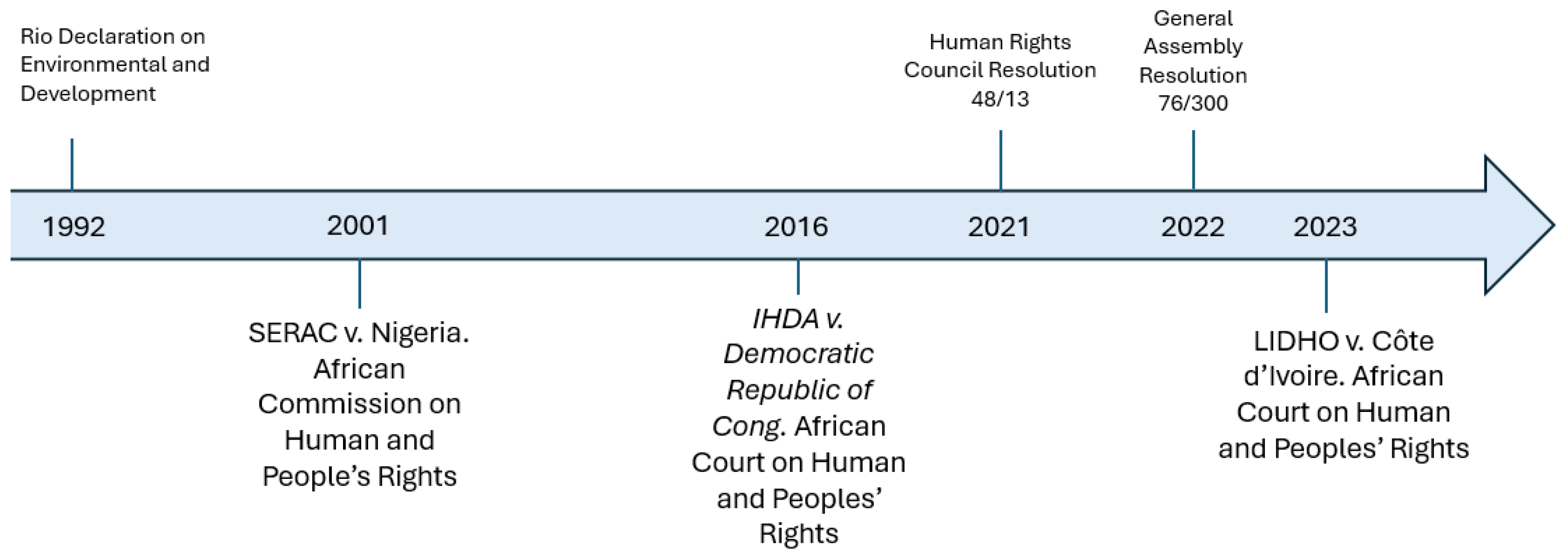
IHDA v DRC (2016), and the universal recognition of a right to a clean, healthy and sustainable environment through Human Rights Council Resolution 48/13 (2021) and General Assembly Resolution 76/300 (2022). These developments did not produce a linear strengthening of enforcement, but rather a gradual thickening of normative expectation. It is within this sedimented trajectory that
LIDHO v Côte d’Ivoire (2023) must be situated: not as an isolated doctrinal innovation, but as the first binding crystallisation, within the African system, of a right whose normative vocabulary had long preceded its judicial enforcement (
Figure 1).
4. The Co-Production of Sovereignty and Corporate Power
If the normative evolution described above appears, at first glance, to signal progress, it simultaneously reveals a fracture within the international legal order. A disjunction between the law’s capacity to articulate injustice and its structural incapacity to secure its material redress. Environmental law has entered an era of normative proliferation, marked by advisory opinions, framework agreements, and declaratory resolutions. Yet this expansion risks transforming law into an end in itself in which legal production multiplies, while ecological degradation continues largely unabated. This dynamic produces a form of hyper-juridification where the articulation of new standards generates the appearance of movement, but may also function as a substitute for material transformation. In the African context, the landmark
Social and Economic Rights Action Center (SERAC) and Center for Economic and Social Rights (CESR) v Nigeria (
2001) decision illustrates this tension. In this groundbreaking moment, the African Commission successfully named the injustice suffered by the Ogoni people in the Niger Delta as a result of oil extraction activities by the Nigerian National Petroleum Company in joint venture with Shell, and articulated state obligations in relation to environmental protection and corporate regulation (
Danwood 2002). However, the symbolic force of this recognition did not translate into structural remediation mainly due to the “hyper-politicisation” of environmental law (
Pedersen 2025). Contemporary environmental law reaches today core domains of sovereignty, energy governance, industrial policy and resource extraction. Article 24 of the African Charter, insofar as it challenges extractive development models, no longer operates as a technical regulatory norm but as a structural constraint on prevailing economic paradigms. Precisely because of this ambition, it encounters intensified resistance. The more environmental law interrogates foundational economic arrangements, the more states and corporate actors mobilise procedural and sovereign defences to contain its material effects. In the
SERAC case, by grounding State responsibility in due diligence—thereby transforming the classical typology of “respect, protect, promote and fulfil” into an enforceable obligation to regulate corporate actors, a move later echoed in the UN Guiding Principles on Business and Human Rights (
United Nations 2011)—the African Commission inserted human rights scrutiny into the political economy of oil extraction. The Commission articulated this regulatory dimension of state responsibility in particularly explicit terms, emphasising that the obligation to protect requires active measures to prevent harmful conduct by private actors: “57. Governments have a duty to protect their citizens, not only through appropriate legislation and effective enforcement but also by protecting them from damaging acts that may be perpetrated by private parties (see Union des jeunes avocats c/Chad 12). This duty calls for positive action on [the] part of governments in fulfilling their obligation under human rights instruments (…).
58. The [African] Commission notes that in the present case, despite its obligation to protect persons against interferences in the enjoyment of their rights, the Government of Nigeria facilitated the destruction of Ogoniland. Contrary to its Charter obligations and despite such internationally established principles, the Nigerian Government has given the green light to private actors, and the oil companies in particular, to devastatingly affect the well-being of the Ogonis. By any measure of standards, its practice falls short of the minimum conduct expected of governments, and therefore, is in violation of Article 21 of the African Charter”.
Environmental degradation by corporate actors was, for the first time, reframed not as an unfortunate by-product of development, but as a violation of the Charter which engages the State’s failure to control private power. In linking Article 24 to the rights to health (Article 16) and to economic, social and cultural development (Article 22), the Commission constructed a dense normative architecture in which environmental harm could no longer be treated as an externality, but as a violation cutting across the core of the Charter’s protective logic (
Social and Economic Rights Action Center (SERAC) and Center for Economic and Social Rights (CESR) v Nigeria 2001, p. 53). Thus, structural violence could occur through omission as much as through coercion. However, the omission at stake cannot be understood merely as regulatory failure. In the Niger Delta, corporate power operated within what may be described as a space of “corporate sovereignty”: a performative claim to authority exercised by private actors within a permissive space sanctioned by the state (
Diphoorn and Wiegink 2022, p. 423). Shell did not simply act in the absence of state control; it operated through concessions, security arrangements, and infrastructural authority that effectively positioned it as a de facto sovereign within the territory. Yet, this expansion of responsibility remained largely declaratory. Implementation depended on State cooperation, and the underlying extractive structures remained intact. The Nigerian state’s participation in the proceedings did not signify a relinquishment of sovereignty, but rather its reconfiguration. Through what has been described as the “sovereign gift,” the state grants extractive corporations privileged access to land, resources, and regulatory latitude (
Barkan 2013, p. 19). Litigation at the regional level may therefore function as a theatre of compliance, reaffirming sovereign legitimacy in international fora while preserving the material concessions that underpin capital accumulation. Sovereignty in this configuration is not eroded by corporate presence; it is co-produced by state and corporation in a mutually reinforcing extractive order. This limitation also reveals a deeper conceptual tension within human rights adjudication. The human rights-bearer often emerges as a “universalised abstraction”, a juridical subject detached from the corporeal and situated conditions of lived vulnerabilities (
Adelman 2021, p. 171). In
SERAC, the Ogoni people were successfully constituted as collective rights-holders, yet this abstraction struggled to apprehend their structural disempowerment within a global extractive economy characterised by carbon asymmetries and transnational capital flows. Moreover, extractive governance frequently generates what may be termed communities of dependency: infrastructures of employment, security, and social provision provided by the very corporation responsible for ecological degradation (
Diphoorn and Wiegink 2022, p. 431). In such contexts, material survival becomes entangled with the presence of the extractive actor, rendering resistance economically precarious and juridical remedies structurally fragile. The law and the Commission named the victim, but it did not fully see the material architecture that produced their suffering. In this sense, the case illustrates the divide between “having” and “using” rights (
Quintana 2014). The Ogoni formally possessed a right under Article 24, yet they lacked the material and institutional leverage required to deploy it effectively against the power of the State-corporate nexus. The right existed at the level of recognition, but remained structurally constrained at the level of enforcement. Moreover, the legal process itself reveals an additional ambivalence. On one hand rights may function as instruments of emancipation, and other hand can be documents of domination (
Agamben 1998, p. 72). In this case, the engagement of the Nigerian state in the litigation can also be read as a performance of compliance. Participation in the discourse of rights reinforced sovereign legitimacy at the international level, even as the underlying extractive regime remained largely undisturbed. Finally, while the Commission’s reliance on due diligence gestures toward an acknowledgment of collective vulnerability—recognising that environmental destruction renders communities materially exposed—, it remains embedded within a framework that presupposes formal equality and regulatory rationality. It does not thus directly confront the strong materiality of ecological devastation or the monetisation of nature that underpins extractive governance.
SERAC therefore inaugurated what might be called a juridical paradox of recognition without repair, which consists of the capacity of international law to name injustice without remedying it (
Çalı 2018).
The paradox of recognition without repair does not remain confined to the regional level; it mutates as affected communities, confronted with the limits of co-produced sovereignty at the national scale, redirect their claims toward metropolitan jurisdictions. The continued litigation arising from the Niger Delta, exemplified by
Bodo Community v. Shell before the High Court of London, illustrates this shift (
King John Bari-Iyiedum Berebon v. Shell Petroleum Development Company of Nigeria 2024). Where corporate sovereignty saturates the domestic legal space, the pursuit of reparation is displaced transnationally. Yet this jurisdictional relocation does not dissolve the structural pathology but reconfigures it. The Bodo litigation underlines what Rob Nixon conceptualised as a “slow violence”, understood as a form of environmental harm that unfolds gradually, dispersed across time and space, and resistant to the spectacular logic through which law typically recognises injury (
Nixon 2011, p. 8). The 2008 pipeline ruptures released an estimated 560,000 barrels of crude oil, contaminating approximately 1000 hectares of mangroves and depriving approximately 49,000 fishermen and farmers. While the ruptures themselves constituted visible events, the residual contamination embedded in mangroves, soil and bodies assumed a less immediately perceptible form. As remediation debates centred on whether the clean-up was “substantially complete”—framed through percentages and procedural compliance—the underlying ecological degradation continued to accumulate beyond the temporal horizon of the proceedings. This temporal disjunction exposes a deeper structural limitation. Legal time operates through closure where liability is determined, settlements are agreed and cases are struck out. In contrast, ecological time unfolds over decades. Expert evidence suggesting that full remediation may require half a century underscores this disjointed temporality (
Crichton 2004, p. 626). In this sense, recognition without repair is not only a political paradox but a temporal one, where the law addresses discrete events, while slow violence accumulates without a definitive moment of completion. The invisibility of such harm also reflects a crisis of representation. Environmental destruction dispersed within sediment, groundwater, and human tissue does not conform to the narrative architecture of explosion and rupture that structures juridicial reasoning. Yet this invisibility is actively produced. Corporate actors mobilise technical complexity, fragmented data, and scientific uncertainty to recast contamination as debatable, measurable, or statistically marginal. Through a translation of ecological destruction into percentages of completion or thresholds of compliance, the legal system transforms slow violence into a question of methodology rather than material harm: “The existing pleaded case is too vague and uncertain to form the basis of a mandatory injunction. The claimants accept the need to amend their claim but have not produced any draft amendment, a state of affairs that I indicated was unsatisfactory. It does not follow that the requirements of an appropriate order could not be formulated with suitable precision, so as to define any obligations on the part of the defendant and avoid constant supervision by the court” (
King John Bari-Iyiedum Berebon v. Shell Petroleum Development Company of Nigeria 2024, §122). Corporate actors can therefore assert that remediation is “substantially complete” precisely because the violence no longer appears spectacular. The law therefore appears to struggle to “see” what does not resemble an event. This technical gaze stands in tension with forms of “slow observation” grounded in lived experience, where persistent odours, discoloured water, declining fish stocks and bodily symptoms constitute an alternative archive of environmental harm (
Karmakar 2023). The marginalisation of such experiential knowledge reveals an epistemic asymmetry: remediation is validated through corporate metrics, while community observation is relegated to anecdote. This was evident in the reliance on percentage-based indicators of completion under the Bodo Mediation Initiative, where methodological thresholds determined “success” despite contested expert evidence regarding residual toxicity. Yet this difficulty is compounded by the biological character of oil contamination itself. Empirical studies in the Niger Delta indicate that exposure pathways persist through soil, groundwater and food chains long after surface clean-up operations are declared complete. Heavy metals and hydrocarbons bioaccumulate in crops, fish and human tissues, producing health effects that are often insidious and delayed in manifestation (
Ordinioha and Brisibe 2013). The ingestion of contaminated food and water remains a major route of exposure even after apparent remediation. Moreover, the Niger Delta underlines what Guha and others term an environmentalism of the poor (
Guha 2000, pp. 98–124;
Martinez-Alier 2003). Those who bear the heaviest burden of toxic exposure are simultaneously those whose claims are least audible within global legal and media circuits. Extractive governance generates communities of dependence, where material survival becomes entangled with the very corporate presence that produces ecological harm. In such conditions, the right to a healthy environment exists formally, yet its mobilisation is constrained by economic precarity, temporal exhaustion, and evidentiary dilution. The concessionary structure of oil extraction, including joint ventures in which the state retains majority participation while delegating operational control, as illustrated in
Bodo, reflects the persistence of extractive rationalities historically associated with colonial resource regimes: “The court would be very reluctant to order a mandatory injunction requiring constant supervision, especially where, as here, the activities are being carried out in another Jurisdiction” (
King John Bari-Iyiedum Berebon v. Shell Petroleum Development Company of Nigeria 2024, §120). In this respect, extractive governance in the Niger Delta cannot be understood as a contingent regulatory failure but as the continuation of a colonial logic in which territory is framed primarily as a site of resource drainage rather than as a living environment for “peoples” (
Karmakar 2023, p. 1). What appears as corporate sovereignty thus reproduces earlier concessionary regimes, now reframed under the language of national development. The permissibility of environmental degradation follows a geopolitical gradient, where politically marginalised populations bear disproportionate exposure to ecological risk. Empirical assessments have documented that operational standards applied in the Niger Delta fall significantly below those implemented by the same corporation in European jurisdiction, despite the incorporation of international “good oil field practice” into Nigerian law (
Steiner 2010, p. 4).
Seen through the lens of SERAC, the Bodo saga reveals the structural continuity of extractive impunity. The same corporate actor, the same geography, and the same social devastation recur, now litigated not in Africa but before the courts of the former colonial metropole. The displacement of jurisdiction from Port Harcourt to London highlights a postcolonial asymmetry of redress: Africa provides the victims and the evidence, while Europe retains the authority to adjudicate harm. This asymmetry is not only spatial but epistemic and temporal. The slow violence of oil contamination through biologically cumulative, dispersed across decades, and embedded within bodies and ecosystems, exceeds the event-based architecture of adjudication.
The jurisprudential insight of SERAC, which posits that human rights violations can arise from the failure to control private power, remains unfulfilled precisely because the global legal order continues to insulate transnational corporations from direct accountability. The concessionary structure of extraction, sustained through the “sovereign gift” and normalised within spaces of corporate sovereignty, produces a permissive zone in which regulatory omission is structurally anticipated rather than exceptional. In this sense, SERAC and Bodo are not successive events but two iterations of the same unresolved question: whether international law can constrain the economic violence it helped to institutionalise.
In this context, the Commission’s jurisprudence did not develop in isolation. It was reinforced by the emergence of regional environmental instruments that situate environmental protection within Africa’s broader development agenda. The African Convention on the Conservation of Nature and Natural Resources (
African Union 2003, revised 2017) and the Bamako Convention on the Ban of Hazardous Waste (
African Union 1998) collectively articulate a framework in which environmental protection, resource management, and human rights are mutually reinforcing. The Maputo Convention, in particular, codifies principles of sustainable use, prior impact assessment, and public participation, principles that mirror the procedural obligations derived from
Endorois3 and
SERAC. Yet the Convention’s effectiveness remains constrained by the absence of a dedicated monitoring body, even though it clearly establishes procedural rights and corresponding positive obligations for States (
Doumbé-Billé 2005). Through these instruments, Africa developed what might be termed a regional environmental constitution, a normative ensemble linking ecological protection to social justice and economic sovereignty (
Weis 2018). The African Commission’s case law gave this framework interpretative depth, embedding environmental rights within the Charter’s architecture and establishing an interpretive continuum from
SERAC to
Anvil Mining.
4By the time the African Court on Human and Peoples’ Rights became operational in 2006, the normative foundations of environmental human rights in Africa were well established. The Commission’s decisions had articulated the state’s duty of care vis-à-vis private actors, the procedural rights of communities, and the transnational dimensions of accountability. What remained absent was enforcement. The Commission’s recommendations, while normatively influential, lacked binding effect. Consequently, the creation of the Court thus represented a structural response to the limitations of soft adjudication. The establishment of the Court therefore represented not merely a structural response to soft adjudication, but an institutional attempt to counterbalance the diffused irresponsibility of the state–corporate nexus—a configuration in which accountability is structurally displaced across corporate groups and host states (
Thompson 1980)—through binding jurisdiction. It signalled an effort to transform recognition into enforceable constraint, and to re-anchor environmental justice within a forum capable, at least in principle, of confronting the material power asymmetries that regional soft law could only name.
5. Collective Environmental Rights and the Limits of State-Centered Adjudication
The transition from the African Commission to the African Court on Human and Peoples’ Rights represents a theoretical re-centering of the State’s fiduciary function within the Anthropocene. While the Commission provided the interpretive depth necessary to link ecological protection to communal survival, its lack of coercive force left the “right to a satisfactory environment” largely confined to the realm of declaratory recognition. The Court’s intervention in African Court on Human and Peoples’ Right (2023) marks an attempt to bridge this gap, moving from interpretive stewardship to binding adjudication of environmental responsibility. In this landmark case, which arose from the 2006 dumping of toxic waste in Abidjan by Trafigura, a Dutch multinational operating through an Ivorian subsidiary, the Court restated the autonomy of Article 24 and confronted the spatial configuration of impunity through which transnational capital exploits jurisdictional fragmentation to diffuse responsibility. In holding the State accountable for environmental harm generated in connection with foreign corporate activity, the ruling seeks to re-anchor responsibility at the material site of ecological degradation, unsettling the concessionary logic through which sovereignty operates as a permissive framework for extractive activity. This re-anchoring was articulated through a concrete allocation of regulatory failure. While Trafigura was the direct perpetrator, the Court held that the State had breached its duty of vigilance by failing to establish effective oversight mechanisms, ensure transparency, provide medical assistance, and guarantee access to justice:
“184. The Court notes that in the instant case, the Respondent State authorities failed to take appropriate legal, administrative and other measures to prohibit the importation of dangerous wastes on its territory as prescribed by the Bamako Convention. It further finds that these authorities had the obligation to ensure that the dumping of this cargo on the territory of the Respondent State was conducted with a view to protecting the environment from the harmful effects which could result. As earlier concluded in this judgment, the failure of the entities which were charged with the dumping and treatment of the waste does not exonerate the Respondent State of its responsibility to guarantee and protect the environment.
185. Lastly, the Respondent State does not demonstrate that it effectively and promptly cleaned up the polluted sites. In these circumstances, it cannot be said that the Respondent State complied with its obligation to protect and implement the right to a generally satisfactory environment favourable to development.”.
Drawing upon SERAC, Endorois and Anvil Mining, the Court clarified that environmental protection entails both negative and positive obligations, including regulatory supervision and judicial remedy. In operationalising Article 24 as a directly enforceable entitlement, the Court translated environmental protection into binding state responsibility. The Court’s reasoning did not, however, isolate Article 24 from the broader normative architecture of the Charter. By reading it in conjunction with Articles 1, 4, 6 and 22, the Court constructed environmental integrity as the structural condition for the enjoyment of life, health and development. Yet crucially, environmental harm was not treated as derivative of these rights. In this scenario, Article 24 functioned as an autonomous normative anchor, displacing the “greening” technique familiar in European jurisprudence and affirming environmental protection as constitutive of communal survival rather than incidental to individual injury.
Yet this normative intervention remains embedded within a fragile jurisdictional architecture. Westphalian sovereignty, frequently mobilised as a “sovereign gift” to extractive actors, continues to generate institutional constraints, including the strategic withdrawal of Article 34(6) declarations limiting direct access to the Court. The authority of the forum thus emerges not as a settled institutional fact, but as a structurally contested space, situated between the promise of binding environmental accountability and the persistence of state–corporate power. In fact, the fragility of the Court’s authority recalls longstanding critiques of the human rights project as simultaneously emancipatory and structurally entangled with sovereign power (
Mutua 1999).
It is precisely this ambivalence that renders the Court’s intervention conceptually significant. Classical international law long equated sovereignty with the capacity to control and exploit territory, embedding within the very grammar of statehood an Enlightenment ideal of mastery over nature, where the environment is reduced to a domain of utility (
Natarajan 2012, p. 192). In postcolonial contexts, this logic was rearticulated through the doctrine of permanent sovereignty over natural resources, frequently mobilised as an instrument of developmental extraction. Consequently, sovereignty became tethered to a promise of economic transformation grounded in the presumed controllability of ecological consequences. What may in fact be described as a foundation “myth of control”. The
LIDHO v. Côte d’Ivoire judgment unsettles this premise. By holding Côte d’Ivoire responsible for the toxic aftermath of activities authorised within its jurisdiction, the African Court implicitly rejects the notion that sovereignty consists in the discretionary management of extractive opportunity. Instead, it redefines sovereignty as responsibility for ecological conditions and for the biophysical integrity of communal life. The failure sanctioned by the Court is not just about regulatory omission, but underlines the collapse of extractive sovereignty’s claim to govern environmental risk. In this respect,
LIDHO v. Côte d’Ivoire resonates with emerging accounts of sovereignty in the Anthropocene which often requires a complete rethink of how we use human rights to mediate the human-environment interface (
Kotzé 2014, p. 252). In fact, the scale and systemic nature of ecological disruption render classical anthropocentric rights frameworks increasingly inadequate unless reoriented toward the protection of Earth system integrity (
Craig and Benson 2013, p. 847). Sovereignty, under such conditions, cannot remain proprietary or purely developmental; it assumes a fiduciary character. The State becomes not the owner of resources, but the mediator of the human–environment interface. Through its operationalisation of due diligence, remediation, and regulatory vigilance, the African Court translates this fiduciary conception into binding adjudication, moving from sovereignty as control to sovereignty as stewardship. The remedial architecture of
LIDHO v. Côte d’Ivoire further crystallises this fiduciary rearticulation of sovereignty. The Court did not restrict itself to compensatory redress; it imposed structural obligations aimed at recalibrating the domestic governance of hazardous waste and reinforcing participatory guarantees. In doing so, it displaced sovereignty from the register of discretionary resource control to that of institutional responsibility. Sovereign authority no longer appears as the prerogative to exploit or permit extraction, but as the duty to construct regulatory infrastructures capable of anticipating, internalising, and structurally managing ecological risk.
Yet the transformation inaugurated by
LIDHO v. Côte d’Ivoire is not limited to these elements, it also unsettles the individualistic architecture of classical human rights adjudication. The African Charter does not hermetically separate civil and political rights from socio-economic and collective entitlements (
Ssenyonjo 2012). Unlike the European Court of Human Rights, which approaches environmental harm through the greening of existing rights (e.g.,
López Ostra v Spain,
Öneryildiz v Turkey), the African Court affirms the environment as a right in itself, one that binds states to protect the ecological conditions of communal life. Article 24, as a right vested in “peoples”, disrupts the liberal premise that environmental harm must be articulated through the injury of an identifiable individual claimant (
Social and Economic Rights Action Center (SERAC) and Center for Economic and Social Rights (CESR) v Nigeria 2001). The juridical gaze is therefore displaced from what might be described as a narcissistic reflection of individual harm toward the integrity of communal ecological conditions. In
LIDHO v. Côte d’Ivoire, the Court did not require proof that a specific victim had been poisoned or that a determinate individual right-holder could demonstrate measurable bodily damage. Instead, it assessed whether the environmental integrity of the affected community had been compromised. This shift is, by essence, doctrinally significant. It alleviates the standing obstacles that frequently paralyse environmental litigation in other regional systems, where the fragmentation of harm and the evidentiary burden placed upon individual claimants often render justice illusory (
Ekhator 2014, p. 68). Through the affirmation of justiciability of a collective environmental right, the Court relocates the threshold of injury from the atomised subject to the condition of communal life. This collective repositioning also distinguishes the African Court from other regional approaches. Unlike the Inter-American Court’s reasoning in
La Oroya v Peru (2023), which consolidated the right to a healthy environment through the language of
jus cogens while remaining tethered to individual harm, the African Court’s approach is structurally collective: environmental degradation is framed as a violation of the integrity of peoples and of their developmental horizon (
Habitantes de La Oroya v. Perú 2023).
This collective orientation also explains the centrality of civil society organisations within the African environmental rights framework. Where environmental justice remains a distant aspiration within domestic systems constrained by regulatory weakness and limited political will, non-governmental organisations frequently act as juridical proxies for affected populations (
Ekhator 2014, p. 66). The fact that
LIDHO v. Côte d’Ivoire was brought by the Ligue ivoirienne des droits de l’homme is therefore not incidental, it reflects the structural logic of a Charter that recognises environmental protection as a collective entitlement requiring collective mobilisation. Yet this collective justiciability must not be romanticised. The persistence of regulatory fragility, corruption, and political ambivalence continues to undermine effective environmental protection across the continent (
Ganda 2020). In fact, this fragility is not just institutional, it is spatial as well. Transnational corporations operate within what may be described as a “spatiality of impunity”, a structural configuration in which corporate decision-making, profit extraction, and environmental harm are territorially disaggregated (
Yusuf and Omoteso 2016, p. 1373). Rather than reflecting a legal vacuum, this configuration is produced through the interaction of corporate law doctrines of limited liability, jurisdictional compartmentalisation, and asymmetrical regulatory capacity between home and host states. Responsibility is not absent but spatially deferred and jurisdictionally dispersed. The locus of profit and strategic control remains anchored in metropolitan headquarters, while the material consequences of extraction are externalised to jurisdictions characterised by weaker enforcement infrastructures. This engineered disjunction between centre and periphery generates a permissive environment in which environmental degradation becomes structurally insulated from effective redress. In this scenario, the
LIDHO v. Côte d’Ivoire judgment can be read as a judicial attempt to interrupt this dispersion of accountability: “135. The Court recalls that States parties must take appropriate measures to protect persons against deprivation of life by other States, international organizations and foreign companies operating on their territory 42 or in other areas under their jurisdiction. They must also take legislative or other measures to ensure that any activity taking place in all or part of their territory or in other locations under their jurisdiction must be compatible with Article 4 of the Charter. Such an obligation applies to all acts having direct and reasonably foreseeable impact on the right to life of persons outside their territory, including activities carried out by companies based in their territory or under their jurisdiction”. Although the Court lacks jurisdiction over corporations as respondents, it refuses to allow corporate complexity to function as an epistemic shield. The Court specifically targeted the “insulation” produced by the settlement protocol between the State and Trafigura, which had resulted in the release of corporate executives and barred victims from further claims, thus violating the right to an effective remedy. In grounding the State responsibility in due diligence vis-à-vis foreign corporate activity, and therefore by interpreting Article 1 of the Charter as imposing an obligation to give effect to environmental rights, the African Court re-materialises accountability at the site of ecological harm. The transnational character of the polluter does not dissolve the State’s fiduciary obligation, rather it intensifies it. This is materially evidenced by the Court’s order to establish a compensation fund financed by the sums paid by Trafigura (
Ligue Ivoirienne des Droits de l’Homme (LIDHO) v. Côte d’Ivoire 2023, ¶ 214) and the mandate to reopen investigations to determine corporate responsibility (Ligue Ivoirienne des Droits de l’Homme (LIDHO) v. Côte d’Ivoire 2023, ¶ 232). In this sense,
LIDHO v. Côte d’Ivoire responds directly to a form of structural asymmetry, where transnational capital benefits from superior financial, political and technical resources relative to host states. The ruling does not pierce the corporate veil in a formal sense; instead, it circumvents its protective function by constitutionalising the state’s duty of vigilance and requiring legislative reform to ensure the liability of legal persons (
Ligue Ivoirienne des Droits de l’Homme (LIDHO) v. Côte d’Ivoire 2023, ¶ 232). Jurisdictional fragmentation is therefore rendered contestable rather than determinative. Some authors therefore present the Court’s judgment as a significant jurisprudential development, expanding the interpretation of Article 24 and clarifying corresponding state obligations in relation to environmental harm and corporate activity (
Waswa 2024). The judgment may indeed be read as consolidating the enforceability of environmental rights within the African system. Yet its innovation lies less in the formal extension of obligations to non-state actors than in the recalibration of the state’s regulatory architecture. By intensifying due diligence requirements and constitutionalising the duty to supervise corporate conduct, the Court narrows the protective insulation historically afforded to transnational capital, even as it remains bound by a state-centred jurisdictional design. This state-centred configuration has, however, attracted critical scrutiny. Commentators have noted that, behind the formal framing of
LIDHO v. Côte d’Ivoire as a case of state responsibility, lay a broader accountability dispute implicating corporate actors—most prominently Trafigura (
Kpla 2024). The litigation may be understood as substantively oriented toward both the state and the corporation, yet institutionally reconfigured into a case of exclusive state liability by virtue of the Court’s jurisdictional design. The structural absence of normative standards within international human rights law, enabling the direct attribution of responsibility to corporate actors, reveals a deeper asymmetry embedded in the adjudicative architecture itself. Where corporations generate material and often irreversible harm but remain procedurally insulated from direct scrutiny, accountability is juridically displaced onto the state as an intermediary. The burden of translation thus falls upon public authority and corporate violence is reframed as regulatory omission.
LIDHO v. Côte d’Ivoire consequently exposes more than a failure of domestic vigilance; it renders visible the limits of a state-centred model of international human rights adjudication. While the judgment recalibrates the contours of state responsibility, it leaves intact the structural condition whereby corporate actors remain formally beyond the reach of the forum. In this context, the spatiality of impunity is embedded within the architecture of global economic governance itself. The African Court’s authority extends only to states, not corporations. Enforcement, therefore, depends upon political compliance, and the financial and investment infrastructures enabling extractive operations remain largely intact.
This persistence of structural insulation invites a deeper reconsideration of the relationship between state authority and corporate power. Corporate sovereignty does not emerge in opposition to the state, but within an authorised permissive space constituted by state sanction (
Diphoorn and Wiegink 2022). Corporate actors do not simply evade, they perform quasi-sovereign authority through concessions, security arrangements, and infrastructural provision, all enabled by sovereign delegation. In this configuration, the so-called weakness of the state conceals a more complex dynamic. Through what Barkan terms the “sovereign gift”, the state confers privileges, immunities, and regulatory latitude upon corporate actors (
Barkan 2013). The permissive space in which extraction unfolds is not juridically empty; it is actively produced. Environmental degradation thus reflects not merely regulatory incapacity, but a negotiated reallocation of sovereign prerogative. This perspective reframes the significance of
LIDHO v. Côte d’Ivoire. The Court’s condemnation of regulatory omission does not expose a sovereign vacuum; on the contrary it exposes a failure in arbitration. If the state remains the ultimate arbiter of the boundaries within which corporate authority operates, then the violation lies in the state’s toleration of permissiveness hardening into impunity (
Diphoorn and Wiegink 2022, p. 427). Therefore,
LIDHO v. Côte d’Ivoire functions as a juridicial reminder that sovereign delegation cannot extinguish fiduciary responsibility. Yet the paradox persists. The Court may recalibrate the terms of delegation, but it cannot dissolve the broader political economy that incentivises such sovereign gifting. Corporate hard power—through securitisation and control of physical space—and soft power—through corporate social responsibility and the production of communities of dependency—continue to entrench authority beyond formal regulation. Sovereignty is therefore continuously negotiated between state and capital. However, through a state-centred lens consistent with its jurisdiction, the Court offers here a localized model for the oversight and prosecution of foreign corporate operations within African national territories. However, only broad adherence by States to the Court and the effective recognition of its authority through the implementation of its judgments would genuinely ensure the effectiveness of this response. It is conceivable that an increasing number of communications may, in the future, be submitted to the African Court on Human and Peoples’ Rights—whose decisions are judicial and binding, unlike those of the Commission. Nevertheless, the development of substantial litigation in this field is likely to remain limited. Only 30 out of 54 African States have ratified the Protocol establishing the Court, and merely nine have accepted its jurisdiction to receive applications from individuals and non-governmental organizations. The expansion of such litigation may therefore depend less on structural legal developments than on the political will of African States, coupled with a more systematic practice of referrals from the Commission to the Court.
However, the structural fragility of the Court’s contentious jurisdiction does not exhaust the normative trajectory inaugurated by
LIDHO v. Côte d’Ivoire. If access to the Court remains politically mediated and uneven, the advisory jurisdiction offers an alternative site through which environmental obligations may be clarified, consolidated, and projected beyond the confines of individual disputes. In this respect, the trajectory inaugurated by
LIDHO v. Côte d’Ivoire finds a natural extension in the 2025 Request for an Advisory Opinion submitted by the Pan-African Lawyers Union (PALU) on States’ obligations in relation to the climate crisis. The request consolidates three decades of normative development, from SERAC’s articulation of state responsibility for private acts to
LIDHO v. Côte d’Ivoire’s operationalisation of positive environmental duties, into a coherent doctrine of ecological governance. The PALU submission identifies Article 24 of the African Charter as a right
prééminent, intrinsically linked to the rights to life (Article 4), health (Article 16), development (Article 22), and peoples’ control over natural resources (Article 21) (
Demande d’avis consultatif N°001 DE 2025: en l’affaire relative à une demande d’avis consultatif de l’Union Panafricaine des avocats sur les obligations des Etats à l’égard de la crise liée au changement climatique 2025). It defines environmental protection as a condition
sine qua non for the enjoyment of all other Charter rights, thereby elevating ecology to the status of a foundational norm. The request further articulates the state’s duty of prevention, vigilance, and environmental impact assessment, extending to the activities of third parties, including corporations. It explicitly recognises the intergenerational dimension of environmental rights and the need to protect women, children, indigenous peoples, and environmental defenders from disproportionate harm. Most strikingly, the Advisory Opinion request introduces an extraterritorial horizon of accountability, urging the Court to clarify the obligations of African states vis-à-vis “traditional emitters.” In doing so, it repositions the continent not as a passive recipient of global climate norms but as a potential normative innovator within the architecture of climate governance. If contentious litigation remains structurally constrained, advisory proceedings may operate as a jurisprudential catalyst, extending the fiduciary conception of sovereignty articulated in
LIDHO v. Côte d’Ivoire from the regulation of toxic waste toward planetary stewardship. The consolidation of African environmental jurisprudence may therefore depend not only on the quantity of cases submitted, but on the Court’s capacity to articulate principled guidance capable of reshaping domestic legislation and transnational regulatory practice.
In comparative terms, the African Court’s jurisprudence now stands as the most comprehensive regional articulation of environmental human rights. If the advisory proceedings suggest an expansion of African environmental normativity beyond the confines of contentious jurisdiction, a comparative perspective reveals both the singular strength and the structural vulnerability of this jurisprudential moment. The European system’s anthropocentric orientation confines its reasoning to individual harms; the Inter-American system, though more experimental, remains tethered to the doctrine of progressive realisation. The African approach, grounded in peoples’ rights, integrates substantive, procedural, and distributive dimensions of justice. It thus dissolves the classical dichotomy between human rights and environmental protection by recognising the co-constitutionality of both. This jurisprudence also embodies a postcolonial critique of global environmental governance. Yet this normative sophistication coexists with structural fragility. The authority of the African Court on Human and Peoples’ Rights remains however structurally limited by the restricted scope of its contentious jurisdiction, which in turn constrains the development of a substantial body of environmental jurisprudence on the African continent. This limitation is not merely technical in nature, but reflects a jurisdictional architecture carefully calibrated around the preservation of sovereign prerogative. The Protocol establishing the African Court on Human and Peoples’ Rights does not confer automatic contentious jurisdiction. Rather, it organises access through a graduated structure of consent. Article 5 authorises referrals by the African Commission, States Parties, and African intergovernmental organisations, and, in principle, by individuals and NGOs enjoying observer status before the Commission. Yet Article 6(3) subjects direct individual and NGO access to the prior deposit of a special declaration by the respondent State accepting such competence. In practice, only a limited number of States have accepted this competence, and several have subsequently withdrawn their declarations, significantly reducing effective access to the Court.
Scholarly analysis has consistently observed that such a jurisdictional configuration impedes the consolidation of a continental judicial authority comparable to that of the European Court of Human Rights, whose individual jurisdiction is automatic rather than consent-based. The conditional architecture of access does not just restrict docket size; it also constrains the Court’s capacity to operate as a central forum for sustained normative elaboration in environmental matters. This constraint sits uneasily alongside the normative ambition of Article 24 of the African Charter, which expressly guarantees to ‘peoples’ the right to a general satisfactory environment favorable to their development. Although the African Commission paved the way in SERAC, establishing a foundational link between natural resource exploitation, environmental degradation, and human rights violations, this jurisprudential momentum has not translated into a substantial and consistent body of environmental case law before the Court itself. Therefore, recognition at the quasi-judicial level has not fully translated into consolidated judicial authority.
The scarcity of inter-State applications further reinforces this structural stagnation. States remain reluctant to initiate litigation that might expose their own regulatory practices to reciprocal scrutiny or be perceived as interference in sensitive domestic domains. Such reluctance is unlikely to dissipate in the environmental sphere, particularly where strategically significant extractive industries are implicated. In this configuration, institutional responsibility de facto shifts toward the African Commission and African intergovernmental organisations, both of which retain referral powers that remain conspicuously underutilised. Their caution appears striking when measured against the scale and urgency of contemporary climate disruption and extractive transformation on the continent. Beyond the constraints of access and jurisdiction, the Court’s authority encounters a further structural test at the stage of execution. Even where jurisdiction is accepted and judgments are rendered, the transformative capacity of environmental jurisprudence ultimately depends upon sustained domestic compliance. During the 2021 Conference on the Execution of Decisions of the African Court on Human and Peoples’ Rights, the Court recalled that Article 30 of the Protocol imposes a clear obligation upon State Parties to “comply with the judgment in any case to which they are parties within the time stipulated by the Court and to guarantee its execution”. The normative clarity of this provision, however, contrasts sharply with the empirical record. The Court acknowledged that only one State had fully complied with its judgments, while others had implemented them only partially or had expressly signalled their refusal to do so. It further observed that its decision continues to exert limited political and legislative influence beyond the immediate respondent State, and that domestic legislative influence beyond the immediate respondent State and that domestic legislation manifestly inconsistent with its rulings continues to be adopted across the continent. Without effective and systematic implementation, judicial determinations risk operating as declaratory affirmations rather than regulatory constraints. The authority of the Court, though formally binding, becomes practically attenuated, and its capacity to recalibrate extractive governance remains contingent upon domestic political translation.
The 2024 Activity Report offers a concrete illustration. In relation to the execution of the
LIDHO v. Côte d’Ivoire judgment, the Court identifies no fewer than ten points on which Côte d’Ivoire must still provide information. These include significant legislative and regulatory reforms, among them the prohibition of hazardous waste importation and the amendment of domestic law to ensure the liability of legal persons, including multinational corporations (
African Union Executive Council 2025).
Admittedly, the legislative and regulatory reforms identified by the Court require time. Structural transformation cannot be instantaneous, particularly where environmental governance intersects with complex administrative and economic arrangements. Yet the absence of substantive communication regarding implementation already signals a weakening of the Court’s authority. Execution, in this sense, is not a merely technical phase following adjudication; it constitutes the site at which judicial authority is either consolidated or silently eroded.
From a TWAIL-informed perspective, this institutional configuration reveals a deeper ambivalence. The restricted jurisdiction of the Court reflects a persistent attachment to sovereign control, often justified as protection against external normative imposition. At the same time, hesitation to consolidate a robust continental judicial mechanism leaves African environmental normativity structurally underdeveloped. Sovereignty is defended against external interference, yet not fully mobilised to strengthen internal juridical capacity. The consequence is not neutral. In the absence of a consolidated and consistently enforced African environmental jurisprudence, significant normative space is occupied by external regulatory regimes, including due diligence, traceability, and supply-chain instruments developed predominantly within the European Union and the United States (
Novotny and Dela 2024). As Africa assumes a central role in global supply chains for critical minerals indispensable to the energy transition, the risk emerges that the continent will be positioned less as a co-architect of environmental governance than as its regulated object. Strengthening the effective jurisdiction and execution capacity of the African Court could instead function as a strategic lever: anchoring environmental accountability within continental institutions, providing effective remedies for affected communities, and articulating an energy transition calibrated to African priorities rather than externally imposed compliance frameworks.
6. Conclusions
This article asked whether the African Court’s environmental jurisprudence can destabilise extractive sovereignty or whether it remains structurally confined within a state-centred architecture that ultimately reproduces corporate insulation. It has advanced a re-reading of the African Charter as a post-sovereign framework of responsibility. Read together, Articles 1 and 24 relocate environmental protection from the realm of domestic discretion to a domain of shared, polycentric obligation. States remain primary duty-bearers, yet their duties include structuring, supervising, and, where necessary, sanctioning corporate activity that threatens the ecological conditions of collective life. That move responds to material asymmetries within Africa’s extractive economies and renders juridically visible harms long treated as the externalities of development.
The jurisprudential arc running from SERAC to LIDHO v. Côte d’Ivoire traces this transformation. SERAC constitutionalised the duty to protect against private power; the Bodo litigation exposed the paradox of recognition without repair and the postcolonial displacement of adjudicatory authority; LIDHO v. Côte d’Ivoire completed the circle by restoring an African forum capable of ordering structural remedies for state failures that enable corporate harm. What emerges is not merely a “greening” of existing rights, but an ecological constitutionalism grounded in peoples’ rights: substantive (health, life, development), procedural (access to information, participation, impact assessment), and distributive (control over resources) in a single normative order.
Two implications follow. First, corporate accountability in Africa can no longer be cabined by territorial and personality doctrines that insulate transnational enterprise groups. Even in the absence of direct jurisdiction over corporations, the Court’s reasoning makes state responsibility hinge on due diligence, regulatory vigilance, and effective remedy, standards that reach the full corporate chain, including parent oversight and transboundary supply relations. Second, the Charter’s collective framing supports an extraterritorial horizon of obligation. Where corporate groups or “traditional emitters” generate foreseeable cross-border risks, Article 1’s injunction to “adopt legislative and other measures” requires outbound regulation, cooperation, and mutual legal assistance consistent with the Maastricht Principles and the UN Guiding Principles.
Institutionally, Africa does not need a new catalogue of rights so much as thicker procedures and stronger implementation around the rights it already recognises. Three priorities stand out: (i) Domesticising the LIDHO v. Côte d’Ivoire standard through mandatory human rights and environmental due-diligence legislation with parent-company duties of vigilance and rebuttable presumptions on control; (ii) building a monitoring backbone for the Maputo Convention in the form of periodic reporting, independent verification, and community-triggered compliance reviews, that converts soft coordination into enforceable baselines; and (iii) entrenching remedial pathways that join compensation to restoration: ring-fenced clean-up funds, timelines indexed to scientific benchmarks, and orders that tie corporate exit to verified remediation rather than paper compliance.
The pending advisory proceedings on climate obligations offer a venue to consolidate these elements. Framing Article 24 as a pre-eminent, intergenerational guarantee would align the Court’s environmental jurisprudence with planetary boundaries and clarify duties of prevention, cooperation, and phase-down consistent with common but differentiated responsibilities. Such guidance could also reaffirm protection for environmental defenders and communities at disproportionate risk, ensuring that participation functions as a shield against reprisal rather than a procedural ritual.
Seen in comparative perspective, the African system now supplies the most complete regional template for ecological justice: less anthropocentric than Europe’s derivative model, more structurally attuned than the Inter-American system’s case-by-case individualisation. Its distinctive contribution lies in refusing the separation between human rights and environment and in relocating sovereignty from control to stewardship. Yet this normative architecture remains fragile. Its transformative promise will depend less on doctrinal innovation than on sustained institutional and political follow-through. The central challenge is one of consolidation: aligning domestic legislation, administrative practice, and remedial mechanisms with emerging jurisprudence, while extending its reasoning to fields such as climate governance and transnational supply-chain regulation. Without such alignment, there is a real risk that environmental rights become a matter of formal adherence—ratified, codified, and celebrated—yet thinly implemented in practice. In that scenario, the “greening” of human rights in Africa would risk amounting to little more than compliance on paper, leaving the structural drivers of ecological harm and extractive injustice fundamentally intact.
Yet this normative advance must be situated within a broader and more sobering global reality. As Ole W. Pedersen has observed, despite the proliferation of environmental rights and their increasing judicial recognition, environmental degradation remains “more pervasive and less effectively remedied than ever,” revealing a persistent gap between normative development and material outcomes (
Pedersen 2018). The transformative promise of African ecological constitutionalism will therefore depend less on doctrinal innovation than on institutional endurance and political commitment. Sustained execution of judgments, alignment of domestic legislation with emerging jurisprudence, and the consolidation of administrative and remedial infrastructures are indispensable. Without such alignment, the destabilisation of extractive sovereignty achieved in doctrine would remain normatively significant yet structurally constrained, leaving intact the deeper political economy that continues to generate ecological harm.