1. Introduction
In several production steps of iron- and steelmaking, large volumes of dusts are generated and require additional cleaning systems from the furnace or converter off-gas streams to protect the environment. During the year 2020, a cumulative mass of 1.66 × 10
6 t of dusts and sludges were reported by [
1] from the steelmaking industry in the German-speaking regions of Europe, indicating that 1.45 × 10
6 t (app. 87%) were produced in integrated steel plants. In general, the utilization rate of dusts and sludges from off-gas filter systems accounts for 1.46 × 10
6 t in the year of 2020 (88%), corresponding with the utilization rates of the recent decade [
2,
3]. However, according to [
1,
4] it was observed that over 200,000 t of filter dusts and sludges were landfilled in that year and a previous study [
5] reported Fe-oxide abundances in blast furnace (BF) filter sludges, for instance, up to 50 wt.%.
Owing to this substantial Fe content of filter dust and sludge, these materials are subjected to internal recycling via different facilities such as the sinter plant in integrated steelmaking or directly in the electric arc furnace (EAF) in electric steel mills [
4].
Some quantities of dusts and sludges, mostly originating from the converter process, are transported to external recycling facilities depending on the Zn concentration [
6]. The external recycling route is most common for dusts and sludges from the EAF steelmaking process because they often contain Zn levels up to 30 wt.% [
7,
8]. Regarding the recovery of iron from such high-Zn-containing residues, [
7] suggested using agglomerates within the OxyCup process as a cost-effective and environmentally friendly way, alongside well-established processes such as the Waelz Process, recently explained by [
8]. In addition to the presence of Zn and other contaminants (e.g., Cu and Cd), additional physical parameters, such as the high moisture content in sludges and the very fine particle size distribution, impede the direct use of the materials in the recycling stream. As a result, a considerable amount of Fe gets lost to landfill rather than being recycled [
4,
5].
Another issue arising from internal recycling of dusts and sludges within integrated steelmaking results from the massive transformation toward more environmentally friendly production methods in the steel industry. As part of this movement, alternative and sustainable processes have been developed, such as using DRI or hydrogen (H
2) reduction in EAFs or submerged arc furnaces (SAFs) instead of conventional fossil-fuel-based blast furnaces to reduce CO
2 emissions. Consequently, blast furnaces as well as sinter plants will no longer be available for internal recycling. For cupola and other shaft furnace types, several authors have demonstrated the feasibility of agglomerates and briquettes produced by various techniques [
9,
10,
11,
12,
13]. A brief comparison of different agglomeration methods for the production of self-reducing agglomerates is given by [
14]. For the use in shaft furnaces, ref. [
4] suggested that the minimum cold compressive strength (CCS) of the agglomerates should be at least 12 MPa to guarantee the column stability in the shaft when agglomerates are charged. In addition to the cold compressive strength, porosity is also a key parameter for such an application, and it should exceed the theoretical value of 21.5% for sinter to allow the adequate passage of reduction gases through individual agglomerate [
5]. As demonstrated by [
15], the porosity of the agglomerate does not significantly contribute to the self-reduction of the Fe-oxides when compared to the effect of composition and applied temperature at the laboratory scale. In shaft furnace systems, however, reduction gases such as carbon monoxide (CO), methane (CH
4), and hydrogen (H
2) must traverse the entire column to guarantee the complete reduction of the Fe-oxide feed. The column permeability can be modified by adjusting the feed composition, which may include sinter, lump ore, pellets and scrap metal (in the cupola shaft).
Other benefits of agglomerated materials, especially for fine-grained residues, are the simplified material transport and facilitated storage due to compact compression of said materials [
9]. Distinct methods of agglomeration include sintering, pelletizing, and briquetting, also called press agglomeration [
9]. In contrast to pelletizing, less binder is required in briquetting. Up to 15% of binders are added to the production of pellets, while consumption in press agglomeration is mostly below 6% [
14], which comes along with an increase in the agglomerate’s payload.
For a production volume below 20,000 t/a, press agglomeration using smaller stamping presses can be a cost-effective method, owing to their smaller Capital Expenditure (CAPEX) and Operational Expenditure (OPEX) [
10,
15]. This is particularly important for small and medium-sized enterprises with a low volume of residual materials. In addition, different briquette shapes and sizes can be produced due to the different pressing machines and die attachments. Due to the freely adjustable pressing force of the machines, lower porosity, higher densities, and thus also higher strengths can be achieved. Also, due to the high pressure, brittle particles can break. This results in smaller particles that fill in the remaining gaps. This lowers the particle spacing, which therefore increases the strength of the agglomerates. Another advantage of press agglomeration is that it is largely independent of the size of the particle to be compressed down to the finest particle sizes.
Press agglomeration is carried out with or without the addition of binder. If no binder is used, the increase in strength is largely due to the form-fitting bonding by the interlocking of particles. This effect is particularly effective with deformable particles and fibrous material and thus is widely used to recycle metal chips from the post-capable of creating liquid bridge processing in foundries. When binders are added, the formation of solid-state bridges through crystallization contributes significantly to the increase in strength [
4,
14]. Usually, up to 6 wt.% of binders are used [
16]. In addition to the adhesive strength of the binders, bound water from the binder mixture or the used raw material is capable of creating liquid bridges which can add some total strength [
16].
However, for most of the used agglomerate bricks, nowadays, Portland cement is utilized as a binder, introducing a high carbon footprint [
17,
18]. In the context of the advancing climate crisis, the CO
2 footprint of about 875–910 kg CO
2 per ton of cement (Scope 1 and 2 emissions) is a considerable environmental impact [
3]. Regarding the metallurgical recycling of the materials, the use of cement as a binder results in further disadvantages [
12]. Due to the use of cement, the amount of water required for the cement reaction and workability, and the subsequent hardening or carbonation of the agglomerate bricks, the material content is diluted. Water and CO
2 must be expelled in the metallurgical process, requiring additional energy. In any case, the cement content must also be melted in the metallurgical process, requiring additional energy input. Depending on the raw material mix in the metallurgical process, the cement mineralogy must also be considered when adjusting the required slag composition and thus be compensated for by the additional input of slag-forming raw materials such as dolomite, limestone, burnt limestone or a SiO
2 source.
In contrast, organic binders such as starch or molasses can be produced nearly CO
2-neutrally and have no effect on the melt and slag chemistry of the metallurgical process while also being comparable to state-of-the-art binder in cost-efficiency [
4,
19]. One further advantage is the hygroscopicity of starches, which tend not to absorb any moisture and prohibit potential swelling [
18].
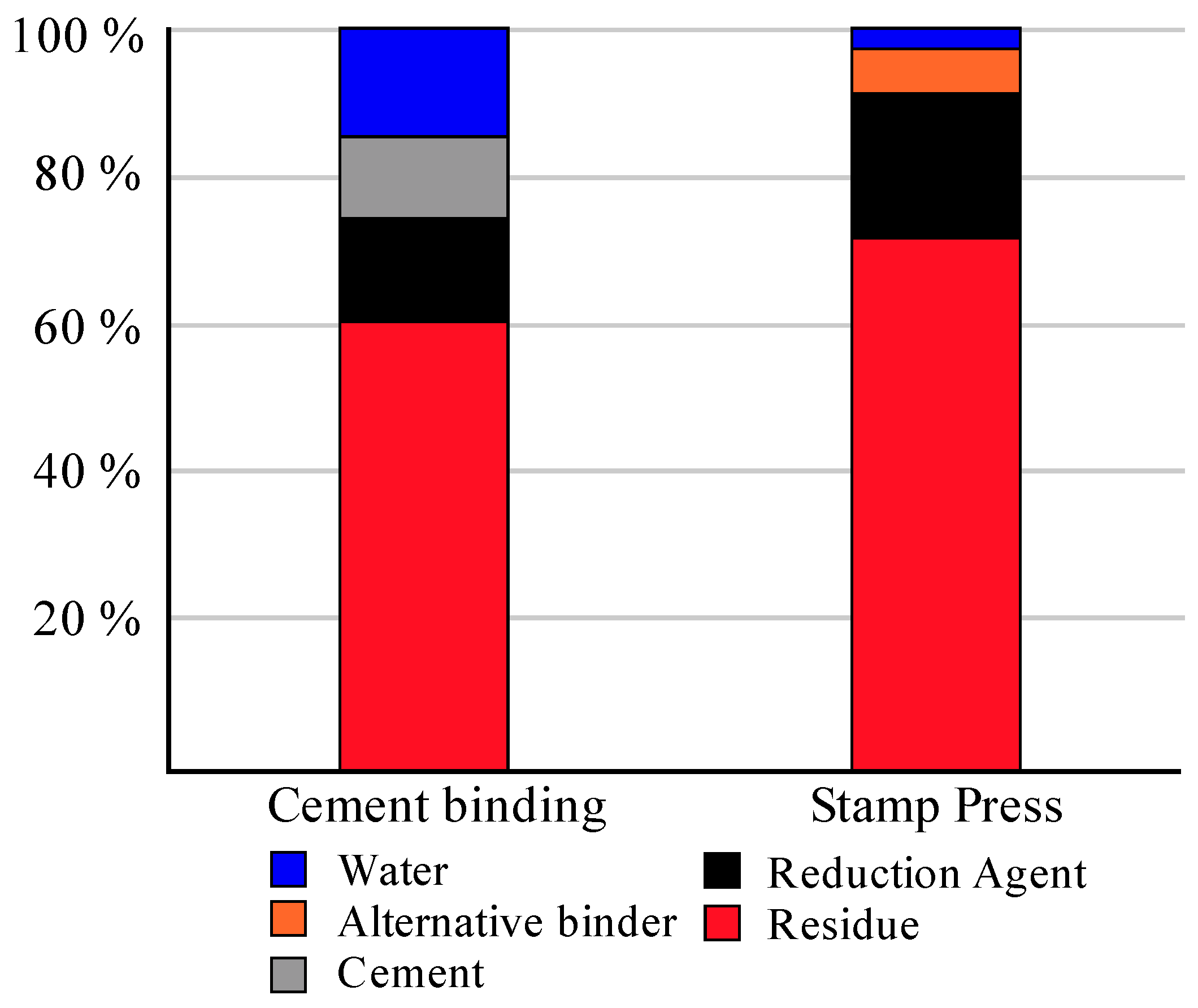
Economic efficiency can be shown by comparing the typical composition of cementitious agglomerates with agglomerates produced with an organic binder produced via a stamp press, as shown in
Figure 1.
It can be shown that cement-bound agglomerates are only used to 74% of their total weight, as the water evaporates and the cement remains in the slag. Both water and cement require additional energy to melt and evaporate. In particular, the highly endothermic carbonate trap of cement increases the energy requirement. The higher water content of the cementitious agglomerates is due to the crystalline bound water in the cement. Organically bound agglomerates have a payload of about 97%, as only the water is not used for the solidification and hardening processes [
13]. Due to the carbon content in organic binders, their use also serves as an energy and/or reducing agent input into the process.
The aim of self-reducing agglomerates is the reduction of the oxidic metal compounds they contain. This concerns the reduction of iron oxides to metallic iron. The determination of the carbon requirement is based on the reaction equations and the individual stoichiometric factor of the reduction of the oxides contained in each of the raw materials. To ensure a complete reduction of the oxides, up to double the stoichiometric amount in the form of coke was used. For the used coke, a carbon content of up to 100 wt.% is assumed, taking into account the proven higher quality standard of the used coke. In addition, the organic binders also contribute as carbon carriers for the self-reduction. Beyond this, no other reducing agents are added to the process.
Thus, press agglomeration tends to be a universal technique capable of handling different types of residues if operated with batches of similar material flows such as chips and other fine-grained residues. For the target-oriented agglomeration of different residues, however, detailed knowledge of the input materials is important both for meeting the requirements and for selecting the appropriate processing method. This includes, in particular, the particle size and particle adhesion brought by the binder. Characteristics should be considered, for example regarding the moisture, shape, size or homogeneity of the input material. A certain minimum strength is almost always required.
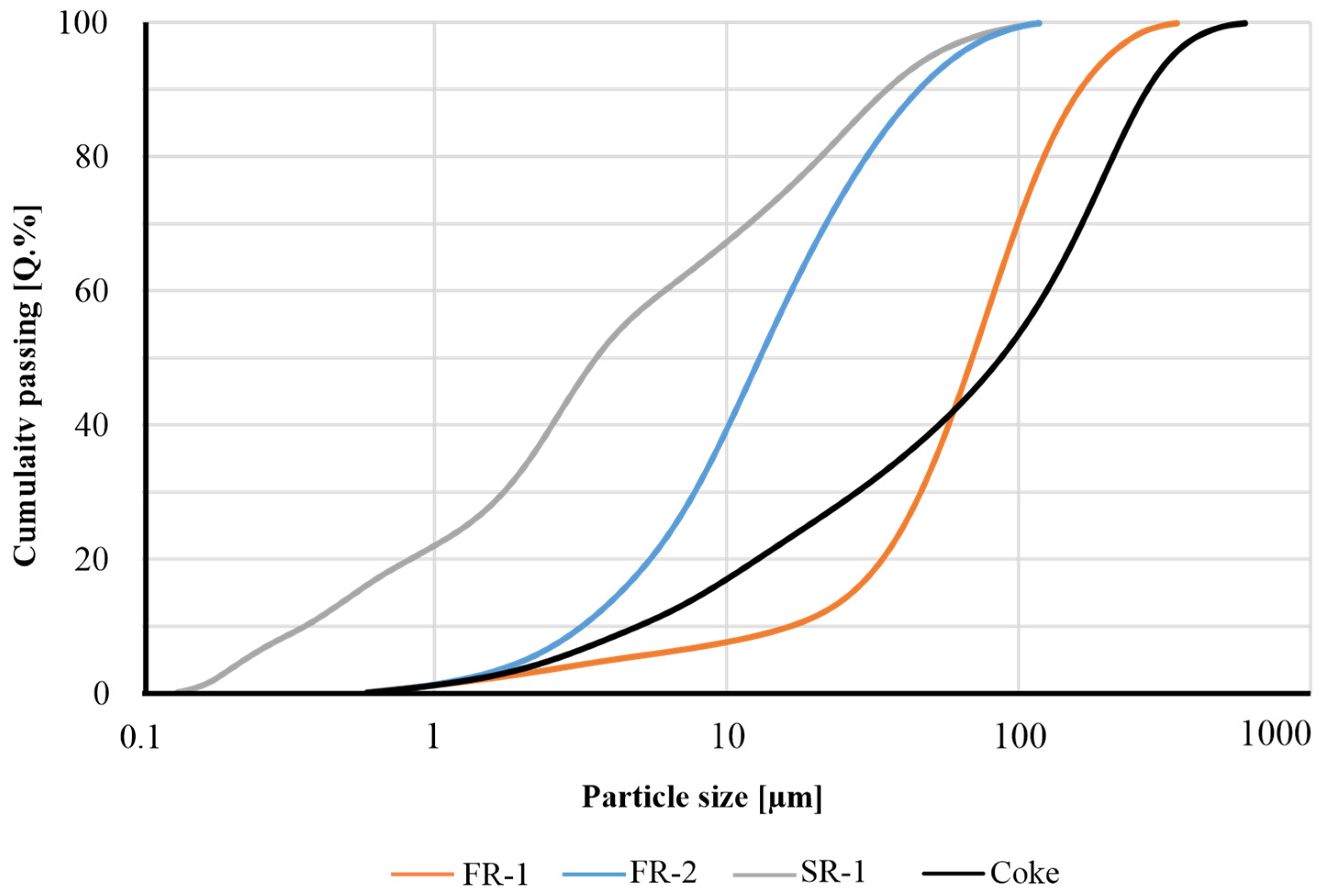
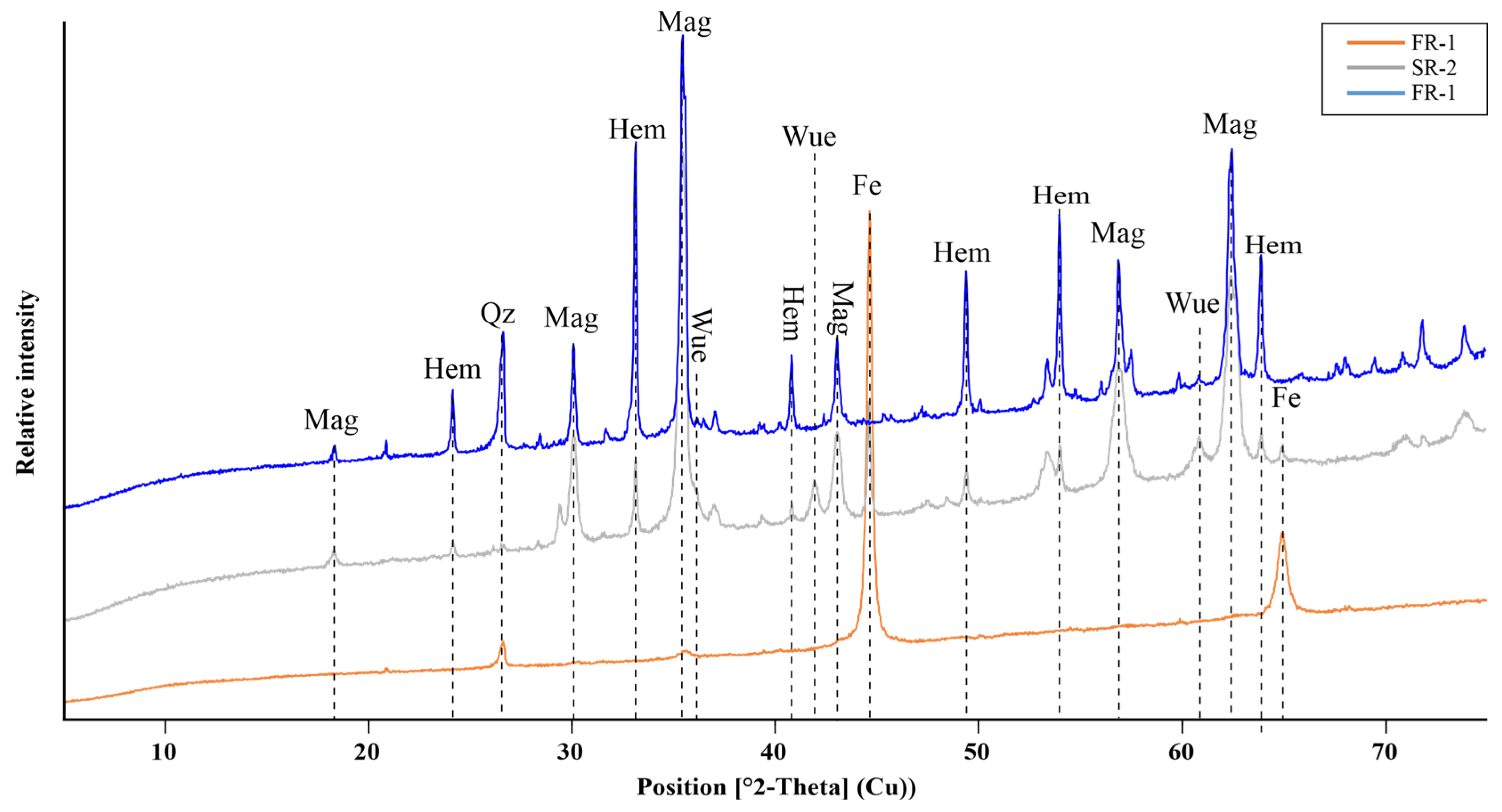
In this study, cement-free stamp press agglomeration was surveyed with exemplary Fe-containing dust and sludge residues for the development of sustainable Fe-recycling in the iron and steel making industry. Therefore, sample materials were characterized by chemical and mineralogical methods as well as physical properties in terms of particle size distribution (PSD) to develop binder–water-reduction agent recipes from which agglomerate bricks were produced with a stamp press. The produced agglomerates were subjected to tests for cold compressive strength as well as self-reducing properties in lab-scale furnace experiments to evaluate the suitability of the created recipes for their mechanical and self-reducing properties. The produced metal and oxidic fractions were investigated for their metal content to evaluate the self-reduction. Furthermore, the environmental impact of using organic binders instead of cement was assessed by a simple LCA (life cycle assessment).





 ,
,