1. Introduction
Among individuals killed by the police, between 33 and 50% of them are disabled [
1,
2]. The dominant argument behind why disabled persons experience higher rates and more deadly use of force [
3,
4,
5] is related to ableism, or construction of the world, both physically and socially, with only able bodies in mind [
6]. In the world of policing, “able-bodied standard” assumes that most police encounters with the public will be with nondisabled individuals, even though that is not the case. This is not to say that the police do not receive training on disabilities; many police departments have crisis intervention training [
7], and some now offer training on neurodivergent conditions, like autism or attention deficit hyperactivity disorder (ADHD) [
8]. Simply, ableism is much more nefarious in our society. While police officers may be trained in best practices around encounters involving mental health crises, academy and departmental training may take precedent in these encounters. Why? These trainings reinforce the most primal element of police culture: the “danger imperative” or the idea that the most important part of the job is to “come home at the end of the night” [
9]. The danger imperative may function to reaffirm ableism in police encounters by leaning on the stereotypes of disabled people as dangerous [
4,
10].
In the coming sections, we describe the link between the danger imperative and disability stereotypes, paying particular attention to neurodivergents (i.e., autism spectrum disorder, attention deficit hyperactivity disorder (ADHD), or Tourette’s). Existing research suggests that, like individuals with mental health conditions, individuals with intellectual and developmental disabilities (I/DD)—and neurodivergent disabilities more broadly—are readily associated with harmful stereotypes that portray them as unstable, unreliable, deceptive, and ultimately, dangerous [
11,
12,
13]. While insightful, these studies remain focused on the interplay between officers’ perceptions and disabled individuals’ behaviors, neglecting the role that larger police culture has in reinforcing ableist stereotypes, expectations of compliance, and policing practices. To test the assumption that officers perceive disabled individuals as more dangerous, we examine the likelihood of being handcuffed and detained for individuals with intellectual and/or developmental disabilities (I/DD), which is closely aligned with neurodiversity, during discretionary stops in California. Using the quasi-experimental design method of doubly robust propensity score weighting, individuals with I/DD are matched with individuals without I/DD on all personal and stop characteristics, enabling a statistically strong comparison of the likelihood of being detained or handcuffed between people with and without I/DD during officer-initiated police stops. We close with a discussion of how the danger imperative may impact the use of force and challenge police departments nationally to rethink their training.
1.1. The Danger Imperative
Police culture has been a topic of study for some time, with scholars working to situate how culture shapes police actions. Of particular interest has been how police officers perceive danger and threat and how those perceptions shape their actions. For example, early research that focused on individuals with mental illness argues that officers determine if an individual is worthy of force or arrest if they are knowingly behaving undesirably (i.e., being an “asshole”) [
14]. Similarly, Skolnick [
11] argues that officers use “perceptual shorthand” (p. 45) to identify if someone is potentially violent. The symbolic assailant, or the types of people that officers believe will become violent based on their verbal and body language, clothing, and other personal characteristics (i.e., race [
11,
15,
16], and importantly, disability [
4]), will often experience a more serious and aggressive police response than individuals officers are unconcerned about. Symbolic assailant training is still in use today [
17,
18]. What is different about the danger imperative is that it not only speaks to how police culture shapes perceptions of threat, but how the idea of threat and danger intersects all areas of policing. The durability of the idea that the occupation of policing is always dangerous is what compromises disabled and neurodivergent individuals during police encounters, given their differing behavior, ways of thinking, and responses to police officers. Below, we walk through the logic of the danger imperative.
The danger imperative is a salient cultural framework among police officers and departments in the United States. Its basic premise is that officers are socialized through formal (e.g., field training) and informal means (e.g., advice from fellow officers) to expect danger at every turn. Consequently, officers are taught to prioritize the safety of themselves and their colleagues over the public’s safety, even if it requires violence [
19]. Its importance to and adoption by the police solidifies it as a contemporary police culture issue, with powerful implications for police perception and action.
Sierra-Arévalo discusses three primary ways that the danger imperative is taught and reinforced. The first is through training in the academy, where “the core lesson … is neither compassion nor service—it is survival” (p. 30) [
9]. This occurs in a variety of ways, including reviewing cases where the officer hesitated to use force and faced severe consequences, teaching “pre-attack indicators” [
17,
18], having danger experts reinforce ideologies around the use of violence to protect the public such as “sheep, wolves, and sheepdogs” [
9] (p. 53), and practicing high-pressure scenarios where officers have to fight for their lives to simulate attacks in the field. Naturally, weaponry and force dominate officers’ training hours over soft-skill techniques like de-escalation and Crisis Intervention Tactics [
7], despite violent encounters being rare [
20]. The second is through the commemoration of officers fallen in the line of duty in training and direct signals of the danger to officers. Memorials to fallen officers are near ubiquitous in departments, serving to symbolically reinforce the danger associated with policing and the importance of the “police officer family” [
9]. Similarly, violence against police officers is often part of press releases and officer safety bulletins, as well as magnified on social media. In short, officers are never far from a reminder that they may die while working [
9]. Third, the day-to-day operation of a police department magnifies potential danger for officers [
21] by highlighting various “dangerous” places and people in the jurisdiction. For example, the departments in Sierra-Arévalo’s study often had pictures of men in street gangs posted for officers to see; most pictures were of Latino or Black men, signaling both a general threat to officers and activating stereotypes of who are most likely to be criminal in American society (i.e., non-whites, but especially Blacks and Latinos) [
22,
23,
24,
25]. Officers are also warned of things that they need to be especially cautious of (e.g., “unique and disguised weapons”) and specific individuals in their communities who pose a particular threat [
9] (see p. 152). These messages—along with how these messages are communicated—reaffirm to officers that danger and dangerous people can strike at any time, even if the bulk of their work does not involve violent crime, gangs, or other dangerous elements [
26,
27,
28].
1.2. The Danger Imperative and Disability
Critically, when police departments reinforce the danger imperative, they also often reinforce the stereotypes that link disability and mental illness to dangerousness. Stereotypes of disability and disabled people spring from ableism, or the idea that able-bodied people are the ideal and what is expected in the physical and social world [
10]. Consequently, the behavior of disabled people—particularly those with mental health conditions—is often unexpected and misunderstood by abled-bodied individuals, and the unexpectedness of behavior can lead to perceptions of fear [
29,
30] and subsequent expectations of dangerous behavior [
31,
32].
One way that police departments may contribute to these ideas of dangerousness is through their communications. As previously mentioned, officer safety bulletins and roll-call announcements serve as dedicated spaces for sharing critical information regarding officer and community safety. Evidently, these communications signal who and what they need to watch out for while on duty, which ultimately primes officers’ expectations for danger. Sierra-Arévalo shows that many of the visible departmental bulletins in his study noted individuals within the community’s potential for violence as well as their known mental health conditions, such as being suicidal or having “severe mental illness.” Although well-intended, this messaging directly associates people with mental health disabilities with danger in the minds of officers [
32].
Another way that police departments reinforce the link between disability and danger is by framing tools or resources that people with disabilities use in their everyday lives as potential points of concern. For example, in the report of “unique and disguised weapons” mentioned above, the author points to assistive devices, like canes, that can be used as weapons generally (i.e., to hit an officer with) or to disguise more serious weapons like electronic conductive devices (i.e., TAZERS). The report also points to the “zap cane” [
33], a cane-flashlight-stun gun combination device as a potentially threatening weapon that officers may mistake as simply an individual using a cane. This type of information further concretizes the link between disability and danger [
4], rather than promoting accommodation and assistance of people in need. Worse, this information also reinforces the idea that individuals with disabilities may not deserve their accommodations, or rather, reinforces a stereotype that people with visible disabilities may not be disabled at all [
34,
35]. This “disability con” [
35] stereotype, or that people are faking a disability to take advantage of accommodations, is held by some police and police departments [
34]. In a case in Dayton, Ohio, police pulled Cliffard Owens, a paraplegic man, from his vehicle because they did not believe he could not walk [
36]; Owens was later only charged with a traffic violation [
37] and the Dayton Police Department came under a Department of Justice consent decree for violating the Americans with Disabilities Act [
36].
Of course, police officers have an extremely dangerous job, where they are exposed to a host of trauma inducing and dangerous events. That being said, danger in the line of work is relatively uncommon: for example, one study reports that force is used in only 3.61 per 10,000 calls for service [
20]. Sierra-Arévalo [
9] contends that because the danger imperative highlights the risks associated with being a police officer, when it is invoked in social spaces, the symbols and language of violence and “us-versus-them” are used, resulting in collateral consequences to police officers and their departments. This is readily seen with officers’ use of force, in which the danger imperative’s “preoccupation with violence and officer safety is closely tied to…the high-profile police killings that are at the heart of US policing’s current crisis of legitimacy” [
9] (pp. 96–97). Thus, when officers see danger in everything and everyone, force becomes justified, both culturally [
9] and legally for the officer [
38,
39].
1.3. The Danger Imperative and Neurodivergence
Neurodivergence can be defined as a difference from what is considered “typical” in neurological thinking and functioning [
40]. More broadly, it is seen as variability in human thinking and brain development. Depending on who invokes the term neurodivergence and how they personally identify with neurodivergence, it can be applied generally to any developmental disability diagnosis or more constrained to diagnoses like autism, dyspraxia, or ADHD. Regardless, because neurodiversity is centered on different ways of thinking and processing one’s environment, neurodiversity stands to complicate police encounters, especially since neurodivergent individuals do not think or act in expected ways. Neurodivergence is also a form of nonapparent disability [
39], or conditions that cannot be visually detected. As such, they do not come with physical indicators like a mobility device or service animal. Thus, to identify neurodivergent conditions, officers must rely on the behavior of the individual, or other sources of information like dispatcher or special needs registries (if available) [
41]. Many disabled individuals report deep concerns over their behaviors being misinterpreted as suspicious, criminal, and/or dangerous [
4,
19,
42,
43], and even if the disclosure of disability happens, it is not a guarantee of accommodation [
44]. For neurodivergent conditions in particular, slow verbal responses, ticks, or a lack of eye contact may signal to the officer that the individual is engaged in passive resistance or non-compliance and may become dangerous [
42,
45] well before those same behaviors convey neurodivergence to the officer. As such, the embedded nature of the danger imperative in police culture may disadvantage officers in their ability to not only provide accommodations and understanding to neurodivergents during encounters but may also expose neurodivergents to more force.
To date, neurodivergence and police contact have been studied from the perspective of understanding how frequently individuals who are neurodivergent encounter the police [
46]. Very few studies—in large part given a lack of data [
47,
48]—have examined what occurs within police stops [
45], such as exposure to use of force and the outcomes of stops (i.e., warning versus citation, arrest). Studies examining both exposure to policing and what occurs during police encounters have largely relied on self- or caregiver-reporting and not administrative policing data. To this end, several scholars have called attention to the need to collect data on disability and neurodivergence in policing [
47,
48] as well as to understand what happens during police encounters with neurodivergent individuals [
42].
1.4. Current Study
As the danger imperative stipulates, police officers’ training, work and social environments facilitate their belief that they are constantly in danger while on the job. Neurodiversity complicates police encounters as individuals with neurodivergent diagnoses—like autism or ADHD—may perceive and act on social cues in situations in ways that are considerably different from neurotypical people’s behavior. In short, given that neurodiverse diagnoses are largely invisible disabilities [
39], neurodivergents’ actions in police encounters may be seen by officers as threatening or dangerous. To test this, we examine the likelihood of being handcuffed or detained for individuals with intellectual and/or developmental disabilities (I/DDs are closely aligned with neurodiverse diagnoses) during discretionary vehicle and pedestrian stops in the 15 most populous counties in California. Given that studies have already shown that disabled people (including those with mental health issues) face higher fatal force in police stops [
1,
2] and few studies have examined what happens to neurodivergent individuals in police stops, we focus on being handcuffed or detained (i.e., curbside detention or being put temporarily in the back of a patrol car). Handcuffing or detention are both mild forms of police force that restrict freedoms and speak to whether officers perceive the neurodivergent individual as dangerous. Below, we discuss the methods, data, and analysis plan.
2. Materials and Methods
We employ discretionary stop data from law enforcement agencies in the 15 most populous counties in California for the years 2022 and 2023. The data come from California’s Open Justice Data Portal (
https://openjustice.doj.ca.gov/data, accessed on 30 March 2026), run by the California Department of Justice. While there are several datasets available on the Open Justice Data Portal, the data used here are the Racial Identity Profiling Act (RIPA) stop data. The RIPA stop data are a collection of all stops conducted by peace officers (California’s term for police officers or law enforcement officer) in all agencies who employ peace officers. The collection of stops enables a state-wide exploration of officer behavior within stops. Importantly, the RIPA stop data are a result of Assembly Bill 953 (AB 953), which requires that officers collect information on the details of the stop but also “identity characteristics”, like race, gender, age, sexual preference, limited English speaking, and important for this work, disability status. Thus, the RIPA stop data are one of the few sources of administrative police data that captures disability. In fact, there are several other datasets (i.e., citizen complaints against officers, serious use of force incident reporting, and hate crimes) on the Open Justice Data Portal that also include disability; however, to our knowledge, outside of California, there are no states that mandate the collection of disability status information during police stops.
To build the dataset for this study, we started by collecting the stop data from the top 15 most populous counties in California, which include Alameda, Contra Costa, Fresno, Kern, Los Angeles, Orange, Riverside, Sacramento, San Bernardino, San Diego, San Francisco, San Joaquin, San Mateo, Santa Clara, and Ventura County. This created a dataset of 4,462,169 individuals within stops in 312 agencies (note: the unit of analysis in the RIPA stop data is persons nested within stops2). Many of these stops and agencies, however, are not relevant to the project. First, approximately 610,589 people within stops were associated with a call for service, like a 911 call. Because we are studying officers’ discretionary actions, we focus exclusively on discretionary or officer-initiated stops, resulting in these observations being removed. Next, we also exclude stops involving students or school resource officers given that these stops are governed by a different set of discretionary actions and laws; this removed and additional 11,403 observations from the data. Next, because all agencies that employ a peace officer must report their stops, there is a number of smaller agencies that do not do traditional policing that are in the dataset, such as District Attorneys, Housing Departments, or Parks and Recreations departments. Observations associated with these types of agencies were excluded; this resulted in 59,217 observations being excluded from the data. Stops that involved Homeland Security (n = 500) were also excluded from the data given that different procedures and rules apply to these stops. There were a few stops (n = 8) that did not involve people and some with missing data (n = 9); both sets of stops were excluded. Finally, we focus only on single-individual stops so that we know precisely who the officer is thinking of during the stop given that in the RIPA data, there is no indicator regarding who is the focal point in the stop is prior to 2024 (which was not available at the time of analysis). This resulted in 479,781 individuals in stops that had multiple people being excluded from the data. Thus, the final analytic dataset includes 3,300,671 person-stops between 2022 and 2023 in 264 agencies.
2.1. Variables
The dependent variables in this study are being handcuffed and detained, both of which are representative of lower levels of use of force, but also some incapacitation of the individual. Thus, they align with conceptions of perceived dangerousness and threat by the officer. Handcuffing is a dummy variable where “1” shows the individual was handcuffed at some point in time during the encounter. Handcuffs can include traditional handcuffs or zip ties. Detention or detained is also a dummy variable where a “1” signals that the individual was detained in some way during the stop, whether that was curb detention (i.e., sat on a curb and not allowed to leave) or held in the back of the patrol car.
The independent variable for this study is whether the officer perceived that the individual was intellectually or developmentally disabled (1 = Developmentally disabled). In these data, intellectually or developmentally disabled was considered: “Perceived or known disability of person stopped: intellectual or developmental disability, including dementia” (see
https://openjustice.doj.ca.gov/data; accessed 30 March 2026). In our study, we cannot directly measure neurodivergence, but instead we measure intellectual and developmental disabilities, or I/DD. Unlike neurodivergence, I/DD is a medical term that captures a set of diagnoses, like intellectual disability, autism spectrum disorder, and ADHD, to name a few [
40]. While these concepts concretely overlap, I/DD is medically defined, while neurodiversity is a more socially defined concept.
Next, controls include individual, situational, and organizational characteristics. For individual characteristics, we control for gender with a set of dummy variables, each representing female, transgender male, or transgender female; male is the reference category. Similarly, race/ethnicity is represented by a set of dummy variables of the following racial/ethnic groups: Asian, Black, Latino, Middle Eastern/Southeast Asian, Native American, Pacific Islander, and multiracial; White is the reference category. Age of the individual was captured as a set of dummy variables representing the following: under 18, 18–24, 25–34, 35–44, 45–54, 55–64, and 65 and older. Under 18 is the reference category. Also included as a control variable is a dummy variable showing the individual had limited English fluency.
Several situational characteristics were included as controls. First, the reason for stop is a set of dummy variables representing the following reasons for the stop: traffic violation–moving, traffic violation–nonmoving, traffic violation–equipment, reasonable suspicion, known to be on community supervision, knowledge of an outstanding warrant, investigation to determine truancy, and consensual encounter resulting in a search. “Traffic violation—moving” is the reference category. Next, we included a dummy variable representing that the individual was given a sobriety test (1 = given a sobriety test). The dummy variable “use of force represents” whether any type of force (outside of the outcomes) was used in the encounter, including: the officer pointing their firearm, discharging their firearm, using an electrical conductive device, chemical spray, discharge of an impact weapon, a bite from a canine, use of a baton, or any other type of force contact defined as force by the agency. For this variable, “1” demonstrates that any of the above types of force was used, while “0” shows that no force was used. Lastly, we control for the length of stop, which ranged from one minute to 1440 with an average of just over 17 min. To facilitate matching, we transformed length of stop into a dummy variable where “1” represents that the length of the stop was longer than average.
Other situational controls include time of day of the stop, month, and year of stop. Time of day was captured with a set of dummy variables representing early morning stops (12:00 a.m. to 5:59 a.m.), mid to late morning stops (6:00 a.m. to 11:59 a.m.), early afternoon stops (12:00 p.m. to 5:59 p.m.) and evening stops (6:00 p.m. to 11:59 p.m.); the dummy variable for mid to late morning stops is the reference category. Month is a set of dummy variables for each month; January is the reference category. Year is a dummy variable signaling the year was 2023; 2022 is the reference year. Also controlled for is the outcome of the stop; naturally, stops for more serious offenses would be more likely to result in officer concern and low-level force actions (handcuffing and detention) by the officer. The following stop outcomes are dummy variables: arrest (both custodial and noncustodial and with and without a warrant), field interview card, citation, minimal action taken (i.e., warning, called guardian, or no action taken), psychiatric hold, and noncriminal/caretaking transport. These are not mutually exclusive categories because individuals can have several stop outcomes; therefore, there is no reference category.
Finally, the type of agency was included as a control. Sheriff’s Department is a dummy variable showing that the agency is such, while College Police Department is a dummy variable signaling that the agency serves a college or university, including community colleges. The reference category is simply “police department.”
2.2. Analysis Plan
To estimate a plausible unbiased difference in the chance of being handcuffed or detained for individuals perceived as having and not having I/DD, we borrow from quasi-experimental methods for non-equivalent control group designs and use propensity weights to match the average values of covariates between having and not having I/DD. We then use a regression model with an indicator for having and not having I/DD and the same set of covariates to estimate this unbiased difference in the chance of being handcuffed or detained for those two groups. These models are akin to doubly robust inverse propensity weighted regression analysis (i.e., IPWRA) models used in quasi-experimental analyses when selection bias or other experimental design problems are present [
49]. These weights are equal to the inverse of the conditional probability of being I/DD given the covariates for I/DD and the inverse of the conditional probability of not being I/DD for the I/DD individuals. The effect of being perceived as I/DD on being handcuffed or detained was analyzed through a weighted multivariate logistic regression with clustering for agency.
By using IPWRA, we are borrowing from quasi-experimental techniques, though we are not making causal assertions. This is because the “treatment effect” or being I/DD cannot be randomly assigned nor is it malleable within this study. Randomization is a mandatory condition for causality and is an assumption we cannot meet. Rather, we use IWPRA to make a comparison about the probability of handcuffing and/or detention based on I/DD (or not) while maintaining similar distributions of the covariates between groups. This allows us to create a counterfactual, namely “would handcuffing or detention happened if the individual was not perceived to have I/DD?”
3. Results
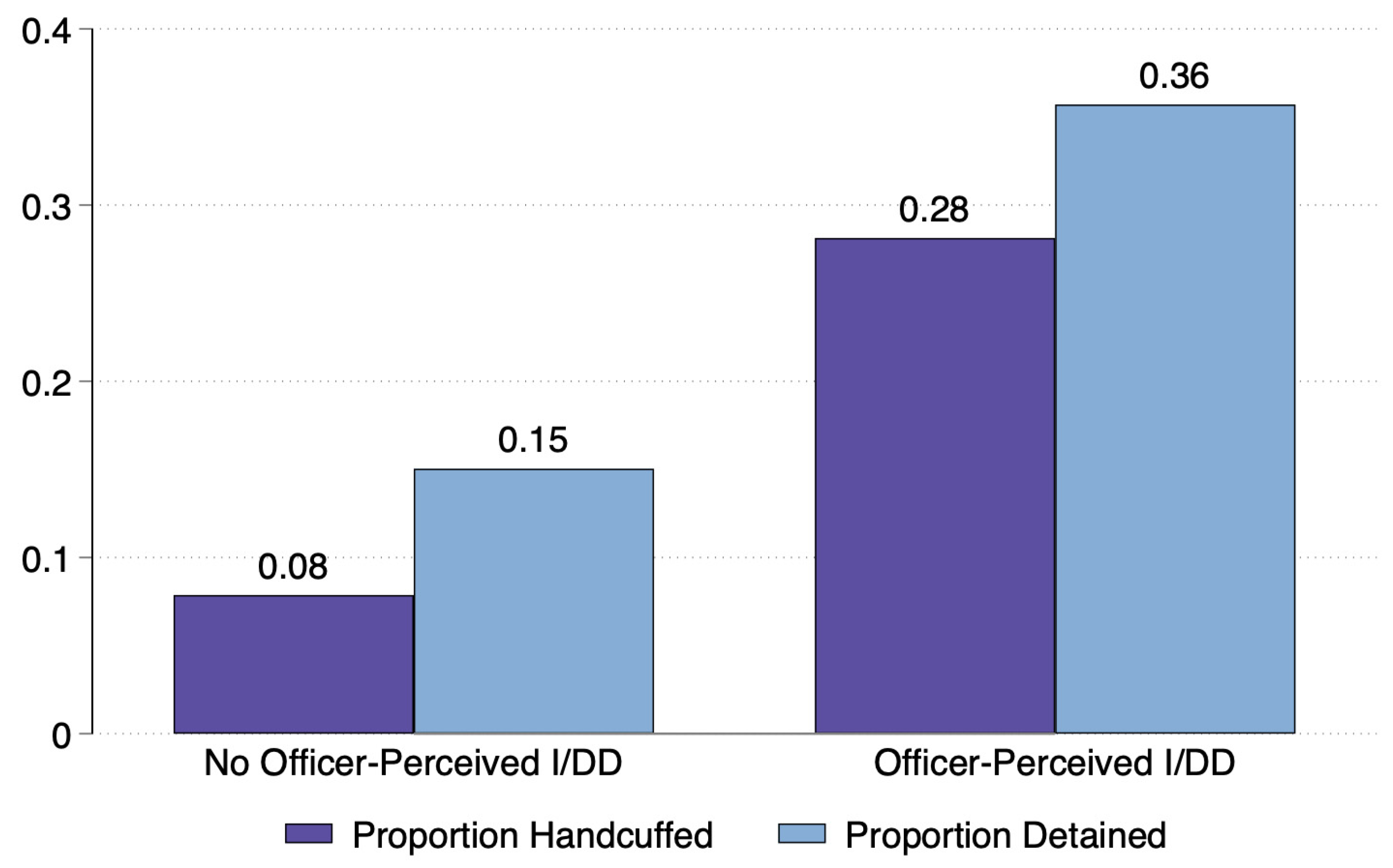
It is important to examine the relationship between officer-perceived I/DD and the outcomes, handcuffing and detention, before applying weights in the models.
Figure 1 shows the proportion of individuals with and without officer-perceived I/DD who were handcuffed or detained. First, examining the proportion of individuals who were handcuffed (the blue bars), approximately 0.08 or 8% of individuals without officer-perceived I/DD were handcuffed, whereas 0.28 or 28% of individuals with officer-perceived I/DD were handcuffed, a stark 20% difference. Second, looking at detention (the red bars), 0.15 or 15% of individuals without officer-perceived I/DD were detained during a stop, whereas 0.36 or 36% of individuals with officer-perceived I/DD were detained; a 21% difference. As noted earlier, these proportions do not consider covariates, so they provide a sense of disparity in handcuffing and detention without accounting for other factors. Once those factors are accounted for, do the disparities remain? For that, we turn to the results of the weighted multivariate logistic regressions.
Table 1 shows the results of the two weighted multivariate logistic regressions, Model 1 for handcuffing and Model 2 for detention, with clustering for agency. Note that the covariates are suppressed in
Table 1 [
50]; for the full table with covariates, please see
Supplementary Materials. For these models, Stata 19 reports the average “treatment” effect (ATE) that one could expect being perceived as I/DD impact on the outcome of either handcuffed or detained. Because this is not a causal analysis, to report it as a treatment effect would be incorrect. Therefore, we rename this as “predicted difference in the weighted means between officer-perceived I/DD” or more simply “the predicted difference in the means”. The Constant–OME0 and Constant–OME1 are the regression adjusted predicted log-odds for individuals without and individuals with officer-perceived I/DD. These predictions provide plausible comparison estimates of the log-odds for the counterfactual [
51], or “How would the outcome of handcuffing or detention changed had the officer perceived that the person with I/DD did not have I/DD (or vice versa)?” This is the idea of potential outcomes: to understand the true effect of having I/DD on our outcomes, we must also examine how the outcome would change if the other potential outcome (i.e., perceiving or not perceiving that the individual has I/DD) was in effect.
In Model 1, the predicted probability of handcuffing for individuals without officer-perceived I/DD is 1/(1 + exp(−1* − 2.459)) = 0.079 (p < 0.001), showing that 7.9% of people without officer-perceived I/DD are handcuffed during a stop. Next, the predicted difference in the weighted means (i.e., the probability) between officer-perceived I/DD is 1/(1 + exp(−1* − 1.780)) − 1/(1 + exp(−1* − 2.459)) = 0.065 (p < 0.001). This effect is positive, showing that individuals officers perceived as having I/DD have a predicted probability of being handcuffed that is 6.5 percentage points higher than non-I/DD individuals. In essence, the predicted probability of handcuffing for individuals with officer-perceived I/DD is 14.4% (i.e., 0.079 + 0.065 = 0.144 or 14.4%).
Next, in Model 2, the predicted probability of being detained for individuals without officer-perceived I/DD is 0.150 (p < 0.001), showing that 15.0% of people without officer perceived I/DD are detained during a stop. Next, the predicted difference in the weighted means (i.e., the probability) between officer-perceived I/DD is 0.075 (p < 0.001). This effect is positive, showing that individuals officers perceived as having I/DD have a predicted probability of being handcuffed that is 7.5 percentage points higher than non-I/DD individuals. In essence, the predicted probability of detention for individuals with officer-perceived I/DD is 22.5% (i.e., 0.150 + 0.075 = 0.225 or 22.5%).
Finally, to establish whether the weights are effective at making a counterfactual, we examine the balance statistics, shown in
Table 2. The largest weighted standardized difference between individuals with and without officer-perceived I/DD was the long stop variable, with a standardized weighted difference 0.176. Out of 49 covariates, 40 covariates had a weighted standardized mean difference of 0.05 or less, and the remaining nine covariates were under 0.25. While this is over the accepted 0.05 threshold for appropriate matching [
52,
53], the doubly robust method corrects for this [
53] by including an additional adjustment on the weighted data for all variables.
4. Discussion
Disabled individuals experience higher rates of both low-level [
3] and fatal force [
1,
2]. One study of media reports of police killings suggested that one-third to one-half of all people killed by the police are disabled [
1], while another study reports that in 2015, 25% of people killed by the police had a mental health condition [
2]. While these statistics are not refined enough to capture the experiences of force among individuals with I/DD, media reports of serious police encounters with this population leave them fearing police contact [
42,
43]. For instance, Victor Perez, an autistic 17-year-old boy was shot nine times by the police and later died [
54]. The results of this study reinforce the veracity of why individuals who are neurodivergent may be more fearful of police contact than their neurotypical counterparts. Below, we discuss our findings in the larger context of policing, police culture, and training.
Results suggest that net of other stop characteristics, the police believe people with I/DD are dangerous and need to be incapacitated, either through handcuffing or detention, during stops. Perceptions of dangerousness about people with I/DD emerge from individuals’ inability to understand various disabilities, how disabled people may behave differently, and ableism more generally. In a world tailored to abled bodies, able-bodied people commonly do not understand disabled people nor their lived experiences. Consequently, the behaviors and mannerisms of disabled people are both unexpected and misunderstood [
32,
55,
56]. This is particularly the case for neurodivergents, such as individuals with autism or ADHD, who think, and consequently behave, differently than others, especially during police stops [
45]. Neurodivergents may have specific behaviors that trigger the danger imperative in police stops, such as slower responses to questions, ticks, or low or no eye contact. These behaviors may be perceived as passive resistance or non-compliance [
42,
45], and subsequently also signal to the officer that they are in danger. Our results lend legitimacy to the above links between neurodivergents, danger, and use of force.
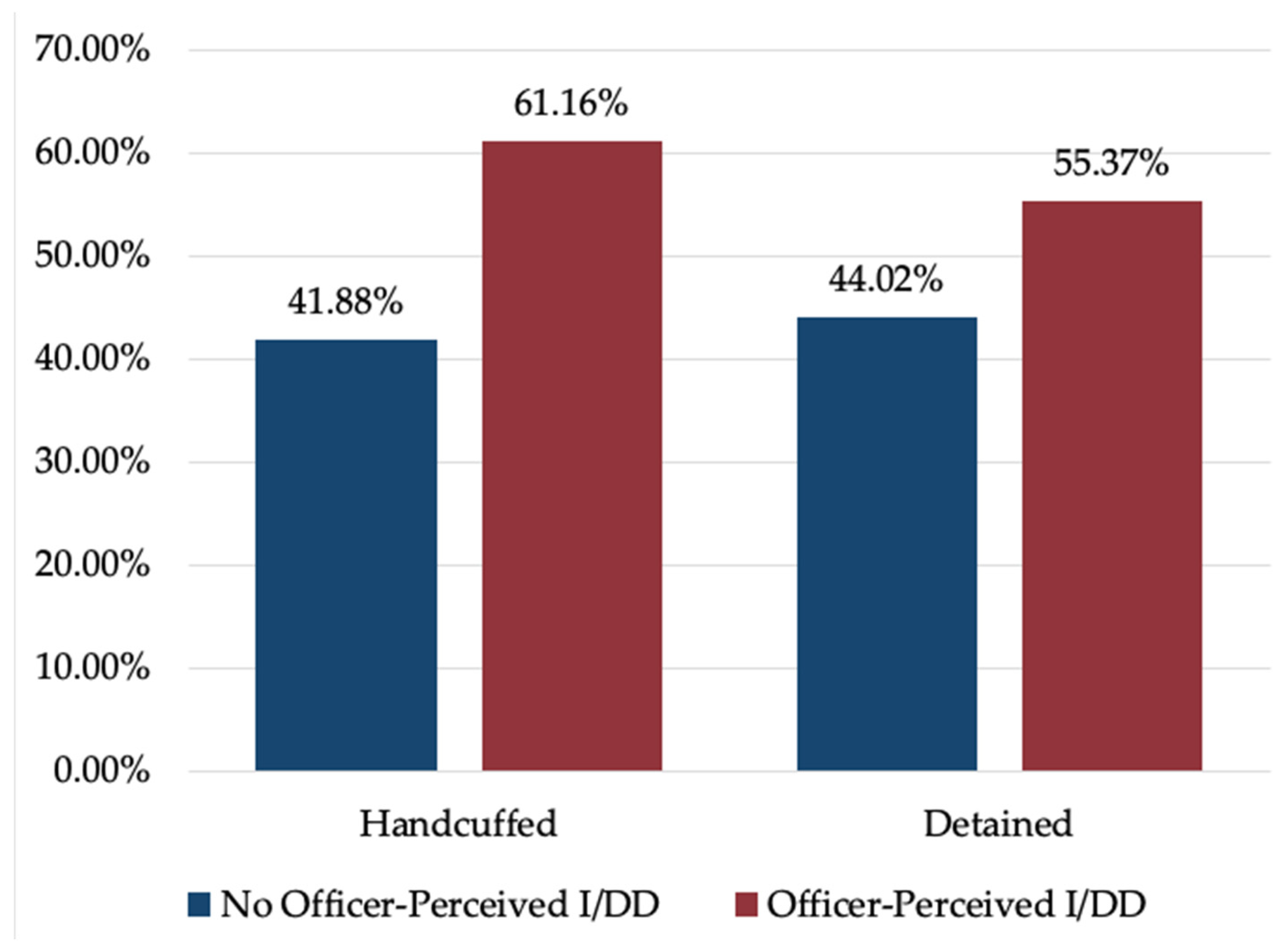
One argument against I/DD driving differences in handcuffing and detention probabilities is differential likelihood of arrest for individuals with and without officer-perceived I/DD. During arrests, individuals are often handcuffed and/or detained in some way—whether that detention is curbside detention or in the back of a patrol car. Given that handcuffing and detention are far more common during arrest, inequities in these outcomes across individuals with I/DD should not exist, or at least, be less drastic. However, a closer investigation of our data demonstrates that although individuals perceived to have I/DD compose a greater percentage of arrests, this ultimately does not account for the stark difference between handcuffing and detention between perceived disability statuses.
Figure 2 below shows that, when examining only arrestees, individuals the officer perceived as I/DD had higher rates of handcuffing and detention than their non-I/DD counterparts.
While the modeling strategy behind this study is strong, the current study has its limitations. First, findings are based on officers’ subjective perceptions of I/DD, rather than on external or validated measures that could reliably confirm an individual’s disability status (e.g., self-identification by the individual themselves or perhaps the dispatcher). This likely means that some individuals were misclassified by officers (e.g., mental health conditions, etc.) over an I/DD-related disability, and vice versa. Officers’ discernment of I/DD may have also been complicated if the individual exhibited additional indicators of other disabilities and/or mental health conditions that took precedent. Considering that misclassification is a commonly cited issue by both officers and the disability community [
42,
57,
58] and that individuals with I/DD are more likely to experience co-occurring conditions [
59,
60], this is a plausible, realistic consideration. This limitation gives pause at first glance; however, we argue that this measure—officer-perceived I/DD—is the most advantageous for examining officers’ discretionary decision-making processes. One way that future data can be improved is by providing officers an opportunity to record their reasons for why they believe the individual has I/DD (e.g., difficulty following verbal instructions). This would not only shed light into how and why officers determined the individual had I/DD but can also inform more effective and targeted police practices, policy, and research.
Second, our analysis only focused on single-individual stops and excluded those involving multiple people. Although this decision was critical to the current study’s aim of understanding the dynamics of perceived disability and dangerousness, doing so may have omitted stops involving individuals with I/DD, their loved ones, and caregivers. Individuals with I/DD, depending on their needs and abilities, may require additional support from loved ones and caregivers as they navigate their daily lives. Applied to the current study, this means that they may be less likely to be stopped by an officer without the presence of loved ones and caregivers. This is important as loved ones and caregivers can act as potential mediators between individuals with I/DD and officers during stops, such as providing information about their individual’s disability status to officers, which in turn may de-escalate ideas of dangerousness and subsequent actions (i.e., handcuffing, detaining). However, emerging cases also suggest loved ones and caregivers, despite their attempts, were unable to prevent the police from doing so [
44]. Although deeply complex, future research is needed to understand the potential role that the presence of loved ones and caregivers have in shaping these officer-disability encounters.
Lastly, the use of an overarching category like I/DD restricts understanding the complexity of the conditions within it and its effects on officers’ perceptions and behaviors associated with dangerousness. As previously mentioned, our measure for I/DD primes officers with the example I/DD condition of dementia, not other I/DD conditions; however, I/DD encompasses a wide range of conditions with all varying needs, abilities, and characteristics, including dementia. This may lead to an over representation of dementia in the I/DD category and an under representation of other I/DD conditions, though officers likely receive training on how to fill out stop forms. Additionally, we hypothesize that some conditions may be more likely to be classified as an I/DD as well as be perceived as dangerous by officers. For example, one individual who is resistant to touch may be misread by officers as being noncompliant or dangerous over being I/DD; on the other hand, another individual who provides answers that indicate suggestibility (e.g., overly compliant and reliant on officers’ guidance) may be more likely to be seen as I/DD. While we recognize that the current data depend on perceptions of I/DD and remains salient, future work should continue to sparse out these potential in-group I/DD differences in police experiences through advanced data collection and collaborative efforts between the disability community, the police, and researchers.