
Article

Psychosocial Correlates of Social Problem-Solving and Empathy Among Youth in Fifteen Muslim Societies

by
Ilham Nasser
1,* and
Mohammed Abu-Nimer
2,3
1
Salam Institute for Peace and Justice, Washington, DC 20005, USA
2
School of International Service, American University, Washington, DC 20016, USA
3
Visiting Scholar at the Centre for Peace and Intercultural Understanding (CPIU), University of Johannesburg, Auckland Park 2006, South Africa
*
Author to whom correspondence should be addressed.
Societies 2026, 16(2), 63; https://doi.org/10.3390/soc16020063
Submission received: 18 November 2025 / Revised: 27 January 2026 / Accepted: 30 January 2026 / Published: 13 February 2026

Abstract

This article is based on a study that surveyed youth in Muslim-majority societies to investigate the competencies that support youths’ problem-solving skills and empathy. More specifically, it aims to examine attitudes towards psychosocial skills, including self-regulation, forgiveness, religiosity/spirituality, collective orientation, social problem solving, and empathy. The survey focused on youth (N = 15,790) in secondary and higher education (ages 18 and under and 18–24) from 15 Muslim-majority societies. The 2020–2021 survey findings reveal that age, gender, and group differences significantly affect collectivistic orientation, self-regulation, and problem-solving. Additionally, the results support the hypothesis that all variables except forgiveness predict empathy and problem-solving among Muslim youth. By including skills essential to modern life, such as empathy and problem-solving, and by exploring their roles in youth development and social interactions, the study highlights social and cultural attitudes toward these psychosocial, personal, and interpersonal skills, especially among youth in Muslim societies.

1. Introduction

In addition to academic skills, which are important for youth development and success, psychosocial skills are essential for forming healthy social relationships [1]. These include emotional and social skills that promote well-being and are vital to academic achievement and overall success. For example, research suggests that mastering self-regulation and demonstrating prosocial attitudes support overall well-being [2]. This study is based on an empirical survey examining youth attitudes toward empathy and social problem-solving, and their correlations with self-regulation, forgiveness, and collective orientation among young participants. This area of research has received limited attention, both conceptually and empirically, in Muslim-majority societies [3].
This study aligns with prior research urging a shift away from viewing youth as “at risk” and toward emphasizing positive youth development [4]. Previous studies noted that policies and international aid agencies often portray youth as one-dimensional actors, ranging from heroes contributing to social change to criminals and extremists. They concluded that “these diverse perceptions of youth within global policy are being circulated and produced without much attention to the voices of youth themselves” [5] (p. 4). This study shifts the focus from a deficit view of youth towards the well-being of this age group in several Muslim communities.
Earlier research has examined links between competencies, such as forgiveness and empathy, and social problem-solving and empathy [6]. Furthermore, skills such as forgiveness, self-regulation, and religiosity/spirituality were positively correlated in earlier studies [7,8,9]. While more is known about religiosity and its expression among youth, there is a lack of new knowledge on how it interacts with other social skills in Muslim societies [10]. One study found that willingness to forgive and religious attitudes are associated with self-regulation skills in youth [6]. However, gaps remain in research on the correlations relevant to Muslim youth.
Previous studies have shown that skills are context-specific and must be examined within the cultural environment [4]. For example, how do individualistic versus collectivistic attitudes interact with self-regulation and forgiveness? Previous studies found that skills such as empathy, gratitude, and life satisfaction are also related [6,11]. Earlier research suggests that people with higher empathy and gratitude are more forgiving [11]. A few recent studies have explored the roles of forgiveness and self-regulation in collectivist cultures that emphasize social harmony and the maintenance of social relationships [12]. However, there is a lack of recent research on whether youth in modern Muslim societies show a collective orientation, if at all [13]. Understanding attitudes toward these skills among Muslim participants, who make up a large share of the global South [14], supports the exploration of ways to foster social cohesion in Muslim-majority societies [15].
More information on these areas can aid social and educational interventions within Muslim societies and others in the so-called Southern hemisphere. The suspicion, distrust, and even rejection of Western individualistic and secular frameworks have been a significant focus of public campaigns by some religious and political actors, many of whom advocate a traditional, religiously grounded collectivist approach as central to education for values in Muslim communities [16]. This study aims to highlight youth and to contribute to a shift in the conversation and strengthen research on Muslim-majority societies and youth. The study highlights the importance of legitimizing culturally appropriate aspects of religious and traditional collective values essential to addressing forgiveness, problem-solving, and empathy among youth.
It also introduces new insights into the connections between two categories of psychosocial skills: personal skills (self-regulation and forgiveness) and interpersonal skills (empathy and social problem-solving). When learned and developed, these competencies contribute to individuals’ psychosocial health and societal welfare [17,18]. The study examines whether personal development skills—specifically self-regulation, forgiveness, religiosity, and a collectivistic/individualistic orientation—predict interpersonal skills such as empathy and social problem-solving. To clarify how these skills are measured, the study defines them in a specific context and situates those definitions within the existing body of knowledge. Here, skills and competencies are used interchangeably and should be understood to refer to the mastery of psychosocial developmental tasks [4].
Empathy is the ability to understand others’ emotions and the willingness to care, feel, and take others’ perspectives [19,20]. It can be fostered by intentionally including it in psychosocial and educational interventions [21]. Social problem-solving refers to the skills individuals use to analyze, understand, and prepare to respond to everyday problems, decisions, and conflicts [22] (p. 53). Social problem-solving skills are among the most important coping strategies [23], especially for overcoming various stressors and gaining greater self-control and regulation over our own behaviors [22,24]. This study explores these two skills and examines their relationships with self-regulation, forgiveness, and religiosity.
In this study, forgiveness is defined as a personal decision, driven by intrinsic motivation and intentionality, to let go [16]. According to Worthington and colleagues [25], there are three types of forgiveness: “Trait forgiveness,” which occurs over time; “state forgiveness,” which focuses on a specific offense; and self-forgiveness, which involves letting go of the shame resulting from offenses committed by others [25]. The focus here is on the interpersonal aspects of forgiveness and whether they predict empathy and social problem-solving skills. The study examines attitudes toward interpersonal forgiveness within a specific cultural and social context, making it both contextually relevant and socially grounded. Self-regulation is the second predictor of empathy and problem-solving in this study. It is defined as “generated thoughts, feelings, and actions that are planned and cyclically adapted to the attainment of personal goals” [26] (p. 14). Self-regulation is a process that enables individuals to proactively manage their circumstances and control their cognitions, emotions, and behaviors to complete specific tasks and achieve their goals [27].
Unlike an individualistic orientation, shaped by personal goals and attitudes, a collective orientation is guided by goals and values shared with the ingroup [28]. A collectivistic versus individualistic orientation is not a skill but a cultural aspect of social interactions; however, both are hypothesized to influence individuals’ ability to navigate their respective contexts. Individualism is defined as a state in which people are primarily concerned with themselves and their immediate family [29,30]. Conversely, collectivism is characterized by a sense of belonging to a larger in-group [31]. Such a collectivist orientation and sense of belonging exist in Muslim societies and were suggested to shape individuals’ framing and considerations of forgiveness in a previous study [32].
In this study, religiosity is defined as the extent to which faith affects one’s values, behaviors, and life. It also includes various dimensions, such as public practice, private practice, religious experience, ideology, and intellect [33]. These dimensions represent a comprehensive set of religious values and the ways they are practiced in life. Sociology of religion scholars agree that religion and faith provide a sense of security, especially in situations related to uncertainty [34].
Previous research on the above-mentioned competencies shows strong links among them, including clear evidence that self-regulation and religiosity positively correlate with each other and with forgiveness. There is also evidence that students with high self-regulation are more persistent in finding ways to solve their problems when facing difficulties and challenging situations [35]. Furthermore, interpersonal skills, such as those listed, are essential for navigating social environments and are important for overall success [2]. They support social adjustment, emotional development, and well-being. However, there is insufficient information on collective/individualistic orientation and social problem-solving, and on how they interact within social and cultural contexts among youth in majority-Muslim societies. This study answers the following questions: Do self-regulation, forgiveness, collectivistic orientation, and religiosity predict attitudes toward social problem-solving and empathy? Do males and females, secondary education students and university students (source), and/or age groups differ in their attitudes toward problem-solving, empathy, forgiveness, self-regulation, collectivism, and religiosity?

2. Materials and Methods

2.1. Participants and Settings

This study included students in university and secondary education. It focused on students aged 24 or younger who were primarily Muslim, from public and private institutions across 15 countries and communities. Due to factors such as regional differences, financial considerations, local approvals, and the location of coordinating teams, almost all the samples were restricted to the country’s central regions or to areas where Muslim-majority communities reside. For example, the sample from India was focused on the New Delhi area only. Of these, 27.9% (4399) attended university, while 72.1% (11,391) were in secondary education. Most of the students were in 10th and 11th grades in secondary schools (%30 and %29). On average, three universities and 10–12 schools were included. The age distribution was 67.1% (10,204) younger than 18 and 32.9% (4997) between 18 and 24. Regarding sex, females accounted for 58.2% (9150) of participants, while males accounted for 41.8% (6578). Most respondents were Muslims (86%), while Christians and others accounted for the remaining 14%, mainly from Tatarstan (55%). Participants were recruited from schools and universities in the following countries and communities: Sudan, Algeria, Morocco, Jordan, Malaysia, Indonesia, Tanzania, Kenya, India, Bosnia, Bangladesh, Kyrgyzstan, Mauritius, the Tatarstan region of Russia (a Muslim-majority community), and private Islamic secondary schools in the United States.

2.2. Measures

The measures in this study were thoroughly reviewed to ensure they fit within the sociocultural contexts, especially in the target Majority Muslim societies. To ensure accuracy, the measures were translated into more than ten languages and local dialects using standard translation and back-translation methods for validation. Before translation, two researchers reviewed the items in the original scales to determine their appropriateness to local contexts, and any controversial items were removed. In reviewing the measures, we included items that were easy to understand, especially across all age groups and countries. Ensuring the survey was not too long was important to prevent participant fatigue and keep their attention. Additionally, we adjusted the scales to ensure a consistent format across all measures, reducing confusion. This involved changing the Likert scale from 1–5 or more to 1–4, aiming to limit options and encourage participants to make a choice. To establish the validity of the constructs measured, especially their consistent meaning across languages, we conducted focus groups with data collectors from several of the participating communities. We clarified their understanding of concepts such as forgiveness and empathy to ensure a similar perception of the skills across communities. The overall reliability of the survey, as measured by Cronbach’s Alpha, was 0.84 (scores above 0.8 indicate acceptable reliability; 0.8 to 0.95 indicate excellent reliability, according to [36]. Table 1 describes each measure and its reliability.

2.3. Design and Procedures

This study is cross-sectional and involved a network of one researcher and his/her data collectors of 3–4 in each society mentioned. In some countries, data collectors accessed schools with permission from ministries or from principals at private schools, who allowed them to explain the surveys to students while teachers were present. Paper-and-pencil surveys and answer sheets were included, and responses were recorded on the sheets. Identification codes were assigned to every participant to keep personal information confidential.
Sampling techniques varied between random in some contexts and convenient in others, depending on access to schools and survey permits. Research coordinators and data collectors selected schools at random; if that was not possible, they randomly selected grade levels within each school. Obtaining official permission typically took three to four months in most locations, plus another three to four months for surveying. To protect human subjects, all data collectors completed online training in research ethics and passed an online test to ensure they understood and adhered to ethical standards. All participants read a statement about the study’s voluntary nature, and consent was obtained from each participant. Parents of secondary students received an information package explaining the study and were asked to return it if they disapproved of their child’s participation.

2.4. Statistical Analysis

First, we computed scale means for each country and broke them down by community (Table 2). Second, we conducted measures of central tendency and variability for all variables in the study (Table 3, including Mean, SD, and range). Third, Pearson’s correlation was used to examine the direction and strength of the relationships between the various scales (Table 3). Fourth, to address the study’s primary goal—predicting the two main dependent variables—we conducted a multivariate multiple regression analysis (Canonical correlation). This analysis included gender, age, sample groups (secondary students versus university students), religiosity, self-regulation, collectivistic orientation, and forgiveness as correlates, with problem-solving and empathy as outcome variables (Table 4 and Figure 1).

3. Results

3.1. Country Means

Table 2 below presents the means for each scale in each country participating in the study. The means suggest similar scores across most scales, while the forgiveness scale had the lowest means across countries and communities.

3.2. Correlations

Table 3 displays the Pearson correlation coefficients among the study’s scales, including problem-solving and empathy as dependent variables. It also provides the means, standard deviations (SD), and ranges for each scale used in this research. The analysis indicates that both dependent variables (problem-solving and empathy) are significantly and positively correlated with self-regulation, collectivistic orientation, religiosity, and forgiveness. Although these findings are statistically significant, they suggest weak to moderate correlations, with the variance explained by each independent variable ranging from 1% to 23%. Additionally, Table 3 highlights a significant correlation between forgiveness and a collectivistic orientation, whereas no significant relationship was observed between forgiveness and self-regulation. Overall, although most correlations with forgiveness are significant, they are weak.

3.3. Correlates of Problem-Solving and Empathy

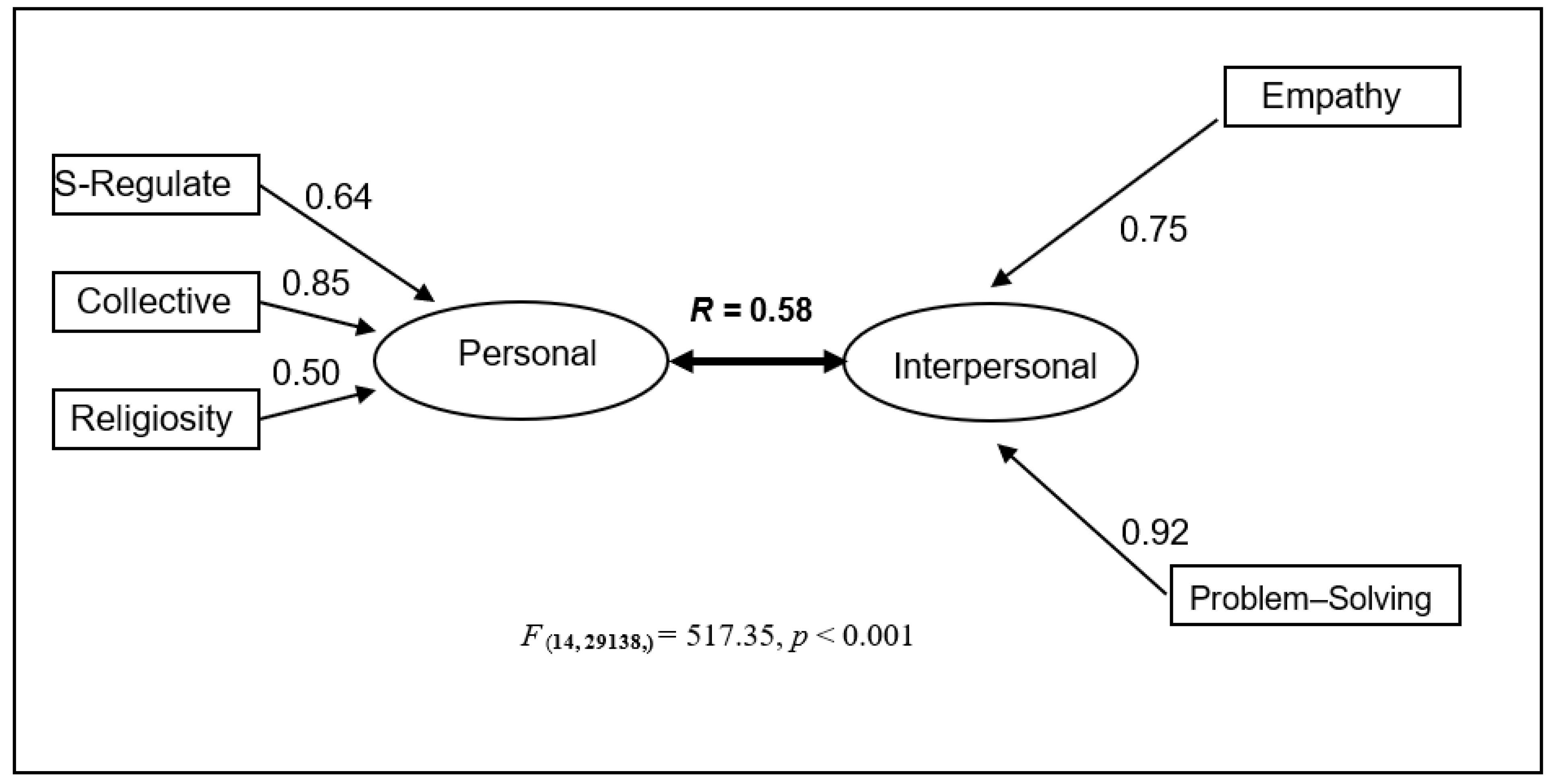
A Canonical correlation was conducted to predict the strength and the size of the correlations between the outcome variables and the six factors mentioned above [42]. The results of the overall Wilks’ lambda multivariate tests of significance show a significant correlation between the (labeled skills = empathy and problem-solving in Figure 1) variate and the demographic and the three factors (labeled personal-interpersonal skills in Figure 1) variate (Wilks’ lambda = 0.64, F (12, 29,140) = 603.26, p < 0.001). Overall, the correlation between the independent variate (self-regulation-forgiveness, collective orientation, and religiosity) and the outcome variate (empathy and problem solving) was 0.58. The independent factors’ canonical variate accounted for 34% of the variance in the dependent canonical variate (R2 = 0.34).
With a cutoff correlation of 0.30, the dependent canonical variate showed a strong loading on empathy (R = 0.75) and problem-solving (R = 0.92). Additionally, the demographic and the other independent canonical variate had high loadings on collectivistic orientation (R = 0.85), self-regulation (R = 0.64), and religiosity (R = 0.52). In contrast, age, gender, source (secondary education students and university students), and forgiveness had low or negligible loadings. These findings indicate that higher levels of collectivism, self-regulation, and religiosity are associated with greater empathy and problem-solving. The canonical correlation results show that the pair of dependent canonical variates accounted for 70.52% of the variance in empathy and problem-solving. Conversely, the independent canonical variate explained only 7.05 percent of the variance among the independent variables (gender, age, source, self-regulation, religiosity, collectivistic orientation, and forgiveness). Table 4 and Figure 1 present the results of the canonical correlation analysis and display the significant pathways.

4. Discussion

The results of this study indicate moderate correlations among most variables, supporting prior research on the links between social problem-solving and other social and emotional skills, which are considered essential for well-being and personal growth among youth in Muslim societies [3]. In fact, forgiveness was the only variable with a weak link to social problem-solving and empathy, and no link to self-regulation. This may highlight the need to master specific skills related to forgiveness and to learn and train in forgiveness [25]. The weak link between forgiveness and social problem-solving can also be attributed to the fact that forgiveness and reconciliation processes are often ritualized and embedded in the collectivist processes that often include family mediation and other social or religious agencies [43].
The findings also suggest that youth with higher levels of collective orientation, self-regulation, and religiosity tend to score higher on empathy and social problem-solving, highlighting their roles in predicting and increasing the likelihood of these two outcome skills. The results support empirical evidence that problem-solving and empathy can be enhanced when youth have more positive attitudes, a better understanding of forgiveness (though weak), and an elevated level of self-regulation (very strong). Therefore, despite the low correlations between the set of skills examined and forgiveness, a program that integrates forgiveness and other psychosocial skills as part of a socio-emotional learning plan can be valuable for youth, especially considering the links identified between forgiveness, self-regulation, and empathy among youth in Muslim societies [15]. Resolving social and interpersonal conflicts peacefully is an essential skill and capacity that all young people need in today’s diverse and globalized world [16].
Additionally, skills such as problem-solving and self-regulation are essential for managing conflicts that arise in the classroom, hallways, or even on social media platforms among youth. These skills are crucial for combating bullying, fostering better peer relationships, and indirectly contributing to success and academic achievement [2]. They are also necessary for strengthening Muslim youth’s resilience in coping with the intense and often violent manifestations of larger social, political, and economic tensions and polarization. Most Muslim youth are significantly affected, to varying degrees, by the dynamics of war in conflict zones. This reality calls for greater resilience and coping skills to handle uncertainty, mistrust, helplessness, and social alienation [44]. Research on empathy also links it to conflict resolution and critical thinking, highlighting its importance in a comprehensive educational reform initiative in Muslim societies, as empathy is a vital skill that promotes dialogue, mediation, and problem-solving [45]. It also correlates positively with the social and communication skills necessary for interactions with others and is associated with lower levels of hostility and aggression [46]. In addition to listening and communication skills, fostering empathetic attitudes can help enhance conflict resolution efforts [45]. Therefore, educators, policymakers, and social agencies need to understand how to support the development of empathy among youth.
Based on the study results, religiosity is significantly associated with empathy, problem-solving, and a collectivist orientation among participating youth. This means that approaches and interventions to reform education and transform societies need to consider “religiosity” when working with Muslim youth and in their local contexts. For instance, this can include educating for forgiveness and empathy using religiosity as a positive factor to promote forgiveness and a culture of peace rooted in people’s faith and teachings about prosocial skills [16]. Further research is necessary to explore this finding in depth, identify additional ways in which religiosity fosters peace and tolerance, and examine further correlations among problem-solving skills, attitudes toward empathy, and religiosity.
Although religion plays a crucial role in how Muslim youth understand their world and their relationships with others, promoting a stronger sense of religiosity through education remains a controversial issue in Muslim and non-Muslim communities worldwide. Western and secular government donors often portray this as a dangerous path that Muslim governments and civil society should avoid [47]. Currently, the approach tends to steer clear of any religious ways of knowing, despite many Muslim scholars calling for the integration of religious education into formal youth education systems [48]. The findings suggest that Muslim youth with strong problem-solving and empathy skills tend to have a heightened sense of religiosity and a collective orientation. This is supported by researchers who have criticized the trend of linking Muslim youth and their religiosity with violent extremism and terrorism [16,49]. Additional studies support the argument that religiosity fosters moral discipline, belonging, and social competence, aligning with this study’s findings on self-regulation and empathy. Also, engagement of Muslim youth in political education and legal pragmatism provides evidence that Muslim youth actively engaging in secular civic frameworks is reinforcing social problem-solving capacities [50,51]. The current findings are clearly supported by previous studies that reject linear radicalization security models and illustrate the need for capabilities-based Positive Youth Development frameworks, in which religiosity is linked to moral infrastructure and self-regulation to civic competence.
Whether emphasizing individualistic or collective orientations, the goal of this study is not to determine which is more important or “right” for well-being, but to understand the tendencies of youth and their orientations within their cultural contexts. For example, in many contexts, forgiveness is a subsequent step that a person takes publicly or privately once other conditions are met (either symbolically or concretely), emphasizing the collective aspect of managing forgiveness behaviors and engaging with others in the community [43]. Skills such as empathy and self-regulation, in addition to a collective orientation, may interact to reinforce the development of a forgiving attitude [52]. Previous research suggests that self-regulation is linked to forgiveness and religiosity/spirituality, but this study broadens the understanding to include cultural orientation among youth. Incorporating the collective orientation highlights the cultural norms involved when examining these psychosocial skills. The researchers are not suggesting or endorsing all forms and expressions of a Muslim collective orientation, but rather those aspects that can strengthen interpersonal and collaborative skills, such as empathy and problem-solving [15]. The study takes a step toward answering a practical question about how educators and socialization agents can enhance a collaborative collective that supports such competencies.

5. Conclusions/Further Research

The findings of this study challenge the tendency among some policymakers and researchers to underestimate the positive impact of interventions that educate youth about socio-emotional learning to enhance their psychosocial skills, including empathy and problem-solving. It also calls for a reevaluation of assumptions and generalizations about the securitization of education among Muslim youth. This discovery encourages further research into current role models, such as adults in their lives and social media influencers they follow, and the values and skills they promote. Youth in Muslim societies are avid consumers of social media, and a follow-up study examining their beliefs about values that improve problem-solving, empathy, and other 21st-century life skills is beyond the scope of this article but represents an important next step [53].
The implications of the findings on polarization and debates about the socialization of Muslim youth suggest integrating specific values and norms related to self-regulation and a stronger collective orientation, while also empowering youth to develop and exercise individual empathy and social problem-solving skills [10]. Additionally, a stronger collective orientation reflects a stronger individual connection to one’s community, an empathetic orientation, and an increased capacity for social problem-solving.
The findings of this study provide new insights into youth and their tendencies in Muslim-majority societies. They are also relevant to issues occurring within these societies, especially those related to youth and their needs. First, given the high levels of sectarian violence and polarization between different religious and political ideologies, the resilience of youth in coping with these stressful and destructive dynamics is clearly connected to their ability to self-regulate, use problem-solving skills, and develop empathetic relationships with others in their social and personal environments. The results highlight some of these tensions regarding what is needed for youth to develop their skills as future citizens and leaders, including the essential components of social and educational programs (whether formal or informal) to foster these skills [5,54]. In most Muslim societies, families and communities tend to focus more on academic achievement scores and less on youth well-being and life skills [3]. In many cases, citizenship education, which teaches skills, does not address these needs due to a lack of follow-up and of proper programs that engage youth [55].
The good news is that many of these skills are teachable and can be integrated into the curriculum through socio-emotional learning programs [24,56]. Teaching students to approach their problems critically and with a logical mindset is a key strategy educators can use to prevent conflicts from escalating in school settings and in the community. For example, engaging students in social problem-solving hypothetical situations helps them develop the knowledge and skills to improve peer acceptance, foster empathy for others, and achieve positive outcomes in problem-solving and behavior [57]. In academic environments, enhancing social adjustment and behavior, as well as social problem-solving skills, also supports academic success and progress [58]. This study highlights the importance of self-regulation skills and a collective orientation—especially when applied as a collective initiative that may include multi-generational leadership figures in the local community. In some communities, religious actors or civil leaders may be involved, and in others, peers and friends [15].
Another implication of the strong connection between collectivist orientation, self-regulation, empathy, and problem-solving is that education systems (including frameworks, values, and teaching methods) for youth in Muslim societies should not avoid addressing collectivist values and beliefs. It is also essential to further explore a collective, collaborative model that focuses less on the interests of the extended family and more on the community [3,15]. Clearly, there are challenges in defining the specific features of a collaborative collective orientation that need to be addressed in a follow-up study that asks questions such as whether a collectivist orientation includes a strong emphasis on patriarchal values and how the marginalization of youth and children’s voices and needs compares with that of males and older members of society. This study centers the conversation on a value that highlights both collectivist orientation and collaboration, addressing the lack of empirical research on this topic within Muslim societies [11]. We hope that further interest in this topic arises as a result.
There is no doubt that teaching empathy and problem-solving is essential across all education systems. However, the findings indicate that cultural and religious collective orientations can help strengthen connections to 21st-century skills, especially within Muslim societies [16]. In many educational systems included in this study, basic socio-emotional skills such as forgiveness are not incorporated into the formal curriculum, despite their religious significance. For example, a child might complete 12 years of education without being taught or exposed to practices such as dialogue, conflict resolution, critical thinking, and problem-solving, which are vital for developing a forgiving attitude [16]. Classrooms in many systems primarily serve as spaces for “deposits of information” [16] rather than environments for building resilience and skills to prepare students for life. In fact, in many cases, the main pedagogical approach used by teachers relies on memorization and punishment [3].
The findings of this study also have implications for the structure of the curriculum in both formal and informal education for youth in Muslim societies. Often, international governmental and non-governmental agencies evaluate education systems from a Western individualistic perspective, leading to programs and reforms that overlook the collectivist values and religiosity of the local context [59,60]. In this area of research, there is a need to pay closer attention to these factors, especially if they are highly correlated with youth and their ability to become problem solvers. The current study suggests that beginning with personal skills, such as self-regulation, will promote interpersonal and prosocial skills. Nevertheless, further explorations should include questions such as what is the impact of harmful or destructive collective orientation (norms and values that negate forgiveness, nonviolence, and tolerance of differences) on social problem-solving and empathy? Also, future research can examine culturally grounded forgiveness measures and employ mixed methods approaches that incorporate ethnography and narrative accounts.

6. Limitations

Because this is a cross-sectional study with partial random sampling, the results cannot be generalized to larger populations. Given the survey’s focus on youth attitudes, further examination is necessary, especially after the COVID-19 pandemic, which hit hard toward the end of data collection and affected their social lives and perspectives [61,62]. Despite the large sample size and broad participation, we cannot make comparisons or conclude representation across any of the countries, and we cannot generalize. To gain more insights, context-specific qualitative studies are essential for deepening knowledge and generating new lessons. This research aims to highlight the voices of Muslim youth in youth development and in the larger society, so involving youth in the research process will help ensure that their perspectives guide both the study and later interventions.

Author Contributions

Conceptualization, I.N. and M.A.-N.; Methodology, I.N. and M.A.-N.; Validation, I.N.; Formal analysis, I.N. and M.A.-N.; Investigation, I.N.; Resources, I.N.; Writing—original draft, I.N. and M.A.-N.; Writing—review & editing, I.N. and M.A.-N.; Supervision, I.N. All authors have read and agreed to the published version of the manuscript.

Funding

This research received no external funding.

Institutional Review Board Statement

The study was conducted in accordance with the Declaration of Helsinki and approved by Indiana University (protocol code 1805764063A004 and 1 September 2019). It was exempted and approval was waived.

Informed Consent Statement

Informed consent was obtained from all subjects involved in the study. In the case of youth (under age 18), the parents received a description of the study in an envelope and were asked to return if they do not agree for their children to participate.

Data Availability Statement

The authors used existing data sets that were gathered by the first author and received financial support from the International Institute of Islamic Thought. The data set can be found and is publicly available at www.iiit.org/aems. The original data presented in the study are openly available in https://dataverse.harvard.edu/dataset.xhtml?persistentId=doi:10.7910/DVN/WGCMP9 (accessed on 30 September 2024).

Acknowledgments

The data analysis was supported by Sulieman Abu-Bader from Howard University, Washington, DC.

Conflicts of Interest

The authors declare no conflicts of interest.

References

  1. Greenberg, M.T. Evidence for Social and Emotional Learning in Schools; Learning Policy Institute: Palo Alto, CA, USA, 2023. Available online: https://files.eric.ed.gov/fulltext/ED630375.pdf (accessed on 1 December 2025).
  2. Jones, D.E.; Greenberg, M.; Crowley, M. Early social-emotional functioning and public health: The relationship between kindergarten social competence and future wellness. Am. J. Public Health 2015, 105, 2283–2290. [Google Scholar] [CrossRef]
  3. Nasser, I.; Miller-Idriss, C.M.; Alwani, A. Reconceptualizing education transformation in Muslim societies: The human development approach. J. Educ. Muslim Soc. 2019, 1, 3–25. [Google Scholar]
  4. Guerra, N.G.; Bradshaw, C.P. Linking the prevention of problem behaviors and positive youth development: Core competencies for positive youth development and risk prevention. New Dir. Child Adolesc. Dev. 2008, 122, 1–17. [Google Scholar] [CrossRef] [PubMed]
  5. Cardozo, M.L.; Higgins, S.; Le Mat, M. Youth Agency and Peacebuilding: An Analysis of the Role of Formal and Non-Formal Education. Synthesis Report on Findings from Myanmar, Pakistan, South Africa, and Uganda; University of Amsterdam: Amsterdam, The Netherlands; UNICEF: New York, NY, USA, 2015. [Google Scholar]
  6. Ho, M.Y.; Van Tongeren, D.R.; You, J. The Role of Self-Regulation in Forgiveness: A Regulatory Model of Forgiveness. Front. Psychol. 2020, 11, 1084. [Google Scholar] [CrossRef] [PubMed]
  7. Luchies, L.B.; Finkel, E.J.; Fitzsimons, G.M. The effects of self-regulatory strength, content, and strategies on close relationships. J. Personal. 2010, 79, 1251–1280. [Google Scholar] [CrossRef] [PubMed]
  8. Koole, S.L.; McCullough, M.E.; Kuhl, J.; Roelofsma, P.H.M.P. Why religion’s burdens are light: From religiosity to implicit self-regulation. Personal. Soc. Psychol. Rev. 2009, 14, 95–107. [Google Scholar] [CrossRef]
  9. Hardy, S.A.; Baldwin, C.R.; Herd, T.; Kim-Spoon, J. Dynamic associations between religiousness and self-regulation across adolescence into young adulthood. Dev. Psychol. 2020, 56, 180–197. [Google Scholar] [CrossRef]
  10. Nasser, I.; Cheema, J.; Saroughi, M. Mapping the Terrain of Education in Muslim Majority Societies; International Institute of Islamic Thought: Herndon, VA, USA, 2020. [Google Scholar]
  11. Marigoudar, S.; Kamble, S.V. A study of forgiveness and empathy: A gender difference. Indian J. Posit. Psychol. 2014, 5, 173–177. [Google Scholar]
  12. Sandage, S.J.; Williamson, I. Relational spirituality and dispositional forgiveness: A structural equations model. J. Psychol. Theol. 2010, 38, 255–266. [Google Scholar] [CrossRef]
  13. Thompson, R.A. Changing societies, changing childhood: Studying the impact of globalization on child development. Child Dev. Perspect. 2012, 6, 187–192. [Google Scholar] [CrossRef]
  14. Bayat, A. Muslim youth and the claim of youthfulness. In Being young and Muslim: New Cultural Politics in the Global South and North; Oxford University Press: Oxford, UK, 2010; pp. 27–47. [Google Scholar]
  15. Nasser, I.; Saroughi, M.; Shelby, L. Mapping the Terrain of Education in Muslim-Majority Societies (2); International Institute of Islamic Thought: Herndon, VA, USA, 2021. [Google Scholar]
  16. Nasser, I.; Abu-Nimer, M. Examining views and attitudes about forgiveness among teachers in the Arab world: A comparison between five communities. Peace Change 2016, 41, 194–220. [Google Scholar] [CrossRef]
  17. Fonseca, X.; Lukosch, S.; Brazier, F. Social cohesion revisited: A new definition and how to characterize it. Innov. Eur. J. Soc. Sci. Res. 2019, 32, 231–253. [Google Scholar] [CrossRef]
  18. Yob, I.M. Cultural perspectives on social responsibility in higher education. High. Learn. Res. Commun. 2016, 5, 1–21. [Google Scholar] [CrossRef]
  19. Horsthemke, K. Epistemic empathy in childrearing and education. Ethics Educ. 2015, 10, 61–72. [Google Scholar] [CrossRef]
  20. Zahavi, D.; Overgaard, S. Empathy without isomorphism: A phenomenological account. In Empathy: From Bench to Bedside; Decety, J., Ed.; MIT Press: Cambridge, MA, USA, 2011. [Google Scholar]
  21. Castillo, R.; Salguero, J.M.; Fernandez-Berrocal, P.; Balluerka, N. Effects of an emotional intelligence intervention on aggression and empathy among adolescents. J. Adolesc. 2013, 36, 883–892. [Google Scholar] [CrossRef] [PubMed]
  22. Elias, M.J.; Clabby, J.F. Teaching social decision making. Educ. Leadersh. 1988, 45, 52–55.23. [Google Scholar]
  23. D’Zurilla, T.J.; Nezu, A.M. Development and preliminary evaluation of the Social Problem-Solving Inventory. Psychol. Assess. A J. Consult. Clin. Psychol. 1990, 2, 156–163. [Google Scholar] [CrossRef]
  24. Gootman, M.E. The Caring Teacher’s Guide to Discipline: Helping Young Students Learn Self-Control, Responsibility, and Respect; Corwin Press: Thousand Oaks, CA, USA, 2001. [Google Scholar]
  25. Worthington, E.L., Jr.; Wade, N.G. Handbook of Forgiveness, 2nd ed.; Routledge: Oxfordshire, UK, 2020. [Google Scholar]
  26. Zimmerman, B.J. Attaining self-regulation: A social-cognitive perspective. In Handbook of Self-Regulation; Boekaerts, M., Pintrich, P., Zeidner, M., Eds.; Elsevier: Amsterdam, The Netherlands, 2000; pp. 13–39. [Google Scholar]
  27. Zimmerman, B.J.; Schunk, D.H. Motivation: An essential dimension of self-regulated learning. In Motivation and Self-Regulated Learning: Theory, Research, and Applications; Schunk, D.H., Zimmerman, B.J., Eds.; Lawrence Erlbaum Associates Publishers: Mahwah, NJ, USA, 2008; pp. 1–30. [Google Scholar]
  28. Mullen, E.; Skitka, L.J. Comparing Americans’ and Ukrainians’ allocations of public assistance. The role of affective reactions in helping behavior. J. Cross-Cult. Psychol. 2009, 40, 301–318. [Google Scholar] [CrossRef]
  29. Hofstede, G.; Bond, M.H. Hofstede’s culture dimensions: An independent validation using Rokeach’s Value Survey. J. Cross-Cult. Psychol. 1984, 15, 417–433. [Google Scholar] [CrossRef]
  30. Hall, E.T. Beyond Culture; Anchor Books: New York, NY, USA, 1989. [Google Scholar]
  31. Darwish, A.E.; Huber, G.L. Individualism vs. collectivism in different cultures: A cross-cultural study. Intercult. Educ. 2003, 14, 47–55. [Google Scholar] [CrossRef]
  32. Shahzad, K.; Shafi, M.Q. Impact of Sense of Belonging on Forgiveness and Gratitude among Muslim Students: Mediating Role of Collectivism and Moderating Role of Religiosity. J. Educ. Muslim Soc. 2023, 5, 47–65. [Google Scholar] [CrossRef]
  33. Huber, S.; Huber, O.W. The Centrality of Religiosity Scale (CRS). Religions 2012, 3, 710–724. [Google Scholar] [CrossRef]
  34. Dawson, L.; Thiessen, J. The Sociology of Religion: A Canadian Perspective; Oxford University Press: Don Mills, ON, Canada, 2014. [Google Scholar]
  35. Schunk, D.H.; Zimmerman, B.J. Competence and Control Beliefs: Distinguishing the Means and Ends. In Handbook of Educational Psychology; Alexander, P.A., Winne, P.H., Eds.; Lawrence Erlbaum Associates Publishers: Mahwah, NJ, USA, 2006; pp. 349–367. [Google Scholar]
  36. Ursachi, G.; Horodnic, I.A.; Zait, A. How Reliable Are Measurement Scales? External Factors with Indirect Influence on Reliability Estimators. Procedia Econ. Finance 2015, 20, 679–686. [Google Scholar] [CrossRef]
  37. Davis, M.H. Measuring individual differences in empathy: Evidence for a multidimensional approach. J. Personal. Soc. Psychol. 1983, 44, 113–126. [Google Scholar] [CrossRef]
  38. Mincemoyer, P.; Perkins, D.F.; Munyua, C. Youth Life Skills Evaluation Project at Penn State; Texas A&M University: College Station, TX, USA, 2001. [Google Scholar]
  39. Pichardo, M.C.; Justicia, F.; de la Fuente, J.; Martínez-Vicente, J.M.; García-Berbén, A.B. Factor Structure of the Self-Regulation Questionnaire (SRQ) at Spanish Universities. Span. J. Psychol. 2014, 17, e62. [Google Scholar] [CrossRef]
  40. Tangney, J.P.; Boone, A.L.; Fee, R.; Reinsmith, C. Multidimensional Forgiveness Scale; George Mason University: Fairfax, VA, USA, 1999. [Google Scholar]
  41. Triandis, H.; Gelfand, M. Converging measurements of horizontal and vertical individualism and collectivism. J. Personal. Soc. Psychol. 1998, 74, 118–128. [Google Scholar] [CrossRef]
  42. Abu-Bader, S.H. Advanced and Multivariate Statistical Methods for Social Science Research; Oxford University Press: Oxford, UK, 2010. [Google Scholar]
  43. Abu-Nimer, M. (Ed.) Reconciliation, Justice, and Coexistence: Theory and Practice; Rowman and Littlefield: New York, NY, USA, 2001. [Google Scholar]
  44. UNHCR. The Impact and Effects of War on Children. Available online: https://www.edu.gov.mb.ca/k12/docs/support/building_hope/impact_effects.pdf (accessed on 15 December 2025).
  45. CEIA. Empathy in Conflict Resolution: If, How and When; Center for Empathy in International Affairs: London, UK, 2016; Available online: https://www.datanyze.com/companies/center-for-empathy/378474923 (accessed on 1 June 2025).
  46. Ahmetoglu, E.; Acar, I.H. The Correlates of Turkish Preschool Preservice Teachers’ Social Competence, Empathy and Communication Skills. Eur. J. Contemp. Educ. 2016, 16, 188–197. [Google Scholar] [CrossRef]
  47. Clover, C. Education minister hits at USAID over textbook policy. Financial Times. 25 November 2003. Available online: http://www.casi.org.uk/discuss/2003/msg04913.html (accessed on 20 August 2025).
  48. Nasser, I.; Abu-Nimer, M.; Mahmoud, O. Contextual and pedagogical considerations in teaching for forgiveness in the Arab world. Comp. J. Comp. Int. Educ. 2014, 44, 32–52. [Google Scholar] [CrossRef]
  49. Abdel-Fatah, R. Countering violent extremism, governmentality, and Australian Muslim youth as ‘becoming terrorists’. J. Sociol. 2020, 56, 372–387. [Google Scholar] [CrossRef]
  50. Emmerich, A. Salafi Youth Activism in Britain: A Social Movement Perspective. J. Muslims Eur. 2020, 9, 273–303. [Google Scholar] [CrossRef]
  51. Emmerich, A. Political Education and Legal Pragmatism of Muslim Organizations in India: A Study of the Changing Nature of Muslim Minority Politics. Asian Surv. 2019, 59, 451–473. [Google Scholar] [CrossRef]
  52. Christensen, K.J.; Padilla-Walker, L.M.; Busby, D.M.; Hardy, S.A.; Day, R.D. Relational and social-cognitive correlates of early adolescents’ forgiveness of parents. J. Adolesc. 2011, 34, 903–913. [Google Scholar] [CrossRef] [PubMed]
  53. Lindsay, A. How Social Media Shapes Muslim Identity and Activism Today; Muslim World Report: Hartford, CT, USA, 2025; Available online: https://www.muslimworldreport.com/news/international/2025-04-29-how-social-media-shapes-muslim-identity-and-activism-today/ (accessed on 1 December 2025).
  54. Davies, L. Teaching about conflict through citizenship education. Int. J. Citizsh. Teach. Educ. 2005, 1, 17–34. [Google Scholar]
  55. Abu-Nimer, M.; Kadayifci-Orellana, S.A. Muslim peace-building actors in Africa and the Balkan context: Challenges and needs. Peace Change 2008, 33, 549–581. [Google Scholar] [CrossRef]
  56. Durlak, J.A.; Domitrovich, C.E.; Mahoney, J.L. Handbook of Social and Emotional Learning. 2024. Available online: https://casel.org/links/handbook-of-social-and-emotional-learning-second-edition/ (accessed on 30 November 2025).
  57. Shure, M.B. I can problem solve (ICPS): An interpersonal cognitive problem-solving program for children. Resid. Treat. Child. Youth 2001, 18, 3–14. [Google Scholar] [CrossRef]
  58. Nelson, J.R.; Dykeman, C.; Powell, S. The effects of a group counseling intervention on students with behavioral adjustment problems. Elem. Sch. Guid. Couns. 1996, 31, 21–33. [Google Scholar]
  59. Herrera, L. Education, Islam, and modernity: Beyond westernization and centralization. Comp. Educ. Rev. 2004, 48, 318–326. [Google Scholar] [CrossRef]
  60. Dale, J.M.; Mohammed, D. Cultural competence—A success factor in NGO projects? Built Environ. Proj. Asset Manag. 2016, 6, 232–246. [Google Scholar]
  61. Giunta, L.D.; Lunetti, C.; Fiasconaro, I.; Gliozzo, G.; Salvo, G.; Ottaviani, C.; Aringolo, K.; Comitale, C.; Riccioni, C.; D’Angeli, G. COVID-19 impact on parental emotion socialization and youth socioemotional adjustment in Italy. J. Res. Adolesc. 2021, 31, 657–677. [Google Scholar] [CrossRef]
  62. Samji, H.; Wu, J.; Ladak, A.; Vossen, C.; Stewart, E.; Dove, N.; Long, D.; Snell, G. Review: Mental health impacts of the COVID-19 pandemic on children and youth—A systematic review. Child Adolesc. Ment. Health 2022, 27, 173–189. [Google Scholar] [CrossRef]
Figure 1. Path Diagram.
Societies 16 00063 g001
Table 1. Measures and Reliabilities.
Competency Measure Used # of Items ReliabilityItem Examples
Empathy (Perspective taking)Interpersonal Reactivity Index [37] (one subscale)70.66I believe there are two sides to everything and try to look at them both
I try to look at everybody’s side of a disagreement before I make a decision.
Problem-solvingYouth Life Skills Evaluation [38]120.80I can easily express my thoughts on a problem
I am able to give reasons for my opinions.
Self-Regulation Self-Regulation Questionnaire (SRQ) [39] originally 17 items160.73I set goals for myself and keep track of my progress.
Once I have a goal, I can usually plan how to reach it.
Forgiveness Forgiveness Scenarios [40]90.75Imagine that one of your friends starts a nasty rumor.
Imagine a young man broke up with your sister.
Collectivist vs. individualist Orientation (CIO)[41]14 (out of 16)0.67It is important that I do my job better than others
The well-being of my peers is important to me.
Religiosity Centrality of Religiosity Scale (CRS) [33]—5 items used50.80How important is your religion for you?
How important is prayer for your religious beliefs?
Table 2. Scale Means by Country.
CountryScale/Mean
Problem-SolvingEmpathySelf-RegulationCollectiveForgiveReligiosity
Bosnia3.03.0 3.13.12.33.1
Indonesia3.13.13.13.12.73.7
Jordan 3.13.03.13.22.43.7
Kyrgyzstan3.13.33.43.22.43.4
Morocco3.13.13.13.22.53.6
Tanzania3.23.33.53.22.93.8
Tatarstan3.02.93.03.02.32.3
Bangladesh3.33.33.33.52.63.7
Algeria 3.23.13.23.32.33.8
India 3.23.33.33.32.03.6
Kenya3.33.23.43.22.53.8
Mauritius3.03.03.13.12.13.5
Sudan 3.33.23.33.32.43.8
Malaysia3.03.13.13.02.43.6
USA 3.03.02.93.12.33.5
Table 3. Correlations, Mean, SD, and Range.
Variable123456
1. Problem-solving
2. Empathy0.43 **
3. Self-regulation0.34 **0.29 **
4. Collectivistic orientation0.48 **0.34 **0.22 **
5. Forgiveness0.10 **0.11 **0.000.10 **
6. Religiosity0.24 **0.29 **0.20 **0.30 **0.06 **
Mean36.9615.7644.6942.5221.2616.89
SD6.112.657.265.865.123.68
Range2–485–201–642–561–361–20
** Correlation is significant at the 0.01 level (2-tailed).
Table 4. Canonical Correlation Analysis.
Set Canonical Variate Pair
Dependent variate:
Empathy 0.75
Problem-solving0.92
         Variance 70.52
         Redundancy24.02
Independent variables
           Gender
           Age
           Source
           Self-regulation0.64
           Collectivistic Orientation0.85
           Religiosity0.50
           Forgiveness
                  Variance7.05
                  Redundancy20.69
Coefficients
     R0.58
     Variance R20.35
Disclaimer/Publisher’s Note: The statements, opinions and data contained in all publications are solely those of the individual author(s) and contributor(s) and not of MDPI and/or the editor(s). MDPI and/or the editor(s) disclaim responsibility for any injury to people or property resulting from any ideas, methods, instructions or products referred to in the content.