


Perception of Students in Intermediate Vocational Training on the Usefulness of Different Teaching Resources and Methods Used in Their Learning: A Case Study


Abstract
1. Introduction
1.1. The Concept of Professional Competence in the Context of the Spanish Vocational Education and Training System
1.2. Learning Outcomes and Curriculum Structure
1.3. Methodologies and Teaching Strategies
1.4. Teaching Resources and Materials
1.5. Research Motivation and Study Aim
2. Materials and Methods
2.1. Participants
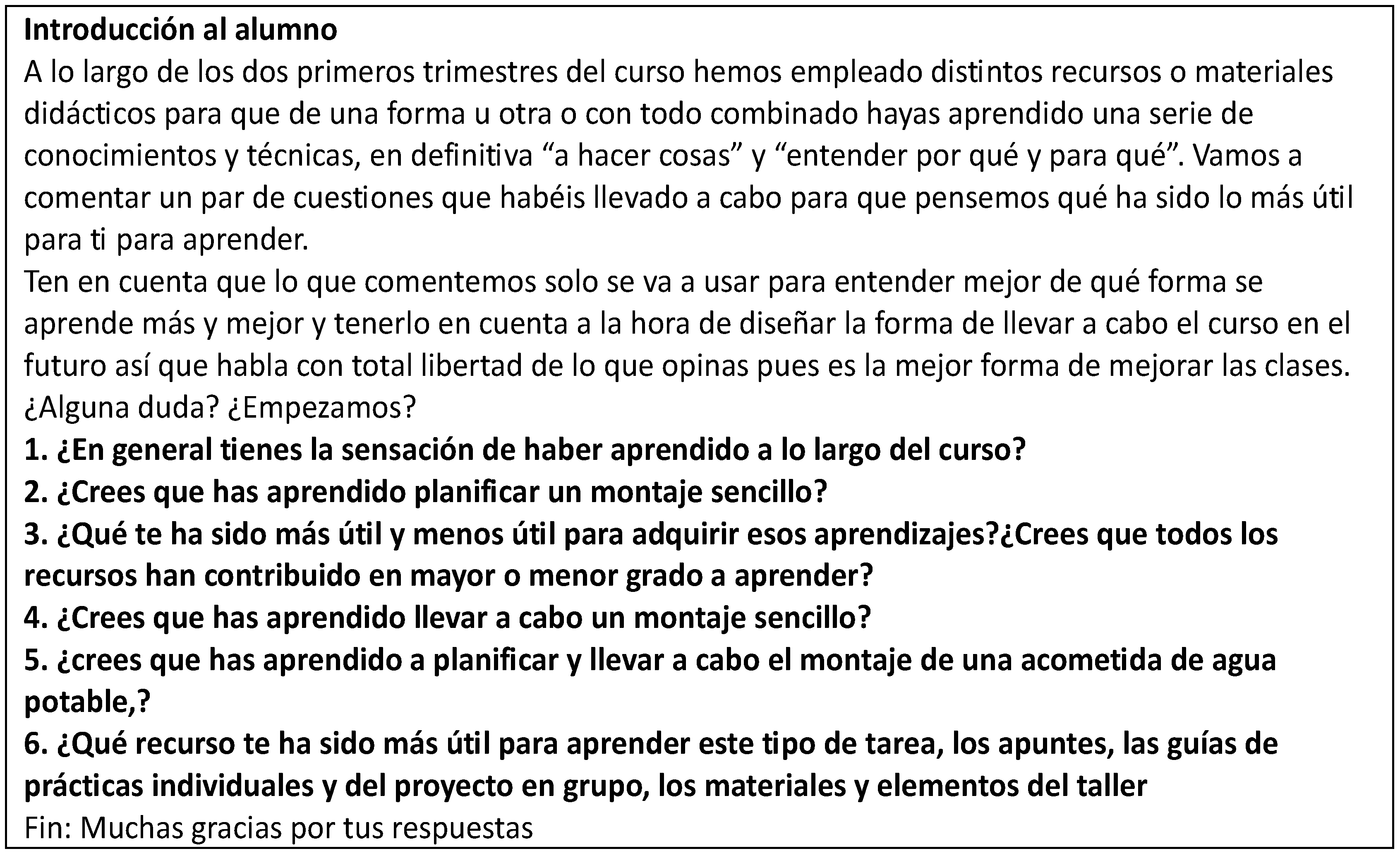
2.2. Method
- LO1 Prepare work plans for the assembly of water supply networks, selecting the work procedures from the corresponding project.
- LO2 Draw up work plans for the assembly of water sanitation networks, selecting the working procedures from the corresponding project.
- LO3 Carry out assembly operations for water supply and sanitation networks, interpreting technical documentation and applying established work procedures.
- LO4 Carry out pre-commissioning checks on water supply and sanitation networks, identifying the procedures specified in technical documentation.
- LO5 Prepare commissioning and operating procedures for water supply and sanitation networks, following the relevant protocols.
- LO6 Carry out commissioning and operating procedures on water supply and sanitation networks, applying the corresponding protocols.
- LO7 Apply prevention and safety measures regarding the commissioning of water supply and sanitation networks, interpreting the safety plans of companies in the sector.
- -
- Reading materials covering the technical and theoretical aspects, consisting of PDF documents that can be downloaded from the official Virtual Learning Environment for comprehensive reading, which, from an instructional approach, facilitate the learning of basic concepts and knowledge.
- -
- Handouts for the development of individual practical work and the use of the tools, equipment and materials available in the workshop, which facilitate the learning of procedures and the acquisition of basic skills.
- -
- Guides for the development of projects and use of the tools, equipment, and materials available in the workshop. These are projects with a PBL approach as they mobilise knowledge and skills, based on prior scaffolding, in a collaborative manner, reproducing small competency tasks that reproduce common activities of their future professional activity, but which, at the same time, allow for the acquisition of complex concepts based on knowledge of the basic aspects covered previously.
- Active/reflective. Active students tend to retain and understand new information better when they do something active with it. They prefer to learn by rehearsing and working with others. Reflective people tend to retain and understand new information by thinking and reflecting on it; they prefer to learn by thinking and working alone.
- Sensory/intuitive. Sensory learners prefer hard facts and practical procedures, while intuitive learners are more comfortable with theories and abstractions.
- Visual/verbal. Visual learners learn best with pictures, diagrams, and graphs, while verbal learners prefer words, both in written and spoken form.
- Sequential/global. Sequential students understand the material in a linear and step-by-step way, while global students learn in large leaps, visualising the whole. They can solve complex problems quickly; however, they may have difficulty explaining how they did it.
- Reading material in relation to the assembly of water networks:
- Stages in supply and sanitation networks
- Components and accessories for the installation of networks
- Organisation and planning of the assembly in networks
- Graphical representation of hydraulic systems
- Equipment, tools, and techniques for network assembly
- Pumps and pumping stations
- Installation project guides
- A.
- Guides for the development of individual assemblies
- Use of basic assembly tools and Personal Protection Equipment
- Inventory of accessories and equipment involved in assemblies
- Types of pipes: cutting techniques
- Mechanical joints
- Flanged joints
- Glued joints
- Threaded joint
- Electrofusion joint
- B.
- Guides for collaborative projects integrating competency tasks:
- Collaborative project 1: Installation of a domestic drinking water connection
- Collaborative project 2: Installation of a lift pump
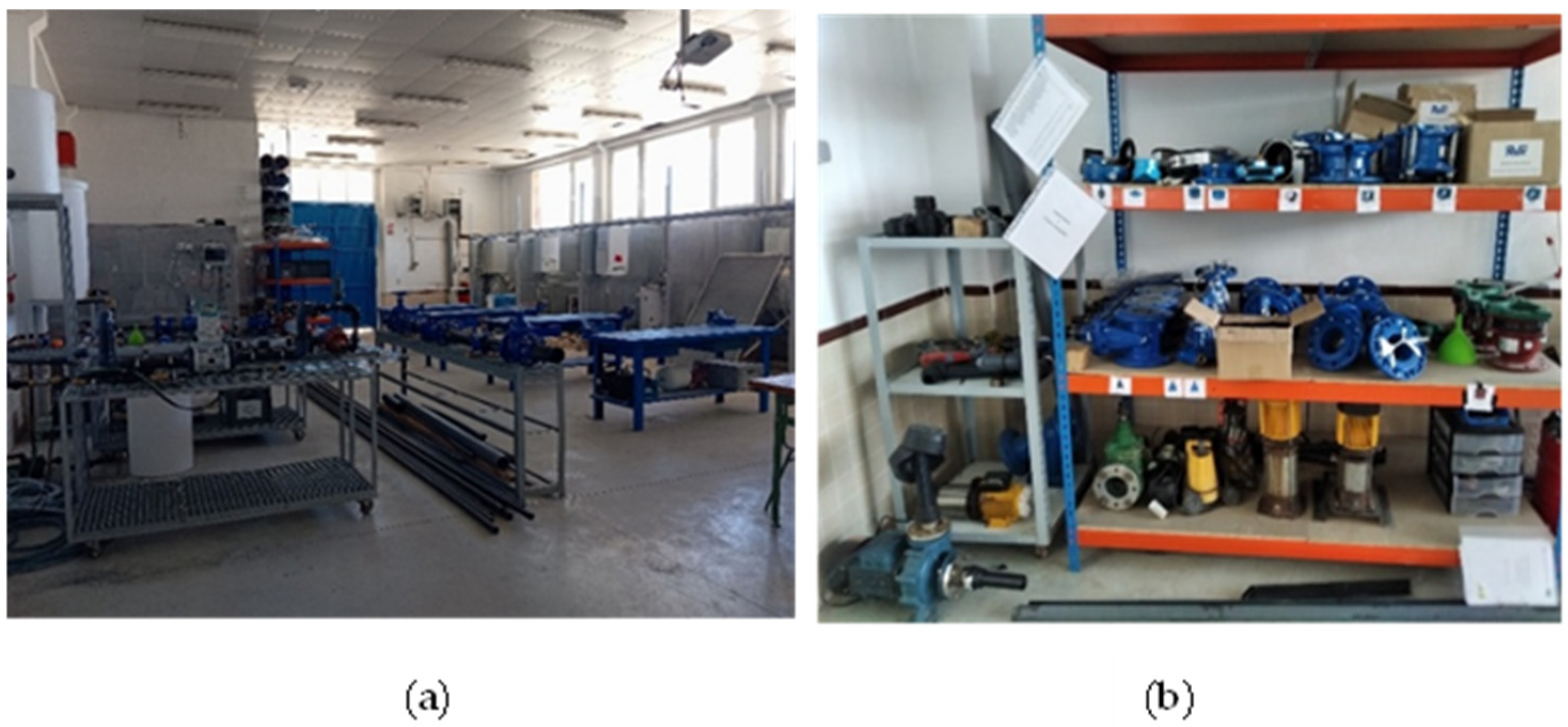
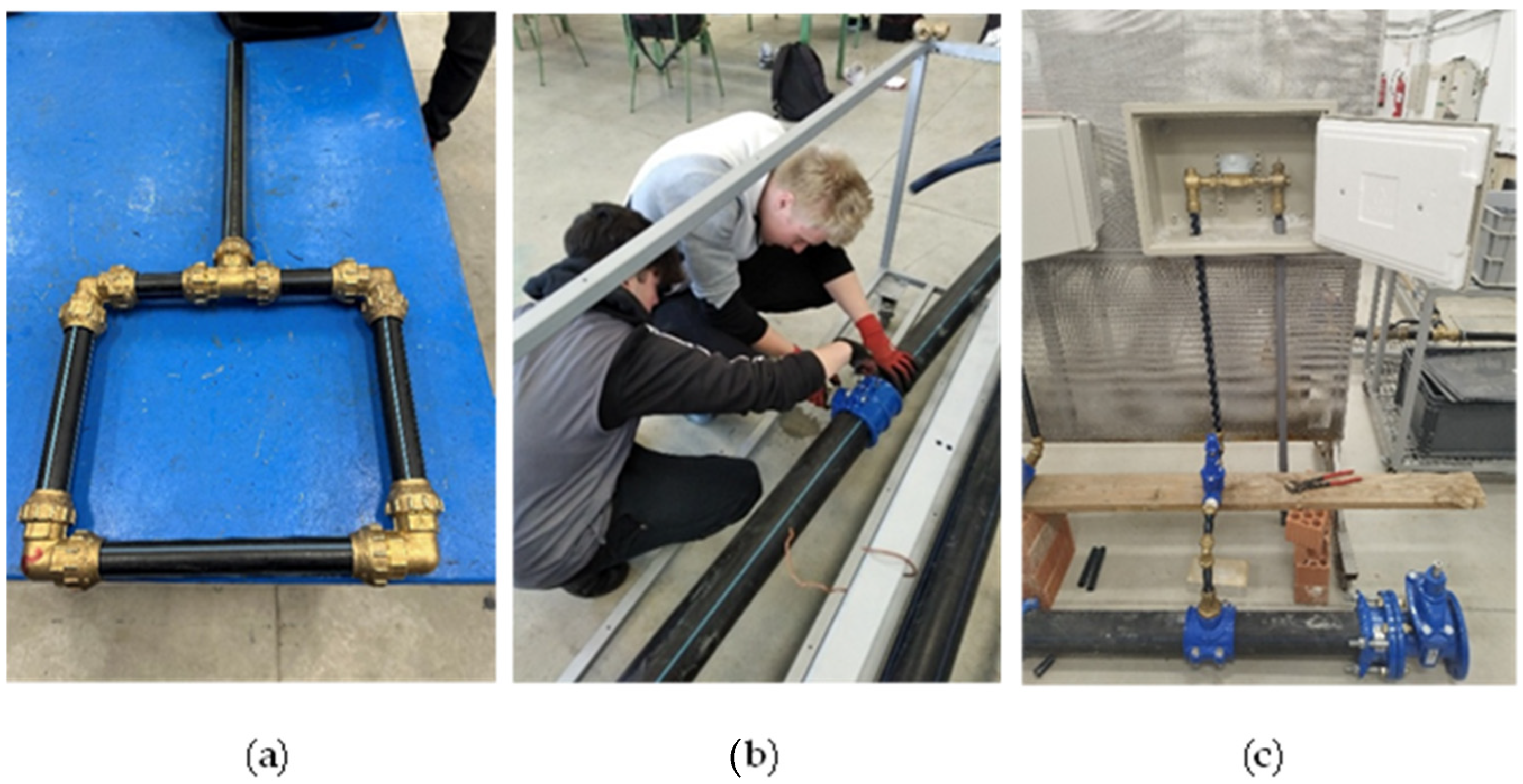
- Workshop on installing systems using all types of tools, components (valves, metres, pumps, etc.), and accessories (flanges, joints, fittings, etc.) for individual assembly, involving different basic work procedures, and the manufacture of a product (individual practical work). An overview of the workshop and some of the equipment and accessories can be seen in Figure 1. Figure 2 shows examples of this type of task.
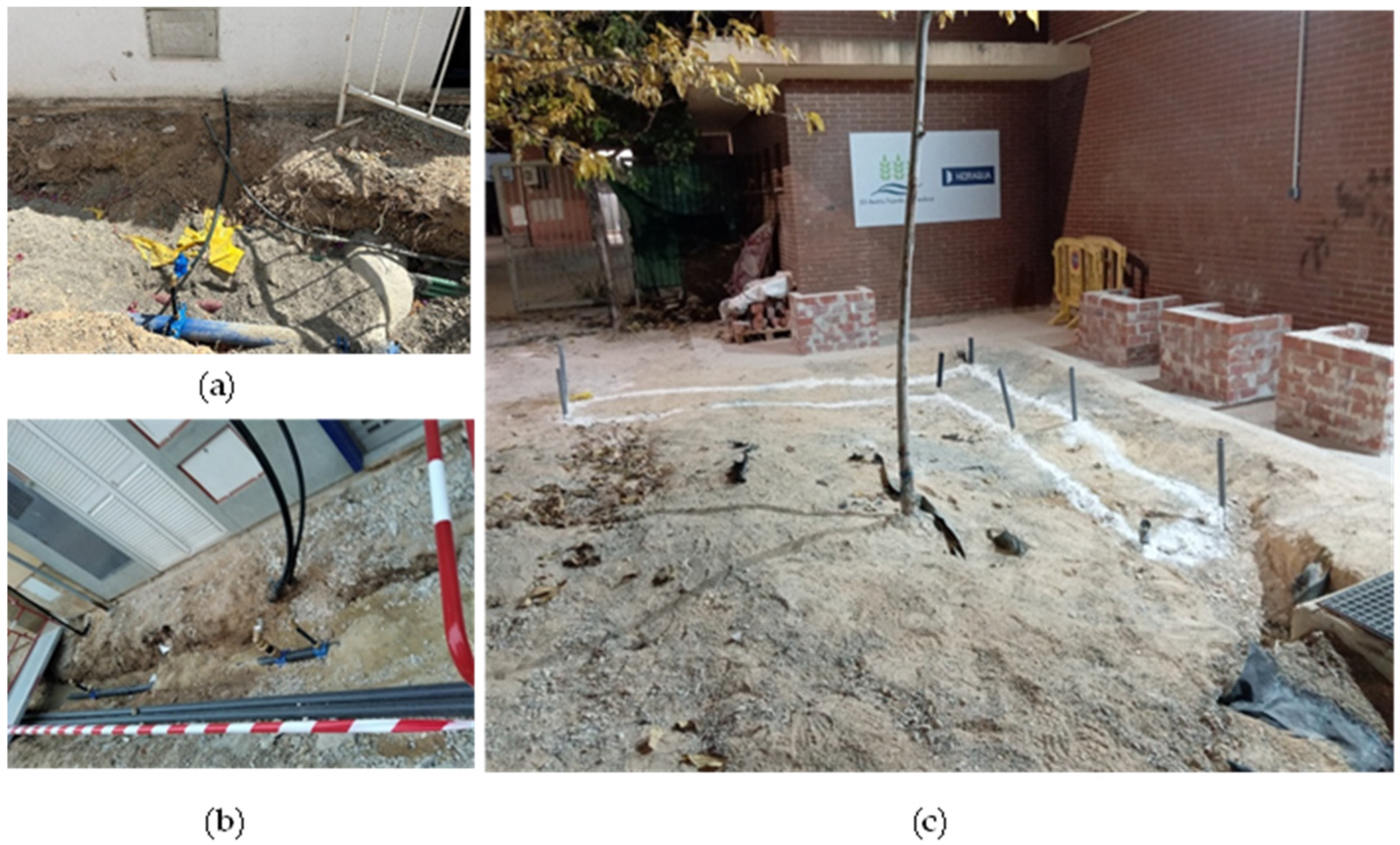
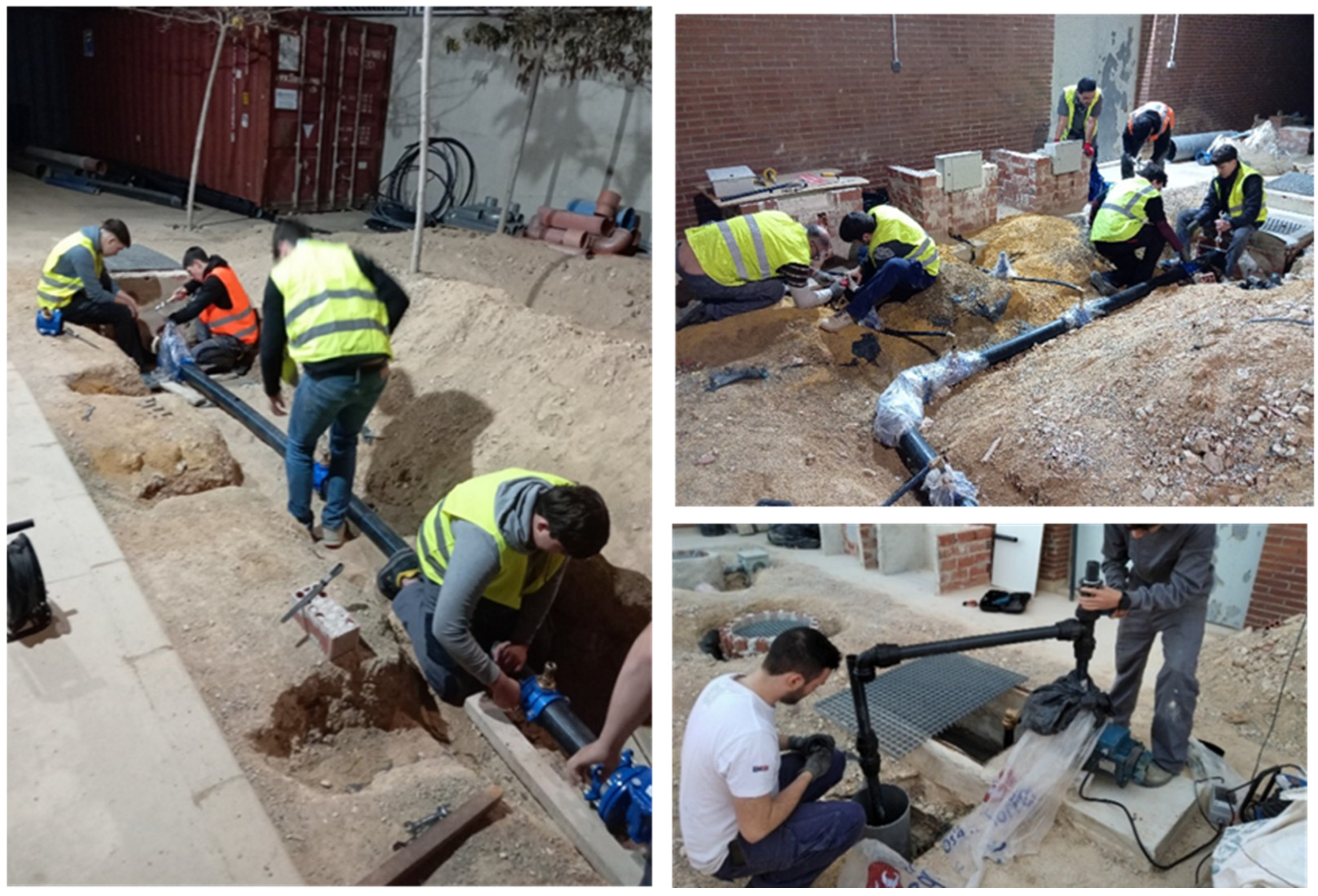
- Workshop for assembling installations with all types of tools, components (valves, metres, pumps, etc.), and accessories (flanges, joints, fittings, etc.) for the development of complex installations, including water networks, which require coordination and teamwork to complete (collaborative projects). Figure 3 shows the work area for the development of collaborative projects inspired by real jobs, while Figure 4 shows students working on this type of project.
2.3. Data Collection
3. Results
3.1. Quantitative Results
3.2. Qualitative Results
3.2.1. General Perception of Learning
Student 1: “A lot, more than enough for the world, they don’t have these studies there, which is what’s needed, except for FOL (refers to Training and Career Guidance) and English… Everything is needed, ten out of ten… really. The operators there don’t know anything, and we are technicians”.
Student 2: “Yes, positive, very satisfied, I didn’t think I would like it so much”.
Student 3: “Yes, when I go around (referring to the street) and see construction sites, I now know what materials they are using and what they are doing. I liked the course. It was my second choice, and I enjoyed it”.
Student 6: “Yes. Lots of things, especially in theory, although I didn’t put as much effort into it as I should have”.
3.2.2. Perception of Learning Skills: Planning a Simple Assembly
Student 2: “Yes, more or less… to repair leaks, change pipes…”
Student 3: “Plan it? Yes… present it… the measurements… decide on the tools, etc.”
Student 5: “I’m not sure, it would be difficult at first, but I think so”
Student 7: “I would know how to plan it, first make a diagram, then make a list of materials, the price…”
3.2.3. Perception of the Most Useful Resources for Planning
Student 1: “The notes are very important, they contain everything and are very useful for later reference, just like the plant manager’s notes. But the material is also important because we have assembled and disassembled things.” (Student 1) When asked if individual practical work or group projects are useful, he adds, “I’m older than the others and there’s a lot of messing around, and if the teacher isn’t there, we don’t get anywhere.”
Student 2: “Everything, yes. There are things in the notes that I didn’t know, for example, about water hammer. I didn’t know the symbols, and I learned them with the theory”. When asked about the order of usefulness, Student 2 added: “Individual practical work first and then group assembly because some people don’t help. The notes and guides are helpful, but less so”.
Student 3: “The most useful thing is to see it in a script where everything is explained so you can do it and ask yourself questions… I think everything has been useful, but the notes less so because everything is in the guides and there’s a lot in the notes and I see it all as important”.
Student 5: “It’s most useful when you do it on your own because you think about it more”.
Student 6: “Above all, the workshop on my own because I understand what I’ve seen in class. On your own it’s more boring but you concentrate more; in a group you get distracted”.
Student 7: “Firstly, the practical work I’ve done”.
Student 4: “Yes, all of them. First, the group projects; second, the notes; third, the guides; and last, the individual practical work”.
3.2.4. Perception of Learning Skills: Carrying out a Simple Assembly
Student 1: “Yes, no problem”.
Student 4: “Yes”.
Student 7: “It would be more difficult to do at work than in the workshop, but I would give it a go”
Student 8: “Yes, I’m sure”.
3.2.5. Perception of Learning: Planning and Assembly
Student 1: “It would be difficult at first, but I think I could do it”.
Student 2: “Yes, I think I can do it. The position of the parts…”.
Student 3: “Yes, although we are used to asking you, but yes, on my own I think I could. As we have done it inside and outside”.
3.2.6. Perception of the Most Useful Resources for Learning
Student 1: “Outdoor work (referring to the outdoor workshop) is what sticks best and is most similar to real life”.
Student 5: “Assembly in the trench is the most comprehensive (referring to the outdoor workshop). Perhaps not so many steps are necessary (referring to addressing the same learning outcome through a progressive sequence of different means)”.
“Individual work and work in the trench… but all useful”.
4. Discussion
5. Limitations of the Study
6. Conclusions
- EFFORT: perceived as the medium’s ability to facilitate learning with less time or effort on the part of the student.
- FOCUS: perceived as the ability of the resource to facilitate the student’s concentration on the issue at hand.
- TRANSFERABILITY: perceived as the ability of the resource to facilitate the transfer of learning to real work contexts.
- REUSABILITY: perceived as the ability of the medium to facilitate future review of concepts or procedures associated with learning over time.
7. Further Work
Author Contributions
Funding
Institutional Review Board Statement
Informed Consent Statement
Data Availability Statement
Conflicts of Interest
Abbreviations
| IES | Instituto de enseñanza secundaria [Secondary School] |
| FOL | Formación y orientación laboral [Training and Career Guidance] |
| LO | Learning outcome |
| RD | Royal decree |
| VET | Vocational education and training |
Appendix A

References
- España. Ley Orgánica 3/2022, de 31 de Marzo, de Ordenación e Integración de la Formación Profesional. Available online: https://www.boe.es/eli/es/lo/2022/03/31/3/con (accessed on 1 September 2024).
- Rajadell Puiggròs, N. Formative processes in the classroom: Teaching-learning strategies. In Didáctica General Para Psicopedagogos; Sepulveda, F., Rajadell, N., Eds.; Universidad Nacional de Educación a Distancia: Madrid, Spain, 2001; pp. 465–528. [Google Scholar]
- Fernández March, A. Active methodologies for skills training. Educ. Siglo XXI 2006, 24, 35–56. [Google Scholar]
- Montanero-Fernández, M. Emerging pedagogical methods for a new century: What is really innovative. Teoría Educ. Rev. Interuniv. 2019, 31, 5–34. [Google Scholar] [CrossRef]
- Lafuente, M. Does student learning improve through project work? In What Works in Education? Evidence for Educational Improvement; Fundació Bofill: Barcelona, Spain, 2019; Available online: https://ivalua.cat/sites/default/files/2020-05/Que_funciona_16_Castella.pdf (accessed on 10 December 2024).
- Zhang, L.; Ma, Y. A study of the impact. of project-based learning on student learning effects: A meta-analysis study. Front. Psychol. 2023, 14, 1202728. [Google Scholar] [CrossRef]
- Ruiz, D.; Ortega-Sánchez, D. Project-Based Learning: A Systematic Review of the Literature (2015–2022). Human Rev. Int. Humanit. Rev./Rev. Int. Humanidades 2022, 11, 2–14. [Google Scholar]
- Gómez, L.G.; Santiago, A.W. Considerations on technology and its teaching. Tecné Epistem. Didaxis TED 2013, 33, 123–145. [Google Scholar] [CrossRef]
- Condliffe, B. Project-Based Learning: A Literature Review; Working Paper; Building Knowledge to Improve Social Policy; MDRC: Gurugram, India, 2017. Available online: https://files.eric.ed.gov/fulltext/ED578933.pdf (accessed on 1 December 2024).
- Villagrá, C.J.; Molina, R.; Llorens, F.; Gallego, F.J. Project-Based Learning: Experience and Lessons Learned; Octaedro Editorial; Universitat de Barcelona: Barcelona, Spain, 2020; p. 41. Available online: http://hdl.handle.net/10045/108419 (accessed on 10 December 2024).
- Feeney, S.; Machicado, G.; Larrosa, L. Project-Based Learning as a Teaching Policy: Some Questions. Prax. Educ. 2022, 26, 1–23. [Google Scholar] [CrossRef]
- Canut, A. Plan for the Transition from a Module-Based Teaching-Learning Model to a Comprehensive Project-Based Learning (PBL) Model in a VET Course in the Professional Field of “Energy and Water”. Master’s Thesis, Cardenal Herrera University, Valencia, Spain, 2024. Available online: https://hdl.handle.net/10637/18392 (accessed on 1 September 2024).
- Ayala López, M.A. Technical and Pedagogical Considerations for Developing and Evaluating Teaching Materials. Rev. Atlante Cuad. Educ. Desarro. 2014. Available online: https://www.eumed.net/rev/atlante/2014/02/materiales-didacticos.html (accessed on 10 March 2025).
- Moreno Herrero, I. The use of teaching aids and resources in the classroom. In El Proceso de Enseñanza y Aprendizaje; Sánchez Contreras, P., Ed.; ICE of the Complutense University: Madrid, Spain, 2004; Available online: https://cmapspublic2.ihmc.us/rid=1K2WRYPDP-8HX9V-13SZ (accessed on 5 March 2025).
- Marquès Graells, P. Teaching Aids. Available online: https://peremarques.net/medios2.htm (accessed on 5 March 2025).
- Vargas Murillo, G. Educational resources in the teaching-learning process. Cuad. Hosp. Clínicas 2017, 58, 68–74. [Google Scholar]
- Parcerisa-Aran, A. Textbooks are not always the best option for learning. Padres Maest. 2009, 322, 15–19. [Google Scholar]
- Valle Taiman, A.; Manrique Villavicencio, L.; Revilla Figueroa, D. Descriptive research with a qualitative approach in education. Pontif. Univ. Católica Del Perú 2022, 2, 3–57. [Google Scholar]
- Solís, E. How to integrate research, innovation and practice in science teaching. Alambique Didáctica Las Cienc. Exp. 2011, 60, 80–88. [Google Scholar]
- Echeverría, B.; Martínez, P. Status quo of research on vocational training in Spain: SWOT analysis and CAME. Rev. Educ.-UPEL-IPB-Segunda Nueva Etapa 2.0 2021, 25, 8–34. [Google Scholar] [CrossRef]
- Galindo-Domínguez, H.; Perines, H.; Verde Trabada, A.; Valero Esteban, J.M. Understanding the pedagogical gap between the educational research and the reality of teachers: An analisis of the difficulties and proposals. Educ. XX1 2022, 25, 173–200. [Google Scholar] [CrossRef]
- Ministerio de Educación, Formación Profesional y Deportes. Statistics on Vocational Training in the Education System; Ministerio de Educación, Formación Profesional y Deportes: Madrid, Spain, 2024; Available online: https://www.educacionfpydeportes.gob.es/dam/jcr:524767d9-8d1d-470e-b347-011233cc0541/publi-2024.pdf (accessed on 1 October 2025).
- Sabariego-Puig, M.; Masson-Lafon, I.; Dorio-Alcaraz, I. Qualitative research methods. In Metodología de la Investigación Educativa, 6th ed.; Bisquerra Alzina, R., Ed.; La Muralla: Madrid, Spain, 2019; pp. 285–320. [Google Scholar]
- Martínez González, R.A. Research in Educational Practice: Methodological Research Guide for Diagnosis and Evaluation in Educational Centers; Ministerio de Educación y Ciencia de España: Madrid, Spain, 2007; Available online: https://hdl.handle.net/20.500.12799/3089 (accessed on 15 January 2025).
- Latorre Beltrán, A. Action research. In Metodología de la investigación Educativa, 6th ed.; Bisquerra Alzina, R., Ed.; La Muralla: Madrid, Spain, 2019; pp. 361–386. [Google Scholar]
- Hernández-Sampieri, R.; Mendoza Torres, C.P. Research Methodology: Quantitative, Qualitative and Mixed Methods; McGraw-Hill Interamericana Editores SA: Mexico City, Mexico, 2018. [Google Scholar] [CrossRef]
- Dorio Alcaraz, I.; Sabariego Puig, M.; Massot Lafon, I. General Characteristics of Qualitative Methodology. In Metodología de la Investigación Educativa, 6th ed.; Bisquerra Alzina, R., Ed.; La Muralla: Madrid, Spain, 2019; pp. 267–284. [Google Scholar]
- Erazo Jiménez, M.S. Scientific rigor in qualitative research practices. Cienc. Docencia Tecnol. 2011, 42, 107–136. [Google Scholar]
- Esteban, M.P.S. Validity criteria in qualitative research: From objectivity to solidarity. Rev. Investig. Educ. 2000, 18, 223–242. [Google Scholar]
- Benavides, M.O.; Gómez-Restrepo, C. Métodos en investigación cualitativa: Triangulación. Rev. Colomb. Psiquiatr. 2005, 34, 118–124. [Google Scholar]
- Martínez-Salgado, C. Sampling in qualitative research. Basic principles and some controversias. Ciência Saúde Coletiva 2012, 17, 613–619. [Google Scholar] [CrossRef]
- ORDER 8/22 April 2025, of the Regional Ministry of Education, Culture, Universities and Employment, Which Regulates the Evaluation of the Teaching-Learning Process in Training Cycles and Specialisation Courses Derived from Organic Law 3/2022, of 31 March, on the Organisation and Integration of Vocational Training. Available online: https://dogv.gva.es/es/eli/es-vc/o/2025/04/22/8/dof/spa/html (accessed on 10 September 2024).
- Solbes-Monzó, R.S.; Sierra Martí, V.; Pérez-Calle, E. Didactic Programs for Vocational Training: A Practical and Grounded Proposal; Nau Llibres: Valencia, Spain, 2025. [Google Scholar]
- Segovia, A.M.F. Learning styles: Strategy to develop meaningful learning. Polo Conoc. Rev. Científico-Prof. 2022, 7, 229–249. [Google Scholar]
- Roque Herrera, Y.; Tenelanda Lopez, D.V.; Basantes Moscoso, D.R.; Erazo Parra, J.L. Theories and models of learning styles. Edumecentro 2023, 15. Available online: http://scielo.sld.cu/scielo.php?script=sci_arttext&pid=S2077-28742023000100030&lng=es&tlng=es (accessed on 10 January 2025).
- Colina Cantillo, A.L. Learning styles: A way to enhance education. Gac. Pedagog. 2024, 49, 117–134. [Google Scholar]
- Gallego, D.J.; Alonso, C.; Barros, D.M.V. Learning Styles and Teaching Styles. Pedagogical proposals for the transformation of education. Rev. Estilos Aprendiz. 2022, 15, 1–4. [Google Scholar] [CrossRef]
- Arévalo Mercado, C.A.; Muñoz Andrade, E.L.; Solano Romo, L.I. The myth of learning styles. Docere 2025, 31, 10–16. [Google Scholar] [CrossRef]
- Silva Sprock, A. Conceptualization of Learning Style Models. J. Learn. Styles 2018, 11, 35–66. [Google Scholar]
- Paredes Bernal, J.J.; Paredes Ortiz, E.M.; Campoverde Buele, W.J.; Sánchez Verdugo, L.M.; Agurto Sánchez, I.F. Relationship between learning styles and cognitive processes: An approach from educational neuropsychology. Rev. Científica Multidiscip. SAGA 2025, 2, 452–466. [Google Scholar]
- España. Real Decreto 114/2017, de 17 de Febrero, por el que se Establece el Título de Técnico en Redes y Estaciones de Tratamiento de Aguas y se Fijan los Aspectos Básicos del Currículo. Available online: https://www.boe.es/eli/es/rd/2017/02/17/114 (accessed on 1 September 2024).
- Naeem, M.; Ozuem, W.; Howell, K.; Ranfagni, S. Demystification and actualisation of data saturation in qualitative research through thematic analysis. Int. J. Qual. Methods 2024, 23, 1–17. [Google Scholar] [CrossRef]
- Daher, W. Saturation in qualitative educational technology research. Educ. Sci. 2023, 13, 98. [Google Scholar] [CrossRef]
- Aragón-García, M. Inherent correlation between learning styles and teaching-learning strategies. Rev. Iberoam. Prod. Académica Gestión Educ. 2016, 3, 1566–1581. [Google Scholar]
- Armijos-Saca, R.A. Relationship between educational materials and academic performance in primary education. Rev. Invecom Estud. Transdiscipl. Comun. Soc. 2025, 5, 2. [Google Scholar] [CrossRef]
- Cool-Cedeño, V.E.; Mala, Q. Didactic materials and their influence on writing skills in high school students. Rev. Chone Cienc. Tecnol. 2024, 2, 33–47. [Google Scholar]
- Rodríguez Martín, A.; Álvarez Arregui, E. Methodologies and resources in Bachelor’s degrees: Perspective of students and institutional managers. Rev. Electrónica Interuniv. Form. Del Profr. 2013, 16, 105–120. [Google Scholar] [CrossRef]
- Pérez Hernández, A.F.; Méndez Sánchez, C.J.; Pérez Arellano, P.; Yris Whizar, H.M. Learning styles as a strategy for teaching in higher education. Rev. Estilos Aprendiz. 2019, 11, 96–122. [Google Scholar] [CrossRef]
- Perlado Lamo de Espinosa, I.; Barroso Tristán, J.M.; Trujillo Vargas, J.J. Assessment by competencies and learning styles. Rev. Estilos Aprendiz. 2023, 16, 104–114. [Google Scholar] [CrossRef]
- Guzmán, A.P.; del Moral, M.E. Perception of university students on the didactic usefulness of virtual simulators in their training. Píxel-Bit. Rev. Medios Educ. 2018, 53, 41–60. [Google Scholar] [CrossRef]
- González-Peitado, M. Teaching and learning styles as support for teaching activity. Rev. Estilos Aprendiz. 2013, 11, 51–70. [Google Scholar] [CrossRef]
- Akpur, U. Metacognitive awareness and academic achievement: A meta-analysis study. Elektron. Sos. Bilim. Derg. 2024, 23, 1276–1293. [Google Scholar] [CrossRef]
- He, G.; Chen, S.; Lin, H.; Su, A. The association between initial metacognition and subsequent academic achievement: A meta-analysis of longitudinal studies. Educ. Psychol. Rev. 2024, 36, 81. [Google Scholar] [CrossRef]
- Muijs, D.; Bokhove, C. Metacognition and Self-Regulation: Evidence Review; Education Endowment Foundation: London, UK, 2020. [Google Scholar]
- Elvira-Zorzo, M.N.; Gandarillas, M.Á.; Martí-González, M. Psychosocial Differences Between Female and Male Students in Learning Patterns and Mental Health-Related Indicators in STEM vs. Non-STEM Fields. Soc. Sci. 2025, 14, 71. [Google Scholar] [CrossRef]




| LO1 Students Can Develop Work Plans for the Assembly of Water Supply Networks by Selecting the Work Procedures from the Corresponding Project | LO3 Students Can Carry out Assembly Operations for Water Supply and Sanitation Networks, Interpret Technical Documentation and Apply Established Work Procedures |
|---|---|
| Assessment criteria | Assessment criteria |
| (e) The materials, tools, and other technical resources necessary to carry out the work in each phase of the assembly have been selected. (f) The assembly sequence has been determined based on plans and technical documentation. (g) The assembly techniques at key points in the installation and the human resources required have been selected. | (a) The work area has been prepared in accordance with the safety requirements of the site itself, according to established work procedures. (b) Equipment and materials have been organised and located in safe conditions in the most suitable place for the work to be carried out. (f) Pipes, manholes, and other elements have been prepared in accordance with standard procedures. (g) The techniques for extending and connecting pipes, manholes, and other accessories have been defined. (i) The techniques for placing and securing the pumps on the base have been applied, aligning and levelling them. (j) The hydraulic connection of the pumps to the corresponding circuit has been made. |
| Student | Practice U1-5 (Average) | Theory Units 1-5 | Theory Unit 6 | Project 1 | Project 2 |
|---|---|---|---|---|---|
| 1 | 66 | 55 | 79 | 80 | 100 |
| 2 | 60 | 59 | 45 | 90 | 70 |
| 3 | 56 | 56 | 44 | 40 | 60 |
| 4 | 50 | 58 | 84 | 50 | 50 |
| 5 | 56 | 45 | 46 | 80 | 60 |
| 6 | 49 | 33 | 38 | 40 | 40 |
| 7 | 49 | 49 | 55 | 50 | 50 |
| 8 | 51 | 48 | 56 | 70 | 40 |
| Question | Mean | 1 | 2 | 3 | 4 | 5 | |
|---|---|---|---|---|---|---|---|
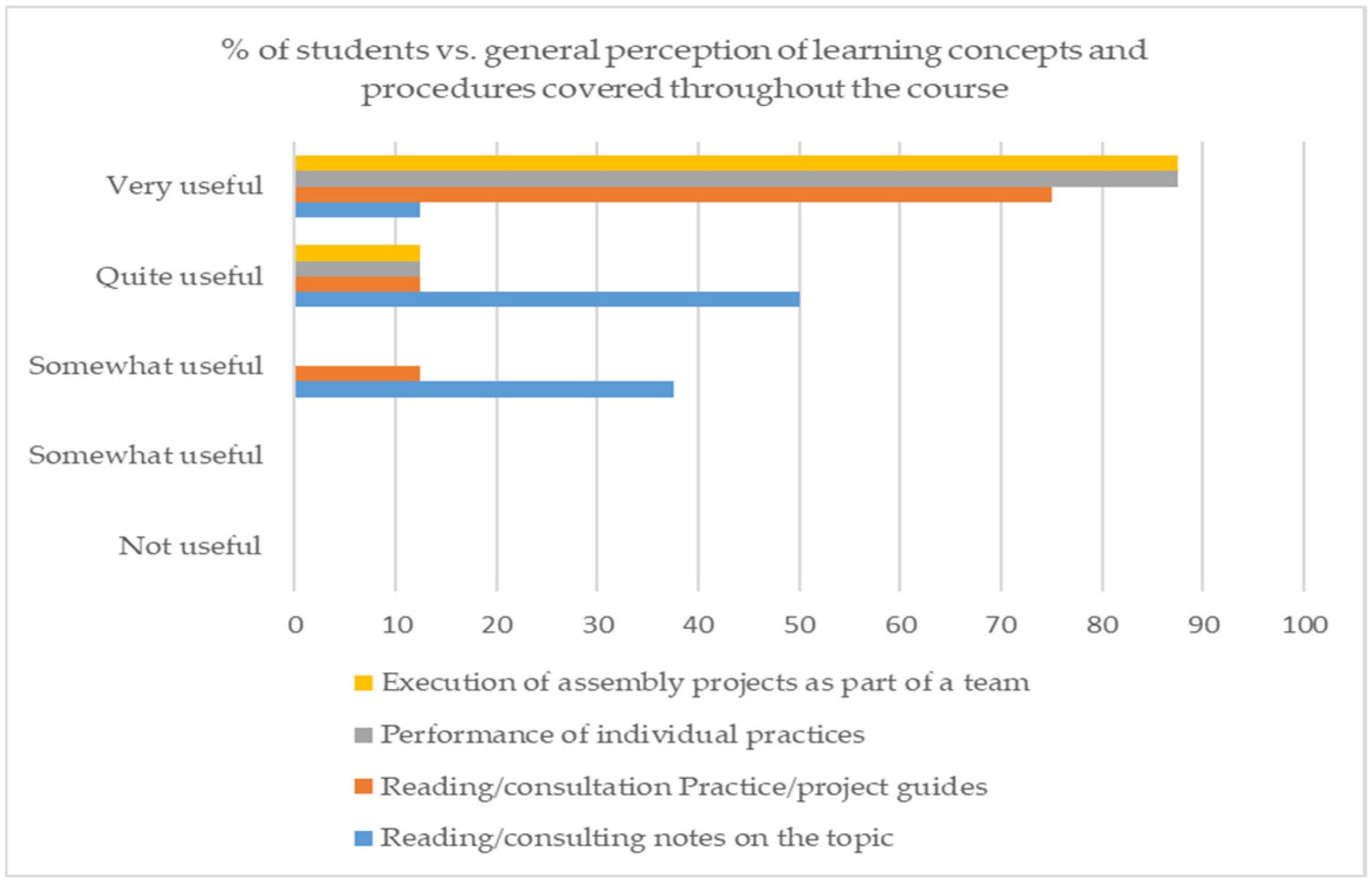
| 1. Think about how useful the following aspects have been for you in general in learning the different concepts and procedures we have covered during the course. Select the option that best applies to you. | Reading/consulting notes | f | 0 | 0 | 3 | 4 | 1 |
| % | 0.0 | 0.0 | 37.5 | 50.0 | 12.5 | ||
| Reading/consulting practical guides/projects | f | 0 | 0 | 1 | 1 | 6 | |
| % | 0 | 0 | 12.5 | 12.0 | 75.5 | ||
| Development of individual practices | f | 0 | 0 | 0 | 1 | 7 | |
| % | 0 | 0 | 0 | 12.5 | 87.5 | ||
| Development of assembly projects as part of a team | f | 0 | 0 | 0 | 1 | 7 | |
| % | 0 | 0 | 0 | 12.5 | 87.5 | ||
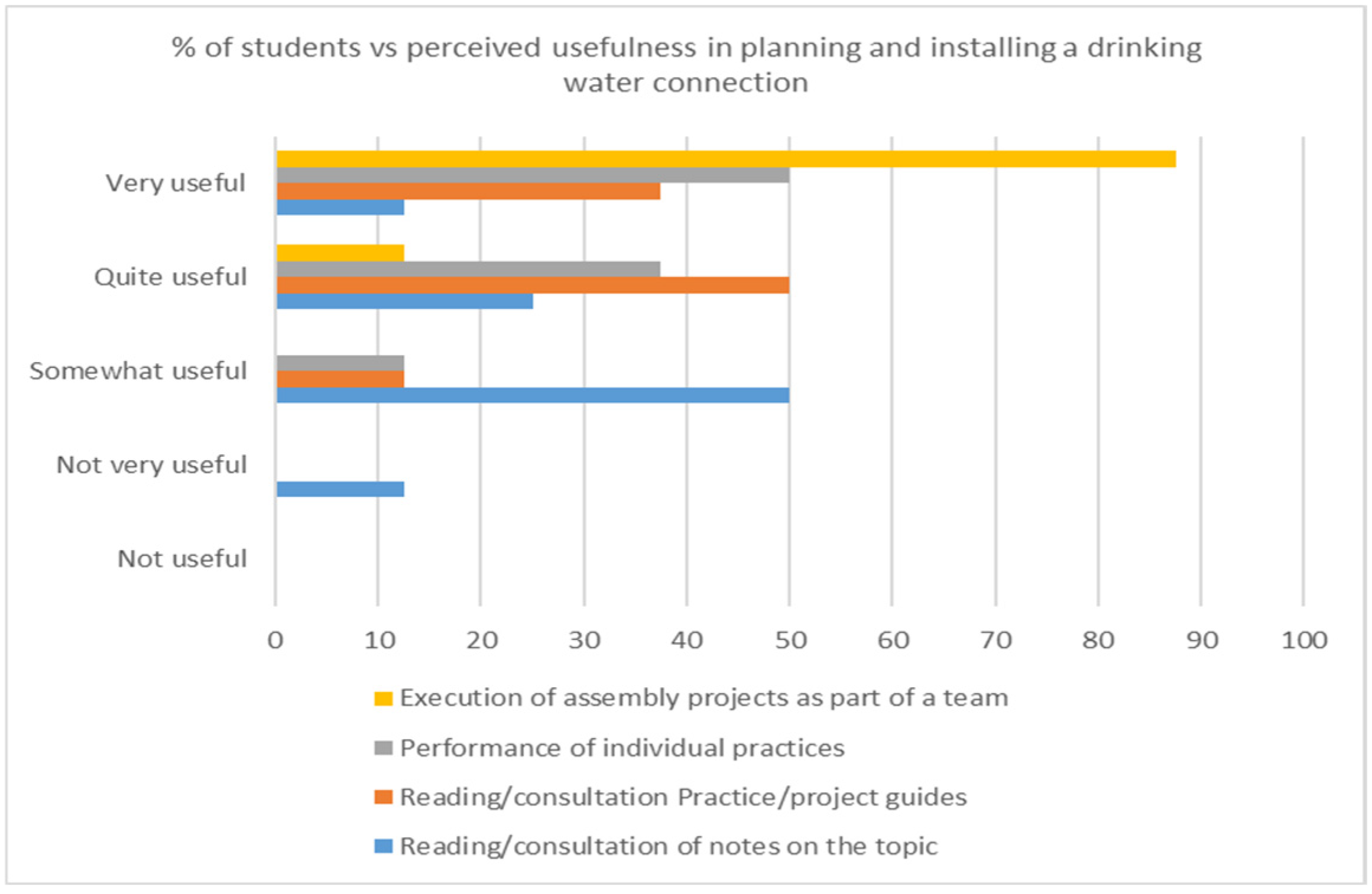
| 2 Planning and installing a drinking water connection requires a variety of knowledge and the application of several techniques seen throughout the course. To what extent have the different learning methods used been useful to you? | Reading/consulting course notes | f | 0 | 1 | 4 | 2 | 1 |
| % | 0 | 12.5 | 50.0 | 25.0 | 12.5 | ||
| Reading/consultation Practice/project guides | f | 0 | 0 | 1 | 4 | 3 | |
| % | 0 | 0 | 12.5 | 50.0 | 37.5 | ||
| Development of individual practices | f | 0 | 0 | 1 | 3 | 4 | |
| % | 0 | 0 | 12.5 | 37.5 | 50.0 | ||
| Development of assembly projects as part of a team | f | 0 | 0 | 0 | 1 | 7 | |
| % | 0 | 0 | 0 | 12.5 | 87.5 | ||
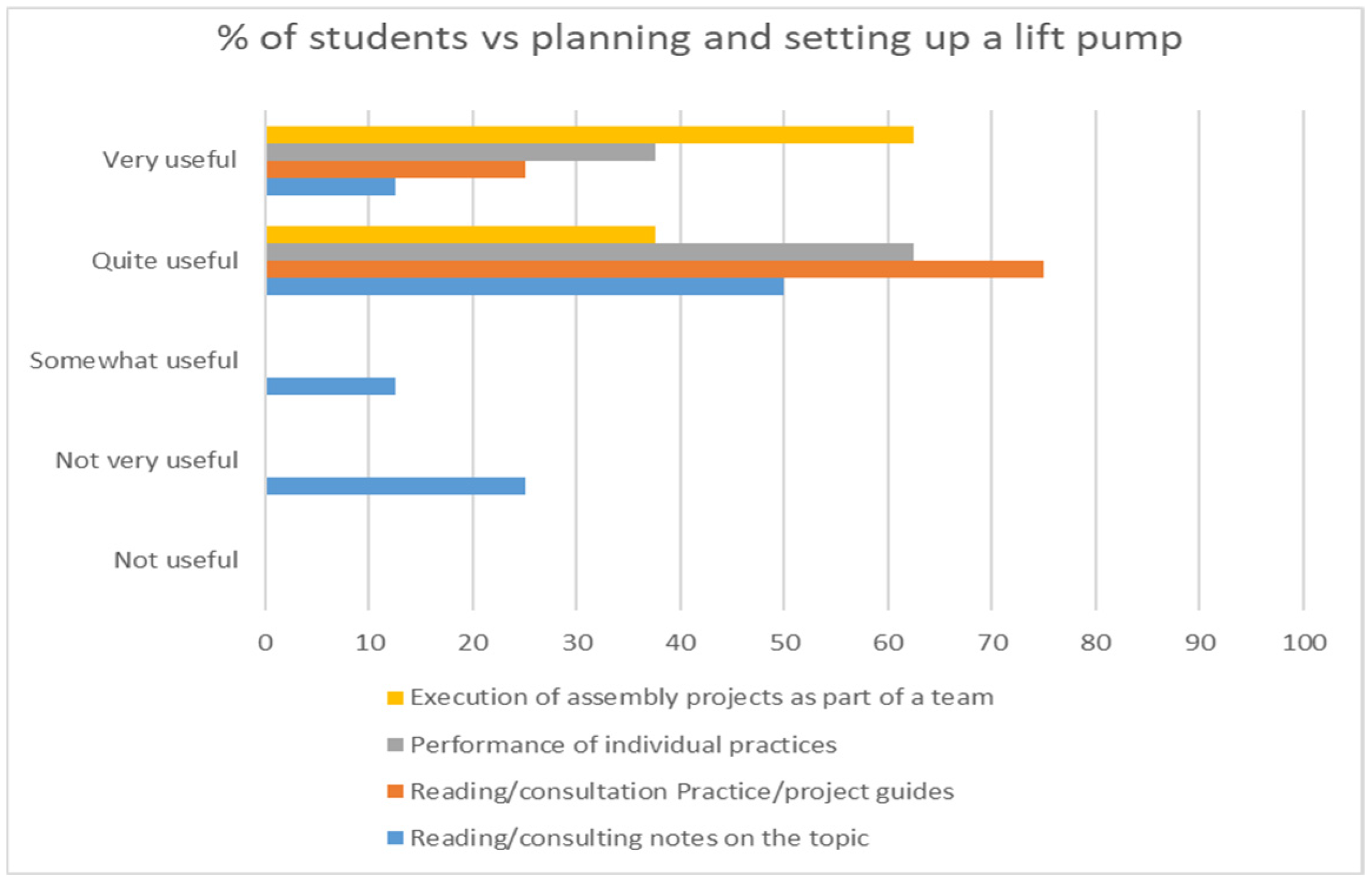
| 3. Planning and assembling a pump to drive water from one tank to another higher tank requires a variety of knowledge and the application of several techniques seen throughout the course. To what extent have the different learning methods used been useful to you? | Reading/consulting course notes | f | 0 | 2 | 1 | 4 | 1 |
| % | 0 | 25.0 | 12.5 | 50.0 | 12.5 | ||
| Reading/consultation Practice/project guides | f | 0 | 0 | 0 | 6 | 2 | |
| % | 0 | 0 | 0 | 75.0 | 25.0 | ||
| Development of individual practices | f | 0 | 0 | 0 | 5 | 3 | |
| % | 0 | 0 | 0 | 62.5 | 37.5 | ||
| Development of assembly projects as part of a team | f | 0 | 0 | 0 | 3 | 5 | |
| % | 0 | 0 | 0 | 37.5 | 62.5 | ||
| 1. Reflect on the usefulness that, in general, the following aspects have had for you in learning the different knowledge and procedures we have seen during the course. Select the option that best fits your case. | ||||||
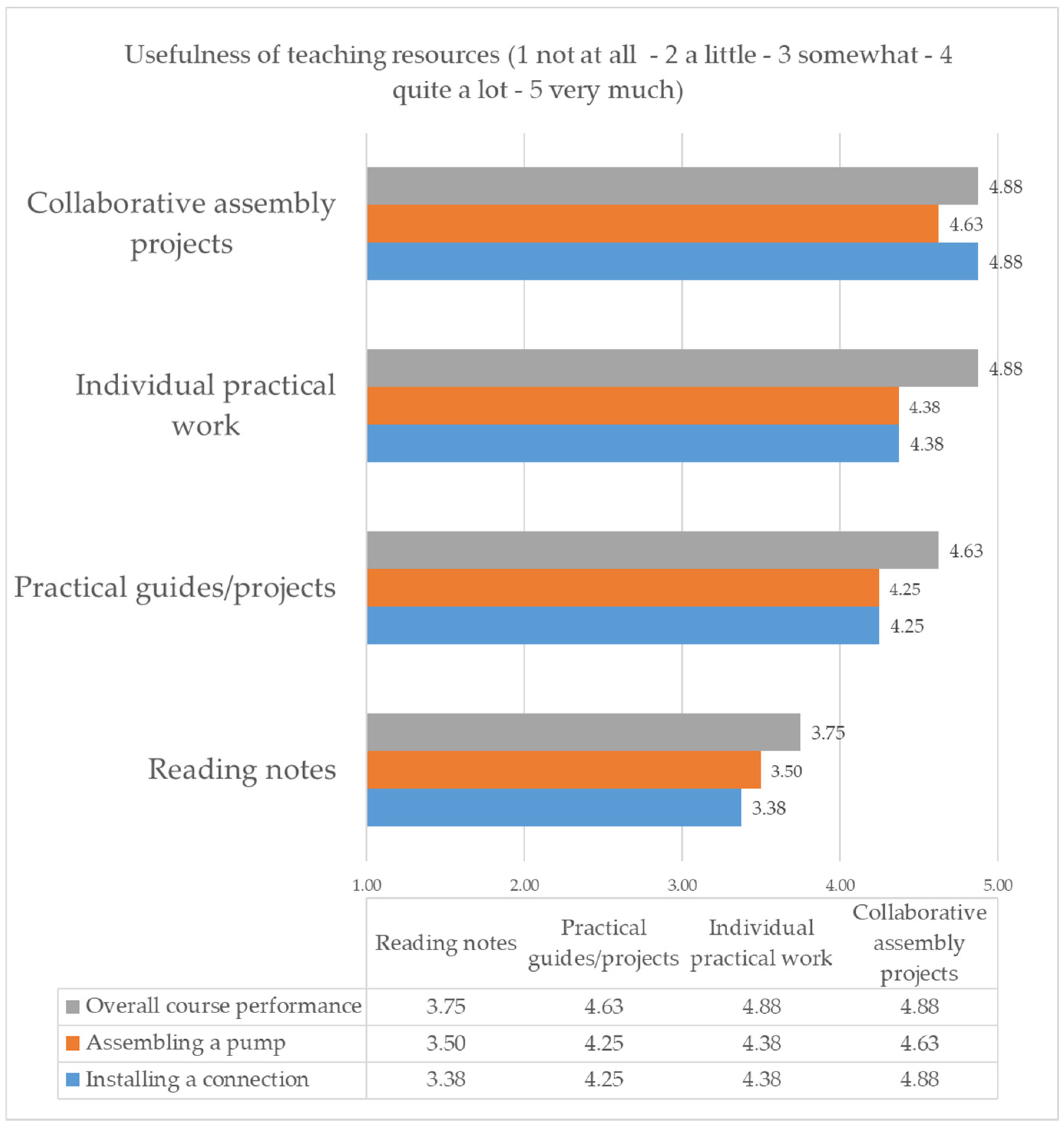
| Mean | Min | Max | SD | Median | Mode | |
| Study the notes on the topic | 3.75 | 3 | 5 | 0.71 | 4 | 4 |
| Read the practice/project guides | 4.63 | 3 | 5 | 0.74 | 5 | 5 |
| Perform basic individual exercises | 4.88 | 4 | 5 | 0.35 | 5 | 5 |
| Perform complex assembly work as part of a team | 4.88 | 4 | 5 | 0.35 | 5 | 5 |
| 2. Planning and installing a drinking water connection requires a variety of knowledge and the application of several techniques seen throughout the course. To what extent have been the different learning methods used useful to you? | ||||||
| Mean | Min | Max | SD | Median | Mode | |
| Reading notes | 3.38 | 2 | 5 | 0.92 | 3 | 3 |
| Consultation of practical guides/projects | 4.25 | 3 | 5 | 0.71 | 4 | 4 |
| Individual practical training | 4.38 | 3 | 5 | 0.74 | 4.5 | 5 |
| Collaborative assembly projects | 4.88 | 4 | 5 | 0.35 | 5 | 5 |
| 3. Planning and assembling a pump to drive water from one tank to another higher tank requires a variety of knowledge and the application of several techniques seen throughout the course. To what extent have been the different learning methods used useful to you? | ||||||
| Mean | Min | Max | SD | Median | Mode | |
| Study the notes on the topic | 3.5 | 2 | 5 | 1.07 | 4 | 4 |
| Read the practice/project guides | 4.25 | 4 | 5 | 0.46 | 4 | 4 |
| Perform basic individual exercises | 4.38 | 4 | 5 | 0.52 | 4 | 4 |
| Perform complex assembly work as part of a team | 4.63 | 4 | 5 | 0.52 | 5 | 5 |
| Code | Theme | Definition | Example |
|---|---|---|---|
| C1 | Overall Learner Learning Perception. | The student’s own perception of having acquired new skills and knowledge. | “A lot, for the world, you don’t have these studies out there, which is what is used” (S1Q1R1) “Yes, when I go around the places (the street) and see works I already know the material I see and what they do” (S3Q1R1) “Yes, many new things I didn’t know” (S4Q1R4). “Yes, of course, it’s all new” (S8Q1R1) |
| C2 | Perception of acquisition of specific competences. | The student’s perception of having acquired specific competences applicable to professional development. | “Yes, because I am prepared for anything, things like measuring diameters, turning off the water, looking for tools, warning…” (S1Q2R2) Yes, more or less yes… to repair leaks, change pipes… (S2Q2R2) “If they are like the ones we have done in class, yes” (S3Q4R4) “It would cost me a little, but I think I would get it out” (S6Q5R5) “I would know how to plan, first make the scheme, then get the bill of materials, the price…” (S7Q2R2) |
| C3 | Eclecticism in the attribution of the utility of resources/methods. | Variety in the positive attribution of usefulness to different resources/methods in learning, although to different degrees. | “But the material also because we have assembled and disassembled” (S1Q3R3) Everything, yes, there are things in the notes that I didn’t know, for example about the water hammer- I didn’t know the symbology and I’ve learned it with theory (S2Q3R3) “Notes and guides help but less” (S2Q3R3) “I think everything has been useful to me” (S3Q3R3) second notes, third guides, last individual practices (S4Q3R3) |
| C4 | Resource/method with the greater utility attribution. | Resource/method that was perceived by a learner as the most useful type for the acquisition of skills. | “The work outside (referred to external workshop) is how it stays the most” (S1Q6R6). “Trench mounting is the most complete” (S2Q6R6) “Group projects first” (S4Q3R3) “Yes, especially the practical part” (S5Q1R1) “The most useful when you do it alone” (S5Q3R3). “much more with practice than with theory” (S7Q1R1) “The first thing is the practice that I have done alone” (S7Q3R3) “In practice is where you learn” (S8Q6R6) |
| C5 | Characteristics of the usefulness of the resources. | A specific feature that made a resource/method useful. | “to consult later is very useful” (S1Q3R3) “The closest thing to real life” (S1Q6R6) “When you do it just because you think about it more” (S5Q3R3) “Alone it is more boring but you concentrate more, in a group you get distracted” S6Q3R3) “In group tasks there is a lot of fun and if the teacher is not there we do not advance” (S1Q3R3) “In a script everything is already explained to do it” (S3Q3R3) |
Disclaimer/Publisher’s Note: The statements, opinions and data contained in all publications are solely those of the individual author(s) and contributor(s) and not of MDPI and/or the editor(s). MDPI and/or the editor(s) disclaim responsibility for any injury to people or property resulting from any ideas, methods, instructions or products referred to in the content. |
© 2025 by the authors. Licensee MDPI, Basel, Switzerland. This article is an open access article distributed under the terms and conditions of the Creative Commons Attribution (CC BY) license (https://creativecommons.org/licenses/by/4.0/).
Share and Cite
Canut-Montalva, A.; Rizo-Maestre, C.; Navarro-Soria, I. Perception of Students in Intermediate Vocational Training on the Usefulness of Different Teaching Resources and Methods Used in Their Learning: A Case Study. Societies 2025, 15, 345. https://doi.org/10.3390/soc15120345
Canut-Montalva A, Rizo-Maestre C, Navarro-Soria I. Perception of Students in Intermediate Vocational Training on the Usefulness of Different Teaching Resources and Methods Used in Their Learning: A Case Study. Societies. 2025; 15(12):345. https://doi.org/10.3390/soc15120345
Chicago/Turabian StyleCanut-Montalva, Albert, Carlos Rizo-Maestre, and Ignasi Navarro-Soria. 2025. "Perception of Students in Intermediate Vocational Training on the Usefulness of Different Teaching Resources and Methods Used in Their Learning: A Case Study" Societies 15, no. 12: 345. https://doi.org/10.3390/soc15120345
APA StyleCanut-Montalva, A., Rizo-Maestre, C., & Navarro-Soria, I. (2025). Perception of Students in Intermediate Vocational Training on the Usefulness of Different Teaching Resources and Methods Used in Their Learning: A Case Study. Societies, 15(12), 345. https://doi.org/10.3390/soc15120345