


Abstract
Cyberbullying victimization (CBV) is widely linked to adolescent depression, but most studies collapse depression into a single score. Far less is known about which specific depressive symptoms track with CBV—and whether those patterns differ by gender—especially in Brazilian youth. We surveyed 268 public-school students in southern Brazil (Mage 13.4 years; 50.7% girls) using the Children’s Depression Inventory and the victimization subscale of the Revised Cyberbullying Inventory. Girls reported higher depressive symptoms overall (p < 0.05), although CBV did not differ by gender (p = 0.11). In gender-stratified analyses, CBV among girls was tied to every depression domain (anhedonia, ineffectiveness, interpersonal problems, negative mood, and negative self-esteem) as well as the total score; among boys, CBV was related only to overall depression. When domains were entered together, anhedonia and interpersonal problems uniquely signaled greater odds of any CBV for girls, whereas no single domain stood out for boys (ineffectiveness showed a modest, nonsignificant trend). Taken together, these results suggest that CBV travels with a distinct emotional–interpersonal profile for girls but aligns with general depressive burden for boys. Practically, schools and clinicians should pair universal digital-safety efforts with targeted supports—behavioral activation and peer-skills work for girls, and broad depression screening and stepped care for boys.
1. Introduction
Cyberbullying (CB) is an intentional, aggressive form of behavior enacted through technology-based interactions. Compared with traditional bullying, it typically involves a wider and faster reach, a perception of perpetrator anonymity, and the persistence of content online—features that can intensify harm to targets [1,2]. Since the early 2000s, research on CB has expanded rapidly, mapping prevalence, identifying correlates, and developing prevention and intervention strategies to support healthier engagement with information and communication technologies [3,4,5]. Prevalence estimates vary considerably across studies due to differences in measurement, time frames, and cutoffs. Even so, cyberbullying victimization (CBV) is often reported more frequently than perpetration [6,7].
In Brazil, recent population-based data from PeNSE 2019 [8] suggest that approximately 13.2% of students aged 13–17 reported CBV, with higher occurrence among girls (15.3%) than boys (10.8%); CBV was also associated with poorer mental-health indicators [9]. Complementing these population findings, Brazilian studies previously developed also indicate that CBV and bullying victimization experiences relate to depressive symptomatology [10,11].
Beyond how often CBV occurs, its psychological repercussions for adolescents are central to understanding developmental impact. Compared with non-victimized peers, adolescent CB victims tend to report higher social isolation and loneliness, lower self-esteem, poorer quality of life and life satisfaction, decrements in school performance, and more maladaptive coping [6]. Psychopathological correlates of CBV further include elevated depression and anxiety, post-traumatic stress symptoms, somatic complaints (e.g., headaches, sleep problems), self-harm, suicidal ideation, and suicide attempts [12,13,14]. Growing evidence now views bullying experiences—including CBV—as adverse childhood experiences with potential long-term emotional, psychological, and physical consequences [15,16].
A robust literature documents links between CBV and internalizing problems, including depression. Meta-analytic work summarizing more than 400 primary outcomes indicates that offline victimization and internalizing problems—including depression—are reliably associated with cybervictimization (approximately rs = 0.42 and 0.28, respectively; [4,5]. More recent syntheses also report a significant association between CBV and depression around r = 0.20, based on more than 33,000 participants [4]. Age appears relevant as well, with CBV more likely among younger adolescents in some studies [3], and gender differences are often observed, with girls frequently reporting higher CBV and higher internalizing symptoms—though findings vary across contexts and measures [1,9,14].
Crucially, the relation between bullying and depression is bidirectional. On one hand, depressive symptoms (e.g., social withdrawal, perceived inefficacy) can heighten vulnerability to victimization; on the other, victimization can exacerbate or precipitate depressive symptoms [1,14]. Our analytic focus in the present study is on the psychosocial and psychopathological correlates of experiencing CBV—that is, how CBV co-varies with depressive symptom profiles in early adolescence. This focus responds to a limitation in the literature: many studies report only global internalizing scores or total depression scores, which can obscure clinically meaningful patterns [4]. Disaggregating depression into domains—such as anhedonia, perceived ineffectiveness, interpersonal problems, negative mood, and negative self-esteem—may help identify which aspects are most tightly coupled with CBV and thereby guide more targeted school-based and clinical responses [2,6,17].
Accordingly, in a Brazilian sample of early adolescents, we examine the association between CBV and specific depressive symptom domains, and whether these patterns vary by gender. Consistent with prior work in Brazil [10,11] and international findings [1,4,5,14], we expect positive associations between CBV and depression. We further anticipate that girls will report higher levels of depressive symptoms than boys—a pattern commonly observed in early adolescence—and treat potential gender differences in CBV occurrence with caution given mixed evidence across studies and contexts [1,9,14]. Finally, drawing on theoretical and qualitative accounts that emphasize fear, helplessness, and perceived power imbalance in cyberbullying [18,19], we focus particular attention on negative mood and perceived ineffectiveness as domains likely to show stronger links with CBV, while also examining interpersonal problems and negative self-evaluations that may co-occur in the aftermath of online victimization.
By specifying how cyberbullying victimization aligns with depressive symptom domains, and whether these patterns differ for girls and boys, this study aims to offer greater conceptual precision to a field that often relies on global indices of internalizing distress. Identifying domain-specific correlates may help clarify the emotional and interpersonal processes through which cybervictimization affects early adolescents, while gender-stratified analyses can reveal distinct profiles of vulnerability. These contributions are expected to inform both research design and practical efforts in schools and clinical settings, supporting more targeted and developmentally sensitive responses to cyberbullying.
2. Materials and Methods
2.1. Design and Participants
This cross-sectional study collected data from adolescents between aged between 13 and 15 years old, enrolled in five public schools (6th to 10th grades) from Universidade do Vale do Rio dos Sinos, Brazil. The schools were selected based on convenience criteria. Sample size was calculated using G*Power (v. 3.1). The procedure indicated that a minimum of 206 participants was required to obtain an average effect size (|ρ|) of 0.24 in two-tailed Pearson’s correlations with 95% of power and α = 0.05 or less.
A total of 268 adolescents participated in the study, with an average age of 13.4 years (SD = 0.70). Of those, 50.7% were female. Most participants (92.5%) owned a mobile phone exclusively, while 44% reported owning their own personal computer. Most participants (98.1%) lived with their parents and other relatives, and 88.3% had siblings (M = 2.04, SD = 2.44).
2.2. Procedures
A team of psychologists headed by the last author of the study, a psychologist with a doctorate in clinical psychology and professor at a Brazilian public university, assisted with logistical issues in data collection, as well as providing emotional support for students if necessary. Questionnaires were filled in at the schools using pen and paper (duration: approximately 30 min). The inclusion criterion was being an enrolled student at the participating school. All students present on the day of data collection were invited to take part, and no exclusion criteria were applied. All visited classes participated in the study, and no students declined participation. Confidentiality was ensured by collecting the parental and student consent forms separately from the survey packets. Questionnaires contained no identifying information, and completed forms were returned anonymously in sealed envelopes. Participation was voluntary, and the participation rate was 100%, as all visited classes took part and no students declined.
2.3. Setting
Porto Alegre, the capital of Rio Grande do Sul, shows generally favorable human development indicators according to the Programa das Nações Unidas para o Desenvolvimento [20] and positive education and health metrics reported by the Instituto Brasileiro de Geografia e Estatística [21], yet marked socioeconomic inequalities across neighborhoods. The participating schools are in peripheral areas with greater social vulnerability, a context relevant because local inequalities may heighten adolescents’ exposure to cyberbullying and depressive symptoms.
2.4. Measures
Children’s Depression Inventory (CDI). Depressive symptoms were assessed with the Children’s Depression Inventory (27 items) [17] which taps five domains: anhedonia, ineffectiveness, interpersonal problems, negative mood, and negative self-esteem. Each item is rated on a 0–2 scale (0 = sometimes, 2 = very often), yielding domain scores and a total score (possible range for the total = 0–54), with higher scores indicating greater severity. We used the Brazilian version [22]. Internal consistency in the present sample was excellent (α = 0.84 for the total score; α = 0.79 for anhedonia; α = 0.86 for ineffectiveness; α = 0.84 for interpersonal problems; α = 0.89 for negative mood; and, α = 0.88 for negative self-esteem).
Revised Cyberbullying Inventory (RCBI)–Victimization. Cyberbullying victimization was measured with the victimization subscale of the Revised Cyberbullying Inventory [2]. The subscale comprises 14 items referring to experiences in the past six months (e.g., receiving offensive messages, being humiliated online). Responses are given on a 0–3 frequency scale (0 = never, 3 = more than 3 times). A summed score (possible range 0–42) indicates greater involvement in cybervictimization. We adopted the Brazilian adaptation previously applied in adolescent samples [23]. Internal consistency for the victimization subscale in this study was acceptable (Cronbach’s α = 0.84).
Sociodemographic questionnaire. Participants reported age, grade, and gender (i.e., female/male). We also recorded indicators of the home and technology context relevant to adolescents’ online activity (exclusive ownership of a mobile phone; ownership of a personal computer; living with parents/relatives; presence and number of siblings).
2.5. Data Analysis
Analyses proceeded in three steps. First, we computed descriptive statistics for all study variables and compared girls and boys on cyberbullying victimization and depressive symptoms using independent-samples t-tests (two-tailed, α = 0.05), accompanied by effect sizes (Cohen’s d). Second, to inspect zero-order associations between cybervictimization and depressive symptomatology at the domain level, we estimated bivariate correlations separately by gender. Because cybervictimization scores are typically skewed in school-based samples, we used Spearman’s ρ. Given multiple tests within each gender, we applied the Holm adjustment to control the family-wise error rate at α = 0.05. Third, to examine whether CBV was differentially associated with the likelihood of reporting specific depression domains were, we fit gender-stratified logistic regressions with cybervictimization as the criterion. For these models, and consistent with prior work emphasizing the practical distinction between any versus no victimization in the past six months, we created a binary indicator from the RCBI victimization items (0 = no victimization across all items; 1 = any victimization at least once). Age was included as a covariate. Anhedonia, ineffectiveness, interpersonal problems, negative mood, and negative self-esteem were entered simultaneously (method: enter). We report unstandardized coefficients (B), standard errors (SE), Wald χ2 tests, odds ratios (OR), 95% confidence intervals (CIs), and McFadden’s pseudo-R2 for overall fit. To enhance the stability of inference in the presence of potential non-normality, bias-corrected and accelerated (BCa) bootstrap intervals based on 10,000 resamples were computed for the regression parameters. Across all analyses, statistical significance was evaluated at two-tailed α = 0.05.
All analyses were conducted using IBM SPSS Statistics (version 29). Before running the parametric tests, the distributional properties of the variables were examined through Shapiro–Wilk normality tests and visual inspection of Q–Q plots. Although several variables violated the normality assumption, we retained Pearson correlations and independent-samples t-tests because these analyses are robust to moderate deviations from normality in large samples and inspection of scatterplots indicated linear associations without influential outliers.
2.6. Ethical Considerations
The research was approved by a research ethics committee (protocol number: 11184 on 21 December) and followed the recommendations of the Declaration of Helsinki. Authorization to conduct the research was formally obtained from each school in a document presenting the study’s main objectives and relevance. Parents of the adolescents signed a consent form authorizing their children’s participation. The adolescents signed an assent form indicating their interest in participating in the research.
3. Results
3.1. Gender Differences in CBV and Depressive Symptoms
First, we conducted comparative analyses to check out possible differences between genders in the key variables of the study. Girls reported higher depressive symptomatology than boys on the CDI total and on several domains, with effect sizes in the small-to-moderate range. Specifically, girls scored higher on total depression (TDS), anhedonia, negative mood, ineffectiveness, and negative self-esteem (Cohen’s ds = 0.26–0.40; all ps ≤ 0.040). No significant gender differences emerged for interpersonal problems (p = 0.484, d = 0.31) or cyberbullying victimization (CBV) (p = 0.113, d = −0.20). Table 1 reports means, SDs, t-tests, ps, and ds.
Table 1.
Gender Differences in CBV and CDI domains.
3.2. Zero-Order Associations by Gender
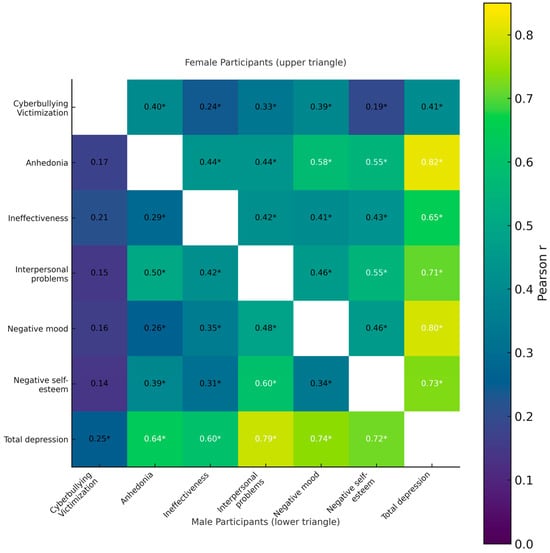
Spearman correlations (Holm-adjusted α = 0.05) are shown in Figure 1. Among girls, CBV correlated positively with all CDI domains and with TDS (ρs = 0.19–0.41, all p_adj < 0.05): anhedonia (0.40*), ineffectiveness (0.24*), interpersonal problems (0.33*), negative mood (0.39*), negative self-esteem (0.19*), and TDS (0.41*). Among boys, CBV related significantly only to TDS (ρ = 0.25*, p_adj < 0.05); correlations with individual domains were small and nonsignificant (ρs = 0.14–0.21). CDI domains further intercorrelated moderately to strongly in both genders, with high magnitudes between domains and the TDS (e.g., up to ρ = 0.82 among girls).
Figure 1.
Correlations between CBV and CDI domains, according to the Participants’ Gender. Note. * p < 0.05. The result of the correlations was examined using the Holm correction to adjust for multiple comparisons based on an alpha value of 0.05.
3.3. Multivariable Prediction of CBV
Gender-stratified logistic regressions examined whether specific depressive domains uniquely predicted any cybervictimization in the past six months (0 = none; 1 = any), controlling for age. In the female sample, higher anhedonia (B = 0.29, SE = 0.14, χ2 = 4.65, p = 0.031, OR = 1.34, 95% CI [1.03, 1.76]) and interpersonal problems (B = 0.38, SE = 0.18, χ2 = 4.57, p = 0.032, OR = 1.46, 95% CI [1.03, 2.07]) were associated with greater odds of reporting CBV. Negative self-esteem showed a nonsignificant protective trend (B = −0.35, p = 0.071, OR = 0.70, 95% CI [0.48, 1.03]). Age and the remaining domains were not significant. In the male sample, no predictors reached significance (all ps ≥ 0.068), although ineffectiveness showed a positive trend (B = 0.37, p = 0.068, OR = 1.45, 95% CI [0.97, 2.16]). Full results appear in Table 2.
Table 2.
Logistic regression analysis examining the role of age, gender, and depression in predicting cyberbullying victimization in Brazilian early adolescents.
4. Discussion
This study investigated how cyberbullying victimization relates to specific depressive symptom domains in early adolescence and whether these links differ by gender in a Brazilian sample. Three patterns emerged. First, girls reported higher depressive symptomatology than boys on the CDI total and on several domains—most notably, anhedonia, negative mood, ineffectiveness, and negative self-esteem—while mean CBV did not differ by gender. Second, zero-order associations revealed a broader, more consistent coupling between CBV and depression among girls than boys: in girls, CBV correlated with every CDI domain and with the total depression score (Figure 1), whereas in boys CBV related only to overall depression burden. Third, when domains were modeled simultaneously, anhedonia and interpersonal problems uniquely predicted any CBV among girls (controlling for age); in boys, no single domain emerged as a unique correlate, although ineffectiveness showed a positive trend. Together, these findings suggest that the emotional–interpersonal profile that accompanies CBV is more differentiated in Brazilian girls and more global (i.e., overall severity rather than particular clusters) in boys.
Our results converge with a robust literature linking cybervictimization to internalizing difficulties, including depression [1,4,5,14]. Consistent with national surveillance data indicating higher internalizing symptoms among girls exposed to CBV in Brazil [9] girls in our sample showed higher depressive symptoms overall, despite similar mean levels of CBV relative to boys. This mirrors international work suggesting that girls are especially prone to internalizing interpersonal stressors such as online harassment [1,3,14]. The correlation map clarifies this pattern: for girls, CBV aligns broadly with negative mood, anhedonia, perceived ineffectiveness, interpersonal strain, and negative self-evaluation; for boys, the association concentrates on the global depression score. Such gendered profiles echo evidence that symptom configurations and help-seeking pathways differ by gender during early adolescence, even under comparable exposure to stressors [1,3,14].
By disaggregating depression into domains rather than relying solely on global scores, the present study answers calls to identify clinically meaningful patterns that can be obscured in composite indices [4,12]. In multivariable analyses, anhedonia and interpersonal problems were the most distinctive correlates of CBV among girls. This is theoretically coherent with qualitative and conceptual accounts that foreground fear, helplessness, and imbalances of power in technology-mediated aggression [18,19]. Power asymmetries and sustained exposure in digital contexts can sap the rewarding value of social participation (anhedonia) and disrupt peer functioning (interpersonal problems), creating a feedback loop in which diminished enjoyment and strained relationships both heighten vulnerability to further online harassment and intensify its affective impact [1,6,19]. The small, nonsignificant protective trend for negative self-esteem in girls once other domains were entered likely reflects suppression due to the strong intercorrelations among CDI domains (Figure 1) and should not be over-interpreted.
In boys, the absence of unique domain predictors alongside a significant CBV–total depression correlation suggests that cybervictimization may relate more to general depressive load than to particular symptom clusters. This pattern is compatible with research showing that boys may externalize or mask specific internalizing symptoms while nevertheless accumulating overall depressive burden in the face of victimization [1,3]. It also aligns with work indicating that co-occurring stressors, such as social exclusion or hostile online exchanges, elevate affective distress across multiple systems rather than in narrow symptom bands [24].
The apparent magnitude of the CBV–depression association in our sample is somewhat larger than some reports from high-income settings (e.g., Australia and Switzerland [1]. Direct comparisons, however, warrant caution. Studies differ in measurement choices (e.g., CDI versus CES-D) [14,17]. scoring frames, recall windows, and treatment of skewed victimization distributions (we used Spearman’s ρ). Cultural and contextual mechanisms may also shape both CBV practices and their emotional sequelae [1,4,5]. Brazilian adolescents navigate heterogeneous digital access and supervision, with family norms and school climates that can differentially constrain or enable digital mediated aggression [3,23]. Norms around public shaming and honor in peer ecologies may heighten the social costs of online victimization [6,19], potentially strengthening its association with depressive symptoms. That our total depression scores approximate prior Brazilian estimates [17,25] suggests stability in symptom reporting nationally, even as the linkage to CBV reflects local social–digital ecologies.
Beyond concurrent symptomatology, CBV is increasingly conceptualized as part of a broader constellation of adverse experiences with lasting consequences for emotional, psychological, and physical health [15,16]. Evidence links cybervictimization not only to depression and anxiety but also to stress physiology, somatic complaints, self-harm, suicidal ideation, and post-traumatic stress symptoms [12,13,14,24]. Positioning our findings within this broader frame underscores the importance of timely identification and multi-level responses.
From a practice standpoint, our gender-stratified results argue against a one-size-fits-all approach in schools and primary care. For girls, domain-sensitive supports that combine behavioral activation (to counter anhedonia) with interpersonal skills and problem-solving (to repair and protect peer relationships) may directly address the symptom clusters most entwined with CBV. For boys, strategies that begin with broad depression screening and stepped-care supports may be more efficient, complemented by classroom-level components that address bystander dynamics and peer norms implicated in cyberaggression [3,19]. At the structural level, adolescents’ own emphasis on power imbalance and intentionality as defining features of cyberbullying [18] highlights the need to pair individual supports with consistent school policies, caregiver guidance on ICT use, and platform-level safeguards that reduce anonymity-enabled coercion and facilitate swift responses to harassment [3,19].
Beyond individual and school-level interventions, promoting adolescents’ understanding of netiquette may also support healthier digital development. Principles such as remembering the human behind the screen, respecting others’ time and privacy, and acknowledging and forgiving online mistakes are emphasized across cyberethics and digital citizenship frameworks [26,27,28]. Embedding these competencies into school curricula and online activities can help adolescents navigate digital spaces more responsibly and reduce behaviors that escalate into cyberbullying. Proactive attention to communication norms and ethical online conduct has been identified as a key strategy for promoting safer and more respectful interactions in digital environments [29].
Taken together, these findings reinforce the need for school-based responses that consider gender-specific patterns in digital experiences and emotional functioning. Although the study has limitations related to its cross-sectional design and data collection within a single school, it also presents important strengths. By reporting gender-stratified associations between cybervictimization and depressive symptoms, the study adds specificity to both Brazilian and international literature and addresses a recurring gap in prior research that has often treated adolescents as a homogeneous group. This contribution strengthens the relevance of the findings and supports future work aimed at designing more targeted preventive strategies.
Limitations and Further Directions
Several methodological choices of this study deserve consideration. Because the design is cross-sectional, we cannot speak to causality between cyberbullying victimization and depressive symptoms; longitudinal work following adolescents over time is needed to clarify what leads to what in this likely bidirectional relationship. Moreover, our data came from public schools in the Porto Alegre metropolitan area using convenience sampling, so generalization to private schools, smaller cities, or other Brazilian regions should be made with caution; replication with larger, more diverse samples across the country is a clear next step. Additionally, measures relied on adolescent self-report, which can under (or over) estimate experiences given ongoing developmental changes in self-perception; future studies should incorporate multiple informants (peers, caregivers, teachers) and complementary methods. Another limitation concerns the cybervictimization measure. The Revised Cyberbullying Inventory does not provide validated cutoff points for defining severity levels or identifying high-risk cases. Consequently, our analyses relied on continuous scores, which are appropriate for group comparisons but do not allow estimating the prevalence of severe or clinically relevant victimization. We also did not examine key risk factors linked to involvement in cyberbullying—such as socioemotional skills, social competence, psychopathology, and family context (e.g., parental supervision and support)—nor did we assess potential motives or targets (e.g., sexual orientation, body characteristics). Addressing these gaps will help identify who is most vulnerable, why certain youths are targeted, and how schools and families can build more effective prevention and support networks. Although the survey included a general indicator of online activity, it did not provide standardized measures of time spent online, parental socio-economic information, or school bullying experiences. These contextual factors could have enriched the interpretation of cybervictimization, but were beyond the scope of the present analysis, which focused specifically on gender differences in the links between CBV and depressive symptom domains. Future studies incorporating these additional variables and broader ecological indicators may deepen the understanding of the social and developmental context surrounding cybervictimization.
5. Conclusions
This investigation provides nuanced evidence that cyberbullying victimization and depressive symptoms travel together in early adolescence, but their relationship manifests differently across gender lines. Brazilian girls in our sample demonstrated a broad and differentiated pattern of associations between CBV and depression, with anhedonia and interpersonal problems emerging as particularly salient correlates. Boys showed a more global pattern, with CBV relating to overall depressive burden rather than specific symptom domains. These gendered patterns have direct implications for intervention design: behavioral activation and interpersonal skill-building may be especially relevant for girls experiencing cybervictimization, while comprehensive depression screening and psychoeducation about diverse manifestations of distress may better serve boys.
While our cross-sectional design limits causal conclusions, these findings contribute important specificity to the growing Brazilian and international literature on cyberbullying’s mental health impacts. The results underscore that effective responses to cybervictimization must move beyond one-size-fits-all approaches to recognize the distinct emotional and interpersonal contours of how online aggression is experienced by different youth. As digital interactions become increasingly central to adolescent social life, understanding and addressing these differentiated impacts becomes ever more critical for supporting healthy development in the digital age.
Author Contributions
Conceptualization, I.T., G.W.W., W.A.D.S., E.D.B. and F.A.-C.; Data curation, B.R.P. and F.A.-C.; Formal analysis, I.T., G.W.W., P.A.R.S. and E.D.B.; Investigation, G.W.W., B.R.P. and P.A.R.S.; Methodology, G.W.W., P.A.R.S., W.A.D.S. and E.D.B.; Project administration, F.A.-C.; Resources, B.R.P. and P.A.R.S.; Writing—original draft, I.T., W.A.D.S., E.D.B. and F.A.-C. Writing—review and editing, I.T., B.R.P., W.A.D.S. and E.D.B. All authors have read and agreed to the published version of the manuscript.
Funding
This research received no external funding.
Institutional Review Board Statement
All ethical aspects were approved by the National Research Ethics Commission, Brazilian Ministry of Health (protocol number: 11184 on 21 December 2011).
Informed Consent Statement
Parents of the adolescents included in this study signed an informed consent form authorizing their children’s participation. The adolescents signed an assent form indicating their interest in participating in the research.
Data Availability Statement
Data is available at the Open Science Framework Platform: https://osf.io/94jv2/?view_only=97135a428c2e4a088732379e34997bc3 (accessed on 10 March 2025).
Conflicts of Interest
The authors declare no conflicts of interest.
References
- Perren, S.; Dooley, J.; Shaw, T.; Cross, D. Bullying in school and cyberspace: Associations with depressive symptoms in Swiss and Australian adolescents. Child Adolesc. Psychiatry Ment. Health 2010, 4, 28. [Google Scholar] [CrossRef] [Scilit] [PubMed]
- Topcu, Ç.; Erdur-Baker, Ö. The Revised Cyber Bullying Inventory (RCBI): Validity and reliability studies. Procedia–Soc. Behav. Sci. 2010, 5, 660–664. [Google Scholar] [CrossRef] [Scilit]
- Cassidy, W.; Faucher, C.; Jackson, M. Cyberbullying among youth: A comprehensive review of current international research and its implications and application to policy and practice. Sch. Psychol. Int. 2013, 34, 575–612. [Google Scholar] [CrossRef] [Scilit]
- Chen, L.; Ho, S.S.; Lwin, M.O. A meta-analysis of factors predicting cyberbullying perpetration and victimization: From the social cognitive and media effects approach. New Media Soc. 2017, 19, 1194–1213. [Google Scholar] [CrossRef] [Scilit]
- Guo, S. A meta-analysis of the predictors of cyberbullying perpetration and victimization. Psychol. Sch. 2016, 53, 432–453. [Google Scholar] [CrossRef] [Scilit]
- Brewer, G.; Kerslake, J. Cyberbullying, self-esteem, empathy and loneliness. Comput. Hum. Behav. 2015, 48, 255–260. [Google Scholar] [CrossRef] [Scilit]
- Vieira, M.A.; Rønning, J.A.; Mari, J.J.; Bordin, I.A. Does cyberbullying occur simultaneously with other types of violence exposure? Braz. J. Psychiatry 2019, 41, 234–237. [Google Scholar] [CrossRef] [Scilit] [PubMed]
- IBGE. Pesquisa Nacional de Saúde do Escolar: 2019; Instituto Brasileiro de Geografia e Estatística: Rio de Janeiro, Brazil, 2021. Available online: https://www.gov.br/saude/pt-br/composicao/svsa/inqueritos-de-saude/pense (accessed on 10 March 2025).
- Malta, D.C.; de Souza, J.B.; de Vasconcelos, N.M.; de Mello, F.C.M.; Buback, J.B.; Gomes, C.S.; Pereira, C.A. Cyberbullying entre escolares brasileiros: Dados da Pesquisa Nacional de Saúde do Escolar, 2019. Ciência Saúde Coletiva 2024, 29, e19572023. [Google Scholar] [CrossRef] [Scilit] [PubMed]
- Cavalcanti, J.G.; de Lima Coutinho, M.D.P.; de Araújo, L.S.; de Lima Pinto, A.V.; Do Bu, E.A.; Silva, K.C. Bullying no contexto da adolescência: Um estudo das representações sociais. Rev. Psicol. IMED 2019, 11, 96–114. [Google Scholar] [CrossRef] [Scilit]
- Cavalcanti, J.G.; de Lima Coutinho, M.D.P.; de Lima Pinto, A.V.; Silva, K.C.; Do Bú, E.A. Vitimização e percepção do bullying: Relação com a sintomatologia depressiva de adolescentes. Rev. Psicol. IMED 2018, 10, 140–159. [Google Scholar] [CrossRef] [Scilit]
- Kokkinos, C.M.; Antoniadou, N.; Dalara, E.; Koufogazou, A.; Papatziki, A. Cyber-bullying, personality and coping among pre-adolescents. Int. J. Cyber Behav. Psychol. Learn. 2013, 3, 55–69. [Google Scholar] [CrossRef] [Scilit]
- Parmar, P.; Yogesh, M.; Damor, N.; Gandhi, R.; Parmar, B. Cyberbullying, social media addiction and associations with depression, anxiety and stress among Malaysian medical students: A cross-sectional study. Indian J. Psychiatry 2024, 66, 641–648. [Google Scholar] [CrossRef] [Scilit] [PubMed]
- Wang, J.; Nansel, T.R.; Iannotti, R.J. Cyber and traditional bullying: Differential association with depression. J. Adolesc. Health 2011, 48, 415–417. [Google Scholar] [CrossRef] [Scilit] [PubMed]
- Kasturiratna, K.S.; Hartanto, A.; Chen, C.H.; Tong, E.M.; Majeed, N.M. Umbrella review of meta-analyses on the risk factors, protective factors, consequences and interventions of cyberbullying victimization. Nat. Hum. Behav. 2025, 9, 101–132. [Google Scholar] [CrossRef] [Scilit] [PubMed]
- Miller, H.H.; Jenkins, L.; Putzeys, S.; Kaminski, S.; Woodall, M. Bullying victimization and adverse childhood experiences: Retrospective reports of relative impact on emotional distress. J. Child Adolesc. Trauma 2024, 17, 481–493. [Google Scholar] [CrossRef] [Scilit] [PubMed]
- Kovacs, M. Children’s Depression Inventory: Manual; Multi-Health Systems: Toronto, ON, Canada, 1992. [Google Scholar]
- Menesini, E.; Nocentini, A.; Palladino, B.E.; Frisén, A.; Berne, S.; Ortega-Ruiz, R.; Calmaestra, J.; Scheithauer, H.; Schultze-Krumbholz, A.; Luik, P.; et al. Cyberbullying definition among adolescents: A comparison across six European countries. Cyberpsychology Behav. Soc. Netw. 2012, 15, 455–463. [Google Scholar] [CrossRef] [Scilit] [PubMed]
- Spears, B.; Slee, P.; Owens, L.; Johnson, B. Behind the scenes and screens: Insights into the human dimension of covert and cyberbullying. J. Psychol. 2009, 217, 189–196. [Google Scholar] [CrossRef] [Scilit]
- Programa das Nações Unidas para o Desenvolvimento (PNUD). Atlas do Desenvolvimento Humano no Brasil: Porto Alegre (RS) [Internet]. 2013. Available online: http://www.atlasbrasil.org.br (accessed on 10 March 2025).
- Instituto Brasileiro de Geografia e Estatística (IBGE). Porto Alegre–Panorama [Internet]. 2024. Available online: https://cidades.ibge.gov.br/brasil/rs/porto-alegre/panorama (accessed on 10 March 2025).
- Hutz, C.S.; Giacomoni, C. Adaptação Brasileira do Inventário de Depressão Infantil; Universidade Federal do Rio Grande do Sul: Porto Alegre, Brazil, 2000; (phase: Unpublished work). [Google Scholar]
- Wendt, G. Cyberbullying em Adolescentes Brasileiros. Ph.D. Thesis, Universidade do Vale do Rio dos Sinos, São Leopoldo, Brazil, 2012. [Google Scholar]
- Smith, L.; López Sánchez, G.F.; Haro, J.M.; Alghamdi, A.A.; Pizzol, D.; Tully, M.A.; Oh, H.; Gibson, P.; Keyes, H.; Butler, L.; et al. Temporal Trends in Bullying Victimization Among Adolescents Aged 12–15 Years from 29 Countries: A Global Perspective. J. Adolesc. Health 2023, 73, 582–590. [Google Scholar] [CrossRef] [Scilit] [PubMed]
- Reppold, C. Estilo Parental Percebido e Adaptação Psicológica de Adolescentes Adotados. Ph.D. Thesis, Universidade Federal do Rio Grande do Sul, Porto Alegre, Brazil, 2001. [Google Scholar]
- Walsh, C. Netiquette, Digital Safety and Social Networking in the Junior High Classroom. Master’s Thesis, St. Cloud State University, St. Cloud, MN, USA, 2020. Available online: https://repository.stcloudstate.edu/cgi/viewcontent.cgi?article=1028&context=im_etds (accessed on 20 November 2024).
- Ng, W.S. A self-assessment approach to adolescents’cyberethics education. J. Inf. Technol. Educ. Res. 2020, 19, 555–570. [Google Scholar]
- Soler-Costa, R.; Lafarga-Ostáriz, P.; Mauri-Medrano, M.; Moreno-Guerrero, A.J. Netiquette: Ethic, education, and behavior on internet—A systematic literature review. Int. J. Environ. Res. Public Health 2021, 18, 1212. [Google Scholar] [CrossRef] [Scilit] [PubMed]
- Semingson, P.; Owens, D. Beyond Netiquette Guidelines: Best Practices for Proactively Fostering Professional Communication Behaviors in E-Learning. In E-Learn: World Conference on E-Learning in Corporate, Government, Healthcare, and Higher Education; Association for the Advancement of Computing in Education (AACE): Waynesville, NC, USA, 2017; pp. 467–471. [Google Scholar]

Disclaimer/Publisher’s Note: The statements, opinions and data contained in all publications are solely those of the individual author(s) and contributor(s) and not of MDPI and/or the editor(s). MDPI and/or the editor(s) disclaim responsibility for any injury to people or property resulting from any ideas, methods, instructions or products referred to in the content. |
© 2025 by the authors. Licensee MDPI, Basel, Switzerland. This article is an open access article distributed under the terms and conditions of the Creative Commons Attribution (CC BY) license (https://creativecommons.org/licenses/by/4.0/).