Refining the Moderate Inclusion Range of Dried Asian Watermeal (Wolffia globosa) in the Diets of Two-Spotted Crickets (Gryllus bimaculatus): Integrating Segmented Regression and Nutritional Self-Selection

 ,
,  , and
, and
Simple Summary
Abstract
1. Introduction
2. Materials and Methods
2.1. Experimental Site and Rearing Conditions
2.2. Experimental Diets, Watermeal Preparation, and Feeding Design
2.2.1. Fixed-Inclusion Treatments (T1–T4)
2.2.2. Self-Selection Treatment (T5)
2.3. Feed Intake Determination and Voluntary Selection
2.3.1. Feed Intake of Crickets in Fixed-Inclusion Treatments (T1–T4)
2.3.2. Feed Intake of Crickets in the Self-Selection Treatment (T5)
2.4. Growth Performance, Survival Rate, and PI
2.5. Sample Collection and Chemical Analysis
2.6. Statistical Analysis
2.6.1. Repeated-Measures Analysis of Production Performance in Crickets Across Experimental Treatments (T1–T5)
2.6.2. Repeated-Measures Analysis of Feed Intake in Crickets Under T5
2.6.3. Overall Performance and Body Composition
2.6.4. Segmented Regression Analysis
3. Results
3.1. Diet Composition
3.2. Self-Selection Feeding Behavior (T5)
3.3. Nutrient and Energy Intake Under Self-Selection
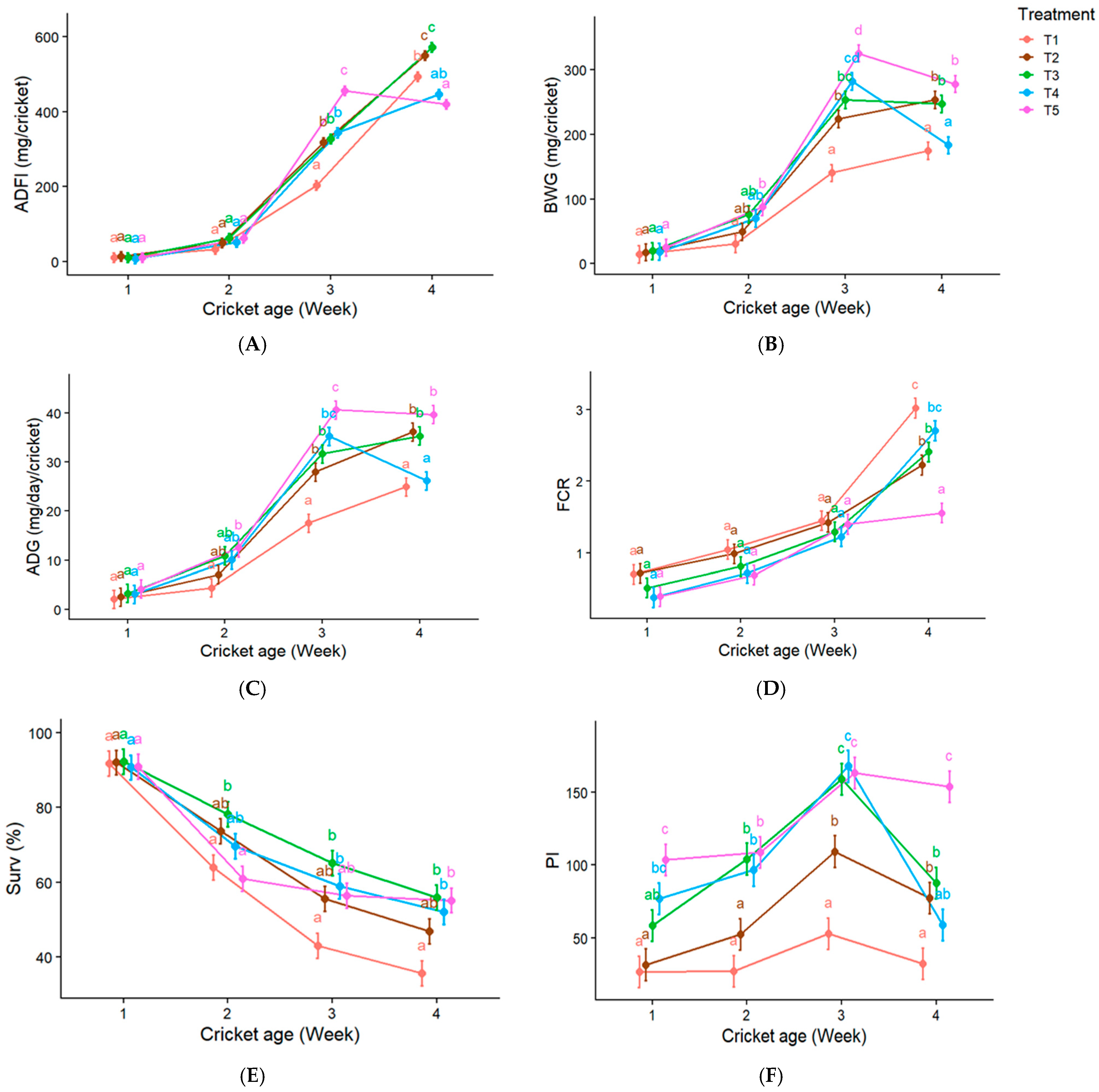
3.4. Repeated-Measures Analysis of Production Performance
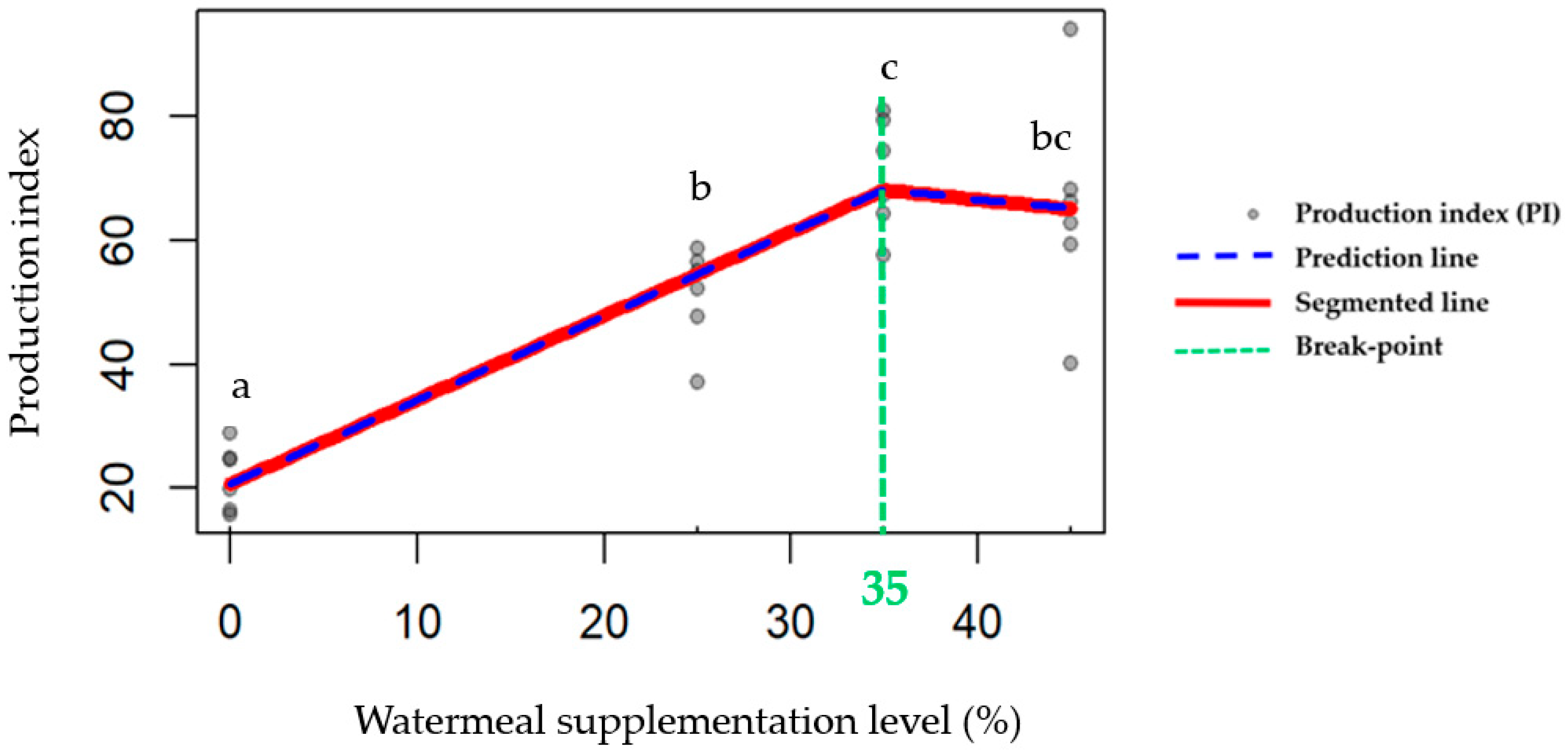
3.5. Segmented Regression Analysis of PI
3.6. Overall Growth Performance (Weeks 1–4)
3.7. Whole-Body Nutrient Composition
4. Discussion
4.1. Nutrient Balance and Dietary Geometry
4.2. Evidence of Nutritional Self-Regulation
4.3. Ontogenetic Effects and Treatment Interactions
4.4. Feed Conversion Efficiency and Nutrient Partitioning
4.5. Voluntary Watermeal Intake Under Self-Selection
4.6. Practical Implications and Economic Considerations
4.7. Alternative Functional Feed Resources
4.8. Sustainability Framing
4.9. Study Limitations and Future Directions
5. Conclusions
Supplementary Materials
Author Contributions
Funding
Institutional Review Board Statement
Data Availability Statement
Acknowledgments
Conflicts of Interest
Abbreviations
| ADFI | Average daily feed intake |
| ADG | Average daily gain |
| ANOVA | Analysis of Variance |
| ATP | Adenosine triphosphate |
| BWG | Body weight gain |
| CF | Crude fiber |
| CI | Confidence interval |
| CP | Crude protein |
| EBI | European Broiler Index |
| EPEF | European Production Efficiency Factor |
| FCR | Feed conversion ratio |
| GE | Gross energy |
| LCA | Life cycle assessment |
| LMM | Linear mixed-effects models |
| NFE | Nitrogen-free extract |
| PI | Production index |
| Q-Q | quantile–quantile |
| SD | Standard deviation |
| Surv | Survival rate |
| TCA | Tricarboxylic acid |
References
- Pal, P.; Singh, A.K.; Srivastava, R.K.; Rathore, S.S.; Sahoo, U.K.; Subudhi, S.; Sarangi, P.K.; Prus, P. Circular bioeconomy in action: Transforming food wastes into renewable food resources. Foods 2024, 13, 3007. [Google Scholar] [CrossRef]
- Srivastav, A.L.; Bagherian, A.; Ghosh, D. The circular bioeconomy: Pathways to sustainability and resource optimization. Clean Technol. Environ. Policy 2025, 27, 815–832. [Google Scholar] [CrossRef]
- Weindl, I.; Popp, A.; Bodirsky, B.L.; Rolinski, S.; Lotze-Campen, H.; Biewald, A.; Humpenöder, F.; Dietrich, J.P.; Stevanović, M. Livestock and human use of land: Productivity trends and dietary choices as drivers of future land and carbon dynamics. Glob. Planet. Change 2017, 159, 1–10. [Google Scholar] [CrossRef]
- Cheng, M.; McCarl, B.; Fei, C. Climate change and livestock production: A literature review. Atmosphere 2022, 13, 140. [Google Scholar] [CrossRef]
- Li, M.; Mao, C.; Li, X.; Jiang, L.; Zhang, W.; Li, M.; Liu, H.; Fang, Y.; Liu, S.; Yang, G.; et al. Edible insects: A new sustainable nutritional resource worth promoting. Foods 2023, 12, 4073. [Google Scholar] [CrossRef]
- Lisboa, H.M.; Nascimento, A.; Arruda, A.; Sarinho, A.; Lima, J.; Batista, L.; Dantas, M.F.; Andrade, R. Unlocking the potential of insect-based proteins: Sustainable solutions for global food security and nutrition. Foods 2024, 13, 1846. [Google Scholar] [CrossRef] [PubMed]
- Ojha, S.; Bußler, S.; Schlüter, O.K. Food waste valorisation and circular economy concepts in insect production and processing. Waste Manag. 2020, 118, 600–609. [Google Scholar] [CrossRef] [PubMed]
- Kee, P.E.; Cheng, Y.-S.; Chang, J.-S.; Yim, H.S.; Tan, J.C.Y.; Lam, S.S.; Lan, J.C.-W.; Ng, H.S.; Khoo, K.S. Insect biorefinery: A circular economy concept for biowaste conversion to value-added products. Environ. Res. 2023, 221, 115284. [Google Scholar] [CrossRef] [PubMed]
- Levizou, E.; Mourantian, A.; Chatzinikolaou, M.; Feka, M.; Karapanagiotidis, I.T.; Mente, E.; Athanassiou, C.G.; Kormas, K.A.; Katsoulas, N. A circular tri-trophic system incorporating plants, fish, and insects turns waste into a resource: Case study with the cultivation of cucumber. Front. Plant Sci. 2025, 16, 1638443. [Google Scholar] [CrossRef]
- Magara, H.J.O.; Niassy, S.; Ayieko, M.A.; Mukundamago, M.; Egonyu, J.P.; Tanga, C.M.; Kimathi, E.K.; Ongere, J.O.; Fiaboe, K.K.M.; Hugel, S.; et al. Edible crickets (Orthoptera) around the world: Distribution, nutritional value, and other benefits—A Review. Front. Nutr. 2021, 7, 537915. [Google Scholar] [CrossRef]
- Mitchaothai, J.; Grabowski, N.T.; Lertpatarakomol, R.; Trairatapiwan, T.; Chhay, T.; Keo, S.; Lukkananukool, A. Production performance and nutrient conversion efficiency of field cricket (Gryllus bimaculatus) in mass-rearing conditions. Animals 2022, 12, 2263. [Google Scholar] [CrossRef]
- Toomer, O.T.; Oviedo-Rondón, E.O.; Ali, M.; Joseph, M.; Vu, T.; Fallen, B.; Mian, R. Full-fat soybean meals as an alternative poultry feed ingredient—Feed processing methods and utilization—Review and perspective. Animals 2024, 14, 2366. [Google Scholar] [CrossRef]
- Soisontes, S.; Freund, F.; Laquai, V. The future of protein feed: A case study of sustainable substitutes in the German livestock industry. Environ. Dev. Sustain. 2024, 26, 25199–25226. [Google Scholar] [CrossRef]
- Lanza, M.; Battelli, M.; Gallo, L.; Soglia, F.; Bovera, F.; Giunta, F.; Primi, R.; Biondi, L.; Giannuzzi, D.; Zampiga, M.; et al. Sustainability of animal production chains: Alternative protein sources as an ecological driver in animal feeding: A review. Animals 2025, 15, 3245. [Google Scholar] [CrossRef] [PubMed]
- Jafir, M.; Abbas, M.; Irfan, M.; Zia-Ur-Rehman, M. Chapter Ten—Greenhouse gas emissions from edible insect species. In Advances and Technology Development in Greenhouse Gases: Emission, Capture and Conversion; Rahimpour, M.R., Makarem, M.A., Meshksar, M., Eds.; Elsevier: Amsterdam, The Netherlands, 2024; pp. 205–225. [Google Scholar]
- Halloran, A.; Roos, N.; Eilenberg, J.; Cerutti, A.; Bruun, S. Life cycle assessment of edible insects for food protein: A review. Agron. Sustain. Dev. 2016, 36, 57. [Google Scholar] [CrossRef] [PubMed]
- Smetana, S.; Palanisamy, M.; Mathys, A.; Heinz, V. Sustainability of insect use for feed and food: Life cycle assessment perspective. J. Clean. Prod. 2016, 137, 741–751. [Google Scholar] [CrossRef]
- Sirison, J.; Ruangsomboon, S.; Jongput, B.; Aue-umneoy, D.; Tongsri, P. Cultivation of Wolffia globosa and its application in functional food development. Sci. Rep. 2025, 15, 38255. [Google Scholar] [CrossRef]
- Mitchaothai, J.; Grabowski, N.T.; Lertpatarakomol, R.; Trairatapiwan, T.; Lukkananukool, A. Effect and optimal level of dietary dried watermeal (Wolffia globosa) supplementation on the production performance of two-spotted crickets (Gryllus bimaculatus). Animals 2025, 15, 2052. [Google Scholar] [CrossRef]
- Saranya, S.; Lourdu Lincy, L.; Thamanna, L.; Dhayanithi, S.; Chellapandi, P. Wolffia: A sustainable aquatic crop for future food systems and space agriculture. Trends Food Sci. Technol. 2025, 161, 105069. [Google Scholar] [CrossRef]
- Yongyod, R.; Kamolrat, N. Effects of different nitrogen and phosphorus ratios on the growth, nutritional value, and nutrient removal efficiency of Wolffia globosa. Sci 2025, 7, 53. [Google Scholar] [CrossRef]
- Sela, I.; Yaskolka Meir, A.; Brandis, A.; Krajmalnik-Brown, R.; Zeibich, L.; Chang, D.; Dirks, B.; Tsaban, G.; Kaplan, A.; Rinott, E.; et al. Wolffia globosa–Mankai plant-based protein contains bioactive vitamin B12 and is well absorbed in humans. Nutrients 2020, 12, 3067. [Google Scholar] [CrossRef] [PubMed]
- Shaw, C.; Knopf, K.; Klatt, L.; Marin Arellano, G.; Kloas, W. Closing nutrient cycles through the use of system-internal resource streams: Implications for circular multitrophic food production systems and aquaponic feed development. Sustainability 2023, 15, 7374. [Google Scholar] [CrossRef]
- Si, H.-R.; Sun, S.-S.; Liu, Y.-K.; Qiu, L.-Y.; Tang, B.; Liu, F.; Fu, Q.; Xu, C.-D.; Wan, P.-J. Roles of GFAT and PFK genes in energy metabolism of brown planthopper, Nilaparvata lugens. Front. Physiol. 2023, 14, 1213654. [Google Scholar] [CrossRef] [PubMed]
- Bretscher, H.; O’Connor, M.B. The role of muscle in insect energy homeostasis. Front. Physiol. 2020, 11, 580687. [Google Scholar] [CrossRef] [PubMed]
- Li, X.; Zhou, Y.; Wu, K. Biological characteristics and energy metabolism of migrating insects. Metabolites 2023, 13, 439. [Google Scholar] [CrossRef]
- Gous, R.M.; Faulkner, A.S.; Swatson, H.K. The effect of dietary energy:protein ratio, protein quality and food allocation on the efficiency of utilisation of protein by broiler chickens. Br. Poult. Sci. 2018, 59, 100–109. [Google Scholar] [CrossRef]
- Liu, Y.; Kong, X.; Jiang, G.; Tan, B.E.; Deng, J.; Yang, X.; Li, F.; Xiong, X.; Yin, Y. Effects of dietary protein/energy ratio on growth performance, carcass trait, meat quality, and plasma metabolites in pigs of different genotypes. J. Anim. Sci. Biotechnol. 2015, 6, 36. [Google Scholar] [CrossRef]
- Konnert, G.D.P.; Martin, E.; Gerrits, W.J.J.; Gussekloo, S.W.S.; Masagounder, K.; Mas-Muñoz, J.; Schrama, J.W. Interactive effects of protein and energy intake on nutrient partitioning and growth in Nile tilapia. Animal 2022, 16, 100494. [Google Scholar] [CrossRef]
- Kwon, W.; Lee, K.P. Macronutrient regulation in nymphs of the two-spotted cricket, Gryllus bimaculatus (Orthoptera: Gryllidae). J. Insect Physiol. 2024, 157, 104684. [Google Scholar] [CrossRef]
- Crumière, A.J.J.; Stephenson, C.J.; Nagel, M.; Shik, J.Z. Using nutritional geometry to explore how social insects navigate nutritional landscapes. Insects 2020, 11, 53. [Google Scholar] [CrossRef]
- Rho, M.S.; Lee, K.P. Geometric analysis of nutrient balancing in the mealworm beetle, Tenebrio molitor L. (Coleoptera: Tenebrionidae). J. Insect Physiol. 2014, 71, 37–45. [Google Scholar] [CrossRef]
- Lawton, D.; Le Gall, M.; Waters, C.; Cease, A.J. Mismatched diets: Defining the nutritional landscape of grasshopper communities in a variable environment. Ecosphere 2021, 12, e03409. [Google Scholar] [CrossRef]
- Kryeziu, A.; Mestani, N.; Berisha, S.; Kamberi, M. The European performance indicators of broiler chickens as influenced by stocking density and sex. Agron. Res. 2018, 16, 483–491. [Google Scholar] [CrossRef]
- Bhamare, K.; Dildeep, V.; Senthil, M.; Chavan, S. Nutritive evaluation of cashew apple waste in broilers. Intern. J. Sci. Nat. 2016, 7, 629–632. [Google Scholar]
- Ritvanen, T.; Pastell, H.; Welling, A.; Raatikainen, M. The nitrogen-to-protein conversion factor of two cricket species, Acheta domesticus and Gryllus bimaculatus. Agric. Food Sci. 2020, 29, 1–5. [Google Scholar] [CrossRef]
- Simpson, S.J.; Raubenheimer, D. The geometric analysis of nutrient–allelochemical interactions: A case study using locusts. Ecology 2001, 82, 422–439. [Google Scholar] [CrossRef]
- Raubenheimer, D.; Simpson, S.J. Nutritional ecology and human health. Annu. Rev. Nutr. 2016, 36, 603–626. [Google Scholar] [CrossRef]
- Anderson, T.R.; Raubenheimer, D.; Hessen, D.O.; Jensen, K.; Gentleman, W.C.; Mayor, D.J. Geometric stoichiometry: Unifying concepts of animal nutrition to understand how protein-rich diets can be “Too much of a good thing”. Front. Ecol. Evol. 2020, 8, 196. [Google Scholar] [CrossRef]
- Lee, K.P.; Jang, T.; Rho, M.S. Recent trends in integrative insect nutrition: A nutritional geometry perspective. Korean J. Appl. Entomol. 2022, 61, 129–142. [Google Scholar] [CrossRef]
- Kwon, W.; Lee, K.P. Nutrient landscape of a cricket nymph: How dietary protein and carbohydrate shape intake, performance, and body composition in the two-spotted cricket, Gryllus bimaculatus. Physiol. Entomol. 2026, 51, 178–192. [Google Scholar] [CrossRef]
- Senior, A.M.; Raubenheimer, D.; Couteur, D.G.L.; Simpson, S.J. The geometric framework for nutrition and its application to rodent models. Annu. Rev. Anim. Biosci. 2025, 13, 389–410. [Google Scholar] [CrossRef]
- Joern, A.; Behmer, S.T. Importance of dietary nitrogen and carbohydrates to survival, growth, and reproduction in adults of the grasshopper Ageneotettix deorum (Orthoptera: Acrididae). Oecologia 1997, 112, 201–208. [Google Scholar] [CrossRef]
- Pesti, G.; Vedenov, D.; Cason, J.; Billard, L. A comparison of methods to estimate nutritional requirements from experimental data. Br. Poult. Sci. 2009, 50, 16–32. [Google Scholar] [CrossRef] [PubMed]
- Wu, Y.; Cao, J.; Tang, J.; Yang, Y.; Hou, S.; Wen, Z. Determination of methionine requirement for Pekin ducks: An integrated linear broken line and quadratic polynomial regression approach. Front. Anim. Sci. 2025, 6, 1727330. [Google Scholar] [CrossRef]
- Robbins, K.; Saxton, A.; Southern, L. Estimation of nutrient requirements using broken-line regression analysis. J. Anim. Sci. 2006, 84, E155–E165. [Google Scholar] [CrossRef]
- Kaewtapee, C.; Triwai, P.; Inson, C.; Masmeatathip, R.; Sriwongras, P. Effects of protein levels on production performance, nutritional values, and phase feeding of two-spotted cricket. J. Insect Sci. 2024, 24, 18. [Google Scholar] [CrossRef]
- Khempaka, S.; Okrathok, S.; Schonewille, J.T.; Pukkung, C.; Sirisopapong, M.; Jantasaeng, O.; Pasri, P. Responses of house crickets (Orthoptera: Gryllidae) to various dietary gross energy levels: Effects on growth performance and nutrient deposition. J. Insect Sci. 2025, 25, 21. [Google Scholar] [CrossRef]
- Engel, P.; Moran, N.A. The gut microbiota of insects—Diversity in structure and function. FEMS Microbiol. Rev. 2013, 37, 699–735. [Google Scholar] [CrossRef]
- Douglas, A.E. Multiorganismal insects: Diversity and function of resident microorganisms. Annu. Rev. Entomol. 2015, 60, 17–34. [Google Scholar] [CrossRef] [PubMed]
- Samways, M.J.; Lecoq, M.; Charl, D. Orthoptera biodiversity for environmental assessment and agroecological advancement. Agronomy 2025, 16, 57. [Google Scholar] [CrossRef]
- Raubenheimer, D.; Simpson, S.J. Integrating nutrition: A geometrical approach. Entomol. Exp. Appl. 1999, 91, 67–82. [Google Scholar] [CrossRef]
- Zera, A.J.; Zhao, Z. Intermediary metabolism and life-history trade-offs: Differential metabolism of amino acids underlies the dispersal-reproduction trade-off in a wing-polymorphic cricket. Am. Nat. 2006, 167, 889–900. [Google Scholar] [CrossRef]
- Treidel, L.A.; Clark, R.M.; Lopez, M.T.; Williams, C.M. Physiological demands and nutrient intake modulate a trade-off between dispersal and reproduction based on age and sex of field crickets. J. Exp. Biol. 2021, 224, jeb237834. [Google Scholar] [CrossRef] [PubMed]
- Muzzatti, M.J.; Harrison, S.J.; McColville, E.R.; Brittain, C.T.; Brzezinski, H.; Manivannan, S.; Stabile, C.C.; MacMillan, H.A.; Bertram, S.M. Applying nutritional ecology to optimize diets of crickets raised for food and feed. R. Soc. Open Sci. 2024, 11, 241710. [Google Scholar] [CrossRef] [PubMed]
- Clark, R.M.; Zera, A.J.; Behmer, S.T. Nutritional physiology of life-history trade-offs: How food protein–carbohydrate content influences life-history traits in the wing-polymorphic cricket Gryllus firmus. J. Exp. Biol. 2015, 218, 298–308. [Google Scholar] [CrossRef] [PubMed]
- Chapman, R.F. The Insects: Structure and Function, 4th ed.; Cambridge University Press: Cambridge, UK, 1998. [Google Scholar]
- Skowronek, P.; Wójcik, Ł.; Strachecka, A. Fat body—Multifunctional insect tissue. Insects 2021, 12, 547. [Google Scholar] [CrossRef]
- Arrese, E.L.; Soulages, J.L. Insect fat body: Energy, metabolism, and regulation. Annu. Rev. Entomol. 2010, 55, 207–225. [Google Scholar] [CrossRef]
- Saraiva, F.B.; Alves-Bezerra, M.; Majerowicz, D.; Paes-Vieira, L.; Braz, V.; Almeida, M.G.; Meyer-Fernandes, J.R.; Gondim, K.C. Blood meal drives de novo lipogenesis in the fat body of Rhodnius prolixus. Insect Biochem. Mol. Biol. 2021, 133, 103511. [Google Scholar] [CrossRef]
- Canavoso, L.E.; Jouni, Z.E.; Karnas, K.J.; Pennington, J.E.; Wells, M.A. Fat metabolism in insects. Annu. Rev. Nutr. 2001, 21, 23–46. [Google Scholar] [CrossRef]
- Arrese, E.L.; Canavoso, L.E.; Jouni, Z.E.; Pennington, J.E.; Tsuchida, K.; Wells, M.A. Lipid storage and mobilization in insects: Current status and future directions. Insect Biochem. Mol. Biol. 2001, 31, 7–17. [Google Scholar] [CrossRef]
- Stec, N.; Saleem, A.; Darveau, C.-A. Proline as a sparker metabolite of oxidative metabolism during the flight of the bumblebee, Bombus impatiens. Metabolites 2021, 11, 511. [Google Scholar] [CrossRef]
- Scaraffia, P.Y.; Wells, M.A. Proline can be utilized as an energy substrate during flight of Aedes aegypti females. J. Insect Physiol. 2003, 49, 591–601. [Google Scholar] [CrossRef]
- Wu, G. Amino acids: Metabolism, functions, and nutrition. Amino Acids 2009, 37, 1–17. [Google Scholar] [CrossRef]
- Fuller, M.F. The Encyclopedia of Farm Animal Nutrition; CABI Publishing: Wallingford, UK, 2004. [Google Scholar]
- Venkatachalam, K.; Phongthai, S.; Puttha, R.; Wongsa, J.; Charoenphun, N. Wolffia globosa as an emerging plant-based protein source for functional and nutraceuticals. Foods 2026, 15, 543. [Google Scholar] [CrossRef] [PubMed]
- Song, Y.; Hu, Z.; Liu, S.; Luo, S.; He, R.; Yang, X.; Li, S.; Yang, X.; An, Y.; Lu, Y. Utilization of microalgae and duckweed as sustainable protein sources for food and feed: Nutritional potential and functional applications. J. Agric. Food Chem. 2025, 73, 4466–4482. [Google Scholar] [CrossRef] [PubMed]
- Obando, J.M.C.; Heitzman, B.; Toniato, M.; dos Santos, T.C.; Machado, L.P.; Bueno, G.W. Advancements in duckweed (Lemna Minor) research: Exploring sustainable applications, bioproducts and cultivation strategies as potential drivers to circular economy. Circ. Econ. Sustain. 2026, 6, 44. [Google Scholar] [CrossRef]
- Chikhale, S.S.; Pathade, G.; Bagwan, W. Duckweed as a circular economy solution for treating agro-industrial wastewaters. Nat. Environ. Pollut. Technol. 2026, 25, B4329. [Google Scholar] [CrossRef]
- Putri, F.E.; Hung, T.-C. Comparison of nutrient removal and biomass production between macrophytes and microalgae for treating artificial citrus nursery wastewater. J. Environ. Manag. 2020, 264, 110303. [Google Scholar] [CrossRef]
- Takács, K.; Végh, R.; Mednyánszky, Z.; Haddad, J.; Allaf, K.; Du, M.; Chen, K.; Kan, J.; Cai, T.; Molnár, P.; et al. New insights into duckweed as an alternative source of food and feed: Key components and potential technological solutions to increase their digestibility and bioaccessibility. Appl. Sci. 2025, 15, 884. [Google Scholar] [CrossRef]
- Appenroth, K.-J.; Sree, K.S.; Böhm, V.; Hammann, S.; Vetter, W.; Leiterer, M.; Jahreis, G. Nutritional value of duckweeds (Lemnaceae) as human food. Food Chem. 2017, 217, 266–273. [Google Scholar] [CrossRef]
- Cheng, J.J.; Stomp, A.-M. Growing duckweed to recover nutrients from wastewaters and for production of fuel ethanol and animal feed. CLEAN—Soil Air Water 2009, 37, 17–26. [Google Scholar] [CrossRef]
- Parodi, A.; Leip, A.; De Boer, I.J.M.; Slegers, P.M.; Ziegler, F.; Temme, E.H.M.; Herrero, M.; Tuomisto, H.; Valin, H.; Van Middelaar, C.E.; et al. The potential of future foods for sustainable and healthy diets. Nat. Sustain. 2018, 1, 782–789. [Google Scholar] [CrossRef]
- Zhang, X.; Wang, X.; Guo, Z.; Liu, X.; Wang, P.; Yuan, X.; Li, Y. Antibiotic treatment reduced the gut microbiota diversity, prolonged the larval development period and lessened adult fecundity of Grapholita molesta (Lepidoptera: Tortricidae). Insects 2022, 13, 838. [Google Scholar] [CrossRef] [PubMed]
- Jing, T.-Z.; Qi, F.-H.; Wang, Z.-Y. Most dominant roles of insect gut bacteria: Digestion, detoxification, or essential nutrient provision? Microbiome 2020, 8, 38. [Google Scholar] [CrossRef] [PubMed]



| Item | Dried Watermeal | Experimental Treatment | |||
|---|---|---|---|---|---|
| T1 | T2 | T3 | T4 | ||
| Ingredients | |||||
| Commercial diet (%) | 0 | 100 | 75 | 65 | 55 |
| Watermeal (%) | 100 | 0 | 25 | 35 | 45 |
| Analyzed nutrient composition | |||||
| Dry matter; DM (%) | 92.26 | 87.75 | 88.88 | 89.33 | 89.78 |
| Crude protein; CP(%) | 22.94 | 21.69 | 22.00 | 22.13 | 22.25 |
| Crude fat (%) | 1.06 | 3.35 | 2.78 | 2.55 | 2.32 |
| Crude fiber; CF (%) | 6.82 | 3.31 | 4.19 | 4.54 | 4.89 |
| Ash (%) | 12.79 | 7.08 | 8.51 | 9.08 | 9.65 |
| Nitrogen-free extract; NFE (%) | 48.65 | 52.42 | 51.48 | 51.10 | 50.72 |
| NFE:CP | 2.12 | 2.42 | 2.34 | 2.31 | 2.28 |
| Calcium (%) | 0.62 | 1.05 | 0.94 | 0.90 | 0.86 |
| Phosphorus, (%) | 0.59 | 0.92 | 0.84 | 0.80 | 0.77 |
| Gross energy; GE (kcal/kg) | 3969.70 | 3917.52 | 3930.57 | 3935.78 | 3941.00 |
| GE:CP (kcal:g CP) | 17.30 | 18.06 | 17.86 | 17.79 | 17.71 |
| Cricket Age (Week) | ADFI of Commercial Feed (mg/cricket) | ADFI of Watermeal (mg/cricket) | Total ADFI (mg/cricket) | Watermeal ADFI/Total ADFI (%) |
|---|---|---|---|---|
| 1 | 10.13 ± 3.46 a | 0.00 ± 0.00 * | 10.13 ± 3.46 a | 0.00 ± 0.00 * |
| 2 | 55.61 ± 13.29 a | 9.69 ± 3.60 a | 62.07 ± 18.21 a | 13.10 ± 4.44 a |
| 3 | 371.24 ± 49.32 c | 85.23 ± 13.14 b | 456.47 ± 50.92 b | 18.79 ± 3.05 a |
| 4 | 268.37 ± 39.57 b | 151.94 ± 51.65 c | 420.31 ± 59.22 b | 35.53 ± 9.87 b |
| 1 to 4 | 706.38 ± 70.48 | 242.60 ± 46.03 | 948.98 ± 74.02 | 25.56 ± 4.46 |
| Item | Nutrient and Energy Intake | ||||||
|---|---|---|---|---|---|---|---|
| CP (mg/cricket) | Crude Fat (mg/cricket) | CF (mg/cricket) | NFE (mg/cricket) | NFE:CP | GE (kcal/cricket) | GE:CP (kcal:g CP) | |
| Total intake | 185.79 ± 14.50 | 23.14 ± 2.01 | 35.78 ± 3.11 | 433.81 ± 33.85 | 2.34 ± 0.01 | 3.32 ± 0.26 | 17.85 ± 0.04 |
| Item | Experimental Treatment | ||||
|---|---|---|---|---|---|
| T1 | T2 | T3 | T4 | T5 | |
| Average feed intake per cricket (mg/cricket) | 740.60 ± 60.63 a | 929.96 ± 24.33 bc | 971.73 ± 42.91 c | 849.94 ± 43.65 b | 948.98 ± 74.02 c |
| Body weight gain (mg) | 360.39 ± 48.67 a | 544.02 ± 30.72 b | 596.45 ± 48.05 b | 553.93 ± 74.44 b | 715.77 ± 50.56 c |
| Average daily gain (mg/day) | 12.43 ± 1.68 a | 18.76 ± 1.06 b | 20.57 ± 1.66 b | 19.10 ± 2.57 b | 25.58 ± 2.66 c |
| Feed conversion ratio (FCR) | 2.07 ± 0.21 c | 1.71 ± 0.07 b | 1.64 ± 0.12 b | 1.55 ± 0.15 ab | 1.33 ± 0.14 a |
| Survival rate (%) | 35.73 ± 4.18 a | 46.96 ± 8.13 ab | 55.93 ± 3.92 b | 52.09 ± 8.85 b | 55.19 ± 13.82 b |
| Production index | 21.74 ± 5.22 a | 51.21 ± 7.92 b | 70.63 ± 9.10 c | 64.07 ± 3.92 c | 113.98 ± 18.40 d |
| Sex ratio (male:female ratio) | 1.08 ± 0.15 | 1.12 ± 0.21 | 1.02 ± 0.18 | 1.00 ± 0.12 | 1.06 ± 0.19 |
| Item | Experimental Treatment | ||||
|---|---|---|---|---|---|
| T1 | T2 | T3 | T4 | T5 | |
| Dry matter (%) | 91.63 ± 0.13 | 91.34 ± 0.32 | 90.79 ± 0.51 | 90.66 ± 0.91 | 91.49 ± 0.61 |
| Crude protein (%) | 52.60 ± 0.87 a | 58.45 ± 2.03 bc | 59.19 ± 1.15 c | 57.96 ± 0.48 bc | 55.39 ± 2.39 ab |
| Crude fat (%) | 26.79 ± 0.64 c | 21.16 ± 2.14 ab | 19.59 ± 1.84 a | 19.82 ± 1.83 a | 24.10 ± 2.58 bc |
| Crude fiber (%) | 8.13 ± 0.83 | 7.18 ± 0.42 | 7.48 ± 0.20 | 7.87 ± 0.42 | 7.87 ± 0.86 |
| Ash (%) | 3.86 ± 0.26 | 4.45 ± 0.32 | 4.43 ± 0.36 | 4.53 ± 0.46 | 4.01 ± 0.48 |
| Calcium (%) | 0.32 ± 0.04 | 0.30 ± 0.06 | 0.29 ± 0.05 | 0.30 ± 0.04 | 0.27 ± 0.03 |
| Phosphorus (%) | 0.73 ± 0.06 | 0.80 ± 0.08 | 0.79 ± 0.14 | 0.75 ± 0.11 | 0.76 ± 0.10 |
| Gross energy (kcal/kg) | 5890.82 ± 15.33 b | 5658.95 ± 31.47 a | 5611.35 ± 28.20 a | 5578.05 ± 47.41 a | 5826.05 ± 67.56 b |
Disclaimer/Publisher’s Note: The statements, opinions and data contained in all publications are solely those of the individual author(s) and contributor(s) and not of MDPI and/or the editor(s). MDPI and/or the editor(s) disclaim responsibility for any injury to people or property resulting from any ideas, methods, instructions or products referred to in the content. |
© 2026 by the authors. Licensee MDPI, Basel, Switzerland. This article is an open access article distributed under the terms and conditions of the Creative Commons Attribution (CC BY) license.
Share and Cite
Mitchaothai, J.; Lertpatarakomol, R.; Lukkananukool, A.; Trairatapiwan, T.; Kaewsiri, N.; Grabowski, N.T. Refining the Moderate Inclusion Range of Dried Asian Watermeal (Wolffia globosa) in the Diets of Two-Spotted Crickets (Gryllus bimaculatus): Integrating Segmented Regression and Nutritional Self-Selection. Insects 2026, 17, 420. https://doi.org/10.3390/insects17040420
Mitchaothai J, Lertpatarakomol R, Lukkananukool A, Trairatapiwan T, Kaewsiri N, Grabowski NT. Refining the Moderate Inclusion Range of Dried Asian Watermeal (Wolffia globosa) in the Diets of Two-Spotted Crickets (Gryllus bimaculatus): Integrating Segmented Regression and Nutritional Self-Selection. Insects. 2026; 17(4):420. https://doi.org/10.3390/insects17040420
Chicago/Turabian StyleMitchaothai, Jamlong, Rachakris Lertpatarakomol, Achara Lukkananukool, Tassanee Trairatapiwan, Natnaree Kaewsiri, and Nils T. Grabowski. 2026. "Refining the Moderate Inclusion Range of Dried Asian Watermeal (Wolffia globosa) in the Diets of Two-Spotted Crickets (Gryllus bimaculatus): Integrating Segmented Regression and Nutritional Self-Selection" Insects 17, no. 4: 420. https://doi.org/10.3390/insects17040420
APA StyleMitchaothai, J., Lertpatarakomol, R., Lukkananukool, A., Trairatapiwan, T., Kaewsiri, N., & Grabowski, N. T. (2026). Refining the Moderate Inclusion Range of Dried Asian Watermeal (Wolffia globosa) in the Diets of Two-Spotted Crickets (Gryllus bimaculatus): Integrating Segmented Regression and Nutritional Self-Selection. Insects, 17(4), 420. https://doi.org/10.3390/insects17040420