Evaluating a Novel Method to Limit Non-Target Mortality in Attractive Toxic Sugar Bait Systems
 ,
,  , and
, and 
Simple Summary
Abstract
1. Introduction
2. Materials and Methods
2.1. Maintenance of Mosquitoes
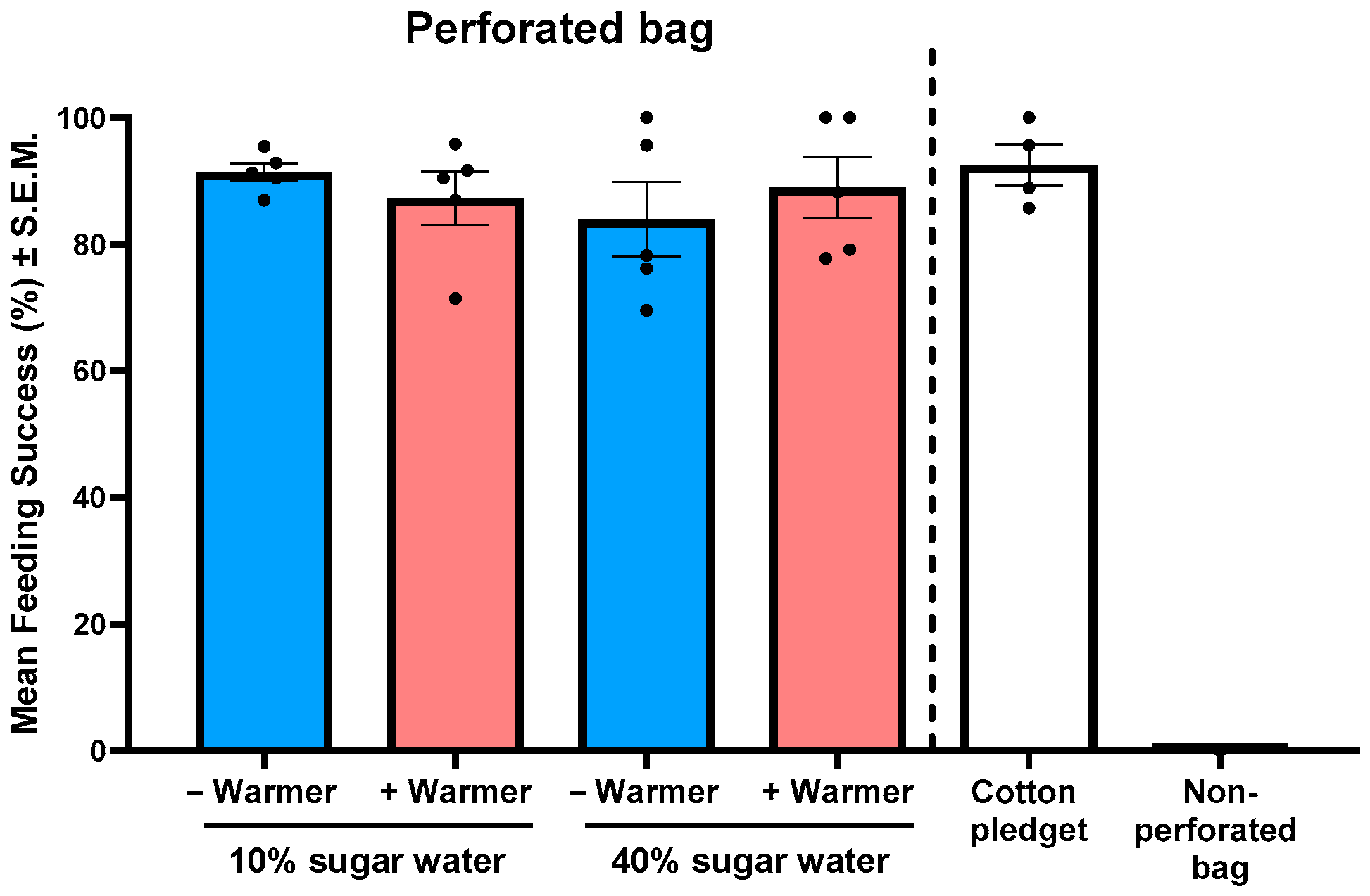
2.2. Mosquito Sugar Feeding Across Membrane Types, Sugar Concentrations, and Thermal Cues
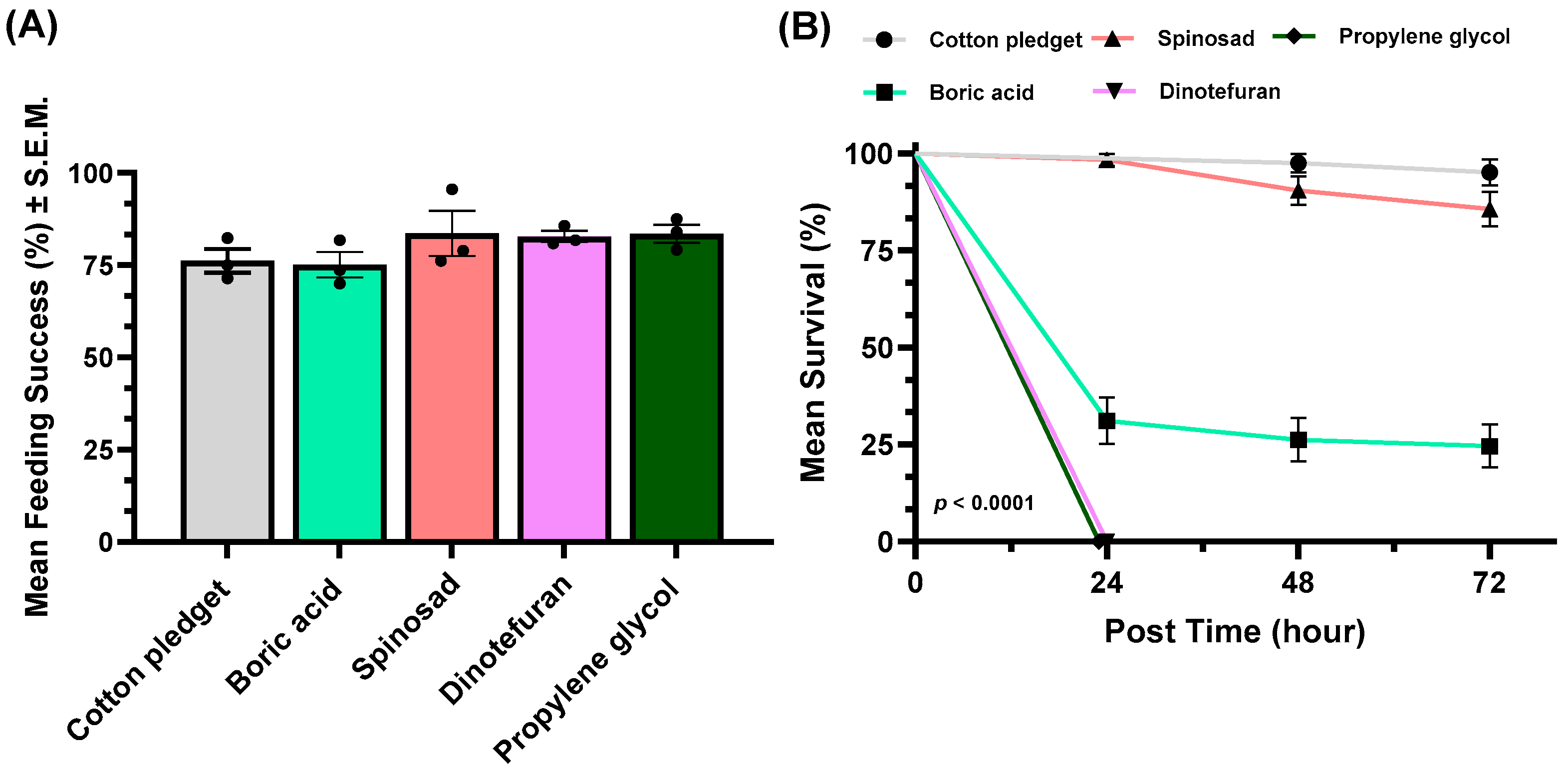
2.3. Acute Toxicity of ATSB Active Ingredients
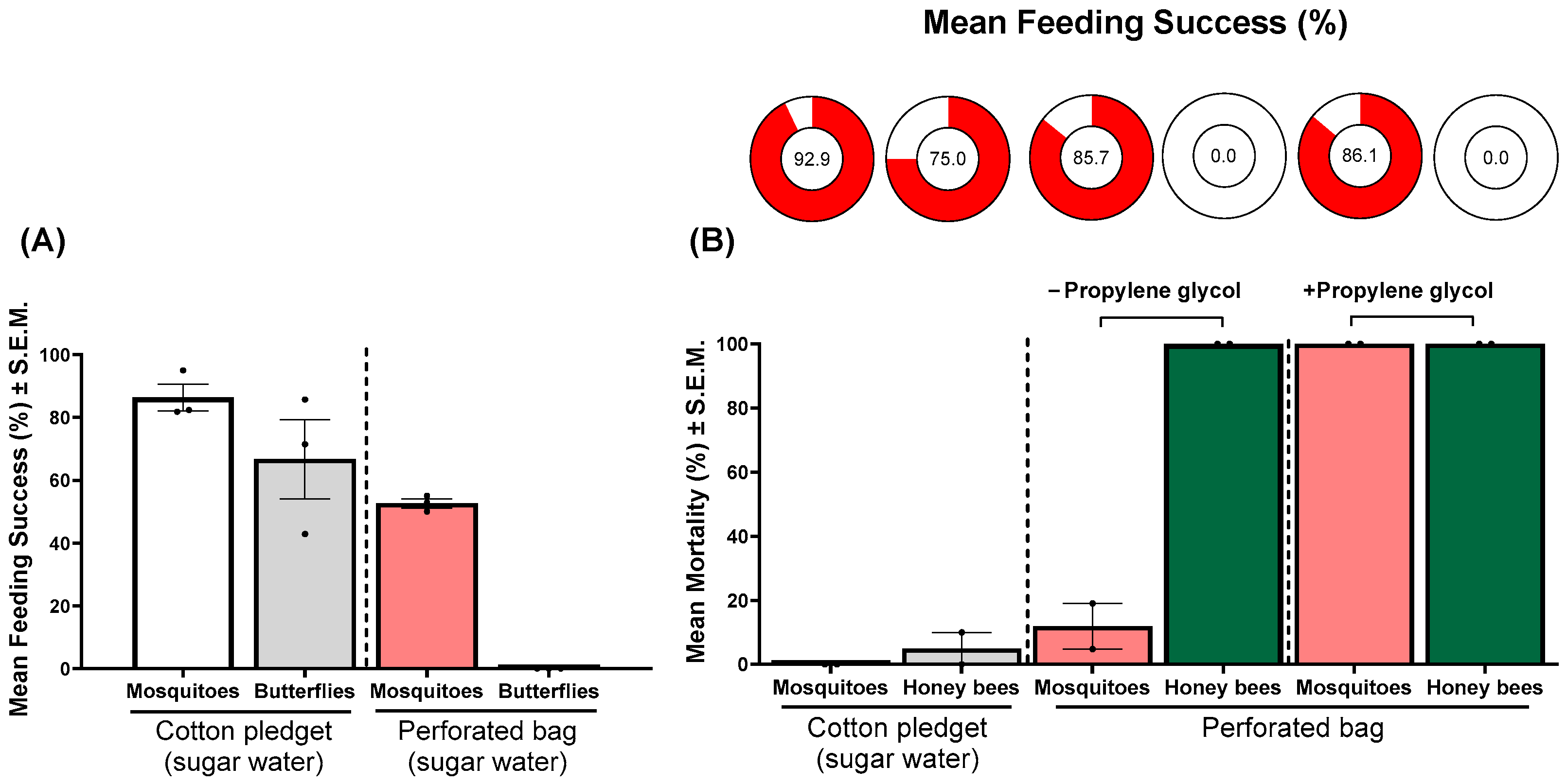
2.4. Sugar Feeding Success and Mortality of Insect Pollinators on Perforated Bag-Based ATSB System
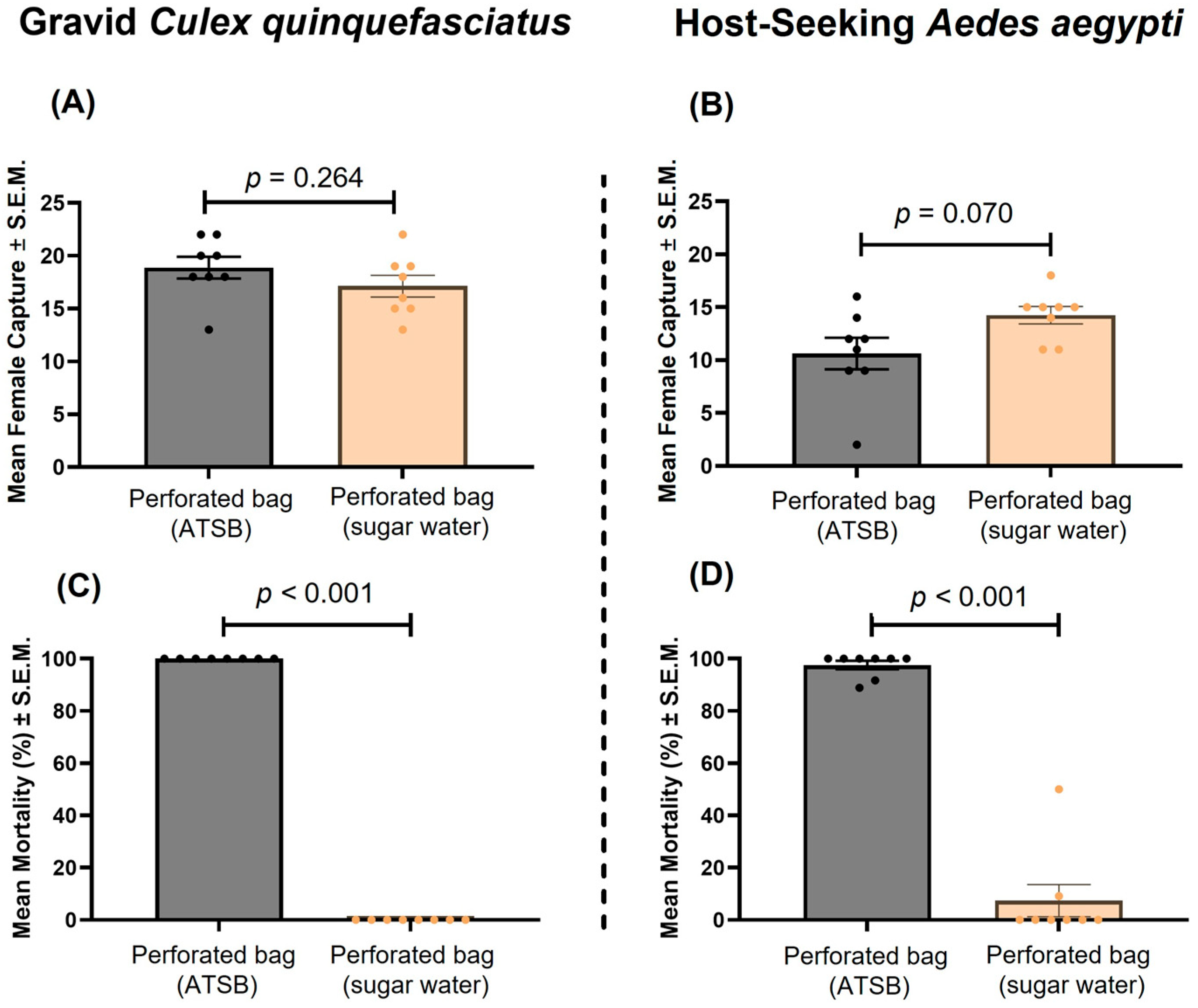
2.5. Semi-Field Validation of Perforated Bag-Based ATSB System
2.6. Statistical Analysis
3. Results
3.1. Mosquito Sugar Feeding Across Membrane Types, Sugar Concentrations, and Thermal Cues
3.2. Acute Toxicity of ATSB Active Ingredients
3.3. Sugar Feeding Success and Mortality of Insect Pollinators on Perforated Bag-Based ATSB System
3.4. Semi-Field Validation of Perforated Bag-Based ATSB System
4. Discussion
Supplementary Materials
Author Contributions
Funding
Data Availability Statement
Acknowledgments
Conflicts of Interest
Abbreviations
| ATSB | Attractive toxic sugar baits |
| BG-GAT | Biogents Gravid Aedes Trap |
| ANOVA | Analysis of Variance |
References
- Gubler, D.J. Human arbovirus infections worldwide. Ann. N. Y. Acad. Sci. 2001, 951, 13–24. [Google Scholar] [CrossRef]
- Hubálek, Z.; Rudolf, I.; Nowotny, N. Arboviruses pathogenic for domestic and wild animals. In Advances in Virus Research; Elsevier: Amsterdam, The Netherlands, 2014; Volume 89, pp. 201–275. [Google Scholar]
- Kim, D.; Burkett-Cadena, N.D.; Reeves, L.E. Changes in mosquito species and blood meal composition associated with adulticide applications. Sci. Rep. 2023, 13, 22087. [Google Scholar] [CrossRef]
- Sass, D.; Li, B.; Clifton, M.; Harbison, J.; Xamplas, C.; Smith, R. The impact of adulticide on Culex abundance and infection rate in North Shore of Cook County, Illinois. J. Am. Mosq. Control Assoc. 2022, 38, 46–58. [Google Scholar]
- Müller, G.C.; Kravchenko, V.D.; Schlein, Y. Decline of Anopheles sergentii and Aedes caspius populations following presentation of attractive toxic (spinosad) sugar bait stations in an oasis. J. Am. Mosq. Control Assoc. 2008, 24, 147–149. [Google Scholar]
- Lea, A.O. Sugar-baited insecticide residues against mosquitoes. Mosq. News 1965, 25, 65–66. [Google Scholar]
- Foster, W.A. Mosquito sugar feeding and reproductive energetics. Annu. Rev. Entomol. 1995, 40, 443–474. [Google Scholar]
- McCrae, A.; Boreham, P.; Ssenkubuge, Y. The behavioural ecology of host selection in Anopheles implexus (Theobald) (Diptera, Culicidae). Bull. Entomol. Res. 1976, 66, 587–631. [Google Scholar]
- Jepson, P.; Healy, T. The location of floral nectar sources by mosquitoes: An advanced bioassay for volatile plant odours and initial studies with Aedes aegypti (L.) (Diptera: Culicidae). Bull. Entomol. Res. 1988, 78, 641–650. [Google Scholar]
- Peach, D.A.; Gries, R.; Young, N.; Lakes, R.; Galloway, E.; Alamsetti, S.K.; Ko, E.; Ly, A.; Gries, G. Attraction of female Aedes aegypti (L.) to aphid honeydew. Insects 2019, 10, 43. [Google Scholar] [CrossRef]
- Joseph, S. Fruit feeding of mosquitoes in nature. Proc. N. J. Mosq. Exterm. Assoc. 1970, 57, 125–131. [Google Scholar]
- Mogi, M.; Miyagi, I. Sugar feeding of Topomyia pseudobarbus (Diptera: Culicidae) in nature. J. Med. Entomol. 1989, 26, 370–371. [Google Scholar] [CrossRef]
- Kumar, S.; Sharma, A.; Samal, R.R.; Kumar, M.; Verma, V.; Sagar, R.K.; Singh, S.P.; Raghavendra, K. Laboratory evaluation of the efficacy of deltamethrin-laced attractive toxic sugar bait formulation on Anopheles stephensi. Malar. J. 2023, 22, 92. [Google Scholar] [CrossRef]
- Qualls, W.A.; Müller, G.C.; Revay, E.E.; Allan, S.A.; Arheart, K.L.; Beier, J.C.; Smith, M.L.; Scott, J.M.; Kravchenko, V.D.; Hausmann, A. Evaluation of attractive toxic sugar bait (ATSB)—Barrier for control of vector and nuisance mosquitoes and its effect on non-target organisms in sub-tropical environments in Florida. Acta Trop. 2014, 131, 104–110. [Google Scholar] [CrossRef]
- Xue, R.-D.; Kline, D.L.; Ali, A.; Barnard, D.R. Application of boric acid baits to plant foliage for adult mosquito control. J. Am. Mosq. Control Assoc. 2006, 22, 497–500. [Google Scholar] [CrossRef]
- Alomar, A.A.; Eastmond, B.H.; Rapti, Z.; Walker, E.D.; Alto, B.W. Ingestion of spinosad-containing toxic sugar bait alters Aedes albopictus vector competence and vectorial capacity for dengue virus. Front. Microbiol. 2022, 13, 933482. [Google Scholar] [CrossRef]
- Müller, G.; Junnila, A.; Qualls, W.; Revay, E.; Kline, D.; Allan, S.; Schlein, Y.; Xue, R. Control of Culex quinquefasciatus in a storm drain system in Florida using attractive toxic sugar baits. Med. Vet. Entomol. 2010, 24, 346–351. [Google Scholar] [CrossRef]
- Müller, G.; Schlein, Y. Sugar questing mosquitoes in arid areas gather on scarce blossoms that can be used for control. Int. J. Parasitol. 2006, 36, 1077–1080. [Google Scholar] [CrossRef]
- Müller, G.C.; Schlein, Y. Efficacy of toxic sugar baits against adult cistern-dwelling Anopheles claviger. Trans. R. Soc. Trop. Med. Hyg. 2008, 102, 480–484. [Google Scholar] [CrossRef]
- Müller, G.C.; Beier, J.C.; Traore, S.F.; Toure, M.B.; Traore, M.M.; Bah, S.; Doumbia, S.; Schlein, Y. Successful field trial of attractive toxic sugar bait (ATSB) plant-spraying methods against malaria vectors in the Anopheles gambiae complex in Mali, West Africa. Malar. J. 2010, 9, 210. [Google Scholar] [CrossRef]
- Alomar, A.A.; Alto, B.W.; Walker, E.D. Spinosyns delivered in sugar meals to Aedes aegypti and Aedes albopictus (Diptera: Culicidae): Acute toxicity and subacute effects on survival, fecundity, and fertility. J. Med. Entomol. 2022, 59, 623–630. [Google Scholar] [CrossRef]
- Fiorenzano, J.M.; Koehler, P.G.; Xue, R.-D. Attractive toxic sugar bait (ATSB) for control of mosquitoes and its impact on non-target organisms: A review. Int. J. Environ. Res. Public Health 2017, 14, 398. [Google Scholar] [CrossRef]
- Qualls, W.A.; Müller, G.C.; Khallaayoune, K.; Revay, E.E.; Zhioua, E.; Kravchenko, V.D.; Arheart, K.L.; Xue, R.-D.; Schlein, Y.; Hausmann, A. Control of sand flies with attractive toxic sugar baits (ATSB) and potential impact on non-target organisms in Morocco. Parasites Vectors 2015, 8, 87. [Google Scholar] [CrossRef]
- Revay, E.E.; Müller, G.C.; Qualls, W.A.; Kline, D.L.; Naranjo, D.P.; Arheart, K.L.; Kravchenko, V.D.; Yefremova, Z.; Hausmann, A.; Beier, J.C. Control of Aedes albopictus with attractive toxic sugar baits (ATSB) and potential impact on non-target organisms in St. Augustine, Florida. Parasitol. Res. 2014, 113, 73–79. [Google Scholar] [CrossRef]
- Willis, G.H.; McDowell, L.L. Pesticide persistence on foliage. Rev. Environ. Contam. Toxicol. Contin. Residue Rev. 1987, 23–73. [Google Scholar]
- Gerberg, E.J.; Barnard, D.R.; Ward, R.A. Manual for Mosquito Rearing and Experimental Techniques; American Mosquito Control Association, Inc.: Sacramento, CA, USA, 1994. [Google Scholar]
- Kim, D.; Stenn, T.M.S.; Skelhorn, E.K.; Dittman, S.M.; Burkett-Cadena, N.D. A simple and low-cost artificial blood feeding system for mosquito colony maintenance and experimental applications. J. Med. Entomol. 2025, 62, 1616–1621. [Google Scholar] [CrossRef]
- Kim, D.; DeBriere, T.J.; Eastmond, B.H.; Alomar, A.A.; Yaren, O.; McCarter, J.; Bradley, K.M.; Benner, S.A.; Alto, B.W.; Burkett-Cadena, N.D. Rapid detection of West Nile and Dengue viruses from mosquito saliva by loop-mediated isothermal amplification and displaced probes. PLoS ONE 2024, 19, e0298805. [Google Scholar] [CrossRef]
- Kim, D.; Stenn, T.M.S.; Cooper, V.M.; Rockwell, M.N.; Wilson, B.C.; McCollum, M.T.; O’Brien, C.R.; Burkett-Cadena, N.D. A mycelium-based carbon dioxide source for trapping vector mosquitoes. J. Med. Entomol. 2025, 62, 1338–1343. [Google Scholar]
- Dias, L.S.; Caldeira, J.C.; Bauzer, L.G.; Lima, J.B. Assessment of synthetic membranes for artificial blood feeding of culicidae. Insects 2020, 12, 15. [Google Scholar] [CrossRef]
- Lyski, Z.L.; Saredy, J.J.; Ciano, K.A.; Stem, J.; Bowers, D.F. Blood feeding position increases success of recalcitrant mosquitoes. Vector-Borne Zoonotic Dis. 2011, 11, 1165–1171. [Google Scholar] [CrossRef]
- Baughman, T.; Peterson, C.; Ortega, C.; Preston, S.R.; Paton, C.; Williams, J.; Guy, A.; Omodei, G.; Johnson, B.; Williams, H. A highly stable blood meal alternative for rearing Aedes and Anopheles mosquitoes. PLoS Negl. Trop. Dis. 2017, 11, e0006142. [Google Scholar]
- Traore, M.M.; Junnila, A.; Traore, S.F.; Doumbia, S.; Revay, E.E.; Kravchenko, V.D.; Schlein, Y.; Arheart, K.L.; Gergely, P.; Xue, R.D.; et al. Large-scale field trial of attractive toxic sugar baits (ATSB) for the control of malaria vector mosquitoes in Mali, West Africa. Malar. J. 2020, 19, 72. [Google Scholar] [CrossRef]
- Tyler-Julian, K.; Darrisaw, C.; Lloyd, A.; Hoel, D. The use of frozen, food-grade blood to successfully maintain colonies of four species of mosquitoes (Diptera: Culicidae). J. Insect Sci. 2021, 21, 1. [Google Scholar] [CrossRef]
- Andersson, I.H. The effect of sugar meals and body size on fecundity and longevity of female Aedes communis (Diptera: Culicidae). Physiol. Entomol. 1992, 17, 203–207. [Google Scholar] [CrossRef]
- Takken, W.; Knols, B.G. Odor-mediated behavior of Afrotropical malaria mosquitoes. Annu. Rev. Entomol. 1999, 44, 131–157. [Google Scholar]
- Andreazza, F.; Oliveira, E.E.; Martins, G.F. Implications of sublethal insecticide exposure and the development of resistance on mosquito physiology, behavior, and pathogen transmission. Insects 2021, 12, 917. [Google Scholar] [CrossRef]
- Xue, R.-D.; Barnard, D.R. Boric acid bait kills adult mosquitoes (Diptera: Culicidae). J. Econ. Entomol. 2003, 96, 1559–1562. [Google Scholar] [CrossRef]
- Aguilar, F.; Crebelli, R.; Dusemund, B.; Galtier, P.; Gott, D.; Gundert-Remy, U.; Koenig, J.; Leblanc, J.-C.; Mosesso, P.; Mortensen, A. Scientific Opinion on the re-evaluation of boric acid (E 284) and sodium tetraborate (borax) (E 285) as food additives. EFSA J. 2013, 11, 3407. [Google Scholar]
- Thompson, D.A.; Lehmler, H.-J.; Kolpin, D.W.; Hladik, M.L.; Vargo, J.D.; Schilling, K.E.; LeFevre, G.H.; Peeples, T.L.; Poch, M.C.; LaDuca, L.E. A critical review on the potential impacts of neonicotinoid insecticide use: Current knowledge of environmental fate, toxicity, and implications for human health. Environ. Sci. Process. Impacts 2020, 22, 1315–1346. [Google Scholar] [CrossRef]
- Henry, M.; Beguin, M.; Requier, F.; Rollin, O.; Odoux, J.-F.; Aupinel, P.; Aptel, J.; Tchamitchian, S.; Decourtye, A. A common pesticide decreases foraging success and survival in honey bees. Science 2012, 336, 348–350. [Google Scholar] [CrossRef]
- Vogel, D. The politics of precaution: Regulating health, safety, and environmental risks in Europe and the United States. In The Politics of Precaution; Princeton University Press: Princeton, NJ, USA, 2012. [Google Scholar]
- Pullmann Lindsley, H.; Lyons, H.B.; Leon-Noreña, M.; Pitts, R.J. Survivorship-reducing effect of propylene glycol on vector mosquito populations and its potential use in attractive toxic sugar baits. Insects 2022, 13, 595. [Google Scholar] [CrossRef]
- Krenn, H.W.; Plant, J.D.; Szucsich, N.U. Mouthparts of flower-visiting insects. Arthropod Struct. Dev. 2005, 34, 1–40. [Google Scholar] [CrossRef]
- Clements, A.N. The Biology of Mosquitoes, Volume 1: Development, Nutrition and Reproduction; CABI Press: Oxfordshire, UK, 2023. [Google Scholar]
- Snodgrass, R.E. The Anatomical Life of the Mosquito; Smithsonian Institution: Washington, DC, USA, 1959; Volume 4388. [Google Scholar]
- Boggs, C.L.; Watt, W.B.; Ehrlich, P.R. Butterflies: Ecology and Evolution Taking Flight; University of Chicago Press: Chicago, IL, USA, 2003. [Google Scholar]
- Eastham, L.E.S.; Eassa, Y. The feeding mechanism of the butterfly Pieris brassicae L. Philos. Trans. R. Soc. Lond. Ser. B Biol. Sci. 1955, 239, 1–43. [Google Scholar]
- Zhu, R.; Lv, H.; Liu, T.; Yang, Y.; Wu, J.; Yan, S. Feeding kinematics and nectar intake of the honey bee tongue. J. Insect Behav. 2016, 29, 325–339. [Google Scholar] [CrossRef]
- Snodgrass, R.E. Anatomy of the Honey Bee; Cornell University Press: Ithaca, NY, USA, 1956. [Google Scholar]
- Srygley, R.B.; Dudley, R. Correlations of the position of center of body mass with butterfly escape tactics. J. Exp. Biol. 1993, 174, 155–166. [Google Scholar] [CrossRef]
- Floore, T.G. Mosquito larval control practices: Past and present. J. Am. Mosq. Control Assoc. 2006, 22, 527–533. [Google Scholar] [CrossRef] [PubMed]
- Brady, O.J.; Godfray, H.C.J.; Tatem, A.J.; Gething, P.W.; Cohen, J.M.; McKenzie, F.E.; Perkins, T.A.; Reiner, R.C.; Tusting, L.S.; Sinka, M.E. Vectorial capacity and vector control: Reconsidering sensitivity to parameters for malaria elimination. Trans. R. Soc. Trop. Med. Hyg. 2016, 110, 107–117. [Google Scholar] [CrossRef] [PubMed]
- Beier, J.C.; Müller, G.C.; Gu, W.; Arheart, K.L.; Schlein, Y. Attractive toxic sugar bait (ATSB) methods decimate populations of Anopheles malaria vectors in arid environments regardless of the local availability of favoured sugar-source blossoms. Malar. J. 2012, 11, 31. [Google Scholar] [CrossRef] [PubMed]
- Muyaga, L.L.; Meza, F.C.; Kahamba, N.F.; Njalambaha, R.M.; Msugupakulya, B.J.; Kaindoa, E.W.; Ngowo, H.S.; Okumu, F.O. Effects of vegetation densities on the performance of attractive targeted sugar baits (ATSBs) for malaria vector control: A semi-field study. Malar. J. 2023, 22, 190. [Google Scholar] [CrossRef]
- Katagi, T. Photodegradation of pesticides on plant and soil surfaces. Rev. Environ. Contam. Toxicol. 2004, 182, 1–78. [Google Scholar]



| Membrane Type | Fed (n) | Unfed (n) | Total (n) | Feeding Success (%) |
|---|---|---|---|---|
| Cell culture bag (FEP) | 0 | 20 | 20 | 0 |
| Dialysis film | 2 | 18 | 20 | 10 |
| DuraSeal film | 0 | 20 | 20 | 0 |
| Parafilm | 0 | 20 | 20 | 0 |
| Parafilm + ATP | 1 | 19 | 20 | 5 |
| Polyisoprene | 0 | 20 | 20 | 0 |
| Polyethylene | 0 | 20 | 20 | 0 |
| Lamb skin | 11 | 9 | 20 | 55 |
| Latex | 0 | 20 | 20 | 0 |
| Perforated bag | 20 | 3 | 23 | 87 |
| Control (cotton pledget) | 19 | 1 | 20 | 95 |
Disclaimer/Publisher’s Note: The statements, opinions and data contained in all publications are solely those of the individual author(s) and contributor(s) and not of MDPI and/or the editor(s). MDPI and/or the editor(s) disclaim responsibility for any injury to people or property resulting from any ideas, methods, instructions or products referred to in the content. |
© 2026 by the authors. Licensee MDPI, Basel, Switzerland. This article is an open access article distributed under the terms and conditions of the Creative Commons Attribution (CC BY) license.
Share and Cite
Kim, D.; Shine, L.C.; Stenn, T.M.S.; Wilson, B.C.; Caragata, E.P.; Alto, B.W.; Burkett-Cadena, N.D. Evaluating a Novel Method to Limit Non-Target Mortality in Attractive Toxic Sugar Bait Systems. Insects 2026, 17, 370. https://doi.org/10.3390/insects17040370
Kim D, Shine LC, Stenn TMS, Wilson BC, Caragata EP, Alto BW, Burkett-Cadena ND. Evaluating a Novel Method to Limit Non-Target Mortality in Attractive Toxic Sugar Bait Systems. Insects. 2026; 17(4):370. https://doi.org/10.3390/insects17040370
Chicago/Turabian StyleKim, Dongmin, Liam C. Shine, Tanise Moitinho S. Stenn, Bryna C. Wilson, Eric P. Caragata, Barry W. Alto, and Nathan D. Burkett-Cadena. 2026. "Evaluating a Novel Method to Limit Non-Target Mortality in Attractive Toxic Sugar Bait Systems" Insects 17, no. 4: 370. https://doi.org/10.3390/insects17040370
APA StyleKim, D., Shine, L. C., Stenn, T. M. S., Wilson, B. C., Caragata, E. P., Alto, B. W., & Burkett-Cadena, N. D. (2026). Evaluating a Novel Method to Limit Non-Target Mortality in Attractive Toxic Sugar Bait Systems. Insects, 17(4), 370. https://doi.org/10.3390/insects17040370