Optimizing Rearing of Helicoverpa zea: Impacts of Pupal Maturity, Emergence Synchrony, and Adult Cohort Size


Simple Summary
Abstract
1. Introduction
2. Materials and Methods
2.1. Sources of Helicoverpa zea Populations
2.2. Effect of Pupal Maturity on Reproduction of Helicoverpa zea (Trial-I)
2.3. Effect of Male/Female Emergence Synchrony on Mating and Reproduction of Helicoverpa zea (Trial-II)
2.4. Effect of Cohort Size in Adult Cages on Mating and Reproduction of Helicoverpa zea (Trial-III)
2.5. Data Analysis
3. Results
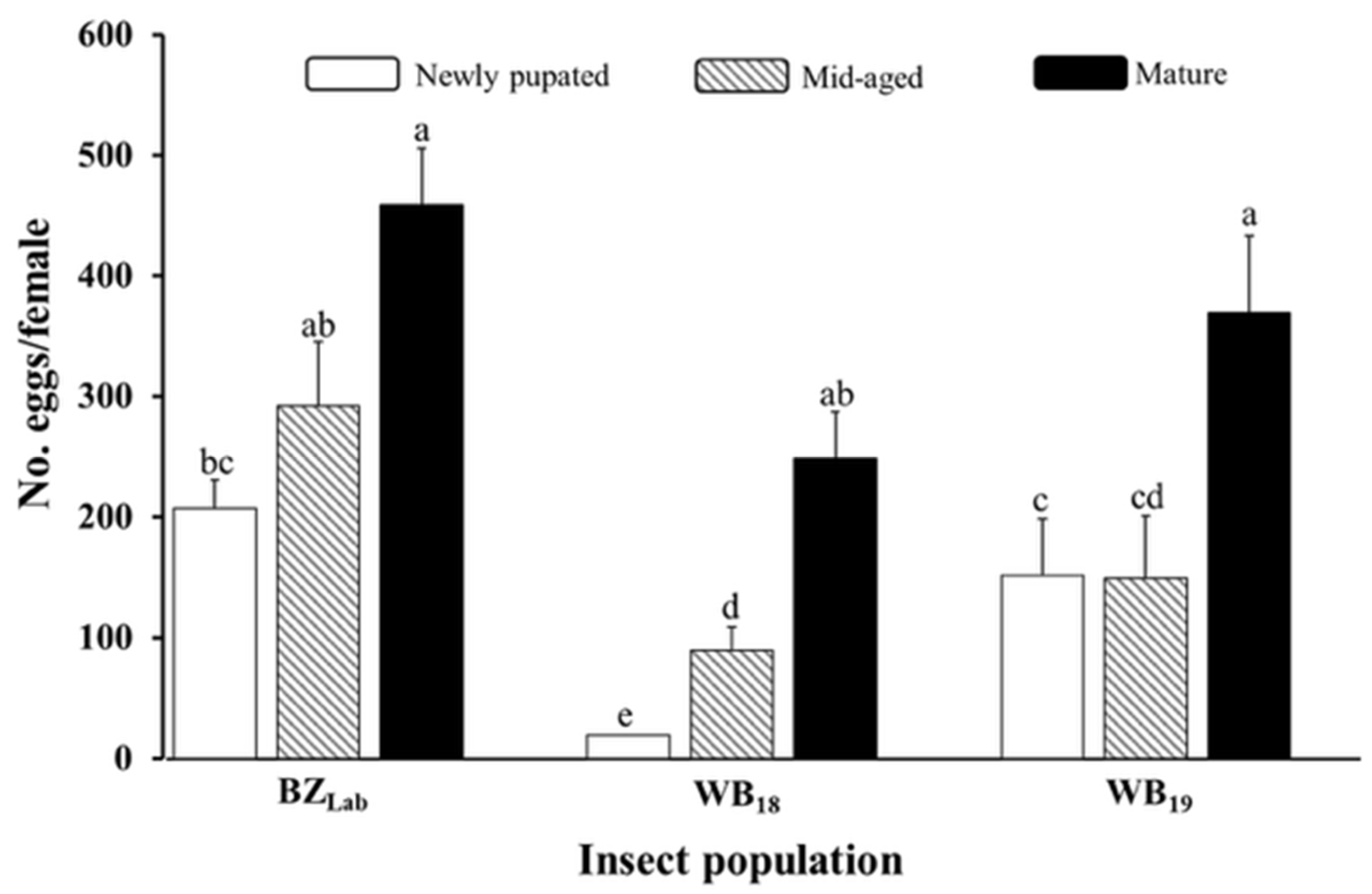
3.1. Effect of Pupal Maturity on Reproduction of Helicoverpa zea
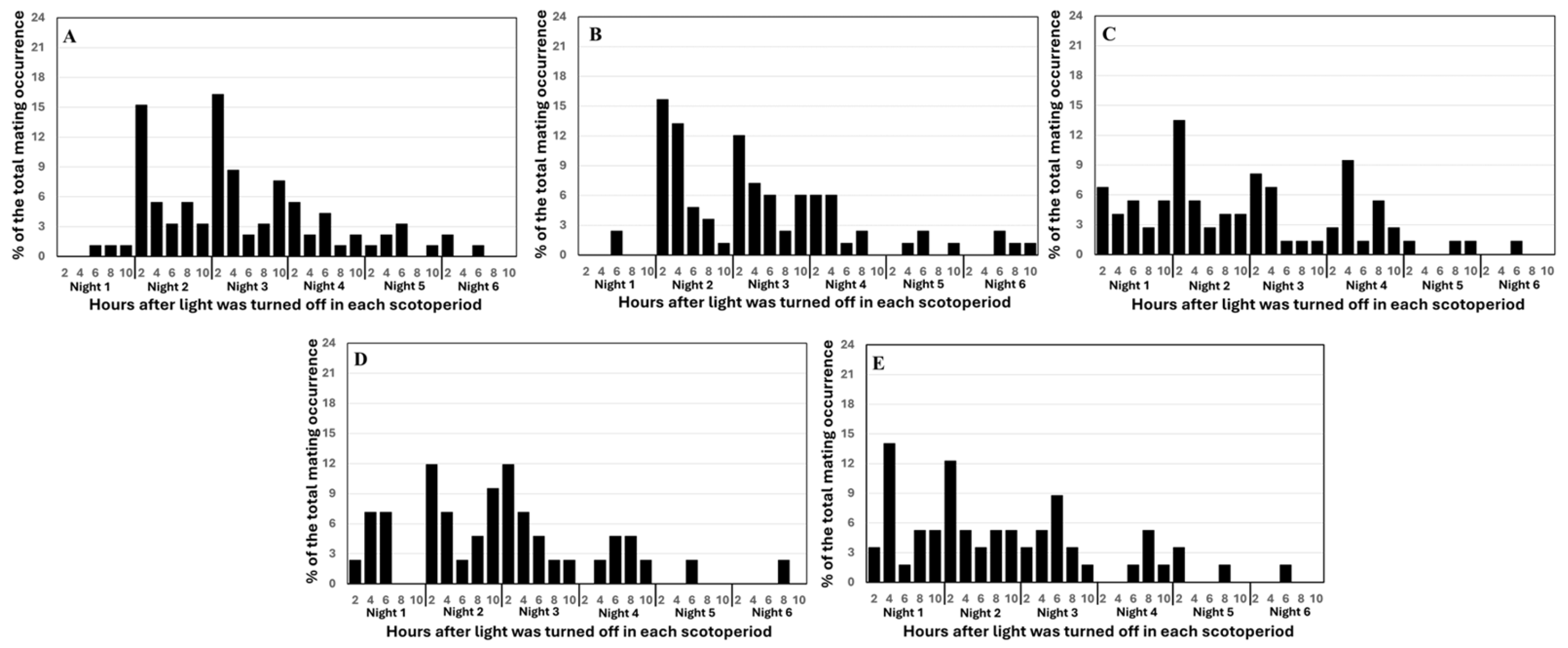
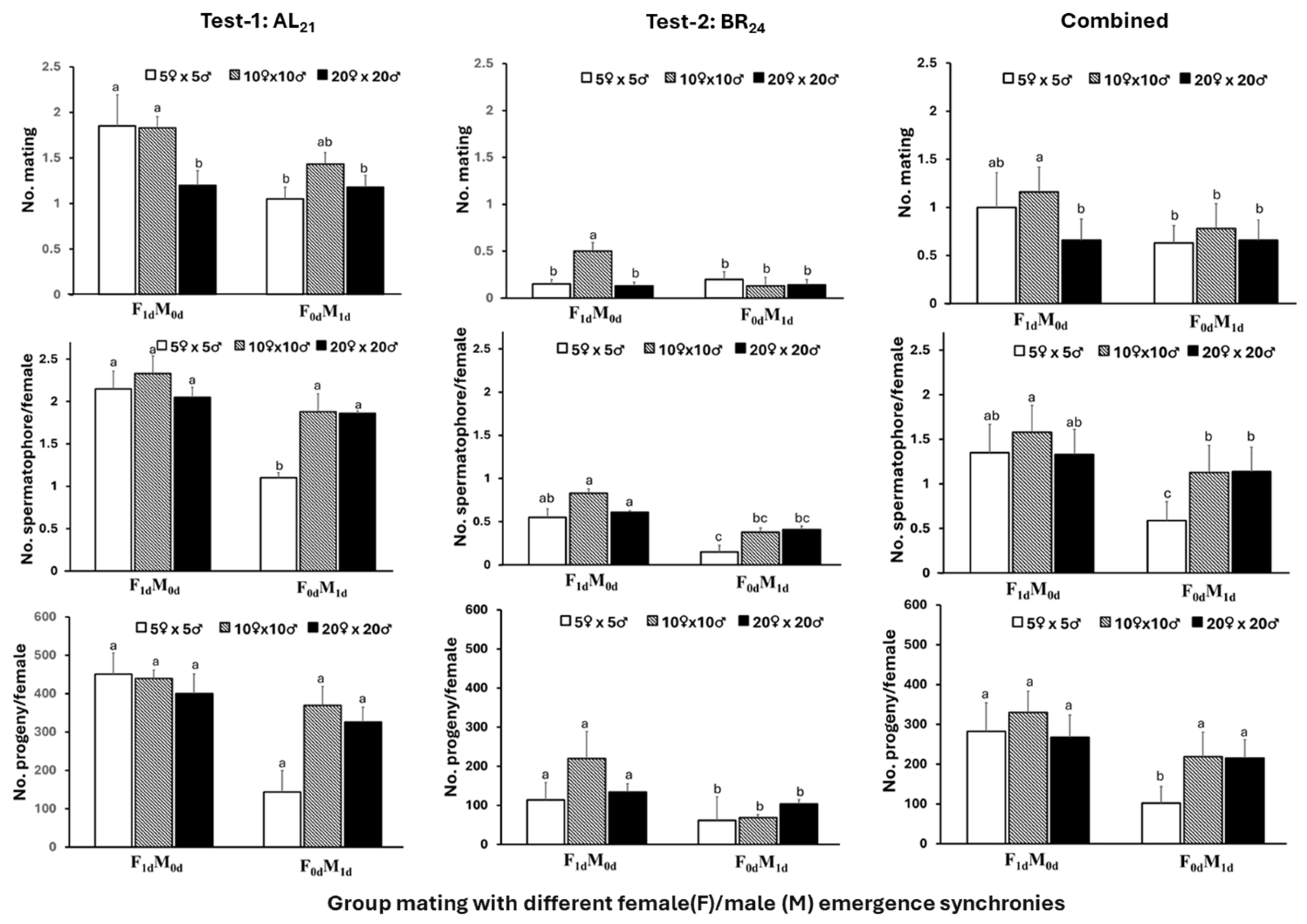
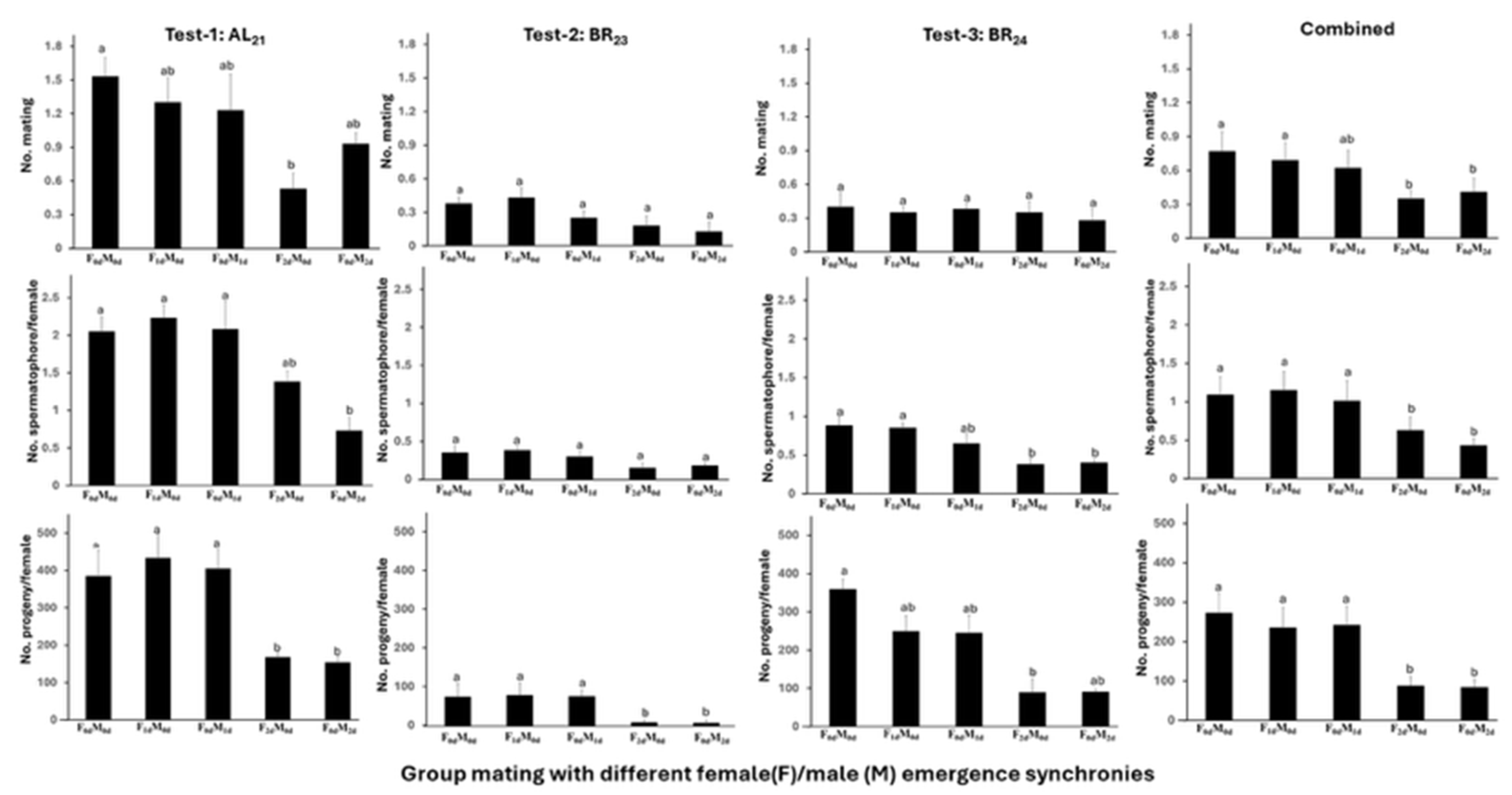
3.2. Effect of Male/Female Emergence Synchrony on Mating and Reproduction of Helicoverpa zea
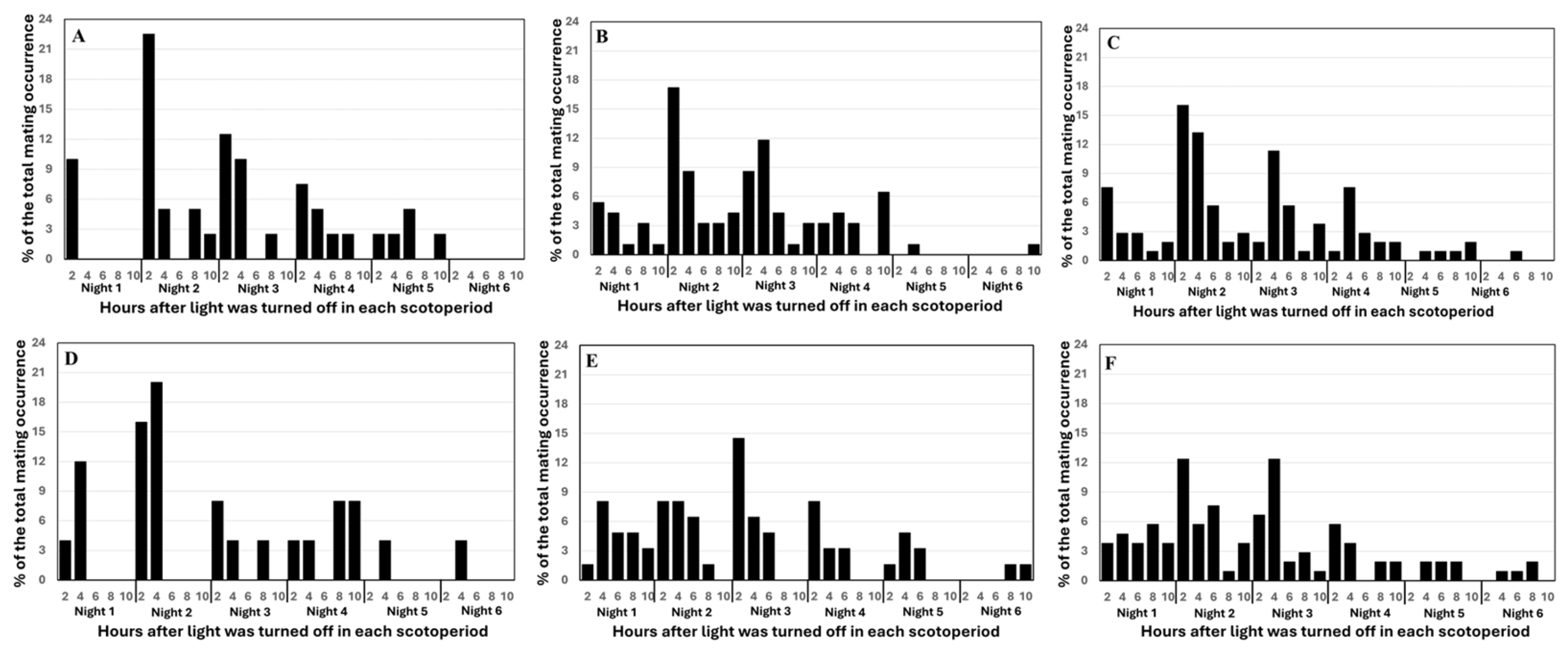
3.3. Effect of Cohort Size in Adult Cages on Mating and Reproduction of Helicoverpa zea
4. Discussion
Supplementary Materials
Author Contributions
Funding
Data Availability Statement
Acknowledgments
Conflicts of Interest
References
- Capinera, J.L. Handbook of Vegetable Pests; Academic Press: San Diego, CA, USA, 2001. [Google Scholar]
- Cook, K.A.; Weinzierl, R. Corn Earworm (Helicoverpa zea). Insect Fact Sheet. University of Illinois. 2004. Available online: http://ipm.illinois.edu/fieldcrops/insects/corn_earworm.pdf (accessed on 15 January 2026).
- Williams, M.R. Cotton insect losses 2010. In Proceedings of the 2011 Beltwide Cotton Conferences, Atlanta, GA, USA, 4–7 January 2011. [Google Scholar]
- Fleming, D.; Musser, F.; Reisig, D.; Greene, J.; Taylor, S.; Parajulee, M.; Lorenz, G.; Catchot, A.; Gore, J.; Kerns, D.; et al. Effects of transgenic Bacillus thuringiensis cotton on insecticide use, Heliothine counts, plant damage, and cotton yield: A meta-analysis, 1996–2015. PLoS ONE 2018, 13, e0200131. [Google Scholar] [CrossRef] [PubMed]
- Reisig, D.D.; Kurtz, R. Bt resistance implications for Helicoverpa zea (Lepidoptera: Noctuidae) insecticide resistance management in the United States. Environ. Entomol. 2018, 47, 1357–1364. [Google Scholar] [CrossRef] [PubMed]
- Tabashnik, B.E.; Fabrick, J.A.; Carrière, Y. Global patterns of insect resistance to transgenic Bt crops: The first 25 years. J. Econ. Entomol. 2023, 116, 297–309. [Google Scholar] [CrossRef] [PubMed]
- Huang, F. Resistance of the fall armyworm, Spodoptera frugiperda (J. E. Smith), to transgenic Bacillus thuringiensis Cry1F corn in the Americas: Lessons and implications for Bt corn IRM in China. Insect Sci. 2021, 28, 574–589. [Google Scholar] [CrossRef]
- Yang, F.; Kerns, D.L.; Brown, S.; Kurtz, R.; Dennehy, T.; Braxton, B.; Head, G.; Huang, F. Performance and cross-crop resistance of Cry1F-maize selected Spodoptera frugiperda on transgenic Bt cotton: Implications for resistance management. Sci. Rep. 2016, 6, 28059. [Google Scholar] [CrossRef]
- Reay-Jones, F.P.F. Pest status and management of corn earworm (Lepidoptera: Noctuidae) in field corn in the United States. J. Integr. Pest Manag. 2019, 10, 19. [Google Scholar] [CrossRef]
- US EPA (U.S. Environmental Protection Agency). Biopesticides Registration Action Document: Bacillus thuringiensis Plant-Incorporated Protectants. Biopesticides and Pollution Prevention Division, Washington, DC. 2001. Available online: https://www3.epa.gov/pesticides/chem_search/reg_actions/pip/bt_brad.htm (accessed on 16 March 2026).
- US-EPA (U.S. Environmental Protection Agency). White Paper on Resistance in Lepidopteran Pests of Bacillus thuringiensis (Bt) Plant Incorporated Protectants in the United States. U.S. 2018, Environmental Protection Agency, Office of Pesticide Programs, Washington, DC. 2018. Available online: https://www.epa.gov/sites/default/files/2018-07/documents/position_paper_07132018.pdf (accessed on 15 January 2026).
- Bilbo, T.R.; Reay-Jones, F.P.F.; Reisig, D.D.; Greene, J.K. Susceptibility of corn earworm (Lepidoptera: Noctuidae) to Cry1A.105 and Cry2Ab2 in North and South Carolina. J. Econ. Entomol. 2019, 112, 1845–1857. [Google Scholar] [CrossRef]
- Kaur, G.; Guo, J.; Brown, S.; Head, G.P.; Price, P.A.; Paula-Moraes, S.; Ni, X.; Dimase, M.; Huang, F. Field-evolved resistance of Helicoverpa zea (Boddie) to transgenic maize expressing pyramided Cry1A. 105/Cry2Ab2 proteins in northeast Louisiana, the United States. J. Invertebr. Pathol. 2019, 163, 11–20. [Google Scholar] [CrossRef]
- Niu, Y.; Oyediran, I.; Yu, W.; Lin, S.; Dimase, M.; Brown, S.; Reay-Jones, F.P.; Cook, D.; Reisig, D.; Thrash, B.; et al. Populations of Helicoverpa zea (Boddie) in the southeastern United States are commonly resistant to Cry1Ab, but still susceptible to Vip3Aa20 expressed in MIR 162 corn. Toxins 2021, 13, 63. [Google Scholar] [CrossRef]
- Yu, W.; Lin, S.; Dimase, M.; Niu, Y.; Brown, S.; Head, G.P.; Price, P.A.; Reay-Jones, F.P.F.; Cook, D.; Reisig, D.; et al. Extended investigation of field-evolved resistance of the corn earworm Helicoverpa zea (Lepidoptera: Noctuidae) to Bacillus thuringiensis Cry1A.105 and Cry2Ab2 proteins in the southeastern United States. J. Invertebr. Pathol. 2021, 183, 107560. [Google Scholar] [CrossRef]
- Dively, G.P.; Kuhar, T.P.; Taylor, S.V.; Doughty, H.; Holmstrom, K.; Gilrein, D.O.; Nault, B.A.; Ingerson-Mahar, J.; Huseth, A.; Reisig, D.; et al. Extended sentinel monitoring of Helicoverpa zea resistance to Cry and Vip3Aa toxins in Bt sweet corn: Assessing changes in phenotypic and allele frequencies of resistance. Insects 2023, 14, 577. [Google Scholar] [CrossRef] [PubMed]
- Patla, B.; Silva, T.; Lin, S.; Head, G.P.; Reay-Jones, F.P.F.; Ni, X.; Bernaola, L.; Brown, S.; Cook, D.; Villegas, J.; et al. Susceptibility to eight common chemical insecticides in Helicoverpa zea populations from the southern United States. Crop Prot. 2026, 202, 107517. [Google Scholar] [CrossRef]
- Ali, M.I.; Luttrell, R.G.; Abel, C. Monitoring Bt susceptibilities in Helicoverpa zea and Heliothis virescens: Results of 2006 studies. In Proceedings of the Beltwide Cotton Conferences, New Orleans, LA, USA, 9–12 January 2007. [Google Scholar]
- Luttrell, R.G.; Ali, M.I. Exploring selection for Bt resistance in Heliothines: Results of laboratory and field studies. In Proceedings of the 2007 Beltwide Cotton Conferences, New Orleans, LA, USA, 9–12 January 2007. [Google Scholar]
- Anilkumar, K.J.; Pusztai-Carey, M.; Moar, W.J. Fitness costs associated with Cry1Ac-resistant Helicoverpa zea (Lepidoptera: Noctuidae): A factor countering selection for resistance to Bt cotton? J. Econ. Entomol. 2008, 101, 1421–1431. [Google Scholar] [CrossRef] [PubMed]
- Glover, J.P.; Portilla, M.; Reddy, G.V.P. Development, survival, and fecundity of Helicoverpa zea on five weedy host plants. Fla. Entomol. 2023, 106, 45–50. [Google Scholar] [CrossRef]
- Lin, S.; Oyediran, I.; Niu, Y.; Brown, S.; Cook, D.; Ni, X.; Zhang, Y.; Reay-Jones, F.P.; Chen, J.S.; Wen, Z.; et al. Resistance allele frequency to Cry1Ab and Vip3Aa20 in Helicoverpa zea (Boddie) (Lepidoptera: Noctuidae) in Louisiana and three other southeastern US states. Toxins 2022, 4, 270. [Google Scholar] [CrossRef]
- Yu, W.; Head, G.P.; Price, P.; Brown, S.; Cook, D.; Ni, X.; Reay-Jones, F.P.F.; Dimase, M.; Huang, F. Estimation of resistance allele frequencies to Cry1A. 105 and Cry2Ab2 in the corn earworm (Lepidoptera: Noctuidae) with F2 isolines generated from a mass-mating method. Crop Prot. 2022, 161, 106054. [Google Scholar] [CrossRef]
- Snow, J.W.; Callahan, P.S. Laboratory mating studies of the corn earworm, Heliothis zea (Lepidoptera: Noctuidae). Ann. Entomol. Soc. Am. 1967, 60, 1066–1071. [Google Scholar] [CrossRef]
- DiFonzo, C. The Handy Bt Trait Table for U.S. Corn Production. 2025. Available online: https://www.texasinsects.org/uploads/4/9/3/0/49304017/bttraittable_march2025.pdf (accessed on 15 January 2026).
- Silva, T.; Ying, N.; Towles, T.; Brown, S.; Walker, W.; Huang, F. Selection, effective dominance, and completeness of Cry1A. 105/Cry2Ab2 dual-protein resistance in Helicoverpa zea (Boddie) (Lepidoptera: Noctuidae). J. Integr. Agric. 2023, 22, 2151–2161. [Google Scholar] [CrossRef]
- Reisig, D.; Buntin, G.D.; Greene, J.K.; Paula-Moraes, S.V.; Reay-Jones, F.; Roberts, P.; Smith, R.; Taylor, S.V. Magnitude and extent of Helicoverpa zea resistance levels to Cry1Ac and Cry2Ab2 across the southeastern USA. Insects 2023, 14, 262. [Google Scholar] [CrossRef]
- Yang, F.; González, J.C.S.; Williams, J.; Cook, D.C.; Gilreath, R.T.; Kerns, D.L. Occurrence and ear damage of Helicoverpa zea on transgenic Bacillus thuringiensis maize in the field in Texas, U.S. and its susceptibility to Vip3A protein. Toxins 2019, 11, 102. [Google Scholar] [CrossRef]
- Waldbauer, G.P.; Cohen, R.W.; Friedman, S. An improved procedure for laboratory rearing of the corn earworm, Heliothis zea (Lepidoptera: Noctuidae). Great Lakes Entomol. 1984, 17, 113–118. [Google Scholar] [CrossRef]
- Hardwick, D.F. The corn earworm complex. Memoirs Entomol. Soc. Canada 1965, 97, 5–247. [Google Scholar] [CrossRef]
- Lin, S.; Head, G.; Price, P.; Niu, Y.; Huang, F. Relative fitness of susceptible and Cry1A. 105/Cry2Ab2-single-/dual-protein-resistant Helicoverpa zea (Boddie) (Lepidoptera: Noctuidae) on non-Bt diet and a diet containing a low concentration of two proteins. Insect Sci. 2023, 30, 398–410. [Google Scholar] [CrossRef] [PubMed]
- Lin, S. (Louisiana State University Agricultural Center, Baton Rouge, LA, USA). Personal communication, 2026.
- Chilcutt, C.F. Cannibalism of Helicoverpa zea from Bacillus thuringiensis (Bt) Transgenic Corn Versus Non-Bt Corn. J. Econ. Entomol. 2006, 99, 728–732. [Google Scholar] [CrossRef]
- Lin, P.-A.; Miko, I.; Felton, G.W. Mated Female Helicoverpa zea Bursa Copulatrix and Spermatophores. 2018. Available online: https://figshare.com/articles/figure/The_inner_surface_of_female_Helicoverpa_zea_before_and_after_mating_png/5746761/2 (accessed on 24 October 2024).
- SAS Institute Inc. SAS Software 9.4 Version 2025.12; SAS Institute Inc.: Cary, NC, USA, 2025. [Google Scholar]
- Lingren, P.D.; Warner, W.B.; Raulston, J.R.; Kehat, M.; Henneberry, T.J.; Pair, S.D.; Zvirgzdins, A.; Gillespie, J.M. Observations on the emergence of adults from natural populations of corn earworm, Heliothis zea (Boddie) (Lepidoptera: Noctuidae). Environ. Entomol. 1988, 17, 254–258. [Google Scholar] [CrossRef]
- Dillard, D.; Reisig, D.D.; Schug, H.T.; Burrack, H.J. Moisture and soil type are primary drivers of Helicoverpa zea pupation. Environ. Entomol. 2023, 52, 847–852. [Google Scholar] [CrossRef]
- Schardong, I.S.; Reisig, D.D.; Possebom, T.; Heitman, J. Helicoverpa zea Boddie pupal success and adult eclosion across variable soil type and moisture. Environ. Entomol. 2024, 53, 511–520. [Google Scholar] [CrossRef]
- Huang, F.; Subramanyam, B. Effects of delayed mating on reproductive performance of Plodia interpunctella (Hubner) (Lepidoptera: Pyralidae). J. Stored Prod. Res. 2003, 39, 53–63. [Google Scholar] [CrossRef]
- Wenninger, E.J.; Averill, A.L. Effects of delayed mating on reproductive output of female oriental beetle Anomala orientalis (Coleoptera: Scarabaeidae). Agric. Forest Entomol. 2006, 8, 221–231. [Google Scholar] [CrossRef]
- Song, W.; Liu, L.; Li, P.; Sun, H.; Qin, Y. Analysis of the mating and reproductive traits of Plutella xylostella (Lepidoptera: Plutellidae). J. Insect Sci. 2014, 14, 267. [Google Scholar] [CrossRef]
- Yang, Y.; Zhang, L.; Zhang, Y.; Zhang, L.; Long, Y. Delayed mating impacts on the reproductive performance of Ectropis obliqua (Lepidoptera: Geometridae). J. Entomol. Sci. 2017, 52, 52–59. [Google Scholar]
- Torres-Vila, L.M.; Rodríguez-Molina, M.C.; Stockel, J. Delayed mating reduces reproductive output of female European grapevine moth, Lobesia botrana (Lepidoptera: Tortricidae). Bull. Entomol. Res. 2002, 92, 241–249. [Google Scholar] [CrossRef]
- Morais, R.M.D.; Redaelli, L.R.; Sant’Ana, J. Age and multiple mating effects on reproductive success of Grapholita molesta (Busck) (Lepidoptera, Tortricidae). Rev. Bras. Entomol. 2012, 56, 319–324. [Google Scholar] [CrossRef]
- Kawazu, K.; Shintani, Y.; Tatsuki, S. Effect of increased male and female age at mating on the reproductive performance of Cnaphalocrocis medinalis (Crambidae: Lepidoptera). J. Econ. Entomol. 2014, 107, 1434–1439. [Google Scholar] [CrossRef] [PubMed]
- Torres-Vila, L.M.; Jennions, M.D. Male mating history and female fecundity in the Lepidoptera: Do male virgins make better partners? Behav. Ecol. Sociobiol. 2005, 57, 318–326. [Google Scholar] [CrossRef]
- Proshold, F.I. Reproductive capacity of laboratory-reared gypsy moths (Lepidoptera: Lymantriidae): Effect of age of female at time of mating. J. Econ. Entomol. 1996, 89, 337–342. [Google Scholar] [CrossRef]
- Kawazu, K.; Tatsuki, S. Diel rhythms of calling behavior and temporal change in pheromone production of the rice leaffolder moth, Cnaphalocrocis medinalis (Lepidoptera: Crambidae). Appl. Entomol. Zool. 2002, 37, 219–224. [Google Scholar] [CrossRef]
- Wu, C.-X.; Liu, J.-F.; Di, X.-Y.; Yang, M.-F. Delay in mating reduces reproductivity but increases life span in tobacco cutworm, Spodoptera litura Fabricius (Lepidoptera: Noctuidae). J. Econ. Entomol. 2018, 111, 1650–1657. [Google Scholar] [CrossRef]
- European Food Safety Authority (EFSA) Panel on Plant Health (PLH). Pest categorisation of Helicoverpa zea. EFSA J. 2020, 18, 6177. [Google Scholar] [CrossRef]
- Huang, F. (Louisiana State University Agricultural Center, Baton Rouge, LA, USA). Personal communication, 2026.
- Brower, J.H. Plodia interpunctella: Effect of sex ratio on reproductivity. Ann. Entomol. Soc. Am. 1975, 68, 847–851. [Google Scholar] [CrossRef]
- Taylor, O.R. Relationship of multiple mating to fertility in Atteva punctella (Lepidoptera: Yponomeutidae). Ann. Entomol. Soc. Am. 1967, 60, 583–590. [Google Scholar] [CrossRef]
- Burns, J.M. Mating frequency in natural populations of skippers and butterflies as determined by spermatophore counts. Proc. Natl. Acad. Sci. USA 1968, 61, 852–859. [Google Scholar] [CrossRef] [PubMed]
- Lederhouse, R.C.; Ayres, M.P.; Scriber, J.M. Evaluation of spermatophore counts in studying mating systems of Lepidoptera. J. Lepid. Soc. 1989, 43, 93–101. [Google Scholar]
- Burand, J.P.; Tan, W. Mate preference and mating behavior of male Helicoverpa zea (Lepidoptera: Noctuidae) infected with the sexually transmitted insect virus Hz-2V. Ann. Entomol. Soc. Am. 2006, 99, 969–973. [Google Scholar] [CrossRef]
- Ridley, M. Mating frequency and fecundity in insects. Biol. Rev. 1988, 63, 509–549. [Google Scholar] [CrossRef]
- Hou, M.; Sheng, C. Fecundity and longevity of Helicoverpa armigera (Lepidoptera: Noctuidae): Effects of multiple mating. J. Econ. Entomol. 1999, 92, 569–573. [Google Scholar] [CrossRef]
- Ward, K.E.; Landolt, P.J. Influence of multiple matings on fecundity and longevity of female cabbage looper moths (Lepidoptera: Noctuidae). Ann. Entomol. Soc. Am. 1995, 88, 768–772. [Google Scholar] [CrossRef]
- Lamunyon, C. Increased fecundity, as a function of multiple mating, in an arctiid moth, Utetheisa ornatrix. Ecol. Entomol. 1997, 22, 69–73. [Google Scholar] [CrossRef]
- Kingan, T.G.; Thomas-Laemont, P.A.; Raina, A.K. Male accessory gland factors elicit change from ‘virgin’ to ‘mated’ behaviour in the female corn earworm moth Helicoverpa zea. J. Exp. Biol. 1993, 183, 61–76. [Google Scholar] [CrossRef]




| Population ID | Sources | Used in |
|---|---|---|
| BZLab | A long-term laboratory-maintained population obtained from Benzon Research Inc. (Carlisle, PA, USA). | Trial-I |
| WB18 | A population initiated from 283 larvae collected from non-Bt maize fields near Winnsboro, LA, USA in 2018. Before it was used in this study, WB18 had been reared in the laboratory for one year (8 generations). | Trial-I |
| WB19 | A population originated from 950 larvae collected from non-Bt maize fields at the same location as WB18 in 2019. Pupae/adults (F0) developed from the field-collected larvae were directly used in this study. | Trial-I |
| AL21 | A dual-protein Cry1A/Cry2A resistant population initiated from >150 larvae and pupae from Genuity VT Double Pro® maize planted near Alexandria, LA, USA in 2021. The offspring of the field-collected population were further selected against Cry1A/Cry2A proteins as described in [26]. AL21 had been maintained in the laboratory for 20 and 22 generations before it was used in this study in Trial-II and Trial-III, respectively. | Trial-II, Trial-III |
| BR23 | A population initiated from ~180 larvae collected from Genuity VT Double Pro® maize near Baton Rouge, LA, USA in 2023. BR23 had been reared in laboratory conditions for six generations before it was used in this study. | Trial-II |
| BR24 | A population originated from ~240 larvae collected from non-Bt maize fields near Baton Rouge, LA, USA in 2024. BR24 had been reared under laboratory conditions for one and two generations before it was used in this study in Trial-II and Trial-III, respectively. | Trial-II, Trial-III |
| Parameter | Regression Equation | R2 | p-Value |
|---|---|---|---|
| Mean number of mating (X) versus spermatophores received per female (Y) | Y = 0.05 + 1.45X | 0.82 | <0.0001 |
| Mean number of mating (X) versus progeny production (Y) | Y = 42.6 + 257.0X | 0.62 | <0.0001 |
| No. spermatophore transfer (X) versus progeny production (Y) | Y = 29.6 + 182.7X | 0.80 | <0.0001 |
| % of ≥1 spermatophore received per female (X) versus progeny production (Y) | Y = −71.9 + 481.0X | 0.86 | <0.0001 |
| % of ≥2 spermatophore received per female (X) versus progeny production (Y) | Y = 101.4 + 378.4X | 0.53 | 0.0020 |
| Parameter | Regression Equation | R2 | p-Value |
|---|---|---|---|
| Mean number of mating (X) versus spermatophores received per female (Y) | Y = 0.27 + 1.13X | 0.92 | <0.0001 |
| Mean number of mating (X) versus progeny production (Y) | Y = 68.5 + 205.2X | 0.86 | <0.0001 |
| No. spermatophore transfer (X) versus progeny production (Y) | Y = 17.6 + 183.2X | 0.95 | <0.0001 |
| % of ≥1 spermatophore received per female (X) versus progeny production (Y) | Y = −93.6 + 463.9X | 0.80 | <0.0001 |
| % of ≥2 spermatophore received per female (X) versus progeny production (Y) | Y = 102.3 + 409.8X | 0.90 | <0.0001 |
Disclaimer/Publisher’s Note: The statements, opinions and data contained in all publications are solely those of the individual author(s) and contributor(s) and not of MDPI and/or the editor(s). MDPI and/or the editor(s) disclaim responsibility for any injury to people or property resulting from any ideas, methods, instructions or products referred to in the content. |
© 2026 by the authors. Licensee MDPI, Basel, Switzerland. This article is an open access article distributed under the terms and conditions of the Creative Commons Attribution (CC BY) license.
Share and Cite
Lin, S.; Silva, T.; Patla, B.; Head, G.P.; Huang, F. Optimizing Rearing of Helicoverpa zea: Impacts of Pupal Maturity, Emergence Synchrony, and Adult Cohort Size. Insects 2026, 17, 342. https://doi.org/10.3390/insects17030342
Lin S, Silva T, Patla B, Head GP, Huang F. Optimizing Rearing of Helicoverpa zea: Impacts of Pupal Maturity, Emergence Synchrony, and Adult Cohort Size. Insects. 2026; 17(3):342. https://doi.org/10.3390/insects17030342
Chicago/Turabian StyleLin, Shucong, Tiago Silva, Bhavana Patla, Graham P. Head, and Fangneng Huang. 2026. "Optimizing Rearing of Helicoverpa zea: Impacts of Pupal Maturity, Emergence Synchrony, and Adult Cohort Size" Insects 17, no. 3: 342. https://doi.org/10.3390/insects17030342
APA StyleLin, S., Silva, T., Patla, B., Head, G. P., & Huang, F. (2026). Optimizing Rearing of Helicoverpa zea: Impacts of Pupal Maturity, Emergence Synchrony, and Adult Cohort Size. Insects, 17(3), 342. https://doi.org/10.3390/insects17030342