
Morphological Modification of the Mouthparts of Aphids (Hemiptera: Sternorryncha: Aphididae)


Simple Summary
Abstract
1. Introduction
2. Materials and Methods
2.1. Samples in SEM
2.2. Collection, Voucher Materials, and Descriptions of the Specimens
2.3. Position of the Sensilla and Sample Size
3. Results
3.1. Morphological Type of the Sensilla
3.1.1. Sensilla Trichodea (St1–St5)
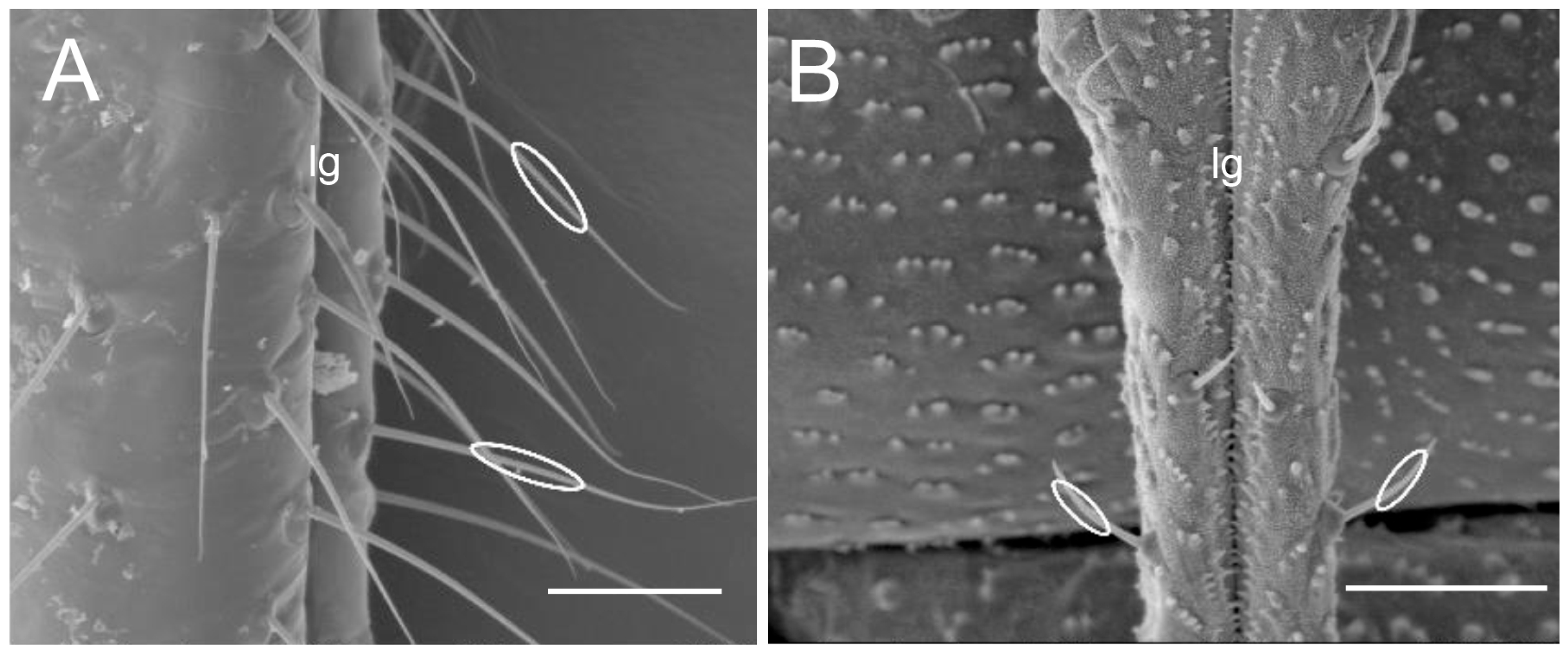
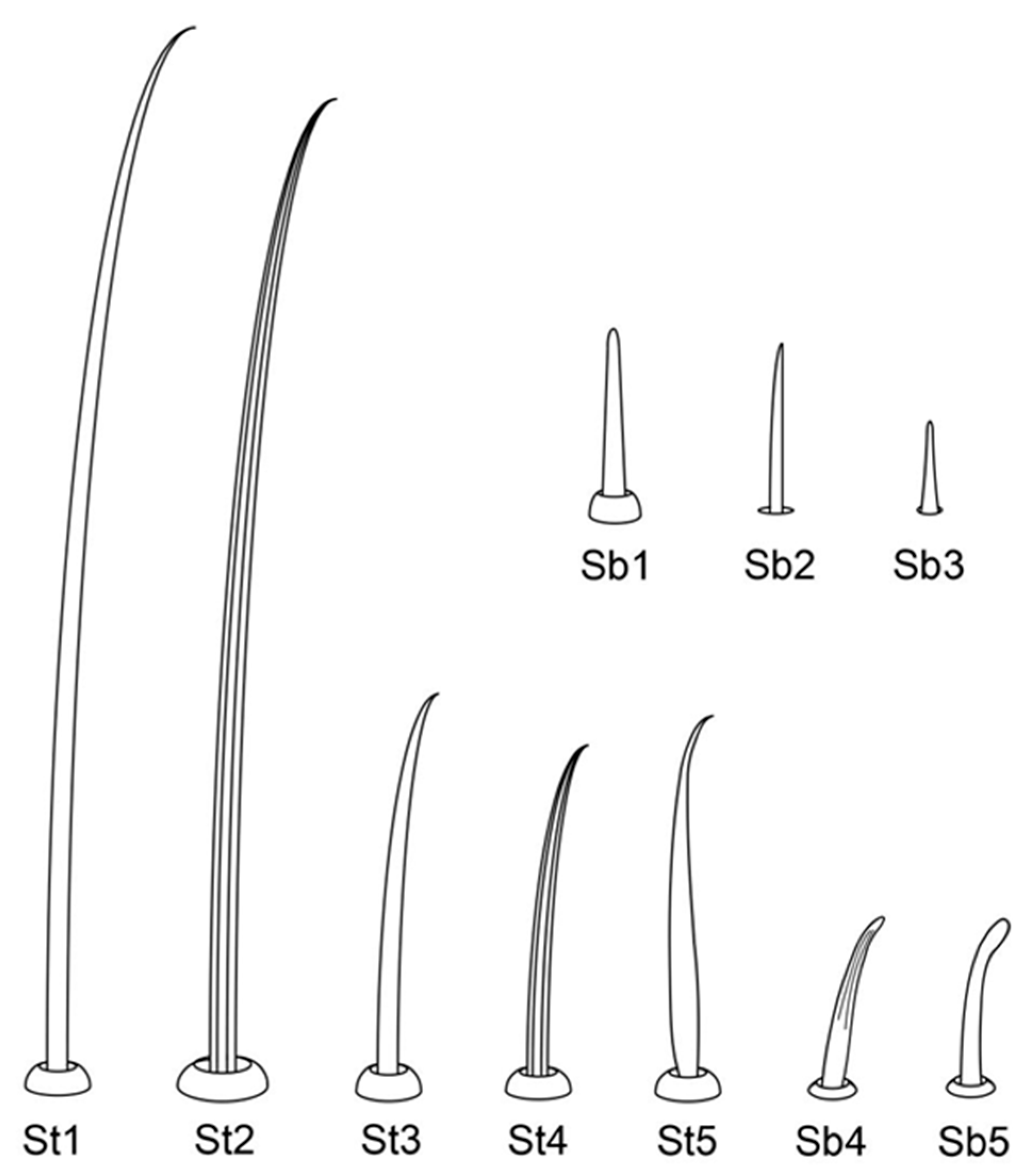
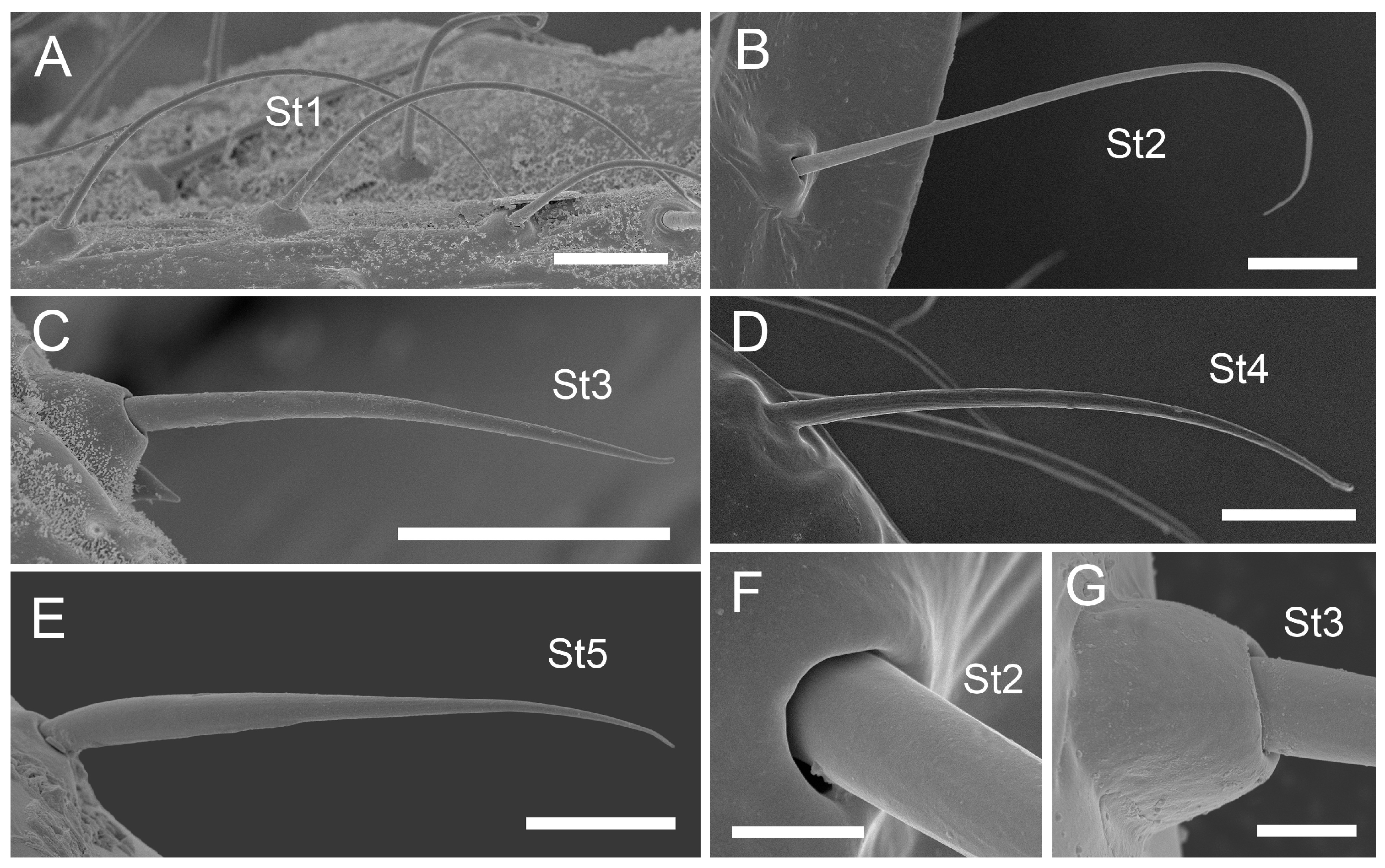
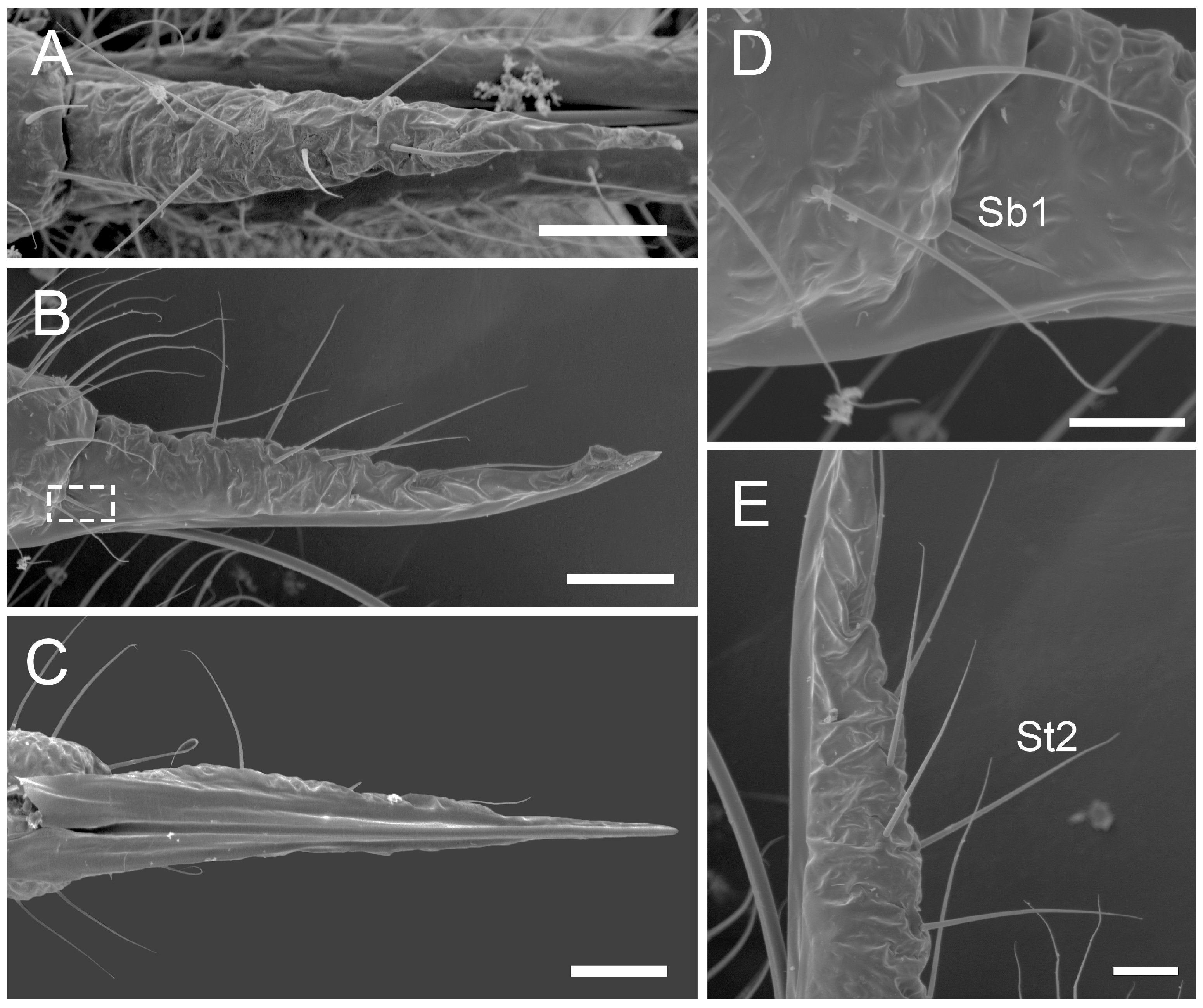
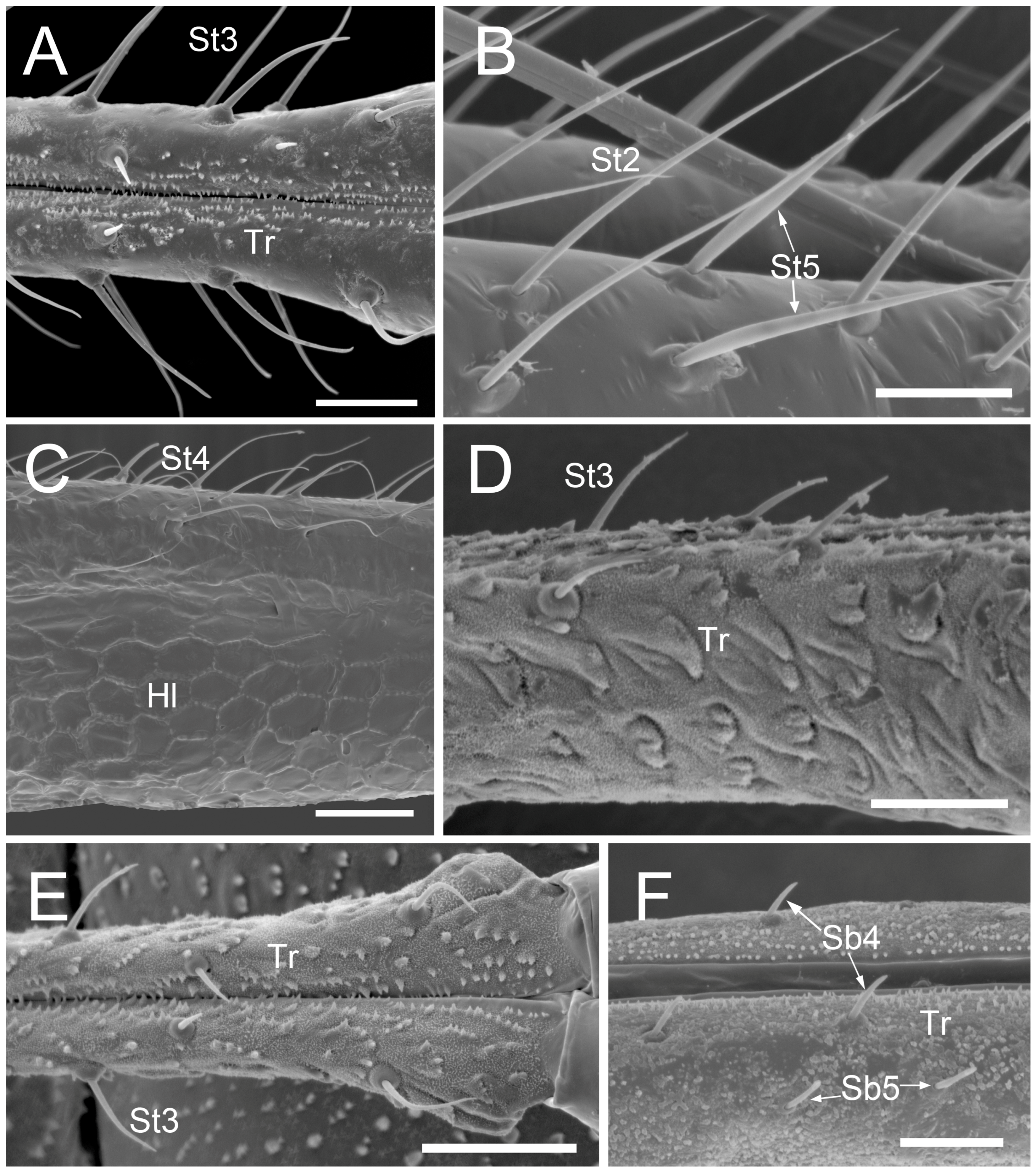
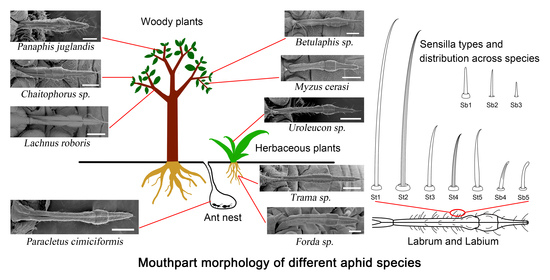
- Sensilla trichodea 1 (St1) and 2 (St2) are extremely slender, often with curved and sharply pointed tips, and are situated in sockets in hemispherical cuticular protrusions (Figure 3 and Figure 4A,B). These two types are morphologically similar; however, sensilla trichodea 2 can be distinguished by the presence of longitudinal grooves on their surface (Figure 3 and Figure 4B).
- Sensilla trichodea 3 (St3) and 4 (St4) resemble sensilla trichodea 1 and 2 but are comparatively shorter and thicker (Figure 3 and Figure 4C,D). These four types (St1–4) represent the most widely distributed sensilla among aphids. In species possessing them, they are generally present on the second, third, and fourth labial segments, except for sensilla St3 in Forda sp., which are restricted to the fourth segment.
- Sensilla trichodea 5 (St5) are also situated in sockets atop hemispherical cuticular protrusions and exhibit a smooth surface devoid of longitudinal grooves. They are distinctly swollen and thickened from the base to the mid-region (Figure 3 and Figure 4E). This sensillum type is presently observed in Trama sp.
3.1.2. Sensilla Basiconica (Sb1–SB5)
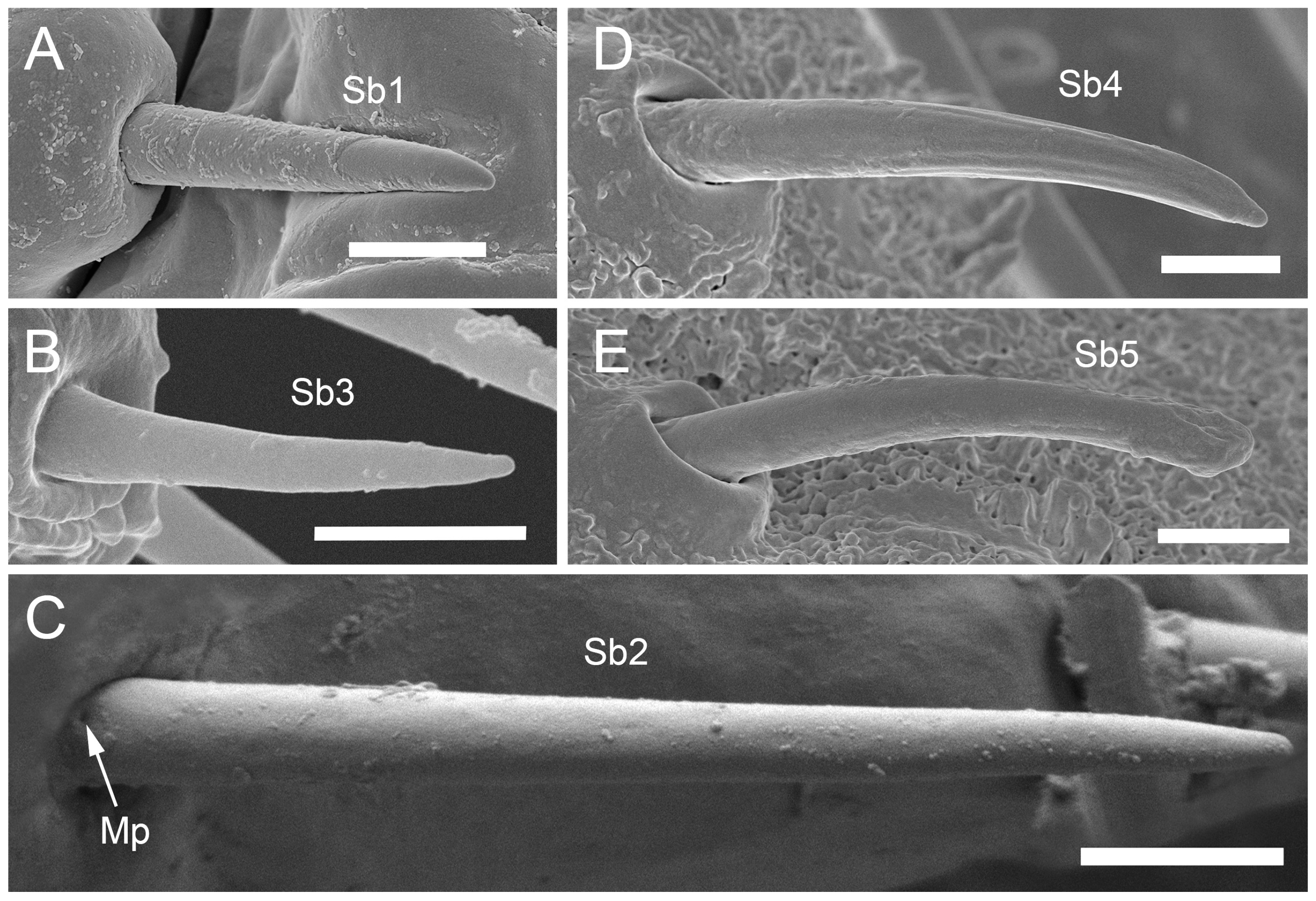
- Sensilla basiconica 1 (Sb1) are straight, elongated-conical sensilla located in sockets on hemispherical cuticular protrusions (Figure 3 and Figure 5A). They are the most common type of sensilla basiconica, occurring at the base of the labrum in all examined species. Additionally, they occur in pairs at the base of the fourth labial segment, except in Trama sp.
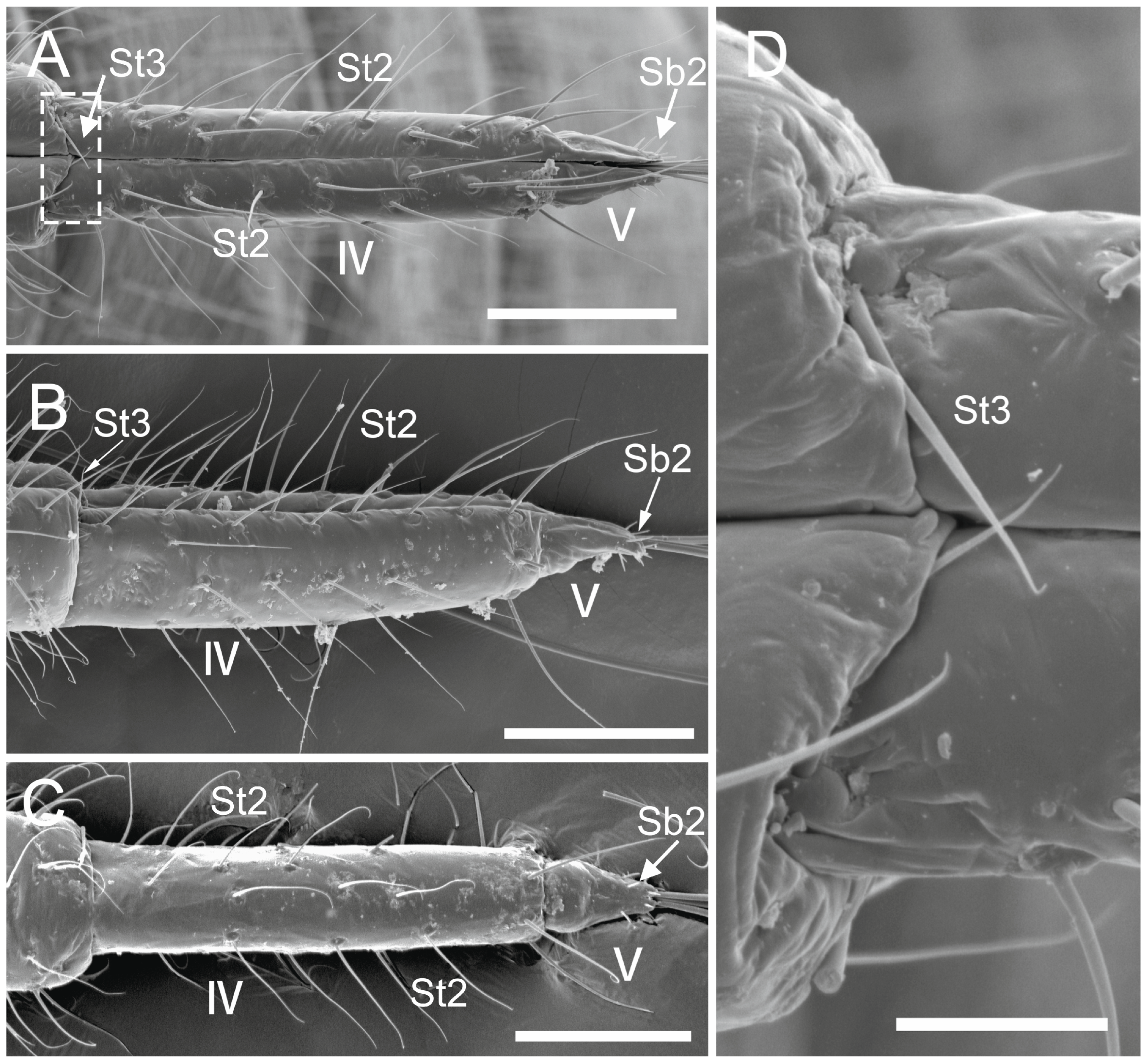
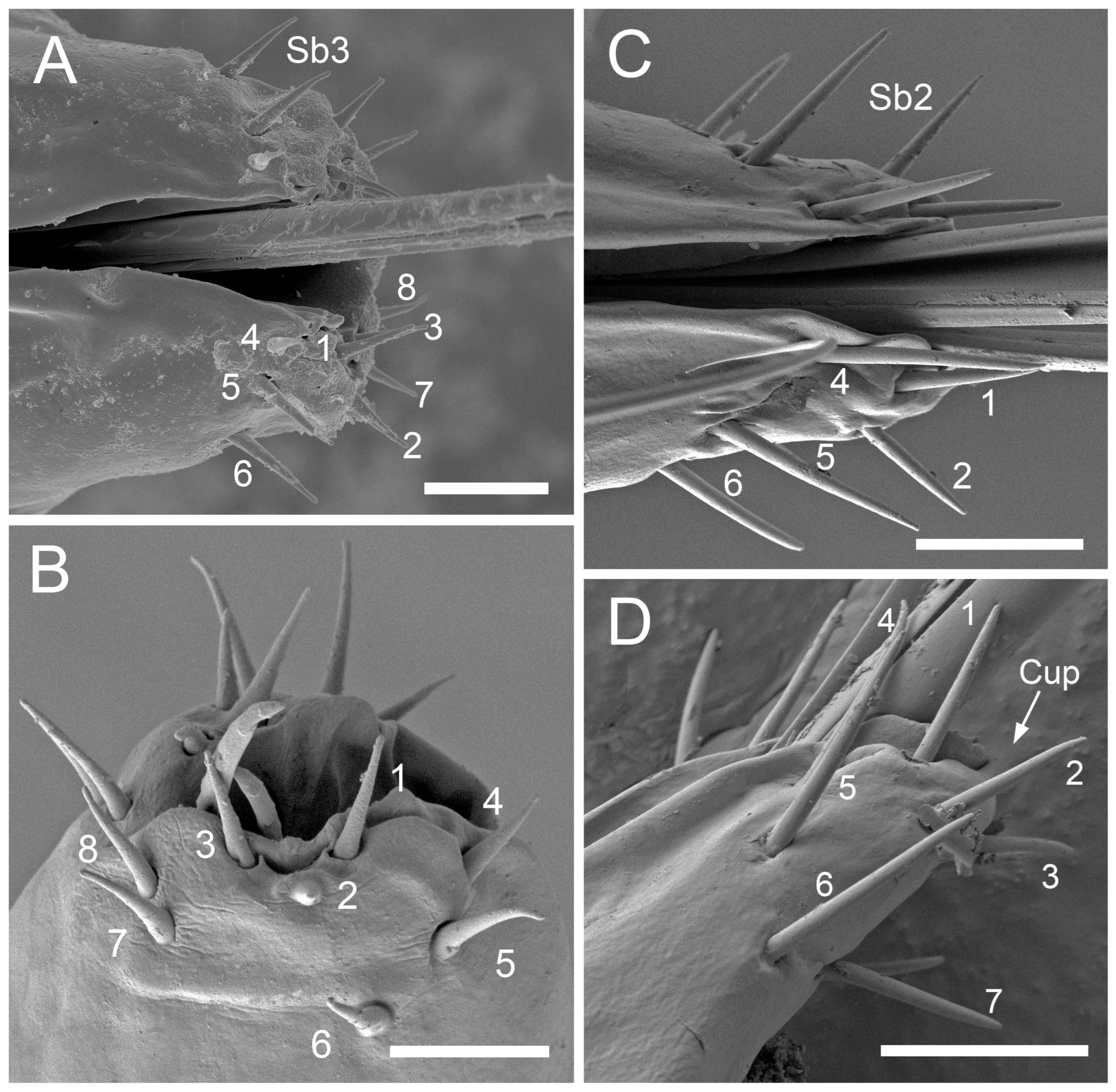
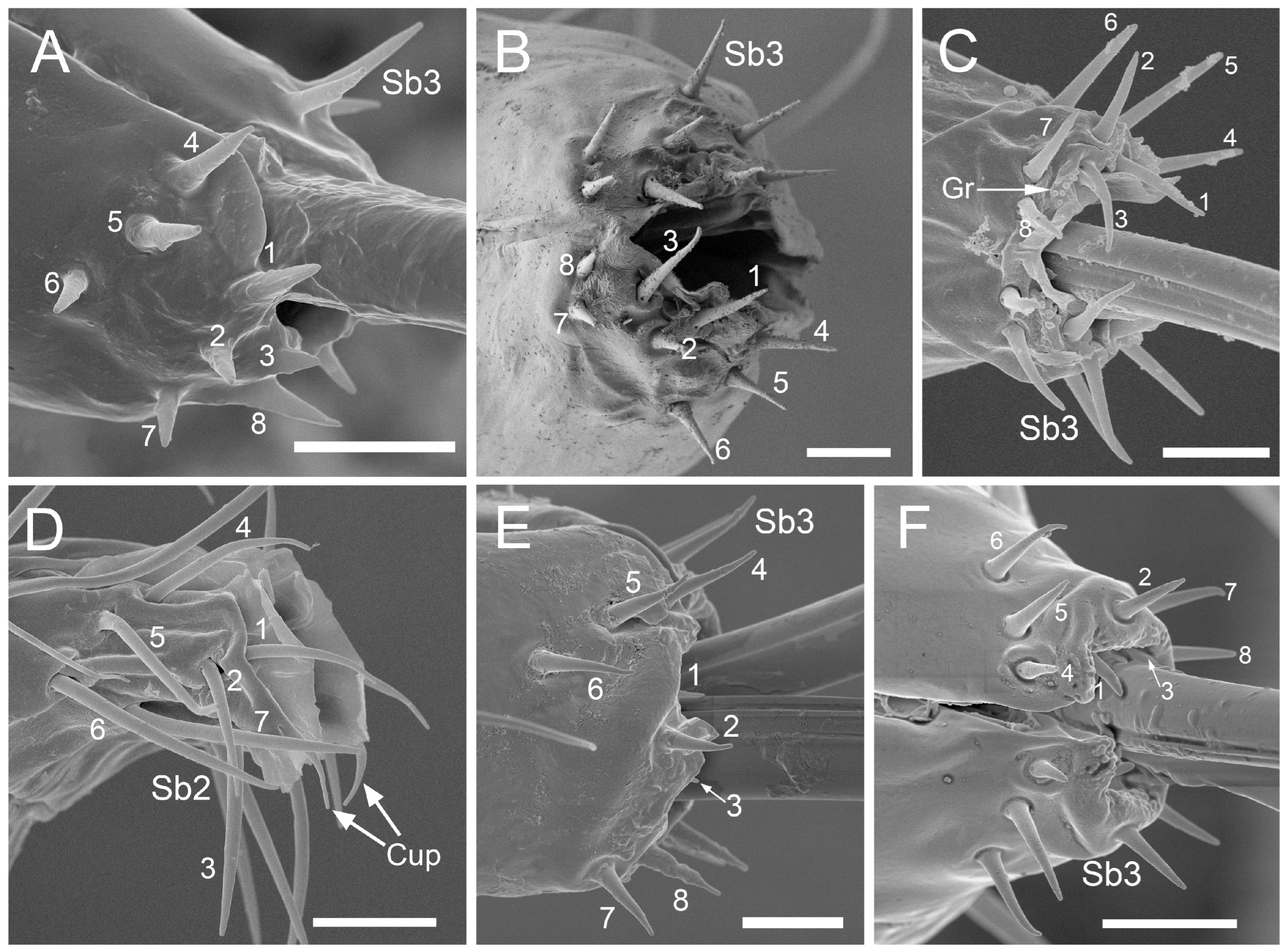
- Sensilla basiconica 2 (Sb2) and 3 (SB3) are specialised sensilla located at the tip of the labium. They are conical in shape and situated within cuticular pits, exhibiting smooth surfaces lacking longitudinal grooves (Figure 3 and Figure 5B,C). Both types are arranged in pairs along the sides of the labial groove. Sensilla Sb2 are more slender and sometimes curved compared with sensilla Sb3 and are found only in two species of Lachninae (Figure 5C).
- Sensilla basiconica 5 (Sb5) are also located in sockets on hemispherical cuticular protrusions. Their general shape resembles that of sensilla basiconica 4; however, the tip is blunt, and the surface lacks longitudinal grooves (Figure 3 and Figure 5E). These two types are found exclusively on the labial surface of Forda sp.
- All sensilla bases recorded in this study possess flexible sockets (Figure 4F,G), indicating their capacity for a certain degree of movement.
3.2. Morphological Description of Labrum, Labium, and Sensilla in Particular Species of Aphids
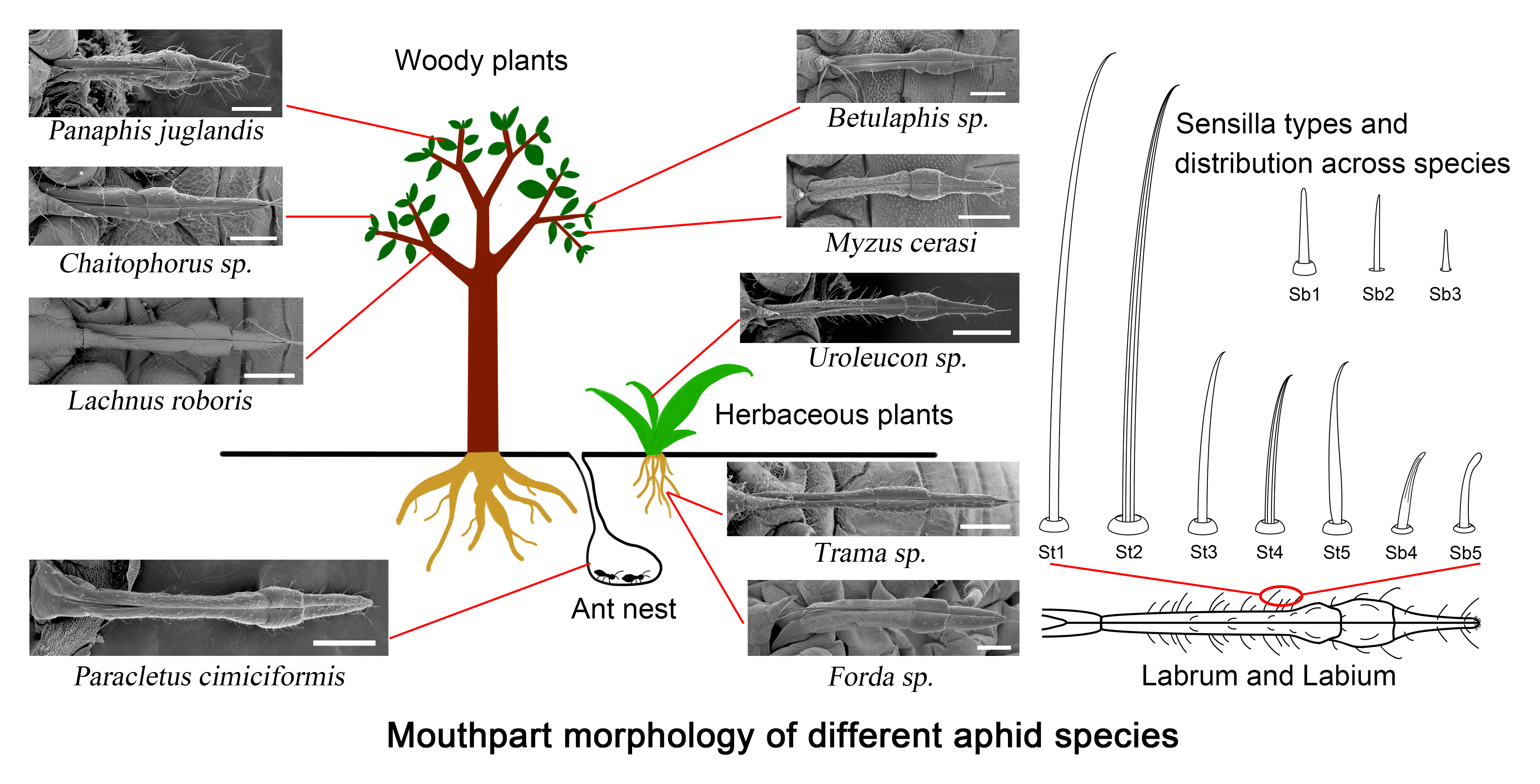
- Uroleucon sp., (Aphidinae)—species feeding on green shoots of herbaceous plants.
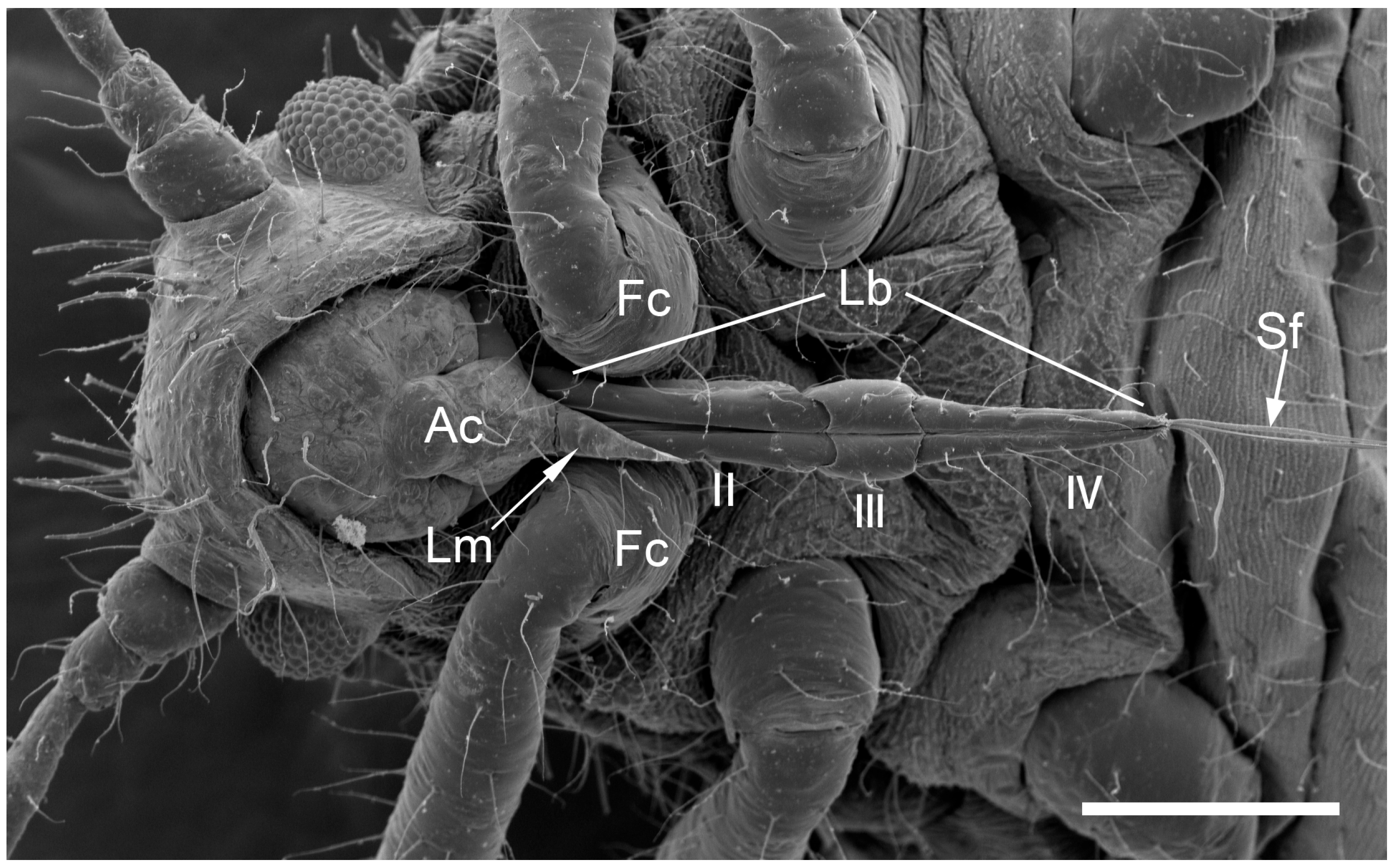
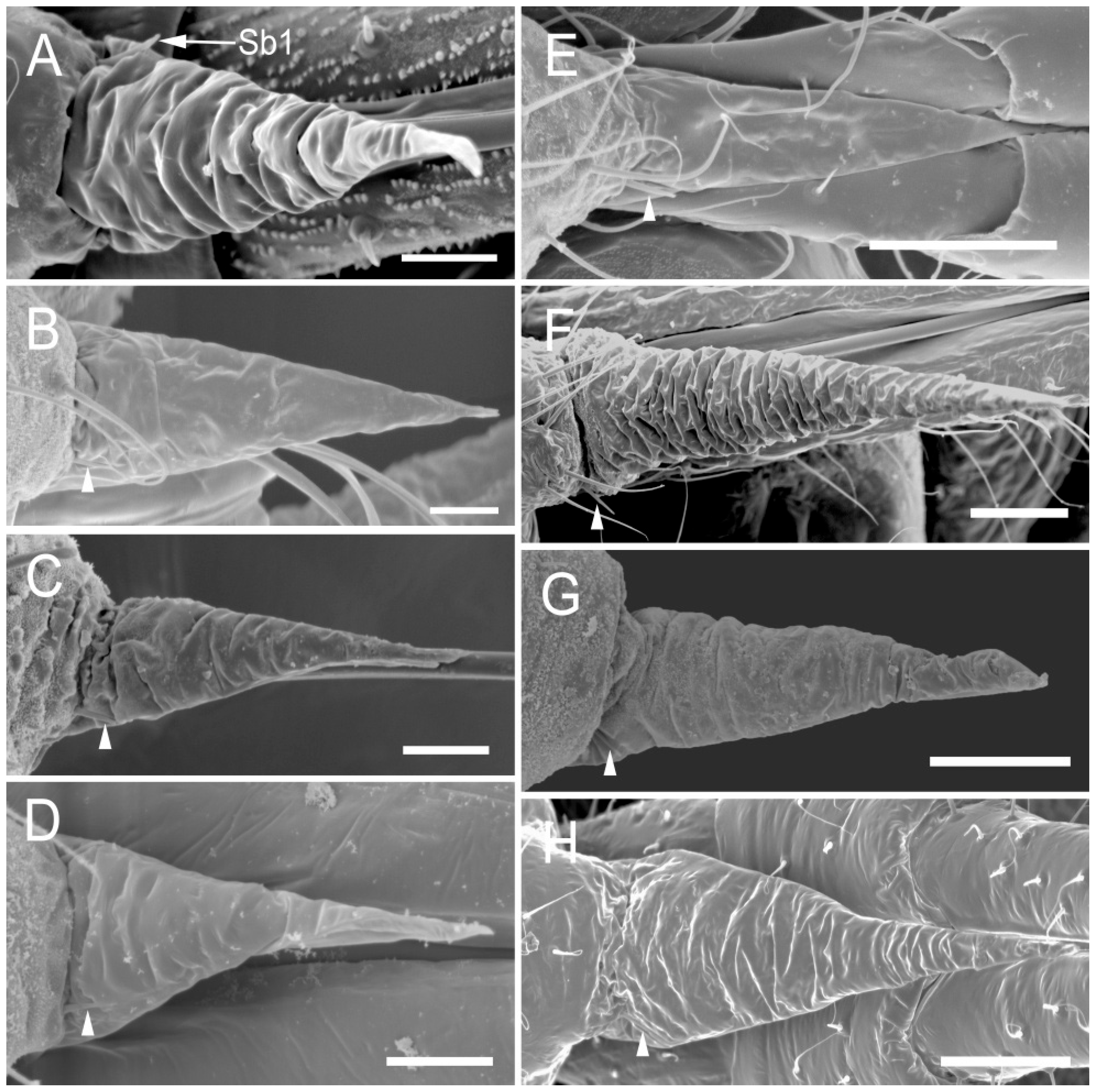
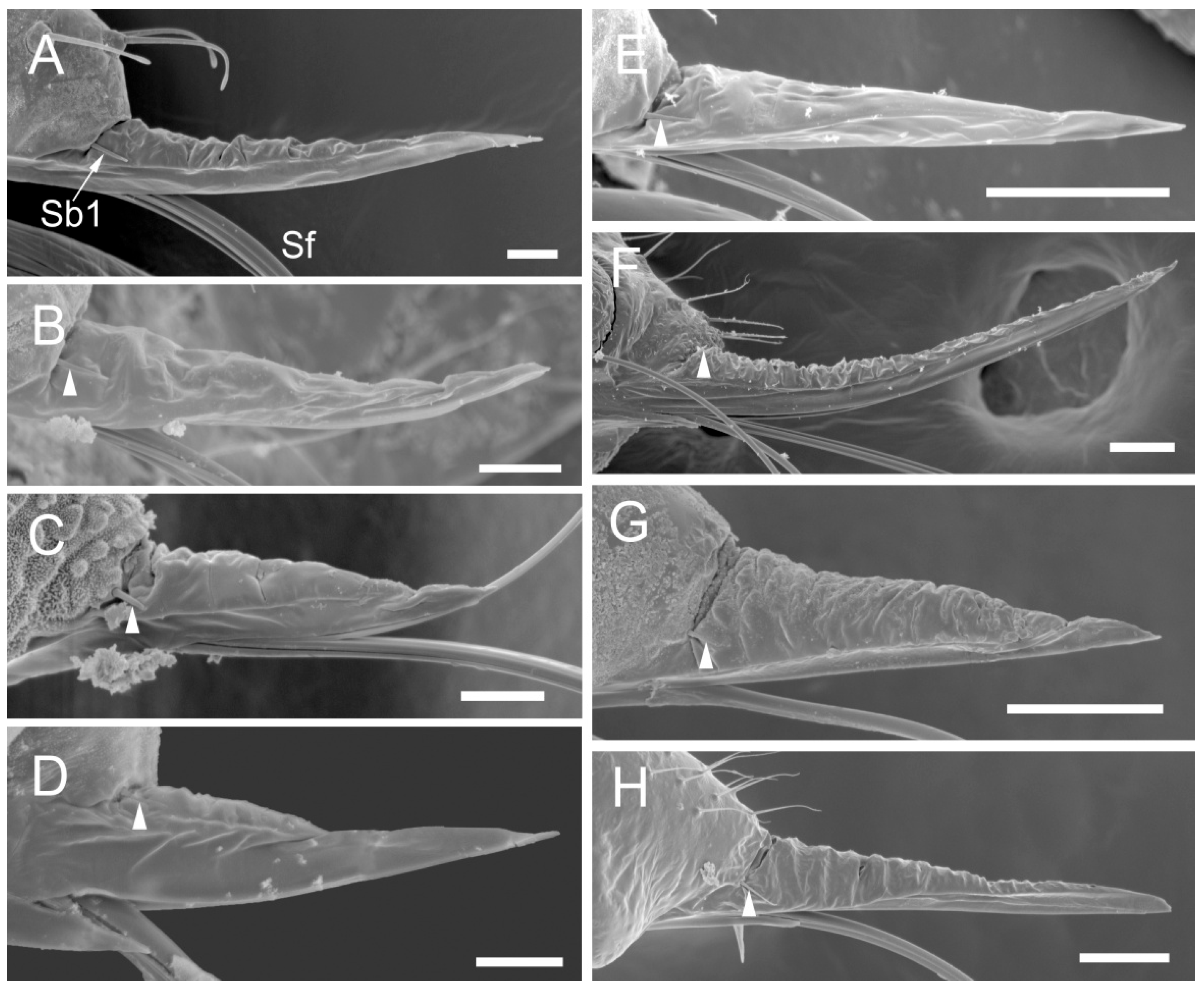
- Labrum (Figure 6A and Figure 7A): Approximately 188.5 μm in length and 43.2 μm in width at the base (Table 2), presenting a triangular shape with transverse folds on the surface but no sensilla. A pair of sensilla basiconica 1 (Sb1) (Figure 3) is present at the base of the labrum, closely adjoined to the lateral sides. The stylet bundle extends from the base of the labrum posterior side, and a groove is present to accommodate and secure the stylet fascicle (Sf).
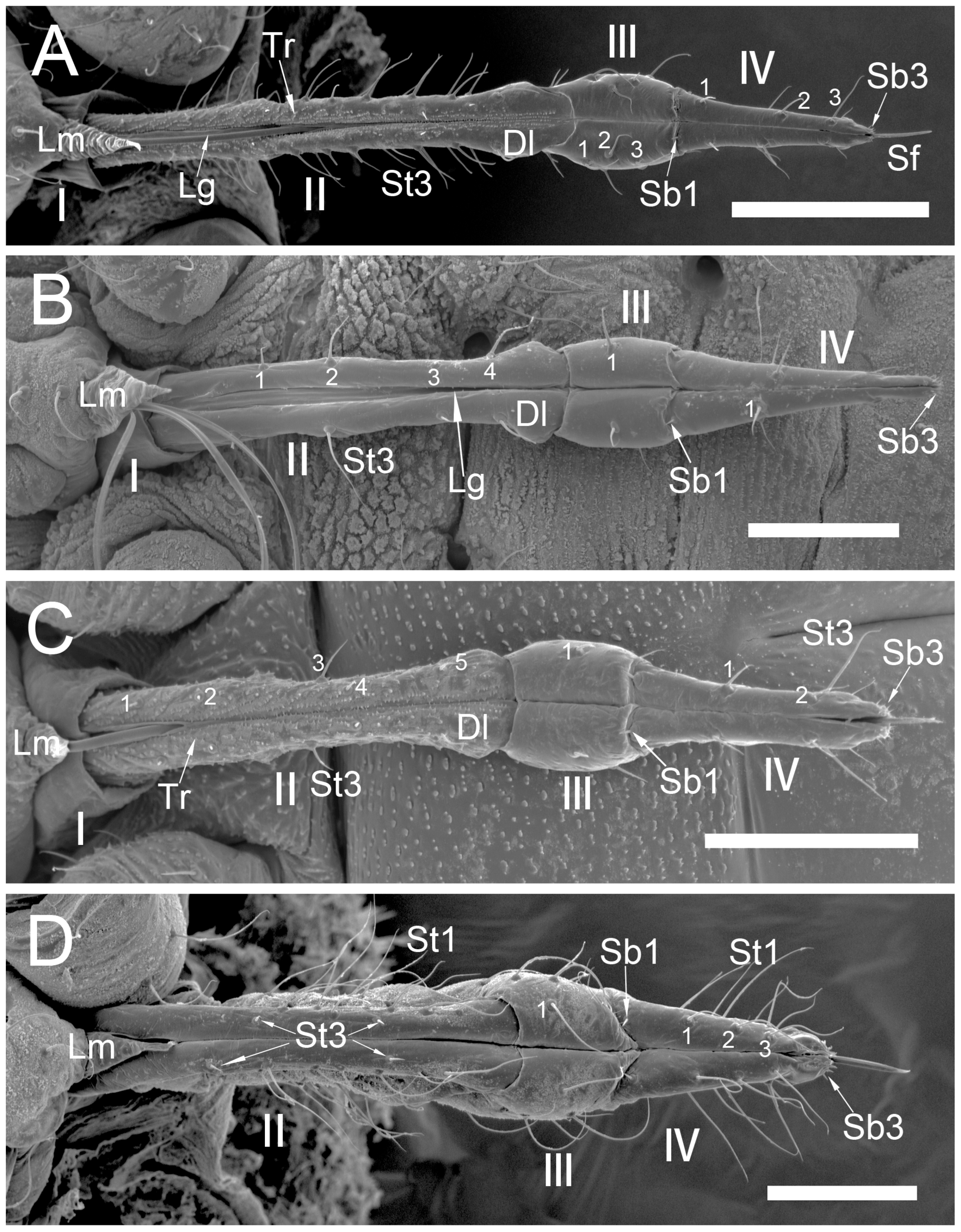
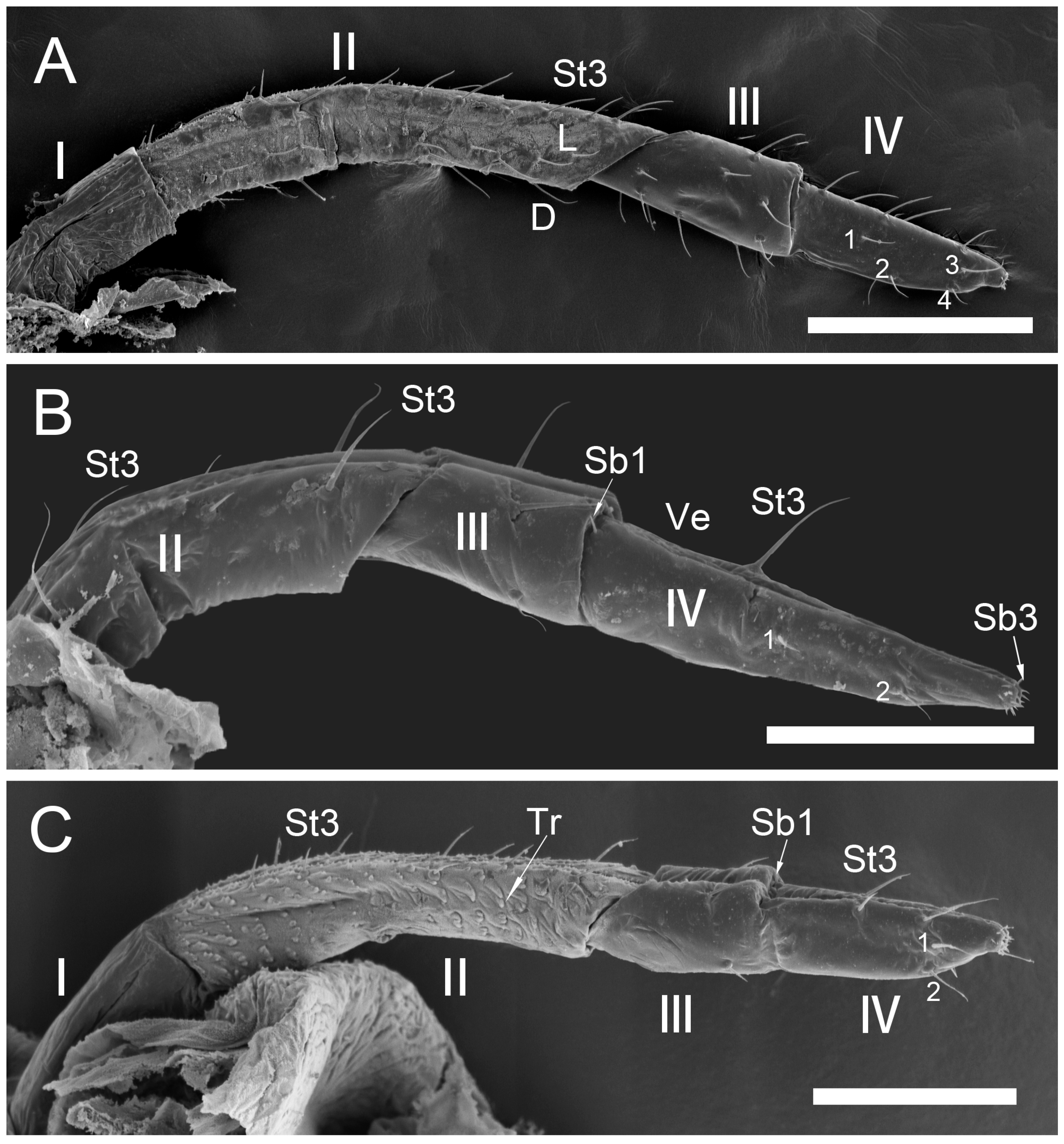
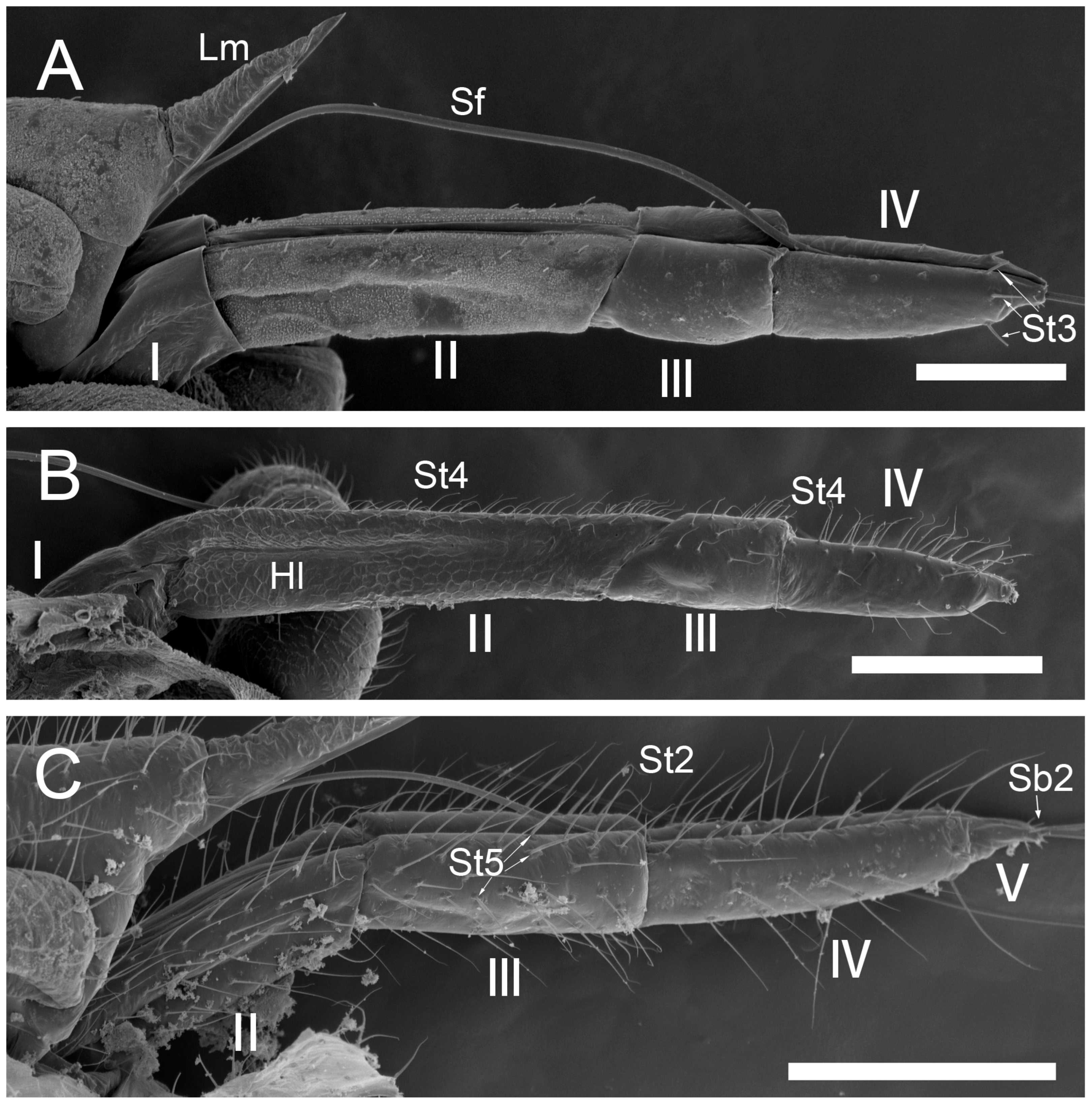
- Labium (Figure 9A, Figure 11A, Figure 15A, and Figure 16B): Measures approximately 969.0 μm in length and is divided into four segments (I–IV), with the second segment being the longest and the third the shortest (Figure 9A and Table 3). The first segment is a soft, membranous, sleeve-like structure that partially envelops the second segment. Its surface exhibits folds and lacks sensilla. The second segment is approximately 441.4 μm long, with nearly uniform width at both ends in ventral view and a slight dilation distally. This segment has numerous sensilla (St3), at least a dozen pairs, primarily distributed along both sides of the labial groove and the lateral surfaces (Figure 9A and Figure 11A). In addition to sensilla, the surface of the second segment is covered with spiniform tubercles (Tr) (Figure 9A and Figure 15A), most densely arranged in band-like patterns along the labial groove. The third segment measures approximately 183.1 μm in length and appears trapezoidal in lateral view (Figure 11A). It has eight pairs of sensilla St3 (Figure 9A), with three pairs located ventrally (nos. 1–3) and the remaining on the lateral (L) and dorsal (D) surfaces (Figure 11A). The fourth segment is approximately 199.2 μm long and conical in shape, tapering distinctly toward the apex. This segment grows seven pairs of sensilla St3, distributed as follows: three pairs ventrally (Figure 9A, nos. 1–3), two pairs laterally, and two pairs dorsally (Figure 11A and Table 3). A pair of sensilla Sb1 is present at the ventral base of this segment (Figure 9A), while the tip grows eight pairs of sensilla Sb3 (Figure 9A and Figure 16B). These sensilla Sb3 are arranged in two groups: three pairs at the foremost tip (nos. 1–3) and five pairs peripherally (three pairs ventrally, nos. 4–6, and two pairs dorsally, nos. 7,8) (Figure 16B).

| Species | Labrum Length (μm) | Labrum Width at Base (μm) | Shape | Surface Features | Sensilla Type and Location |
|---|---|---|---|---|---|
| Uroleucon sp. | 188.5 | 43.2 | Triangular | Transverse folds | Sb1 at base, lateral sides |
| G. betulae | 128.0 | 44.5 | Triangular | Surface folds | Sb1at base, lateral sides |
| M. cerasi | 88.8 | 23.8 | Triangular | Transverse folds | Sb1at base, lateral sides |
| P. juglandis | 96.5 | 32.6 | Triangular | Transverse folds | Sb1at base, lateral sides |
| Trama sp. | 311.1 | 55.6 | Conical | Groove, folds | Sb1at base, lateral sides, 3 pairs St2 on dorsal surface |
| Chaitophorus sp. | 138.3 | 36.2 | Triangular | Surface folds | Sb1 at base, lateral sides |
| L. roboris | 358.1 | 66.6 | Elongated Triangular | Transverse folds | Sb1at base, lateral sides |
| Forda sp. | 185.2 | 52.2 | Conical | Groove, folds | Sb1at base, lateral sides |
| P. cimiciformis | 240.0 | 62.0 | Elongated Triangular | Transverse folds | Sb1at base, lateral sides |
| Species | Labium Length (μm) | Number of Segments | Segment 2 Length (μm) | Segment 2 Features | Segment 3 Length (μm) | Segment 3 Features | Segment 4 Length (μm) | Segment 4 Features | Sensilla (Segment-Wise) |
|---|---|---|---|---|---|---|---|---|---|
| Uroleucon sp. | 969.0 | 4 | 441.4 | Dilation spiniform tubercles, St3 | 183.1 | Trapezoidal, St3 | 199.2 | Conical, Sb1 at base, Sb3 at tip | Segment2: Numerous sensilla (St3), at least a dozen pairs, (both sides, labial groove). Segment 3: 8 pairs St3. Segment 4: 7 pairs St3, Sb1, Sb3. |
| G. betulae | 585.1 | 4 | 265.1 | Tubular, slight dilation sparse St3 | 86.7 | Short, St3 | 176.3 | Conical, five St3, Sb1 | Segment 2: Sparse St3. Segment 3: 2 pairs St3. Segment 4: 5 St3, Sb1, Sb3. |
| M. cerasi | 512.5 | 4 | 218.3 | Dilation, numerous spiniform tubercles, St3 | 91.8 | Short, stout, St3 | 125.9 | Conical, St3, Sb1, Sb3 | Segment 2: 5 pairs St3, spiniform tubercles. Segment 3: 2 pairs St3. Segment 4: 4 pairs St3, Sb1, Sb3. |
| P. juglandis | 566.2 | 4 | 280.4 | Short, stout, St1, St3 | 125.6 | Short, St1 | 157.4 | Conical, St1 Sb3 | Segment 2: 17 pairs St1, 2 pairs St3 Segment 3: 10 pairs St1 Segment 4: 9 pairs St1, Sb1, Sb3. |
| Trama sp. | 1287.0 | 5 | 572.1 | Distal dilation dense, St2, St5 | 243.9 | Narrow, elongated, numerous, St2, St5 | 249.9 | Distal constriction, densely covered with St2, St3 = Sb1 St5 | Segment 2: Densely covered St2. 1 pair St5; Segment 3: 30 pairs St2, 2–3 pairs St5. Segment 4: Densely covered St2, 1–2 pairs St5. Segment 5: 7 pairs Sb2 |
| Chaitophorus sp. | 687.3 | 4 | 335.6 | Uniform, St1,Sb1 | 144.2 | Trapezoidal, St1 | 196.7 | Conical, St1, Sb1, Sb3 | Segment 2: 10 pairs St1, 4 pairs of Sb1. Segment 3: 6 pairs St1. Segment 4: 6–7 pairs St1, Sb1, Sb3. |
| L. roboris | 1446.0 | 5 | 883.9 | Soft, slight thickening, dense St2 | 228.9 | Abundant St2 | 200.6 | Distal constriction, numerous St2 | Segment 2: Numerous St2. Segment 3: 4 pairs St2. Segment 4: 14 pairs St2, Sb1, Sb3. Segment 5: Conical, 7 pairs Sb2 |
| Forda sp. | 734.2 | 4 | 329.1 | Tubular, slight dilation Sb4, Sb5 | 122.5 | Rectangular, Sb5 | 181.3 | Conical, St3, Sb5, Sb1 | Segment 2: 14 pairs Sb3, Sb4. Segment 3: 4 pairs Sb5. Segment 4: 4 pairs Sb5, 3 pairs St3; Sb3. |
| P. cimiciformis | 1074.0 | 4 | 570.6 | Distal dilation sparse, short spiniform tubercles, St4 | 169.3 | Trapezoidal, St4 | 236.9 | Conical, St4, Sb3 | Segment 2: 36 pairs St4,. Segment 3: 13 pairs St4. Segment 4: 14 pairs St4, Sb1, Sb3 |
- Glyphina betulae (Linnaeus, 1758) (Thelaxinae)—species feeding on green tips of birch twigs.
- Labrum (Figure 6B and Figure 7B): Approximately 128.0 μm in length and 44.5 μm in width at the base (Table 2), presenting a triangular shape with surface folds but no sensilla. A pair of sensilla basiconica 1 is present at the base, closely adjoined to the lateral sides. The stylet fascicle extends from the base of the labrum (Figure 7B).
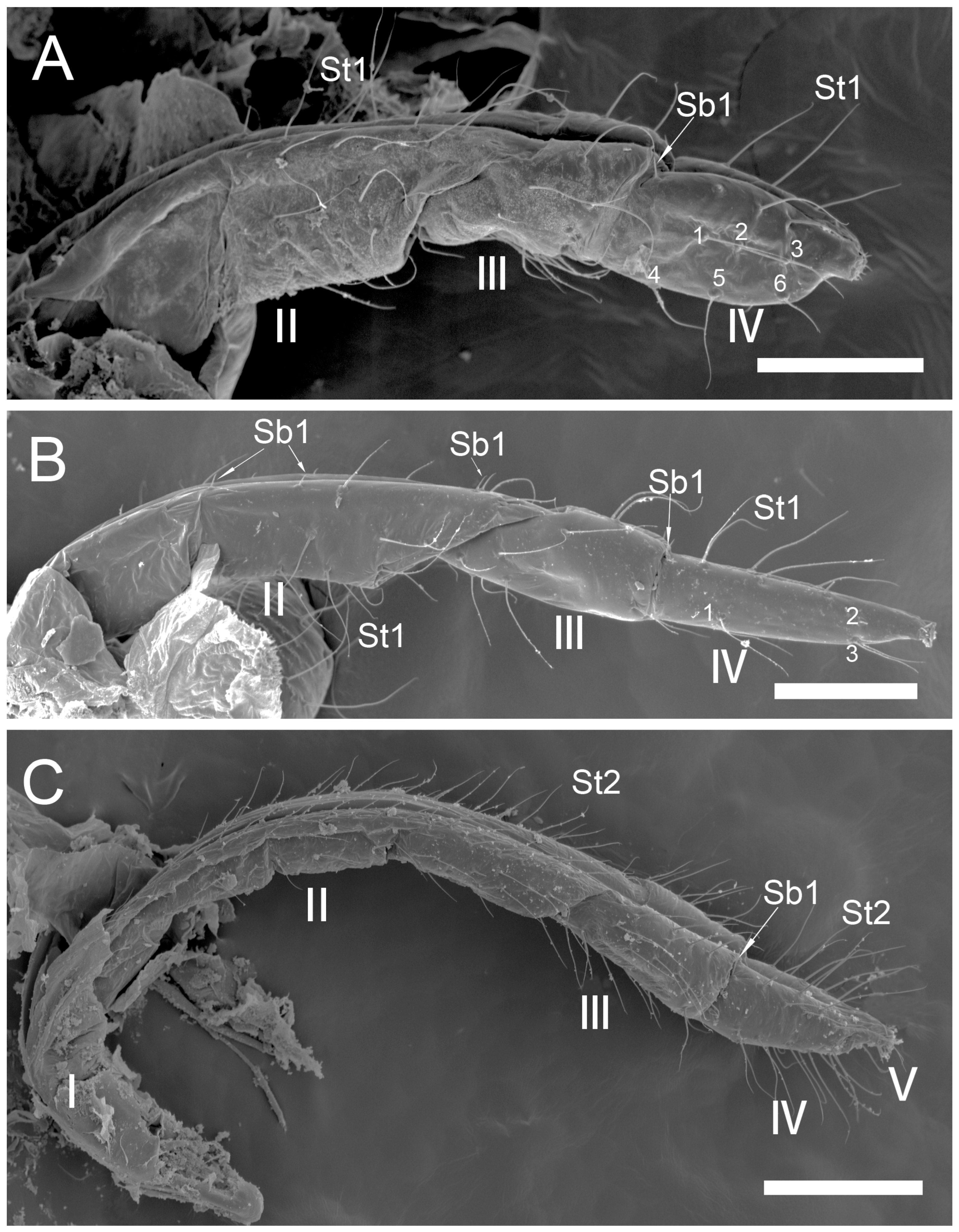
- Labium (Figure 9B, Figure 11B and Figure 17A): Measures approximately 585.1 μm in length and is divided into four segments (I–IV) with the second segment being the longest and the third the shortest (Table 3). The first segment is a soft, sleeve-like structure that can partially envelop the second segment, with no sensilla on its surface. The second segment is approximately 265.1 μm long, tubular in shape, and exhibits a distinct distal dilation (Dl) in ventral view. This segment has very few sensilla, with only four pairs of sensilla trichodea 3 distributed along both sides of the labial groove (Lg). The rest of the segment is largely smooth apart from minor folds. The third segment measures approximately 86.7 μm in length and appears trapezoidal in lateral view. It has two pairs of sensilla St3, with one pair located ventrally on both sides of the labial groove (Figure 9B) and the other pair dorsally (Figure 11B). The fourth segment is approximately 176.3 μm long and conical in shape, showing only slight constriction at the apex without distinct tapering. This segment also grows few sensilla St3, with only three pairs present: one pair ventrally (Ve) and two pairs laterally (L, nos. 1,2). A pair of sensilla basiconica 1 is located at the ventral base of this segment (Figure 11B), while the tip grows eight pairs of sensilla Sb3 (Figure 11B and Figure 17A). The sensilla Sb3 are arranged in two groups: three pairs at the foremost tip and five pairs peripherally (three pairs ventrally and two pairs dorsally) (Figure 17A).
- Myzus cerasi (Fabricius, 1775) (Aphidinae)—species feeding on leaves and young shoots of cherry and sweet cherry trees
- Labrum (Figure 6C and Figure 7C): Approximately 88.8 μm in length and 23.8 μm in width at the base (Table 2), presenting a triangular shape with transverse folds on the surface but no sensilla. A pair of sensilla Sb1 is present at the base of the labrum, closely adjoined to the lateral sides. The stylet fascicle extends from the base of the labrum, and a posterior labrum groove is present to accommodate and secure it.
- Labium (Figure 9C, Figure 11C, Figure 15E,F and Figure 16A): Measures approximately 512.5 μm in length and is divided into four segments I-IV), with the second segment being the longest and the third the shortest (Table 3). The first segment is a soft, sleeve-like structure that can partially envelops the second segment, with no sensilla on its surface. The second segment is approximately 218.3 μm long and exhibits a distinct distal dilation (DI) in ventral view. The surface of this segment is covered with numerous spiniform tubercles (Tr), which are arranged in band-like patterns (Figure 9C and Figure 15D,E). Those on both sides of labial groove are small and densely distributed, while those on lateral and dorsal surfaces are larger, more sparsely distributed, and exhibit more complex shapes. Sensilla on this segment are mainly concentrated ventrally, consisting of five pairs of sensilla St3: three pairs adjacent to the labial groove are shorter (nos. 1–3), and two pairs farther from the groove are longer (nos. 4,5) (Figure 9C). The third segment measures approximately 91.8 μm in length, appearing short and stout. It has only two pairs of sensilla St3, located ventrally and dorsally, with the ventral pair being longer. The fourth segment is approximately 125.9 μm long and conical in shape, without distinct constriction at the apex. It grows four pairs of sensilla St3, which can be clearly divided into two groups: one pair located ventrally at the mid-length of the segment (no 1) and three pairs near the tip (distributed ventrally no 2, laterally no 3, and dorsally no 4, one pair each) (Figure 9C and Figure 11C). A pair of sensilla Sb1 is present at the ventral base of this segment (Figure 9C), while the tip grows eight pairs of sensilla Sb3. These sensilla basiconica are arranged in two groups: three pairs at the foremost tip and five pairs peripherally (three pairs ventrallyn nos. 1,3,4 and five pairs dorsally, nos. 2, 5–8) (Figure 16A).
- Panaphis juglandis (Goeze 1778) (Calaphidinae)—species feeding on walnut leaves, on veins.
- Labrum (Figure 6D and Figure 7D): Approximately 96.5 μm in length and 32.6 μm in width at the base (Table 2), presenting a triangular shape with transverse folds on the surface but no sensilla. A pair of sensilla basiconica 1 is present at the base of the labrum, closely adjoined to the lateral sides.
- Labium (Figure 9D, Figure 12A, and Figure 17B): Measures approximately 566.2 μm in length and is divided into four segments (I–IV), with the second segment being the longest and the third the shortest (Table 3). The first segment has a smooth surface with no sensilla. The second segment is relatively short and stout, measuring approximately 280.4 μm in length, with no distinct dilation at the distal end. This segment grows numerous sensilla St1 (approximately 17 pairs), primarily distributed on the lateral surfaces. Additionally, two pairs of sensilla St3 are symmetrically arranged on the ventral surface (Figure 9D). The third segment is approximately 125.6 μm in length and has ten pairs of sensilla trichodea 1, with one pair located ventrally and the remaining pairs distributed on the lateral and dorsal surfaces. The fourth segment is approximately 157.4 μm long, triangular in ventral view, relatively short and stout, with a distinct constriction and tapering at the tip. It grows nine pairs of sensilla St1, with three pairs each on the ventral (nos. 1–3) (Figure 9D), lateral (nos. 1–3), and dorsal (nos. 4–6) surfaces (Figure 12A). A pair of sensilla Sb1 is present at the ventral base of this segment, while the tip has eight pairs of sensilla Sb3 (Figure 9D). The tip sensilla basiconica are arranged in two groups: three pairs at the foremost tip and five pairs peripherally (three pairs ventrally and two pairs dorsally) (Figure 17B).
- Chaitophorus sp., (Chaitophorinae)—species feeding on leaves and young shoots of aspen.
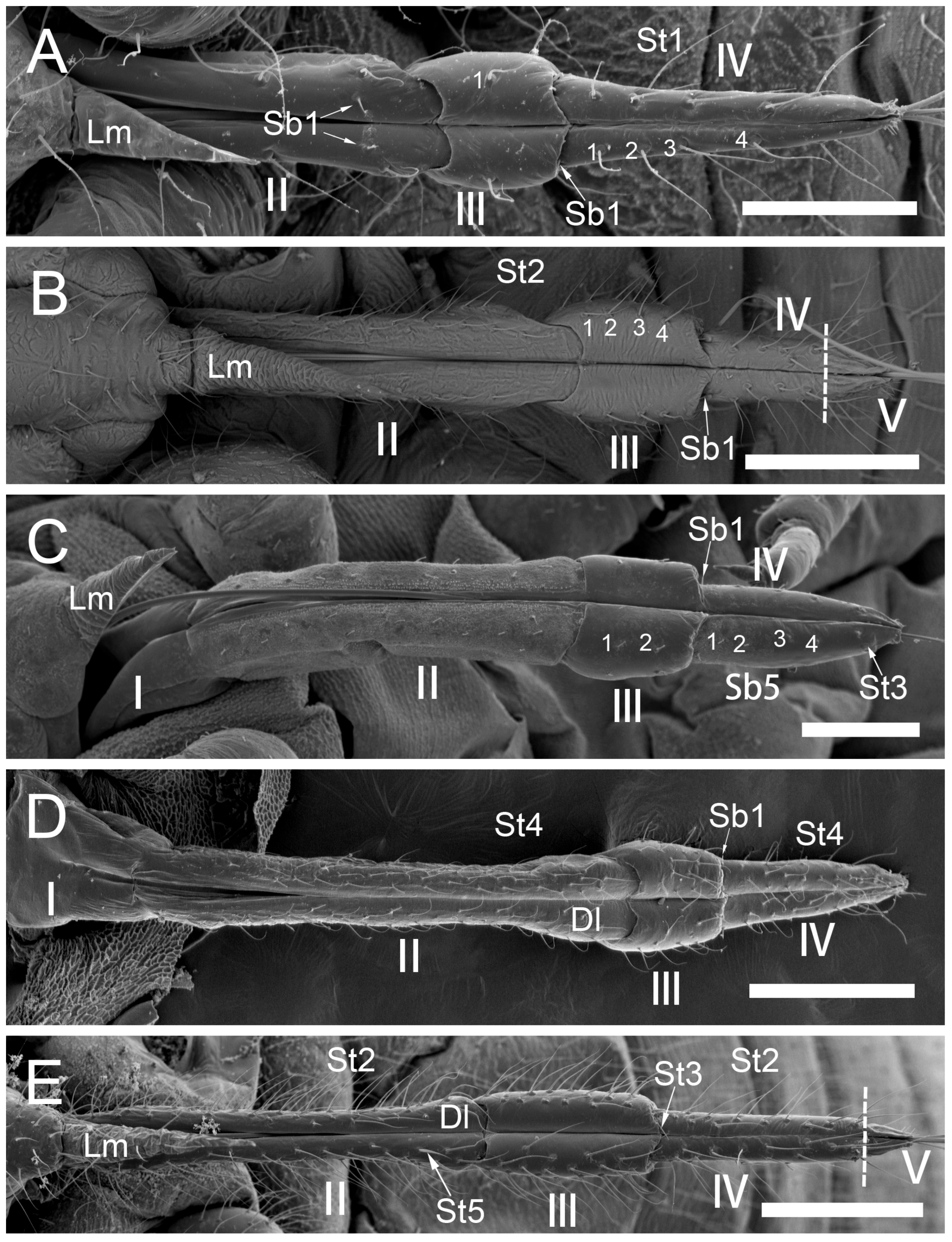
- Labium (Figure 10A, Figure 12B, and Figure 17C): Approximately 687.3 μm in length and consists of five segments (I–IV), with the third segment being the shortest and the second segment the longest (Table 3). Sensilla are distributed on all segments except the first. The second segment measures approximately 335.6 μm in length, with nearly uniform width at both ends. Its surface grows two types of sensilla: sensilla St1 and sensilla Sb1. There are ten pairs of sensilla St1, with three pairs each along the labial groove and lateral surfaces (Figure 10A) and four pairs on the dorsal surface (Figure 10A and Figure 12B). The third segment measures approximately 144.2 μm in length and appears trapezoidal in lateral view (Figure 12B). This segment has only six pairs of sensilla St1: one pair along labial groove (no 1) (Figure 10A), two pairs laterally, and three pairs dorsally (Figure 12B). The fourth segment is approximately 196.7 μm long and conical in shape, without distinct constriction or tapering at the tip. It has seven to eight pairs of sensilla St1, distributed as follows: four pairs along both sides of the labial groove (nos. 1–4) (Figure 10A), one pair laterally (no 2), and three pairs dorsally (nos. 1–3) (Figure 12B). A pair of sensilla Sb1 is present at the ventral base of this segment, while the tip grows eight pairs of sensilla Sb3. These sensilla are arranged in two groups: three pairs at the foremost tip and five pairs peripherally (three pairs ventrally and two pairs dorsally) (Figure 17C). Granular cuticular protrusions are present around the three foremost pairs of sensilla basiconica.
- Lachnus roboris (Linnaeus, 1758) (Lachninae)—species feeding on woody oak twigs.
- Labrum (Figure 6F and Figure 7F): Approximately 358.1 μm in length and 66.6 μm in width at the base (Table 2), presenting an elongated triangular shape with transverse folds on the surface but no sensilla. A pair of sensilla basiconica 1 (Figure 6F) is present at the base of the labrum, closely adjoined to the lateral sides. The stylet fascicle extends from the base of the labrum, and a ventral (posterior) groove is present to accommodate and secure it (Figure 7F).
- Labium (Figure 10B, Figure 12C, and Figure 17D): Measures approximately 1446.0 μm in length and consists of five segments (I–V), with the third segment being shortest and second segment longest (Table 3). The first segment is a soft, elongated, membranous sleeve-like structure that can accommodate approximately half the length of the second segment. The first segment in the photo (Figure 10B) is not visible because it is pulled into the body of the aphids. When the second segment is partially retracted into the first, the labium bends into a fishhook-like shape (Figure 12C). The second segment measures approximately 883.9 μm in length, with a relatively soft surface, and is slightly thicker distally than basally. It has numerous sensilla trichodea 2 distributed on the ventral, lateral, and dorsal surfaces. The third segment measures approximately 228.9 μm in length and appears nearly trapezoidal in lateral view. Its surface grows abundant sensilla St2, with four pairs symmetrically arranged on both sides of labial groove (nos. 1–4) and the remainder located on the lateral and dorsal surfaces (Figure 12C). The fourth segment is approximately 200.6 μm in length, with a distinct distal constriction forming the fifth segment. It has a large number of sensilla St2 (approximately 14 pairs), distributed on all side surfaces (Figure 10B). A pair of sensilla Sb1 is present at the ventral base of the fourth segment, which is more slender compared to those found in most aphid species. The fifth segment is conical in shape, with seven pairs of sensilla Sb2 distributed at its tip, arranged in two groups: three shorter pairs at the foremost tip and four longer pairs peripherally. A pair of cuticular processes (Cup) is present at the apex of the labium, with moulting pores similar to sensilla Sb2 located at their bases (Figure 17D).
- Forda sp., (Pemphiginae)—species and morph feeding on underground shoots and roots of grasses.
- Labrum (Figure 6G and Figure 7G): Approximately 185.2 μm in length and 52.2 μm in width at the base (Table 2), convex conical in shape, with surface folds but no sensilla. A pair of sensilla Sb1 is present at the base of the labrum (Figure 6G), closely adjoined to the lateral sides. The ventral surface is flat, with a groove accommodating the stylet fascicle (Figure 7G).
- Labium (Figure 10C, Figure 13A, Figure 15F, and Figure 17E): Measures approximately 734.2 μm in length and consists of four segments (I–IV), with the third segment being the shortest and the second segment the longest (Table 3). The first segment is a membranous, sleeve-like structure, allowing partial retraction of the second segment into it. Its surface is smooth, with no sensilla (Figure 10C). The second segment is approximately 329.1 μm in length, is tubular in shape, and is slightly thicker distally than basally. Only the ventral surface has sensilla, including 14 pairs of sensilla Sb4 and Sb5. In the examined specimens, a row of sensilla basiconica 4 is distributed adjacent to the labial groove, while sensilla Sb5 are located farther from the groove. Dense, short spiniform tubercles (Tr) are distributed on both sides of the labial groove, arranged in distinct band-like patterns (Figure 15F). The third segment measures approximately 122.5 μm in length and appears nearly rectangular in dorsal, lateral, and ventral views (Figure 10C and Figure 13A). Its surface is smooth and grows four pairs of sensilla Sb5, with two pairs on the ventral surface and two pairs on the lateral surface (nos. 1,2). The fourth segment has a smooth surface, measures approximately 181.3 μm in length, and is conical in shape with constriction at the apex. Four pairs of sensilla Sb5 are distributed on both sides of the ventral labial groove of this segment, and three pairs of sensilla trichodea 3 are located near the apex, with one pair each on the ventral, lateral, and dorsal surfaces (Figure 10C). A pair of sensilla Sb1 is present at the ventral base of the fourth segment, while the tip has eight pairs of sensilla Sb3. These apical sensilla are arranged in two groups: three pairs at the foremost tip and five pairs peripherally (three pairs ventrally and five pairs dorsally) (Figure 17E).
- Paracletus cimiciformis von Heyden, 1837 (Pemphiginae)—species and morph feeding on grass roots, where they live with ants Tetramorium sp., feeding also on hemolymph of ant larvae.
- Labrum (Figure 6H and Figure 7H): Approximately 240.0 μm in length and 62.0 μm in width at the base (Table 2), presenting an elongated triangular shape with transverse folds on the surface but no sensilla. A pair of sensilla Sb1 is present at the base of labrum, closely adjoined to the lateral sides (Figure 6H). The stylet fascicle extends from the base of the labrum, and a ventral groove is present to accommodate and secure it (Figure 7H).
- Labium (Figure 10D, Figure 13B, Figure 15C, and Figure 17F): Measures approximately 1074.0 μm in length and consists of four segments, with the third segment being the shortest and the second segment the longest (Table 3). The first segment is a smooth, membranous structure that is broad at the base and tapers toward the apex. The second segment is approximately 570.6 μm in length, with a slightly dilated distal end (DI). It has a large number of sensilla trichodea 4 (approximately 36 pairs), distributed exclusively on the ventral surface (Figure 13B). On the lateral and dorsal surfaces of this segment, dense honeycomb-like (Hl) patterns are visible (Figure 15C), with each polygonal unit formed by interconnected granular protrusions. The ventral surface lacks such patterns and exhibits only sparse, short spiniform tubercles (Tr). The third segment measures approximately 169.3 μm in length and appears trapezoidal in lateral view. It has 13 pairs of sensilla St4, distributed on the ventral and lateral surfaces. The fourth segment measures approximately 236.9 μm in length and is conical in shape, tapering distinctly toward the apex. This segment grows sensilla St4, with approximately 14 pairs on the ventral surface and a smaller number (approximately 7 pairs) distributed on the lateral and dorsal surfaces (Figure 10D and Figure 13B). A pair of sensilla basiconica 1 is present at the ventral base of the fourth segment, while the tip grows eight pairs of sensilla Sb3. These sensilla are arranged in two groups: three pairs at the foremost tip and five pairs peripherally (three pairs ventrally and five pairs dorsally). Among the three foremost pairs, two are situated very close to the inner side of the labial groove, often with only their anterior portions visible (Figure 17F).
- Trama sp., (Lachninae)—species feeding on roots and underground shoots of herbaceous perennials of the Asteraceae.
- Labrum (Figure 8A–E): Approximately 311.1 μm in length and 55.6 μm in width at the base (Table 2), exhibiting a generally conical shape. The ventral surface is relatively flat (Figure 8A), with a groove accommodating the protruding stylet fascicle from the base (Figure 8B,C). A pair of sensilla Sb1 is present at the base of the labrum, closely adjoined to the lateral sides, appearing more slender compared to other species (Figure 8D). In this species, the dorsal (anterior) surface of the labrum, in addition to folds, grows three pairs of sensilla St2 (Figure 8E), mainly concentrated in the middle part. This represents the only recorded aphid species with sensilla present on labrum.
- Labium (Figure 10E, Figure 13C, Figure 14A–D, Figure 15B, and Figure 16C,D): Measures approximately 1287.0 μm in length, consists of five segments (I–V), and exhibits a slender, tubular form (Table 3). The labial surface, except for the first segment, grows a large number of sensilla. The first segment is a soft, sleeve-like structure that partially envelops the second segment. The second segment, the longest of the labium at approximately 572.1 μm, shows a slight distal dilation (DI) in ventral view. Its surface is densely covered with sensilla trichodea 2, primarily concentrated along both sides of the labial groove and the lateral surfaces. Additionally, one pair of sensilla St5 is located on the ventral surface near the distal end (Figure 10E and Figure 15B). The third segment measures approximately 243.9 μm in length, appears rectangular in lateral view, and is notably narrower and more elongated (length-to-width ratio > 2) compared to most aphids. Its surface grows approximately 30 pairs of sensilla St2 and 2–3 pairs of sensilla St5, mainly concentrated on the ventral and lateral surfaces (Figure 13C). The fourth segment is approximately 249.9 μm in length, with a distinct distal constriction that forms a secondary fifth segment at the tip. The fourth segment is also densely covered with sensilla St2, distributed on the ventral, lateral, and dorsal surfaces (Figure 13C and Figure 14A–C). Additionally, 1–2 pairs of sensilla St 5 are present on the ventral surface (Figure 15B). A pair of sensilla St3 is located at the ventral base of this segment, which distinctly differs from the sensilla basiconica typically found in this position in most aphids (Figure 14D). The fifth segment is conical in shape, with seven pairs of sensilla Sb2 distributed at its tip, arranged in two groups: three shorter pairs at the foremost tip and four longer pairs peripherally (Figure 16C,D). A pair of cuticular processes (Cup) is present at the apex of the labium, with moulting pores similar to sensilla Sb2 located at their bases. The length statistics of the sensilla are summarised in Table 1.
3.2.1. Labrum Comparison
3.2.2. Labium Comparison
- Sensilla distribution:
- Across the examined aphid taxa, five types of sensilla trichodea (St1–St5) and five types of sensilla basiconica (Sb1–Sb5) are distinguished, varying in length (Table 1). Sensilla trichodea represent the most abundant (Table 3) and widely distributed sensillum type, whereas sensilla basiconica show stronger positional and taxon-specific constraints.
- Sensilla (St1–St4) typically occur on the second to fourth labial segments. Sensilla St5 is restricted to the second segment in Trama sp., suggesting that this taxon has specific characters.
- Sensilla (Sb1–Sb5) show greater functional differentiation. Sensilla Sb1 is conserved across all examined taxa except for Trama sp. and consistently occurs at the base of the labrum and the ventral base of the terminal labial segment, supporting its interpretation as a conserved proprioceptive/mechanosensory element. In contrast, Sb2–Sb3 exhibit restricted distributions to the apex of labium, but Sb4-Sb5 are associated in Forda sp. with all surfaces of the labium.
- Special features: Trama sp. features cuticular processes (Cup) at the apex of the labium, which are also seen in L. roboris. Moreover, the last has distinct granular cuticular protrusions on the lateral and dorsal surfaces of the second segment, forming honeycomb-like patterns that are absent in other species.
- Conical and tapering segments: The fourth segment tends to taper toward the apex and is often conical in shape for most species. This is especially true for M. cerasi, P. juglandis, Trama sp., Forda sp., P. cimiciformis, and L. roboris, while Uroleucon sp. and G. betulae show more smooth or less distinct tapering.
- Sensilla types and distribution patterns (Table 3)
- Sensilla basiconica: A pair of sensilla (Sb1) is located at the ventral base of the fourth segment of the labium in most species. Eight pairs of sensilla (Sb3) are found at the tip of the labium in the studied species except Trama sp. and L. roboris, which possess seven pairs of sensilla (Sb2). In Forda sp. the labial surface is covered by the sensilla basiconica Sb4 and Sb5, and only a few sensilla St3 are observed on the last segment.
- Sensilla trichodea: Sensilla (St1), (St2), and (St3) are common in certain species, but St1 is generally found in higher numbers than St3, particularly on the ventral and lateral surfaces of P. juglandis and Chaitophorus sp. The common type of St2 sensillum was found in L. roboris and Trama sp., whereas Uroleucon sp., G. betulae and M. cerasi mainly exhibit St3 sensilla from the second to fourth segments. Trichodea sensilla St4 are notably found in P. cimiiformis, whereas St5 are restricted to Trama sp.
- Special variations: In Uroleucon sp., M. cerasi, and G. betulae, sensilla St3 are highly concentrated in specific regions such as the ventral labial groove and lateral surfaces, with no other types of sensilla trichodea in the segments. L. roboris and Trama sp. stand out for the sheer number of sensilla trichodea 2 found on the segments, distributed symmetrically on all surfaces. Sensilla trichoidea St3 have been observed at the ventral base of the fourth segment in the Trama sp.
- Overall summary of comparison:
- Size Variations: Five-segmented labia occur in L. roboris and Trama sp., while the remaining species possess four-segmented labium.
- Sensilla Patterns: Trama sp. is unique for its combination of sensilla (St2, St3, and St5) and sensilla (Sb2), along with the highest concentration of sensilla (St2) on its second and third segments.
- Unique Features: Only Trama sp. and L. roboris contains a combination of cuticular processes and distinct granular protrusions, which sets it apart from the other aphids that mostly share basic sensory structures on the labium, particularly on the second segment.
4. Discussion
4.1. Labium Segmentation and Functional Morphology
4.2. Sensillar Diversity and Distribution Patterns
4.3. Mechanosensory Function
4.4. Ecological and Evolutionary Implications
5. Conclusions
Author Contributions
Funding
Data Availability Statement
Acknowledgments
Conflicts of Interest
References
- Brożek, J.; Mróz, E.; Wylężek, D.; Depa, Ł.; Wegierek, P. The structure of extremely long mouthparts in the aphid genus Stomaphis Walker (Hemiptera: Sternorrhyncha: Aphididae). Zoomorphology 2015, 134, 431–445. [Google Scholar] [CrossRef]
- Emeljanov, A.F. Evolutionary scenario of rostrum formation in the Rhynchota. Entomol. Rev. 2002, 82, 1197–1206. [Google Scholar]
- Turpeau-Ait Ighil, E.; Dedryver, C.A.; Chaubet, B.; Hulle, M. Les Pucerons Des Grandes Cultures; Cycles biologiques et activités de vol; Éd. Quae: Versailles, France, 2011; 135p. [Google Scholar]
- Guyton, T.L. A taxonomy, ecologic and economic study of Ohio Aphididae. Ohio J. Sci. 1924, 26, 1–26. [Google Scholar]
- Wojciechowski, W. Studies on the Systematic System of Aphids (Homoptera: Aphidinea); University of Silesia: Katowice, Poland, 1992. [Google Scholar]
- Rakitov, R.; Karengin, S.; Karengina, O. How Stomaphis aphids use their giant proboscides. J. Nat. Hist. 2018, 52, 299–304. [Google Scholar] [CrossRef]
- Hottes, F.C. Some observations on the rostrum of Cinara puerca Hottes (Aphidae). Great Basin Nat. 1954, 14, 83–86. [Google Scholar] [CrossRef]
- Forbes, A.R.; Mullick, D.B. The stylets of the balsam woolly aphid, Adelges piceae (Homoptera: Adelgidae). Can. Entomol. 1970, 102, 1074–1082. [Google Scholar] [CrossRef]
- Kingston, K.B.; Powell, K.S.; Cooper, P.D. Grape Phylloxera external morphology observations under scanning electron microscopy. In International Grapevine Phylloxera Symposium 2005, Proceedings of the 3rd International Grapevine Phylloxera Symposium, Fremantle, Australia, 5–7 October 2005; Powell, K.S., Trethowan, C.J., Eds.; International Society for Horticultural Science: Korbeek-Lo, Belgium, 2007; Volume 733, pp. 107–114. Available online: https://openresearch-repository.anu.edu.au/server/api/core/bitstreams/adc003a0-6546-4ac8-a89c-9d4277741468/content (accessed on 1 January 2026).
- Cobben, R.H. Evolutionary Trends in Heteroptera. Part II: Mouthpart-Structures and Feeding Strategies; Mededelingen Landbouwhogeschool: Wageningen, The Netherlands, 1978; pp. 1–407. [Google Scholar]
- Wang, Y.; Li, L.; Dai, W. Fine morphology of the mouthparts in Cheilocapsus nigrescens (Hemiptera: Heteroptera: Miridae) reflects adaptation for phytophagous habits. Insects 2019, 10, 143. [Google Scholar] [CrossRef] [PubMed]
- Wang, Y.; Brożek, J.; Dai, W. Comparative morphology of the mouthparts in three predatory stink bugs (Heteroptera: Asopinae) reveals feeding specialisation of stylets and sensilla. Insects 2020, 11, 762. [Google Scholar] [CrossRef] [PubMed]
- Wang, Y.; Brożek, J.; Dai, W. Morphological disparity of the mouthparts in polyphagous species of Largidae (Heteroptera: Pentatomomorpha: Pyrrhocoroidea) reveals feeding specialisation. Insects 2020, 11, 145. [Google Scholar] [CrossRef]
- Zhang, Y.; Dietrich, C.H.; Duan, Y. Structure and sensilla of the mouthparts of Alobaldia tobae, Maiestas dorsalis and Stirellus indrus (Hemiptera: Cicadellidae: Deltocephalinae). Zoomorphology 2020, 139, 189–198. [Google Scholar] [CrossRef]
- Wensler, R.J. The fine structure of distal receptors on the labium of the aphid Brevicoryne brassicae L. (Homoptera). Cell Tissue Res. 1977, 181, 409–422. [Google Scholar] [CrossRef]
- Tjallingii, W. Mechanoreceptors of the aphid labium. Entomol. Exp. Appl. 1978, 24, 731–737. [Google Scholar] [CrossRef]
- Forbes, A.R. The stylets of the green peach aphid, Myzus persicae (Homoptera: Aphididae). Can. Entomol. 1969, 101, 31–41. [Google Scholar] [CrossRef]
- Walker, G.; Gordh, G. The occurrence of apical labial sensilla in the Aleyrodidae and evidence for a contact chemosensory function. Entomol. Exp. Appl. 1989, 51, 215–224. [Google Scholar] [CrossRef]
- Liang, X.; Zhang, C.; Li, Z.; Xu, L.; Dai, W. Fine structure and sensory apparatus of the mouthparts of the pear psyllid Cacopsylla chinensis. Arthropod Struct. Dev. 2013, 42, 495–506. [Google Scholar] [CrossRef] [PubMed]
- Favret, C.; Miller, G.L. AphID. Identification Technology Program, USDA–APHIS, 2012. Available online: http://AphID.AphidNet.org/ (accessed on 13 November 2025).
- Will, T.; Steckbauer, K.; Hardt, M.; van Bel, A.J.E. Aphid gel saliva: Sheath structure, protein composition and secretory dependence on stylet-tip milieu. PLoS ONE 2012, 7, e46903. [Google Scholar] [CrossRef] [PubMed]
- Tjallingii, W.F.; Hogen Esch, T.H. Fine structure of aphid stylet routes in plant tissues in correlation with EPG signals. Physiol. Entomol. 1993, 18, 317–328. [Google Scholar] [CrossRef]
- Favret, C. Aphid Taxon Community, eds. Blackman & Eastop’s Aphids on the World’s Plants, Version 1.0. 2025. Available online: https://aphidsonworldsplants.info/ (accessed on 12 November 2025).
- Altner, H.; Prillinger, L. Ultrastructure of invertebrate chemo-, thermo-, and hygroreceptors and its functional significance. Int. Rev. Cytol. 1980, 6, 69–139. [Google Scholar]
- Shields, V.D. High-resolution ultrastructural investigation of insect sensory organs using field emission SEM. In Microscopy: Science, Technology, Applications and Education; Formatex: Badajoz, Spain, 2010; pp. 321–328. [Google Scholar]
- Shi, Y.; Chen, T.; Jin, M.; Brożek, J.; Dai, W. Fine structural divergence in feeding apparatus of Bemisia tabaci and Trialeurodes vaporariorum: Mechanistic insights into host adaptation. Zoomorphology 2025, 144, 33. [Google Scholar] [CrossRef]
- Chen, R.; Favret, C.; Jiang, L.; Wang, Z.; Qiao, G. An aphid lineage maintains a bark-feeding niche while switching to and diversifying on conifers. Cladistics 2016, 32, 555–572. [Google Scholar] [CrossRef]
- Saxena, P.N.; Chada, H.L. The greenbug Schizaphis graminum: II. The salivary gland complex. Ann. Entomol. Soc. Am. 1971, 64, 897–912. [Google Scholar] [CrossRef]
- Heie, O.E. The Aphidoidea (Hemiptera) of Fennoscandia and Denmark. I. General Part; Fauna Entomol. Scand. 9; Scandinavian Science Press: Klampenborg, Denmark, 1980; pp. 1–236. [Google Scholar]
- Pike, K.; Graf, G.; Foottit, R.; Maw, H.; Von Dohlen, C.; Harpel, J.; Hagerty, A. Eriosomatine aphids associated with moss and roots of conifer and willow in forests of the Pacific Northwest. Can. Entomol. 2012, 144, 555–576. [Google Scholar] [CrossRef][Green Version]
- Purkart, A.; Morawski, M.; Masłowski, A.; Depa, Ł. Ant-mediated anholocyclic overwintering of Prociphilus fraxini (Hemiptera: Aphididae). Entomol. Fenn. 2019, 30, 179–185. [Google Scholar] [CrossRef]
- Ge, F.; Dietrich, C.; Dai, W. Mouthpart structure in the woolly apple aphid Eriosoma lanigerum (Hausmann) (Hemiptera: Aphidoidea: Pemphigidae). Arthropod Struct. Dev. 2016, 45, 230–241. [Google Scholar] [CrossRef] [PubMed]
- Razaq, A.; Kashiwazaki, P.M.; Shiraishi, M. SEM observation on the citrus green aphid Aphis citricola. Pak. J. Biol. Sci. 2000, 3, 942–952. [Google Scholar] [CrossRef]
- Chen, J.; Fang, Y.; Qiao, G. Euthoracaphis Takahashi (Hemiptera: Aphididae: Hormaphidinae), a generic account, description of a new species from China, and a key to species. Zootaxa 2009, 2284, 30–40. [Google Scholar] [CrossRef]
- Depa, Ł.; Mróz, E. Central European Acer- and Salicaceae-feeding aphids of the genus Stomaphis (Insecta: Aphidoidea: Lachnidae)—Separate species or populations? Zool. Sci. 2014, 30, 509–518. [Google Scholar] [CrossRef]
- Kanturski, M.; Yeh, H.T.; Lee, Y. Morphology, taxonomy and systematic position of the enigmatic aphid genus Sinolachnus (Hemiptera: Aphididae, Lachninae). Eur. Zool. J. 2023, 90, 10–59. [Google Scholar] [CrossRef]
- Lee, M.; Kanturski, M.; Kim, M.-J.; Glumac, A.; Lee, S. First record and integrative analysis of the invasive aphid Cinara pilicornis in South Korea. Sci. Rep. 2025, 15, 29075. [Google Scholar] [CrossRef]
- Kanturski, M.; Ali Akbar, S.; Favert, C. Morphology and sensilla of the enigmatic Bhutan pine aphid Pseudessigella brachychaeta Hille Ris Lambers (Hemiptera: Aphididae)—A SEM study. Zool. Anz. 2017, 266, 1–13. [Google Scholar] [CrossRef]
- Ibbotson, A.; Kennedy, J.S. Interaction between walking and probing in Aphis fabae. J. Exp. Biol. 1951, 36, 377–390. [Google Scholar] [CrossRef]
- Marek, J. Über das Einstich- und Saugverhalten der Zwiebellaus Myzus ascalonicus Doncaster. Z. Pflanzenkrankh. 1961, 68, 155–165. [Google Scholar] [CrossRef]
- Wensler, R.J.D. Sensory Physiology of Host Selection in Some Aphids. Ph.D. Thesis, University of Cambridge, Cambridge, UK, 1963. [Google Scholar]
- Hennig, E. Zum Probieren der schwarzen Bohnenlaus Aphis fabae. Entomol. Exp. Appl. 1963, 6, 326–336. [Google Scholar] [CrossRef]
- Backus, E.A.; McLean, D.L. The sensory systems and feeding behaviour of leafhoppers: I. Macrosteles fascifrons. J. Morphol. 1982, 172, 361–379. [Google Scholar] [CrossRef] [PubMed]
- Adams, J.B.; Fyfe, F.W. Stereoscan views of some aphid mouthparts. Can. J. Zool. 1970, 48, 1033–1034. [Google Scholar] [CrossRef]
- Schoonhoven, L.M. Some aspects of host selection and feeding in phytophagous insects. In Insect and Mite Nutrition; North Holland: Amsterdam, The Netherlands, 1972; pp. 557–566. [Google Scholar]
- Forbes, A.R. Mouthparts of Sucking Insects; Canada Agriculture: Ottawa, ON, Canada, 1974; 3p. [Google Scholar]
- Schoonhoven, L.M.; Henstra, S. Morphology of some rostrum receptors in Dysdercus spp. Neth. J. Zool. 1972, 22, 343–346. [Google Scholar]
- Forbes, A.R. The mouthparts and feeding mechanism of aphids. In Aphids as Virus Vectors; Academic Press: New York, NY, USA, 1977; pp. 83–103. [Google Scholar]
- Forbes, A.R. Electron microscopic evidence for nerves in the mandibular stylets of the green peach aphid. Nature 1966, 212, 726. [Google Scholar] [CrossRef]
- Parrish, W.B. The Origin, Morphology, and Innervation of Aphid Stylets (Homoptera). Ann. Entomol. Soc. Am. 1967, 60, 273–276. [Google Scholar] [CrossRef]
- Salazar, A.; Fürstenau, B.; Quero, C.; Pérez-Hidalgo, N.; Carazo, P.; Font, E.; Martínez-Torres, D. Aggressive mimicry coexists with mutualism in an aphid. Proc. Natl. Acad. Sci. USA 2015, 112, 201508497. [Google Scholar] [CrossRef]


| St1 | St2 | St3 | St4 | St5 | Sb1 | Sb2 | Sb3 | Sb4 | Sb5 | |
|---|---|---|---|---|---|---|---|---|---|---|
| Uroleucon sp. | 46.9 ± 8.9 | 14.7 ± 2.0 | 4.6 ± 1.0 | |||||||
| G. betulae | 45.3 ± 10.2 | 13.2 ± 1.4 | 3.6 ± 1.1 | |||||||
| M. cerasi | 28.7 ± 9.7 | 10.5 ± 2.9 | 3.7 ± 0.5 | |||||||
| P. juglandis | 74.8 ± 13.2 | 22.6 ± 5.8 | 11.2 ± 1.1 | 5.2 ± 0.8 | ||||||
| Trama sp. | 80.6 ± 13.5 | 31.1 ± 1.9 | 47.9 ± 2.6 | 21.6 ± 1.0 | 11.1 ± 2.8 | |||||
| Chaitophorus sp. | 69.2 ± 18.8 | 12.9 ± 2.5 | 6.5 ± 1.0 | |||||||
| L. roboris | 88.4 ± 23.7 | 20.8 ± 3.8 | 16.5 ± 3.7 | |||||||
| Forda sp. | 27.1 ± 1.9 | 13.2 ± 2.5 | 4.7 ± 1.2 | 9.7 ± 1.0 | 9.2 ± 0.7 | |||||
| P. cimiciformis | 39.0 ± 9.3 | 21.8 ± 5.8 | 6.8 ± 1.4 |
| Feeding Niche | Representative Species | Structural–Sensory Adaptations |
|---|---|---|
| Soft herbaceous shoots/leaves | Uroleucon sp., Glyphina betulae, Myzus cerasi Chaitophorus sp. | Short, 4-segmented labium; moderate or sparse ventral sensilla (trichodea 1/3, basiconica 1/3); banded spiniform tubercles in some. Optimised for gentle probing of thin epidermis. |
| Woody hosts (tree twigs) | L. roboris | Long, 5-segmented labium; abundant trichodea 2; sensilla on all surfaces; cuticular processes—enables deep penetration through lignified tissues. |
| Subterranean herb/root feeders | Trama sp., Forda sp. | 5-segmented labium, dense sensilla arrays (trichodea 2–5, basiconica 4–5); cuticular processes for mechanosensory precision underground in Trama. |
| Root-associated, polymorphic species | P. cimiciformis | Long labium, sensilla numerous (trichodea 4); honeycomb surface texture (Figure 13C) may improve structural flexibility and sensory feedback. |
| Vein and midrib specialists | P. juglandis | Stout, short labium with dense trichodea 1; suited for firm tissues. |
Disclaimer/Publisher’s Note: The statements, opinions and data contained in all publications are solely those of the individual author(s) and contributor(s) and not of MDPI and/or the editor(s). MDPI and/or the editor(s) disclaim responsibility for any injury to people or property resulting from any ideas, methods, instructions or products referred to in the content. |
© 2026 by the authors. Licensee MDPI, Basel, Switzerland. This article is an open access article distributed under the terms and conditions of the Creative Commons Attribution (CC BY) license.
Share and Cite
Shi, Y.; Depa, Ł.; Brożek, J.; Dai, W. Morphological Modification of the Mouthparts of Aphids (Hemiptera: Sternorryncha: Aphididae). Insects 2026, 17, 87. https://doi.org/10.3390/insects17010087
Shi Y, Depa Ł, Brożek J, Dai W. Morphological Modification of the Mouthparts of Aphids (Hemiptera: Sternorryncha: Aphididae). Insects. 2026; 17(1):87. https://doi.org/10.3390/insects17010087
Chicago/Turabian StyleShi, Yuchen, Łukasz Depa, Jolanta Brożek, and Wu Dai. 2026. "Morphological Modification of the Mouthparts of Aphids (Hemiptera: Sternorryncha: Aphididae)" Insects 17, no. 1: 87. https://doi.org/10.3390/insects17010087
APA StyleShi, Y., Depa, Ł., Brożek, J., & Dai, W. (2026). Morphological Modification of the Mouthparts of Aphids (Hemiptera: Sternorryncha: Aphididae). Insects, 17(1), 87. https://doi.org/10.3390/insects17010087