Preliminary Evaluation of the Toxic Effects of Essential Oils as Natural Pesticides Against Maize Weevil (Sitophilus zeamais) and Its Fungal Pathogens

 , and
, and
Simple Summary
Abstract
1. Introduction
2. Materials and Methods
2.1. Ethical Approval
2.2. Collection of Maize Weevils
2.3. Collection of Plant Materials
2.4. Preparation of Essential Oils
2.5. Isolation of Pathogenic Fungi
2.6. Morphological Identification of Fungal Isolates
2.7. Molecular Identification of Fungal Isolates
2.7.1. Genomic Deoxyribonucleic Acid (DNA) Extraction
2.7.2. PCR Amplification
2.7.3. Agarose Gel Electrophoresis
2.7.4. Sequencing and Data Analysis
2.8. Antifungal Activity of Essential Oils
2.9. Contact Toxicity Effect of Essential Oils Against Maize Weevil
2.10. Repellence Assay of Essential Oils Against Maize Weevil
2.11. GC-MS Analysis of Essential Oils
2.12. Statistical Analysis
3. Results
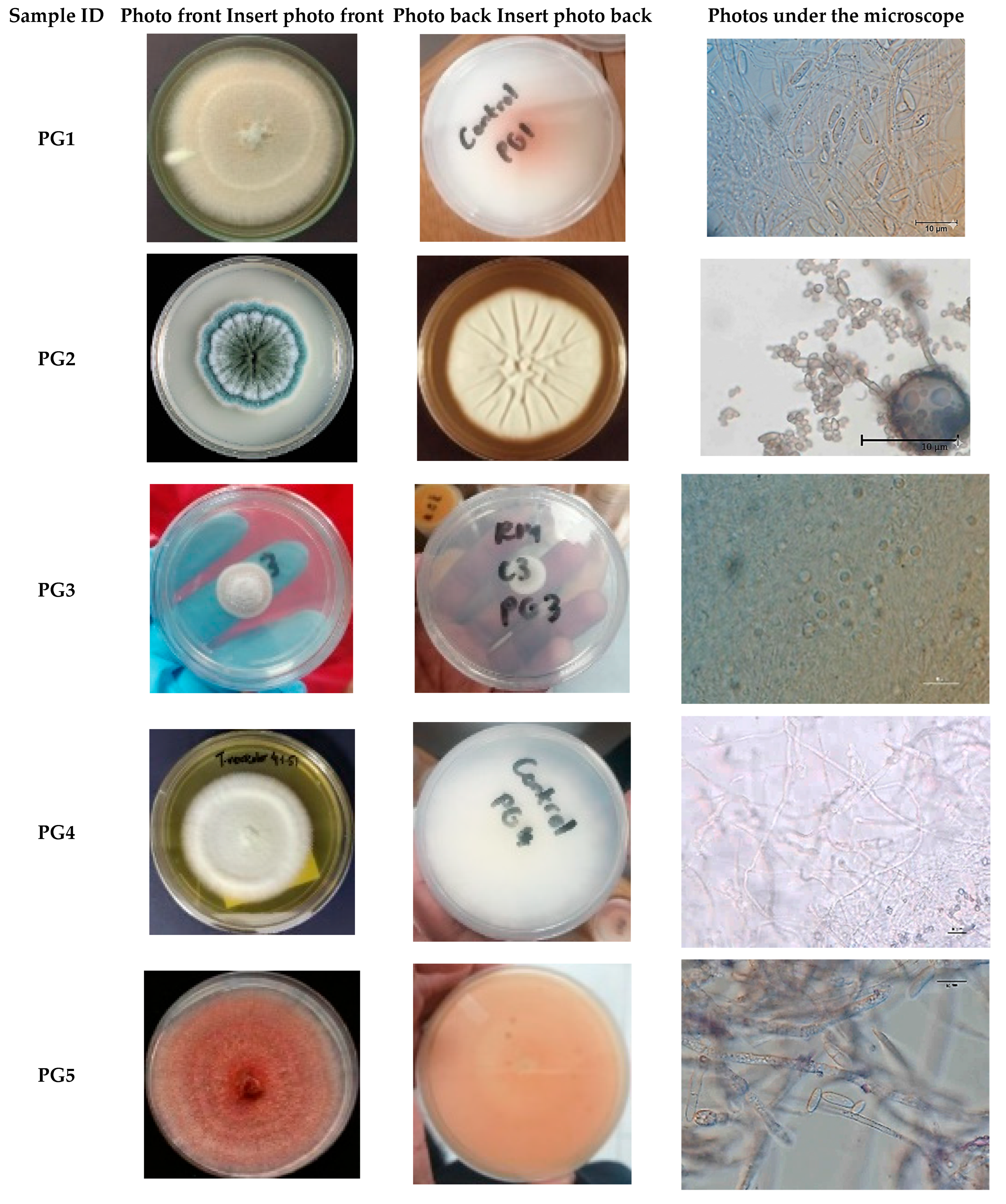
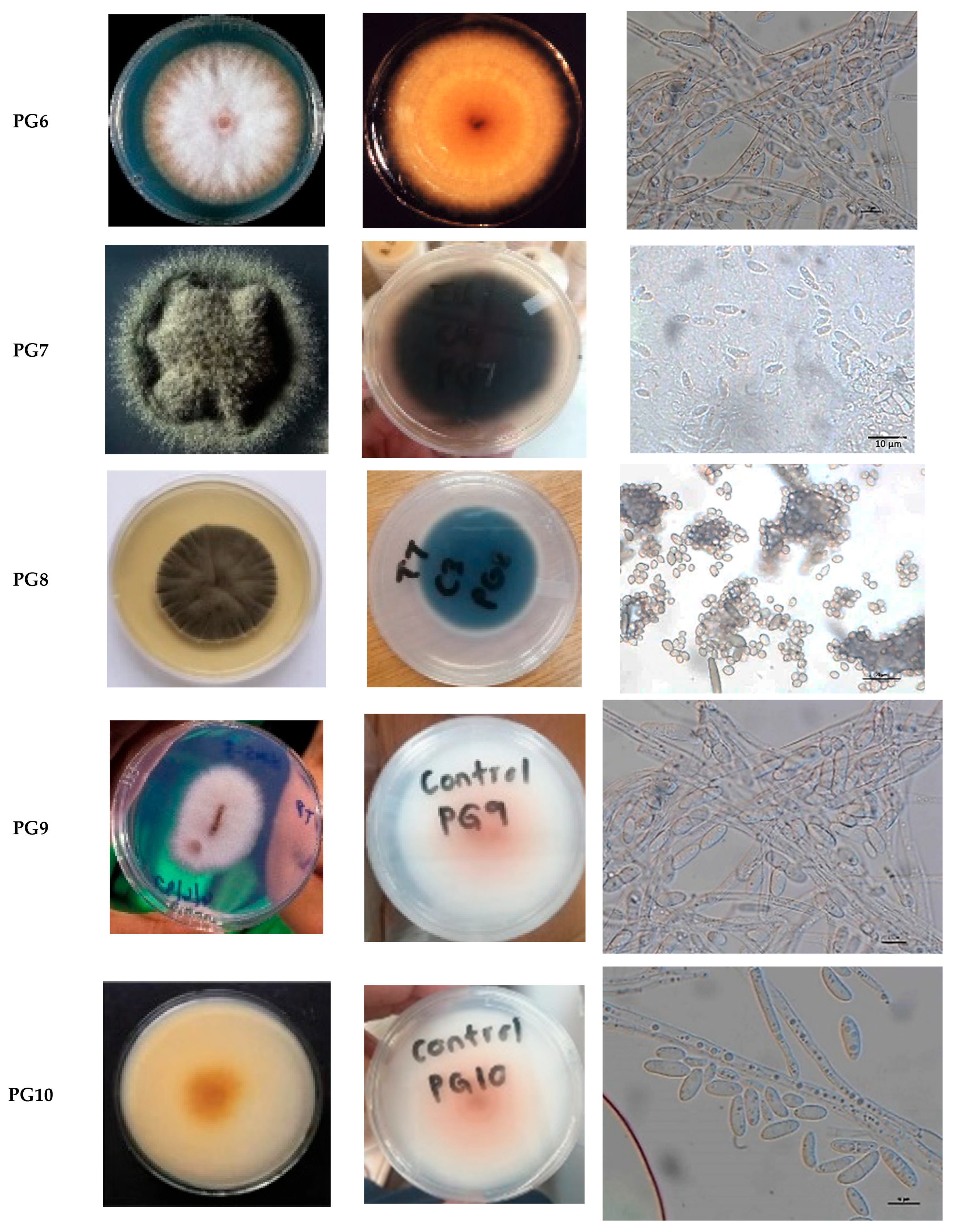
3.1. Morphological Identification of Fungal Pathogens
3.2. Molecular Identification of Fungal Pathogens
3.3. Antifungal Activity of Essential Oils Against Fungal Pathogens from S. zeamais
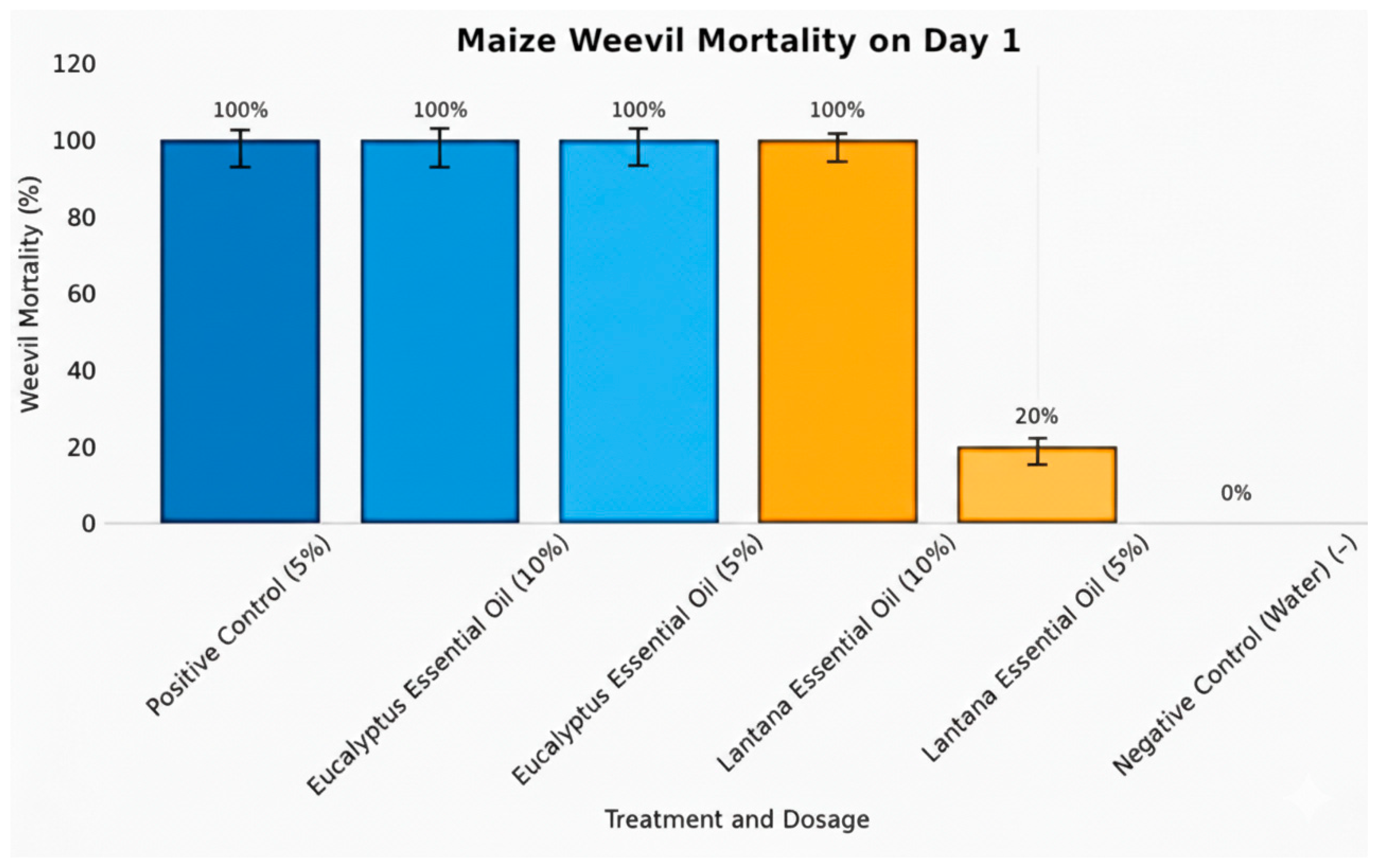
3.4. Contact Toxicity Effect of Essential Oils Against Maize Weevil
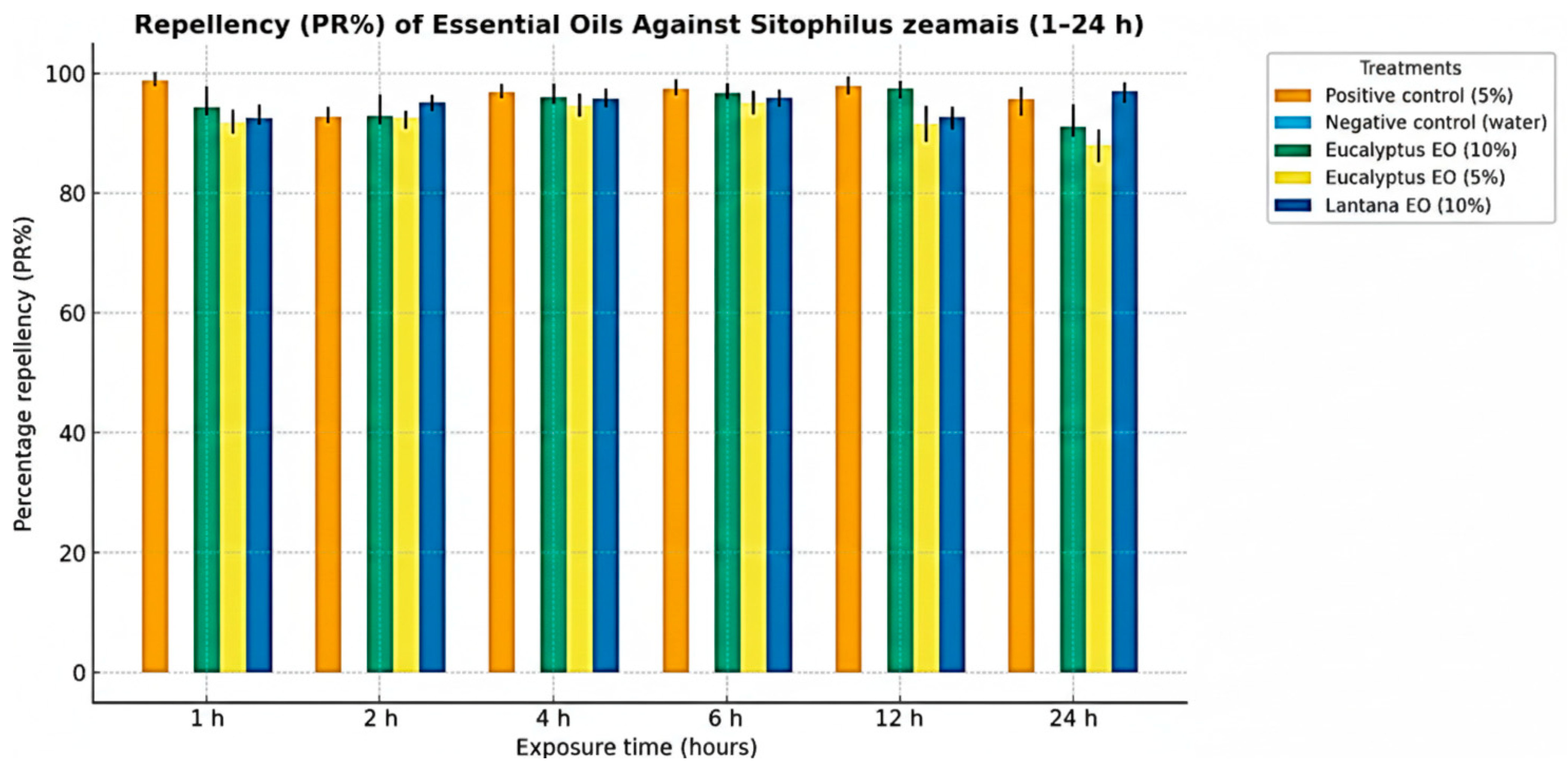
3.5. Repellence Bioassay
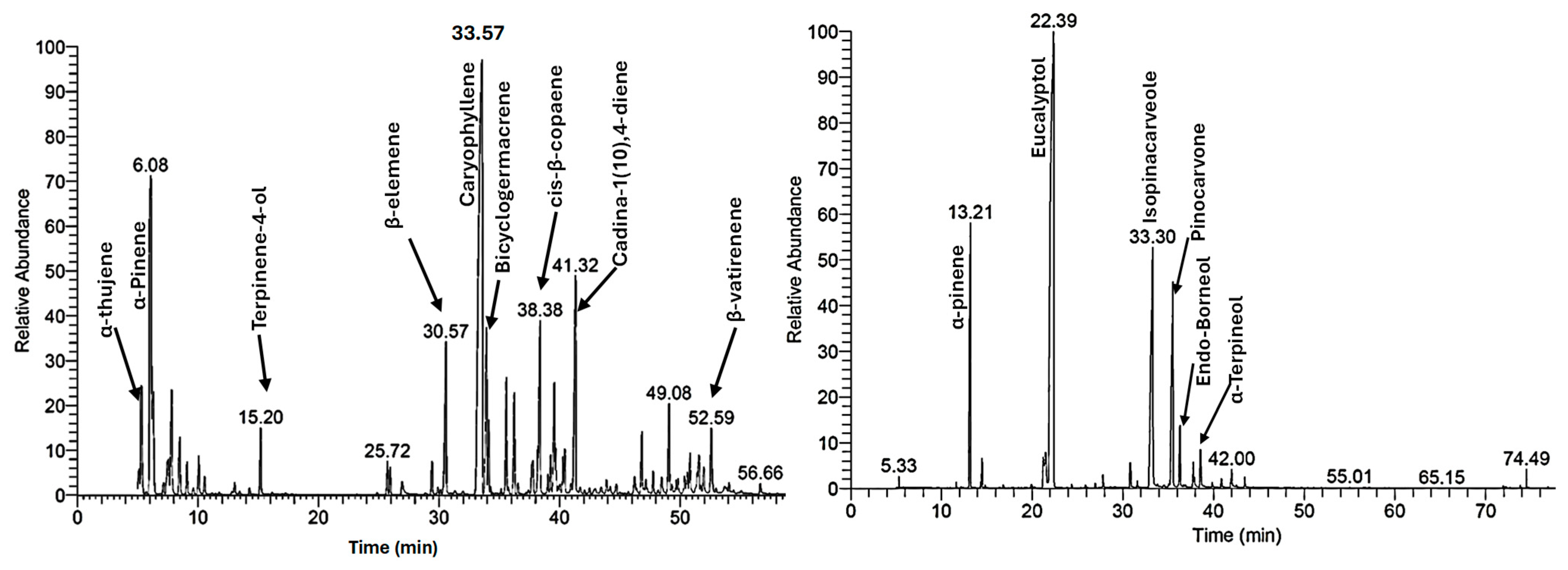
3.6. GC-MS Analysis
4. Discussion
5. Conclusions
Supplementary Materials
Author Contributions
Funding
Data Availability Statement
Acknowledgments
Conflicts of Interest
References
- Tefera, M.L.; Carletti, A.; Altea, L.; Rizzu, M.; Migheli, Q.; Seddaiu, G. Land degradation and the upper hand of sustainable agricultural intensification in sub-Saharan Africa-A systematic review. J. Agric. Rural Dev. Trop. Subtrop. (JARTS) 2024, 125, 63–83. [Google Scholar]
- Warmate, D.; Onarinde, B.A. Food safety incidents in the red meat industry: A review of foodborne disease outbreaks linked to the consumption of red meat and its products, 1991 to 2021. Int. J. Food Microbiol. 2023, 398, 110240. [Google Scholar] [CrossRef] [PubMed]
- Simane, B.; Kapwata, T.; Naidoo, N.; Cissé, G.; Wright, C.Y.; Berhane, K. Ensuring Africa’s Food Security by 2050: The role of population growth, climate-resilient strategies, and putative pathways to resilience. Foods 2025, 14, 262. [Google Scholar] [CrossRef]
- Ngegba, P.M.; Cui, G.; Khalid, M.Z.; Zhong, G. Use of botanical pesticides in agriculture as an alternative to synthetic pesticides. Agriculture 2022, 12, 600. [Google Scholar] [CrossRef]
- Satya, S.; Kadian, N.; Kaushik, G.; Sharma, U. Impact of chemical pesticides for stored grain protection on environment and human health. In Proceedings of the 10th International Conference on Controlled Atmosphere and Fumigation in Stored Products, New Delhi, India, 7–11 November 2016; pp. 92–97. [Google Scholar]
- Gossen, B.D.; McDonald, M.R. New technologies could enhance natural biological control and disease management and reduce reliance on synthetic pesticides. Can. J. Plant Pathol. 2020, 42, 30–40. [Google Scholar] [CrossRef]
- Ganai, M.; Khan, Z.; Tabasum, B. Challenges and constraints in chemical pesticide usage and their solution: A review. Int. J. Fauna Biol. Stud. 2018, 5, 31–37. [Google Scholar]
- Liang, J.; Xiao, F.; Ojo, J.; Chao, W.H.; Ahmad, B.; Alam, A.; Abbas, S.; Abdelhafez, M.M.; Rahman, N.; Khan, K.A. Insect resistance to insecticides: Causes, mechanisms, and exploring potential solutions. Arch. Insect Biochem. Physiol. 2025, 118, e70045. [Google Scholar] [CrossRef] [PubMed]
- Chattopadhyay, P.; Banerjee, G. Arms race between insecticide and insecticide resistance and evolution of insect management strategies. In Pesticides in Crop Production: Physiological and Biochemical Action; John Wiley & Sons Ltd.: Hoboken, NJ, USA, 2020; pp. 109–130. [Google Scholar]
- Ádám, B.; Cocco, P.; Godderis, L. Hazardous effects of pesticides on human health. Toxics 2024, 12, 186. [Google Scholar] [CrossRef] [PubMed]
- Akhter, S.; Naik, V.K.; Naladi, B.J.; Rathore, A.; Yadav, P.; Lal, D. The Ecological Impact of Pesticides on Non-Target Organisms in Agricultural Ecosystems. Adv. Biores. 2024, 15, 322–334. [Google Scholar]
- Ansari, I.; El-Kady, M.M.; Arora, C.; Sundararajan, M.; Maiti, D.; Khan, A. A review on the fatal impact of pesticide toxicity on environment and human health. In Global Climate Change; Elsevier: Amsterdam, The Netherlands, 2021; pp. 361–391. [Google Scholar]
- Hamid, A.; Yaqub, G.; Ayub, M.; Naeem, M. Determination of malathion, chlorpyrifos, λ-cyhalothrin and arsenic in rice. Food Sci. Technol. 2020, 41, 461–466. [Google Scholar] [CrossRef]
- Harun-Ur-Rashid, M.; Imran, A.B. Biomimetic and Synthetic Advances in Natural Pesticides: Balancing Efficiency and Environmental Safety. J. Chem. 2025, 2025, 1510186. [Google Scholar] [CrossRef]
- Karaoğlan, B.; Alkassab, A.T.; Borges, S.; Fisher, T.; Link-Vrabie, C.; McVey, E.; Ortego, L.; Nuti, M. Microbial pesticides: Challenges and future perspectives for non-target organism testing. Environ. Sci. Eur. 2024, 36, 205. [Google Scholar] [CrossRef]
- Khan, M.A.; Ahmad, W. Synthetic chemical insecticides: Environmental and agro contaminants. In Microbes for Sustainable Insect Pest Management: An Eco-Friendly Approach-Volume 1; Springer: Berlin/Heidelberg, Germany, 2019; pp. 1–22. [Google Scholar]
- Teder, T.; Knapp, M. Sublethal effects enhance detrimental impact of insecticides on non-target organisms: A quantitative synthesis in parasitoids. Chemosphere 2019, 214, 371–378. [Google Scholar] [CrossRef] [PubMed]
- Mariadoss, A.; Sujeetha, A.R.; Sankarganesh, E. Challenges and Issues Associated with Chemical Methods of Fumigation. In Non-Chemical Methods for Disinfestation of Stored Products; CRC Press: Boca Raton, FL, USA, 2025; pp. 60–74. [Google Scholar]
- Lyubenova, A.; Georgieva, L.; Antonova, V. Utilization of plant secondary metabolites for plant protection. Biotechnol. Biotechnol. Equip. 2023, 37, 2297533. [Google Scholar] [CrossRef]
- Tlak Gajger, I.; Dar, S.A. Plant allelochemicals as sources of insecticides. Insects 2021, 12, 189. [Google Scholar] [CrossRef] [PubMed]
- Bava, R.; Castagna, F.; Palma, E.; Marrelli, M.; Conforti, F.; Musolino, V.; Carresi, C.; Lupia, C.; Ceniti, C.; Tilocca, B. Essential oils for a sustainable control of honeybee varroosis. Vet. Sci. 2023, 10, 308. [Google Scholar] [CrossRef]
- Zuo, S.; Ma, J.; Gao, B. A review of bio-insecticidal activity of essential oils from Asteraceae. J. Plant Dis. Prot. 2025, 132, 1–17. [Google Scholar] [CrossRef]
- Nourbakhsh, F.; Lotfalizadeh, M.; Badpeyma, M.; Shakeri, A.; Soheili, V. From plants to antimicrobials: Natural products against bacterial membranes. Phytother. Res. 2022, 36, 33–52. [Google Scholar] [CrossRef]
- Barboucha, G.; Rahim, N.; Boulebd, H.; Bramki, A.; Andolfi, A.; Salvatore, M.M.; Masi, M. Chemical composition, in silico investigations and evaluation of antifungal, antibacterial, insecticidal and repellent activities of Eucalyptus camaldulensis Dehn. leaf essential oil from ALGERIA. Plants 2024, 13, 3229. [Google Scholar] [CrossRef]
- Chaubey, M.K. Insecticidal property of terpenes against maize weevil, Sitophilus zeamais (Motschulsky). J. Biopestic. 2022, 15, 92. [Google Scholar] [CrossRef]
- Minozzo, M.; da Silva, G.S.; Bernardi, J.L.; do Nascimento, L.H.; Duarte, P.F.; Puton, B.M.S.; Junges, A.; Backes, G.T.; Sausen, T.L.; Steffens, C. Insecticidal Activity of Free and Microencapsulated Cinnamomum cassia Essential Oil Against Sitophilus zeamais in Stored Maize. Food Bioprocess Technol. 2025, 18, 4035–4047. [Google Scholar] [CrossRef]
- Wanna, R.; Bunphan, D.; Kunlanit, B.; Khaengkhan, P.; Khaengkhan, P.; Bozdoğan, H. Chemical Composition of Essential Oil from Apium graveolens L. and Its Biological Activities Against Sitophilus zeamais Motschulsky (Coleoptera: Dryophthoridae). Plants 2025, 14, 347. [Google Scholar] [CrossRef]
- Yang, Y.; Isman, M.B.; Tak, J.-H. Insecticidal activity of 28 essential oils and a commercial product containing Cinnamomum cassia bark essential oil against Sitophilus zeamais Motschulsky. Insects 2020, 11, 474. [Google Scholar] [CrossRef]
- Pimenta, T.A.; da Silva, A.B.; Farias, L.R.A.; Cruz, G.S.; Teixeira, V.W.; Teixeira, Á.A.C.; de Lima Silva, N.; Trindade, R.C.P. Bioactivity, biochemical mechanisms, and olfactory effects of the essential oil from Syzygium aromaticum and its major compound eugenol on Sitophilus zeamais L. (Coleoptera: Curculionidae). Res. Sq. 2025; preprint. [Google Scholar] [CrossRef]
- Ngongo-Kapenga, J.; Kwete, S.M.; Yefile-Mposhi, S.; Kalonji-Mbangila, A.; Mulumba-Badibanga, G.; Ngombo-Nzokwani, A.; Kalonji-Kabemba, N.; Kalala, B.K.; Kalonji-Mbuyi, A.; Muengula-Manyi, M. Use of essential oil of Eucalyptus globulus leaves against Sitophilus zeamais Motsch. Asian J. Biol. 2021, 10, 74–82. [Google Scholar] [CrossRef]
- Kumar, R.; Guleria, N.; Deeksha, M.G.; Kumari, N.; Kumar, R.; Jha, A.K.; Parmar, N.; Ganguly, P.; de Aguiar Andrade, E.H.; Ferreira, O.O. From an invasive weed to an insecticidal agent: Exploring the potential of Lantana camara in insect management strategies—A review. Int. J. Mol. Sci. 2024, 25, 12788. [Google Scholar] [CrossRef]
- Wong, M.-Y.; Kwan, Y.-M.; Sathyapriya, H. Utilization of Biodiversity for Sustainable Plant Disease Management. In Advances in Tropical Crop Protection; Springer: Berlin/Heidelberg, Germany, 2024; pp. 199–220. [Google Scholar]
- Čmiková, N.; Galovičová, L.; Schwarzová, M.; Vukic, M.D.; Vukovic, N.L.; Kowalczewski, P.Ł.; Bakay, L.; Kluz, M.I.; Puchalski, C.; Kačániová, M. Chemical composition and biological activities of Eucalyptus globulus essential oil. Plants 2023, 12, 1076. [Google Scholar] [CrossRef] [PubMed]
- Liambila, R.N.; Wesonga, J.M.; Ngamau, C.N.; Wallyambilla, W. Seasonal and Regional Chemical Variability of the Wild Population of Lantana camara Leaf Essential Oil from Kenya. J. Agric. Sci. 2021, 13, 86–104. [Google Scholar] [CrossRef]
- Kato-Noguchi, H.; Kato, M. Compounds involved in the invasive characteristics of Lantana camara. Molecules 2025, 30, 411. [Google Scholar] [CrossRef]
- Routray, S.; Kabi, M.; Debnath, D.; Palei, S. Potential of Lantana camara L. extracts as biopesticide against insect pests. J. Entomol. Res. 2021, 45, 461–469. [Google Scholar] [CrossRef]
- Kinkela, N.; Morales, A.; Sánchez-Martínez, H.A.; Díaz, M.; Samba, N.; Mawunu, M.; Morán-Pinzón, J.A.; Silva, L.; Rodilla, J.; De León, E.G. Comprehensive Characterization of Lantana camara Essential Oils: GC-MS Profiling, Antioxidant Capacity, and Drug-Likeness Prediction. 2025. Available online: https://www.preprints.org/frontend/manuscript/3dace6650c68805bb4cddf8aa9e23b64/download_pub (accessed on 20 April 2025).
- Satyal, P.; Crouch, R.A.; Monzote, L.; Cos, P.; Awadh Ali, N.A.; Alhaj, M.A.; Setzer, W.N. The chemical diversity of Lantana camara: Analyses of essential oil samples from Cuba, Nepal, and Yemen. Chem. Biodivers. 2016, 13, 336–342. [Google Scholar] [CrossRef] [PubMed]
- Atti-Santos, A.C.; Rossato, M.; Serafini, L.A.; Cassel, E.; Moyna, P. Extraction of essential oils from lime (Citrus latifolia Tanaka) by hydrodistillation and supercritical carbon dioxide. Braz. Arch. Biol. Technol. 2005, 48, 155–160. [Google Scholar] [CrossRef]
- Gopane, B.; Tchatchouang, C.K.; Regnier, T.; Ateba, C.; Manganyi, M. Community diversity and stress tolerance of culturable endophytic fungi from black seed (Nigella sativa L.). S. Afr. J. Bot. 2021, 137, 272–277. [Google Scholar] [CrossRef]
- Sishuba, A.; Leboko, J.; Ateba, C.N.; Manganyi, M.C. First report: Diversity of endophytic fungi possessing antifungal activity isolated from native Kougoed (Sceletium tortuosum L.). Mycobiology 2021, 49, 89–94. [Google Scholar] [CrossRef]
- Singh, M.; Pandey, N.; Agnihotri, V.; Singh, K.; Pandey, A. Antioxidant, antimicrobial activity and bioactive compounds of Bergenia ciliata Sternb.: A valuable medicinal herb of Sikkim Himalaya. J. Tradit. Complement. Med. 2017, 7, 152–157. [Google Scholar] [CrossRef]
- Oyedeji, O.; Ekundayo, O.; König, W. Volatile leaf oil constituents of Lantana camara L from Nigeria. Flavour Fragr. J. 2003, 18, 384–386. [Google Scholar] [CrossRef]
- Ramírez, J.; Balcázar, K.; López, J.; Castillo, L.N.; Ortega, R.; López, H.V.; Delgado-Fernández, E.; Vacacela, W.; Calva, J.; Armijos, C. Chemical Composition and Acaricidal Activity of Lantana camara L. Essential Oils Against Rhipicephalus microplus. Plants 2025, 14, 2336. [Google Scholar] [CrossRef]
- Haikal, A.; Ali, A.R. Chemical composition and toxicity studies on Lantana camara L. flower essential oil and its in silico binding and pharmacokinetics to superoxide dismutase 1 for amyotrophic lateral sclerosis (ALS) therapy. RSC Adv. 2024, 14, 24250–24264. [Google Scholar] [CrossRef]
- Almas, I.; Innocent, E.; Machumi, F.; Kisinza, W. Chemical composition of essential oils from Eucalyptus globulus and Eucalyptus maculata grown in Tanzania. Sci. Afr. 2021, 12, e00758. [Google Scholar] [CrossRef]
- Adams, R.P. Identification of Essential Oil Components by Gas Chromatography/Mass Spectrometry (ed. 4.1); Allured Publ Crop: Carol Steam, IL, USA, 2017. [Google Scholar]
- Tran, T.M.; Ameye, M.; Phan, L.T.-K.; Devlieghere, F.; De Saeger, S.; Eeckhout, M.; Audenaert, K. Post-harvest contamination of maize by Fusarium verticillioides and fumonisins linked to traditional harvest and post-harvest practices: A case study of small-holder farms in Vietnam. Int. J. Food Microbiol. 2021, 339, 109022. [Google Scholar] [CrossRef]
- Deressa, T.; Adugna, G.; Suresh, L.; Bekeko, Z.; Vaughan, M.M.; Iriarte-Broders, G.; Proctor, R.; Mehl, H.; Prasanna, B.M.; Opoku, J. Fusarium species associated with preharvest maize ear rot cause stalk rot disease in Ethiopia. Plant Dis. 2025, 10, 3057–3066. [Google Scholar] [CrossRef]
- Zunino, M.P.; Herrera, J.M.; Pizzolitto, R.P.; Rubinstein, H.R.; Zygadlo, J.A.; Dambolena, J.S. Effect of selected volatiles on two stored pests: The fungus Fusarium verticillioides and the maize weevil Sithophilus zeamais. J. Agric. Food Chem. 2015, 63, 7743–7749. [Google Scholar] [CrossRef]
- Seco, M.; Beltran, A.; Balendres, M. First record of Hyphopichia burtonii isolated from the storage pest Sitophilus zeamais and its bioactivity against mycotoxigenic fungi. Hell. Plant Prot. J. 2024, 17, 97–110. [Google Scholar] [CrossRef]
- Alhantoobi, W.A.; Alkatheri, A.H.; Parusheva, T.; Lai, K.S.; Thomas, W.; Lim, S.-H.E. Antimicrobial Activity of Essential Oils and Their Mechanism of Action Against Bacterial and Fungal Infections. Saudi J. Biomed. Res. 2025, 10, 168–186. [Google Scholar] [CrossRef]
- Tian, F.; Woo, S.Y.; Lee, S.Y.; Park, S.B.; Zheng, Y.; Chun, H.S. Antifungal activity of essential oil and plant-derived natural compounds against Aspergillus flavus. Antibiotics 2022, 11, 1727. [Google Scholar] [CrossRef] [PubMed]
- Dantas, T.d.S.; Machado, J.C.B.; Ferreira, M.R.A.; Soares, L.A.L. Bioactive Plant Compounds as Alternatives Against Antifungal Resistance in the Candida Strains. Pharmaceutics 2025, 17, 687. [Google Scholar] [CrossRef] [PubMed]
- Chen, S.; Li, Z.; Chitrakar, B.; Gu, Z.; Ban, X.; Hong, Y.; Cheng, L.; Li, C. Minimum inhibitory concentration (MIC) of essential oils against microorganisms: Methods, function, accuracy factors and application. Food Rev. Int. 2024, 40, 3445–3470. [Google Scholar] [CrossRef]
- Speranza, B.; Bevilacqua, A.; Campaniello, D.; Altieri, C.; Corbo, M.R.; Sinigaglia, M. Minimal inhibitory concentrations of thymol and carvacrol: Toward a unified statistical approach to find common trends. Microorganisms 2023, 11, 1774. [Google Scholar] [CrossRef]
- Gakuubi, M.M.; Maina, A.W.; Wagacha, J.M. Antifungal activity of essential oil of Eucalyptus camaldulensis Dehnh. against selected Fusarium spp. Int. J. Microbiol. 2017, 2017, 8761610. [Google Scholar] [CrossRef]
- Wu, T.-L.; Zhang, B.-Q.; Luo, X.-F.; Li, A.-P.; Zhang, S.-Y.; An, J.-X.; Zhang, Z.-J.; Liu, Y.-Q. Antifungal efficacy of sixty essential oils and mechanism of oregano essential oil against Rhizoctonia solani. Ind. Crops Prod. 2023, 191, 115975. [Google Scholar] [CrossRef]
- Upadhyay, R.; Saini, R.; Shukla, P.; Tiwari, K. Role of secondary metabolites in plant defense mechanisms: A molecular and biotechnological insights. Phytochem. Rev. 2025, 24, 953–983. [Google Scholar] [CrossRef]
- Páez, A.R.; Leite, J.P.V. Antimicrobial Activity of Essential Oils: Uses and Applications Against Plant Pathogens. In Natural Pesticides and Allelochemicals; CRC Press: Boca Raton, FL, USA, 2025; pp. 147–167. [Google Scholar]
- Shala, A.Y.; Gururani, M.A. Phytochemical properties and diverse beneficial roles of Eucalyptus globulus Labill.: A review. Horticulturae 2021, 7, 450. [Google Scholar] [CrossRef]
- Moussa, H.H.; Sara, B.; Benhalima, H.; Benaliouche, F.; Sbartai, I.; Sbartai, H. Chemical characterization of Eucalyptus (Eucalyptus globulus) leaf essential oil and evaluation of its antifungal, antibacterial and antioxidant activities. Cell. Mol. Biol. 2024, 70, 1–9. [Google Scholar] [CrossRef] [PubMed]
- Ammad, F.; Bentoumi, Y.; Gharnaout, M.L.; Zebib, B.; Merah, O. Inhibitory effect of Eucalyptus globulus essential oil against Botryosphaeria dothidea and Fomitiporia mediterranea fungi causing wood diseases in viticulture. Vegetos 2024, 38, 2482–2490. [Google Scholar] [CrossRef]
- Shukla, A.; Kushwaha, A.; Sanju, S.; Spring, P.; Kumar, A.; Misra, P.; Shukla, P.K. Essential oils toxicity and conflicts. In Aromatherapy: The Science of Essential Oils; Bentham Science Publishers: Sharjah, United Arab Emirates, 2024; pp. 124–167. [Google Scholar]
- Ihssane, G.; Jihane, T.N. Comparative Efficacy of Essential Oils Extracted from the Fruits and Leaves of Eucalyptus globulus in the Control of a Stored-Product. Ph.D. Thesis, Larbi Tébessi University, Tébessa, Algeria, 2025. [Google Scholar]
- Baouahi, N.; Bouhadi, M.; Elagdi, C.; Hamdane, H.; Yousfi, S.; Bouamrani, M.L.; El Kouali, M.h.; Talbi, M.; Bennani, L. Evaluation, efficacy and function of essential oils from Lantana camara L. Morocco leaves for the antioxidant activity and as a bio-insecticide against the wheat weevil Sitophilus granarius in post-harvest crops. Euro-Mediterr. J. Environ. Integr. 2025, 10, 3821–3834. [Google Scholar] [CrossRef]
- Laoudi, T.; Khelfane-Goucem, K.; Hamani-Aoudjit, S.; Chebrouk, F.; Amrouche, T.; Saher, L.; Kellouche, A. Chemical composition of essential oils from the leaves of Schinus molle and Cupressus sempervirens and their insecticidal activity against Oryzaephilus surinamensis (Coleoptera: Silvanidae). J. Essent. Oil Bear. Plants 2023, 26, 309–322. [Google Scholar] [CrossRef]



| Sample ID | Colony Colour (Front) | Colony Colour (Back) | Colony Texture | Colony Margin | Nature of Hyphae | Spores and Conidiophores | Probable ID |
|---|---|---|---|---|---|---|---|
| PG1 | White | Orange and white | Filamentous | Radial and Fuzzy | Septate | Oval spores and sickle-shaped conidia | Fusarium |
| PG2 | Dark Green with a white border | Green | Velvety | Wavy | Aerial | Oval spores and Penicillate conidiophores | Penicillium |
| PG3 | Light purple and white | Cream white | Velvety | Smooth | Hyaline and Septate | Ellipsoidal spores with phialides terminating conidiophores | Purpureocillium |
| PG4 | White | White | Filamentous | Radial and Fuzzy | Septate hyphae with clamp connections | Smooth cylindrical spores and no conidiophores | Unknown |
| PG5 | Pink | Pink | Filamentous | Radial and Fuzzy | Septate | Oval spores and sickle-shaped conidia | Fusarium |
| PG6 | Cream white | Red-Orange centre with white | Filamentous | Radial and Fuzzy | Septate | Oval spores and sickle-shaped conidia | Fusarium |
| PG7 | Black or brown | Black or brown | Filamentous | Radial and Fuzzy | Septate | Lemon shaped spores and conidiophores with shield cells | Cladosporium |
| PG8 | Military green | Military green | Velvety | Lobed | Aerial | Oval spores and Penicillate conidiophores | Penicillium |
| PG9 | Red line surrounded by cream white | Red line surrounded by cream white | Filamentous | Radial and Fuzzy | Septate | Oval spores and sickle-shaped conidia | Fusarium |
| PG10 | Orange centre surrounded by cream white | Orange centre surrounded by cream white | Filamentous | Radial and Fuzzy | Septate | Oval spores and sickle-shaped conidia | Fusarium |
| Sample ID | Closest Related Species | GenBank Best BLAST Match | ||
|---|---|---|---|---|
| GenBank Accession | HSP Length | % Identity | ||
| PG1 | Fusarium solani | OQ818134.1 | 569 bp | 100% |
| PG2 | Penicillium brasilinum | AB455514.2 | 593 bp | 100% |
| PG3 | Purpureocillium lilacinum | MK503783.1 | 604 bp | 100% |
| PG4 | Trametes versicolor | OR250362.1 | 630 bp | 100% |
| PG5 | Fusarium solani | OQ818134.1 | 568 bp | 100% |
| PG6 | Fusarium solani | OQ818134.1 | 515 bp | 100% |
| PG7 | Cladosporium sp. | OP596126.1 | 552 bp | 100% |
| PG8 | Penicillium sp. | MN788660.1 | 139 bp | 100% |
| PG9 | Fusarium solani | OQ818134.1 | 569 bp | 100% |
| PG10 | Fusarium solani | OQ818134.1 | 569 bp | 100% |
| Plants | Fungal Pathogens | Inhibition (%) Concentrations | ||||
|---|---|---|---|---|---|---|
| 100 µL/L | 250 µL/L | 500 µL/L | 1000 µL/L | 2000 µL/L | ||
| Lantana oil | PG1 | 72 ± 1.2 a | 78 ± 0.7 a | 78 ± 0.9 a | 89 ± 0.0 e | 90 ± 1.2 e |
| PG2 | 81 ± 8.2 a | 85 ± 0.0 b | 89 ± 2.9 b | 89 ± 0.1 e | 89 ± 0.6 e | |
| PG3 | 80 ± 2.1 b | 81 ± 0.3 b | 83 ± 0.2 b | 87 ± 0.4 b | 89 ± 0.0 e | |
| PG4 | 67 ± 0.0 c | 72 ± 1.0 a | 83 ± 0.0 b | 83 ± 1.0 b | 85 ± 0.1 b | |
| PG5 | 58 ± 0.7 d | 75 ± 0.4 a | 80 ± 2.4 b | 83 ± 0.7 b | 84 ± 0.7 b | |
| PG6 | 80 ± 2.3 b | 81 ± 5.0 a | 82 ± 0.0 b | 83 ± 0.3 b | 89 ± 0.0 e | |
| PG7 | 76 ± 0.4 a | 76 ± 0.6 a | 78 ± 0.4 a | 81 ± 2.4 f | 83 ± 0.9 b | |
| PG8 | 65 ± 0.0 c | 71 ± 3.7 c | 82 ± 8.0 e | 82 ± 0.4 b | 88 ± 3.3 e | |
| PG9 | 69 ± 0.1 c | 75 ± 0.0 a | 75 ± 0.6 a | 81 ± 0.9 b | 88 ± 0.1 b | |
| PG10 | 67 ± 0.2 c | 72 ± 0.8 a | 78 ± 0.9 a | 78 ± 0.0 a | 83 ± 0.5 b | |
| Eucalyptus oil | PG1 | 71 ± 0.9 a | 72 ± 0.2 a | 73 ± 0.7 c | 75 ± 1.4 b | 83 ± 0.0 b |
| PG2 | 81 ± 0.1 b | 83 ± 0.5 b | 87 ± 2.3 d | 89 ± 0.8 d | 89 ± 0.6 d | |
| PG3 | 83 ± 0.6 b | 83 ± 0.0 b | 87 ± 1.1 d | 87 ± 0.9 d | 90 ± 3.4 d | |
| PG4 | 72 ± 3.3 a | 78 ± 3.2 c | 78 ± 0.8 e | 79 ± 0.3 b | 83 ± 0.9 b | |
| PG5 | 71 ± 2.0 a | 75 ± 1.0 c | 76 ± 0.4 b | 83 ± 0.1 b | 83 ± 0.2 b | |
| PG6 | 81 ± 0.9 b | 81 ± 0.0 b | 89 ± 0.4 d | 89 ± 0.9 f | 93 ± 0.0 f | |
| PG7 | 82 ± 0.2 b | 82 ± 0.0 b | 88 ± 1.3 d | 89 ± 1.7 d | 89 ± 0.7 d | |
| PG8 | 76 ± 1.5 c | 76 ± 0.4 c | 82 ± 0.9 b | 82 ± 0.0 b | 82 ± 1.0 b | |
| PG9 | 69 ± 1.9 a | 75 ± 2.2 c | 75 ± 0.6 b | 81 ± 0.6 b | 81 ± 0.5 b | |
| PG10 | 73 ± 0.6 a | 83 ± 0.3 b | 83 ± 0.3 b | 83 ± 0.8 b | 83 ± 0.1 b | |
| Treatment | Dosage | Day 1 | Day 2 | Day 3 | Day 4 | Day 5 | Day 6 | Day 7 | Day 8 | Day 9 | Day 10 |
|---|---|---|---|---|---|---|---|---|---|---|---|
| Positive Control | 5% | 100 ± 2.0 a | – | – | – | – | – | – | – | – | – |
| Negative Control (Water) | – | 0 | 0 | 0 | 0 | 0 | 0 | 0 | 0 | 0 | 0 |
| Eucalyptus Essential Oil | 10% | 100 ± 4.5 a | – | – | – | – | – | – | – | – | – |
| Eucalyptus Essential Oil | 5% | 100 ± 3.0 a | – | – | – | – | – | – | – | – | – |
| Lantana Essential Oil | 10% | 100 ± 1.2 a | – | – | – | – | – | – | – | – | – |
| Lantana Essential Oil | 5% | 20 ± 3.2 b | 20 ± 2.6 a | 0 | 20 ± 1.8 a | 0 | 40 ± 0.2 b | 0 | 0 | 0 | 0 |
| Treatment (Conc.) | 1 h PR (%) | 2 h PR (%) | 4 h PR (%) | 6 h PR (%) | 12 h PR (%) | 24 h PR (%) |
|---|---|---|---|---|---|---|
| Positive control (5%) | 98.0 ± 1.2 a | 98.5 ± 0.9 b | 99.0 ± 0.7 a | 98.8 ± 0.8 a | 98.3 ± 1.0 a | 98.0 ± 1.1 a |
| Negative control (water) | 0.0 ± 0.0 c | 0.0 ± 0.0 c | 0.0 ± 0.0 c | 0.0 ± 0.0 c | 0.0 ± 0.0 c | 0.0 ± 0.0 c |
| Eucalyptus EO (10%) | 97.5 ± 1.5 a | 98.2 ± 1.1 a | 98.7 ± 0.9 a | 98.1 ± 1.0 a | 97.9 ± 1.3 a | 97.4 ± 1.4 a |
| Eucalyptus EO (5%) | 95.6 ± 1.9 a | 96.2 ± 1.7 a | 96.9 ± 1.6 a | 96.3 ± 1.8 a | 95.8 ± 2.0 a | 95.1 ± 2.1 a |
| Lantana EO (10%) | 96.9 ± 1.4 a | 97.3 ± 1.2 a | 97.8 ± 1.1 a | 97.1 ± 1.3 a | 96.6 ± 1.6 a | 96.0 ± 1.8 a |
| Lantana EO (5%) | 21.8 ± 2.9 b | 20.4 ± 2.6 b | 2.1 ± 1.0 b | 19.7 ± 2.5 b | 1.6 ± 0.9 b | 39.6 ± 2.1 b |
| Identified Compound | Peak Area% | Identified Compound | Peak Area% |
|---|---|---|---|
| L. camara | E. globulus | ||
| α-thujene | 4.02 | α-Pinene | 9.09 |
| α-Pinene | 13.83 | p-cymene | 1.17 |
| Camphene | 1.99 | m-cymene | 1.86 |
| Sabinene | 1.55 | Eucalyptol | 52.77 |
| β-Pinene | 2.73 | Isopinocarveole | 16.72 |
| β-Myrcene | 1.47 | Pinocarvone | 10.93 |
| Terpinene-4-ol | 1.25 | Endo-Borneol | 1.65 |
| β-elemene | 4.08 | α-Terpineol | 1.14 |
| Caryophyllene | 30.99 | ||
| Bicyclogermacrene | 4.11 | ||
| Alloaromadendrene | 1.54 | ||
| (E)-β-Farnesene | 2.26 | ||
| α-humulene | 2.18 | ||
| γ-Curcumene | 1.19 | ||
| cis-β-copaene | 5.02 | ||
| γ-muurolene | 3.04 | ||
| Cadina-1(10),4-diene | 5.92 | ||
| Caryophyllene oxide | 1.33 | ||
| Unknown * | 1.98 | ||
| δ-Cadinene | 1.36 | ||
| β-vatirenene | 1.7 | ||
Disclaimer/Publisher’s Note: The statements, opinions and data contained in all publications are solely those of the individual author(s) and contributor(s) and not of MDPI and/or the editor(s). MDPI and/or the editor(s) disclaim responsibility for any injury to people or property resulting from any ideas, methods, instructions or products referred to in the content. |
© 2026 by the authors. Licensee MDPI, Basel, Switzerland. This article is an open access article distributed under the terms and conditions of the Creative Commons Attribution (CC BY) license.
Share and Cite
Phokwe, O.J.; Magoro, K.; Maseme, M.R.; Manganyi, M.C. Preliminary Evaluation of the Toxic Effects of Essential Oils as Natural Pesticides Against Maize Weevil (Sitophilus zeamais) and Its Fungal Pathogens. Insects 2026, 17, 68. https://doi.org/10.3390/insects17010068
Phokwe OJ, Magoro K, Maseme MR, Manganyi MC. Preliminary Evaluation of the Toxic Effects of Essential Oils as Natural Pesticides Against Maize Weevil (Sitophilus zeamais) and Its Fungal Pathogens. Insects. 2026; 17(1):68. https://doi.org/10.3390/insects17010068
Chicago/Turabian StylePhokwe, Ompelege Jacqueline, Kabelo Magoro, Mametsi Rahab Maseme, and Madira Coutlyne Manganyi. 2026. "Preliminary Evaluation of the Toxic Effects of Essential Oils as Natural Pesticides Against Maize Weevil (Sitophilus zeamais) and Its Fungal Pathogens" Insects 17, no. 1: 68. https://doi.org/10.3390/insects17010068
APA StylePhokwe, O. J., Magoro, K., Maseme, M. R., & Manganyi, M. C. (2026). Preliminary Evaluation of the Toxic Effects of Essential Oils as Natural Pesticides Against Maize Weevil (Sitophilus zeamais) and Its Fungal Pathogens. Insects, 17(1), 68. https://doi.org/10.3390/insects17010068