


Simple Summary
Being a common group of ectoparasites of rodents and other small mammals, chiggers (chigger mites) are the exclusive vector of scrub typhus and can also serve as potential vectors of hemorrhagic fever with renal syndrome (HFRS). From November 2020 to October 2021, a 12-month investigation was conducted to illustrate the infestation, community structure and seasonal dynamics of chiggers on small mammals at a focus of scrub typhus in northern Yunnan, southwest China. A total of 217,671 chiggers collected from 1329 small mammal hosts at the survey site (Waxi Village) were taxonomically identified as 115 species and 13 genera in the family Trombiculidae, with high species diversity. Rodents and other sympatric small animals at Waxi Village were susceptible to chigger infestation, with high infestation burdens, and coexistence of multiple vector chiggers. Most chigger species had a wide range of hosts with low host specificity. The chigger community showed a high similarity between August and October in summer and autumn with low species diversity, and a large number of vector chiggers, such as Leptotrombidium deliense and L. imphalum, appeared in these seasons.
Abstract
Chiggers are common ectoparasites and the exclusive vector of scrub typhus. From November 2020 to October 2021, a 12-month investigation was conducted at Waxi Village of Binchuan County, Yunnan Province of southwest China, a focus of scrub typhus. A total of 217,671 chiggers collected from 1329 small mammal hosts (belonging to 18 species) at the survey site were taxonomically identified as 115 species and 13 genera in the family Trombiculidae with high species diversity. Among the 115 chigger species identified, there were nine vector species. The prevalence (PM = 69.38%), mean abundance (MA = 163.79 mites/per examined host), and mean intensity (MI = 236.09 mites/per infested host) were high. Three rodent species, Rattus andamanensis, Apodemus chevrieri, and Mus caroli, were the dominant hosts. Three vector chiggers, L. deliense, L. scutellare, and L. imphalum, were the dominant chiggers, with a constituent ratio (Cr) of 60.72%. The indexes of chigger infestation and community showed varying degrees of monthly and seasonal fluctuations. From August (summer) to September and October (autumn), the Margalef richness index (R), Shannon–Wiener diversity index (H), and Pielou evenness (E) of chiggers were at low levels, but the Simpson dominance index (D) was at a high level. The Cr and infestation indexes (MA, MI) of chiggers were high from August to October in summer and autumn, with abundant vector chiggers (such as L. deliense and L. imphalum) appearing in these seasons. The species richness of chigger community was highest in winter, but lowest in summer. The similarity of the chigger community was very high between August (summer) and September to October (autumn). The evenness of the chigger community was highest in spring and lowest in summer. In conclusion, small mammals are susceptible to chigger infestation with coexistence of multiple vector chigger species. Most chigger species have a wide range of hosts with low host specificity. The abundant vector chiggers (especially L. deliense and L. imphalum) in summer and autumn suggests that the surveillance campaign of scrub typhus and vector chiggers should mainly focus on these two seasons at the survey site.
1. Introduction
Rodents and other sympatric small mammals are of medical significance, and they can serve as the infectious source and reservoir host of many zoonotic diseases such as plague, murine typhus, scrub typhus, and hemorrhagic fever with renal syndrome (HFRS) [1,2]. Chiggers (chigger mites) usually refer to the larval stage of trombiculid mites (Trombiculidae) with over 3000 species recorded in the world, and they are a common group of ectoparasites on rodents and other small mammals [3,4]. In the life cycle of trombiculid mites, only the larval stage (chigger) is ectoparasitic, while the other stages are all free-living [5,6]. Chiggers are the exclusive vector of scrub typhus, and through their biting activities, Orientia tsutsugamushi (Ot) can be transmitted among wild animals (e.g., rodents and other small mammals) and even from wild animals to domestic animals and humans [7,8]. Besides transmitting scrub typhus, some chiggers (e.g., Leptotrombidium scutellare) can act as the potential vectors of HFRS [9,10]. Scrub typhus is widespread in China, with the incidence being in continuous rise and the foci gradually expanding in recent years [11,12]. Yunnan Province, located in the southwest of China, is a very important focus of scrub typhus and HFRS. Among the 129 counties in 16 prefectural administrative regions of Yunnan Province, 118 counties in all the 16 prefectural regions have reported cases of scrub typhus [13]. Of the 283,273 cases of scrub typhus reported in mainland China between 2006 and 2023, 84,795 cases from Yunnan Province ranked first, accounting for 29.93% of the total in China [11].
The community study is an important aspect in ecological fields [14,15]. In fact, the seasonal variation patterns of the same group of mites may vary from region to region. To study the seasonal variations in a specific mite group (or a specific species), it is recommended to select a fixed survey site and conduct field investigations once a month for a period of at least one entire year (a 12-month consecutive field investigation). The present study selected Waxi Village of Binchuan County, Dali Prefecture in Yunnan Province of southwest China as the fixed survey site and conducted a consecutive 12-month investigation. The survey site is a focus of scrub typhus and HFRS [16,17]. The study is an attempt to illustrate the infestation, community structure and seasonal dynamics of chiggers in this epidemic focus. The hosts of chiggers involved in this study were mainly rodents (Rodentia) and other sympatric small animals such as shrews (Eulipotyphla) and tree shrews (Scandetia), excluding volant bats (Chiroptera).
2. Materials and Methods
2.1. Field Investigations
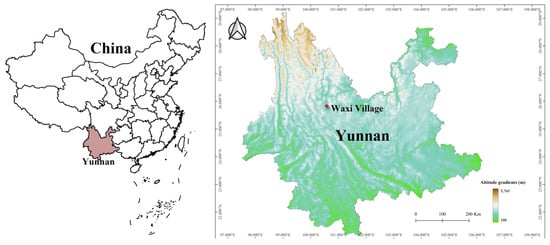
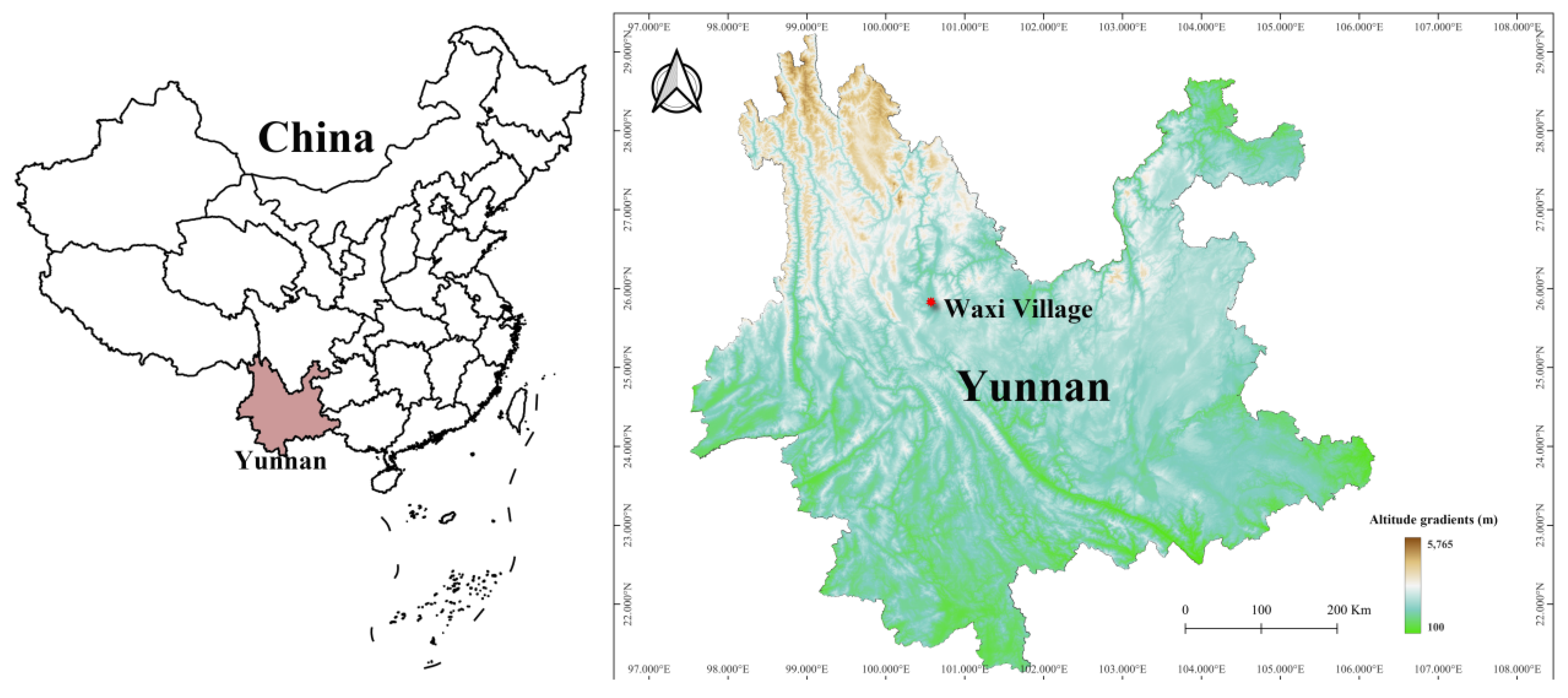
A consecutive 12-month investigation was carried out at Waxi Village of Binchuan County, Dali Prefecture in Yunnan Province of southwest China from November 2020 to October 2021 (Figure 1). The field investigation each month lasted for seven to ten days to ensure a sufficient number of host samples (at least 100 hosts per month). The fixed survey site, Waxi village (25°43′ N, 100°24′ E), belongs to a subtropical area, with a typical subtropical monsoon climate [18].
Figure 1.
Map of China and Yunnan Province showing the location of the fixed survey site (Waxi Village) in Binchuan County, Yunnan Province of southwest China (2020–2021).
2.2. Collection of Animal Hosts and Chiggers
At the fixed survey site, mouse traps (18 × 12 × 9 cm, Guixi Mousetrap Apparatus Factory, Guixi, Jiangxi, China) were placed in different habitats to capture rodents and other sympatric small mammals in the late afternoon or evening. The microhabitats for the trap placement included residential areas, farmlands, uncultivated lands, shrublands, and riverbanks. Each captured host was separately collected with a white cloth bag in the following morning and then were transported to the laboratory for the collection of chiggers. Each animal host was conventionally anesthetized with ether and placed in a large white square plate to collect chiggers. With the help of magnifier, a lancet or curette was used to scrape chiggers or chigger-like substance from each host’s auricle, external auditory canal opening, groin, perianal area, and perineum, where chiggers often attach. The collected chiggers (including chigger-like substance) from each host were separately placed in a covered centrifuge tube or other covered vial filled with 70% or 75% ethanol for fixation and preservation [19,20]. After the chigger collection, each host was identified to species according to its external morphology (size, shape, and color) and body measurements (body length, body weight, tail length, ear height, hind foot length, etc.) [21,22,23]. The capture and use of animal hosts for the research was officially approved by the Animals’ Ethics Committee of Dali University, approval code: DLDXLL2020-1104, approval date: 4 November 2020.
2.3. Specimen-Making and Taxonomic Identification of Chiggers
In the study of chigger community, it is essential to conduct the taxonomic identification of the large number of chiggers collected from the field surveys. As the larval stage of trombiculid mites, chiggers are extremely small and their morphological structure has not yet fully developed. The taxonomic identification of chiggers is technically challenging, which, to some extent, limits the study of chigger community. Before the taxonomic identification, the specimen-making of chiggers must be carried out, and each chigger specimen must be carefully observed and measured under the high power or oil lens of a microscope [5,24]. The chiggers and chigger-like substance collected from the field surveys were rinsed with clean or distilled water two to three times, and then placed under a stereomicroscope to isolate chiggers from other impurities (chigger-like substance). The isolated chiggers were mounted onto glass slides with Hoyer’s fixative medium. After dehydration, drying, and transparent process, each mounted chigger specimen was meticulously observed and measured under the high power or oil lens of a microscope. Under the microscope, each chigger specimen was ultimately identified to species according to relevant taxonomic books, the literature, and taxonomic keys [6,25,26,27].
2.4. Basic Statistics of Chigger Infestation and Community
The conventional statistical analysis was conducted on the species composition and constituent ratio (Cr) of hosts and chiggers. Based on the Cr of different species within the community, the dominant species of hosts and chiggers at the survey sites were determined. The infestation status of chiggers on hosts was reflected by the prevalence (PM), mean abundance (MA), and mean intensity (MI). The PM reflects the frequency of chigger infestation on the hosts. The MA and MI indicate the intensity of chigger infestation on the hosts, with MA standing for the average chiggers per examined host and MI for the average chiggers per infested host [28,29,30]. The significance test for Cr and PM was conducted using the chi-square test, while the non-parametric rank-sum test was used for MA and MI.
The following formulas were used to calculate the species richness (S), Margalef richness index (R), Shannon–Wiener diversity index (H), Pielou evenness (E), and Simpson dominance index (D) [31]. Of these community indexes, S is actually the total number of all species within the community.
In the above formulae, Si = species i in the community; Ni = the number of a certain species in the community; N = the total number of all the species; and ln = natural logarithm.
2.5. Analysis of Species Abundance and Species-Sample Relationship
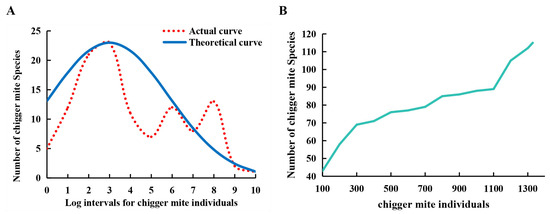
In the analysis of species abundance distribution and species-sample relation of chigger community, all the identified chigger species from small mammal hosts at the survey site were regarded as a chigger community unit. To illustrate the species abundance distribution of chigger community on small mammals, a semi-logarithmic rectangular system was established. The X-axis (indicating individuals of chiggers) was labeled with log intervals based on log3M, and the Y-axis (representing the number of chigger species) was marked with arithmetic scales. Based on the calculation of fitting goodness (R2), Preston’s lognormal model was used to fit the theoretical curve of species abundance distribution [3,20]. The model calculation was accomplished using Excel Office 2019 and the “sads package” of R version 4.4.3. The parameter optimization method employed was the maximum likelihood estimation method. The expected total number of chigger species (ST) and the likely missed species (SM) in the field survey were approximately estimated according to the formulae:
In the above formulae, S(R) = the expected theoretical number of chigger species at R-th log interval, R0 = the mode log interval with the highest number of species, S0 = the number of species at the log interval R0, α = the spread constant of distribution, and SA = the number of chigger species actually collected in the field survey. The value of α was determined based on the best fitting goodness, R2 [3,20].
In the analysis of species-sample relation, all the 1329 small mammal hosts captured in the field survey were randomly numbered and grouped, with each group consisting of 100 individual hosts. The number of chigger species collected from each group of small mammal hosts was counted. The number of host samples (host individuals) was labeled at the X-axis and the number of chigger species was marked at the Y-axis, and then the species-sample curve was created in a rectangular coordinate system [32].
2.6. Analysis of Chigger-Host and Chigger-Chigger Relationship
In the analysis of chigger-host and chigger-chigger relationship, the main chigger species with large individuals within the chigger community were selected as the objects. The bipartite network analysis was used to analyze the chigger-host relationship, the bilateral relationship between the main chigger species and their hosts [3]. In the visualized diagram of the bipartite network analysis, the widths of color bands (or patches) represent the constituent ratios of the main chigger species and their corresponding small mammal hosts. Pearson correlation coefficient was used to calculate the interspecific correlation between any two of the main chigger species (the chigger-chigger relationship), and the results were visualized using a correlation heatmap [3].
2.7. Analysis on Seasonal Dynamics of Chigger Community
Based on the calculation of the species composition, Cr, infestation indexes (PM, MA, MI) and community indexes (R, H, E, D) of chiggers in each month, the monthly variation curves for these indexes were separately created in a rectangular coordinate system to reflect their seasonal fluctuations. The seasonal dynamics of chigger community was visualized using the abundance rank curve, non-metric multidimensional scaling ordination (NMDS) combined with PERMANOVA (Adonis analysis) (NMDS + PERMANOVA), Venn diagram, and Pareto chart [33,34,35].
3. Results
3.1. Species Composition of Small Mammal Hosts and Chiggers
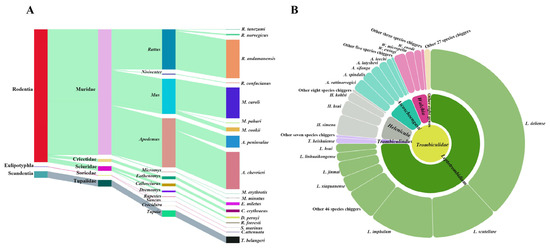
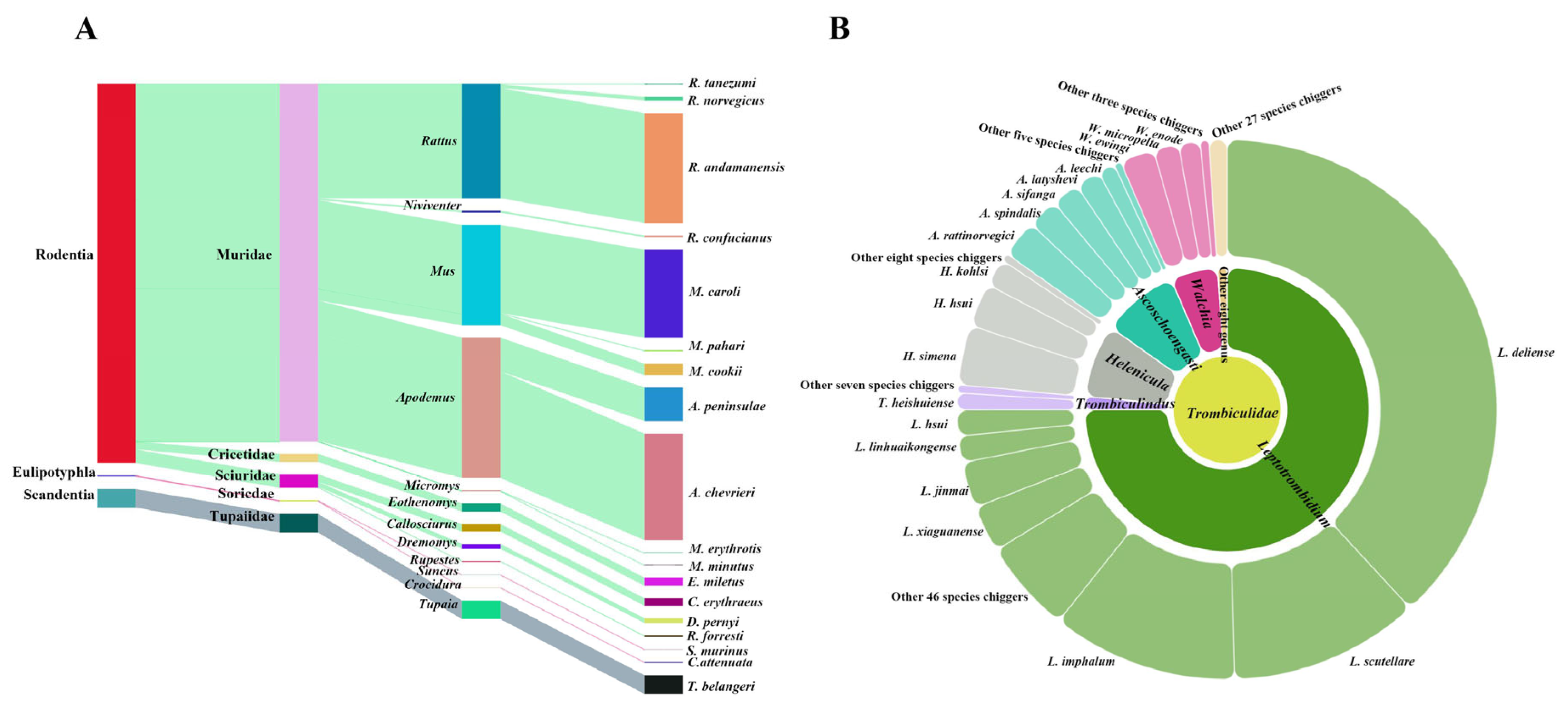
A total of 1329 rodents and other sympatric small mammals captured were identified as 18 species, 12 genera, and 5 families in three orders (Rodentia, Eulipotyphla, Scandetia). Of the three orders, the number of Rodentia (rodents) was the most abundant, with a total Cr of 95.03% (Figure 2A). Of the 18 host species, 3 rodent species were the most numerous with total Cr = 76.30%, and they were Rattus andamanensis, Apodemus chevrieri and Mus caroli (Table 1, Figure 2A).
Figure 2.
Visualization of host and chigger mite distribution. Annotation: (A) The constituent ratios (Cr) of small mammal hosts (1329 individuals) at different orders, families, genera, and species. The shade width indicates the constituent ratio of hosts. (B) The constituent ratios (Cr) of chiggers (217,671 individuals) at different taxonomic levels (family, genera, and species).
Table 1.
Collection and identification of small mammal hosts and their ectoparasitic chiggers at Waxi Village of Binchuan County, Yunnan Province of southwest China (2020–2021).
A total of 217,671 chiggers collected from 1329 hosts were taxonomically identified as 115 species, 13 genera and 2 subfamilies in the family Trombiculidae (Table 2). A total of 5454 chiggers could not be accurately identified to species, and they were regarded as “unidentified specimens” because of the structural damage, dirt covering, unclear structure, or suspected new species; these unidentified specimens were not included in the data statistics of the study. Of 18 small mammal host species, 2 rat species (R. andamanensis and A. chevrieri) harbored the largest numbers of chigger species and individuals (Table 1). At the subfamily level, 94.11% of chigger individuals came from the subfamily Trombiculinae. At the genus level, 74.99% of chiggers belonged to the genus Leptotrombidium. At the species level, L. deliense, L. scutellare, and L. imphalum accounted for 60.72% of the total 115 chigger species (Table 2, Figure 2B).
Table 2.
Taxonomic identification of chiggers on small mammal hosts at Waxi Village of Binchuan County, Yunnan Province of southwest China (2020–2021).
3.2. Infestation of Vector Chiggers
The overall infestation indexes of chiggers on all hosts throughout the 12 months at the survey site were as follows: PM = 69.38%, MA = 163.79 mites/per examined host, MI = 236.09 mites/per infested host (Table 3). Of the 115 chigger species identified, 9 species can serve as vectors or potential vectors of scrub typhus and HFRS. These nine vector chiggers were: L. deliense, L. scutellare, L. imphalum, L. linhuaikongense, L. rubellum, L. apodemi, L. intermedium, L. kaohuense, and Walchia pacifica (Table 2). Of the nine vector species, L. deliense, L. scutellare and L. imphalum were also three dominant chigger species, accounting for 60.72% of the total 115 chigger species (Table 2). The infestation indexes of L. deliense were the highest (Table 3).
Table 3.
Infestation indexes of dominant chigger species.
3.3. Infestation and Community Indexes of Chiggers on Main Hosts
Of the 18 host species, R. andamanensis, A. chevrieri, and M. caroli were 3 dominant host species (Table 1). Among these three dominant host species, the infestation indexes of chiggers on R. andamanensis were the highest. The species richness of chigger community on R. andamanensis was higher than that of other two dominant host species. The R and D of chigger community on A. chevrieri were higher than those on R. andamanensis and M. caroli. The H and E of chigger community on M. caroli were higher than those on R. andamanensis and A. chevrieri (Table 4).
Table 4.
Infestation and community indexes of chiggers on three dominant host species.
3.4. Species Abundance Distribution and Species-Sample Relationship
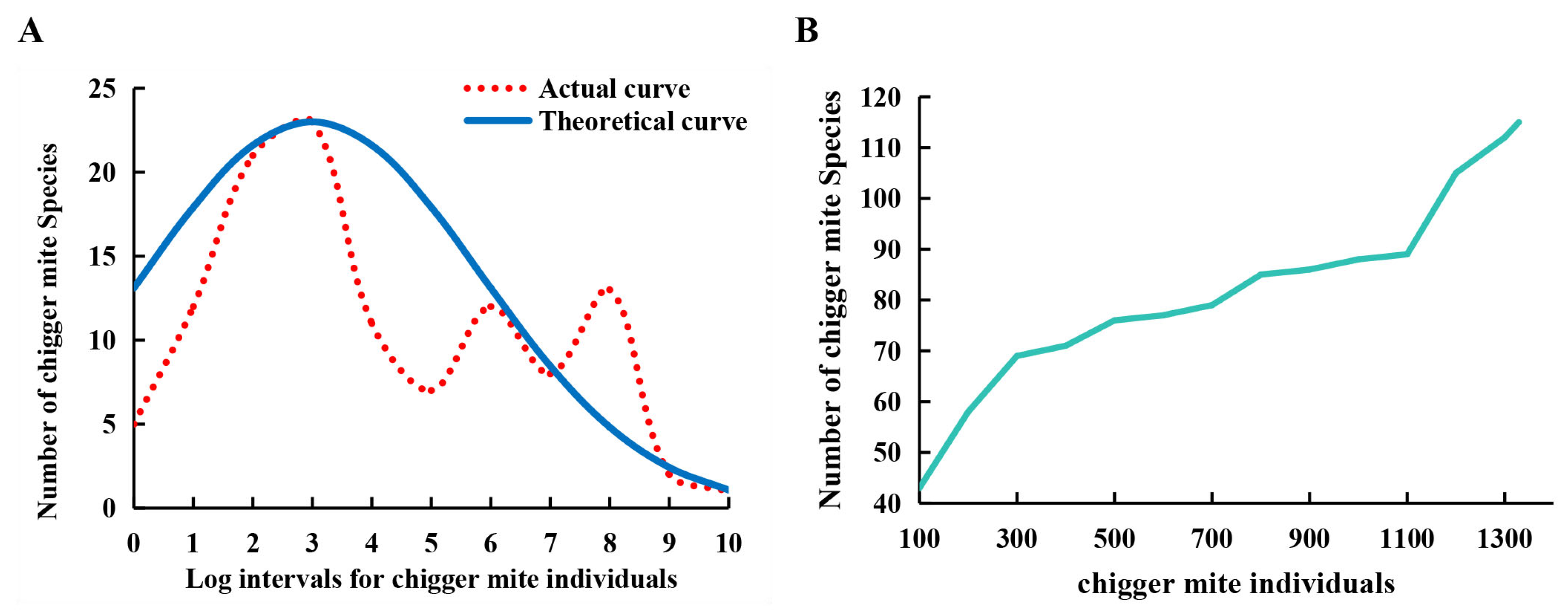
Based on Preston’s lognormal model, the species abundance distribution of chigger community in the study area was successfully fitted by the lognormal distribution with α = 0.25 and R2 = 0.99 (Figure 3A). From the theoretical curve tendency of species abundance distribution, it could be found that a very small number of species were the dominant species with a large number of individuals (>9842) in the chigger community. The vast majority of chigger species were those with a relatively small number of individuals, followed by the rare species with few individuals (Table 5, Figure 3A). On the basis of the curve fitting of species abundance distribution, the expected total number (ST) of chigger species in the chigger community was estimated to be 163, 48 more than the number of species actually collected. The curve of species-sample relationship showed that the number of chigger species gradually increased with the increase in host individuals (Figure 3B).
Figure 3.
The species-abundance and species-sample curves of chigger community. Annotation: (A) The species-abundance curve. (B) The species-sample curve.
Table 5.
The fitting results of species abundance distribution of chigger community.
3.5. Chigger-Host and Chigger-Chigger Relationship
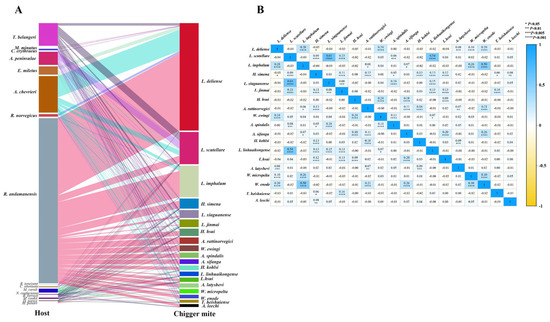
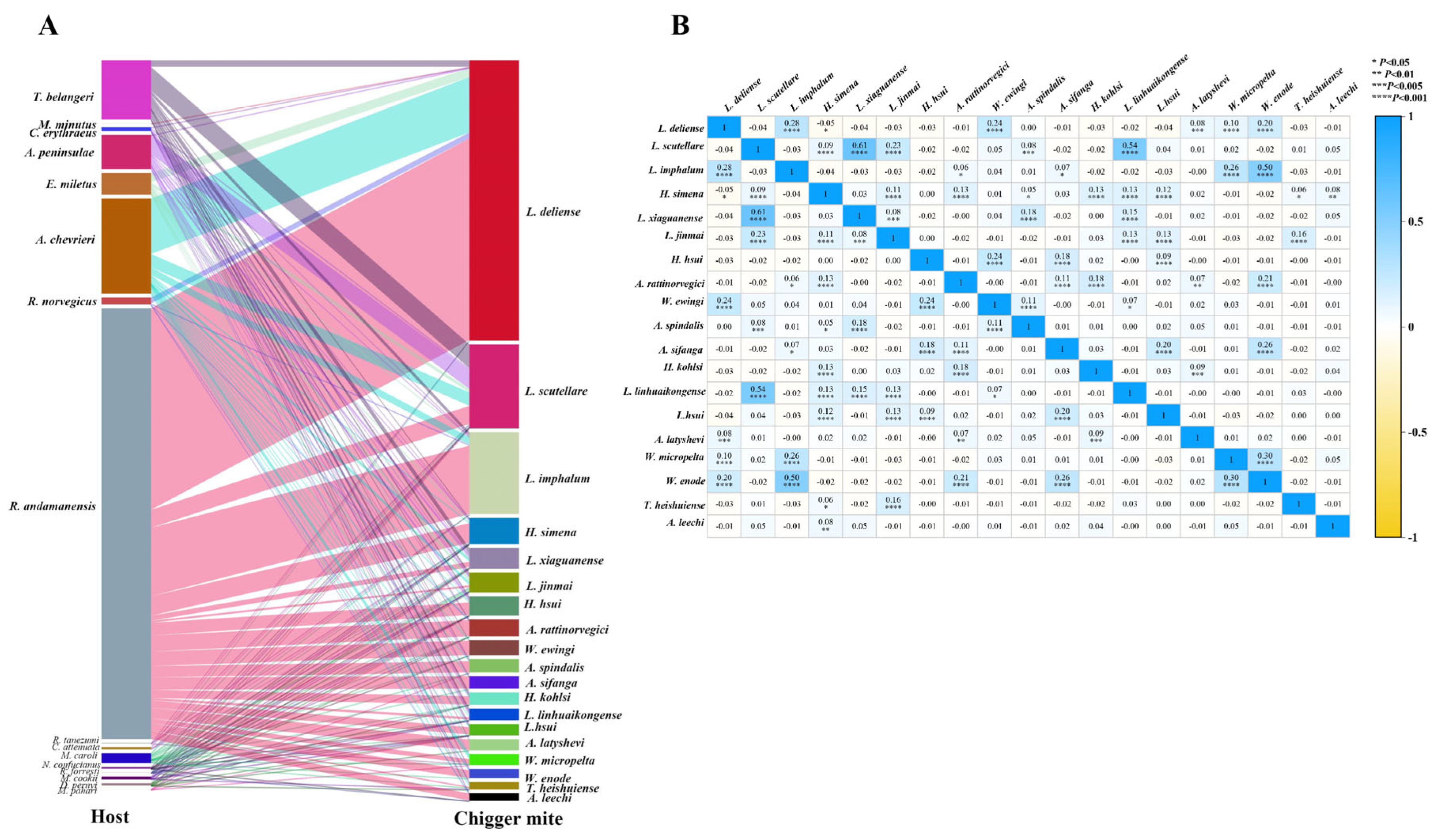
The 19 main chigger species with more than 2000 individuals per species were selected to analyze the bilateral relationship between chiggers and their hosts (chigger-host relationship). These 19 main chigger species had 199,061 individuals, accounting for 91.45% of the total chiggers, which included the 3 dominant chigger species, L. deliense, L. scutellare and L. imphalum. The 19 main chigger species corresponded to 16 different host species, excluding 2 host species (one Suncus murinus and one Micromys erythrotis) without harboring any of the 19 main chigger species. The bipartite diagram for visualizing the chigger-host relationship showed that one host species could harbor several different chigger species, and one chigger species could parasitize multiple host species with low host specificity. Of the 19 main chigger species, L. scutellare and Helenicula simena were, respectively, found on 14 and 13 species of hosts with the widest host rage and the lowest host specificity. The other 4 chigger species also had very low host specificity, being found on 12 host species, and they are L. jinmai, L. xiaguanense, L. hsui, and Helenicula hsui. Ascoschoengastia latyshevi had the narrowest host range, but it still parasitized 4 host species, R. andamanensis, A. chevrieri, Dremomys pernyi, and Tupaia belangeri (Figure 4A).
Figure 4.
Bilateral relationship between chiggers and their hosts and interspecific relationship of main chigger species. Annotation: (A) The bipartite diagram for visualizing the relationships between 19 main chigger species and their corresponding small mammal hosts. (B) The correlation heatmap for visualizing the interspecific relationships of 19 main chigger species.
Pearson correlation coefficient (r) was used to analyze the interspecific relationships between any 2 of the 19 main chigger species. The results showed that a relatively high positive correlation (r ≥ 0.5) existed between L. scutellare and L. xiaguanense (r = 0.61, p < 0.001), between L. scutellare and L. linhuaikongense (r = 0.54, p < 0.001), and between L. imphalum and W. enode (r = 0.50, p < 0.001). For most main chigger species, however, only a slight positive or negative correlation existed between any two of them (r < 0.5, p < 0.05) (Figure 4B).
3.6. Seasonal Dynamics of Chigger Infestation and Community
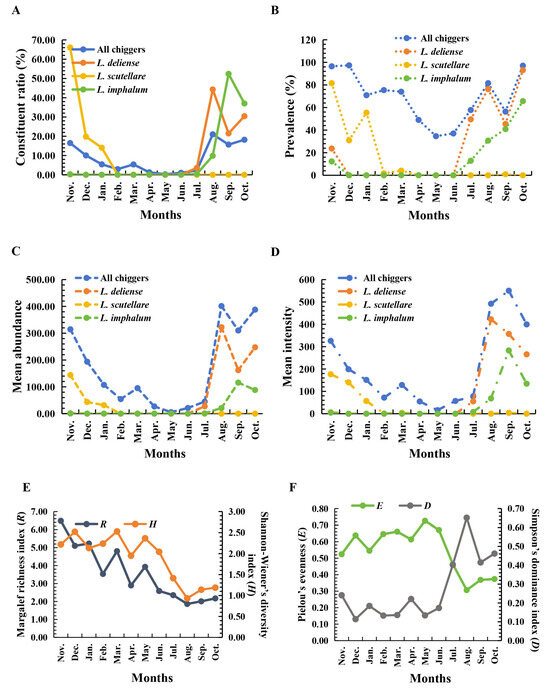
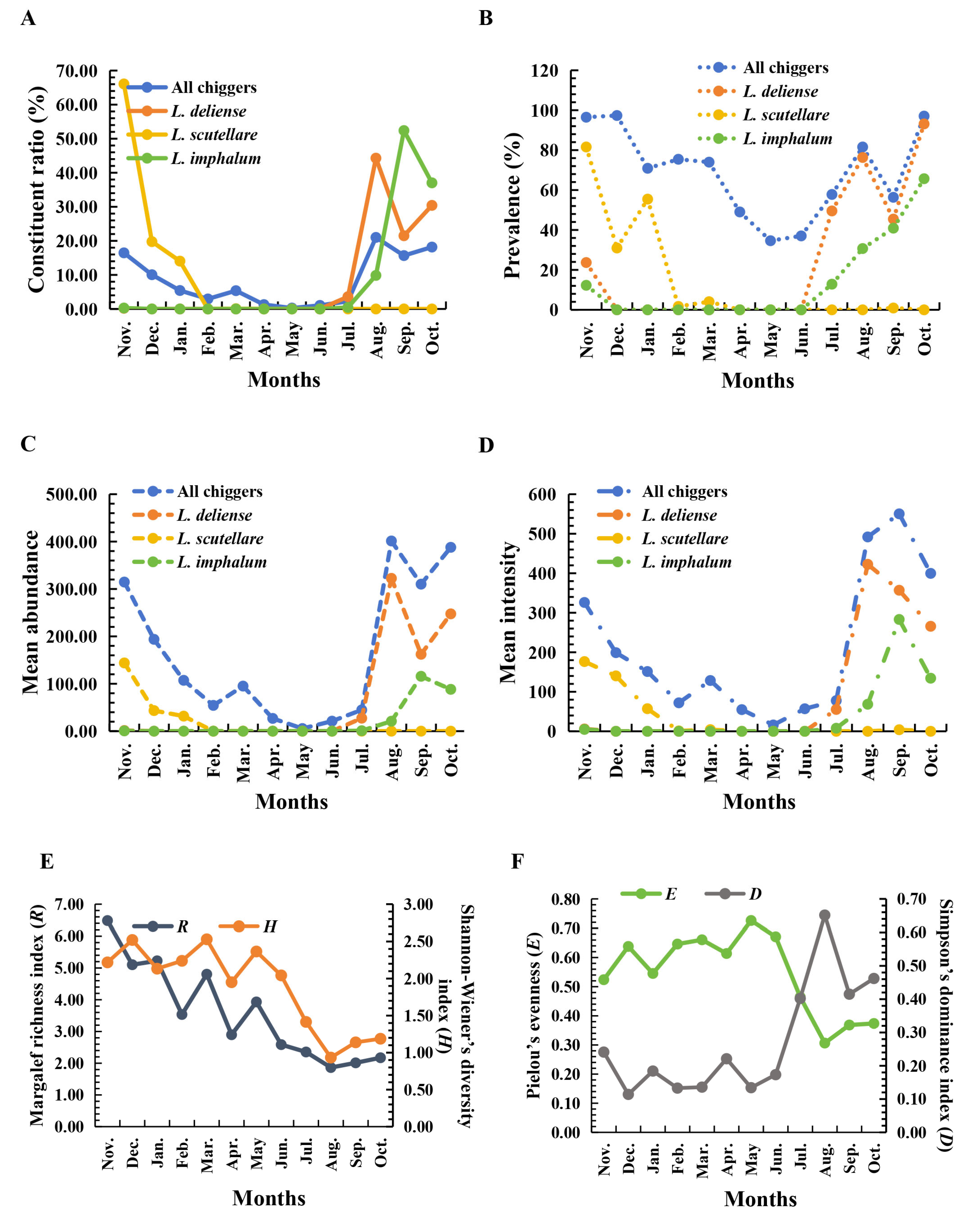
In August (summer) and September to October (autumn), the Cr and overall infestation indexes (PM, MA, MI) of chiggers were high, with Cr, MA, and MI reaching their peaks between August and October. From August to October in summer and autumn, the R, H, and E of chigger community were at low levels, while the D was at a high level (Table 6; Figure 5). Of the three dominant chigger species, L. deliense and L. imphalum were very abundant from August to October in summer and autumn, with their Cr and infestation indexes (PM, MA, MI) being relatively high or even reaching their peaks. Leptotrombidium scutellare, however, mainly appeared in November at the end of autumn and December at the beginning of winter, with its Cr and infestation indexes (PM, MA, MI) reaching their peaks in November at the end of autumn (Figure 5A–D).
Table 6.
Monthly variation in chigger infestation indexes on small mammal hosts.
Figure 5.
Seasonal fluctuations of infestation indexes of all chiggers and three dominant chigger species (L. deliense, L. scutellare, and L. imphalum) and community indexes of chiggers. Annotation: (A) monthly fluctuation of constituent ratios (Cr) of chiggers; (B) monthly fluctuation of prevalence (PM) of chiggers; (C) monthly fluctuation of mean abundance (MA) of chiggers; (D) monthly fluctuation of mean intensity (MI) of chiggers; (E) monthly fluctuation of Margalef richness index (R) and Shannon–Wiener diversity index (H) of chigger community; (F) and monthly fluctuation of Pielou evenness (E) and Simpson dominance index (D) of chigger community.
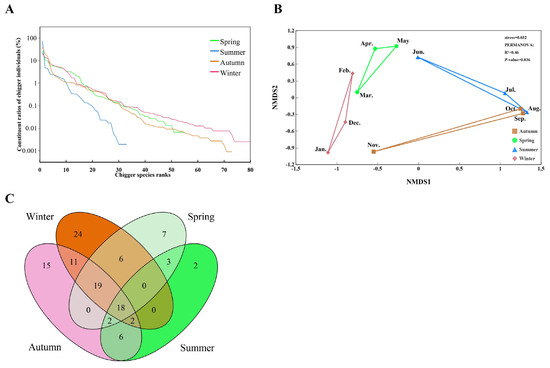
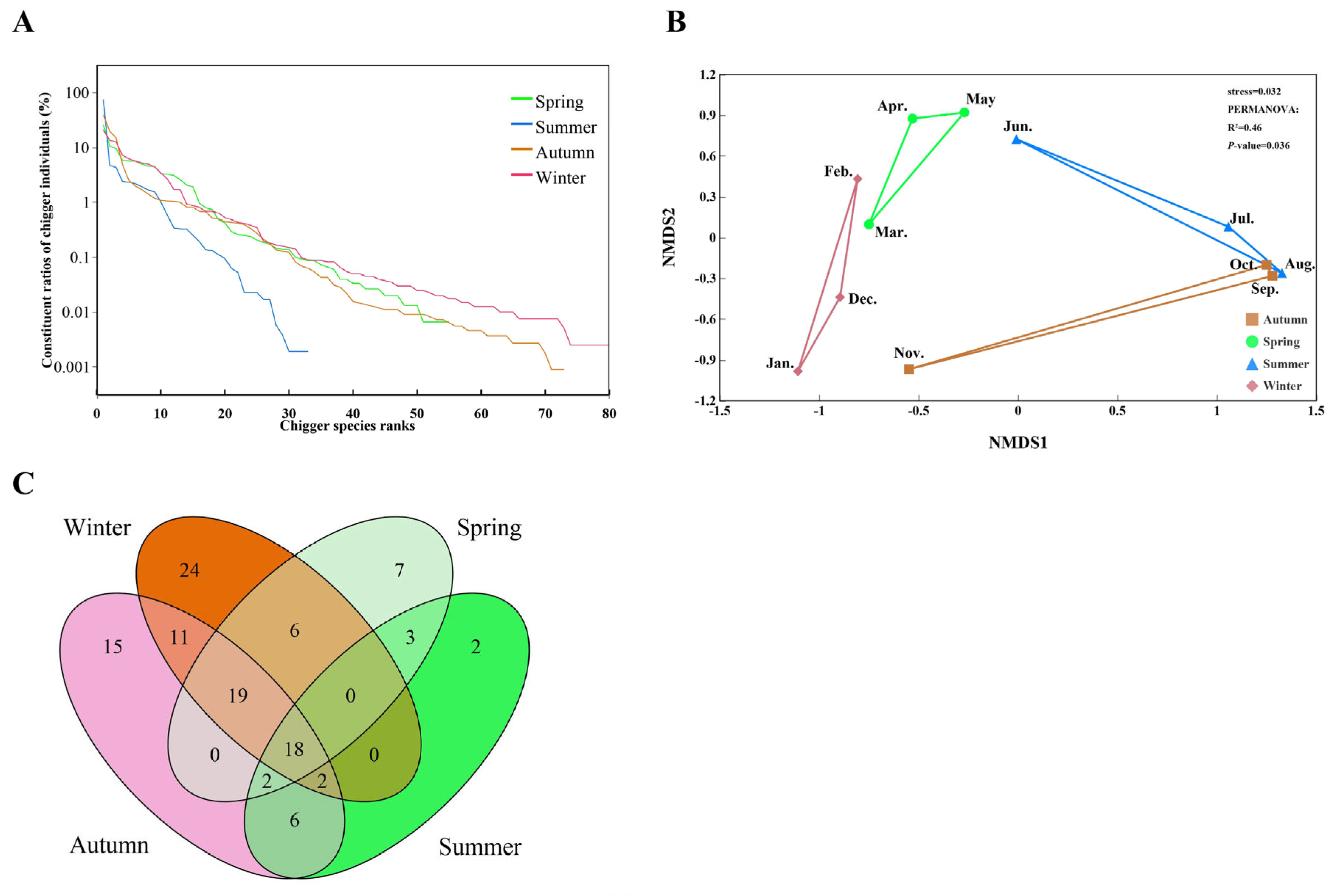
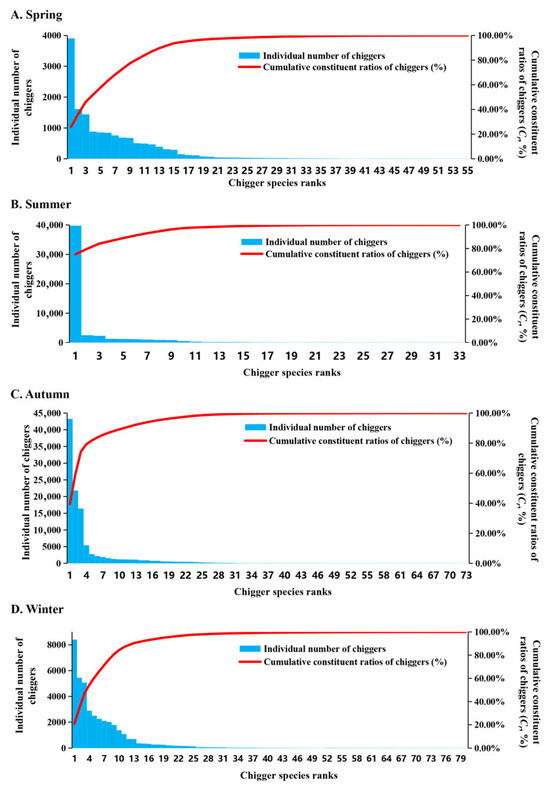
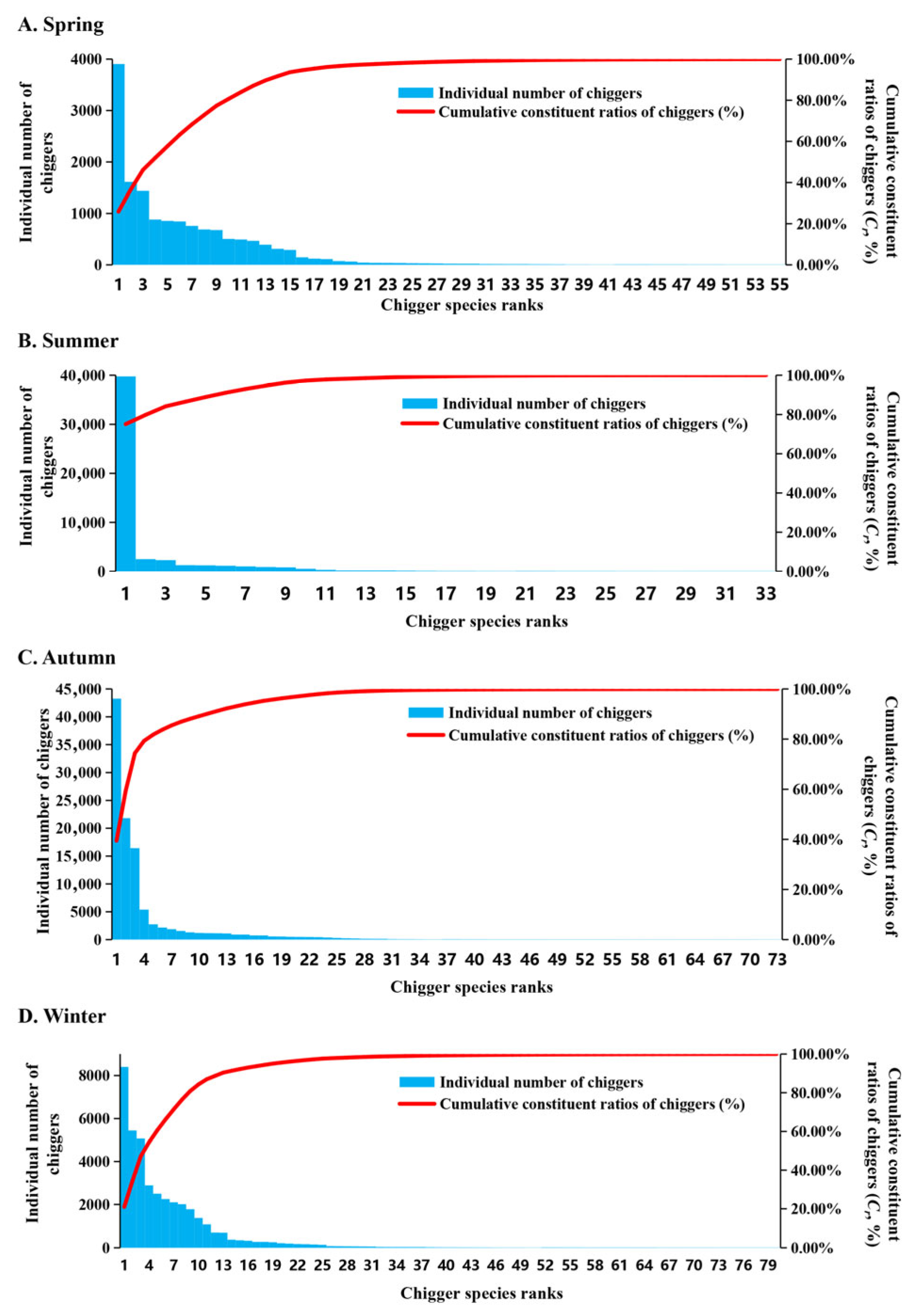
The results of the species rank abundance curve showed that the extension length of the curve in the horizontal direction was the longest in winter and the shortest in summer, indicating that the species richness of chigger community was the highest in winter and the lowest in summer. In the vertical direction, the slope of the species rank abundance curve was the flattest in spring and the steepest in summer, indicating that the evenness of chigger community was the highest in spring and the lowest in summer (Figure 6A). In a two-dimensional coordinate system, the results showed that the similarity of chigger community was very high in August (summer) and September to October (autumn), with the positions of these three months being very close (Figure 6B). The Venn diagram visually reflected the overall distribution of chigger species in the four seasons of spring, summer, autumn, and winter, as well as the distribution of endemic species and overlapping species in different seasons (Figure 6C). For instance, the number of chigger species in spring, summer, autumn, and winter were 55, 33, 73, and 80, respectively. The endemic species in the four seasons were 7, 2, 15, and 24, respectively, with the most endemic species in winter (24 species) and the least in summer (only 2 species). There were 18 chigger species that were distributed in all four seasons, and 19 chigger species that were overlapped in spring, autumn and winter (Figure 6C). The Pareto chart was a visualization based on the Pareto analysis model, reflecting the contribution of the main chigger species in different seasons to the cumulative Cr of chigger community, all chiggers (Figure 7). The results showed that 80.67% of the cumulative Cr of chigger community was mainly contributed by ten chigger species in spring, 79.84% of Cr contributed by two chigger species in summer, 79.28% of Cr contributed by four chigger species in autumn, and 80.91% of Cr contributed by nine chigger species in winter (Figure 7).
Figure 6.
The visualization of seasonal dynamics of chigger community on small mammals in different seasons. Annotation: (A) Species rank abundance curves of chigger community in different seasons. The chigger species ranks from 1 to 80 on the horizontal axis (X-axis) represent the most dominant chigger species to the rarest chigger species. (B) The dimension-reduced ordination of chigger community in different seasons by non-metric multidimensional scaling ordination (NMDS) and PERMANOVA (Adonis). (C) The Venn diagram for visualizing the species distribution of chigger community in different seasons.
Figure 7.
The Pareto chart for visualizing the contribution of main chigger species in different seasons to the cumulative constituent ratio (Cr) of chigger community on small mammals. Annotation: The chigger species ranks from 1 to 80 on the horizontal axis (X-axis) represent the most dominant chigger species to the rarest chigger species.
4. Discussion
4.1. Medical Significance of the Chigger Study
The survey site of the present study, Waxi Village of Bichuan County, Dali Prefecture, Yunnan Province of southwest China, is not only an important focus of scrub typhus and HFRS, but also a hot tourist place in China [16,38,39]. Therefore, it is of great medical significance to study chiggers on rodents and other sympatric small animals in this epidemic area. Globally, at least 12 million people were infected with scrub typhus each year [40,41]. In recent years, the incidence of scrub typhus has been increasing in some endemic areas or countries, including China [10,42,43,44]. A total of 69,246 cases of scrub typhus were reported in Yunnan Province from 2013 to 2022, with 14.58/100,000 of the average annual incidence [45]. Yunnan Province (especially Dali Prefecture) is one of main tourist regions in China, and scrub typhus has become one of the most important infectious diseases threatening tourists’ health [45]. In addition to the widespread prevalence of scrub typhus, HFRS is also widely distributed in Yunnan Province, and the epidemic situation is especially severe in the central and northwestern regions of Yunnan (including Dali Prefecture). The incidence of HFRS in Dali Prefecture has been high in recent years, with HFRS cases accounting for 54.47% (999/1834) of the total in Yunnan Province from 2012 to 2020 [16,46].
The results of the present study indicate that rodents and other sympatric small animals were highly susceptible to chigger infestation at the survey site, with abundant species and heavy infestation burden found on their body surface. Previous studies have shown that many chigger species prefer to breed in environments with high temperature and humidity. A warm and humid climate is conducive to the growth and reproduction of many chigger species [47,48]. Waxi Village is located in a low-latitude subtropical area with warm and humid climate. This might be an important reason for rodents and other sympatric small mammals to be infested with abundant chiggers with high species diversity and heavy infestation burdens in the survey site. The heavy infestation burdens and low host specificity would be conducive to the transmission of pathogens of zoonotic diseases such as scrub typhus and HFRS among different rodents and other wild animal hosts at this site and nearby areas, and even from wild animals to domestic animals and humans.
4.2. Infestation and Coexistence of Multiple Vector Chiggers
Although there have been over 3000 chigger species recorded globally, not all of them can effectively transmit scrub typhus. It has been confirmed that the majority of effective vector species belong to the genus Leptotrombidium [4,10]. In China, it has been proved that there are six main vectors and more than ten secondary or potential vectors of scrub typhus, and most of them are Leptotrombidium species [36,49]. In the present study, L. deliense, L. scutellare and L. imphalum were not only the dominants at the survey site, but also the important vector species. Leptotrombidium deliense and L. scutellare are the most important two of the six main vectors of scrub typhus in China, and L. imphalum is an important potential vector of the disease [9,37,50]. In addition, L. scutellare can serve as the potential vector of HFRS as well [9,37,50]. In China, many previous studies have shown that L. deliense is the dominant chigger species and the most important vector of scrub typhus in the vast territory south of the Yangtze River, including Yunnan and some other regions of southwest China [51,52], and the results of the present study are consistent with previous studies. There were nine vector species coexisting at the survey site, and most chigger species had a wide range of hosts with low host specificity. The occurrence of a large number of L. deliense, L. scutellare, and L. imphalum at Waxi, together with the coexistence of other vector species and low host specificity, would increase the potential risk of the transmission of zoonotic diseases such as scrub typhus and HFRS, and the persistence of the epidemic foci.
4.3. Species Abundance and Species-Sample Relationship
The species abundance distribution of a community is used to illustrate the relationship between the number of species and individuals in a certain community, which can reflect the proportion structure of dominant, common, and rare species in the community [32,53]. In the present study, the species abundance distribution was successfully fitted by Preston’s lognormal distribution model (Figure 3A). The result indicates that the species abundance of chigger community conforms to lognormal distribution, with very few dominant species having a large number of individuals, and the majority of common species having a relatively small number of individuals [3,32]. In ecological research, it is an important issue to estimate the expected total number of species in a certain community [54,55]. There are a few methods to roughly estimate the expected total species, and the method used in the present study is one of them [3,20]. Based on the fitting of the theoretical curve of species abundance distribution, the expected total species (ST) of chigger community at the survey site was roughly estimated to be 163 species, 48 more than the 115 species actually identified (SA), implying that approximately 48 rare chigger species might have been missed in the actual field investigation. In a community with a lognormal distribution of species abundance, there are some rare species with very few individuals (even one or two individuals), and these rare species are often missed in a certain field investigation [3,20].
The species-sample relationship is used to illustrate the relationship between the sample size (or plot) and the number of species within a certain community [32]. The result showed that the number of chigger species gradually increased with the increase in host samples (Figure 3B), suggesting that it is impossible to find all species in a single field investigation and that more species would be found if host samples continued to increase. The result of the species-sample relationship is consistent with the estimation result of the expected total species, with approximately 48 rare chigger species not being found in the present field investigation.
4.4. Host-Chigger and Chigger-Chigger Relationships
The results of the host-chigger relationship showed that one host species could harbor several different chigger species, and one chigger species could parasitize multiple host species with low host specificity. As one of the dominant and vector chigger species, L. scutellare had the widest host selection with lowest host specificity (Figure 2A). The low host specificity of chiggers would facilitate the circulatory transmission of some zoonotic pathogens such as O. tsutsugamushi and Hantavirus among different host animals, thereby increasing the potential risk of transmission of the corresponding zoonotic diseases (scrub typhus and HFRS) among different hosts and the persistence of their foci [5,10].
The results of the chigger-chigger relationship showed that a relatively high positive correlation (r ≥ 0.5) existed between some pairs of main chigger species with statistical significance (p < 0.001) (Figure 4B). The results were consistent with some previous reports [56,57], suggesting that some chigger species have a tendency to parasitize the same host species without much interspecific competition or mutual repulsion.
4.5. Seasonal Fluctuation of Chigger Infestation and Community
Since chiggers are the exclusive vector of scrub typhus and potential vector of HFRS, the seasonal fluctuations of chiggers would undoubtedly affect the seasonal distribution of these mite-borne diseases. Therefore, the investigation on the seasonal fluctuation of vector chiggers would be conductive to the surveillance and control of scrub typhus and HFRS [24,58]. The results of the present study showed that both the infestation indexes and community indexes of chiggers exhibited varying degrees of monthly and seasonal fluctuations (Table 6; Figure 5). The seasonal fluctuation tendency of overall chigger infestations of all chigger species throughout the 12 months were basically consistent with that of the three dominant vector chigger species (Figure 5A–D), suggesting that the seasonal variation in these dominant chiggers (especially L. deliense and L. imphalum) determine that of the whole chigger community. The large numbers of the three vector chiggers (L. deliense, L. imphalum, and L. scutellare) occurring in summer and autumn seasons would probably increase the potential risk of scrub typhus outbreaks in these two seasons. Therefore, the surveillance campaign of scrub typhus and vector chiggers should mainly focus on these two seasons at the survey site.
High species diversity and evenness with relatively few dominant species in a certain community usually reflect the community’s complexity. A complex community with many species may inhibit the outbreak of vectors, and a simple community without abundant species may be conductive to the outbreak of vectors [5,59,60]. The results of the present study indicate that species diversity and evenness of the chigger community are much lower in summer and autumn seasons than in winter and spring seasons. In summer and autumn seasons, only three vector chigger species (L. deliense, L. imphalum, and L. scutellare) were the dominant species. Due to the simple community structure without many chigger species in summer and autumn seasons, the outbreak probability of vector chiggers would be much higher in summer and autumn than in winter and spring at the survey site.
5. Conclusions
At the survey site, Waxi village of Binchuan County, Dali Prefecture, Yunnan Province of southwest China, where scrub typhus is prevalent, rodents and other sympatric small animals are susceptible to chigger infestation, with high infestation burdens, high species diversity, and the coexistence of multiple vector chiggers. The main hosts of chiggers are three rodent species, R. andamanensis, A. chevrieri, and M. caroli. Three vector chigger species, L. deliense, L. scutellare, and L. imphalum, are the dominant species of the chigger community. Most chigger species have a wide range of hosts with low host specificity. One host species can harbor multiple chigger species, and one chigger species can parasitize multiple host species. The infestation and community indexes of chiggers have seasonal fluctuations. In seasonal fluctuation patterns, L. deliense and L. imphalum (summer-autumn type) are very different from L. scutellare (autumn-winter type). The chigger community shows a high similarity between August and October in summer and autumn with low species diversity, and a large number of vector chiggers such as L. deliense and L. imphalum appear in these seasons. The occurrence of abundant vector chiggers (especially L. deliense and L. imphalum) in summer and autumn suggests that the surveillance campaign of scrub typhus and vector chiggers should mainly focus on these two seasons at the survey site.
Author Contributions
Data curation, formal analysis, investigation, methodology, software, visualization, writing—original draft, Y.L. and P.-W.Y.; conceptualization, data curation, formal analysis, funding acquisition, methodology, project administration, resources, supervision, validation, writing—review and editing X.-G.G.; investigation, specimen-making, and identification, R.F., C.-F.Z., Z.-W.Z., and Y.-F.Z.; supervision, software, L.Z. All authors have read and agreed to the published version of the manuscript.
Funding
The authors declare financial support was received for the research, authorship, and/or publication of this article. The present study was supported by the National Natural Science Foundation of China (Nos. 81960380 and 82160400) and the Research and Development Fund of Dali University (No. KY2319101340, KY2519103340) to Xian-Guo Guo, Science Foundation of Dali University (No. KYBS2023008), and Yunnan Fundamental Research Projects to Yan Lv (No. 202501AT070418).
Institutional Review Board Statement
The animal study was approved by the use of animals (including animal euthanasia) for our research was officially approved by the Animals’ Ethics Committees of Dali University, approval codes: DLDXLL2020-1104, approval dates: 4 November 2020. The study was conducted in accordance with the local legislation and institutional requirements.
Data Availability Statement
The original contributions presented in this study are included in the article. Further inquiries can be directed to the corresponding author.
Acknowledgments
We would like to express our sincere thanks to the following people who contributed to the field investigations: He Sha, Long Zhou, A-Si Di, Cheng-Wei He, Jian-Zhou Han, Ping Luo, Qiao-Hai Han, Jian-Zhu Chen, Xin Zhao, some colleagues and college students.
Conflicts of Interest
The authors declare no conflicts of interest.
References
- Hardgrove, E.; Zimmerman, D.M.; Fricken, M.E.V.; Deem, S. A scoping review of rodent-borne pathogen presence, exposure, and transmission at zoological institutions. Prev. Vet. Med. 2021, 193, 105345. [Google Scholar] [CrossRef] [Scilit] [PubMed]
- Dahmana, H.; Granjon, L.; Diagne, C.; Davoust, B.; Fenollar, F.; Mediannikov, O. Rodents as hosts of pathogens and related zoonotic disease risk. Pathogens 2020, 9, 202. [Google Scholar] [CrossRef] [Scilit]
- Guo, Y.; Zhou, J.X.; Guo, X.G.; Song, W.Y.; Zhao, C.F.; Zhang, Z.W.; Fan, R.; Chen, T.; Lv, Y.; Yin, P.W. Species diversity and related ecology of chiggers on small mammals in a unique geographical area of Yunnan Province, southwest China. Exp. Appl. Acarol. 2023, 91, 439–461. [Google Scholar] [CrossRef] [Scilit] [PubMed]
- Santibáñez, P.; Palomar, A.M.; Portillo, A.; Santibáñez, S.; Oteo, J.A. The role of chiggers as human pathogens. In An Overview of Tropical Diseases; In TechOpen: Rijeka, Croatia, 2015; pp. 173–202. [Google Scholar]
- Peng, P.Y.; Guo, X.G.; Jin, D.C.; Dong, W.G.; Qian, T.J.; Qin, F.; Yang, Z.H.; Fan, R. Landscapes with different biodiversity influence distribution of small mammals and their ectoparasitic chigger mites: A comparative study from southwest China. PLoS ONE 2018, 13, e189987. [Google Scholar] [CrossRef] [Scilit]
- Li, J.C.; Wang, D.Q.; Chen, X.B. Trombiculid Mites of China: Studies on Vector and Pathogen of Tsutsugamushi Disease; Guangdong Science and Technology Press: Guangzhou, China, 1997; pp. 1–570. [Google Scholar]
- Derne, B.; Weinstein, P.; Musso, D.; Lau, C. Distribution of rickettsioses in Oceania: Past patterns and implications for the future. Acta Trop. 2015, 143, 121–133. [Google Scholar] [CrossRef] [Scilit]
- Liu, R.J.; Guo, X.G.; Zhao, C.F.; Zhao, Y.F.; Peng, P.Y.; Jin, D.C. An ecological survey of chiggers (Acariformes: Trombiculidae) associated with small mammals in an epidemic focus of scrub typhus on the China-Myanmar border in southwest China. Insects 2024, 15, 812. [Google Scholar] [CrossRef] [Scilit] [PubMed]
- Xiang, R.; Guo, X. Research advances of Leptotrombidium scutellare in China. Korean J. Parasitol. 2021, 59, 1–8. [Google Scholar] [CrossRef] [Scilit]
- Elliott, I.; Pearson, I.; Dahal, P.; Thomas, N.V.; Roberts, T.; Newton, P.N. Scrub typhus ecology: A systematic review of Orientia in vectors and hosts. Parasit. Vector. 2019, 12, 513. [Google Scholar] [CrossRef] [Scilit]
- Zhang, Y.F.; Zhang, Q.; Han, L.; Shi, Y.; Geng, M.J.; Teng, Z.Q.; Kan, B.; Mu, D.; Qin, T. Epidemiological study of scrub typhus in China, 2006–2023. Dis. Surveill. 2024, 39, 1629–1634. [Google Scholar]
- Peng, P.Y.; Duan, H.; Xu, L.Y.; Zhang, L.T.; Sun, J.Q.; Zu, Y.; Ma, L.J.; Sun, Y.; Yan, T.L.; Guo, X.G. Epidemiologic changes of a longitudinal surveillance study spanning 51 years of scrub typhus in mainland China. Sci. Rep. 2024, 14, 3138. [Google Scholar] [CrossRef] [Scilit]
- Yuan, Q.H.; Chen, M.; Yang, X.D. Epidemiological analysis of scrub typhus in Yunnan Province during 2006–2017. Chin. J. Vector Biol. Control 2018, 29, 69–72. [Google Scholar]
- Guo, X.G.; Qian, T.J.; Meng, X.Y.; Dong, W.G.; Shi, W.X.; Wu, D. Preliminary analysis of chigger communities associated with house rats (Rattus flavipectus) from six counties in Yunnan, China. Syst. Appl. Acarol. 2006, 11, 13–21. [Google Scholar] [CrossRef] [Scilit]
- Bannar Martin, K.H.; Kremer, C.T.; Ernest, S.K.M.; Leibold, M.A.; Auge, H.; Chase, J.; Declerck, S.A.J.; Eisenhauer, N.; Harpole, S.; Hillebrand, H.; et al. Integrating community assembly and biodiversity to better understand ecosystem function: The community assembly and the functioning of ecosystems (CAFE) approach. Ecol. Lett. 2018, 21, 167–180. [Google Scholar] [CrossRef] [Scilit]
- Zhou, J.H.; Zhang, Y.Z.; Zhang, Y.Z.; Yang, W.H.; Feng, Y. Epidemiological characteristics of hemorrhagic fever with renal syndrome in Yunnan Province, China, 2012–2020. Chin. J. Vector Biol. Control 2021, 32, 715–719. [Google Scholar]
- Yuan, Q.H.; Feng, X.G.; Mi, Z.Q.; Zhang, H.L.; Zi, D.Y.; Chen, Y.M. Investigation on the outbreak of tsutsugamushi disease in Binchuan County, Yunnan Province. Chin. J. Zoon. 1999, 15, 80. [Google Scholar]
- Luo, J.W. Analysis on the characteristics of rainfall time variation in Binchuan County, Yunnan Province. Shaanxi Water Resour. 2020, 29–32. [Google Scholar] [CrossRef]
- Lv, Y.; Guo, X.G.; Jin, D.C.; Song, W.Y.; Fan, R.; Zhao, C.F.; Zhang, Z.W.; Mao, K.Y.; Peng, P.Y.; Lin, H.; et al. Host selection and seasonal fluctuation of Leptotrombidium deliense (Walch, 1922) (Trombidiformes: Trombiculidae) at a localized area of southern Yunnan, China. Syst. Appl. Acarol. 2019, 24, 2253–2271. [Google Scholar] [CrossRef] [Scilit]
- Peng, P.Y.; Guo, X.G.; Jin, D.C.; Dong, W.G.; Qian, T.J.; Qin, F.; Yang, Z.H. Species abundance distribution and ecological niches of chigger mites on small mammals in Yunnan Province, southwest China. Biologia 2017, 72, 1031–1040. [Google Scholar] [CrossRef] [Scilit]
- Kia, E.; Moghddas-Sani, H.; Hassanpoor, H.; Vatandoost, H.; Zahabiun, F.; Akhavan, A.; Hanafi-Bojd, A.; Telmadarraiy, Z. Ectoparasites of rodents captured in Bandar Abbas, southern Iran. Iran. J. Arthropod-Borne Dis. 2009, 3, 44–49. [Google Scholar]
- Wang, Y.X. A Complete Checklist of Mammal Species and Subspecies in China, a Taxonomic and Geographic Reference; China Forestry Publishing House: Beijing, China, 2003; pp. 1–394. [Google Scholar]
- Wilson, D.E.; Reeder, D.M. Mammal Species of the World: A Taxonomic and Geographic Reference, 3rd ed.; Johns Hopkins University Press: Baltimore, MD, USA, 2005; pp. 1–2142. [Google Scholar]
- Kim, S.Y.; Gill, B.; Song, B.G.; Chu, H.; Park, W.I.; Lee, H.I.; Shin, E.; Cho, S.; Roh, J.Y. Annual fluctuation in chigger mite populations and Orientia tsutsugamushi infections in scrub typhus endemic regions of south Korea. Osong Public Health Res. Perspect. 2019, 10, 351–358. [Google Scholar]
- Guo, X.G.; Speakman, J.R.; Dong, W.G.; Men, X.Y.; Qian, T.J.; Wu, D.; Qin, F.; Song, W.Y. Ectoparasitic insects and mites on Yunnan red-backed voles (Eothenomys miletus) from a localized area in southwest China. Parasitol. Res. 2013, 112, 3543–3549. [Google Scholar] [CrossRef] [Scilit]
- Stekolnikov, A.A. Leptotrombidium (Acari: Trombiculidae) of the world. Zootaxa 2013, 3728, 1–173. [Google Scholar] [CrossRef] [Scilit]
- Vercammen-Grandjean, P.H.; Langston, R. The Chigger Mites of the World (Acarina: Trombiculidae & Leeuwenhoekiidae). Volume III. Leptotrombidium Complex; George Williams Hooper Foundation: San Francisco, CA, USA, 1976; pp. 1–1061. [Google Scholar]
- Bush, A.O.; Lafferty, K.D.; Lotz, J.M.; Shostak, A.W. Parasitology meets ecology on its own terms: Margolis et al. Revisited. J. Parasitol. 1997, 83, 575–583. [Google Scholar] [CrossRef] [Scilit]
- Whitaker, J. Collecting and preserving ectoparasites for ecological study. In Ecological and Behavioral Methods for the Study of Bats; Kunz, T.H., Ed.; Smithsonian Institute Press: Washington, DC, USA, 1988; pp. 459–474. [Google Scholar]
- Peng, P.Y.; Guo, X.G.; Jin, D.C.; Dong, W.G.; Qian, T.J.; Qin, F.; Yang, Z.H. New record of the scrub typhus vector, Leptotrombidium rubellum, in southwest China. J. Med. Entomol. 2017, 54, 1767–1770. [Google Scholar] [CrossRef] [Scilit]
- Zhan, Y.Z.; Guo, X.G.; Speakman, J.R.; Zuo, X.H.; Wu, D.; Wang, Q.H.; Yang, Z.H. Abundances and host relationships of chigger mites in Yunnan Province, China. Med. Vet. Entomol. 2013, 27, 194–202. [Google Scholar] [CrossRef] [Scilit]
- Peng, P.Y.; Guo, X.G.; Song, W.Y.; Hou, P.; Zou, Y.J.; Fan, R. Ectoparasitic chigger mites on large oriental vole (Eothenomys miletus) across southwest, China. Parasitol. Res. 2016, 115, 623–632. [Google Scholar] [CrossRef] [Scilit]
- Maji, U.J.; Mohanty, S.; Mahapatra, A.S.; Mondal, H.K.; Samanta, M.; Maiti, N.K. Exploring the gut microbiota composition of Indian major carp, rohu (Labeo rohita), under diverse culture conditions. Genomics 2022, 114, 110354. [Google Scholar] [CrossRef] [Scilit]
- Sæther, B.E.; Engen, S.; Grøtan, V. Species diversity and community similarity in fluctuating environments: Parametric approaches using species abundance distributions. J. Anim. Ecol. 2013, 82, 721–738. [Google Scholar] [CrossRef] [Scilit]
- Mary, A.Q.; Das, S.; Chaudhary, N.; Raju, K. Analysis of the six sigma principle in pre-analytical quality for hematological specimens. Cureus 2023, 15, e42434. [Google Scholar] [CrossRef] [Scilit]
- Lv, Y.; Guo, X.G.; Jin, D.C.; Song, W.Y.; Yang, Z.H. Relative abundance of a vector of scrub typhus, Leptotrombidium sialkotense, in southern Yunnan Province, China. Korean J. Parasitol. 2020, 58, 153–159. [Google Scholar] [CrossRef] [Scilit]
- Wu, G.H.; Jiang, Z.K.; Wang, L.; Ding, L.Y.; Mao, C.Q.; Ma, B.Y. Accordance and identification of vector chigger mites of tsutsugamushi disease in China. Chin. J. Hyg. Insect. Equip. 2013, 19, 286–292. [Google Scholar]
- Chen, A.X.; Tian, C.; Yang, X.; Cao, G.; Lv, X.F. Research progress on the distribution of scrub typhus vector chigger mites in China. Chin. J. Hyg. Insect. Equip. 2022, 28, 556–561. [Google Scholar]
- Li, Z.; Deng, S.Z.; Ma, T.; Hao, J.X.; Wang, H.; Han, X.; Lu, M.H.; Huang, S.J.; Huang, D.S.; Yang, S.Y. Retrospective analysis of spatiotemporal variation of scrub typhus in Yunnan Province, 2006–2022. PLoS Neglect. Trop. Dis. 2024, 18, e12654. [Google Scholar] [CrossRef] [Scilit]
- Luo, Y.; Zhang, L.; Lv, H.; Zhu, C.; Ai, L.; Qi, Y.; Yue, N.; Zhang, L.; Wu, J.; Tan, W. How meteorological factors impacting on scrub typhus incidences in the main epidemic areas of 10 Provinces, China, 2006–2018. Front. Public Health 2022, 10, 992555. [Google Scholar] [CrossRef] [Scilit]
- Wongsantichon, J.; Jaiyen, Y.; Dittrich, S.; Salje, J. Orientia tsutsugamushi. Trends Microbiol. 2020, 28, 780–781. [Google Scholar] [CrossRef] [Scilit]
- Wu, Y.C.; Qian, Q.; Magalhaes, R.J.; Han, Z.H.; Haque, U.; Weppelmann, T.A.; Hu, W.B.; Liu, Y.X.; Sun, Y.S.; Zhang, W.Y. Rapid increase in scrub typhus incidence in mainland China, 2006–2014. Am. J. Trop. Med. Hyg. 2015, 94, 532. [Google Scholar] [CrossRef] [Scilit]
- Paris, D.H.; Shelite, T.R.; Day, N.P.; Walker, D.H. Unresolved problems related to scrub typhus: A seriously neglected life-threatening disease. Am. J. Trop. Med. Hyg. 2013, 89, 301–307. [Google Scholar] [CrossRef] [Scilit]
- Tilak, R.; Kunte, R. Scrub typhus strikes back: Are we ready? Med. J. Armed Forces India 2019, 75, 8–17. [Google Scholar] [CrossRef] [Scilit]
- Deng, S.Z.; Dong, X.M.; Shen, X.L.; Zhou, Y.M.; Han, Z.M.; Shui, T.J. Epidemiological characteristics of scrub typhus in Yunnan Province, China, 2013–2022. Chin. J. Vector Biol. Control 2024, 35, 194–199. [Google Scholar]
- Deng, X.F.; Du, S.S.; Huang, X.X.; Wang, Q.; Li, A.Q.; Li, C.; Sun, L.N.; Wu, W.; Li, H.; Liu, T.Z. Epidemiological characteristics of hemorrhagic fever of renal syndrome in China, 2004–2021. Dis. Surveill. 2023, 38, 70–74. [Google Scholar]
- Peng, P.Y.; Xu, L.; Wang, G.X.; He, W.Y.; Yan, T.L.; Guo, X.G. Epidemiological characteristics and spatiotemporal patterns of scrub typhus in Yunnan Province from 2006 to 2017. Sci. Rep. 2022, 12, 2985. [Google Scholar] [CrossRef] [Scilit]
- Lv, Y.; Guo, X.G.; Jin, D.C.; Song, W.Y.; Peng, P.Y.; Lin, H.; Fan, R.; Zhao, C.F.; Zhang, Z.W.; Mao, K.Y.; et al. Infestation and seasonal fluctuation of chigger mites on the southeast Asian house rat (Rattus brunneusculus) in southern Yunnan Province, China. Int. J. Parasitol. Parasites Wildl. 2021, 14, 141–149. [Google Scholar] [CrossRef] [Scilit]
- Xiang, R.; Ren, T.G.; Guo, X.G. Research history and progress of six vector chigger species of scrub typhus in China. Syst. Appl. Acarol. 2022, 27, 1841–1856. [Google Scholar] [CrossRef] [Scilit]
- Liu, Q.Y.; Fan, R.; Song, W.Y.; Peng, P.Y.; Zhao, Y.F.; Jin, D.C.; Guo, X.G. The distribution and host-association of the vector chigger species Leptotrombidium imphalum in southwest China. Insects 2024, 15, 504. [Google Scholar] [CrossRef] [Scilit]
- Lv, Y.; Guo, X.G.; Jin, D.C. Research progress on Leptotrombidium deliense. Korean J. Parasitol. 2018, 56, 313–324. [Google Scholar] [CrossRef] [Scilit]
- Su, J.J.; Wang, Y.; Zhou, J.; Yu, B.; Yang, Z.Q. Advances in research of tsutsugamushi disease epidemiology in China in recent years. Chin. J. Hyg. Insect. Equip. 2012, 18, 160–163. [Google Scholar]
- Guo, X.G.; Dong, W.G.; Men, X.Y.; Qian, T.J.; Fletcher, Q.E. Species abundance distribution of ectoparasites on Norway rats (Rattus norvegicus) from a localized area in southwest China. J. Arthropod Borne Dis. 2016, 10, 192–200. [Google Scholar] [PubMed]
- Callaghan, C.; Santini, L.; Spake, R.; Bowler, D. Population abundance estimates in conservation and biodiversity research. Trends Ecol. Evol. 2024, 39, 515–523. [Google Scholar] [CrossRef] [Scilit]
- Farr, M.; Green, D.; Holekamp, K.; Zipkin, E. Integrating distance sampling and presence-only data to estimate species abundance. Ecology 2021, 102, e3204. [Google Scholar] [CrossRef] [Scilit]
- Guo, Y.; Guo, X.G.; Peng, P.Y.; Lv, Y.; Xiang, R.; Song, W.Y.; Huang, X.B. Infestation and distribution of chiggers on the Anderson’s white-bellied rats in southwest China. Vet. Med. Sci. 2023, 9, 2920–2926. [Google Scholar] [CrossRef] [Scilit]
- Liu, R.J.; Guo, X.G.; Peng, P.Y.; Lv, Y.; Yin, P.W.; Song, W.Y.; Xiang, R.; Chen, Y.L.; Li, B.; Jin, D.C. Mite infestation on Rattus tanezumi rats in southwest China concerning risk models. Front. Vet. Sci. 2025, 12, 1519188. [Google Scholar]
- Gautam, R.; Parajuli, K.; Sherchand, J.B. Epidemiology, risk factors and seasonal variation of scrub typhus fever in central Nepal. Trop. Med. Infect. Dis. 2019, 4, 27. [Google Scholar] [CrossRef] [Scilit] [PubMed]
- Pongsiri, M.J.; Roman, J.; Ezenwa, V.O.; Goldberg, T.L.; Koren, H.S.; Newbold, S.C.; Ostfeld, R.S.; Pattanayak, S.K.; Salkeld, D.J. Biodiversity loss affects global disease ecology. BioScience 2009, 59, 945–954. [Google Scholar] [CrossRef] [Scilit]
- Suzán, G.; Marcé, E.; Giermakowski, J.T.; Mills, J.N.; Ceballos, G.; Ostfeld, R.S.; Armién, B.; Pascale, J.M.; Yates, T.L. Experimental evidence for reduced rodent diversity causing increased Hantavirus prevalence. PLoS ONE 2009, 4, e5461. [Google Scholar] [CrossRef] [Scilit]

Disclaimer/Publisher’s Note: The statements, opinions and data contained in all publications are solely those of the individual author(s) and contributor(s) and not of MDPI and/or the editor(s). MDPI and/or the editor(s) disclaim responsibility for any injury to people or property resulting from any ideas, methods, instructions or products referred to in the content. |
© 2025 by the authors. Licensee MDPI, Basel, Switzerland. This article is an open access article distributed under the terms and conditions of the Creative Commons Attribution (CC BY) license.