
Effect of Rearing Substrate on Nutritional Composition, Growth Performance and Multi-Omics Characteristics of Black Soldier Fly

 , and
, and
Simple Summary
Abstract
1. Introduction
2. Materials and Methods
2.1. Rearing and Sample Preparation
2.2. Nutritional Indicators
2.3. Growth Indicators
2.4. Microbiota Collection, 16S rRNA Sequencing, and Bioinformatic Analysis
2.5. Untargeted Metabolic Profiling by UPLC-QTOF/ESI-MS
2.6. Transcriptome Analysis
2.7. Statistical Analysis
3. Results
3.1. Nutritional Components
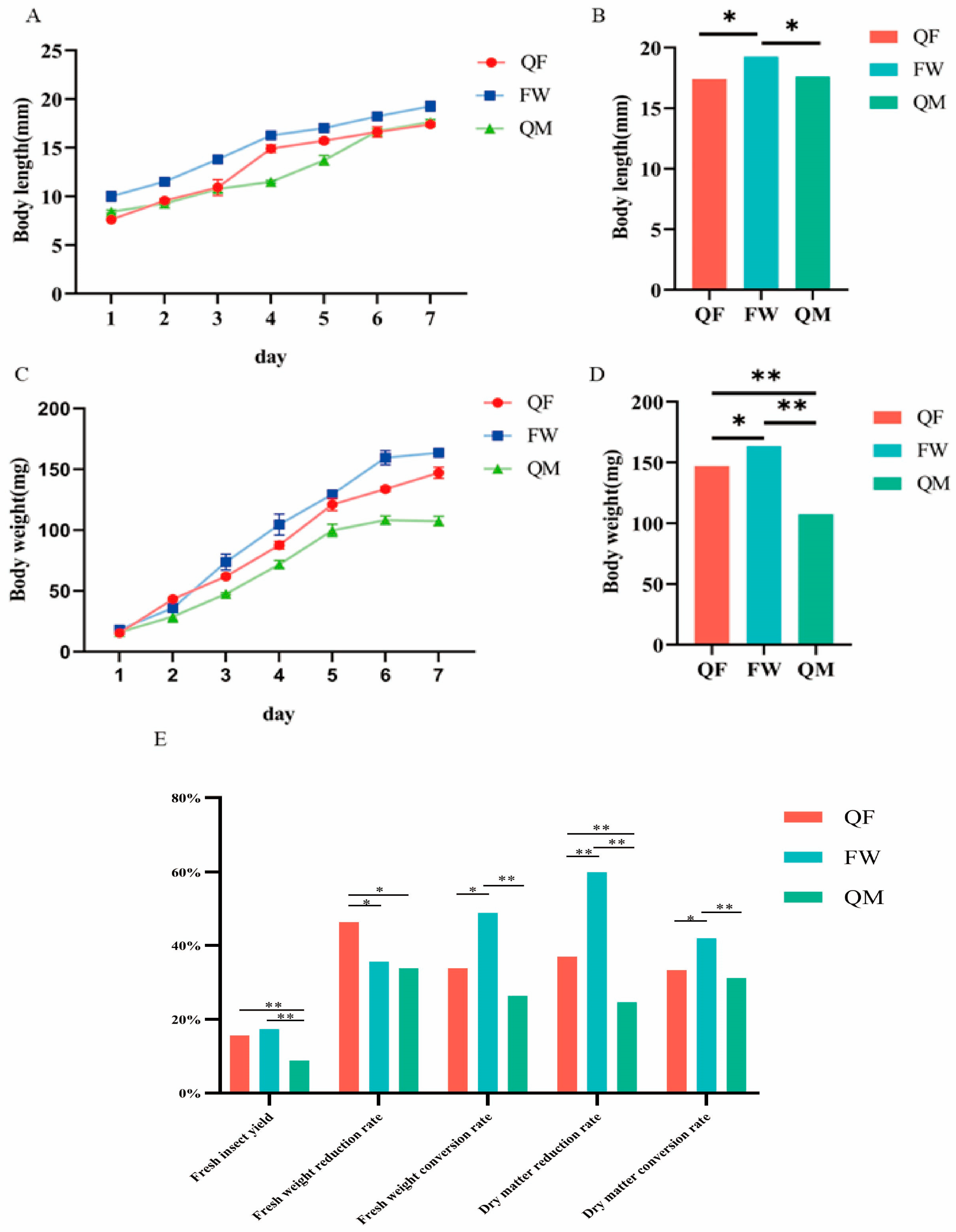
3.2. Growth Indicators
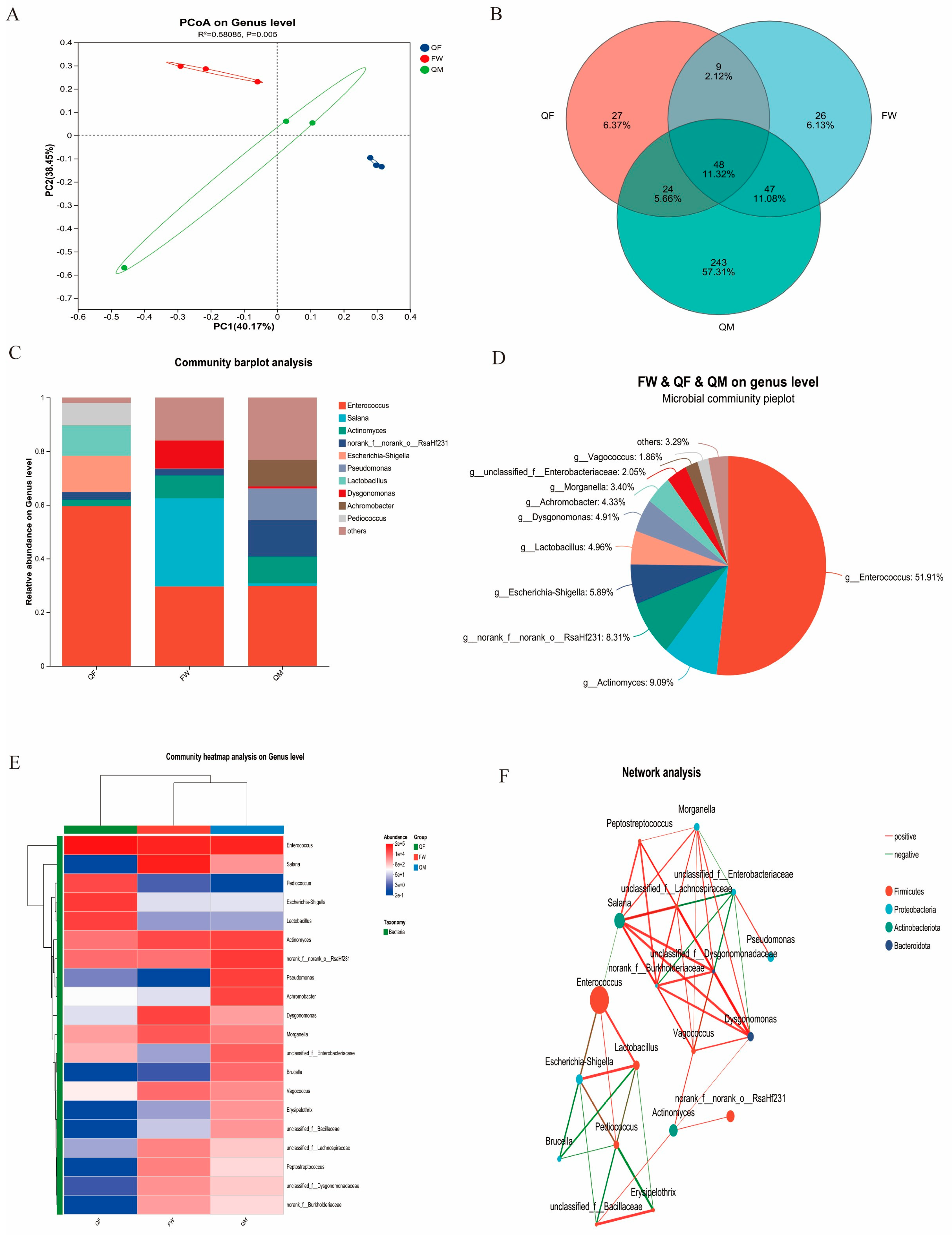
3.3. Microbiome
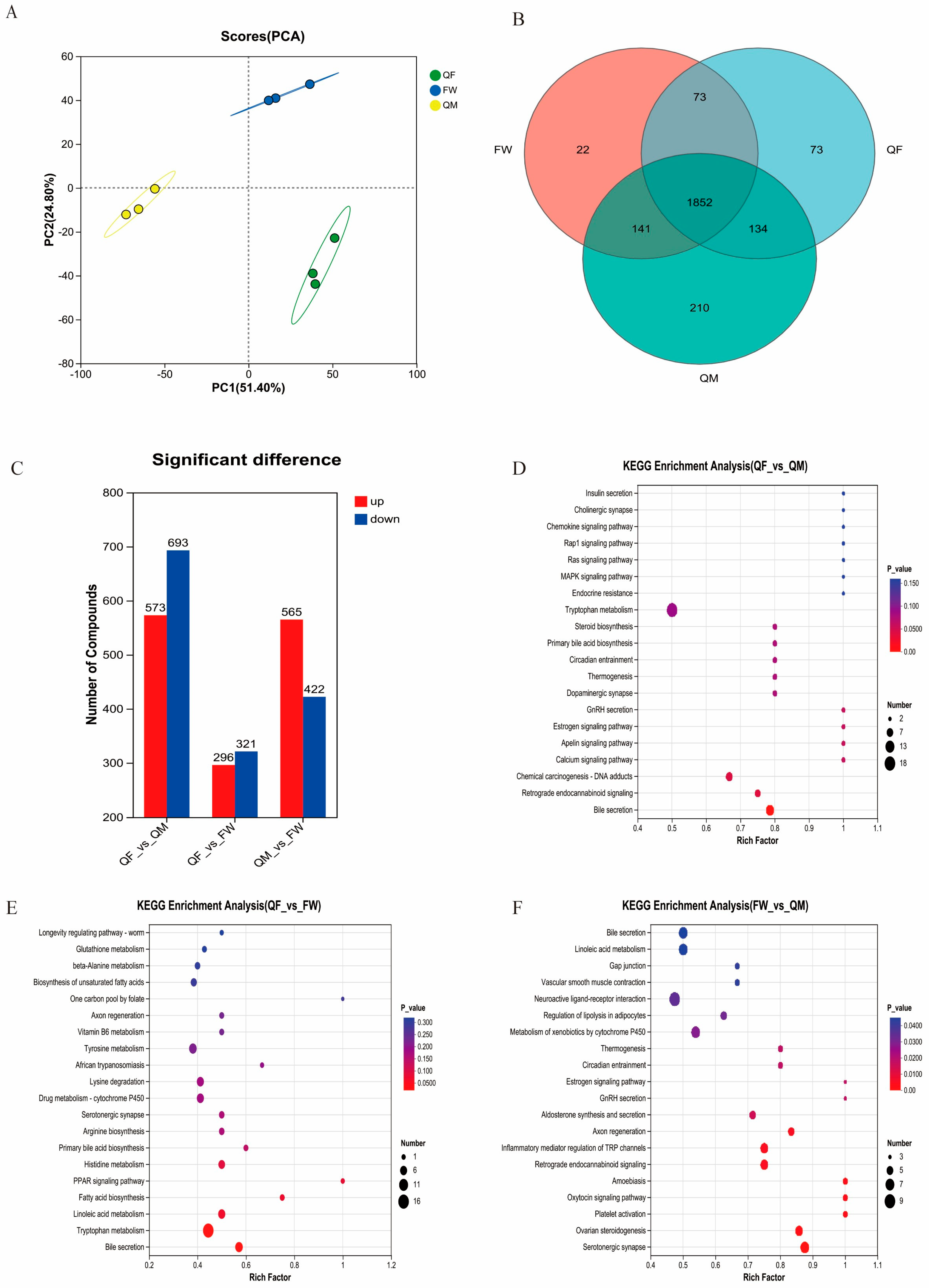
3.4. Metabolome
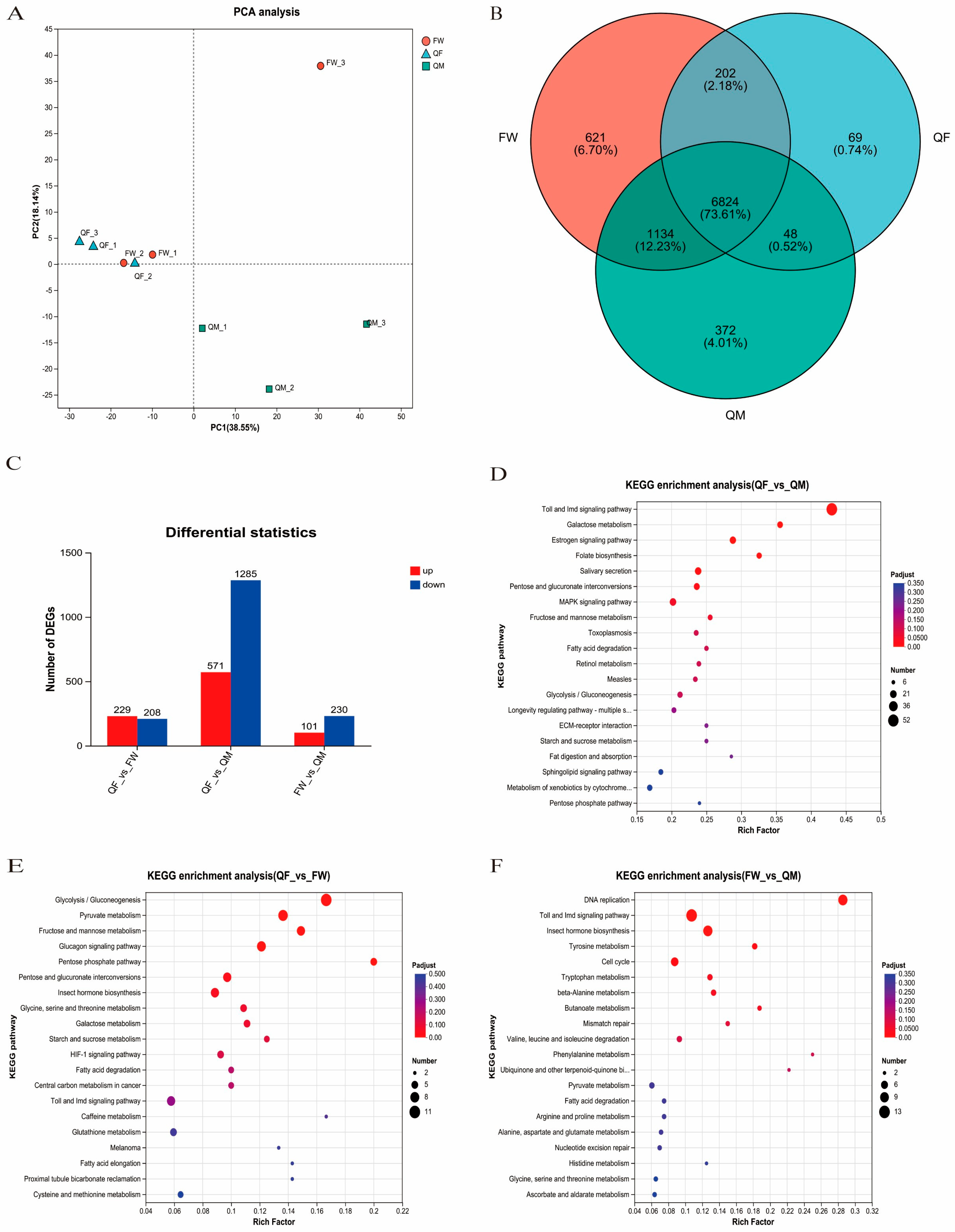
3.5. Transcriptome
4. Discussion
5. Conclusions
Author Contributions
Funding
Data Availability Statement
Acknowledgments
Conflicts of Interest
References
- Antonella, B.; Davide, G. Livestock production to feed the planet. Animal protein: A forecast of global demand over the next years. Relations 2017, 5, 65–71. [Google Scholar] [CrossRef]
- Andrea, M.L.; Jose Eleazar, A.; Belinda, V.; Aaron, F.G.; Adrian, H. Insects as an alternative protein source. Annu. Rev. Food Sci. Technol. 2022, 13, 19–34. [Google Scholar] [CrossRef]
- Norgren, R.; Jonsson, A.; Björkqvist, O. Original article: Fermented pulp and paper bio-sludge as feed for black soldier fly larvae. Biomass Convers. Biorefinery 2023, 13, 5625–5632. [Google Scholar] [CrossRef]
- Ojha, S.; Bußler, S.; Schlüter, O.K. Food waste valorisation and circular economy concepts in insect production and processing. Waste Manag. 2020, 118, 600–609. [Google Scholar] [CrossRef]
- Hoffman, L.C.; Zhang, S.; Alagappan, S.; Wills, V.; Yarger, O.; Cozzolino, D. Monitoring compositional changes in black soldier fly larvae (BSFL) sourced from different waste stream diets using attenuated total reflectance mid infrared spectroscopy and chemometrics. Molecules 2022, 27, 7500. [Google Scholar] [CrossRef]
- Makkar, H.P.S.; Tran, G.; Heuzé, V.; Ankers, P. State-of-the-art on use of insects as animal feed. Anim. Feed. Sci. Technol. 2014, 197, 1–33. [Google Scholar] [CrossRef]
- Schiavone, A.; Marco, M.D.; Martínez, S.; Dabbou, S.; Renna, M.; Madrid, J.; Hernandez, F.; Rotolo, L.; Costa, P.; Gai, F.; et al. Nutritional value of a partially defatted and a highly defatted black soldier fly larvae (Hermetia illucens L.) meal for broiler chickens: Apparent nutrient digestibility, apparent metabolizable energy and apparent ileal amino acid digestibility. J. Anim. Sci. Biotechnol. 2017, 8, 51. [Google Scholar] [CrossRef]
- Bovera, F.; Loponte, R.; Pero, M.E.; Cutrignelli, M.I.; Calabrò, S.; Musco, N.; Vassalotti, G.; Panettieri, V.; Lombardi, P.; Piccolo, G.; et al. Laying performance, blood profiles, nutrient digestibility and inner organs traits of hens fed an insect meal from Hermetia illucens larvae. Res. Vet. Sci. 2018, 120, 86–93. [Google Scholar] [CrossRef] [PubMed]
- Brede, A.; Wecke, C.; Liebert, F. Does the optimal dietary methionine to cysteine ratio in diets for growing chickens respond to high inclusion rates of insect meal from Hermetia illucens? Animals 2018, 8, 187. [Google Scholar] [CrossRef] [PubMed]
- Belghit, I.; Liland, N.S.; Waagbø, R.; Biancarosa, I.; Pelusio, N.; Li, Y.; Krogdahl, Å.; Lock, E.J. Potential of insect-based diets for Atlantic salmon (Salmo salar). Aquaculture 2018, 491, 72–81. [Google Scholar] [CrossRef]
- Renna, M.; Schiavone, A.; Gai, F.; Dabbou, S.; Lussiana, C.; Malfatto, V.; Prearo, M.; Capucchio, M.T.; Biasato, I.; Biasibetti, E.; et al. Evaluation of the suitability of a partially defatted black soldier fly (Hermetia illucens L.) larvae meal as ingredient for rainbow trout (Oncorhynchus mykiss Walbaum) diets. J. Anim. Sci. Biotechnol. 2017, 8, 57. [Google Scholar] [CrossRef] [PubMed]
- Spranghers, T.; Ottoboni, M.; Klootwijk, C.; Ovyn, A.; Deboosere, S.; De Meulenaer, B.; Michiels, J.; Eeckhout, M.; De Clercq, P.; De Smet, S. Nutritional composition of black soldier fly (Hermetia illucens) prepupae reared on different organic waste substrates. J. Sci. Food Agric. 2017, 97, 2594–2600. [Google Scholar] [CrossRef]
- Zhou, F.; Tomberlin, J.K.; Zheng, L.; Yu, Z.; Zhang, J. Developmental and waste reduction plasticity of three black soldier fly strains (diptera: Stratiomyidae) raised on different livestock manures. J. Med. Entomol. 2013, 50, 1224–1230. [Google Scholar] [CrossRef]
- Jin, N.; Liu, Y.; Zhang, S.; Sun, S.; Wu, M.; Dong, X.; Tong, H.; Xu, J.; Zhou, H.; Guan, S.; et al. C/N-Dependent Element Bioconversion Efficiency and Antimicrobial Protein Expression in Food Waste Treatment by Black Soldier Fly Larvae. Int. J. Mol. Sci. 2020, 23, 5036. [Google Scholar] [CrossRef] [PubMed]
- Nguyen, T.T.X.; Tomberlin, J.K.; Vanlaerhoven, S. Ability of black soldier fly (Diptera: Stratiomyidae) larvae to recycle food waste. Environ. Entomol. 2015, 44, 406–410. [Google Scholar] [CrossRef] [PubMed]
- Wang, Y.; Quan, J.; Cheng, X.; Li, C.; Yuan, Z. Relationship of black soldier fly larvae (BSFL) gut microbiota and bioconversion efficiency with properties of substrates. WMNY 2024, 180, 106–114. [Google Scholar] [CrossRef]
- Klammsteiner, T.; Walter, A.; Bogataj, T.; Heussler, C.D.; Stres, B.; Steiner, F.M.; Schlick-Steiner, B.C.; Arthofer, W.; Insam, H. The core gut microbiome of black soldier fly (Hermetia illucens) larvae raised on low-bioburden diets. Front. Microbiol. 2020, 11, 993. [Google Scholar] [CrossRef]
- Jiang, C.L.; Jin, W.Z.; Tao, X.H.; Zhang, Q.; Zhu, J.; Feng, S.Y.; Xu, X.H.; Li, H.Y.; Wang, Z.H.; Zhang, Z.J. Black soldier fly larvae (Hermetia illucens) strengthen the metabolic function of food waste biodegradation by gut microbiome. Microb. Biotechnol. 2019, 12, 528–543. [Google Scholar] [CrossRef]
- Shumo, M.; Khamis, F.M.; Ombura, F.L.; Tanga, C.M.; Fiaboe, K.K.M.; Subramanian, S.; Ekesi, S.; Schlüter, O.K.; van Huis, A.; Borgemeister, C. A molecular survey of bacterial species in the guts of black soldier fly larvae (Hermetia illucens) reared on two urban organic waste streams in Kenya. Front. Microbiol. 2021, 12, 687103. [Google Scholar] [CrossRef]
- Liu, K.; Zhang, G.; Li, Y.; Jiao, M.; Guo, J.; Shi, H.; Ji, X.; Zhang, W.; Quan, K.; Xia, W. Effects of feeding unprocessed whole black soldier fly (Hermetia illucens) larvae on performance, biochemical profile, health status, egg quality, microbiome and metabolome patterns of quails. Poultry Science 2025, 104, 105374. [Google Scholar] [CrossRef]
- Diola, C.S.; Nacilla, E.J.; Pardillo, C.A.; Alosbaños, R.S.; Evacitas, F.; Maglangit, F. Waste reduction and bioconversion of quail, chicken, and pig manure by black soldier fly (Hermetia illucens L.). Phil. J. Sci. 2024, 153, 609–618. [Google Scholar] [CrossRef]
- Mani, K.; Vitenberg, T.; Ben-Mordechai, L.; Schweitzer, R.; Opatovsky, I. Comparative untargeted metabolic analysis of natural- and laboratory-reared larvae of black soldier fly, Hermetia illucens (L.) (Diptera: Stratiomyidae). Comp. Biochem. Physiol. B 2023, 266, 110851. [Google Scholar] [CrossRef]
- Kariuki, E.G.; Kibet, C.; Paredes, J.C.; Mboowa, G.; Mwaura, O.; Njogu, J.; Masiga, D.; Bugg, T.D.H.; Tanga, C.M. Metatranscriptomic analysis of the gut microbiome of black soldier fly larvae reared on lignocellulose-rich fiber diets unveils key lignocellulolytic enzymes. Front. Microbiol. 2023, 14, 1120224. [Google Scholar] [CrossRef] [PubMed]
- Ma, C.; Huang, Z.; Feng, X.; Memon, F.U.; Cui, Y.; Duan, X.; Zhu, J.; Tettamanti, G.; Hu, W.; Tian, L. Selective breeding of cold-tolerant black soldier fly (Hermetia illucens) larvae: Gut microbial shifts and transcriptional patterns. Waste Manag. 2024, 177, 252–265. [Google Scholar] [CrossRef] [PubMed]
- Memon, F.U.; Zhu, Y.; Cui, Y.; Feng, X.; Ahmad, S.; Zeng, P.; Nabi, F.; Hao, D.; Huang, Z.; Tettamanti, G.; et al. Gut microbial communities and transcriptional profiles of black soldier fly (Hermitia illucens) larvae fed on fermented sericulture waste. Waste Manag. 2025, 194, 158–168. [Google Scholar] [CrossRef]
- Meneguz, M.; Gasco, L.; Tomberlin, J.K. Impact of pH and feeding system on black soldier fly (Hermetia illucens, L; Diptera: Stratiomyidae) larval development. PLoS ONE 2018, 13, e0202591. [Google Scholar] [CrossRef]
- Zulkifli, N.F.N.M.; Seok-Kian, A.Y.; Seng, L.L.; Mustafa, S.; Kim, Y.S.; Shapawi, R. Nutritional value of black soldier fly (Hermetia illucens) larvae processed by different methods. PLoS ONE 2022, 17, e0263924. [Google Scholar] [CrossRef]
- Harwood, J. Gas chromatography and lipids: A practical guide. Phytochemistry 1989, 28, 3251–3252. [Google Scholar] [CrossRef]
- AOAC International. Official Method 985.01. Minerals in Foods: Inductively Coupled Plasma Optical Emission Spectrometry (ICP-OES); AOAC International: Gaithersburg, MD, USA, 2005. [Google Scholar]
- Chen, S.; Zhou, Y.; Chen, Y.; Gu, J. Fastp: An ultra-fast all-in-one FASTQ preprocessor. Bioinformatics 2018, 34, i884–i890. [Google Scholar] [CrossRef]
- Magoč, T.; Salzberg, S.L. FLASH: Fast length adjustment of short reads to improve genome assemblies. Bioinformatics 2011, 27, 2957–2963. [Google Scholar] [CrossRef]
- Edgar, R.C. UPARSE: Highly accurate OTU sequences from microbial amplicon reads. Nat. Methods 2013, 10, 996–998. [Google Scholar] [CrossRef]
- Wang, Q.; Garrity, G.M.; Tiedje, J.M.; Cole, J.R. Naïve bayesian classifier for rapid assignment of rRNA sequences into the new bacterial taxonomy. Appl. Environ. Microbiol. 2007, 73, 5261–5267. [Google Scholar] [CrossRef] [PubMed]
- Kim, D.; Langmead, B.; Salzberg, S.L. HISAT: A fast spliced aligner with low memory requirements. Nat. Methods 2015, 12, 357–360. [Google Scholar] [CrossRef] [PubMed]
- Pertea, M.; Pertea, G.M.; Antonescu, C.M.; Chang, T.C.; Mendell, J.T.; Salzberg, S.L. StringTie enables improved reconstruction of a transcriptome from RNA-seq reads. Nat. Biotechnol. 2015, 33, 290–295. [Google Scholar] [CrossRef]
- Li, B.; Dewey, C.N. RSEM: Accurate transcript quantification from RNA-Seq data with or without a reference genome. BMC Bioinformatics 2011, 12, 323. [Google Scholar] [CrossRef]
- Love, M.I.; Huber, W.; Anders, S. Moderated estimation of fold change and dispersion for RNA-seq data with DESeq2. Genome Biol. 2014, 15, 550. [Google Scholar] [CrossRef] [PubMed]
- Wang, L.; Feng, Z.; Wang, X.; Wang, X.W.; Zhang, X. DEGseq: An R package for identifying differentially expressed genes from RNA-seq data. Bioinformatics 2010, 26, 136–138. [Google Scholar] [CrossRef]
- Shen, S.; Park, J.W.; Lu, Z.; Lin, L.; Henry, M.D.; Wu, Y.N.; Zhou, Q.; Xing, Y. rMATS: Robust and flexible detection of differential alternative splicing from replicate RNA-Seq data. Proc. Natl. Acad. Sci. USA 2014, 111, e5593-5601. [Google Scholar] [CrossRef]
- Kroeckel, S.; Harjes, A.G.E.; Roth, I.; Katz, H.; Wuertz, S.; Susenbeth, A.; Schulz, C. When a turbot catches a fly: Evaluation of a pre-pupae meal of the black soldier fly (Hermetia illucens) as fish meal substitute–growth performance and chitin degradation in juvenile turbot (Psetta maxima). Aquaculture 2012, 364−365, 345–352. [Google Scholar] [CrossRef]
- Gold, M.; Tomberlin, J.K.; Diener, S.; Zurbrügg, C.; Mathys, A. Decomposition of biowaste macronutrients, microbes, and chemicals in black soldier fly larval treatment: A review. Waste Manag. 2018, 82, 302–318. [Google Scholar] [CrossRef]
- Meneguz, M.; Schiavone, A.; Gai, F.; Dama, A.; Lussiana, C.; Renna, M.; Gasco, L. Effect of rearing substrate on growth performance, waste reduction efficiency and chemical composition of black soldier fly (Hermetia illucens) larvae. J. Sci. Food Agric. 2018, 98, 5776–5784. [Google Scholar] [CrossRef] [PubMed]
- Fischer, H.; Romano, N. Fruit, vegetable, and starch mixtures on the nutritional quality of black soldier fly (Hermetia illucens) larvae and resulting frass. J. Insects Food Feed. 2021, 7, 319–328. [Google Scholar] [CrossRef]
- Sandrock, C.; Leupi, S.; Wohlfahrt, J.; Kaya, C.; Heuel, M.; Terranova, M.; Blanckenhorn, W.U.; Windisch, W.; Kreuzer, M.; Leiber, F. Genotype–by–diet interactions for larval performance and body composition traits in the black soldier fly, Hermetia illucens. Insects 2022, 13, 424. [Google Scholar] [CrossRef]
- Oonincx, D.G.A.B.; Van Broekhoven, S.; Van Huis, A.; Van Loon, J.J.A. Feed conversion, survival and development, and composition of four insect species on diets composed of food by-products. PLoS ONE 2015, 10, e0144601. [Google Scholar] [CrossRef]
- Ushakova, N.A.; Brodskii, E.S.; Kovalenko, A.A.; Bastrakov, A.I.; Kozlova, A.A.; Pavlov, D.S. Characteristics of lipid fractions of larvae of the black soldier fly Hermetia illucens. Dokl. Biochem. Biophys. 2016, 468, 209–212. [Google Scholar] [CrossRef]
- Skrivanová, E.; Marounek, M.; Dlouhá, G.; Kaňka, J. Susceptibility of Clostridium perfringens to C2–C18 fatty acids. Lett. Appl. Microbiol. 2005, 41, 77–81. [Google Scholar] [CrossRef]
- Zeitz, J.O.; Fennhoff, J.; Kluge, H.; Stangl, G.I.; Eder, K. Effects of dietary fats rich in lauric and myristic acid on performance, intestinal morphology, gut microbes, and meat quality in broilers. Poult. Sci. 2015, 94, 2404–2413. [Google Scholar] [CrossRef] [PubMed]
- Li, Q.; Zheng, L.Y.; Cai, H.; Garza, E.; Yu, Z.N.; Zhou, S.D. From organic waste to biodiesel: Black soldier fly, Hermetia illucens, makes it feasible. Fuel 2011, 90, 1545–1548. [Google Scholar] [CrossRef]
- Zhu, Z.; Rehman, K.U.; Yu, Y.; Liu, X.; Wang, H.; Tomberlin, J.K.; Sze, S.H.; Cai, M.; Zhang, J.; Yu, Z.; et al. De novo transcriptome sequencing and analysis revealed the molecular basis of rapid fat accumulation by black soldier fly (Hermetia illucens, L.) for development of insectival biodiesel. Biotechnol. Biofuels 2019, 12, 194. [Google Scholar] [CrossRef]
- Yandi, I.; Öztürk, R.Ç.; Kocabas, M.; Kurtoglu, I.Z.; Altinok, I. Nutritional composition of black soldier fly (Hermetia illucens) reared on chicken waste meal, fruit & vegetable waste, and their mixture. J. Insects Food Feed. 2023, 9, 557–568. [Google Scholar] [CrossRef]
- Lalander, C.; Nordberg, Å.; Vinnerås, B. A comparison in product–value potential in four treatment strategies for food waste and faeces–assessing composting, fly larvae composting and anaerobic digestion. Glob. Change Biol. Bioenergy 2018, 10, 84–91. [Google Scholar] [CrossRef]
- Yang, S.S.; Chen, Y.; Kang, J.H.; Xie, T.R.; He, L.; Xing, D.F.; Ren, N.Q.; Ho, S.H.; Wu, W.M. Generation of high–efficient biochar for dye adsorption using frass of yellow mealworms (larvae of Tenebrio molitor Linnaeus) fed with wheat straw for insect biomass production. J. Clean. Prod. 2019, 227, 33–47. [Google Scholar] [CrossRef]
- Zhu, F.X.; Wang, W.P.; Hong, C.L.; Feng, M.G.; Xue, Z.Y.; Chen, X.Y.; Yao, Y.L.; Yu, M. Rapid production of maggots as feed supplement and organic fertilizer by the two–stage composting of pig manure. Bioresour. Technol. 2012, 116, 485–491. [Google Scholar] [CrossRef] [PubMed]
- Choi, Y.C.; Choi, J.Y.; Kim, J.G.; Kim, M.S.; Jeong, G.S. Potential usage of food waste as a natural fertilizer after digestion by Hermetia illucens (Diptera: Stratiomyidae). Int. J. Ind. Entomol. 2009, 19, 171–174. [Google Scholar] [CrossRef]
- Sarpong, D.; Oduro–Kwarteng, S.; Gyasi, S.F.; Buamah, R.; Donkor, E.; Awuah, E.; Baah, M.K. Biodegradation by composting of municipal organic solid waste into organic fertilizer using the black soldier fly (Hermetia illucens) (Diptera: Stratiomyidae) larvae. Int. J. Recycl. Org. Waste Agric. 2019, 8, 45–54. [Google Scholar] [CrossRef]
- Bellezza Oddon, S.; Biasato, I.; Resconi, A.; Gasco, L. Determination of lipid requirements in black soldier fly through semi–purified diets. Sci. Rep. 2022, 12, 10922. [Google Scholar] [CrossRef]
- Bruno, D.; Bonelli, M.; De Filippis, F.; Di Lelio, I.; Tettamanti, G.; Casartelli, M.; Ercolini, D.; Caccia, S. The intestinal microbiota of Hermetia illucens larvae is affected by diet and shows a diverse composition in the different midgut regions. Appl. Environ. Microbiol. 2019, 85, e01864-18. [Google Scholar] [CrossRef] [PubMed]
- Khamis, F.M.; Ombura, F.L.O.; Akutse, K.S.; Subramanian, S.; Mohamed, S.A.; Fiaboe, K.K.M.; Saijuntha, W.; Van Loon, J.J.A.; Dicke, M.; Dubois, T.; et al. Insights in the global genetics and gut microbiome of black soldier fly, Hermetia illucens: Implications for animal feed safety control. Front. Microbiol. 2020, 11, 1538. [Google Scholar] [CrossRef]
- Dillon, R.J.; Dillon, V.M. The gut bacteria of insects: Nonpathogenic interactions. Annu. Rev. Entomol. 2004, 49, 71–92. [Google Scholar] [CrossRef]
- Engel, P.; Moran, N.A. The gut microbiota of insects-diversity in structure and function. FEMS Microbiol. Rev. 2013, 37, 699–735. [Google Scholar] [CrossRef] [PubMed]
- Dietrich, C.; Köhler, T.; Brune, A. The cockroach origin of the termite gut microbiota: Patterns in bacterial community structure reflect major evolutionary events. Appl. Environ. Microbiol. 2014, 80, 2261–2269. [Google Scholar] [CrossRef] [PubMed]
- Dubin, K.; Pamer, E.G. Enterococci and their interactions with the intestinal microbiome. Microbiol. Spectr. 2014, 5, bad-0014-2016. [Google Scholar] [CrossRef]
- Wang, C.; Guo, X.; Deng, H.; Dong, D.; Tu, Q.; Wu, W. New insights into the structure and dynamics of actinomycetal community during manure composting. Appl. Microbiol. Biotechnol. 2014, 98, 3327–3337. [Google Scholar] [CrossRef]
- Franke-Whittle, I.H.; Knapp, B.A.; Fuchs, J.; Kaufmann, R.; Insam, H. Application of COMPOCHIP microarray to investigate the bacterial communities of different composts. Microb. Ecol. 2009, 57, 510–521. [Google Scholar] [CrossRef]
- Hanning, I.; Diaz-Sanchez, S. The functionality of the gastrointestinal microbiome in non-human animals. Microbiome 2015, 3, 51. [Google Scholar] [CrossRef]
- Yang, Y.J.; Zhang, N.; Ji, S.Q.; Lan, X.; Zhang, K.; Shen, Y.L.; Li, F.L.; Ni, J.F. Dysgonomonas macrotermitis sp. nov., isolated from the hindgut of a fungus-growing termite. Int. J. Syst. Evol. Microbiol. 2014, 64, 2956–2961. [Google Scholar] [CrossRef] [PubMed]
- Sun, X.; Yang, Y.; Zhang, N.; Shen, Y.; Ni, J. Draft genome sequence of Dysgonomonas macrotermitis strain JCM 19375T, isolated from the gut of a termite. Genome Announc. 2015, 3, e00963-15. [Google Scholar] [CrossRef]
- Bruno, D.; Bonelli, M.; Cadamuro, A.G.; Reguzzoni, M.; Grimaldi, A.; Casartelli, M.; Tettamanti, G. The digestive system of the adult Hermetia illucens (Diptera: Stratiomyidae): Morphological features and functional properties. Cell Tissue Res. 2019, 378, 221–238. [Google Scholar] [CrossRef] [PubMed]
- Shelomi, M.; Wu, M.K.; Chen, S.M.; Huang, J.J.; Burke, C.G. Microbes associated with black soldier fly (Diptera: Stratiomiidae) degradation of food waste. Environ. Entomol. 2020, 49, 405–411. [Google Scholar] [CrossRef]
- Lee, C.M.; Kim, S.Y.; Song, J.; Lee, Y.S.; Sim, J.S.; Hahn, B.S. Isolation and characterization of a halotolerant and protease-resistant α-galactosidase from the gut metagenome of Hermetia illucens. J. Biotechnol. 2018, 279, 47–54. [Google Scholar] [CrossRef]
- Xue, C.; Li, G.; Zheng, Q.; Gu, X.; Shi, Q.; Su, Y.; Chu, X.; Bao, L. Tryptophan metabolism in health and disease. Cell Metab. 2023, 35, 1304–1326. [Google Scholar] [CrossRef] [PubMed]
- Cervenka, I.; Agudelo, L.Z.; Ruas, J.L. Kynurenines: Tryptophan’s metabolites in exercise, inflammation, and mental health. Science 2017, 357, eaaf9794. [Google Scholar] [CrossRef] [PubMed]
- Jing, T.Z.; Qi, F.H.; Wang, Z.Y. Most dominant roles of insect gut bacteria: Digestion, detoxification, or essential nutrient provision? Microbiome 2020, 8, 38. [Google Scholar] [CrossRef]
- Lipke, H.; Strout, K.; Henzel, W.; Sugumaran, M. Structural proteins of sarcophagid larval exoskeleton. Composition and distribution of radioactivity derived from [7-14C] dopamine. J. Biol. Chem. 1981, 256, 4241–4246. [Google Scholar] [CrossRef] [PubMed]



| Item (%DM) | QF | FW | QM | p-Values |
|---|---|---|---|---|
| Total ash | 12.6 ± 0.1 b | 11.3 ± 0.1 c | 24.6 ± 0.1 a | <0.001 |
| Crude protein | 21.2 ± 0.2 c | 35.2 ± 0.7 b | 41.3 ± 0.4 a | <0.001 |
| Crude fat | 10.6 ± 0.3 a | 6.9 ± 0.1 a | 2.7 ± 0.1 b | <0.001 |
| Calcium | 3.6 ± 0.1 b | 2.1 ± 0.1 c | 5.1 ± 0.1 a | <0.001 |
| Phosphorus | 0.6 ± 0.1 b | 0.6 ± 0.1 b | 2.2 ± 0.2 a | 0.001 |
| Item (%DM) | QF | FW | QM | p-Values |
|---|---|---|---|---|
| Moisture | 65.0 ± 0.6 c | 78.3 ± 1.3 a | 73.3 ± 2.0 b | <0.001 |
| Total ash | 12.3 ± 0.3 c | 16.6 ± 0.4 b | 23.4 ± 0.7 a | <0.001 |
| Crude protein | 37.4 ± 0.8 b | 47.5 ± 3.8 a | 48.3 ± 1.5 a | <0.001 |
| Crude fat | 33.2 ± 1.3 a | 25.1 ± 1.1 b | 7.0 ± 1.1 c | <0.001 |
| Calcium | 4.0 ± 0.1 c | 5.6 ± 0.4 a | 4.8 ± 0.2 b | <0.001 |
| Phosphorus | 0.6± 0.1 a | 0.4 ± 0.1 b | 0.6 ± 0.1 a | <0.001 |
| Item (%DM) | QF | FW | QM | p-Values |
|---|---|---|---|---|
| Moisture | 45.9 ± 3.0 c | 85.1 ± 0.6 a | 66.5 ± 2.0 b | <0.001 |
| Total ash | 19.8 ± 0.9 c | 22.2 ± 0.9 b | 40.6 ± 1.2 a | <0.001 |
| Crude protein | 26.2 ± 0.6 a | 25.8 ± 2.7 a | 18.3 ± 0.4 b | <0.001 |
| Crude fat | 2.2 ± 0.3 b | 3.5 ± 0.3 a | 2.3 ± 0.1 b | 0.001 |
| Calcium | 5.0 ± 0.1 b | 2.1 ± 0.1 c | 9.6 ± 0.3 a | <0.001 |
| Phosphorus | 1.0 ± 0.1 a | 0.2 ± 0.1 c | 0.7 ± 0.1 b | <0.001 |
| Amino Acid (%DM) | QF | FW | QM | p-Values |
|---|---|---|---|---|
| Essential amino-acid | 10.6 ± 0.9 | 11.9 ± 0.5 | 11.1 ± 0.5 | 0.809 |
| Isoleucine | 1.7 ± 0.2 | 1.8 ± 0.1 | 1.7 ± 0.2 | 0.413 |
| Leucine | 2.6 ± 0.3 | 2.8 ± 0.1 | 2.5 ± 0.3 | 0.417 |
| Valine | 2.0 ± 0.2 b | 2.3 ± 0.1 a | 2.2 ± 0.1 a | 0.016 |
| Phenylalanine | 1.6 ± 0.2 b | 2.0 ± 0.1 a | 1.7 ± 0.1 b | 0.003 |
| Threonine | 1.3 ± 0.1 b | 1.5 ± 0.1 a | 1.5 ± 0.1 a | <0.001 |
| Lysine | 1.4 ± 0.2 | 1.6 ± 0.3 | 1.5 ± 0.1 | 0.667 |
| Non-essential amino acid | 21.4 ± 1.1 b | 24.0 ± 0.3 a | 24.4 ± 0.7 a | 0.002 |
| Aspartic acid | 3.7 ± 0.1 b | 4.4 ± 0.1 a | 4.3 ± 0.1 a | <0.001 |
| Serine | 1.2 ± 0.1 b | 1.4 ± 0.1 a | 1.5 ± 0.1 a | <0.001 |
| Glycine | 1.8 ± 0.1 b | 2.1 ± 0.1 a | 2.2 ± 0.1 a | <0.001 |
| Tyrosine | 2.6 ± 0.2 ab | 2.8 ± 0.1 a | 2.2 ± 0.1 b | 0.009 |
| Glutamic acid | 5.1 ± 0.2 b | 5.4 ± 0.3 b | 6.2 ± 0.2 a | <0.001 |
| Histidine | 1.2 ± 0.1 b | 1.6 ± 0.1 a | 1.5 ± 0.1 a | 0.004 |
| Arginine | 1.7 ± 0.15 b | 2.3 ± 0.1 a | 2.3 ± 0.1 a | <0.001 |
| Proline | 1.7 ± 0.1 | 1.7 ± 0.1 | 1.8 ± 0.1 | 0.292 |
| Alanine | 2.5 ± 0.3 | 2.4 ± 0.1 | 2.5 ± 0.2 | 0.917 |
| Fatty Acid (% Total Identified Fatty Acids) | QF | FW | QM | p-Values |
|---|---|---|---|---|
| C10:0 | 1.2 ± 0.1 a | 1.0 ± 0.1 b | 0.7 ± 0.1 c | 0.001 |
| C12:0 | 35.8 ± 1.5 a | 34.1 ± 2.2 a | 13.2 ± 0.5 b | <0.001 |
| C14:0 | 7.3 ± 0.7 a | 7.3 ± 0.7 a | 3.6 ±0.1 b | <0.001 |
| C16:0 | 15.9 ± 0.8 c | 20.4 ± 2.1 b | 29.2 ± 0.3 a | <0.001 |
| C17:0 | 0.1 ± 0.1 b | 0.2 ± 0.1 b | 1.2 ± 0.1 a | <0.001 |
| C20:0 | 16.0 ± 1.5 c | 22.3 ± 0.9 b | 31.7 ± 0.4 a | <0.001 |
| C21:0 | 1.0 ± 0.1 c | 4.3 ± 0.6 a | 2.9 ±0.4 b | <0.001 |
| Sum SFA | 77.3 ± 0.8 c | 89.7 ± 0.8 a | 82.4 ± 1.3 b | <0.001 |
| C14:1 | 0.2 ± 0.1 b | 0.3 ± 0.1 b | 1.9 ± 0.3 a | <0.001 |
| C16:1n7 | 0.4 ± 0.1 c | 0.7 ± 0.1 b | 1.4 ± 0.1 a | <0.001 |
| C18:1n9t | 3.3 ± 0.2 c | 4.6 ± 0.4 b | 6.8 ± 0.2 a | <0.001 |
| C18:2n6t | 17.7 ± 0.7 a | 0.3 ± 0.1 b | 0.7 ± 0.1 b | <0.001 |
| Sum UFA | 21.5 ± 0.9 a | 5.9 ± 0.5 c | 10.8 ± 0.4 b | <0.001 |
| Trace Element (µg/g) | QF | FW | QM | p-Values |
|---|---|---|---|---|
| Fe | 353.7 ± 20.2 c | 588.5 ± 7.4 b | 707.6 ± 10.5 a | <0.001 |
| Cu | 12.8 ± 1.5 b | 15.0 ± 1.6 b | 35.0 ± 0.8 a | <0.001 |
| Zn | 109.1 ± 5.7 b | 73.8 ± 9.8 c | 287.6 ± 10.2 a | <0.001 |
| Mn | 152.7 ± 6.4 b | 58.1 ± 5.1 c | 224.5 ± 1.4 a | <0.001 |
| K | 9664.7 ± 124.2 b | 9653.0 ± 345.7 b | 21,236.5 ± 471.5 a | <0.001 |
| Na | 2083.4 ± 129.5 c | 3752.0 ± 146.4 b | 4531.5 ± 91.7 a | <0.001 |
| Mg | 3031.2 ± 61.0 b | 2292.0 ± 71.1 c | 4806.4 ± 113.5 a | <0.001 |
Disclaimer/Publisher’s Note: The statements, opinions and data contained in all publications are solely those of the individual author(s) and contributor(s) and not of MDPI and/or the editor(s). MDPI and/or the editor(s) disclaim responsibility for any injury to people or property resulting from any ideas, methods, instructions or products referred to in the content. |
© 2025 by the authors. Licensee MDPI, Basel, Switzerland. This article is an open access article distributed under the terms and conditions of the Creative Commons Attribution (CC BY) license.
Share and Cite
Liu, K.; Zhang, G.; Li, Y.; Jiao, M.; Guo, J.; Li, J.; Shi, H.; Wang, X.; Zhang, W.; Quan, K.; et al. Effect of Rearing Substrate on Nutritional Composition, Growth Performance and Multi-Omics Characteristics of Black Soldier Fly. Insects 2026, 17, 10. https://doi.org/10.3390/insects17010010
Liu K, Zhang G, Li Y, Jiao M, Guo J, Li J, Shi H, Wang X, Zhang W, Quan K, et al. Effect of Rearing Substrate on Nutritional Composition, Growth Performance and Multi-Omics Characteristics of Black Soldier Fly. Insects. 2026; 17(1):10. https://doi.org/10.3390/insects17010010
Chicago/Turabian StyleLiu, Kun, Guangming Zhang, Yuting Li, Minghui Jiao, Jianlai Guo, Jun Li, Huibin Shi, Xianwei Wang, Weixian Zhang, Kai Quan, and et al. 2026. "Effect of Rearing Substrate on Nutritional Composition, Growth Performance and Multi-Omics Characteristics of Black Soldier Fly" Insects 17, no. 1: 10. https://doi.org/10.3390/insects17010010
APA StyleLiu, K., Zhang, G., Li, Y., Jiao, M., Guo, J., Li, J., Shi, H., Wang, X., Zhang, W., Quan, K., & Xia, W. (2026). Effect of Rearing Substrate on Nutritional Composition, Growth Performance and Multi-Omics Characteristics of Black Soldier Fly. Insects, 17(1), 10. https://doi.org/10.3390/insects17010010