Four New Species and One New Record of Stromboscerini (Coleoptera, Curculionidae, Dryophthorinae) from China †


Simple Summary
Abstract
1. Introduction
2. Materials and Methods
3. Results
3.1. Dexipeus Pascoe, 1885
- Type species. Dexipeus fumosus Pascoe, subsequent designation by Lyal [29].
- Diagnosis. see Introduction.
- Distribution. China, Japan, Java, Indonesia, Philippines.
3.1.1. Key to Species of the Genus Dexipeus
- 1.
- Elytral interstrial pubescence forming continuous pilose pustule…………………………………………………………………………………………………………………..2
- -
- Elytral interstrial pubescence interrupted, not forming pilose pustule……………………………………………………………………………………………………………..3
- 2.
- Forehead flat. Antennal club L/W ratio 1.7. Pronotum lacking median carina. Elytral sides subparallel. Body length 3.40–3.80 mm……………………...D. krasilnikovi
- -
- Forehead with small median fovea. Antennal club L/W ratio 2.0. Pronotum with fine median carina. Elytra widest at basal 1/3, sides not parallel. Body length 3.40–3.90 mm…………………………………………………………………………………………………………………………………………………………………………......D. uenoi
- 3.
- Body reddish brown. Rostrum shorter than pronotum, emarginate laterally at apical 1/3. Pronotal punctures small. Elytral interstriae with sparse pubescence. Body length 4.90 mm………………………………………………….……………………………………………………………………………………..D. tengchongensis sp. nov.
- -
- Body black. Rostrum not emarginate laterally. Pronotal punctures coarse. Elytral interstriae with dense pubescence. Body length 4.00 mm………………..………....4
- 4.
- Pronotal sides subparallel. Elytral punctures large, oblong-ovate.……………………………………………………………………………………………………... D. costatus
- -
- Pronotal sides weakly rounded. Elytral punctures very large, subquadrate…………………………………………………………………………………………... D. fumosus
3.1.2. Dexipeus tengchongensis Lü & Zhang sp. nov.
- LSIDurn:lsid:zoobank.org:act:F38C1532-EEBB-485A-936C-E887C1802257
- Material examined. Holotype: 1♀, China, Yunnan, Tengchong City, elev. 1920 m, 10/V/1979, collector unknown, IOZ(E)1507476.
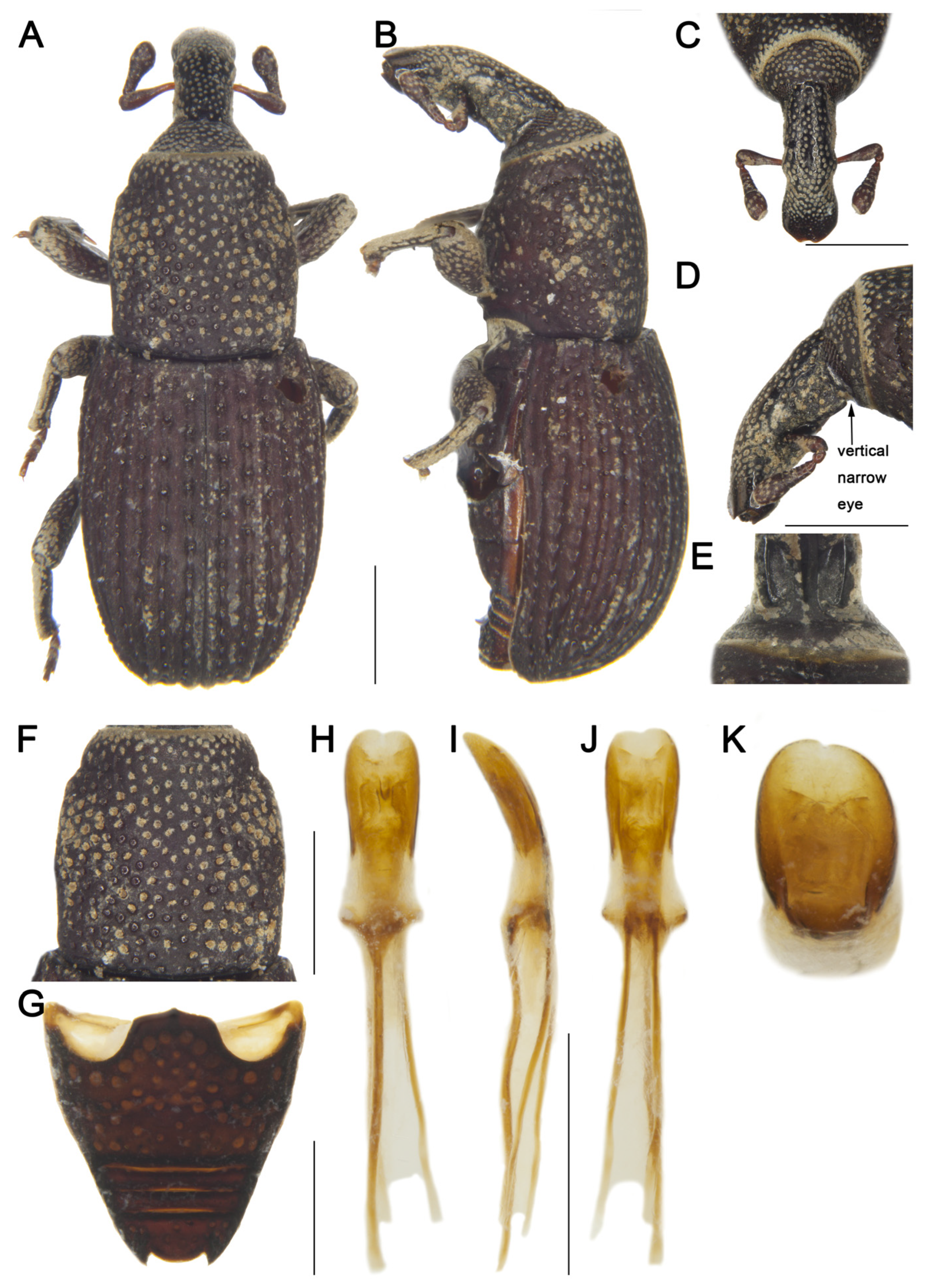
- Comparative diagnosis. D. tengchongensis sp. nov. is morphologically most similar to D. costatus, but differs in the following characters: (I) rostrum distinctly shorter than pronotum (Rl/Pl 0.73) (vs. longer than pronotum in D. costatus); (II) rostrum emarginate laterally at apical 1/3 (vs. lacking emargination in D. costatus); (III) pronotal punctures small, distance between punctures exceeding puncture diameter (vs. punctures large, distance less than puncture diameter in D. costatus); (IV) elytral interstriae with sparse pubescence, striae with small punctures and distance between punctures about 2.0 times the puncture diameter (vs. elytra with dense pubescence, striae with large punctures and distance subequal to puncture diameter in D. costatus; see Grebennikov [7]: figure 3A); (V) body reddish brown (vs. black in D. costatus); (VI) body larger (length 4.90 mm vs. 4.00 mm in D. costatus).
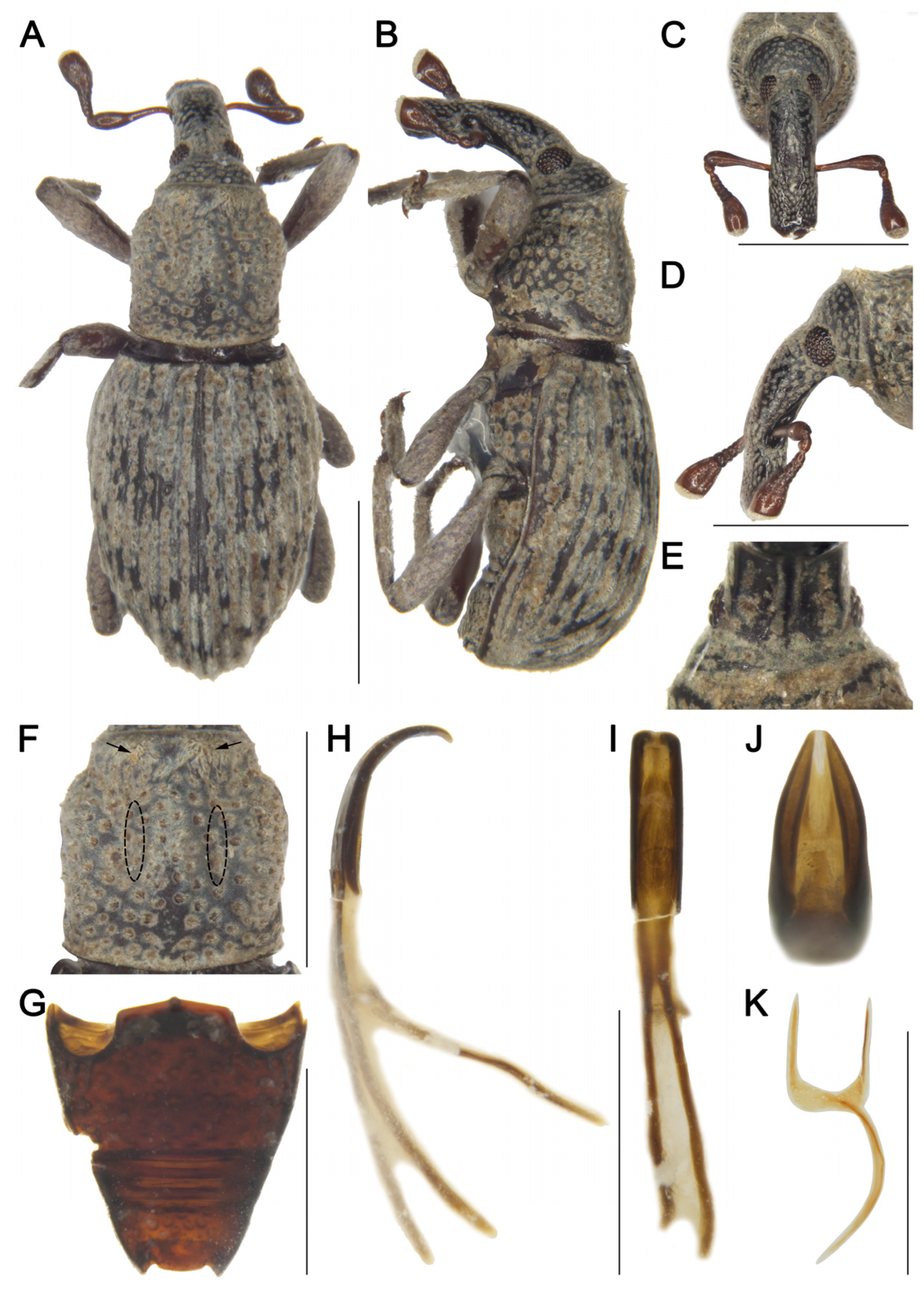
- Description. Coloration (Figure 1A,B). Body reddish brown; head, mesosternum, and metasternum dark reddish brown; rostrum black.
- Head (Figure 1C–E). Forehead flat, narrower than rostrum, with deep depression between forehead and rostrum; eyes narrowly linear and vertical, length exceeding longest side of antennal club, widely separated ventrally; rostrum long (Rl/Rw 2.20), shorter than pronotum (Rl/Pl 0.73), emarginate laterally at apical 1/3 in dorsal view, nearly straight from base to apical 1/3 in lateral view, slightly curved from apical 1/3 to apex, base thick, from base to apical 1/5 with short pubescence and coarse punctures, apex smooth and shiny; antennae inserted at middle of rostrum; scape long (l/w 3.13), not reaching eyes, gradually broadening from base to apex, widest at apical 1/4; funicular segment 1 longer than wide, segment 2 funnel-shaped, segments 3–6 transverse; club subconical (l/w 1.50), apex obliquely truncate and densely pubescent.
- Pronotum (Figure 1F). Nearly cylindrical, longer than wide (Pl/Pw 1.10), widest at middle, apical 1/8 distinctly constricted, sides rounded; disc slightly convex in lateral view; densely covered with small punctures, distance between punctures exceeding puncture diameter; densely covered with short pubescence; postocular lobes absent.
- Scutellum. Small, invisible.
- Elytra. Obovate, longer than wide (El/Ew 1.45), widest at basal 1/4, apex nearly truncate, sides rounded; disc slightly convex in lateral view; interstriae distinctly convex, subequal in width, with 1–2 rows of short pubescence; striae as wide as interstriae, deep, punctures rounded, distance between punctures about 2.0 times puncture diameter.
- Abdomen (Figure 1G). Abdominal ventrites covered with coarse punctures, punctures on ventrites 3 and 4 sparser than on others, punctures at margins larger than those at middle; anterior margin of ventrite 2 slightly convex at middle, posterior margins of ventrites 2–4 rectilinear; ventrite 2 0.8 times length of ventrite 1, ventrite 3 as long as ventrite 4, ventrite 5 deeply emarginate, 2.5 times as wide as long.
- Legs. Densely covered with short pubescence; femora and tibiae with punctures; procoxae subconical, contiguous; mesocoxae narrowly separated; profemur more robust than mesofemur and metafemur, femora unarmed; tibiae bearing single long apical uncus; profemur 3.3 times as long as wide; protibia 5.0 times as long as wide; tarsi long, tarsomeres 1–3 obconical, ventrally with dense erect setae, onychium elongate; claws free, divergent.
- Male genitalia (Figure 1H–K). Pedon 0.3 times length of temones, gradually broadening from base to apical 1/3, then narrowed apically, curved in lateral view, sides rounded, base symmetrical; temones slender, slightly curved; manubrium of tegmen elongate, subequal to length of temones, slightly curved.
- Female: unknown.
- Measurement (in mm). Holotype. Bl: 4.90. Rl: 1.32, Rw: 0.60. Pl: 1.80, Pw: 1.63. El: 3.00, Ew: 2.10.
- Distribution. Known only from the type locality in Yunnan, China.
- Etymology. This species is named after its type locality, Tengchong City. Adjective, variable.
3.2. Tasactes Faust, 1894
- Type species. Tasactes interruptus Faust, subsequent designation by Legalov [8].
- Diagnosis. (modified from Lü and Zhang [22]): Body small; integument black to reddish brown, antennae and tarsomeres reddish-brown; head, rostrum, pronotum, abdominal ventrites densely covered with punctures; eyes linear or oval laterally, distinctly separated ventrally; antennal funicle 6-segmented, antennal club transversely truncated with conically projecting velvety apex; scutellum very small, usually subtriangular, sometimes not visible; elytra usually bearing pilose pustules, striae distinct; metepisternum entirely covered by elytra; legs usually covered with dense short pubescence; procoxae contiguous; femora unarmed; tibiae bearing 1–2 uncus; claws free; male genitalia usually without parameres, temones longer than pedon; lamina of female sternite 8 usually bifurcated; collum of spermatheca usually more developed than ramus.
- Distribution. China, Myanmar, Nepal.
3.2.1. Key to Species of the Genus Tasactes (Modified from Lü and Zhang [22])
- 1.
- Male protibia and mesotibia with only one uncus………………………………………………………………………………………………………………………………........2
- -
- Male protibia and mesotibia with two unci. Eyes barely visible in ventral view. Rostrum subequal to pronotum in length. Elytra widest at middle, interstriae with interrupted pilose pustules. Ventrite 5 with posterior margin convex. Body length 3.40–4.40 mm, width 1.31–1.80 mm………………………....... T. biunciatus sp. nov.
- 2.
- Elytra without interrupted pilose pustules………………………………………………………………………………………………………………………………………….....3
- -
- Elytra with interrupted pilose pustules……………………………………………………………………………………………………………………………………………........4
- 3.
- Rostrum shorter than pronotum. Pronotal sides rounded, lacking basal transverse de pression. Elytral interstriae subequal in width and height. Body length 3.40–4.40 mm, width 1.31–1.80 mm…………………………………………………………………………………..........................................................................................T. angustus
- -
- Rostrum longer than pronotum. Pronotal sides subparallel, with basal transverse depression. Elytral interstriae 1, 3 and 5 distinctly narrower than others. Body length 4.20 mm, width 1.80 mm……………………………………………………………………………...........................................................................................T. carinulatus
- 4.
- Pronotum punctate………………………………………..………………………………………………………………………………………………………………………..........5
- -
- Pronotum rugose-punctate. Body length 4.00–4.80 mm, width 1.81–2.20 mm……......................................................................................................................T. interruptus
- 5.
- Pronotum with weak postocular lobes ……………………………………………………………………………………………………………....................................................6
- -
- Pronotal postocular lobes absent ………………………………………………………………………………………………………………………………………………............8
- 6.
- Antennal scape L/W ratio 6.70. Pronotum with weak median carina, lacking median longitudinal pilose pustule. Body length 5.40–6.20 mm ……………...T. dudkoi
- -
- Antennal scape L/W ratio 4.70–4.75. Pronotum without median carina……………………………………………………………………………………………………….......7
- 7.
- Pronotum widest at apical 1/3, lacking median longitudinal pilose pustule; elytral pustules hemispherical in lateral view, densely distributed apically; styli width approximately 1/3 width of gonocoxite apices. Body length 5.22 mm, width 2.31 mm ....................................................................................................... T. liangi sp. nov.
- -
- Pronotum widest at middle, bearing median longitudinal pilose pustule; elytral pustules linear in lateral view, densely distributed; styli width approximately 1/4 width of gonocoxite apices. Body length 4.20–4.40 mm, width 1.91–1.98 mm ……………………………………………………………………………........…..……T. pilosus
- 8.
- Eyes linear in lateral view. Rostrum longer than pronotum. Antennal scape L/W ratio 5.18. Pronotum wider than long. Elytral pustules hemispherical in lateral view. Body length 4.20–4.40 mm, width 2.50–2.70 mm …………………………………………………………………………......................................................T. baoxingensis
- -
- Eyes oval in lateral view. Elytral pustules linear in lateral view………….…..……………………………………………………………………………………………………..9
- 9.
- Eyes barely visible in ventral view. Pronotum widest at middle, lacking sulci, spaces between punctures smooth. Scutellum visible. Elytral pubescence sparse. Pedon short, 0.3 times length of temones. Lamina of sternite 8 bifurcate at base, sides curved and depressed, apex with sparse setae. Styli width approximately 1/4 width of gonocoxite apices. Ramus of spermatheca not developed. Body length 3.65–3.89 mm, width 1.66–1.68 mm …………................................................T. ocellatus
- -
- Eyes distinctly visible in ventral view. Pronotum widest at apical 1/3, with sulci, spaces between punctures with pubescence. Scutellum invisible. Elytra with dense pubescence. Pedon long, 0.6 times length of temones. Lamina of sternite 8 truncatum, not bifurcate at base. Styli width approximately 1/3 width of gonocoxite apices. Ramus of spermatheca well developed. Body length 3.0–3.83 mm, width 1.30–1.60 mm ………………………………………….... T. sulcatus sp. nov.
3.2.2. Tasactes biunciatus Lü & Zhang sp. nov.
- LSIDurn:lsid:zoobank.org:act:84CD1BB2-1A02-43D2-922E-D29341C557C8
- Material examined. Holotype: 1♂, China, Yunnan, 1956, collector unknown, IOZ(E)1507496. Paratypes: 2♂1♀, same data as holotype, IOZ(E)1507497–1507499.
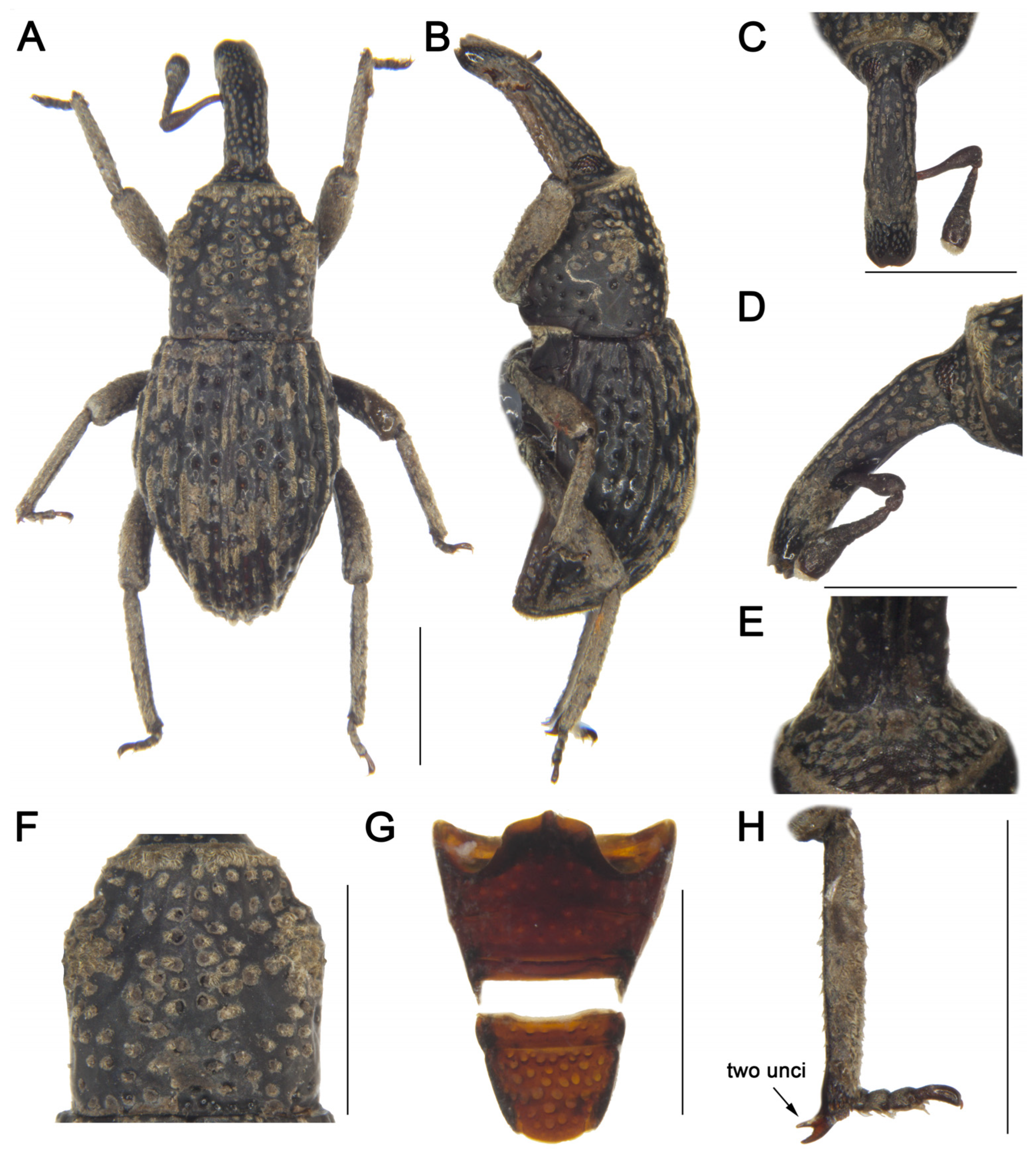
- Comparative diagnosis. T. biunciatus sp. nov. is a very peculiar species characterized by male protibia and mesotibia with two unci, which cannot be confused with any other species of the genus. Besides this character, its morphology is most similar to T. ocellatus Lü & Zhang, 2025, but differs in the following characters: (I) rostrum subequal to pronotum (Rl/Pl 1.00) (vs. rostrum shorter than pronotum (Rl/Pl 0.73) in T. ocellatus); (II) posterior margin of pronotum truncate (vs. convex at middle in T. ocellatus); (III) elytra widest at middle, pilose pustules not forming distinct pattern (vs. elytra widest at basal 1/4, pilose pustules forming indistinct V-shaped pattern in T. ocellatus); (IV) posterior margin of ventrite 5 convex (vs. deeply emarginate in T. ocellatus).
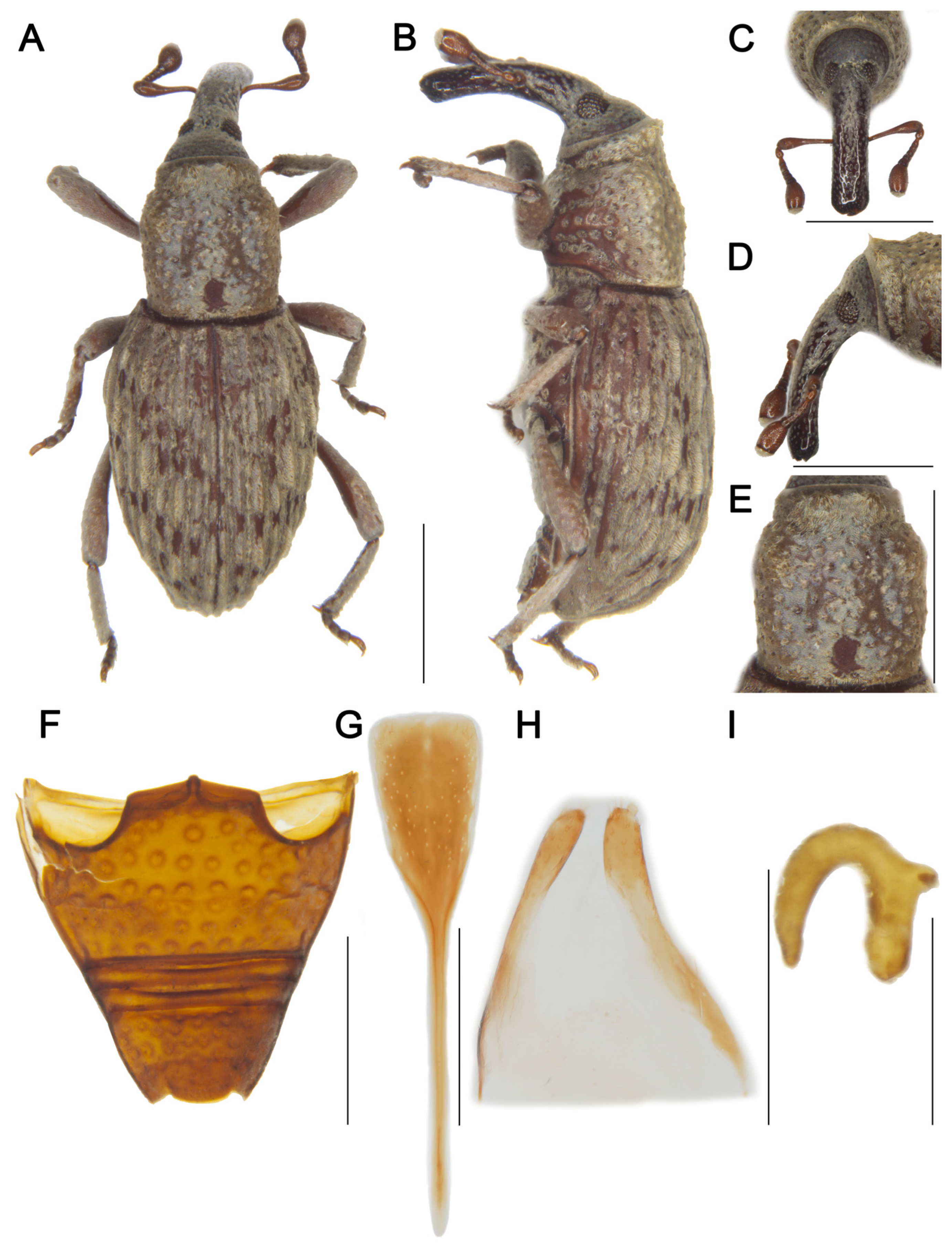
- Description. Coloration (Figure 2A,B). Body entirely black; antennal scape, funicle, tarsomeres, and claws reddish brown.
- Head (Figure 2C–E). Forehead concave, narrower than rostrum; eyes oval, length shorter than longest side of antennal club, barely visible ventrally; rostrum long (Rl/Rw 3.42), subequal to pronotum in length (Rl/Pl 1.00), slightly curved in lateral view, base thick, from base to apical 1/5 with short pubescence and coarse punctures, apex smooth and shiny; antennae inserted slightly anterior to middle of rostrum; scape long (l/w 3.95), not reaching eyes, gradually broadening from base to apex, widest at apex; funicular segment 1 longer than wide, segment 2 funnel-shaped, segments 3–6 transverse; club subconical (l/w 1.65).
- Pronotum (Figure 2F). Nearly cylindrical, longer than wide (Pl/Pw 1.04), widest posterior to middle, apical 1/6 distinctly constricted, gradually narrowed from apical 1/4 to base; disc slightly convex in lateral view; densely covered with punctures, particularly concentrated on central disc and lateral areas; postocular lobes absent.
- Scutellum. Very small, elongate-oval.
- Elytra. Longer than wide (El/Ew 1.43), widest at middle, strongly narrowed from middle to apex, lacking constriction; disc slightly convex in lateral view; interstriae distinctly convex, subequal in width, with interrupted pilose pustules; striae deep, punctures rounded, with dense, short pubescence; distance between punctures slightly exceeding puncture diameter.
- Abdomen (Figure 2G). Abdominal ventrites covered with coarse punctures; distance between punctures exceeding puncture diameter on ventrites 1–4; punctures on ventrite 5 coarser than on others, distance between punctures smaller than puncture diameter; anterior margin of ventrite 2 slightly convex at middle, posterior margins of ventrites 3 and 4 rectilinear; ventrite 2 0.64 times length of ventrite 1, ventrite 4 slightly longer than ventrite 3, ventrite 5 convex, 1.5 times as wide as long.
- Legs. Densely covered with short pubescence; femora and tibiae with punctures; procoxae subconical, contiguous; mesocoxae narrowly separated; profemur more robust than mesofemur and metafemur, femora unarmed; protibiae and mesotibiae each bearing two adjacent apical unci (Figure 2H), metatibia with single long uncus; profemur 3.6 times as long as wide; protibia 6.9 times as long as wide; tarsi long, tarsomeres 1–3 obconical, ventrally with dense erect setae, onychium elongate; claws free, divergent.
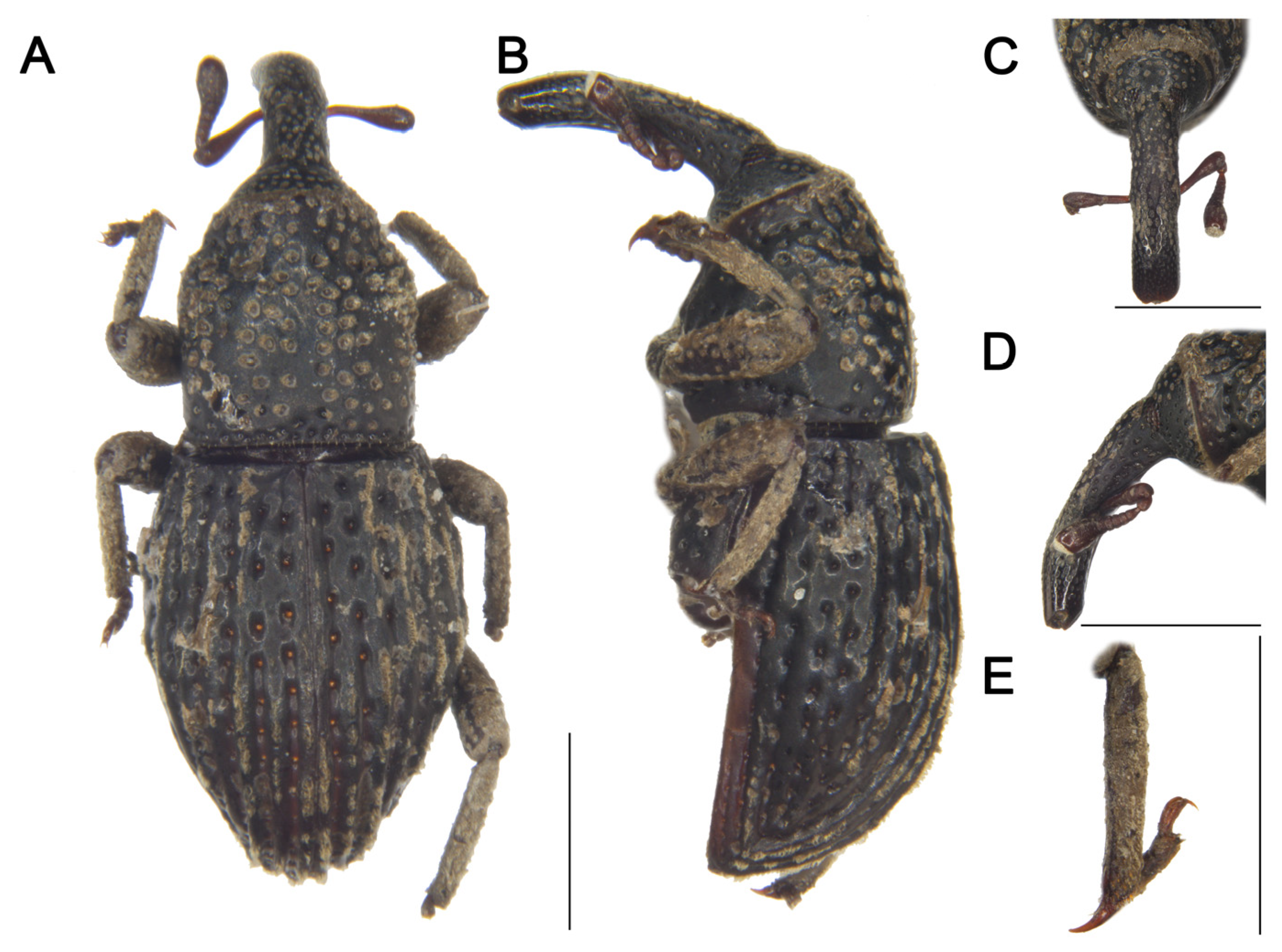
- Female (Figure 3A–E). Body larger than that of male; rostrum slightly shorter than pronotum, from apical 1/3 to apex smooth and shiny, antennae inserted at middle of rostrum; interrupted pilose pustules on elytral interstriae 1 and 2 sparser than those of male; protibiae, mesotibiae and metatibiae each bearing only single long uncus.
- Measurement (in mm). Holotype. Bl: 3.60. Rl: 1.20, Rw: 0.35. Pl: 1.20, Pw: 1.15. El: 2.20, Ew: 1.53. Male paratypes. (n = 2): Bl: 3.48–3.58 (3.53). Rl: 1.2, Rw: 0.35–0.38 (0.37). Pl: 1.2, Pw: 1.10–1.17 (1.14). El: 2.00–2.20 (2.10), Ew: 1.50–1.52 (1.51). Female paratype. Bl: 3.70. Rl: 1.32, Rw: 0.42. Pl: 1.35, Pw: 1.32. El: 2.25, Ew: 1.60.
- Distribution. Known only from Yunnan, China.
- Etymology. The species name is a Latin masculine adjective biunciatus, referring to the male tibiae bearing two unci compared to other species within the genus.
3.2.3. Tasactes liangi Lü & Zhang sp. nov.
- LSIDurn:lsid:zoobank.org:act:13DF0B1A-059C-4361-BAD2-1D30840D485C
- Material examined. Holotype: 1♀, China, Yunnan, Diqing Tibetan Autonomous Prefecture, Gongshan County, Cikai Town, Gazu Station, 27.7431° N, 98.6047° E, elev. 1500 m, 04/V/2002, Hongbin Liang & Weidong Ba leg. IOZ(E)1965838.
- Comparative diagnosis.T. liangi sp. nov. resembles T. pilosus Lü & Zhang, 2025 but differs in the following characters: (I) rostrum more curved (see Lü and Zhang [22]: figure 7D vs. Figure 4D); (II) pronotum widest at apical 1/3, lacking pilose pustule (vs. widest at middle, bearing median longitudinal pilose pustule in T. pilosus); (III) elytral pustules hemispherical in lateral view, sparsely distributed (vs. linear in lateral view, densely distributed in T. pilosus); (IV) styli width approximately 1/3 width of gonocoxite apices (vs. approximately 1/4 in T. pilosus).
- Description. Coloration (Figure 4A,B). Body entirely black; antennal scape, funicle, tarsomeres, and claws reddish brown.
- Head (Figure 4C–E). Forehead flat, slightly narrower than rostrum base width; eyes oval, length exceeding longest side of antennal club, barely visible ventrally; rostrum elongate (Rl/Rw 3.52), longer than pronotum (Rl/Pl 1.43), evenly curved in lateral view, from base to apical 1/6 with short pubescence, apex with dense punctures; antennae inserted slightly anterior to middle of rostrum; scape long (l/w 4.70), not reaching eyes, gradually broadening from base to apex, apical 1/3 markedly widened; funicular segments 1 and 2 elongate, segment 2 funnel-shaped, longer than segments 3+4 combined; segments 3–6 transverse; club subconical (l/w 1.86).
- Pronotum. Wider than long (Pl/Pw 0.97), widest at apical 1/3, apical 1/7 distinctly constricted, gradually narrowed from apical 1/3 to base, sides rounded; disc convex in lateral view; densely covered with punctures, particularly concentrated on central disc and lateral areas; postocular lobes weak.Scutellum. Small, subtriangular.
- Elytra. Longer than wide (El/Ew 1.42), widest at basal 1/4, apical 1/6 distinctly constricted, sides rounded; disc nearly flat in lateral view; interstriae distinctly convex, subequal in width, basally with small punctures distinctly smaller than strial punctures, interstriae with interrupted oval pilose pustules, mainly distributed from apical 1/3 to apex; striae deep, punctures rounded, bearing dense, short pubescence; distance between punctures slightly exceeding puncture diameter.
- Abdomen (Figure 4F). Abdominal ventrites densely covered with coarse punctures; ventrite 2 with anterior margin slightly convex at middle, posterior margins of ventrites 2–4 rectilinear; ventrite 2 0.7 times length of ventrite 1, ventrite 3 slightly longer than ventrite 4, ventrite 5 deeply emarginate, 2.1 times as wide as long.
- Legs. Densely covered with short pubescence; femora and tibiae with punctures; procoxae subconical, contiguous; profemur more robust than mesofemur and metafemur, femora unarmed; profemur 3.9 times as long as wide; tibiae bearing single long uncus; protibia 5.9 times as long as wide; tarsi long, tarsomeres 1–3 obconical, ventrally with setae, onychium elongate; claws free, divergent.
- Sternite 8 and genitalia (Figure 4G–I). Sternite 8 with apodeme 0.9 times length of lamina; lamina bifurcate at base, sides curved, apex with sparse setae; gonocoxites cylindrical, apices with setae; styli short, cylindrical, width approximately 1/3 width of gonocoxite apices, apices with short setae; spermatheca with curved, apically rounded cornu; corpus robust; ramus and collum weakly developed.
- Male. unknown.
- Measurement (in mm). Holotype. Bl: 5.22. Rl: 2.00, Rw: 0.43. Pl: 1.75, Pw: 1.80. El: 3.28, Ew: 2.31.
- Distribution. Known only from the type locality in Yunnan, China.
- Etymology. This species is named after the professor of the Institute of Zoology, Chinese Academy of Sciences in China and also the collector of the type specimens, Dr. Hongbin Liang. The specific name is a noun in apposition.
3.2.4. Tasactes sulcatus Lü & Zhang sp. nov.
- LSIDurn:lsid:zoobank.org:act:893E4281-1547-4C44-8A8A-C44700912287
- Material examined. Holotype: 1♂, China, Xizang, Linzhi City, Mêdog County, Beibeng Township, Doxong Pass, Lage hotel, 29.4675° N, 95.00232° E, elev. 3210 m, 07/VIII/2006, Hongbin Liang leg. IOZ(E)1965835. Paratypes: 12♀, same data as holotype, IOZ(E)1965728, 1965729, 1965827–1965834, 1965836, 1965837.
- Comparative diagnosis.T. sulcatus sp. nov. is most similar to T. ocellatus, which is also distributed in Mêdog County, but differs in the following characters: (I) eyes distinctly visible in ventral view (vs. barely visible in T. ocellatus); (II) pronotum widest at apical 1/3, spaces between punctures with pubescence, with sulci laterally to middle (vs. widest at middle, interpuncture spaces smooth, lacking sulci in T. ocellatus); (III) scutellum invisible (vs. visible in T. ocellatus); (IV) elytra with dense pubescence (vs. sparse in T. ocellatus); (V) pedon long, 0.6 times length of temones (vs. pedon short, 0.3 times length of temones in T. ocellatus); (VI) lamina of sternite 8 truncate, not bifurcate at base (vs. bifurcate at base, sides curved and depressed in T. ocellatus); (VII) styli width approximately 1/3 width of gonocoxite apices, ramus of spermatheca weakly developed (vs. approximately 1/4 width of gonocoxite apices, ramus well developed in T. ocellatus).
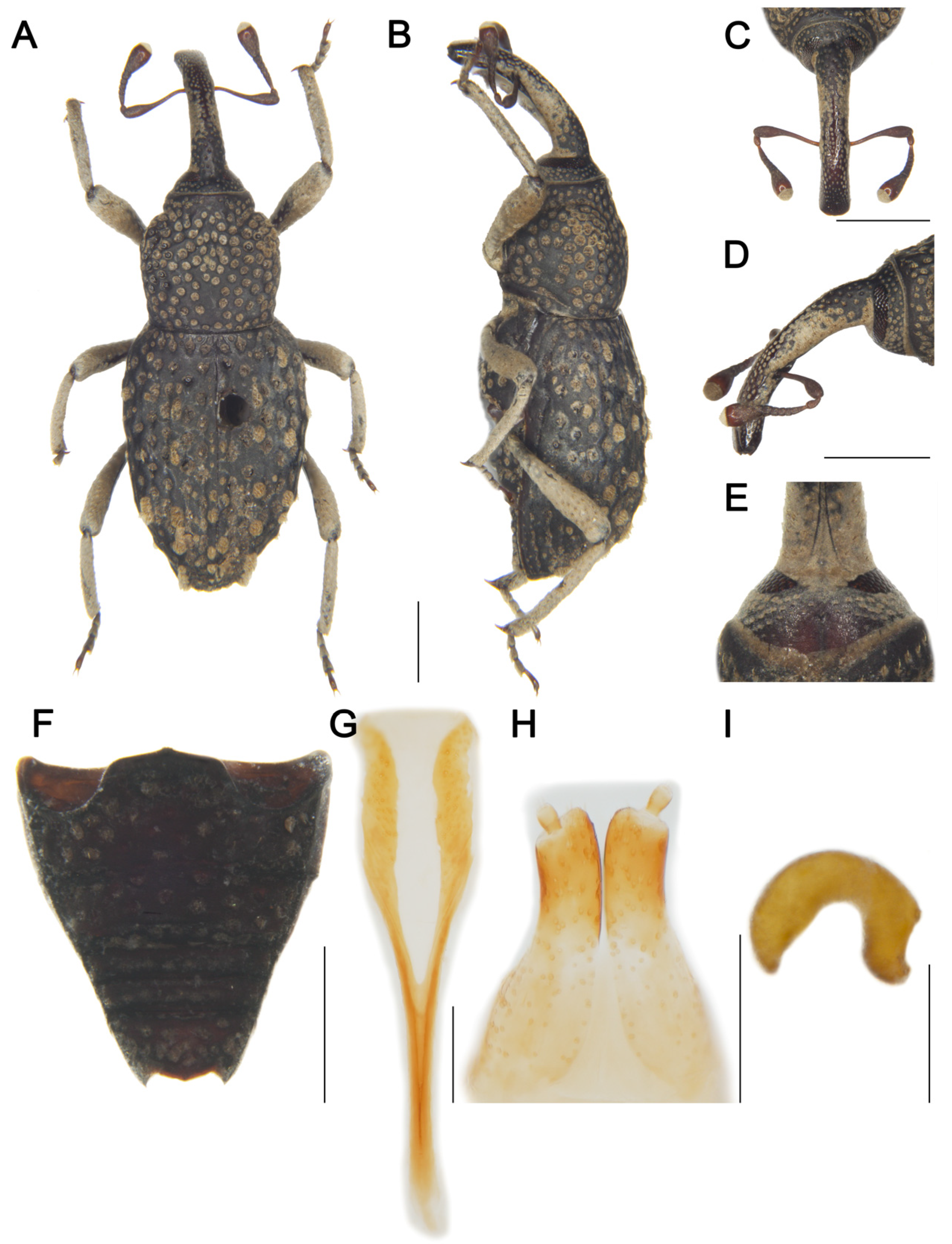
- Description. Coloration (Figure 5A,B). Body entirely black; antennal scape, funicle, tarsomeres, and claws reddish brown.
- Head (Figure 5C–E). Forehead flat, slightly narrower than rostrum base width; eyes oval, shorter than longest side of antennal club, distinctly separated ventrally; rostrum elongate (Rl/Rw 3.52), shorter than pronotum (Rl/Pl 0.90), evenly curved in lateral view, from base to apical 1/3 with short pubescence, apex with dense punctures; antennae inserted slightly anterior to middle of rostrum; scape long (l/w 4.00), not reaching eyes, gradually broadening from base to apex, apical 1/3 markedly widened; funicular segments 1 and 2 elongate, segment 2 funnel-shaped, subequal in length to segments 3+4 combined; segments 3–6 transverse; club subconical (l/w 1.80).
- Pronotum (Figure 5F). Longer than wide (Pl/Pw 1.15), widest at apical 1/3, apical 1/6 distinctly constricted, gradually narrowed from apical 1/4 to base; disc slightly convex in lateral view, with dense and coarse punctures; distance between punctures subequal to puncture diameter, apical with two clusters of pilose pustules; with one broad oval sulcus on each side of the middle; postocular lobes absent.
- Scutellum. Small, invisible.
- Elytra. Longer than wide (El/Ew 1.46), widest at basal 1/4, apical 1/5 distinctly constricted, sides rounded; disc nearly flat in lateral view; interstriae and striae with dense short pubescence; interstriae distinctly convex, subequal in width, with interrupted pilose pustules; striae deep, punctures rounded, distance between punctures slightly less than puncture diameter.
- Abdomen (Figure 5G). Abdominal ventrites densely covered with coarse punctures; ventrite 2 with anterior margin slightly convex at middle, posterior margins of ventrites 2–4 rectilinear; ventrite 2 0.6 times length of ventrite 1, ventrites 3 and 4 subequal in length, ventrite 5 deeply emarginate, 2.0 times as wide as long.
- Legs. Densely covered with short pubescence; femora and tibiae with punctures; procoxae subconical, contiguous; profemur more robust than mesofemur and metafemur, femora unarmed; profemur 3.7 times as long as wide; tibiae bearing single long uncus; protibia 6.6 times as long as wide; tarsi long, tarsomeres 1–3 obconical, ventrally with setae, onychium elongate; claws free, divergent.
- Male genitalia (Figure 5H–K). Pedon 0.6 times length of temones, evenly curved in lateral view, sides subparallel, base symmetrical, apex distinctly narrowed; temones slender, slightly curved; manubrium of tegmen long, 0.9 times length of temones, slightly curved, subequal in width to temones; spiculum gastrale evenly curved, widest at middle; basal plate bifurcate, basal arms slender, opposed, apices acute.
- Female (Figure 6A–I). Body larger than in male, some individuals with lighter, reddish-brown body coloration; rostrum more longer than in male; antennae inserted at middle of rostrum; sternite 8 with apodeme 1.7 times length of lamina; lamina truncatum, not bifurcate at base, apex with short setae; gonocoxites cylindrical, apices with long setae; styli short, cylindrical, width approximately 1/3 width of gonocoxite apices, apices with short setae; spermatheca with curved, apically rounded cornu; corpus robust; ramus longer than collum.
- Measurement (in mm). Holotype. Bl: 3.00. Rl: 0.88, Rw: 0.25. Pl: 0.98, Pw: 0.85. El: 1.90, Ew: 1.30. Female paratypes. (n = 12): Bl: 3.40–3.83 (3.65). Rl: 1.00–1.06 (1.02), Rw: 0.30–0.35 (0.31). Pl: 1.10–1.22 (1.15), Pw: 0.95–1.04 (1.04). El: 2.15–2.40 (2.26), Ew: 1.38–1.60 (1.42).Distribution. Known only from the type locality in Xizang, China.
- Etymology. The species name is a Latin masculine adjective sulcatus, referring to the pronotum with broad oval sulci compared to other species within the genus.
3.3. Allaeotes Pascoe, 1885
- Type species. Allaeotes griseus Pascoe, by original designation.
- Distribution. China, Cuba, Japan, Indonesia, Vietnam.
Allaeotes niger He, Zhang & Pelsue, 2003
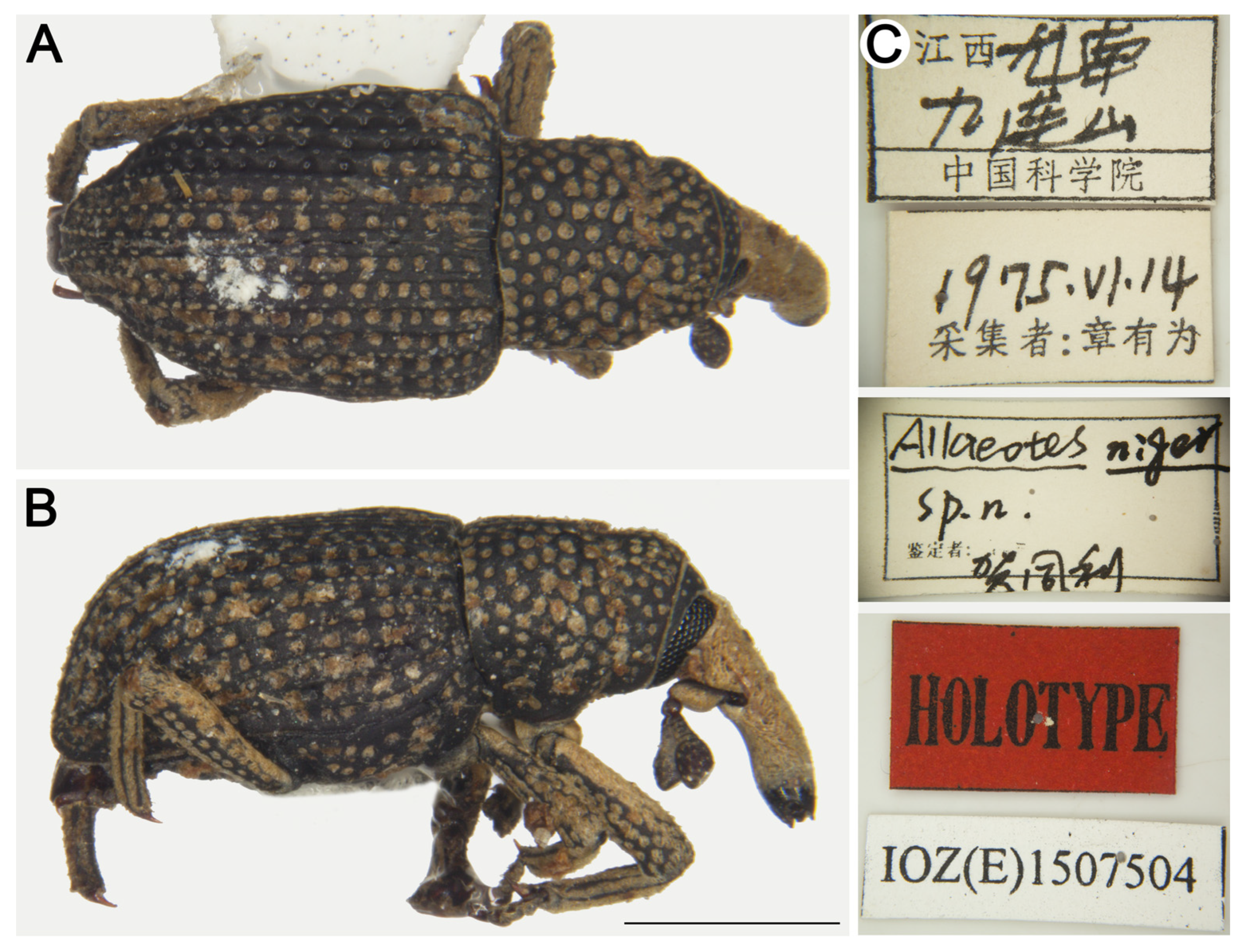
- Type material examined. Holotype: 1♂, China, Jiangxi, Longnan County, Jiulian Mountain, 14/VI/1975, Youwei Zhang leg. IOZ(E)1507504. Paratypes: 1♀, same data as holotype, IOZ(E)1507505; 1♀, Zhejiang, Hangzhou City, 12/VI/1954, collector unknown, IOZ(E)1507506; 1♀, Fujian, Fuan City, Shekou, 22/VI/1955, collector unknown, IOZ(E)1507507; 18♂12♀, Guangdong, Guangzhou City, 05/IV/1954, Keren Huang leg. IOZ(E)1507508–1507525 (some numbers correspond to multiple individuals).Additional material examined. 1♂, China, Hong Kong, collector unknown, IOZ(E)1965723; 3♂4♀, Guangxi, Laibin City, Jinxiuyaozu Autonomous County, Huawang Villa, elev. 600 m, 20/V/1999, Fusheng Huang leg. IOZ(E)1965724–1965727, 1965731–1965733.
- Remarks. He et al. [27] distinguished this species from A. griseus. Based on examination of the type specimen and syntype images from Grebennikov [12], we document additional diagnostic characters differentiating A. niger from A. griseus: (I) head with distance between punctures smooth (vs. dense short pubescence in A. griseus); (II) rostrum slightly curved (Figure 7B) (vs. strongly curved at apical 1/3 in A. griseus; see Grebennikov [12]: figure 3H); (III) pronotum constricted at apical 1/3, with dense coarse punctures and and spaces between punctures smooth (vs. constricted at apical 1/5, with dense small punctures and spaces between punctures with short pubescence in A. griseus); (IV) elytral interstriae lacking interrupted pilose pustules (vs. interrupted pilose pustules in A. griseus). It is further distinguished from A. sklodowskii Legalov, 2021 by: (I) antennal club shorter and stouter (l/w 1.33 vs. l/w 1.50 in A. sklodowskii); (II) pronotal lacking median carina (vs. weak median carina in A. sklodowskii); (III) scutellum spindle-shaped (vs. triangular in A. sklodowskii); (IV) elytral interstriae lacking interrupted pilose pustules (vs. interrupted pilose pustules in A. sklodowskii).
3.4. Synommatoides Morimoto, 1978
- Type species. Synommatoides shirozui Morimoto, by original designation.
- Distribution. China, Japan, Korea.
Synommatoides scutellatus He, Zhang & Pelsue, 2003
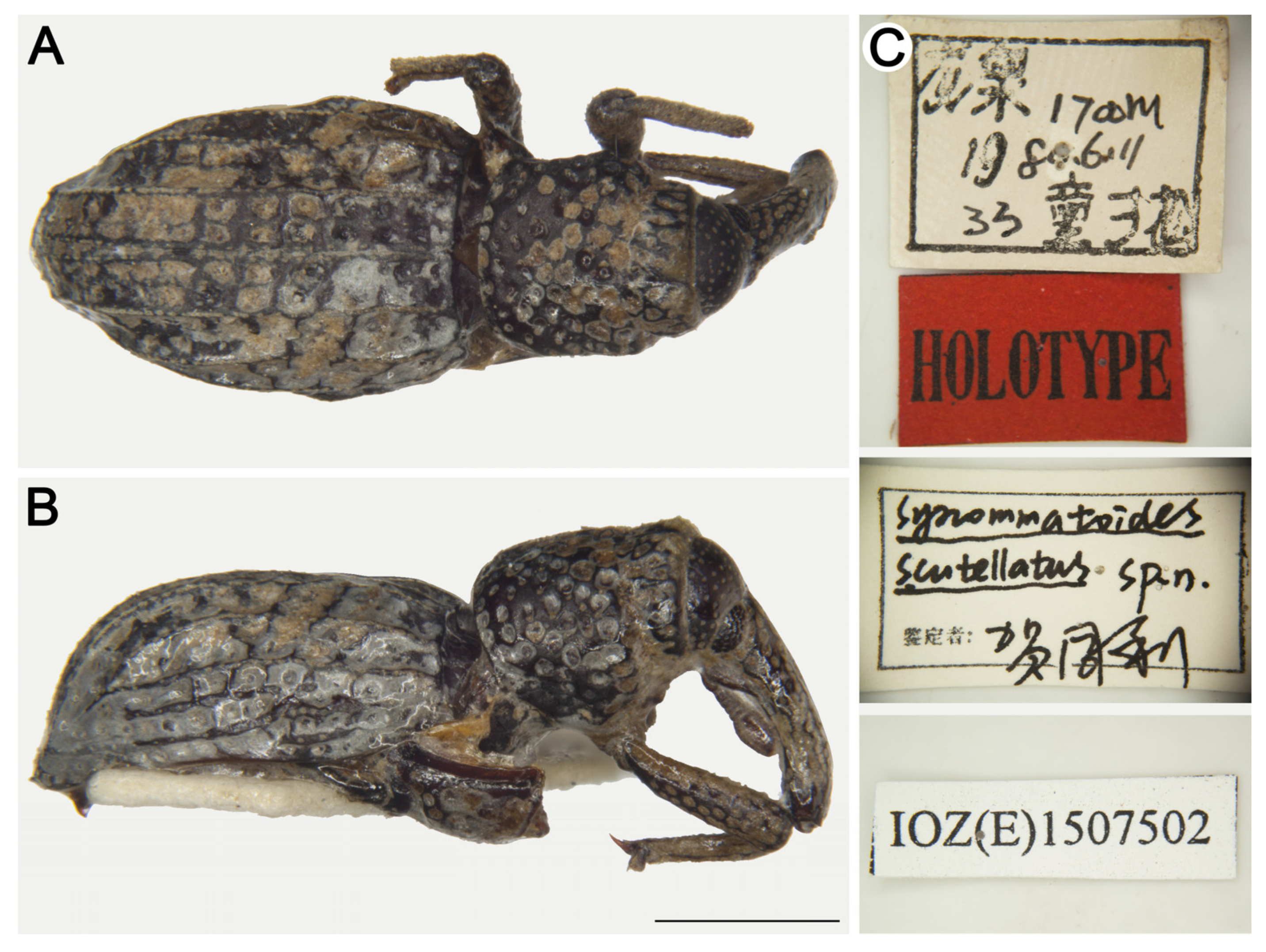
- Type material examined. Holotype: 1♀, China, Zhejiang, Lishui City, Longquan County, Fengyang Mountain, elev. 1700 m, 11/VI/1980, Xuesong Tong leg. IOZ(E)1507502. Paratype: 1♂, same data as holotype, IOZ(E)1507503.
- Remarks. He et al. [26] distinguished this species from S. shirozui by the following characters: scutellum present and tiny; apical margin of pronotum punctate with two pilose pustules; antennae stout and more compact. These characters are not diagnostic, as the apical margin of the pronotum in S. shirozui also bears two pilose pustules. Based on the present study of the type specimen of S. scutellatus and the holotype images of S. shirozui from Grebennikov [7], we identify the following reliable characters to distinguish the two species: (I) pronotum not rugose-punctate (vs. rugose-punctate in S. shirozui); (II) odd elytral interstriae with interrupted pilose pustules, strial punctures very large, distance between punctures about 0.3 times a puncture diameter (vs. continuous pilose pustules, strial punctures large, distance between punctures subequal to puncture diameter in S. shirozui).
4. Discussion
Author Contributions
Funding
Data Availability Statement
Acknowledgments
Conflicts of Interest
References
- Chamorro, M.L. An illustrated synoptic key and comparative morphology of the larvae of Dryophthorinae (Coleoptera, Curculionidae) genera with emphasis on the mouthparts. Diversity 2019, 11, 1–96. [Google Scholar] [CrossRef] [Scilit]
- Chamorro, M.L.; de Medeiros, B.A.S.; Farrell, B.D. First phylogenetic analysis of Dryophthorinae (Coleoptera, Curculionidae) based on structural alignment of ribosomal DNA reveals Cenozoic diversification. Ecol. Evol. 2021, 11, 1984–1998. [Google Scholar] [CrossRef] [Scilit]
- Marvaldi, A.E.; Duckett, C.N.; Kjer, K.M.; Gillespie, J.J. Structural alignment of 18S and 28S rDNA sequences provides in sights into phylogeny of Phytophaga (Coleoptera: Curculionoidea and Chrysomeloidea). Zool. Scr. 2009, 38, 63–77. [Google Scholar] [CrossRef] [Scilit]
- Oberprieler, R.G.; Marvaldi, A.E.; Anderson, R.S. Weevils, weevils, weevils everywhere. Zootaxa 2007, 1668, 491–520. [Google Scholar] [CrossRef] [Scilit]
- Alonso-Zarazaga, M.A.; Lyal, C.H.C. A World Catalogue of Families and Genera of Curculionoidea (Insecta: Coleoptera) (Excepting Scolytidae and Platypodidae); Entomopraxis: Barcelona, Spain, 1999. [Google Scholar]
- Anderson, A.S.; Marvaldi, A.E. Dryophthorinae Schoenherr, 1825. In Handbook of Zoology. Arthropoda: Insecta: Coleoptera; Leschen, R.A.B., Beutel, R.G., Eds.; De Gruyter: Berlin, Germany; München, Germany; Boston, MA, USA, 2014; pp. 477–483. [Google Scholar]
- Grebennikov, V.V. Dryophthorinae weevils (Coleoptera: Curculionidae) of the forest floor in Southeast Asia: Illustrated overview of nominal Stromboscerini genera. Zootaxa 2018, 4418, 121–135. [Google Scholar] [CrossRef] [Scilit]
- Legalov, A.A. A new species of the genus Tasactes Faust, 1894 (Coleoptera, Curculionidae) from Nepal. Ecol. Montenegrina 2021, 40, 128–132. [Google Scholar] [CrossRef] [Scilit]
- Grebennikov, V.V. Dryophthorinae weevils (Coleoptera: Curculionidae) of the forest floor in Southeast Asia: Three-marker analysis reveals monophyly of Asian Stromboscerini and new identity of rediscovered Tasactes. Eur. J. Entomol. 2018, 115, 437–444. [Google Scholar] [CrossRef] [Scilit]
- Gunter, N.L.; Oberprieler, R.G.; Cameron, S.L. Molecular phylogenetics of Australian weevils (Coleoptera: Curculionoidea): Exploring relationships in a hyperdiverse lineage through comparison of independent analyses. Austral Entomol. 2016, 55, 217–233. [Google Scholar] [CrossRef] [Scilit]
- Grebennikov, V.V. Dryophthorinae weevils (Coleoptera: Curculionidae) of the forest floor in Southeast Asia: DNA analysis of two new Nephius from Vietnam and Taiwan suggests non-monophyly of Stromboscerini. Zootaxa 2018, 4500, 381–387. [Google Scholar] [CrossRef] [Scilit]
- Grebennikov, V.V. Allaeotes niger, a weevil introduced to Cuba and the only known New World Stromboscerini (Coleoptera: Curculionidae: Dryophthorinae). Zootaxa 2020, 4803, 495–504. [Google Scholar] [CrossRef] [Scilit] [PubMed]
- Legalov, A.A. A new species of the genus Orthosinus Motschulsky, 1863 (Coleoptera, Curculionidae) from Laos. Ecol. Montenegrina 2021, 46, 80–83. [Google Scholar] [CrossRef] [Scilit]
- Legalov, A.A. A new species of the genus Nephius Pascoe, 1885 (Coleoptera, Curculionidae) from Indonesia. Ecol. Montenegrina 2021, 47, 33–36. [Google Scholar] [CrossRef] [Scilit]
- Legalov, A.A. A new species of the genus Allaeotes Pascoe, 1885 (Coleoptera, Curculionidae) from Philippines. Balt. J. Coleopterol. 2021, 21, 25–29. [Google Scholar] [CrossRef]
- Legalov, A.A. A new species of the genus Dexipeus Pascoe, 1885 (Coleoptera, Curculionidae) from the Philippines. Balt. J. Coleopterol. 2021, 21, 175–180. [Google Scholar] [CrossRef]
- Legalov, A.A. Orthosinus laosensis Legalov, a new species of the tribe Strombocerini (Coleoptera: Curculionidae) from North-eastern Laos. Ecol. Montenegrin 2022, 51, 15–18. [Google Scholar] [CrossRef] [Scilit]
- Legalov, A.A. A new species of the genus Synommatus Wollaston, 1873 (Coleoptera: Curculionidae) from the Philippines. Far East. Entomol. 2022, 462, 1–7. [Google Scholar] [CrossRef] [Scilit]
- Legalov, A.A. Four new species of the genera Dryophthoroides Roelofs, 1879 and Nephius Pascoe, 1885 (Coleoptera, Curculionidae) from Oriental and Papuan Regions. Ecol. Montenegrin 2022, 58, 42–49. [Google Scholar] [CrossRef] [Scilit]
- Legalov, A.A. The first record of the genus Orthosinus Motschulsky, 1863 (Coleoptera: Curculionidae) from Nepal. Far East. Entomol. 2023, 474, 7–10. [Google Scholar] [CrossRef] [Scilit]
- Alonso-Zarazaga, M.A.; Barrios, H.; Borovec, R.; Bouchard, P.; Caldara, R.; Colonnelli, E.; Gültekin, L.; Hlaváč, P.; Korotyaev, B.; Lyal, C.H.C.; et al. Cooperative catalogue of palaearctic Coleoptera Curculionoidea. Monogr. Electrón. SEA 2017, 8, 1–729. [Google Scholar]
- Lü, H.Y.; Zhang, R.Z. Four new species of the genus Tasactes Faust, 1894 (Coleoptera, Curculionidae, Dryophthorinae) from China. ZooKeys 2025, 1256, 141–161. [Google Scholar] [CrossRef] [Scilit]
- Voss, E. Über einige in Fukien (China) gesammelte Rüssler. IV. Entomol. Blätter 1953, 49, 42–82. [Google Scholar]
- Voss, E. Ein Beitrag zur Kenntnis der Curculioniden im Grenzgebiet der Orientalischen zur Paläarktischen Region (Col., Curc). Die von J. Klapperich und Tschung Sen in der Provinz Fukien gesammelten Rüsselkäfer. (132. Веіtrag zur Kenntnis der Curculioniden). Decheniana 1958, 5, 1–139. [Google Scholar]
- He, T.L. Systematic Study of the Subfamily Dryophthorinae in China (Coleoptera: Curculionidae). Ph.D. Thesis, University of Chinese Academy of Sciences, Beijing, China, 2001. [Google Scholar]
- He, T.L.; Zhang, R.Z.; Pelsue, F.W. A new species of the genus Synommatoides Morimoto from China (Coleoptera: Curculionidae: Dryophthorinae). Coleopt. Bull. 2003, 57, 123–126. [Google Scholar] [CrossRef] [Scilit]
- He, T.L.; Zhang, R.Z.; Pelsue, F.W. A new species of the genus Allaeotes Pascoe from China (Coleoptera: Curculionidae: Dryophthorinae). Coleopt. Bull. 2003, 57, 127–131. [Google Scholar] [CrossRef] [Scilit]
- Pascoe, F.P. List of the Curculionidae of the Malay Archipelago collected by Dr. Odoardo Beccari, L.M. D’Albertis, and others. Ann. Mus. Civ. Storia Nat. Genova 1885, 2, 201–332. [Google Scholar]
- Lyal, C.H.C. Dryophthoridae, new acts and comments. In Catalogue of Palaearctic Coleoptera. Volume 7. Curculionoidea I.; Löbl, I., Smetana, A., Eds.; Apollo Books: Stenstrup, Denmark, 2011; pp. 84–85. [Google Scholar]
- Morimoto, K. Check-list of the family Rhynchophoridae (Coleoptera) of Japan, with descriptions of a new genus and five new species. Esakia 1978, 12, 103–118. [Google Scholar] [CrossRef] [Scilit] [PubMed]
- Morimoto, K. Supplement to the check-list of the family Rhynchophoridae (Coleoptera) of Japan, with descriptions of a new genus and four new species. Esakia 1985, 23, 67–76. [Google Scholar] [CrossRef] [Scilit]
- Faust, J. Viaggio di Leonardo Fea in Birmania e regioni vicine. LX, Curculionidae. Ann. Mus. Civ. Storia Nat. Genova 1894, 34, 153–370. [Google Scholar]
- Oberprieler, R.G.; Anderson, R.S.; Marvaldi, A.E. 3. Curculionoidea Latreille, 1802: Introduction, phylogeny. In Handbook of Zoology, Arthropoda: Insecta; Coleoptera, Beetles. Volume 3 Morphology and Systematics (Phytophaga); Leschen, R.A.B., Beutel, R.G., Eds.; De Gruyter: Berlin, Germany, 2014; pp. 285–300. [Google Scholar] [CrossRef] [Scilit]
- Girón, J.C.; Chamorro, M.L. Variability and distribution of the golden-headed weevil Compsus auricephalus (Say) (Curculionidae: Entiminae: Eustylini). Biodivers. Data J. 2020, 8, e55474. [Google Scholar] [CrossRef] [Scilit]
- Lyal, C.H.C. Dryophthoridae. In Catalogue of Palaearctic Coleoptera. Volume 7. Curculionoidea I.; Löbl, I., Smetana, A., Eds.; Apollo Books: Stenstrup, Denmark, 2011; pp. 185–192. [Google Scholar]
- Kojima, H.; Fujisawa, Y. First record of Allaeotes niger He, Zhang & Pelsue (Coleoptera, Dryophthoridae, Stromboscerinae) from Japan. Nodai Entomol. 2020, 2, 10–13. [Google Scholar]

Disclaimer/Publisher’s Note: The statements, opinions and data contained in all publications are solely those of the individual author(s) and contributor(s) and not of MDPI and/or the editor(s). MDPI and/or the editor(s) disclaim responsibility for any injury to people or property resulting from any ideas, methods, instructions or products referred to in the content. |
© 2025 by the authors. Licensee MDPI, Basel, Switzerland. This article is an open access article distributed under the terms and conditions of the Creative Commons Attribution (CC BY) license (https://creativecommons.org/licenses/by/4.0/).
Share and Cite
Lü, H.; Zhang, R. Four New Species and One New Record of Stromboscerini (Coleoptera, Curculionidae, Dryophthorinae) from China. Insects 2025, 16, 1211. https://doi.org/10.3390/insects16121211
Lü H, Zhang R. Four New Species and One New Record of Stromboscerini (Coleoptera, Curculionidae, Dryophthorinae) from China. Insects. 2025; 16(12):1211. https://doi.org/10.3390/insects16121211
Chicago/Turabian StyleLü, Heyu, and Runzhi Zhang. 2025. "Four New Species and One New Record of Stromboscerini (Coleoptera, Curculionidae, Dryophthorinae) from China" Insects 16, no. 12: 1211. https://doi.org/10.3390/insects16121211
APA StyleLü, H., & Zhang, R. (2025). Four New Species and One New Record of Stromboscerini (Coleoptera, Curculionidae, Dryophthorinae) from China. Insects, 16(12), 1211. https://doi.org/10.3390/insects16121211