


Developing Consensus Standard Operating Procedures (SOPs) to Evaluate New Types of Insecticide-Treated Nets
 , ,
, ,  ,
,  , ,
, , 
Abstract
:Simple Summary
Abstract
1. Introduction
2. Materials and Methods
3. Case Study 1: ITNs Containing Pyrethroid plus Piperonyl Butoxide (Pyrethroid + PBO Nets)
3.1. Other Methodological Considerations Identified
- Date, temperature, relative humidity, test species/strain (including resistance profiles), and mosquito age (days) should always be recorded.
- Time of testing and light–dark cycle of test mosquitoes should be recorded.
- Nets and mosquitoes should be acclimatized to the temperature and humidity of the testing room for a minimum of 1 h before testing. This is critical if nets have been stored in a refrigerator or cold room.
- For mosquitoes collected as larvae from the field, details on the collection procedure, such as the number and distribution of collection sites, and mosquito-rearing conditions, should be recorded.
- Some pyrethroid + PBO nets have different pyrethroid concentrations on the sides and the roof and this should be considered in the data recording and interpretation. Therefore, it is important that net pieces are well labelled to establish if the sample is from the roof or sides, and data should be recorded per net piece. Though analysis should be pooled for each net for interpretation, having the data disaggregated in this way will allow for further interrogation of the data if required.
3.2. Changes Made to the Proposed Pyrethroid + PBO Methods following Stakeholder Discussions
- It was decided that it was clearer to structure the SOP based on net panel type (i.e., a pyrethroid-only net panel), rather than describe testing based on nets with ‘PBO all over’ vs. ‘PBO mosaic net’ (PBO on the roof only). This structuring should allow adaptation to ITNs that may be developed in the future with different net panel configurations.
- Number of pieces sampled from each net: WHO biological durability monitoring [6] for pyrethroid-only nets recommended sampling one piece from the net roof and three–four pieces from the sides (four–five total). Our original proposal for pyrethroid + PBO nets was to sample three pieces from the roof and three from the sides (six total). The decision to test more roof samples was based on research which has shown greater mosquito activity on the net roof [9,10,11], the acknowledgement that some pyrethroid + PBO nets have different physio-chemical properties on the net roof, and that, during their manufacture, roof panels come from different net runs than side panels [12]. However, weighing up the benefits of a more precise measurement of intra-net heterogeneity by using six replicates per net against the challenge of evaluating large cohorts of ITNs with high numbers of mosquitoes per net, it was decided that the key measurement was the estimated bioefficacy of a cohort of ITNs. Therefore, it is important to be able to evaluate as many ITNs as possible (as nets have a high degree of heterogeneity due to different variability in use and care) while balancing this against the requirement for mosquitoes. Four samples per net (two from the roof, two from the sides) will allow the maximal numbers of samples to be tested without putting undue strain on testing facilities.
- Replicates: The original proposal was four replicates per net sample based on the WHOPES recommendations for pyrethroid-only nets [6]. However, this made the required mosquito numbers unfeasible. The consensus was that two replicates per net sample was sufficient. If mosquito numbers are abundant, testing should prioritize testing more nets (if available), as this will provide more precision. If additional nets are not available, surplus mosquitoes could be used to conduct more test replicates. After the consensus SOP was developed, a pre-print was published [13], which contained additional methods for the planned evaluation of the biological durability of PBO nets. The methods published in that report were compared to the draft consensus SOP and, methodologically, these were found to be largely the same, with some variability in sampling position and number of net samples/replicates.
- Testing should primarily use the WHO cone method specified in the consensus SOP (Additional File 2). A tunnel test may be used as a second test when nets fail to meet WHO thresholds (<95% 60-min knockdown or <80% 24-h mortality in a susceptible strain [6]), although this is not preferred. Currently, there are no recommended thresholds for resistant mosquito strains.
4. Case Study 2: ITNs Containing Pyrethroid plus Pyriproxyfen (Pyrethroid + PPF Nets)
Changes Made to the Proposed Methods following Stakeholder Discussions
- The option to score oviposition and then dissect those that did not lay was discounted. This would have meant dissections were being conducted on non-standardized days, making results incomparable to data collected using the standard dissection method, and likely resulting in a small sample size for that subset. For similar reasons, those which died before oviposition counts should not be dissected and scored.
- As we do not expect the pyrethroid to impact fertility, and we are using a pyrethroid-resistant strain, the untreated net is a useful negative control, and oviposition inhibition can be compared to this. Therefore, the decision was made not to include a pyrethroid-only net.
- Questions remain regarding the ‘net effectiveness threshold’ for sterility endpoints. For pyrethroid only nets, a net is considered effective if KD60 is >95% or 24-h mortality is >80% [6]. We do not yet know what an operationally meaningful level of sterility is, i.e., what level of sterility in a cone test means the net is controlling mosquitoes in the field. Hence, it is not yet possible to set a threshold for biological durability monitoring, and the best approach is to simply monitor for a reduction in sterilizing effect over time. However, this question is critical and should be considered as data is generated.
- When analyzing the results, the untreated net and the test net should be paired, i.e., a single control for the day acts as the benchmark for all tests on that day, and inhibition is calculated against that day’s control. Inhibition can be calculated by odds ratio using regressions.
- Following the development of the consensus SOP, a pre-print was published, which contained additional methods planned for evaluating biological durability of PPF nets [13]). These methods were compared to the drafted consensus SOP and found to be methodologically the same, apart from some variability in sampling position and number of net samples/replicates.
5. Case Study 3: ITNs Containing Pyrethroid plus Chlorfenapyr (Pyrethroid + CFP Nets)
Changes Made to the Proposed Pyrethroid + CFP Methods following Stakeholder Discussions
- Where tunnel testing is not possible, it would be beneficial to have an additional method available. It was established that S. Moore will be validating the I-ACT method [18] for IG2 testing, and K. Gleave will be validating the ‘Net in Tube’ (cylinder) test. When complete, we will include these SOPs with the tunnel-test methodology on the I2I website (https://innovationtoimpact.org/workstreams/methods-validation/). Accessed on 20 December 2021.
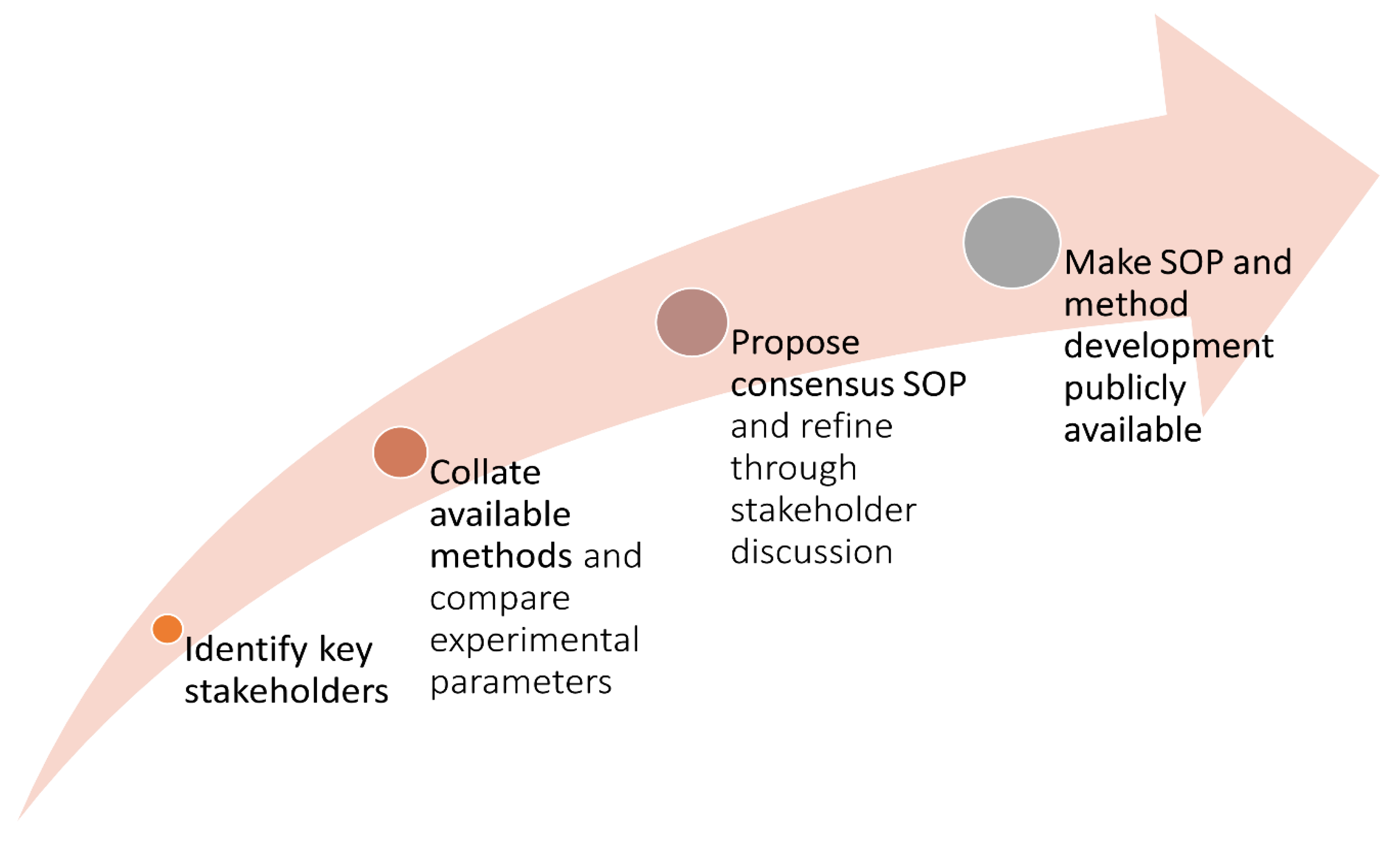
- Following a preliminary discussion with all stakeholders, a sub-group was formed with key individuals to start a draft proposal for the CFP methodology. In the initial meeting, representatives of BASF joined to share information on Interceptor G2. Following on from these discussions, a draft method development with methodological parameters for the tunnel test was shared with the sub-group, and this was refined before sharing with the full stakeholder group for approval.
- From a biological durability perspective, it was decided that it was not necessary to have a comparison to a new Interceptor net (IG1) and a new Interceptor G2 net (IG2) at every time point. Thus, these were removed as daily controls. Instead, the resistant strain should be characterized against the Ais in parallel with each round of bioassays, as recommended in Lees et al. (in prep), to investigate the additional effect of chlorfenapyr, and to confirm pyrethroid resistance and chlorfenapyr susceptibility to check that they have not drifted in the test strain during the test period.
- There is a lack of data on how mortality in tunnel tests changes with mosquito numbers (the standard is 100 mosquitoes in a tunnel). Reducing the sample to 50 mosquitoes per tunnel allows us to increase the sample pieces tested per net without increasing mosquito numbers. However, this also increases the risk of having to disregard testing results if high control mortality is observed—control mortality would still be based on 100 mosquitoes, but over two net replicates.
- Data comparing the use of 50 vs. 100 mosquitoes in tunnels with pyrethroid nets are available (Moore, Personal communication), and these data were considered to confirm the number of mosquitoes tested.
- Further to this, preliminary work to compare 50 vs. 100 mosquitoes in tunnels using Interceptor net and Interceptor G2 nets was conducted, and found no significant difference in these two numbers (Kamande, Personal communication).
- The number of mosquitoes required must be balanced against the number of replicates, since maximizing the number of nets, to measure efficacy of the ITN population, is key. There was some disagreement over which was the best balance. It is likely that the capacity to test more mosquitoes per net will be related to mosquito availability in the testing sites. Therefore, it is suggested we validate with the lower number to make the SOP less onerous for testing sites. We are interested in measuring the biological durability of the ITN population—not individual nets, which could be highly variable. Currently, the WHO recommends 30 nets per time point, but increasing this will provide better data. Thirty nets should be seen as the minimum. Reducing the number of mosquitoes may allow increases in replication to be possible.
- Control thresholds: blood-feeding must be >50% on the untreated control net. Mortality will be measured up to 72 h, due to the slow-acting nature of chlorfenapyr. Mortality in the untreated control must be <10% after 24 h and <20% at 72 h (both must be true for the test to be valid).
6. Discussion
Supplementary Materials
Author Contributions
Funding
Institutional Review Board Statement
Informed Consent Statement
Data Availability Statement
Acknowledgments
Conflicts of Interest
References
- WHO. World Malaria Report 2020: 20 Years of Global Progress and Challenges; World Health Organization: Geneva, Switzerland, 2020. [Google Scholar]
- Bhatt, S.; Weiss, D.J.; Cameron, E.; Bisanzio, D.; Mappin, B.; Dalrymple, U.; Battle, K.E.; Moyes, C.L.; Henry, A.; Eckhoff, P.A.; et al. The effect of malaria control on Plasmodium falciparum in Africa between 2000 and 2015. Nature 2015, 526, 207–211. [Google Scholar] [CrossRef] [PubMed] [Green Version]
- WHO. Prequalified Vector Control Products|WHO—Prequalification of Medical Products (IVDs, Medicines, Vaccines and Immunization Devices, Vector Control). 2020. Available online: https://extranet.who.int/pqweb/vector-control-products/prequalified-product-list (accessed on 2 August 2021).
- Hancock, P.A.; Hendriks, C.J.M.; Tangena, J.-A.; Gibson, H.; Hemingway, J.; Coleman, M.; Gething, P.W.; Cameron, E.; Bhatt, S.; Moyes, C.L. Mapping trends in insecticide resistance phenotypes in African malaria vectors. PLoS Biol. 2020, 18, e3000633. [Google Scholar] [CrossRef] [PubMed]
- Moyes, C.L.; Athinya, D.K.; Seethaler, T.; Battle, K.E.; Sinka, M.; Hadi, M.P.; Hemingway, J.; Coleman, M.; Hancock, P.A. Evaluating insecticide resistance across African districts to aid malaria control decisions. Proc. Natl. Acad. Sci. USA 2020, 117, 22042–22050. [Google Scholar] [CrossRef] [PubMed]
- WHO. Guidelines for Laboratory and Field-Testing of Long-Lasting Insecticidal Nets; World Health Organization: Geneva, Switzerland, 2013. [Google Scholar]
- WHO. WHO Malaria Policy Advisory Committee (MPAC) Meeting, Online, 13–14 May 2020. Available online: http://www.mesamalaria.org/sites/default/files/2020-06/mpac-report-may2020.pdf (accessed on 26 August 2021).
- WHO. WHO Guidance Note for Estimating the Longevity of Long-Lasting Insecticidal Nets in Malaria Control; World Health Organization: Geneva, Switzerland, 2013. [Google Scholar]
- Parker, J.E.A.; Angarita-Jaimes, N.; Abe, M.; Towers, C.E.; Towers, D.; McCall, P.J. Infrared video tracking of Anopheles gambiae at insecticide-treated bed nets reveals rapid decisive impact after brief localised net contact. Sci. Rep. 2015, 5, 13392. [Google Scholar] [CrossRef] [PubMed] [Green Version]
- Parker, J.E.A.; Angarita Jaimes, N.C.; Gleave, K.; Mashauri, F.; Abe, M.; Martine, J.; Towers, C.E.; Towers, D.; McCall, P.J. Host-seeking activity of a Tanzanian population of Anopheles arabiensis at an insecticide treated bed net. Malar. J. 2017, 16, 270. [Google Scholar] [CrossRef] [PubMed] [Green Version]
- Murray, G.P.D.; Lissenden, N.; Jones, J.; Voloshin, V.; Toé, K.H.; Sherrard-Smith, E.; Foster, G.M.; Churcher, T.S.; Parker, J.E.A.; Towers, C.E.; et al. Barrier bednets target malaria vectors and expand the range of usable insecticides. Nat. Microbiol. 2020, 5, 40–47. [Google Scholar] [CrossRef] [PubMed]
- Skovmand, O.; Dang, D.M.; Tran, T.Q.; Bossellman, R.; Moore, S.J. From the factory to the field: Considerations of product characteristics for insecticide-treated net (ITN) bioefficacy testing. Malar. J. 2021, 20, 363. [Google Scholar] [CrossRef] [PubMed]
- Martin, J.L.; Messenger, L.A.; Mosha, F.W.; Lukole, E.; Mosha, J.F.; Kulkarni, M.; Churcher, T.S.; Sherrard-Smith, E.; Manjurano, A.; Protopopoff, N.; et al. Durability of three types of dual active ingredient long-lasting insecticidal net compared. medRxiv 2021. [Google Scholar] [CrossRef]
- Ngufor, C.; Agbevo, A.; Fagbohoun, J.; Fongnikin, A.; Rowland, M. Efficacy of Royal Guard, a new alpha-cypermethrin and pyriproxyfen treated mosquito net, against pyrethroid-resistant malaria vectors. Sci. Rep. 2020, 10, 1–15. [Google Scholar] [CrossRef]
- Christophers, S. The development of the egg follicles in anophelines. Paludism 1911, 2, 73–88. [Google Scholar]
- Oxborough, R.M.; N’Guessan, R.; Jones, R.; Kitau, J.; Ngufor, C.; Malone, D.; Mosha, F.W.; Rowland, M.W. The activity of the pyrrole insecticide chlorfenapyr in mosquito bioassay: Towards a more rational testing and screening of non-neurotoxic insecticides for malaria vector control. Malar. J. 2015, 14, 124. [Google Scholar] [CrossRef] [PubMed] [Green Version]
- Balmert, N.J.; Rund, S.S.C.; Ghazi, J.P.; Zhou, P.; Duffield, G.E. Time-of-day specific changes in metabolic detoxification and insecticide resistance in the malaria mosquito Anopheles gambiae. J. Insect Physiol. 2014, 64, 30–39. [Google Scholar] [CrossRef] [PubMed]
- Massue, D.J.; Lorenz, L.M.; Moore, J.D.; Ntabaliba, W.S.; Ackerman, S.; Mboma, Z.M.; Kisinza, W.N.; Mbuba, E.; Mmbaga, S.; Bradley, J.; et al. Comparing the new Ifakara Ambient Chamber Test with WHO cone and tunnel tests for bioefficacy and non-inferiority testing of insecticide-treated nets. Malar. J. 2019, 18, 153. [Google Scholar] [CrossRef] [PubMed]

| ID | Contact | Biological Durability Monitoring | Method Availability |
|---|---|---|---|
| #1 PMI VectorLink SOP for NNP | Stephen Poyer, PSI | Yes | Provided |
| #2 NNP Burkina Faso DM protocol | Stephen Poyer, PSI | Yes | Provided |
| #3 LLINEUP trial Uganda | Amy Lynd, LSTM | Yes | Provided |
| #4 LLINEUP trial LSTM | Frank Mechan, LSTM | Yes | Provided |
| #5 Nigeria trial (Awolola et al., 2014) | Samson Awolola, NIMR | Yes | Published |
| #6 Kenya SMART Trial NCT04182126 | Guiyun Yan, UC Irvine | Yes | Provided |
| #7 ISRCTN99611164 | David Weetman, LSTM | Yes | Method not set |
| #8 JPRN-UMIN000019971 | Noboru Minakawa, Nagasaki University | No | - |
| #9 NCT03289663 | Gillon Ilombe, University of Kinshasa | Unclear | - |
| PMI VectorLink SOP 1 | LLINEUP SOPs 3 | Mechan PhD Project 4 | Nigeria Trial 5 | Kenya SMART Trial 6 | Proposed for Consensus SOP | Justification | |
|---|---|---|---|---|---|---|---|
| Author | PMI VectorLink | Lynd (LSTM) | Mechan (LSTM) | Awolala (Nigeria medical institute) | Yan (University of California) | Lees and Lissenden (LSTM) | - |
| Method of exposure (primary test) | Cone (3 min) | Cone (3 min) | Cone (3 min) | Cone (3 min) | Cone (3–5 min) | Cone (3 min) | This is the standard exposure time used in WHO cone bioassays [6]. |
| Controls | Untreated net. New pyrethroid-only net. New pyrethroid + PBO net. | Untreated net control. | - | - | Untreated net control. | Negative control: Untreated control net. Positive control 1: New pyrethroid + PBO net of the same brand. Positive control 2: Pyrethroid-only net of the same pyrethroid (as similar as possible). | Untreated net controls for handling procedure and checks for contamination. New pyrethroid + PBO net provides ‘baseline’ mortality and allows us to monitor the suitability of test mosquito strains. New pyrethroid-only net controls for the mortality conferred by the pyrethroid product. |
| Age of mosquito | - | 3–5 days | 3–5 days | 2–3 days | 2–5 days | 2–5 days | Age range recommended for bioefficacy testing [6]. It encompasses the age ranges previously tested and is logistically feasible. |
| Mosquitoes per rep | 5 | 5 | 5 | 5 | 10 | 5 | This is the standard number used in WHO cone bioassays [6] |
| Samples per net | PBO all over: 4 pieces (1 roof); PBO roof only: 6 pieces (3 roof). | 2 pieces from the top of the net (though 3 pieces were cut from net). | 2 pieces from the top of the net (25 × 25 cm2). | 5 pieces (1 top, 4 sides). | 5 pieces (1 top, 4 sides); 30 × 30 cm2. | 4 pieces (2 from net roof, 2 from net sides). | This aligns with the other new net type SOPs, and with the standard WHO biological durability testing where (post-baseline) 4 pieces of net are tested [6]. The decision to take equal pieces from the roof is due to greater mosquito activity observed here [9,10,11] and because some nets only have PBO on the roof. During their manufacture, roof panels can come from different net runs than side panels [12]. |
| Replicate tests per piece of net | 2 cones per net piece; PBO all over: n = 40; PBO roof only: n = 60. | 25 per piece (n = 50). | 3 cones simultaneously on each piece of net (6 cones total, n = 30). | 1 cone per piece (25 mosquitoes). | 2 cones per rep (n = 100 mosquitoes). | 2 replicates per piece (8 cones per net). | Likely to be a feasible number for testing. Numbers will be finalized during multicenter validation of the SOP. |
| Replicate nets per treatment | - | - | - | +30 (35 houses selected). | 18 nets | A minimum of 30 nets of each treatment at each time point. | WHO guidelines [6] recommend a minimum of 30 nets (at time points 0–24 months), and a minimum of 50 nets at 36 months testing. |
| Species/strain | A pyrethroid-susceptible and a pyrethroid-resistant strain. | - | A pyrethroid-susceptible (An. gambiae Kisumu) and a pyrethroid-resistant strain (An. gambiae Busia). | A pyrethroid-susceptible strain (An. gambiae Kisumu). | A pyrethroid-susceptible strain (An. gambiae Kisumu). | Lab-reared pyrethroid-susceptible strain. Lab-reared pyrethroid-resistant strain. Lab strains characterized before and after the bioassays for each time point, as per strain characterization guidelines (Lees et al. in prep). | The susceptible strain is used to monitor the biological durability of the pyrethroid over time. The pyrethroid-resistant strain is used to monitor the impact of PBO over time. |
| Storage of netting pieces (prior to testing) | - | Room temperature | Refrigerator-stored (5 °C) | - | In foil (4 °C) | Refrigerated or in a cool dry place, at <5 °C or as per manufacturer’s instructions. | - |
| Entomological endpoints measured | Knock down (KD): 60 min; Mortality: 24 h. | KD: 60; Mortality: 24 h + alive with 2 or less legs, and the number alive and flying well with 3 or more legs. | KD: 60 min. Mortality: 24 h. | - | KD: 10, 20, 30, 40, 50, and 60 min. Mortality: 24 h. | KD: 1 h. Mortality: 24 h. | These endpoints are sufficient to capture the efficacy of a pyrethroid + PBO net. |
| ID | Contact | Biological Durability Monitoring | Method Availability |
|---|---|---|---|
| #1 CNRFP tunnel test AvecNet | Emile Tchicaya, CSRS | Yes | N/A |
| #2 LSTM Cone test AvecNet (Toé et al., 2019) | Hyacinth Toé, CNRFP | Yes | Provided |
| #3 Oviposition SOP, CREC, Benin | Corine Ngufor, LSHTM | Yes | Provided |
| #4 Dissection SOP, CREC, Benin | Thomas Syme, LSHTM | Yes | Provided |
| #5 Dissection SOP, KCMUCO, Tanzania | Jackline Martin, KCMUCo | Yes | Provided |
| #6 Royal Guard Trial [14] | Corine Ngufor, LSHTM | Yes | Provided |
| #7 WHO PPF DC bottle study | Vincent Corbel, IRD | Yes | Provided |
| Toé et al., 2019, Malaria Journal 1,2 | CREC, Benin SOP/BL/131/03-S 3 | Ngufor et al., 2020 Scientific Reports 6 | WHO SOP 7 | Proposed for Consensus SOP | Justification | |||
|---|---|---|---|---|---|---|---|---|
| Author(s) | Toé, Tchicaya, Ranson, Morgan, and Grisales | Gregbo, Fagbohou, and Ngufor | Ngufor | Corbel (based on LITE SOP) | Lees and Lissenden | - | ||
| Method of exposure | Cone Test | Tunnel Test (nets that did not reach target in cone test). | SOP-only covers post-exposure. | Cone Test | Tunnel Test | TGAI on bottles | Cone Test | The cone test has been used in several studies to evaluate PPF nets and seems to be a suitable method of exposure. |
| Exposure time | 3 min | 15 h, 18:00–09:00 h. | - | 3 min | Overnight | 1 h | 3 min | This is the standard exposure time used in WHO cone bioassays [6]. Preliminary validation testing will be conducted to look at effect of exposure time. |
| Controls | Untreated net (4 reps per day, n = 20 mosquitoes). PPF-only net (4 reps per day, n = 20 mosquitoes). | Untreated netting. | - | Royal Sentry (alpha-cypermethrin net). Untreated control net. | Royal Sentry (alpha-cypermethrin net). Untreated control net. | Does not state treatment of control bottles. | Negative control: Untreated control net. Positive control: New pyrethroid + PPF net of the same brand. | Untreated net controls for handling procedure and checks for contamination, and provides denominator for measuring oviposition inhibition. New pyrethroid + PPF net provides ‘baseline’ and allows us to monitor the suitability of test mosquito strains. |
| Species/strain | Kisumu (pyrethroid-susceptible) in CNRFP, Kisumu and Tiassalé 13 (pyrethroid-resistant) in LSTM. Sterilizing effect only tested in LSTM on Tiassalé 13 that survived the Cone Test. | Kisumu | - | Kisumu and pyrethroid-resistant An. gambiae Cove strain. | Kisumu and pyrethroid-resistant An. gambiae Cove strain. | Susceptible strains of each species. | Lab-reared pyrethroid-susceptible strain Lab-reared pyrethroid-resistant strain Lab strains characterized before and after the bioassays for each time point as per strain characterization guidelines (Lees et al. In prep). | Lab-reared strains increase the likelihood of forced oviposition, yielding high rates. Pyrethroid-susceptible strain to monitor pyrethroid durability. Pyrethroid-resistant strain to monitor durability of PPF. |
| Age of mosquitoes | 3–5 days | 5–8 days | - | 2–5 days old | 5–8 days | 5–7 days old, fed and inseminated. | 3–5 days | This age range falls within the range of standard cone test (2–5 days, [6]) but allows an extra day for mating to increase likelihood of insemination. Effect of age for PPF is unknown and could be validated, but should be held constant until it is. |
| Mosquitoes per replicate | 5 | 100 | - | 5 | ~80 | 25/bottle, 2 bottles/concentration, equal numbers of controls. | 5 per cone. | This is the standard number used in WHO cone bioassays [6]. |
| Samples per net | 3 panels per net, one from each side at CNRFP, and 4 further panels for LSTM. 4 tests per panel at CNFRP, 3 further panels in LSTM. | ‘Nets that did not reach the target’. | - | 1 | 1 | - | 4 pieces from each net. Two from the roof, two from the sides. | This aligns with the other next-gen net SOPs, and with the standard WHO durability testing where (post-baseline) 4 pieces of net are tested [6]. The decision to take equal pieces from the roof is due to greater mosquito activity observed here [9]. During their manufacture, roof panels can come from different net runs than side panels [12] |
| Replicate tests per piece of net | 3 | ? | - | 1 | 1 | N/A | 2 replicates per piece (8 cones per net). | Consensus was that this was a feasible number for testing. Numbers will be confirmed during multi-center validation. |
| Replicate nets per treatment | 24 of each type, or as many as available (high attrition), per timepoint. | ‘Nets that did not reach the target’. | - | 4 (2 control) | 3 | N/A | A minimum of 30 nets for each treatment at each time point. | WHO guidelines [6] recommend a minimum of 30 nets (at time points 0–24 months), and a minimum of 50 nets at 36 months testing. |
| Blood feeding timing | 24 h post-exposure (LSTM: 30 min blood meal using Hemotek membrane feeding system). | - | Before exposure. | Before exposure (separate group b/d after exposure failed to feed and too few survived). | Unfed females used in test. Only blood-fed during tunnel were measured after for sterilizing effects. | Fed in the hour before exposure. | 3–9 h before net exposure Blood fed using method of feeding standard for the test population (e.g., Hemotek membrane feeding system, arm feed, animal fed to repletion). | There is little data available and some contradiction on the impact of time of blood feeding, and this could be validated. Consensus was that this was a suitable and logistically possible method. |
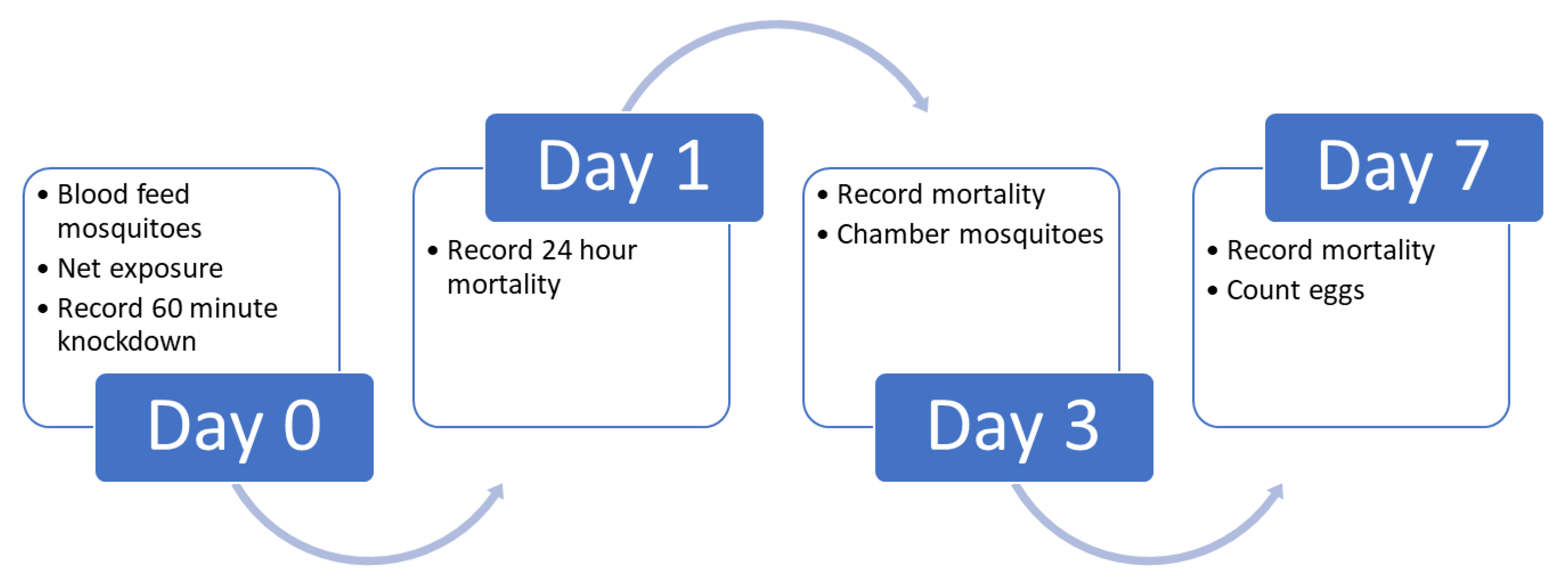
| Timing of chambering | 24 h post-exposure (LSTM) 72-h post-bloodmeal, 96-h post-exposure | Sterilizing effect not measured. | - | - | - | 72 h post-exposure (73 h post b/m). | 72 h post-exposure (Day 3). | This allows 3 days for bloodmeal development and egg maturation. |
| Method of chambering | 30-mL cell culture tubes, moist cotton wool, and filter paper, individuals. Chambered for 3 days. | - | Cup, 50 mL water, 10% glucose cotton wool, individuals. | Individuals | - | 100-mL plastic cups, 30 mL water, 10% glucose, individuals. | The chambering equipment used (i.e., culture tubes or plastic cups) is not critical and should reflect what method each lab has capacity to conduct. The same setup should then be used for all treatments and replicates. When oviposition in the untreated control is <20%, test results should be discarded and repeated. | 20% oviposition threshold in the untreated control is based on power calculations performed by Joe Wagman (PATH). |
| Entomological endpoints measured | KD: 60 min; Mortality: 24 h; Number blood-fed; Eggs laid per female; Number 2nd instar larvae per female; Oviposition rate, fecundity, hatch rate, and fertility. | Blood-fed and dead after test. | Daily mortality to day 8. Count eggs and larvae on day 4 and day 8. | KD: 60 min. Mortality: 24-h mortality, individual oviposition: % reduction in oviposition rate, % reduction in fecundity, % reduction in offspring. | # alive/dead and # fed/unfed in each section, 24-h mortality, individual oviposition: % reduction in oviposition rate, % reduction in fecundity, % reduction in offspring. | KD: 60 min. Daily mortality (pre- and post-chambering until Day 8). Presence of eggs on day 8 post-exposure. Oviposition rate. Oviposition inhibition. | Primary endpoint: oviposition inhibition (calculated compared to untreated control. Additional measures: KD: 60 min, 24-h mortality, 72-h mortality (when chambering). Oviposition (egg laying) counted on Day 7 post-exposure only (4 days post-chambering). | A preliminary validation test will be conducted to establish if other endpoints should be included, e.g., median number of eggs laid. |
| Length of bioassay | - | 15 h | 8 days post-exposure. | - | - | 8 days post-exposure. | 8 days (Day 0 = day of exposure). | - |
| Notes on the protocol | High-performance liquid chromatography (HPLC) conducted on net samples—3 samples from each of 4 panels. Sterilizing effect measured in rounds 1–5 (1–24 m). | Untreated control run for each round. | No food provided to eggs/larvae. Water with eggs transferred to larvae cup on day 4. | - | - | Test rejected if control mortality is 20% or more, or oviposition in controls is <30%. | - | |
| Storage of netting pieces (prior to testing) | - | - | - | - | - | - | Refrigerated or in a cool dry place, but at <5 °C or as per manufacturer’s instructions. | - |
| CREC, Benin SOP BL/159/01-S v01 4 | KCMUCO, Tanzania SOP 008v02 5 | Proposed for Consensus SOP | Justification | |
|---|---|---|---|---|
| Author | Syme | Martin, Matowo, and Furnival-Adams | Lees and Lissenden | - |
| Method of exposure | Not included in SOP | Cone test | Cone test | The cone test has been used in several studies to evaluate PPF nets and seems to be a suitable method of exposure. |
| Exposure time | Not included in SOP | 3 min | 3 min | This is the standard exposure time used in WHO cone bioassays [6]. Preliminary validation testing will be conducted to look at effect of exposure time. |
| Age of mosquitoes | Unknown | 2–5 days old | 3–5 days | This age range falls within the range of standard cone test (2–5 days, [6]) but allows an extra day for mating to increase likelihood of insemination. Effect of age for PPF is unknown and could be validated, but should be held constant until it is. |
| Blood feeding timing | ‘Blood-fed at the time of collection/testing’. | Females ‘freshly blood fed’ for exposure. | 3–9 h before net exposure. Blood fed using method of feeding standard for the test population (e.g., Hemotek membrane feeding system, arm feed, animal feed). | There is little data available and some contradiction on the impact of time of blood feeding, and this could be validated. Consensus was that this was a suitable, and logistically possible, method. |
| Mosquitoes per replicate | N/A | 5 | 5 per cone | This is the standard number used in WHO cone bioassays [6]. |
| Replicates per piece of net | N/A | 20–25 replicates (n = 100–150); 4 per piece; 30 nets per treatment. | 2 replicates per piece (8 cones per net) | Consensus was that this was a feasible number for testing. Numbers will be confirmed during multi-center validation. |
| Replicate nets per treatment | N/A | A minimum of 30 nets of each treatment at each time point. | WHO guidelines [6] recommend a minimum of 30 nets (at time points 0–24 months), and a minimum of 50 nets at 36 months testing. | |
| Species/strain | Anopheles mosquitoes (generic SOP for dissection). | An. gambiae s.s. Muleba kis (kdr east and mixed-function oxidize resistance), or wild blood-fed resistance mosquitoes of unknown age with species id at time of dissection. | Lab-reared pyrethroid-susceptible strain. Lab-reared pyrethroid-resistant strain. Lab strains characterized before and after the bioassays for each time point as per strain characterization guidelines (Lees et al. in prep). | Pyrethroid-susceptible strain to monitor pyrethroid durability. Pyrethroid-resistant strain to monitor durability of PPF. |
| Time of dissection | 72 h post-exposure | 72 h post-exposure | 72 h post-exposure | This allows 3 days for bloodmeal digestion and egg maturation. |
| Blinded samples | No | Yes | Yes | Controls for scorer subjectivity. |
| Number of scorers | 2, in case of discrepancy calculate the average (only for egg count). | 2, using slide or photograph if slide cannot be counted on the same day. 3 scorers in case of discrepancy. | 2, using slide or photograph if slide cannot be counted on the same day. 3rd scorer in cases of discrepancy. | Controls for scorer subjectivity. |
| Microscope details | Can use dissecting microscope, better a compound microscope at 4× or 10×. | 0.7× magnification, stereomicroscope. | Microscope details not critical. However, we recommend using a magnification of ×4 or ×10 for dissections and ×40 for observation of eggs. | - |
| Entomological endpoints measured | Live/dead and gravid/semi-gravid at time of collection, egg development stage, and fertility status of each mosquito, total number of eggs present in ovary (1/2 per female?). | KD: 60 min. Mortality: 24 h. Mortality: 48 h. Mortality: 72 h. % of dissected females with under-developed ovaries 72 h post-feeding. Proportion of dissected females with deformed eggs. Average number of eggs in the ovaries 72 h post-feeding. | Primary endpoint: Fertility inhibition (fertility rate/fertility rate in the negative control). Additional measures: KD: 60 min. 24-h mortality. Egg development stage. Fertility rate (proportion with developed ovaries/total). | A preliminary validation test will be conducted to establish if other endpoints should be included, e.g., number of eggs in each dissected ovary. |
| Definition of Fertility | Christophers’ scale to score development stage of eggs (I–V); female is fertile if eggs are V and sterile if eggs are I–IV. | Christophers’ stages to score development stage of eggs (I–V); female is fertile if eggs are V and sterile if eggs are I–IV. Inconclusive if both are present. | Score development stage of eggs (1–5) [15]. Female is classed as fertile if all eggs are 5 and sterile if eggs are 1–4. If both classes 4 and 5 are present, the results are inconclusive. | This is a well-established method for scoring fertility |
| Controls | - | Untreated net. Standard LN: Interceptor. | Negative control: Untreated control net. Positive control 1: New pyrethroid + PPF net of the same brand. | Untreated net controls for handling procedure and checks for contamination, and provides denominator for measuring oviposition inhibition. New pyrethroid + PPF net provides ‘baseline’ and allows us to monitor the suitability of test mosquito strains. |
| Notes on the protocol | Dissect all mosquitoes left alive at 72 h post-collection, but if there are not adequate numbers, also dissect dead mosquitoes at this time. Photographs taken of eggs. | Method from Detinova et al. 1962. Photographs taken of eggs. | If the testing site has the capacity to photograph dissected ovaries, then this should be conducted. Photographs can then be used in future training, and machine learning activities. |
| ID | Contact | Biological Durability Monitoring | Method Availability |
|---|---|---|---|
| NNP Burkina Faso DM (ID = 1) | Richard Oxborough, PMI | Yes | Provided |
| Tanzania cRCT (Martin et al., 2021) (ID = 2) | Jackline Martin, KCMUCo | Yes | Published pre-print |
| Net in tube CFP, LSTM (ID = 3) | Katherine Gleave, LSTM | Yes | Provided |
| PMI CFP Tunnel SOP (ID = 4) | Richard Oxborough, PMI | Yes | Provided |
| Residual efficacy of Interceptor G2 (ID = 5) | Seth Irish, CDC, and Richard Oxborough, PMI | Yes | Provided |
| PAMVERC SOP for cylinder assay (ID = 6) | Leslie Choi, LSTM | Yes | N/A, generic SOP |
| IT LN SOP 002 V04—Tunnel Tests (ID = 7) | Sarah Moore, IHI | Yes | N/A, generic SOP |
| CREC SOP.BL.112.05.S—Tunnel tests (ID = 8) | Corine Ngufor, LSHTM | Yes | N/A, generic SOP |
| NNP Burkina Faso DM 1 | Tanzania cRCT 2 | Net in Tube, LSTM 3 | PMI SOP 4 | Irish and Oxborough SOP 5 | Proposed for Consensus SOP | Justification | |||
|---|---|---|---|---|---|---|---|---|---|
| Author(s) | NNP | JL Martin et al. | Irish, Oxborough & Gleave | PMI | Irish and Oxborough | Lissenden | |||
| Method of exposure (primary test) | Cone test | Cone test | Tunnel test | Cylinder test | Cylinder test | Tunnel Test | Tunnel Test | Tunnel Test | The tunnel test has been used in several studies to evaluate CFP nets and seems to be a suitable method of exposure. |
| Exposure time | - | 3 min | 12–15 h | 3, 15, 30, 60 min, ‘as necessary’ | 30 min | 12–15 h | 12–15 h | This is the standard exposure time used in WHO tunnel tests [6]. | |
| Controls | No exposure control | Untreated net IG1 collected at same time point. | Untreated net IG1 collected at same time point. | - | Untreated net Alphacypermethrin net (100 mg/m2). | Negative control New IG1 New IG2 | Untreated net. New IG1. New IG2 (used up to 10 times). | Untreated net (Used up to 10 times). Untreated Control thresholds: blood-feeding must be >50%. Mortality must be <10% after 24 h and < 20% at 72 h. New IG1 and IG2 should be used to characterize strain prior to testing. | Untreated net controls for handling procedure and checks for contamination and provides denominator for measuring oviposition inhibition. New IG1 + IG2 nets provides ‘baseline’ and allows us to monitor the suitability of test mosquito strains. |
| Species/ strain | Pyrethroid-susceptible strain. Pyrethroid-resistant strain. | A pyrethroid-susceptible strain (Kisumu). | A pyrethroid-susceptible strain (Kisumu—failed cone nets only). Pyrethroid-resistant strain (Muleba-kis), regularly selected and profiled. | - | Pyrethroid-resistant strain (<70% mortality). | Pyrethroid-susceptible (Kisumu) strain Pyrethroid-resistant (VKPER) strain | Profiled pyrethroid-resistant strain (<70% mortality to new IG1). | Lab-reared pyrethroid-susceptible strain. Lab-reared pyrethroid-resistant strain. Lab strains characterized before and after the bioassays for each time point, as per strain characterization guidelines (Lees et al. In prep). | The susceptible strain is used to monitor the biological durability of the pyrethroid over time. The pyrethroid-resistant strain is used to monitor the impact of CFP over time. |
| Age of mosquito | 2–5 days | 2–5 days | - | - | 3–5 days | - | 5–8 days old | 5–8 days | This is the standard age used in WHO tunnel tests [6]. |
| Status of mosquito | Unfed | - | - | - | Non-blood-fed; Sugar-starved, 6 h. | Nulliparous. Sugar-starved, 6 h | Nulliparous. Non-blood-fed. Sugar-starved for a minimum of 6 h. | This is the standard mosquito status used in WHO tunnel tests [6]. Consensus agreed sugar-starving found increase mosquito responsiveness to bait. | |
| Mosquitoes per replicate | 5 | 5 | 50 | 10 | 20–25 | 100 | 50 | Preliminary research has shown no difference between using 50 or 100 mosquitoes in tunnel tests with IG2 (Kamande, Personal communication). | |
| Samples per net | 2 (30 × 30 cm) | Baseline: 5 pieces (1 top, 4 sides). Post-baseline: 4 pieces (1 top, 3 sides). | 1 piece (position 2), 25 × 25 cm, 9 × 1 cm holes. | - | 4 tubes (4 net pieces). | 4 (30 × 30 cm) | 2 pieces (1 from roof, 1 from sides); 30 × 30 cm, 9 × 1 cm holes in net. | In the standard WHO tunnel test, one net piece is used [6]. The increase allows a 2nd piece from the roof to be tested. During their manufacture, roof panels can come from different net runs than side panels [12]. | |
| Replicate tests per piece of net | 2 | 4 replicates | 2 replicates | - | 1 replicate per net. | ? | 1 replicate per net piece. | This is the standard used in WHO tunnel tests [6]. | |
| Replicate nets per treatment | 30 | 30 nets (timepoint: 0–30 months), 50 nets (timepoint: 36 months). | 30 nets (timepoint: 0–30 months), 50 nets (t36). | Sub-set of nets | 2 per testing day (200–250 mosquitoes). | A minimum of 30 nets for each treatment at each time point. | WHO guidelines [6] recommend a minimum of 30 nets (at time points 0–24 months), and a minimum of 50 nets at 36 months testing. | ||
| Storage of netting pieces (prior to testing) | cool dry place at 4° | - | - | - | Refrigerated or in a cool dry place, at <5 °C or as per manufacturer’s instructions. | - | |||
| Entomological endpoints measured | KD: 30 min. KD: 60 min. Mortality: 24 h. | KD: 60 min. Mortality: 24 h. Mortality: 48 h. Mortality: 72 h. | KD: 60 min. Mortality: 24 h. Mortality: 48 h. Mortality: 72 h. Blood feeding. | - | KD: 60 min. Mortality: 24 h. Mortality: 48 h. Mortality: 72 h. | Mortality: 24 h. Mortality: 72 h. Net penetration. Blood feeding. Blood feeding inhibition. Corrected mortality due to chlorfenapyr. | Collection compartment. Blood-feeding status. ‘Immediate’ mortality (07:00). ‘Delayed’ mortality 24 h, 48 h, 72 h. | Collection compartment. Blood-feeding status. Mortality on collection (‘immediate’). 24 h, 48 h, 72 h mortality (‘delayed’). | These endpoints are sufficient to capture the efficacy of a pyrethroid + CFP net. |
| Other | Cone test is only looking at impact of alphacypermethrin. | 18:00: introduced; 08:00: end. | - | Conducted in darkness during the ‘night phase’ of mosquitoes’ circadian rhythm; 27 ± 2 °C and 75% ± 10% relative humidity. Acclimatized to holding tubes for 1 h. | 18:00: introduced; 07:00: end. Conducted in darkness, 27 ± 2 °C and 75% ± 10% relative humidity. Mortality corrected for alpha mortality. | Conducted in darkness during the ‘night phase’ of the mosquitoes’ circadian rhythm. Blood meal source preferably the same as what was used to feed the strain in colony, 27 ± 2 °C and 75% ± 10% relative humidity. | Higher mortalities have been observed when chlorfenapyr is used overnight [16], when, as a result of the Anopheles circadian rhythm, flight is increased, and, subsequently, cellular respiration and oxidative metabolism, which the chlorfenapyr targets ([17]), is at its peak. | ||
Publisher’s Note: MDPI stays neutral with regard to jurisdictional claims in published maps and institutional affiliations. |
© 2021 by the authors. Licensee MDPI, Basel, Switzerland. This article is an open access article distributed under the terms and conditions of the Creative Commons Attribution (CC BY) license (https://creativecommons.org/licenses/by/4.0/).
Share and Cite
Lissenden, N.; Armistead, J.S.; Gleave, K.; Irish, S.R.; Martin, J.L.; Messenger, L.A.; Moore, S.J.; Ngufor, C.; Protopopoff, N.; Oxborough, R.; et al. Developing Consensus Standard Operating Procedures (SOPs) to Evaluate New Types of Insecticide-Treated Nets. Insects 2022, 13, 7. https://doi.org/10.3390/insects13010007
Lissenden N, Armistead JS, Gleave K, Irish SR, Martin JL, Messenger LA, Moore SJ, Ngufor C, Protopopoff N, Oxborough R, et al. Developing Consensus Standard Operating Procedures (SOPs) to Evaluate New Types of Insecticide-Treated Nets. Insects. 2022; 13(1):7. https://doi.org/10.3390/insects13010007
Chicago/Turabian StyleLissenden, Natalie, Jennifer S. Armistead, Katherine Gleave, Seth R. Irish, Jackline L. Martin, Louisa A. Messenger, Sarah J. Moore, Corine Ngufor, Natacha Protopopoff, Richard Oxborough, and et al. 2022. "Developing Consensus Standard Operating Procedures (SOPs) to Evaluate New Types of Insecticide-Treated Nets" Insects 13, no. 1: 7. https://doi.org/10.3390/insects13010007
APA StyleLissenden, N., Armistead, J. S., Gleave, K., Irish, S. R., Martin, J. L., Messenger, L. A., Moore, S. J., Ngufor, C., Protopopoff, N., Oxborough, R., Spiers, A., & Lees, R. S. (2022). Developing Consensus Standard Operating Procedures (SOPs) to Evaluate New Types of Insecticide-Treated Nets. Insects, 13(1), 7. https://doi.org/10.3390/insects13010007

