


Abstract
The stability of nanolubricants is critical for ensuring effective performance under extreme pressure (EP) conditions, where severe boundary lubrication governs friction and wear behaviour. This study examines palm kernel oil (PKO)-based nanolubricants enhanced with carbon graphene (CG), hexagonal boron nitride (hBN), and molybdenum disulfide (MoS2), with and without oleic acid (OA) as a surfactant. OA incorporation improved CG dispersion stability, reducing agglomerate size by 30.4% (17.61 μm to 12.23 μm) and increasing the viscosity index from ~176 to 188, compared to 152 for the commercial hydrogen engine oil baseline. Under EP conditions, PKO + CG + OA achieved a 51.7% reduction in the coefficient of friction (0.58 to 0.28) and 18.2% improvement in weld load resistance, while wear scar diameter decreased by 13.4%. Surface and elemental analyses indicated the formation of a composite tribofilm containing oxide species, graphene platelets, and carboxylate-derived compounds from OA, consistent with iron–oleate-like chemistry that enhances load-carrying capacity and wear protection. These findings demonstrate the potential of OA-assisted PKO nanolubricants as sustainable, high-performance formulations for extreme pressure boundary lubrication, contributing to the advancement of green tribology.
1. Introduction
The growing global population, declining fossil fuel reserves, and climate change have intensified worldwide energy concerns, while fossil fuels remain dominant due to their affordability despite environmental drawbacks [1,2,3,4]. Internal combustion engines (ICEs) are major contributors to harmful emissions, prompting stricter environmental regulations and renewed interest in alternative fuels such as biodiesel, alcohol, and biogas, although these often compromise engine performance [5,6,7,8]. Previous studies have extensively examined fuel–lubricant interactions in conventional internal combustion engines (ICEs) operating under increasingly severe thermal and chemical environments [9,10,11]. Khedr et al. [12] demonstrated that alterations in combustion characteristics under advanced or mixed-fuel operating modes can significantly modify in-cylinder pressure–temperature; however, the associated implications for lubricant degradation were not explicitly addressed. Subsequent investigations have shown that such changes in combustion severity and by-product composition can accelerate lubricant ageing, manifested by viscosity reduction, depletion of Total Base Number, and an increase in Total Acid Number. These trends are widely recognised as indicators of oxidative degradation, acid formation, and contaminant accumulation in modern ICE lubrication systems [13,14]. Elevated concentrations of wear-related metals in lubricants have also been reported, suggesting accelerated component wear and potentially reduced service life in conventional systems [15,16].
Nanoparticles offer advantages such as enhanced durability, thermal conductivity, low volatility at elevated temperatures, and effective friction and wear reduction [17]. However, maintaining uniform and stable dispersion remains a major challenge due to agglomeration driven by van der Waals forces [18]. Stability here refers to the ability of nanoparticles to remain evenly dispersed without settling or clumping over time. Factors such as nanoparticle size, shape, concentration, and the physical properties of the base oil, including density, viscosity, and polarity, affect dispersion behaviour. Denser particles and those with low surface area tend to settle faster, especially at higher concentrations [19]. Jiang et al. [17] noted that agglomerate size increases with nanoparticle loading. Moreover, shape matters: rod-like particles with high aspect ratios tend to disperse poorly compared to spherical ones [20]. High-viscosity base oils improve stability [21], and the polarity of both the nanoparticles and base fluid also influences dispersion. For example, TiO2 disperses effectively in non-polar media like Therminol-55, while Al2O3 often requires polarity modification for improved performance [22].
The stability problems associated with nanolubricants have been the subject of substantial study, frequently utilising solutions that combine surfactants and nanoparticle surface modification [23,24]. The integration of surfactants provides a straightforward, economical, and pragmatic method, in contrast to direct surface modification [25]. In certain investigations, the surfaces of nanoparticles have been modified using organic compounds to enhance their long-term dispersion stability in lubricants. These adjustments have shown significant enhancements in dispersion stability and tribological performance [26,27]. In oil-based suspensions, it is essential to choose a surfactant with good compatibility, since the ideal selection is contingent upon the physicochemical properties of both the nanoparticles and the base oil [28]. This study chose oleic acid (OA; C18H34O2), a surfactant characterised by a hydrophilic hydroxyl group and an organophilic alkyl chain, for its established efficacy in improving nanoparticle dispersion in lubricants and its environmental benefits [17,29].
Severe extreme pressure (EP) boundary lubrication conditions are often associated with limited formation of protective carbon-based boundary films, increasing the risk of adhesive wear and lubricant degradation. To address this tribological challenge, the present study introduces oleic acid (OA) as a surfactant additive in palm kernel oil (PKO) nanolubricants containing carbon graphene (CG), hexagonal boron nitride (hBN), and molybdenum disulfide (MoS2). Owing to its amphiphilic molecular structure, OA enhances nanoparticle dispersion through steric stabilization, while simultaneously interacting with steel surfaces to form an iron–oleate-derived boundary layer. The synergistic action of OA and solid nanoparticles promotes the in situ formation of hybrid tribofilms, which enhance load-carrying capacity and reduce friction and wear under extreme pressure boundary lubrication conditions, supporting the development of sustainable green lubrication formulations.
2. Experimental Section
2.1. Materials
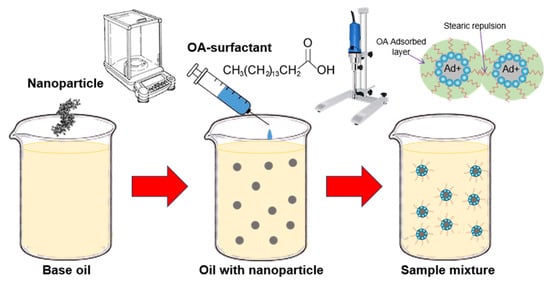
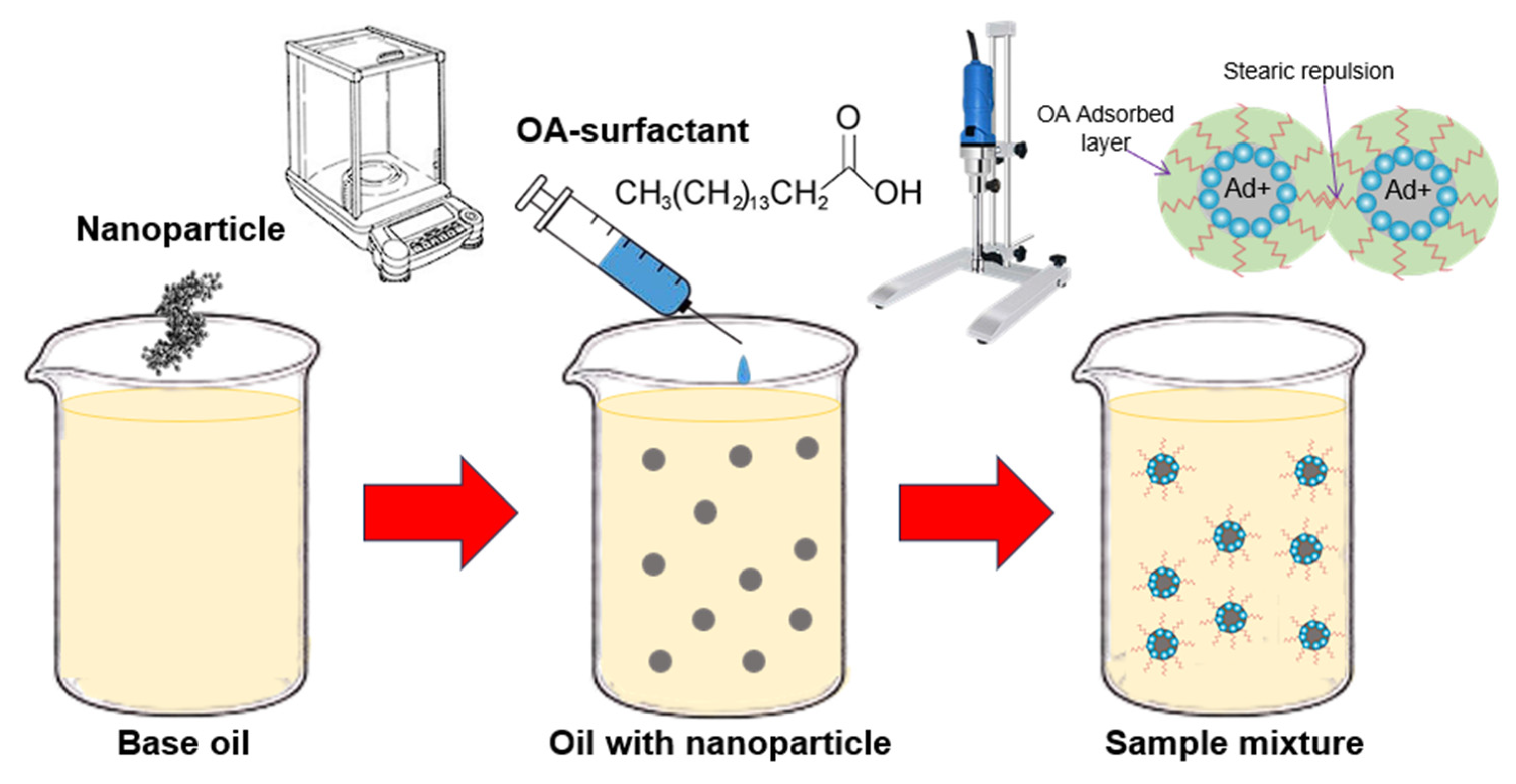
This study utilised RBD palm kernel oil (PKO) supplied by Keck Seng (Malaysia) Berhad, Johor, as the base lubricant. PKO was chosen due to its local availability in Malaysia, cost-effectiveness compared to other vegetable oils, and superior oxidative stability resulting from its lower polyunsaturated fatty acid content [30]. The physical properties of PKO are summarised in Table 1. A commercial hydrogen engine oil (H2EO) obtained from Yew Auto Parts Johor, (Malaysia) was used solely as a benchmark lubricant to provide a comparative baseline for extreme pressure tribological performance, as it represents a commercially formulated oil intended for operation under high-temperature and high-load conditions. Hexagonal boron nitride (hBN), graphene (CG) and molybdenum disulfide (MoS2) nanoparticles, obtained from MK Impex Corp., Canada, were employed as nanoadditives. According to previous work [31], hBN exhibits a spherical-like morphology with an average diameter of 86.6 nm and a thickness of 23.2 nm, while MoS2 features nanosheet structures ranging from 160 nm to 2.56 μm in lateral size and an average particle size of 870 nm, with a thickness of approximately 23 nm. Oleic acid (OA), used as a surfactant, was sourced from Sigma Aldrich (M) Sdn. Bhd., and its properties are detailed in Table 1. Figure 1 shows the sample mixture preparation process.
Table 1.
Properties of oleic acid surfactant.
Figure 1.
Preparation of sample mixture.
Each nanoparticle type (CG, hBN, MoS2) was added at 0.05 wt% relative to the total nanolubricant mass for all formulations, ensuring a consistent basis for comparison across stability, rheological, and tribological assessments. To ensure reproducibility, all nanolubricants were prepared using a standardized procedure in which PKO was first heated to 50 °C to reduce viscosity, followed by gradual incorporation of nanoparticles under mechanical stirring at 500 rpm for 10 min, at which stage OA was introduced for the OA-assisted samples. The mixture was then subjected to high-shear mixing at 3000 rpm for 20 min to promote initial deagglomeration, after which probe ultrasonication (20 kHz, 40% amplitude) was applied for 30 min in 5 s on/5 s off cycles while maintaining the temperature below 45 °C with external cooling to prevent thermal oxidation. All prepared samples were stored in sealed amber bottles at 25 °C and allowed to equilibrate for 7 days, during which time sedimentation and dispersion behaviour were monitored before rheological, stability, and tribological evaluations were conducted.
2.2. Tribological Test
The tribological performance of all formulations was evaluated using a four-ball tribotester following ASTM D2783 procedures [32]. AISI 52100 steel balls (12.7 mm diameter, 65 HRC) were used, with one ball mounted in a rotating spindle sliding against three stationary balls immersed in 10 mL of the test nanolubricant. The tests were conducted at 75 °C, representing a moderate engine-relevant temperature that avoids accelerated oxidation. The loading sequence began at 40 kg (392 N), corresponding to a maximum Hertzian contact pressure of 4.64 GPa, and was subsequently increased in 10 kg increments at each step until weld failure occurred. Each load step was applied for 10 s, as prescribed by the EP testing standard, to isolate the lubricant’s instantaneous boundary and anti-weld characteristics while minimizing thermal artefacts. The spindle operated at 1760 rpm, and the coefficient of friction (COF) was recorded continuously via an integrated data acquisition system. For each formulation, three independent repetitions were performed at every load level, and the resulting COF and wear scar diameter (WSD) values are reported as mean ± standard deviation. This methodology ensures reproducible assessment of load-carrying capability, seizure resistance, and tribofilm behaviour under extreme pressure conditions.
2.3. Sample Properties and Characterization
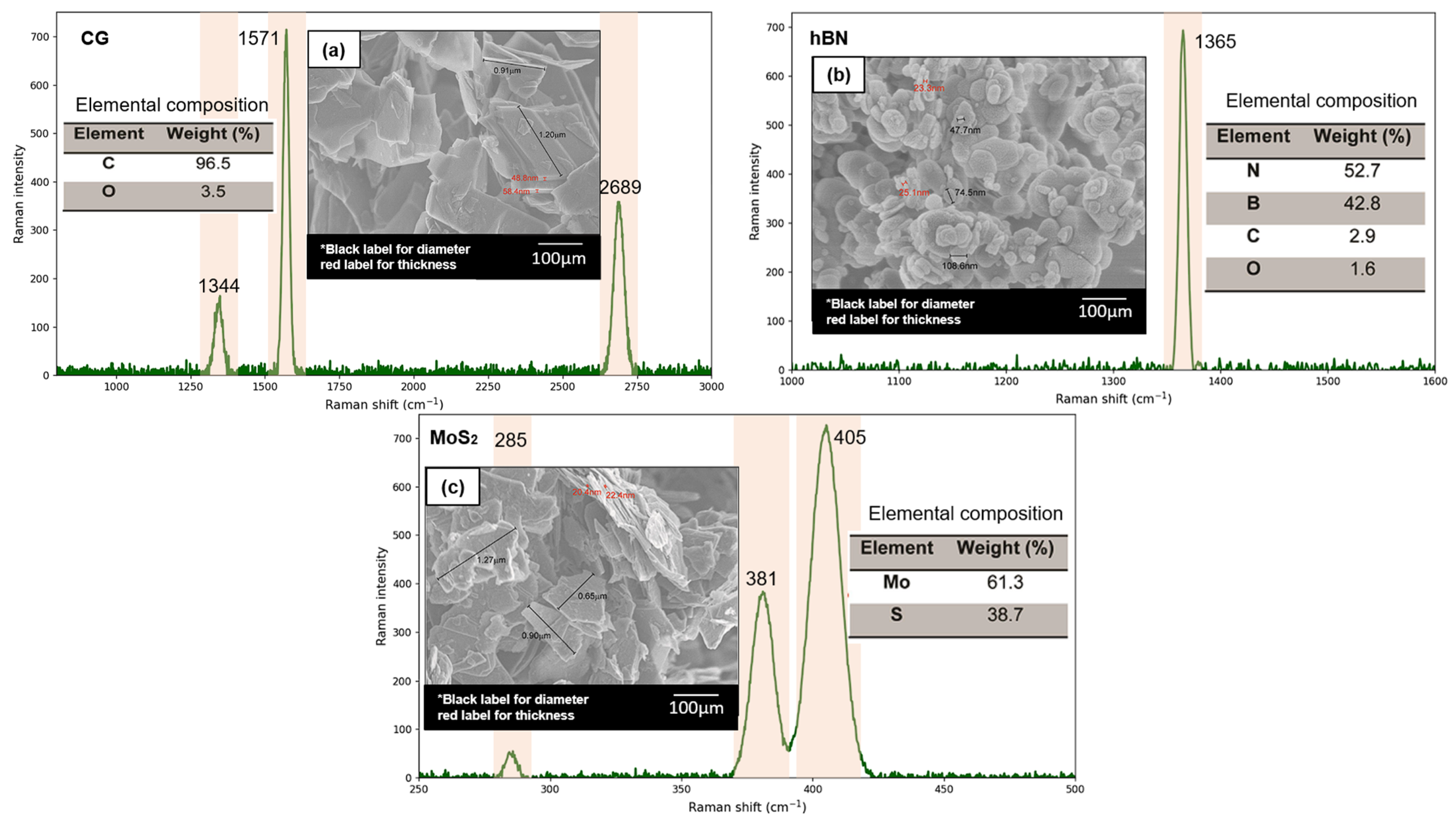
Table 2 shows the physical and chemical properties of CG, hBN, and MoS2 [33]. The morphological, structural, and elemental characterizations confirm that the synthesised CG, hBN, and MoS2 nanoadditives possess distinct microstructural features and high purity, making them suitable for tribological applications. The CG sample, as revealed by SEM imaging, exhibits layered graphene platelets with lateral sizes ranging from ~0.91 µm to 1.20 µm and thicknesses between ~48.8 nm and 55.4 nm, indicating few-layer graphene structures. Raman spectroscopy displays prominent D, G, and 2D bands at ~1344, 1571, and 2689 cm−1, respectively, which signify a high degree of graphitization with minimal defects. Elemental analysis shows a high carbon content (96.5 wt%) with minimal oxygen contamination (3.5 wt%), suggesting effective synthesis with limited oxidation.
Table 2.
Physical and chemical properties of nanoadditives.
The hBN sample exhibits flower-like agglomerates composed of nanosheets with diameters ranging from ~23.8 nm to 106.0 nm and sheet thicknesses of ~25.1 nm to 35.1 nm, as seen from SEM images (see Figure 2). Raman spectroscopy reveals a sharp peak at ~1365 cm−1, corresponding to the E2g vibrational mode of hBN, confirming its crystalline hexagonal structure. Elemental composition analysis indicates high boron (42.8 wt%) and nitrogen (52.7 wt%) contents, with minor carbon and oxygen impurities, validating the high purity of the synthesised hBN nanoparticles. This morphology is expected to facilitate smooth sliding in lubrication due to its lamellar structure and chemical stability under extreme conditions.
Figure 2.
Characterization of sample nanoadditives: (a) CG, (b) hBN, and (c) MoS2.
MoS2 nanoadditives present a characteristic stacked platelet morphology with lateral sizes between ~0.65 µm and 1.27 µm and thicknesses of ~20.2 nm to 22.1 nm. Raman spectra show two distinct peaks at ~381 cm−1 (E12g) and ~405 cm−1 (A1g), which are characteristic vibrational modes of hexagonal MoS2, indicating a few-layer structure with strong in-plane and out-of-plane bonding. Elemental composition reveals high molybdenum (61.3 wt%) and sulphur (38.7 wt%) content, confirming a near-stoichiometric ratio. The combination of its layered structure and high purity suggests excellent potential for reducing friction and wear when incorporated into lubricants, complementing the tribological benefits of CG and hBN in hybrid additive systems.
2.4. Physicochemical Property Analysis
A 25 mL pycnometer was used to determine the density of the prepared samples in accordance with ASTM D854 [34]. Kinematic viscosity was measured using a rotary viscometer following ASTM D2983 [35], with 250 mL of each sample used for the test. To obtain the temperature dependence of kinematic viscosity, measurements were recorded at both 40 °C and 100 °C, the two standard reference temperatures were specified for viscosity and viscosity-index evaluation. Each temperature point was allowed to equilibrate for 10 min to ensure thermal stability before measurement, and the procedure was repeated at least twice, with mean values reported. The viscosity index (VI), reflecting the sensitivity of viscosity to temperature, was then calculated according to ASTM D2270 [36]. A higher VI indicates that the viscosity is less affected by temperature variations.
2.5. Analysis of the Tested Sample
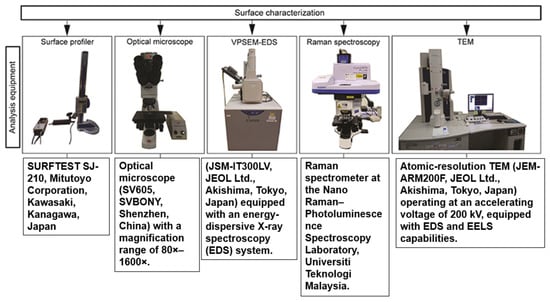
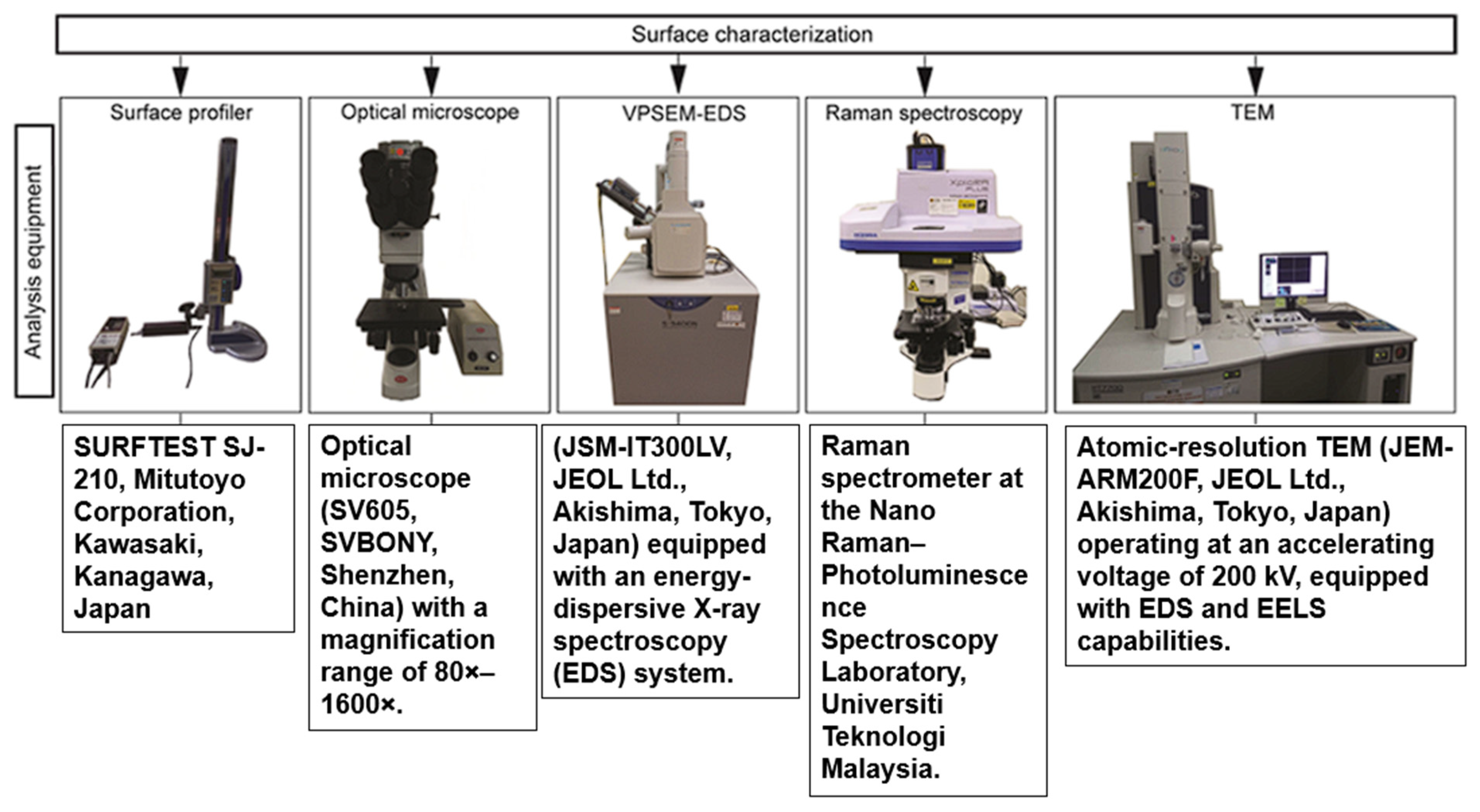
Surface characterisation of the samples was conducted with several provided analytical methods to assess topographical, morphological, and compositional attributes. Surface roughness measurements were acquired using a surface profiler by following a perpendicular line over the wear scar region to assess differences in surface texture. An optical microscope was used to evaluate the wear scar diameter (WSD) and surface morphology at both low and high resolutions. The morphological characteristics and elemental composition were analysed using a variable pressure scanning electron microscope with energy dispersive X-ray spectroscopy (VPSEM-EDS), yielding detailed imaging and quantitative elemental analysis. Raman spectroscopy was used to analyse the chemical structure and molecular composition using vibrational fingerprinting. Transmission electron microscopy (TEM) was used for high-resolution examination of nanoparticle shape and internal structure. This integrated method allowed for a thorough evaluation of the physical, chemical, and structural properties of the materials under investigation. Figure 3 summarises the instruments and analyses used in this study.
Figure 3.
Analytical instruments used for surface and structure characterization.
2.6. Rehbinder Effect
Rehbinder-type surface effects may occur when surface-active species are present at sliding metal interfaces [27]. In the present study, oleic acid acts as a surface-active additive that can adsorb onto freshly exposed steel surfaces during extreme pressure contact, leading to physicochemical interactions at the near-surface region. Such adsorption lowers the surface energy of the material and may alter the local resistance to plastic deformation and adhesion during sliding [37]. The extent of this effect is influenced by operating temperature, contact stress, and surface condition under load. Within the context of four-ball extreme pressure testing, these surfactant-mediated interactions can contribute to reduced friction and modified wear behaviour by facilitating localised shear accommodation and suppressing adhesive junction growth, thereby influencing the observed tribological response without altering bulk material properties [38].
3. Results and Discussion
3.1. Effect of Oleic Acid Surfactant on Dispersion Stability
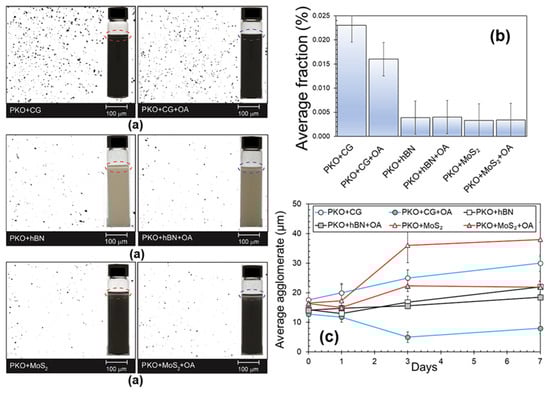
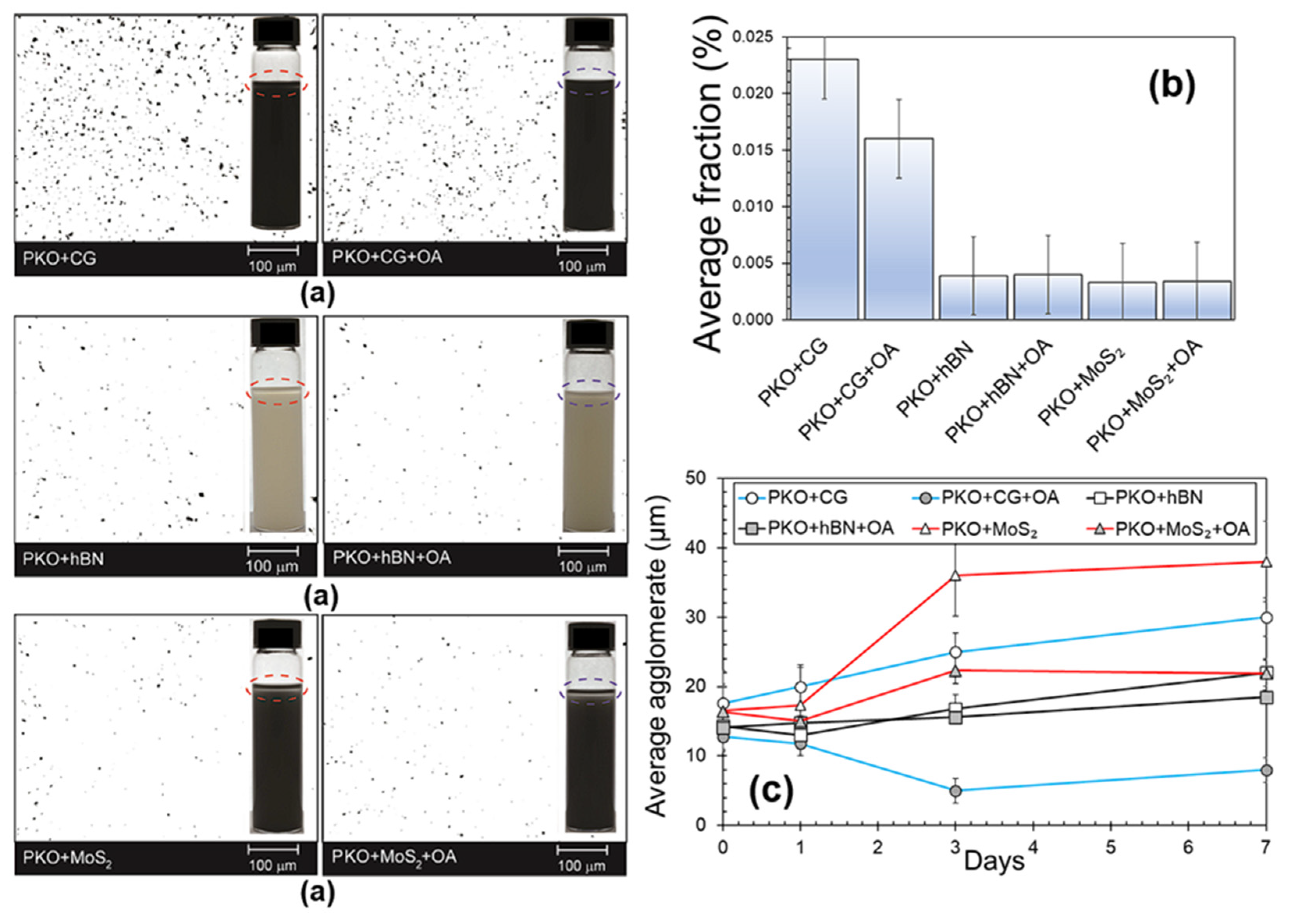
Optical microscopy findings for nanolubricants including PKO with 0.05 wt% CG, 0.05 wt% hBN, and 0.05 wt% MoS2 are shown in Figure 4, both with and without oleic acid (OA) used as a surfactant. Incorporating OA greatly improved the dispersion of CG nanoparticles and decreased their aggregation size. Quantitative examination of the images showed that the proportion of the area occupied by CG agglomerates decreased by 30.4% when OA was added, indicating better dispersion stability. In line with these findings, Figure 4a shows that the PKO + CG + OA formulation was more stable in dispersion than PKO + CG alone. The agglomeration size significantly decreased from 17.61 μm to 12.23 μm after adding OA to the CG-based nanolubricant, as shown in Figure 4b. The PKO + CG + OA formulation showed better uniformity than the OA-free one, which had more polydispersity and bigger agglomeration dimensions, as shown by the smaller error margin. The agglomeration size in the PKO + CG + OA nanolubricant fell somewhat to 11.2 μm after 1 day of storage, based on subsequent research, while it increased significantly to 19.98 μm in the PKO + CG sample that did not include OA. This pattern verifies that the surfactant successfully stabilises the suspension of CG nanoparticles for a short period of time. The PKO + CG + OA formulation showed signs of instability after 3 days, as the agglomeration size increased significantly.
Figure 4.
Dispersion and sedimentation analysis for (a) optical micrographs, (b) agglomerate particle fractions, and (c) average agglomerate for 7 days.
The addition of OA also helps to disperse hBN nanoparticles more evenly. Agglomerate size was likely reduced since the area percentage of hBN agglomerates was down from 0.0039% to 0.0038%. The visual pictures in Figure 4a further verify the higher colloidal stability, which is confirmed by the better dispersion and decreased particle clustering in the PKO + hBN + OA nanolubricant. Only a small decrease in agglomeration size, from 14.34 μm to 14.12 μm, was likewise caused by the addition of OA. Additionally, the particle sizes of the PKO + hBN + OA sample remained mostly unchanged after 3 days, growing marginally to 14.42 μm, in contrast to the more noticeable changes shown in Figure 4c for the OA-free form. After 7 days, the agglomeration size was still less in the OA-containing sample compared to the one without OA, even though it had risen.
On the other hand, when comparing the PKO + MoS2 + OA sample to its OA-free counterpart, the optical micrograph in Figure 4b reveals little improvement in particle dispersion. Surprisingly, after adding OA, the fraction of area occupied by MoS2 agglomerates rose from 0.0033% to 0.0034%. This small increase might be due the sedimentation rate being lower than usual, maybe because there are more suspended particles in the solution between the glass slides. It would seem that these results contradict the optical observations in Figure 4a, which indicated a significant improvement in stability. The disparity suggests that there may not have been enough OA adsorbed onto the MoS2 surface to considerably reduce agglomeration. Thus, OA may temporarily reduce agglomeration but have no impact on the dispersion stability of MoS2 nanolubricants in the long run.
In order to verify these theories, CG, hBN, and MoS2 nanoparticles in suspension were subjected to dynamic light scattering (DLS) to see how OA affected their aggregation behaviour. The first agglomeration diameters of the PKO + MoS2 and PKO + MoS2 + OA nanolubricants were 16.45 μm and 16.40 μm, respectively, and there was no significant difference between the two, as shown in Figure 4c. The agglomeration size in the PKO + MoS2 formulation grew after 1 day, but in the PKO + MoS2 + OA sample it shrank somewhat. Both formulations seem to have low colloidal stability, according to these opposing tendencies. A slight stabilising impact was shown by the fact that the agglomeration size in the OA-containing sample remained lower than that in the OA-free sample from 1 to 7 days.
3.2. FTIR Analysis
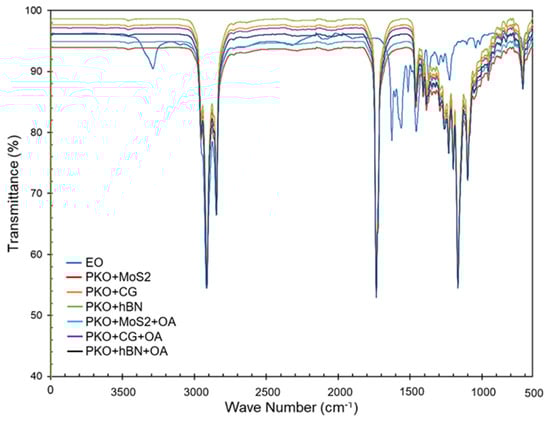
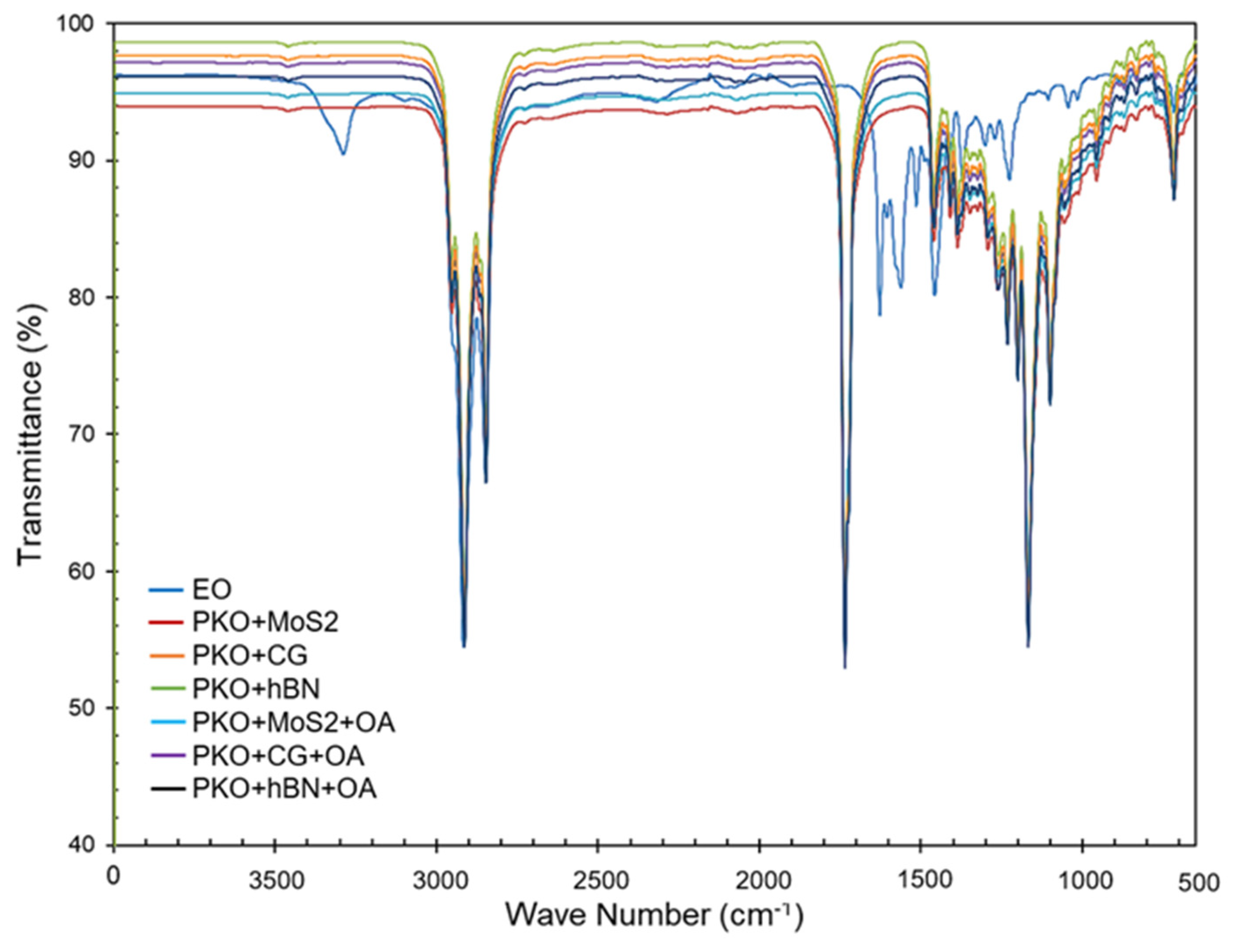
Figure 5 shows that the FTIR spectra of the base fluids (engine oil) are dominated by the characteristic functional groups of long-chain hydrocarbons. Strong CH2 asymmetric and symmetric stretching vibrations are observed at 2958 and 2850 cm−1, while the ester carbonyl band at ~1740 cm−1 is sharp and intense, confirming the ester backbone of palm kernel oil. Additional bands at 1465 and 1377 cm−1 correspond to CH2/CH3 bending, with further C–O and C–O–C stretching features in the 1250 to 1000 cm−1 region, and the CH2 rocking band at ~720 cm−1. These assignments indicate that the chemical structure of the oils remains intact throughout the formulation process, with no evidence of hydrolysis, oxidation, or transesterification under the studied conditions.
Figure 5.
FTIR analysis of sample lubricant effects on adhesion.
For samples containing nanoparticles alone (MoS2, carbon/graphite, and hBN), the main PKO bands are preserved without significant shifts, confirming that no new covalent chemical species are formed. The observed changes are limited to small peak broadening, minor intensity variations, and slight baseline distortions, which can be attributed to physical adsorption of oil molecules on nanoparticle surfaces and light scattering effects. A weak perturbation around ~1360 cm−1 is observed in the PKO + hBN sample, which may reflect a B–N contribution. The spectra suggest that, in the absence of dispersant, the nanoparticles remain physically dispersed, with only weak interfacial interactions with the oil matrix.
The inclusion of oleic acid (OA) as a surfactant introduces distinct and consistent spectral modifications. All OA-containing samples display broadening of the ester carbonyl region with a new shoulder near 1710 to 1725 cm−1, together with an enhanced broad absorption in the 3500 to 2500 cm−1 region. These changes are characteristic of hydrogen-bonded carboxylic acids and indicate that OA successfully adsorbs onto nanoparticle surfaces while interacting with the oil matrix through its hydrophobic tail. This adsorption process reflects the role of OA in stabilizing the dispersion of nanoparticles, which was particularly evident in the PKO + hBN + OA formulation, where the most pronounced carbonyl broadening was detected. Therefore, the FTIR analysis confirms that, while the base oil structure remains stable, OA functions effectively as a dispersant by anchoring nanoparticles via its polar carboxyl head and providing steric stabilization through its hydrocarbon chain. The summarised results are shown in Table 3.
Table 3.
FTIR analysis of each peak in all of the samples.
3.3. Analysis on Kinematic Viscosity
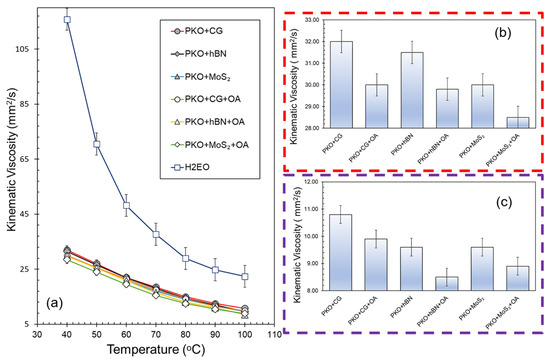
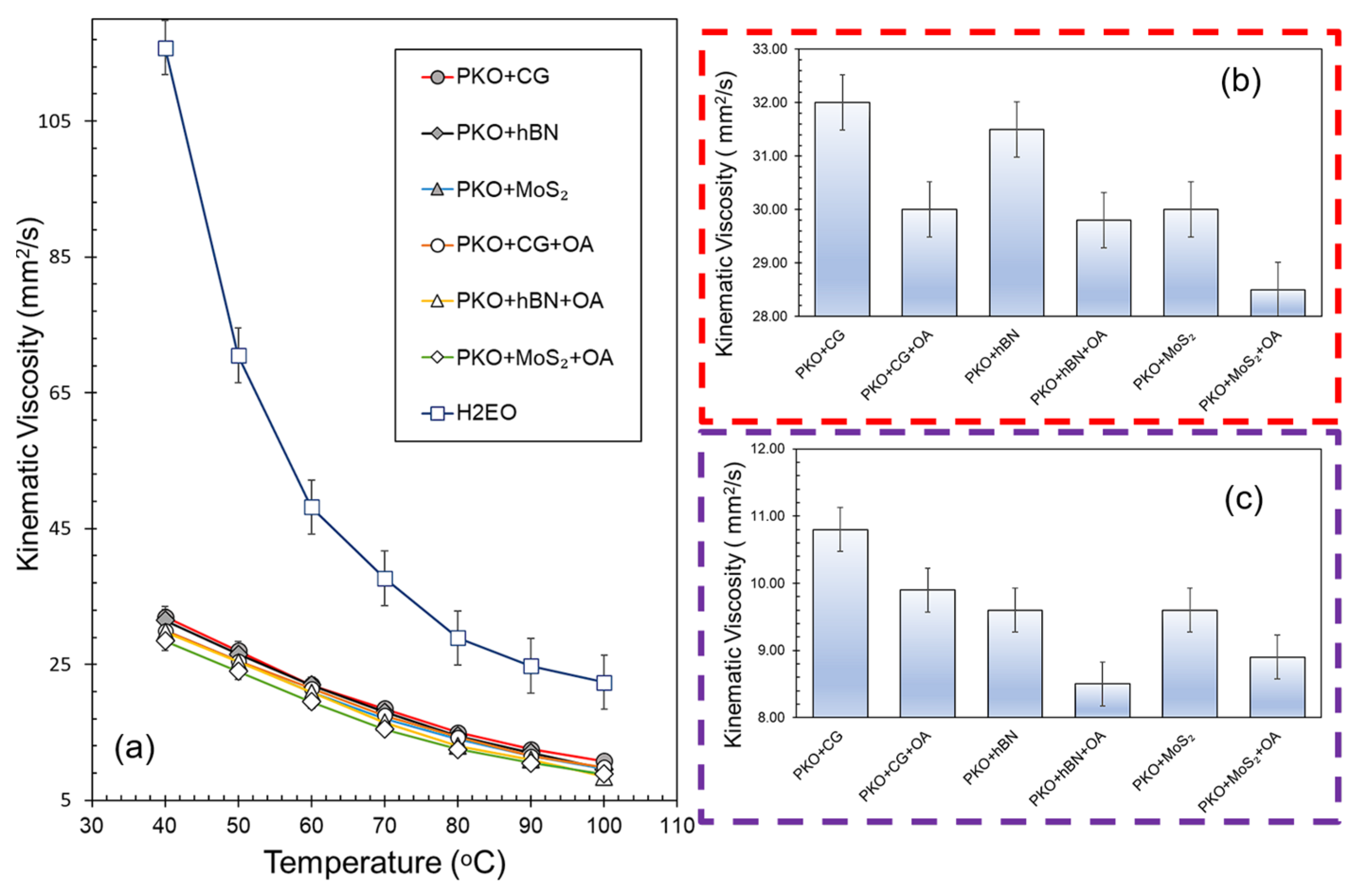
The kinematic viscosity profiles of PKO-based nanolubricants with various nanoparticles (CG, hBN, and MoS2) and the influence of oleic acid (OA) as a surfactant are shown in Figure 6. From 40 to 100 °C, all PKO-based nanolubricants showed decreasing viscosity with temperature. Compared to the H2EO reference oil, PKO-based nanolubricants displayed significantly lower viscosities, reflecting PKO’s inherently lower molecular weight triglyceride composition. The narrow separation between viscosity curves for the PKO nanolubricants indicates that the 0.05 wt% nanoparticle loading only modestly influences bulk rheology at elevated temperatures. The calculated viscosity index (VI) values for the nanolubricants ranged from 175 to 188, which are considerably higher than that of H2EO (VI ≈ 152), suggesting superior viscosity temperature stability and greater potential for maintaining lubricating film thickness over a range of operating conditions.
Figure 6.
Kinematic viscosity of all samples at (a) 40–100 °C, (b) 40 °C, and (c) 100 °C.
At 40 °C (Figure 6b), the PKO + CG and PKO + hBN samples without OA exhibited the highest viscosities (32.05 mm2 s−1 and 31.87 mm2 s−1, respectively), suggesting that nanoparticle agglomeration may have increased hydrodynamic drag in the oil matrix [21]. This finding is consistent with the optical microscopy results (Figure 6a), where larger agglomerates were observed in the OA-free formulations. Upon OA incorporation, the viscosities for PKO + CG and PKO + hBN decreased to 30.85 mm2 s−1 and 29.65 mm2 s−1, respectively, reflecting improved dispersion stability and reduced particle clustering. The smaller, more uniformly dispersed nanoparticles likely reduced flow resistance.
Alignment with fluid induces streamlining, thereby lowering internal shear stresses [26]. This is further evidenced by the slight increase in VI for these OA-containing formulations (from ~180 to ~185), indicating that improved nanoparticle dispersion enhanced the oil’s ability to resist viscosity loss with temperature.
At 100 °C, viscosity values decreased for all formulations (8.84–10.94 mm2 s−1), consistent with thermal thinning of the oil. While absolute differences between samples were smaller than at 40 °C, the relative variation between the highest and lowest values was in fact larger (~23% at 100 °C vs. ~12% at 40 °C). This indicates that nanoparticle type and OA addition continued to influence viscosity even at elevated temperatures, although the trends cannot be attributed solely to particle aggregation without further rheological analysis. The lowest viscosities were recorded for PKO + hBN + OA (8.84 mm2 s−1) and PKO + MoS2 + OA (9.12 mm2 s−1), which may reflect the combined effect of thermal thinning and the presence of smaller, well-dispersed particles contributing less to hydrodynamic resistance. Interestingly, MoS2-based nanolubricants showed only marginal VI improvement with OA (from ~176 to ~178), aligning with earlier findings that OA’s stabilisation effect on MoS2 is weaker over extended periods. Overall, these viscosity, temperature, and VI results confirm that OA-enhanced dispersion stability translates into higher VI values and better thermal robustness, particularly for CG and hBN systems, where agglomeration control is most effective.
3.4. Analysis of Friction Under Extreme Pressure
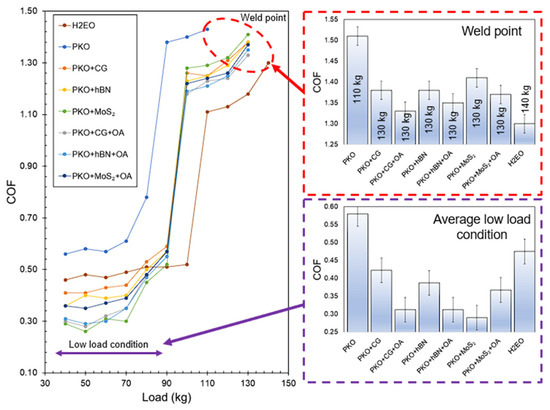
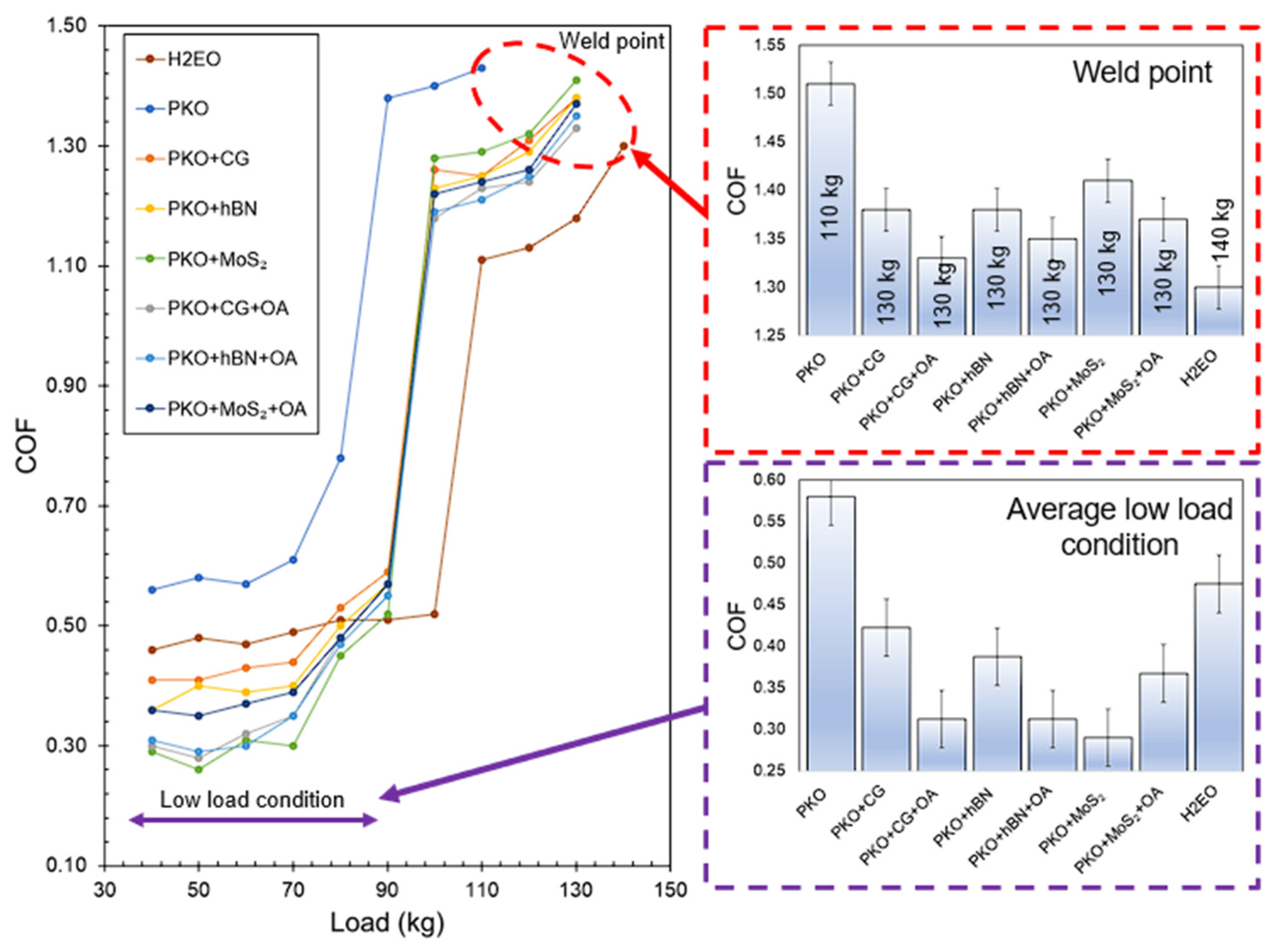
The relationship between the coefficient of friction (COF) and the applied load for PKO-based nanolubricants, including CG, hBN, and MoS2, both with and without oleic acid (OA), is shown in Figure 7. Under low load conditions (40–90 kg), all formulations including nanoparticles demonstrated a significant decrease in coefficient of friction (COF) compared to pure palm kernel oil (PKO) and H2EO. Pure PKO had the greatest average COF of 0.58, while the incorporation of CG decreased this value to 0.43, reflecting a 25.86% decrease. The use of OA further reduced the COF to 0.28 for PKO + CG + OA, signifying a 51.72% decrease compared to PKO. This large improvement aligns with the optical microscopy and viscosity results, indicating that OA markedly decreased CG agglomeration size by 30.4% and improved dispersion stability, resulting in more uniform nanoparticle distribution in the tribological contact zone. In hBN-based samples, the addition of OA decreased the COF from 0.38 to 0.31, representing an 18.42% reduction, which aligns with the mild but steady enhancement in dispersion seen over a 7-day period. Nanolubricants based on MoS2 had the lowest coefficient of friction (COF) of 0.36 under low load when mixed with oleic acid (OA), indicating a 37.93% decrease compared to palm kernel oil (PKO), despite previous findings suggesting that OA’s long-term stabilisation impact on MoS2 was limited, whereas nanolubricants based on MoS2 showed a decline in performance when OA surfactant was added. This finding is in agreement with other research that found lower COF values in MoS2 nanolubricants without surfactant as compared to those which include OA [39,40]. Because of the increased friction, OA may prevent MoS2 nanoparticles from effectively interacting with the contact surfaces, which would restrict their ability to form a protective tribofilm.
Figure 7.
Coefficient of friction, weld point, and average low load condition for all samples.
Nanoparticles increased the weld point from 110 kg (PKO) to 130 kg, improving load-bearing capacity by 18.18%. The PKO + CG + OA sample exhibited the lowest coefficient of friction at the weld site (1.28), reflecting an estimated 15.2% decrease relative to PKO, indicating a synergistic effect of OA and CG in forming a robust composite tribofilm under extreme pressure. In the hBN systems, the addition of OA decreased the weld-point coefficient of friction from 1.39 to 1.35 (a 2.88% reduction) and from 1.37 to 1.34 (a 2.19% reduction), respectively, indicating the synergistic effects of enhanced dispersion and diminished boundary resistance, as evidenced by the viscosity index improvement from approximately 180 to approximately 185 for these systems.
Correlation of COF data with dispersion stability reveals that nanolubricants exhibiting superior particle stability generally demonstrate reduced COF, particularly in boundary lubrication conditions at low loads. In the case of hBN, despite a small drop in agglomeration size with OA (from 14.34 to 14.12 μm), the particle distribution exhibited temporal stability, resulting in a consistently low coefficient of friction over the entire load spectrum. Conversely, MoS2 exhibited a small OA-induced decrease in agglomeration size (from 16.45 to 16.40 μm initially) and a moderate enhancement in viscosity index (about 176 to 178), while still gaining tribological advantages, owing to its inherent layered architecture that promotes shear.
PKO + CG + OA showed a reduced COF compared to the other nanolubricant formulations, likely due to differences in lubrication mechanisms under extreme pressure boundary conditions. For PKO + CG + OA, the synergistic interaction between oleic acid (OA) and carbon graphene (CG) is the key factor, where OA improves CG dispersion stability by approximately 30.4% (reduced agglomerate area and smaller mean platelet size), enabling more graphene platelets to enter and remain active in the contact zone [20]. OA also chemisorbs onto steel surfaces, forming an iron–oleate boundary layer, while CG integrates into this layer to create a lamellar solid–liquid composite tribofilm that can shear easily and patch micro-defects, thereby suppressing severe adhesion. Graphene’s high in-plane thermal conductivity further dissipates localised flash temperatures, reducing the risk of seizure, as explained by [24]. In contrast, benchmark lubricant benefits from its higher base oil viscosity and strong polar ester boundary film formation, which more effectively maintains a stable fluid film at the weld point. While PKO + CG + OA shows slightly higher COF because its mechanism relies more on boundary and solid lubrication rather than continuous thick-film separation, the difference is minimal, and its improved viscosity index still supports consistent film formation at high loads. This demonstrates that optimised additive chemistry in PKO + CG + OA can achieve friction performance comparable to that of the benchmark oil, despite relying on a lower-viscosity base fluid.
3.5. Analysis of Wear Scar Diameter
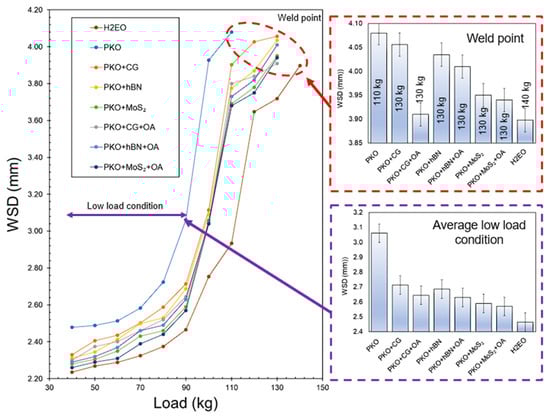
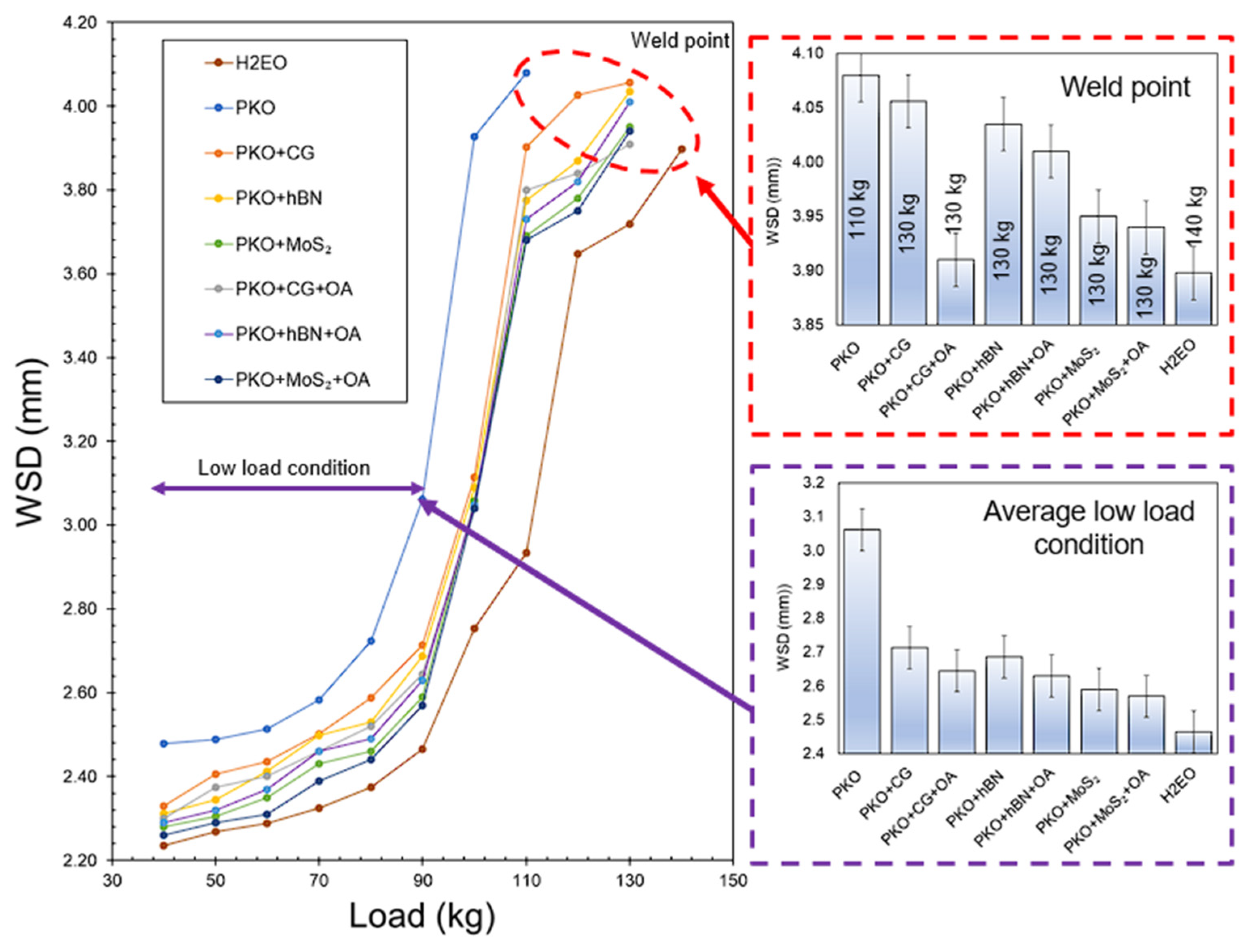
Figure 8 illustrates the progression of wear scar diameter (WSD) in relation to applied load for PKO-based nanolubricants, including CG, hBN, and MoS2, both with and without oleic acid (OA). Under low load conditions (40–90 kg), all formulations including nanoparticles demonstrated reduced WSD values in comparison to pure PKO. Pure PKO had the highest average low-load WSD at 3.06 mm, whereas the incorporation of CG decreased this reading to 2.71 mm, reflecting a 11.44% decrease. The use of OA further reduced the WSD to 2.65 mm for PKO + CG + OA, indicating a 13.40% drop relative to PKO. These enhancements correspond with previous dispersion stability findings, whereby the inclusion of OA decreased CG agglomeration size by 30.4% and improved uniformity, facilitating CG’s formation of a more constant protective layer in the contact zone, hence mitigating wear propagation.
Figure 8.
The effect of OA surfactant on wear scar diameter at the weld point and the average low load condition.
The average low-load wear scar diameter for hBN-based nanolubricants decreased from 2.69 mm without oleic acid to 2.63 mm with oleic acid, indicating a 2.23% reduction. The decrease, although less significant than that of CG, presumably contributed to consistent wear protection because of the stability enhancement shown by optical microscopy. Nanolubricants based on MoS2 demonstrated a decrease in wear, exhibiting WSD values of 2.59 mm without OA and 2.57 mm with OA under low load conditions. The moderate OA impact aligns with previous studies indicating that OA offers limited long-term stabilisation for MoS2; yet, the intrinsic lamellar structure of MoS2 provides underlying anti-wear properties via straightforward interlayer shear, enhancing lubrication efficacy [41].
The WSD trends exhibit a high correlation with previously reported COF and viscosity data. Nanolubricants exhibiting enhanced dispersion stability (CG + OA and hBN + OA) showed less friction and wear, especially under mixed lubrication conditions at low loads. The reduced viscosity at 40 °C in samples containing OA likely facilitated lubricant flow into the contact interface, while the higher VI guaranteed superior film thickness preservation at elevated temperatures [42]. In MoS2-based lubricants, despite the modest augmentation of OA dispersion, the amalgamation of high load-carrying capacity, low coefficient of friction at the weld site, and minimum wear scar diameter expansion substantiates that the inherent features of nanoparticles may partly mitigate dispersion-related constraints. This substantiates the assertion that particle stability and material properties collaboratively dictate the tribological efficacy of PKO-based nanolubricants.
The performance of PKO + CG + OA at the weld point is similar to that of benchmark lubricant, but the effects on tribological behaviour diverge, offering significant insights into the reasons why PKO + CG + OA attains comparably low WSD values. Both lubricants exhibit strong resistance to severe adhesive failure under extreme pressure, yet PKO + CG + OA’s advantage lies in the synergistic action between CG and OA. CG contributes a lamellar solid lubrication effect, while OA enhances CG’s dispersion stability in PKO and chemisorbs onto steel surfaces to form a load-bearing iron–oleate film [43]. This dual action creates a uniform and resilient tribofilm that suppresses abrasive and adhesive wear. H2EO, on the other hand, benefits from its inherently higher viscosity and stronger boundary film formation due to its polar ester structure, which helps maintain a stable lubricant layer and delay severe wear onset. However, while H2EO’s high viscosity index ensures consistent film thickness across temperature variations, PKO + CG + OA achieves a similar effect through its improved dispersion stability and composite tribofilm formation, despite having slightly lower viscosity. This explains why PKO + CG + OA and H2EO exhibit similar WSD performance and maintain surface protection effectively, but PKO + CG + OA does so through a synergistic additive mechanism, whereas the benchmark lubricant relies more on bulk fluid film stability. The comparable results highlight that, in extreme pressure regimes, optimised additive interactions can achieve wear mitigation equivalent to that of a high-viscosity base oil [44].
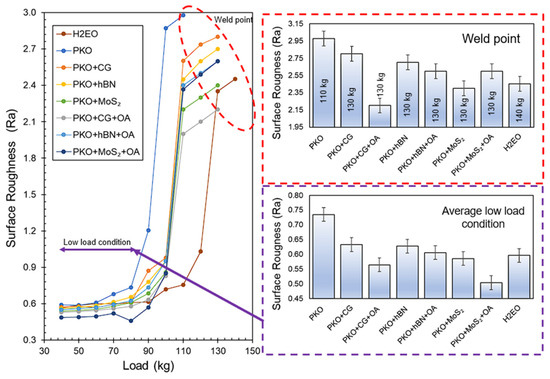
3.6. Analysis of Surface Roughness
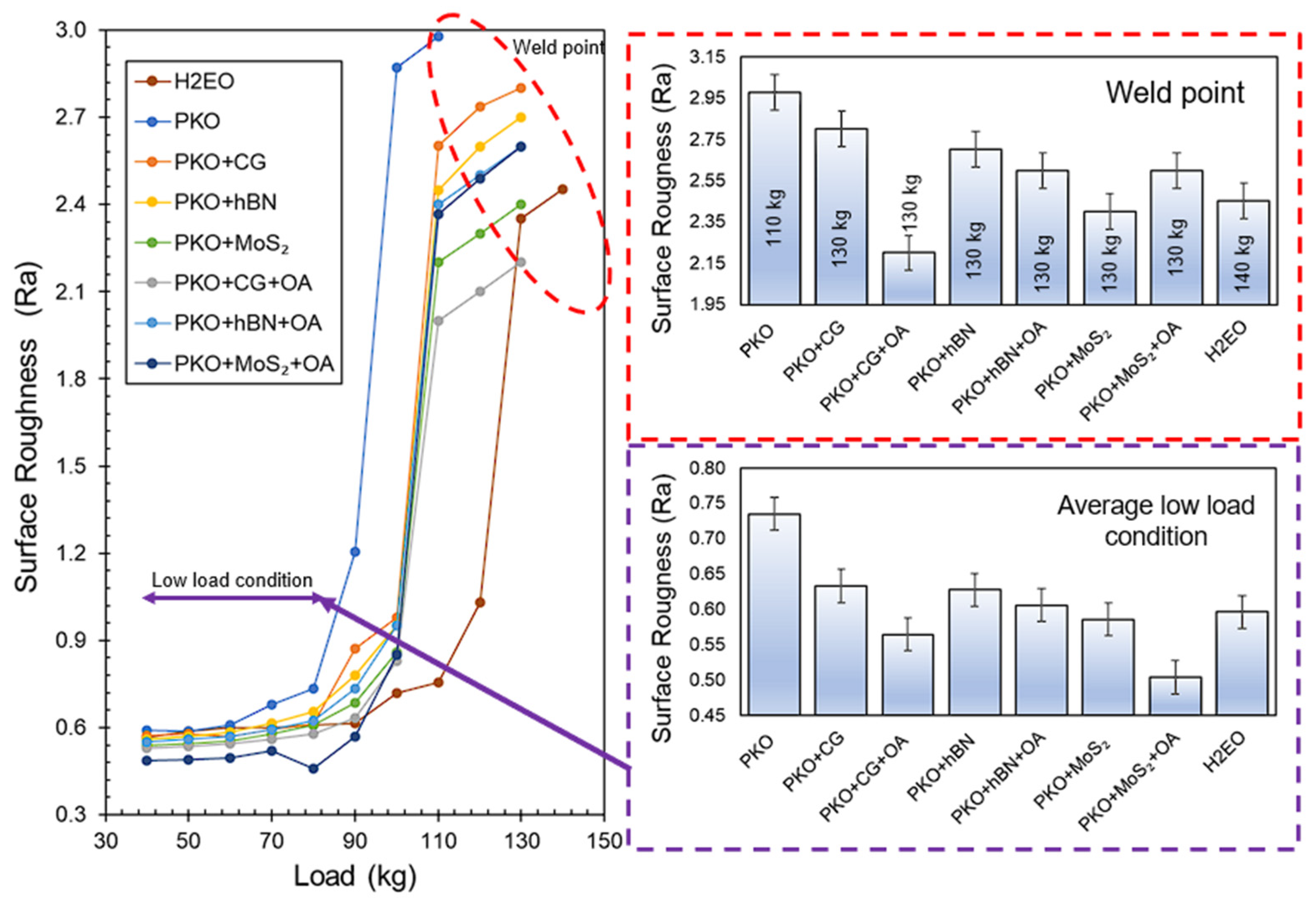
Under low load conditions (40–90 kg), the PKO + MoS2 + OA nanolubricant has the lowest average surface roughness of all tested formulations, surpassing the benchmark lubricant, as seen in Figure 9. The enhanced surface smoothing results from the synergistic interaction between the intrinsic lamellar crystal structure of MoS2 and the surfactant characteristics of OA. Dispersion analysis revealed that OA resulted in a small reduction in initial MoS2 agglomerate size (from 16.45 μm to 16.40 μm) and offered minimal enhancement in long-term stability. However, DLS and optical microscopy findings corroborated that MoS2 suspensions with OA exhibited marginally smaller agglomerates over time relative to those without OA. This provisional stabilisation facilitated a more uniform distribution of MoS2 platelets inside the tribological contact zone, hence reducing three-body abrasion.
Figure 9.
Analysis of surface roughness at the weld point and the average low load condition.
The polar head of oleic acid chemisorbs onto steel surfaces, creating an iron–oleate boundary coating that reduces asperity–asperity contact, while the nonpolar tail aligns with the lubricating medium to improve wettability [28]. This mixed solid–liquid tribofilm, when integrated with readily sheared MoS2 platelets, reduces ploughing and micro-cutting, resulting in smoother worn surfaces. Conversely, H2EO depends mostly on its elevated viscosity and ester-based polar film to maintain a larger hydrodynamic layer; yet, during boundary lubrication at low loads, the protective composite film composed of PKO + MoS2 + OA offers superior micro-scale asperity modification. This aligns with the observed correlation among enhanced nanoparticle dispersion, decreased friction, and diminished wear scar diameter in OA-containing systems, affirming that even slight improvements in dispersion when combined with a solid lubricant of intrinsically low shear strength can lead to substantial reductions in surface roughness.
At the weld load, the surface roughness findings reveal that PKO + CG + OA attains the lowest Ra value among all formulations, even surpassing the benchmark lubricant, hence illustrating the efficacy of integrating CG with OA in extreme pressure lubrication. Optical microscopy and dispersion analysis showed that OA decreased CG agglomeration, facilitating more uniform nanoparticle distribution in the contact zone. This stable dispersion enables the creation of a robust, load-bearing composite tribofilm, whereby oleic acid chemisorbs onto steel to produce an iron–oleate layer, while calcium glycerophosphate integrates into this layer, providing lamellar solid lubrication that occupies grooves on the surface and mitigates significant adhesive wear [45]. However, PKO + MoS2 without OA displays surface roughness at the weld site that is comparable to that seen with the benchmark lubricant, due to MoS2’s intrinsic layered structure that facilitates shear and efficient load-bearing, while restricting dispersion enhancement. The incorporation of OA into MoS2 unexpectedly enhances surface roughness, presumably due to OA’s insignificant stabilising effect on MoS2 (agglomerate size alteration from 16.45 μm to 16.40 μm) and possible disruption of MoS2 platelet arrangement at the contact interface, resulting in diminished cohesive tribofilm development. These trends align with the friction and wear scar diameter data, confirming that, under extreme pressure, superior nanoparticle dispersion stability such as in PKO + CG + OA yields smoother surfaces, while limited or counterproductive surfactant interaction, as in PKO + MoS2 + OA, can diminish surface finish quality despite the presence of a solid lubricant.
3.7. Analysis of Worn Surface
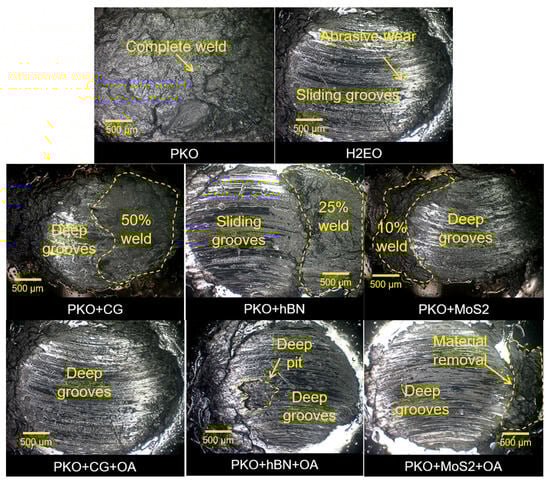
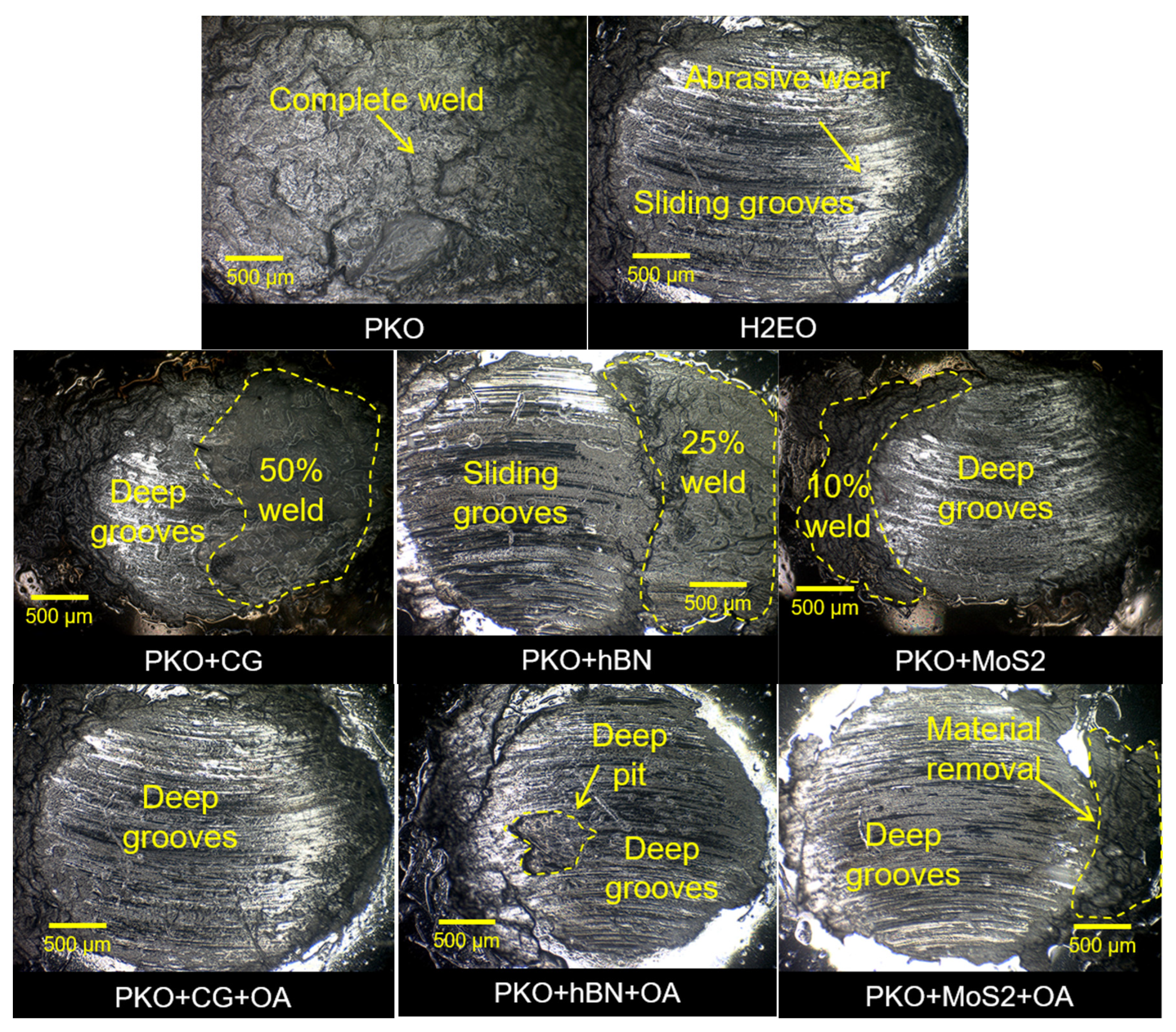
At a 110 kg load, the worn surface morphologies in Figure 10 reveal distinct wear patterns that correlate closely with the measured surface roughness values. PKO + CG + OA exhibits the smoothest surface among all tested lubricants at this load, characterised by the presence of deep grooves but without large-scale material removal. This observation is consistent with its lowest Ra value and is attributed to the synergistic interaction between CG and OA. The incorporation of OA improves CG dispersion stability by 30.4%, reducing the agglomerate size from 17.61 µm to 12.23 µm, thereby promoting more uniform distribution of graphene platelets within the contact zone. These well-dispersed platelets interact with an OA-derived iron–oleate boundary layer to form a dense composite tribofilm that effectively patches micro-defects, sustains high contact stress, and mitigates severe adhesive wear.
Figure 10.
Analysis of worn surfaces with all samples at 110 kg.
In addition to its role in dispersion stabilisation, OA may also contribute through a surface-activity-mediated mechanism consistent with the Rehbinder effect. Under extreme pressure boundary lubrication, repeated asperity fracture and micro-welding events generate freshly exposed metallic surfaces [27]. The adsorption or chemisorption of OA molecules on these nascent surfaces can reduce local surface energy, thereby weakening adhesive junctions and facilitating interfacial shear during sliding. Such surface-energy reduction does not alter the bulk mechanical properties of the steel but may locally modify the near-surface deformation behaviour, contributing to smoother shearing and reduced material pull-out [37]. When coupled with load-sharing graphene platelets, this Rehbinder-type interfacial effect does not directly strengthen the tribofilm, but instead moderates adhesive junction growth and interfacial shear severity. By reducing the tendency for catastrophic adhesive pull-out during sliding, the surface-activity-mediated weakening of adhesion enables the graphene–oxide composite tribofilm to survive repeated high-load contact, thereby exhibiting enhanced endurance and surface integrity at elevated loads.
In comparison, the benchmark lubricant also maintains relatively low surface roughness but exhibits abrasive wear with distinct sliding grooves, indicating a different lubrication mechanism. Its wear protection stems primarily from its high viscosity and polar ester-based film, which provides stable fluid separation under load. However, without reinforcement from well-dispersed solid lubricants, the surface is more prone to groove formation from entrained debris [46]. PKO + MoS2 presents a surface finish comparable to benchmark lubricant, as reflected in its morphology showing only 10% weld area and deep grooves. This performance is largely due to the intrinsic lamellar structure of MoS2, which facilitates low-shear interlayer sliding and reduces friction under high load conditions.
Conversely, the addition of OA to MoS2 (PKO + MoS2 + OA) results in increased surface roughness and more severe wear, including notable material removal. This outcome is supported by dispersion analysis, which shows that OA has minimal effect on MoS2 stability (agglomerate size change from 16.45 μm to 16.40 μm) and may even interfere with optimal platelet packing in the tribofilm. Such poor surfactant nanoparticle compatibility weakens the cohesion of the protective layer, allowing direct asperity contact and accelerating wear. Overall, these results confirm that, at 110 kg, nanoparticle dispersion stability plays a critical role in surface protection, with PKO + CG + OA forming the most resilient load-bearing film, while PKO + MoS2 + OA suffers from compromised tribofilm integrity despite containing a solid lubricant.
Table 4 presents the EDS spectra analysis of the worn surfaces after testing. The worn morphologies indicate the presence of surface fatigue and spalling pits, even though the PKO + CG + OA nanolubricant effectively reduced abrasive wear. Compared to PKO + CG (8.92 wt%), PKO + CG + OA exhibits a lower carbon content (7.39 wt%), suggesting a reduced extent of fatty-acid-derived carbonaceous species on the contact surface. Concurrently, lubrication with PKO + CG + OA resulted in a slightly higher oxygen concentration (3.98 wt% versus 3.89 wt%), indicating the formation of a more developed oxide layer.
Table 4.
EDS spectra analysis, showing the weight percentage of each element.
The presence of this oxide-rich surface, together with organic carboxylate species consistent with oleic-acid-derived surface reactions, supports a lubrication mechanism dominated by tribofilm formation rather than simple fatty acid adsorption, as also reported by Bahari et al. [47]. Under extreme pressure conditions, repeated asperity fracture and surface renewal expose fresh metallic surfaces, on which surface-active OA molecules may adsorb or react to form iron–oleate-type species. Such adsorption can locally reduce surface energy and weaken adhesive junctions, a behaviour consistent with a Rehbinder-type surface activity effect [38]. This interfacial energy reduction facilitates easier shear at the sliding interface and suppresses severe adhesive pull-out, complementing the protective role of the oxide–carbon composite tribofilm.
For the hBN results, a comparison between PKO + hBN and PKO + hBN + OA revealed an increase in nitrogen content from 1.43% to 2.68%, suggesting a greater deposition of hBN nanoparticles on the worn ball surface. This implies the formation of a thicker hBN tribolayer, enhancing its ability to penetrate the contact zone and minimise direct metal-to-metal contact, thereby improving the lubricating performance of the PKO + hBN + OA nanolubricant. Conversely, the carbon content decreased substantially from 12.54 wt% to 7.39 wt%, indicating reduced adsorption of fatty acids on the worn surface. Additionally, oxygen content was lower for PKO + hBN + OA (2.54 wt%) compared to PKO + hBN (3.23 wt%), signifying reduced surface oxidation, likely due to the diminished fatty acid adsorption [24].
The unstable lubricant film seen with the PKO + MoS2 + OA nanolubricant is likely responsible for the observed increase in COF and WSD. EDS analysis showed lower Mo (1.18 wt%) and S (0.13 wt%) contents for PKO + MoS2 + OA compared to PKO + MoS2, which exhibited contents of 1.92 wt% and 0.13 wt%, respectively [43]. This suggests that the OA surfactant reduced the deposition of MoS2 nanoparticles on the contact surface, hindering the formation of a continuous protective film. In addition, the oxygen content on the worn surface lubricated with PKO + MoS2 + OA (8.64 wt%) was significantly higher than that of PKO + MoS2 (3.51 wt%), indicating the formation of an MoO3 transfer film. The results imply that OA promotes oxidation of MoS2 nanoparticles during sliding, producing an unstable film that increases friction and wear, a phenomenon that is supported by previous findings [48,49]. Raman spectroscopy was conducted to confirm the presence of the MoO3 film. It was also previously reported that OA surfactant failed to reduce the agglomerate size of MoS2 nanoparticles [50]. This agglomeration during sliding reduces the number of nanoparticles able to penetrate the contact interface and adsorb onto the surface. Additionally, particle agglomeration may interfere with fatty acid adsorption on the worn surface. The EDS results confirmed this effect, showing that the carbon content decreased from 8.35 wt% in MoS2 to 7.89 wt% in MoS2 + OA, indicating reduced fatty acid adsorption for PKO + MoS2 + OA compared to the PKO + MoS2 nanolubricant. This reduction in both nanoparticle deposition and fatty acid adsorption likely contributed to the poorer tribological performance of the OA-containing formulation [39].
3.8. Analysis of the Chemical Composition of the Worn Surface
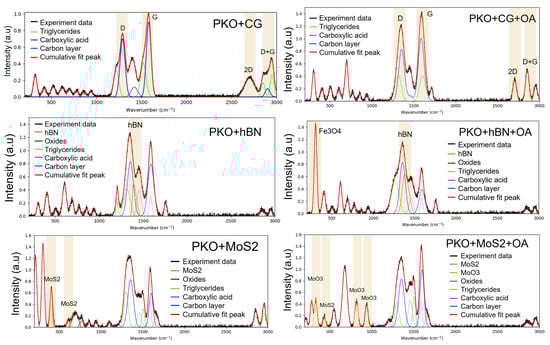
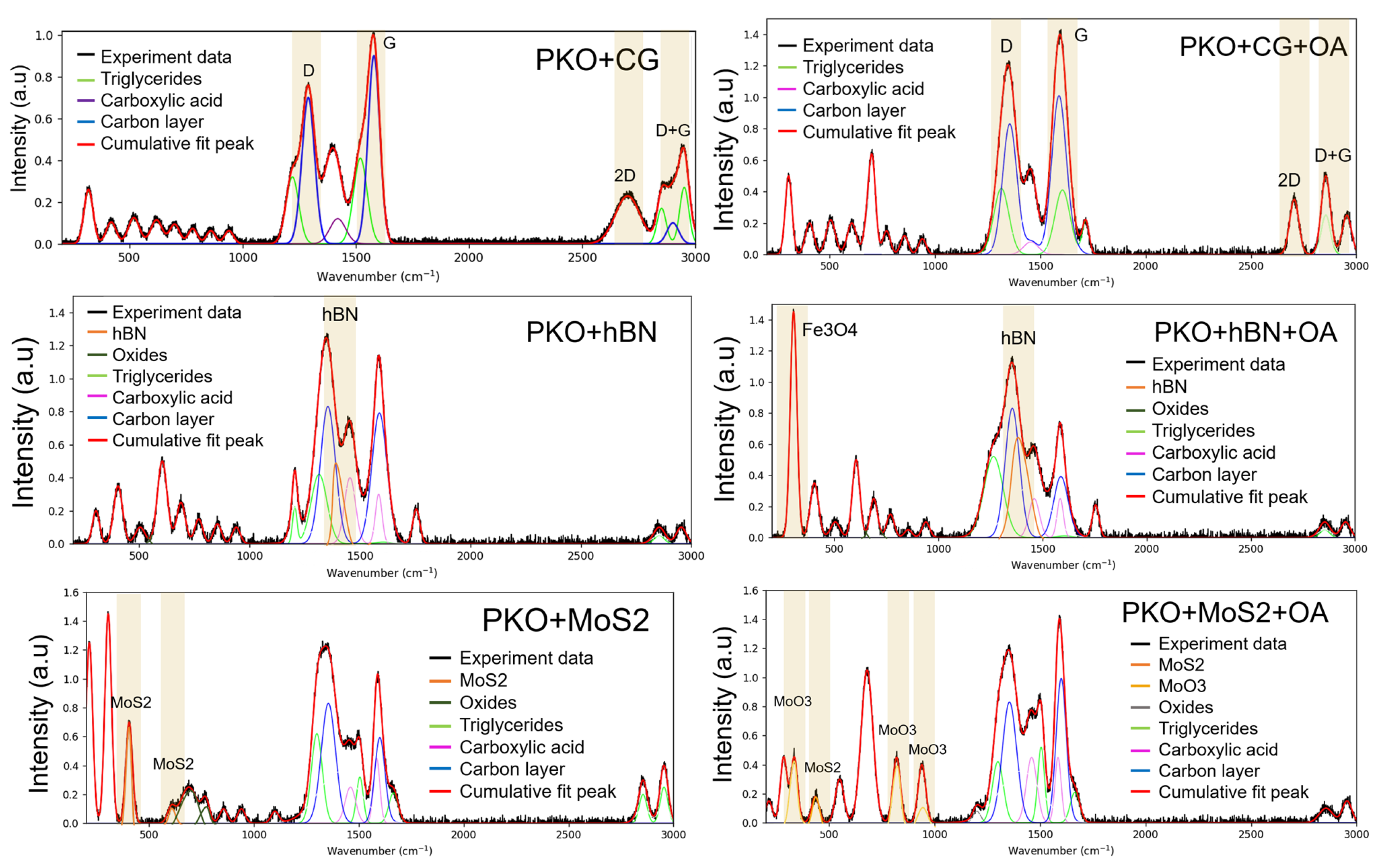
The deconvoluted Raman spectra of the worn surfaces that were lubricated with the PKO + CG and PKO + CG + OA nanolubricants are shown in Figure 11. When PKO + CG + OA was introduced to a worn surface, the iron carboxylate peaks were weaker than when PKO + CG was used alone, indicating that the production of metallic soap films was further reduced. These findings corroborate those from the VPSEM-EDS analysis, which showed that the worn surface had a reduced carbon content [51]. Compared to PKO + CG alone, the PKO + CG + OA nanolubricant probably enabled more CG nanoparticles to access the sliding contact due to its better dispersion stability. Metallic soap film development is reduced due to the increased concentration of CG at the contact zone, which seems to limit the adsorption of fatty acid molecules onto the steel surface [33]. Furthermore, it seems that there are more free-floating fatty acid molecules in the contact area rather than bound ones to the steel surface, as shown by the higher intensity at 1706 cm−1.
Figure 11.
Deconvolution or Raman spectra on the worn surface of all sample.
The VPSEM-EDS findings are further supported by the Raman analysis. Wear on surfaces coated with the PKO + CG + OA nanolubricant was accompanied by a more substantial oxide layer compared with the PKO + CG nanolubricant. The development of one well-known lubricious oxide, Fe3O4, which may help reduce metal-to-metal contact, was induced by the addition of OA surfactant [52]. Additional friction and wear prevention has been seen in some instances when a composite lubricating layer made of carbon and iron oxide is applied [53]. Additionally, the presence of the D, G, and 2D bands in the spectra provided further evidence that CG particles were able to penetrate the sliding contact, deposit on the worn surface, and aid in the formation of a protective tribofilm. The presence of OA resulted in a lower ID/IG ratio (0.83) for the surface lubricated with the PKO + CG + OA nanolubricant compared to the PKO + CG nanolubricant (0.97), indicating that a more ordered tribofilm was formed. Previous research has shown that ordered tribofilms on sliding surfaces are responsible for the better lubricating behaviour of carbon-based nanomaterials, and this suggests that structural ordering is associated with improved lubrication performance [54,55].
Analysing the deconvoluted Raman spectra of the lubricated surfaces that were worn down with the PKO + hBN and PKO + hBN + OA nanolubricants demonstrated that the Fe3O4 peaks were not as strong in the PKO + hBN + OA sample as they were with the PKO + hBN nanolubricant, indicating that there was less iron oxide deposited on the contact surface. Sliding was shown to cause an increase in the intensity at 810 cm−1, which corresponds to Cr (III) oxide, suggesting the opposite. The fact that Cr (III) oxide has been shown to help reduce friction makes this even more beneficial [56]. Figure 11 also shows that the worn surface that was lubricated with PKO + hBN + OA displays the Raman signatures of iron carboxylates at 933, 1427, and 1559 cm−1. Based on the spectra, it seems that the bridging configuration was somewhat less significant in adsorption than monodentate coordination. There was a clear drop in 1427 cm−1 peak intensity compared to the PKO + hBN nanolubricant, suggesting that fewer iron carboxylates bound via bridging modes. The strength of the carbonaceous layer’s distinctive D and G bands was also significantly reduced in PKO + hBN + OA compared to PKO + hBN [57]. These spectrum results are in agreement with the VPSEM-EDS study, which validated the Raman results by confirming a significant decrease in surface carbon content for the PKO + hBN + OA lubricated surface.
The Raman spectra of the worn surfaces that were lubricated with the PKO + MoS2 and PKO + MoS2 + OA nanolubricants are shown in Figure 11. In the PKO + MoS2 + OA system, specific peaks at 522 cm−1 and 673 cm−1 were identified as Cr2O3 and Fe3O4, respectively. The production of a thicker iron oxide layer was suggested by the substantially greater peak intensity of the Fe3O4 compared to PKO + MoS2 alone. This finding is in line with what the VPSEM-EDS analysis revealed: that the worn surface had a much higher oxygen content. At 922, 1382, and 1557 cm−1, iron carboxylate bands were seen in the PKO + MoS2 + OA spectra. A greater percentage of bridging contacts on the steel surface lubricated with PKO + MoS2 + OA is indicated by the more intense 1382 cm−1 peak compared to the 1377 cm−1 peak of PKO + MoS2 in the PKO + MoS2 spectrum. On the other hand, the PKO + MoS2 spectrum’s stronger 1559 cm−1 band implies that monodentate bonding was more common when OA was not present. Furthermore, when contrasted with the metallic soap film produced by PKO + MoS2 alone, the PKO + MoS2 + OA nanolubricant displayed a more organised and compact appearance. The peaks at 2839 and 2954 cm−1 were less intense compared to the peaks at 2851 and 2935 cm−1 for PKO + MoS2, suggesting that the molecules were packed closer together in the film. The addition of OA surfactant significantly altered the structure and behaviour of MoS2 with the PKO + MoS2 nanolubricant. The Raman spectra revealed the formation of defective MoS2 nanoparticles and nonstoichiometric phases, along with the transformation of MoS2 into MoO3, as indicated by peaks at 287, 817, and 955 cm−1. The presence of MoO3 promoted abrasive wear and explained the increased surface roughness of the worn surface lubricated with PKO + MoS2 + OA [49,50]. These findings suggest that OA induced higher structural defects in MoS2, reducing its ability to adsorb and form a stable protective film, thereby increasing friction and wear compared to PKO + MoS2 nanolubricant.
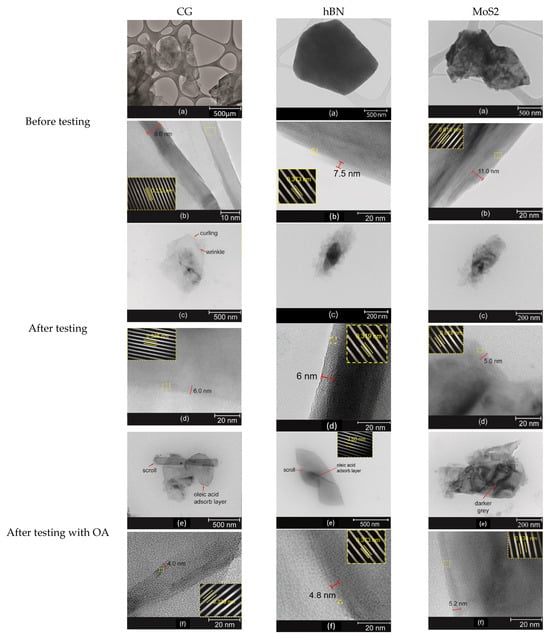
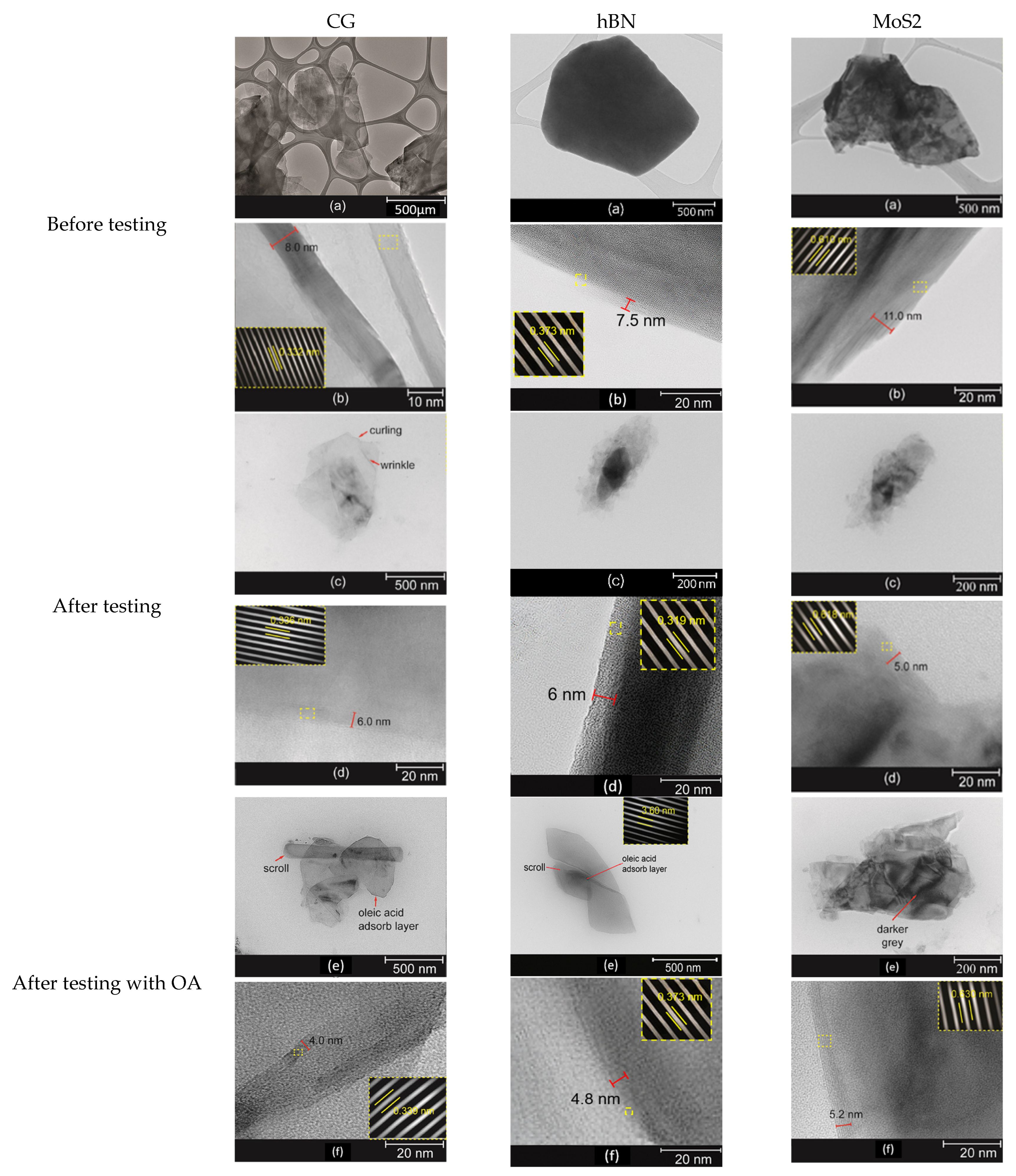
TEM analysis provided crucial insights into the structural evolution of CG, hBN, and MoS2 nanoparticles dispersed in palm kernel oil (PKO) before and after tribological testing (see Figure 12). The exfoliation of CG and MoS2 was evident from the reduced thickness and enlarged interlayer spacing, as seen in the transition from 8.0 nm to 4.0 nm for CG and from 11.0 nm to 5.2 nm for MoS2, respectively. These morphological changes suggest that continuous shearing during sliding facilitated the delamination of multilayer structures into thinner nanosheets, thereby increasing the effective contact area for tribofilm formation. In contrast, hBN maintained its layered morphology with a moderate decrease in thickness (~7.5 nm to 4.8 nm), indicating that it acted primarily as a solid lubricant with stable lattice integrity. The presence of oleic acid (OA) was found to form a uniform adsorption layer around all three nanomaterials, preventing severe agglomeration and promoting better dispersion stability within the PKO medium. This stable distribution likely enhanced the nanoparticles’ ability to enter the contact interface, resulting in improved anti-wear and load-bearing properties [33].
Figure 12.
TEM images of wear after testing each sample (a) low magnification before testing, (b) high magnification before testing, (c) low magnification after testing (d) high magnification after testing, (e) low magnification after testing with OA and (f) high magnification after testing with OA.
The observed microstructural behaviour aligns closely with the macroscopic tribological performance, confirming OA’s decisive role in enhancing PKO-based nanolubricants. The reduction in CG agglomeration by 30.4% and the improvement in viscosity index (from 176 to 188) suggest that OA effectively stabilised the nanoparticles under EP. Consequently, the PKO + CG + OA formulation exhibited the most significant friction reduction (51.7%) and wear scar minimization (13.4%), attributed to the synergistic exfoliation intercalation mechanism where OA molecules penetrated between nanoparticle layers to form an elastic “spring-like” tribofilm. Meanwhile, the moderate enhancement observed with PKO + hBN + OA and PKO + MoS2 + OA indicates that hBN contributed mainly through surface rolling effects, while MoS2 offered lamellar shear support. These findings demonstrate that OA-assisted PKO nanolubricants exhibit superior lubrication stability, improved thermal endurance, and enhanced protective tribofilm formation, highlighting their potential as sustainable, bio-based formulations for demanding extreme pressure and high-shear tribological conditions.
4. Conclusions
This study confirmed that the addition of oleic acid (OA) plays a decisive role in enhancing the dispersion stability of PKO-based nanolubricants under extreme pressure (EP) conditions. Particle size analysis showed a 30.4% reduction in CG agglomeration (from 17.61 μm to 12.23 μm), which promoted more homogeneous nanoparticle distribution. This improvement translated into a higher viscosity index of 188 compared to ~176 without OA and only 152 for the benchmark lubricant baseline, confirming enhanced temperature stability. Tribological testing under EP conditions further demonstrated that OA-assisted formulations significantly improved performance. The coefficient of friction was reduced by 51.7% for PKO + CG + OA (0.58 to 0.28) and by 18.4% for PKO + hBN + OA. Weld load resistance increased by 18.2% relative to pure PKO, while wear scar diameter decreased by 13.4% with PKO + CG + OA. These results collectively indicate superior load-carrying capacity and wear protection. The observed improvements are particularly relevant to tribological systems operating under elevated thermal and mechanical stresses. The enhanced dispersion stability and tribofilm formation achieved through OA-assisted PKO nanolubricants highlight their potential as sustainable, bio-based formulations for high-load extreme-pressure lubrication.
The present work focused on short-term dispersion behaviour and extreme pressure (EP) tribological screening under standardised four-ball test conditions. While these results provide valuable comparative insights into lubricant formulation performance, future studies may extend the evaluation to longer-duration loading conditions and application-relevant contact configurations, such as piston ring–cylinder liner tribotesting. In addition, tribological experimentals conducted under hydrogen-rich or hydrogen-assisted combustion environments would be necessary to elucidate hydrogen-specific wear mechanisms and to assess the performance of OA-stabilised nanolubricants under conditions representative of hydrogen-fuelled internal combustion engines.
Supplementary Materials
The following supporting information can be downloaded at: https://www.mdpi.com/article/10.3390/lubricants14010017/s1.
Author Contributions
A.Y. and S.S. conceived the research idea and designed the study. A.Y., Z.P., and N.F.A. performed the experimental work and data acquisition, while A.Y. and N.F.A. carried out the formal data analysis. S.S. and S.K. provided resources and technical guidance throughout the project. The original manuscript was drafted by A.Y., with critical review and editing contributed by S.S., Z.P., and N.F.A. Visualization and data interpretation were handled by A.Y. Overall supervision, project administration, and funding acquisition were led by S.S. and S.K. All authors have read and agreed to the published version of the manuscript.
Funding
This research received no external funding.
Data Availability Statement
The datasets generated and analysed during this study are available in the Supplementary Materials.
Acknowledgments
The authors would like to express their gratitude to the Ministry of Higher Education (MOHE) Malaysia for its support through the Higher Institution Centre of Excellence (HiCOE) program under the HiCOE Research Grant (R.J130000.7824.4J743) and to the Universiti Teknologi Malaysia (UTM) for the UTMFR Grant (22H46) and JVR Grant (00P63).
Conflicts of Interest
The authors declare no conflicts of interest.
References
- Abdul Sani, A.S.; Rahim, E.A.; Samion, S. Tribological performance of modified jatropha oil containing oil-miscible ionic liquid for machining applications. J. Mech. Sci. Technol. 2017, 31, 5675–5685. [Google Scholar] [CrossRef] [Scilit]
- Prasannakumar, P.; Sankarannair, S.; Prasad, G.; S, P.; P, V.; S, S.; Shanmugam, R. Bio-based additives in lubricants: Addressing challenges and leveraging for improved performance toward sustainable lubrication. Biomass Convers. Biorefin. 2025, 15, 17969–17997. [Google Scholar] [CrossRef] [Scilit]
- Pichler, J.; Maria Eder, R.; Besser, C.; Pisarova, L.; Dörr, N.; Marchetti-Deschmann, M.; Frauscher, M. A comprehensive review of sustainable approaches for synthetic lubricant components. Green Chem. Lett. Rev. 2023, 16, 2185547. [Google Scholar] [CrossRef] [Scilit]
- Liu, H.; Yu, S.; Wang, T.; Li, J.; Wang, Y. A systematic review on sustainability assessment of internal combustion engines. J. Clean. Prod. 2024, 451, 141996. [Google Scholar] [CrossRef] [Scilit]
- Khanam, Z.; Sultana, F.M.; Mushtaq, F. Environmental pollution control measures and strategies: An overview of recent developments. In Geospatial Analytics for Environmental Pollution Modeling: Analysis, Control and Management; Springer Nature Switzerland: Cham, Switzerland, 2023; pp. 385–414. [Google Scholar] [CrossRef] [Scilit]
- Opia, A.C.; Abdollah, M.F.B.; Hamid, M.K.A.; Veza, I. A review on bio-lubricants as an alternative green product: Tribological performance, mechanism, challenges and future opportunities. Tribol. Online 2023, 18, 18–33. [Google Scholar] [CrossRef] [Scilit]
- El-Adawy, M.; Nemitallah, M.A.; Abdelhafez, A. Towards sustainable hydrogen and ammonia internal combustion engines: Challenges and opportunities. Fuel 2024, 364, 131090. [Google Scholar] [CrossRef] [Scilit]
- Oktar, H.E.; Tonyali, I.H.; Apaydin, A.H. A cost-effective and sustainable path to a green future: Retrofitting internal combustion engines for hydrogen fuel utilization. Int. J. Hydrogen Energy 2025, 143, 969–977. [Google Scholar] [CrossRef] [Scilit]
- Taylor, R.I. Fuel-lubricant interactions: Critical review of recent work. Lubricants 2021, 9, 92. [Google Scholar] [CrossRef] [Scilit]
- Zhang, Q.; Kalva, V.T.; Tian, T. Modeling the Evolution of Fuel and Lubricant Interactions on the Liner in Internal Combustion Engines (No. 2018-01-0279); SAE Technical Paper; SAE International: Warrendale, PA, USA, 2018. [Google Scholar] [CrossRef] [Scilit]
- Butcher, R.; Bradley, N.; Jamieson, M.; Chambers, T. Aspects of Engine Lubricant Operating Conditions and Fuel Economy Differentiation; In-Vehicle Comparisons of Standard Internal Combustion Engine with Two Types of Hybrid Electric (No. 2024-01-2824); SAE Technical Paper; SAE International: Warrendale, PA, USA, 2024. [Google Scholar] [CrossRef] [Scilit]
- Khedr, A.M.; El-Adawy, M.; Ismael, M.A.; Qador, A.; Abdelhafez, A.; Ben-Mansour, R.; Habib, M.A.; Nemitallah, M.A. Recent fuel-based advancements of internal combustion engines: Status and perspectives. Energy Fuels 2025, 39, 5099–5132. [Google Scholar] [CrossRef] [Scilit]
- Pardo-García, C.; Orjuela-Abril, S.; Pabón-León, J. Investigation of emission characteristics and lubrication oil properties in a dual diesel–hydrogen internal combustion engine. Lubricants 2022, 10, 59. [Google Scholar] [CrossRef] [Scilit]
- Yusof, S.N.A.; Sidik, N.A.C.; Asako, Y.; Japar, W.M.A.A.; Mohamed, S.B.; Muhammad, N.M.A. A comprehensive review of the influences of nanoparticles as a fuel additive in an internal combustion engine (ICE). Nanotechnol. Rev. 2020, 9, 1326–1349. [Google Scholar] [CrossRef] [Scilit]
- Forero, J.D.; Ochoa, G.V.; Alvarado, W.P. Study of the piston secondary movement on the tribological performance of a single cylinder low-displacement diesel engine. Lubricants 2020, 8, 97. [Google Scholar] [CrossRef] [Scilit]
- Koten, H. Hydrogen effects on the diesel engine performance and emissions. Int. J. Hydrogen Energy 2018, 43, 10511–10519. [Google Scholar] [CrossRef] [Scilit]
- Jiang, H.; Hou, X.; Qian, Y.; Liu, H.; Ali, M.K.A.; Dearn, K.D. A tribological behavior assessment of steel contacting interface lubricated by engine oil introducing layered structural nanomaterials functionalized by oleic acid. Wear 2023, 524, 204675. [Google Scholar] [CrossRef] [Scilit]
- Saidi, M.Z.; Pasc, A.; El Moujahid, C.; Canilho, N.; Badawi, M.; Delgado-Sanchez, C.; Celzard, A.; Fierro, V.; Peignier, R.; Chafik, T.; et al. Improved tribological properties, thermal and colloidal stability of poly-α-olefins based lubricants with hydrophobic MoS2 submicron additives. J. Colloid Interface Sci. 2020, 562, 91–101. [Google Scholar] [CrossRef] [Scilit]
- Pawar, R.V.; Hulwan, D.B.; Mandale, M.B. Recent advancements in synthesis, rheological characterization, and tribological performance of vegetable oil-based lubricants enhanced with nanoparticles for sustainable lubrication. J. Clean. Prod. 2022, 378, 134454. [Google Scholar] [CrossRef] [Scilit]
- Al-Janabi, A.S.; Hussin, M.; Abdullah, M.Z.; Ismail, M.A. Effect of CTAB surfactant on the stability and thermal conductivity of mono and hybrid systems of graphene and FMWCNT nanolubricant. Colloids Surf. A Physicochem. Eng. Asp. 2022, 648, 129275. [Google Scholar] [CrossRef] [Scilit]
- Marino, F.; del Rio, J.M.L.; Lopez, E.R.; Fernandez, J. Chemically modified nanomaterials as lubricant additive: Time stability, friction, and wear. J. Mol. Liq. 2023, 382, 121913. [Google Scholar] [CrossRef] [Scilit]
- Gulzar, O.; Qayoum, A.; Gupta, R. Experimental study on stability and rheological behaviour of hybrid Al2O3-TiO2 Therminol-55 nanofluids for concentrating solar collectors. Powder Technol. 2019, 352, 436–444. [Google Scholar] [CrossRef] [Scilit]
- Wen, G.; Wen, X.; Bai, P.; Meng, Y.; Ma, L.; Tian, Y. Effect of mixing procedure of oleic acid and BN nanoparticles as additives on lubricant performance of PAO8. Tribol. Int. 2022, 175, 107842. [Google Scholar] [CrossRef] [Scilit]
- del Rio, J.M.L.; Perez, G.A.; Martínez, A.; Peña, D.; Fernández, J. Tribological improvement of potential lubricants for electric vehicles using double functionalized graphene oxide as additives. Tribol. Int. 2024, 193, 109402. [Google Scholar] [CrossRef] [Scilit]
- Wang, B.; Wang, X.; Lou, W.; Hao, J. Thermal conductivity and rheological properties of graphite/oil nanofluids. Colloids Surf. A Physicochem. Eng. Asp. 2012, 414, 125–131. [Google Scholar] [CrossRef] [Scilit]
- Li, X.; Gan, C.; Han, Z.; Yan, H.; Chen, D.; Li, W.; Li, H.; Fan, X.; Li, D.; Zhu, M. High dispersivity and excellent tribological performance of titanate coupling agent modified graphene oxide in hydraulic oil. Carbon 2020, 165, 238–250. [Google Scholar] [CrossRef] [Scilit]
- Damir, A.; Shi, B.; Elsayed, A.; Thelin, J.; M’Saoubi, R.; Attia, H. On the tribological and thermal aspects of cryogenic machining of Inconel 718 and their effects on surface integrity. Wear 2025, 571, 205855. [Google Scholar] [CrossRef] [Scilit]
- Gulzar, M.; Masjuki, H.H.; Varman, M.; Kalam, M.A.; Mufti, R.A.; Zulkifli, N.W.M.; Yunus, R.; Zahid, R. Improving the AW/EP ability of chemically modified palm oil by adding CuO and MoS2 nanoparticles. Tribol. Int. 2015, 88, 271–279. [Google Scholar] [CrossRef] [Scilit]
- Guo, J.; Barber, G.C.; Schall, D.J.; Zou, Q.; Jacob, S.B. Tribological properties of ZnO and WS2 nanofluids using different surfactants. Wear 2017, 382, 8–14. [Google Scholar] [CrossRef] [Scilit]
- Azman, N.F.; Samion, S.; Sot, M.N.H.M. Investigation of tribological properties of CuO/palm oil nanolubricant using pin-on-disc tribotester. Green Mater. 2018, 6, 30–37. [Google Scholar] [CrossRef] [Scilit]
- Santos, R.M.; Mould, S.T.; Formánek, P.; Paiva, M.C.; Covas, J.A. Effects of particle size and surface chemistry on the dispersion of graphite nanoplates in polypropylene composites. Polymers 2018, 10, 222. [Google Scholar] [CrossRef] [Scilit]
- ASTM D2783–21; Standard Test Method for Measurement of Extreme-Pressure Properties of Lubricating Fluids (Four-Ball Method). ASTM International: West Conshohocken, PA, USA, 2021.
- Azman, N.F.; Samion, S.; Paiman, Z.; Hamid, M.K.A. Tribological performance and mechanism of graphite, hBN and MoS2 as nano-additives in palm kernel oil-based lubricants: A comparative study. J. Mol. Liq. 2024, 410, 125616. [Google Scholar] [CrossRef] [Scilit]
- ASTM D854–23; Standard Test Methods for Specific Gravity of Soil Solids by the Water Displacement Method. ASTM International: West Conshohocken, PA, USA, 2023.
- ASTM D2983–22; Standard Test Method for Low-Temperature Viscosity of Automatic Transmission Fluids, Hydraulic Fluids, and Lubricants Using a Rotational Viscometer. ASTM International: West Conshohocken, PA, USA, 2022.
- ASTM D2270-10; Standard Practice for Calculating Viscosity Index from Kinematic Viscosity at 40 °C and 100 °C. ASTM International: West Conshohocken, PA, USA, 2016.
- Chaudhari, A.; Soh, Z.Y.; Wang, H.; Kumar, A.S. Rehbinder effect in ultraprecision machining of ductile materials. Int. J. Mach. Tools Manuf. 2018, 133, 47–60. [Google Scholar] [CrossRef] [Scilit]
- Traskin, V.Y. Rehbinder effect in tectonophysics. Izv. Phys. Solid Earth 2009, 45, 952–963. [Google Scholar] [CrossRef] [Scilit]
- Demas, N.G.; Timofeeva, E.V.; Routbort, J.L.; Fenske, G.R. Tribological effects of BN and MoS2 nanoparticles added to polyalphaolefin oil in piston skirt/cylinder liner tests. Tribol. Lett. 2012, 47, 91–102. [Google Scholar] [CrossRef] [Scilit]
- Jazaa, Y.; Lan, T.; Padalkar, S.; Sundararajan, S. The effect of agglomeration reduction on the tribological behavior of WS2 and MoS2 nanoparticle additives in the boundary lubrication regime. Lubricants 2018, 6, 106. [Google Scholar] [CrossRef] [Scilit]
- Guo, L.; Pan, L.; Li, Z. Study on the sliding tribological behavior of oleic acid-modified MoS2 under boundary lubrication. Langmuir 2023, 39, 14562–14572. [Google Scholar] [CrossRef] [Scilit]
- Aiman, Y.; Syahrullail, S.; Hamid, M.K.A. Optimisation of friction surfacing process parameters for a1100 aluminium utilising different derivatives of palm oil based on closed forging test. Biomass Convers. Biorefin. 2024, 14, 8857–8874. [Google Scholar] [CrossRef] [Scilit]
- Azman, N.F.; Samion, S.; Paiman, Z.; Hamid, M.K.A. Effect of oleic acid surfactant on the stability, viscosity and tribological performance of hBN versus MoS2 nanolubricants. Tribol. Int. 2025, 211, 110897. [Google Scholar] [CrossRef] [Scilit]
- Li, H.; Zhang, Y.; Li, C.; Zhou, Z.; Nie, X.; Chen, Y.; Cao, H.; Liu, B.; Zhang, N.; Said, Z.; et al. Extreme pressure and antiwear additives for lubricant: Academic insights and perspectives. Int. J. Adv. Manuf. Technol. 2022, 120, 1–27. [Google Scholar] [CrossRef] [Scilit]
- Hibi, Y.; Mano, H. Tribological Behavior of Cast Iron in Ethanol with and without Oleic Acid. Tribol. Online 2016, 11, 675–680. [Google Scholar] [CrossRef] [Scilit]
- Sinha, M.K.; Madarkar, R.; Ghosh, S.; Rao, P.V. Application of eco-friendly nanofluids during grinding of Inconel 718 through small quantity lubrication. J. Clean. Prod. 2017, 141, 1359–1375. [Google Scholar] [CrossRef] [Scilit]
- Bahari, A.; Lewis, R.; Slatter, T. Friction and wear phenomena of vegetable oil–based lubricants with additives at severe sliding wear conditions. Tribol. Trans. 2018, 61, 207–219. [Google Scholar] [CrossRef] [Scilit]
- Windom, B.C.; Sawyer, W.G.; Hahn, D.W. A Raman spectroscopic study of MoS2 and MoO3: Applications to tribological systems. Tribol. Lett. 2011, 42, 301–310. [Google Scholar] [CrossRef] [Scilit]
- Chen, Z.; Liu, Y.; Gunsel, S.; Luo, J. Mechanism of antiwear property under high pressure of synthetic oil-soluble ultrathin MoS2 sheets as lubricant additives. Langmuir 2018, 34, 1635–1644. [Google Scholar] [CrossRef] [Scilit] [PubMed]
- Wu, P.; Li, W.; Liu, Z.; Cheng, Z. Preparation and tribological properties of oleic acid-decorated MoS2 nanosheets with good oil dispersion. J. Dispers. Sci. Technol. 2018, 39, 1742–1751. [Google Scholar] [CrossRef] [Scilit]
- Golshokouh, I.; Syahrullail, S.; Ani, F.N.; Masjuki, H.H. Investigation of palm fatty acid distillate oil as an alternative to petrochemical based lubricant. J. Oil Palm Res. 2014, 26, 25–36. [Google Scholar]
- Li, C.; Li, M.; Wang, X.; Feng, W.; Zhang, Q.; Wu, B.; Hu, X. Novel carbon nanoparticles derived from biodiesel soot as lubricant additives. Nanomaterials 2019, 9, 1115. [Google Scholar] [CrossRef] [Scilit]
- Syahir, A.Z.; Zulkifli, N.W.M.; Masjuki, H.H.; Kalam, M.A.; Harith, M.H.; Yusoff, M.N.A.M.; Zulfattah, Z.M.; Jamshaid, M. Tribological improvement using ionic liquids as additives in synthetic and bio-based lubricants for steel–steel contacts. Tribol. Trans. 2020, 63, 235–250. [Google Scholar] [CrossRef] [Scilit]
- Zhao, J.; Mao, J.; Li, Y.; He, Y.; Luo, J. Friction-induced nano-structural evolution of graphene as a lubrication additive. Appl. Surf. Sci. 2018, 434, 21–27. [Google Scholar] [CrossRef] [Scilit]
- Rahman, M.M.; Islam, M.; Roy, R.; Younis, H.; AlNahyan, M.; Younes, H. Carbon nanomaterial-based lubricants: Review of recent developments. Lubricants 2022, 10, 281. [Google Scholar] [CrossRef] [Scilit]
- Gunes, I. Effect of sliding speed on the frictional behavior and wear performance of borided and plasma-nitrided W9Mo3Cr4V high-speed steel. Mater. Tehnol. 2015, 49, 111–116. [Google Scholar]
- Abdollah, M.F.B.; Amiruddin, H.; Jamallulil, A.D. Experimental analysis of tribological performance of palm oil blended with hexagonal boron nitride nanoparticles as an environment-friendly lubricant. Int. J. Adv. Manuf. Technol. 2020, 106, 4183–4191. [Google Scholar] [CrossRef] [Scilit]

Disclaimer/Publisher’s Note: The statements, opinions and data contained in all publications are solely those of the individual author(s) and contributor(s) and not of MDPI and/or the editor(s). MDPI and/or the editor(s) disclaim responsibility for any injury to people or property resulting from any ideas, methods, instructions or products referred to in the content. |
© 2025 by the authors. Licensee MDPI, Basel, Switzerland. This article is an open access article distributed under the terms and conditions of the Creative Commons Attribution (CC BY) license.