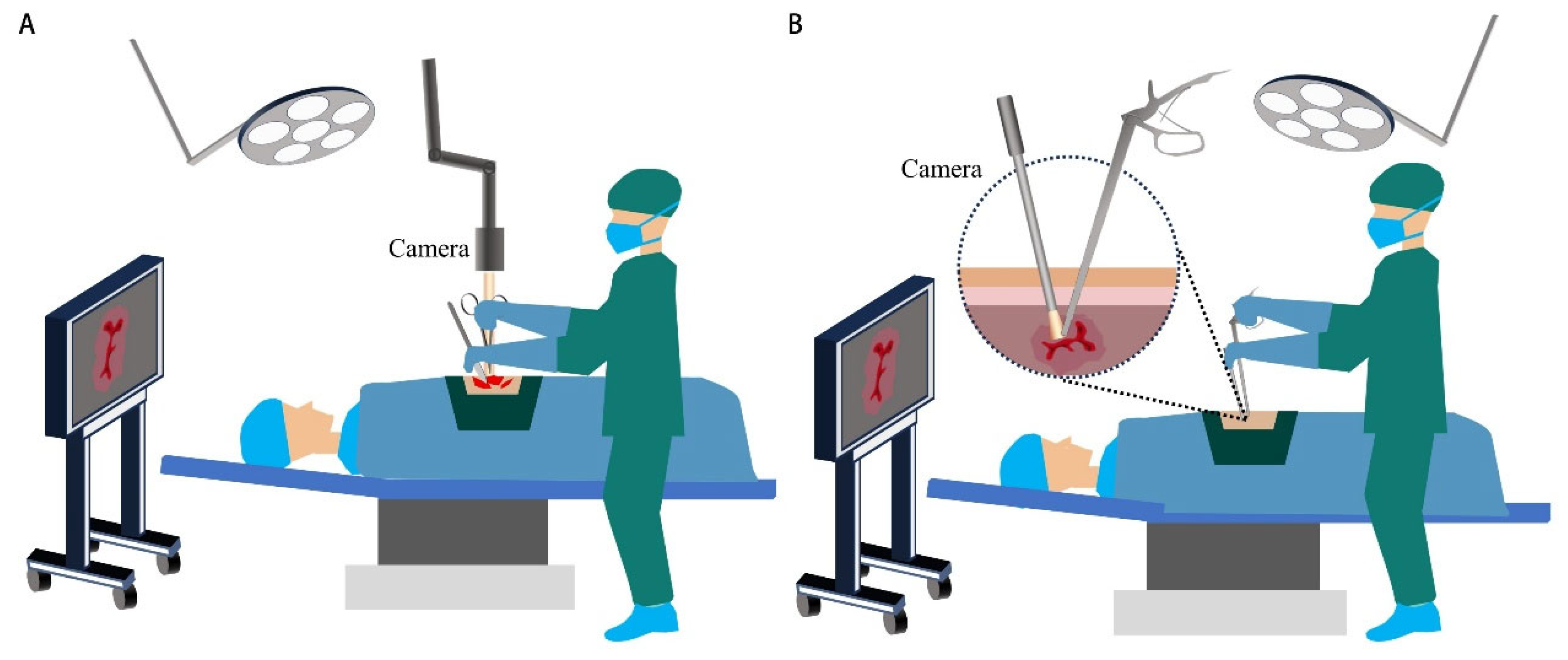
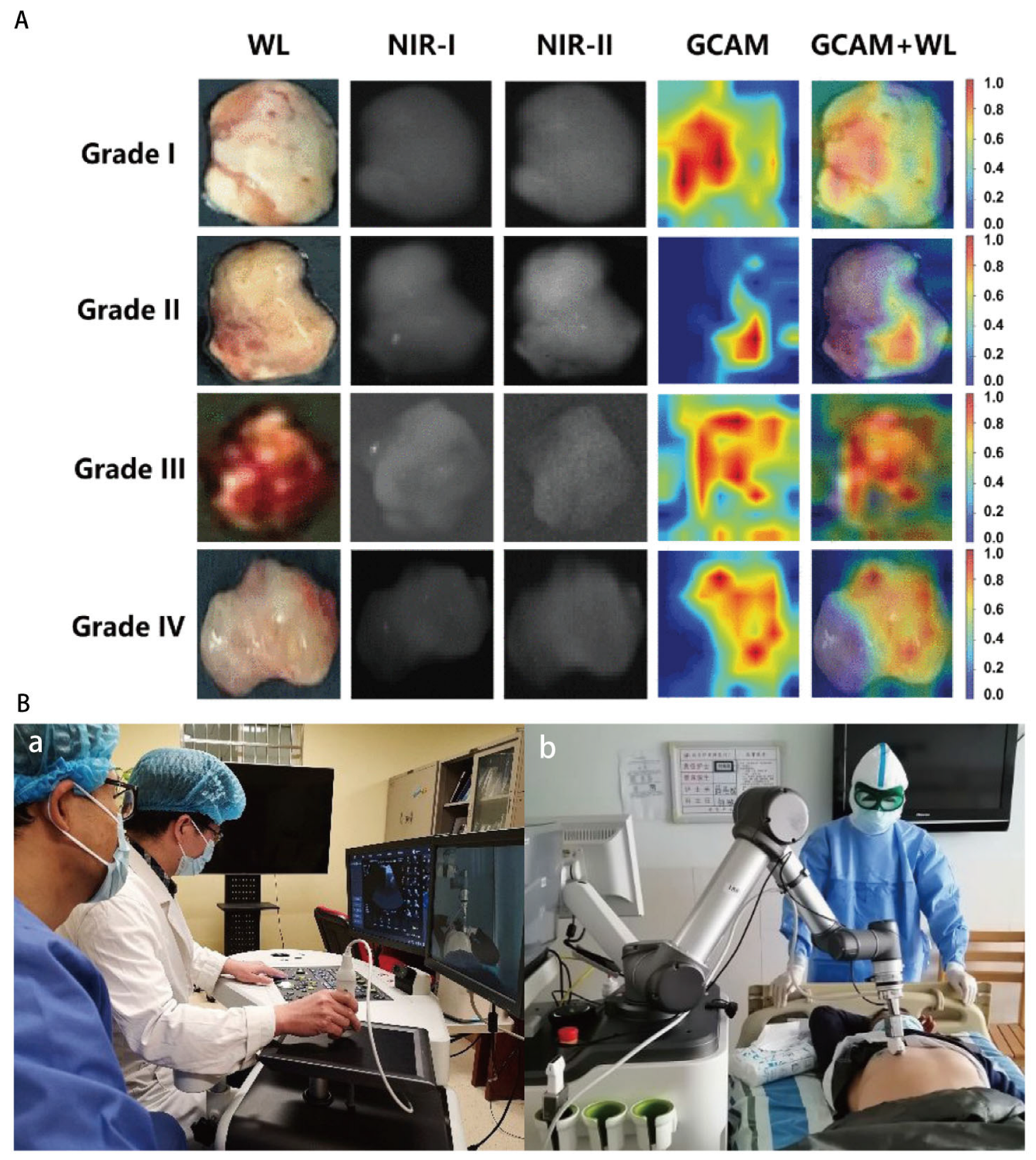
Advances and Opportunities in NIR-II Endoscopy: From Diagnosis to Therapeutic Applications

Abstract
1. Introduction

2. Methods
3. Endoscopic Visualization and Screening
3.1. Conventional Endoscopy
3.2. NIR-II Endoscopy
4. Endoscopy-Guided Precision Diagnosis
4.1. Conventional Endoscopy
4.1.1. In Vivo Histological Assessment
4.1.2. Functional and Molecular Imaging
4.1.3. Depth-Resolved Imaging
4.2. NIR-II Endoscopy

| Type | Name | Excitation/Emission (nm) | QYs | Hydrophilic Modification | Applications | Targeted Elements |
|---|---|---|---|---|---|---|
| Cynaine dyes | IR-32p [179] | 1020, 1064/1120 | / | Coupled polyethylene glycol. | In vivo targeted brain glioma imaging. | cRGDfK |
| BIT NPs [180] | 1012/1120 | 0.42%; (IR-1061 = 1.7%) | Integrating bovine serum albumin. | Spatiotemporally specific diagnosis and combination therapy of tumors. | Nonspecific | |
| IR-TPP-1100 [181] | 1020/1100 | 0.83%; (IR-1061 = 1.7%) | Encapsulated with F-127. | NIR-II FL/NIR-II PA imaging-guided PTT/PDT. | TPP | |
| ICG-Herceptide [182] | Similar to free ICG | / | / | In vivo tumor imaging and image-guided surgery. | Herceptide peptide | |
| AIR-PE [183] | 808/1080 ± 10 | 0.27% (in water) | The mixture of PLGA and Eudragit S100. Coating. | Real-time NIR-II imaging of IBD. | Nonspecific | |
| LZ-1105@Ham [184] | 1064/1105 | / | Human non-small cell lung cancer cell membrane coating. | NIR-II FL/PA/PT imaging and PTT. | Cell lung cancer cell membrane | |
| CyN-Ome [185] | 1064/ | 0.1%; (IR786 = 19%)? | Encapsulated with liposome. | PTT for tumor ablation. | Nonspecific | |
| NIRG-2 [186] | 850/940 | / | Introducing the hydrophilic sulfonic group. | Visualizing the tumor’s lymphatic metastasis and precise tumor resection. | G-quadruplex (G4) | |
| D-A dyes | TPGS-NT-4 NPs [187] | 808/1050 | 3.46% | d-α-tocopheryl polyethylene glycol succinate coating. | Angiography and localized photothermal therapy. | Nonspecific |
| TQ-100 [188] | 808/1006 | 0.1%; (IR-26 = 0.5%) | Coupled with protein. | Tumor therapy and neuromodulation. | RGD | |
| OBADC-TPA [189] | 660, 685, 808/900–1100 | / | Amphiphilic polymers coating. | PA/NIR-II FL imaging-guided PTT/PDT of lymphoma. | 9-NH2-SA | |
| B-ToMeT NCs [190] | /970 | 9.7% (in crystal state); 28.2% (in water) | / | Real-time monitoring of intestinal vessels. | Nonspecific | |
| TTX-P [191] | 808/920 | / | / | NIR-II FL imaging of diabetic liver injury. | Phosphate group | |
| QDs | CD-AuNCs [192] | 808/above 1000 | 0.098% (in water); (IR-26 = 0.05%) | β-cyclodextrin coating. | Profiling of early-stage acute kidney injury. | Nonspecific |
| DPTPzIr NPs [193] | 808/1108 | 0.15% | DSPE-mPEG2000 coating. | NIR-II FL/NIR-II PA/NIR-II PT imaging-guided NIR-II PTT/PDT. | Nonspecific | |
| Syn-Ag2S NC [194] | 808/1220 | 46 ± 2% | Synchronous passivation with MgCl2. | Deep lymph node imaging. | Nonspecific | |
| Nd@Y-FA NPs, Er@Y-PEG NPs [195,196] | 808/1060, 1525 | / | The mixture of mPEG-NH2 and 8 Arm-PEG-NH2 coating. | Determining the metastatic status of sentinel lymph nodes. | FA (targeting folate receptors) | |
| Else | PPy-TAT-R848-HA NC [197] | 808, 1064/ | / | Hyaluronic acid coating. | Induced tumor ablation; activated ICD and immunotherapeutic agents. | TAT peptide |
| BSA@TT NPs [198] | 760, 808/960 | 3.82%; (ICG = 1.7%) | Bovine serum albumin coating. | Microvascular visualization and tissue discrimination. | Bovine serum albumin | |
| 5SGNPs NPs [199] | /above 1200 | / | Constructing amphiphilic lipid nanocarrier. | Accurate thrombus visualization and PTT. | Bis–serotonin (bis-5HT) | |
| BTC12 NPs [200] | 808, 1064/940 | / | Assembled with 1,2-dimyristoyl-sn-glycero-3-phosphocholine. | NIR-II FL/NIR-II PA imaging-guided NIR-II PTT. | Nonspecific | |
| BM dyes [201] | 808/870–930 | ΦF = 10.4–18.0% in DCM (dichloromethane) | / | Cerebral vasculature and lymphatic vessels imaging; detecting subtle cerebral capillary damage. | Nonspecific | |
| MYM [202] | 808/extended to 1100 | / | Encapsulated in exosomes derived from 293F cells. | Diagnosis and therapeutic treatment of glioblastoma. | iRGD peptide | |
| DK@RA-PEG [203] | 808/~917 | 0.11% | Conjugated to the polymer N3-PEG2000-NHS. | NIR-II FL imaging guided PDT for rabies. | Aptamer OF RABV glycoprotein | |
| P-INT [204] | / | / | DSPE-PEG2000-COOH coating. | Neuroimaging and tumor imaging of OCT. | Nonspecific | |
| MSINPs [205] | 1064/ | / | Encapsulated with a macrophage membrane. | PA molecular imaging of neuroinflammation. | Macrophage membrane | |
| BIS-NPs [206] | 808/902 | 2.86% | Coassembled with amphiphilic polymers. | NIR-II FL imaging and PDT of colon cancer. | Nonspecific | |
| DNHFD [207] | 808/1071 | / | / | NIR-II FL imaging and loading anticancer drug. | INF-γ aptamers | |
| DFFP [208] | 808, 980/1050, 1550 | / | Loading elements onto hydrophilic DCNP. | Real-time evaluation of the Fenton reactivity. | Fe2+ | |
| 64Cu-NODAGA-uFSH-CH1055 [209] | 808/ | / | / | PET/CT and NIR-II imaging of various tumors. | Urofollitropin (uFSH) |
5. Endoscopic Therapeutic Interventions
5.1. Surgical Guidance
5.2. PTT/PDT
6. The Future of Endoscopy: Integration with AI and 5G
6.1. AI’s Transformative Role in Endoscopy
6.2. 5G Connectivity: Enabling Remote Endoscopy
7. Discussion and Outlook
7.1. Comparison with Other Publications
7.2. Current Challenges and Future Directions
8. Conclusions
Supplementary Materials
Author Contributions
Funding
Institutional Review Board Statement
Informed Consent Statement
Data Availability Statement
Acknowledgments
Conflicts of Interest
Abbreviations
| GI | Gastrointestinal |
| WLE | White-light endoscopy |
| CLE | Confocal laser endomicroscopy |
| EC | Endocytoscopy |
| HSE | Hyperspectral endoscopy |
| MPE | Multiphoton endoscopy |
| OCT | Optical coherence tomography |
| PAE | Photoacoustic endoscopy |
| NIR | Near-infrared |
| NIR-I | The first near-infrared window |
| SNR | Signal-to-noise ratio |
| NIR-II | The second near-infrared window |
| AI | Artificial intelligence |
| 5G | Fifth-generation mobile communication technology |
| FOV | Field of view |
| VCE | Virtual chromoendoscopy |
| SD | Standard definition |
| HD | High definition |
| IBD | Inflammatory bowel disease |
| MTF | Modulation transfer function |
| InGaAs | Indium gallium arsenide |
| nA | Nanoampere |
| 2D | Two-dimensional |
| RDI | Red dichromatic imaging |
| NBI | Narrow-band imaging |
| FDA | Food and Drug Administration |
| H&E | Hematoxylin and eosin |
| NIR/ICG | Near-infrared imaging with indocyanine green |
| PTT/PDT | Photothermal/photodynamic therapy |
| FWHM | Full-width at half-maximum |
| 3D | Three-dimensional |
| 3PEF | Three-photon excitation fluorescence |
| THG | Third harmonic generation |
| CARS | Coherent anti-Stokes Raman scattering |
| TPF | Two-photon fluorescence |
| SHG | Second harmonic generation |
| PAI | Photoacoustic imaging |
| US | Ultrasound |
| EMA | European Medicines Agency |
| MIS | Minimally invasive surgery |
| AIE | Aggregation-induced emission |
| DOF | Degree-of-freedom |
| SWIR | Short-wave infrared |
| CNNs | Convolutional neural networks |
| LTE | Long Term Evolution |
| IoT | Internet of Things |
References
- Boese, A.; Wex, C.; Croner, R.; Liehr, U.B.; Wendler, J.J.; Weigt, J.; Walles, T.; Vorwerk, U.; Lohmann, C.H.; Friebe, M.; et al. Endoscopic Imaging Technology Today. Diagnostics 2022, 12, 1262. [Google Scholar] [CrossRef] [PubMed]
- Youssef, F.F.; Branch, L.L.; Kowalczyk, M.; Savides, T.J. Endoscopic Approaches for Managing Small Intestinal Disease. Annu. Rev. Med. 2024, 76, 155–165. [Google Scholar] [CrossRef] [PubMed]
- Toyonaga, H.; Hayashi, T.; Katanuma, A. Usefulness of Texture and Color Enhancement Imaging in the Endoscopic Management of Duodenal Ampullary Tumors. Dig. Endosc. 2023, 35, e109–e110. [Google Scholar] [CrossRef] [PubMed]
- Rath, T.; Morgenstern, N.; Vitali, F.; Atreya, R.; Neurath, M.F. Advanced Endoscopic Imaging in Colonic Neoplasia. Visc Med. 2020, 36, 48–59. [Google Scholar] [CrossRef]
- Chang, S.; Krzyzanowska, H.; Bowden, A.K. Label-Free Optical Technologies to Enhance Noninvasive Endoscopic Imaging of Early-Stage Cancers. Annu. Rev. Anal. Chem. 2024, 17, 289–311. [Google Scholar] [CrossRef]
- Caballero-García, J.; Linares-Benavides, Y.J.; Leitão, U.L.S.; Aparicio-García, C.; López-Sánchez, M. Minimally Invasive Removal of Extra- and Intradural Spinal Tumors Using Full Endoscopic Visualization. Glob. Spine J. 2022, 12, 121–129. [Google Scholar] [CrossRef]
- Pasaguayo, L.V.; Al Masry, Z.; Lescano, S.; Zerhouni, N. Surgical Microgrippers: A Survey and Analysis. J. Med. Devices 2023, 17, 030801. [Google Scholar] [CrossRef]
- Michel, G.; Salunkhe, D.H.; Bordure, P.; Chablat, D. Literature Review on Endoscopic Robotic Systems in Ear and Sinus Surgery. J. Med. Devices 2021, 15, 040803. [Google Scholar] [CrossRef]
- Tang, Y.; Anandasabapathy, S.; Richards-Kortum, R. Advances in Optical Gastrointestinal Endoscopy: A Technical Review. Mol. Oncol. 2021, 15, 2580–2599. [Google Scholar] [CrossRef]
- Tacconi, L.; Signorelli, F.; Giordan, E. Is Full Endoscopic Lumbar Discectomy Less Invasive Than Conventional Surgery? A Randomized MRI Study. World Neurosurg. 2020, 138, e867–e875. [Google Scholar] [CrossRef]
- Tieber, F.; Lewandrowski, K.-U. Technology Advancements in Spinal Endoscopy for Staged Management of Painful Spine Conditions. J. Spine Surg. 2020, 6, S19–S28. [Google Scholar] [CrossRef] [PubMed]
- Vitiello, V.; Lee, S.-L.; Cundy, T.P.; Yang, G.-Z. Emerging Robotic Platforms for Minimally Invasive Surgery. IEEE Rev. Biomed. Eng. 2013, 6, 111–126. [Google Scholar] [CrossRef] [PubMed]
- Kaur, M.; Lane, P.M.; Menon, C. Endoscopic Optical Imaging Technologies and Devices for Medical Purposes: State of the Art. Appl. Sci. 2020, 10, 6865. [Google Scholar] [CrossRef]
- Tripathi, D.; Hardaniya, M.; Pande, S.; Maity, D. Advances in Optical Contrast Agents for Medical Imaging: Fluorescent Probes and Molecular Imaging. J. Imaging 2025, 11, 87. [Google Scholar] [CrossRef] [PubMed]
- Gulati, S.; Patel, M.; Emmanuel, A.; Haji, A.; Hayee, B.; Neumann, H. The Future of Endoscopy: Advances in Endoscopic Image Innovations. Dig. Endosc. 2020, 32, 512–522. [Google Scholar] [CrossRef]
- He, Z.; Wang, P.; Liang, Y.; Fu, Z.; Ye, X. Clinically Available Optical Imaging Technologies in Endoscopic Lesion Detection: Current Status and Future Perspective. J. Healthc. Eng. 2021, 2021, 7594513. [Google Scholar] [CrossRef]
- He, Z.; Wang, P.; Ye, X. Novel Endoscopic Optical Diagnostic Technologies in Medical Trial Research: Recent Advancements and Future Prospects. BioMed Eng. OnLine 2021, 20, 5. [Google Scholar] [CrossRef]
- Ragunath, K.; Chiu, P. A Primer to Image Enhanced Endoscopy. Transl. Gastroenterol. Hepatol. 2022, 7, 1. [Google Scholar] [CrossRef]
- Kaniyala Melanthota, S.; Kistenev, Y.V.; Borisova, E.; Ivanov, D.; Zakharova, O.; Boyko, A.; Vrazhnov, D.; Gopal, D.; Chakrabarti, S.; K, S.P.; et al. Types of Spectroscopy and Microscopy Techniques for Cancer Diagnosis: A Review. Lasers Med. Sci. 2022, 37, 3067–3084. [Google Scholar] [CrossRef]
- Li, C.; Chen, G.; Zhang, Y.; Wu, F.; Wang, Q. Advanced Fluorescence Imaging Technology in the Near-Infrared-II Window for Biomedical Applications. J. Am. Chem. Soc. 2020, 142, 14789–14804. [Google Scholar] [CrossRef]
- Zhang, Z.; Du, Y.; Shi, X.; Wang, K.; Qu, Q.; Liang, Q.; Ma, X.; He, K.; Chi, C.; Tang, J.; et al. NIR-II Light in Clinical Oncology: Opportunities and Challenges. Nat. Rev. Clin. Oncol. 2024, 21, 449–467. [Google Scholar] [CrossRef] [PubMed]
- Ni, H.; Qian, J. Clinical research progress on the fluorescence imaging in the second near-infrared window. J. Infrared Millim. Waves 2023, 42, 896–906. [Google Scholar]
- Li, C.; Wang, Q. Challenges and Opportunities for Intravital Near-Infrared Fluorescence Imaging Technology in the Second Transparency Window. ACS Nano 2018, 12, 9654–9659. [Google Scholar] [CrossRef] [PubMed]
- Chi, C.; Du, Y.; Ye, J.; Kou, D.; Qiu, J.; Wang, J.; Tian, J.; Chen, X. Intraoperative Imaging-Guided Cancer Surgery: From Current Fluorescence Molecular Imaging Methods to Future Multi-Modality Imaging Technology. Theranostics 2014, 4, 1072–1084. [Google Scholar] [CrossRef]
- Vahrmeijer, A.L.; Hutteman, M.; van der Vorst, J.R.; van de Velde, C.J.H.; Frangioni, J.V. Image-Guided Cancer Surgery Using near-Infrared Fluorescence. Nat. Rev. Clin. Oncol. 2013, 10, 507–518. [Google Scholar] [CrossRef]
- Matsui, A.; Tanaka, E.; Choi, H.S.; Winer, J.H.; Kianzad, V.; Gioux, S.; Laurence, R.G.; Frangioni, J.V. Real-Time Intra-Operative near-Infrared Fluorescence Identification of the Extrahepatic Bile Ducts Using Clinically Available Contrast Agents. Surgery 2010, 148, 87–95. [Google Scholar] [CrossRef]
- Cai, Z.; Zhu, L.; Wang, M.; Roe, A.W.; Xi, W.; Qian, J. NIR-II Fluorescence Microscopic Imaging of Cortical Vasculature in Non-Human Primates. Theranostics 2020, 10, 4265–4276. [Google Scholar] [CrossRef]
- Deng, G.; Li, S.; Sun, Z.; Li, W.; Zhou, L.; Zhang, J.; Gong, P.; Cai, L. Near-Infrared Fluorescence Imaging in the Largely Unexplored Window of 900–1000 Nm. Theranostics 2018, 8, 4116–4128. [Google Scholar] [CrossRef]
- Kennedy, G.T.; Azari, F.S.; Bernstein, E.; Nadeem, B.; Chang, A.; Segil, A.; Carlin, S.; Sullivan, N.T.; Encarnado, E.; Desphande, C.; et al. Targeted Detection of Cancer at the Cellular Level during Biopsy by Near-Infrared Confocal Laser Endomicroscopy. Nat. Commun. 2022, 13, 2711. [Google Scholar] [CrossRef]
- Welsher, K.; Liu, Z.; Sherlock, S.P.; Robinson, J.T.; Chen, Z.; Daranciang, D.; Dai, H. A Route to Brightly Fluorescent Carbon Nanotubes for Near-Infrared Imaging in Mice. Nat. Nanotech. 2009, 4, 773–780. [Google Scholar] [CrossRef]
- Smith, A.M.; Mancini, M.C.; Nie, S. Second Window for in Vivo Imaging. Nat. Nanotech. 2009, 4, 710–711. [Google Scholar] [CrossRef] [PubMed]
- Diao, S.; Hong, G.; Antaris, A.L.; Blackburn, J.L.; Cheng, K.; Cheng, Z.; Dai, H. Biological Imaging without Autofluorescence in the Second Near-Infrared Region. Nano Res. 2015, 8, 3027–3034. [Google Scholar] [CrossRef]
- Upputuri, P.K.; Pramanik, M. Photoacoustic Imaging in the Second Near-Infrared Window: A Review. J. Biomed. Opt. 2019, 24, 040901. [Google Scholar] [CrossRef] [PubMed]
- Wang, F.; Zhong, Y.; Bruns, O.; Liang, Y.; Dai, H. In Vivo NIR-II Fluorescence Imaging for Biology and Medicine. Nat. Photon. 2024, 18, 535–547. [Google Scholar] [CrossRef]
- Zhong, Y.; Ma, Z.; Wang, F.; Wang, X.; Yang, Y.; Liu, Y.; Zhao, X.; Li, J.; Du, H.; Zhang, M.; et al. In Vivo Molecular Imaging for Immunotherapy Using Ultra-Bright near-Infrared-IIb Rare-Earth Nanoparticles. Nat. Biotechnol. 2019, 37, 1322–1331. [Google Scholar] [CrossRef]
- Wang, Y.; Lu, W.; Chen, Z.-H.; Xiao, Y.; Wang, Y.; Gao, W.; Wang, Z.; Song, R.; Fang, Z.; Hu, W.; et al. Molecular Imaging of Ovarian Follicles and Tumors With Near-Infrared II Bioconjugates. Adv. Mater. 2025, 37, 2414129. [Google Scholar] [CrossRef]
- Zhuang, P.; Xiang, K.; Meng, X.; Wang, G.; Li, Z.; Lu, Y.; Kan, D.; Zhang, X.; Sun, S.-K. Gram-Scale Synthesis of a Neodymium Chelate as a Spectral CT and Second near-Infrared Window Imaging Agent for Visualizing the Gastrointestinal Tract in Vivo. J. Mater. Chem. B 2021, 9, 2285–2294. [Google Scholar] [CrossRef]
- Mi, C.; Guan, M.; Zhang, X.; Yang, L.; Wu, S.; Yang, Z.; Guo, Z.; Liao, J.; Zhou, J.; Lin, F.; et al. High Spatial and Temporal Resolution NIR-IIb Gastrointestinal Imaging in Mice. Nano Lett. 2022, 22, 2793–2800. [Google Scholar] [CrossRef]
- Wang, T.; Jiang, Z.; Liu, Z. 1,4-Bisvinylbenzene-Bridged BODIPY Dimers for Fluorescence Imaging in the Second Near-Infrared Window. Org. Lett. 2023, 25, 1638–1642. [Google Scholar] [CrossRef]
- Tang, D.; Cui, M.; Wang, B.; Liang, G.; Zhang, H.; Xiao, H. Nanoparticles Destabilizing the Cell Membranes Triggered by NIR Light for Cancer Imaging and Photo-Immunotherapy. Nat. Commun. 2024, 15, 6026. [Google Scholar] [CrossRef]
- Lin, L.; He, H.; Xue, R.; Zhang, Y.; Wang, Z.; Nie, S.; Ye, J. Direct and Quantitative Assessments of Near-Infrared Light Attenuation and Spectroscopic Detection Depth in Biological Tissues Using Surface-Enhanced Raman Scattering. Med-X 2023, 1, 9. [Google Scholar] [CrossRef]
- Sun, A.; Guo, H.; Gan, Q.; Yang, L.; Liu, Q.; Xi, L. Evaluation of Visible NIR-I and NIR-II Light Penetration for Photoacoustic Imaging in Rat Organs. Opt. Express 2020, 28, 9002–9013. [Google Scholar] [CrossRef] [PubMed]
- Sliker, L.J.; Ciuti, G. Flexible and Capsule Endoscopy for Screening, Diagnosis and Treatment. Expert Rev. Med. Devices 2014, 11, 649–666. [Google Scholar] [CrossRef] [PubMed]
- Subramanian, V.; Ragunath, K. Advanced Endoscopic Imaging: A Review of Commercially Available Technologies. Clin. Gastroenterol. Hepatol. 2014, 12, 368–376.e1. [Google Scholar] [CrossRef]
- Osawa, H.; Miura, Y.; Takezawa, T.; Ino, Y.; Khurelbaatar, T.; Sagara, Y.; Lefor, A.K.; Yamamoto, H. Linked Color Imaging and Blue Laser Imaging for Upper Gastrointestinal Screening. Clin. Endosc. 2018, 51, 513–526. [Google Scholar] [CrossRef]
- Paswan, A.; Kumar, A.; Jha, K.; Sinha, S.K. VIA (Visual Inspection with Acetic Acid) and VILI (Visual Inspection with Lugol’s Iodine) as an Initial Approach with Colposcopy as a next Screening Tool with Its Positive Predictive Value in Low Socioeconomic Patients. Int. J. Reprod. Contracept Obstet. Gynecol. 2017, 7, 210. [Google Scholar] [CrossRef][Green Version]
- Khalid, A.; Aslam, A.; Khan, N.T. Sensitivity and specificity of visual inspection with Lugol’s iodine s(vili) in cervical cancer. J. Med. Physiol. Biophys. 2019, 52, 52. [Google Scholar]
- Noor, M.; Ishaq, Y.; Aftab, A.; Ata, S.; Manji, S.N.; Anwar, M.A. Diagnostic Accuracy of Lugol’s Iodine Staining in Detection of Safe Margins of Oral Squamous Cell Carcinoma. Health Sci. J. 2020, 14, 725. [Google Scholar]
- Zhang, F.; Wang, S.; Liu, B.; Yang, W. Role of Immediate Injection of Methylene Blue after Fiberoptic Ductoscopy in Selective Ductectomy for Patients with Pathological Nipple Discharge. BMC Cancer 2025, 25, 60. [Google Scholar] [CrossRef]
- Morales, T.G.; Bhattacharyya, A.; Camargo, E.; Johnson, C.; Sampliner, R.E. Methylene Blue Staining for Intestinal Metaplasia of the Gastric Cardia with Follow-up for Dysplasia. Gastrointest Endosc. 1998, 48, 26–31. [Google Scholar] [CrossRef]
- Yang, Q.; Zhang, X. Indocyanine Green Combined with Methylene Blue versus Methylene Blue Alone for Sentinel Lymph Node Biopsy in Breast Cancer: A Retrospective Study. BMC Surg. 2023, 23, 133. [Google Scholar] [CrossRef] [PubMed]
- Markar, S.R.; Koehler, R.; Low, D.E.; Ross, A. Novel Multimodality Endoscopic Closure of Postoperative Esophageal Fistula. Int. J. Surg. Case Rep. 2012, 3, 577–579. [Google Scholar] [CrossRef] [PubMed]
- Pallagatti, S.; Sheikh, S.; Aggarwal, A.; Gupta, D.; Singh, R.; Handa, R.; Kaur, S.; Mago, J. Toluidine Blue Staining as an Adjunctive Tool for Early Diagnosis of Dysplastic Changes in the Oral Mucosa. J. Clin. Exp. Dent. 2013, 5, e187–e191. [Google Scholar] [CrossRef] [PubMed]
- Tummidi, S.; Shankaralingappa, A.; Sharmila, V. Applicability of On-Site Evaluation of Cervical Cytology Smears Stained with Toluidine Blue to Reduce Unsatisfactory Results. Acta Cytologica 2022, 66, 513–523. [Google Scholar] [CrossRef]
- Piñerúa-Gonsálvez, J.F.; Zambrano-Infantino, R.d.C.; Benítez, S. Chromoendoscopy using toluidine blue plus Lugol’s solution for early diagnosis of esophageal premalignant lesions and superficial neoplasms in high-risk patients. Arq. Gastroenterol. 2019, 56, 41–44. [Google Scholar] [CrossRef]
- Sachdeva, K.; Saji, T.A.; Sachdeva, N.; Karun, H. A Prospective Study to Evaluate the Role of Narrow Band Imaging and Toludine Blue in the Screening of Premalignant and Malignant Lesions of the Oral Cavity in a Tertiary Referral Centre. Indian J. Otolaryngol. Head Neck Surg. 2022, 74, 2177–2183. [Google Scholar] [CrossRef]
- Bergholt, N.L.; Lysdahl, H.; Lind, M.; Foldager, C.B. A Standardized Method of Applying Toluidine Blue Metachromatic Staining for Assessment of Chondrogenesis. Cartilage 2019, 10, 370–374. [Google Scholar] [CrossRef]
- Chedgy, F.J.Q.; Subramaniam, S.; Kandiah, K.; Thayalasekaran, S.; Bhandari, P. Acetic Acid Chromoendoscopy: Improving Neoplasia Detection in Barrett’s Esophagus. World J. Gastroenterol. 2016, 22, 5753–5760. [Google Scholar] [CrossRef][Green Version]
- Kandiah, K.; Chedgy, F.J.Q.; Subramaniam, S.; Longcroft-Wheaton, G.; Bassett, P.; Repici, A.; Sharma, P.; Pech, O.; Bhandari, P. International Development and Validation of a Classification System for the Identification of Barrett’s Neoplasia Using Acetic Acid Chromoendoscopy: The Portsmouth Acetic Acid Classification (PREDICT). Gut 2018, 67, 2085–2091. [Google Scholar] [CrossRef]
- Fleischer, D.E. Chromoendoscopy and Magnification Endoscopy in the Colon. Gastrointest. Endosc. 1999, 49, S45–S49. [Google Scholar] [CrossRef]
- Szalóki, T. Indigo Carmine Contrast Staining in Combination with High Resolution Electronic Endoscopy. Orvosi. Hetilap. 2002, 143, 25–29. [Google Scholar] [PubMed]
- Su, M.-Y.; Ho, Y.-P.; Chen, P.-C.; Chiu, C.-T.; Wu, C.-S.; Hsu, C.-M.; Tung, S.-Y. Magnifying Endoscopy with Indigo Carmine Contrast for Differential Diagnosis of Neoplastic and Nonneoplastic Colonic Polyps. Dig. Dis. Sci. 2004, 49, 1123–1127. [Google Scholar] [CrossRef] [PubMed]
- Rutter, M.D.; Saunders, B.P.; Schofield, G.; Forbes, A.; Price, A.B.; Talbot, I.C. Pancolonic Indigo Carmine Dye Spraying for the Detection of Dysplasia in Ulcerative Colitis. Gut 2004, 53, 256. [Google Scholar] [CrossRef] [PubMed]
- Gono, K. Narrow Band Imaging: Technology Basis and Research and Development History. Clin. Endosc. 2015, 48, 476–480. [Google Scholar] [CrossRef]
- Kaneko, K.; Oono, Y.; Yano, T.; Ikematsu, H.; Odagaki, T.; Yoda, Y.; Yagishita, A.; Sato, A.; Nomura, S. Effect of Novel Bright Image Enhanced Endoscopy Using Blue Laser Imaging (BLI). Endosc. Int. Open 2014, 2, E212–E219. [Google Scholar] [CrossRef]
- Miyazaki, K.; Kato, M. Red Dichromatic Imaging (RDI). In Atlas of Advanced Endoscopy; Sano, Y., Chiu, P., Singh, R., Uedo, N., Goda, K., Katada, C., Eds.; Springer Nature: Singapore, 2024; pp. 17–24. ISBN 978-981-97-2732-2. [Google Scholar]
- Uraoka, T.; Igarashi, M. Development and Clinical Usefulness of a Unique Red Dichromatic Imaging Technology in Gastrointestinal Endoscopy: A Narrative Review. Therap. Adv. Gastroenterol. 2022, 15, 17562848221118302. [Google Scholar] [CrossRef]
- Olypus Texture and Color Enhancement Imaging. Available online: https://medical.olympusamerica.com/technology/txi (accessed on 12 November 2025).
- Coriat, R.; Chryssostalis, A.; Zeitoun, J.D.; Deyra, J.; Gaudric, M.; Prat, F.; Chaussade, S. Computed Virtual Chromoendoscopy System (FICE): A New Tool for Upper Endoscopy? Gastroentérologie Clin. Biol. 2008, 32, 363–369. [Google Scholar] [CrossRef]
- Pentax Medical Virtual Chromoendoscopy: PENTAX Medical i-Scan Technology. Available online: https://www.pentaxmedical.com/apac-en/products/video-processors/i-scan (accessed on 12 November 2025).
- Kamphuis, G.M.; de Bruin, D.M.; Fallert, J.; Gultekin, M.H.; de Reijke, T.M. Storz Professional Image Enhancement System: A New Technique to Improve Endoscopic Bladder Imaging. J. Cancer Sci. Ther. 2016, 8, 71–77. [Google Scholar] [CrossRef]
- Robles-Medranda, C.; Valero, M.; Puga-Tejada, M.; Oleas, R.; Baquerizo-Burgos, J.; Soria-Alcívar, M.; Alvarado-Escobar, H.; Pitanga-Lukashok, H. High-Definition Optical Magnification with Digital Chromoendoscopy Detects Gastric Mucosal Changes in Dyspeptic-Patients. World J. Gastrointest. Endosc. 2020, 12, 23–32. [Google Scholar] [CrossRef]
- Kiesslich, R. Advanced Imaging Techniques and In Vivo Histology: Current Status and Future Perspectives (Upper G.I.). In Gastrointestinal and Pancreatico-Biliary Diseases: Advanced Diagnostic and Therapeutic Endoscopy; Testoni, P.A., Inoue, H., Wallace, M.B., Eds.; Springer International Publishing: Cham, Switzerland, 2022; pp. 3–20. ISBN 978-3-030-56993-8. [Google Scholar]
- Jin, X.; Zhou, Q.; Lyu, B.; Zhang, C.; Huang, L. Ability of Detection in Different Resolution Endoscopy for Upper Gastrointestinal Mucosal Lesions. Surg. Endosc. 2024, 38, 5903–5913. [Google Scholar] [CrossRef]
- Bhat, Y.M.; Abu Dayyeh, B.K.; Chauhan, S.S.; Gottlieb, K.T.; Hwang, J.H.; Komanduri, S.; Konda, V.; Lo, S.K.; Manfredi, M.A.; Maple, J.T.; et al. High-Definition and High-Magnification Endoscopes. Gastrointest. Endosc. 2014, 80, 919–927. [Google Scholar] [CrossRef] [PubMed]
- Jin, B.; Jin, X.; Huang, L.; Zhang, C.; Lyu, B. Magnifying Endoscopy Is Superior at Detecting Easy-Missed Neoplastic Lesions on the Upper Gastrointestinal Tract. Surg. Endosc. 2023, 37, 5094–5100. [Google Scholar] [CrossRef] [PubMed]
- Alexandersson, B.; Hamad, Y.; Andreasson, A.; Rubio, C.A.; Ando, Y.; Tanaka, K.; Ichiya, T.; Rezaie, R.; Schmidt, P.T. High-Definition Chromoendoscopy Superior to High-Definition White-Light Endoscopy in Surveillance of Inflammatory Bowel Diseases in a Randomized Trial. Clin. Gastroenterol. Hepatol. 2020, 18, 2101–2107. [Google Scholar] [CrossRef] [PubMed]
- Udagawa, T.; Amano, M.; Okada, F. Development of Magnifying Video Endoscopes with High Resolution. Dig. Endosc. 2001, 13, 163–169. [Google Scholar] [CrossRef]
- Kiesslich, R. Enhanced Endoscopy. In Crohn’s Disease and Ulcerative Colitis: From Epidemiology and Immunobiology to a Rational Diagnostic and Therapeutic Approach; Baumgart, D.C., Ed.; Springer International Publishing: Cham, Switzerland, 2017; pp. 175–183. ISBN 978-3-319-33703-6. [Google Scholar]
- Foerster, F.; Neumann, H. Advanced Endoscopic Imaging Methods. In Innovative Endoscopic and Surgical Technology in the GI Tract; Horgan, S., Fuchs, K.-H., Eds.; Springer International Publishing: Cham, Switzerland, 2021; pp. 409–419. ISBN 978-3-030-78217-7. [Google Scholar]
- Shergill, A.K.; Lightdale, J.R.; Bruining, D.H.; Acosta, R.D.; Chandrasekhara, V.; Chathadi, K.V.; Decker, G.A.; Early, D.S.; Evans, J.A.; Fanelli, R.D.; et al. The Role of Endoscopy in Inflammatory Bowel Disease. Gastrointest. Endosc. 2015, 81, 1101–1121.e13. [Google Scholar] [CrossRef]
- Mohamed, M.F.H.; Marino, D.; Elfert, K.; Beran, A.; Nayfeh, T.; Abdallah, M.A.; Sultan, S.; Shah, S.A. Dye Chromoendoscopy Outperforms High-Definition White Light Endoscopy in Dysplasia Detection for Patients with Inflammatory Bowel Disease: An Updated Meta-Analysis of Randomized Controlled Trials. Off. J. Am. Coll. Gastroenterol. ACG 2024, 119, 719–726. [Google Scholar] [CrossRef]
- Konijeti, G.G.; Shrime, M.G.; Ananthakrishnan, A.N.; Chan, A.T. Cost-Effectiveness Analysis of Chromoendoscopy for Colorectal Cancer Surveillance in Patients with Ulcerative Colitis. Gastrointest. Endosc. 2014, 79, 455–465. [Google Scholar] [CrossRef]
- Soetikno, R.; Subramanian, V.; Kaltenbach, T.; Rouse, R.V.; Sanduleanu, S.; Suzuki, N.; Tanaka, S.; McQuaid, K. The Detection of Nonpolypoid (Flat and Depressed) Colorectal Neoplasms in Patients With Inflammatory Bowel Disease. Gastroenterology 2013, 144, 1349–1352.e6. [Google Scholar] [CrossRef]
- National Health Commission of the People’s Republic of China Chinese Guidelines for Diagnosis and Treatment of Gastric Cancer 2018 (English Version). Chin. J. Cancer Res. 2019, 31, 707–737. [CrossRef]
- Zhang, M.; Yue, J.; Cui, R.; Ma, Z.; Wan, H.; Wang, F.; Zhu, S.; Zhou, Y.; Kuang, Y.; Zhong, Y.; et al. Bright Quantum Dots Emitting at ∼1,600 Nm in the NIR-IIb Window for Deep Tissue Fluorescence Imaging. Proc. Natl. Acad. Sci. USA 2018, 115, 6590–6595. [Google Scholar] [CrossRef]
- Antaris, A.L.; Chen, H.; Diao, S.; Ma, Z.; Zhang, Z.; Zhu, S.; Wang, J.; Lozano, A.X.; Fan, Q.; Chew, L.; et al. A High Quantum Yield Molecule-Protein Complex Fluorophore for near-Infrared II Imaging. Nat. Commun. 2017, 8, 15269. [Google Scholar] [CrossRef] [PubMed]
- Zhu, S.; Herraiz, S.; Yue, J.; Zhang, M.; Wan, H.; Yang, Q.; Ma, Z.; Wang, Y.; He, J.; Antaris, A.L.; et al. 3D NIR-II Molecular Imaging Distinguishes Targeted Organs with High-Performance NIR-II Bioconjugates. Adv. Mater. 2018, 30, 1705799. [Google Scholar] [CrossRef] [PubMed]
- Guo, S.; Fang, L.; Chen, F. Design of Zoom Optical System from Visible to NIR-II for Vivo Fluorescence Imaging Device. Appl. Sci. 2023, 13, 1421. [Google Scholar] [CrossRef]
- Hansen, M.P.; Malchow, D.S. Overview of SWIR Detectors, Cameras, and Applications. In Proceedings of the SPIE Defense and Security Symposium, Orlando, FL, USA, 2008; SPIE: Bellingham, WA, USA, 2008; Volume 6939, p. 69390I. [Google Scholar] [CrossRef]
- Green, D.R.; Hagon, J.J.; Gómez, C.; Gregory, B.J. Chapter 21—Using Low-Cost UAVs for Environmental Monitoring, Mapping, and Modelling: Examples From the Coastal Zone. In Coastal Management; Krishnamurthy, R.R., Jonathan, M.P., Srinivasalu, S., Glaeser, B., Eds.; Academic Press: Cambridge, MA, USA, 2019; pp. 465–501. ISBN 978-0-12-810473-6. [Google Scholar]
- Hu, W.l.; Qi, Z.-q.; Sun, H.-c. InGaAs NIR Detector Epitaxial Design and Device Fabrication. In Proceedings of the 2020 IEEE 5th Optoelectronics Global Conference (OGC), Shenzhen, China, 7 September 2020; pp. 68–71. [Google Scholar]
- Li, C.; Liu, H.; Wang, J.; Guo, D.; Chen, B.; Wu, J. Exploiting the Correlation Between 1/f Noise-Dark Current in PIN InGaAs Photodetectors. IEEE J. Quantum Electron. 2024, 60, 4000305. [Google Scholar] [CrossRef]
- Lv, F.; Zheng, Y.; Zhang, B.; Lu, F. Turn a Silicon Camera Into an InGaAs Camera. In Proceedings of the 2019 IEEE/CVF Conference on Computer Vision and Pattern Recognition (CVPR), Long Beach, CA, USA, 15 June 2019; pp. 5980–5988. [Google Scholar]
- Song, B.; Shi, B.; Zhu, S.; Brunelli, S.Š.; Klamkin, J. InGaAs Photodiodes on Silicon by Heteroepitaxy. In Proceedings of the 2021 Opto-Electronics and Communications Conference (OECC), Hong Kong, China, 3 July 2021; pp. 1–3. [Google Scholar]
- Pan, S.; Wu, S.-E.; Hei, J.; Zhou, Z.; Zeng, L.; Xing, Y.; Lin, P.; Shi, Z.; Tian, Y.; Li, X.; et al. Light Trapping Enhanced Broadband Photodetection and Imaging Based on MoSe2/Pyramid Si vdW Heterojunction. Nano Res. 2023, 16, 10552–10558. [Google Scholar] [CrossRef]
- Tang, Y.; Wang, Z.; Gao, M.; Han, J.; Yuan, L.; Zhu, F. Dual-Mode Narrowband Organic Photodetectors for Self-Aligned Imaging in NIR-I and NIR-II. Nat. Commun. 2025, 16, 7144. [Google Scholar] [CrossRef]
- Wang, Z.; Tang, Y.; Gao, M.; Han, J.; Zhu, F. Advanced Flexible Organic Near-Infrared Photodetectors for Sensing Applications. Wearable Electron. 2025, 2, 124–148. [Google Scholar] [CrossRef]
- Liu, C.; Guo, J.; Yu, L.; Li, J.; Zhang, M.; Li, H.; Shi, Y.; Dai, D. Silicon/2D-Material Photodetectors: From near-Infrared to Mid-Infrared. Light Sci. Appl. 2021, 10, 123. [Google Scholar] [CrossRef]
- Wang, F.; Fang, S.; Zhang, Y.; Wang, Q.J. 2D Computational Photodetectors Enabling Multidimensional Optical Information Perception. Nat. Commun. 2025, 16, 6791. [Google Scholar] [CrossRef]
- Yang, H.; Aleman, S.; Jiang, H. Photoacoustic Endoscopy. In Biomedical Photoacoustics: Technology and Applications; Xia, W., Ed.; Springer Nature Switzerland: Cham, Switzerland, 2024; pp. 109–129. ISBN 978-3-031-61411-8. [Google Scholar]
- Zhang, H.; He, Z.; Jin, Z.; Yan, Q.; Wang, P.; Ye, X. The Development and Clinical Application of Microscopic Endoscopy for in Vivo Optical Biopsies: Endocytoscopy and Confocal Laser Endomicroscopy. Photodiagnosis Photodyn. Ther. 2022, 38, 102826. [Google Scholar] [CrossRef]
- ASGE Technology Committee; Thosani, N.; Abu Dayyeh, B.K.; Sharma, P.; Aslanian, H.R.; Enestvedt, B.K.; Komanduri, S.; Manfredi, M.; Navaneethan, U.; Maple, J.T.; et al. ASGE Technology Committee Systematic Review and Meta-Analysis Assessing the ASGE Preservation and Incorporation of Valuable Endoscopic Innovations Thresholds for Adopting Real-Time Imaging-Assisted Endoscopic Targeted Biopsy during Endoscopic Surveillance of Barrett’s Esophagus. Gastrointest. Endosc. 2016, 83, 684–698.e7. [Google Scholar] [CrossRef] [PubMed]
- Lim, C.-H.; Park, J.C. Image Magnification Endoscopy. In Clinical Gastrointestinal Endoscopy: A Comprehensive Atlas; Chun, H.J., Yang, S.-K., Choi, M.-G., Eds.; Springer: Singapore, 2018; pp. 719–734. ISBN 978-981-10-4995-8. [Google Scholar]
- Waterhouse, D.J. Flexible Endoscopy: Early Detection of Dysplasia in Barrett’s Oesophagus. In Novel Optical Endoscopes for Early Cancer Diagnosis and Therapy; Waterhouse, D.J., Ed.; Springer International Publishing: Cham, Switzerland, 2019; pp. 17–42. ISBN 978-3-030-21481-4. [Google Scholar]
- Septier, D.; Brévalle-Wasilewski, G.; Lefebvre, E.; Kumar, N.G.; Wang, Y.J.; Kaszas, A.; Rigneault, H.; Kudlinski, A. A Hollow-Core Fiber Based Stand-Alone Multimodal (2-Photon, 3-Photon, SHG, THG) Nonlinear Flexible Imaging Endoscope System. IEEE J. Sel. Top. Quantum Electron. 2024, 30, 4301212. [Google Scholar] [CrossRef]
- Bae, H.; Rodewald, M.; Meyer-Zedler, T.; Bocklitz, T.W.; Matz, G.; Messerschmidt, B.; Press, A.T.; Bauer, M.; Guntinas-Lichius, O.; Stallmach, A.; et al. Feasibility Studies of Multimodal Nonlinear Endoscopy Using Multicore Fiber Bundles for Remote Scanning from Tissue Sections to Bulk Organs. Sci. Rep. 2023, 13, 13779. [Google Scholar] [CrossRef] [PubMed]
- Szwaj, M. Nonlinear Optical Endoscopy with Anti-Resonant Hollow-Core Fibre (ARF) for Cancer Diagnosis. Ph.D. Thesis, University of Southampton, Southampton, UK, 2022. [Google Scholar]
- Knapp, T.G.; Duan, S.; Merchant, J.L.; Sawyer, T.W. Quantitative Characterization of Duodenal Gastrinoma Autofluorescence Using Multiphoton Microscopy. Lasers Surg. Med. 2023, 55, 208–225. [Google Scholar] [CrossRef]
- Montague, J.E. Multiphoton Microscopy for Assessment of Tissue Structure. Ph.D. Thesis, The University of Arizona, Tucson, AZ, USA, 2024. [Google Scholar]
- Cho, H.; Moon, D.; Heo, S.M.; Chu, J.; Bae, H.; Choi, S.; Lee, Y.; Kim, D.; Jo, Y.; Kim, K.; et al. Artificial Intelligence-Based Real-Time Histopathology of Gastric Cancer Using Confocal Laser Endomicroscopy. npj Precis. Oncol. 2024, 8, 131. [Google Scholar] [CrossRef]
- Wang, X.-Y.; Xing, Y.-T.; Chen, R.-Z.; Jia, X.-Q.; Wu, J.-H.; Jiang, J.; Li, L.-Y.; Chang, G.-Q. Simultaneous label-free autofluorescence-multiharmonic microscopy driven by femtosecond sources based on self-phase modulation enabled spectral selection. Acta Phys. Sin. 2022, 71, 104204–104208. [Google Scholar] [CrossRef]
- Kumagai, Y.; Kawada, K.; Yamazaki, S.; Iida, M.; Ochiai, T.; Momma, K.; Odajima, H.; Kawachi, H.; Nemoto, T.; Kawano, T.; et al. Endocytoscopic Observation of Esophageal Squamous Cell Carcinoma. Dig. Endosc. 2010, 22, 10–16. [Google Scholar] [CrossRef]
- Abad, M.R.A.; Shimamura, Y.; Fujiyoshi, Y.; Seewald, S.; Inoue, H. Endocytoscopy: Technology and Clinical Application in Upper Gastrointestinal Tract. Transl. Gastroenterol. Hepatol. 2020, 5, 28. [Google Scholar] [CrossRef]
- Han, W.; Kong, R.; Wang, N.; Bao, W.; Mao, X.; Lu, J. Confocal Laser Endomicroscopy for Detection of Early Upper Gastrointestinal Cancer. Cancers 2023, 15, 776. [Google Scholar] [CrossRef]
- Thesing, L.; Sievert, M.; Panuganti, B.A.; Aubreville, M.; Meyer, T.; Müller-Diesing, F.; Scherzad, A.; Hackenberg, S.; Goncalves, M. Characterization of Irradiated Mucosa Using Confocal Laser Endomicroscopy in the Upper Aerodigestive Tract. Eur. Arch. Otorhinolaryngol. 2025, 282, 2507–2514. [Google Scholar] [CrossRef]
- Bi, Y.; Min, M.; Cui, Y.; Xu, Y.; Li, X. Research Progress of Autofluorescence Imaging Technology in the Diagnosis of Early Gastrointestinal Tumors. Cancer Control 2021, 28, 10732748211044337. [Google Scholar] [CrossRef] [PubMed]
- Lifante, J.; Shen, Y.; Ximendes, E.; Martín Rodríguez, E.; Ortgies, D.H. The Role of Tissue Fluorescence in in Vivo Optical Bioimaging. J. Appl. Phys. 2020, 128, 171101. [Google Scholar] [CrossRef]
- Keiser, G. Light-Tissue Interactions. In Biophotonics: Concepts to Applications; Keiser, G., Ed.; Springer: Singapore, 2016; pp. 147–196. ISBN 978-981-10-0945-7. [Google Scholar]
- Thomaßen, M.T.; Köhler, H.; Pfahl, A.; Stelzner, S.; Mehdorn, M.; Thieme, R.; Jansen-Winkeln, B.; Gockel, I.; Chalopin, C.; Moulla, Y. In Vivo Evaluation of a Hyperspectral Imaging System for Minimally Invasive Surgery (HSI-MIS). Surg. Endosc. 2023, 37, 3691–3700. [Google Scholar] [CrossRef] [PubMed]
- Grigoroiu, A.; Yoon, J.; Bohndiek, S.E. Deep Learning Applied to Hyperspectral Endoscopy for Online Spectral Classification. Sci. Rep. 2020, 10, 3947. [Google Scholar] [CrossRef]
- Wang, Y.-P.; Karmakar, R.; Mukundan, A.; Tsao, Y.-M.; Sung, T.-C.; Lu, C.-L.; Wang, H.-C. Spectrum Aided Vision Enhancer Enhances Mucosal Visualization by Hyperspectral Imaging in Capsule Endoscopy. Sci. Rep. 2024, 14, 22243. [Google Scholar] [CrossRef]
- Yoon, J.; Joseph, J.; Waterhouse, D.J.; Borzy, C.; Siemens, K.; Diamond, S.; Tsikitis, V.L.; Bohndiek, S.E. First Experience in Clinical Application of Hyperspectral Endoscopy for Evaluation of Colonic Polyps. J. Biophotonics 2021, 14, e202100078. [Google Scholar] [CrossRef]
- Tsai, C.-L.; Mukundan, A.; Chung, C.-S.; Chen, Y.-H.; Wang, Y.-K.; Chen, T.-H.; Tseng, Y.-S.; Huang, C.-W.; Wu, I.-C.; Wang, H.-C. Hyperspectral Imaging Combined with Artificial Intelligence in the Early Detection of Esophageal Cancer. Cancers 2021, 13, 4593. [Google Scholar] [CrossRef]
- Rivenson, Y.; Wang, H.; Wei, Z.; de Haan, K.; Zhang, Y.; Wu, Y.; Günaydın, H.; Zuckerman, J.E.; Chong, T.; Sisk, A.E.; et al. Virtual Histological Staining of Unlabelled Tissue-Autofluorescence Images via Deep Learning. Nat. Biomed. Eng. 2019, 3, 466–477. [Google Scholar] [CrossRef]
- García, M.J.; Kamaid, A.; Malacrida, L. Label-Free Fluorescence Microscopy: Revisiting the Opportunities with Autofluorescent Molecules and Harmonic Generations as Biosensors and Biomarkers for Quantitative Biology. Biophys. Rev. 2023, 15, 709–719. [Google Scholar] [CrossRef]
- Lennon, Á.M.; Brune, L.; Techert, S.; Buchalla, W. Fluorescence Spectroscopy Shows Porphyrins Produced by Cultured Oral Bacteria Differ Depending on Composition of Growth Media. Caries Res. 2023, 57, 74–86. [Google Scholar] [CrossRef]
- Vazquez-Portalatin, N.; Alfonso-Garcia, A.; Liu, J.C.; Marcu, L.; Panitch, A. Physical, Biomechanical, and Optical Characterization of Collagen and Elastin Blend Hydrogels. Ann. Biomed. Eng. 2020, 48, 2924–2935. [Google Scholar] [CrossRef] [PubMed]
- Yakovleva, M.A.; Radchenko, A.S.; Feldman, T.B.; Kostyukov, A.A.; Arbukhanova, P.M.; Borzenok, S.A.; Kuzmin, V.A.; Ostrovsky, M.A. Fluorescence Characteristics of Lipofuscin Fluorophores from Human Retinal Pigment Epithelium. Photochem. Photobiol. Sci. 2020, 19, 920–930. [Google Scholar] [CrossRef] [PubMed]
- Fransvea, P.; Miccini, M.; Rondelli, F.; Brisinda, G.; Costa, A.; Garbarino, G.M.; Costa, G. A Green Lantern for the Surgeon: A Review on the Use of Indocyanine Green (ICG) in Minimally Invasive Surgery. J. Clin. Med. 2024, 13, 4895. [Google Scholar] [CrossRef] [PubMed]
- Gelzinis, T.A. Indocyanine Green in Thoracic and Esophageal Surgery: What Anesthesiologists Need to Know. J. Cardiothorac. Vasc. Anesth. 2024, 38, 7–11. [Google Scholar] [CrossRef]
- Xia, W.-L.; Ran, X.-Y.; Xie, K.-P.; Zhao, Y.; Chen, J.; Zhou, Q.; Yu, X.-Q.; Li, K. Optimized Indocyanine Green Nanopreparations for Biomedical Applications. Coord. Chem. Rev. 2025, 528, 216422. [Google Scholar] [CrossRef]
- Lim, Z.Y.; Mohan, S.; Balasubramaniam, S.; Ahmed, S.; Siew, C.C.H.; Shelat, V.G. Indocyanine Green Dye and Its Application in Gastrointestinal Surgery: The Future Is Bright Green. World J. Gastrointest. Surg. 2023, 15, 1841–1857. [Google Scholar] [CrossRef]
- Yin, Z.; He, B.; Ying, Y.; Zhang, S.; Yang, P.; Chen, Z.; Hu, Z.; Shi, Y.; Xue, R.; Wang, C.; et al. Fast and Label-Free 3D Virtual H&E Histology via Active Phase Modulation-Assisted Dynamic Full-Field OCT. npj Imaging 2025, 3, 12. [Google Scholar] [CrossRef]
- Schulte, B.; Göb, M.; Singh, A.P.; Lotz, S.; Draxinger, W.; Heimke, M.; Pieper, M.; Heinze, T.; Wedel, T.; Rahlves, M.; et al. High-Resolution Rectoscopy Using MHz Optical Coherence Tomography: A Step towards Real Time 3D Endoscopy. Sci. Rep. 2024, 14, 4672. [Google Scholar] [CrossRef]
- Liu, T.; Pan, T.; Wang, P.; Qin, S.; Xie, H. Scanning Optimization of an Electrothermally-Actuated MEMS Mirror for Applications in Optical Coherence Tomography Endoscopy. Sens. Actuators A Phys. 2022, 335, 113377. [Google Scholar] [CrossRef]
- Xue, P. Development of High-Performance Optical Coherence Tomography. Chin. J. Lasers 2021, 48, 398–408. [Google Scholar]
- Malone, J.; Hill, C.; Tanskanen, A.; Liu, K.; Ng, S.; MacAulay, C.; Poh, C.F.; Lane, P.M. Imaging Biomarkers of Oral Dysplasia and Carcinoma Measured with In Vivo Endoscopic Optical Coherence Tomography. Cancers 2024, 16, 2751. [Google Scholar] [CrossRef] [PubMed]
- Gao, L.; Wu, Z.; Chen, Z.; Kong, R.; Song, Y.; Ma, T.; Dai, C. Endoscopic Optical Coherence Tomography Angiography Using an Externally Driving Catheter. J. Biophotonics 2023, 16, e202300014. [Google Scholar] [CrossRef] [PubMed]
- Zhao, Y.; Kong, R.; Ma, F.; Qi, S.; Dai, C.; Meng, J. ATN-Res2Unet: An Advanced Deep Learning Network for the Elimination of Saturation Artifacts in Endoscopy Optical Coherence Tomography. Opt. Express 2024, 32, 17318. [Google Scholar] [CrossRef] [PubMed]
- DePaoli, D.; Côté, D.C.; Bouma, B.E.; Villiger, M. Endoscopic Imaging of White Matter Fiber Tracts Using Polarization-Sensitive Optical Coherence Tomography. NeuroImage 2022, 264, 119755. [Google Scholar] [CrossRef]
- Wang, C.; Calle, P.; Reynolds, J.C.; Ton, S.; Yan, F.; Donaldson, A.M.; Ladymon, A.D.; Roberts, P.R.; de Armendi, A.J.; Fung, K.; et al. Epidural Anesthesia Needle Guidance by Forward-View Endoscopic Optical Coherence Tomography and Deep Learning. Sci. Rep. 2022, 12, 9057. [Google Scholar] [CrossRef]
- Zulina, N.; Caravaca, O.; Liao, G.; Gravelyn, S.; Schmitt, M.; Badu, K.; Heroin, L.; Gora, M.J. Colon Phantoms with Cancer Lesions for Endoscopic Characterization with Optical Coherence Tomography. Biomed. Opt. Express BOE 2021, 12, 955–968. [Google Scholar] [CrossRef]
- Xiao, J.; Jiang, J.; Zhang, J.; Wang, Y.; Wang, B. Acoustic-Resolution-Based Spectroscopic Photoacoustic Endoscopy towards Molecular Imaging in Deep Tissues. Opt. Express 2022, 30, 35014. [Google Scholar] [CrossRef]
- Kim, J.; Heo, D.; Cho, S.; Ha, M.; Park, J.; Ahn, J.; Kim, M.; Kim, D.; Jung, D.H.; Kim, H.H.; et al. Enhanced Dual-Mode Imaging: Superior Photoacoustic and Ultrasound Endoscopy in Live Pigs Using a Transparent Ultrasound Transducer. Sci. Adv. 2024, 10, eadq9960. [Google Scholar] [CrossRef]
- Liang, Y.; Fu, W.; Li, Q.; Chen, X.; Sun, H.; Wang, L.; Jin, L.; Huang, W.; Guan, B.-O. Optical-Resolution Functional Gastrointestinal Photoacoustic Endoscopy Based on Optical Heterodyne Detection of Ultrasound. Nat. Commun. 2022, 13, 7604. [Google Scholar] [CrossRef]
- Li, Y.; Lu, G.; Zhou, Q.; Chen, Z. Advances in Endoscopic Photoacoustic Imaging. Photonics 2021, 8, 281. [Google Scholar] [CrossRef]
- Ansari, R.; Zhang, E.Z.; Desjardins, A.E.; Beard, P.C. All-Optical Forward-Viewing Photoacoustic Probe for High-Resolution 3D Endoscopy. Light Sci. Appl. 2018, 7, 75. [Google Scholar] [CrossRef] [PubMed]
- Pang, W.; Wang, Y.; Guo, L.; Wang, B.; Lai, P.; Xiao, J. Two-Dimensional Photoacoustic/Ultrasonic Endoscopic Imaging Based on a Line-Focused Transducer. Front. Bioeng. Biotechnol. 2022, 9, 807633. [Google Scholar] [CrossRef]
- Wen, X.; Lei, P.; Huang, S.; Chen, X.; Yuan, Y.; Ke, D.; Liu, R.; Liang, J.; Wang, E.; Wei, B.; et al. High-Fluence Relay-Based Disposable Photoacoustic-Ultrasonic Endoscopy for in Vivo Anatomical Imaging of Gastrointestinal Tract. Photon. Res. 2023, 11, 55–64. [Google Scholar] [CrossRef]
- Lu, G.; Fei, B. Medical Hyperspectral Imaging: A Review. J. Biomed. Opt. 2014, 19, 010901. [Google Scholar] [CrossRef] [PubMed]
- Kester, R.T.; Bedard, N.; Gao, L.S.; Tkaczyk, T.S. Real-Time Snapshot Hyperspectral Imaging Endoscope. J. Biomed. Opt. 2011, 16, 056005. [Google Scholar] [CrossRef]
- Pilonis, N.D.; Januszewicz, W.; di Pietro, M. Confocal Laser Endomicroscopy in Gastro-Intestinal Endoscopy: Technical Aspects and Clinical Applications. Transl. Gastroenterol. Hepatol. 2022, 7, 7. [Google Scholar] [CrossRef]
- Radtke, K.; Schulz-Schaeffer, W.J.; Oertel, J. Confocal Laser Endomicroscopy in Glial Tumors—A Histomorphological Analysis. Neurosurg. Rev. 2024, 47, 65. [Google Scholar] [CrossRef]
- Zhang, T.; Yuan, S.; Xu, C.; Liu, P.; Chang, H.-C.; Ng, S.H.C.; Ren, H.; Yuan, W. PneumaOCT: Pneumatic Optical Coherence Tomography Endoscopy for Targeted Distortion-Free Imaging in Tortuous and Narrow Internal Lumens. Sci. Adv. 2024, 10, eadp3145. [Google Scholar] [CrossRef]
- Yang, S.; Hu, S. Perspectives on Endoscopic Functional Photoacoustic Microscopy. Appl. Phys. Lett. 2024, 125, 030502. [Google Scholar] [CrossRef]
- Guo, H.; Li, Y.; Qi, W.; Xi, L. Photoacoustic Endoscopy: A Progress Review. J. Biophotonics 2020, 13, e202000217. [Google Scholar] [CrossRef]
- Gunalan, A.; Mattos, L.S. Towards OCT-Guided Endoscopic Laser Surgery—A Review. Diagnostics 2023, 13, 677. [Google Scholar] [CrossRef] [PubMed]
- Li, J.; Thiele, S.; Quirk, B.C.; Kirk, R.W.; Verjans, J.W.; Akers, E.; Bursill, C.A.; Nicholls, S.J.; Herkommer, A.M.; Giessen, H.; et al. Ultrathin Monolithic 3D Printed Optical Coherence Tomography Endoscopy for Preclinical and Clinical Use. Light Sci. Appl. 2020, 9, 124. [Google Scholar] [CrossRef] [PubMed]
- Adams, Z.; Gorman, T.; Vega, D.; Kiekens, K.C.; Galvez, D.; Barton, J.K. Design of Multiphoton Microendoscope System for Minimally Invasive Detection of Cancer. In Proceedings of the Endoscopic Microscopy XVIII; Suter, M.J., Tearney, G.J., Wang, T.D., Eds.; SPIE: San Francisco, CA, USA, 2023; Volume 12356, p. 1235608. [Google Scholar]
- Septier, D.; Mytskaniuk, V.; Habert, R.; Labat, D.; Baudelle, K.; Cassez, A.; Brévalle-Wasilewski, G.; Conforti, M.; Bouwmans, G.; Rigneault, H.; et al. Label-Free Highly Multimodal Nonlinear Endoscope. Opt. Express. OE 2022, 30, 25020–25033. [Google Scholar] [CrossRef] [PubMed]
- He, H.; Englert, L.; Ntziachristos, V. Optoacoustic Endoscopy of the Gastrointestinal Tract. ACS Photonics 2023, 10, 559–570. [Google Scholar] [CrossRef]
- Zhang, J.; Shi, Y.; Zhang, Y.; Liu, H.; Li, S.; Liu, L. Resolution Enhancement Strategies in Photoacoustic Microscopy: A Comprehensive Review. Micromachines 2024, 15, 1463. [Google Scholar] [CrossRef]
- Miranda, C.; Marschall, E.; Browning, B.; Smith, B.S. Side-Viewing Photoacoustic Waveguide Endoscopy. Photoacoustics 2020, 19, 100167. [Google Scholar] [CrossRef]
- McNally, P.R. Chapter 72—Endoscopic Ultrasound. In GI/Liver Secrets, 4th ed.; McNally, P.R., Ed.; Mosby: Philadelphia, PA, USA, 2010; pp. 537–544. ISBN 978-0-323-06397-5. [Google Scholar]
- Qiu, Y.; Huang, Y.; Zhang, Z.; Cox, B.F.; Liu, R.; Hong, J.; Mu, P.; Lay, H.S.; Cummins, G.; Desmulliez, M.P.Y.; et al. Ultrasound Capsule Endoscopy With a Mechanically Scanning Micro-Ultrasound: A Porcine Study. Ultrasound Med. Biol. 2020, 46, 796–804. [Google Scholar] [CrossRef]
- Suo, Y.; Wu, F.; Xu, P.; Shi, H.; Wang, T.; Liu, H.; Cheng, Z. NIR-II Fluorescence Endoscopy for Targeted Imaging of Colorectal Cancer. Adv. Healthc. Mater. 2019, 8, 1900974. [Google Scholar] [CrossRef]
- Kučikas, V.; Werner, M.P.; Schmitz-Rode, T.; Louradour, F.; van Zandvoort, M.A.M.J. Two-Photon Endoscopy: State of the Art and Perspectives. Mol. Imaging Biol. 2023, 25, 3–17. [Google Scholar] [CrossRef]
- Schmidt, E.L.; Ou, Z.; Ximendes, E.; Cui, H.; Keck, C.H.C.; Jaque, D.; Hong, G. Near-Infrared II Fluorescence Imaging. Nat. Rev. Methods Primers 2024, 4, 23. [Google Scholar] [CrossRef]
- Zhu, S.; Tian, R.; Antaris, A.L.; Chen, X.; Dai, H. Near-Infrared-II Molecular Dyes for Cancer Imaging and Surgery. Adv. Mater 2019, 31, e1900321. [Google Scholar] [CrossRef] [PubMed]
- Wang, F.; Jiang, X.; Xiang, H.; Wang, N.; Zhang, Y.; Yao, X.; Wang, P.; Pan, H.; Yu, L.; Cheng, Y.; et al. An Inherently Kidney-Targeting near-Infrared Fluorophore Based Probe for Early Detection of Acute Kidney Injury. Biosens. Bioelectron. 2021, 172, 112756. [Google Scholar] [CrossRef] [PubMed]
- Matus, M.F.; Häkkinen, H. Atomically Precise Gold Nanoclusters: Towards an Optimal Biocompatible System from a Theoretical–Experimental Strategy. Small 2021, 17, 2005499. [Google Scholar] [CrossRef] [PubMed]
- Gao, H.; Sun, L.; Li, J.; Zhou, Q.; Xu, H.; Ma, X.; Li, R.; Yu, B.; Tian, J. Illumination of Hydroxyl Radical in Kidney Injury and High-Throughput Screening of Natural Protectants Using a Fluorescent/Photoacoustic Probe. Adv. Sci. 2023, 10, 2303926. [Google Scholar] [CrossRef]
- James, M.L.; Gambhir, S.S. A Molecular Imaging Primer: Modalities, Imaging Agents, and Applications. Physiol. Rev. 2012, 92, 897–965. [Google Scholar] [CrossRef]
- U.S. Department of Health and Human Services; Food and Drug Administration (FDA). Development and Submission of Near Infrared Analytical Procedures Guidance for Industry; U.S. Food and Drug Administration: Silver Spring, MD, USA, 2021.
- European Medicines Agency (EMA); Committee for Medicinal Products for Human Use (CHMP). Guideline on the Use of near Infrared Spectroscopy by the Pharmaceutical Industry and the Data Requirements for New Submissions and Variations; European Medicines Agency: London, UK, 2012.
- Zhang, S.; Liu, Y.; Liao, W.; Ron Zee Tan, R.; Bi, R.; Olivo, M. Ex Vivo Tissue Classification Using Broadband Hyperspectral Imaging Endoscopy and Artificial Intelligence: A Pilot Study. IEEE Sens. J. 2024, 24, 24737–24749. [Google Scholar] [CrossRef]
- Zhang, Y.; Wu, X.; He, L.; Meng, C.; Du, S.; Bao, J.; Zheng, Y. Applications of Hyperspectral Imaging in the Detection and Diagnosis of Solid Tumors. Transl. Cancer Res. 2020, 9, 1265. [Google Scholar] [CrossRef]
- Lyu, S.; Lu, S.; Gui, C.; Guo, C.; Han, J.; Xiao, Y.; Zhang, R.; Hong, X. A NIR-II Photoacoustic/NIR-IIa Fluorescent Probe for Targeted Imaging of Glioma under NIR-II Excitation. J. Med. Chem. 2024, 67, 1861–1871. [Google Scholar] [CrossRef]
- Zhao, H.; Wang, Z.; He, X.; Li, J.; Chen, K.; Pan, Y.; Hu, W.; Fan, Q.; Shen, Q. NIR-II Light Excited Heptamethine Cyanine/Prodrug/Albumin Nanoparticles for Photothermal/Photodynamic/Chemo Combination Therapy. ACS Appl. Nano Mater. 2024, 7, 12053–12063. [Google Scholar] [CrossRef]
- Zhao, H.; Chen, K.; Liu, M.; Wang, Z.; Li, L.; Li, M.; Sun, P.; Zhou, H.; Fan, Q.; Shen, Q. A Mitochondria-Targeted NIR-II Molecule Fluorophore for Precise Cancer Phototheranostics. J. Med. Chem. 2024, 67, 467–478. [Google Scholar] [CrossRef]
- Cao, R.; Li, R.; Shi, H.; Liu, H.; Cheng, Z. Novel HER2-Targeted Peptide for NIR-II Imaging of Tumor. Mol. Pharm. 2023, 20, 1394–1403. [Google Scholar] [CrossRef] [PubMed]
- Liu, Y.; Diao, S.; Ruan, B.; Zhou, Y.; Yu, M.; Dong, G.; Xu, W.; Ning, L.; Zhou, W.; Jiang, Y.; et al. Molecular Engineering of Activatable NIR-II Hemicyanine Reporters for Early Diagnosis and Prognostic Assessment of Inflammatory Bowel Disease. ACS Nano 2024, 18, 8437–8451. [Google Scholar] [CrossRef] [PubMed]
- Jiang, S.; Li, W.; Li, B.; Chen, S.; Lei, S.; Liu, Y.; Lin, J.; Huang, P. Albumin-Energized NIR-II Cyanine Dye for Fluorescence/Photoacoustic/Photothermal Multi-Modality Imaging-Guided Tumor Homologous Targeting Photothermal Therapy. J. Med. Chem. 2025, 68, 3324–3334. [Google Scholar] [CrossRef] [PubMed]
- Shi, T.; Chen, X.; Li, X.; Li, X.; Zhao, Y.; Zhang, H.; Han, F.; Cai, L.; Zhou, X.; Su, Y.; et al. Charge Transfer-Mediated J-Aggregates of Azaindole Cyanine with 160 Nm Absorption Redshift for Efficient NIR-II Photothermal Tumor Therapy. ACS Nano 2025, 19, 27845–27859. [Google Scholar] [CrossRef]
- Wang, R.-X.; Ou, Y.; Chen, Y.; Ren, T.-B.; Yuan, L.; Zhang, X.-B. Rational Design of NIR-II G-Quadruplex Fluorescent Probes for Accurate In Vivo Tumor Metastasis Imaging. J. Am. Chem. Soc. 2024, 146, 11669–11678. [Google Scholar] [CrossRef]
- Li, L.; Ma, X.; Peng, Y.; Yin, J.; Guissi, N.E.I.; Wang, Y. Bright Asymmetric Shielding Strategy-Based NIR-II Probes for Angiography and Localized Photothermal Therapy. ACS Appl. Bio Mater. 2023, 6, 1639–1649. [Google Scholar] [CrossRef]
- Li, J.; Ji, A.; Lei, M.; Xuan, L.; Song, R.; Feng, X.; Lin, H.; Chen, H. Hypsochromic Shift Donor–Acceptor NIR-II Dye for High-Efficiency Tumor Imaging. J. Med. Chem. 2023, 66, 7880–7893. [Google Scholar] [CrossRef]
- Nan, F.; Zhou, Z.; Bai, Q.; Chen, K.; Liu, Y.; Wu, S. Sialic Acid-Modified NIR-II Fluorophore with Enhanced Brightness and Photoconversion Capability for Targeted Lymphoma Phototheranostics. Anal. Chem. 2025, 97, 2525–2536. [Google Scholar] [CrossRef]
- Ma, F.; Zhang, R.; Wang, B.; Liang, Z.; Zhang, S.; Jiang, J.; Tan, H.; Xing, G.; Kwok, R.T.K.; Lam, J.W.Y.; et al. High-Luminescence Efficiency NIR-II Nanocrystals via Hierarchical Confinements for Imaging-Guided Surgery of Acute Intestinal Ischemia. J. Am. Chem. Soc. 2025, 147, 29815–29828. [Google Scholar] [CrossRef]
- Chen, Z.; Zhang, Z.; Zeng, F.; Wu, S. Visualizing Detection of Diabetic Liver Injury by a Biomarker-Activatable Probe via NIR-II Fluorescence Imaging. Chem. Biomed. Imaging 2023, 1, 716–724. [Google Scholar] [CrossRef]
- Fan, J.; Guo, J.; Zhou, L.; Yin, Z.; Yan, Y.; Wei, X.; Zhao, Y.; Wang, F.; Fu, B.; Wan, H. Gold Cluster-Based Profiling of Early Stage Acute Kidney Injury through Second Near-Infrared Fluorescence Imaging and Mass Spectrometry Imaging. ACS Nano 2025, 19, 14375–14388. [Google Scholar] [CrossRef]
- You, C.; Tian, L.; Zhu, J.; Wang, L.; Tang, B.Z.; Wang, D. The Midas Touch by Iridium: A Second Near-Infrared Aggregation-Induced Emission-Active Metallo-Agent for Exceptional Phototheranostics of Breast Cancer. J. Am. Chem. Soc. 2025, 147, 2010–2020. [Google Scholar] [CrossRef] [PubMed]
- Ge, W.; Huang, S.; Huang, X.; Gao, B.; Shen, Z.; Zhuang, X.; Wang, F. Synchronous Passivation Boosts the NIR-II Luminescence Efficiency of Ag2S Nanocrystals for Effective Deep Tissue Lymphatic Mapping. ACS Nano 2025, 19, 6601–6612. [Google Scholar] [CrossRef] [PubMed]
- Li, M.; Sun, B.; Zheng, X.; Ma, S.; Zhu, S.; Zhang, S.; Wang, X. NIR-II Ratiometric Fluorescence Probes Enable Precise Determination of the Metastatic Status of Sentinel Lymph Nodes. ACS Sens. 2024, 9, 1339–1348. [Google Scholar] [CrossRef] [PubMed]
- Li, M.; Zheng, X.; Han, T.; Ma, S.; Wang, Y.; Sun, B.; Xu, J.; Wang, X.; Zhang, S.; Zhu, S.; et al. Near-Infrared-II Ratiometric Fluorescence Probes for Non-Invasive Detection and Precise Navigation Surgery of Metastatic Sentinel Lymph Nodes. Theranostics 2022, 12, 7191–7202. [Google Scholar] [CrossRef]
- Karthikeyan, L.; Yasothamani, V.; Haldorai, Y.; Selvan Christyraj, J.R.S.; Vivek, R. TLR-7/8 Agonist-Loaded Polypyrrole-Based Theranostic Nanovaccine for Second Near-Infrared Photothermal Immunotherapy of Cancer. ACS Appl. Nano Mater. 2023, 6, 6279–6291. [Google Scholar] [CrossRef]
- Vasquez, I.; Harun, A.; Posey, R.; Reddy, R.; Gill, N.; Bickel, U.; Tropp, J.; Srivastava, I. Ultrabright NIR-II Nanoprobes for Ex Vivo Bioimaging: Protein Nanoengineering Meets Molecular Engineering. ACS Nanosci. Au 2025, 5, 527–542. [Google Scholar] [CrossRef]
- Meng, X.; Song, J.; Du, Z.; Tao, Y.; Qi, J. Microenvironment-Activatable Long-Wavelength NIR-II Visualization and Synergistic Treatment of Pulmonary Embolism. ACS Nano 2025, 19, 22454–22467. [Google Scholar] [CrossRef]
- Hu, D.; Du, X.; Qu, F.; Yang, Z.; Chen, P.; Shen, Q.; Miao, H.; Sun, P.; Fan, Q. Conjugated Polymer Coupled with Nonconjugated Segments for NIR-II Fluorescence/NIR-II Photoacoustic Imaging-Guided NIR-II Photothermal Therapy. ACS Appl. Polym. Mater. 2023, 5, 8712–8719. [Google Scholar] [CrossRef]
- Bian, H.; Ma, D.; Zhang, X.; Qiu, Y.; Wu, X.; Jia, M.; Zhang, X.; Liu, X.; Yang, Y.; Peng, X.; et al. Bright, Robust and Readily Accessible Fluorophore Family for NIR-II Bioimaging. J. Am. Chem. Soc. 2025, 147, 39936–39952. [Google Scholar] [CrossRef]
- Yu, D.; Ding, Q.; Xiang, C.; Wang, D.; Hu, L.; Wang, J.; Qian, K.; Cheng, Z.; Li, Z. NIR-II Engineered Exosome Nanotheranostic Probes for “Oriented Blasting” in Orthotopic Glioblastoma. ACS Nano 2025, 19, 22900–22913. [Google Scholar] [CrossRef] [PubMed]
- Ding, Q.; Wang, C.; Wang, H.; Xiang, C.; Wang, Z.; Wang, Y.; Zhao, L.; Vendrell, M.; Kim, J.S. Rabies Virus Targeting NIR-II Phototheranostics. J. Am. Chem. Soc. 2025, 147, 16661–16673. [Google Scholar] [CrossRef] [PubMed]
- Geng, X.; Liang, X.; Liu, Y.; Chen, Y.; Xue, B.; Wei, X.; Yuan, Z. Natural Fat Nanoemulsions for Enhanced Optical Coherence Tomography Neuroimaging and Tumor Imaging in the Second Near-Infrared Window. ACS Nano 2024, 18, 9187–9198. [Google Scholar] [CrossRef] [PubMed]
- Pan, Y.; Chen, J.; Zhang, Y.; Ren, Y.; Wu, Z.; Xue, Q.; Zeng, S.; Fang, C.; Zhang, H.; Zhang, L.; et al. Second Near-Infrared Macrophage-Biomimetic Nanoprobes for Photoacoustic Imaging of Neuroinflammation. Mol. Pharm. 2024, 21, 1804–1816. [Google Scholar] [CrossRef]
- Cheng, D.; Feng, Y.; Liu, Y.; Zhao, J.; Xiong, J.; Gao, G.; Xu, W.; Zhao, M.; Miao, Q.; Li, Q. H2S-Activatable Nanoagent for NIR-II Fluorescence Imaging and Photodynamic Therapy of Colon Cancer. Anal. Chem. 2025, 97, 22837–22845. [Google Scholar] [CrossRef]
- Gao, F.; Guo, L.; Lin, W.; Zhang, X.; Zhan, Q.; Cao, P.; Ju, H.; Zhang, Y. Simply Designed and Universal DNA Nanohydrogel for Stimuli-Responsive NIR-II Fluorescence Imaging of Early-Stage Tumor. Anal. Chem. 2025, 97, 10699–10708. [Google Scholar] [CrossRef]
- Xiao, S.; Zheng, L.; Chen, Z.; Li, Q.; Gao, S.; Du, W.; Song, J. Chemodynamic Therapeutic Nanoplatform with Activatable NIR-II Ratiometric Fluorescence for Self-Evaluating Fenton Reactivity. J. Med. Chem. 2025, 68, 14895–14906. [Google Scholar] [CrossRef]
- Sun, Y.; Qu, C.; Qian, K.; Zhang, X.; Zhao, J.; Chen, H.; Cheng, Z. Development of a Dual-Modal PET/NIR-II Probe of Urofollitropin for Enhanced Follicle-Stimulating Hormone Receptor-Targeted Imaging in Diverse Tumors. Mol. Pharm. 2025, 22, 6228–6236. [Google Scholar] [CrossRef]
- Reynolds, W. The First Laparoscopic Cholecystectomy. J. Soc. Laparoendosc. Surg. 2001, 5, 89–94. [Google Scholar]
- Feray, S.; Lubach, J.; Joshi, G.P.; Bonnet, F.; Van de Velde, M.; PROSPECT Working Group of the European Society of Regional Anaesthesia and Pain Therapy. PROSPECT Guidelines for Video-Assisted Thoracoscopic Surgery: A Systematic Review and Procedure-Specific Postoperative Pain Management Recommendations. Anaesthesia 2022, 77, 311–325. [Google Scholar] [CrossRef]
- Holcomb, G.W. Chapter 50—LAPAROSCOPY. In Ashcraft’s Pediatric Surgery (Fifth Edition); Holcomb, G.W., Murphy, J.P., Ostlie, D.J., Eds.; W.B. Saunders: Philadelphia, PA, USA, 2010; pp. 641–666. ISBN 978-1-4160-6127-4. [Google Scholar]
- Fernandes, R.; Gracias, D.H. Toward a Miniaturized Mechanical Surgeon. Mater. Today 2009, 12, 14–20. [Google Scholar] [CrossRef]
- Hu, Z.; Fang, C.; Li, B.; Zhang, Z.; Cao, C.; Cai, M.; Su, S.; Sun, X.; Shi, X.; Li, C.; et al. First-in-Human Liver-Tumour Surgery Guided by Multispectral Fluorescence Imaging in the Visible and near-Infrared-I/II Windows. Nat. Biomed. Eng. 2020, 4, 259–271. [Google Scholar] [CrossRef] [PubMed]
- Li, R.; Liu, K.; Hu, Q.; Shen, J.; Zuo, D.; Wang, H.; Zhu, X.; Sun, W. NIR-II AIEgens Nanosystem for Fluorescence and Chemiluminescence Synergistic Imaging-Guided Precise Resection in Osteosarcoma Surgery. Aggregate 2025, 6, e658. [Google Scholar] [CrossRef]
- Yang, R.-Q.; Lou, K.-L.; Wang, P.-Y.; Gao, Y.-Y.; Zhang, Y.-Q.; Chen, M.; Huang, W.-H.; Zhang, G.-J. Surgical Navigation for Malignancies Guided by Near-Infrared-II Fluorescence Imaging. Small Methods 2021, 5, 2001066. [Google Scholar] [CrossRef] [PubMed]
- Fan, X.; Yang, J.; Ni, H.; Xia, Q.; Liu, X.; Wu, T.; Li, L.; Prasad, P.N.; Liu, C.; Lin, H.; et al. Initial Experience of NIR-II Fluorescence Imaging-Guided Surgery in Foot and Ankle Surgery. Engineering 2024, 40, 19–27. [Google Scholar] [CrossRef]
- Guo, C.; Urner, T.; Jia, S. 3D Light-Field Endoscopic Imaging Using a GRIN Lens Array. Appl. Phys. Lett. 2020, 116, 101105. [Google Scholar] [CrossRef]
- Dagnino, G.; Kundrat, D. Robot-Assistive Minimally Invasive Surgery: Trends and Future Directions. Int. J. Intell. Robot Appl. 2024, 8, 812–826. [Google Scholar] [CrossRef]
- Arezzo, A.; Vettoretto, N.; Francis, N.K.; Bonino, M.A.; Curtis, N.J.; Amparore, D.; Arolfo, S.; Barberio, M.; Boni, L.; Brodie, R.; et al. The Use of 3D Laparoscopic Imaging Systems in Surgery: EAES Consensus Development Conference 2018. Surg. Endosc. 2019, 33, 3251–3274. [Google Scholar] [CrossRef]
- Dagnino, G.; Georgilas, I.; Köhler, P.; Morad, S.; Atkins, R.; Dogramadzi, S. Navigation System for Robot-Assisted Intra-Articular Lower-Limb Fracture Surgery. Int. J. CARS 2016, 11, 1831–1843. [Google Scholar] [CrossRef]
- Schneeberger, E.W.; Michler, R.E. An Overview of the Intuitive System: The Surgeon’s Perspective. Oper. Tech. Thorac. Cardiovasc. Surg. 2001, 6, 170–176. [Google Scholar] [CrossRef]
- Kim, M.; Lee, C.; Hong, N.; Kim, Y.J.; Kim, S. Development of Stereo Endoscope System with Its Innovative Master Interface for Continuous Surgical Operation. Biomed. Eng. OnLine 2017, 16, 81. [Google Scholar] [CrossRef] [PubMed]
- Chen, K.; Yin, B.; Luo, Q.; Liu, Y.; Wang, Y.; Liao, Y.; Li, Y.; Chen, X.; Sun, B.; Zhou, N.; et al. Endoscopically Guided Interventional Photodynamic Therapy for Orthotopic Pancreatic Ductal Adenocarcinoma Based on NIR-II Fluorescent Nanoparticles. Theranostics 2023, 13, 4469–4481. [Google Scholar] [CrossRef] [PubMed]
- Xie, W.; Yao, Z.; Ji, E.; Qiu, H.; Chen, Z.; Guo, H.; Zhuang, J.; Jia, Q.; Huang, M. Artificial Intelligence–Based Computed Tomography Processing Framework for Surgical Telementoring of Congenital Heart Disease. J. Emerg. Technol. Comput. Syst. 2021, 17, 60:1–60:24. [Google Scholar] [CrossRef]
- Angelina, C.L.; Lee, T.-C.; Wang, H.-P.; Rerknimitr, R.; Han, M.-L.; Kongkam, P.; Chang, H.-T. Artificial Intelligence for Diagnosis of Pancreatic Cystic Lesions in Confocal Laser Endomicroscopy Using Patch-Based Image Segmentation. In Proceedings of the Technologies and Applications of Artificial Intelligence; Lee, C.-Y., Lin, C.-L., Chang, H.-T., Eds.; Springer Nature: Singapore, 2024; pp. 92–104. [Google Scholar]
- Tang, A.; Tian, L.; Gao, K.; Liu, R.; Hu, S.; Liu, J.; Xu, J.; Fu, T.; Zhang, Z.; Wang, W.; et al. Contrast-Enhanced Harmonic Endoscopic Ultrasound (CH-EUS) MASTER: A Novel Deep Learning-Based System in Pancreatic Mass Diagnosis. Cancer Med. 2023, 12, 7962–7973. [Google Scholar] [CrossRef]
- Pooja, K.; Kishore Kanna, R. A Systematic Review on Detection of Gastric Cancer in Endoscopic Imaging System in Artificial Intelligence Applications. In Proceedings of the Advances in Data and Information Sciences; Tiwari, S., Trivedi, M.C., Kolhe, M.L., Singh, B.K., Eds.; Springer Nature: Singapore, 2024; pp. 337–346. [Google Scholar]
- Savino, A.; Rondonotti, E.; Rocchetto, S.; Piagnani, A.; Bina, N.; Di Domenico, P.; Segatta, F.; Radaelli, F. GI Genius Endoscopy Module: A Clinical Profile. Expert Rev. Med. Devices 2024, 21, 359–372. [Google Scholar] [CrossRef]
- Kobayashi, R.; Yoshida, N.; Tomita, Y.; Hashimoto, H.; Inoue, K.; Hirose, R.; Dohi, O.; Inada, Y.; Murakami, T.; Morimoto, Y.; et al. Detailed Superiority of the CAD EYE Artificial Intelligence System over Endoscopists for Lesion Detection and Characterization Using Unique Movie Sets. J. Anus Rectum Colon 2024, 8, 61–69. [Google Scholar] [CrossRef]
- Da Rio, L.; Spadaccini, M.; Parigi, T.L.; Gabbiadini, R.; Dal Buono, A.; Busacca, A.; Maselli, R.; Fugazza, A.; Colombo, M.; Carrara, S.; et al. Artificial Intelligence and Inflammatory Bowel Disease: Where Are We Going? World J. Gastroenterol 2023, 29, 508–520. [Google Scholar] [CrossRef]
- Catlow, J.; Bray, B.; Morris, E.; Rutter, M. Power of Big Data to Improve Patient Care in Gastroenterology. Frontline Gastroenterol 2021, 13, 237–244. [Google Scholar] [CrossRef]
- Xiao, A.; Shen, B.; Shi, X.; Zhang, Z.; Zhang, Z.; Tian, J.; Ji, N.; Hu, Z. Intraoperative Glioma Grading Using Neural Architecture Search and Multi-Modal Imaging. IEEE Trans. Med. Imaging 2022, 41, 2570–2581. [Google Scholar] [CrossRef]
- Ye, R.; Zhou, X.; Shao, F.; Xiong, L.; Hong, J.; Huang, H.; Tong, W.; Wang, J.; Chen, S.; Cui, A.; et al. Feasibility of a 5G-Based Robot-Assisted Remote Ultrasound System for Cardiopulmonary Assessment of Patients With Coronavirus Disease 2019. Chest 2021, 159, 270–281. [Google Scholar] [CrossRef]
- Ali, S. Where Do We Stand in AI for Endoscopic Image Analysis? Deciphering Gaps and Future Directions. npj Digit. Med. 2022, 5, 184. [Google Scholar] [CrossRef]
- Cheng, K.Y.; Fabel, M.; Bergh, B.; Saalfeld, S. Standardizing DICOM Annotation: Deep Learning Enhances Body Part Description in X-Ray Image Retrieval for Clinical Research. BMC Med. Imaging 2025, 26, 39. [Google Scholar] [CrossRef] [PubMed]
- Lavanchy, J.L.; Ramesh, S.; Dall’Alba, D.; Gonzalez, C.; Fiorini, P.; Müller-Stich, B.P.; Nett, P.C.; Marescaux, J.; Mutter, D.; Padoy, N. Challenges in Multi-Centric Generalization: Phase and Step Recognition in Roux-En-Y Gastric Bypass Surgery. Int. J. Comput. Assist. Radiol. Surg. 2024, 19, 2249–2257. [Google Scholar] [CrossRef] [PubMed]
- Wang, X.; Yang, M.; Tosun, S.; Nakamura, K.; Li, S.; Li, X. CalDiff: Calibrating Uncertainty and Accessing Reliability of Diffusion Models for Trustworthy Lesion Segmentation. IEEE J. Biomed. Health Inform 2026, 30, 1555–1567. [Google Scholar] [CrossRef] [PubMed]
- Tham, C.; Rea, D.; Tham, T. Artificial Intelligence in Endoscopy: A Narrative Review. Ulster Med. J. 2025, 94, 16–23. [Google Scholar]
- Dong, Z.; Wang, J.; Li, Y.; Deng, Y.; Zhou, W.; Zeng, X.; Gong, D.; Liu, J.; Pan, J.; Shang, R.; et al. Explainable Artificial Intelligence Incorporated with Domain Knowledge Diagnosing Early Gastric Neoplasms under White Light Endoscopy. npj Digit. Med. 2023, 6, 64. [Google Scholar] [CrossRef]
- Meara, J.G.; Leather, A.J.M.; Hagander, L.; Alkire, B.C.; Alonso, N.; Ameh, E.A.; Bickler, S.W.; Conteh, L.; Dare, A.J.; Davies, J.; et al. Global Surgery 2030: Evidence and Solutions for Achieving Health, Welfare, and Economic Development. Lancet 2015, 386, 569–624. [Google Scholar] [CrossRef]
- GSA; Ericsson; Huawei; Qualcomm. The Road to 5G: Drivers, Applications, Requirements and Technical Development; Global Mobile Suppliers Association: Sheffield, UK, 2015. [Google Scholar]
- IEEE. IEEE 5G and Beyond Technology Roadmap White Paper; IEEE: Piscataway, NJ, USA, 2017. [Google Scholar]
- Moglia, A.; Georgiou, K.; Marinov, B.; Georgiou, E.; Berchiolli, R.N.; Satava, R.M.; Cuschieri, A. 5G in Healthcare: From COVID-19 to Future Challenges. IEEE J. Biomed. Health Inform. 2022, 26, 4187–4196. [Google Scholar] [CrossRef]
- Chen, H.; Pan, X.; Yang, J.; Fan, J.; Qin, M.; Sun, H.; Liu, J.; Li, N.; Ting, D.S.W.; Chen, Y. Application of 5G Technology to Conduct Real-Time Teleretinal Laser Photocoagulation for the Treatment of Diabetic Retinopathy. JAMA Ophthalmol. 2021, 139, 975–982. [Google Scholar] [CrossRef]
- Wang, J.; Peng, C.; Zhao, Y.; Ye, R.; Hong, J.; Huang, H.; Chen, L. Application of a Robotic Tele-Echography System for COVID-19 Pneumonia. J. Ultrasound Med. 2021, 40, 385–390. [Google Scholar] [CrossRef]
- Wu, S.; Wu, D.; Ye, R.; Li, K.; Lu, Y.; Xu, J.; Xiong, L.; Zhao, Y.; Cui, A.; Li, Y.; et al. Pilot Study of Robot-Assisted Teleultrasound Based on 5G Network: A New Feasible Strategy for Early Imaging Assessment During COVID-19 Pandemic. IEEE Trans. Ultrason. Ferroelectr. Freq. Control. 2020, 67, 2241–2248. [Google Scholar] [CrossRef]
- Yu, R.-Z.; Li, Y.-Q.; Peng, C.-Z.; Ye, R.-Z.; He, Q. Role of 5G-Powered Remote Robotic Ultrasound during the COVID-19 Outbreak: Insights from Two Cases. Eur. Rev. Med. Pharmacol. Sci. 2020, 24, 7796–7800. [Google Scholar] [CrossRef] [PubMed]
- Hollander, J.E.; Carr, B.G. Virtually Perfect? Telemedicine for COVID-19. N. Engl. J. Med. 2020, 382, 1679–1681. [Google Scholar] [CrossRef] [PubMed]
- Yang, X.; Wang, Y.; Jiao, W.; Li, J.; Wang, B.; He, L.; Chen, Y.; Gao, X.; Li, Z.; Zhang, Y.; et al. Application of 5G Technology to Conduct Tele-Surgical Robot-Assisted Laparoscopic Radical Cystectomy. Int. J. Med. Robot 2022, 18, e2412. [Google Scholar] [CrossRef] [PubMed]
- Fan, Y.; Ma, C.; Wu, X.; Cai, T.; Liang, X.; Li, Z.; Cai, X. 5G Remote Robot-Assisted Hepatobiliary and Pancreatic Surgery: A Report of Five Cases and a Literature Review. Int. J. Med. Robot. Comput. Assist. Surg. 2025, 21, e70027. [Google Scholar] [CrossRef]
- Roy, S.; Bag, N.; Bardhan, S.; Hasan, I.; Guo, B. Recent Progress in NIR-II Fluorescence Imaging-Guided Drug Delivery for Cancer Theranostics. Adv. Drug Deliv. Rev. 2023, 197, 114821. [Google Scholar] [CrossRef]
- Kudo, S.; Hirota, S.; Nakajima, T.; Hosobe, S.; Kusaka, H.; Kobayashi, T.; Himori, M.; Yagyuu, A. Colorectal Tumours and Pit Pattern. J. Clin. Pathol. 1994, 47, 880–885. [Google Scholar] [CrossRef]
- Guo, R.; Chen, R.; Rao, Z.; Wang, L.; Xi, J.; Zhang, Y.; Guo, W.; Tian, Y. Boosting Checkpoint Blockade Immunotherapy with T Cell Membrane Redox Homeostasis Regulation and Deep Learning Enhanced NIR-II Imaging. Adv. Healthc. Mater. 2025, 14, 2500769. [Google Scholar] [CrossRef]
- Wang, Y.; Wang, L.; Tian, Y. BRCycle-GAN: A Near-Infrared Fluorescence Image Processing Network Based on a Small Training Set. IEEE Access 2024, 12, 94520–94526. [Google Scholar] [CrossRef]
- Huang, Q.; Li, C.; Xiao, A.; Tian, J.; Hu, Z. DANG: Data Augmentation Based on NIR-II Guided Diffusion Model for Fluorescence Molecular Tomography. IEEE Trans. Comput. Imaging 2026, 12, 128–141. [Google Scholar] [CrossRef]
- Li, T.; Liu, D.; Zhang, P.; Li, Z.; Gao, F. Deep Convolutional Encoder Decoder Neural Network Approach for Functional Near Infrared Spectroscopic Imaging. Chin. J. Lasers 2023, 50, 2107107. [Google Scholar] [CrossRef]
- Fu, L.; Li, L.; Lu, B.; Guo, X.; Shi, X.; Tian, J.; Hu, Z. Deep Equilibrium Unfolding Learning for Noise Estimation and Removal in Optical Molecular Imaging. Comput. Med. Imaging Graph. 2025, 120, 102492. [Google Scholar] [CrossRef] [PubMed]
- Li, W.; Lin, B.; Li, B.; Zhang, P.; Ju, Z.; Ansari, A.A.; Lv, R. Deep Learning Enabled Magnetic/Rare Earth Hybrid Nanorobots for Multi-Modal Bioimaging and Temperature Sensing with Surgical Boundary Determination. Sens. Actuator B-Chem. 2026, 455, 139673. [Google Scholar] [CrossRef]
- Yu, K.; Fu, L.; Chao, Y.; Zeng, X.; Zhang, Y.; Chen, Y.; Gao, J.; Lu, B.; Zhu, H.; Gu, L.; et al. Deep Learning Enhanced Near Infrared-II Imaging and Image-Guided Small Interfering Ribonucleic Acid Therapy of Ischemic Stroke. ACS Nano 2025, 19, 10323–10336. [Google Scholar] [CrossRef] [PubMed]
- Wu, S.; Yang, Z.; Ma, C.; Zhang, X.; Mi, C.; Zhou, J.; Guo, Z.; Jin, D. Deep Learning Enhanced NIR-II Volumetric Imaging of Whole Mice Vasculature. Opto-Electron. Adv. 2023, 6, 220105. [Google Scholar] [CrossRef]
- Song, Y.; Lu, M.; Xie, Y.; Sun, G.; Chen, J.; Zhang, H.; Liu, X.; Zhang, F.; Sun, L. Deep Learning Fluorescence Imaging of Visible to NIR-II Based on Modulated Multimode Emissions Lanthanide Nanocrystals. Adv. Funct. Mater. 2022, 32, 2206802. [Google Scholar] [CrossRef]
- Falahkheirkhah, K.; Yeh, K.; Mittal, S.; Pfister, L.; Bhargava, R. Deep Learning-Based Protocols to Enhance Infrared Imaging Systems. Chemom. Intell. Lab. Syst. 2021, 217, 104390. [Google Scholar] [CrossRef]
- Peng, S.; Zhang, Y.; Liu, X.; Fan, X.; Lin, H.; Qian, J. Deep Learning-Based Resolution Enhancement Method for NIR-II Fluorescence Imaging. Laser Optoelectron. Prog. 2025, 62, 1817022. [Google Scholar] [CrossRef]
- Peng, S.; Zhang, Y.; Mou, X.; Wu, T.; Zhang, M.; Qian, J. Deep Learning-Enhanced NIR-II Fluorescence Volumetric Microscopy for Dynamic 3D Vascular Imaging. J. Innov. Opt. Health Sci. 2025, 18, 2550013. [Google Scholar] [CrossRef]
- Wang, B.; Li, S.; Zhang, H.; Li, J.; Zhang, L.; Yu, J.; He, X.; Guo, H. Deep System Prior Based Graph Convolution Network for NIR-II Fluorescence Molecular Tomography. Comput. Meth. Programs Biomed. 2025, 270, 108948. [Google Scholar] [CrossRef]
- Song, Y.; Lu, M.; Mandl, G.A.; Xie, Y.; Sun, G.; Chen, J.; Liu, X.; Capobianco, J.A.; Sun, L. Energy Migration Control of Multimodal Emissions in an Er3+-Doped Nanostructure for Information Encryption and Deep-Learning Decoding. Angew. Chem.-Int. Edit. 2021, 60, 23790–23796. [Google Scholar] [CrossRef]
- Yu, D.; Zhang, H.; Liu, Z.; Liu, C.; Du, X.; Ren, J.; Qu, X. Hydrogen-Bonded Organic Framework (HOF)-Based Single-Neural Stem Cell Encapsulation and Transplantation to Remodel Impaired Neural Networks. Angew. Chem.-Int. Edit. 2022, 61, e202201485. [Google Scholar] [CrossRef]
- Han, K.; Xiao, A.; Tian, J.; Hu, Z. Mamba-Based Context-Aware Local Feature Network for Vessel Detail Enhancement. Comput. Med. Imaging Graph. 2025, 125, 102645. [Google Scholar] [CrossRef]
- Fang, L.; Sheng, H.; Li, H.; Li, S.; Feng, S.; Chen, M.; Li, Y.; Chen, J.; Chen, F. Unsupervised Translation of Vascular Masks to NIR-II Fluorescence Images Using Attention-Guided Generative Adversarial Networks. Sci. Rep. 2025, 15, 6725. [Google Scholar] [CrossRef]


| Principle of Staining | Dyes | Origin of Contrast Improvement | Clinical Use | Advantages and Disadvantages |
|---|---|---|---|---|
| Absorptive | Lugol’s iodine [46,47,48] | Iodine stains glycogen in normal squamous epithelium dark brown or black; abnormal areas with less glycogen stain lightly or not at all. | Screening and detection of cervical neoplasia, cervical carcinoma, safe margins of oral and esophageal squamous cell carcinoma. | Staining contrast is clear and easy to assess, but the effect depends on tissue target substance levels. Some agents are contraindicated in specific patients. |
| Methylene blue [49,50,51,52] | Methylene blue is rapidly absorbed by healthy intestinal mucosa but poorly taken up in inflamed or neoplastic areas. | Detection and diagnosis of intestinal metaplasia, sentinel lymph node biopsy, and esophageal fistula identification. | ||
| Toluidine blue [53,54,55,56,57] | Targeting acidic components like DNA, RNA, and proteoglycans, elevating mitotic activity and core-to-cytoplasmic ratio. | Detection of premalignant and malignant lesions of the oral cavity, oropharynx, esophagus and uterine cervix. Histological assessment of cartilaginous- and chondrogenic-differentiated tissues. | ||
| Reactive | Acetic acid [46,58,59] | Acetic acid induces reversible protein denaturation in mucosa, yielding transient acetowhitening. | Detection of Barrett’s esophagus, esophageal adenocarcinoma and cervical intraepithelial neoplasia. | The staining process is rapid and reversible. But the staining is transient, necessitating prompt observation and judgment. |
| Congo red [60] | Below a pH of 3, Congo red breaks down, shifting from red to black. | Identifying the stomach’s acid-secreting areas. | ||
| Contrast | Indigo carmine [61,62,63] | It collects in crevices, accentuating tiny lesions and mucosal irregularities. | Distinguish neoplastic and nonneoplastic colonic polyps, highlight dysplastic lesion. | Only physical deposition; effective for superficial structural lesions but invalid for deep lesions. |
| Imaging Processing Method | Modality | Specific Clinical Characteristics | Advantages and Disadvantages |
|---|---|---|---|
| Pre-processing | NBI [64] | Capillary network and submucosal vessels. | Real-time imaging via fast processing, but detection narrowly focused on vascular features. |
| BLI [45,65] | Capillary network. | ||
| RDI [66,67] | Bleeding points and deep blood vessels. | ||
| Post-processing | TXI [68] | Mucosal texture and subtle differences. | High contrast for mucosal details, yet with inherent processing delays. |
| FICE [69] | Mucosal pit pattern and vascular. | ||
| i-scan [70] | Mucosal structure, vascular and depressed areas. | ||
| SPIES [71] | Mucosal pit pattern and vascular. | ||
| Both pre- and post-processing | LCI [45] | Capillary network, texture and submucosal vessels. | Comprehensive characterization of vascular, texture, and submucosal features comes with complex imaging algorithms and higher hardware requirements. |
| i-scan OE [72] | Capillary network, texture and submucosal vessels. |
| Endoscopic Imaging Technology | Resolution | Molecular Contrast | Imaging Depth | Main Limitation |
|---|---|---|---|---|
| Confocal laser endoscopy [102,115,153] | Axial: ~5–10 µm Lateral: ~0.5–5 µm | N | ~40–200 µm | Insufficient penetration depth Limited field of view |
| Endocytoscopy [102] | Lateral: ~1–5 µm | N | ~5–50 µm | Insufficient penetration depth Limited field of view |
| Hyperspectral endoscopy [120,123] | Spectral resolution: 1–10 nm | Y | Millimeter-scale | Long imaging time Low spatial resolution |
| Endoscopic optical coherence tomography [138,141,155,158,159] | Axial: ~5–15 µm Lateral: ~5–30 µm | N | 1–3 mm | Challenges in miniaturization High equipment costs |
| Multiphoton endoscopy [106,107,108,109,110,160,161] | Axial: ~0.5–3 µm Lateral: ~5–15 µm | Y | 100–300 µm | Complex and expensive system Risk of phototoxicity |
| Photoacoustic endoscopy [101,162,163,164] | Axial: ~1.5–150 µm Lateral: <200 µm | Y | ~1 mm–4 cm | Complex and expensive system Balance imaging depth and resolution |
| Ultrasonic endoscopy [165,166] | Axial: ~50–800 mm Lateral: <300 µm | Y | 2–8 cm | Limited field of view Balance imaging depth and resolution |
Disclaimer/Publisher’s Note: The statements, opinions and data contained in all publications are solely those of the individual author(s) and contributor(s) and not of MDPI and/or the editor(s). MDPI and/or the editor(s) disclaim responsibility for any injury to people or property resulting from any ideas, methods, instructions or products referred to in the content. |
© 2026 by the authors. Licensee MDPI, Basel, Switzerland. This article is an open access article distributed under the terms and conditions of the Creative Commons Attribution (CC BY) license.
Share and Cite
Luo, J.; Du, X.; Wang, S.; Yao, C.; Wang, J. Advances and Opportunities in NIR-II Endoscopy: From Diagnosis to Therapeutic Applications. Diagnostics 2026, 16, 986. https://doi.org/10.3390/diagnostics16070986
Luo J, Du X, Wang S, Yao C, Wang J. Advances and Opportunities in NIR-II Endoscopy: From Diagnosis to Therapeutic Applications. Diagnostics. 2026; 16(7):986. https://doi.org/10.3390/diagnostics16070986
Chicago/Turabian StyleLuo, Jing, Xiaofan Du, Sijia Wang, Cuiping Yao, and Jing Wang. 2026. "Advances and Opportunities in NIR-II Endoscopy: From Diagnosis to Therapeutic Applications" Diagnostics 16, no. 7: 986. https://doi.org/10.3390/diagnostics16070986
APA StyleLuo, J., Du, X., Wang, S., Yao, C., & Wang, J. (2026). Advances and Opportunities in NIR-II Endoscopy: From Diagnosis to Therapeutic Applications. Diagnostics, 16(7), 986. https://doi.org/10.3390/diagnostics16070986