Interesting Images

Clinical Value of 18F-FDG PET in Paraneoplastic and Pembrolizumab-Associated Myositis

1
Department of Nuclear Medicine, Hualien Tzu Chi Hospital, Buddhist Tzu Chi Medical Foundation, Hualien 970473, Taiwan
2
School of Medicine, Tzu Chi University, Hualien 970374, Taiwan
3
Department of Medical Imaging and Radiological Sciences, Tzu Chi University, Hualien 970374, Taiwan
4
Department of Surgery, Hualien Tzu Chi Hospital, Buddhist Tzu Chi Medical Foundation, Hualien 970374, Taiwan
5
Division of Allergy, Immunology and Rheumatology, Hualien Tzu Chi Hospital, Buddhist Tzu Chi Medical Foundation, Hualien 970374, Taiwan
6
Department of Hematology and Oncology, Hualien Tzu Chi Hospital, Buddhist Tzu Chi Medical Foundation, Hualien 970374, Taiwan
*
Author to whom correspondence should be addressed.
Diagnostics 2026, 16(4), 596; https://doi.org/10.3390/diagnostics16040596

Submission received: 26 January 2026 / Revised: 12 February 2026 / Accepted: 13 February 2026 / Published: 17 February 2026
(This article belongs to the Section Medical Imaging and Theranostics)

Abstract

Fluorine-18 fluorodeoxyglucose positron emission tomography (18F-FDG PET) is widely used to evaluate patients with cancer and to detect various inflammatory processes. Here, we report a rare case of a 53-year-old woman with breast cancer who developed generalized pain, weakness, rash, and edema over the trunk after the first cycle of neoadjuvant pembrolizumab and cytotoxic chemotherapeutic agents. 18F-FDG PET revealed diffusely increased uptake in the muscles without skeletal or visceral metastasis, aiding in the diagnosis of paraneoplastic and pembrolizumab-associated myositis and subsequent monitoring. This case underscores the value of 18F-FDG PET in differentiating myositis from tumor progression and monitoring treatment response in such cases.

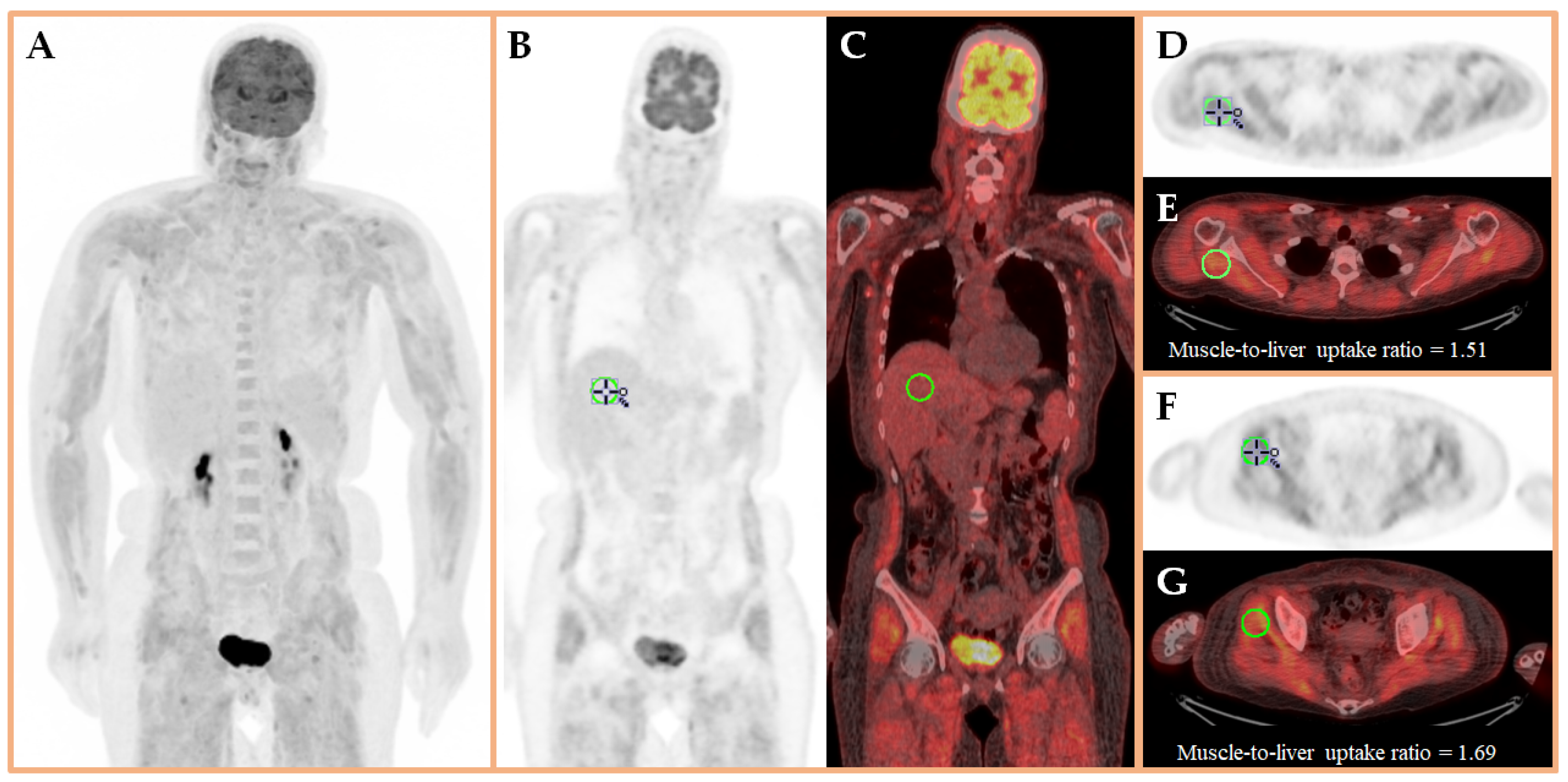
Figure 1. A 53-year-old woman with triple-negative breast cancer (TNBC), classified as cT2N1M0 [1], received neoadjuvant therapy with pembrolizumab and cytotoxic chemotherapeutic agents [2]. After the first cycle, she developed generalized pain, weakness, rash, and edema over the trunk and limbs, eventually becoming bedridden. Fluorine-18 fluorodeoxyglucose positron emission tomography (18F-FDG PET) was performed to rule out disease progression and skeletal metastasis. The patient fasted for at least 4 h before intravenous 18F-FDG injection (400.00 MBq). The patient did not exercise before the injection. We performed the 18F-FDG PET scan from head to thigh 60 min after the radiotracer injection. (A): Maximum Intensity Projection showing diffusely increased uptake in the muscles without skeletal or visceral metastasis. Coronal (B,C) and axial PET and fused PET/CT images showed the scapular (D,E) and gluteal (F,G) muscle-to-liver mean standardized uptake value (SUVmean) ratios of 1.51 and 1.69, respectively. Laboratory tests showed elevated creatine kinase at 1945 U/L (reference range: 30–223 U/L) [3] and positive anti-transcription intermediary factor 1-γ autoantibodies. Taken together, these findings confirmed the diagnosis of paraneoplastic and pembrolizumab-induced myositis [4,5,6].
Diagnostics 16 00596 g001
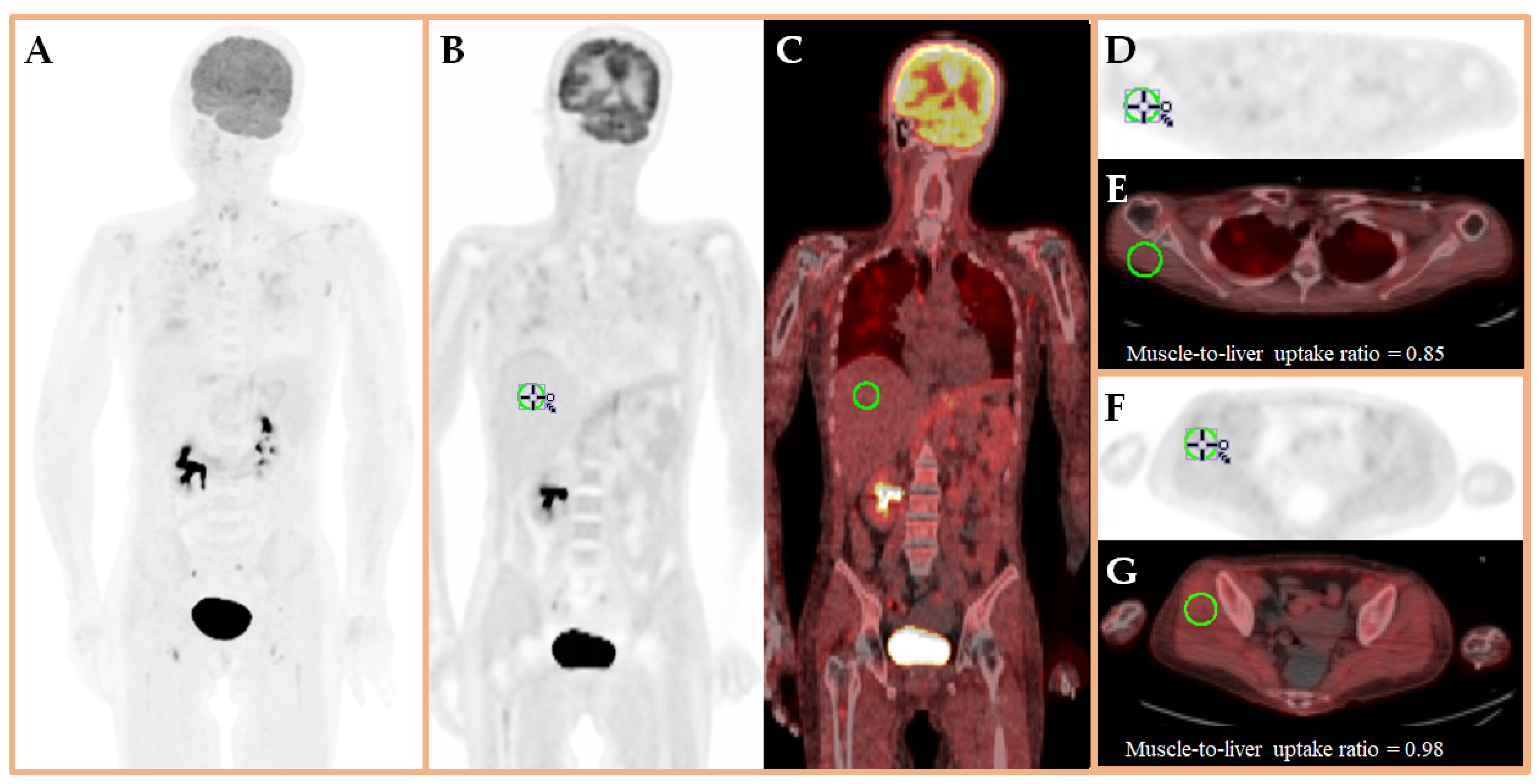
Figure 2. The paraneoplastic and pembrolizumab-induced myositis were treated with intravenous immunoglobulin (2 g/kg) and prednisolone at an equivalent daily dose of 50 mg [7,8,9]. The prednisolone dose was gradually tapered to 5 mg daily over a two-month period. The patient subsequently underwent a modified radical mastectomy, with a final pathological stage of ypT2N1a. Follow-up 18F-FDG PET performed 5 months after the initial scan revealed reduced muscular 18F-FDG uptake (AC), with scapular (D,E) and gluteal (F,G) muscle-to-liver SUVmean ratios of 0.85 and 0.98, respectively. The creatine kinase level normalized, and her symptoms gradually subsided. She could walk using a walker and required minimal assistance with self-care. Myositis is a rare comorbidity among patients with TNBC, whether as an immune-related adverse event of pembrolizumab or as a paraneoplastic manifestation. In this case, the onset occurred immediately after the first cycle of pembrolizumab, suggesting that the pembrolizumab may trigger a latent paraneoplastic phenomenon. While serum creatine kinase levels are routinely used as a biomarker of muscle injury, 18F-FDG PET enables direct visualization of inflammatory activities, allows assessment of myositis severity, and assists in distinguishing myositis from cancer metastasis. This case demonstrates the value of 18F-FDG PET as a molecular imaging modality to evaluate patients with cancer with suspected paraneoplastic or immune checkpoint inhibitor-associated myositis.
Diagnostics 16 00596 g002

Author Contributions

Conceptualization, C.-S.T. and Y.-H.C.; methodology, C.-S.T. and Y.-H.C.; investigation, C.-C.H., K.-Y.S., and S.-C.C.; resources, Y.-H.C. and S.-H.L.; data curation, C.-S.T. and Y.-H.C.; writing—original draft preparation, C.-S.T.; writing—review and editing, Y.-H.C.; supervision, Y.-H.C., K.-Y.S., S.-C.C., and S.-H.L. All authors have read and agreed to the published version of the manuscript.

Funding

This research was funded by Hualien Tzu Chi Hospital, Buddhist Tzu Chi Medical Foundation, and National Science and Technology Council in Taiwan, grant number 113-2314-B-303-018-MY2.

Institutional Review Board Statement

The study was conducted in accordance with the Declaration of Helsinki and approved by the Research Ethics Committee of Hualien Tzu Chi Hospital, Buddhist Tzu Chi Medical Foundation (protocol code: CR115-002 and date: 13 January 2026).

Informed Consent Statement

Written informed consent was obtained from the patient to publish this paper.

Data Availability Statement

The data presented in this study are available on request from the corresponding author due to ethical restrictions.

Conflicts of Interest

The authors declare no conflicts of interest.

Abbreviations

The following abbreviations are used in this manuscript:
FDGFluoro-deoxy-glucose
PETPositron emission tomography
SUVmeanMean standardized uptake value
TNBCTriple-negative breast cancer

References

  1. Amin, M.B.; Greene, F.L.; Edge, S.B.; Compton, C.C.; Gershenwald, J.E.; Brookland, R.K.; Meyer, L.; Gress, D.M.; Byrd, D.R.; Winchester, D.P. The Eighth Edition AJCC Cancer Staging Manual: Continuing to build a bridge from a population-based to a more “personalized” approach to cancer staging. CA Cancer J. Clin. 2017, 67, 93–99. [Google Scholar] [CrossRef] [PubMed]
  2. Schmid, P.; Cortes, J.; Pusztai, L.; McArthur, H.; Kummel, S.; Bergh, J.; Denkert, C.; Park, Y.H.; Hui, R.; Harbeck, N.; et al. Pembrolizumab for Early Triple-Negative Breast Cancer. N. Engl. J. Med. 2020, 382, 810–821. [Google Scholar] [CrossRef] [PubMed]
  3. Aleksovska, K.; Kyriakides, T.; Angelini, C.; Argov, Z.; Claeys, K.G.; de Visser, M.; Filosto, M.; Jovanovic, I.; Kostera-Pruszczyk, A.; Molnar, M.J.; et al. What Are the Normal Serum Creatine Kinase Values for Skeletal Muscle? A Worldwide Systematic Review. Eur. J. Neurol. 2025, 32, e70240. [Google Scholar] [CrossRef] [PubMed]
  4. De Vooght, J.; Vulsteke, J.B.; De Haes, P.; Bossuyt, X.; Lories, R.; De Langhe, E. Anti-TIF1-gamma autoantibodies: Warning lights of a tumour autoantigen. Rheumatology 2020, 59, 469–477. [Google Scholar] [CrossRef] [PubMed]
  5. Kostine, M.; Truchetet, M.E.; Schaeverbeke, T. Clinical characteristics of rheumatic syndromes associated with checkpoint inhibitors therapy. Rheumatology 2019, 58, vii68–vii74. [Google Scholar] [CrossRef] [PubMed]
  6. Dalakas, M.C.; Hohlfeld, R. Polymyositis and dermatomyositis. Lancet 2003, 362, 971–982. [Google Scholar] [CrossRef] [PubMed]
  7. Danieli, M.G.; Antonelli, E.; Gammeri, L.; Longhi, E.; Cozzi, M.F.; Palmeri, D.; Gangemi, S.; Shoenfeld, Y. Intravenous immunoglobulin as a therapy for autoimmune conditions. Autoimmun. Rev. 2025, 24, 103710. [Google Scholar] [CrossRef] [PubMed]
  8. Ghate, J.; Katsambas, A.; Augerinou, G.; Jorizzo, J.L. Review article: A therapeutic update on dermatomyositis/polymyositis. Int. J. Dermatol. 2000, 39, 81–87. [Google Scholar] [CrossRef] [PubMed]
  9. Jayan, A.; Mammen, A.L.; Suarez-Almazor, M.E. Immune Checkpoint Inhibitor-induced Myositis. Rheum. Dis. Clin. N. Am. 2024, 50, 281–290. [Google Scholar] [CrossRef] [PubMed]
Disclaimer/Publisher’s Note: The statements, opinions and data contained in all publications are solely those of the individual author(s) and contributor(s) and not of MDPI and/or the editor(s). MDPI and/or the editor(s) disclaim responsibility for any injury to people or property resulting from any ideas, methods, instructions or products referred to in the content.