A Comparative Analysis of Differences in Salivary hBD-2 Levels and Their Correlation with Dental Caries and Unstimulated Saliva pH in Children with Primary and Permanent Dentition

 , ,
, ,  ,
,  ,
,
Abstract
1. Introduction
2. Materials and Methods
2.1. Study Design and Participants
2.2. Inclusion and Exclusion Criteria
2.3. Data Collection
2.3.1. Basic Data Collection
2.3.2. Clinical Examination of the Study Participants
2.3.3. Unstimulated Saliva Sampling and Measurement of pH and hBD-2 Antimicrobial Peptide Levels
2.4. Sample Size
2.5. Statistical Analysis
3. Results
4. Discussion
5. Conclusions
Author Contributions
Funding
Institutional Review Board Statement
Informed Consent Statement
Data Availability Statement
Acknowledgments
Conflicts of Interest
Abbreviations
| hBD-2 | Human β-defensin 2 |
| WHO | World Health Organization |
| ELISA | Enzyme-linked immunosorbent assay |
| MAPK | Mitogen-activated protein kinases |
| NFκB | Nuclear factor kappa B |
References
- Gorr, S.U.; Abdolhosseini, M. Antimicrobial peptides and periodontal disease. J. Clin. Periodontol. 2011, 38, 126–141. [Google Scholar] [CrossRef]
- Gorr, S.U. Antimicrobial peptides of the oral cavity. Periodontol. 2000 2009, 51, 152–180. [Google Scholar] [CrossRef] [PubMed]
- Brown, K.L.; Hancock, R.E.W. Cationic host defense (antimicrobial) peptides. Curr. Opin. Immunol. 2006, 18, 24–30. [Google Scholar] [CrossRef]
- Hancock, R.E.W.; Diamond, G. The role of cationic antimicrobial peptides in innate host defences. Trends Microbiol. 2000, 8, 402–410. [Google Scholar] [CrossRef]
- Hemshekhar, M.; Anaparti, V.; Mookherjee, N. Functions of cationic host defense peptides in immunity. Pharmaceuticals 2016, 9, 40. [Google Scholar] [CrossRef]
- Dürr, U.H.N.; Sudheendra, U.S.; Ramamoorthy, A. LL-37, the only human member of the cathelicidin family of antimicrobial peptides. Biochim. Biophys. Acta Biomembr. 2006, 1758, 1408–1425. [Google Scholar] [CrossRef]
- Kohlgraf, K.G.; Pingel, L.C.; Dietrich, D.E.; Brogden, K.A. Defensins as anti-inflammatory compounds and mucosal adjuvants. Future Microbiol. 2010, 5, 99–113. [Google Scholar] [CrossRef]
- Tokajuk, J.; Deptuła, P.; Piktel, E.; Daniluk, T.; Chmielewska, S.; Wollny, T.; Wolak, P.; Fiedoruk, K.; Bucki, R. Cathelicidin LL-37 in health and diseases of the oral cavity. Biomedicines 2022, 10, 1086. [Google Scholar] [CrossRef] [PubMed]
- Kim, J.; Cho, B.H.; Jang, Y.S. Understanding the roles of host defense peptides in immune modulation: From antimicrobial action to potential as adjuvants. J. Microbiol. Biotechnol. 2023, 33, 288. [Google Scholar] [CrossRef]
- Niu, J.Y.; Yin, I.X.; Mei, M.L.; Wu, W.K.K.; Li, Q.L.; Chu, C.H. The multifaceted roles of antimicrobial peptides in oral diseases. Mol. Oral Microbiol. 2021, 36, 159–171. [Google Scholar] [CrossRef] [PubMed]
- Nagib, M.; Sayed, A.M.; Korany, A.H.; Abdelkader, K.; Shari, F.H.; Mackay, W.G.; Rateb, M.E. Human defensins: Structure, function, and potential as therapeutic antimicrobial agents with highlights against SARS CoV-2. Probiotics Antimicrob. Proteins 2025, 17, 1563–1583. [Google Scholar] [CrossRef]
- Tao, K.; He, C.; Zhu, Y.; Li, Z.; Shao, D.; Li, B.; Wei, J.; Qiu, Y.; Ma, Z.; Liu, K. The Other Side of Defensins: Review of Antiviral Activity of Defensins. Appl. Biochem. Microbiol. 2025, 61, 637–648. [Google Scholar] [CrossRef]
- Bastos, P.; Trinidade, F.; da Costa, J.; Ferreira, R.; Vitorino, R. Human antimicrobial peptides in bodily fluids: Current knowledge and therapeutic perspectives in the postantibiotic era. Medic. Res. Rev. 2018, 38, 101–146. [Google Scholar] [CrossRef] [PubMed]
- Salem, A.; Almahmoudi, R.; Hagström, J.; Stark, H.; Nordström, D.; Salo, T.; Eklund, K.K. Human β-defensin 2 expression in oral epithelium: Potential therapeutic targets in oral lichen planus. Int. J. Mol. Sci. 2019, 20, 1780. [Google Scholar] [CrossRef] [PubMed]
- Slebioda, Z.; Szponar, E.; Kowalska, A. Defensins and their role in the maintenance of the oral cavity homeostasis–a literature review. Cent. Eur. J. Immunol. 2013, 38, 111–117. [Google Scholar] [CrossRef]
- Chen, M.; Hu, Z.; Shi, J.; Xie, Z. Human β-defensins and their synthetic analogs: Natural defenders and prospective new drugs of oral health. Life Sci. 2024, 346, 122591. [Google Scholar] [CrossRef]
- Özdemir, M.; Caglayan, F.; Bikker, F.J.; Pussinen, P.; Könönen, E.; Yamalik, N.; Gürsoy, M.; Fteita, D.; Nazmi, K.; Güncü, G.N.; et al. Gingival tissue human beta-defensin levels in relation to infection and inflammation. J. Clin. Periodontol. 2020, 47, 309–318. [Google Scholar] [CrossRef]
- Zhai, Y.J.; Feng, Y.; Ma, X.; Ma, F. Defensins: Defenders of human reproductive health. Hum. Reprod. Update 2023, 29, 126–154. [Google Scholar] [CrossRef]
- Li, X.; Dingyu, D.; Jingmei, Y.; Panpan, W.; Bo, H.; Lei, Z.; Soren, J.; Henrik, D.; Jochen, W.; Yi, X. The expression of human β-defensins (hBD-1, hBD-2, hBD-3, hBD-4) in gingival epithelia. Arch. Oral Biol. 2016, 66, 15–21. [Google Scholar] [CrossRef]
- Atalay, N.; Balci, N.; Gürsoy, M.; Gürsoy, U.K. Systemic factors affecting human Beta-Defensins in oral cavity. Pathogens 2024, 13, 654. [Google Scholar] [CrossRef]
- Peters, B.M.; Shirtliff, M.E.; Jabra-Rizk, M.A. Antimicrobial Peptides: Primeval molecules or future drugs? PLoS Pathog. 2010, 6, e1001067. [Google Scholar] [CrossRef]
- Hancock, R.E.W. Cationic peptides: Effectors in innate immunity and novel antimicrobials. Lancet Infec. Dis. 2001, 1, 156–164. [Google Scholar] [CrossRef] [PubMed]
- da Silva, B.R.; Freitas, V.A.A.; Nascimento-Neto, L.G.; Carniero, V.A.; Arruda, F.V.S.; de Aguiar, A.S.W.; Cavada, B.S.; Teixeira, E.H. Antimicrobial peptide control of pathogenic microorganisms of the oral cavity: A review of the literature. Peptides 2012, 36, 315–321. [Google Scholar] [CrossRef]
- Ouhara, K.; Komatsuzawa, H.; Yamada, S.; Shiba, H.; Fujiwara, T.; Ohara, M.K.; Koji, H.; Kurihara, H.; Sugai, M. Susceptibilities of periodontopathogenic and cariogenic bacteria to antibacterial peptides, β-defensins and LL37, produced by human epithelial cells. J. Antimicrob. Chemother. 2005, 55, 888–896. [Google Scholar] [CrossRef]
- Nishimura, E.; Eto, A.; Kato, M.; Hashizume, S.; Imai, S.; Nisizawa, T.; Hanada, N. Oral streptococci exhibit diverse susceptibility to human β-defensin-2: Antimicrobial effects of hBD-2 on oral streptococci. Curr. Microbiol. 2024, 48, 285–287. [Google Scholar] [CrossRef]
- Brogden, K.A. Antimicrobial peptides: Pore formers or metabolic inhibitors in bacteria? Nat. Rev. Microbiol. 2005, 3, 238–250. [Google Scholar] [CrossRef] [PubMed]
- Söylemez, Ü.G.; Yousef, M.; Kesmen, Z.; Büyükkiraz, M.E.; Bakir-Gungor, B. Prediction of linear cationic antimicrobial peptides active against gram-negative and gram-positive bacteria based on machine learning models. Appl. Sci. 2022, 12, 3631. [Google Scholar] [CrossRef]
- Kim, J.; Yang, Y.L.; Jang, S.H.; Jang, Y.S. Human β-defensin 2 plays a regulatory role in innate antiviral immunity and is capable of potentiating the induction of antigen-specific immunity. Virol. J. 2018, 15, 124. [Google Scholar] [CrossRef]
- Ghosh, S.K.; Gerken, T.A.; Schneider, K.M.; Feng, Z.; McCormick, T.S.; Weinberg, A. Quantification of human β-defensin-2 and -3 in body fluids: Application for studies of innate immunity. Clin. Chem. 2007, 53, 757–765. [Google Scholar] [CrossRef][Green Version]
- Yang, D.; Biragyn, A.; Hoover, D.M.; Lubkowski, J.; Oppenheim, J.J. Multiple Roles of Antimicrobial Defensins, Cathelicidins, and Eosinophil-Derived Neurotoxin in Host Defense. Annu. Rev. Immun. 2004, 22, 181–215. [Google Scholar] [CrossRef]
- Li, X.; Wang, X.; Du, J.; Bu, X.; Peng, C.; Duan, X.; Fu, C. Applications of β-defensins against infectious pathogenic microorganisms. Expert Rev. Anti-Infect. Ther. 2024, 22, 501–510. [Google Scholar] [CrossRef]
- Guryanova, S.V.; Ovchinnikova, T.V. Immunomodulatory and allergenic properties of antimicrobial peptides. Int. J. Mol. Sci. 2022, 23, 2499. [Google Scholar] [CrossRef] [PubMed]
- Krisanaprakornkit, S.; Kimball, J.R.; Weinberg, A.; Darveau, R.P.; Bainbridge, B.W.; Dale, B.A. Inducible expression of human defensin 2 by Fusobacterium nucleatum in oral epithelial cells: Multiple signaling pathways and role of commensal bacteria in innate immunity and the epithelial barrier. Infect. Immun. 2000, 68, 2907–2915. [Google Scholar] [CrossRef] [PubMed]
- Cieślik, M.; Bagińska, N.; Górski, A.; Jończyk-Matysiak, E. Human β-Defensin 2 and Its Postulated Role in Modulation of the Immune Response. Cells 2021, 10, 2991. [Google Scholar] [CrossRef]
- Tsutsumi-Ishii, Y.; Nagaoka, I. NF-κB-mediated transcriptional regulation of human β-defensin-2 gene following lipopolysaccharide stimulation. J. Leukoc. Biol. 2002, 71, 154–162. [Google Scholar] [CrossRef]
- Harder, J.; Meyer-Hoffert, U.; Teran, L.M.; Schwichtenberg, L.; Bartels, J.; Maune, S.; Schröder, J.M. Mucoid Pseudomonas aeruginosa, TNF-alpha, and IL-1beta, but not IL-6, induce human beta-defensin-2 in respiratory epithelia. Am. J. Respir. Cell Mol. Biol. 2000, 22, 714–721. [Google Scholar] [CrossRef] [PubMed]
- Dale, B.A.; Fredericks, L.P. Antimicrobial peptides in the oral environment: Expression and function in health and disease. Curr. Issues Mol. Biol. 2005, 7, 119–133. [Google Scholar] [CrossRef]
- Yin, L.; Chino, T.; Horst, O.V.; Hacker, B.M.; Clark, E.A.; Dale, B.A.; Chung, W. Differential and coordinated expression of defensins and cytokines by gingival epithelial cells and dendritic cells in response to oral bacteria. BMC Immunol. 2010, 11, 37. [Google Scholar] [CrossRef]
- Shimizu, K.; Hanaoka, Y.; Akama, T.; Kono, I. Ageing and free-living daily physical activity effects on salivary beta-defensin 2 secretion. J. Sport. Sci. 2017, 35, 617–623. [Google Scholar] [CrossRef]
- Gürsoy, M.; Könönen, E.; He, Q.; Liukkonen, A.; Huumonen, S.; Gürsoy, U.S. Toll-like receptor-1,-2, and-6 genotypes in relation to salivary human beta-defensin-1,-2,-3 and human neutrophilic peptide-1. J. Clin. Periodontol. 2022, 49, 1185–1191. [Google Scholar] [CrossRef]
- Davidopoulou, S.; Diza, E.; Menexes, G.; Kafas, S. Salivary concentration of the antimicrobial peptide LL-37 in children. Arch. Oral Biol. 2012, 57, 865–869. [Google Scholar] [CrossRef]
- Lenander-Lumikari, M.; Loimaranta, V. Saliva and dental caries. Adv. Dent. Res. 2000, 14, 40–47. [Google Scholar] [CrossRef]
- Kumari, A.; Kumari, S.A. Antimicrobial Peptide in Oral Health: A Therapeutic Approach. In Evolution of Antimicrobial Peptides: From Self-Defense to Therapeutic Applications; Springer Nature: Cham, Switzerland, 2024; pp. 55–79. [Google Scholar]
- Dale, B.A.; Tao, R.; Kimball, J.R.; Jurevic, R.J. Oral antimicrobial peptides and biological control of caries. BMC Oral Health 2016, 6, S13. [Google Scholar] [CrossRef]
- Luong, A.D.; Buzid, A.; Luong, J.H. Important roles and potential uses of natural and synthetic antimicrobial peptides (AMPs) in oral diseases: Cavity, periodontal disease, and thrush. J. Funct. Biomater. 2022, 13, 175. [Google Scholar] [CrossRef] [PubMed]
- Alamoudi, A.; Alamoudi, R.; Gazzaz, Y.; Alqahtani, A.M. Role of salivary biomarkers in diagnosis and detection of dental caries: A systematic review. Diagnostics 2022, 12, 3080. [Google Scholar] [CrossRef] [PubMed]
- Yamamoto, M.; Aizawa, R. Maintaining a protective state for human periodontal tissue. Periodontol. 2000 2021, 86, 142–156. [Google Scholar] [CrossRef] [PubMed]
- Biomarkers Definitions Working Group. Biomarkers and surrogate endpoints: Preferred definitions and conceptual framework. Clin. Pharmacol. Ther. 2001, 69, 89–95. [Google Scholar] [CrossRef]
- Jurczak, A.; Kościelniak, D.; Papież, M.; Vyhouskaya, P.; Krzyściak, W. A study on β-defensin-2 and histatin-5 as a diagnostic marker of early childhood caries progression. Biol. Res. 2015, 48, 61–69. [Google Scholar] [CrossRef]
- Al-Ali, G.M.; Jafar, Z.J.; AL-Ghurabi, B.H. The relation of salivary cathelicidin and beta-defensin with dental caries of schoolchildren. J. Res. Med. Dent. Sci. 2021, 9, 30–35. [Google Scholar]
- Phattarataratip, E.; Olson, B.; Broffitt, B.; Qian, F.; Brogden, K.A.; Drake, D.R.; Levy, S.M.; Banas, J.A. Streptococcus mutans strains recovered from caries-active or caries-free individuals differ in sensitivity to host anti-microbial peptides. Mol. Oral Microbiol. 2011, 26, 187–199. [Google Scholar] [CrossRef]
- Ribeiro, T.R.; Dria, K.J.; de Carvalho, C.B.M.; Monteiro, A.J.; Fonteles, M.C.; de Moraes Carvalho, K.; Fonteles, C.S.R. Salivary peptide profile and its association with early childhood caries. Int. J. Paediatr. Dent. 2013, 23, 225–234. [Google Scholar] [CrossRef]
- Nazemisalman, B.; Baheran, V.; Shokrani, M.R.; Taheri, S.S. Comparing salivary antibacterial peptides in children with and without Caries. J. Pediatr. Perspect. 2023, 11, 18212–18219. [Google Scholar] [CrossRef]
- Koopaie, M.; Shahri, F.K.; Montazeri, R.; Kolahdooz, S.; Shahri, M.M.; Moshkbouy, E. Comparison of salivary statherin and beta-defensin-2 levels, oral health behaviors, and demographic factors in children with and without early childhood caries. BMC Oral Health 2025, 25, 868. [Google Scholar] [CrossRef]
- Ahmad, P.; Hussain, A.; Carrasco-Labra, A.; Siqueira, W.L. Salivary proteins as dental caries biomarkers: A systematic review. Caries Res. 2022, 56, 385–398. [Google Scholar] [CrossRef] [PubMed]
- Silveira, E.G.D.; Prato, L.S.; Pilati, S.F.M.; Arthur, R.A. Comparison of oral cavity protein abundance among caries-free and caries-affected individuals—A systematic review and meta-analysis. Front. Oral Health 2023, 4, 1265817. [Google Scholar] [CrossRef]
- Malik, E.; Dennison, S.R.; Harris, F.; Phoenix, D.A. pH dependent antimicrobial peptides and proteins, their mechanisms of action and potential as therapeutic agents. Pharmaceuticals 2016, 9, 67. [Google Scholar] [CrossRef]
- Bucki, R.; Namiot, D.B.; Namiot, Z.; Savage, P.B.; Janmey, P.A. Salivary mucins inhibit antibacterial activity of the cathelicidin-derived LL-37 peptide but not the cationic steroid CSA-13. J. Antimicrob. Chemother. 2008, 62, 329–335. [Google Scholar] [CrossRef]
- Tomita, T.; Hitomi, S.; Nagase, T.; Matsui, H.; Matsuse, T.; Kimura, S.; Ouchi, Y. Effect of ions on antibacterial activity of human beta defensin 2. Microbiol. Immunol. 2000, 44, 749–754. [Google Scholar] [CrossRef] [PubMed]
- Petrović, T.M.; Mandić, M.Z.; Veljković, N.; Papić, P.J.; Poznanović, M.M.; Stojković, J.S.; Magazinović, S.M. Makro i mikroelementi u flaširanim vodama i vodama iz javnih vodovoda u Srbiji. Hem. Ind. 2012, 66, 107–122. (In Serbian) [Google Scholar] [CrossRef]
- World Health Organization. Oral Health Surveys: Basic Methods, 5th ed.; World Health Organization: Geneva, Switzerland, 2013. [Google Scholar]
- Clarkson, J.; O’Mullane, D. A modified DDE Index for use in epidemiological studies of enamel defects. J. Dent. Res. 1989, 68, 445–450. [Google Scholar] [CrossRef] [PubMed]
- Greene, J.G.; Vermillion, J.R. The simplified oral hygiene index. J. Am. Dent. Assoc. 1964, 68, 7–13. [Google Scholar] [CrossRef] [PubMed]
- Thwin, K.M.; Zaitsu, T.; Ueno, M.; Kawaguchi, Y. Early childhood caries and related risk factors among Myanmar preschool children. Int. J. Clin. Prev. Dent. 2016, 12, 236. [Google Scholar] [CrossRef]
- Löe, H.; Silness, J. Periodontal disease in pregnancy. I. Prevalence and severity. Acta Odontol. Scand. 1963, 21, 533–555. [Google Scholar] [CrossRef]
- The R Development Core Team. A Language and Environment for Statistical Computing; R Foundation for Statistical Computing: Vienna, Austria, 2013; Available online: http://www.R-project.org/ (accessed on 13 June 2025).
- Joly, S.; Organ, C.C.; Johnson, G.K.; McCray, P.B.; Guthmiller, J.M. Correlation between β-defensin expression and induction profiles in gingival keratinocytes. Mol. Immunol. 2005, 42, 1073–1084. [Google Scholar] [CrossRef]
- Chung, W.O.; Dale, B.A. Innate Immune Response of Oral and Foreskin Keratinocytes: Utilization of Different Signaling Pathways by Various Bacterial Species. Infect. Immun. 2004, 72, 352–358. [Google Scholar] [CrossRef] [PubMed]
- Mathews, M.; Jia, H.P.; Guthmiller, J.M.; Losh, G.; Grahm, S.; Johnson, G.K.; Tack, B.F.; McCray, P.B. Production of β-Defensin Antimicrobial Peptides by the Oral Mucosa and Salivary Glands. Infect. Immun. 1999, 67, 2740–2745. [Google Scholar] [CrossRef]
- Colombo, N.H.; Ribas, L.F.F.; Pereira, J.A.; Kreling, P.F.; Kressirer, C.A.; Tanner, A.C.R.; Duque, C. Antimicrobial peptides in saliva of children with severe early childhood caries. Arch. Oral Biol. 2016, 69, 40–46. [Google Scholar] [CrossRef]
- Simon-Soro, A.; Sherriff, A.; Sadique, S.; Ramage, G.; Macpherson, L.; Mira, A.; Malcolm, S.C. Combined analysis of the salivary microbiome and host defence peptides predicts dental disease. Sci. Rep. 2018, 8, 1484–1494. [Google Scholar] [CrossRef]
- Gilbert, C.; Lefeuvre, C.; Preisser, L.; Pivert, A.; Soleti, R.; Blanchard, S.; Delneste, Y.; Ducancelle, A.; Couez, D.; Jeannin, P. Age-related expression of IFN-λ1 versus IFN-I and beta-defensins in the nasopharynx of SARS-CoV-2-infected individuals. Front. Immunol. 2021, 12, 750279. [Google Scholar] [CrossRef]
- Könönen, E. Oral colonization by anaerobic bacteria during childhood: Role in health and disease. Oral Dis. 1999, 5, 278–285. [Google Scholar] [CrossRef] [PubMed]
- Bachrach, G.; Chaushu, G.; Zigmond, M.; Yefenof, E.; Stabholz, A.; Shapira, J.; Merrick, J.; Chaushu, S. Salivary LL-37 secretion in individuals with Down Syndrome is normal. J. Dent. Res. 2006, 85, 933–936. [Google Scholar] [CrossRef] [PubMed]
- Dožić, I.; Todorović, T. Antimicrobial peptides of human saliva. Serbian Dent. J. 2005, 52, 208–216. [Google Scholar] [CrossRef]
- Ismail, A.I.; Sohn, W.; Tellez, M.; Amaya, A.; Sen, A.; Hasson, H.; Pitts, N.B. The International Caries Detection and Assessment System (ICDAS): An integrated system for measuring dental caries. Comm. Dentist. Oral Epidemiol. 2007, 35, 170–178. [Google Scholar] [CrossRef] [PubMed]


| Participants | n | Age (Years) (Mean ± SD) | Gender (n; %) | dt/DT = 0 (n; Mean ± SD) | dt/DT ≥ 1 (n; Mean ± SD) |
|---|---|---|---|---|---|
| Primary dentition | 75 | 3.44 ± 0.43 | Male (42; 56%) | 30; 0.00 ± 0.00 | 45; 7.31 ± 4.82 |
| Female (33; 44%) | |||||
| Permanent dentition | 78 | 12.63 ± 0.65 | Male (34; 44%) | 30; 0.00 ± 0.00 | 48; 6.19 ± 2.85 |
| Female (44; 56%) |
| hBD-2 (ng/mL) | Mean ± SD | p-Value |
|---|---|---|
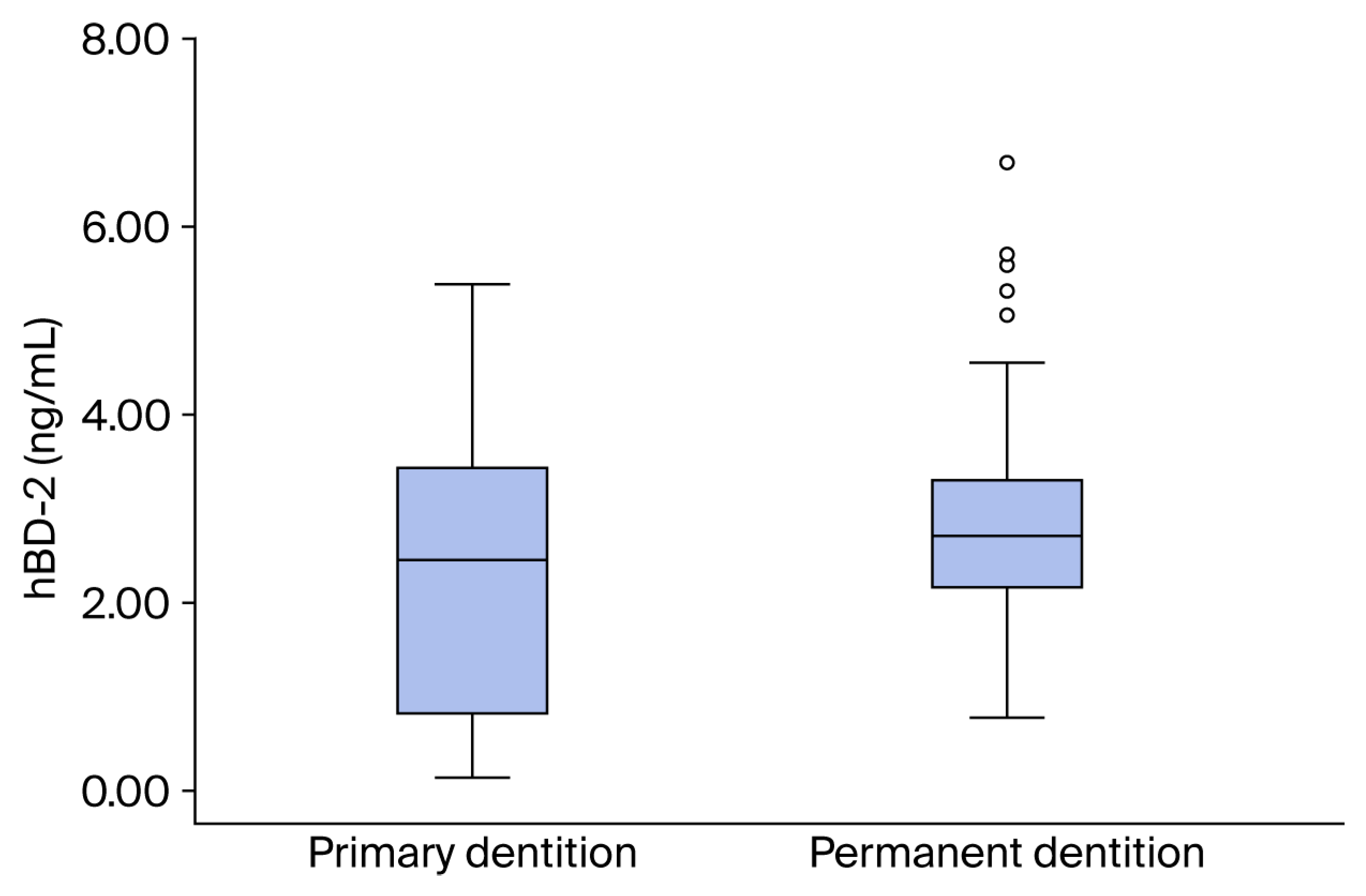
| Primary dentition | 2.26 ± 1.48 2.42 (0.80–3.46) 3 | 0.044 1 |
| Permanent dentition | 2.78 ± 1.08 2.69 (2.12–3.30) 3 | |
| Salivary pH | ||
| Primary dentition | 7.32 ± 0.30 7.29 (7.06–7.54) 3 | <0.001 2 |
| Permanent dentition | 7.03 ± 0.31 7.09 (6.87–7.22) 3 |
| hBD-2 (ng/mL) | Caries Free (Mean ± SD) | With Caries (Mean ± SD) | p-Value |
|---|---|---|---|
| Primary dentition | 2.14 ± 1.19 | 2.51 ± 1.72 | 0.535 1 |
| Permanent dentition | 2.60 ± 0.98 | 2.92 ± 1.12 | 0.150 1 |
| Salivary pH | |||
| Primary dentition | 7.34 ± 0.27 | 7.30 ± 0.31 | 0.595 2 |
| Permanent dentition | 7.08 ± 0.36 | 7.00 ± 0.36 | 0.271 2 |
| Primary Dentition | Permanent Dentition | ||||
|---|---|---|---|---|---|
| Saliva pH | Ʃdt/DT | Saliva pH | Ʃdt/DT | ||
| hBD-2 | rs | −0.067 | 0.076 | −0.230 | 0.139 |
| p | 0.566 | 0.515 | 0.043 * | 0.224 | |
| n | 75 | 75 | 78 | 75 | |
| 95%CI | −0.298–0.164 | −0.150–0.288 | −0.430–−0.009 | −0.102–0.360 | |
| effect size | Negligible | Negligible | Small | Negligible | |
| Saliva pH | rs | 1 | −0.180 | 1 | −0.213 |
| p | 0.121 | 0.061 | |||
| n | 75 | 75 | |||
| 95%CI | −0.381–0.037 | −0.419–0.015 | |||
| effect size | Small | Small | |||
Disclaimer/Publisher’s Note: The statements, opinions and data contained in all publications are solely those of the individual author(s) and contributor(s) and not of MDPI and/or the editor(s). MDPI and/or the editor(s) disclaim responsibility for any injury to people or property resulting from any ideas, methods, instructions or products referred to in the content. |
© 2026 by the authors. Licensee MDPI, Basel, Switzerland. This article is an open access article distributed under the terms and conditions of the Creative Commons Attribution (CC BY) license.
Share and Cite
Stojković, B.; Igić, M.; Jevtović Stoimenov, T.; Tričković Janjić, O.; Ignjatović, A.; Kostić, M.; Petrović, M.; Stojanović, S.; Živković, N.; Stojanović, A.; et al. A Comparative Analysis of Differences in Salivary hBD-2 Levels and Their Correlation with Dental Caries and Unstimulated Saliva pH in Children with Primary and Permanent Dentition. Diagnostics 2026, 16, 591. https://doi.org/10.3390/diagnostics16040591
Stojković B, Igić M, Jevtović Stoimenov T, Tričković Janjić O, Ignjatović A, Kostić M, Petrović M, Stojanović S, Živković N, Stojanović A, et al. A Comparative Analysis of Differences in Salivary hBD-2 Levels and Their Correlation with Dental Caries and Unstimulated Saliva pH in Children with Primary and Permanent Dentition. Diagnostics. 2026; 16(4):591. https://doi.org/10.3390/diagnostics16040591
Chicago/Turabian StyleStojković, Branislava, Marija Igić, Tatjana Jevtović Stoimenov, Olivera Tričković Janjić, Aleksandra Ignjatović, Miloš Kostić, Milica Petrović, Simona Stojanović, Nikola Živković, Ana Stojanović, and et al. 2026. "A Comparative Analysis of Differences in Salivary hBD-2 Levels and Their Correlation with Dental Caries and Unstimulated Saliva pH in Children with Primary and Permanent Dentition" Diagnostics 16, no. 4: 591. https://doi.org/10.3390/diagnostics16040591
APA StyleStojković, B., Igić, M., Jevtović Stoimenov, T., Tričković Janjić, O., Ignjatović, A., Kostić, M., Petrović, M., Stojanović, S., Živković, N., Stojanović, A., & Veličković, Z. (2026). A Comparative Analysis of Differences in Salivary hBD-2 Levels and Their Correlation with Dental Caries and Unstimulated Saliva pH in Children with Primary and Permanent Dentition. Diagnostics, 16(4), 591. https://doi.org/10.3390/diagnostics16040591