1. Introduction
Anterior cruciate ligament (ACL) tears are among the most frequent and consequential knee injuries, accounting for over 50% of all knee injuries sustained during athletic participation [
1,
2,
3]. The injury mechanism often occurs after multiplanar loading patterns such as sudden torsional load, abrupt changes in direction, jump/landing sequences, pivoting during athletic activities, combined with valgus collapse and tibial translation [
4,
5,
6]. Despite the substantial advances obtained in surgical techniques, rehabilitation protocols and injury prevention strategies, ACL injury still represents a major threat to athletic performance and career longevity due to its long-term social/physical impact.
ACL reconstruction (ACLR) has evolved beyond objective static stability; instead, the modern ACLR goal is to recreate functional knee kinematics capable of tolerating and adapting to sport-specific loads while preserving neuromuscular efficiency and minimizing donor site morbidity. The paradigm shift is particularly relevant in athletes who undergo ACLR and must withstand the same mechanical demands that mainly caused their initial injury. Failure to guarantee postoperative sport-specific functional demands not only compromises athletic return to sports (RTS) but also predisposes athletes to graft failure, contralateral knee injury and early retirement from competitive sports [
7,
8,
9,
10].
Pivot-dominant sports such as soccer, basketball and handball impose high rotational loads and rapid deceleration forces, whereas contact and collision sports introduce frequent direct trauma, kneeling positions and static pivoting. In contrast, endurance and non-pivoting sports rely heavily on cyclical loading patterns, muscle symmetry, and fatigue resistance rather than abrupt directional changes. These distinctions suggest that a “one size fits all” approach in ACL graft selection may be a biomechanically non-advantageous strategy and possibly inadequate for athletic populations [
11]. Therefore, graft selection for ACL reconstruction should minimize donor site morbidity and support the functional demands specific to each sport [
12,
13].
Despite extensive research comparing graft types in ACL reconstruction, most studies evaluate heterogeneous athletic populations and focus primarily on graft survival and general functional scores. This approach overlooks the substantial variability in biomechanical demands across different sports and playing roles, as well as the sport-specific consequences of donor site morbidity. Consequently, current evidence provides limited guidance for tailoring graft selection to the functional requirements of athletes engaged in pivoting, contact, or endurance-based sports.
For the purpose of this review, athletic activities were broadly categorized into pivoting and cutting sports (e.g., soccer, basketball, handball, downhill skiing), contact and collision sports (e.g., wrestling, martial arts, American football), and endurance or non-pivoting sports (e.g., sprinting, long-distance running). To the best of our knowledge, few studies specifically address these sport-related demands in relation to graft selection. Therefore, this review aims to synthesize the available evidence and support surgical graft selection through a sport-specific, recent literature-based approach.
2. Materials and Methods
The current study was conducted based on the principles of evidence-based practice with a focus on the sport-specific characteristics and graft choice reported in athletes of various sport types. Research was conducted on PubMed, MEDLINE, Scopus and Web of Science up to September 2025. The objectives were to descriptively evaluate different outcomes of bone–patellar tendon–bone (BPTB) autograft, hamstring tendon (HT) autograft and quadriceps tendon (QT) autografts. Outcomes evaluated included revision and graft survival, return to sports (RTS), time to return to sports (TTRS), patient-reported outcome measures (PROMs), return to pre-injury level, anterior knee pain, donor site morbidity and patient-specific prognostic factors of age and sex across sports categories. Sports were categorized into three types: pivoting sports (soccer, basketball, handball, downhill skiing), contact and collision sports (wrestling, martial arts, American football), and endurance and non-pivoting sports (sprinters, long-distance runners). Search terms included MeSH terms of anterior cruciate ligament reconstruction, ACL graft, patellar tendon, hamstring tendon, return to sport, pivoting sports, contact sports, collision sports, endurance and non-pivoting sports. The references of the included studies were screened for additional resources. Due to the nature of the search, the results were synthesized narratively.
3. Diagnostic Evaluation
3.1. Physical Examination
Multiple tests can be used to assess ACL injury. Deriving from its anatomy, ACL has two main bundles, the anteromedial (AM) and posterolateral (PL) bundles. The AM bundle is mostly responsible for anterior tibial translation, whereas the PL bundle has major rotational control and some translational control in near extension.
The Lachman test and the anterior drawer (AD) tests are specific translational tests; therefore, they both predominantly assess the AM bundle [
13]. The Lachman test is performed in slight knee flexion and is often positive in acute settings as its accuracy tends to “wane off” in chronic cases, whereas the AD test is performed at 90° of knee flexion and is less sensitive due to hamstring and secondary stabilizers’ activation at this anatomical position [
14].
The PL bundle may be assessed through the pivot-shift test, which reproduces dynamic rotatory instability. By applying combined rotational and translational forces, the aim is to reproduce the “giving way” feeling which directly correlates it to the functional instability seen during athletic activities. The pivot-shift test exploits the anatomical function of the iliotibial tract (IT band) which functions as an extensor in low knee flexion degrees that “shifts” to being a flexor in higher degrees of flexion. In an ACL deficient knee, during knee flexion on an internally rotated tibia, when the IT band changes its function, there is a sliding of the tibial plateau compared with the femur which is felt by the examiner [
15]. Whenever the slide is appreciated by others standing close to the examiner, the pivot-shift is graded as II, and when a clunk is heard, it is graded as III. Although the pivot-shift test is crucial for rotational instability assessment, it is heavily influenced by the examiner’s experience and subjective evaluation [
16].
3.2. Objective Evaluation
In ACL injury, objective laxity may be assessed through instrumented tools such as arthrometer test, KT-1000 and KT-2000 that produce a millimetric side-to-side difference with mechanical stress radiography, between the affected and the contralateral limb. The unaffected knee serves as a standardized control for the injured limb, providing both a preoperative and a postoperative evaluation of static laxity [
17]. Typically, a difference of 0–2 mm is considered normal, 3–5 mm indicates mild laxity, 6–10 mm moderate laxity, and >10 mm severe laxity. Although instrumented measurements provide precise quantitative data, they are inherently non-dynamic, and since exact thresholds may vary slightly depending on the device and study population, these instruments are complementary to clinical evaluation as they capture rotational and functional stability only partially. Therefore, instrumented assessments should be contextualized based on their clinical relevance from case to case [
18].
A part of the objective evaluation assesses the range of motion, relevant in both the choice of graft and rehabilitation progress, as well as cases where arthrofibrosis may be suspected.
3.3. Imaging
Whenever there is a clinical suspicion of ACL injury, plain X-rays help exclude fractures in acute settings, and may indirectly indicate ACL involvement such as in cases of tibial eminence fractures in young patients and anterolateral ligament (ALL) avulsion fractures known as Segond fractures, and thus remain important for a comprehensive knee evaluation [
19,
20]. Although the definitive diagnosis is made arthroscopically, magnetic resonance imaging (MRI) is often mentioned as the gold standard for ACL injury diagnosis due to its high sensitivity and accuracy, which exceed 90% for complete ACL tears. Partial ACL tears can sometimes be missed on MRI and may be managed conservatively, highlighting the importance of careful clinical evaluation. MRI also evidences anatomical conformation, concomitant meniscal, cartilaginous and ligamentous injuries, all crucial for complete operative planning [
21].
3.4. Special Considerations in Athletes
Assessment of pivot-shift, rotational instability, and MRI findings is essential for guiding surgical graft decisions, particularly in athletes engaged in high-demand, pivoting sports. Although rotational instability can impact daily activities, it is especially consequential in pivoting sports, where it increases the risk of secondary injuries and accelerates knee joint degeneration. Thus, in athletic patients, additional assessments relevant to neuromuscular control, strength testing, and proprioceptive evaluation are necessary [
22,
23]. These assessments heavily influence the athlete’s return to sports (RTS) timing and return to pre-injury sports level following an ACL reconstruction.
Based on the patient’s practiced sport and role, the patterns of muscle activation may differ significantly; therefore, an evaluation of sport-specific muscle performance comparing the affected limb with the contralateral side prior and following surgery becomes mandatory [
24]. Muscle performance assessment may help reduce donor site morbidity by sparing case-specific grafts that are predominantly used in each sport, by delaying game or by intensifying rehabilitation programs on sport-specific exercises, thus permitting postoperative RTS to the desired level [
25].
Although isokinetic and isoinertial dynamometers should be used for a comprehensive muscle assessment following an ACL injury, the mechanical designs between the available machines vary considerably, importantly, these devices do not truly isolate individual muscles but rather assess net torque produced by muscle groups acting on the knee. This limitation is particularly relevant in the athletic population, as results may reflect a specific altered neuro-motor control rather than true standalone muscle weakness [
26]. Therefore, machine-based data must be interpreted within a broader functional context that integrates neuromuscular control, proprioception, and sport-specific performance measures, holding the contralateral limb as a valuable monitoring resource to guide recovery and RTS [
27].
4. Graft Options
Graft options for ACL reconstruction primarily include autografts, allografts and synthetic grafts. Robust clinical evidence consistently demonstrates that allograft use is associated with inferior outcomes compared with autografts. Specifically, compared with autografts, allografts have been reported to lead to two to four times higher rates of graft failure, increased knee laxity, and lower rates of return to sport, particularly in young and active populations, the main recipients of ACL reconstruction [
28].
Although emerging options for autografts including the peroneus longus tendon (PL) and rectus femoris tendon are gaining popularity, there is limited evidence regarding their long-term outcomes and these will not be discussed in this article. Consequently, the current recommendation is to use autografts such as bone–patellar tendon–bone (BPTB), hamstring tendon (HT), or quadriceps tendon (QT) for primary ACL reconstruction, particularly in high-risk patients. Allografts may be considered for select older, less active individuals or in cases of multiple knee injuries [
28,
29,
30,
31]. The overall characteristics of autografts are summarized in
Table 1.
4.1. Pivoting and Cutting Sports
This category includes team sports like soccer and basketball, where athletes are exposed to high-demand forces, including pivoting, cutting maneuvers, and direct contact. The mechanisms of injury often vary by field position and role. Soccer wingers frequently sustain non-contact injuries during explosive cutting or landing tasks, whereas midfielders and defenders are more prone to contact-related injuries [
32]. Regardless of injury mechanism, players are generally expected to return to their original positions following ACL reconstruction, making restoration of optimal knee stability essential in regaining pre-injury performance levels.
Additional factors like sex and age play heavily affect injury risk and prognosis. Female athletes are known to have a higher risk of ACL injury, graft re-tears, and contralateral knee injuries compared with their male counterparts. Consequently, when these factors intersect, careful consideration of graft selection is crucial to achieving a robust reconstruction strategy and optimizing athletic outcomes [
32,
33].
4.1.1. BPTB Versus HT
When addressing ACL reconstruction in pivoting sports, evidence suggests that both HT and BPTB autografts are valid options; however, subtle differences should be considered based on the desired outcome. Although there is general agreement that BPTB autografts may provide better outcomes for athletes in pivoting sports, the athlete’s specific expectations should be clarified before determining the surgical strategy. Is the primary goal RTS, time to return to sport (TTRS), reducing revision risk, or return to pre-injury performance levels?
Revisions: Age appears to be a significant revision-modifying factor as reported by Busch et al. Their study found that HT graft failure occurred at a younger mean age (14.9 years) compared with BPTB graft failure (15.9 years) and that revision rates were significantly higher in the HT group [
34] reaching nearly fivefold in athletes younger than 18 [
35]. On the other hand, a study by Salem et al. mentions that when allograft-augmented HT grafts were excluded, there was no significant difference in revision rates between the HT and BPTB groups, while donor site morbidity remained significantly higher in the BPTB group [
36,
37]. This tendency was confirmed by a meta-analysis where re-rupture rates of BPTB (2.2%) were statistically comparable with HT (2.5%) [
38,
39]. Long-term outcomes indicate a significantly higher risk of revision with HT (93%) ACL reconstruction compared with BPTB (96%) at 12 years from index surgery, particularly in younger soccer, handball, and alpine skiing athletes [
40,
41]. However, these findings were contradicted by other studies involving netball, rugby, and soccer athletes [
35,
41]. Studies report that 18-year-old males present a 44% risk of re-injury [
42], while female volleyball athletes are more prone to ACL injury due to landing mechanics predisposing to valgus–external rotation [
43]. Overall, nearly one-third of young athletes participating in pivoting sports experience a secondary ACL injury, emphasizing the intrinsically high risk in this population [
44,
45].
RTS and return to pre-injury level: Studies indicate no significant difference in RTS rates with BPTB autografts (81.0%) compared with HT autografts (70.6%) as well as return to pre-injury levels between BPTB (48.9%) and HT (50.0%) groups [
40]. However, HT autografts demonstrated superior medium-term International Knee Documentation Committee (IKDC) scores (
p = 0.017) and significantly reduced long-term anterior knee pain symptoms compared with BPTB autografts (
p = 0.045), both important for early rehabilitation, RTS, and long-term athletic performance [
46,
47].
Stability and strength: Compared with HT autografts, BPTB autografts provided significantly greater stability in pivoting female athletes younger than 20 years, as measured by side-to-side difference (STSD) on radiographs at 5 and 12 months postoperatively. Interestingly, the same study found no significant difference in quadriceps muscle strength but significantly better hamstring strength in the BPTB group [
41].
Morbidity: The most reported donor site morbidity is consistently associated with BPTB autograft use and includes anterior knee pain and, rarely, patellar fractures. The incidence of anterior knee pain is a significant drawback that often limits athletic performance. It has been reported to reach as high as 50.5% of cases with BPTB autografts compared with 2% with HT ACL reconstructions (
p = 0.04) [
36,
37,
38]. Kneeling pain should be carefully evaluated based on the athlete’s sport, such as volleyball and skiing. These findings suggest that although both BPTB and HT autografts are viable options they each exhibit superiority in different outcomes.
4.1.2. QT Versus HT and BPTB
QT autograft use has recently gained popularity as an alternative to BPTB and HT autografts in pivoting and cutting sports.
Re-rupture, patient-reported outcome measures (PROMs), RTS, and TTRS: A comparative study evaluated soccer, football, lacrosse, and basketball athletes’ PROMs, RTS, TTRS, and re-tear rates between QT and BPTB autografts reporting no significant differences in IKDC and Lysholm scores, TTRS (7.1–7.6 months), or RTS rates (90.6% with QT vs. 86.1% with BPTB;
p = 0.82) [
48]. Although some sport-nonspecific studies reported better rotational control and lower re-rupture rates with QT autografts (odds ratio 0.46) compared with HT autografts, STSD and PROMs were still comparable between groups [
49].
QT autografts also demonstrated fewer donor site morbidities and kneecap-related symptoms compared with BPTB autografts (odds ratio 0.14–0.16) [
50]. Nevertheless, a recent study by Zegzdryn et al. reported a higher risk of revision in QT autograft recipients compared with BPTB recipients, while maintaining similar failure rates to the HT group, highlighting the need for long-term research before establishing the definitive role of QT autografts in athletic populations [
51].
Strength: An in vivo kinematic study indicated that HT autograft use may result in increased anterior tibial translation and decreased flexion strength compared with BPTB and QT autografts, and a similar extensor deficit in patients receiving BPTB and QT autografts that did not significantly affect PROMs [
31]. QT harvest leads to an approximate reduction of 34% in quadriceps strength, compared with 25% reduction in patellar tendon tensile strength following BPTB harvest. Both potentially contribute to long-term strength and functional knee deficits compared with HT autografts [
52]. Consequently, the choice between QT and HT should involve a careful sport- and role-specific assessment, considering whether it is knee flexion or extension that plays a secondary role in the athlete’s performance demands.
4.2. Contact and Collision Sports
Graft survival and diameter: A study of wrestlers reported an 80% return to competitive wrestling after ACL reconstruction, with 14% experiencing a secondary ACL failure. At 15 years post index surgery, BPTB graft survival (90.4%) was significantly higher than HT autograft survival (76.3%) (
p = 0.03). However, when HT autografts with a diameter smaller than 7.5 mm were excluded, failure rates were comparable between HT and all BPTB graft sizes [
53]. To achieve a larger graft diameter, Jeffers et al. reported good outcomes with quadrupled HT autografts in football athletes, with an RTS rate of 85% and a re-injury rate of 6.9% [
54].
RTS: Data regarding graft selection in contact and collision sports remain limited. A study of martial arts athletes reported comparable RTS rates among BPTB, HT, and QT autografts (
p = 0.47) [
55]. Takazawa et al. reported favorable outcomes in rugby players receiving augmented HT autografts, with RTS rates of 90–92%, longer time to failure, and lower failure rates in patients older than 20 years compared with younger patients (5% vs. 23%;
p = 0.006) [
56] where the majority of rugby players returned to sports within 12 months when BPTB was used [
57,
58].
In National Football League athletes, offensive and defensive linemen demonstrated a 64.3% RTS rate, and those who returned did so at high levels without a significant difference in performance or career length [
59]. In contrast, some studies report lower RTS rates (50%) in football players [
60], while others indicate comparable RTS (95%) and return to pre-injury levels (90%) among football and rugby elite athletes. Interestingly, rugby players demonstrated a shorter TTRS compared with football players (9.6 vs. 10.6 months;
p = 0.027) and football players were more likely to receive BPTB autografts than rugby athletes [
61].
Although some papers logically advise against the use of HT autografts in sports requiring sprinting and substantial hamstring strength [
62], given the current state of evidence, it may be premature to definitively recommend against a specific autograft type in the contact and collision category, particularly considering the survival and stability of ACL reconstructions with adjunct anterolateral ligament (ALL).
4.3. Endurance and Non-Pivoting Sports
This category of athletes is supported by the least amount of research evidence as the literature primarily addresses HT autograft use in this population.
Return to running: One study focusing on a structured rehabilitation program reported that 97% of athletes receiving HT autografts successfully completed a short-term return-to-running program, and IKDC scores above 64 predicted program completion [
63,
64].
Biomechanics and morbidity: Regardless of graft, studies report that running biomechanics remain altered 12 months after the index surgery, demonstrating substantial deficits compared with the pre-injury state that persist beyond the RTS period [
65]. Although BPTB autografts have been suggested to protect against secondary injury by mitigating flexion–extension asymmetry, HT autograft harvest alters hamstring muscle activation during running as well [
66]. These neuromuscular deficits theoretically increase the risk of hamstring strain injuries, particularly near the end of the swing phase of running and sprinting. However, these theoretical deficits do not appear to delay the timing of RTS progression [
67,
68], emphasizing the importance of a dedicated rehabilitation program for runners, which differs from that of athletes in pivoting sports [
69]. Guglielmetti et al. compared outcomes of BPTB and HT autografts and found that, although knee pain was significantly more common in the BPTB group, loss of kicking power, sprint start performance, and tendinitis rates were comparable between groups, suggesting HT autografts to be a favorable option for long-distance runners. However, the study was conducted primarily on soccer athletes rather than exclusively on non-pivoting athletes [
70].
The growing interest in QT autografts is supported by their low complication rates, favorable medium-term outcomes, and preservation of hamstring muscle function and swing mechanics. These findings suggest QT autografts may represent a promising option for high-volume runners. Nonetheless, further high-quality, long-term studies are needed to confirm the advantages of QT autografts in this population [
71,
72,
73].
5. Discussion
When considering RTS, TTRS, and PROMs, all autograft options appear to provide comparable results. Therefore, revision rates and donor site morbidities become the key outcome parameters to balance when selecting the graft and should integrate patient-specific factors with an understanding of sport-specific biomechanical demands [
48,
57].
In pivoting and cutting sports, abrupt directional changes, deceleration, and landing represent high-risk mechanics. Thus, regardless of graft choice, sport-specific injury prevention programs should target these movements. BPTB autografts appear to offer both high survival rates and high complication rates, making them a suitable option for young female pivoters [
32,
33]. However, the relatively high incidence of anterior knee pain is a considerable drawback, particularly for sports that require kneeling or deep flexion. Although HT autografts are associated with higher revision rates in athletes younger than 20 years, their use permits early rehabilitation and RTS while maintaining low donor site morbidity without compromising long-term athletic performance. QT autografts represent an emerging option for pivoting sports; however, current evidence is conflicting, suggesting possible long-standing extensor mechanism weakness and a revision risk comparable to that of HT autografts at two years postoperatively. These findings call for cautious use of QT autografts until additional high-quality evidence becomes available [
51].
Despite contact and collision sports showing outcomes like those in pivoting sports, kneeling, stationary pivoting actions, and contact injuries are more frequent and place the ACL at greater risk of primary and secondary injury. Since athletes who return to sport often do so at the same competitive level, donor site morbidity associated with BPTB autografts should be carefully considered to permit return to pre-injury levels. Wrestlers, who require substantial hamstring strength, should be considered carefully for HT autografts, and when used, HT graft diameter greater than 7.5 mm is desirable to ensure revision outcomes comparable to those of BPTB autografts [
53]. QT autografts represent an attractive option for this category; however, given the need to balance durability and morbidity while ensuring favorable RTS rates, current evidence remains heterogeneous and limited.
Endurance and non-pivoting athletes face fewer pivoting demands but rely heavily on muscle symmetry and repetitive motion. Consequently, BPTB autografts appear less suitable in this category as they increase repetitive patellofemoral joint stress and alter both sprint mechanism and muscle asymmetry in long-distance runners. HT autografts are generally considered a good option for endurance athletes for a successful RTS, and theoretical concerns regarding the risk of hamstring strain are successfully addressed through dedicated prevention programs [
65,
66,
69]. Evidence regarding the use of QT autografts in non-pivoting athletes remains scarce and controversial, largely due to concerns about potential muscle asymmetry and the lack of robust long-term outcome data [
51].
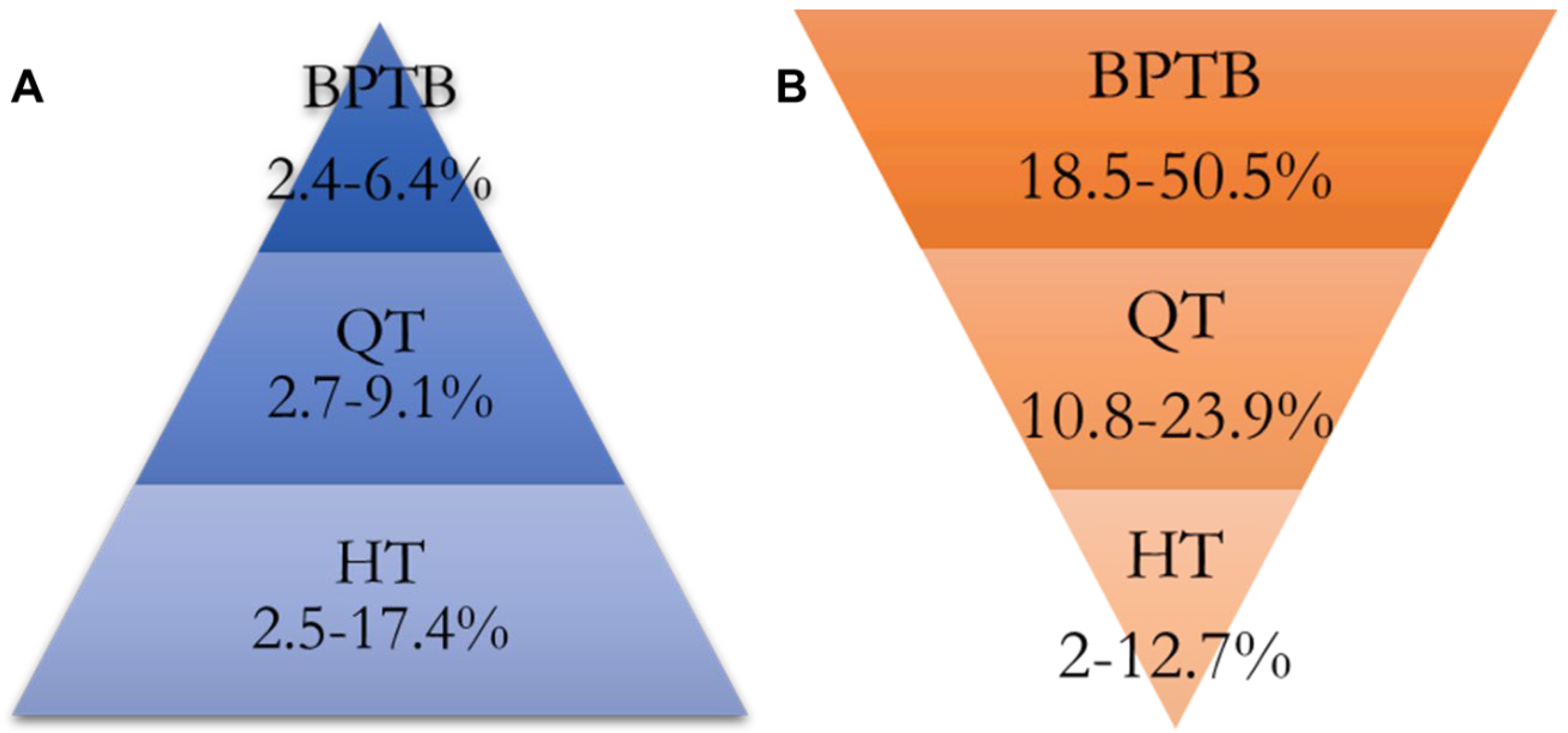
Considering the general literature, although reported failure rates vary, they typically range from approximately 2.4 to 6.4% for BPTB autografts, 2.7–9.1% for QT autografts, and 2.5–17.4% for HT autografts (
Figure 1A) [
74]. Reported rates of anterior knee pain (
Figure 1B) are frequently variable, ranging from 18.5 to 50.5% for BPTB, 10.8–23.9% for QT, and 2–12.7% for HT autografts. This variability is likely due to differences in study populations and surgical heterogeneity, such as the use of soft-tissue QT versus bone-plug QT grafts [
75,
76,
77,
78,
79].
Finally, a meta-analysis by Haybäck et al. calculated the yearly incidence of graft failure and found no statistically significant differences among the three graft types [
80]. Therefore, across all sports categories, graft choice should be tailored to sport-specific and patient-specific factors. Given the consistently higher revision rates reported in high-risk populations, adjunctive procedures such as ALL reconstruction may be considered to enhance rotational stability while balancing the morbidity trade-offs associated with BPTB grafts; ALL reconstruction may play a role in reducing revision risk and mitigating anterior knee pain symptoms deriving from BPTB harvest [
81,
82,
83,
84]. Therefore, future research should investigate the benefits of adjunctive procedures by comparing outcomes of BPTB, HT, and QT autografts with and without ALL reconstruction, particularly in high-risk populations.
This review has several limitations. First, although emerging autograft options such as the peroneus longus and rectus femoris tendons have been reported in recent research, current evidence is limited by small sample sizes, short follow-up, and a lack of sport-specific outcome measures, precluding meaningful conclusions regarding their implications in competitive athletes [
85,
86,
87]. For this reason, the present review focuses on grafts supported by more robust evidence in athletic populations, thereby allowing more reliable interpretation and clinical applicability. In addition, the literature on graft selection in athletes is heterogeneous with respect to study design, surgical technique, rehabilitation protocols, and definitions of return to sport, with many studies failing to stratify outcomes by sport type or performance level. To mitigate this limitation, a sport-based conceptual framework was adopted to synthesize existing data in a clinically interpretable manner.
Finally, although categorizing sports into pivoting, contact, and endurance-based activities inevitably simplifies the spectrum of biomechanical demands, this approach provides a pragmatic structure to integrate biomechanical principles with clinical outcomes. Importantly, by emphasizing donor site morbidity in relation to sport-specific functional demands, this review addresses common surgeon concerns regarding potential performance-limiting morbidities associated with graft choice in different sports. Despite these limitations, this study offers a focused, sport-specific synthesis of contemporary evidence and delivers clinically relevant guidance to support individualized graft selection while identifying key areas for future athlete-centered research.
6. Conclusions
Graft selection for ACL reconstruction in athletes should be individualized according to sport-specific biomechanical demands rather than based on a uniform strategy. While BPTB, HT, and QT autografts yield comparable RTS rates and PROMs, differences in revision risk and donor site morbidity remain clinically relevant. In pivoting and cutting sports, BPTB grafts provide reliable stability but are frequently associated with anterior knee pain, whereas HT grafts offer lower donor site morbidity with a higher susceptibility to revision in younger and high-risk athletes. In contact and collision sports, graft durability must be balanced against functional morbidity, making adequately sized HT or QT grafts reasonable alternatives. For endurance and non-pivoting athletes, HT grafts appear most suitable due to preserved muscle symmetry and reduced patellofemoral loading. In high-risk athletic populations, adjunctive ALL reconstruction may represent a complementary strategy to enhance rotational stability and potentially reduce revision risk when using HT grafts, while maintaining the advantage of low donor site morbidity. Overall, graft choice should be guided by an integrated assessment of sport demands, athlete characteristics, and acceptable morbidity to optimize long-term athletic outcomes.
Author Contributions
Conceptualization, K.-M.J. and A.A.M.; methodology, K.-M.J. and A.A.M.; software, K.-M.J. and A.A.M.; validation, K.-M.J., A.A.M., G.P.; formal analysis, G.P.; investigation, A.A.M.; resources, K.-M.J.; data curation, K.-M.J. and G.P.; writing—original draft preparation, A.A.M.; writing—review and editing, A.A.M.; visualization, K.-M.J.; supervision, K.-M.J. and G.P.; project administration, K.-M.J.; funding acquisition, K.-M.J. All authors have read and agreed to the published version of the manuscript.
Funding
This study was supported by a Korea University Fund.
Institutional Review Board Statement
Not applicable.
Informed Consent Statement
Not applicable.
Data Availability Statement
No new data were created or analyzed in this study. Data sharing is not applicable to this article.
Conflicts of Interest
The authors declare no conflicts of interest.
Abbreviations
The following abbreviations are used in this manuscript:
| ACL | Anterior cruciate ligament |
| ACLR | Anterior cruciate ligament reconstruction |
| AD | Anterior drawer |
| ALL | Anterolateral ligament |
| AM | Anteromedial |
| BPTB | Bone–patellar tendon–bone |
| HT | Hamstring tendon |
| IKDC | International Knee Documentation Committee |
| IT | Iliotibial (tract) |
| KT-1000 | Knee arthrometer (KT-1000) |
| KT-2000 | Knee arthrometer (KT-2000) |
| MRI | Magnetic resonance imaging |
| PL | Posterolateral |
| PROMs | Patient-reported outcome measures |
| QT | Quadriceps tendon |
| RTS | Return to sport |
| STSD | Side-to-side difference |
| TTRS | Time to return to sport |
References
- Risberg, M.A.; Lewek, M.; Snyder-Mackler, L. A systematic review of evidence for anterior cruciate ligament rehabilitation: How much and what type? Phys. Ther. Sport 2004, 5, 125–145. [Google Scholar] [CrossRef]
- Majewski, M.; Susanne, H.; Klaus, S. Epidemiology of athletic knee injuries: A 10-year study. Knee 2006, 13, 184–188. [Google Scholar] [CrossRef]
- Griffin, L.Y.; Agel, J.; Albohm, M.J.; Arendt, E.A.; Dick, R.W.; Garrett, W.E.; Garrick, J.G.; Hewett, T.E.; Huston, L.; Ireland, M.L.; et al. Noncontact Anterior Cruciate Ligament Injuries: Risk Factors and Prevention Strategies. J. Am. Acad. Orthop. Surg. 2000, 8, 141–150. [Google Scholar] [CrossRef]
- Sim, K.; Rahardja, R.; Zhu, M.; Young, S.W. Optimal Graft Choice in Athletic Patients with Anterior Cruciate Ligament Injuries: Review and Clinical Insights. Open Access J. Sports Med. 2022, 13, 55–67. [Google Scholar] [CrossRef] [PubMed]
- Krosshaug, T.; Nakamae, A.; Boden, B.P.; Engebretsen, L.; Smith, G.; Slauterbeck, J.R.; Hewett, T.E.; Bahr, R. Mechanisms of Anterior Cruciate Ligament Injury in Basketball. Am. J. Sports Med. 2007, 35, 359–367. [Google Scholar] [CrossRef] [PubMed]
- Hewett, T.E.; Myer, G.D.; Ford, K.R.; Heidt, R.S., Jr.; Colosimo, A.J.; McLean, S.G.; Van Den Bogert, A.J.; Paterno, M.V.; Succop, P. Biomechanical Measures of Neuromuscular Control and Valgus Loading of the Knee Predict Anterior Cruciate Ligament Injury Risk in Female Athletes: A Prospective Study. Am. J. Sports Med. 2005, 33, 492–501. [Google Scholar] [CrossRef]
- Ahsan, M. Anterior Cruciate Ligament Reconstruction and Return to Sports: A Comprehensive Guide. Ann. Sports Med. Res. 2023, 10, 1219. [Google Scholar] [CrossRef]
- Joseph, A.M.; Collins, C.L.; Henke, N.M.; Yard, E.E.; Fields, S.K.; Comstock, R.D. A Multisport Epidemiologic Comparison of Anterior Cruciate Ligament Injuries in High School Athletics. J. Athl. Train. 2013, 48, 810–817. [Google Scholar] [CrossRef]
- Ardern, C.L.; Taylor, N.F.; A Feller, J.; E Webster, K. Fifty-five per cent return to competitive sport following anterior cruciate ligament reconstruction surgery: An updated systematic review and meta-analysis including aspects of physical functioning and contextual factors. Br. J. Sports Med. 2014, 48, 1543–1552. [Google Scholar] [CrossRef]
- Fu, F.H.; van Eck, C.F.; Tashman, S.; Irrgang, J.J.; Moreland, M.S. Anatomic anterior cruciate ligament reconstruction: A changing paradigm. Knee Surg. Sports Traumatol. Arthrosc. 2014, 23, 640–648. [Google Scholar] [CrossRef]
- Lai, C.C.H.; Ardern, C.L.; A Feller, J.; E Webster, K. Eighty-three per cent of elite athletes return to preinjury sport after anterior cruciate ligament reconstruction: A systematic review with meta-analysis of return to sport rates, graft rupture rates and performance outcomes. Br. J. Sports Med. 2017, 52, 128–138. [Google Scholar] [CrossRef]
- Kahraman Marasli, M.; Bøe, B. ACL Graft Selection Based on Age and Sport. Video J. Sports Med. 2025, 5, 26350254241308584. [Google Scholar] [CrossRef] [PubMed]
- Kartus, J.; Movin, T.; Karlsson, J. Donor-site morbidity and anterior knee problems after anterior cruciate ligament reconstruction using autografts. Arthrosc. J. Arthrosc. Relat. Surg. 2001, 17, 971–980. [Google Scholar] [CrossRef] [PubMed]
- Amis, A.; Dawkins, G. Functional anatomy of the anterior cruciate ligament. Fibre bundle actions related to ligament replacements and injuries. J. Bone Jt. Surgery. Br. 1991, 73, 260–267. [Google Scholar] [CrossRef] [PubMed]
- Benjaminse, A.; Gokeler, A.; van der Schans, C.P. Clinical Diagnosis of an Anterior Cruciate Ligament Rupture: A Meta-analysis. J. Orthop. Sports Phys. Ther. 2006, 36, 267–288. [Google Scholar] [CrossRef]
- Bach, B.R.; Warren, R.F.; Wickiewicz, T.L. The pivot shift phenomenon: Results and description of a modified clinical test for anterior cruciate ligament insufficiency. Am. J. Sports Med. 1988, 16, 571–576. [Google Scholar] [CrossRef]
- Kopf, S.; Kauert, R.; Halfpaap, J.; Jung, T.; Becker, R. A new quantitative method for pivot shift grading. Knee Surg. Sports Traumatol. Arthrosc. 2012, 20, 718–723. [Google Scholar] [CrossRef]
- Daniel, D.M.; Stone, M.L.; Sachs, R.; Malcom, L. Instrumented measurement of anterior knee laxity in patients with acute anterior cruciate ligament disruption. Am. J. Sports Med. 1985, 13, 401–407. [Google Scholar] [CrossRef]
- Highgenboten, C.L.; Jackson, A.W.; Jansson, K.A.; Meske, N.B. KT-1000 arthrometer: Conscious and unconscious test results using 15, 20, and 30 pounds of force. Am. J. Sports Med. 1992, 20, 450–454. [Google Scholar] [CrossRef]
- Weerakkody, Y.; Bell, D. Anterior Cruciate Ligament Avulsion Fracture. Reference Article. Available online: https://Radiopaedia.org (accessed on 10 January 2026).
- Skinner, E.J.; Davis, D.D.; Varacallo, M.A. Segond Fracture. In StatPearls; StatPearls Publishing: Treasure Island, FL, USA, 2025. Available online: https://www.ncbi.nlm.nih.gov/books/NBK557810/ (accessed on 7 August 2023).
- Sultana, N.; Shirin, M.; Jabeen, S.; A Faruque, M.; Sarkar, S.K.; Nag, U.K.; Nabi, S. Diagnostic Accuracy of Magnetic Resonance Imaging in Evaluation of Anterior Cruciate Ligament Tear. Mymensingh Med. J. 2023, 32, 200–206. [Google Scholar]
- The Panther Symposium ACL Treatment Consensus Group; Diermeier, T.; Rothrauff, B.B.; Engebretsen, L.; Lynch, A.D.; Ayeni, O.R.; Paterno, M.V.; Xerogeanes, J.W.; Fu, F.H.; Karlsson, J.; et al. Treatment after anterior cruciate ligament injury: Panther Symposium ACL Treatment Consensus Group. Knee Surg. Sports Traumatol. Arthrosc. 2020, 28, 2390–2402. [Google Scholar] [CrossRef] [PubMed]
- Gokeler, A.; Benjaminse, A.; E Hewett, T.; Lephart, S.M.; Engebretsen, L.; Ageberg, E.; Engelhardt, M.; Arnold, M.P.; Postema, K.; Otten, E.; et al. Proprioceptive deficits after ACL injury: Are they clinically relevant? Br. J. Sports Med. 2011, 46, 180–192. [Google Scholar] [CrossRef] [PubMed]
- Shelbourne, K.D.; Gray, T. Anterior Cruciate Ligament Reconstruction with Autogenous Patellar Tendon Graft Followed by Accelerated Rehabilitation. Am. J. Sports Med. 1997, 25, 786–795. [Google Scholar] [CrossRef] [PubMed]
- Grindem, H.; Snyder-Mackler, L.; Moksnes, H.; Engebretsen, L.; Risberg, M.A. Simple decision rules can reduce reinjury risk by 84% after ACL reconstruction: The Delaware-Oslo ACL cohort study. Br. J. Sports Med. 2016, 50, 804–808. [Google Scholar] [CrossRef]
- Kyritsis, P.; Bahr, R.; Landreau, P.; Miladi, R.; Witvrouw, E. Likelihood of ACL graft rupture: Not meeting six clinical discharge criteria before return to sport is associated with a four times greater risk of rupture. Br. J. Sports Med. 2016, 50, 946–951. [Google Scholar] [CrossRef]
- Logerstedt, D.; Lynch, A.; Axe, M.J.; Snyder-Mackler, L. Pre-operative quadriceps strength predicts IKDC2000 scores 6months after anterior cruciate ligament reconstruction. Knee 2013, 20, 208–212. [Google Scholar] [CrossRef]
- Kaeding, C.C.; Aros, B.; Pedroza, A.; Pifel, E.; Amendola, A.; Andrish, J.T.; Dunn, W.R.; Marx, R.G.; McCarty, E.C.; Parker, R.D.; et al. Allograft Versus Autograft Anterior Cruciate Ligament Reconstruction: Predictors of Failure from a MOON Prospective Longitudinal Cohort. Sports Health A Multidiscip. Approach 2010, 3, 73–81. [Google Scholar] [CrossRef]
- Cruz, A.I.; Beck, J.J.; Ellington, M.D.; Mayer, S.W.; Pennock, A.T.; Stinson, Z.S.; VandenBerg, C.D.; Barrow, B.; Gao, B.; Ellis, H.B. Failure Rates of Autograft and Allograft ACL Reconstruction in Patients 19 Years of Age and Younger: A Systematic Review and Meta-Analysis. JBJS Open Access 2020, 5, e20.00106. [Google Scholar] [CrossRef]
- Min, J.H.; Yoon, H.-K.; Oh, H.-C.; Youk, T.; Ha, J.-W.; Park, S.-H. Graft choice to decrease the revision rate of anterior cruciate ligament reconstruction: A nationwide retrospective cohort study. Sci. Rep. 2024, 14, 20004. [Google Scholar] [CrossRef] [PubMed]
- Runer, A.; Keeling, L.; Wagala, N.; Nugraha, H.; Özbek, E.A.; Hughes, J.D.; Musahl, V. Current trends in graft choice for primary anterior cruciate ligament reconstruction—Part II: In-vivo kinematics, patient reported outcomes, re-rupture rates, strength recovery, return to sports and complications. J. Exp. Orthop. 2023, 10, 40. [Google Scholar] [CrossRef]
- Brophy, R.H.; Stepan, J.G.; Silvers, H.J.; Mandelbaum, B.R. Defending Puts the Anterior Cruciate Ligament at Risk During Soccer. Sports Health A Multidiscip. Approach 2014, 7, 244–249. [Google Scholar] [CrossRef] [PubMed]
- Paterno, M.V.P.; Rauh, M.J.; Schmitt, L.C.; Ford, K.R.; Hewett, T.E. Incidence of Contralateral and Ipsilateral Anterior Cruciate Ligament (ACL) Injury After Primary ACL Reconstruction and Return to Sport. Am. J. Ther. 2012, 22, 116–121. [Google Scholar] [CrossRef] [PubMed]
- Busch, M.; Murata, A.; Perkins, C.; Willimon, S.C. Graft Choice for Adolescent Athletes Returning to High-Risk Sports: A Matched Cohort Analysis of Patellar Tendon and Hamstring Autografts. Orthop. J. Sports Med. 2020, 8, 2325967120S00502. [Google Scholar] [CrossRef]
- Ekeland, A.; Engebretsen, L.; Fenstad, A.M.; Heir, S. Similar risk of ACL graft revision for alpine skiers, football and handball players: The graft revision rate is influenced by age and graft choice. Br. J. Sports Med. 2019, 54, 33–37. [Google Scholar] [CrossRef]
- Salem, H.S.; Varzhapetyan, V.; Patel, N.; Dodson, C.C.; Tjoumakaris, F.P.; Freedman, K.B. Anterior Cruciate Ligament Reconstruction in Young Female Athletes: Patellar Versus Hamstring Tendon Autografts. In Proceedings of the 44th Annual Meeting of the American-Orthopaedic-Society-for-Sports-Medicine (AOSSM), Boston, MA, USA, 11–14 July 2019; pp. 2086–2092. [Google Scholar] [CrossRef]
- Niki, Y.; Matsumoto, H.; Hakozaki, A.; Kanagawa, H.; Toyama, Y.; Suda, Y. Anatomic Double-Bundle Anterior Cruciate Ligament Reconstruction Using Bone–Patellar Tendon–Bone and Gracilis Tendon Graft: A Comparative Study with 2-Year Follow-Up Results of Semitendinosus Tendon Grafts Alone or Semitendinosus–Gracilis Tendon Grafts. Arthrosc. J. Arthrosc. Relat. Surg. 2011, 27, 1242–1251. [Google Scholar] [CrossRef]
- Niki, Y.; Hakozaki, A.; Iwamoto, W.; Kanagawa, H.; Matsumoto, H.; Toyama, Y.; Suda, Y. Factors affecting anterior knee pain following anatomic double-bundle anterior cruciate ligament reconstruction. Knee Surg. Sports Traumatol. Arthrosc. 2011, 20, 1543–1549. [Google Scholar] [CrossRef]
- DeFazio, M.W.; Curry, E.J.; Gustin, M.J.; Sing, D.C.; Abdul-Rassoul, H.; Ma, R.; Fu, F.; Li, X. Return to Sport After ACL Reconstruction with a BTB Versus Hamstring Tendon Autograft: A Systematic Review and Meta-analysis. Orthop. J. Sports Med. 2020, 8, 2325967120964919. [Google Scholar] [CrossRef]
- Gifstad, T.; Foss, O.A.; Engebretsen, L.; Lind, M.; Forssblad, M.; Albrektsen, G.; Drogset, J.O. Lower Risk of Revision with Patellar Tendon Autografts Compared with Hamstring Autografts: A registry study based on 45,998 primary ACL reconstructions in Scandinavia. Am. J. Sports Med. 2014, 42, 2319–2328. [Google Scholar] [CrossRef]
- Sanada, T.; Iwaso, H.; Fukai, A.; Honda, E.; Yoshitomi, H.; Inagawa, M. Anatomic Anterior Cruciate Ligament Reconstruction Using Rectangular Bone–Tendon– Bone Autograft Versus Double-Bundle Hamstring Tendon Autograft in Young Female Athletes. Arthrosc. Sports Med. Rehabil. 2021, 3, e47–e55. [Google Scholar] [CrossRef]
- Tiplady, A.; Love, H.; Young, S.W.; Frampton, C.M. Comparative Study of ACL Reconstruction with Hamstring Versus Patellar Tendon Graft in Young Women: A Cohort Study from the New Zealand ACL Registry. Am. J. Sports Med. 2023, 51, 627–633. [Google Scholar] [CrossRef]
- Manara, J.R.; Salmon, L.J.; Kilani, F.M.; de Camino, G.Z.; Monk, C.; Sundaraj, K.; Pinczewski, L.A.; Roe, J.P. Repeat Anterior Cruciate Ligament Injury and Return to Sport in Australian Soccer Players After Anterior Cruciate Ligament Reconstruction with Hamstring Tendon Autograft. Am. J. Sports Med. 2022, 50, 3533–3543. [Google Scholar] [CrossRef] [PubMed]
- Tarantino, K. Return to Sport Following Anterior Cruciate Ligament Reconstruction: Women’s Indoor Volleyball. J. Women’s Sports Med. 2022, 2, 42–56. [Google Scholar] [CrossRef]
- Webster, K.E.; Feller, J.A.; Leigh, W.B.; Richmond, A.K. Younger Patients Are at Increased Risk for Graft Rupture and Contralateral Injury After Anterior Cruciate Ligament Reconstruction. Am. J. Sports Med. 2014, 42, 641–647. [Google Scholar] [CrossRef] [PubMed]
- Wiggins, A.J.; Grandhi, R.K.; Schneider, D.K.; Stanfield, D.; Webster, K.E.; Myer, G.D. Risk of Secondary Injury in Younger Athletes After Anterior Cruciate Ligament Reconstruction. Am. J. Sports Med. 2016, 44, 1861–1876. [Google Scholar] [CrossRef]
- He, X.; Yang, X.-G.; Feng, J.-T.; Wang, F.; Huang, H.-C.; He, J.-Q.; Hu, Y.-C. Clinical Outcomes of the Central Third Patellar Tendon Versus Four-strand Hamstring Tendon Autograft Used for Anterior Cruciate Ligament Reconstruction: A Systematic Review and Subgroup Meta-analysis of Randomized Controlled Trials. Injury 2020, 51, 1714–1725. [Google Scholar] [CrossRef]
- Renfree, S.P.; Brinkman, J.C.; Tummala, S.V.; Economopoulos, K.J. ACL Reconstruction with Quadriceps Soft Tissue Autograft Versus Bone-Patellar Tendon-Bone Autograft in Cutting and Pivoting Athletes: Outcomes at Minimum 2-Year Follow-up. Orthop. J. Sports Med. 2023, 11, 23259671231197400. [Google Scholar] [CrossRef]
- Hurley, E.T.; Mojica, E.S.; Kanakamedala, A.C.; Meislin, R.J.; Strauss, E.J.; Campbell, K.A.; Alaia, M.J. Quadriceps tendon has a lower re-rupture rate than hamstring tendon autograft for anterior cruciate ligament reconstruction—A meta-analysis. J. ISAKOS 2022, 7, 87–93. [Google Scholar] [CrossRef]
- Zhang, X.-F.; Liu, P.; Huang, J.-W.; He, Y.-H. Efficacy and safety of quadriceps tendon autograft versus bone–patellar tendon–bone and hamstring tendon autografts for anterior cruciate ligament reconstruction: A systematic review and meta-analysis. J. Orthop. Traumatol. 2024, 25, 65. [Google Scholar] [CrossRef]
- Zegzdryn, M.; Moatshe, G.; Engebretsen, L.; Drogset, J.O.; Lygre, S.H.L.; Visnes, H.; Persson, A. Increased risk for early revision with quadriceps graft compared with patellar tendon graft in primary ACL reconstructions. Knee Surg. Sports Traumatol. Arthrosc. 2024, 32, 656–665. [Google Scholar] [CrossRef]
- Solie, B.; Monson, J.; Larson, C. Graft-Specific Surgical and Rehabilitation Considerations for Anterior Cruciate Ligament Reconstruction with the Quadriceps Tendon Autograft. Int. J. Sports Phys. Ther. 2023, 18, 493–512. [Google Scholar] [CrossRef]
- Marigi, E.M.; Song, B.M.; Wasserburger, J.N.; Camp, C.L.; Levy, B.A.; Stuart, M.J.; Okoroha, K.R.; Krych, A.J. Anterior Cruciate Ligament Reconstruction in 107 Competitive Wrestlers: Outcomes, Reoperations, and Return to Play at 6-Year Follow-up. Orthop. J. Sports Med. 2022, 10, 23259671221092770. [Google Scholar] [CrossRef] [PubMed]
- Jeffers, K.W.; Shah, S.A.; Calvert, D.D.; Lemoine, N.P.; Marucci, J.; Mullenix, S.; Zura, R.D.; Bankston, A.B.; Bankston, L.S. High Return to Play and Low Reinjury Rates in National Collegiate Athletic Association Division I Football Players Following Anterior Cruciate Ligament Reconstruction Using Quadrupled Hamstring Autograft. Arthrosc. J. Arthrosc. Relat. Surg. 2022, 38, 99–106. [Google Scholar] [CrossRef] [PubMed]
- Park, Y.L.; Wackerle, A.M.; Collins, B.; Nazzal, E.M.; Giusto, J.D.; Kolevar, M.; Irrgang, J.J.; Hughes, J.D.; Musahl, V. Return to sport and patient reported outcomes in athletes participating in martial arts after anterior cruciate ligament reconstruction at mean follow-up of 12 years. J. Exp. Orthop. 2025, 12, e70272. [Google Scholar] [CrossRef] [PubMed]
- Takazawa, Y.; Ikeda, H.; Saita, Y.; Kawasaki, T.; Ishijima, M.; Nagayama, M.; Kaneko, H.; Kaneko, K. Return to Play of Rugby Players After Anterior Cruciate Ligament Reconstruction Using Hamstring Autograft: Return to Sports and Graft Failure According to Age. Arthrosc. J. Arthrosc. Relat. Surg. 2017, 33, 181–189. [Google Scholar] [CrossRef]
- Hurley, E.T.; Withers, D.; King, E.; Franklyn-Miller, A.; Jackson, M.; Moran, R. Return to Play After Patellar Tendon Autograft for Primary Anterior Cruciate Ligament Reconstruction in Rugby Players. Orthop. J. Sports Med. 2021, 9, 23259671211000460. [Google Scholar] [CrossRef]
- Arner, J.W.; Bradley, J.P. Practice Patterns and Return-to-Sports Timing of National Football League Head Team Physicians for ACL Reconstruction. Orthop. J. Sports Med. 2024, 12, 23259671241274139. [Google Scholar] [CrossRef]
- Cinque, M.E.; Hannon, C.P.; Bohl, D.D.; Erickson, B.J.; Verma, N.N.; Cole, B.J.; Bach, B.R., Jr. Return to Sport and Performance After Anterior Cruciate Ligament Reconstruction in National Football League Linemen. Orthop. J. Sports Med. 2017, 5, 2325967117711681. [Google Scholar] [CrossRef]
- Aldawoudy, A.M.; Van Blerk, J.; Elfeel, A. The Incidence and Rate of Return to Competitive Sport Post ACL Reconstruction: Literature Review. Svoa Orthop. 2024, 4, 117–126. [Google Scholar] [CrossRef]
- Jones, M.; Pinheiro, V.H.; Balendra, G.; Borque, K.; Williams, A. No difference in return to play rates between different elite sports after primary autograft ACL reconstruction. Knee Surg. Sports Traumatol. Arthrosc. 2023, 31, 5924–5931. [Google Scholar] [CrossRef]
- Ostojic, M.; Indelli, P.F.; Lovrekovic, B.; Volcarenghi, J.; Juric, D.; Hakam, H.T.; Salzmann, M.; Ramadanov, N.; Królikowska, A.; Becker, R.; et al. Graft Selection in Anterior Cruciate Ligament Reconstruction: A Comprehensive Review of Current Trends. Medicina 2024, 60, 2090. [Google Scholar] [CrossRef]
- de Fontenay, B.P.; Van Cant, J.; Gokeler, A.; Roy, J.-S. Reintroduction of Running After Anterior Cruciate Ligament Reconstruction with a Hamstrings Graft: Can We Predict Short-Term Success? J. Athl. Train. 2021, 57, 540–546. [Google Scholar] [CrossRef]
- Van Cant, J.; de Fontenay, B.P.; Douaihy, C.; Rambaud, A. Characteristics of return to running programs following an anterior cruciate ligament reconstruction: A scoping review of 64 studies with clinical perspectives. Phys. Ther. Sport 2022, 57, 61–70. [Google Scholar] [CrossRef] [PubMed]
- Knurr, K.A.; Kliethermes, S.A.; Stiffler-Joachim, M.R.; Cobian, D.G.; Baer, G.S.; Heiderscheit, B.C. Running Biomechanics Before Injury and 1 Year After Anterior Cruciate Ligament Reconstruction in Division I Collegiate Athletes. Am. J. Sports Med. 2021, 49, 2607–2614. [Google Scholar] [CrossRef] [PubMed]
- Einarsson, E.; Thomson, A.; Sas, B.; Hansen, C.; Gislason, M.; Whiteley, R. Lower medial hamstring activity after ACL reconstruction during running: A cross-sectional study. BMJ Open Sport Exerc. Med. 2021, 7, e000875. [Google Scholar] [CrossRef] [PubMed]
- Leung, A.; DeSandis, B.; O’brien, L.; Hammoud, S.; Zarzycki, R. Postoperative considerations based on graft type after anterior cruciate ligament reconstruction a narrative review. Ann. Jt. 2023, 8, 26. [Google Scholar] [CrossRef]
- Alaoui, I.B.; Moiroux-Sahraoui, A.; Mazeas, J.; Kakavas, G.; Biały, M.; Douryang, M.; Forelli, F. Impact of Hamstring Graft on Hamstring Peak Torque and Maximum Effective Angle After Anterior Cruciate Ligament Reconstruction: An Exploratory and Preliminary Study. Bioengineering 2025, 12, 465. [Google Scholar] [CrossRef]
- Lorenz, D.; Domzalski, S. Criteria-based return to sprinting progression following lower extremity injury. Int. J. Sports Phys. Ther. 2020, 15, 326–332. [Google Scholar] [CrossRef]
- Guglielmetti, L.G.B.; Salas, V.E.R.; Jorge, P.B.; Duarte, A., Jr.; Marques de Oliveira, V.; de Paula Leite Cury, R. Prospective and Randomized Clinical Evaluation of Hamstring Versus Patellar Tendon Autograft for Anterior Cruciate Ligament Reconstruction in Soccer Players. Orthop. J. Sports Med. 2021, 9, 23259671211028168. [Google Scholar] [CrossRef]
- Englander, Z.A.; Garrett, W.E.; Spritzer, C.E.; DeFrate, L.E. In vivo attachment site to attachment site length and strain of the ACL and its bundles during the full gait cycle measured by MRI and high-speed biplanar radiography. J. Biomech. 2020, 98, 109443. [Google Scholar] [CrossRef]
- Shelburne, K.B.; Pandy, M.G.; Anderson, F.C.; Torry, M.R. Pattern of anterior cruciate ligament force in normal walking. J. Biomech. 2004, 37, 797–805. [Google Scholar] [CrossRef]
- Horstmann, H.; Petri, M.; Tegtbur, U.; Felmet, G.; Krettek, C.; Jagodzinski, M. Quadriceps and hamstring tendon autografts in ACL reconstruction yield comparably good results in a prospective, randomized controlled trial. Arch. Orthop. Trauma Surg. 2021, 142, 281–289. [Google Scholar] [CrossRef] [PubMed]
- Kurkowski, S.C.; Thimmesch, M.J.; Murphy, M.; Kuechly, H.A.; Emmert, A.S.; Grawe, B. Uncovering the State of Current Data on Quadriceps Tendon Autograft Use Versus Bone–Patellar Tendon–Bone and Hamstring Tendon Autografts in Anterior Cruciate Ligament Reconstruction at ≥5 Years After Surgery: A Systematic Review and Meta-analysis. Am. J. Sports Med. 2025, 53, 1739–1749. [Google Scholar] [CrossRef] [PubMed]
- da Silva Marques, F.; Barbosa, P.H.B.; Alves, P.R.; Zelada, S.; Pereira da Silva Nunes, R.; Régis de Souza, M.; do Amaral Camargo Pedro,, P.; Nunes, J.F.; Mello Alves, W., Jr.; de Campos, G.C. Anterior Knee Pain After Anterior Cruciate Ligament Reconstruction. Orthop. J. Sports Med. 2020, 8, 2325967120961082. [Google Scholar] [CrossRef] [PubMed]
- Kitagawa, T.; Nakase, J.; Takata, Y.; Shimozaki, K.; Asai, K.; Yoshimizu, R.; Kimura, M.; Tsuchiya, H. Flexibility of infrapatellar fat pad affecting anterior knee pain 6 months after anterior cruciate ligament reconstruction with hamstring autograft. Sci. Rep. 2020, 10, 21347. [Google Scholar] [CrossRef]
- Jackson, G.R.; Mameri, E.S.; Tuthill, T.; Wessels, M.; Sugrañes, J.; Batra,, A.K.; McCormick, J.R.; Kaplan, D.J.; Knapik, D.M.; Verma, N.N.; et al. Adverse Events and Complications After Primary ACL Reconstruction with Quadriceps Tendon Autograft: A Systematic Review. Orthop. J. Sports Med. 2023, 11, 23259671231199728. [Google Scholar] [CrossRef]
- Ashy, C.; Bailey, E.; Hutchinson, J.; Brennan, E.; Bailey, R.; Pullen, W.M.; Xerogeanes, J.W.; Slone, H.S. Quadriceps tendon autograft has similar clinical outcomes when compared to hamstring tendon and bone–patellar tendon–bone autografts for revision ACL reconstruction: A systematic review and meta-analysis. Knee Surg. Sports Traumatol. Arthrosc. 2023, 31, 5463–5476. [Google Scholar] [CrossRef]
- Meena, A.; Di Paolo, S.; Grassi, A.; Raj, A.; Farinelli, L.; Hoser, C.; Tapasvi, S.; Zaffagnini, S.; Fink, C. No difference in patient reported outcomes, laxity, and failure rate after revision ACL reconstruction with quadriceps tendon compared to hamstring tendon graft: A systematic review and meta-analysis. Knee Surg. Sports Traumatol. Arthrosc. 2023, 31, 3316–3329. [Google Scholar] [CrossRef]
- Haybäck, G.; Raas, C.; Rosenberger, R. Failure rates of common grafts used in ACL reconstructions: A systematic review of studies published in the last decade. Arch. Orthop. Trauma Surg. 2021, 142, 3293–3299. [Google Scholar] [CrossRef]
- Suh, D.K.; Cho, I.-Y.; Noh, S.; Yoon, D.J.; Jang, K.-M. Anatomical and Biomechanical Characteristics of the Anterolateral Ligament: A Descriptive Korean Cadaveric Study Using a Triaxial Accelerometer. Medicina 2023, 59, 419. [Google Scholar] [CrossRef]
- Park, J.-G.; Han, S.-B.; Rhim, H.C.; Jeon, O.H.; Jang, K.-M. Anatomy of the anterolateral ligament of the knee joint. World J. Clin. Cases 2022, 10, 7215–7223. [Google Scholar] [CrossRef]
- Assala Abu Mukh, A.A.M.; Elsayed Ahmed Abdelatif, E.A.A.; Shengdong Yang, S.Y.; Heyon Seok Hong, H.S.H.; Lael Kang, L.K.; Hye Chang Rhim, H.C.R.; Ki-Mo Jang, K.M.J. The addition of Anterolateral Ligament Reconstruction to Primary Hamstring Autograft ACLR Improves Objective Rotatory Stability and Reduces Graft Rupture Rates: A Systematic Review and Meta-analysis. KSRR 2026. (submitted; in revision). [Google Scholar]
- Soleymanha, M.; Soleymani Nejad, A.; Keyhani, S.; Vosoughi, F.; LaPrade, R.F.; Tollefson, L.V. Peroneus longus tendon harvest for ACL reconstruction yields good functional outcome of the ankle: A systematic review and meta-Analysis. Knee Surg. Sports Traumatol. Arthrosc. 2025. Advance online publication. [Google Scholar] [CrossRef]
- Opoku, M.; Abdramane, A.M.; Abdirahman, A.; Fang, M.; Li, Y.; Xiao, W. Can peroneus longus tendon autograft become an alternative to hamstring tendon autograft for anterior cruciate ligament reconstruction: A systematic review and meta-analysis of comparative studies. J. Orthop. Surg. Res. 2025, 20, 719. [Google Scholar] [CrossRef]
- Hashish, M.A.; Eloliemy, A.M.; Samy, A.M.; El Forse, E.M. Results of arthroscopic anterior cruciate ligament reconstruction using full-thickness peroneus longus tendon autograft. Egypt. Orthop. J. 2024, 59, 408–415. [Google Scholar] [CrossRef]
| Disclaimer/Publisher’s Note: The statements, opinions and data contained in all publications are solely those of the individual author(s) and contributor(s) and not of MDPI and/or the editor(s). MDPI and/or the editor(s) disclaim responsibility for any injury to people or property resulting from any ideas, methods, instructions or products referred to in the content. |