Large Language Models in Cardiovascular Prevention: A Narrative Review and Governance Framework

Abstract
1. Introduction
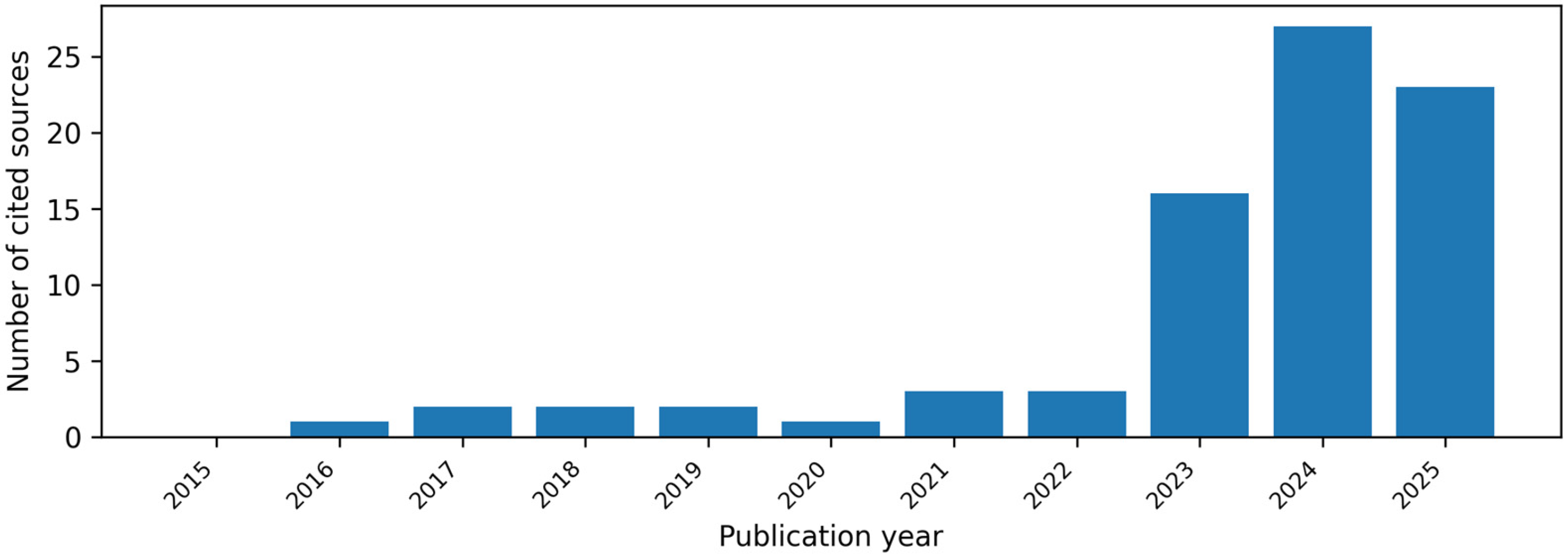
2. Methods and Literature Search
3. Fundamentals of Large Language Models for Clinicians
4. Current Evidence on Large Language Models for Cardiovascular Prevention
4.1. Patient Applications
4.2. Clinicians Applications
4.3. System Applications
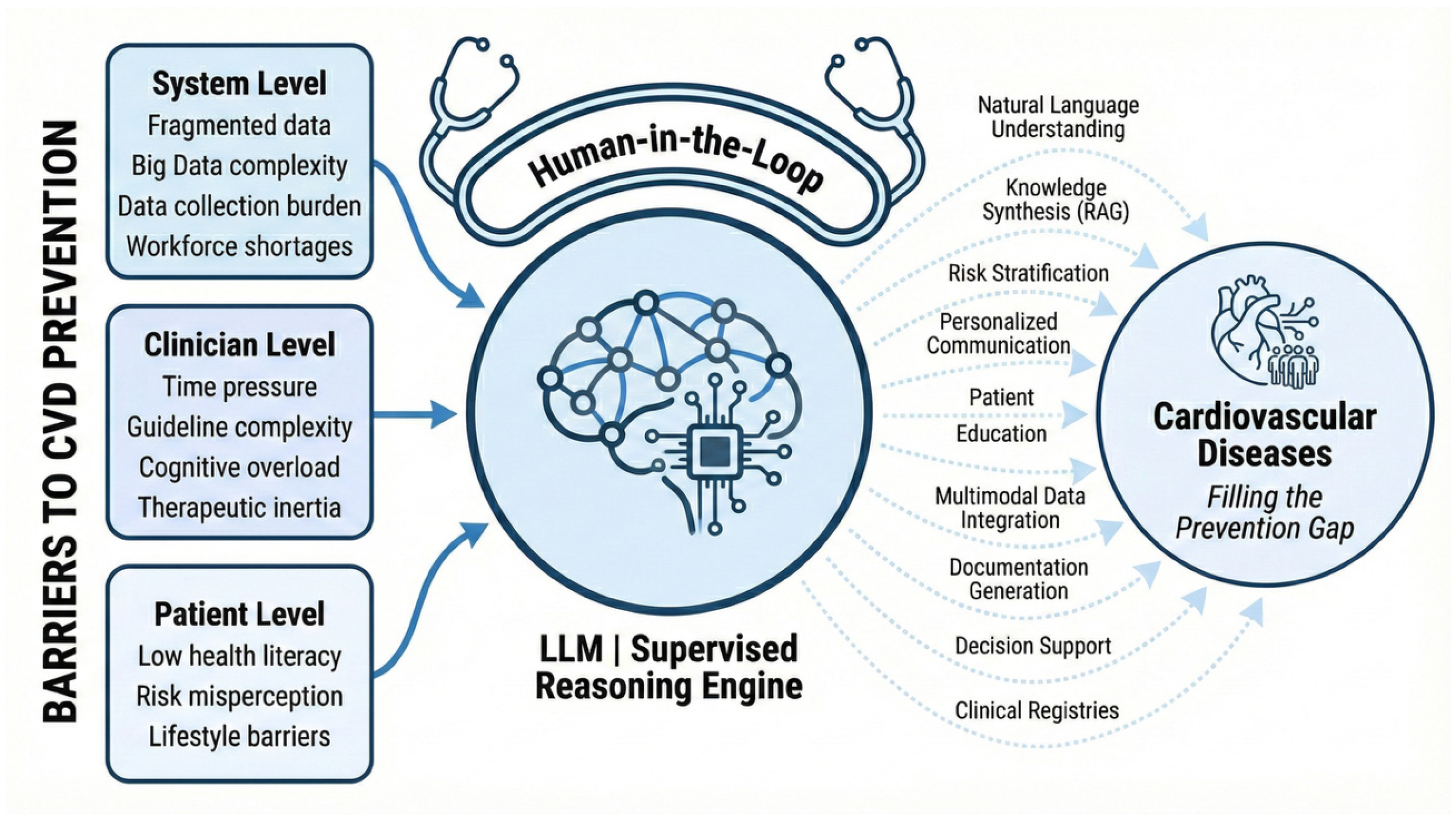
5. Future Directions: From Hype to Clinical Utility
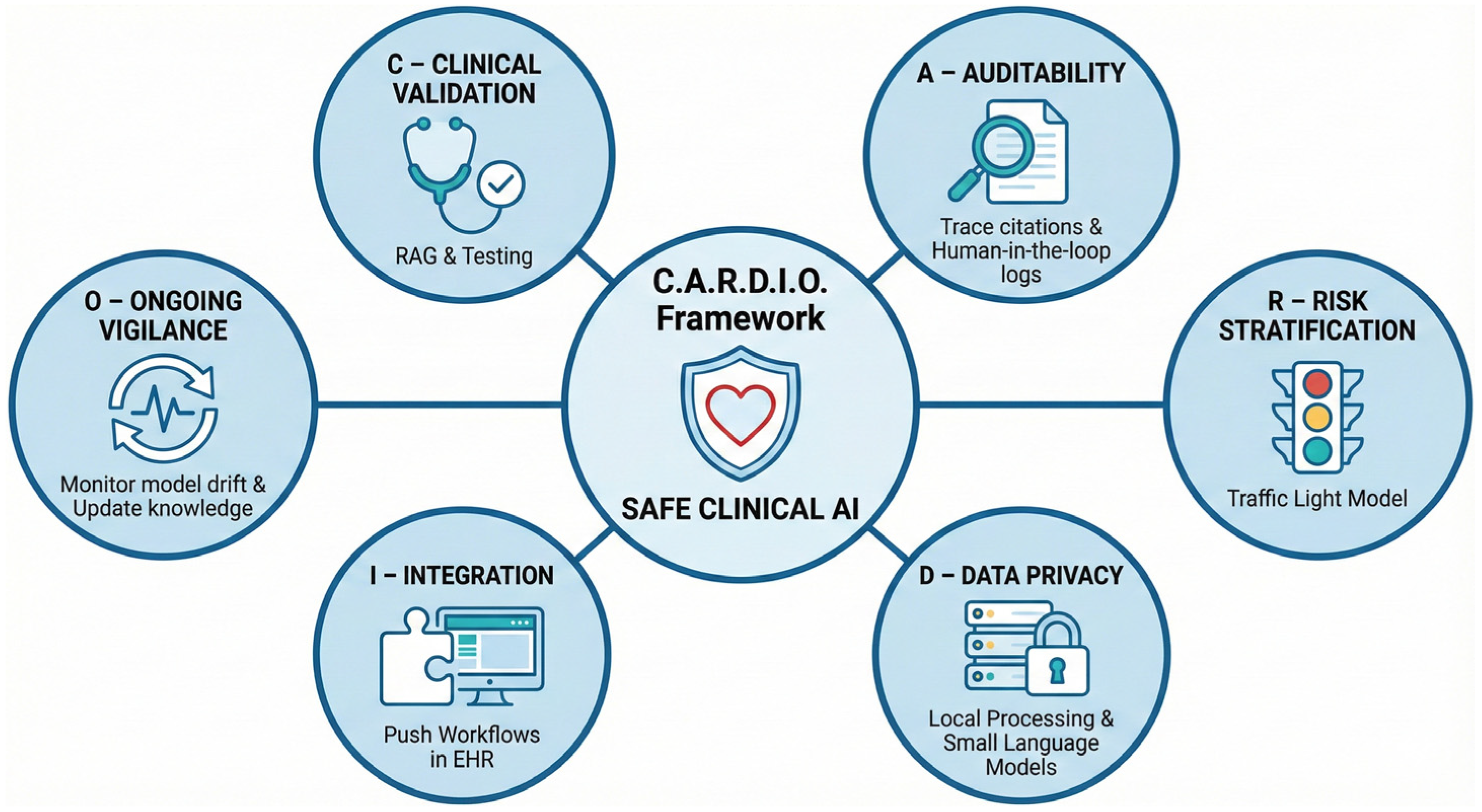
6. A Conceptual Framework for Safe Clinical Translation
- Low Risk (Green): Tasks such as drafting discharge summaries or patient education letters, where errors are easily detected by the patient or clinician.
- Medium Risk (Orange): Clinical decision support, such as suggesting risk factors extracted from notes, which requires mandatory clinician verification.
- High Risk (Red): Autonomous actions, such as initiating medication changes or auto-signing orders. Currently, these tasks remain prohibited for generative AI due to the risk of error.
7. Narrative Review Limitations
8. Conclusions
Author Contributions
Funding
Institutional Review Board Statement
Informed Consent Statement
Data Availability Statement
Acknowledgments
Conflicts of Interest
Abbreviations
| ACC | American College of Cardiology |
| AHA | American Heart Association |
| AI | Artificial intelligence |
| API | Application programming interface |
| CV | Cardiovascular |
| CVD | Cardiovascular disease |
| EHR | Electronic health record |
| ESC | European Society of Cardiology |
| LLM | Large language model |
| NLP | Natural language processing |
| RAG | Retrieval-augmented generation |
References
- Mensah, G.A.; Fuster, V.; Murray, C.J.L.; Roth, G.A. Global Burden of Cardiovascular Diseases and Risks, 1990–2022. J. Am. Coll. Cardiol. 2023, 82, 2350–2473. [Google Scholar] [CrossRef]
- Cardiovascular Diseases (CVDs). Available online: https://www.who.int/news-room/fact-sheets/detail/cardiovascular-diseases-(cvds) (accessed on 15 November 2025).
- Visseren, F.L.J.; Mach, F.; Smulders, Y.M.; Carballo, D.; Koskinas, K.C.; Bäck, M.; Benetos, A.; Biffi, A.; Boavida, J.-M.; Capodanno, D.; et al. 2021 ESC Guidelines on Cardiovascular Disease Prevention in Clinical Practice. Eur. Heart J. 2021, 42, 3227–3337. [Google Scholar] [CrossRef]
- Uchmanowicz, I.; Hoes, A.; Perk, J.; McKee, G.; Svavarsdóttir, M.H.; Czerwińska-Jelonkiewicz, K.; Janssen, A.; Oleksiak, A.; Dendale, P.; Graham, I.M. Optimising Implementation of European Guidelines on Cardiovascular Disease Prevention in Clinical Practice: What Is Needed? Eur. J. Prev. Cardiol. 2021, 28, 426–431. [Google Scholar] [CrossRef]
- Arca, M.; Calabrò, P.; Solini, A.; Pirillo, A.; Gambacurta, R.; Ray, K.K.; Catapano, A.L.; the SANTORINI Italian Group. Lipid-Lowering Treatment and LDL-C Goal Attainment in High and Very High Cardiovascular Risk Patients: Evidence from the SANTORINI Study-The Italian Experience: The SANTORINI Italian Subgroup Study. Eur. Atheroscler. J. 2023, 2, 1–13. [Google Scholar] [CrossRef]
- Ray, K.K.; Haq, I.; Bilitou, A.; Manu, M.C.; Burden, A.; Aguiar, C.; Arca, M.; Connolly, D.L.; Eriksson, M.; Ferrières, J.; et al. Treatment Gaps in the Implementation of LDL Cholesterol Control among High- and Very High-Risk Patients in Europe between 2020 and 2021: The Multinational Observational SANTORINI Study. Lancet Reg. Health-Eur. 2023, 29, 100624. [Google Scholar] [CrossRef] [PubMed]
- Kotseva, K.; Wood, D.; De Bacquer, D.; De Backer, G.; Rydén, L.; Jennings, C.; Gyberg, V.; Amouyel, P.; Bruthans, J.; Castro Conde, A.; et al. EUROASPIRE IV: A European Society of Cardiology Survey on the Lifestyle, Risk Factor and Therapeutic Management of Coronary Patients from 24 European Countries. Eur. J. Prev. Cardiol. 2016, 23, 636–648. [Google Scholar] [CrossRef]
- Uchmanowicz, I.; Czapla, M.; Lomper, K.; Iovino, P.; Rosiek-Biegus, M.; Surma, S.; Rahimi, K. Effective Implementation of Preventive Cardiology Guidelines: Pathways to Success. Eur. J. Prev. Cardiol. 2025, zwaf448. [Google Scholar] [CrossRef] [PubMed]
- Tokgozoglu, L.; Bruckert, E. Implementation, Target Population, Compliance and Barriers to Risk Guided Therapy. Eur. J. Prev. Cardiol. 2012, 19, 37–41. [Google Scholar] [CrossRef] [PubMed]
- Sposito, A.C.; Ramires, J.A.F.; Jukema, J.W.; Molina, J.C.; da Silva, P.M.; Ghadanfar, M.M.; Wilson, P.W.F. Physicians’ Attitudes and Adherence to Use of Risk Scores for Primary Prevention of Cardiovascular Disease: Cross-Sectional Survey in Three World Regions. Curr. Med. Res. Opin. 2009, 25, 1171–1178. [Google Scholar] [CrossRef]
- Liew, S.M.; Lee, W.K.; Khoo, E.M.; Ismail, I.Z.; Ambigapathy, S.; Omar, M.; Suleiman, S.Z.; Saaban, J.; Zaidi, N.F.M.; Yusoff, H. Can Doctors and Patients Correctly Estimate Cardiovascular Risk? A Cross-Sectional Study in Primary Care. BMJ Open 2018, 8, e017711. [Google Scholar] [CrossRef]
- Muthee, T.B.; Kimathi, D.; Richards, G.C.; Etyang, A.; Nunan, D.; Williams, V.; Heneghan, C. Factors Influencing the Implementation of Cardiovascular Risk Scoring in Primary Care: A Mixed-Method Systematic Review. Implement. Sci. 2020, 15, 57. [Google Scholar] [CrossRef]
- Smits, G.; Romeijnders, A.; Rozema, H.; Wijnands, C.; Hollander, M.; van Doorn, S.; Bots, M.; on behalf of the PoZoB primary care group. Stepwise Implementation of a Cardiovascular Risk Management Care Program in Primary Care. BMC Prim. Care 2022, 23, 1. [Google Scholar] [CrossRef]
- Bakhit, M.; Fien, S.; Abukmail, E.; Jones, M.; Clark, J.; Scott, A.M.; Glasziou, P.; Cardona, M. Cardiovascular Disease Risk Communication and Prevention: A Meta-Analysis. Eur. Heart J. 2024, 45, 998–1013. [Google Scholar] [CrossRef] [PubMed]
- Dennison Himmelfarb, C.R.; Beckie, T.M.; Allen, L.A.; Commodore-Mensah, Y.; Davidson, P.M.; Lin, G.; Lutz, B.; Spatz, E.S.; on behalf of the American Heart Association Council on Cardiovascular and Stroke Nursing; Council on Clinical Cardiology; et al. Shared Decision-Making and Cardiovascular Health: A Scientific Statement From the American Heart Association. Circulation 2023, 148, 912–931. [Google Scholar] [CrossRef] [PubMed]
- Singhal, K.; Azizi, S.; Tu, T.; Mahdavi, S.S.; Wei, J.; Chung, H.W.; Scales, N.; Tanwani, A.; Cole-Lewis, H.; Pfohl, S.; et al. Large Language Models Encode Clinical Knowledge. Nature 2023, 620, 172–180. [Google Scholar] [CrossRef]
- Thirunavukarasu, A.J.; Ting, D.S.J.; Elangovan, K.; Gutierrez, L.; Tan, T.F.; Ting, D.S.W. Large Language Models in Medicine. Nat. Med. 2023, 29, 1930–1940. [Google Scholar] [CrossRef]
- Quer, G.; Topol, E.J. The Potential for Large Language Models to Transform Cardiovascular Medicine. Lancet Digit. Health 2024, 6, E767–E771. [Google Scholar] [CrossRef] [PubMed]
- Rao, S.J.; Iqbal, S.B.; Isath, A.; Virk, H.U.H.; Wang, Z.; Glicksberg, B.S.; Krittanawong, C. An Update on the Use of Artificial Intelligence in Cardiovascular Medicine. Hearts 2024, 5, 91–104. [Google Scholar] [CrossRef]
- Boonstra, M.J.; Weissenbacher, D.; Moore, J.H.; Gonzalez-Hernandez, G.; Asselbergs, F.W. Artificial Intelligence: Revolutionizing Cardiology with Large Language Models. Eur. Heart J. 2024, 45, 332–345. [Google Scholar] [CrossRef]
- Olariu, M.-E.; Burlacu, A.; Brinza, C.; Iftene, A. Large Language Models for ESC Guideline Interpretation: A Targeted Review of Accuracy and Applicability. Future Cardiol. 2025, 21, 961–968. [Google Scholar] [CrossRef]
- Ferreira Santos, J.; Ladeiras-Lopes, R.; Leite, F.; Dores, H. Applications of Large Language Models in Cardiovascular Disease: A Systematic Review. Eur. Heart J. Digit. Health 2025, 6, 540–553. [Google Scholar] [CrossRef]
- Busch, F.; Hoffmann, L.; Rueger, C.; van Dijk, E.H.; Kader, R.; Ortiz-Prado, E.; Makowski, M.R.; Saba, L.; Hadamitzky, M.; Kather, J.N.; et al. Current Applications and Challenges in Large Language Models for Patient Care: A Systematic Review. Commun. Med. 2025, 5, 26. [Google Scholar] [CrossRef]
- Parsa, S.; Somani, S.; Dudum, R.; Jain, S.S.; Rodriguez, F. Artificial Intelligence in Cardiovascular Disease Prevention: Is It Ready for Prime Time? Curr. Atheroscler. Rep. 2024, 26, 263–272. [Google Scholar] [CrossRef] [PubMed]
- El Sherbini, A.; Rosenson, R.S.; Al Rifai, M.; Virk, H.U.H.; Wang, Z.; Virani, S.; Glicksberg, B.S.; Lavie, C.J.; Krittanawong, C. Artificial Intelligence in Preventive Cardiology. Prog. Cardiovasc. Dis. 2024, 84, 76–89. [Google Scholar] [CrossRef] [PubMed]
- Dey, D.; Slomka, P.J.; Leeson, P.; Comaniciu, D.; Shrestha, S.; Sengupta, P.P.; Marwick, T.H. Artificial Intelligence in Cardiovascular Imaging: JACC State-of-the-Art Review. J. Am. Coll. Cardiol. 2019, 73, 1317–1335. [Google Scholar] [CrossRef]
- Meder, B.; Asselbergs, F.W.; Ashley, E. Artificial Intelligence to Improve Cardiovascular Population Health. Eur. Heart J. 2025, 46, 1907–1916. [Google Scholar] [CrossRef]
- Chen, J.; Liang, Y.; Ge, J. Artificial Intelligence Large Language Models in Cardiology. Rev. Cardiovasc. Med. 2025, 26, 39452. [Google Scholar] [CrossRef]
- Vaswani, A.; Shazeer, N.; Parmar, N.; Uszkoreit, J.; Jones, L.; Gomez, A.N.; Kaiser, Ł.; Polosukhin, I. Attention Is All You Need. arXiv 2023, arXiv:1706.03762v7. [Google Scholar] [PubMed]
- Introducing ChatGPT. Available online: https://openai.com/index/chatgpt/ (accessed on 16 September 2024).
- Arnett, D.K.; Blumenthal, R.S.; Albert, M.A.; Buroker, A.B.; Goldberger, Z.D.; Hahn, E.J.; Himmelfarb, C.D.; Khera, A.; Lloyd-Jones, D.; McEvoy, J.W.; et al. 2019 ACC/AHA Guideline on the Primary Prevention of Cardiovascular Disease: A Report of the American College of Cardiology/American Heart Association Task Force on Clinical Practice Guidelines. Circulation 2019, 140, e596–e646. [Google Scholar] [CrossRef]
- Attia, Z.I.; Noseworthy, P.A.; Lopez-Jimenez, F.; Asirvatham, S.J.; Deshmukh, A.J.; Gersh, B.J.; Carter, R.E.; Yao, X.; Rabinstein, A.A.; Erickson, B.J.; et al. An Artificial Intelligence-Enabled ECG Algorithm for the Identification of Patients with Atrial Fibrillation during Sinus Rhythm: A Retrospective Analysis of Outcome Prediction. Lancet 2019, 394, 861–867. [Google Scholar] [CrossRef]
- Liu, L.; Yang, X.; Lei, J.; Shen, Y.; Wang, J.; Wei, P.; Chu, Z.; Qin, Z.; Ren, K. A Survey on Medical Large Language Models: Technology, Application, Trustworthiness, and Future Directions. arXiv 2024, arXiv:2406.03712. [Google Scholar] [CrossRef]
- Lee, P.; Bubeck, S.; Petro, J. Benefits, Limits, and Risks of GPT-4 as an AI Chatbot for Medicine. N. Engl. J. Med. 2023, 388, 1233–1239. [Google Scholar] [CrossRef]
- Zhou, H.; Liu, F.; Gu, B.; Zou, X.; Huang, J.; Wu, J.; Li, Y.; Chen, S.S.; Zhou, P.; Liu, J.; et al. A Survey of Large Language Models in Medicine: Progress, Application, and Challenge. arXiv 2024, arXiv:2311.05112. [Google Scholar] [CrossRef]
- Jin, Q.; Wan, N.; Leaman, R.; Tian, S.; Wang, Z.; Yang, Y.; Wang, Z.; Xiong, G.; Lai, P.-T.; Zhu, Q.; et al. Demystifying Large Language Models for Medicine: A Primer. arXiv 2024, arXiv:2410.18856. [Google Scholar] [CrossRef]
- Zakka, C.; Chaurasia, A.; Shad, R.; Dalal, A.R.; Kim, J.L.; Moor, M.; Alexander, K.; Ashley, E.; Boyd, J.; Boyd, K.; et al. Almanac: Retrieval-Augmented Language Models for Clinical Medicine. arXiv 2023, arXiv:2303.01229. [Google Scholar] [CrossRef] [PubMed]
- Singhal, K.; Tu, T.; Gottweis, J.; Sayres, R.; Wulczyn, E.; Amin, M.; Hou, L.; Clark, K.; Pfohl, S.R.; Cole-Lewis, H.; et al. Toward Expert-Level Medical Question Answering with Large Language Models. Nat. Med. 2025, 31, 943–950. [Google Scholar] [CrossRef]
- Wornow, M.; Xu, Y.; Thapa, R.; Patel, B.; Steinberg, E.; Fleming, S.; Pfeffer, M.A.; Fries, J.; Shah, N.H. The Shaky Foundations of Large Language Models and Foundation Models for Electronic Health Records. npj Digit. Med. 2023, 6, 135. [Google Scholar] [CrossRef]
- Xie, Q.; Chen, Q.; Chen, A.; Peng, C.; Hu, Y.; Lin, F.; Peng, X.; Huang, J.; Zhang, J.; Keloth, V.; et al. Me-LLaMA: Foundation Large Language Models for Medical Applications. Res. Sq. 2024, rs.3.rs-4240043. [Google Scholar] [CrossRef]
- Khandekar, N.; Jin, Q.; Xiong, G.; Dunn, S.; Applebaum, S.S.; Anwar, Z.; Sarfo-Gyamfi, M.; Safranek, C.W.; Anwar, A.A.; Zhang, A.; et al. MedCalc-Bench: Evaluating Large Language Models for Medical Calculations. arXiv 2024, arXiv:2406.12036. [Google Scholar]
- Yang, X.; Chen, A.; PourNejatian, N.; Shin, H.C.; Smith, K.E.; Parisien, C.; Compas, C.; Martin, C.; Costa, A.B.; Flores, M.G.; et al. A Large Language Model for Electronic Health Records. npj Digit. Med. 2022, 5, 194. [Google Scholar] [CrossRef]
- Chow, J.C.L.; Wong, V.; Li, K. Generative Pre-Trained Transformer-Empowered Healthcare Conversations: Current Trends, Challenges, and Future Directions in Large Language Model-Enabled Medical Chatbots. BioMedInformatics 2024, 4, 837–852. [Google Scholar] [CrossRef]
- Omiye, J.A.; Lester, J.C.; Spichak, S.; Rotemberg, V.; Daneshjou, R. Large Language Models Propagate Race-Based Medicine. npj Digit. Med. 2023, 6, 195. [Google Scholar] [CrossRef]
- Sarraju, A.; Bruemmer, D.; Van Iterson, E.; Cho, L.; Rodriguez, F.; Laffin, L. Appropriateness of Cardiovascular Disease Prevention Recommendations Obtained from a Popular Online Chat-Based Artificial Intelligence Model. JAMA 2023, 329, 842–844. [Google Scholar] [CrossRef]
- Ayers, J.W.; Poliak, A.; Dredze, M.; Leas, E.C.; Zhu, Z.; Kelley, J.B.; Faix, D.J.; Goodman, A.M.; Longhurst, C.A.; Hogarth, M.; et al. Comparing Physician and Artificial Intelligence Chatbot Responses to Patient Questions Posted to a Public Social Media Forum. JAMA Intern. Med. 2023, 183, 589–596. [Google Scholar] [CrossRef]
- Behers, B.J.; Vargas, I.A.; Behers, B.M.; Rosario, M.A.; Wojtas, C.N.; Deevers, A.C.; Hamad, K.M. Assessing the Readability of Patient Education Materials on Cardiac Catheterization From Artificial Intelligence Chatbots: An Observational Cross-Sectional Study. Cureus 2024, 16, e63865. [Google Scholar] [CrossRef]
- Mishra, V.; Sarraju, A.; Kalwani, N.M.; Dexter, J.P. Evaluation of Prompts to Simplify Cardiovascular Disease Information Generated Using a Large Language Model: Cross-Sectional Study. J. Med. Internet Res. 2024, 26, e55388. [Google Scholar] [CrossRef] [PubMed]
- Bucher, A.; Blazek, E.S.; Symons, C.T. How Are Machine Learning and Artificial Intelligence Used in Digital Behavior Change Interventions? A Scoping Review. Mayo Clin. Proc. Digit. Health 2024, 2, 375–404. [Google Scholar] [CrossRef] [PubMed]
- Aggarwal, A.; Tam, C.C.; Wu, D.; Li, X.; Qiao, S. Artificial Intelligence–Based Chatbots for Promoting Health Behavioral Changes: Systematic Review. J. Med. Internet Res. 2023, 25, e40789. [Google Scholar] [CrossRef] [PubMed]
- Bedi, S.; Liu, Y.; Orr-Ewing, L.; Dash, D.; Koyejo, S.; Callahan, A.; Fries, J.A.; Wornow, M.; Swaminathan, A.; Lehmann, L.S.; et al. Testing and Evaluation of Health Care Applications of Large Language Models: A Systematic Review. JAMA 2025, 333, 319–328. [Google Scholar] [CrossRef]
- Skalidis, I.; Cagnina, A.; Luangphiphat, W.; Mahendiran, T.; Muller, O.; Abbe, E.; Fournier, S. ChatGPT Takes on the European Exam in Core Cardiology: An Artificial Intelligence Success Story? Eur. Heart J.-Digit. Health 2023, 4, 279–281. [Google Scholar] [CrossRef]
- Novak, A.; Zeljković, I.; Rode, F.; Lisičić, A.; Nola, I.A.; Pavlović, N.; Manola, Š. The Pulse of Artificial Intelligence in Cardiology: A Comprehensive Evaluation of State-of-the-Art Large Language Models for Potential Use in Clinical Cardiology. medRxiv 2024. 2023.08.08.23293689. [Google Scholar]
- Nastasi, A.J.; Courtright, K.R.; Halpern, S.D.; Weissman, G.E. A Vignette-Based Evaluation of ChatGPT’s Ability to Provide Appropriate and Equitable Medical Advice across Care Contexts. Sci. Rep. 2023, 13, 17885. [Google Scholar] [CrossRef]
- ESC Chat—Your AI-Powered Guidelines Companion. Available online: https://www.escardio.org/guidelines/clinical-practice-guidelines/esc-chat/ (accessed on 24 November 2025).
- Sarraju, A.; Ouyang, D.; Itchhaporia, D. The Opportunities and Challenges of Large Language Models in Cardiology. JACC Adv. 2023, 2, 100438. [Google Scholar] [CrossRef]
- Hager, P.; Jungmann, F.; Holland, R.; Bhagat, K.; Hubrecht, I.; Knauer, M.; Vielhauer, J.; Makowski, M.; Braren, R.; Kaissis, G.; et al. Evaluation and Mitigation of the Limitations of Large Language Models in Clinical Decision-Making. Nat. Med. 2024, 30, 2613–2622. [Google Scholar] [CrossRef]
- Goh, E.; Gallo, R.; Hom, J.; Strong, E.; Weng, Y.; Kerman, H.; Cool, J.A.; Kanjee, Z.; Parsons, A.S.; Ahuja, N.; et al. Large Language Model Influence on Diagnostic Reasoning: A Randomized Clinical Trial. JAMA Netw. Open 2024, 7, e2440969. [Google Scholar] [CrossRef] [PubMed]
- Roeschl, T.; Hoffmann, M.; Hashemi, D.; Rarreck, F.; Hinrichs, N.; Trippel, T.D.; Gröschel, M.I.; Unbehaun, A.; Klein, C.; Kempfert, J.; et al. Assessing the Limitations of Large Language Models in Clinical Practice Guideline-Concordant Treatment Decision-Making on Real-World Data. medRxiv 2025. 2024.11.20.24313385. [Google Scholar] [CrossRef]
- Griot, M.; Hemptinne, C.; Vanderdonckt, J.; Yuksel, D. Large Language Models Lack Essential Metacognition for Reliable Medical Reasoning. Nat. Commun. 2025, 16, 642. [Google Scholar] [CrossRef] [PubMed]
- Aydin, S.; Karabacak, M.; Vlachos, V.; Margetis, K. Navigating the Potential and Pitfalls of Large Language Models in Patient-Centered Medication Guidance and Self-Decision Support. Front. Med. 2025, 12, 1527864. [Google Scholar] [CrossRef]
- Poon, E.G.; Lemak, C.H.; Rojas, J.C.; Guptill, J.; Classen, D. Adoption of Artificial Intelligence in Healthcare: Survey of Health System Priorities, Successes, and Challenges. J. Am. Med. Inform. Assoc. JAMIA 2025, 32, 1093–1100. [Google Scholar] [CrossRef] [PubMed]
- Leung, T.I.; Coristine, A.J.; Benis, A. AI Scribes in Health Care: Balancing Transformative Potential With Responsible Integration. JMIR Med. Inform. 2025, 13, e80898. [Google Scholar] [CrossRef]
- Kim, E.; Liu, V.X.; Singh, K. AI Scribes Are Not Productivity Tools (Yet). NEJM AI 2025, 2, AIe2501051. [Google Scholar] [CrossRef]
- Olson, K.D.; Meeker, D.; Troup, M.; Barker, T.D.; Nguyen, V.H.; Manders, J.B.; Stults, C.D.; Jones, V.G.; Shah, S.D.; Shah, T.; et al. Use of Ambient AI Scribes to Reduce Administrative Burden and Professional Burnout. JAMA Netw. Open 2025, 8, e2534976. [Google Scholar] [CrossRef] [PubMed]
- Shah, S.J.; Devon-Sand, A.; Ma, S.P.; Jeong, Y.; Crowell, T.; Smith, M.; Liang, A.S.; Delahaie, C.; Hsia, C.; Shanafelt, T.; et al. Ambient Artificial Intelligence Scribes: Physician Burnout and Perspectives on Usability and Documentation Burden. J. Am. Med. Inform. Assoc. JAMIA 2025, 32, 375–380. [Google Scholar] [CrossRef]
- Williams, C.Y.K.; Subramanian, C.R.; Ali, S.S.; Apolinario, M.; Askin, E.; Barish, P.; Cheng, M.; Deardorff, W.J.; Donthi, N.; Ganeshan, S.; et al. Physician- and Large Language Model-Generated Hospital Discharge Summaries. JAMA Intern. Med. 2025, 185, 818–825. [Google Scholar] [CrossRef] [PubMed]
- Cohen, I.G.; Ritzman, J.; Cahill, R.F. Ambient Listening—Legal and Ethical Issues. JAMA Netw. Open 2025, 8, e2460642. [Google Scholar] [CrossRef] [PubMed]
- Rasmy, L.; Xiang, Y.; Xie, Z.; Tao, C.; Zhi, D. Med-BERT: Pretrained Contextualized Embeddings on Large-Scale Structured Electronic Health Records for Disease Prediction. npj Digit. Med. 2021, 4, 86. [Google Scholar] [CrossRef]
- Shao, Y.; Zhang, S.; Raman, V.K.; Patel, S.S.; Cheng, Y.; Parulkar, A.; Lam, P.H.; Moore, H.; Sheriff, H.M.; Fonarow, G.C.; et al. Artificial Intelligence Approaches for Phenotyping Heart Failure in U.S. Veterans Health Administration Electronic Health Record. ESC Heart Fail. 2024, 11, 3155–3166. [Google Scholar] [CrossRef]
- Topaz, M.; Radhakrishnan, K.; Blackley, S.; Lei, V.; Lai, K.; Zhou, L. Studying Associations Between Heart Failure Self-Management and Rehospitalizations Using Natural Language Processing. West. J. Nurs. Res. 2017, 39, 147–165. [Google Scholar] [CrossRef]
- Zhang, R.; Ma, S.; Shanahan, L.; Munroe, J.; Horn, S.; Speedie, S. Discovering and Identifying New York Heart Association Classification from Electronic Health Records. BMC Med. Inform. Decis. Mak. 2018, 18, 48. [Google Scholar] [CrossRef]
- Guevara, M.; Chen, S.; Thomas, S.; Chaunzwa, T.L.; Franco, I.; Kann, B.H.; Moningi, S.; Qian, J.M.; Goldstein, M.; Harper, S.; et al. Large Language Models to Identify Social Determinants of Health in Electronic Health Records. npj Digit. Med. 2024, 7, 6. [Google Scholar] [CrossRef]
- Wellnhofer, E. Real-World and Regulatory Perspectives of Artificial Intelligence in Cardiovascular Imaging. Front. Cardiovasc. Med. 2022, 9, 890809. [Google Scholar] [CrossRef]
- Kim, Y.; Garvin, J.H.; Goldstein, M.K.; Hwang, T.S.; Redd, A.; Bolton, D.; Heidenreich, P.A.; Meystre, S.M. Extraction of Left Ventricular Ejection Fraction Information from Various Types of Clinical Reports. J. Biomed. Inform. 2017, 67, 42–48. [Google Scholar] [CrossRef]
- Garvin, J.H.; Elkin, P.L.; Shen, S.; Brown, S.; Trusko, B.; Wang, E.; Hoke, L.; Quiaoit, Y.; Lajoie, J.; Weiner, M.G.; et al. Automated Quality Measurement in Department of the Veterans Affairs Discharge Instructions for Patients with Congestive Heart Failure. J. Healthc. Qual. 2013, 35, 16–24. [Google Scholar] [CrossRef]
- Pandey, D.; Xu, L.; Kun, E.; Li, C.; Wang, J.Y.; Melek, A.; DiCarlo, J.C.; Castillo, E.; Narula, J.; Taylor, C.A.; et al. Multimodal AI for Precision Preventive Cardiology. medRxiv 2025. 2025.10.09.25337677. [Google Scholar] [CrossRef]
- Jin, Q.; Wang, Z.; Floudas, C.S.; Chen, F.; Gong, C.; Bracken-Clarke, D.; Xue, E.; Yang, Y.; Sun, J.; Lu, Z. Matching Patients to Clinical Trials with Large Language Models. Nat. Commun. 2024, 15, 9074. [Google Scholar] [CrossRef] [PubMed]
- Rao, S.; Li, Y.; Mamouei, M.; Salimi-Khorshidi, G.; Wamil, M.; Nazarzadeh, M.; Yau, C.; Collins, G.S.; Jackson, R.; Vickers, A.; et al. Refined Selection of Individuals for Preventive Cardiovascular Disease Treatment with a Transformer-Based Risk Model. Lancet Digit. Health 2025, 7, 100873. [Google Scholar] [CrossRef] [PubMed]
- Han, C.; Kim, D.W.; Kim, S.; Chan You, S.; Park, J.Y.; Bae, S.; Yoon, D. Evaluation of GPT-4 for 10-Year Cardiovascular Risk Prediction: Insights from the UK Biobank and KoGES Data. iScience 2024, 27, 109022. [Google Scholar] [CrossRef] [PubMed]
- Roeschl, T.; Hoffmann, M.; Unbehaun, A.; Dreger, H.; Hindricks, G.; Falk, V.; Balicer, R.; Tanacli, R.; Hohendanner, F.; Meyer, A. Development of an LLM Pipeline Surpassing Physicians in Cardiovascular Risk Score Calculation. medRxiv 2025. 2025.11.11.25340002. [Google Scholar] [CrossRef]
- Mihan, A.; Pandey, A.; Spall, H.G.V. Mitigating the Risk of Artificial Intelligence Bias in Cardiovascular Care. Lancet Digit. Health 2024, 6, e749–e754. [Google Scholar] [CrossRef]
- Lekadir, K.; Frangi, A.F.; Porras, A.R.; Glocker, B.; Cintas, C.; Langlotz, C.P.; Weicken, E.; Asselbergs, F.W.; Prior, F.; Collins, G.S.; et al. FUTURE-AI: International Consensus Guideline for Trustworthy and Deployable Artificial Intelligence in Healthcare. BMJ 2025, 388, e081554. [Google Scholar] [CrossRef]
- Chen, H.; Zeng, D.; Qin, Y.; Fan, Z.; Ci, F.N.Y.; Klonoff, D.C.; Ji, J.S.; Zhang, S.; Amissah-Arthur, K.N.; de Tavárez, M.M.J.; et al. Large Language Models and Global Health Equity: A Roadmap for Equitable Adoption in LMICs. Lancet Reg. Health-West. Pac 2025, 63, 101707. [Google Scholar] [CrossRef] [PubMed]
- Kim, H.; Hwang, H.; Lee, J.; Park, S.; Kim, D.; Lee, T.; Yoon, C.; Sohn, J.; Park, J.; Reykhart, O.; et al. Small Language Models Learn Enhanced Reasoning Skills from Medical Textbooks. npj Digit. Med. 2025, 8, 240. [Google Scholar] [CrossRef] [PubMed]
- Garg, M.; Raza, S.; Rayana, S.; Liu, X.; Sohn, S. The Rise of Small Language Models in Healthcare: A Comprehensive Survey. arXiv 2025, arXiv:2504.17119. [Google Scholar] [CrossRef]



| Key Concept | Concise Definition | Clinical Implication |
|---|---|---|
| Large Language Model (LLM) | A deep learning model trained on vast text data to predict the next word and generate human-like language | Acts as a “reasoning engine” for summarisation and dialogue but lacks true understanding; outputs are probabilistic and require verification |
| Context Window & Tokens | The limit on the amount of text (measured in “tokens” or word parts) a model can process at one time | Long patient histories may be truncated if they exceed the window; critical data (e.g., remote events) must be explicitly present in the input to be analyzed |
| Hallucination | The generation of plausible but factually incorrect information, such as invented citations or non-existent drug doses | The primary safety risk in medicine; clinicians must never rely on LLMs as authoritative sources without independent verification of claims |
| Retrieval-Augmented Generation (RAG) | A method that connects the LLM to trusted external sources (e.g., ESC guidelines) before generating an answer | Essential for clinical accuracy; it allows the model to cite specific sources and prevents “temporal obsolescence” (outdated knowledge) |
| Fine-tuning | The process of adapting a general-purpose model with specific datasets (e.g., medical journals, clinical notes). | Determines if a model “speaks medicine”; generic models may struggle with complex cardiovascular terminology compared to domain-adapted versions |
| Stochasticity (Non-determinism) | The inherent randomness in the model; identical questions may yield slightly different answers each time | Can compromise consistency in tasks like risk triage; for formal protocols, system settings must be adjusted to minimize variability |
| Functional Domain | Key Applications | Potential Benefits | Risks & Limitations | Readiness Level * |
|---|---|---|---|---|
| Patient-facing |
|
|
| Evaluative/Early Use |
| Clinician-facing |
|
|
| Early Clinical Adoption |
| System-facing |
|
|
| Research & Pilot Phase |
Disclaimer/Publisher’s Note: The statements, opinions and data contained in all publications are solely those of the individual author(s) and contributor(s) and not of MDPI and/or the editor(s). MDPI and/or the editor(s) disclaim responsibility for any injury to people or property resulting from any ideas, methods, instructions or products referred to in the content. |
© 2026 by the authors. Licensee MDPI, Basel, Switzerland. This article is an open access article distributed under the terms and conditions of the Creative Commons Attribution (CC BY) license.
Share and Cite
Ferreira Santos, J.; Dores, H. Large Language Models in Cardiovascular Prevention: A Narrative Review and Governance Framework. Diagnostics 2026, 16, 390. https://doi.org/10.3390/diagnostics16030390
Ferreira Santos J, Dores H. Large Language Models in Cardiovascular Prevention: A Narrative Review and Governance Framework. Diagnostics. 2026; 16(3):390. https://doi.org/10.3390/diagnostics16030390
Chicago/Turabian StyleFerreira Santos, José, and Hélder Dores. 2026. "Large Language Models in Cardiovascular Prevention: A Narrative Review and Governance Framework" Diagnostics 16, no. 3: 390. https://doi.org/10.3390/diagnostics16030390
APA StyleFerreira Santos, J., & Dores, H. (2026). Large Language Models in Cardiovascular Prevention: A Narrative Review and Governance Framework. Diagnostics, 16(3), 390. https://doi.org/10.3390/diagnostics16030390