Effects of the Uncoupling Protein 1 (UCP1) A-3826G Polymorphism on Taste Preferences in Healthy Young Japanese Adults

 , , ,
, , , 
Abstract
1. Introduction
2. Materials and Methods
2.1. Study Participants
2.2. Study Overview
2.3. Genotyping of the UCP1 Gene Polymorphism
2.4. Measurement of Resting and Mastication-Induced Salivary Secretion
2.5. Taste Preference Assessment
2.6. Statistical Methods
3. Results
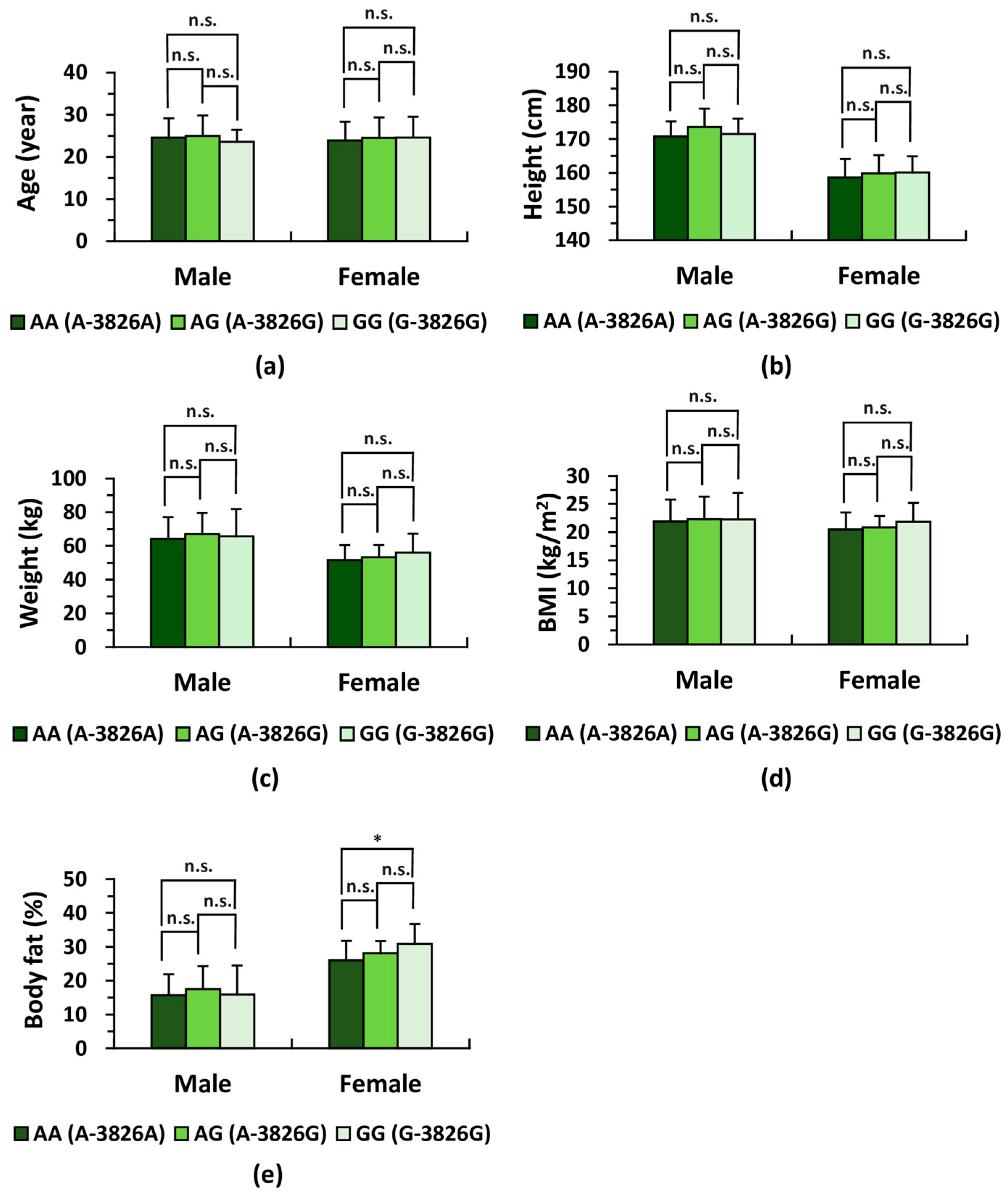
3.1. General Characteristics of the Participants
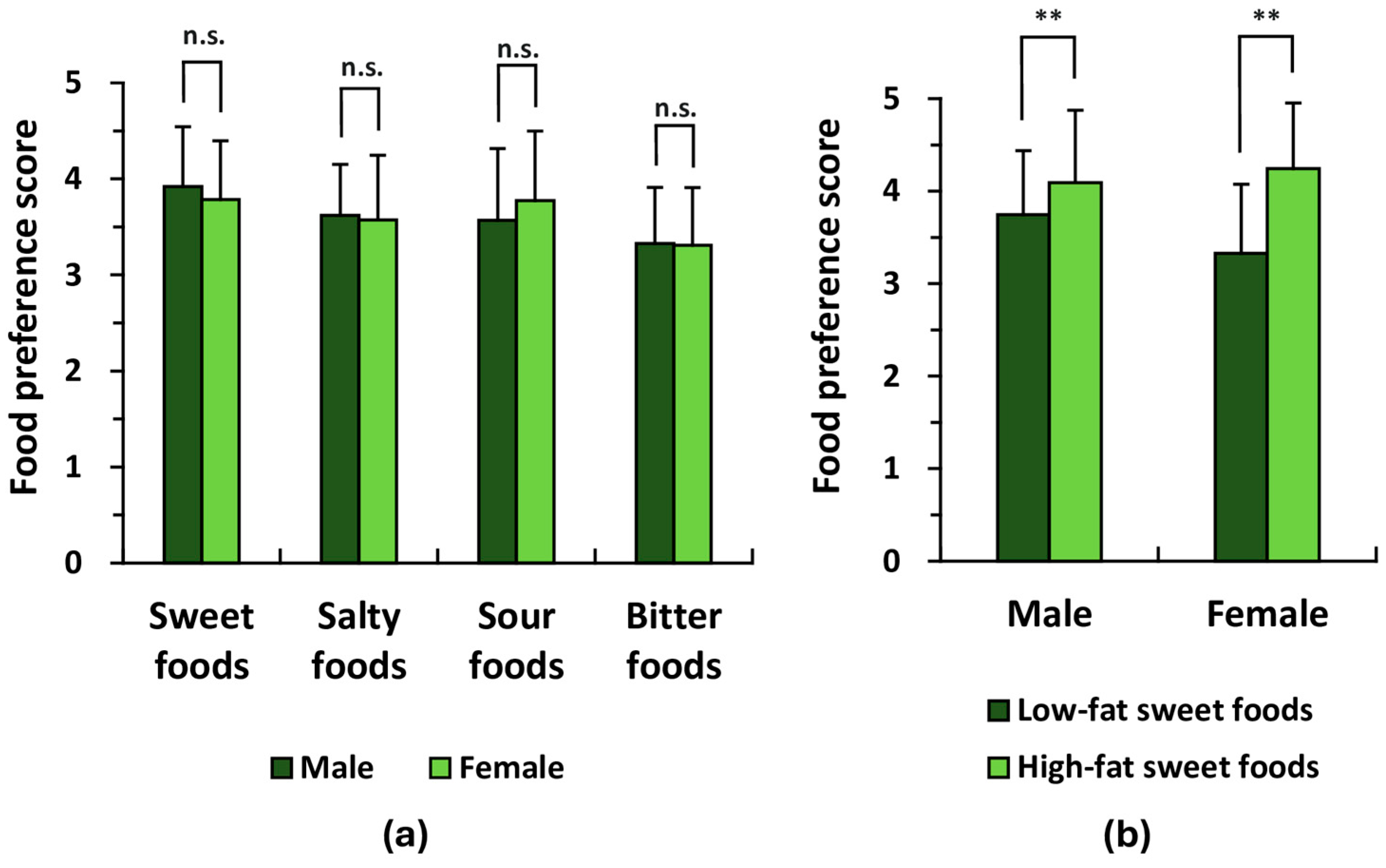
3.2. Sex Differences in Basic Taste Preference
3.3. Genotype Frequencies of the UCP1 A-3826G Polymorphism in Each Sex Group
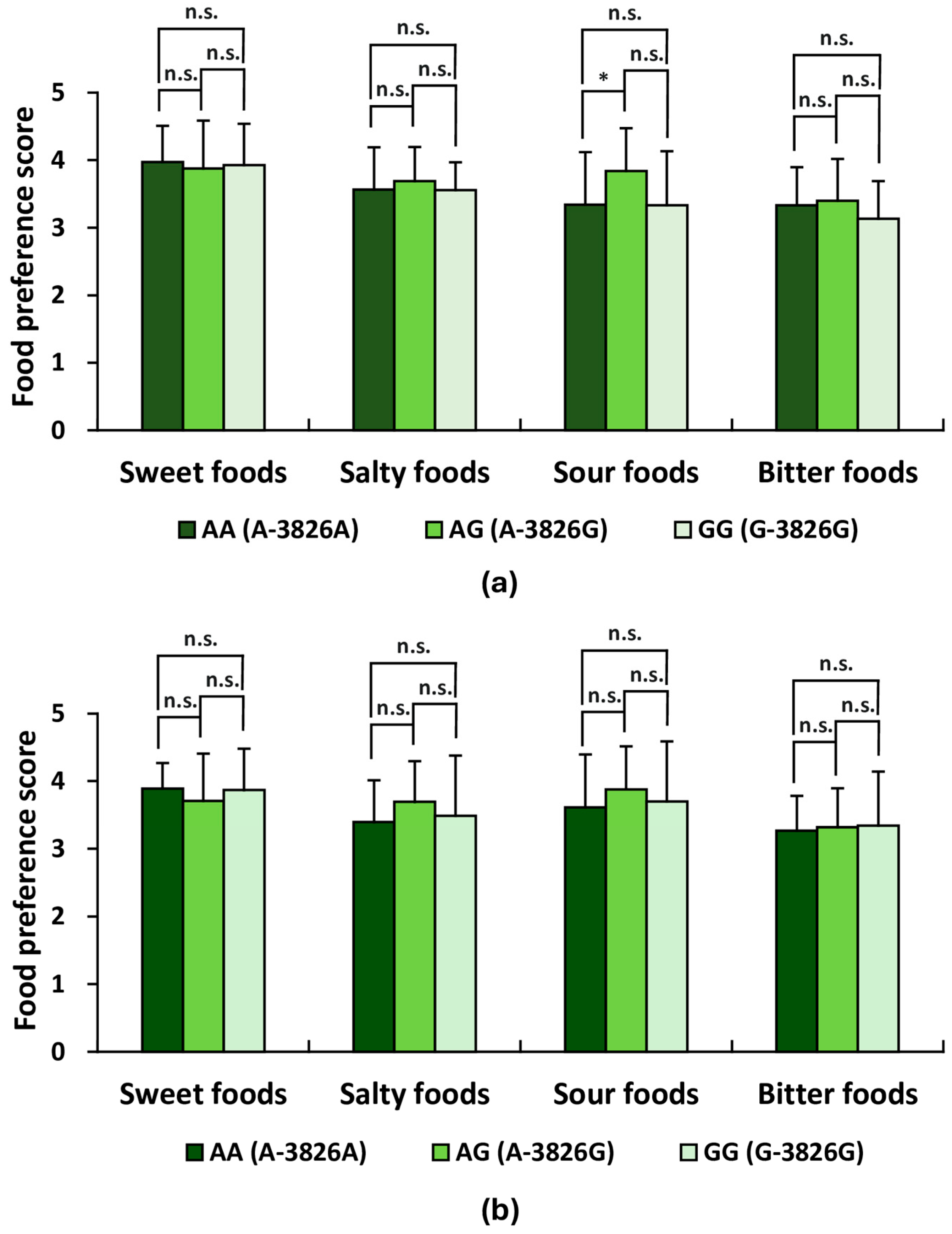
3.4. Food Preferences Across UCP1 A-3826G Genotypes Within Each Sex Group
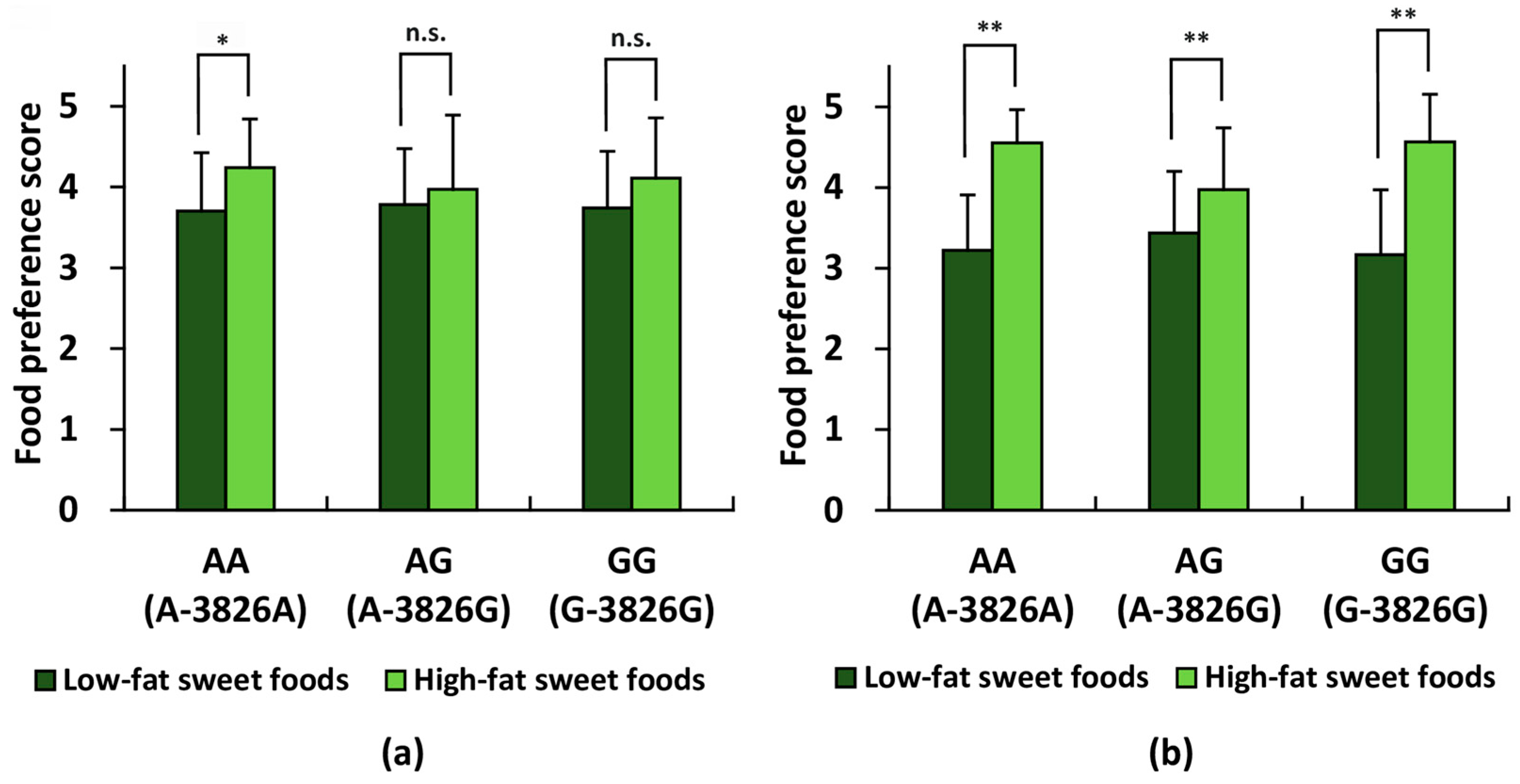
3.5. Preferences for Low-Fat and High-Fat Sweet Foods Across UCP1 Genotypes Within Each Sex Group
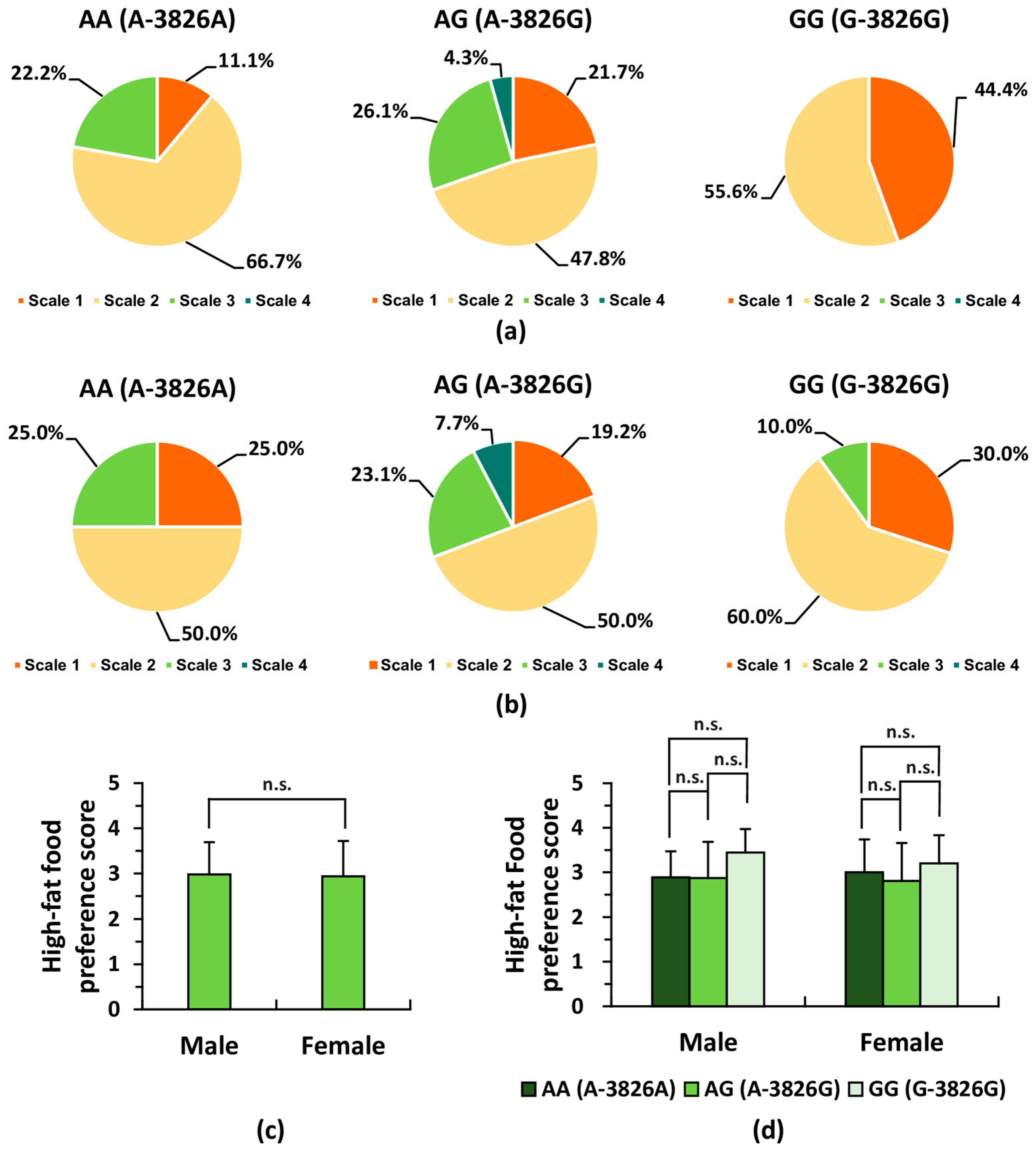
3.6. Preferences for Fatty Foods Across UCP1 Genotypes Within Each Sex Group
4. Discussion
5. Conclusions
Author Contributions
Funding
Institutional Review Board Statement
Informed Consent Statement
Data Availability Statement
Acknowledgments
Conflicts of Interest
References
- Drewnowski, A.; Greenwood, M.R. Cream and Sugar: Human Preferences for High-Fat Foods. Physiol. Behav. 1983, 30, 629–633. [Google Scholar] [CrossRef] [PubMed]
- Drewnowski, A. Why Do We like Fat? J. Am. Diet. Assoc. 1997, 97, S58–S62. [Google Scholar] [CrossRef] [PubMed]
- Imaizumi, M.; Takeda, M.; Fushiki, T. Effects of Oil Intake in the Conditioned Place Preference Test in Mice. Brain Res. 2000, 870, 150–156. [Google Scholar] [CrossRef] [PubMed]
- Yoneda, T.; Taka, Y.; Okamura, M.; Mizushige, T.; Matsumura, S.; Manabe, Y.; Tsuzuki, S.; Inoue, K.; Fushiki, T. Reinforcing Effect for Corn Oil Stimulus Was Concentration Dependent in an Operant Task in Mice. Life Sci. 2007, 81, 1585–1592. [Google Scholar] [CrossRef]
- Adachi, S.; Endo, Y.; Mizushige, T.; Tsuzuki, S.; Matsumura, S.; Inoue, K.; Fushiki, T. Increased Levels of Extracellular Dopamine in the Nucleus Accumbens and Amygdala of Rats by Ingesting a Low Concentration of a Long-Chain Fatty Acid. Biosci. Biotechnol. Biochem. 2013, 77, 2175–2180. [Google Scholar] [CrossRef]
- Cartoni, C.; Yasumatsu, K.; Ohkuri, T.; Shigemura, N.; Yoshida, R.; Godinot, N.; le Coutre, J.; Ninomiya, Y.; Damak, S. Taste Preference for Fatty Acids Is Mediated by GPR40 and GPR120. J. Neurosci. 2010, 30, 8376–8382. [Google Scholar] [CrossRef]
- DiPatrizio, N. V Is Fat Taste Ready for Primetime? Physiol. Behav. 2014, 136, 145–154. [Google Scholar] [CrossRef]
- Pang, J.; Xi, C.; Huang, X.; Cui, J.; Gong, H.; Zhang, T. Effects of Excess Energy Intake on Glucose and Lipid Metabolism in C57BL/6 Mice. PLoS ONE 2016, 11, e0146675. [Google Scholar] [CrossRef]
- Kovesdy, C.P.; Furth, S.L.; Zoccali, C.; World Kidney Day Steering Committee. Obesity and Kidney Disease: Hidden Consequences of the Epidemic. J. Nephrol. 2017, 30, 1–10. [Google Scholar] [CrossRef]
- Kong, Y.; Yang, H.; Nie, R.; Zhang, X.; Zuo, F.; Zhang, H.; Nian, X. Obesity: Pathophysiology and Therapeutic Interventions. Mol. Biomed. 2025, 6, 25. [Google Scholar] [CrossRef]
- Hubert, H.B.; Feinleib, M.; McNamara, P.M.; Castelli, W.P. Obesity as an Independent Risk Factor for Cardiovascular Disease: A 26-Year Follow-up of Participants in the Framingham Heart Study. Circulation 1983, 67, 968–977. [Google Scholar] [CrossRef]
- Avgerinos, K.I.; Spyrou, N.; Mantzoros, C.S.; Dalamaga, M. Obesity and Cancer Risk: Emerging Biological Mechanisms and Perspectives. Metabolism 2019, 92, 121–135. [Google Scholar] [CrossRef]
- Murakami, N.; Nakamura, Y.; Nakajima, T.; Sasakawa, Y.; Nakakura-Ohshima, K.; Murakami, T.; Kurosawa, M.; Iwase, Y.; Murakami, D.; Saitoh, I.; et al. Oral Feeding Behavior during a Whole Meal. Dent. Oral Craniofac. Res. 2017, 4, 1–7. [Google Scholar] [CrossRef]
- Watanabe, K.; Hong, G.; Tominami, K.; Izumi, S.; Hayashi, Y.; Kudo, T.-A. Association between Beta3-Adrenergic Receptor Trp64Arg Polymorphism and Fat Preference in Healthy Young Japanese Women. Tohoku J. Exp. Med. 2019, 248, 181–192. [Google Scholar] [CrossRef] [PubMed]
- Bouchard, C. Long-Term Programming of Body Size. Nutr. Rev. 1996, 54, S8–S16. [Google Scholar] [CrossRef]
- Large, V.; Hellström, L.; Reynisdottir, S.; Lönnqvist, F.; Eriksson, P.; Lannfelt, L.; Arner, P. Human Beta-2 Adrenoceptor Gene Polymorphisms Are Highly Frequent in Obesity and Associate with Altered Adipocyte Beta-2 Adrenoceptor Function. J. Clin. Invest. 1997, 100, 3005–3013. [Google Scholar] [CrossRef]
- Narita, K.; Kudo, T.-A.; Hong, G.; Tominami, K.; Izumi, S.; Hayashi, Y.; Nakai, J. Effect of Beta 2-Adrenergic Receptor Gly16Arg Polymorphism on Taste Preferences in Healthy Young Japanese Adults. Nutrients 2022, 14, 1430. [Google Scholar] [CrossRef] [PubMed]
- Harms, M.; Seale, P. Brown and Beige Fat: Development, Function and Therapeutic Potential. Nat. Med. 2013, 19, 1252–1263. [Google Scholar] [CrossRef] [PubMed]
- Cannon, B.; Nedergaard, J. Brown Adipose Tissue: Function and Physiological Significance. Physiol. Rev. 2004, 84, 277–359. [Google Scholar] [CrossRef]
- Lowell, B.B.; Spiegelman, B.M. Towards a Molecular Understanding of Adaptive Thermogenesis. Nature 2000, 404, 652–660. [Google Scholar] [CrossRef]
- Cypess, A.M.; Lehman, S.; Williams, G.; Tal, I.; Rodman, D.; Goldfine, A.B.; Kuo, F.C.; Palmer, E.L.; Tseng, Y.-H.; Doria, A.; et al. Identification and Importance of Brown Adipose Tissue in Adult Humans. N. Engl. J. Med. 2009, 360, 1509–1517. [Google Scholar] [CrossRef]
- Saito, M.; Okamatsu-Ogura, Y.; Matsushita, M.; Watanabe, K.; Yoneshiro, T.; Nio-Kobayashi, J.; Iwanaga, T.; Miyagawa, M.; Kameya, T.; Nakada, K.; et al. High Incidence of Metabolically Active Brown Adipose Tissue in Healthy Adult Humans: Effects of Cold Exposure and Adiposity. Diabetes 2009, 58, 1526–1531. [Google Scholar] [CrossRef]
- van Marken Lichtenbelt, W.D.; Vanhommerig, J.W.; Smulders, N.M.; Drossaerts, J.M.A.F.L.; Kemerink, G.J.; Bouvy, N.D.; Schrauwen, P.; Teule, G.J.J. Cold-Activated Brown Adipose Tissue in Healthy Men. N. Engl. J. Med. 2009, 360, 1500–1508. [Google Scholar] [CrossRef] [PubMed]
- Collins, S.; Yehuda-Shnaidman, E.; Wang, H. Positive and Negative Control of Ucp1 Gene Transcription and the Role of β-Adrenergic Signaling Networks. Int. J. Obes. 2010, 34, S28–S33. [Google Scholar] [CrossRef]
- Yoneshiro, T.; Aita, S.; Matsushita, M.; Okamatsu-Ogura, Y.; Kameya, T.; Kawai, Y.; Miyagawa, M.; Tsujisaki, M.; Saito, M. Age-Related Decrease in Cold-Activated Brown Adipose Tissue and Accumulation of Body Fat in Healthy Humans. Obesity 2011, 19, 1755–1760. [Google Scholar] [CrossRef]
- Lean, M.E. Brown Adipose Tissue in Humans. Proc. Nutr. Soc. 1989, 48, 243–256. [Google Scholar] [CrossRef]
- Klaus, S.; Casteilla, L.; Bouillaud, F.; Ricquier, D. The Uncoupling Protein UCP: A Membraneous Mitochondrial Ion Carrier Exclusively Expressed in Brown Adipose Tissue. Int. J. Biochem. 1991, 23, 791–801. [Google Scholar] [CrossRef] [PubMed]
- Lowell, B.B.; S-Susulic, V.; Hamann, A.; Lawitts, J.A.; Himms-Hagen, J.; Boyer, B.B.; Kozak, L.P.; Flier, J.S. Development of Obesity in Transgenic Mice after Genetic Ablation of Brown Adipose Tissue. Nature 1993, 366, 740–742. [Google Scholar] [CrossRef] [PubMed]
- Hamann, A.; Benecke, H.; Le Marchand-Brustel, Y.; Susulic, V.S.; Lowell, B.B.; Flier, J.S. Characterization of Insulin Resistance and NIDDM in Transgenic Mice with Reduced Brown Fat. Diabetes 1995, 44, 1266–1273. [Google Scholar] [CrossRef]
- Nedergaard, J.; Bengtsson, T.; Cannon, B. Unexpected Evidence for Active Brown Adipose Tissue in Adult Humans. Am. J. Physiol.-Endocrinol. Metab. 2007, 293, E444–E452. [Google Scholar] [CrossRef]
- Virtanen, K.A.; Lidell, M.E.; Orava, J.; Heglind, M.; Westergren, R.; Niemi, T.; Taittonen, M.; Laine, J.; Savisto, N.-J.; Enerbäck, S.; et al. Functional Brown Adipose Tissue in Healthy Adults. N. Engl. J. Med. 2009, 360, 1518–1525. [Google Scholar] [CrossRef] [PubMed]
- Zingaretti, M.C.; Crosta, F.; Vitali, A.; Guerrieri, M.; Frontini, A.; Cannon, B.; Nedergaard, J.; Cinti, S. The Presence of UCP1 Demonstrates That Metabolically Active Adipose Tissue in the Neck of Adult Humans Truly Represents Brown Adipose Tissue. FASEB J. 2009, 23, 3113–3120. [Google Scholar] [CrossRef] [PubMed]
- Yoneshiro, T.; Aita, S.; Matsushita, M.; Kameya, T.; Nakada, K.; Kawai, Y.; Saito, M. Brown Adipose Tissue, Whole-Body Energy Expenditure, and Thermogenesis in Healthy Adult Men. Obesity 2011, 19, 13–16. [Google Scholar] [CrossRef]
- Orava, J.; Nuutila, P.; Lidell, M.E.; Oikonen, V.; Noponen, T.; Viljanen, T.; Scheinin, M.; Taittonen, M.; Niemi, T.; Enerbäck, S.; et al. Different Metabolic Responses of Human Brown Adipose Tissue to Activation by Cold and Insulin. Cell Metab. 2011, 14, 272–279. [Google Scholar] [CrossRef]
- Walston, J.; Lowe, A.; Silver, K.; Yang, Y.; Bodkin, N.L.; Hansen, B.C.; Shuldiner, A.R. The Β3-Adrenergic Receptor in the Obesity and Diabetes Prone Rhesus Monkey Is Very Similar to Human and Contains Arginine at Codon 64. Gene 1997, 188, 207–213. [Google Scholar] [CrossRef]
- Matsushita, H.; Kurabayashi, T.; Tomita, M.; Kato, N.; Tanaka, K. Effects of Uncoupling Protein 1 and Beta3-Adrenergic Receptor Gene Polymorphisms on Body Size and Serum Lipid Concentrations in Japanese Women. Maturitas 2003, 45, 39–45. [Google Scholar] [CrossRef]
- Nagai, N.; Sakane, N.; Tsuzaki, K.; Moritani, T. UCP1 Genetic Polymorphism (–3826 A/G) Diminishes Resting Energy Expenditure and Thermoregulatory Sympathetic Nervous System Activity in Young Females. Int. J. Obes. 2011, 35, 1050–1055. [Google Scholar] [CrossRef]
- Valve, R.; Heikkinen, S.; Rissanen, A.; Laakso, M.; Uusitupa, M. Synergistic Effect of Polymorphisms in Uncoupling Protein 1 and Beta3-Adrenergic Receptor Genes on Basal Metabolic Rate in Obese Finns. Diabetologia 1998, 41, 357–361. [Google Scholar] [CrossRef]
- Nagai, N.; Sakane, N.; Ueno, L.M.; Hamada, T.; Moritani, T. The -3826 A → G Variant of the Uncoupling Protein-1 Gene Diminishes Postprandial Thermogenesis after a High Fat Meal in Healthy Boys. J. Clin. Endocrinol. Metab. 2003, 88, 5661–5667. [Google Scholar] [CrossRef]
- Nagai, N.; Sakane, N.; Fujishita, A.; Fujiwara, R.; Kimura, T.; Kotani, K.; Moritani, T. The −3826 A → G Variant of the Uncoupling Protein-1 Gene Diminishes Thermogenesis during Acute Cold Exposure in Healthy Children. Obes. Res. Clin. Pract. 2007, 1, 99–107. [Google Scholar] [CrossRef]
- Yoneshiro, T.; Ogawa, T.; Okamoto, N.; Matsushita, M.; Aita, S.; Kameya, T.; Kawai, Y.; Iwanaga, T.; Saito, M. Impact of UCP1 and Β3AR Gene Polymorphisms on Age-Related Changes in Brown Adipose Tissue and Adiposity in Humans. Int. J. Obes. 2013, 37, 993–998. [Google Scholar] [CrossRef]
- Del Mar Gonzalez-Barroso, M.; Ricquier, D.; Cassard-Doulcier, A.M. The Human Uncoupling Protein-1 Gene (UCP1): Present Status and Perspectives in Obesity Research. Obes. Rev. 2000, 1, 61–72. [Google Scholar] [CrossRef]
- Kogure, A.; Sakane, N.; Takakura, Y.; Umekawa, T.; Yoshioka, K.; Nishino, H.; Yamamoto, T.; Kawada, T.; Yoshikawa, T.; Yoshida, T. Effects of Caffeine on the Uncoupling Protein Family in Obese Yellow KK Mice. Clin. Exp. Pharmacol. Physiol. 2002, 29, 391–394. [Google Scholar] [CrossRef]
- Chathoth, S.; Ismail, M.H.; Vatte, C.; Cyrus, C.; Al Ali, Z.; Ahmed, K.A.; Acharya, S.; Al Barqi, A.M.; Al Ali, A. Association of Uncoupling Protein 1 (UCP1) Gene Polymorphism with Obesity: A Case-Control Study. BMC Med. Genet. 2018, 19, 203. [Google Scholar] [CrossRef]
- Pravednikova, A.E.; Shevchenko, S.Y.; Kerchev, V.V.; Skhirtladze, M.R.; Larina, S.N.; Kachaev, Z.M.; Egorov, A.D.; Shidlovskii, Y. V Association of Uncoupling Protein (Ucp) Gene Polymorphisms with Cardiometabolic Diseases. Mol. Med. 2020, 26, 51. [Google Scholar] [CrossRef] [PubMed]
- Izumi, S.; Hong, G.; Iwasaki, K.; Izumi, M.; Matsuyama, Y.; Chiba, M.; Toda, T.; Kudo, T.-A. Gustatory Salivation Is Associated with Body Mass Index, Daytime Sleepiness, and Snoring in Healthy Young Adults. Tohoku J. Exp. Med. 2016, 240, 153–165. [Google Scholar] [CrossRef]
- Tanaka, T.; Hong, G.; Tominami, K.; Kudo, T.-A. Oral Fat Sensitivity Is Associated with Social Support for Stress Coping in Young Adult Men. Tohoku J. Exp. Med. 2018, 244, 249–261. [Google Scholar] [CrossRef] [PubMed]
- Mese, H.; Matsuo, R. Salivary Secretion, Taste and Hyposalivation. J. Oral Rehabil. 2007, 34, 711–723. [Google Scholar] [CrossRef]
- Asano, M.; Hong, G.; Matsuyama, Y.; Wang, W.; Izumi, S.; Izumi, M.; Toda, T.; Kudo, T.-A. Association of Oral Fat Sensitivity with Body Mass Index, Taste Preference, and Eating Habits in Healthy Japanese Young Adults. Tohoku J. Exp. Med. 2016, 238, 93–103. [Google Scholar] [CrossRef] [PubMed]
- Ohmori, R. Comparisons of the taste sensitivity between three generations. Bull. Fac. Educ. Utsunomiya Univ. Sect. 1 2013, 63, 201–210. [Google Scholar]
- Kotani, K.; Fujiwara, S.; Tsuzaki, K.; Sano, Y.; Nagai, N.; Yamada, T.; Sakane, N. The Association Between the Uncoupling Protein-1 Gene A-3826G Polymorphism and High-Density Lipoprotein Cholesterol in A General Japanese Population: A Consideration of the Obesity Status. J. Clin. Med. Res. 2011, 3, 319–324. [Google Scholar] [CrossRef] [PubMed]
- Garruti, G.; Ricquier, D. Analysis of Uncoupling Protein and Its MRNA in Adipose Tissue Deposits of Adult Humans. Int. J. Obes. Relat. Metab. Disord. 1992, 16, 383–390. [Google Scholar]
- Arner, P. Obesity—A Genetic Disease of Adipose Tissue? Br. J. Nutr. 2000, 83, S9–S16. [Google Scholar] [CrossRef]
- Esterbauer, H.; Oberkofler, H.; Liu, Y.-M.; Breban, D.; Hell, E.; Krempler, F.; Patsch, W. Uncoupling Protein-1 MRNA Expression in Obese Human Subjects: The Role of Sequence Variations at the Uncoupling Protein-1 Gene Locus. J. Lipid Res. 1998, 39, 834–844. [Google Scholar] [CrossRef]
- Morita, E.; Taniguchi, H.; Sakaue, M. Trp64Arg Polymorphism in Beta3-Adrenergic Receptor Gene Is Associated with Decreased Fat Oxidation Both in Resting and Aerobic Exercise in the Japanese Male. Exp. Diabetes Res. 2009, 2009, 605139. [Google Scholar] [CrossRef]
- Jia, J.; Tian, Y.; Cao, Z.; Tao, L.; Zhang, X.; Gao, S.; Ge, C.; Lin, Q.-Y.; Jois, M. The Polymorphisms of UCP1 Genes Associated with Fat Metabolism, Obesity and Diabetes. Mol. Biol. Rep. 2010, 37, 1513–1522. [Google Scholar] [CrossRef] [PubMed]
- Brondani, L.A.; Assmann, T.S.; Duarte, G.C.K.; Gross, J.L.; Canani, L.H.; Crispim, D. The Role of the Uncoupling Protein 1 (UCP1) on the Development of Obesity and Type 2 Diabetes Mellitus. Arq. Bras. Endocrinol. Metabol. 2012, 56, 215–225. [Google Scholar] [CrossRef] [PubMed]
- Oppert, J.M.; Vohl, M.C.; Chagnon, M.; Dionne, F.T.; Cassard-Doulcier, A.M.; Ricquier, D.; Pérusse, L.; Bouchard, C. DNA Polymorphism in the Uncoupling Protein (UCP) Gene and Human Body Fat. Int. J. Obes. Relat. Metab. Disord. 1994, 18, 526–531. [Google Scholar]
- Cassard-Doulcier, A.M.; Bouillaud, F.; Chagnon, M.; Gelly, C.; Dionne, F.T.; Oppert, J.M.; Bouchard, C.; Chagnon, Y.; Ricquier, D. The Bcl I Polymorphism of the Human Uncoupling Protein (Ucp) Gene Is Due to a Point Mutation in the 5′-Flanking Region. Int. J. Obes. Relat. Metab. Disord. 1996, 20, 278–279. [Google Scholar]
- Fumeron, F.; Durack-Bown, I.; Betoulle, D.; Cassard-Doulcier, A.M.; Tuzet, S.; Bouillaud, F.; Melchior, J.C.; Ricquier, D.; Apfelbaum, M. Polymorphisms of Uncoupling Protein (UCP) and Beta 3 Adrenoreceptor Genes in Obese People Submitted to a Low Calorie Diet. Int. J. Obes. Relat. Metab. Disord. 1996, 20, 1051–1054. [Google Scholar]
- Clément, K.; Ruiz, J.; Cassard-Doulcier, A.M.; Bouillaud, F.; Ricquier, D.; Basdevant, A.; Guy-Grand, B.; Froguel, P. Additive Effect of A→G (-3826) Variant of the Uncoupling Protein Gene and the Trp64Arg Mutation of the Beta 3-Adrenergic Receptor Gene on Weight Gain in Morbid Obesity. Int. J. Obes. Relat. Metab. Disord. 1996, 20, 1062–1066. [Google Scholar]
- Heilbronn, L.K.; Kind, K.L.; Pancewicz, E.; Morris, A.M.; Noakes, M.; Clifton, P.M. Association of -3826 G Variant in Uncoupling Protein-1 with Increased BMI in Overweight Australian Women. Diabetologia 2000, 43, 242–244. [Google Scholar] [CrossRef]
- Proenza, A.M.; Poissonnet, C.M.; Ozata, M.; Ozen, S.; Guran, S.; Palou, A.; Strosberg, A.D. Association of Sets of Alleles of Genes Encoding Beta3-Adrenoreceptor, Uncoupling Protein 1 and Lipoprotein Lipase with Increased Risk of Metabolic Complications in Obesity. Int. J. Obes. Relat. Metab. Disord. 2000, 24, 93–100. [Google Scholar] [CrossRef]
- Hayakawa, T.; Nagai, Y.; Taniguchi, M.; Yamashita, H.; Takamura, T.; Abe, T.; Nomura, G.; Kobayashi, K. Phenotypic Characterization of the Beta3-Adrenergic Receptor Mutation and the Uncoupling Protein 1 Polymorphism in Japanese Men. Metabolism 1999, 48, 636–640. [Google Scholar] [CrossRef] [PubMed]
- Tenk, C.M.; Felfeli, T. Sucrose and Fat Content Significantly Affects Palatable Food Consumption in Adolescent Male and Female Rats. Appetite 2017, 118, 49–59. [Google Scholar] [CrossRef] [PubMed]
- Brondani, L.A.; de Souza, B.M.; Assmann, T.S.; Bouças, A.P.; Bauer, A.C.; Canani, L.H.; Crispim, D. Association of the UCP Polymorphisms with Susceptibility to Obesity: Case-Control Study and Meta-Analysis. Mol. Biol. Rep. 2014, 41, 5053–5067. [Google Scholar] [CrossRef] [PubMed]
- López, M.; Varela, L.; Vázquez, M.J.; Rodríguez-Cuenca, S.; González, C.R.; Velagapudi, V.R.; Morgan, D.A.; Schoenmakers, E.; Agassandian, K.; Lage, R.; et al. Hypothalamic AMPK and Fatty Acid Metabolism Mediate Thyroid Regulation of Energy Balance. Nat. Med. 2010, 16, 1001–1008. [Google Scholar] [CrossRef]
- Minokoshi, Y.; Alquier, T.; Furukawa, N.; Kim, Y.-B.; Lee, A.; Xue, B.; Mu, J.; Foufelle, F.; Ferré, P.; Birnbaum, M.J.; et al. AMP-Kinase Regulates Food Intake by Responding to Hormonal and Nutrient Signals in the Hypothalamus. Nature 2004, 428, 569–574. [Google Scholar] [CrossRef]
- Rodriguez-Cuenca, S.; Monjo, M.; Frontera, M.; Gianotti, M.; Proenza, A.M.; Roca, P. Sex Steroid Receptor Expression Profile in Brown Adipose Tissue. Effects of Hormonal Status. Cell. Physiol. Biochem. 2007, 20, 877–886. [Google Scholar] [CrossRef]
- Martínez de Morentin, P.B.; González-García, I.; Martins, L.; Lage, R.; Fernández-Mallo, D.; Martínez-Sánchez, N.; Ruíz-Pino, F.; Liu, J.; Morgan, D.A.; Pinilla, L.; et al. Estradiol Regulates Brown Adipose Tissue Thermogenesis via Hypothalamic AMPK. Cell Metab. 2014, 20, 41–53. [Google Scholar] [CrossRef]
- Rodriguez, A.M.; Monjo, M.; Roca, P.; Palou, A. Opposite Actions of Testosterone and Progesterone on UCP1 MRNA Expression in Cultured Brown Adipocytes. Cell. Mol. Life Sci. 2002, 59, 1714–1723. [Google Scholar] [CrossRef]
- Ikeda, K.; Yamada, T. UCP1 Dependent and Independent Thermogenesis in Brown and Beige Adipocytes. Front. Endocrinol. 2020, 11, 498. [Google Scholar] [CrossRef]
- Sugino, T.; Aoyagi, S.; Shirai, T.; Kajimoto, Y.; Kajimoto, O. Effects of Citric Acid and L-Carnitine on Physical Fatigue. J. Clin. Biochem. Nutr. 2007, 41, 224–230. [Google Scholar] [CrossRef]
- Rodríguez Valerón, N.; Mak, T.; Jahn, L.J.; Arboleya, J.C.; Sörensen, P.M. Derivation of Kokumi γ-Glutamyl Peptides and Volatile Aroma Compounds from Fermented Cereal Processing By-Products for Reducing Bitterness of Plant-Based Ingredients. Foods 2023, 12, 4297. [Google Scholar] [CrossRef]
- Ohsu, T.; Amino, Y.; Nagasaki, H.; Yamanaka, T.; Takeshita, S.; Hatanaka, T.; Maruyama, Y.; Miyamura, N.; Eto, Y. Involvement of the Calcium-Sensing Receptor in Human Taste Perception. J. Biol. Chem. 2010, 285, 1016–1022. [Google Scholar] [CrossRef] [PubMed]
- Suzuki, Y.; Miyoshi, N.; Isemura, M. Health-Promoting Effects of Green Tea. Proc. Jpn. Acad. Ser. B Phys. Biol. Sci. 2012, 88, 88–101. [Google Scholar] [CrossRef] [PubMed]
- Higdon, J.V.; Frei, B. Tea Catechins and Polyphenols: Health Effects, Metabolism, and Antioxidant Functions. Crit. Rev. Food Sci. Nutr. 2003, 43, 89–143. [Google Scholar] [CrossRef]
- Dulloo, A.G.; Duret, C.; Rohrer, D.; Girardier, L.; Mensi, N.; Fathi, M.; Chantre, P.; Vandermander, J. Efficacy of a Green Tea Extract Rich in Catechin Polyphenols and Caffeine in Increasing 24-h Energy Expenditure and Fat Oxidation in Humans. Am. J. Clin. Nutr. 1999, 70, 1040–1045. [Google Scholar] [CrossRef]
- Urhammer, S.A.; Fridberg, M.; Sørensen, T.I.; Echwald, S.M.; Andersen, T.; Tybjaerg-Hansen, A.; Clausen, J.O.; Pedersen, O. Studies of Genetic Variability of the Uncoupling Protein 1 Gene in Caucasian Subjects with Juvenile-Onset Obesity. J. Clin. Endocrinol. Metab. 1997, 82, 4069–4074. [Google Scholar] [CrossRef] [PubMed]
- Gagnon, J.; Lago, F.; Chagnon, Y.C.; Pérusse, L.; Näslund, I.; Lissner, L.; Sjöström, L.; Bouchard, C. DNA Polymorphism in the Uncoupling Protein 1 (UCP1) Gene Has No Effect on Obesity Related Phenotypes in the Swedish Obese Subjects Cohorts. Int. J. Obes. Relat. Metab. Disord. 1998, 22, 500–505. [Google Scholar] [CrossRef]
- Zhang, M.; Ward, J.; Strawbridge, R.J.; Celis-Morales, C.; Pell, J.P.; Lyall, D.M.; Ho, F.K. How Do Lifestyle Factors Modify the Association between Genetic Predisposition and Obesity-Related Phenotypes? A 4-Way Decomposition Analysis Using UK Biobank. BMC Med. 2024, 22, 230. [Google Scholar] [CrossRef] [PubMed]
- Mahmoud, R.; Kimonis, V.; Butler, M.G. Genetics of Obesity in Humans: A Clinical Review. Int. J. Mol. Sci. 2022, 23, 11005. [Google Scholar] [CrossRef] [PubMed]
- Dahir, N.S.; Calder, A.N.; McKinley, B.J.; Liu, Y.; Gilbertson, T.A. Sex Differences in Fat Taste Responsiveness Are Modulated by Estradiol. Am. J. Physiol. Endocrinol. Metab. 2021, 320, E566–E580. [Google Scholar] [CrossRef]
- Martin, L.J.; Sollars, S.I. Contributory Role of Sex Differences in the Variations of Gustatory Function. J. Neurosci. Res. 2017, 95, 594–603. [Google Scholar] [CrossRef]
- Wright, P.; Crow, R.A. Menstrual Cycle: Effect on Sweetness Preferences in Women. Horm. Behav. 1973, 4, 387–391. [Google Scholar] [CrossRef]
- Barragán, R.; Coltell, O.; Portolés, O.; Asensio, E.M.; Sorlí, J.V.; Ortega-Azorín, C.; González, J.I.; Sáiz, C.; Fernández-Carrión, R.; Ordovas, J.M.; et al. Bitter, Sweet, Salty, Sour and Umami Taste Perception Decreases with Age: Sex-Specific Analysis, Modulation by Genetic Variants and Taste-Preference Associations in 18 to 80 Year-Old Subjects. Nutrients 2018, 10, 1539. [Google Scholar] [CrossRef]
- Santollo, J.; Daniels, D.; Leshem, M.; Schulkin, J. Sex Differences in Salt Appetite: Perspectives from Animal Models and Human Studies. Nutrients 2023, 15, 208. [Google Scholar] [CrossRef] [PubMed]



| All | Male | Female | Male vs. | ||||||||
|---|---|---|---|---|---|---|---|---|---|---|---|
| (Japanese, n = 98) | (n = 50) | (n = 48) | Female | ||||||||
| Mean | SD | Min–Max | Mean | SD | Min–Max | Mean | SD | Min–Max | p-Value # | ||
| Age (years) | 24.5 | 4.5 | 20–39 | 24.6 | 4.4 | 20–38 | 24.4 | 4.7 | 20–39 | n.s. | |
| Height (cm) | 166.0 | 8.1 | 151.0–183.5 | 172.2 | 5.0 | 161.5–183.5 | 159.6 | 5.2 | 151.0–175.5 | ** | |
| Weight (kg) | 59.8 | 12.6 | 43.3–106.6 | 65.8 | 13.1 | 48.5–106.6 | 53.5 | 8.6 | 43.3–85.7 | ** | |
| Body mass index (kg/m2) | 21.6 | 3.4 | 16.0–35.4 | 22.1 | 4.0 | 16.0–35.4 | 21.0 | 2.6 | 16.7–30.9 | n.s. | |
| Body fat (%) | 22.2 | 8.3 | 5.6–44.5 | 16.6 | 6.8 | 5.6–34.9 | 28.2 | 4.9 | 16.6–44.5 | ** | |
| All | Male | Female | Male vs. | ||||||
|---|---|---|---|---|---|---|---|---|---|
| (Japanese, n = 98) | (n = 50) | (n = 48) | Female | ||||||
| Mean | SD | Mean | SD | Mean | SD | p-Value # | |||
| Sweet food | Azuki-bean jelly (Yokan) | 3.58 | 1.09 | 3.88 | 1.02 | 3.27 | 1.09 | ** | |
| Steamed bean-jam bun (Manju) | 3.87 | 0.98 | 4.04 | 0.86 | 3.69 | 1.07 | n.s. | ||
| Candy | 3.17 | 1.04 | 3.32 | 1.00 | 3.02 | 1.06 | n.s. | ||
| Ice cream | 4.37 | 0.82 | 4.34 | 0.75 | 4.40 | 0.89 | n.s. | ||
| Chocolate | 4.15 | 0.96 | 3.96 | 0.99 | 4.35 | 0.89 | * | ||
| Strawberry sponge cake (Japanese-style shortcake) | 3.98 | 1.05 | 3.98 | 1.08 | 3.98 | 1.02 | n.s. | ||
| Salty food | Potato chips | 4.05 | 0.96 | 4.04 | 0.92 | 4.06 | 1.00 | n.s. | |
| Salted squids (Ika shiokara) | 2.72 | 1.34 | 2.78 | 1.27 | 2.67 | 1.42 | n.s. | ||
| Salted kelp (Shio kombu) | 3.05 | 1.20 | 3.06 | 1.13 | 3.04 | 1.27 | n.s. | ||
| Pickled vegetables (Tsukemono) | 3.44 | 1.11 | 3.36 | 1.06 | 3.52 | 1.17 | n.s. | ||
| Salted cod roe (Tarako) | 3.71 | 1.15 | 3.82 | 1.02 | 3.60 | 1.27 | n.s. | ||
| Salted salmon | 3.92 | 0.88 | 4.02 | 0.84 | 3.81 | 0.91 | n.s. | ||
| Miso soup (Misoshiru) | 4.29 | 0.75 | 4.26 | 0.75 | 4.31 | 0.75 | n.s. | ||
| Sour food | Japanese orange (Mikan) | 4.35 | 0.90 | 4.38 | 0.85 | 4.31 | 0.95 | n.s. | |
| Hassaku orange | 3.66 | 1.15 | 3.48 | 1.11 | 3.85 | 1.17 | n.s. | ||
| Pickled Japanese plum (Umeboshi) | 3.24 | 1.18 | 3.22 | 1.11 | 3.27 | 1.25 | n.s. | ||
| Yogurt | 4.02 | 1.04 | 3.86 | 1.14 | 4.19 | 0.89 | n.s. | ||
| Lemon | 3.29 | 1.07 | 3.12 | 1.10 | 3.46 | 1.03 | n.s. | ||
| Grapefruit | 3.46 | 1.22 | 3.36 | 1.22 | 3.56 | 1.22 | n.s. | ||
| Bitter food | Celery | 2.41 | 1.13 | 2.36 | 1.03 | 2.46 | 1.24 | n.s. | |
| Tea | 4.39 | 0.73 | 4.36 | 0.69 | 4.42 | 0.77 | n.s. | ||
| Green pepper | 3.53 | 1.04 | 3.52 | 1.13 | 3.54 | 0.94 | n.s. | ||
| Parsley | 2.57 | 1.09 | 2.64 | 1.10 | 2.50 | 1.09 | n.s. | ||
| Coffee | 3.69 | 1.25 | 3.76 | 1.27 | 3.63 | 1.23 | n.s. | ||
| SNP | Male (n = 50) | Female (n = 48) | ||||||||
|---|---|---|---|---|---|---|---|---|---|---|
| Ratio of Genotypes | Chi-Square Test | Ratio of Genotypes | Chi-Square Test | |||||||
| UCP1 | AA | AG | GG | Χ2 | p-value | AA | AG | GG | Χ2 | p-value |
| A-3826G | (A-3826A) | (A-3826G) | (G-3826G) | (A-3826A) | (A-3826G) | (G-3826G) | ||||
| (refSNP #: | n = 18 | n = 23 | n = 9 | 0.121 | n.s. | n = 12 | n = 26 | n = 10 | 0.349 | n.s. |
| rs1800592) | (36.0) | (46.0) | (18.0) | (25.0) | (54.2) | (20.8) | ||||
| AA | AG | GG | ||||||||||
|---|---|---|---|---|---|---|---|---|---|---|---|---|
| (A-3826A) | (A-3826G) | (G-3826G) | AA vs. AG | AA vs. GG | AG vs. GG | |||||||
| (n = 18) | (n = 23) | (n = 9) | ||||||||||
| Mean | SD | Mean | SD | Mean | SD | p-Value # | p-Value # | p-Value # | ||||
| Sweet food | Azuki-bean jelly (Yokan) | 4.00 | 1.03 | 3.78 | 1.09 | 3.89 | 0.93 | n.s. | n.s. | n.s. | ||
| Steamed bean-jam bun (Manju) | 3.94 | 0.80 | 4.17 | 0.89 | 3.89 | 0.93 | n.s. | n.s. | n.s. | |||
| Candy | 3.17 | 0.86 | 3.39 | 1.08 | 3.44 | 1.13 | n.s. | n.s. | n.s. | |||
| Ice cream | 4.44 | 0.62 | 4.26 | 0.86 | 4.33 | 0.71 | n.s. | n.s. | n.s. | |||
| Chocolate | 4.22 | 0.81 | 3.83 | 1.07 | 3.78 | 1.09 | n.s. | n.s. | n.s. | |||
| Strawberry sponge cake (Japanese-style shortcake) | 4.06 | 1.06 | 3.83 | 1.15 | 4.22 | 0.97 | n.s. | n.s. | n.s. | |||
| Salty food | Potato chips | 3.89 | 0.90 | 4.04 | 1.02 | 4.33 | 0.71 | n.s. | n.s. | n.s. | ||
| Salted squids (Ika shiokara) | 2.89 | 1.13 | 2.48 | 1.38 | 3.33 | 1.12 | n.s. | n.s. | n.s. | |||
| Salted kelp (Shio kombu) | 3.11 | 1.18 | 3.04 | 1.15 | 3.00 | 1.12 | n.s. | n.s. | n.s. | |||
| Pickled vegetables (Tsukemono) | 3.33 | 1.03 | 3.43 | 1.24 | 3.22 | 0.67 | n.s. | n.s. | n.s. | |||
| Salted cod roe (Tarako) | 3.72 | 1.02 | 3.91 | 1.12 | 3.78 | 0.83 | n.s. | n.s. | n.s. | |||
| Salted salmon | 4.06 | 0.87 | 4.22 | 0.85 | 3.44 | 0.53 | n.s. | n.s. | * | |||
| Miso soup (Misoshiru) | 3.94 | 0.80 | 4.70 | 0.47 | 3.78 | 0.67 | ** | n.s. | ** | |||
| Sour food | Japanese orange (Mikan) | 4.06 | 0.94 | 4.70 | 0.70 | 4.22 | 0.83 | * | n.s. | n.s. | ||
| Hassaku orange | 3.11 | 1.08 | 3.83 | 1.11 | 3.33 | 1.00 | n.s. | n.s. | n.s. | |||
| Pickled Japanese plum (Umeboshi) | 3.00 | 1.19 | 3.39 | 1.08 | 3.22 | 1.09 | n.s. | n.s. | n.s. | |||
| Yogurt | 3.78 | 1.11 | 4.04 | 1.07 | 3.56 | 1.42 | n.s. | n.s. | n.s. | |||
| Lemon | 3.06 | 0.94 | 3.39 | 1.16 | 2.56 | 1.13 | n.s. | n.s. | n.s. | |||
| Grapefruit | 3.06 | 1.11 | 3.70 | 1.29 | 3.11 | 1.17 | n.s. | n.s. | n.s. | |||
| Bitter food | Celery | 2.11 | 0.76 | 2.70 | 1.11 | 2.00 | 1.12 | n.s. | n.s. | n.s. | ||
| Tea | 4.33 | 0.69 | 4.43 | 0.73 | 4.22 | 0.67 | n.s. | n.s. | n.s. | |||
| Green pepper | 3.50 | 1.15 | 3.61 | 1.27 | 3.33 | 0.71 | n.s. | n.s. | n.s. | |||
| Parsley | 2.78 | 1.06 | 2.74 | 1.10 | 2.11 | 1.17 | n.s. | n.s. | n.s. | |||
| Coffee | 3.94 | 1.11 | 3.52 | 1.50 | 4.00 | 0.87 | n.s. | n.s. | n.s. | |||
| AA | AG | GG | ||||||||||
|---|---|---|---|---|---|---|---|---|---|---|---|---|
| (A-3826A) | (A-3826G) | (G-3826G) | AA vs. AG | AA vs. GG | AG vs. GG | |||||||
| (n = 12) | (n = 26) | (n = 10) | ||||||||||
| Mean | SD | Mean | SD | Mean | SD | p-Value # | p-Value # | p-Value # | ||||
| Sweet food | Azuki-bean jelly (Yokan) | 3.08 | 1.08 | 3.38 | 1.13 | 3.20 | 1.03 | n.s. | n.s. | n.s. | ||
| Steamed bean-jam bun (Manju) | 3.75 | 1.14 | 3.69 | 1.05 | 3.60 | 1.17 | n.s. | n.s. | n.s. | |||
| Candy | 2.83 | 1.11 | 3.23 | 1.11 | 2.70 | 0.82 | n.s. | n.s. | n.s. | |||
| Ice cream | 4.75 | 0.45 | 4.15 | 1.05 | 4.60 | 0.70 | n.s. | n.s. | n.s. | |||
| Chocolate | 4.67 | 0.49 | 4.04 | 1.04 | 4.80 | 0.42 | * | n.s. | * | |||
| Strawberry sponge cake (Japanese-style shortcake) | 4.25 | 0.75 | 3.73 | 1.08 | 4.30 | 1.06 | n.s. | n.s. | n.s. | |||
| Salty food | Potato chips | 4.08 | 0.90 | 3.96 | 1.04 | 4.30 | 1.06 | n.s. | n.s. | n.s. | ||
| Salted squids (Ika shiokara) | 2.25 | 1.29 | 2.88 | 1.31 | 2.60 | 1.84 | n.s. | n.s. | n.s. | |||
| Salted kelp (Shio kombu) | 2.67 | 0.98 | 3.31 | 1.26 | 2.80 | 1.55 | n.s. | n.s. | n.s. | |||
| Pickled vegetables (Tsukemono) | 2.83 | 0.83 | 3.85 | 1.12 | 3.50 | 1.35 | * | n.s. | n.s. | |||
| Salted cod roe (Tarako) | 3.42 | 1.51 | 3.69 | 1.09 | 3.60 | 1.51 | n.s. | n.s. | n.s. | |||
| Salted salmon | 4.08 | 1.08 | 3.73 | 0.83 | 3.70 | 0.95 | n.s. | n.s. | n.s. | |||
| Miso soup (Misoshiru) | 4.42 | 0.67 | 4.42 | 0.70 | 3.90 | 0.88 | n.s. | n.s. | n.s. | |||
| Sour food | Japanese orange (Mikan) | 4.25 | 0.97 | 4.46 | 0.71 | 4.00 | 1.41 | n.s. | n.s. | n.s. | ||
| Hassaku orange | 3.67 | 1.23 | 4.00 | 1.06 | 3.70 | 1.42 | n.s. | n.s. | n.s. | |||
| Pickled Japanese plum (Umeboshi) | 3.17 | 1.11 | 3.58 | 1.21 | 2.60 | 1.35 | n.s. | n.s. | n.s. | |||
| Yogurt | 4.08 | 1.08 | 4.15 | 0.88 | 4.40 | 0.70 | n.s. | n.s. | n.s. | |||
| Lemon | 3.17 | 1.03 | 3.54 | 1.07 | 3.60 | 0.97 | n.s. | n.s. | n.s. | |||
| Grapefruit | 3.33 | 1.23 | 3.54 | 1.24 | 3.90 | 1.20 | n.s. | n.s. | n.s. | |||
| Bitter food | Celery | 2.00 | 1.04 | 2.54 | 1.14 | 2.80 | 1.62 | n.s. | n.s. | n.s. | ||
| Tea | 4.50 | 0.52 | 4.62 | 0.64 | 3.80 | 1.03 | n.s. | * | ** | |||
| Green pepper | 3.83 | 1.03 | 3.42 | 0.90 | 3.50 | 0.97 | n.s. | n.s. | n.s. | |||
| Parsley | 2.75 | 1.22 | 2.38 | 1.06 | 2.50 | 1.08 | n.s. | n.s. | n.s. | |||
| Coffee | 3.25 | 1.36 | 3.62 | 1.20 | 4.10 | 1.10 | n.s. | n.s. | n.s. | |||
| Question: Do You Like Fatty Foods? | Genotype: AA (A-3826A) | Genotype: AG (A-3826G) | Genotype: GG (G-3826G) | ||||||||||
|---|---|---|---|---|---|---|---|---|---|---|---|---|---|
| Male | Female | Male | Female | Male | Female | ||||||||
| (n = 18) | (n = 12) | (n = 23) | (n = 26) | (n = 9) | (n = 10) | ||||||||
| Scale | Score | n | % | n | % | n | % | n | % | n | % | n | % |
| 1. I like them very much | 4 | 2 | 11.1% | 3 | 25.0% | 5 | 21.7% | 5 | 19.2% | 4 | 44.4% | 3 | 30.0% |
| 2. I like them moderately | 3 | 12 | 66.7% | 6 | 50.0% | 11 | 47.8% | 13 | 50.0% | 5 | 55.6% | 6 | 60.0% |
| 3. I dislike them moderately | 2 | 4 | 22.2% | 3 | 25.0% | 6 | 26.1% | 6 | 23.1% | 0 | 0.0% | 1 | 10.0% |
| 4. I dislike them very much | 1 | 0 | 0.0% | 0 | 0.0% | 1 | 4.3% | 2 | 7.7% | 0 | 0.0% | 0 | 0.0% |
Disclaimer/Publisher’s Note: The statements, opinions and data contained in all publications are solely those of the individual author(s) and contributor(s) and not of MDPI and/or the editor(s). MDPI and/or the editor(s) disclaim responsibility for any injury to people or property resulting from any ideas, methods, instructions or products referred to in the content. |
© 2026 by the authors. Licensee MDPI, Basel, Switzerland. This article is an open access article distributed under the terms and conditions of the Creative Commons Attribution (CC BY) license.
Share and Cite
Kokubun, T.; Kudo, T.-a.; Tominami, K.; Ishigaki, H.; Matsushita, A.; Izumi, S.; Tanaka, T.; Kawaguchi, K.; Hayashi, Y.; Sato, H.; et al. Effects of the Uncoupling Protein 1 (UCP1) A-3826G Polymorphism on Taste Preferences in Healthy Young Japanese Adults. Life 2026, 16, 499. https://doi.org/10.3390/life16030499
Kokubun T, Kudo T-a, Tominami K, Ishigaki H, Matsushita A, Izumi S, Tanaka T, Kawaguchi K, Hayashi Y, Sato H, et al. Effects of the Uncoupling Protein 1 (UCP1) A-3826G Polymorphism on Taste Preferences in Healthy Young Japanese Adults. Life. 2026; 16(3):499. https://doi.org/10.3390/life16030499
Chicago/Turabian StyleKokubun, Toshishige, Tada-aki Kudo, Kanako Tominami, Hirotaka Ishigaki, Ayumu Matsushita, Satoshi Izumi, Takakuni Tanaka, Kotoku Kawaguchi, Yohei Hayashi, Hajime Sato, and et al. 2026. "Effects of the Uncoupling Protein 1 (UCP1) A-3826G Polymorphism on Taste Preferences in Healthy Young Japanese Adults" Life 16, no. 3: 499. https://doi.org/10.3390/life16030499
APA StyleKokubun, T., Kudo, T.-a., Tominami, K., Ishigaki, H., Matsushita, A., Izumi, S., Tanaka, T., Kawaguchi, K., Hayashi, Y., Sato, H., Shoji, N., Gengyo-Ando, K., Adachi, K., Nakai, J., & Hong, G. (2026). Effects of the Uncoupling Protein 1 (UCP1) A-3826G Polymorphism on Taste Preferences in Healthy Young Japanese Adults. Life, 16(3), 499. https://doi.org/10.3390/life16030499