The Morphometry of Male Genitalia as a Reliable Tool for Identifying Forest Pests Dendrolimus sibiricus, D. pini (Lepidoptera: Lasiocampidae), and Their Hybrids in Eurasia

 , , ,
, , ,  and
and 
Abstract
1. Introduction
2. Materials and Methods
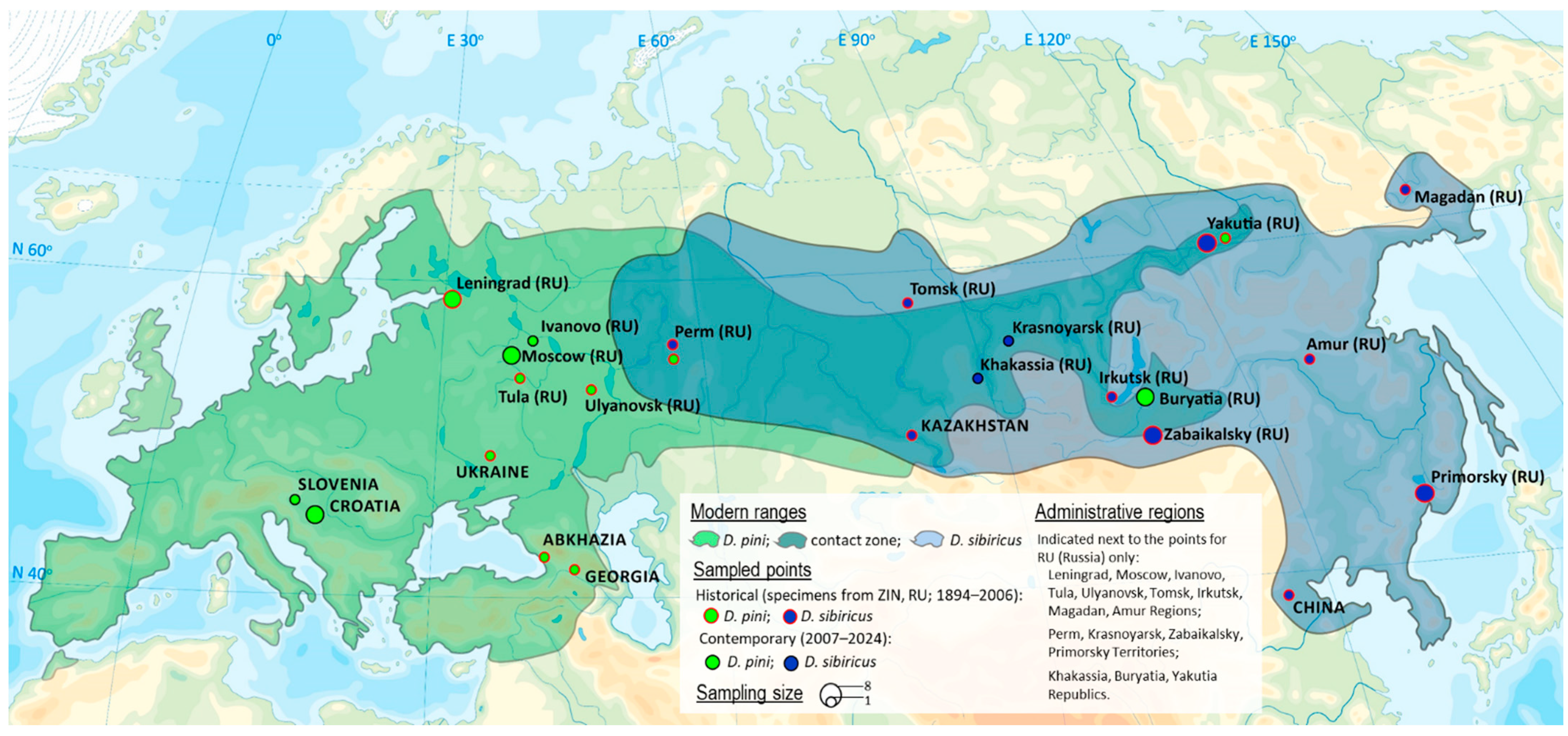
2.1. Study Region
2.2. Specimen Sampling
2.3. Preparation of Male Genitalia Slides
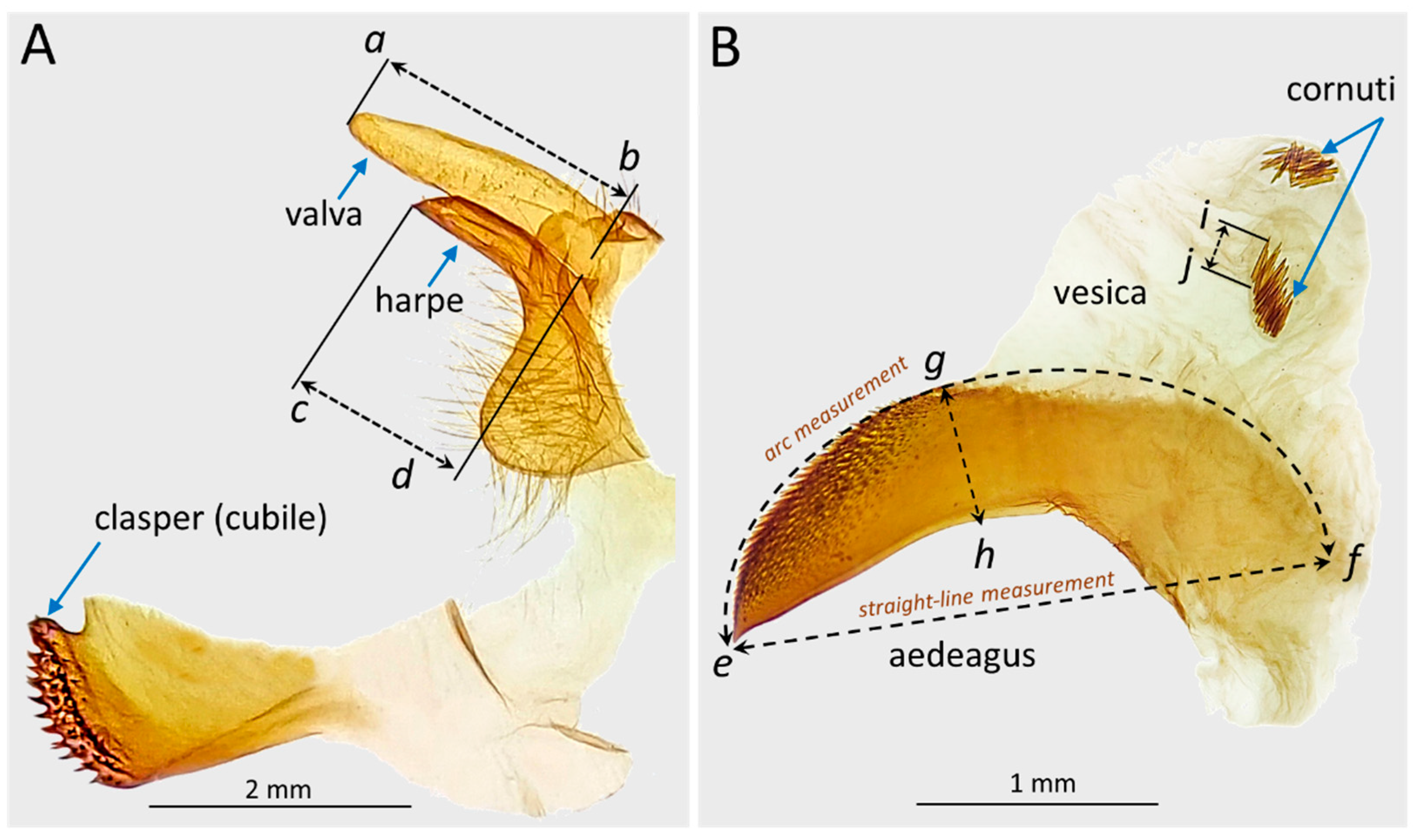
2.4. Measurements of Genitalia Structures
2.5. Data Analysis
2.6. Mapping
3. Results
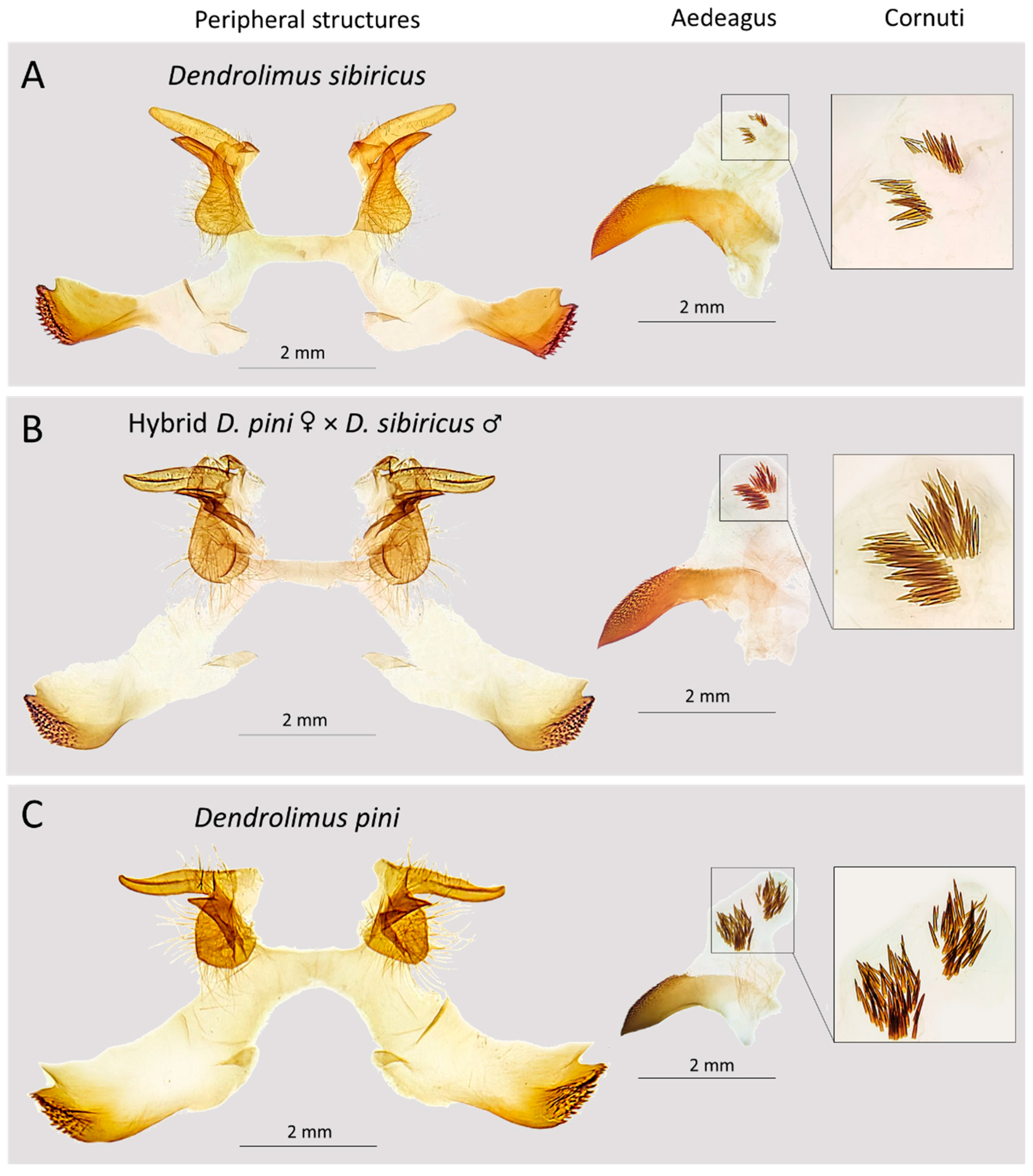
3.1. Morphometric Values of Male Genital Structures
3.2. Relationship of Genital Structures
3.3. Male Genitalia Indices
3.4. Discriminant Analysis for D. sibiricus and D. pini
3.5. Decision Tree for Identifying D. sibiricus, D. pini and Their Hybrids
4. Discussion
5. Conclusions
Supplementary Materials
Author Contributions
Funding
Institutional Review Board Statement
Informed Consent Statement
Data Availability Statement
Acknowledgments
Conflicts of Interest
References
- Baranchikov, Y.N.; Kondakov, Y.P.; Petrenko, E.S. Catastrophic outbreaks of mass reproduction of the Siberian silkworm in the forests of the Krasnoyarsk Territory. In Besopastnost Rossii. Pravovye, Social’no-Ekonomicheskie i Nauchno-Tekhnicheskie Aspekty. Regional’nye Problemy Bezopasnosti [Russian Security. Legal, Socio-Economic and Scientific-Technical Aspects. Regional Security Issues]; Lepeshev, A.A., Ed.; MGF Znanie: Moscow, Russia, 2001; Volume 18, pp. 146–167. (In Russian) [Google Scholar]
- Kirichenko, N.I.; Ageev, A.A.; Astapenko, S.A.; Golovina, A.N.; Kasparyan, D.R.; Kosheleva, O.V.; Timokhov, A.V.; Tselikh, E.V.; Zakharov, E.V.; Musolin, D.L.; et al. The diversity of parasitoids and their role in the control of the Siberian moth, Dendrolimus sibiricus (Lepidoptera: Lasiocampidae), a major coniferous pest in Northern Asia. Life 2024, 14, 268. [Google Scholar] [CrossRef] [PubMed]
- Rozhkov, A.S. The Siberian Moth; AS USSR Press: Moscow, Russia, 1963; 176p. (In Russian) [Google Scholar]
- Kondakov, Y.P. Siberian Moth Outbreaks in Krasnoyarsk Kray. Entomologichskiye Issledovaniya v Sibiri [Research on Entomology in Siberia]; Baranchikov, Y.N., Ed.; Russian Entomological Society, Siberian Branch: Kranoyarsk, Russia, 2002; Volume 2, pp. 25–74. (In Russian) [Google Scholar]
- Kharuk, V.I.; Im, S.T.; Ranson, K.J.; Yagunov, M.I. Climate-induced northerly expansion of Siberian silkmoth range. Forests 2017, 8, 301. [Google Scholar] [CrossRef] [PubMed]
- Kharuk, V.I.; Im, S.T.; Soldatov, V.V. Siberian silkmoth outbreaks surpassed geoclimatic barrier in Siberian Mountains. J. Mt. Sci. 2020, 17, 1891–1900, Erratum in J. Mt. Sci. 2021, 18, 1404. [Google Scholar] [CrossRef]
- EPPO Global Database. EPPO Datasheet: Dendrolimus sibiricus. 2022. Available online: https://gd.eppo.int/taxon/DENDSI/datasheet (accessed on 17 December 2025).
- On Approval of a Unified List of Quarantine Objects of the Eurasian Economic Union. Decision of the Council of the Eurasian Economic Commission of 30 November 2016 (as Amended on 25 January 2023), No. 158. Federal Service for Veterinary and Phytosanitary Supervision. Available online: https://fsvps.gov.ru/files/edinyj-perechen-karantinnyh-obektov-eajes/ (accessed on 17 December 2025). (In Russian)
- Boldaruev, V.O. Population Dynamics of the Siberian Silkworm and Its Parasites; Buryatskoe Knizhnoe Izdatel’stvo: Ulan-Ude, Buryatskaya ASSR, USSR, 1969; 163p. [Google Scholar]
- Kirichenko, N.I. Performance of the Siberian Moth Larvae on Host Plants in Siberia. Ph.D. Dissertation, VN Sukachev Institute of Forest SB RAS, Krasnoyarsk, Russia, 24 December 2002. (In Russian) [Google Scholar]
- Kirichenko, N.I.; Baranchikov, Y.N. Appropriateness on needles of different conifer species for the feeding and growth of larvae from two populations of the Siberian moth. Russ. J. Ecol. 2007, 38, 216–221. [Google Scholar] [CrossRef]
- Kirichenko, N.; Flament, J.; Baranchikov, Y.; Grégoire, J.-C. Larval performances and life cycle completion of the Siberian moth, Dendrolimus sibiricus (Lepidoptera: Lasiocampidae), on potential host plants in Europe: A laboratory study on potted trees. Eur. J. For. Res. 2011, 130, 1067–1074. [Google Scholar] [CrossRef]
- Yang, Z.Q.; Gu, Y.Q. Egg parasitic wasps of the larch larva in Danxinganling Mts. with a description of a new species. Sci. Silvae Sin. (Linye Kexue) 1995, 31, 223–231. [Google Scholar]
- Mikkola, K.; Ståhls, G. Morphological and molecular taxonomy of Dendrolimus sibiricus Chetverikov stat. rev. and allied lappetmoths (Lepidoptera: Lasiocampidae), with description of a new species. Entomol. Fenn. 2008, 19, 65–85. [Google Scholar] [CrossRef]
- Kononov, A.; Ustyantsev, K.; Wang, B.; Mastro, V.C.; Fet, V.; Blinov, A.; Baranchikov, Y. Genetic diversity among eight Dendrolimus species in Eurasia (Lepidoptera: Lasiocampidae) inferred from mitochondrial COI and COII, and nuclear ITS2 markers. BMC Genet. 2016, 17, 157. [Google Scholar] [CrossRef]
- Gninenko, Y.; Orlinskii, A.D. Dendrolimus sibiricus in the coniferous forests of European Russia at the beginning of the twenty-first century. EPPO Bull. 2002, 332, 481–483. [Google Scholar] [CrossRef]
- Freina, J.J.d.; Witt, T.J. Die Bombyces und Sphinges der Westpaläarktis (Insecta, Lepidoptera); Forschung: München, Germany, 1987. [Google Scholar]
- Molet, T. CPHST Pest Datasheet for Dendrolimus pini. USDA-APHIS-PPQ-CPHST, 2012. Available online: https://caps.ceris.purdue.edu/wp-content/uploads/2025/07/Dendrolimus-pini-2012-Molet.pdf (accessed on 17 December 2025).
- Björkman, C.; Lindelöw, Å.; Eklund, K.; Kyrk, S.; Klapwijk, J.; Fedderwitz, F.; Nordlander, G. A rare event—An isolated outbreak of the pine-tree lappet moth (Dendrolimus pini) in the Stockholm archipelago. Entomol. Tidskr. 2013, 134, 1–9. [Google Scholar]
- Zolotuhin, V.V. Lasiocampidae. In Catalogue of the Lepidoptera of Russia, 2nd ed.; Sinev, S.Y., Ed.; Zoological Institute RAS: St. Petersburg, Russia, 2019; pp. 281–284. (In Russian) [Google Scholar]
- Skrzecz, I.; Ślusarski, S.; Tkaczyk, M. Integration of science and practice for Dendrolimus pini (L.) management—A review with special reference to Central Europe. For. Ecol. Manag. 2020, 455, 117697. [Google Scholar] [CrossRef]
- CABI Compendium. Dendrolimus pini (Pine Tree Lappet). 2022. Available online: https://www.cabidigitallibrary.org/doi/full/10.1079/cabicompendium.18367 (accessed on 17 December 2025).
- A’Hara, S.; Moore, R.; Cottrell, J. Molecular investigation of the pine-tree lappet moth Dendrolimus pini (L.) population in Scotland: A new arrival or an old acquaintance? Agric. For. Entomol. 2022, 24, 40–52. [Google Scholar] [CrossRef]
- EPPO Global Database. PM 7/157 (1) Dendrolimus sibiricus. EPPO Bull. 2024, 54, 137–146. [Google Scholar] [CrossRef]
- Stewart, D.; Djoumad, A.; Holden, D.; Kimoto, T.; Capron, A.; Dubatolov, V.V.; Akhanaev, Y.B.; Yakimova, M.E.; Martemyanov, V.V.; Cusson, M. A TaqMan assay for the detection and monitoring of potentially invasive lasiocampids, with particular attentionto the Siberian silk moth, Dendrolimus sibiricus (Lepidoptera: Lasiocampidae). J. Insect Sci. 2023, 23, 5. [Google Scholar] [CrossRef]
- Ryazanova, M.A. Molecular Genetic Identification of the Siberian Moth Dendrolimus sibiricus (Lepidoptera: Lasiocampidae) and Related Species. Master’s Thesis, The Siberian Federal University, Krasnoyarsk, Russia, 2024. (In Russian) [Google Scholar]
- Klun, J.A.; Baranchikov, Y.N.; Mastro, V.C.; Hijji, Y.; Nicholson, J.; Ragenovich, I.; Vshivkova, T.A. A sex attractant for the Siberian moth Dendrolimus superans sibiricus (Lepidoptera: Lasiocampidae). J. Entomol. Sci. 2000, 35, 158–166. [Google Scholar] [CrossRef]
- Baranchikov, Y.N.; Pet’ko, V.M.; Ponomarev, V.L. The Russians are coming–aren’t they? Siberian moth in European forests. In Proceedings of 17th U.S. Department of Agriculture Interagency Research Forum on Gypsy Moth and other Invasive Species, 2006, Annapolis, MD, USA, 10–13 January 2006; Gottschalk, K.W., Ed.; USDA Forest Service, Northern Research Station: Newtown Square, PA, USA, 2007; pp. 18–20. [Google Scholar]
- Chalkin, A.A.; Zinnikov, D.F.; Lyabzina, S.N.; Sinkevich, O.V. Pests and diseases of forest biocenoses of specially protected natural areas of the Republic of Karelia. Plant Health Quar. 2021, 2, 9–19. [Google Scholar] [CrossRef]
- Zhao, Q.S.; Wu, W.B.; Lu, G.P.; Yuan, X.; Li, S.K.; Jiang, J.C. Hybridization experiments with two species of Dendrolimus. Acta Entomol. Sin. 1992, 35, 29–32. [Google Scholar] [CrossRef]
- ESRI. ArcGIS Desktop, Release 9.3; Environmental Systems Research Institute: Redlands, CA, USA, 2008; Available online: http://www.esri.com/software/arcgis/eval-help/arcgis-93 (accessed on 4 January 2026).
- Golub, V.B.; Tsurikov, M.N.; Prokin, A.A. Insect Collections: Collection, Processing and Storage of Material, 2nd ed.; KMK Scientific Publications Partnership: Moscow, Russia, 2021; 358p. (In Russian) [Google Scholar]
- Siegel, S.; Castellan, N.J. Nonparametric Statistics for the Behavioral Sciences, 2nd ed.; McGraw-Hill: New York, NY, USA, 1988; 399p. [Google Scholar]
- Kendall, M.; Stuart, A. The Advanced Theory of Statistics. Inference and Relationship; Hafner Publishing Company: New York, NY, USA, 1961; Volume 2, 676p. [Google Scholar]
- Kendall, M.; Stuart, A. The Advanced Theory of Statistics. Design and Analysis, and Time-Series; Charles Griffin & Company Limited: London, UK, 1966; Volume 3, 552p. [Google Scholar]
- Shitikov, V.K.; Mastitsky, S.E. Classification, Regression and Other Data Mining Algorithms Using R. 2017; 351p. (In Russian) Available online: https://github.com/ranalytics/data-mining (accessed on 17 December 2025).
- Rudziński, K.J.; Staszek, D.; Asztemborska, M.; Sukovata, L.; Raczko, J.; Cieślak, M.; Kolk, A.; Szmigielski, R. Newly discovered components of Dendrolimus pini sex pheromone. Insects 2022, 13, 1063. [Google Scholar] [CrossRef]
- Arnqvist, G. Comparative evidence for the evolution of genitalia by sexual selection. Nature 1998, 393, 784–786. [Google Scholar] [CrossRef]
- Eberhard, W.G. Evolution of genitalia: Theories, evidence, and new directions. Genetica 2010, 138, 5–18. [Google Scholar] [CrossRef]
- Eberhard, W.G. Rapid divergent evolution of genitalia: Theory and data updated. In The Evolution of Primary Sexual Characters in Animals; Leonard, J.L., Córdoba-Aguilar, A., Eds.; Oxford University Press: Oxford, UK, 2010; pp. 40–78. [Google Scholar]
- Mutanen, M.; Rytkönen, S.; Lindén, J.; Sinkkonen, J. Male genital variation in a moth Pammene luedersiana (Lepidoptera: Tortricidae). Eur. J. Entomol. 2007, 104, 259–265. [Google Scholar] [CrossRef]
- Mutanen, M.; Pretorius, E. Subjective visual evaluation vs. traditional and geometric morphometrics in species delimitation: A comparison of moth genitalia. Syst. Entomol. 2007, 32, 371–386. [Google Scholar] [CrossRef]
- Prieto, C.G.; Munguira, M.L.; Romo, H. Morphometric analysis of genitalia and wing pattern elements in the genus Cupido (Lepidoptera: Lycaenidae): Are Cupido minimus and C. carswelli different species? Dtsch. Entomol. Z. 2009, 56, 137–147. [Google Scholar] [CrossRef]
- Anzaldo, S.S.; Dombroskie, J.; Brown, J.W. Morphological variation, taxonomic distribution, and phylogenetic significance of cornuti in Tortricinae (Lepidoptera: Tortricidae). Proc. Entomol. Soc. Wash. 2014, 116, 1–31. [Google Scholar] [CrossRef]
- Chapuis, M.-P.; Pélissié, B.; Piou, C.; Chardonnet, F.; Pagès, C.; Foucart, A.; Chapuis, E.; Jourdan Pineau, H. Additive genetic variance for traits least related to fitness increases with environmental stress in the desert locust, Schistocerca gregaria. Ecol. Evol. 2021, 11, 13930–13947. [Google Scholar] [CrossRef]
- Elkinton, J.S.; Boettner, G.H.; Sermac, M.; Gwiazdowski, R.; Hunkins, R.R.; Callahan, J.; Scheufele, S.B.; Donahue, C.P.; Porter, A.H.; Khrimian, A.; et al. Survey for winter moth (Lepidoptera: Geometridae) in northeastern North America with pheromone-baited traps and hybridization with the native Bruce spanworm (Lepidoptera: Geometridae). Ann. Entomol. Soc. Am. 2010, 103, 135–145. [Google Scholar] [CrossRef]
- Capblancq, T.; Despres, L.; Rioux, D.; Mavarez, J. Hybridization promotes speciation in Coenonympha butterflies. Mol. Ecol. 2015, 24, 6209–6222. [Google Scholar] [CrossRef]
- Lukhtanov, V.A. A new species of Melitaea from Israel, with notes on taxonomy, cytogenetics, phylogeography and interspecific hybridization in the Melitaea persea complex (Lepidoptera, Nymphalidae). Comp. Cytogenet. 2017, 11, 325–357. [Google Scholar] [CrossRef]
- Shapoval, N.A.; Yakovlev, R.V.; Kuftina, G.N.; Lukhtanov, V.A.; Knyazev, S.A.; Romanovich, A.E.; Krupitsky, A.V. Identification of natural hybrids between Ahlbergia frivaldszkyi (Lederer, 1853) and Callophrys rubi (Linnaeus, 1758) (Lepidoptera, Lycaenidae) using mitochondrial and nuclear markers. Insects 2021, 12, 1124. [Google Scholar] [CrossRef]
- Dincă, V.; Dapporto, L.; Kudrna, O.; Lamas, G.; Vila, R. Unexpected layers of cryptic diversity in a widely distributed butterfly. Sci. Rep. 2011, 1, 158. [Google Scholar] [CrossRef]
- Vodă, R.; Dapporto, L.; Dincă, V.; Vila, R. Why do cryptic species tend not to co-occur? A case study on two cryptic pairs of butterflies. PLoS ONE 2015, 10, e0117802. [Google Scholar] [CrossRef] [PubMed]
- Cordero, C. On the function of cornuti, sclerotized structures of the endophallus of Lepidoptera. Genetica 2010, 138, 27–35. [Google Scholar] [CrossRef] [PubMed]
- Cordero, C.; Baixeras, J. Sexual selection within the female genitalia in Lepidoptera. In Cryptic Female Choice in Arthropods: Patterns, Mechanisms and Prospects; Peretti, V.A., Aisenberg, A., Eds.; Springer International Publishing: Cham, Switzerland, 2015; pp. 325–350. [Google Scholar]
- Sperling, F. Mitochondrial DNA variation and Haldane’s rule in the Papilio glaucus and P. troilus species groups. Heredity 1993, 71, 227–233. [Google Scholar] [CrossRef]
- EFSA Panel on Plant Health (PLH); Jeger, M.; Bragard, C.; Caffier, D.; Candresse, T.; Chatzivassiliou, E.; Dehnen-Schmutz, K.; Gilioli, G.; Miret, J.A.J.; MacLeod, A.; et al. Pest categorisation of Dendrolimus sibiricus. EFSA J. 2018, 16, e05301. [Google Scholar] [CrossRef]



| Indices * | Definition | What It Captures; Why Helpful |
|---|---|---|
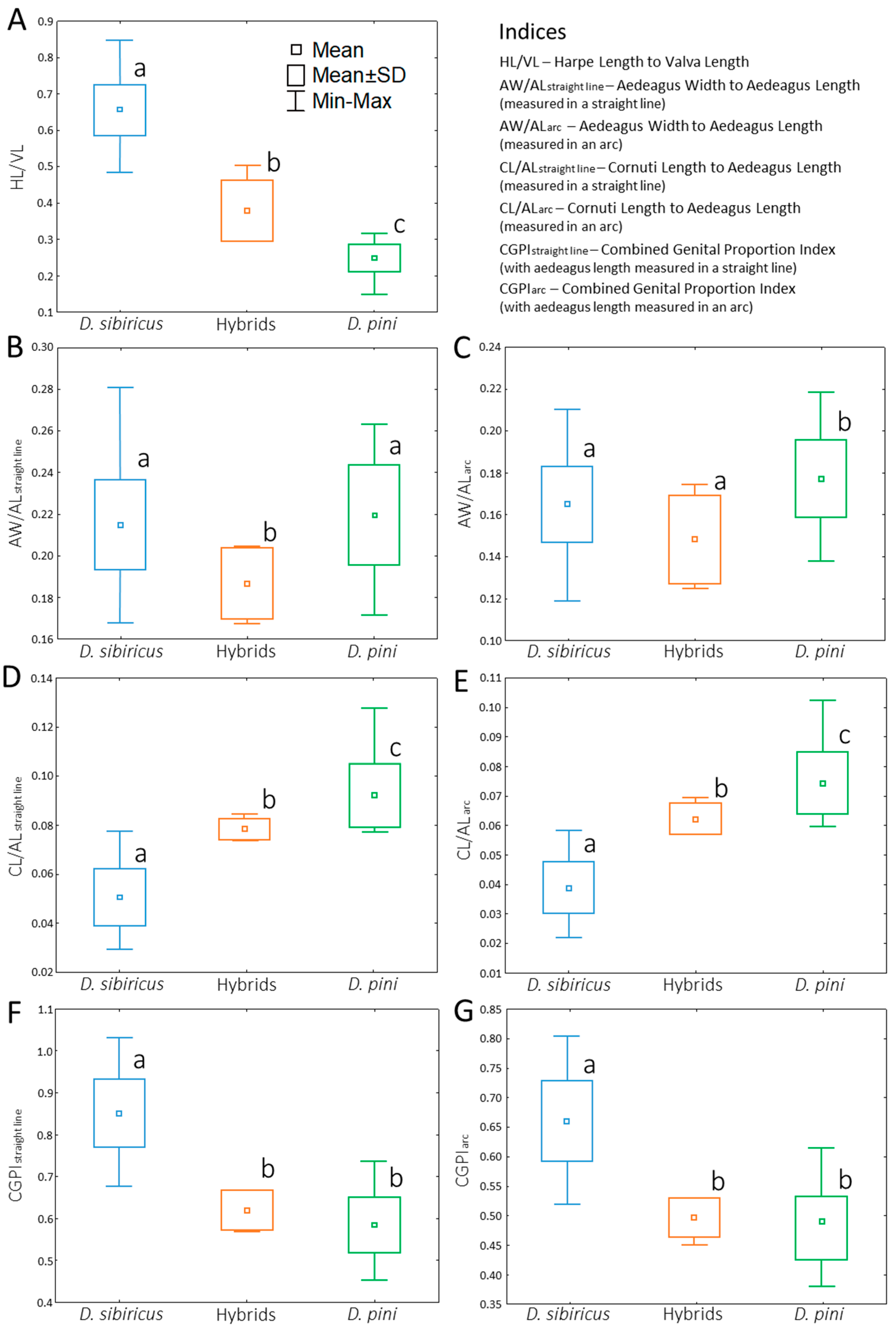
| Harpe Length/Valva Length Index (HL/VL) | harpe length to valva length | captures relative size of harpe vs. valva; helpful if one species has longer harpe than another |
| Aedeagus Width/Aedeagus Length Index (AW/AL) | aedeagus width to aedeagus length | captures relative size of aedeagus; helpful if one species has wider aedeagus than another |
| Cornuti Length/Aedeagus Length Index (CL/AL) | cornuti length to aedeagus length | captures relative size of cornuti vs. aedeagus; helpful if one species has wider aedeagus than another |
| Combined Genital Proportion Index (CGPI) | (valva length + harpe length) to (aedeagus length + cornuti length) | captures relative size of multiple structures; helpful if one species has larger multiple structures than another |
| Genital Structures | F-Remove | p-Value |
|---|---|---|
| Harpe length * | 35.882 | ≤0.01 |
| Cornuti length * | 12.370 | ≤0.01 |
| Valva length * | 4.557 | ≤0.05 |
| Aedeagus length, measured in an arc * | 4.265 | ≤0.05 |
| Aedeagus width | 3.510 | ≥0.05 |
| Aedeagus length, measured in straight line | 1.164 | ≥0.1 |
| Indices of Male Genitalia Structures | F-Remove | p-Value |
|---|---|---|
| Model 1 (includes all indices) | ||
| HL/VL * | 87.540 | ≤0.01 |
| CL/ALstraight line | 1.947 | ≥0.1 |
| AW/ALstraight line | 1.711 | ≥0.1 |
| AW/ALarc | 1.588 | ≥0.1 |
| CL/ALarc | 1.311 | ≥0.1 |
| CGPIarc | 0.904 | ≥0.1 |
| CGPIstraight line | 0.673 | ≥0.1 |
| Model 2 (excludes HL/VL Index) | ||
| CGPIarc * | 44.061 | ≤0.01 |
| CL/ALstraight line * | 41.035 | ≤0.01 |
| AW/ALarc * | 17.869 | ≤0.01 |
| AW/ALstraight line * | 13.705 | ≤0.01 |
| Indices | Taxa | Reference Index Values | ||
|---|---|---|---|---|
| Mean ± SD * | Min | Max | ||
| Highly informative indices (enabling differentiation between D. sibiricus, D. pini and their hybrids) | ||||
| HL/VL | D. sibiricus | 0.656 ± 0.069 a | 0.484 | 0.847 |
| Hybrids | 0.378 ± 0.085 b | 0.317 | 0.503 | |
| D. pini | 0.251 ± 0.038 c | 0.149 | 0.316 | |
| CL/ALstraight-line | D. sibiricus | 0.051 ± 0.012 a | 0.029 | 0.077 |
| Hybrids | 0.078 ± 0.004 b | 0.073 | 0.085 | |
| D. pini | 0.092 ± 0.013 c | 0.077 | 0.128 | |
| CL/ALarc | D. sibiricus | 0.039 ± 0.009 a | 0.022 | 0.059 |
| Hybrids | 0.062 ± 0.005 b | 0.058 | 0.069 | |
| D. pini | 0.074 ± 0.010 c | 0.060 | 0.102 | |
| Informative indices (enabling differentiation between D. sibiricus, D. pini, and between only one of the parental species and their hybrids) | ||||
| CGPIstraight-line | D. sibiricus | 0.852 ± 0.081 a | 0.677 | 1.031 |
| Hybrids | 0.621 ± 0.048 b | 0.568 | 0.664 | |
| D. pini | 0.586 ± 0.065 b | 0.453 | 0.736 | |
| CGPIarc | D. sibiricus | 0.662 ± 0.068 a | 0.522 | 0.808 |
| Hybrids | 0.499 ± 0.033 b | 0.452 | 0.531 | |
| D. pini | 0.480 ± 0.054 b | 0.381 | 0.617 | |
| AW/ALarc | D. sibiricus | 0.165 ± 0.018 a | 0.120 | 0.210 |
| Hybrids | 0.148 ± 0.021 a | 0.125 | 0.174 | |
| D. pini | 0.177 ± 0.019 b | 0.138 | 0.218 | |
| The least informative index (enabling differentiation of hybrids from their parental species but not the parental species themselves) | ||||
| AW/ALstraight-line | D. sibiricus | 0.215 ± 0.022 a | 0.168 | 0.280 |
| Hybrids | 0.186 ± 0.017 b | 0.167 | 0.205 | |
| D. pini | 0.218 ± 0.026 a | 0.159 | 0.263 | |
Disclaimer/Publisher’s Note: The statements, opinions and data contained in all publications are solely those of the individual author(s) and contributor(s) and not of MDPI and/or the editor(s). MDPI and/or the editor(s) disclaim responsibility for any injury to people or property resulting from any ideas, methods, instructions or products referred to in the content. |
© 2026 by the authors. Licensee MDPI, Basel, Switzerland. This article is an open access article distributed under the terms and conditions of the Creative Commons Attribution (CC BY) license.
Share and Cite
Ryazanova, M.A.; Ageev, A.A.; Sinev, S.Y.; Matov, A.Y.; Gomboc, S.; Kovalenko, M.G.; Akulov, E.N.; Demidko, D.A.; Musolin, D.L.; Kirichenko, N.I. The Morphometry of Male Genitalia as a Reliable Tool for Identifying Forest Pests Dendrolimus sibiricus, D. pini (Lepidoptera: Lasiocampidae), and Their Hybrids in Eurasia. Life 2026, 16, 398. https://doi.org/10.3390/life16030398
Ryazanova MA, Ageev AA, Sinev SY, Matov AY, Gomboc S, Kovalenko MG, Akulov EN, Demidko DA, Musolin DL, Kirichenko NI. The Morphometry of Male Genitalia as a Reliable Tool for Identifying Forest Pests Dendrolimus sibiricus, D. pini (Lepidoptera: Lasiocampidae), and Their Hybrids in Eurasia. Life. 2026; 16(3):398. https://doi.org/10.3390/life16030398
Chicago/Turabian StyleRyazanova, Maria A., Alexander A. Ageev, Sergey Yu. Sinev, Alexey Yu. Matov, Stanislav Gomboc, Margarita G. Kovalenko, Evgeny N. Akulov, Denis A. Demidko, Dmitrii L. Musolin, and Natalia I. Kirichenko. 2026. "The Morphometry of Male Genitalia as a Reliable Tool for Identifying Forest Pests Dendrolimus sibiricus, D. pini (Lepidoptera: Lasiocampidae), and Their Hybrids in Eurasia" Life 16, no. 3: 398. https://doi.org/10.3390/life16030398
APA StyleRyazanova, M. A., Ageev, A. A., Sinev, S. Y., Matov, A. Y., Gomboc, S., Kovalenko, M. G., Akulov, E. N., Demidko, D. A., Musolin, D. L., & Kirichenko, N. I. (2026). The Morphometry of Male Genitalia as a Reliable Tool for Identifying Forest Pests Dendrolimus sibiricus, D. pini (Lepidoptera: Lasiocampidae), and Their Hybrids in Eurasia. Life, 16(3), 398. https://doi.org/10.3390/life16030398