1. Introduction
The three-level back-to-back (3L-BTB) topology with Neutral-Point Clamped (NPC) is well-suited for medium-to-high voltage and high-power converters [
1,
2]. Characterized by low harmonic content, low electromagnetic interference (EMI), and mature control strategies, the topology is extensively applied in various fields, such as medium-to-high voltage variable speed drives, grid-connected photovoltaic (PV) systems, and Flexible AC Transmission Systems (FACTS) [
3,
4]. However, bidirectional power flow is not required in many industrial applications. In certain cases, such as drive systems, wind turbine systems, and the power supply stages of telecommunication systems, the power flow is strictly restricted to a single direction [
5,
6,
7]. Therefore, control strategies for medium-to-high voltage converters with unidirectional power flow still require further investigation. The 3L-BTB structure employing a Vienna rectifier on the grid side is considered a highly suitable topology for unidirectional power flow applications owing to its high-power density, low switching losses, and inherent structural advantages [
8].
However, current zero-crossing distortion (CZCD) is an inherent issue of the Vienna rectifier, which can affect the stability of unidirectional back-to-back (BTB) converters [
9,
10]. The fundamental cause lies in the phase difference between the reference voltage and the current on the grid side of Vienna rectifier. This phase misalignment prevents the two from maintaining synchronous switching, which in turn leads to the CZCD on the grid side [
11,
12,
13]. Furthermore, NPP imbalance on the DC bus in the converter becomes more significant, as both the Vienna rectifier and the NPC inverter can contribute to this issue. Moreover, there is a coupling relationship between the input CZCD and the NPP imbalance. Specifically, the fluctuations of the NPP could also cause a deviation between the actual output voltage and the reference voltage of the Vienna rectifier, which could exacerbate the CZCD further [
14].
The most prevalent modulation techniques for suppressing the CZCD in the Vienna rectifier include Space Vector Modulation (SVPWM) and Carrier-Based Pulse Width Modulation (CBPWM) [
15]. The SVPWM-based strategy was utilized to eliminate CZCD in reference [
16], which is achieved by clamping the modulation waveform to zero within the distortion interval. Similarly, the carrier-based discontinuous PWM (CB-DPWM) method was applied in [
17] to suppress the CZCD. In the approach, the reference voltage is clamped to the neutral point to eliminate the intervals in which the input current and the reference voltage have opposite signs. However, these methods introduced certain harmonics on the grid side. For the Reduced Switch Hybrid Multilevel Converter (RSHMC) [
18], the CZCD phenomenon was eliminated by selecting redundant switching states, while the NPP control was achieved by selecting appropriate switching states to charge or discharge the floating capacitors. A model predictive control method was proposed with reduced switching losses and CZCD in [
19], but it requires heavy computational process and involves tuning complexity.
Regarding the NPP balance control of BTB converters, much of the research has primarily focused on the control strategies for the three-level topology with bidirectional power flow [
20,
21]. The SVPWM-based strategy achieves the regulation of the upper and lower capacitor voltages by directly adjusting the duration of redundant small vectors within each sampling period to control the average neutral-point current [
22,
23,
24]. In [
25], the researcher decomposed the medium vectors into two virtual small vectors, which increases the freedom to select different small vectors and avoids the impact of medium vectors on the NPP. Based on the above idea, various methods for synthesizing virtual vectors have been derived [
26]. Furthermore, a zero-sequence voltage (ZSV) injection method based on SPWM was proposed to achieve NPP balance by adjusting the zero-level duration of each phase [
27,
28]. In [
29], a simple dual-end ZSV injection method based on CBPWM was presented for NPP balance in bidirectional 3L-BTB converters. However, the application of this method could aggravate CZCD on the Vienna rectifier side in unidirectional 3L-BTB converters. Existing research predominantly addresses only one side of the converter, often treating the rectifier and inverter as independent subsystems [
30]. However, for unidirectional 3L-BTB converters, CZCD on the rectifier side and NPP imbalance on the common DC bus are not independent issues but are inherently coupled through the shared DC bus dynamics. Consequently, control methods developed separately for Vienna-rectifier CZCD suppression or NPC-inverter NPP regulation cannot guarantee simultaneous performance and may even conflict when directly combined. To the best of our knowledge, an integrated control strategy that explicitly addresses this coupling and achieves coordinated CZCD suppression and NPP balancing for unidirectional BTB converters is still missing.
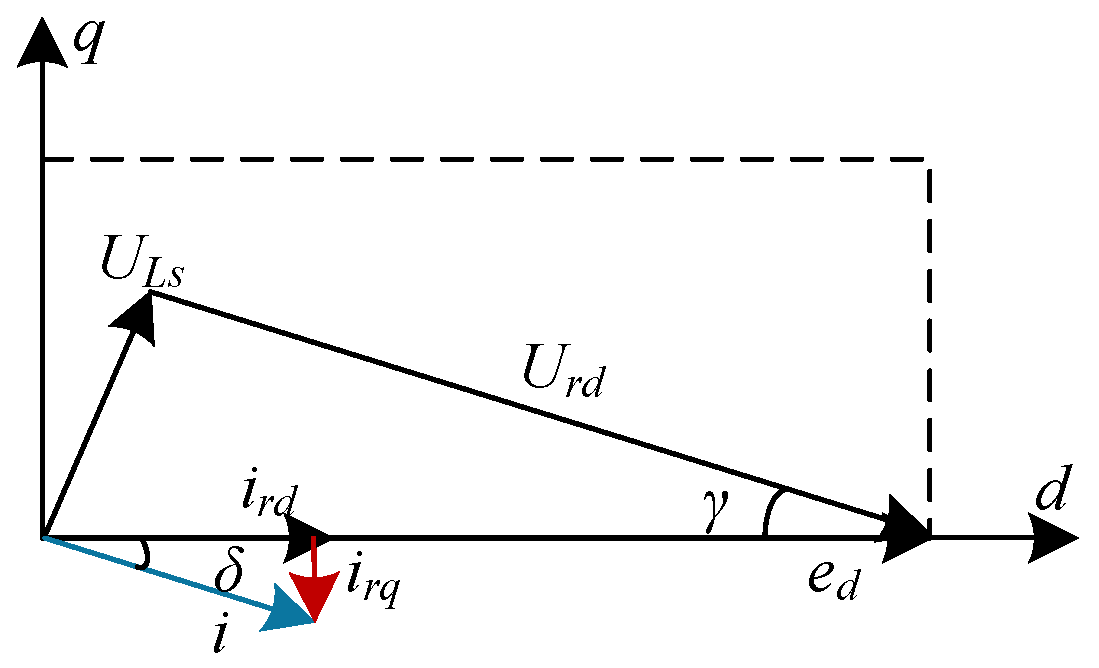
In this paper, a coordinated control strategy, capable of simultaneously suppressing CZCD on the grid side and balancing NPP on the DC bus for unidirectional 3L-BTB converters, is proposed. The main innovations and contributions are summarized as follows.
- (1)
Unlike existing studies that treat CZCD mitigation or NPP balancing separately, this paper systematically analyzes the coupling mechanism between rectifier-side CZCD and DC-link NPP imbalance in a unidirectional Vienna–NPC BTB converter.
- (2)
A decoupled control formulation is developed by reconstructing the neutral-point current reference, which converts the rectifier-side impact on NPP from an unknown coupling term into a known disturbance to be compensated.
- (3)
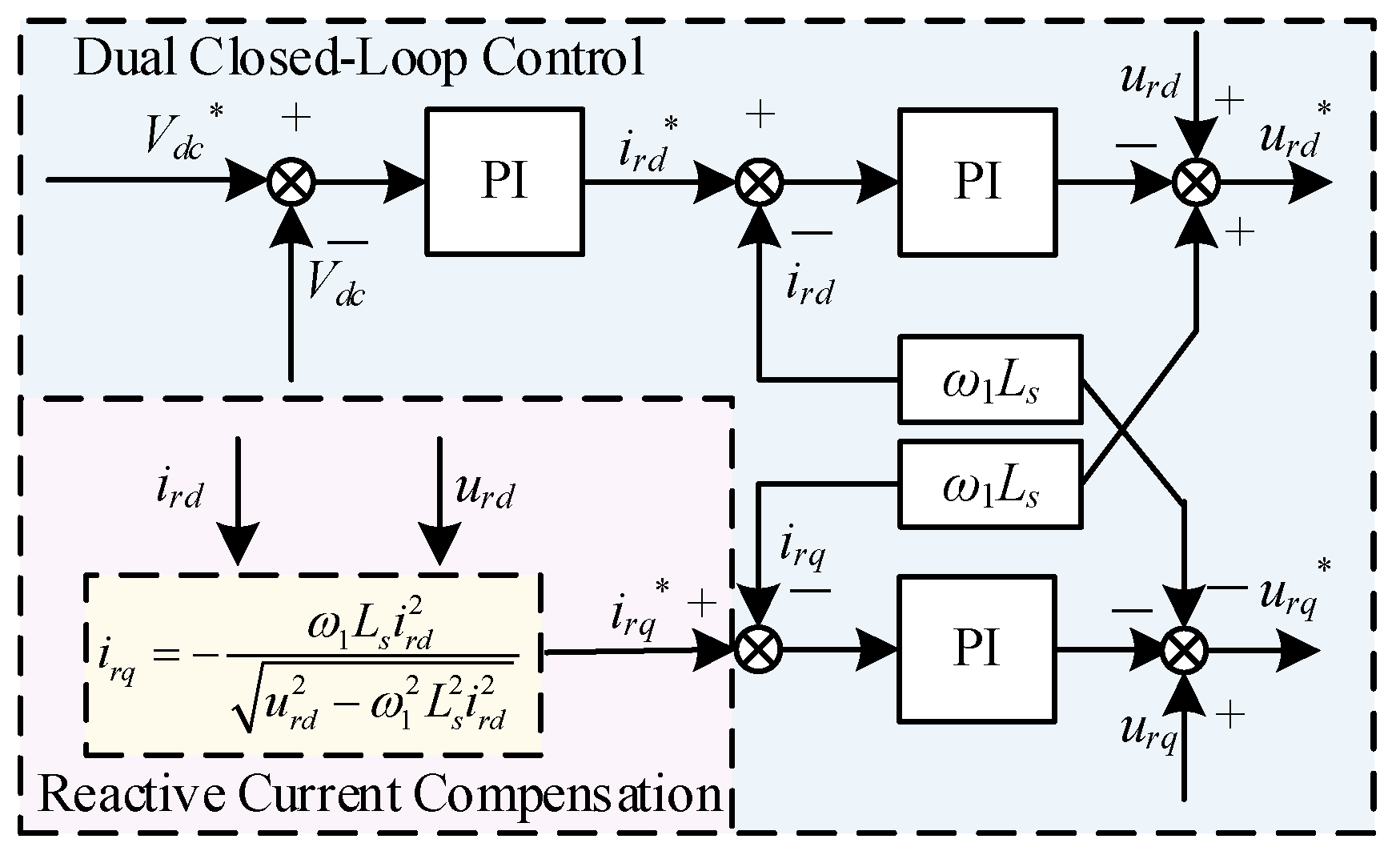
A coordinated control strategy is proposed to simultaneously suppress CZCD and balance NPP, where reactive current compensation is applied on the Vienna rectifier side and an optimal ZSV injection is implemented on the NPC inverter side for active compensation.
The rest of this paper is structured as follows. In
Section 2, the topology of the converter used in this article and its equivalent voltage equations are introduced. In
Section 3, the coupling relationship between the CZCD and the NPP imbalance is analyzed. In
Section 4, the proposed coordinated control method is described. In
Section 5, the effectiveness of the proposed strategy is verified through experimental results. Finally, this article is summarized in
Section 6.
2. Introduction to Converter Topology
BTB converters can be categorized in
Table 1, according to the number of voltage levels and the direction of power flow, such as the two-level back-to-back (2L-BTB) converters, the 3L-BTB converters, and so on. As shown in
Table 1, several representative converter topologies and the respective characteristics are presented. It can be seen from the table that the 3L-BTB converter employing a Vienna rectifier on the grid side has the most advantage in terms of performance and losses.
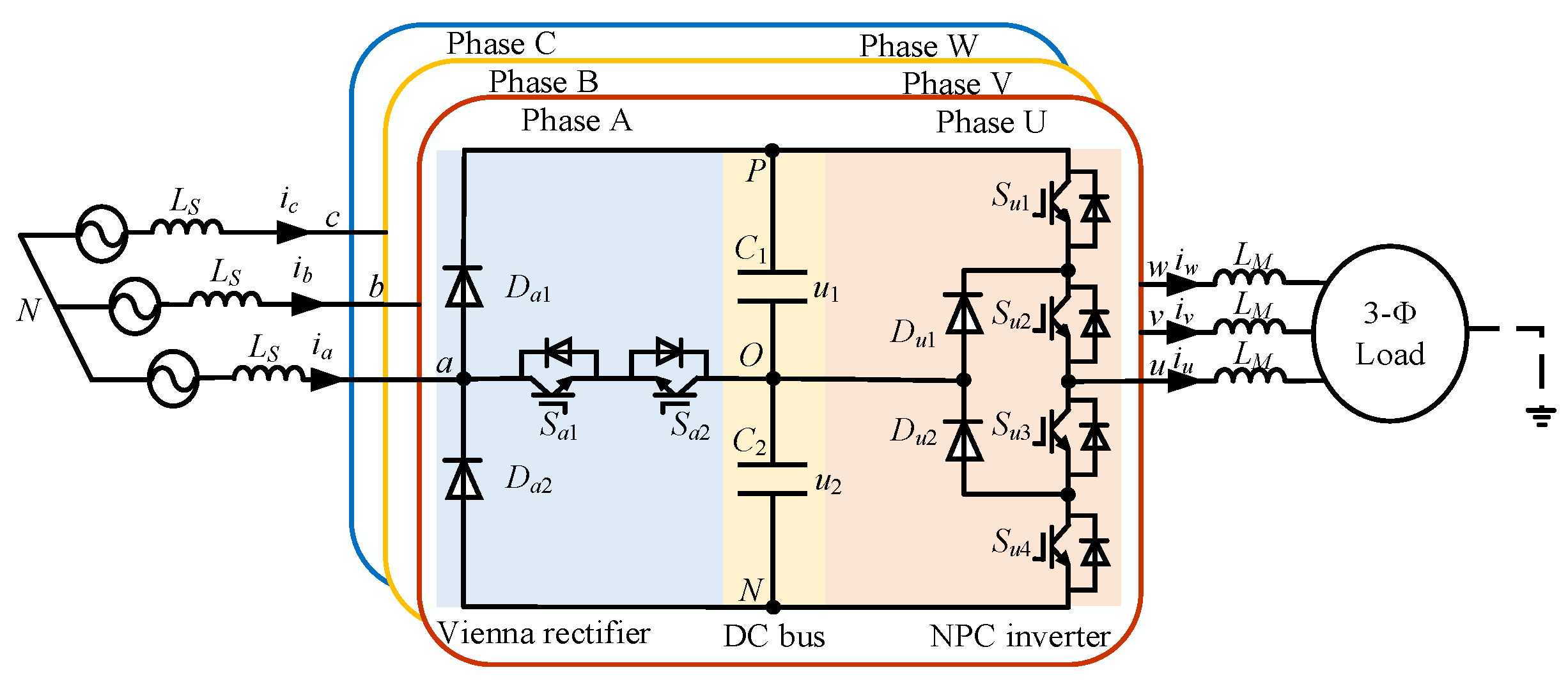
The topology of the unidirectional 3L-BTB converter studied in this paper is shown in
Figure 1, which is composed of a Vienna rectifier on the grid side and a three-level NPC inverter on the load side. The intermediate stage is a common DC bus, which is composed of upper and lower capacitors. The Vienna rectifier is connected to the three-phase grid with voltages
ex (
x =
a,
b,
c).
LS and
LM respectively represent the inductance of the reactors on the rectifier and inverter sides, and it is assumed that
LS =
LM.
C1 and
C2 represent the upper and lower capacitors on the common DC bus with corresponding voltages
u1 and
u2, where it is assumed that
C1 =
C2 =
C. The input currents of the Vienna rectifier are
ix (
x =
a,
b,
c), while the output currents of the NPC inverter are
iy (
y =
u,
v,
w). The switches
Sx1 and
Sx2 (
x =
a,
b,
c) share the same switching state. The two pairs of IGBT switches,
Sy1,
Sy2 and
Sy3,
Sy4 (
y =
u,
v,
w) operate in a complementary manner. The components
Dx1,
Dx2 and
Dy1,
Dy2 are the uncontrolled diodes. The energy is transferred from the grid to the common DC bus via the Vienna rectifier and is then converted by the NPC inverter to supply a three-phase AC load. operating in a unidirectional flow mode. This topology achieves a higher power density and substantially lower switching losses compared to a traditional 3L-BTB converter. Furthermore, it is crucial that the absence of dead-time requirements on the rectifier side could improve system reliability and reduce the current harmonic content on the grid side.
The three-phase reference voltages
,
and
for the Vienna rectifier side and
,
and
for the inverter side can be expressed as follows according to the Phase Disposition Pulse Width Modulation (PDPWM) strategy.
where
mx denotes the modulation index (0 <
mx ≤ 1), and
ωx represents the angular frequency, corresponding to the rectifier side when
x = 1 and the inverter side when
x = 2. In addition,
E denotes half of the DC-link voltage.
According to the operating principles of the Vienna rectifier and the NPC inverter, the overall voltage transfer equation of the converter in the
d-q axis can be expressed as follows.
where
ird,
irq and
iid,
iiq are the
d-
q axis components of the current on the rectifier side and the inverter side, respectively.
erd and
erq are the
d-q axis components of the grid voltage;
urd,
urq and
uid,
uiq are the
d-q axis components of the output voltages on the rectifier side and the inverter side, respectively.
uiod and
uioq are the
d-q axis components of the voltage across the load.
3. Analysis of the Coupling Relationship Between CZCD and NPP Imbalance
Under ideal conditions, the voltages across the upper and lower capacitors on the DC bus should be equal, that is
u1 =
u2 =
E, and the voltage on the DC bus is given by
udc=
u1 +
u2. For the Vienna rectifier, the switching function
SX (
X =
A,
B,
C), based on the power device switching states
Sx1 =
Sx2 = S
x (
x =
a,
b,
c), is expressed as follows.
Then, the output voltage function of the Vienna rectifier can be expressed as follows.
where sgn(
ix) is the sign function, which is expressed as
In the actual operation of the converter, the three-phase voltages
ux (
x =
a,
b,
c) lag the grid side currents
ix by an angle
γ due to the input filter inductance
LS of the Vienna rectifier. Meanwhile, the reference voltage
fails to track the commutation of the input current
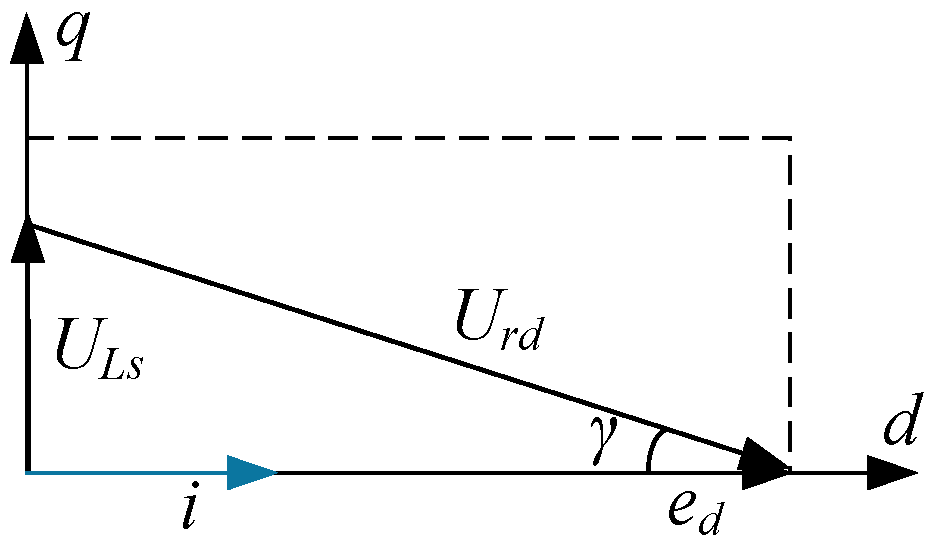
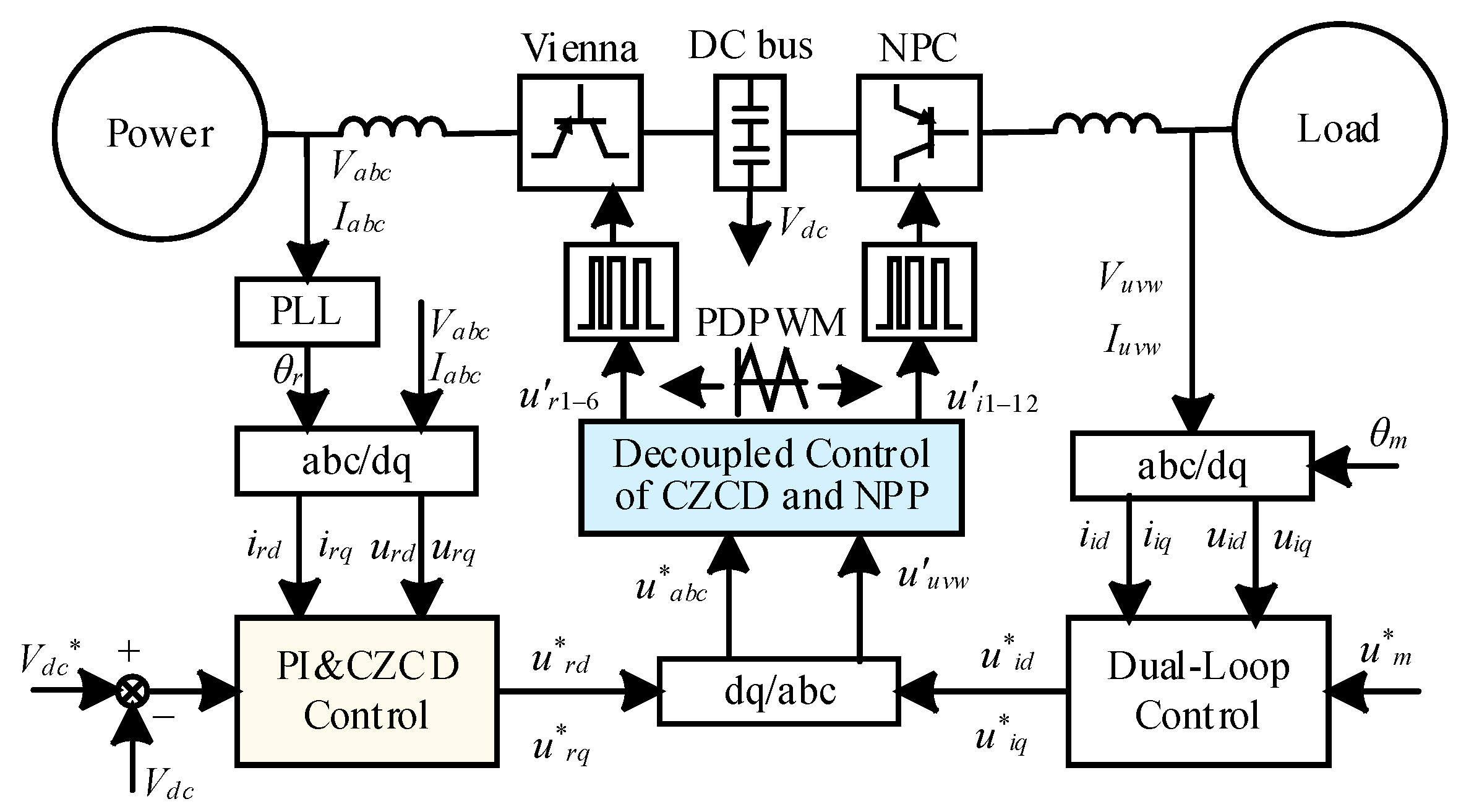
irx in real-time at its zero-crossing point, which results in the CZCD of the input current on the grid side. The vector diagram of the forced commutation in the
d-q axis coordinate system for the Vienna rectifier is presented in
Figure 2.
Where ULs denotes the voltage across the inductor Ls, i is the current on the grid side, ed is the input voltage on the grid side, and urd lags the grid voltage ed by an angle γ, which is referred to as the distortion angle.
The distortion angle γ can be calculated from the vector relationship in
Figure 2, as shown below.
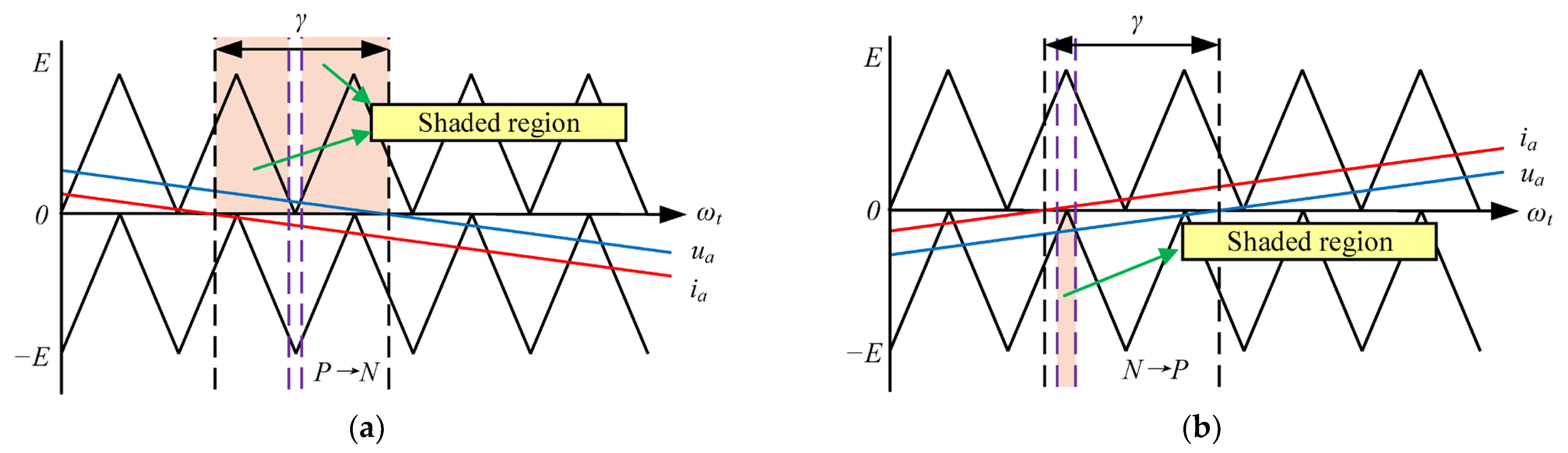
The modulation process of PDPWM in the Vienna rectifier of the converter is illustrated in
Figure 3. As shown in
Figure 3a for Phase A, the reference voltage
ua (indicated by the blue line) is positive, while the actual input current
ia (indicated by the red line) is negative within the narrow transition interval
γ. In the shaded region, the ideal output voltage amplitude of phase A is E, when the modulation wave is compared with the carrier wave. However, the actual output voltage of phase A is clamped at −E due to the negative input current
ia. Similarly, as shown in
Figure 3b, the modulation wave
ua is negative and the input current
ia is positive within the
γ transition interval. In the shaded region, the ideal output voltage amplitude of phase A is −E, when the modulation wave is compared with the carrier wave. However, the actual output voltage of phase A is clamped at +E due to the positive input current
ia. This kind of modulation phenomenon also occurs in phases B and C. Consequently, the three-phase output voltages fail to accurately synthesize the reference voltage, which results in CZCD on the Vienna rectifier side.
3.1. Effect of CZCD on NPP Balance
From the perspective of converter power analysis, the continuity of instantaneous power flow in the converter is disrupted when the CZCD occurs on the Vienna rectifier side. The capacitors on the DC bus serve as the energy storage unit for the back-to-back converter and promptly compensate for power fluctuations on the DC bus through charging and discharging process. Consequently, voltages across the upper and lower capacitors on the DC bus become unstable, leading to an unbalanced voltage division. This phenomenon is referred to as NPP imbalance on the DC bus. The detailed analysis is presented as follows.
The instantaneous input power of the Vienna rectifier can be expressed as the following equation.
Then, under the condition of input current distortion, the actual distorted current of each phase can be expressed as
where
k(
ω1t) is introduced as a generalized distortion describing function within the current distortion interval, and
γ denotes the width of the distortion interval. Here, the function
k(
ω1t) is introduced to quantitatively analyze the coupling mechanism between CZCD and NPP imbalance from the perspective of macroscopic energy transmission. The instantaneous power deviation caused by the distorted current can be expressed as the following equation.
where
irx,ideal(
t) denotes the phase current under the ideal state, and Δ
P(t) represents the instantaneous power deviation.
The impact of CZCD on NPP balance is reflected in the form of instantaneous power fluctuations. The underlying cause is the deviation between the actual switching states and the ideal switching states during the zero-crossing distortion interval, which leads to NPP imbalance. The detailed analysis from the perspective of the switching states in Vienna rectifier is presented below.
The neutral-point current generated on the DC bus can be expressed as the following equation during operation of the Vienna rectifier.
where
Srx (
x =
a,
b,
c) denotes the switching state of the Vienna rectifier. When
Srx = 1, it means that the corresponding phase is connecting the neutral point of the DC bus.
The current deviation at neutral point caused by CZCD can be expressed as the following equation.
where
Srx,dist(
t) represents the actual switching state under the influence of CZCD, and
Srx,ideal(
t) represents the ideal switching state.
The voltage equation of the DC bus can be expressed as
where
udc0 is the voltage when the DC bus is on the balanced state, and Δ
udc(
t) is the voltage deviation from
udc0. For the convenience of analysis, the NPC inverter is regarded as a whole load, and the dynamic equation of the DC bus voltage deviation can be expressed as follows.
where
ip(
t) is the current injected into the P point of the DC bus, and
in(
t) is the current flowing out of the N point of the DC bus. Under the practical operating condition of CZCD, the dynamic equation of the voltage deviation on the DC bus can be expressed as follows.
As shown in (11) and (16), the CZCD in the Vienna rectifier produces an instantaneous power difference ΔP(t). This power difference gives rise to a neutral-point current deviation Δio(t), which subsequently generates a voltage deviation Δudc(t). Ultimately, the voltage deviation leads to the NPP imbalance on the DC bus.
3.2. Effect of NPP Imbalance on CZCD
The NPP imbalance on the DC bus means that the voltages across the upper and lower capacitors deviate by Δudc(t). The voltage deviation Δudc(t) can modify the magnitude of the fundamental vectors in the synthesized reference voltage, which leads to changes in the three-phase output voltages of the Vienna rectifier. According to the equivalent voltage equation of the Vienna rectifier, the changes in output voltages induce corresponding input current variations, which leads to the occurrence of CZCD in the Vienna rectifier.
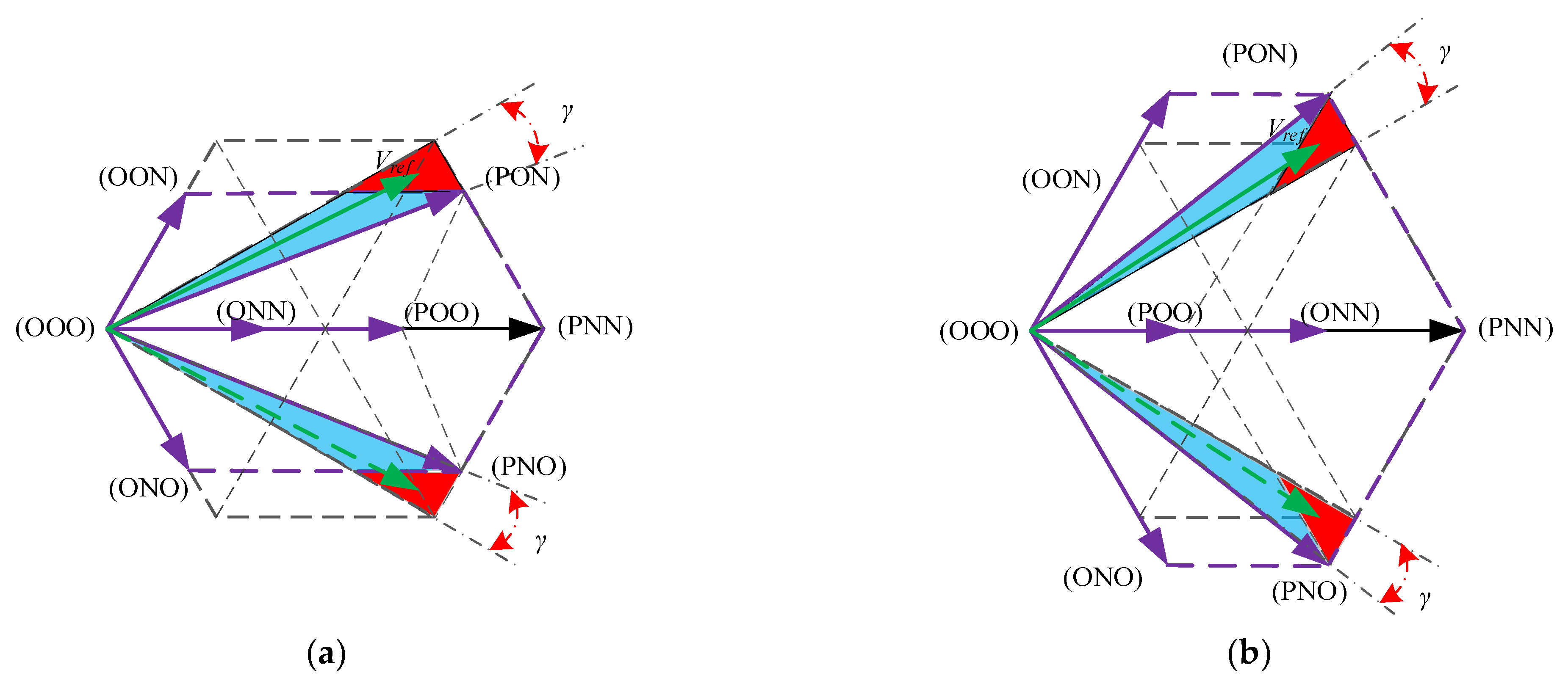
As shown in the space vector diagram for Sector I in
Figure 4, NPP imbalance of the DC bus significantly alters the magnitudes of both the small and medium vectors, thus modifying the overall size of the space vector diagram. When Δ
udc > 0, the space vector diagram of Sector I is illustrated in
Figure 4a. The area of the hexagon formed by the corrected basic vectors is much smaller than that of the hexagon formed under condition of the NPP balance on the DC bus. When the reference voltage lies near the zero-crossing boundary, that is during the reference voltage switching from Sector I to Sector II or from Sector VI to Sector I, it cannot be synthesized via the basic space vectors within the red shaded area. Similarly, when Δ
udc < 0, the space vector diagram of Sector I is illustrated in
Figure 4b. The area of the hexagon formed by the corrected basic vectors is much larger than the area of the hexagon formed under condition of the NPP balance on the DC bus. When the reference voltage lies near the zero- crossing boundary, it also cannot be synthesized via the basic space vectors within the red shaded area.
Based on the analysis above, the NPP imbalance on the common DC bus could generate a voltage deviation. This deviation alters the magnitudes of the basic vectors of the Vienna rectifier. As a result, the reference voltage cannot be accurately synthesized, ultimately leading to CZCD in the converter.
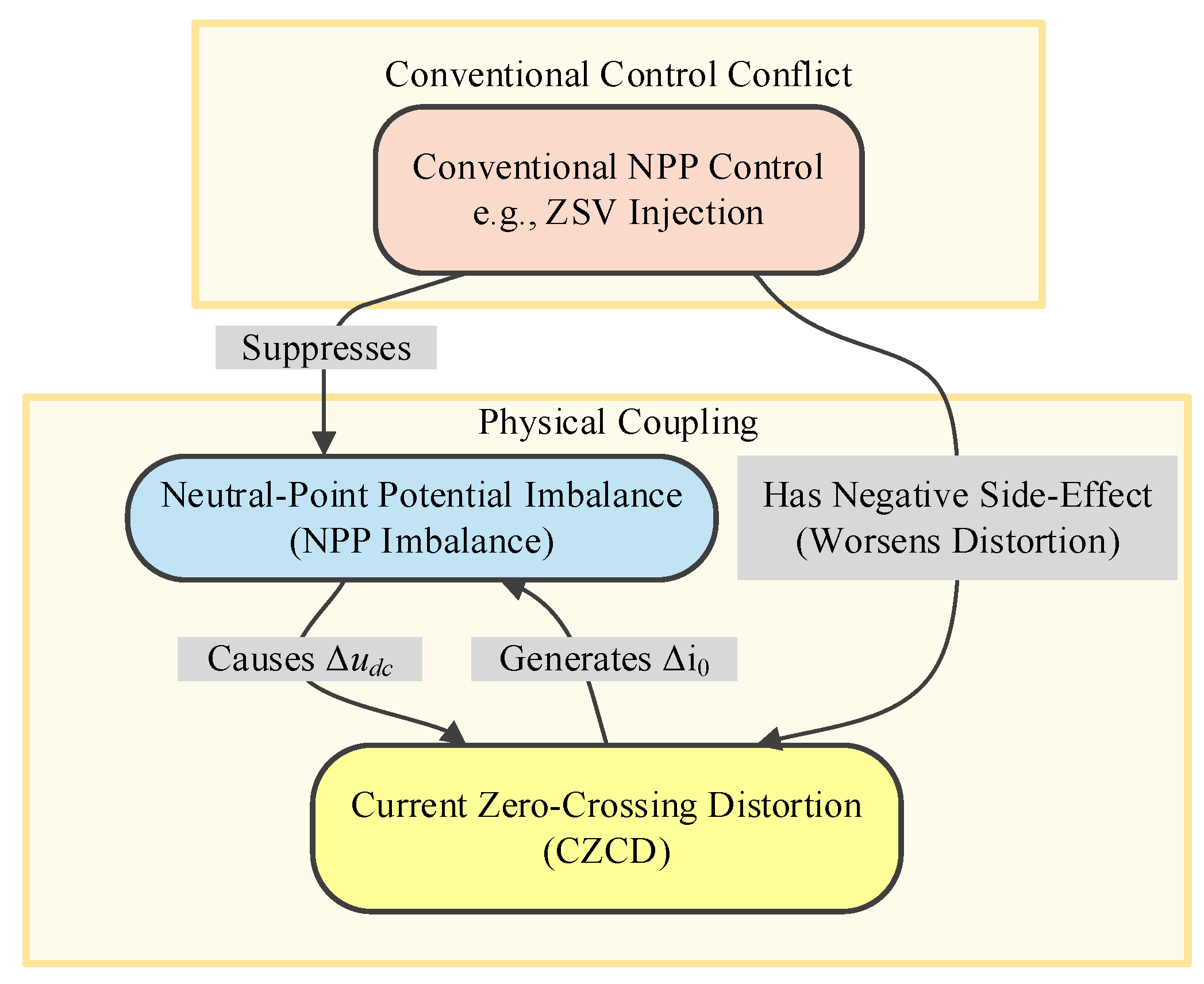
The coupling relationship between CZCD and NPP is shown in
Figure 5. This diagram illustrates the mutual interaction mechanism where the NPP imbalance alters the space voltage vectors, leading to current distortion (CZCD), which in turn creates instantaneous power fluctuations that further aggravate the NPP imbalance. Traditional control methods fail to achieve decoupled control, which consequently affects the stable operation of the converter.
5. Experimental Results
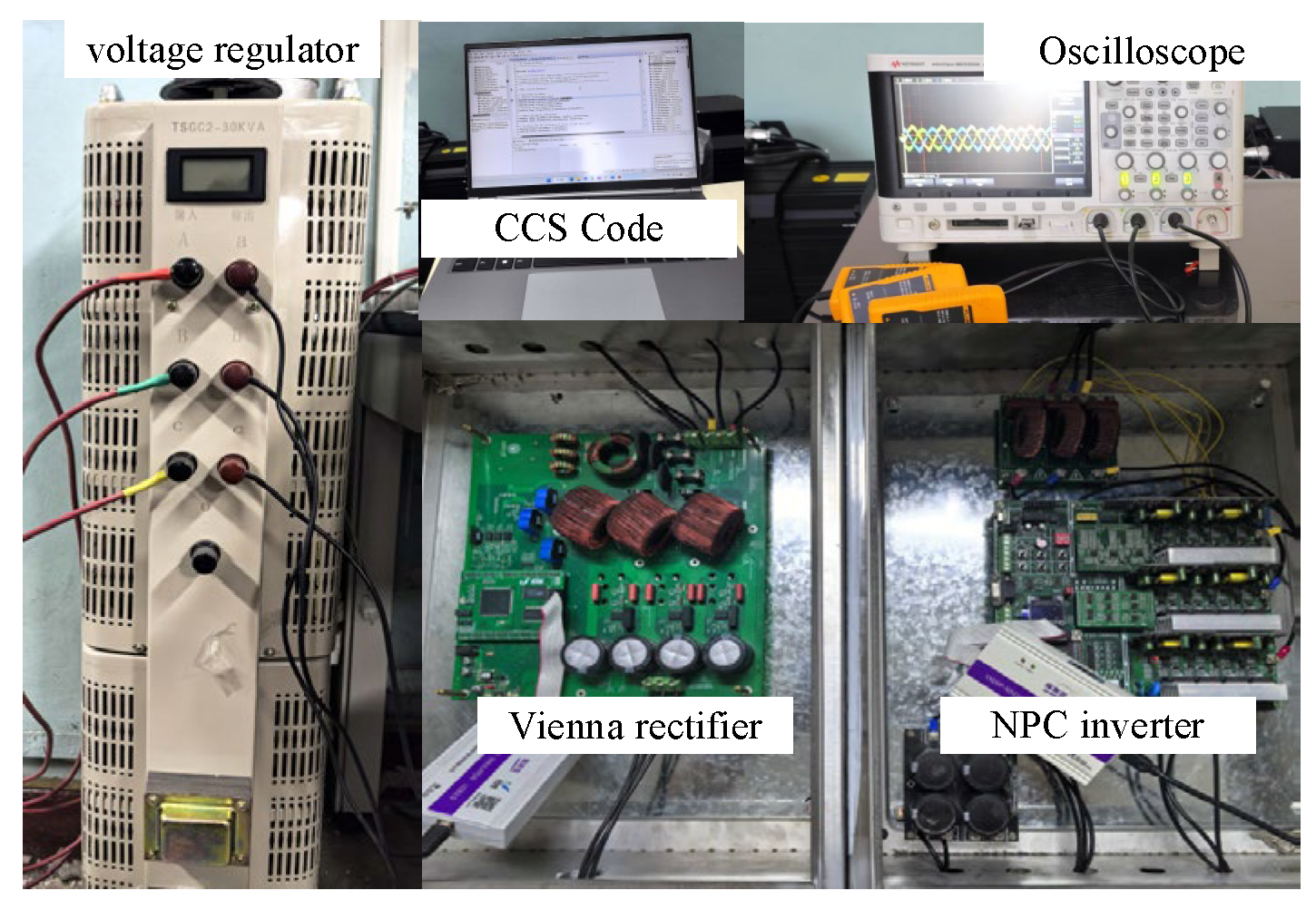
An experimental platform was independently developed to validate the effectiveness of the proposed control strategy, as shown in
Figure 11. In the platform, a Vienna rectifier is adopted on the grid side, an NPC inverter is employed on the load side, and a common DC bus with upper and lower capacitors is introduced between the rectifier and the inverter. In addition, the platform employs TMS320F28377D DSP devices (Nanjing Yanxu Electric Technology Co., Ltd., Nanjing, China) as the core controllers for both sides. The detailed experimental parameters are listed in
Table 2.
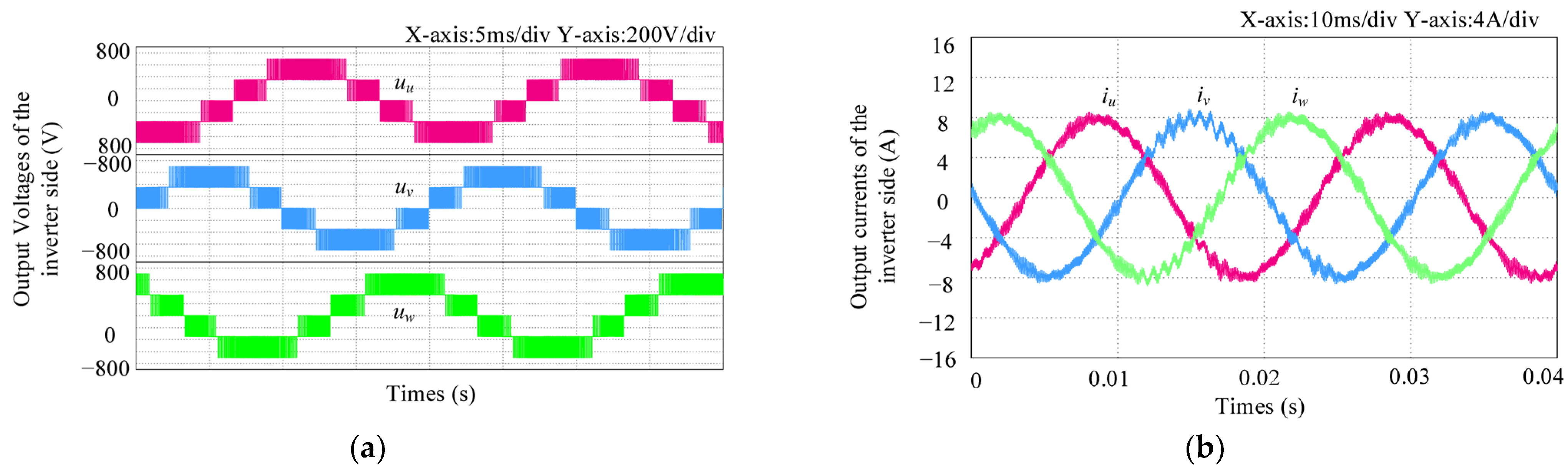
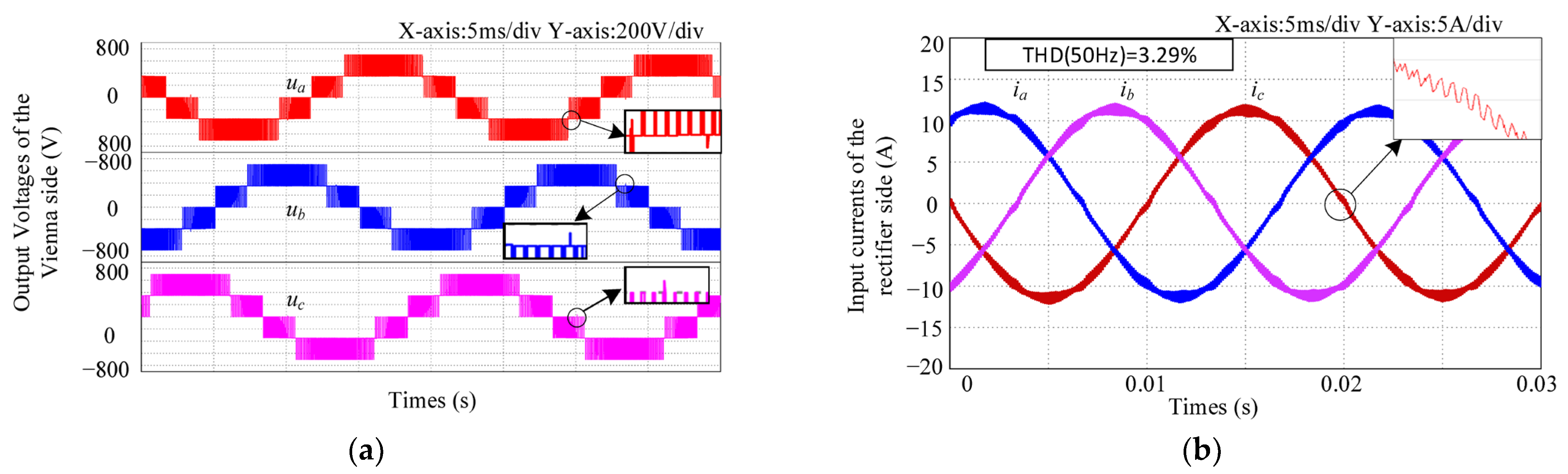
The waveforms of the output voltages and input currents on the Vienna rectifier side without the proposed control strategy are shown in
Figure 12. As illustrated in
Figure 12b, the phase currents of the Vienna rectifier become distorted near zero-crossing points, that is, the phenomenon of CZCD. Based on the coupling relationship between CZCD and NPP, this distortion would lead to voltage fluctuations across the capacitors on the DC bus and produce a voltage deviation Δ
udc.
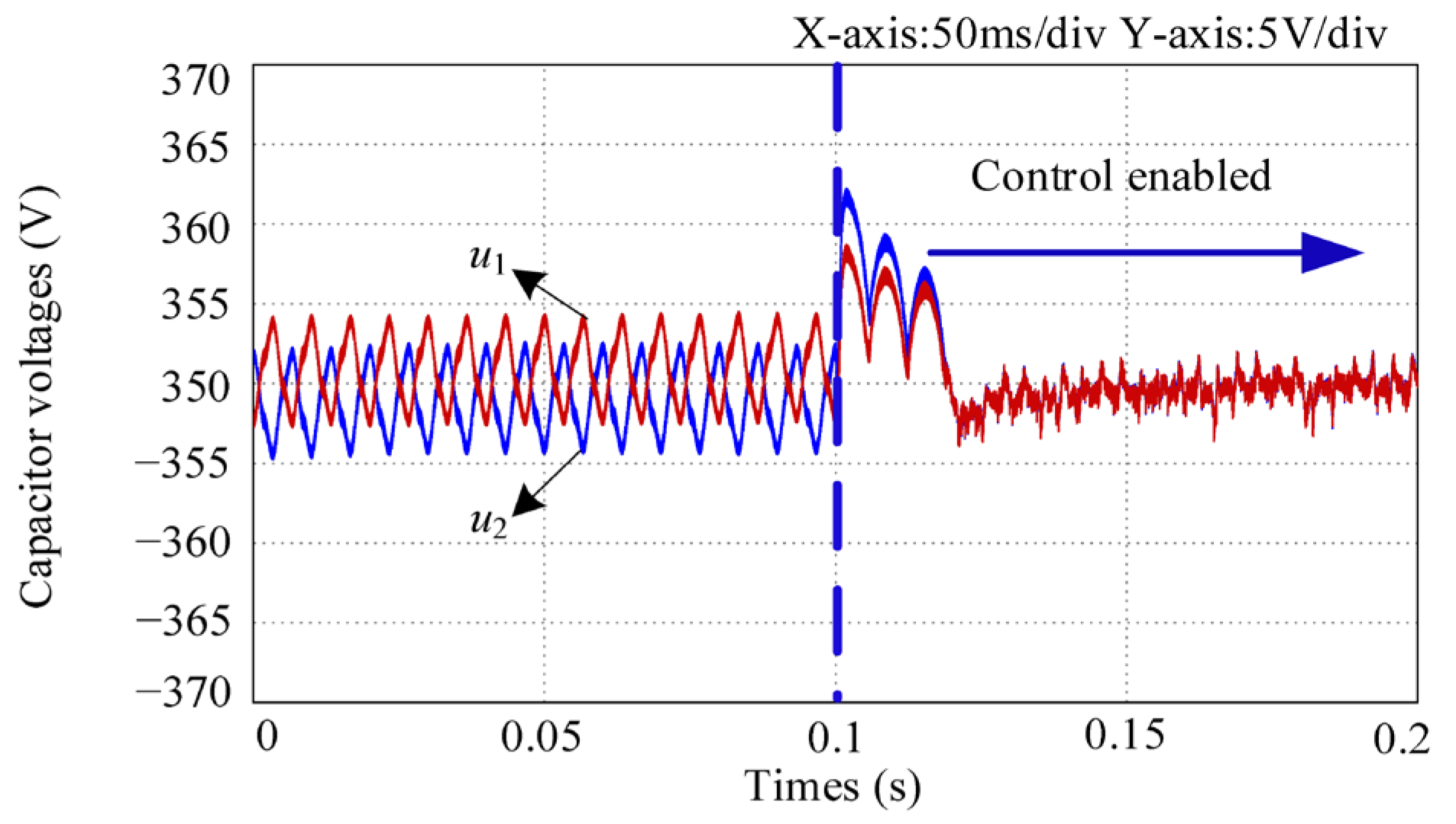
Figure 13 shows the waveforms of the voltages across the upper and lower capacitors on the DC bus. As we can see, the voltages of the upper and lower capacitors exhibit a voltage deviation Δ
udc of up to 9 V, that is, the NPP imbalance on DC bus. Further, the NPP imbalance on DC bus results in abnormal variations in each phase voltage near the zero-crossing point in the Vienna rectifier, as shown in
Figure 12a.
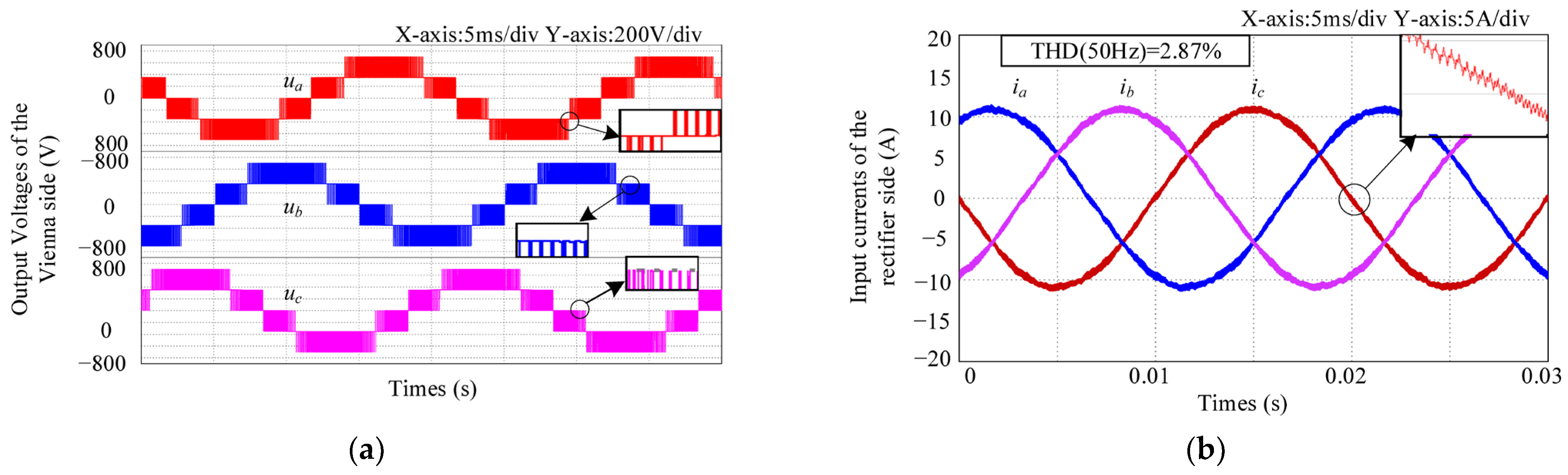
The waveforms on the Vienna rectifier side after the application of the proposed control strategy are shown in
Figure 14. Compared with the results in
Figure 12, the phase currents exhibit a significantly smoother transition during commutation, and the Total Harmonic Distortion (THD) of the grid side current is reduced from 3.29% to 2.87%, as shown in
Figure 14b. The voltage deviation Δ
udc on the DC bus is controlled below 0.8 V, and the voltages across upper and lower DC bus capacitors rapidly stabilized at approximately 350 V. Moreover, the abnormal variations in the output voltage near the zero-crossing points are eliminated, as shown in
Figure 14a.
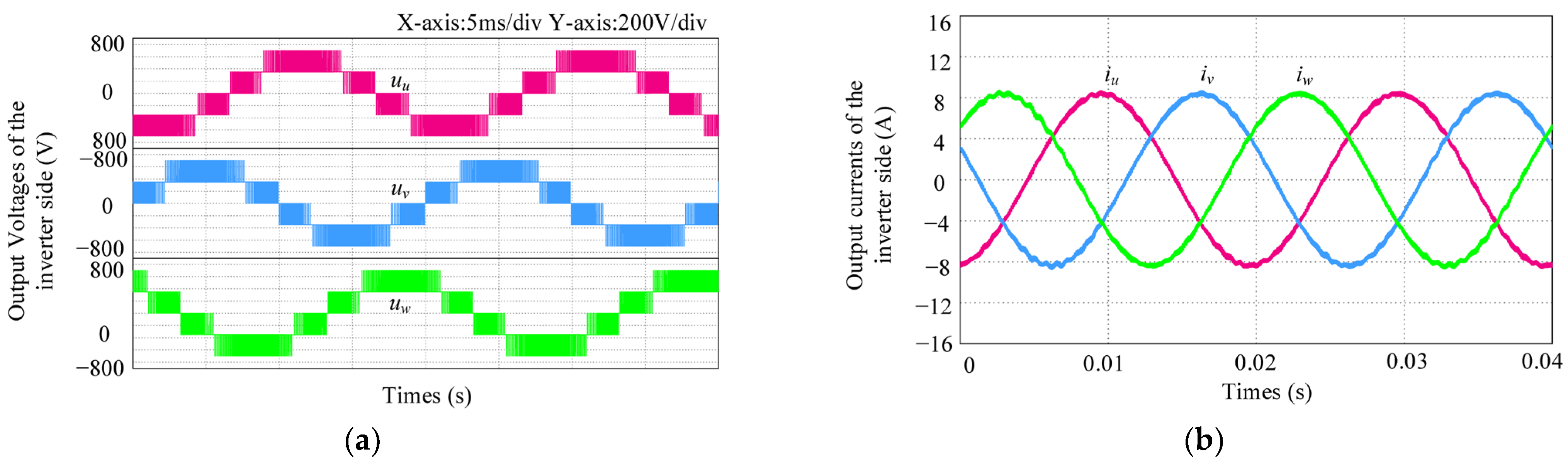
The waveforms of the output voltages and input currents on the NPC inverter side before and after the application of the proposed control strategy are shown in
Figure 15 and
Figure 16, respectively. The coupled effects of the CZCD and the NPP imbalance result in the degraded quality of the output current, as shown in
Figure 15b. Under the condition of the proposed strategy, the current output waveform becomes smoother, as shown in
Figure 16b.
From the above analysis, the experimental results demonstrate the effectiveness of the proposed coordinated control strategy.
6. Conclusions
This paper proposes a coordinated control strategy to simultaneously address the issues of the CZCD and NPP imbalance in unidirectional 3L-BTB converters with a Vienna rectifier on the grid side. The strategy analyzes and resolves the coupling between CZCD and NPP imbalance by reconstructing the neutral-point current target function. The CZCD on the Vienna rectifier side is suppressed by reactive current compensation, and the NPP balance on the DC bus of the whole converter is achieved by optimal ZSV injection on the NPC side. Experimental results from an independently developed platform demonstrate that the grid-side THD is reduced from 3.29% to 2.87%, the voltage fluctuations on the common DC bus are significantly suppressed, and the waveform of output current on the load side becomes notably smoother, which validates the effectiveness of the proposed strategy. The proposed control strategy provides an effective solution for unidirectional multilevel BTB converters, offering significant theoretical and practical value for applications such as renewable energy generation and motor drives.
Despite these achievements, the current study primarily focuses on balanced grid conditions. In practical industrial environments, grid voltage imbalances may introduce additional disturbances that could affect the decoupling performance. Therefore, future work will focus on validating and optimizing the proposed strategy under unbalanced grid conditions. Additionally, extending this decoupled control concept to other multilevel topologies, such as T-type or five-level converters, represents a promising avenue for further research.