Article

Structural Optimization Design of Rotary Drilling Rig Drill Pipes Based on an Improved Enhanced Knowledge Gain Sharing Algorithm

School of Mechanical Engineering, Taiyuan University of Science and Technology, Taiyuan 030024, China
*
Authors to whom correspondence should be addressed.
Machines 2026, 14(1), 48; https://doi.org/10.3390/machines14010048 (registering DOI)
Submission received: 3 December 2025 / Revised: 26 December 2025 / Accepted: 28 December 2025 / Published: 30 December 2025
(This article belongs to the Section Machine Design and Theory)

Abstract

To address the technical challenge of synergistic optimization between lightweight design and structural performance for mechanical locking drill pipes of rotary drilling rigs, this study takes such drill pipes as the research object. Seven typical operating conditions are classified to construct a multidimensional verification model encompassing static strength, stiffness, stability, and fatigue strength, while a lightweight optimization model with multi-performance constraints is established to minimize the cross-sectional area. Aiming at the limitations of the Enhanced Gaining–Sharing Knowledge (eGSK) algorithm in initial population distribution, integer constraint adaptation, and local exploration, an Improved Enhanced Gaining–Sharing Knowledge algorithm (ieGSK) is proposed, integrating hybrid initialization, integer solution processing, and elite local search mechanisms. Comparative tests with Enzyme-Activated Optimization (EAO), State-Based Optimization (SBO), and eGSK algorithms demonstrate that ieGSK converges to engineering-practical integer solutions in 258 iterations (computational efficiency, 4.475 s). Compared with EAO, SBO, and eGSK algorithms, the computational efficiency is improved by 61.6%, 43.1%, and 9.6%, respectively, while achieving a 9.8% weight reduction and maintaining optimal stability and robustness. This verifies the superiority of ieGSK in drill pipe structural optimization, offering technical support for the lightweight design of core components in rotary drilling rigs.

1. Introduction

The drill pipe is a core component of rotary drilling rigs for pile foundation construction, enduring complex loads (torque, axial pressure) during operation. Ensuring structural safety (strength, stiffness, stability, fatigue resistance) while achieving lightweighting is critical—lightweight design reduces energy consumption, transportation, and maintenance costs, while inadequate performance may lead to catastrophic accidents such as drill pipe fracture or drill string collapse. However, balancing multi-performance constraints and lightweighting remains a key challenge for drill pipe structural optimization, particularly for mechanical locking drill pipes subjected to extreme torque and pressure.
Swarm-based optimization algorithms have become mainstream technologies in the field of engineering structural optimization. The “constraint modeling-algorithm selection-objective coordination” framework established in related studies [1,2,3] holds significant reference value. These studies have achieved success in marine platforms, thin-walled pipes, and lightweight spacecraft design through multi-constraint optimization methods. However, a notable research gap remains regarding their applicability to drill pipe structures. First, mainstream algorithms (e.g., genetic algorithms, particle swarm optimization) commonly suffer from non-integer solutions, uneven initial population distributions, and weak local exploration capabilities [4,5,6,7,8,9], making them difficult to align with actual drill pipe manufacturing requirements. Second, existing optimization models often fail to cover the entire operational lifecycle of drill pipes. They frequently neglect fatigue strength constraints and overlook certain typical operating conditions, resulting in inadequate structural safety assurance [10,11,12]. Notably, fatigue constraints have been successfully applied in structural optimization for tubular structures like offshore wind turbine towers and cyclically loaded components such as helical gears, providing effective lifetime safety assurance [13,14]. However, this critical consideration remains underutilized in drill pipe optimization research. Existing multi-constraint optimization studies on drill pipes are largely confined to static performance metrics, failing to incorporate cyclic loading characteristics during drilling, running-casing, and static phases into corresponding fatigue strength constraints. Furthermore, existing studies rarely address the co-optimization of drill pipe static strength, stiffness, stability, and fatigue strength. This results in overly generalized optimization frameworks that struggle to accommodate the unique structural characteristics of drill pipes. Even optimization research related to rotary drilling rigs predominantly focuses on components like derricks, rotary tables, power heads, or drill string friction-reducing tools, with limited studies on multidimensional constraint optimization for drill pipes themselves. Existing drill pipe studies either confine themselves to single-property analysis [15,16] or emphasize localized structural improvements [17], failing to conduct comprehensive synergistic optimization of key properties. Optimization of drill pipe-related tools [18] also targets auxiliary properties like friction reduction rather than core structural performance. In rig prototype design [19], drill pipes are typically integrated as functional components without undergoing structural optimization under multi-property constraints. In summary, current research lacks a targeted optimization framework tailored to drill pipe structural characteristics and fails to synergistically evaluate key properties such as static strength, stiffness, stability, and fatigue strength. This gap has become a core issue requiring urgent resolution in the field of drill pipe structural design.
To fill these gaps, this study centers on mechanical locking drill pipes of rotary drilling rigs and launches targeted research to address the core contradiction between lightweight design and comprehensive structural performance. First, it systematically categorizes seven typical operating conditions of drill pipes, constructing a comprehensive performance verification system that integrates static strength, stiffness, stability, and fatigue strength—effectively compensating for the lack of full-cycle performance coverage in existing optimization models. Second, a multi-constraint lightweight optimization framework is established, incorporating load-bearing capacity metrics across the entire lifecycle—including strength, stiffness, stability, and fatigue strength—to comprehensively ensure drill pipe safety. Third, aiming at the limitations of the original eGSK algorithm in adapting to drill pipe manufacturing requirements, an improved ieGSK algorithm is proposed by integrating hybrid initialization, integer solution processing, and an elite local search mechanism. Finally, taking TGJ508 mechanical locking drill pipes as the engineering case, comparative optimization tests are conducted with mainstream algorithms such as SBO, eGSK, and EAO to verify the algorithm’s practicality and superiority in balancing lightweighting effects and structural performance. This research lays a theoretical and technical foundation for the lightweight and high-performance design of core components of rotary drilling rigs.

2. Verification of Drill Pipe Load Capacity for Rotary Drilling Rigs

Rotary drilling rigs are critical equipment for pile foundation construction, primarily composed of five major modules: chassis, working mechanism, hydraulic system, electrical control system, and actuators [20]. During drilling operations, the drill pipe serves as the key component connecting the main unit to the drilling tools, directly transmitting torque and axial pressure while regulating hole depth. In actual construction, drill pipes endure complex loads over extended periods while facing impact loads from uneven soil hardness. Insufficient strength, inadequate stiffness, or compromised stability can all trigger severe accidents. Therefore, verifying the strength, stiffness, and stability of drill pipes using the limit state method is a critical step in ensuring the safe and efficient operation of rotary drilling rigs and preventing construction failures.

2.1. Operating Condition Classification

Based on the working principle of rotary drilling rigs, their operational states and load characteristics vary significantly under different construction conditions. To accurately identify potential hazardous operating conditions and implement targeted countermeasures, the entire working process of rotary drilling rigs has been categorized into seven distinct operating conditions [21], as shown in Table 1.

2.2. Working Principle of Drill Pipes

Based on different pressurization methods, drill pipes are categorized into friction-locked drill pipes, mechanical locking drill pipes, and hybrid drill pipes [22]. Mechanical locking drill pipes endure immense torque and pressure during construction, necessitating detailed analysis. Mechanically locked drill pipes achieve hole formation through the sequence: “lowering the drill pipe → locking → drilling → raising → discharging cuttings”. During lowering, the drill pipes extend outward from the innermost section to the outer sections, descending as a single unit under their own weight to the designated hole position. When raising, the innermost section pulls the entire drill string upward. Subsequently, the water discharge plate at the bottom of this innermost section lifts the remaining pipes sequentially from the innermost to the outermost sections.

2.3. Drill Pipe Load Capacity Verification

2.3.1. Static Strength Verification

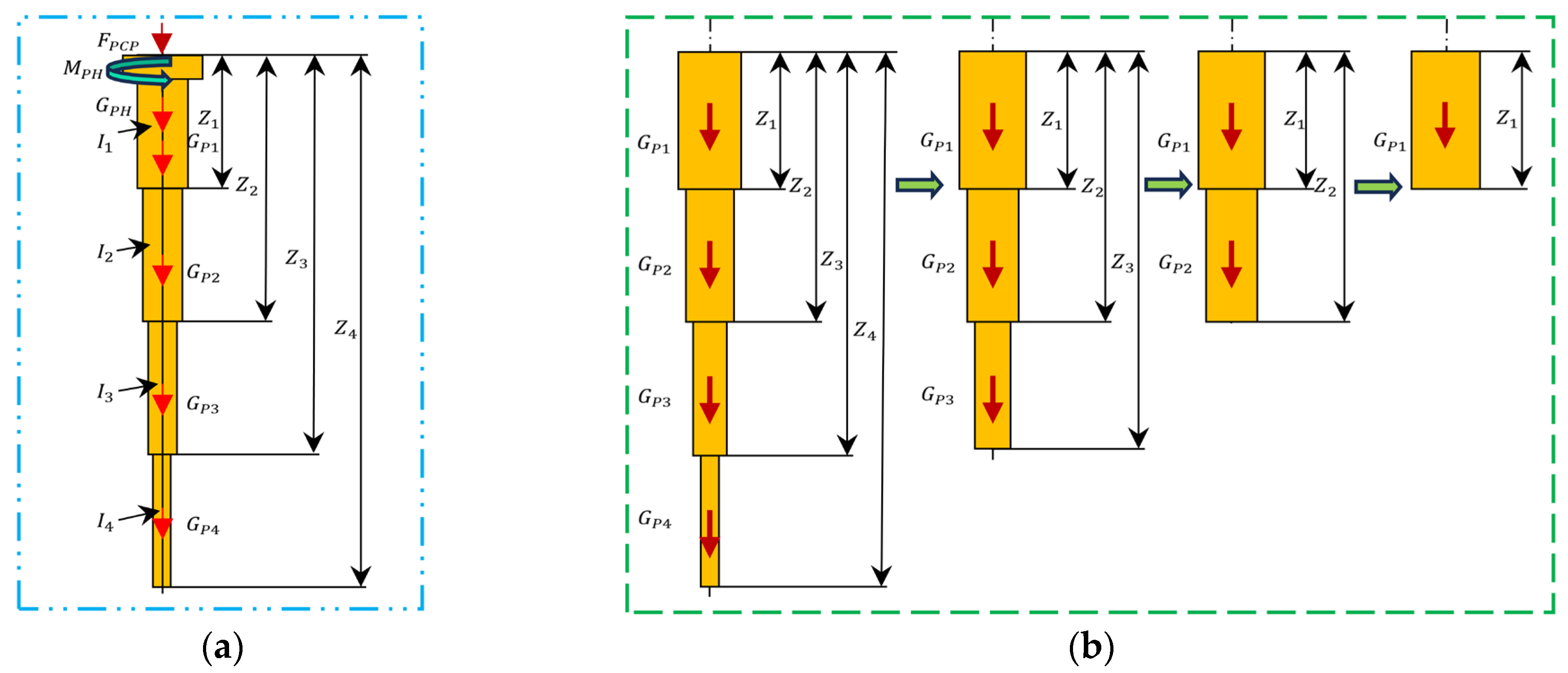
For mechanical locking drill pipes, two typical operating conditions are distinguished: drilling operation and lifting operation. During verification, it is necessary to ensure that the static strength requirements for both conditions are met. The mechanical models for drilling and lifting operations are shown in Figure 1.
Verification is conducted from two aspects [23]: the static strength of the tube body and the strength of the internal and external drive keys.
The tubular body of the mechanical locking drill pipe features a circular thin-walled cross-section, primarily subjected to axial compressive stress and torsional shear stress. These constitute a typical two-dimensional combined stress state, with maximum stress occurring along the circumference of the cross-section. The strength of each pipe section is verified according to the fourth strength theory, as shown in Equation (1).
σ max = σ 2 + 3 τ 2 lim σ = σ s γ m
In the formula, σmax is the maximum stress; σ is the axial compressive stress, σ = F/A; F is the maximum normal stress; A is the cross-sectional area; τ is the torsional shear stress, τ = T/(2πr2δ); T is the torque; R is the mean radius of the circular tube; δ is the wall thickness of the circular tube; σs is the yield strength of the material; and γm is the resistance factor, 1.1.
Mechanical locking drill pipes transmit compressive force and torque through the engagement of internal and external keys, performing single-key compression and shear verification [24] on components with lower yield strength.
Single-key compression verification:
σ p = 2000 T d b l lim σ
Single-key shear verification:
τ p = 2000 T d h l lim σ
In the formula, T is the torque; d is the tube outer diameter; b is the minimum contact thickness between inner and outer keys; h is the minimum width of the external drive key; and l is the internal drive key length.

2.3.2. Stiffness Verification

Stiffness verification comprises two aspects: slenderness ratio evaluation for buckling resistance and torsional stiffness assessment for rotational deformation control.
The slenderness ratio [25] must comply with the requirement specified in Equation (4):
λ = l 0 r λ
The torsional stiffness [23] must comply with the criterion specified in Equation (5):
θ = T l G I P θ
In the formula, l0 is the drill pipe calculated length; r is the minimum turning radius of the rough cross-section of the drill pipe; [λ] is the allowable slenderness ratio, 180; T is the torque; l is the drill pipe length; G is the shear modulus; IP is the extreme moment of inertia; and [θ] is the permissible torsional angle, 0.5.

2.3.3. Stability Verification

As a critical pressure-bearing component, stability verification of the drill pipe is paramount. Both global and local stability assessments must be conducted for the drill pipe.
The overall stability [25] must satisfy the criterion specified in Equation (6):
N s d N R d = k σ s A γ m
where cross-sectional properties vary, the minimum value of the design resistance NRd shall be adopted, in accordance with the following specifications:
N R d N K 1.2 γ m
In the formula, Nsd is the design value of compressive force; NRd is the maximum design pressure; k is the discount factor; σS is the yield strength of the material; A is the cross-sectional area of the component; γm is the resistance coefficient, 1.1; and NK is the critical buckling load.
Local stability [25] must satisfy the criterion specified in Equation (8):
R δ 50 ( 235 σ s )
In the formula, R is the radius of the midplane in a cylindrical shell; δ is the wall thickness of cylindrical shell; and σS is the yield strength of the material.
If the condition specified in R/δ ≤ 50(235/σS) is met, additional local stability verification of the cylindrical shell is required. Should the verification fail, transverse and longitudinal stiffness must be incorporated.

2.3.4. Fatigue Strength Verification

To mitigate the risk of drill pipe failure caused by critical crack propagation under cyclic loading conditions, fatigue strength verification [25] must be conducted across the entire operational cycle.
For the structural details under consideration, verification is conducted in accordance with Equations (9) and (10):
Δ σ s d Δ σ R d
Δ σ s d = max σ min σ
In the formula, Δσsd is the maximum range of design stress for calculations; maxσ, minσ are the design stress limit values determined for load combination A with γP = 1 according to the applicable sections of ISO 8686 [26] (compressive stress is taken as negative); and ΔσRd is the ultimate design stress range, obtained from Equation (11).
Δ σ R d = Δ σ c γ m f s m m
In the formula, ΔσC is the characteristic fatigue strength; m is the slope constant of the logσ-logN curve; γmf is the fatigue strength-specific resistance coefficient; and sm is the stress history parameter.

3. Lightweight Design of Drill Pipe Structure

The drill pipe optimization model comprises design variables, constraints, and an objective function. By rationally setting design variables and imposing constraints to meet strength, stiffness, and stability requirements, lightweight design of the drill pipe is achieved. Consequently, the optimization model [27] developed in this study is formulated as shown in (12):
x = x i 1 , x i 2 , x i 3 T min f x = π ( D x i 1 ) x i 1 + 6 x i 2 x i 3 s . t . g j x 0 j = 1 , 2 , 3 , , 7 , 8

3.1. Objective Function and Design Variables

The objective function constitutes the core element of the optimization design framework. To achieve lightweight drill pipes while preserving their original length, the minimization of the cross-sectional area for each pipe segment is set as the optimization objective. Each section comprises seamless steel tubing and spline keys. The selected design variables include pipe wall thickness xi1, key width xi2, and key height xi3, where i is the total number of pipe sections and i = 4. Thus, the complete set of optimization design variables is mathematically defined in (13):
x = x i 1 , x i 2 , x i 3 T
The objective function is given by (14):
min f x = π ( D x i 1 ) x i 1 + 6 x i 2 x i 3

3.2. Constraints

During the structural optimization of drill pipes, all requirements for strength, stiffness, and stability must be satisfied. Accordingly, the verification formulas presented in Section 2 can be transformed into constraint conditions.

3.2.1. Static Strength Constraint

Static strength denotes the load-bearing capacity of mechanical locking drill pipes under static loading conditions. These pipes must withstand sustained axial compression, torsional forces, and other static loads during drilling processes without experiencing fracture or plastic deformation. Static strength assessment includes both the evaluation of the pipe body integrity and the strength verification of the internal and external drive keys.
The constraints for the pipe body are defined by Equation (15), as defined in Equation (1):
g 1 x = σ max lim σ
The constraints for the internal and external drive keys are specified by Equations (16) and (17), as defined in Equations (2) and (3):
g 2 x = σ p lim σ
g 3 x = τ p lim σ

3.2.2. Stiffness Constraint

Stiffness describes the capacity of drill pipes to resist elastic deformation under applied loads. Drill pipes must exhibit adequate stiffness to mitigate excessive deformation, buckling, and vibrational effects. In engineering practice, the slenderness ratio serves to characterize the stiffness behavior of drill pipes subjected to axial compressive loads. Thus, the stiffness constraints are mathematically defined by Equation (18), as defined in Equation (4):
g 4 x = λ λ
The torsional stiffness constraint, as specified in Equation (19), quantifies the drill pipe’s resistance to angular deformation under applied torque, as defined in Equation (5):
g 5 x = θ θ

3.2.3. Stability Constraint

Stability constraints mainly include both global and local stability requirements. Global stability pertains to the structural integrity of the drill pipe under comprehensive loading conditions, with the corresponding constraint defined by Equation (20), as defined in Equation (6):
g 6 x = N s d N R d
Local stability pertains to the structural integrity of critical regions in mechanical locking drill pipes, with the corresponding constraints governed by Equation (21), as defined in Equation (8):
g 7 x = R / δ 50 ( 235 / σ s )

3.2.4. Fatigue Strength Constraint

Fatigue strength denotes the resistance to fatigue failure in drill pipes subjected to cyclic loading conditions. As drill pipes undergo cyclic loading during operations including repeated drilling cycles and percussive drilling, they must exhibit adequate fatigue resistance to endure long-term cyclic stress without crack initiation or fatigue failure. The corresponding fatigue constraints are governed by Equation (22), as defined in Equation (9):
g 8 x = Δ σ s d Δ σ R d

4. IeGSK Algorithm

4.1. Principles and Physical Significance of the eGSK Algorithm

The eGSK [28] algorithm is a swarm intelligence method inspired by human social knowledge transmission and iterative refinement processes. Its core concept models the cognitive evolution process from peer learning to hierarchical knowledge absorption, establishing a dynamic balance between global exploration and local exploitation via a two-stage knowledge interaction strategy. This algorithm is designed for single-objective optimization problems in continuous search spaces.
In this algorithm, population individuals are conceptualized as knowledge carriers. Each individual’s position in the d-dimensional search space is represented as x = (x1, x2, ⋯, xd), where xj (j = 1, 2, ⋯, d) is the decision variable in the j-th dimension. The algorithm iteratively updates individual positions to progressively approach the global optimum solution. The optimization process follows a cyclical workflow comprising four key steps: knowledge initialization, two-stage knowledge interaction, boundary constraint handling, and population updating. The core mechanism involves dynamic dimension allocation and adaptive knowledge factor regulation to balance global exploration and local exploitation capabilities.
Prior to algorithm iteration, we first initialize the algorithm parameters and generate an initial population by randomly generating N individuals within the search space, then evaluate the fitness values of all individuals. The initial global optimum solution is then identified and recorded.
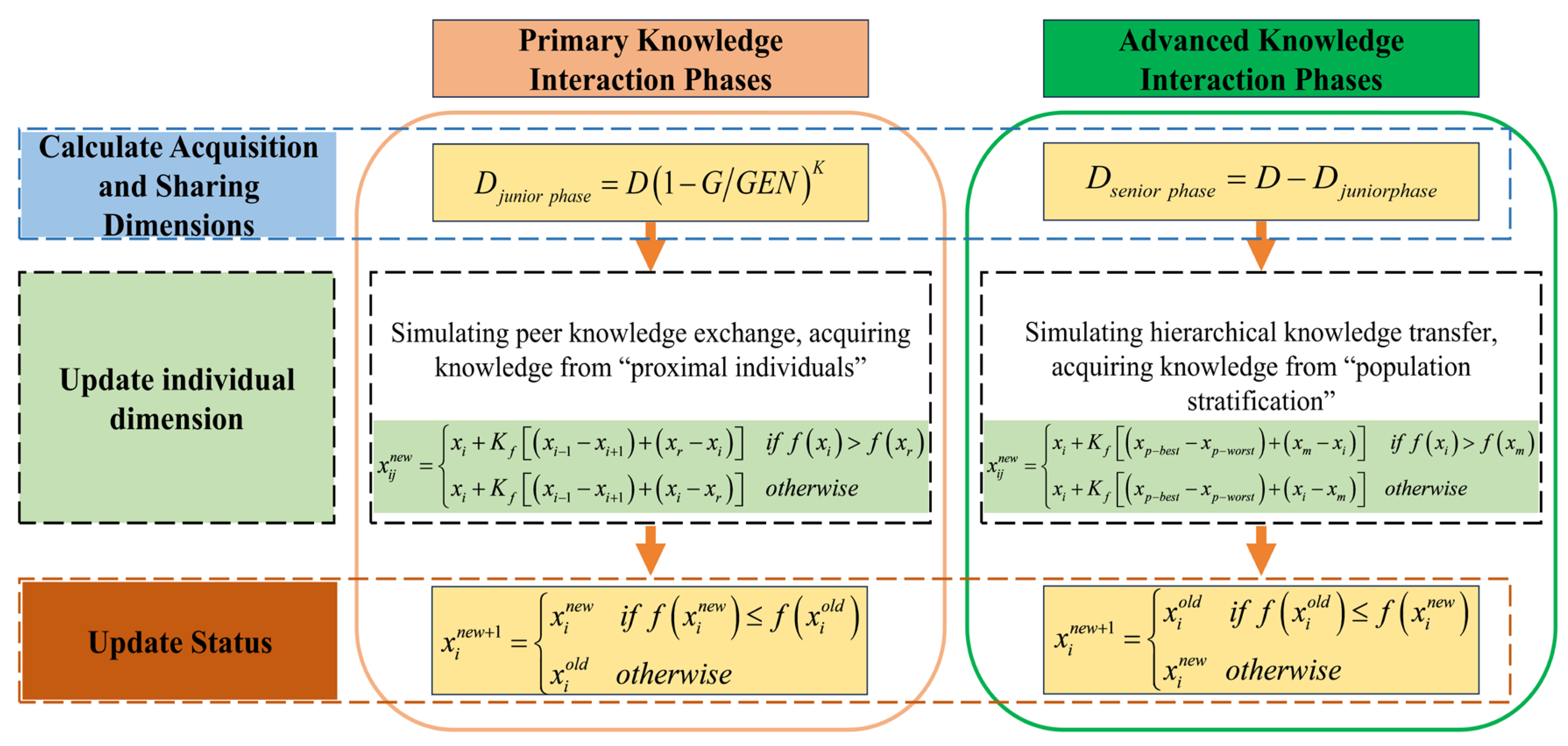
The two-stage knowledge interaction constitutes the core of the algorithm, where each iteration consists of two phases: primary knowledge interaction and advanced knowledge interaction. The specific steps are shown in Figure 2.
To mitigate undesirable oscillations resulting from fixed knowledge factors during later iteration stages, the parameters KF1 and KF2 are dynamically adjusted using Equations (23) and (24) when FEs ≥ 0.75MaxFEs.
K F 1 = Δ K F 1 i f   0 < Δ K F 1 < 1 0 o t h e r w i s e
K F 2 = Δ K F 2 i f   0 < Δ K F 2 < 1 0 o t h e r w i s e
In the formula, KF1 is the elementary-stage knowledge factor; and KF2 is the advanced-stage knowledge factor.
Finally, we determine whether a local optimum has been reached using Equation (25). If stdf ≤ 1, employ the SQP algorithm to enhance the current optimal solution:
s t d f = 0.01 s t d min f x p b e s t , min f x m , min f x p w o r s t
In the formula, stdf is the population fitness standard deviation.
The fitness values of all individuals are compared to identify the final optimal solution. After this, the iterative process is exited and the algorithm terminates.

4.2. IeGSK Algorithm

The ieGSK algorithm addresses shortcomings in the eGSK algorithm regarding initial population uniformity, integer constraint adaptability, and individual fitness in selection strategies, thereby enhancing algorithm performance and engineering applicability.

4.2.1. Hybrid Initialization Strategy

To improve the uniformity and quality of the initial population distribution, the original uniform random initialization in the eGSK algorithm is replaced by a hybrid strategy integrating chaotic mapping and opposition-based learning. The selection of chaotic mapping and opposition-based learning is based on two core theoretical foundations: (1) logistic chaotic mapping exhibits ergodicity and non-periodicity, ensuring uniform coverage of the initial population in the 12-dimensional search space [29]; (2) opposition-based learning expands population diversity by generating opposite solutions, improving the probability of approaching the global optimum [30]. This implementation comprises three fundamental steps:
Step 1: Chaotic mapping generates chaotic populations
Chaotic mapping generates pseudo-random sequences characterized by ergodicity and non-periodicity, enabling comprehensive exploration of the entire search space during initial solution generation.
The Logistic chaotic mapping is expressed in Equation (26):
x n + 1 = μ x n ( 1 x n )
In the formula, xn is the value of the chaotic variable at iteration n; μ is the control parameter of the Logistic mapping; and xn+1 is the value of the chaotic variable at iteration n + 1.
Following their generation, chaotic variables are mapped to the actual search space. The mapping process is defined in Equation (27):
p o p _ c h a o t i c i , j = l b j + x j u b j l b j
In the formula, pop_chaotic(i,j) is the j-th dimension value of the i-th individual in the chaotic population; lb(j), ub(j) are the lower and upper bounds of the j-th dimension of the search space; and x(j) are the iterated chaotic variables.
Step 2: Generation of inverse solutions
Using the chaotic population as a basis, opposition-based learning is generated to enhance population diversity and improve the likelihood of approaching the global optimum. The generation of these solutions is mathematically defined by Equation (28):
p o p _ o p p o s i t e i , j = l b j + u b j p o p _ c h a o t i c ( i , j )
In the formula, pop_opposite(i,j) is the inverse solution of pop_chaotic(i,j).
Step 3: Optimal Individual Selection
The chaotic population is combined with the opposition-based solutions, and the best-performing individuals are selected based on fitness values to form the final initial population. This selection process improves the overall quality of the initial population by ensuring a higher proportion of high-fitness solutions, thereby establishing a robust foundation for subsequent optimization.

4.2.2. Integerization of Solutions

To ensure engineering feasibility, the optimal solution is converted to integer values, preventing the impracticality of non-integer solutions. This process promotes exploration of discrete solution spaces, enhancing the probability of locating the global optimum while maintaining solution feasibility and practicality. The conversion methodology is mathematically defined by Equations (29) and (30).
b s f _ s o l d = b s f _ s o l ( d ) , i f   f o b j ( ) < f o b j ( ) b s f _ s o l ( d ) , o t h e r w i s e
b s f _ f i t _ var = f o b j ( ) , f o b j ( ) < f o b j ( ) f o b j ( ) , o t h e r w i s e
In the formula, d is dimension; bsf_sol is the current optimal solution vector; ⌊•⌋ denotes the round down; ⌈•⌉ denotes the ceiling function; fobj(j) is the objective function for the j-th dimension; and bsf_fit_var is the fitness value corresponding to the current optimal solution.

4.2.3. Elite Local Search Mechanism

The original algorithm’s knowledge acquisition-sharing phase emphasizes global exploration, whereas the elite local search mechanism focuses on local exploitation. Integrating these two approaches mitigates the risks of premature convergence caused by insufficient exploration in initial stages and inadequate exploitation in later stages. This integration establishes an optimization strategy wherein the initial phase conducts global exploration to identify promising regions, followed by a subsequent phase dedicated to localized refinement for precise optimum identification. The implementation procedure comprises the following steps:
Step 1: Elite Individual Screening
The top-performing individuals are selected from the current population based on fitness values for subsequent local search operations.
Step 2: Adaptive Step Size Calculation
The local search step size decreases linearly with iteration count, where larger initial step sizes facilitate broad exploration whereas smaller step sizes in subsequent phases enable precise refinement. This adaptive mechanism is mathematically defined by Equation (31):
s t e p s i z e ( g ) = 0.3 1 g M u b g l b g
In the formula, stepsize(g) is the local search step size for the g-th iteration; g is the iteration variable; M is the maximum number of iterations; ub(g) is the upper bound of dimensions; and lb(g) is the lower bound of dimensions.
Step 3: Candidate Solution Generation and Boundary Constraints
For each elite individual, a candidate solution is generated by applying bounded random perturbation, as defined in Equation (32):
y = c u r r _ e + ( r a n d ( 1 , d ) 0.5 ) 2 s t e p s i z e ( g )
In the formula, y is the candidate solution; curr_e is the current elite individual to be optimized; and rand (1, d) is the random vector.
Candidate solutions are constrained to stay within the search space boundaries as defined in Equation (33):
y g = max min y ( g ) , u b ( g ) , l b ( g )
Step 4: Fitness Update
The fitness of each candidate solution is evaluated. If a candidate solution exhibits superior fitness, both the position and fitness value of the elite individual are updated accordingly, and the global optimum solution is simultaneously refreshed. This evaluation and update process is mathematically defined by Equation (34):
e n e w = y i f   f ( y ) < f ( e ) e o t h e r w i s e f e n e w = f ( y ) i f   f ( y ) < f ( e ) f ( e ) o t h e r w i s e f b e s t , n e w = f ( y ) i f   f ( y ) < f b e s t f b e s t o t h e r w i s e x b e s t , n e w = y i f   f ( y ) < f b e s t x b e s t o t h e r w i s e
In the formula, f(y) is the fitness value of candidate solutions; e is the original elite individual; f(e) is the fitness value of the original elite individual; fbest is the global optimal fitness; and xbest is the global optimal position.
This mechanism effectively mitigates the limitations of the knowledge acquisition-sharing phase, which prioritizes exploration at the expense of exploitation, while also enhancing convergence speed and algorithmic robustness in complex search spaces via adaptive step size control and update strategies.
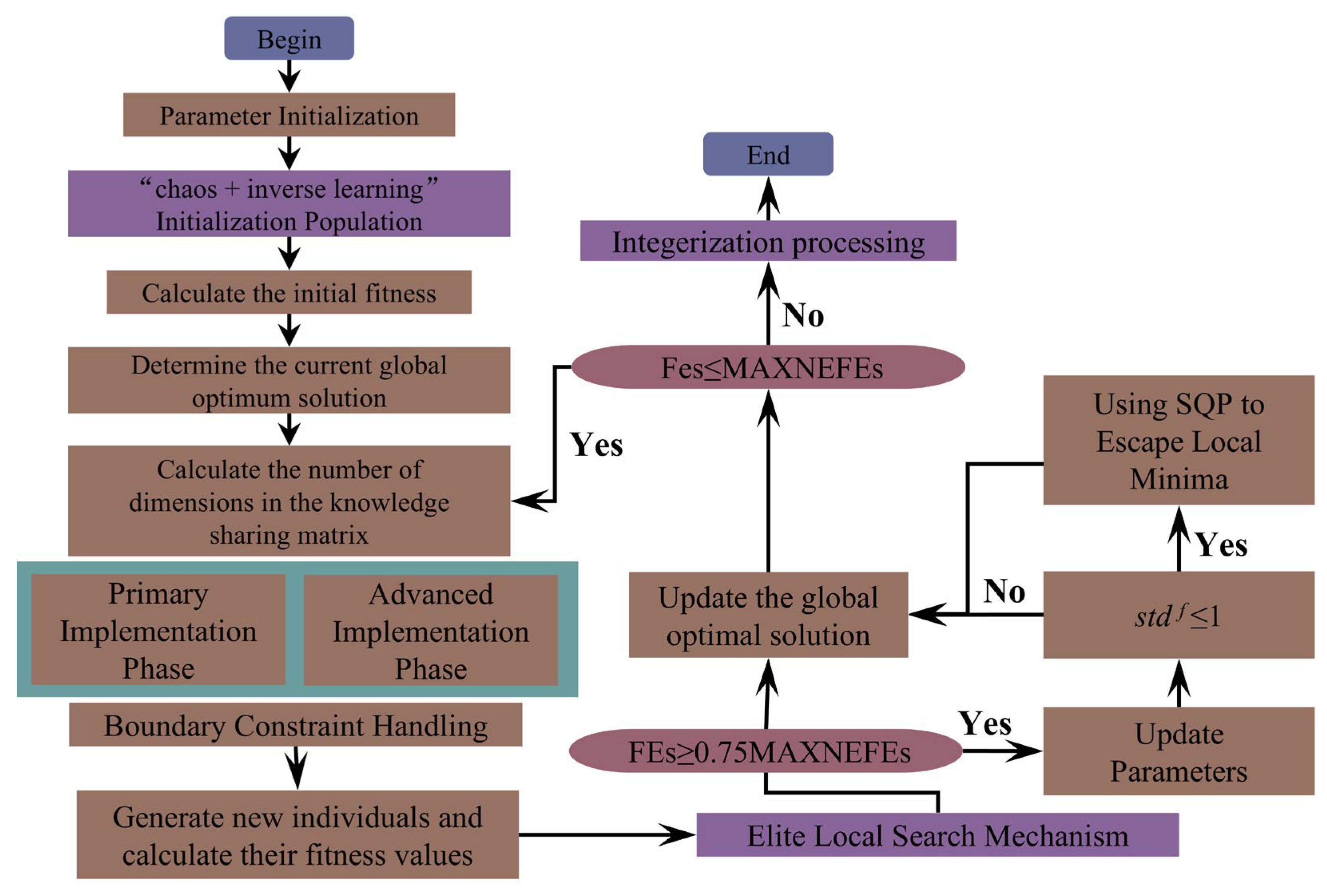
In summary, the ieGSK algorithm enhances initial population quality through “chaos + inverse learning”, improves solution integerization for better engineering applicability, and balances global search with local exploration capabilities via its elite local search mechanism. The ieGSK algorithm flowchart is shown in Figure 3.

5. Engineering Case Studies

5.1. Parameter Settings

For the optimization of TGJ508 mechanical locking drill pipes, a population size of 50 and a maximum iteration count of 1000 were selected. The design variables comprise wall thickness, key width, and key height for each pipe segment, with their value ranges provided in Table 2. The objective function focuses on minimizing the cross-sectional area of each segment while satisfying all strength, stiffness, and stability constraints. Convert it into an unconstrained optimization problem using a penalty function. According to engineering experience, an appropriate penalty factor is selected to ensure the algorithm balances constraint satisfaction and computational efficiency. Furthermore, three established algorithms SBO [31], eGSK, and EAO [32] were employed for multidimensional comparative analysis with the proposed ieGSK algorithm.

5.2. Constraints

This study investigates a lock-type drill pipe utilized in a specific model of rotary drilling rig, comprising four distinct sections. The corresponding mechanical parameters are provided in Table 3.
Based on the established mechanical models for drilling and hoisting operations, the support reaction forces are determined, followed by calculations of strength, stiffness, and stability based on these forces. Based on Section 3.2, the constraints are determined as shown in Table 4:

5.3. Optimization Results and Discussion

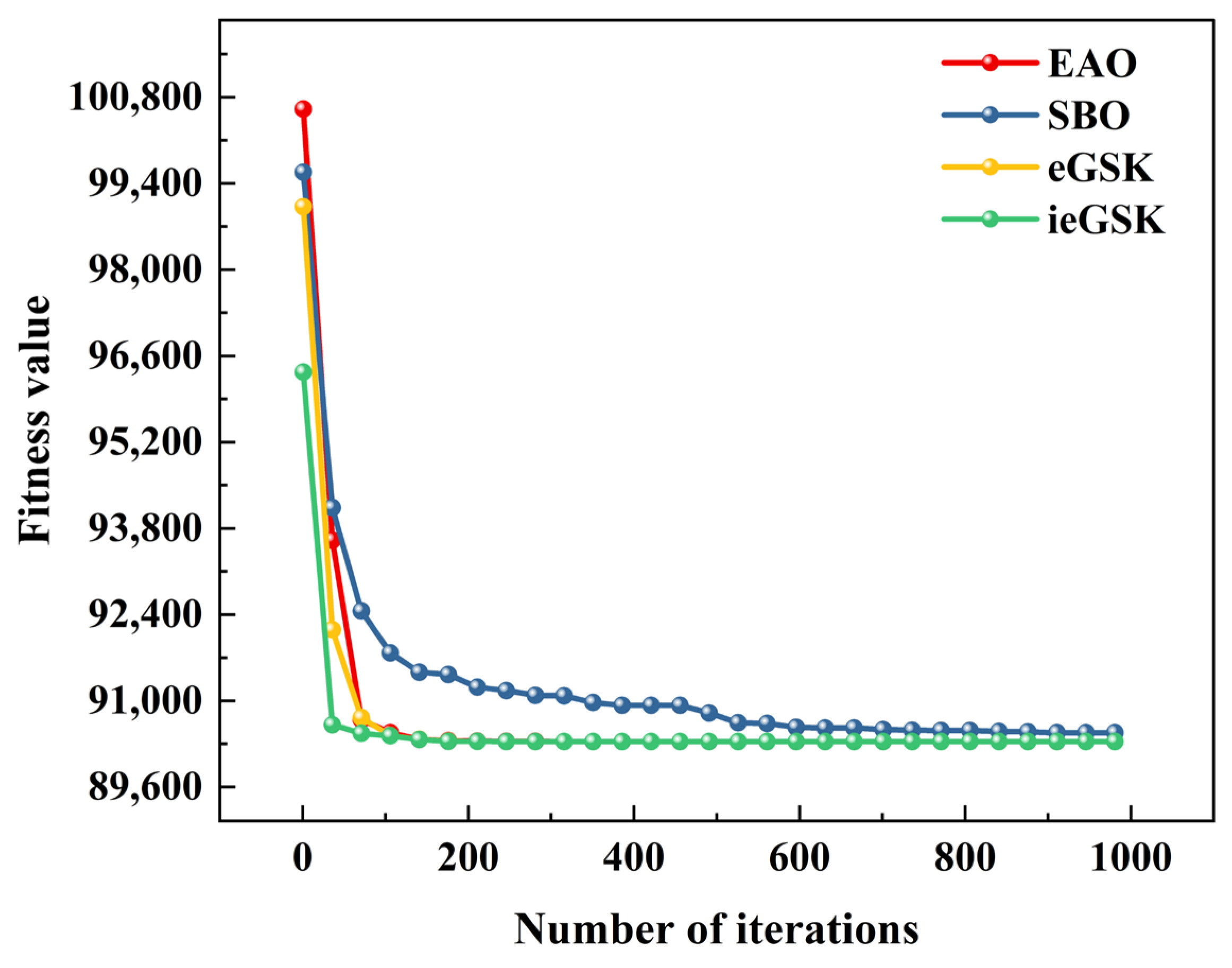
After running each algorithm, the iteration curves for each algorithm are shown in Figure 4. From the presented convergence curve, key observations regarding each algorithm’s performance are derived: specifically, the EAO algorithm displays a substantial discrepancy between its initial fitness and the optimal value, yet maintains a fast convergence rate toward the optimal fitness and ultimately attains a relatively low final fitness; in contrast, the SBO algorithm exhibits moderate initial proximity to the optimal fitness, maintains a moderate convergence rate in the early iterations, but undergoes a notable attenuation in convergence speed during the later stages; meanwhile, the eGSK algorithm features moderate initial proximity to the optimal fitness, characterized by a fast convergence rate toward the optimal value; notably, the ieGSK algorithm outperforms the other algorithms, characterized by a relatively close initial fitness to the optimal value and rapid convergence toward it, thereby demonstrating outstanding convergence efficiency.
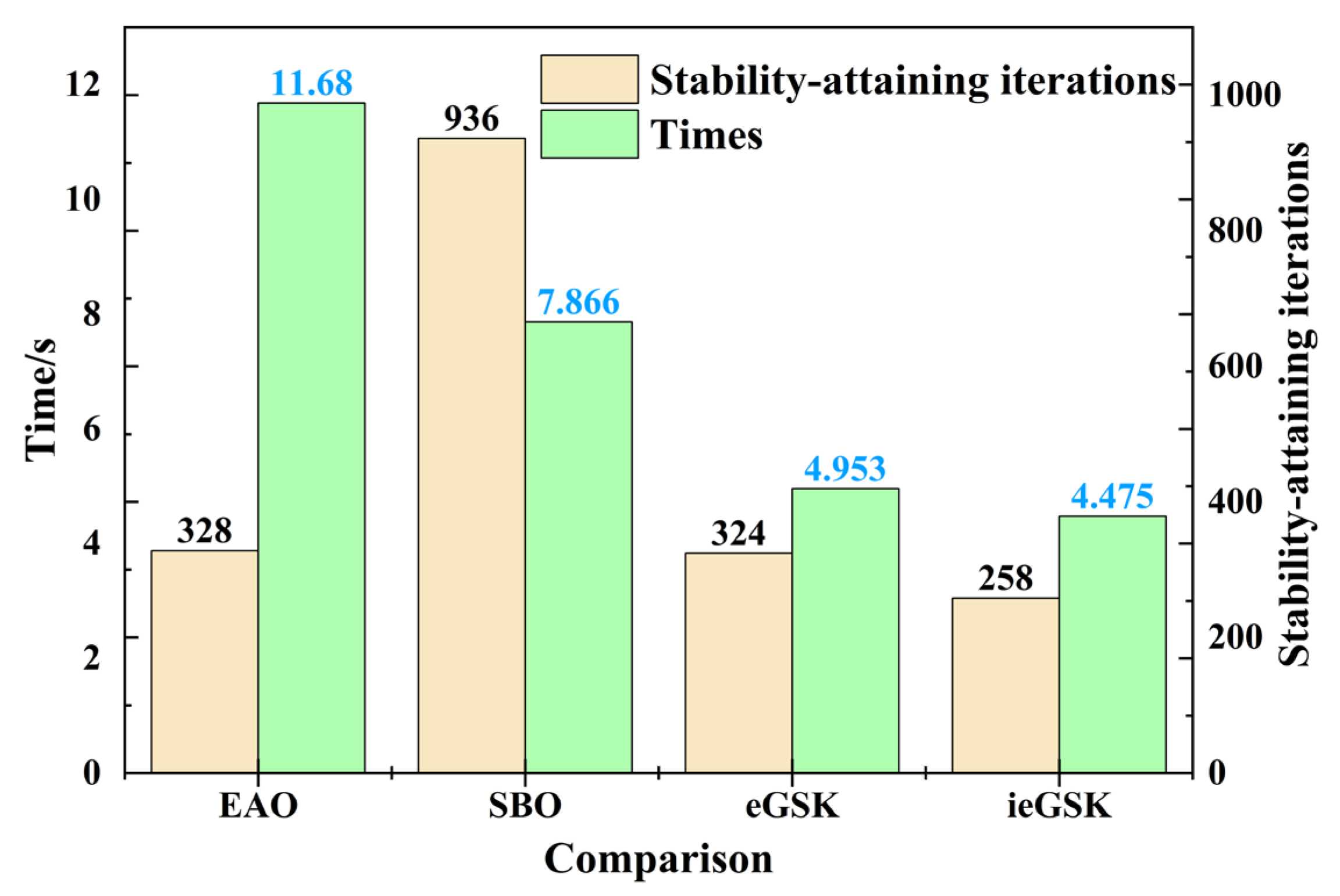
Additionally, Figure 5 details the runtime and Stability-attaining iterations for the four algorithms. Notably, the ieGSK algorithm stands out: it converges to the optimal solution in 258 iterations, outperforming its counterparts on this metric. We further evaluated computational efficiency (via runtime) by quantifying the performance improvements of the ieGSK algorithm relative to the other algorithms: specifically, it delivers approximately 61.6% efficiency gain over EAO, roughly 43.1% gain over SBO, and approximately 9.6% gain over eGSK.
Throughout the optimization process, the outer diameter of each drill pipe section is held constant. The pre- and post-optimization results for wall thickness, key width, and key height are summarized in Table 5. Comparison of these results reveals that solutions generated by the EAO, SBO, and eGSK algorithms include non-integer values—rendering them unfeasible for practical drill pipe manufacturing. While the SBO algorithm yields reduced fitness values relative to the pre-optimization baseline, its reduced fitness values are not competitive with those of the other algorithms. Despite yielding slightly higher fitness values than the EAO algorithm, the ieGSK algorithm generates feasible, integer-valued solutions that are directly applicable to engineering practice. With respect to weight reduction, all algorithms achieve a reduction in the total weight of the drill pipe post-optimization. In particular, the ieGSK algorithm attains a 9.8% weight reduction, achieving a commendable performance in this critical metric for structural optimization.
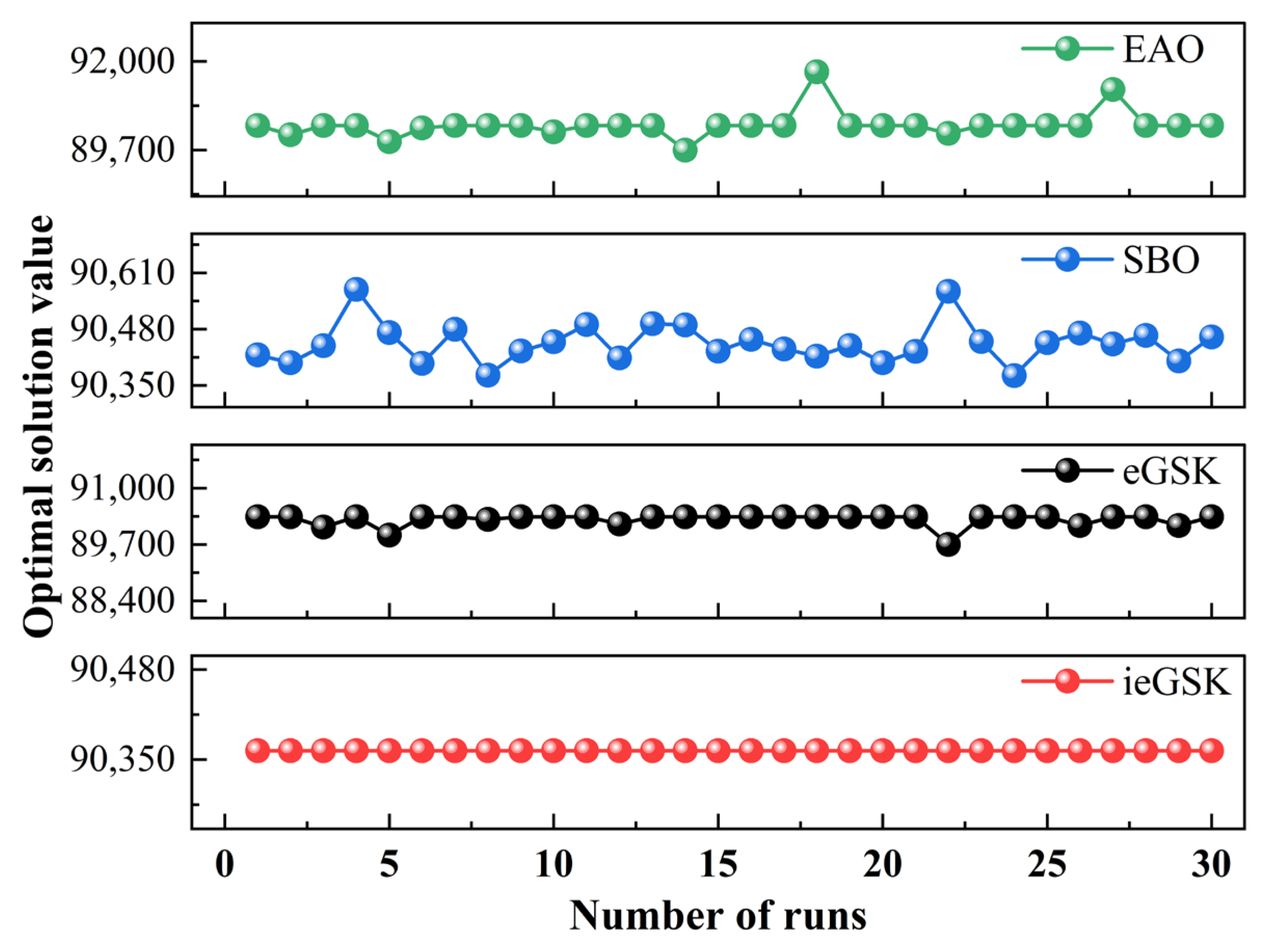
Stability directly indicates the variability in an algorithm’s optimal solution output and represents a key metric for assessing algorithmic reliability. To further evaluate algorithmic stability, the variations in optimal solutions of the EAO, SBO, eGSK, and ieGSK algorithms were compared over 30 independent runs, as illustrated in Figure 6. As depicted in Figure 6, the EAO algorithm exhibits several obvious peak fluctuations in its optimal solution, resulting in weaker stability compared to ieGSK and eGSK; the SBO algorithm has the most significant fluctuations in optimal values among the four algorithms; while it does not deviate extremely from the general trend, its stability is relatively the poorest; the eGSK algorithm maintains small overall fluctuations, with only minor local deviations appearing in individual runs, thus possessing good stability; the ieGSK algorithm keeps its optimal values highly consistent across all 30 independent runs, with almost negligible fluctuations. Its stability is significantly superior to that of the EAO, SBO, and eGSK algorithms, demonstrating the most excellent stability performance.
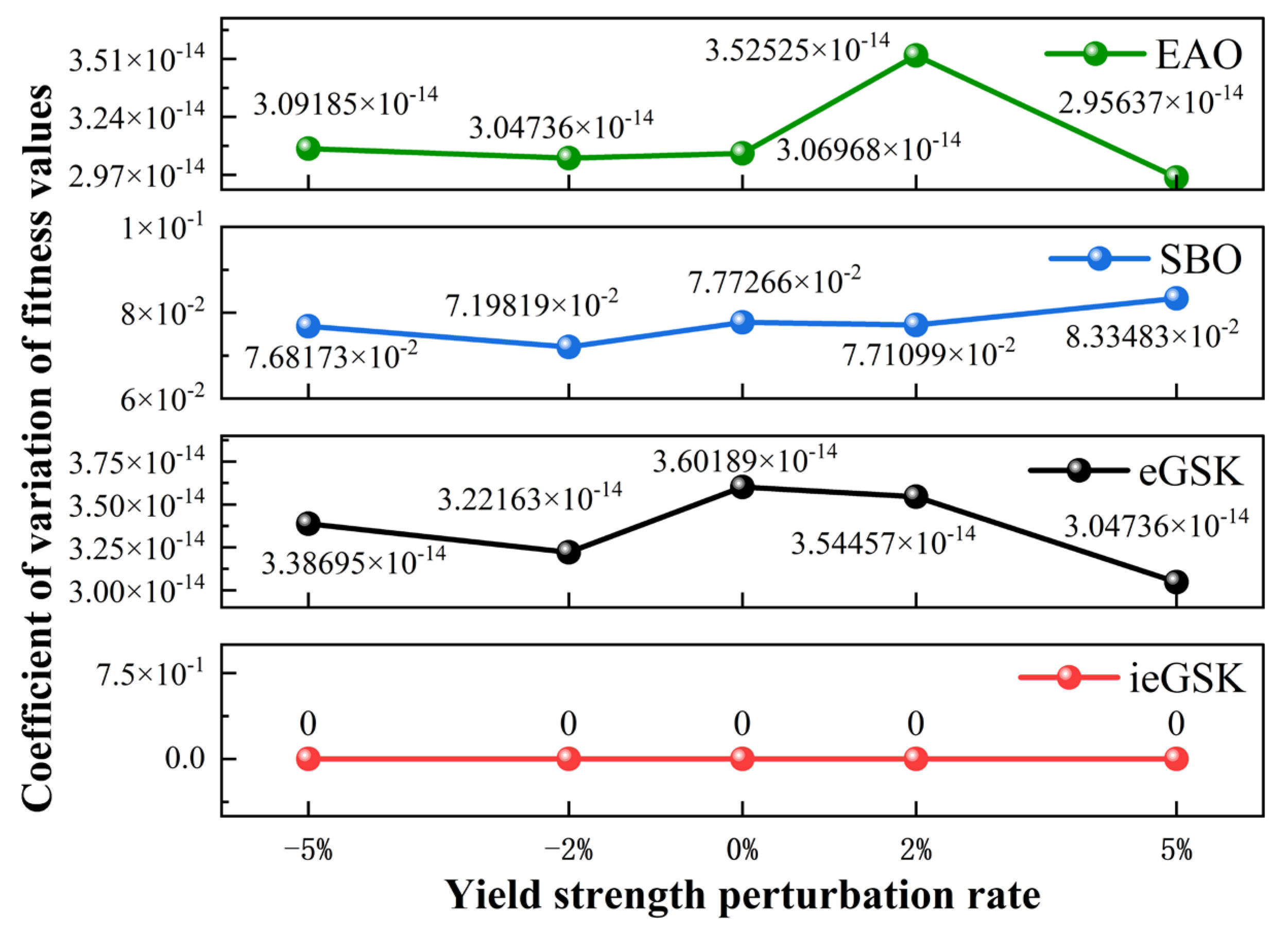
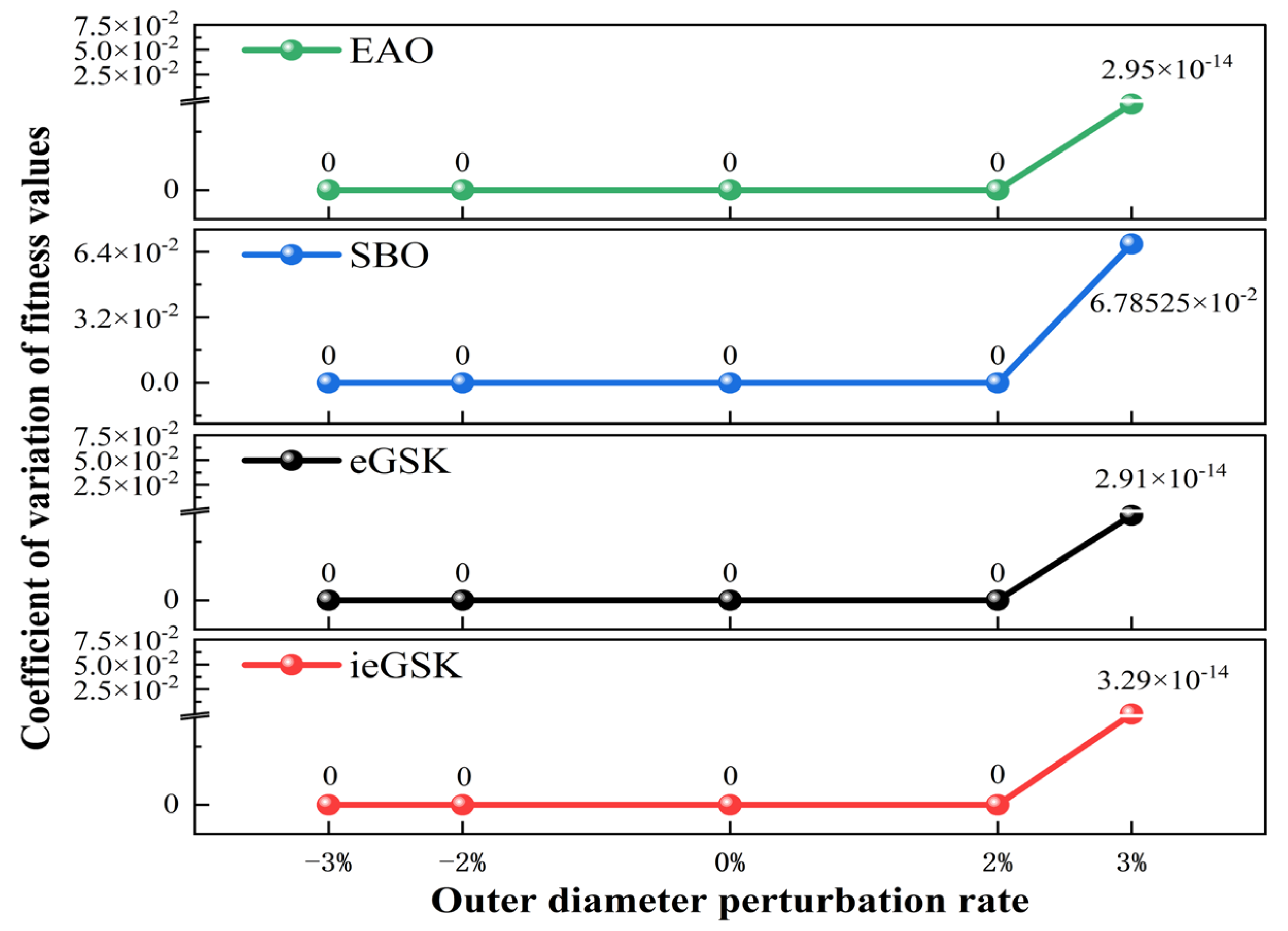
In addition to stability, algorithmic robustness constitutes another essential metric for evaluation. Robustness characterizes an algorithm’s capacity to maintain consistent performance despite variations in initial conditions and perturbations in input data. To thoroughly evaluate each algorithm’s robustness, we adopted yield strength variations and outer diameter perturbations as test scenarios. The robustness of the EAO, SBO, eGSK and ieGSK algorithms was assessed by subjecting them to different perturbation intensities. The corresponding results are presented in Figure 7 and Figure 8.
The horizontal axis represents the applied yield strength perturbation coefficients of −5%, −2%, 0%, 2%, and 5%, respectively, while the vertical axis shows the coefficient of variation values. As shown in Figure 7, the fitness coefficient of variation for the SBO algorithm fluctuates significantly with changes in the yield strength perturbation rate, indicating overall poor stability. The EAO and the eGSK algorithms maintain their coefficient within a minimal fluctuation range but demonstrate average robustness compared to the ieGSK algorithm. In contrast, the ieGSK algorithm exhibits an extremely small fitness coefficient variation, remaining nearly stable at 0 and unaffected by yield strength perturbations, thereby showcasing exceptional robustness.
The horizontal axis represents the applied outer diameter perturbation coefficients of −3%, −1%, 0%, 1%, and 3%, respectively, while the vertical axis shows the coefficient of variation values. As shown in Figure 8, the coefficient of variation approaches zero for all algorithms under perturbation coefficients of −3%, −1%, 0%, and 1%, demonstrating excellent robustness. Under a 3% outer diameter perturbation, the SBO algorithm exhibits a relatively high fitness coefficient variation, reaching a peak value of 0.06785, demonstrating the poorest robustness. Although the EAO and eGSK algorithms achieve the lowest fitness coefficient variation and good robustness, their computational efficiency is slightly weaker. In contrast, the ieGSK algorithm shows only a slight increase in the coefficient variation, with negligible fluctuations, indicating outstanding robustness.
For columnar structures, buckling represents the primary failure mode. However, to ensure the structural safety of drill pipes, the optimization model proposed in this study comprehensively incorporates load-bearing capacity metrics—including strength, stiffness, stability, and fatigue performance—into its constraints, thereby providing comprehensive safety assurance. Additionally, to address the limitations of traditional algorithms, this research integrates a hybrid initialization strategy, integer solution processing, and an elite local search mechanism into the ieGSK algorithm. These modifications effectively resolve the engineering impracticability of non-integer solutions while enhancing optimization efficiency and stability. Benefiting from these improvements, the ieGSK algorithm achieves a 9.8% weight reduction while mitigating the risk of structural failure. Furthermore, it converges to an engineering-practical solution in merely 258 iterations, with computational efficiency improved by 61.6%, 43.1%, and 9.6% compared to the EAO, SBO, and eGSK algorithms, respectively. This algorithm attains a precise balance between lightweight design and full-life-cycle structural safety, and its engineering feasibility and multi-constraint adaptability offer a reliable reference for the structural optimization of similar mechanical components with discrete variables.

6. Conclusions

This study constructed a multi-performance constraint verification system covering the full operating conditions of drill pipes and proposed an ieGSK algorithm. With these integrated approaches, it has successfully addressed the core technical challenge of synergistic optimization between lightweight design and structural safety for mechanical locking drill pipes of rotary drilling rigs.
Key research findings demonstrate the following:
1. The ieGSK algorithm’s superior performance in drill pipe optimization stems from three targeted improvements (hybrid initialization, integerization processing, elite local search) that align with the characteristics of engineering discrete optimization, enabling rapid convergence, engineering-applicable solutions, high stability and efficiency.
2. The established multidimensional constraint optimization model (integrating static strength, stiffness, stability, and fatigue strength constraints) achieves a 9.8% reduction in drill pipe weight while comprehensively ensuring safe and reliable operation in complex service environments, demonstrating significant practical value for engineering.
3. This study innovates by tailoring the ieGSK algorithm to drill pipe discrete manufacturing and multi-performance requirements, establishing a dedicated multi-constraint optimization framework that fills gaps in existing drill pipe research and outperforms generic optimization methods.
Despite the study’s achievements, limitations remain: future research should integrate vibration coupling effects into the model, calibrate fatigue strength constraints with measured data, and conduct long-term prototype testing to enhance engineering adaptability and industrial applicability.

Author Contributions

H.Y. (Heng Yang): Conceptualization, methodology, validation, writing—review and editing, visualization, funding acquisition; H.Y. (Haorong Yang): Conceptualization, methodology, validation, investigation, data curation, writing—original draft preparation; G.X.: software, validation, formal analysis, resources, supervision, project; M.Y.: validation, data curation, writing—review and editing, visualization, visualization, funding acquisition. All authors have read and agreed to the published version of the manuscript.

Funding

This work is supported by the Key R&D Program of Shanxi Province (Grant No. 202402150101006).

Data Availability Statement

The data presented in this study are available on request from the corresponding author.

Conflicts of Interest

The authors declare no conflicts of interest.

Abbreviations

The following abbreviations are used in this manuscript:
eGSKEnhanced Gaining–Sharing Knowledge
ieGSKImproved Enhanced Gaining–Sharing Knowledge
SBOState-Based Optimization
EAOEnzyme-Activated Optimization

References

  1. Shabakhty, N.; Karimi, H.R.; Yeganeh-Bakhtiary, A.; Ghanbarian, M. Structural optimization of offshore jacket platforms considering structure-pile-soil interactions, using a continuous genetic algorithm. Appl. Ocean Res. 2025, 164, 104767. [Google Scholar] [CrossRef]
  2. Miao, F.; Jin, Y. Crashworthiness analysis and structural optimization of thin-walled circular tubes with porous arrays. Structures 2024, 70, 107811. [Google Scholar] [CrossRef]
  3. Borwankar, P.; Kapania, R.K.; Inoyama, D.; Stoumbos, T. Integrated structural design optimization of space vehicles with multidisciplinary constraints. Aerosp. Sci. Technol. 2026, 168, 110906. [Google Scholar] [CrossRef]
  4. Yildiz, A.R. A new hybrid particle swarm optimization approach for structural design optimization in the automotive industry. Proc. Inst. Mech. Eng. Part D J. Automob. Eng. 2012, 226, 1340–1351. [Google Scholar] [CrossRef]
  5. Zhou, Y.; Zhao, Y.; Meng, Z. Design on low noise and lightweight of aircraft equipment cabin based on genetic algorithm and variable-complexity model. J. Vibroengineering 2015, 17, 2066–2076. [Google Scholar]
  6. Cheng, M.-Y.; Prayogo, D. A novel fuzzy adaptive teaching–learning-based optimization (FATLBO) for solving structural optimization problems. Eng. Comput. 2016, 33, 55–69. [Google Scholar] [CrossRef]
  7. Jiang, R.; Ci, S.; Liu, D.; Cheng, X.; Pan, Z. A Hybrid Multi-Objective Optimization Method Based on NSGA-II Algorithm and Entropy Weighted TOPSIS for Lightweight Design of Dump Truck Carriage. Machines 2021, 9, 156. [Google Scholar] [CrossRef]
  8. Liang, Z.; Wang, Z. Enhancing population diversity based gaining-sharing knowledge based algorithm for global optimization and engineering design problems. Expert Syst. Appl. 2024, 252, 123958. [Google Scholar] [CrossRef]
  9. Zhou, Y.; Wang, H. An improved guide weight method for multi-constraints structural optimization design. Structures 2025, 77, 109058. [Google Scholar] [CrossRef]
  10. Zhao, L.; Yan, Y.; Yan, X.; Zhao, L. Structural Parameters Optimization of Elastic Cell in a Near-Bit Drilling Engineering Parameters Measurement Sub. Sensors 2019, 19, 3343. [Google Scholar] [CrossRef]
  11. Li, Y.; Ooi, K.T.; He, L.; Zhao, S.; Luo, Q.; Liu, W.; Liu, Z. Structural optimization design of dimple plate heat exchanger based on machine learning. Int. Commun. Heat Mass Transf. 2025, 167, 109271. [Google Scholar] [CrossRef]
  12. Wang, X.; Xu, S.; Tian, Y.; Wang, B.; Chen, Y. Structural optimization design of rotary table of CNC grinding machine based on NSGA-II algorithm. Mach. Tool Hydraul. 2025, 53, 35–41. [Google Scholar]
  13. Stolpe, M.; Sandal, K. Structural optimization with several discrete design variables per part by outer approximation. Struct. Multidiscip. Optim. 2018, 57, 2061–2073. [Google Scholar] [CrossRef]
  14. Rai, P.; Barman, A.G. An approach for design optimization of helical gear pair with balanced specific sliding and modified tooth profile. Struct. Multidiscip. Optim. 2019, 60, 331–341. [Google Scholar] [CrossRef]
  15. Song, W.; Xia, X.; Yang, F.; Shi, D.; Song, M. Welding distortion investigation of rotary drill rig pipe with radial loading transition bars. Int. J. Press. Vessel. Pip. 2022, 199, 104704. [Google Scholar] [CrossRef]
  16. Zou, H.; Tan, Z. Fatigue life analysis of rotary drill pipe. Int. J. Press. Vessel. Pip. 2023, 201, 104874. [Google Scholar] [CrossRef]
  17. Luo, J.; Li, L.-g.; Yi, W.; Li, X. Working Performance Analysis and Optimization Design of Rotary Drilling Rig under on Hard Formation Conditions. Procedia Eng. 2014, 73, 23–28. [Google Scholar] [CrossRef]
  18. Wang, P.; Ni, H.; Wang, R. A novel vibration drilling tool used for reducing friction and improve the penetration rate of petroleum drilling. J. Pet. Sci. Eng. 2018, 165, 436–443. [Google Scholar] [CrossRef]
  19. Adeniyi, A.; Igbafe, A.; Ebis, O.; Ogunyemi, A.; Yusuff, S.; Oyebode, O. Design and Construction of Rotary Drilling Rig Prototype. Soc. Pet. Eng. 2022. [Google Scholar] [CrossRef]
  20. He, Q. Research and Design of Rotary Drilling Rigs; Central South University Press: Changsha, China, 2012; p. 412. [Google Scholar]
  21. Yang, H.; Ren, Y.; Xu, G. Optimization of Rotary Drilling Rig Mast Structure Based on Multi-Dimensional Improved Salp Swarm Algorithm. Appl. Sci. 2024, 14, 10040. [Google Scholar] [CrossRef]
  22. Liu, D. The Analysis and Optimalize of the Machine-locked Drilling Rod of Rotary Drill. Master’s Thesis, North University Of China, Taiyuan, China, 2016. [Google Scholar]
  23. Li, Z.; Jiao, S.; Wu, F. Rotary Drilling Rig and the Construction Technology; People’s Communications Press: Beijing, China, 2010. [Google Scholar]
  24. Chen, D.; Kong, J.; Yang, J. Modern Mechanical Designer’s Handbook; China Machine Press: Beijing, China, 2014. [Google Scholar]
  25. Xu, G. Design of Metal Structure for Mechanical Equipment; China Machine Press: Beijing, China, 2022. [Google Scholar]
  26. ISO 8686-1; Cranes-Design principles for loads and load combinations—Part 1: General first ed. ISO: Geneva, Switzerland, 2012.
  27. Sun, J.; Liang, Y. Optimal Design of Machine; China Machine Press: Beijing, China, 2012. [Google Scholar]
  28. Jawad, M.A.; Roshdy, H.S.M.; Mohamed, A.W. Enhanced Gaining-Sharing Knowledge-based algorithm. Results Control Optim. 2025, 19, 100542. [Google Scholar] [CrossRef]
  29. Chou, J.-S.; Ngo, N.-T. Modified firefly algorithm for multidimensional optimization in structural design problems. Struct. Multidiscip. Optim. 2016, 55, 2013–2028. [Google Scholar] [CrossRef]
  30. Mohapatra, S.; Mohapatra, P. Fast random opposition-based learning Golden Jackal Optimization algorithm. Knowl. -Based Syst. 2023, 275, 110679. [Google Scholar] [CrossRef]
  31. Wang, J.; Chen, Y.; Lu, C.; Heidari, A.A.; Wu, Z.; Chen, H. The status-based optimization: Algorithm and comprehensive performance analysis. Neurocomputing 2025, 647, 130603. [Google Scholar] [CrossRef]
  32. Rodan, A.; Al-Tamimi, A.-K.; Al-Alnemer, L.; Mirjalili, S.; Tiňo, P. Enzyme action optimizer: A novel bio-inspired optimization algorithm. J. Supercomput. 2025, 81, 686. [Google Scholar] [CrossRef]
Figure 1. Mechanical model: (a) Drilling Operation; (b) Lifting Operation.
Machines 14 00048 g001
Figure 2. Two-Stage Knowledge Interaction Process.
Machines 14 00048 g002
Figure 3. IeGSK algorithm flowchart.
Machines 14 00048 g003
Figure 4. Algorithm Iteration Curve.
Machines 14 00048 g004
Figure 5. Comparison of Algorithm Time and Number of Iteration.
Machines 14 00048 g005
Figure 6. Comparison of the trend of the Optimal Solution of Each Algorithm in 30 runs.
Machines 14 00048 g006
Figure 7. Fluctuation of adaptation values under different perturbations.
Machines 14 00048 g007
Figure 8. Transmissibility fluctuations under different outer diameter perturbations.
Machines 14 00048 g008
Table 1. Operating Condition Classification.
Operating ConditionsInstruction
Drilling Operation B1The drill pipe transmits torque and pressure to the drill bit to complete drilling.
Out-of-Hole Lifting Operation B2The winch lifts the drill pipe, raising it vertically.
In-Hole Lifting Operation B3The winch lifts the drill pipe, with the pressure cylinder assisted by the power head.
Dirt-Slinging Operation B4The power head rotates forward and backward to dislodge soil through impact.
Dirt-Shaking Operation B5The winch continuously starts and stops, moving the drill pipe up and down to dislodge soil by inertia.
Traveling Operation B6The entire machine moves.
Rotation Operation B7The chassis remains stationary while the upper structure rotates.
Table 2. Design Variable Value.
xi1xi2xi3
i = 1[13, 14][40, 60][20, 25]
i = 2[13, 14][40, 60][20, 25]
i = 3[13, 14][40, 60][20, 25]
i = 4[20, 25][40, 60][20, 25]
Table 3. Mechanical Parameters.
ParameterValue
Powerhead Weight GPH10.92 kN
Drill Pipe 1 Weight GP143.65 kN
Drill Pipe 2 Weight GP232.12 kN
Drill Pipe 3 Weight GP330.21 kN
Drill Pipe 4 Weight GP432.27 kN
Pressure Applied FPCP532.48 kN
Torque MPH499.2 kN·m
Distance from Drill Pipe 1 to Top Z115,950 mm
Distance from Drill Pipe 2 to Top Z230,315 mm
Distance from Drill Pipe 3 to Top Z344,545 mm
Distance from Drill Pipe 4 to Top Z460,670 mm
The yield strength of drill pipe 1 σs1550 MPa
The yield strength of drill pipe 2 σs2550 MPa
The yield strength of drill pipe 3 σs3850 MPa
The yield strength of drill pipe 4 σs4850 MPa
Key compression Strength σkc900 MPa
Key shear Strength σks1200 MPa
Table 4. Constraints.
gi(x)FormulaMeet the Conditions
g 1 1 x σ max 500 g i x 0
g 1 2 x σ max 772.7
g 2 x σ p 1090.9
g 3 x τ p 818.2
g 4 x λ 180
g 5 x θ 0.5
g 6 x 260000 N R d
g 7 1 x R / δ 21.36
g 7 2 x R / δ 13.82
Table 5. Comparison of Optimization Results.
VariableBefore OptimizationAfter Optimization
EAOSBOeGSKieGSK
x11 (mm)1413131313
x12 (mm)6051.8457.5251.8452
x13 (mm)252523.542525
x21 (mm)1413131313
x22 (mm)404040.024040
x23 (mm)2020202020
x31 (mm)1413131313
x32 (mm)6040404040
x33 (mm)302020.012020
x41 (mm)2520202020
x42 (mm)405048.465050
x43 (mm)203029.983030
Fitness value (mm2)100,205.2190,338.7690,479.1890,338.7690,362.83
Weight Loss Percentage (%)-9.89.79.89.8
Disclaimer/Publisher’s Note: The statements, opinions and data contained in all publications are solely those of the individual author(s) and contributor(s) and not of MDPI and/or the editor(s). MDPI and/or the editor(s) disclaim responsibility for any injury to people or property resulting from any ideas, methods, instructions or products referred to in the content.