Article

Braking Energy Recovery Control Strategy Based on Instantaneous Response and Dynamic Weight Optimization

1
School of Electrical and Control Engineering, North China University of Technology, Beijing 100144, China
2
Jiangsu Industrial Innovation Center of Intelligent Equipment Co., Ltd., Liyang 213300, China
3
Western China Science City Innovation Center of Intelligent and Connected Vehicles (Chongqing) Co., Ltd., Chongqing 400039, China
4
China North Vehicle Research Institute, Beijing 100071, China
5
Yulin Saiyi Intelligent Technology Co., Ltd., Yulin 719099, China
6
Yulin Innovation Center of Intelligent Equipment Co., Ltd., Yulin 719099, China
*
Author to whom correspondence should be addressed.
Machines 2026, 14(1), 10; https://doi.org/10.3390/machines14010010
Submission received: 13 October 2025 / Revised: 11 December 2025 / Accepted: 16 December 2025 / Published: 19 December 2025

Abstract

Multi-axle electric heavy-duty trucks face significant challenges in maintaining braking stability and achieving real-time control during regenerative braking due to their large mass and complex inter-axle coupling dynamics. To address these issues, this paper proposes an improved model predictive control (IMPC) strategy that enhances computational efficiency and control responsiveness through an instantaneous response mechanism. The approach integrates a first-order error attenuation term within the MPC framework and employs an extended Kalman filter to estimate tire–road friction in real time, enabling adaptive adjustment between energy recovery and stability objectives under varying road conditions. A control barrier function constraint is further introduced to ensure smooth and safe regenerative braking. Simulation results demonstrate improved energy recovery efficiency and faster convergence, while real-vehicle tests confirm that the IMPC maintains superior real-time performance and adaptability under complex operating conditions, reducing average computation time by approximately 14% compared with conventional MPC and showing strong potential for practical deployment.

1. Introduction

Multi-axle electric heavy-duty trucks play a crucial role in achieving low-carbon transportation and improving energy utilization efficiency [1,2,3,4]. Compared with dual-axle electric vehicles, multi-axle electric trucks possess greater kinetic energy during motion, resulting in a substantially larger potential for regenerative braking energy recovery. Therefore, optimizing regenerative braking for such vehicles is of higher necessity and practical significance [5,6,7]. Effective energy recovery can significantly improve overall energy efficiency, extend driving range, and reduce dependence on external charging infrastructure, thereby lowering operating costs [8,9]. However, due to multiple driven axles, the rotational speed differences and braking force distribution imbalances among axles strongly influence the effectiveness of regenerative braking [10,11,12,13]. Thus, designing a high-efficiency and safety-assured energy recovery strategy that coordinates multiple actuators and ensures braking stability remains a key technical challenge [14,15,16].
In recent years, various control strategies for regenerative braking have been proposed for electric vehicles. In the domain of traditional control methods, techniques such as genetic algorithms and fuzzy control have been widely applied to dual-axle electric vehicles. These methods are intuitive and computationally efficient, and can improve braking stability and energy recovery to a certain extent [17,18,19,20]. For instance, Xu et al. [21] proposed a regenerative braking strategy based on direct adhesion control, employing a fuzzy PI controller to track the desired adhesion force and determine the torque distribution for enhanced braking stability. Chang and Zhang [22] developed a regenerative braking torque allocation strategy for EMB systems, where fuzzy control was optimized using a particle swarm optimization (PSO) algorithm. However, such heuristic or rule-based methods rely heavily on empirical tuning and lack adaptability to the highly coupled, nonlinear, and dynamically constrained characteristics of multi-axle electric heavy trucks. Consequently, they are inadequate for complex operating conditions requiring coordinated control of multiple drive axles.
In advanced control methodologies, model predictive control has emerged as a powerful approach due to its ability to handle multi-variable constraints and optimize performance over a finite prediction horizon [23,24,25,26]. MPC allows simultaneous consideration of vehicle dynamics and energy recovery objectives to achieve globally optimized braking control. Nevertheless, conventional MPC still suffers from high computational complexity, limited real-time performance, and fixed weighting parameters. These limitations become critical under transient conditions such as sudden changes in road adhesion or emergency braking, where control lag and poor adaptability may degrade both safety and efficiency [27,28,29].
To address the particular structural and dynamic characteristics of multi-axle electric trucks, some studies have integrated braking stability and regenerative control. For example, several front–rear axle cooperative braking strategies have been proposed to optimize torque distribution between regenerative and pneumatic braking, thereby improving both stability and energy recovery [30,31,32]. However, most of these studies focus on dual-axle or four-wheel-drive electric vehicles. In contrast, multi-axle heavy trucks exhibit more complex dynamic coupling among multiple drive axles, significant load transfer during braking, and stringent multi-variable constraints. Traditional MPC approaches struggle to balance real-time performance, convergence efficiency, and global coordination in such scenarios. Currently, systematic modeling and high-efficiency control strategies tailored to the unique braking characteristics of multi-axle heavy trucks remain limited [33,34,35], making it difficult for existing methods to effectively address the challenges posed by complex braking conditions [36,37,38,39,40].
To overcome these limitations, this study proposes an IMPC strategy inspired by instantaneous response for regenerative braking energy recovery. The main contributions are summarized as follows:
  • Section 3.3: A first-order error attenuation mechanism is introduced into the MPC framework to enhance computational efficiency and reduce control delay, enabling the motor braking torque to respond promptly under transient conditions and improving recovery continuity.
  • Section 3.4: An extended Kalman filter (EKF) is employed for real-time estimation of the road adhesion coefficient. The estimated value dynamically adjusts the weighting factors between energy recovery and stability, increasing regenerative braking on high-adhesion surfaces while maintaining stability on low-adhesion roads, thereby enhancing average recovery efficiency over the entire braking cycle.
  • Section 3.5: A control barrier function is incorporated into the constraint-handling process, allowing gradual satisfaction of constraints to prevent abrupt recovery interruptions and ensure the smoothness and continuity of the braking process.
The remainder of this paper is organized as follows: Section 2 describes the dynamic modeling of the multi-axle electric heavy-duty truck. Section 3 presents the proposed instantaneous-response-inspired IMPC approach. Section 4 provides simulation-based performance evaluation. Section 5 reports real-vehicle experimental results. Section 6 concludes the paper.

2. Multi-Axle Electric Heavy Truck Vehicle Model

2.1. Vehicle Dynamics Model

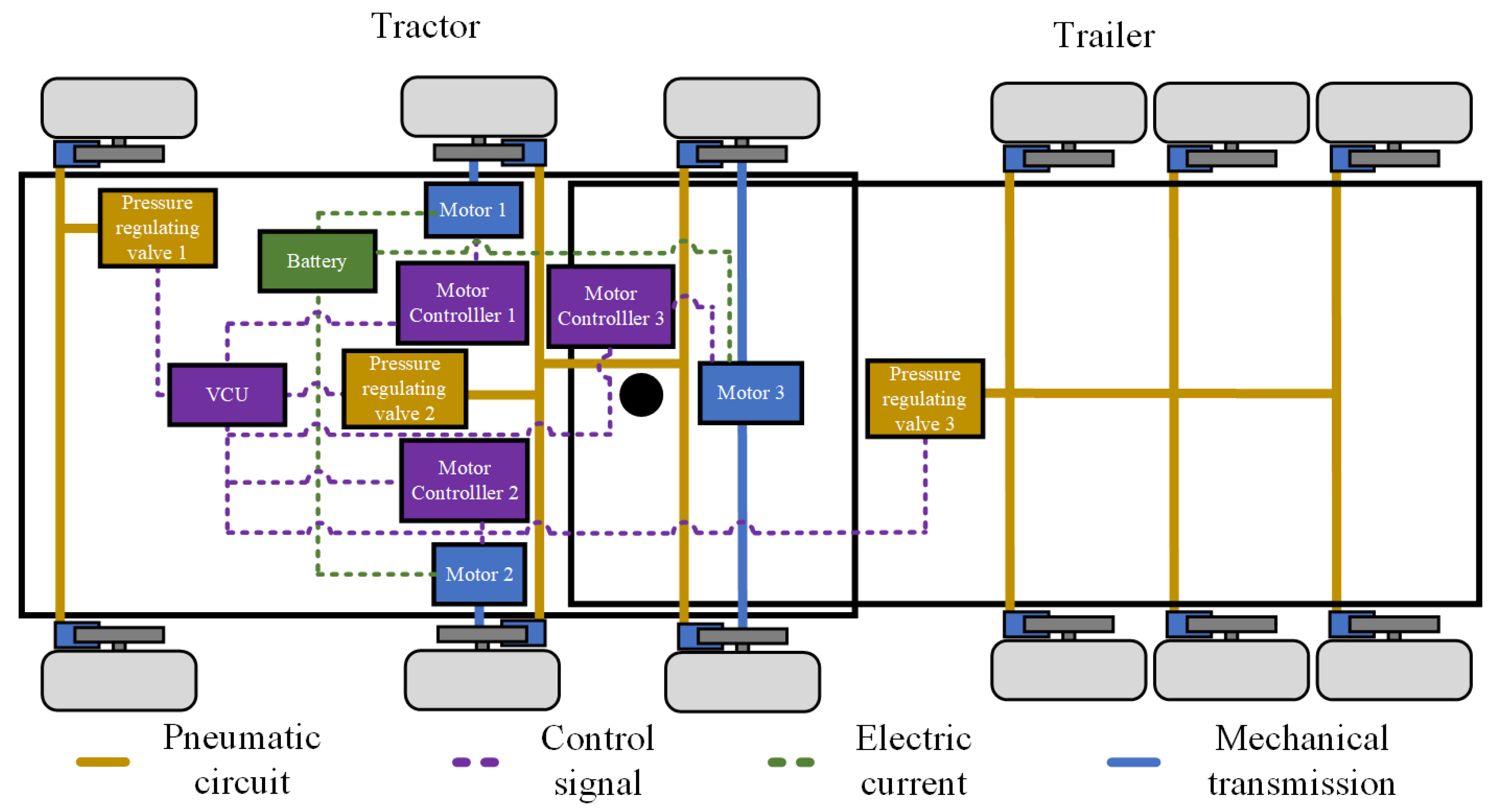
A multi-axle electric heavy-duty truck with the configuration shown in Figure 1 comprises a tractor-trailer combination. The tractor’s front axle uses an independent pneumatic braking circuit, and its middle and rear axles share a common circuit. The three trailer axles also employ a shared pneumatic braking system. For the driveline, the tractor’s middle axle has two independent traction motors (Motor 1 and Motor 2), one on each side, while the rear axle is fitted with a third motor (Motor 3). Each motor is independently controlled by its dedicated motor controller (Motor Controller 1–3). During braking, a central vehicle control unit (VCU) supervises and coordinates the overall process through the following functions:
  • Based on the driver’s braking demand and the real-time status of each subsystem, the VCU computes the target control signals for both pneumatic and regenerative braking.
  • Once the braking command is issued, the pneumatic regulating valves (Pressure Regulating Valve 1, 2, and 3) transmit compressed air through pipelines (yellow circuits) to the brake chambers, thereby generating mechanical braking torque at the wheels.
  • Simultaneously, the VCU sends regenerative braking commands to the motor controllers, which in turn regulate the corresponding motors to initiate energy recovery.
Figure 1. Configuration of the multi-axle electric heavy truck.
Machines 14 00010 g001
In the regenerative braking phase, the motors convert kinetic energy into electrical energy, which is subsequently stored in the battery system for reuse.
As illustrated in Figure 2, taking the articulation point of the truck as the reference, a lumped-parameter multi-body dynamic model of the multi-axle electric heavy-duty tractor–semitrailer combination is established in this study. In the modeling process, the tractor and the semitrailer are regarded as rigid bodies moving in the horizontal plane, each with three degrees of freedom in the longitudinal, lateral and yaw directions, so that the whole system has six degrees of freedom in total. The longitudinal and lateral velocities of the centers of gravity of the tractor and semitrailer, ( v x 1 , v y 1 ) and ( v x 2 , v y 2 ) , together with the corresponding yaw angles ϕ 1 and ϕ 2 , are selected as the state variables. First, the kinematic relations between the velocities of the centers of gravity expressed in the body-fixed coordinate frames and those expressed in the global coordinate frame are derived. Then, based on Newton’s second law and the classical Newton–Euler formulation, the force and moment equilibrium equations of the tractor and semitrailer are written in the longitudinal, lateral and yaw directions. By taking into account the tire forces, aerodynamic drag and the interaction forces at the articulation point, the dynamic equilibrium Equations (3)–(5) of the tractor–semitrailer combination are systematically derived.
In the diagram, frame X O Y represents the global coordinate system, whose origin O is fixed to the ground and used to describe the vehicle’s absolute position in space. The tractor body-fixed coordinate frame x 1 O 1 y 1 has its origin O 1 located at the tractor center of gravity (CG); axis x 1 points forward along the tractor longitudinal axis, and axis y 1 points left along the lateral axis. The trailer body-fixed coordinate frame x 2 O 2 y 2 has its origin O 2 at the trailer CG; axis x 2 points forward along the trailer longitudinal axis, and axis y 2 points left laterally. The frames x 1 O 1 y 1 and x 2 O 2 y 2 are rigidly attached to the tractor and trailer bodies, respectively, and therefore translate and rotate together with the corresponding vehicle units in the global frame X O Y . The tractor and trailer are connected through the articulation point O a , which allows relative yaw motion. (In the actual vehicle, O a and O a coincide; they are separated in the figure only for clarity in depicting forces). The articulation point is located between the tractor’s center and rear axles, lying on the common longitudinal axis of the tractor–trailer combination. The yaw angles ϕ 1 and ϕ 2 describe the orientation of the tractor and trailer body-fixed frames with respect to the global frame X O Y ; they vary continuously as the vehicle travels. When the tractor yaw angle ϕ 1 differs from the trailer yaw angle ϕ 2 , the trailer exhibits a follow-up yaw motion in response to the tractor’s steering or yawing, and this motion is jointly constrained by the moment balance at the articulation point and the tire forces. F x i and F y i denote the longitudinal and lateral tire forces acting on the i-th wheel group, while R x , R y and R x , R y represent the interaction forces between the tractor and trailer at the articulation point. θ is the articulation angle between the tractor and trailer, and δ is the front-wheel steering angle. Variables v x 1 and v y 1 denote the longitudinal and lateral velocities of the tractor, respectively. Similarly, v x 2 , v y 2 correspond to the trailer’s longitudinal and lateral velocities. Parameter l i denotes the distance between each axle center and the corresponding vehicle CG, l p i is the distance from the CG to the articulation point, and l w i represents the track widths of the tractor axles. F a i r 1 and F a i r 2 represent the aerodynamic drag forces acting on the tractor and trailer, respectively, while F r o l l 1 and F r o l l 2 denote the rolling resistance forces acting on the tractor and trailer. Key parameters not explicitly labeled in the figure include m 1 , the total mass of the tractor, and I z 1 , its yaw moment of inertia; m 2 , the total mass of the trailer, and I z 2 , its yaw moment of inertia. Based on the Newton–Euler equations, the forces and moments acting on each rigid body are balanced, and the corresponding dynamic equations of the tractor and trailer are derived accordingly [11].
The velocity of the tractor center of gravity in the global coordinate frame ( X ˙ 1 , Y ˙ 1 ) and its velocity in the tractor body-fixed frame ( v x 1 , v y 1 ) satisfy.
X ˙ 1 Y ˙ 1 = cos φ 1 sin φ 1 sin φ 1 cos φ 1 v x 1 v y 1
The velocity of the trailer center of gravity in the global coordinate frame ( X ˙ 2 , Y ˙ 2 ) and its velocity in the tractor body-fixed frame ( v x 2 , v y 2 ) satisfy.
X ˙ 2 Y ˙ 2 = cos φ 2 sin φ 2 sin φ 2 cos φ 2 v x 2 v y 2
The coordinates ( X 1 , Y 1 ) and ( X 2 , Y 2 ) of the tractor and semitrailer centers of gravity in the global coordinate frame, as well as the corresponding yaw angles ϕ 1 and ϕ 2 with respect to the X O Y frame, are time-varying functions under general operating conditions. Only in a few degenerate cases (e.g., when the vehicle is completely at standstill, or when it travels in uniform straight-ahead motion without yaw) do the yaw rates satisfy φ ˙ 1 = φ ˙ 2 = 0 ; in this situation, ϕ 1 and ϕ 2 are constant, the motion of the vehicle is dominated by pure longitudinal translation, and the yaw and relative articulation motions can be regarded as vanishing. The model developed in this paper is formulated for the general operating conditions, where ϕ 1 , ϕ 2 and their derivatives are treated as state variables, while straight-ahead and standstill motions are interpreted as special cases that arise as natural degenerations of the model under specific conditions.
To make the derivation of the dynamic equations more transparent, the modeling procedure for the tractor–semitrailer combination can be summarized as follows.
(1)
Selection of degrees of freedom and state variables. Based on the above definitions of coordinate frames and degrees of freedom, the tractor and semitrailer are modeled as rigid bodies moving in the horizontal plane, each with three degrees of freedom in the longitudinal, lateral and yaw directions, so that the whole system has six degrees of freedom in total. The longitudinal and lateral velocities of the centers of gravity in the body-fixed frames, ( v x 1 , v y 1 ) and ( v x 2 , v y 2 ) , together with the yaw angles φ 1 and φ 2 , are chosen as the state variables. Their relations to the velocities in the global frame ( X ˙ 1 , Y ˙ 1 ) and ( X ˙ 2 , Y ˙ 2 ) are given by Equations (1) and (2).
(2)
Rigid-body dynamic equilibrium equations. Taking the body-fixed frames of the tractor and semitrailer as references, Newton’s second law and Euler’s rotational equation are applied in the longitudinal, lateral and yaw directions for each rigid body i (tractor i = 1 , semitrailer i = 2 ), leading to the general form.
m i ν ˙ x i = F x i , m i ν ˙ y i = F y i , I z i φ ¨ i = M z i ,
where F x i , F y i and M z i denote the resultant longitudinal force, lateral force and yaw moment acting on body i, respectively.
(3)
Modeling of external forces and articulation constraints. According to the simplified linear tire-force relations adopted in this paper, the longitudinal and lateral tire forces of each wheel group are expressed (e.g., F x i = C x s i , F y i = C α α i ). The aerodynamic drag forces F air 1 , F air 2 , the rolling resistance forces F roll 1 , F roll 2 , and the interaction forces at the fifth wheel are also included and substituted into the force and moment balance equations in step (2). In addition, the kinematic constraints at the articulation point between the tractor and semitrailer are formulated on the basis of the geometric relations and velocity compatibility conditions, as given in Equation (6), which couple the longitudinal, lateral and yaw motions of the two units.
(4)
Assembly and rearrangement of the system equations. On the basis of the dynamic equations and articulation constraints obtained in steps (2) and (3), the internal constraint reactions are eliminated by means of the articulation constraints, and the force and moment balance equations of the tractor and semitrailer are assembled and rearranged. In this way, the coupled dynamic equilibrium equations of the combination vehicle in the longitudinal, lateral and yaw directions are obtained, whose compact state-space form is given by Equations (4)–(6).
These steps constitute the complete procedure used in this work to construct the dynamic equations, corresponding to the rigid-body multibody dynamics modeling approach for planar articulated vehicles based on Newton’s second law and the Newton–Euler formulation [41,42].
The dynamic model of the tractor can be expressed as follows:
m 1 ( ν ˙ x 1 ϕ ˙ 1 ν y 1 ) = F x 1 cos δ + F x 2 cos δ F y 1 sin δ F y 2 sin δ + i = 3 6 F x i R x F a i r 1 F r o l l 1 m 1 ( ν ˙ y 1 ϕ ˙ 1 ν x 1 ) = F y 1 cos δ + F y 2 cos δ + F x 1 sin δ + F x 2 sin δ + i = 3 6 F y i R y I z 1 ϕ ¨ 1 = ( F y 1 sin δ F y 2 sin δ + F x 2 cos δ F x 1 cos δ ) l w 1 2 + ( F x 4 F x 3 + F x 6 F x 5 ) l w 2 2 + ( F y 1 cos δ + F y 2 cos δ + F x 1 sin δ + F x 2 sin δ ) l 1 ( F y 3 + F y 4 ) l 2 ( F y 5 + F y 6 ) l 3 + R y l p 1
For each wheel group, the longitudinal tire force is F x i = C x s i , where C x is the longitudinal stiffness and s i is the slip ratio, and the lateral tire force is F y i = C α α i , where C α is the cornering stiffness and α i is the side-slip angle. The aerodynamic drag forces are F a i r 1 = 1 2 c a i r ρ A 1 v x 1 2 and F a i r 2 = 1 2 c a i r ρ A 2 v x 2 2 , where c a i r is the aerodynamic drag coefficient, A 1 and A 2 are the frontal areas of the tractor and trailer, respectively, and ρ is the air density. The rolling-resistance forces are given by F r o l l 1 = c r o l l m 1 g and F r o l l 2 = c r o l l m 2 g , where c r o l l is the rolling-resistance coefficient. The longitudinal and lateral coupling forces at the articulation point are modeled as R x = k c ( v x 2 cos θ v y 2 sin θ ) v x 1 and R y = k c o u p l i n g ( v x 2 sin θ + v y 2 cos θ ) v y 1 , where k c is the longitudinal coupling stiffness between the tractor and trailer, and k c o u p l i n g is the lateral coupling stiffness between the tractor and trailer.
The dynamic model of the trailer can be expressed as:
m 2 ( ν ˙ x 2 ϕ ˙ 2 ν y 2 ) = i = 7 12 F x i + R x cos θ R y sin θ F a i r 2 F r o l l 2 m 2 ( ν ˙ y 2 ϕ ˙ 2 ν x 2 ) = i = 7 12 F y i + R x sin θ + R y cos θ I z 2 ϕ ¨ 2 = ( F x 8 F x 7 + F x 10 F x 9 + F x 12 F x 11 ) l w 3 2 + ( F y 8 F y 7 ) l 4 + ( F y 10 F y 9 ) l 5 + ( F y 12 F y 11 ) l 6 + ( R y cos θ + R x sin θ ) l p 2
The tractor and trailer are connected by an articulation point. When establishing the full-vehicle dynamic model of the multi-axle heavy-duty truck, it is necessary to account for the kinematic constraints introduced by this articulation. The longitudinal, lateral, and yaw motions of the tractor and trailer are coupled through constraint relations at the articulation point, which can be written as:
θ = ϕ 1 ϕ 2 ν x 2 = ν x 1 cos θ ν y 1 sin θ + ϕ ˙ 1 l p 1 sin θ ν y 2 = ν x 1 sin θ + ν y 1 cos θ ϕ ˙ 1 l p 1 cos θ ϕ ˙ 2 l p 2

2.2. Braking Energy Consumption Model

During braking, the vehicle’s kinetic energy provides the main source for regenerative energy recovery. For the multi-axle electric heavy-duty truck considered here, part of this kinetic energy is converted into electrical energy via the regenerative operation of the drive motors and stored in the traction battery, whereas pneumatic braking and running resistances lead to irreversible energy dissipation. The overall energy balance can therefore be written as:
Δ E = E b + E l
Here, Δ E denotes the variation of vehicle kinetic energy during braking, E b represents the actual energy absorbed by the battery, and E l corresponds to the unrecovered energy losses, including motor and inverter inefficiencies, mechanical braking consumption, as well as external losses such as aerodynamic drag and rolling resistance. The braking energy recovery efficiency η k is then defined as:
η k = E b Δ E
Considering the coupling effect of multiple drive-axle motors, the energy absorbed by the battery can be obtained by integrating the regenerative power of each motor. After discretization of the integration process, the braking energy recovery efficiency is calculated as:
η k = i = 1 3 T i ω i Δ t 1 2 m 1 ( ν N 1 , k 2 ν N 1 , k + 1 2 ) + 1 2 m 2 ( ν N 2 , k 2 ν N 2 , k + 1 2 )
where T i is the regenerative braking torque of the i-th axle. According to the multi-axle electric heavy trucks configuration, T 1 = 0 , T 2 = T a 1 + T a 2 , T 3 = T a 3 , and ω i is the wheel speed of the i-th axle. v N 1 , k , v N 2 , k denote the tractor and trailer speeds at time step k, ν N 1 = ν x 1 2 + ν y 1 2 , ν N 2 = ν x 2 2 + ν y 2 2 .
The dynamic model provides the fundamental constraints on vehicle speed, acceleration, and axle forces during braking, while the braking energy consumption model characterizes the conversion of kinetic energy into battery energy. Together, these two models form a unified framework that underpins the proposed MPC-based improved control strategy, enabling a coordinated balance between braking stability and energy recovery efficiency. Within this framework, the present study regulates the motor torque T a i and pneumatic braking pressure P a i based on the key parameters of the dynamic model, so as to ensure smooth vehicle deceleration, maximize regenerative energy recovery, and maintain driving stability, thereby avoiding adverse phenomena such as trailer swing or jackknifing. By optimally adjusting T a i and P a i he distribution of braking forces across the vehicle is effectively managed, enabling controlled speed reduction while improving the rate of braking energy recovery. Combined with the articulation constraint θ = ϕ 1 ϕ 2 between the tractor and trailer, the coordinated motion of each unit during braking is ensured, which further enhances the overall stability of the multi-axle vehicle.

3. IMPC Algorithm

3.1. Overall Strategy for Energy Recovery Control

The control strategy design for the braking energy-recovery system of multi-axle electric heavy trucks faces challenges of multi-variable coupling and nonlinear optimization. The system involves control variables such as braking-torque distribution coefficients and motor regenerative-torque thresholds, as well as state variables including vehicle speed, battery SOC, and axle-load transfer ratio. Their coupling relationships exhibit strong nonlinearity and time-varying characteristics.
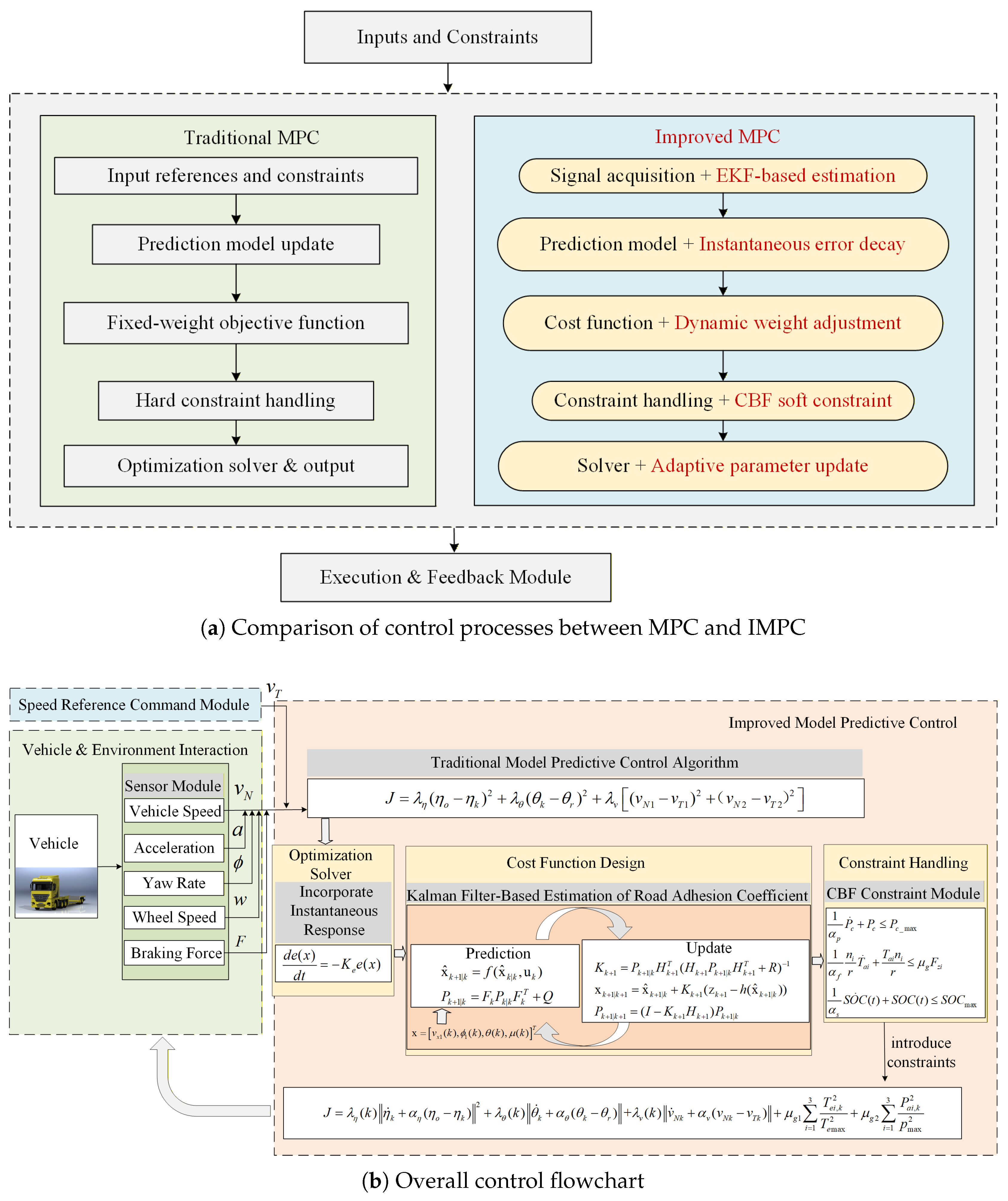
Traditional MPC suffers from limited real-time performance, weak adaptability to varying road conditions, and inflexible constraint handling. To address these issues, the proposed IMPC introduces an instantaneous-response mechanism into the optimization process, a dynamic weight adjustment method into the cost-function design, and a control barrier function (CBF)-based soft-constraint strategy into constraint handling. Figure 3a compares the two control strategies. The traditional MPC performs optimization with fixed models and static weights, whereas the IMPC integrates error-decay dynamics, adaptive weighting based on adhesion estimation, and CBF soft constraints, achieving a smooth transition from predictive optimization to instantaneous regulation. As shown in Figure 3b, the IMPC framework uses the vehicle-dynamics model as its core, combined with sensor and EKF modules that update road-adhesion information and system states in real time. The controller optimizes braking-force distribution through error-dynamic shaping and adaptive weighting, while the CBF module constructs feasible regions based on SOC and motor-torque constraints. The rolling optimization solver outputs coordinated motor and pneumatic braking commands, realizing unified braking stability and energy-recovery efficiency.
In the braking-force allocation process, each coaxial motor adopts an equivalent in-axle distribution to maintain left–right balance. The inter-axle braking torque is dynamically determined by the optimizer according to road-adhesion conditions and motor-efficiency characteristics: under high-adhesion surfaces, the front-axle regenerative braking share is increased to improve recovery efficiency, whereas under low-adhesion conditions, stability is prioritized. The IMPC follows a hierarchical regulation principle of “adhesion priority—battery protection—efficiency optimization.” Based on EKF-estimated adhesion and battery SOC, the controller dynamically adjusts the objective-function weights: it decreases the regenerative-braking share under low-adhesion conditions to prevent axle lockup, increases the recovery contribution under high adhesion to enhance efficiency, and smoothly shifts to a pneumatic-braking-dominated mode as SOC approaches the charging-power limit, ensuring both safety and continuity of energy recovery. Through this dynamic-optimization mechanism, the IMPC achieves coordinated enhancement of energy-recovery efficiency and braking stability across diverse operating conditions.

3.2. Algorithm Framework

Based on the vehicle dynamics model, this section designs a predictive model for energy recovery and defines an initial cost function. The state variables are selected as x = [ ( v x 1 , v y 1 , ϕ ˙ 1 , ϕ ˙ 2 ) ] T , representing the motion state of the vehicle. The control input is defined as u = [ ( T a 1 , T a 2 , T a 3 , P a 1 , P a 2 , P a 3 ) ] T , The nonlinear dynamics model of the tractor-trailer system established in Section 2 is approximated by first-order linearization to obtain the following time-varying linear equation.
x ˙ = f 1 ( x , u ) = A x + B u
A = c air + k c m 1 0 0 0 0 c α m 1 ν x 1 0 0 0 k ϕ I z 1 0 0 0 k coupling I z 2 k ϕ + k coupling I z 2
B = η m 1 m 1 r η m 2 m 1 r η m 3 m 1 r k p m 1 k p m 1 k p m 1 0 0 0 0 0 0 0 0 0 0 0 0 0 0 0 0 0 0
This equation is discretized using Euler’s method to obtain the state-space expression, which serves as the prediction model.
x k + 1 = f 2 ( x k , u k )
v x 1 , k + 1 v y 1 , k + 1 ϕ ˙ 1 , k + 1 ϕ ˙ 2 , k + 1 = v x 1 , k + i = 1 3 η m i T a i , k r + k p P a i , k ( c a i r + k c ) v x 1 , k m 1 Δ t v y 1 , k + c α m 1 v y 1 , k + v x 1 , k ϕ ˙ 1 , k Δ t ϕ ˙ 1 , k k ϕ I z 1 ϕ ˙ 1 , k Δ t ϕ ˙ 2 , k + k y 1 + k c o u p l i n g I z 2 ϕ ˙ 2 , k + k c o u p l i n g I z 2 ϕ ˙ 1 , k Δ t
Here, k ϕ is the yaw damping coefficient, η m i denotes the equivalent efficiency coefficient of the i-th motor–reducer–wheel drivetrain under the considered operating conditions, and is used to collectively represent the dominant mechanical and electromechanical losses in this power transmission path. To simplify the modeling and ensure comparability between different control strategies, the same equivalent efficiency is adopted for both traction and regenerative modes, without explicitly distinguishing the directional differences in energy flow or the losses associated with the inverter and the charging/discharging processes of the traction battery. The primary purpose of this energy model is to provide a consistent basis for comparing the energy recovery performance of the conventional MPC and the Improved MPC strategies. As a result, while this simplification may introduce some deviation in the absolute values of recovered energy, its impact on the relative comparison between the two control strategies is limited.
Considering the characteristics of multi-axle electric heavy-duty trucks, the cost function of the predictive control model is designed to achieve three main objectives:
First, the control objective is to ensure a high braking energy recovery efficiency, and the corresponding cost function is defined as follows:
J 1 = λ η ( η o η k ) 2
where η 0 is the theoretical maximum energy recovery efficiency, and λ η is the weight coefficient for energy recovery efficiency.
Second, an articulation angle error penalty is introduced to prevent excessive articulation, which could lead to vehicle folding or loss of stability.
J 2 = λ θ ( θ k θ r ) 2
where θ k is the articulation angle at time step k, and θ r is the reference articulation angle (set to 0 to represent the desired straight-line driving condition). λ θ is the weight coefficient for articulation stability.
Third, to ensure that the actual vehicle speed tracks the desired speed:
J 3 = λ ν ( ν N 1 ν T 1 ) 2 + ( ν N 2 ν T 2 ) 2
where v T 1 , v T 2 are the target speeds. λ ν is the speed tracking weight coefficient.
Thus, the Model Predictive Control for braking in multi-axle electric heavy-duty trucks is formulated as:
min J k = 1 N λ η ( η o η k ) 2 + λ θ ( θ k θ r ) 2 + λ ν ( v N 1 v T 1 ) 2 + ( v N 2 v T 2 ) 2 s . t . x k + 1 = f 2 ( x k , u k ) | T a i | T max T a i ( k + 1 ) T a i ( k ) Δ T max | P a i | P max P a i ( k + 1 ) P a i ( k ) Δ P max
where Δ T m a x is the maximum rate of change of motor torque, Δ P m a x is the maximum rate of change in pneumatic brake pressure.

3.3. Instantaneous Response Reformulation

In instantaneous control, by selecting appropriate tuning parameters, the decay behavior of the error e i can be directly prescribed, which enables intuitive parameter adjustment. This property avoids blind tuning of the weighting matrix, while shaping the closed-loop bandwidth via the tuning parameters helps improve system stability. However, instantaneous control cannot anticipate future constraints, and its performance degrades under time-varying operating conditions. In this work, the dynamic response behavior of instantaneous control is embedded within the MPC framework. The improved MPC algorithm not only retains the intuitive parameter-tuning characteristics of instantaneous control, but also incorporates future constraints through prediction over the control horizon. The desired error dynamics for e i are typically specified in the following first-order form:
d e ( x ) d t = K e e ( x )
where e ( x ) is the task error vector, and K e = d i a g ( α 1 , α 2 , . . . ) is the gain matrix. The parameters α i are tuning coefficients, and α i 1 represents the time constant, reflecting the decay rate of the error component e i . In the context of braking energy recovery for multi-axle electric heavy-duty trucks, the task error vector comprises deviations in energy recovery efficiency, articulation angle, and speed tracking.
In instantaneous control, the control input u is solved through the following optimization problem:
min u , ξ ξ T W e ξ + μ g u T W u u s . t . e ˙ ( x ) + K e e ( x ) = ξ e h ˙ ( x ) + K h h ( x ) ξ h
where ξ = [ ( ξ e T ξ h T ) ] T , with ξ e T representing task error deviations and ξ h T representing inequality constraint violations. W e and W u are the weight matrices, and μ g is the regularization coefficient.
Compared with the conventional MPC, the IMPC embeds a tunable first-order error-decay dynamic within the MPC structure, establishing a continuous mapping from predictive optimization to instantaneous adjustment. Its core innovation lies in incorporating the error convergence rate into the optimization framework, extending the control objective from static deviation minimization to dynamic error evolution control. This mechanism not only preserves the advantages of MPC in constraint handling and stability analysis, but also achieves an adaptive balance between response speed and stability through the adjustment of the parameter matrix K e .
Specifically, in multi-axle electric heavy-duty trucks with regenerative braking, first-order dynamic responses are specified for energy recovery efficiency deviation, articulation angle deviation, and velocity tracking in regenerative braking, respectively:
d d t ( η o η k ) = α η ( η o η k ) d d t ( θ θ r ) = α θ ( θ θ r ) d d t ( ν N ν T ) = α ν ( ν N ν T )
where α η , α θ , α v are error decay coefficients that directly determine the speed of the dynamic response.
Based on the desired dynamics, the stage cost function is constructed as a weighted sum of dynamic errors and control efforts:
J = λ η η ˙ k + α η ( η o η k ) 2 + λ θ θ ˙ k + α θ ( θ k θ r ) 2 + λ ν ν ˙ N k + α ν ( ν N k ν T k ) 2 + μ g 1 i = 1 3 T a i , k 2 T max 2 + μ g 2 i = 1 3 P a i , k 2 P max 2
where μ g i is a regularization term that balances dynamic tracking performance and actuator workload.

3.4. Road Adhesion Based Weight Adjustment

The road adhesion coefficient has a decisive influence on braking energy recovery, as it directly determines the maximum transmissible longitudinal force at the wheels. When the adhesion coefficient is low, the upper limit of the tire longitudinal force decreases. Maintaining a high proportion of regenerative braking under such conditions may induce wheel slip and even vehicle instability. The regenerative braking torque must therefore be reduced and compensated by increased pneumatic braking, which inevitably degrades energy recovery performance. Under high-adhesion road conditions, by contrast, the tires provide a larger braking margin and can safely accommodate a higher share of regenerative braking torque, thereby increasing both the recovery ratio and the total amount of recovered energy. In this sense, the road adhesion coefficient not only constrains the upper bound of regenerative braking, but also indirectly determines the achievable recovery efficiency.
Since the road adhesion coefficient varies with changing road surfaces and operating conditions, this study employs an extended Kalman filter (EKF)-based real-time estimation scheme to obtain adhesion information online. The estimated coefficient is embedded into the MPC cost function to dynamically adjust the weighting between energy-recovery and stability-related objectives. As a result, the controller prioritizes vehicle stability under low-adhesion conditions, while under high-adhesion conditions it actively increases the contribution of regenerative braking, thereby achieving a balanced optimization between energy recovery efficiency and braking stability over the entire braking cycle.
The initial estimation of the ground adhesion coefficient is based on tire slip ratio:
s i = ν i ω i r ν i , i = 1 , 2 , μ i = F x i 2 + F y i 2 F z i
where, ν i = ν x 1 , i = 1 , 2 , 3 , 4 , 5 , 6 ν x 2 , i = 7 , 8 , 9 , 10 , 11 , 12 , s i denotes the slip ratio of tire i-th, and r is the wheel radius.
Extended Kalman filtering is employed, with the state vector defined as x k = ν x 1 ( k ) , ϕ 1 ( k ) , θ ( k ) , μ ( k ) T , and the input vector as u k = T a i ( k ) , P a i ( k ) , δ ( k ) T . The state update is:
x k + 1 = f ( x k , u k ) + w k
In the equation, w k represents process noise. The state update is specifically expanded as follows:
ν x 1 ( k + 1 ) = ν x 1 ( k ) + T s m 1 [ ( F x 1 ( k ) + F x 2 ( k ) ) cos δ ( F y 1 ( k ) + F y 2 ( k ) ) sin δ + i = 3 6 F x i ( k ) F a i r ( k ) ] ϕ ˙ 1 ( k + 1 ) = ϕ ˙ 1 ( k ) + T s I z 1 i = 1 6 l i F y i ( k ) θ ( k + 1 ) = θ ( k ) + T s ϕ ˙ 2 ( k ) ϕ ˙ 1 ( k ) μ ( k + 1 ) = μ ( k ) + w μ ( k )
In the equation, w μ ( k ) represents process noise. The observation vector is defined as z k = [ ω i ( k ) , ν x 1 ( k ) , ϕ 1 ( k ) , θ ( k ) , μ ( k ) ] T . The observation equation is as follows:
z k = h ( x k ) + v k
The EKF prediction and update steps are as follows:
x ^ k + 1 | k = f ( x ^ k | k , u k ) P k + 1 | k = F k P k | k F k T + Q
K k + 1 = P k + 1 | k H k + 1 T ( H k + 1 P k + 1 | k H k + 1 T + R ) 1 x k + 1 | k + 1 = x ^ k + 1 | k + K k + 1 ( z k + 1 h ( x ^ k + 1 | k ) ) P k + 1 | k + 1 = ( I K k + 1 H k + 1 ) P k + 1 | k
In the equation, F k = f x | x ^ k denotes the Jacobian matrix of the state equation, and H k = h x | x ^ k denotes the Jacobian matrix of the observation equation. Q and R represent the covariance matrices of process noise and observation noise, respectively.
Through these steps, a real-time estimate of the ground adhesion coefficient μ ( k ) is obtained.The weight coefficients in the objective function can be expressed as follows:
λ η ( k ) = λ η 1 + k η μ ( k ) μ min μ max μ min λ θ ( k ) = λ θ 1 k θ μ ( k ) μ min μ max μ min λ v ( k ) = λ ν 1 k v μ ( k ) μ min μ max μ min
where k η , k θ , k v are tuning coefficients controlling the weight variation range, and μ m i n , μ m a x denote the lower and upper bounds of road adhesion.
Under different adhesion conditions, the system suppresses the risk of drive-axle lockup through a combination of dynamic weight adjustment and braking-force constraints. When the vehicle operates on low-adhesion surfaces, the EKF estimation enables the controller to reduce the weight of energy recovery and limit the motor braking torque in real time, ensuring that the regenerative braking force does not exceed the tire’s longitudinal adhesion limit, thereby preventing drive-axle lockup and vehicle instability. Under high-adhesion conditions, the system smoothly increases the motor braking contribution, and the error-decay mechanism mitigates sudden changes in braking torque, avoiding transient torque jumps that could unbalance tire–road adhesion distribution.This bidirectional regulation process realizes adaptive braking-force allocation under varying adhesion states, ensuring both smooth regenerative braking and safe drive-axle operation.
The final stage cost function incorporating dynamic weights is thus:
J = λ η ( k ) η ˙ k + α η η o η k 2 + λ θ ( k ) θ ˙ k + α θ θ k θ r 2 + λ ν ( k ) ν ˙ N k + α ν ( ν N k ν T k ) 2 + μ g 1 i = 1 3 T a i , k 2 T max 2 + μ g 2 i = 1 3 P a i , k 2 P max 2

3.5. Constraint Optimization Based on CBF

To address dynamic constraints including battery power, road surface adhesion, and battery SOC, this paper adopts the CBF framework. For battery SOC, the dynamic evolution is expressed as:
To facilitate real-time prediction and constraint handling in the IMPC framework, this paper adopts an instantaneous differential formulation of the SOC based on energy balance, and implements it numerically using explicit Euler discretization:
S O C ˙ ( t ) = P c ( t ) η c h ( S O C , T ) E b a t × 100 %
where P r e c ( t ) denotes the instantaneous regenerative power fed back from the drive motors to the battery side, η c h ( S O C , T ) represents the charging efficiency, and E b a t is the rated energy capacity of the battery pack. The corresponding discrete form is expressed as:
S O C k + 1 = S O C k + Δ t 3600 · η c h , k P c , k E b a t × 100 %
The general form of CBF-based inequality constraints is:
1 α i h ˙ i ( x ) + h i ( x ) 0
For the three constraints (power, adhesion, and SOC), define h ( x ) = h ( x m a x ) h ( x i ) 0
h 1 ( x ) = P c max P c h 2 ( x ) = μ F z i T a i n i r h 3 ( x ) = S O C max S O C ( t )
Substituting this into the CBF formulation:
1 α p ( P ˙ a i ) + ( P max P r e c ) 0 1 α f ( n i r T ˙ a i ) + ( μ g F z i T a i n i r ) 0 1 α s ( S O C ˙ ( t ) ) + ( S O C max S O C ( t ) ) 0
After mathematical manipulation, a smoother and more implementable constraint condition can be obtained, enabling safe and efficient enforcement of the SOC boundary within the MPC optimization process.
1 α p P ˙ r e c + P r e c P max 1 α f n i r T ˙ a i + T a i n i r μ g F z i 1 α s S O ˙ C ( t ) + S O C ( t ) S O C max

3.6. Improved MPC Algorithm Summary

The final form of the Improved MPC optimization problem is given as:
min J k = 0 N 1 λ η ( k ) η ˙ k + α η ( η o η k ) 2 + λ θ ( k ) θ ˙ k + α θ ( θ k θ r ) + λ ν ( k ) ν ˙ N k + α ν ( ν N k ν T k ) + μ g 1 i = 1 3 T a i , k 2 T max 2 + μ g 2 i = 1 3 P a i , k 2 P max 2 x k + 1 = f 2 ( x k , u k ) 1 α p P ˙ c + P c P c max 1 α f n i r T ˙ a i + T a i n i r μ g F z i 1 α s S O ˙ C ( t ) + S O C ( t ) S O C max
where α p is the decay coefficient for battery power constraints, which governs the soft approach of power toward its upper limit—smaller values slow the response, preventing overload. α f controls the decay of adhesion-related constraints; a smaller α f on low-adhesion surfaces allows more buffering time, while a larger value on high-adhesion surfaces improves responsiveness. α s regulates the SOC boundary’s dynamic decay; overly large α s can push SOC to its limit too quickly, reducing recovery potential, while overly small values may induce overcharging due to lag. The selection of these coefficients should be carefully adjusted according to experimental conditions. In summary, the proposed improvements enrich the tuning process while preserving its intuitiveness.

4. Simulation Experiments

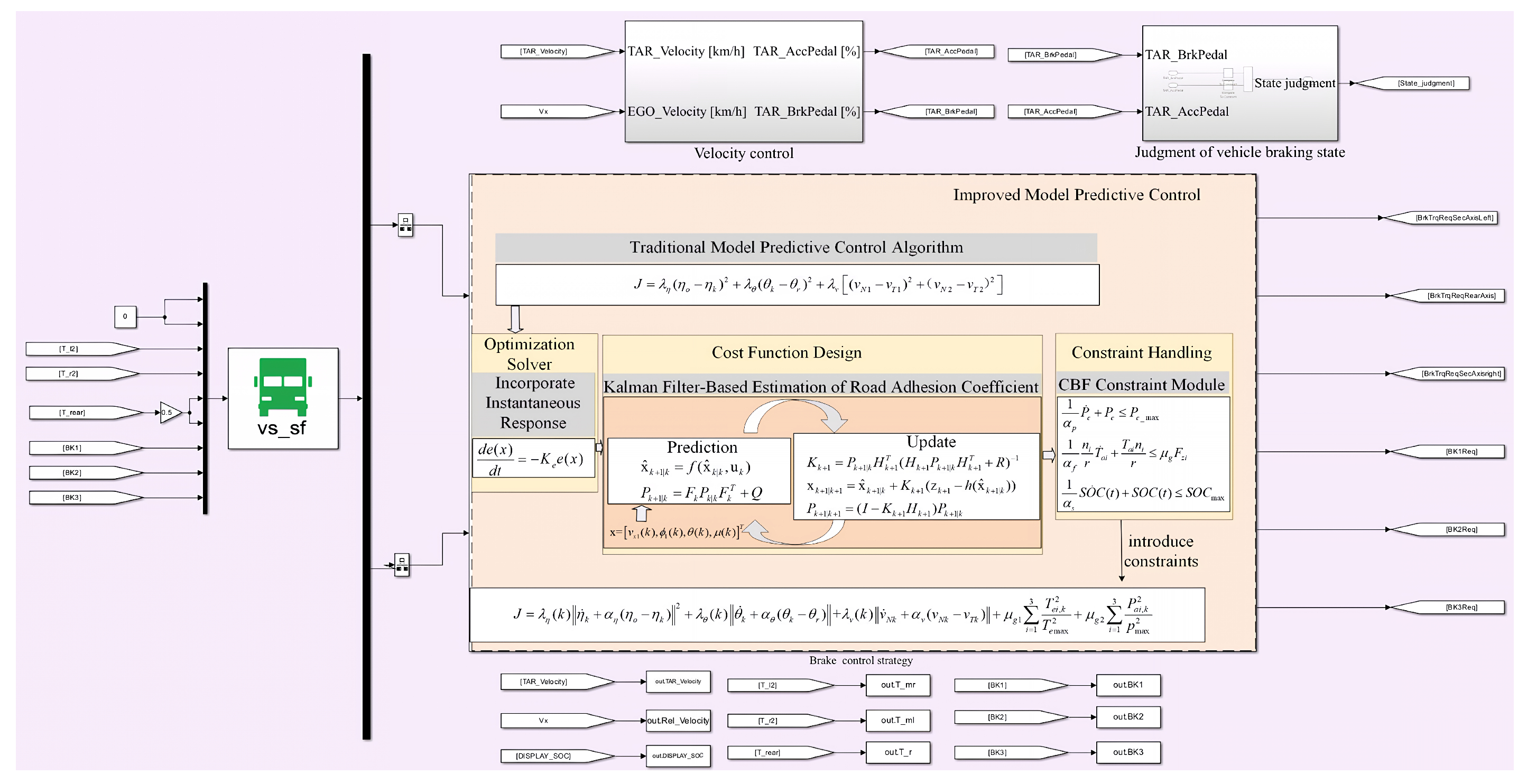
A co-simulation platform was developed in MATLAB/Simulink R2023b and the vehicle dynamics software TruckSim 2019.0 to carry out the simulation study. As shown in Figure 4, the overall framework consists of three main parts: the TruckSim data interface and acquisition module, the IMPC control strategy module inspired by instantaneous response, and the braking system control module. TruckSim is responsible for modeling the vehicle longitudinal dynamics, tire–road interaction, and driving environment, while Simulink executes the control algorithm computation and signal exchange. The two are linked through an interface that enables real-time transfer of vehicle speed, braking torque, motor torque, and battery-state information, forming a closed-loop control system.
During the simulation, the vehicle is assumed to travel on a straight and level road. The dynamic variations of aerodynamic drag and rolling resistance are neglected and treated as constants, and the signal transmission delay in the drivetrain is ignored to emphasize the dynamic response of the control algorithm. The battery temperature and internal resistance are considered constant, with only the SOC variation affecting the terminal voltage. The initial SOC is set to 80%, and the vehicle dynamic parameters are taken from the real vehicle, as listed in Table 1. The braking system module includes the motor model, battery model, and pneumatic braking model. The control strategy computes the required driving and braking torques in real time: the motor model outputs the corresponding regenerative braking torque to TruckSim, while the pneumatic braking module generates the demanded braking pressure, achieving coordinated electro-pneumatic braking control. To ensure a fair comparison, both the traditional MPC and the IMPC adopt identical prediction models, sampling periods, and constraint conditions. The optimization objective of the conventional MPC is defined by Equation (18), whereas the IMPC introduces an error-dynamic constraint, combined with the CBF soft constraint and dynamic weight adjustment mechanism, to enhance real-time performance, as defined by Equation (37).
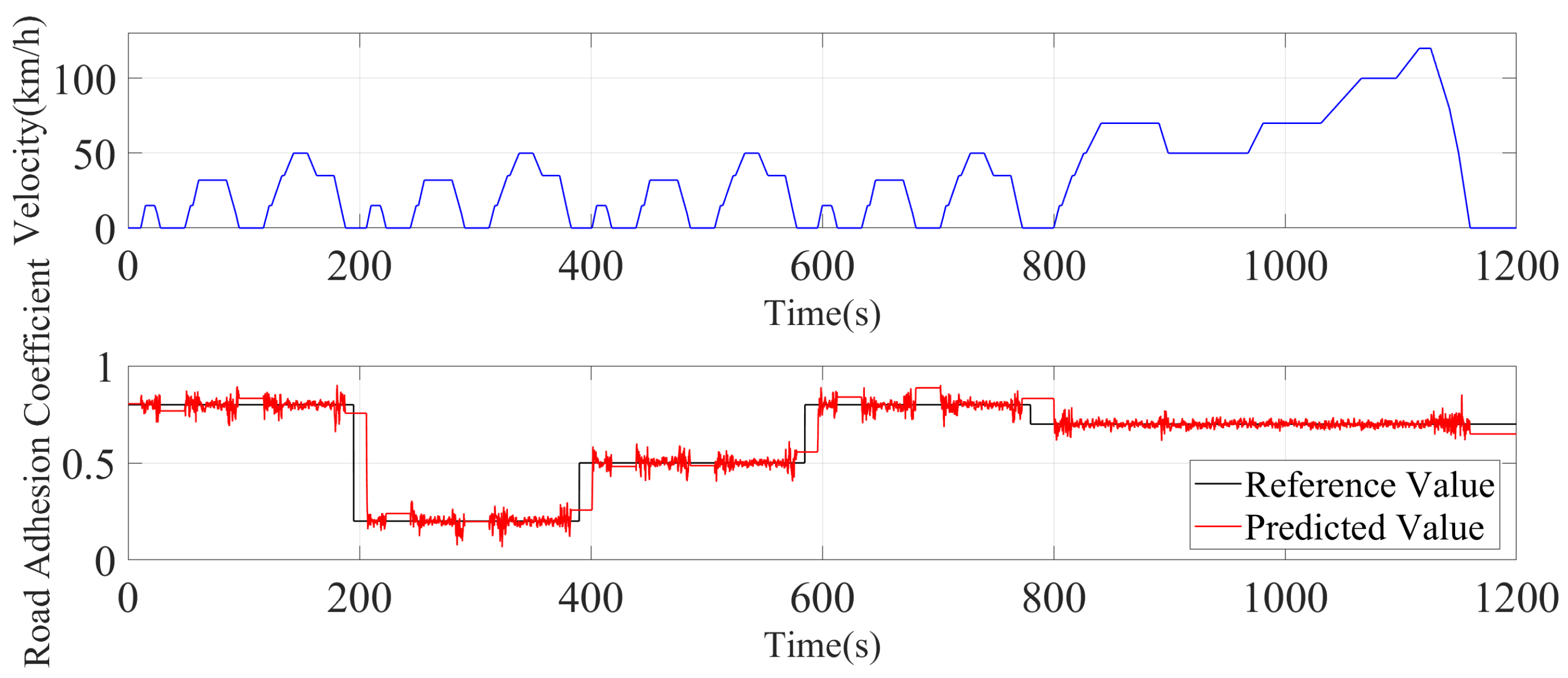
To verify the capability of the IMPC strategy in dynamically estimating the road adhesion coefficient under complex road conditions, an NEDC driving cycle was implemented in the TruckSim co-simulation platform as the vehicle operating scenario. Multiple segments with typical adhesion variations were designed to emulate the multi-condition transitions encountered on real roads. The NEDC cycle features frequent speed changes, diverse acceleration and deceleration phases, and a well-distributed braking sequence, making its dynamic characteristics well-suited to represent the longitudinal operating behavior of multi-axle electric heavy trucks under urban and mixed-road conditions. Hence, it is widely used in control-strategy verification for evaluating energy management and braking coordination performance. In this study, the road adhesion coefficients for the four urban driving segments of the NEDC cycle were set sequentially to 0.8, 0.2, 0.5, and 0.8, corresponding to dry asphalt, icy/snowy, wet, and dry concrete surfaces, respectively. The suburban segment was assigned an adhesion coefficient of 0.7, representing a dry gravel surface. This design creates a dynamic transition of road adhesion—from high to low and then gradually recovering—allowing a comprehensive evaluation of the proposed MPC-based control strategy in terms of its real-time estimation accuracy and response performance under varying driving conditions.
Based on this, a simulation test is conducted under the standard NEDC condition with the road adhesion coefficient fixed at 0.8 to further validate the improvement of the IMPC strategy in enhancing energy recovery efficiency under high-adhesion conditions.

4.1. Friction Coefficient Estimation

The estimation of the road adhesion coefficient is performed under the NEDC driving cycle, and the results are shown in Figure 5. During acceleration and deceleration phases, the estimated adhesion coefficient exhibits noticeable fluctuations, whereas it remains relatively stable during steady cruising. Overall, the proposed Improved MPC strategy provides accurate real-time adhesion estimation, which offers a reliable basis for dynamic weight adjustment and enables a balanced trade-off between energy recovery efficiency and braking stability across varying road conditions.

4.2. NEDC Driving Cycle Test

In the proposed control framework, the weight associated with the energy-recovery term in the cost function is dynamically adjusted according to the estimated road–tire friction coefficient. Specifically, it is reduced under low-friction conditions to prioritize vehicle stability and increased under high-friction conditions to maximize regenerative braking efficiency. This adaptive weighting strategy enables the controller to intelligently balance safety and efficiency in real time as road surface conditions vary. To evaluate the effectiveness of the Improved MPC algorithm in enhancing energy recovery performance, an NEDC driving-cycle simulation was conducted under high-friction conditions ( μ = 0.8 ).
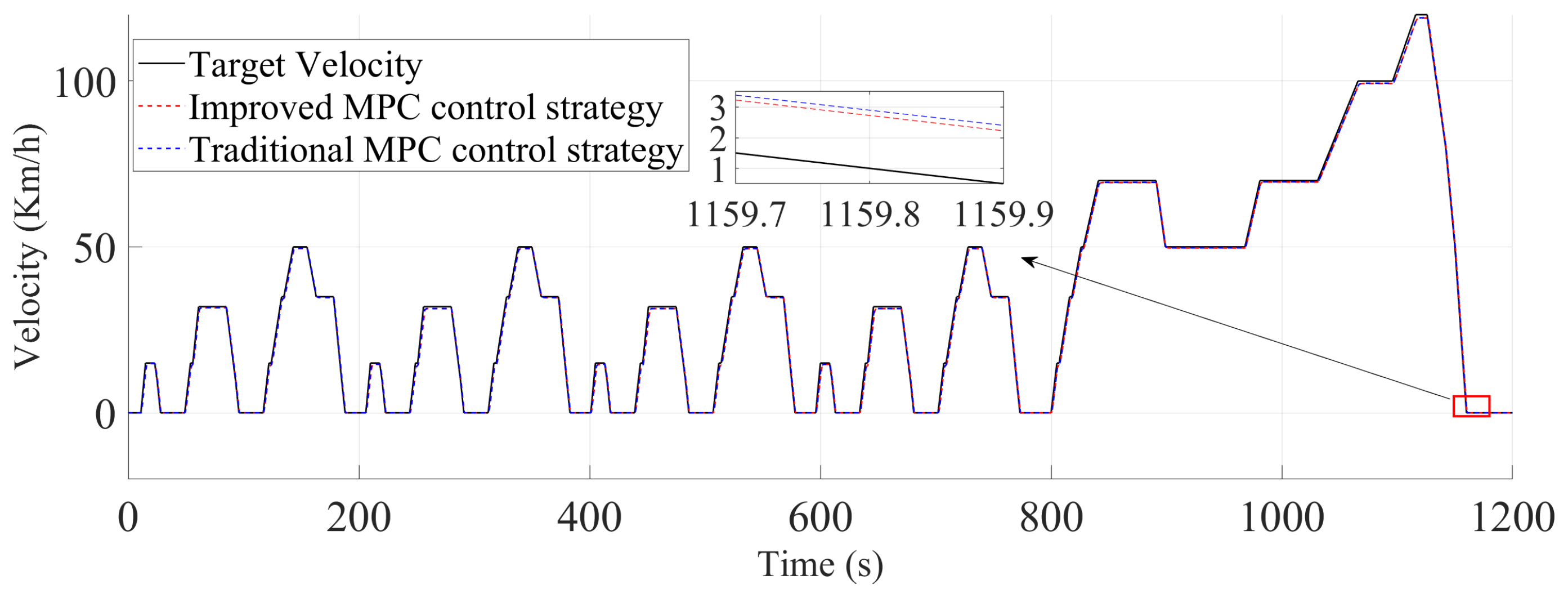
Figure 6 compares the vehicle speed-tracking performance of the conventional MPC and the improved MPC strategies, while Table 2 lists the corresponding speed-tracking RMSE values. It can be observed that the Improved MPC achieves higher tracking accuracy. This improvement mainly results from the instantaneous response mechanism, which ensures rapid error convergence and timely engagement of regenerative braking, thereby maintaining recovery continuity.
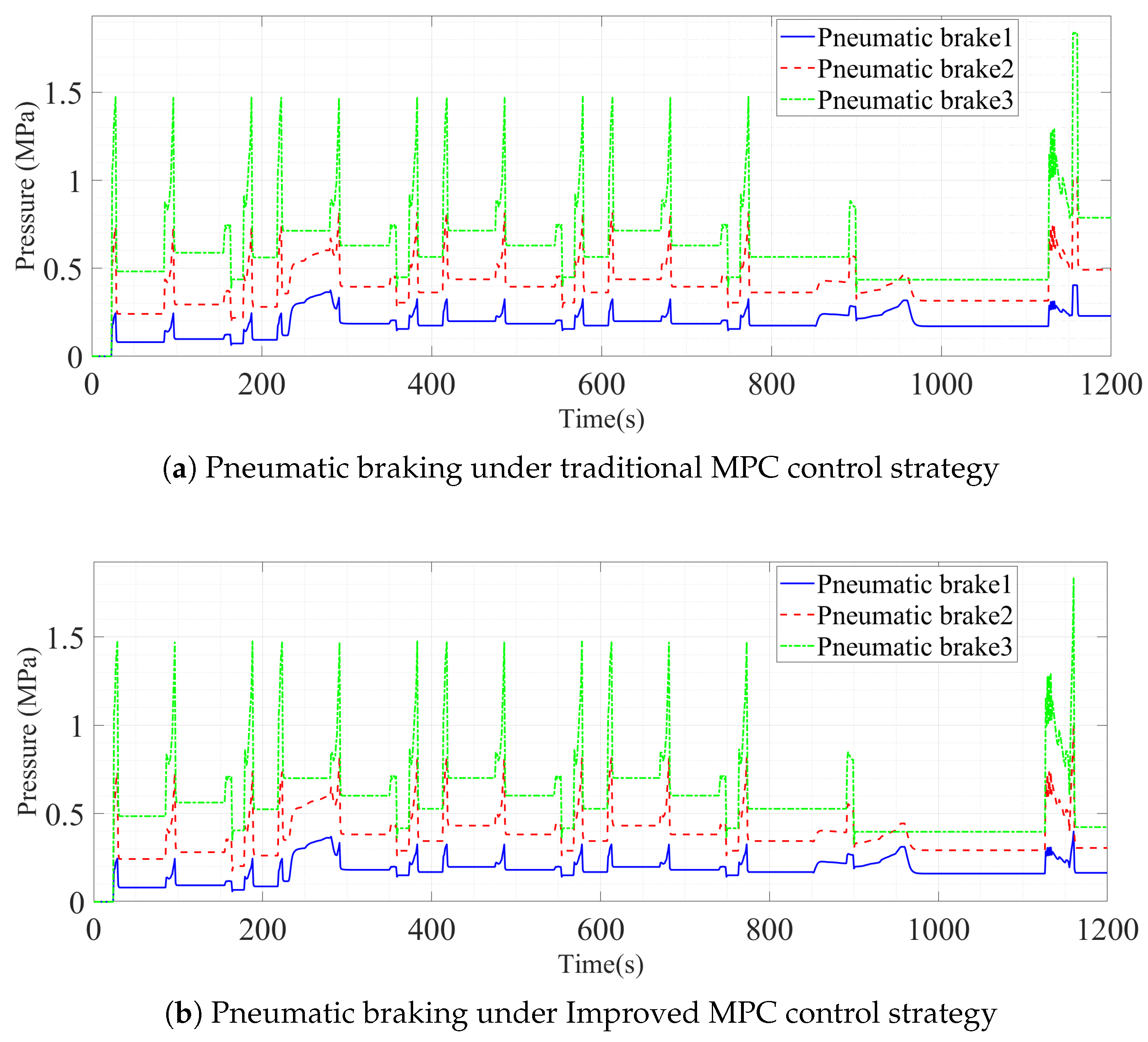
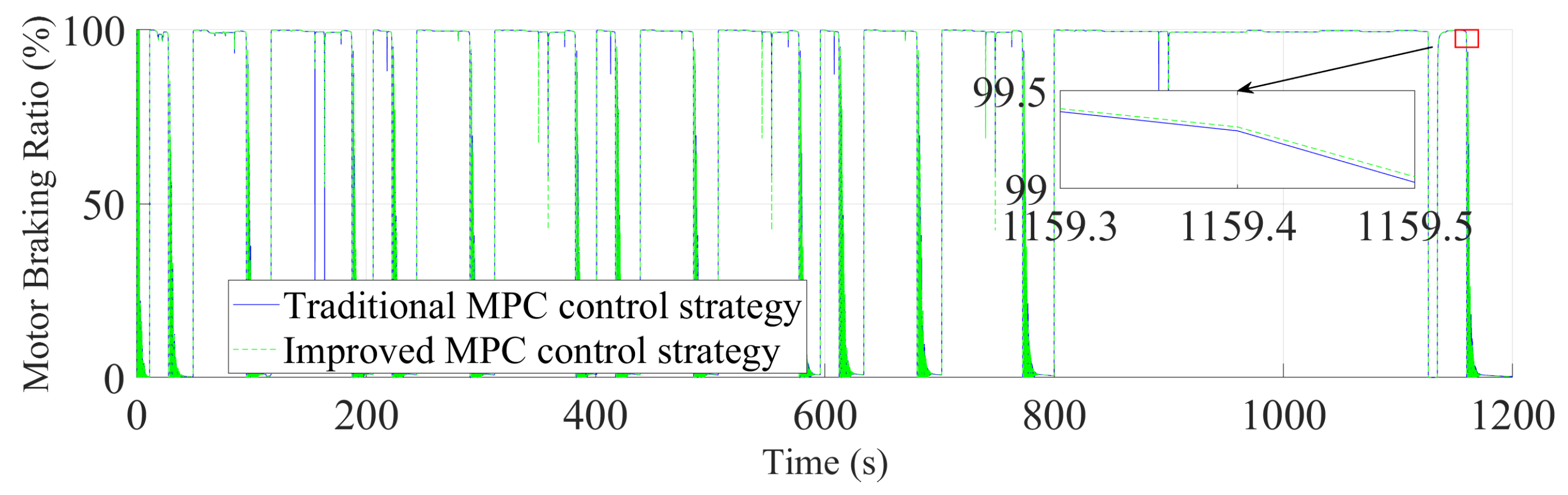
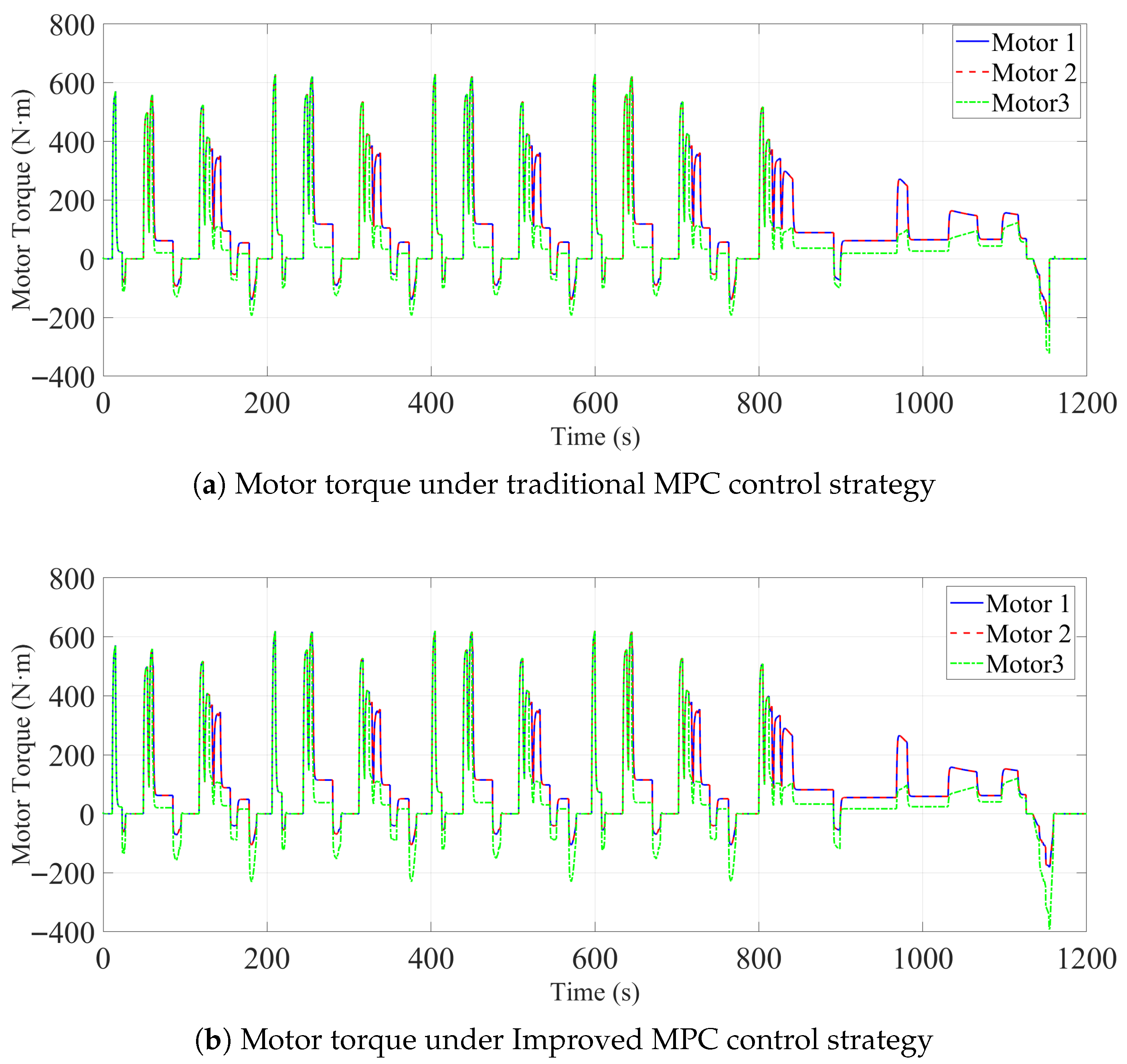
Figure 7 and Figure 8 illustrate the motor torque and pneumatic braking diagrams during vehicle braking under the two distinct control strategies, respectively, while Figure 9 compares the proportion of motor torque to total braking torque. This effect is attributable not only to the improved real-time responsiveness provided by the instantaneous response mechanism, but also to the dynamic adjustment of weighting based on real-time estimates of the road adhesion coefficient, which actively increases the weight assigned to energy recovery under high-adhesion conditions and thereby enhances overall energy recovery.
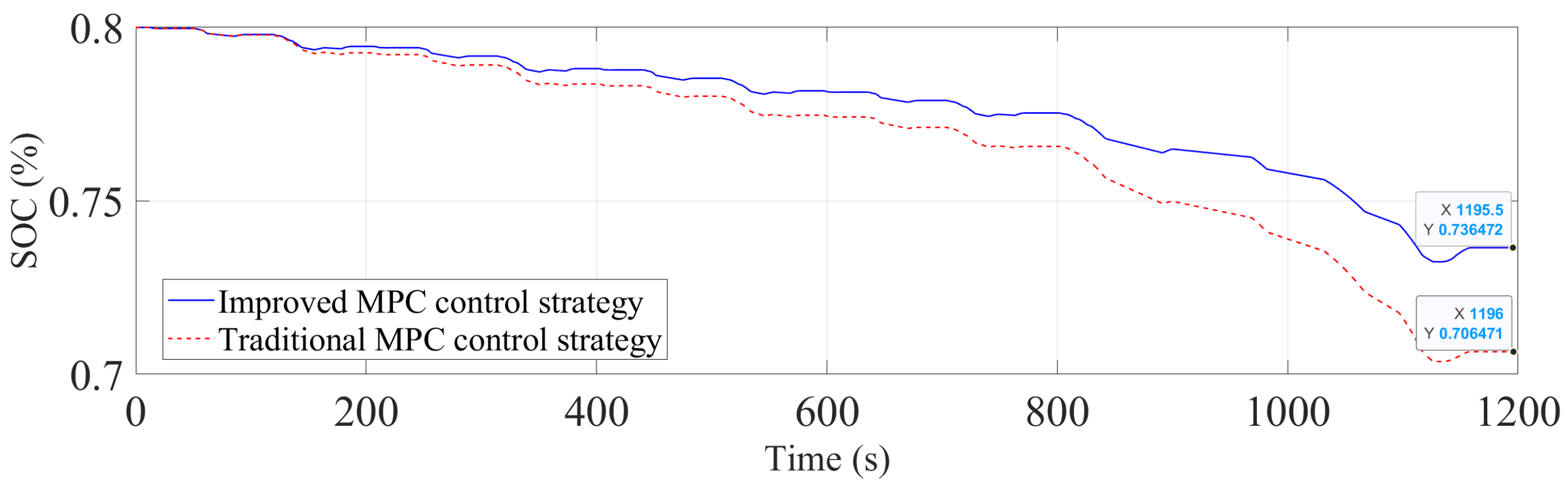
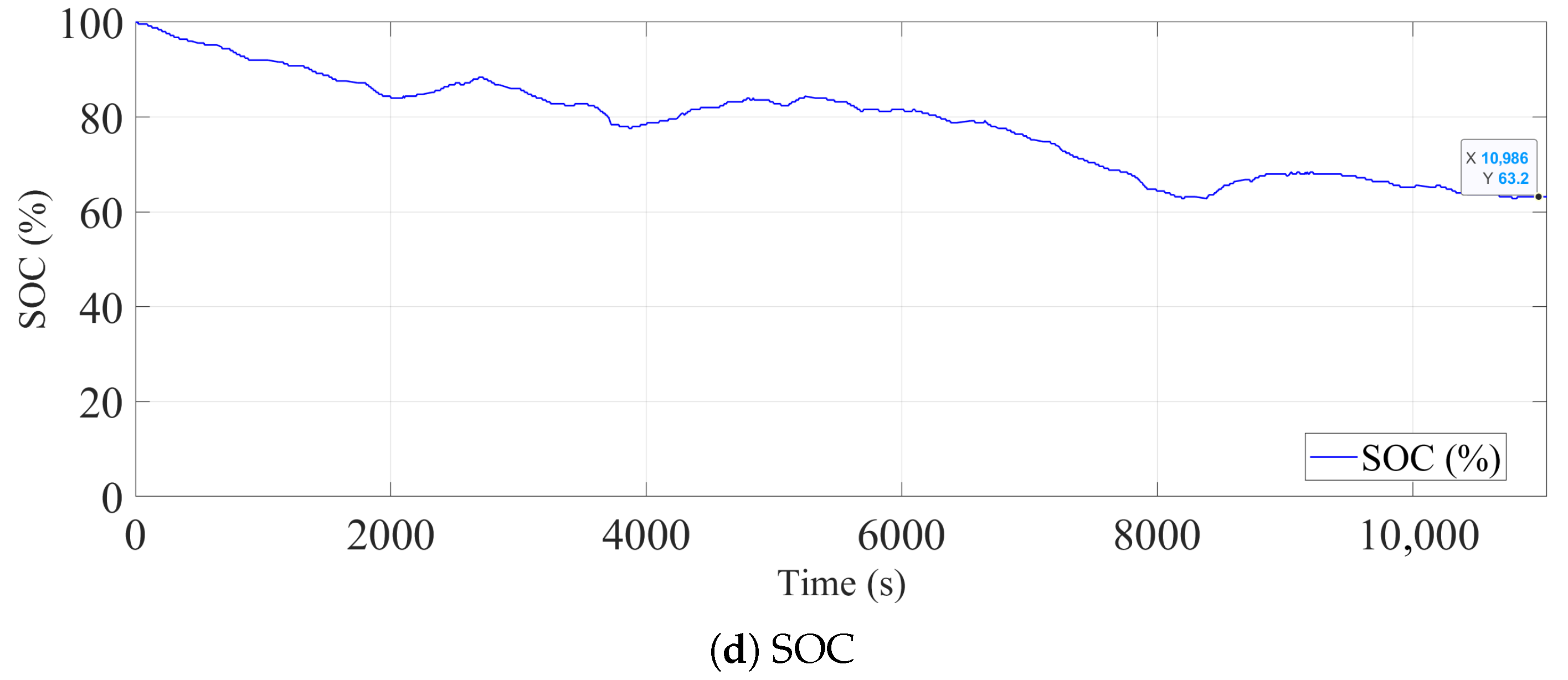
Figure 10 shows the SOC curve during braking. Under the same operating conditions, the final SOC obtained with the IMPC strategy is 73.64%, whereas that achieved with the traditional MPC is 70.64%. Therefore, the IMPC strategy yields an approximately 3% improvement in regenerative braking energy recovery compared with the traditional MPC. Although energy recovery benefits are not significant under single-cycle conditions, the strategy’s value lies not only in improving the SOC but also in ensuring system safety, smoothness, and real-time performance during braking. Braking distribution becomes more stable, energy recovery smoother, and optimization can be completed in real time within the constraints of onboard computing resources, demonstrating both engineering feasibility and application potential.

4.3. High-Intensity Braking Test

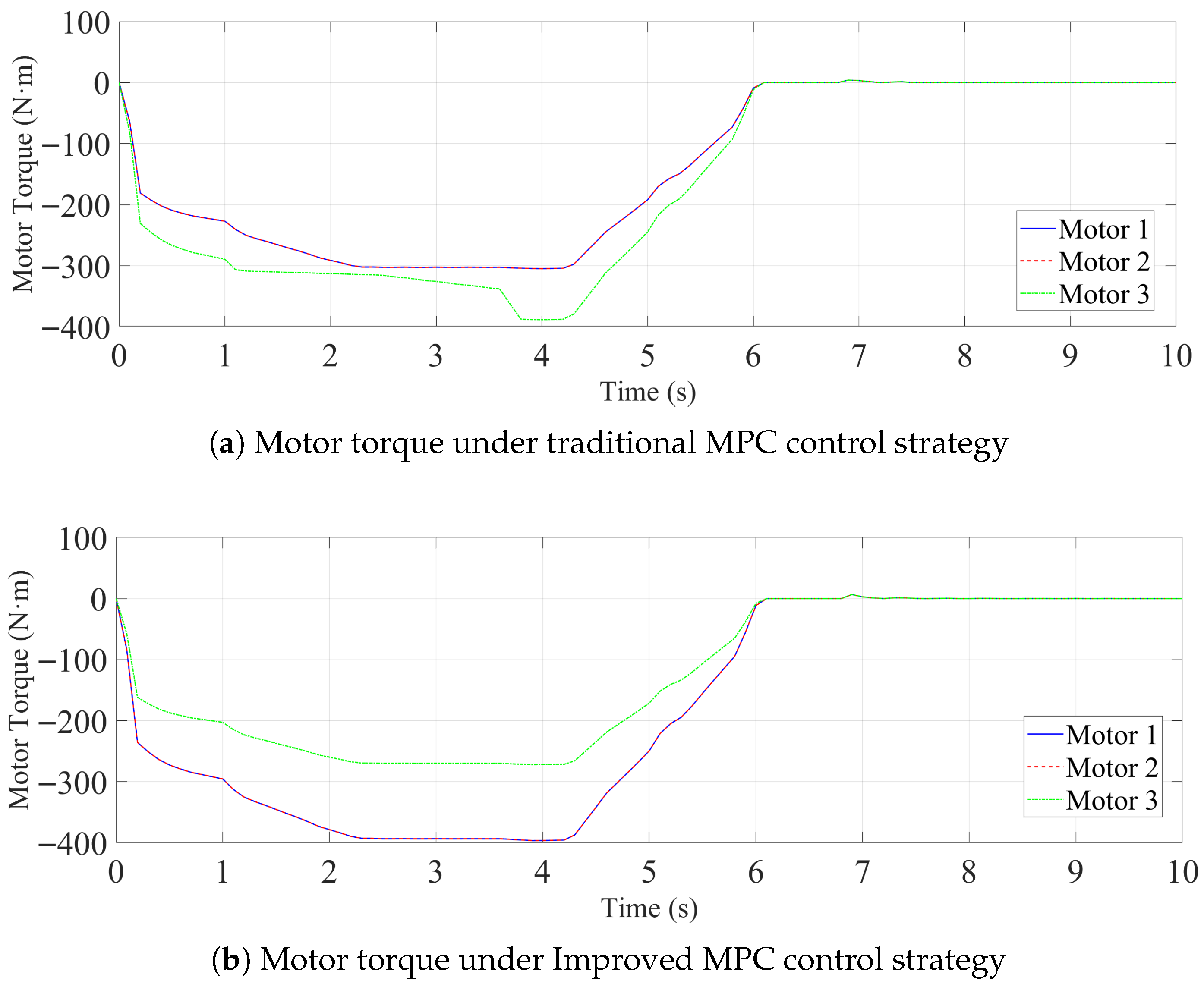
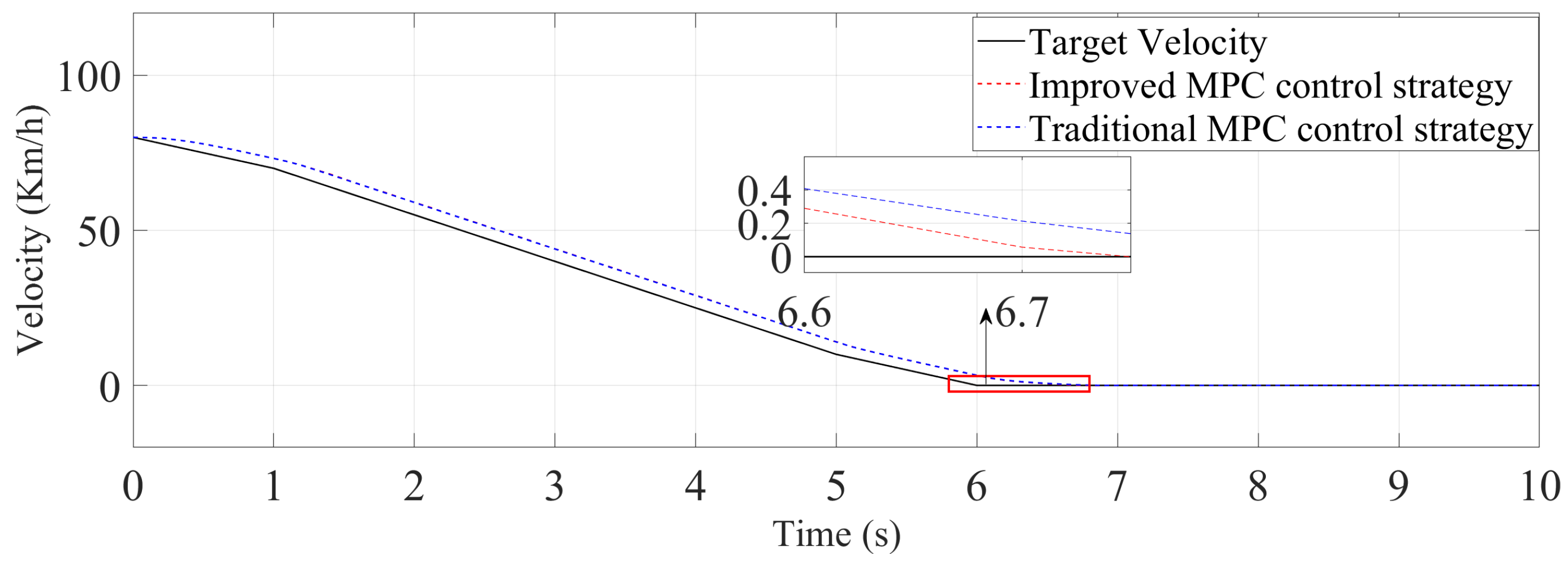
A high-intensity braking simulation was performed with an initial vehicle speed of 80 km/h to evaluate the motor torque behavior under rapid deceleration.
As illustrated in Figure 11, the motor torque curve under the Improved MPC strategy exhibits significantly smoother variation compared to that of the traditional MPC. This smooth torque transition reduces sudden stress on the braking system, thereby enhancing braking stability and ensuring safer deceleration performance.
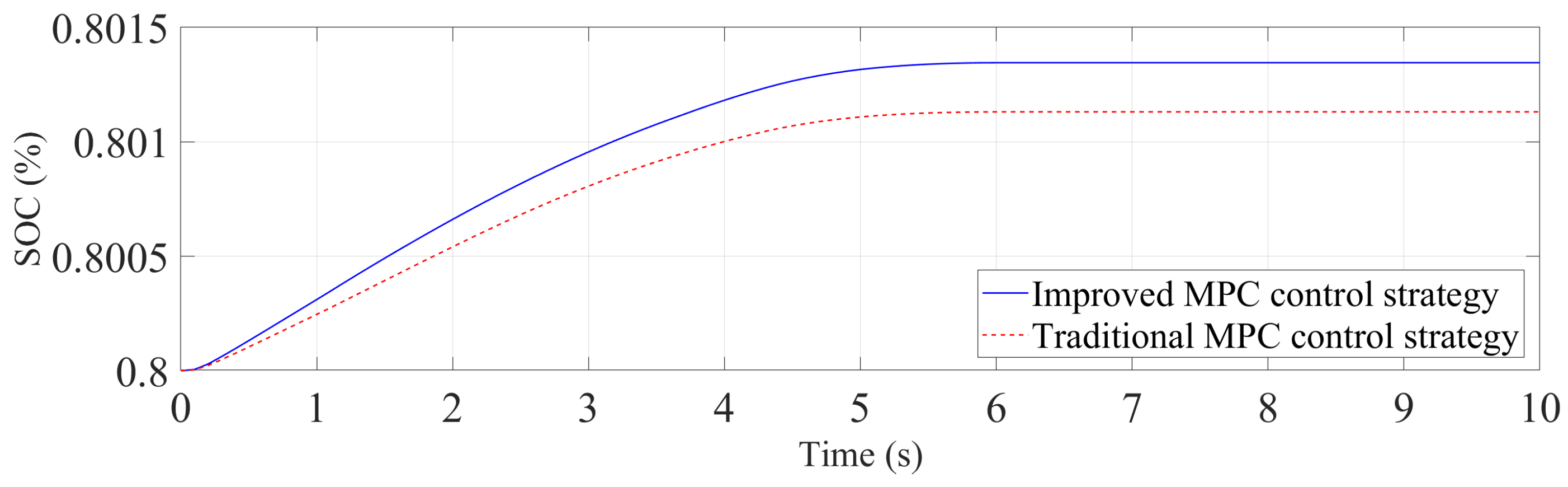
Figure 12 and Figure 13 show the vehicle speed-tracking and SOC comparison results under high-intensity braking conditions, while Table 3 presents the corresponding speed-tracking RMSE. It can be seen that, in this scenario, the vehicle using the improved MPC control strategy maintains a speed trajectory closer to the desired value and achieves a higher remaining SOC.

4.4. Summary of Simulation Results

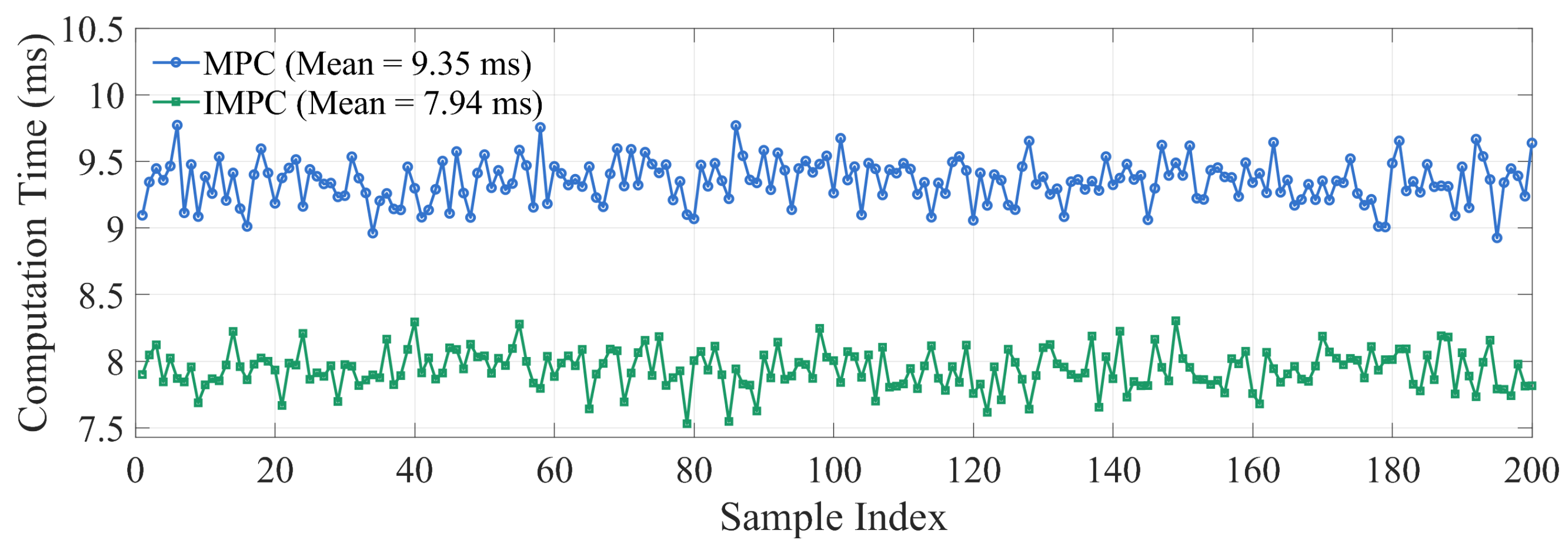
Figure 14 shows the computation time samples of MPC and IMPC under the same hardware platform (Intel i7 CPU, MATLAB/Simulink environment). It can be observed that the IMPC exhibits shorter overall computation times and smaller fluctuations. The average solving times per iteration are approximately 9.35 ms for MPC and 7.94 ms for IMPC, indicating that the improved strategy outperforms the conventional MPC in both convergence speed and real-time performance.
Based on the experimental results, the speed-tracking curves (Figure 6 and Figure 12) indicate that the Improved MPC strategy, augmented with the instantaneous response mechanism, enables the vehicle to follow the desired speed trajectory more accurately. This demonstrates enhanced dynamic responsiveness and higher accuracy in vehicle-state prediction. The friction-coefficient estimation results (Figure 5) further confirm that the Improved MPC algorithm provides accurate real-time estimation of the road–tire friction coefficient. In the NEDC simulations, the comparisons of motor torque and torque contribution ratios (Figure 7 and Figure 9) show that the proposed strategy adaptively adjusts the weighting coefficients in the cost function according to the estimated road conditions. Under high-friction scenarios, the controller places greater emphasis on regenerative braking, thereby increasing the proportion of motor torque and improving energy recovery efficiency. Moreover, Figure 11 illustrates that the Improved MPC employs control barrier functions to relax hard constraints into soft ones, resulting in smoother motor torque transitions and reduced instantaneous loading on the system.

5. Real-Vehicle Verification

5.1. Experimental Setup

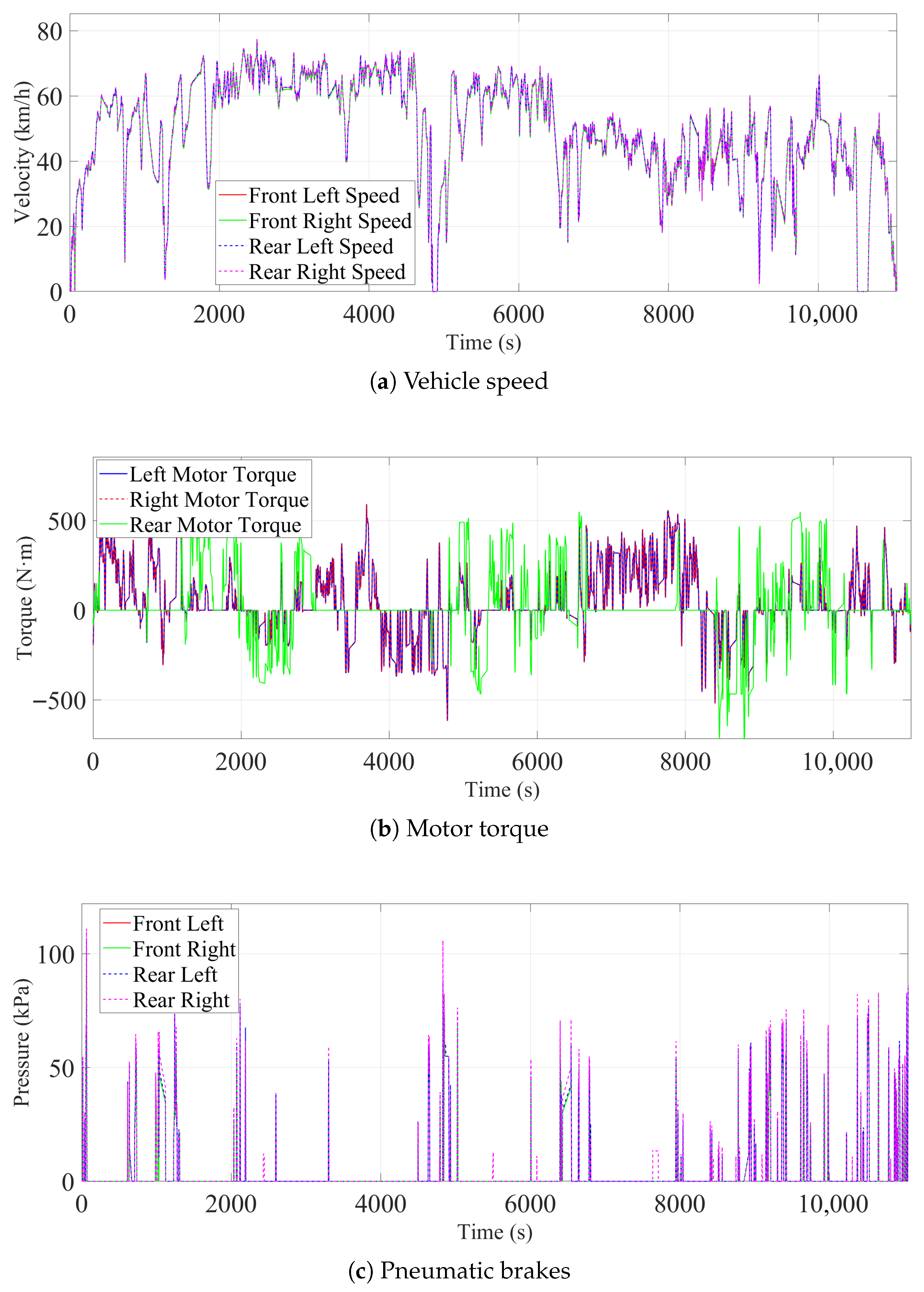
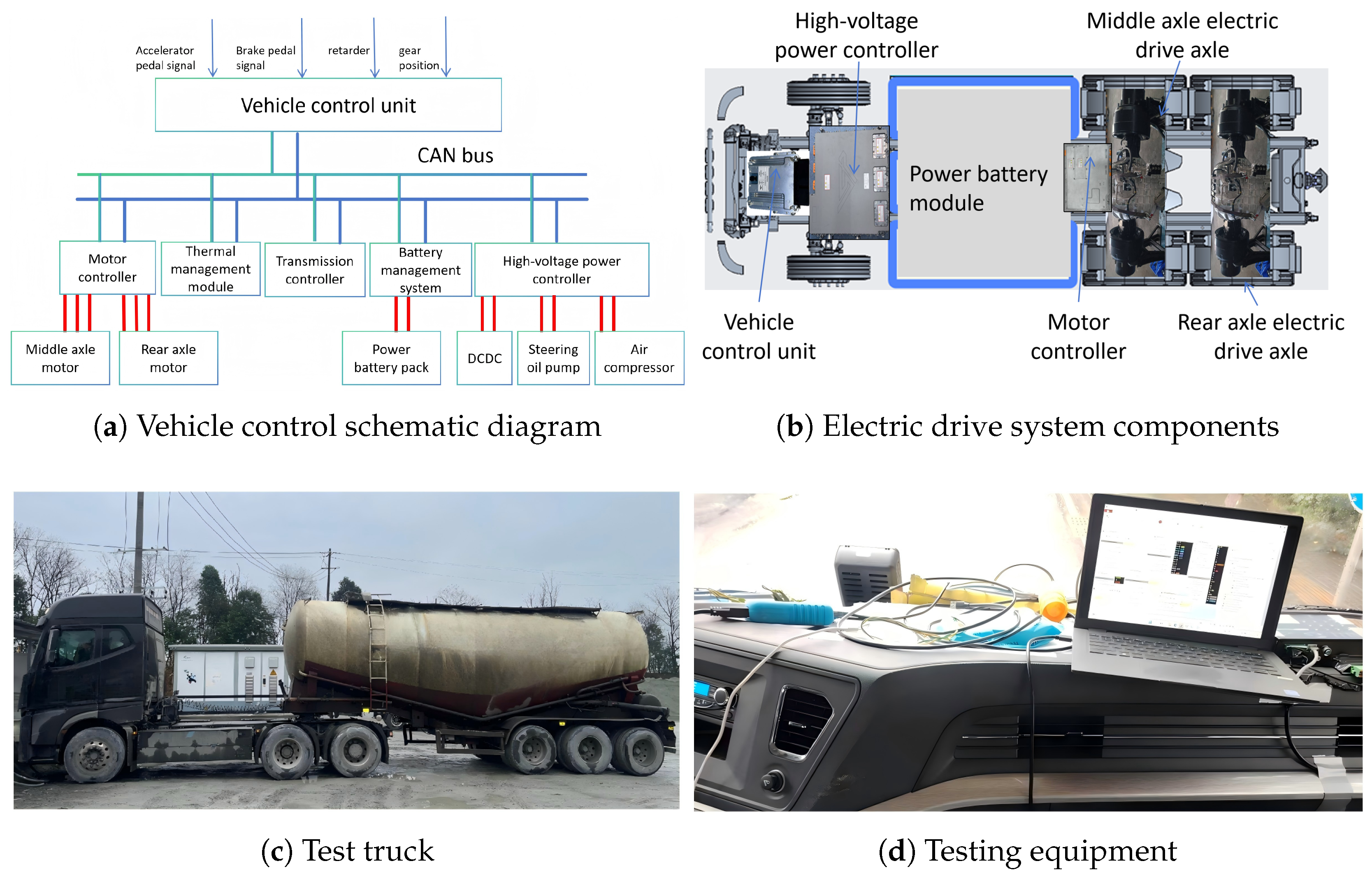
To further assess the adaptability and engineering applicability of the proposed control strategy under real-world conditions, field tests were carried out on a representative multi-axle electric heavy-duty truck. The main vehicle parameters are summarized in Table 1. The test vehicle was equipped with three drive motors and an independent pneumatic braking system, and was instrumented with a high-precision motor torque acquisition module, pneumatic pressure sensors, and a speed measurement system, enabling real-time recording of key operating variables. The test scenarios are shown in Figure 15.
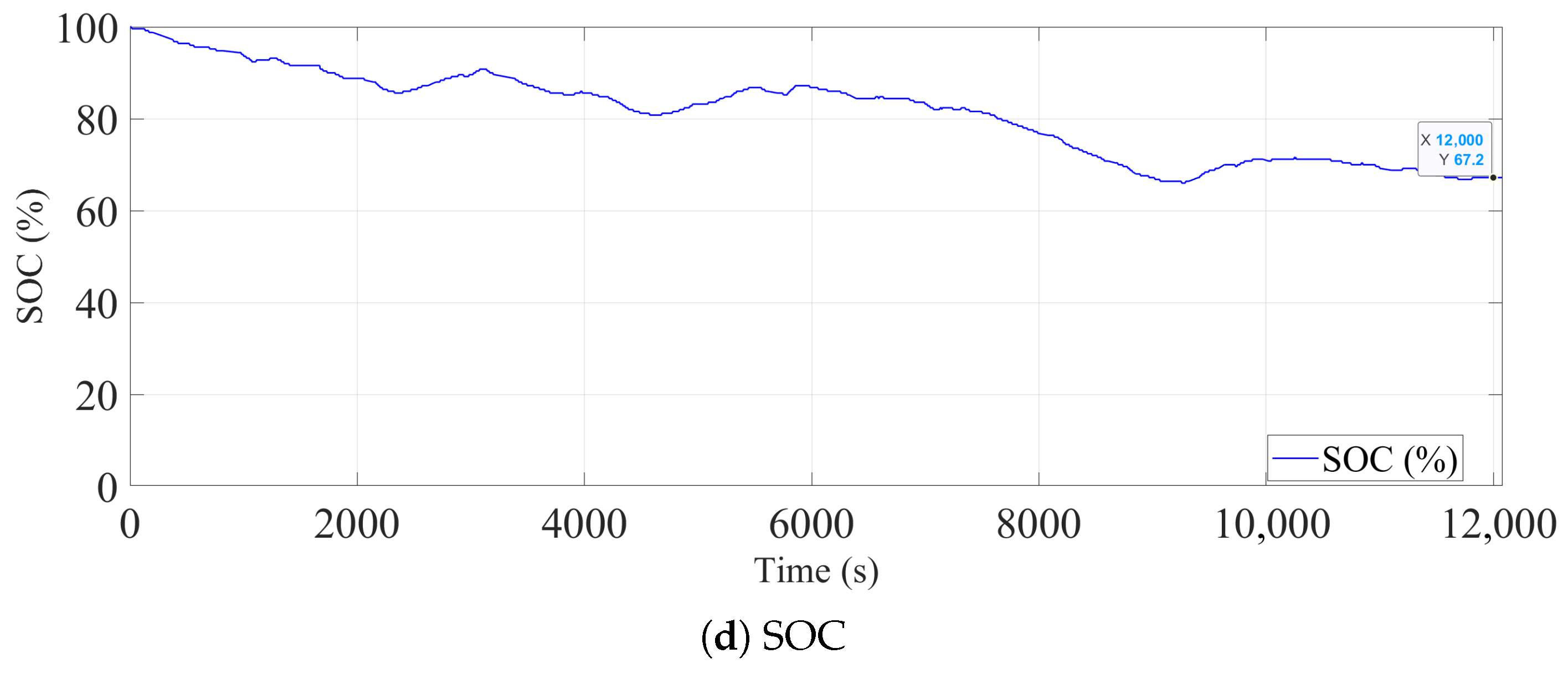
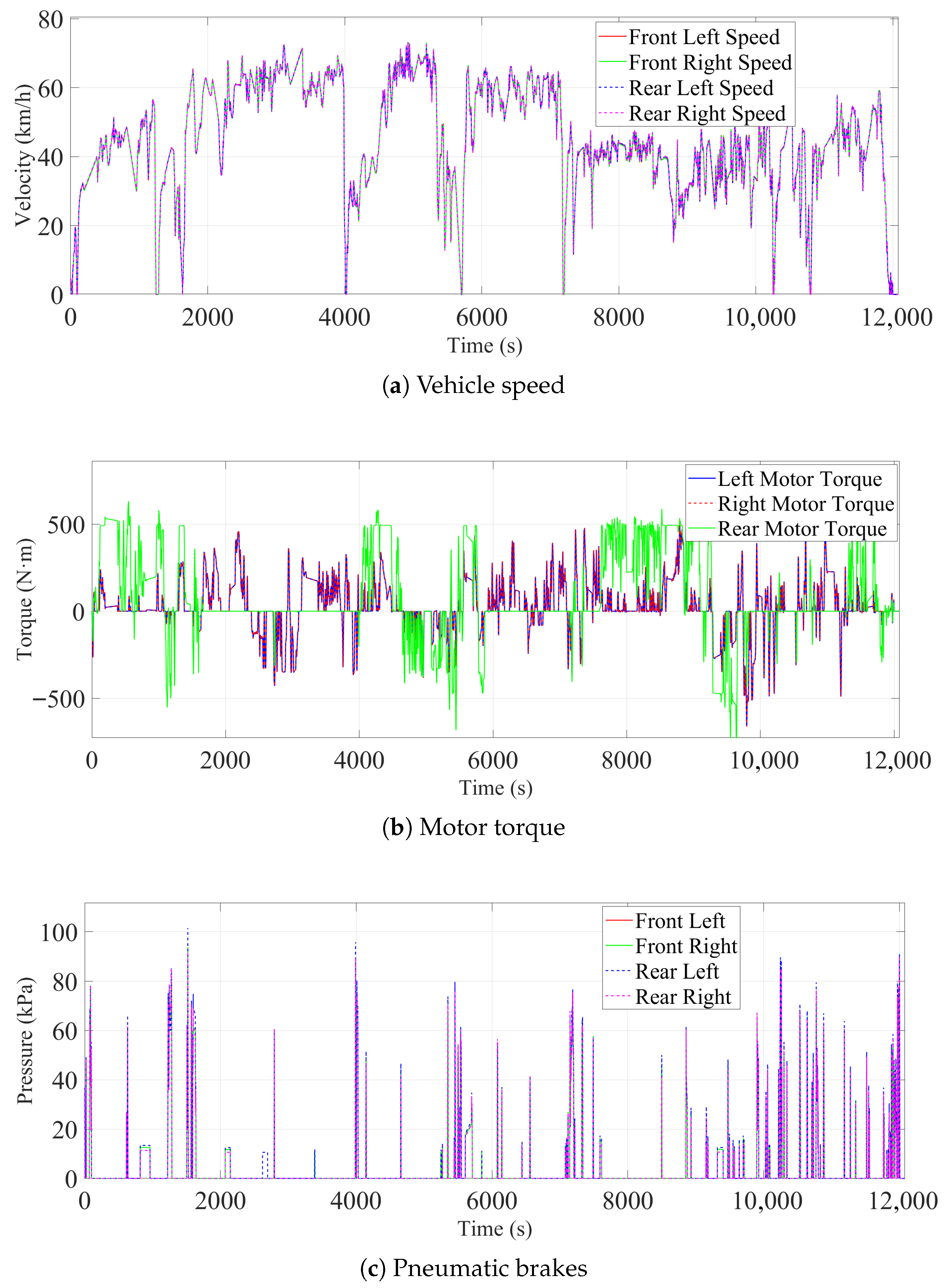
All tests were conducted with the vehicle in a fully loaded condition. The controller was configured to run the proposed IMPC-based braking energy recovery strategy and the conventional MPC strategy in separate test runs for comparative analysis. The trials were performed on a dry asphalt road over a total driving distance of 159 km, with a maximum vehicle speed of 77 km/h. Throughout the tests, operating data were continuously recorded, including battery SOC, motor torque and speed, braking pressure distribution, and wheel speeds.

5.2. Experimental Results

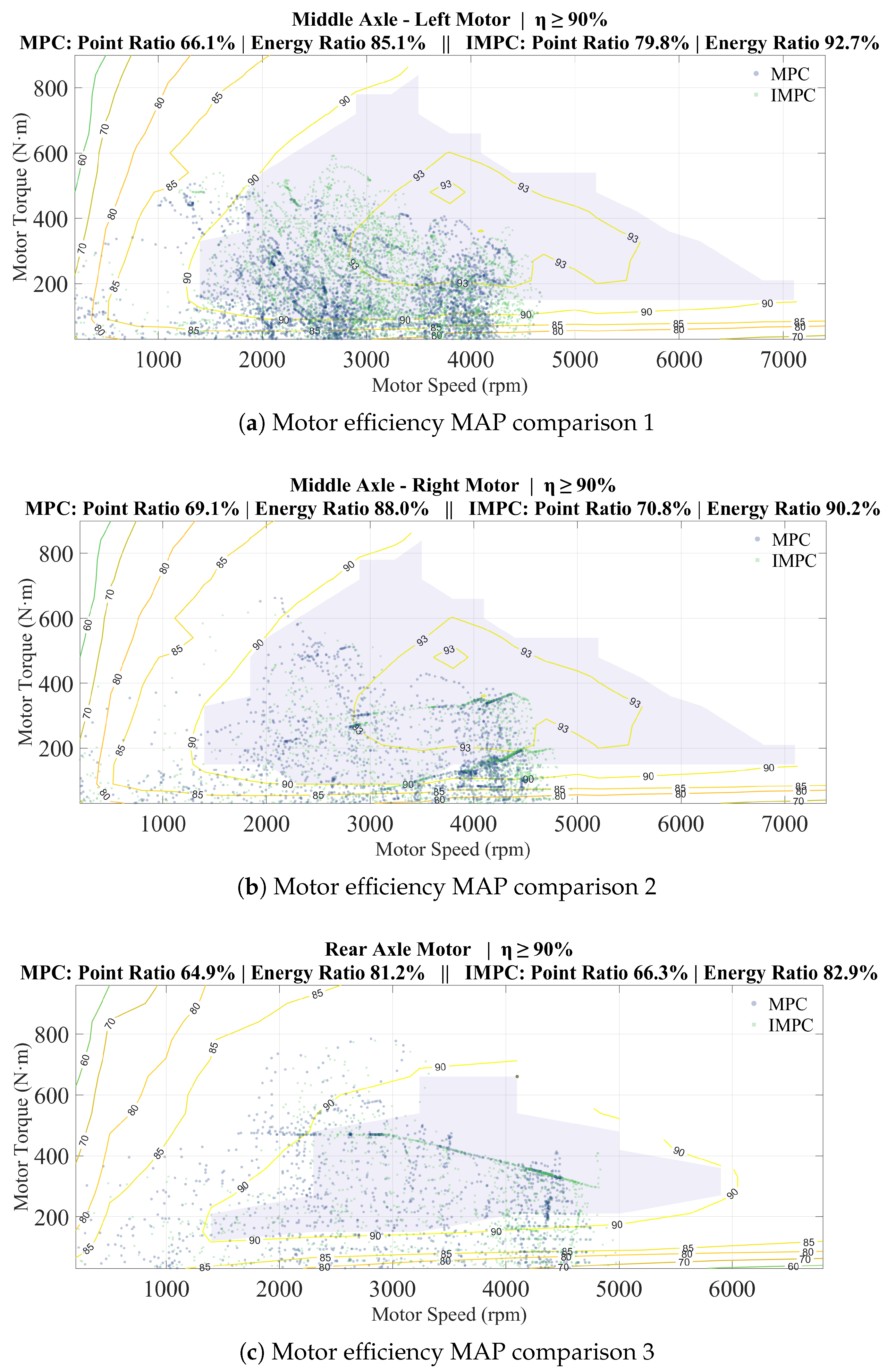
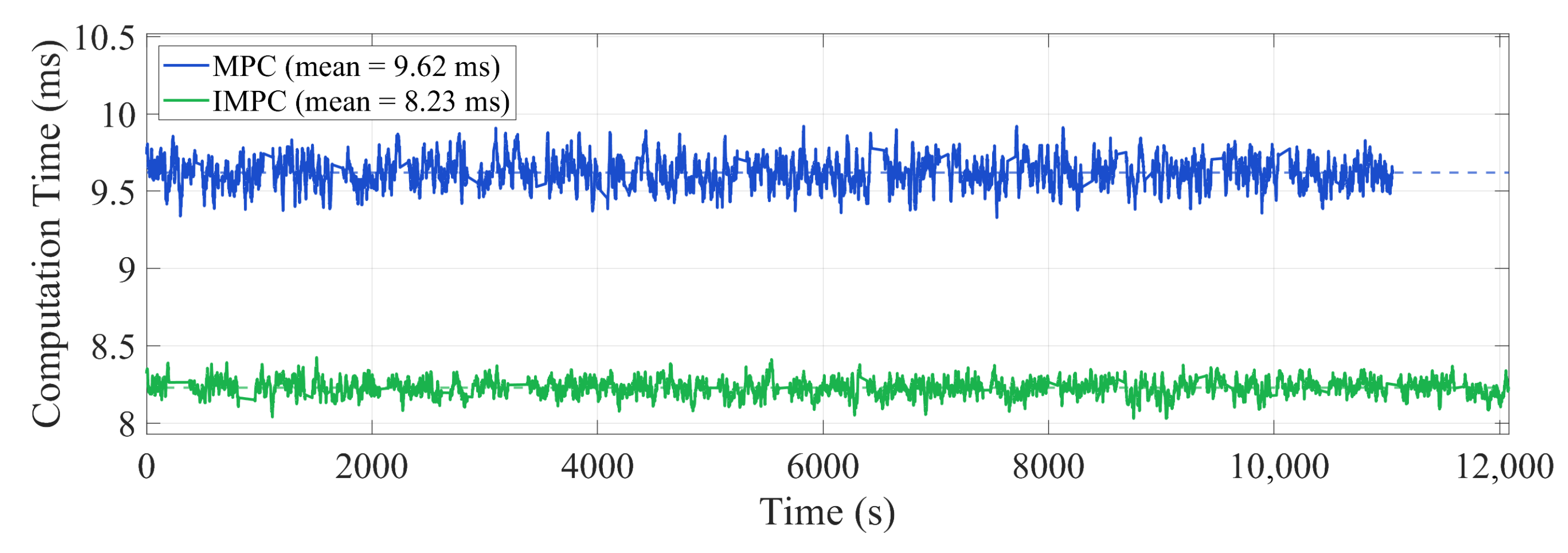
Figure 16 and Figure 17 demonstrate that the IMPC strategy achieves significant improvements in the overall performance of the braking energy recovery system compared to the traditional strategy. Under the improved strategy, the overall air pressure is lower with reduced fluctuations, indicating that electric braking effectively replaces pneumatic braking, particularly showing distinct advantages during mid-braking phases. This lays the foundation for enhancing energy recovery efficiency. The most intuitive change is observed in the SOC curve. The SOC decline rate under the improved strategy is markedly slowed, resulting in a 4% increase in the final residual SOC. This demonstrates a substantial improvement in the average energy recovery efficiency across the entire cycle. Under the improved strategy control, the speeds of all wheels are coordinated and consistent, with the speed curve exhibiting a smooth descent without any instability or jitter. This ensures a smooth and safe braking process. The test results fully validate the effectiveness and advanced nature of the improved strategy in simultaneously optimizing energy recovery efficiency and braking stability. Figure 18 shows the efficiency maps of the middle-axle and rear-axle motors under different speed–torque conditions, comparing MPC and IMPC operating points. The high-efficiency region is mainly concentrated in the medium-speed and medium-torque range. Compared with MPC, IMPC yields denser operating points within high-efficiency zones, reflecting better torque distribution and energy recovery. Overall, IMPC increases both the proportion of high-efficiency points and energy share, demonstrating improved energy utilization through dynamic weight adjustment and coordinated constraint control. Figure 19 shows the computation time of the MPC and IMPC controllers during the real-vehicle test. Both strategies maintain good real-time performance, while the IMPC exhibits shorter and more stable computation times. The average computation times are 9.62 ms and 8.23 ms for MPC and IMPC, respectively, indicating that the improved controller achieves better real-time performance under real driving conditions.
In addition, the simulation and experimental validations in this study are complementary. The simulation uses a standardized NEDC cycle to ensure repeatability and fair comparison, while the real-vehicle tests are conducted under realistic A–B driving conditions that cannot be exactly replicated. Consequently, a point-by-point comparison would primarily reflect external disturbances rather than intrinsic controller performance. The consistent trends observed in vehicle speed, braking smoothness, and SOC evolution confirm that the proposed IMPC strategy achieves reliable control and energy recovery performance under both standardized and real-world conditions.

6. Conclusions

This study proposes an improved model predictive control strategy to address the challenge of balancing energy recovery efficiency and vehicle stability during the braking process of multi-axle heavy-duty trucks. The method introduces an instantaneous-response mechanism to reduce control delay and maintain high motor participation under abrupt braking conditions. By integrating an extended Kalman filter EKF for real-time estimation of the road adhesion coefficient and dynamically adjusting the optimization weights, the strategy increases energy recovery on high-adhesion roads while ensuring stability on low-adhesion surfaces. A control barrier function CBF is further applied to convert hard constraints into soft ones, preventing interruptions in energy recovery and achieving smoother braking transitions.
Simulation results under the NEDC driving cycle demonstrate that the proposed strategy provides better speed-tracking performance and yields an average SOC improvement of about 3%. Real-vehicle experiments further verify that it enables coordinated pressure distribution, suppresses SOC decline, and maintains wheel-speed synchronization. These findings confirm the strategy’s capability to ensure system safety, stability, and high energy recovery efficiency in multi-axle electric heavy trucks. Although the proposed method performs well under typical conditions and limited load scenarios, future work will extend the validation to more complex road environments and real-world driving conditions. Research will also explore vehicle–infrastructure cooperative control for fleet-level energy recovery optimization, as well as intelligent control approaches such as deep reinforcement learning to complement MPC, further enhancing energy recovery efficiency and control robustness, and promoting the large-scale and industrial application of regenerative braking technology in multi-axle electric heavy-duty trucks.

Abbreviations

This section reports the meaning of the abbreviations, in alphabetical order.
CBFControl Barrier Function
CGCenter of Gravity
CPUCentral Processing Unit
EKFExtended Kalman Filter
EMBElectro-Mechanical Brake (system)
EVElectric Vehicle
IMPCImproved Model Predictive Control
MAPMotor Efficiency Map
MPCModel Predictive Control
NEDCNew European Driving Cycle
PSOParticle Swarm Optimization
RMSERoot-Mean-Square Error
SOCState of Charge
VCUVehicle Control Unit

Author Contributions

Conceptualization, L.C. and Y.L.; methodology, L.C. and Y.L.; software, P.Y. and X.Y.; validation, L.C. and P.Y.; formal analysis, L.C.,Y.L. and L.Y.; investigation, P.Y. and G.H.; resources, Y.L. and P.Y.; data curation, L.C. and P.Y.; writing—original draft preparation, L.C.; writing—review and editing, Y.L., J.F. and S.L.; visualization, L.C.; supervision, J.F.; project administration, Y.L.; funding acquisition, Y.L. All authors have read and agreed to the published version of the manuscript.

Funding

This work was supported in part by Beijing Municipal Natural Science Foundation under Grant L241054, in part by the National Engineering Research Center of Wheeled Vehicles Foundations (2023NELEV001), in part by the National Key Laboratory of Advanced Off-Road System Technology under Grant No. 2023-JCJQ-LB-037-09, in part by Anhui Provincial Science and Technology Breakthrough Plan (202423d12050009).

Data Availability Statement

The raw data supporting the conclusions of this article will be made available by the authors on request.

Conflicts of Interest

The authors Pengxiang Yan, Yi Liu and Jingjing Fan were employed by the Jiangsu Industrial Innovation Center of Intelligent Equipment Co., Ltd. The author Pengxiang Yan was also employed by the Western China Science City Innovation Center of Intelligent and Connected Vehicles (Chongqing) Co., Ltd. The author Yi Liu was also employed by the Yulin Saiyi Intelligent Technology Co., Ltd. The authors Xiaopeng Yang and Liyu Yang were employed by the China North Vehicle Research Institute. The author Guanfu Huang was employed by the Yulin Innovation Center of Intelligent Equipment Co., Ltd. The authors declare that the research was conducted in the absence of any commercial or financial relationships that could be construed as a potential conflict of interest.

References

  1. Hamada, A.T.; Orhan, M.F. An overview of regenerative braking systems. J. Energy Storage 2022, 52, 105033. [Google Scholar] [CrossRef]
  2. Dou, G.; Ke, J.; Liang, J.; Wang, J.; Li, J.; Liu, Q.; Hao, C. Analysis of the Actual Usage and Emission Reduction Potential of Electric Heavy-Duty Trucks: A Case Study of a Steel Plant. Atmosphere 2023, 14, 1562. [Google Scholar] [CrossRef]
  3. Xu, Y.Y.; Gong, D.H.; Huang, Z.G.; Yang, L. Life Cycle Carbon Reduction Benefits of Electric Heavy-Duty Truck to Replace Diesel Heavy-Duty Truck. Environ. Sci. 2024, 45, 3119–3128. [Google Scholar] [CrossRef]
  4. Gunawan, T.A.; Monaghan, R.F.D. Techno-econo-environmental Comparisons of Zero- and Low-Emission Heavy-Duty Trucks. Appl. Energy 2022, 308, 118327. [Google Scholar] [CrossRef]
  5. Zhang, X.; Lin, Z.; Crawford, C.; Li, S. Techno-economic comparison of electrification for heavy - duty trucks in China by 2040. Transp. Res. Part D Transp. Environ. 2022, 102, 103152. [Google Scholar] [CrossRef]
  6. Jahangir Samet, M.; Liimatainen, H.; van Vliet, O.P.R.; Pöllänen, M. Road Freight Transport Electrification Potential by Using Battery Electric Trucks in Finland and Switzerland. Energies 2021, 14, 823. [Google Scholar] [CrossRef]
  7. Pardhi, S.; Chakraborty, S.; Tran, D.-D.; El Baghdadi, M.; Wilkins, S.; Hegazy, O. A Review of Fuel Cell Powertrains for Long-Haul Heavy-Duty Vehicles: Technology, Hydrogen, Energy and Thermal Management Solutions. Energies 2022, 15, 9557. [Google Scholar] [CrossRef]
  8. Zhang, J.; Lü, C.; Li, Y.; Gou, J.; He, C. Status Quo and Prospect of Regenerative Braking Technology in Electric Cars. Automot. Eng. 2014, 36, 911–918. [Google Scholar]
  9. Xue, X.; Yan, Z.; Prada, D.N.; Jia, G.; Popuri, S.S.; Vijayagopal, R.; Li, Y.; Sari, R.L.; Liu, C.; He, X.; et al. Life Cycle Economic and Environmental Assessment for Emerging Heavy-Duty Truck Powertrain Technologies in China: A Comparative Study of Battery Electric, Fuel Cell Electric, and Hydrogen Combustion Engine Trucks. Environ. Sci. Technol. 2025, 59, 2018–2030. [Google Scholar] [CrossRef]
  10. Kumar, C.S.N.; Subramanian, S.C. Cooperative control of regenerative braking and friction braking for a hybrid electric vehicle. Proc. Inst. Mech. Eng. Part D J. Automob. Eng. 2016, 230, 103–116. [Google Scholar] [CrossRef]
  11. Yan, P.; Yang, L.; Zhang, J.; Chen, C.; Gao, Q.; Liu, Y. Reinforcement Learning-Based Braking Energy Recovery Control Strategy for Multi-axle Electric Heavy-Duty Truck Vehicles. In Proceedings of 2024 International Conference on Artificial Intelligence and Autonomous Transportation; (AIAT 2024); Lecture Notes in Electrical Engineering; Springer: Singapore, 2025; Volume 1392. [Google Scholar] [CrossRef]
  12. Xu, G.; Peng, M.; Huang, Z. A Novel Tire-Road Adhesion Stability Model and Control Strategy for Centralized Drive Pure Electric Vehicles. In Proceedings of the 2021 IEEE Intelligent Vehicles Symposium (IV), Nagoya, Japan, 11–17 July 2021; IEEE: Piscataway, NJ, USA, 2021; pp. 42–48. [Google Scholar] [CrossRef]
  13. Li, X.; Ma, J.; Zhao, X.; Wang, L. Study on Braking Energy Recovery Control Strategy for Four-Axle Battery Electric Heavy-Duty Trucks. J. Adv. Transp. 2023, 2023, 1868528. [Google Scholar] [CrossRef]
  14. Xu, S.; Li, J.; Zhang, X.; Zhu, D. Research on Optimal Driving Torque Control Strategy for Multi-Axle Distributed Electric Drive Heavy-Duty Vehicles. Sustainability 2024, 16, 7231. [Google Scholar] [CrossRef]
  15. Wang, X.; Wong, P.K.; Guo, R.; Sun, Z. Design of an Omnidirectional, Multi-Axle, Distributed-Drive Electric Truck with Mecanum Wheels and Direct Yaw Moment Controller. Int. J. Heavy Veh. Syst. 2024, 31, 721–751. [Google Scholar] [CrossRef]
  16. Liu, J.; Shi, C.; Lin, B.; Huang, H. Design and Steering Angle Control of Steering-by-Wire Hydraulic Systems for Multi-Axle Vehicles. China Mech. Eng. 2022, 33, 1741–1750. [Google Scholar] [CrossRef]
  17. Xiong, J.; Song, J.; Zhang, Z. Electric Vehicle Braking Energy Recovery Control Method Integrating Fuzzy Control and Improved Firefly Algorithm. PLoS ONE 2025, 20, e0320537. [Google Scholar] [CrossRef]
  18. Zu, E.-H.; Shu, M.-H.; Huang, J.-C.; Lin, H.-T. Energy Recovery Decision of Electric Vehicles Based on Improved Fuzzy Control. Processes 2024, 12, 2919. [Google Scholar] [CrossRef]
  19. Li, Y.; Wu, Z.; Lv, W. Optimisation of Braking Energy Recovery for Rear-Drive Electric Vehicles Based on Fuzzy Control. Int. J. Veh. Des. 2023, 92, 93–112. [Google Scholar] [CrossRef]
  20. Liu, F. A PMSM Fuzzy Logic Regenerative Braking Control Strategy for Electric Vehicles. J. Intell. Fuzzy Syst. 2021, 41, 4873–4881. [Google Scholar] [CrossRef]
  21. Xu, K.; Huang, Z.; Xu, G. Regenerative Braking with Direct Adhesion Control for Distributed Drive Electric Vehicles. In Proceedings of the 2021 IEEE International Intelligent Transportation Systems Conference (ITSC), Indianapolis, IN, USA, 19–22 September 2021; pp. 1664–1669. [Google Scholar] [CrossRef]
  22. Chang, J.J.; Zhang, Y.F. Research on Optimization Control Strategy for Braking Energy Recovery of a Battery Electric Vehicle Based on EMB System. Automot. Eng. 2022, 44, 64–72. [Google Scholar]
  23. Liu, H.; Wang, H.; Yu, M.; Wang, Y.; Luo, Y. Long Short-Term Memory–Model Predictive Control Speed Prediction-Based Double Deep Q-Network Energy Management for Hybrid Electric Vehicle to Enhance Fuel Economy. Sensors 2025, 25, 2784. [Google Scholar] [CrossRef]
  24. Li, Y.; Hao, G. Energy-Optimal Adaptive Control Based on Model Predictive Control. Sensors 2023, 23, 4568. [Google Scholar] [CrossRef] [PubMed]
  25. Hao, J.; Ruan, S.; Wang, W. Model Predictive Control Based Energy Management Strategy of Series Hybrid Electric Vehicles Considering Driving Pattern Recognition. Electronics 2023, 12, 1418. [Google Scholar] [CrossRef]
  26. Kang, Q.; Meng, D.; Jiang, Y.; Zhao, C.; Chu, H.; Gao, B. Torque Vectoring Control of Distributed Drive Electric Vehicles Using Fast Iterative Model Predictive Control. IFAC-PapersOnLine 2024, 58, 106–111. [Google Scholar] [CrossRef]
  27. Li, X.L.; Huang, H.; Yang, L.; Wang, H.F.; Gao, T. Multi-Strategy Pelican Algorithm Optimized MPC Controller for Vehicle Trajectory Tracking. J. Shanghai Jiaotong Univ. Available online: https://xuebao.sjtu.edu.cn/EN/10.16183/j.cnki.jsjtu.2024.316 (accessed on 30 June 2025).
  28. Li, D.F.; Zha, A.F.; Xu, B.; Zhang, J.J. Trajectory Tracking Control Algorithm of Emergency Collision Avoidance for Tractor Semi-trailer Combination. Automot. Eng. 2022, 44, 1098–1106. [Google Scholar] [CrossRef]
  29. Ubbink, J.; Viljoen, R.; Aertbeliën, E.; Decrè, W.; De Schutter, J. From Instantaneous to Predictive Control: A More Intuitive and Tunable MPC Formulation for Robot Manipulators. IEEE Robot. Autom. Lett. 2024, 10, 748–755. [Google Scholar] [CrossRef]
  30. Meng, L.J.; Sun, B.B.; Zhang, T.Z.; Ni, M.; Lin, L.H.; Xu, H.G. Study of braking energy recovery control strategy for a dual motor pure electric all-terrain vehicle. Mod. Manuf. Eng. 2022, 12, 53–62. [Google Scholar] [CrossRef]
  31. Wu, T.; Wang, F.; Ye, P. Regenerative braking strategy of dual—Motor EV considering energy recovery and brake stability. World Electr. Veh. J. 2023, 14, 19. [Google Scholar] [CrossRef]
  32. Liu, B.; Li, G.; Wang, S. Research on Multi - Mode Braking Energy Recovery Control Strategy for Battery Electric Vehicles. Appl. Sci. 2024, 14, 6505. [Google Scholar] [CrossRef]
  33. Huang, Y.; Yong, S.Z.; Chen, Y. Stability Control of Autonomous Ground Vehicles Using Control-Dependent Barrier Functions. IEEE Trans. Intell. Veh. 2021, 6, 699–710. [Google Scholar] [CrossRef]
  34. Li, Z.; Chen, H.; Liu, H.; Wang, P.; Gong, X. Integrated Longitudinal and Lateral Vehicle Stability Control for Extreme Conditions With Safety Dynamic Requirements Analysis. IEEE Trans. Intell. Transp. Syst. 2022, 23, 19285–19298. [Google Scholar] [CrossRef]
  35. Zhang, Y.; Ai, Z.; Chen, J.; You, T.; Du, C.; Deng, L. Energy-Saving Optimization and Control of Autonomous Electric Vehicles With Considering Multiconstraints. IEEE Trans. Cybern. 2022, 52, 10869–10881. [Google Scholar] [CrossRef]
  36. Xu, W.; Chen, H.; Wang, J.; Zhao, H. Velocity optimization for braking energy management of in-wheel motor electric vehicles. IEEE Access 2019, 7, 66410–66422. [Google Scholar] [CrossRef]
  37. Chu, L.; Chang, C.; Zhao, D.; Xu, Y. Research on Cooperative Braking Control Algorithm Based on Nonlinear Model Prediction. World Electr. Veh. J. 2021, 12, 173. [Google Scholar] [CrossRef]
  38. Liang, C.; Zheng, Z. Research on Composite Braking Control Strategy of Battery Electric Vehicle Based on Road Surface Recognition. Proc. Inst. Mech. Eng. Part D 2022, 238, 788–801. [Google Scholar] [CrossRef]
  39. Zheng, Z.A.; Liang, C. Research on Particle Swarm Optimization Algorithm of Electromechanical Hybrid Braking Control Strategy Based on Road Surface Recognition. Energy Sources Part A Recover. Util. Environ. Eff. 2022, 47, 2027580. [Google Scholar] [CrossRef]
  40. Liu, J.; Bu, L.; Fu, B.; Zheng, J.; Wang, G.; He, L.; Hu, Y. Research on Adaptive Distribution Control Strategy of Braking Force for Pure Electric Vehicles. Processes 2023, 11, 1152. [Google Scholar] [CrossRef]
  41. Cai, H.; Xu, X. Lateral Stability Control of a Tractor–Semitrailer at High Speed. Machines 2022, 10, 716. [Google Scholar] [CrossRef]
  42. Wu, X.; Sun, L.; Zhao, J.; Li, L.; Wang, X.; Song, Z. Research on Anti-lock Braking Control for Intelligent Multiple-axis Semi-trailer Based on Wheel Group Braking Force Different-phase Fluctuation Reconstruction. J. Mech. Eng. 2025, 61, 243–260. [Google Scholar]
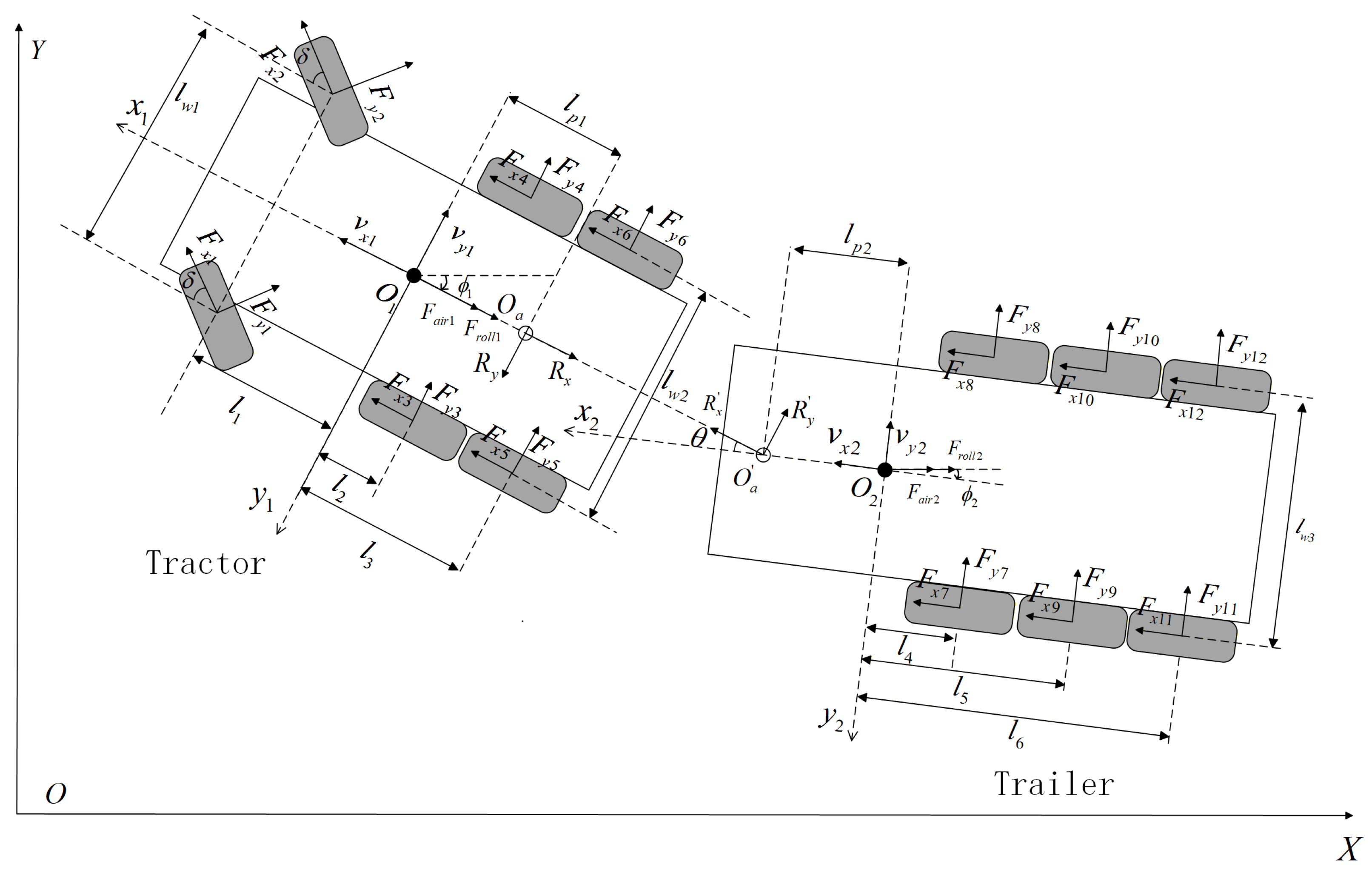
Figure 2. Dynamic model of the multi-axle electric heavy truck.
Machines 14 00010 g002
Figure 3. Control strage.
Machines 14 00010 g003
Figure 4. TruckSim and Simulink co-simulation model.
Machines 14 00010 g004
Figure 5. Estimation of road surface adhesion Coefficient.
Machines 14 00010 g005
Figure 6. Vehicle speed tracking under high ground adhesion coefficient.
Machines 14 00010 g006
Figure 7. Comparison of motor torque under high ground adhesion coefficient conditions.
Machines 14 00010 g007
Figure 8. Comparison of pneumatic braking.
Machines 14 00010 g008
Figure 9. Comparison of motor torque distribution under different control strategies.
Machines 14 00010 g009
Figure 10. Comparison of SOC under high ground adhesion conditions.
Machines 14 00010 g010
Figure 11. Comparison of motor torque under high-intensity braking conditions.
Machines 14 00010 g011
Figure 12. Vehicle speed tracking under high-intensity braking conditions.
Machines 14 00010 g012
Figure 13. Comparison of SOC under high-intensity braking conditions.
Machines 14 00010 g013
Figure 14. Comparison of MPC and IMPC computation time in simulation experiments.
Machines 14 00010 g014
Figure 15. Test scenario.
Machines 14 00010 g015
Figure 16. MPC strategy driving results.
Machines 14 00010 g016aMachines 14 00010 g016b
Figure 17. IMPC Strategy Driving Results.
Machines 14 00010 g017aMachines 14 00010 g017b
Figure 18. Motor efficiency MAP comparison.
Machines 14 00010 g018
Figure 19. Comparison of MPC and IMPC computation time n Real-Vehicle Testing.
Machines 14 00010 g019
Table 1. Basic parameters of the experimental truck.
Parameter NameValueUnit
VehicleUnladen Vehicle Weight17,000kg
Gross Vehicle Weight49,000kg
Wheelbase3600/1400mm
Track Width2085/1880mm
Wheel Radius530mm
MotorRated Torque450Nm
Rated Speed3500rpm
Peak Power346kW
BatteryRated Voltage800V
Battery Pack Capacity414KWh
Table 2. Vehicle speed tracking RMSE under high ground adhesion coefficient.
MPCIMPC
RMSE1.10361.0232
Table 3. Vehicle speed tracking RMSE under high-intensity braking conditions.
MPCIMPC
RMSE1.86671.7812
Disclaimer/Publisher’s Note: The statements, opinions and data contained in all publications are solely those of the individual author(s) and contributor(s) and not of MDPI and/or the editor(s). MDPI and/or the editor(s) disclaim responsibility for any injury to people or property resulting from any ideas, methods, instructions or products referred to in the content.