


Abstract
To address the challenge of controlling the hydraulic excavator’s precise motion, a nonlinear backstepping control algorithm is designed, combining a funnel function and a neural network (NN), which effectively compensates for the influence of unmodeled dynamics and external disturbances on the hydraulic excavator’s control system. Specifically, an improved funnel function is introduced to characterize both the steady-state and transient performance of the system simultaneously, thereby limiting the joint tracking error within predetermined performance constraints and enhancing the trajectory tracking accuracy. Two RBFNN estimators are employed to address the uncertain coupled mechanical dynamics and nonlinear hydraulic dynamics, respectively. The weight updating law is generated based on the gradient descent method, which can prevent high-gain feedback and enhance the system’s robustness. Finally, the stability of the closed-loop system is rigorously proven using the Lyapunov function analysis method. To verify the effectiveness of the proposed algorithm, simulations and experimental research are conducted under various external disturbances, using the excavator’s flat working condition as a case study. The results demonstrate that the controller maintains good control performance and robustness even in the presence of uncertainties and external disturbances within the system.
1. Introduction
As a high-tech equipment with the most extensive application, the most complex operation scene, the highest economic added value and the richest functions in the field of construction machinery, excavators play an essential role in the fields of people’s livelihood and energy [1], such as urban and rural infrastructure, emergency rescue and disaster relief, farmland water conservancy, etc. Its efficient and precise operation is key to improving efficiency and ensuring construction quality [2,3]. It also serves as an essential basis for realizing intelligent [4] and clustered construction operations [5] of engineering equipment. This places higher requirements for its motion control.
High-precision trajectory tracking plays a crucial role in enhancing the operational accuracy, efficiency, and autonomous operation capabilities of hydraulic excavators. In recent decades, research on the motion control of hydraulic manipulators has made significant progress, and a variety of control strategies have emerged, including PID control [6,7,8], fuzzy variable structure control [9], adaptive robust control [10], and intelligent control [11,12]. Among them, PID control is widely used in engineering due to its simple structure and the fact that it does not rely on an accurate system model. However, this method does not fully utilize the system model information in the design process, which limits its dynamic performance in the face of complex nonlinear systems, and it is challenging to meet the requirements for high-precision trajectory tracking of hydraulic excavators. It is often combined with other control methods [7,8] to enhance the system’s control performance. Although fuzzy control [13] has some advantages in dealing with nonlinearity and uncertainty, its performance is highly dependent on expert experience and prior knowledge, mainly due to the lack of systematic design methods in rule base construction and membership function selection, which limits its application in high-performance control situations. The above control has alleviated the nonlinear and uncertain problems of the system to a certain extent. As a typical electromechanical–hydraulic coupling system, the hydraulic excavator exhibits complex characteristics, including strong nonlinearity, dynamic coupling, and time-varying loads [14]. In addition, existing research primarily focuses on nonlinear compensation at the hydraulic actuator level; however, research on accurately modeling and tracking the dynamic coupling effect and load uncertainty of the entire working device is still lacking, which warrants further study. To address the issue of parameter uncertainty in hydraulic systems, an adaptive robust control method is proposed in [15,16] to effectively handle parameter uncertainty and unmodeled disturbances. Deng [12] designed a recursive adaptive RISE control strategy, which significantly improved the asymptotic stability of the error. Kim [17] treats the system’s nonlinearity and disturbance as uncertainties in joint dynamics and also studies the combination of discrete-time delay control and nonlinear sliding mode control, which improves control accuracy [18]. At the same time, we can also utilize disturbance observation control ideas, such as the high-gain disturbance observer [19], the extended state observer [20], and the finite-time disturbance observer [21,22], to address system uncertainty. Literature [21] combines adaptive control with a disturbance observer and makes feedforward compensation for uncertainty in output feedback control. Chen [22] employed model reference adaptive control and developed an adaptive disturbance observer to estimate the load disturbance and time-varying inertia disturbance of the system, thereby enhancing the control performance of the excavator. However, when the time-varying disturbance is severe, the observation burden is heavy, and the system’s asymptotic tracking cannot be realized.
NNs are widely used to solve system parameter nonlinearity and model uncertainty due to their powerful approximation characteristics [23,24]. By model feedforward compensation, the system can reduce its dependence on high feedback gain. Some adaptive tracking controllers based on NNs have been developed and used in hydraulic actuators [23,24,25,26,27,28]. He [23] employed a RBFNN to estimate the unknown joint dynamics, thereby ensuring the system’s tracking accuracy. In [24], an adaptive tracking controller based on an NN is designed for the electric manipulator, taking into account dead time. In [27], An adaptive control method for an n-DOF hydraulic manipulator based on NNs is developed, which addresses the uncertainty in mechanical dynamics. All the above control methods primarily focus on improving nonlinear compensation and steady-state tracking performance, rather than the transient performance of the control system. To limit the control error within the specified performance constraints, standard solutions include the obstacle Lyapunov function [28], the specified performance function [29,30], and funnel control [31]. Its core idea is that by setting the performance constraint function, the transient and steady-state performance of the system are constrained in the full-time domain, ensuring that the output error finally converges to a preset narrow region. Compared to motor-driven manipulators and hydraulic manipulators with fixed working forms, the working environment of an excavator is harsh, complex, and subject to significant interference, which requires a higher level of performance from the controller. Therefore, it remains a problem worthy of in-depth study to select a high-precision asymptotic tracking control strategy with low parameter dependence and stable performance, which is suitable for the heavy hydraulic manipulator of an excavator.
To address the challenges above, this paper proposes an adaptive funnel control method for hydraulic excavators, utilizing NNs to enhance motion control accuracy in the presence of unmodeled dynamics and external disturbances. Firstly, an improved funnel function is designed to strictly restrict the tracking error of the system within the preset time-varying boundary, thus improving the transient and steady-state performance of trajectory tracking. Secondly, to effectively compensate for the unmodeled dynamics and external disturbances in the system, two RBFNN estimators are introduced to approximate the uncertainties in the coupled mechanical dynamics and nonlinear hydraulic dynamics, respectively. Based on Lyapunov stability theory, the asymptotic stability of the closed-loop system is strictly proved. Finally, simulations and experimental research are conducted under various external disturbance conditions to verify the effectiveness and robustness of the proposed control strategy, using the flat working condition of the excavator as an example.
The contributions of this paper are summarized as follows:
- An adaptive controller based on preset performance and an NN is proposed. RBFNN is used to learn and approximate all kinds of unmodeled dynamics of the system, and feedforward compensation is carried out. A funnel function is constructed to constrain the system error within the specified time-varying boundary, thereby improving the system’s stability.
- Based on the excellent characteristics that NNs can approximate any smooth curve, two RBFNNs are introduced to estimate the unmodeled errors and disturbances of the dynamics of the manipulator and the hydraulic system, respectively, and feed-forward compensation is carried out to reduce the dependence on the model.
- Taking flat ground as an example, the simulation analysis and experimental verification of various control strategies under different disturbance scenarios are carried out. The results show that the proposed control algorithm is robust to system parameter uncertainty and external interference, enabling high-precision trajectory tracking control of hydraulic excavators.
This paper is organized as follows: In the Section 2, the modeling process of the hydraulic manipulator system is introduced. In the Section 3, the controller design and stability analysis are carried out. In the Section 4, the simulation analysis is conducted under various external disturbances. The Section 5 presents the experimental results. Section 6 contains the conclusion.
2. System Model Description and Preliminary Explanation
2.1. Dynamic Modeling of Hydraulic Excavator
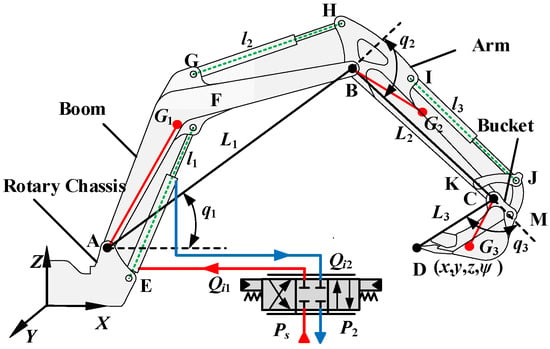
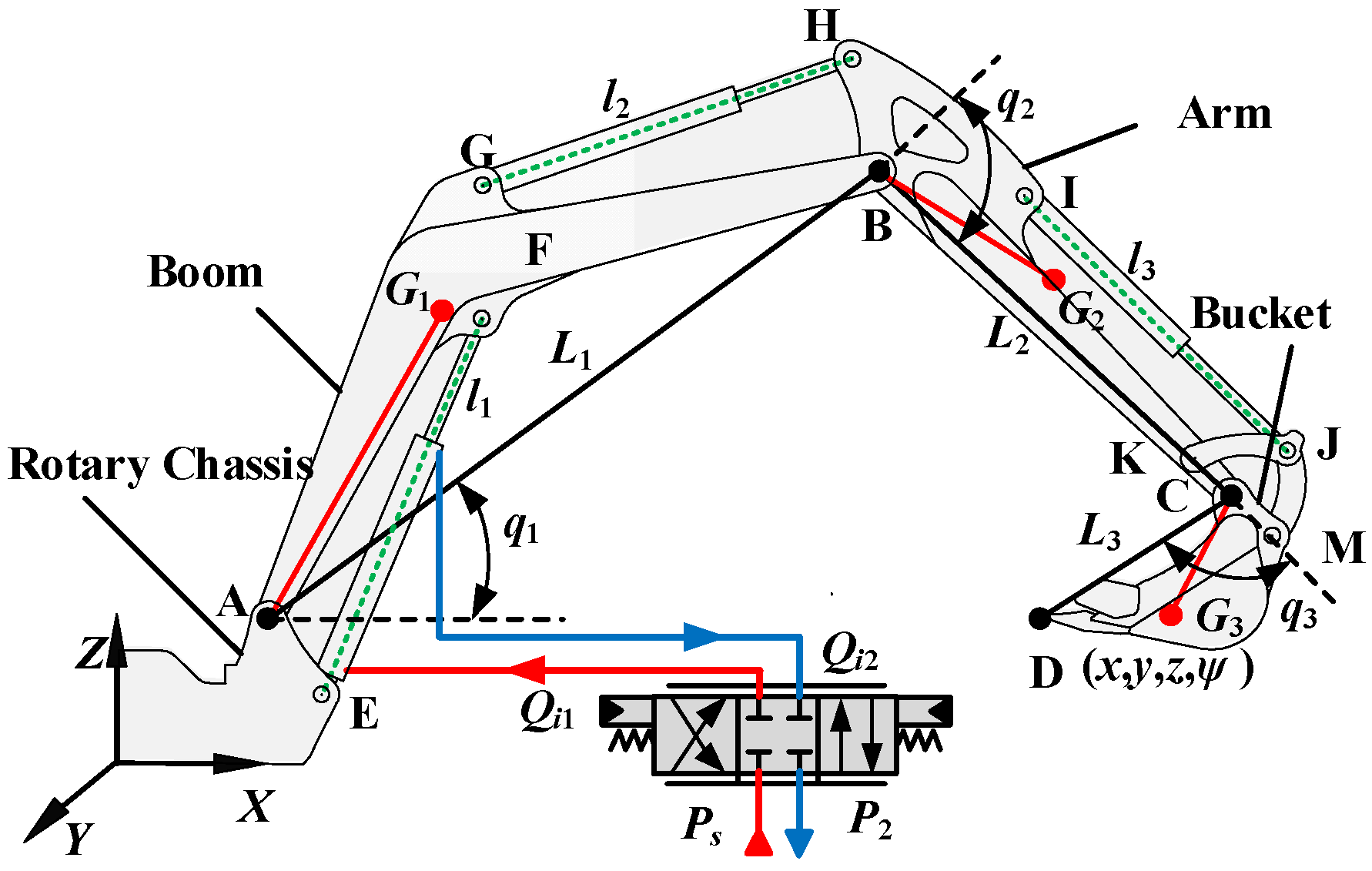
The research object of this paper is the hydraulic excavator, as shown in Figure 1, and the green line segment represents the geometric parameters of the manipulator, the red line segment represents the displacement of the hydraulic cylinder, and the black line segment represents the distance parameter of the hinge point. Without considering the rotation of the excavator, its working device consists of boom, arm, bucket and driving cylinder.
Figure 1.
Excavator kinematics model.
To describe the dynamic characteristics of the system, we set up a dynamic model based on the Lagrange equation in joint space:
Among them, represents joint angular displacement, velocity, and acceleration; represents the inertial matrix; represents the matrix of centrifugal force and Coriolis force; represents the gravity matrix; is a nonlinear friction matrix; represents unmodeled dynamics and disturbance; represents the control torque.
A continuously differentiable friction model suitable for reverse design is adopted, and its form is as follows [32]:
where represent the friction coefficients of different friction levels; represent the shape coefficients that approximate the friction effect.
The dynamics of the hydraulic excavator system have the following characteristics:
Property 1.
The inertia matrix is a positive definite symmetric matrix, that is, it satisfies:
where and are both positive numbers, and represents the standard Euclidean norm.
Property 2.
Matrix 3 is skew-symmetric, that is, it satisfies:
2.2. Dynamic Modeling of Hydraulic Cylinder
As shown in Figure 1, the moving joint of the excavator is driven by a single-rod hydraulic cylinder controlled by a three-position four-way reversing valve, and the moment that the hydraulic cylinder acts on the corresponding manipulator joint can be expressed as
In the formula, represents the i-th hydraulic cylinder arm, which can be solved by the geometric method as follows [33]:
Considering the internal leakage, the pressure dynamics of the hydraulic cylinder can be written as follows:
where is the effective bulk modulus of oil; are the volume of the hydraulic cylinder cavity, is the initial volume, represent the unmodeled errors and unknown perturbations, is the area of two-chamber piston of the hydraulic cylinder; is the oil supply and return flow of the hydraulic cylinder.
where , represents the flow gain at both ends of the spool displacement, is the spool displacement and control signal gain coefficient, denotes the generated control command voltage.
2.3. Funnel Control
Funnel Control is a new control method. Generally, the system is mainly determined by the control input u(t).
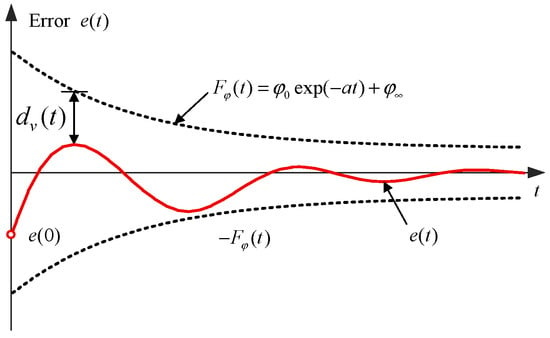
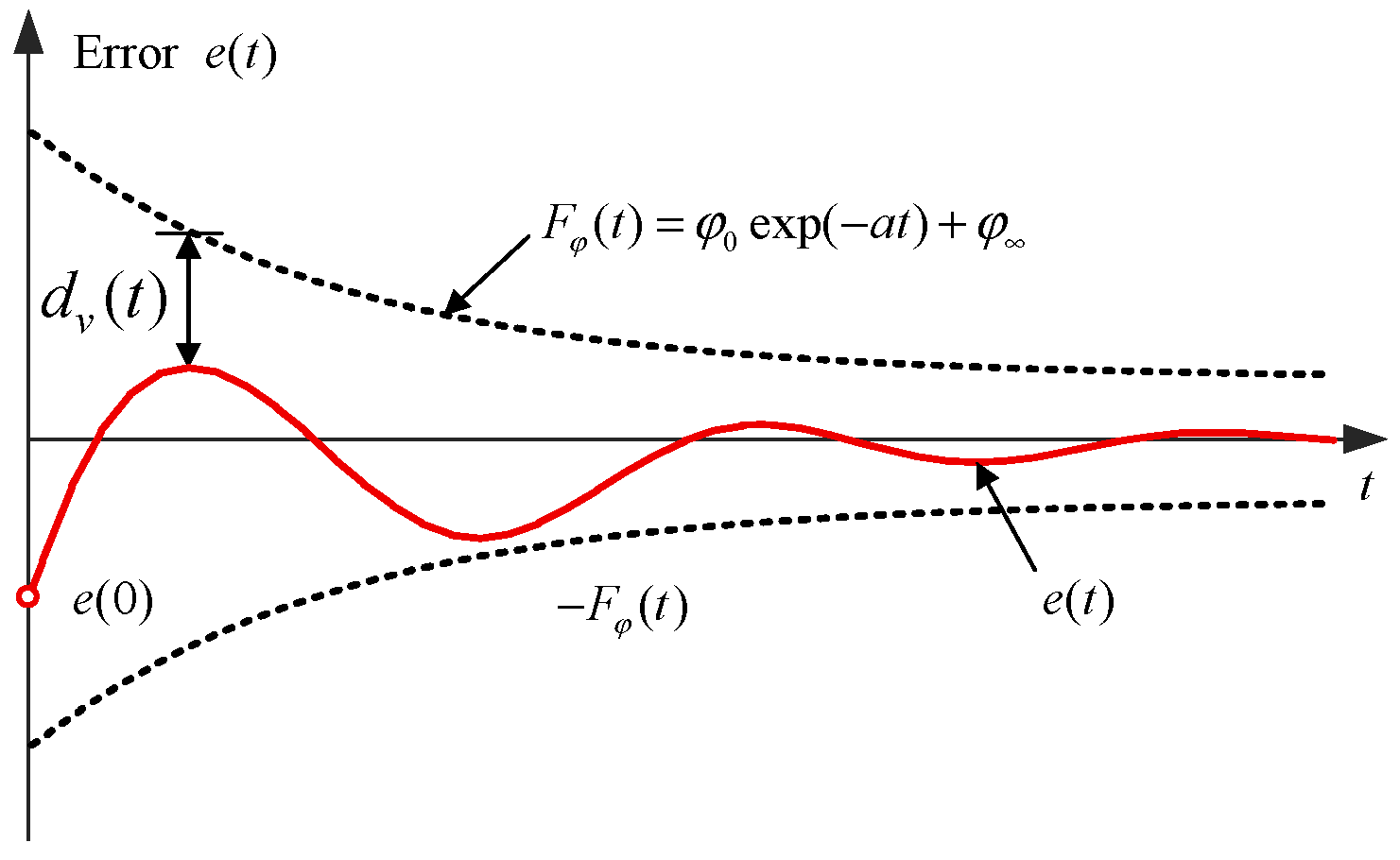
As shown in Figure 2, by calculating the vertical distance
where is expressed as the distance between the Funnel boundary and the error Euclidean norm. , are the reference input and output of the system, respectively.
Figure 2.
Funnel control.
The control gain τ(t) in the Funnel control can be adjusted according to the following way:
where can ensure that the tracking error remains within . Therefore, when the tracking error is close to the boundary zero, the control gain should be increased; On the contrary, when the tracking error exceeds the boundary , the control gain should be reduced accordingly.
Funnel boundary function is defined as a function with exponential transient behavior, and its expression is
where are constants greater than zero and satisfies and . The convergence rate constant a determines how fast the funnel boundary shrinks (converges), and the initial boundary constant determines the width of the funnel opening at the initial moment. The steady-state boundary constant represents the final control accuracy allowed after the system is steady-state.
The standard funnel control method is usually suitable for systems with relative order one or two. For the third-order system, such as the hydraulic manipulator of an excavator, the standard procedure is no longer directly applicable. To extend the application scope of funnel control to high-order systems, an improved funnel boundary design method is proposed in this section.
Through the nonlinear mapping of the above formula, the tracking error signal of the system itself is converted into a set of funnel variable form, which will be used as a new error signal for the design of more advanced controllers (such as adaptive control, neural network control, etc.). The adaptive controller will be designed using funnel control to enhance the transient performance of the system, maintain the tracking error within the given time-varying constraint boundary, and achieve asymptotic tracking of the trajectory.
2.4. RBFNN
RBFNN is a three-layer forward network with nonlinear input and output, which not only improves learning speed through local optimization but also avoids falling into local extrema, thereby meeting the requirements of real-time control. The RBFNN control scheme can effectively reduce dependence on the system model and achieve better tracking accuracy. In this paper, RBFNNs are used to approximate the dynamics of mechanical systems and hydraulic systems, which can be expressed as continuous function , respectively.
The approximate definition of function on compact domain is
where represents the approximate error of the NN, and , is the ideal value of the NN weight to minimize the approximate error . is the activation function, and its expression is
where is the center of the Gaussian function of the i-th neuron, and is the width of the Gaussian function of the i-th neuron.
Because the ideal NN weight is unknown, we can only use the estimated value of in control design, which can be updated by adaptive law.
3. Controller Design and Stability Analysis
3.1. Controller Design
Aiming at the hydraulic excavator system considered in this paper, an adaptive progressive tracking control integrating an improved funnel function and an NN is designed to realize:
- (a)
- All signals in the closed-loop system are continuous and bound;
- (b)
- The joint tracking error is limited to a preset performance constraint function, which can represent the transient and steady-state characteristics of the system;
- (c)
- Accurately estimate and compensate for the external disturbance of the system.
Define the state variable , where , , and the hydraulic excavator model can be expressed as the following state space form:
When designing a nonlinear backstepping controller, (10) can be rewritten as:
where and are nonlinear continuous smooth functions.
Step 1: Define the tracking error as , where is the track to be tracked. Define funnel performance function:
According to (14), the funnel error variable is defined as:
The time derivative of is
where .
Define a Lyapunov function:
Defining error variables , and the derivative of a can be obtained.
Design the virtual controller according to Equation (25)
where is a positive constant.
Substitute (26) into (25) to obtain
Step 2: Define the funnel performance function:
According to (14), the funnel error variable is defined as:
The time derivative of is
where .
To simplify the controller design and improve the robustness of the system, the unknown nonlinear function is approximated by NN, which can be written as
where is the weight and is the approximate error; are the estimation errors.
Define a Lyapunov function:
where are positive constants.
The error variable is defined and the derivative of can be obtained.
The virtual controller designed according to Equation (33) is
where is a positive constant.
The adaptive rate of that neural network design, according to Equation (33) is
where is positive constants.
Substituting Equations (34) and (35) into Equation (33) yields the following result.
By using Young’s inequality, we can get
Substituting Equation (37) into Equation (36), we can get
Step 3: We will obtain the actual control u. Define funnel performance function:
According to Equation (14), the funnel error variable is defined as:
The time derivative of is
where .
To simplify the controller design and improve the robustness of the system, the unknown nonlinear function A is approximated by NN, which can be written as
where is the weight and is the approximate error; are the estimation errors.
Define a Lyapunov function:
where are positive constants.
The time derivative of is
According to Equation (44), the absolute control signal is designed as follows:
where is a positive constant.
The adaptive rate of that neural network design, according to Equation (44) is
where are positive constants.
Substituting Equations (45) and (46) into Equation (44), we can get
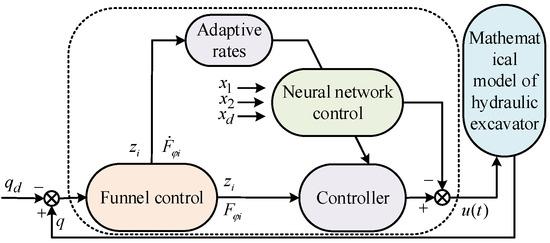
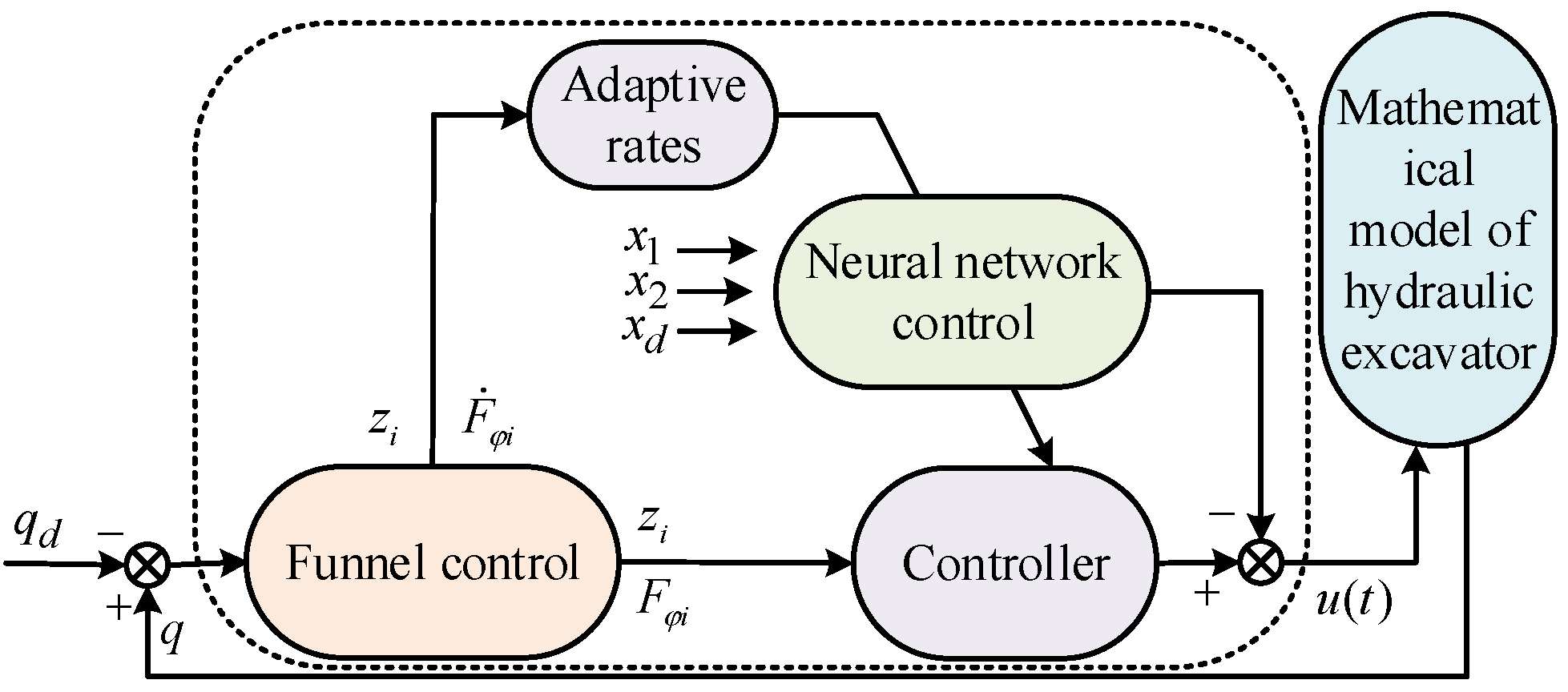
The whole block diagram of the proposed controller is shown in Figure 3.
Figure 3.
Schematic diagram of the control framework.
3.2. Stability Analysis
Lemma 1.
Let a continuous function be positive definite and satisfy the following differential equation:
where . At this time, satisfies uniform final bound convergence.
Lemma 2.
For the uncertain manipulator system (1) disturbed by the outside world, if the Funnel variable in the form of Equation (14) is selected and the virtual control law, control input and adaptive law are designed, all the closed-loop signals of the system can be guaranteed to be uniformly ultimately bound, and the tracking error can converge to any small Funnel boundary.
By using Young’s inequality, we have
Substituting Equation (49) into Equation (47), we can get
where are positive constants and are defined as
The explicit definitions of given in Equation (51) reveal that the system’s convergence performance and steady-state error bounds can be systematically designed by tuning the controller parameters. Specifically:
- Increasing the controller gains or the σ-modification coefficients enhances the convergence rate .
- The steady-state error bound is proportional to NN approximation error bounds and weight bounds. A choice of the σ-modification coefficients allows for a trade-off between weight estimation errors and steady-state tracking precision.
- The funnel boundary function, by ensuring the positiveness of , guarantees that the stability conditions for the closed-loop system are always satisfied.
According to Lemma 2, the system is uniformly ultimately bound. By integrating the two sides of Equation (55), we can get:
where , is bound when . It can be concluded that are bound, and the available control signals are bound. In this case, we can further obtain for , such that for . It can be obtained that the tracking error finally stays within the given Funnel boundary, and the tracking error finally stays within the given Funnel boundary.
4. Simulation Analysis
4.1. Simulation Results of Trajectory Tracking Control
Taking the flat working condition of the excavator as an example, the trajectory tracking control simulation analysis of compound action is carried out, and the model parameters are shown in Table 1.
Table 1.
Excavator model parameters.
The inertia matrix , centrifugal force and Coriolis force matrix and gravity matrix of excavator can be expressed as follows:
To evaluate the superiority of the proposed control scheme, three different flow controllers are selected for comparative simulation.
Controller C1: This is the controller proposed in this paper, in which the constraint boundary setting: the time-varying constraint function adopts . The constraint functions of boom and stick are the same, , . The controller parameters are set to: , , . NN: the number of hidden layer nodes is set to 36, The initial conditions are . The parameters are set to , .
Controller C2: This controller simplifies the time-varying constraints in controller C1 into constant constraints. Its constraint boundary is set to , and other parameters are consistent with C1.
Controller C3: This is a direct adaptive NN controller without system constraints. The control law is designed as follows:
The controller parameters are: , . NN parameters are consistent with C1 settings.
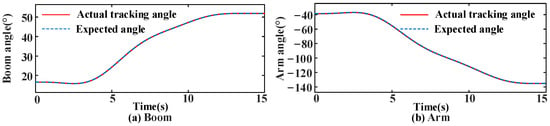
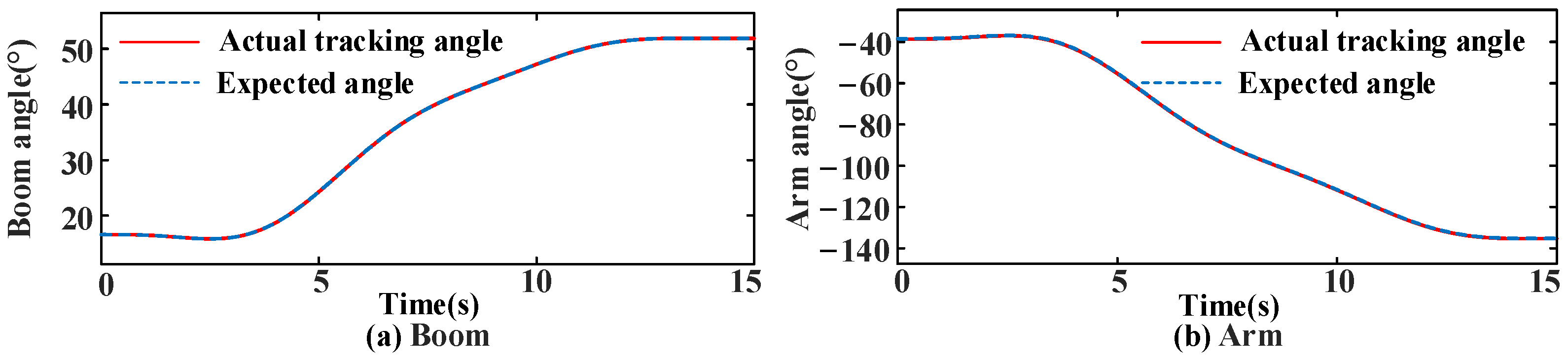
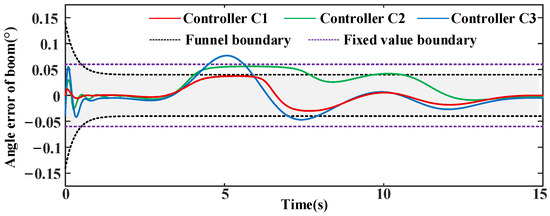
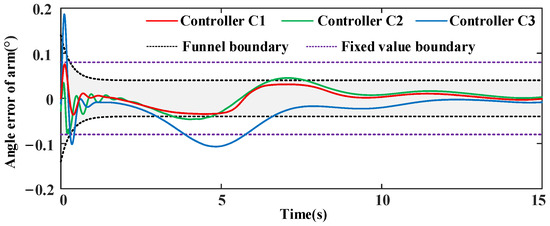
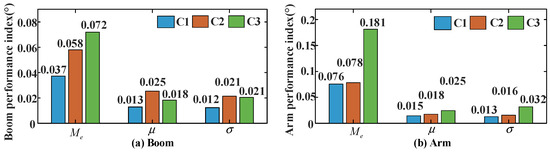
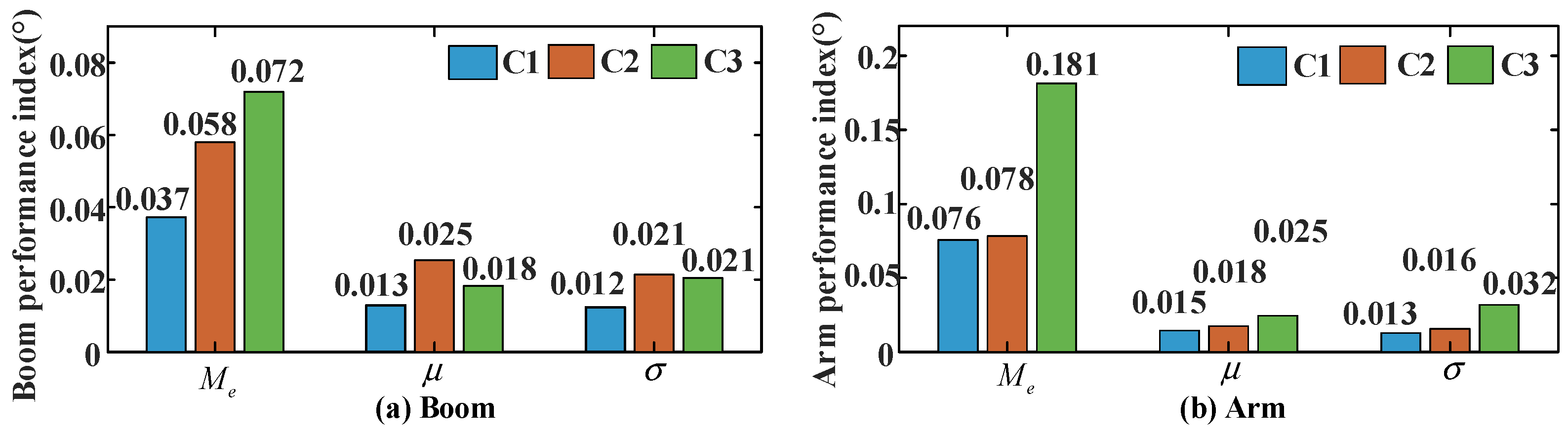
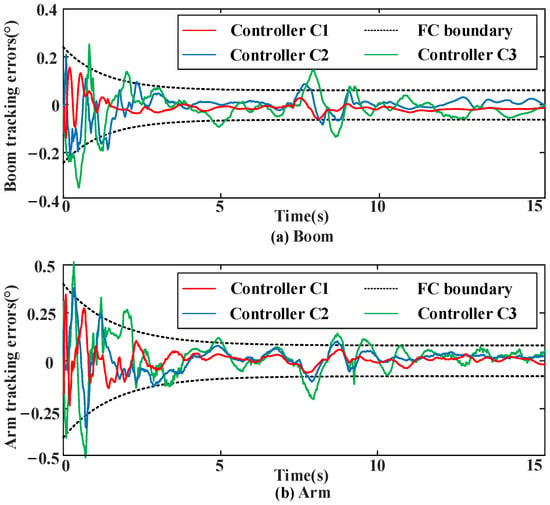
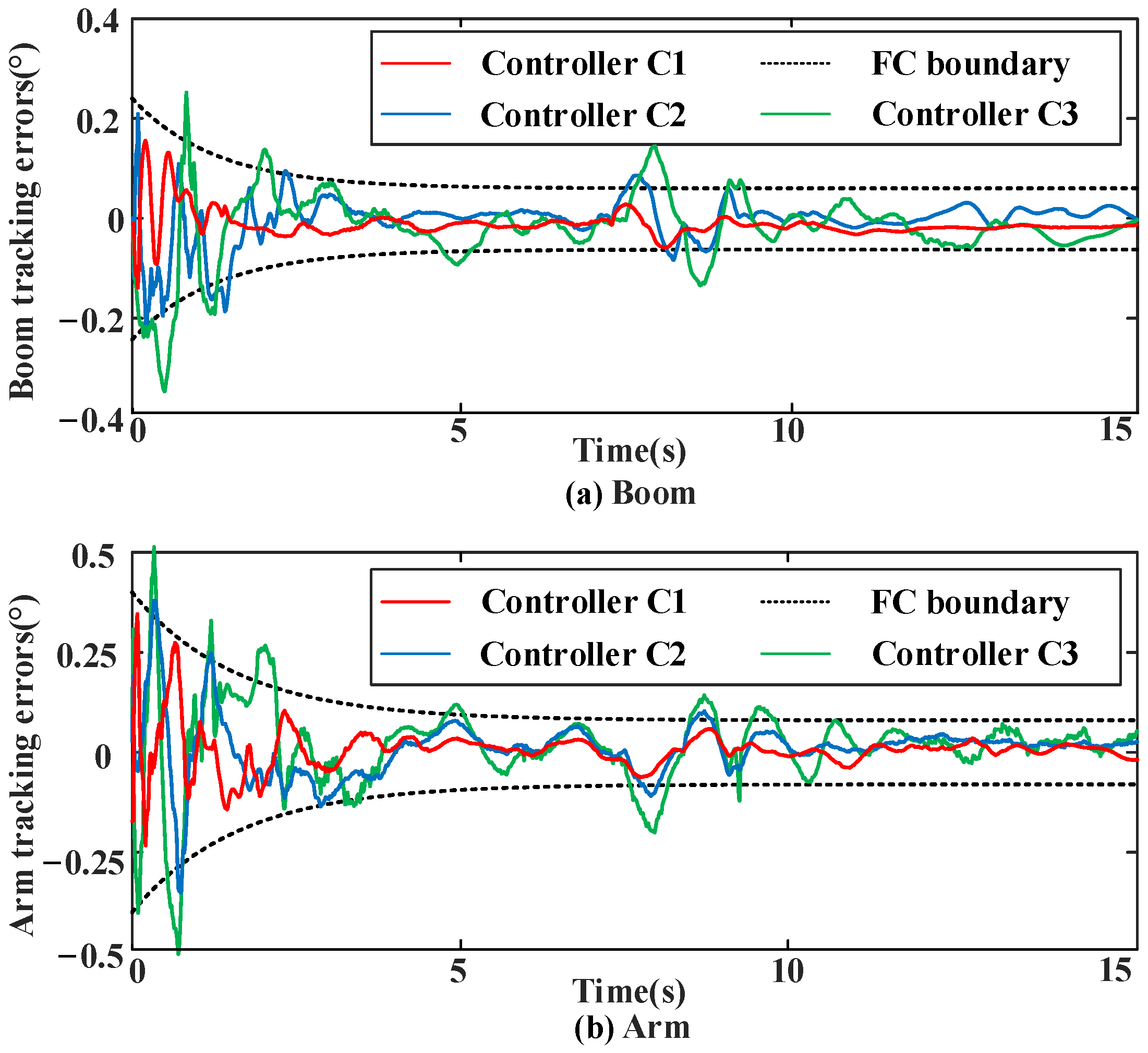
Figure 4 illustrates the tracking performance of the proposed controller C1 on the boom and arm joint of the excavator, demonstrating that the working trajectories generated by the two controllers can be quickly and accurately followed. The tracking errors of the lower boom and the arm joint of the three controllers are compared as shown in Figure 5 and Figure 6. To ensure an objective quantitative comparison [31], the control performance of controllers C1–C3 is further evaluated using the maximum absolute value, average value, and standard deviation of the position tracking error as measurement indicators. The analysis results are presented in Figure 7. From the simulation results, it can be seen that the transient and steady-state control performance of the proposed controller C1 is superior to that of the other two controllers, enabling high-precision trajectory tracking control of the excavator.
Figure 4.
Angle tracking performance of the proposed motion controller.
Figure 5.
Tracking error of the boom under different controllers.
Figure 6.
Tracking error of the arm under different controllers.
Figure 7.
Comparison of the tracking performance of different controllers.
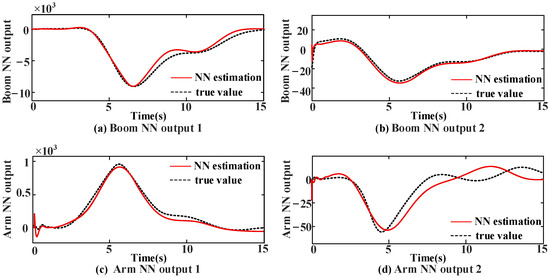
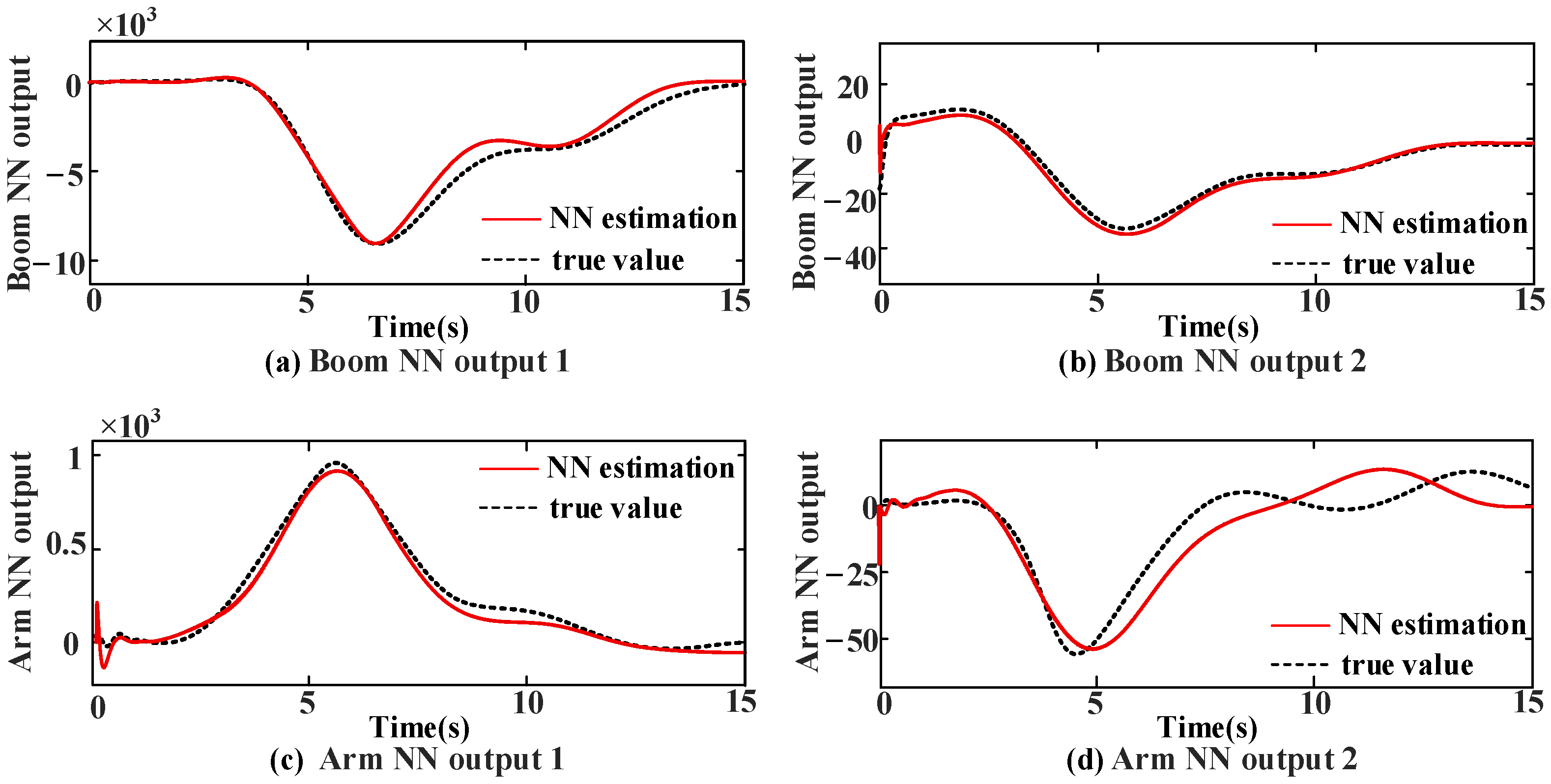
Specifically, due to completely ignoring the system constraints, C3 repeatedly violated the preset constant boundary in C2 and the preset funnel boundary in C1 during the control process, resulting in a significant overshoot in its transient response, continuous fluctuation in the steady state stage, and poor overall control performance. Although C2 can limit the tracking error within a specific range by introducing a constant constraint, its error curve will still exceed the funnel constraint boundary adopted by C1. Furthermore, the error convergence speed of C2 is obviously slower than that of C1, exhibiting a more pronounced oscillation phenomenon in the steady-state stage. In addition, when the initial error of the system is significant, the constant constraint boundary must be set to a larger value, which makes it challenging to ensure good steady-state performance simultaneously and has certain limitations. In contrast, thanks to the exponentially decaying time-varying funnel constraint boundary function, this design has three advantages: Firstly, the initial boundary value can be set flexibly according to the initial error of the system; Secondly, the transient response of the system can be effectively optimized by adjusting the decay rate parameters; Finally, the control accuracy in the steady-state stage can be ensured by setting the boundary terminal value reasonably. The maximum tracking error under C1 is reduced by 35.7% and 3.3% compared with C2, and by 48.1% and 58.3% compared with C3. These quantitative indicators objectively verify the superiority of the proposed method in control performance. In addition, by introducing a neural network to estimate the system dynamics and other nonlinear functions, the system’s robustness is enhanced while strictly satisfying the output constraints. As shown in Figure 8, the output response of the NN is satisfactory, demonstrating excellent estimation ability and providing a more accurate and simplified model description for the control system.
Figure 8.
Neural network output of the proposed motion controller.
4.2. Trajectory Tracking Control Under Abrupt Disturbance
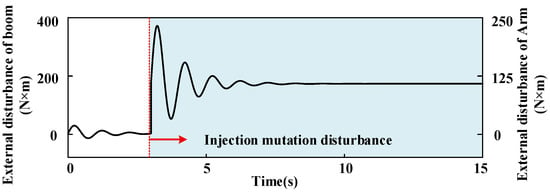
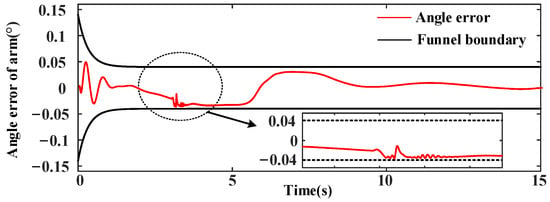
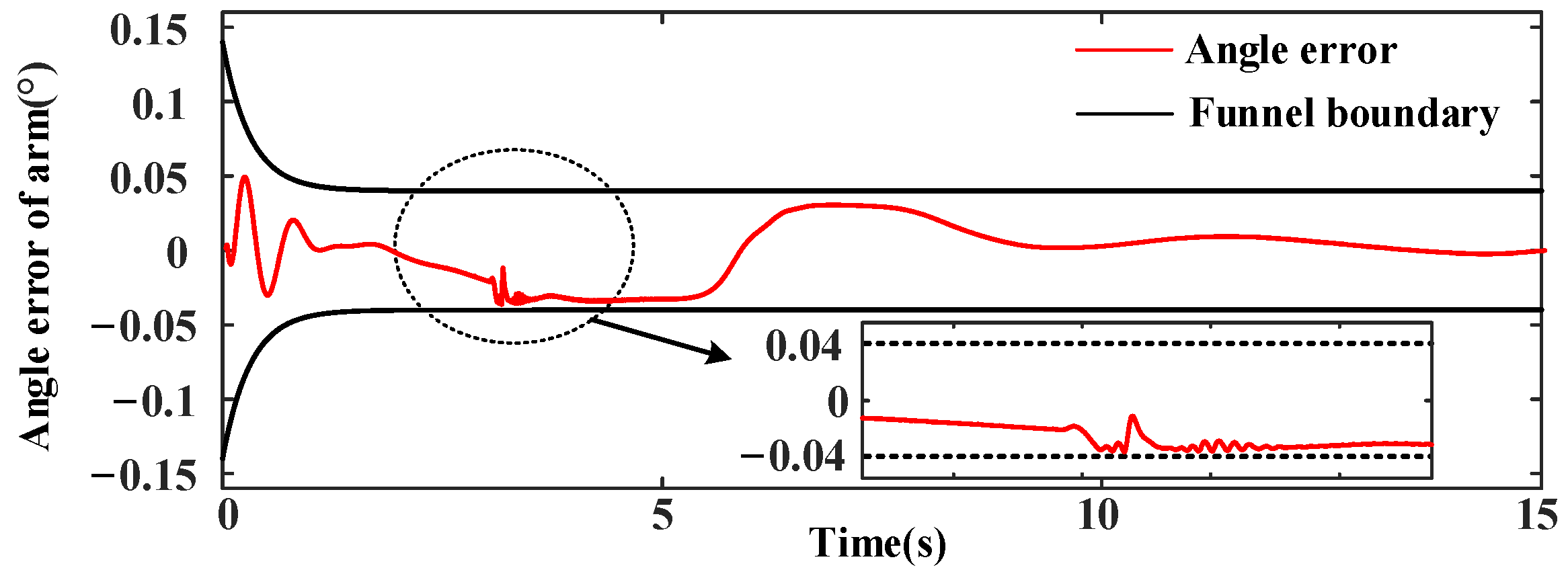
To further verify the robustness of the proposed controller, a step signal, as shown in Figure 9, is injected into the simulation model at the third second of trajectory tracking control to simulate a strong, abrupt, uncertain disturbance that the excavator may encounter in actual operation.
Figure 9.
Step signal simulating strong abrupt external disturbance.
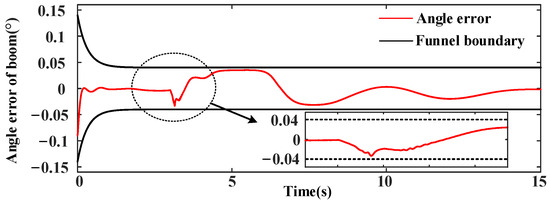
Figure 10 and Figure 11 show the position tracking errors of the boom and arm joints of the C1 controller in response to sudden disturbance injection. The system can still achieve high-precision trajectory tracking, and the steady-state tracking errors of all joints converge within a preset reasonable range of ±. The results show that the controller can successfully limit the transient and steady-state tracking errors strictly within the preset performance constraints, which strongly verifies the robustness of the controller.
Figure 10.
Tracking error of boom under sudden disturbance.
Figure 11.
Tracking error of arm under abrupt disturbance.
5. Experimental Verification
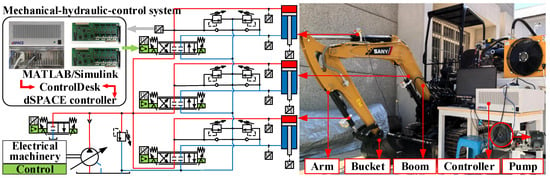
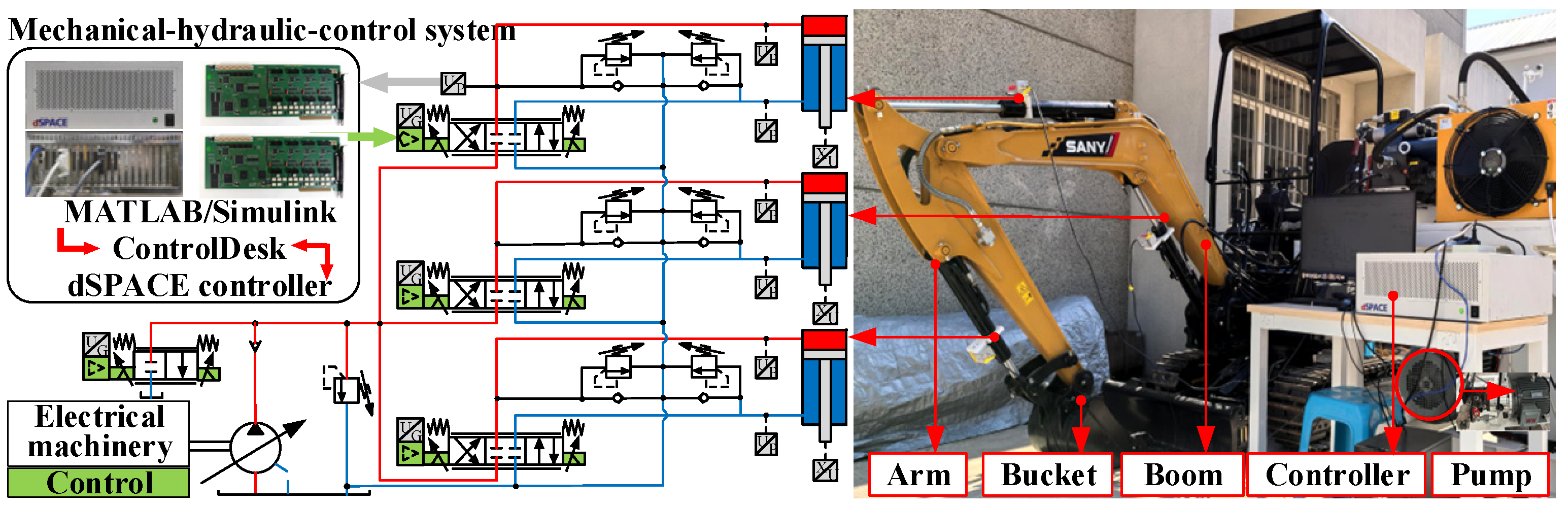
To verify the engineering application of the proposed controller, an excavator platform, as shown in Figure 12, is constructed. SYDFEE-20/071R electric proportional pump from Rexroth company (Horb am Neckar, Germany) is used to input the system flow, and 4WREE-10 proportional servo valve from Rexroth company (Germany) is used to control the boom, arm, and bucket. The 4WREE-6 proportional servo valve is used as an unloading valve to control the bypass throttling of the pump head. The cylinder displacement is measured using an NS-WY06-1000mm cable sensor (Shanghai Tianmu company, Shanghai, China), with a measurement noise of ±0.5 mm. The system pressure is measured by the oil pressure sensor of the RPT8200 (Shanghai Stedeford company, Shanghai, China), with a measurement noise of ±0.07 MPa.
Figure 12.
Hydraulic excavator test bench.
Measurement and control module: The real-time measurement and control system, based on dSPACE, has established a complete control closed loop. Firstly, the control algorithm in the Simulink environment is automatically generated into executable code, and online adjustment of operation parameters is realized using the ControlDesk software (2015). Subsequently, the dS-4302 board outputs control instructions to drive the hydraulic actuator. At the same time, the dS-2004 board is responsible for collecting feedback signals from various sensors and inputting them into the control algorithm after digital filtering, thereby forming a complete closed-loop control loop. The sampling period of the system is strictly set to 10ms to ensure the real-time control performance.
To simulate the intense, abrupt, and uncertain disturbances faced by excavators in actual operation, an interference test environment was constructed by adding 30 kg sandbags at the passing points of the test trajectory.
Figure 13 shows the position tracking errors of the lower boom and the arm joint for the three controllers, further evaluating the control performance of controllers C1–C3 using the maximum absolute value, average value, and standard deviation of the tracking errors as measurement indicators. The analysis results are shown in Table 2. In addition, Figure 14 further illustrates the real-time motion trajectory of the bucket, showing that the manipulator can smoothly complete the designated leveling task even under external disturbances, which reflects the practicability and robustness of the control system.
Figure 13.
Joint tracking error under different controllers.
Table 2.
Comparison of tracking.
Figure 14.
Real-time motion state of bucket tip flat operation.
Specifically, because C3 utilizes a neural network to estimate the unknown disturbance, the system response exhibits prominent oscillations after the load interference intervention, resulting in control accuracy and anti-interference ability that are inferior to those of the other two controllers. C2 realizes the asymptotically stable tracking of the system when the external disturbance is unknown. Due to the lack of time-varying performance constraints similar to the funnel function, the tracking error convergence speed is not as fast as C1. When the system disturbance is significant, the system error violates the preset funnel constraint function, and the transient stage oscillation is apparent. Thanks to the improved funnel control, achieved through exponential decay, the error is ensured to converge strictly within the funnel boundary. At the same time, two RBFNNs are used to feed forward the unmodeled errors of the manipulator dynamics and the hydraulic system, respectively, which further improves the progressive tracking performance of the system. Among them, the maximum tracking error under C1 is reduced by 15.79% and 16.32% compared with C2, and by 42.13% and 35.3% compared with C3, which verifies that the proposed control method exhibits better control performance.
6. Conclusions
Considering that it is challenging to develop an accurate dynamic model of a hydraulic excavator system and that unknown external disturbances compromise control performance, this paper proposes a nonlinear backstepping control algorithm that combines a funnel function with an NN control framework. By constructing an improved funnel function, the system error is strictly restricted within the specified time-varying boundary. Two RBFNN estimators are employed to address the uncertain coupled mechanical dynamics and nonlinear hydraulic dynamics, respectively. The weight updating law is generated using the gradient descent method, thereby enhancing the system’s robustness while minimizing high-gain feedback. Based on the Lyapunov function analysis method, the stability of the closed-loop system is theoretically analyzed and proven. Numerous simulations and experiments verify the effectiveness of the controller designed in this paper. The experimental results demonstrate that the proposed algorithm is robust to system uncertainties and external disturbances, achieving high-performance motion control of excavators. In future research, the combination of the specified performance control mechanism, such as the funnel function, and other nonlinear control methods is explored to simplify the controller structure, reduce the calculation burden, and enable the reliable and efficient deployment of complex algorithms on the vehicle’s embedded system.
Author Contributions
Conceptualization and methodology, X.Q.; software, validation and data curation, Y.L.; writing—original draft preparation, Y.L.; writing—review and editing, Y.L. and X.Q. All authors have read and agreed to the published version of the manuscript.
Funding
This research received no external funding.
Data Availability Statement
The raw data supporting the conclusions of this article will be made available by the authors on request.
Conflicts of Interest
Author Yuhe Li was employed by the company Tianjin Research Institute of Construction Machinery Co., Ltd. The remaining authors declare that the research was conducted in the absence of any commercial or financial relationships that could be construed as a potential conflict of interest.
References
- Liang, K.; Zhao, J.; Zhang, Z.; Guan, W.; Pan, M.; Li, M. Data-driven AI algorithms for construction machinery. Autom. Constr. 2024, 167, 105648. [Google Scholar]
- Feng, H.; Zhou, H.; Cao, D.; Yin, C.; Zhou, C. Data-driven hydraulic pressure prediction for typical excavators using a new deep learning SCSSA-LSTM method. Expert Syst. Appl. 2025, 275, 127078. [Google Scholar] [CrossRef] [Scilit]
- Assadzadeh, A.; Arashpour, M.; Li, H.; Hosseini, R.; Elghaish, F.; Baduge, S. Excavator 3D pose estimation using deep learning and hybrid datasets. Adv. Eng. Inform. 2023, 55, 101875. [Google Scholar] [CrossRef] [Scilit]
- Chen, J.; Ai, C.; Kong, X. PID Control of Hydraulic Robotic Arm Based on Reinforcement Learning. IEEE Trans. Ind. Electron. 2025, 1–11. [Google Scholar] [CrossRef] [Scilit]
- Shen, Y.; Wang, J.; Mo, S.; Gu, X. Data augmentation aided excavator activity recognition using deep convolutional conditional generative adversarial networks. Adv. Eng. Inform. 2024, 62, 102785. [Google Scholar] [CrossRef] [Scilit]
- Sarkar, A.; Maji, K.; Chaudhuri, S.; Saha, R.; Mookherjee, S.; Sanyal, D. Actuation of an electrohydraulic manipulator with a novel feedforward compensation scheme and PID feedback in servo-proportional valves. Control. Eng. Pract. 2023, 135, 105490. [Google Scholar] [CrossRef] [Scilit]
- Feng, H.; Yin, C.; Weng, W.; Ma, W.; Zhou, J.-J.; Jia, W.-H.; Zhang, Z.-L. Robotic excavator trajectory control using an improved GA based PID controller. Mech. Syst. Signal Process. 2018, 105, 153–168. [Google Scholar] [CrossRef] [Scilit]
- Ma, W.; Ma, S.; Qiao, W.; Cao, D.; Yin, C. Research on PID Controller of Excavator Electro-Hydraulic System Based on Improved Differential Evolution. Machines 2023, 11, 143. [Google Scholar] [CrossRef] [Scilit]
- Jin, X.; Chen, K.; Zhao, Y.; Ji, J.; Jing, P. Simulation of hydraulic transplanting robot control system based on fuzzy PID controller. Measurement 2020, 164, 108023. [Google Scholar] [CrossRef] [Scilit]
- Yao, B.; Bu, F.; Reedy, J.; Chiu, G.T.-C. Adaptive robust motion control of single-rod hydraulic actuators: Theory and experiments. IEEE ASME Trans. Mechatron. 2000, 5, 79–91. [Google Scholar]
- Yao, Z.; Yao, J.; Sun, W. Adaptive rise control of hydraulic systems with multilayer neural networks. IEEE Trans. Ind. Electron. 2019, 66, 8638–8647. [Google Scholar] [CrossRef] [Scilit]
- Deng, W.; Zhou, H.; Zhou, J.; Yao, J. Neural network-based adaptive asymptotic prescribed performance tracking control of hydraulic manipulators. IEEE Trans. Syst. Man Cybern. 2023, 53, 285–295. [Google Scholar] [CrossRef] [Scilit]
- Zweiri, Y.; Seneviratne, L.; Althoefer, K. Modelling and control of an uncrewed excavator vehicle. Proc. Inst. Mech. Eng. Part I J. Syst. Control Eng. 2003, 217, 259–274. [Google Scholar]
- Manring, N.D.; Fales, R.C. Hydraulic Control Systems; Wiley: New York, NY, USA, 2019. [Google Scholar]
- Mohanty, A.; Yao, B. Integrated direct/indirect adaptive robust control of hydraulic manipulators with valve deadband. IEEE ASME Trans. Mechatron. 2011, 16, 707–715. [Google Scholar] [CrossRef] [Scilit]
- Kim, S.; Park, J.; Kang, S.; Kim, P.Y.; Kim, H.J. A robust control approach for hydraulic excavators using μ-synthesis. Int. J. Control Autom. Syst. 2018, 16, 1615–1628. [Google Scholar] [CrossRef] [Scilit]
- Kim, J.; Jin, M.; Choi, W.; Lee, J. Discrete time delay control for hydraulic excavator motion control with terminal sliding mode control. Mechatronics 2019, 60, 15–25. [Google Scholar] [CrossRef] [Scilit]
- Won, D.; Kim, W.; Shin, D.; Chung, C. High-gain disturbance observer-based backstepping control with output tracking error constraint for electro-hydraulic systems. IEEE Trans. Control Syst. Technol. 2015, 23, 787–795. [Google Scholar] [CrossRef] [Scilit]
- Zhang, X.; Shi, G. Dual extended state observer-based adaptive dynamic surface control for a hydraulic manipulator with actuator dynamics. Mech. Mach. Theory 2022, 169, 104647. [Google Scholar] [CrossRef] [Scilit]
- Ren, Y.; Hu, F.; Sun, Y.; Liu, L. Finite-time disturbance observers based reliable control for a constrained autonomous flexible manipulator system with mismatched and matched disturbances. Control Eng. Pract. 2023, 139, 105627. [Google Scholar] [CrossRef] [Scilit]
- Li, X.; Chen, X.; Yao, J.; Xu, J.; Zhou, C. Nonlinear robust motion control of hydraulic servo system with matched and mismatched disturbance compensation. In Proceedings of the Chinese Control And Decision Conference, Shenyang, China, 9–11 June 2018; pp. 283–288. [Google Scholar]
- Chen, Q.; Zheng, L.; Lin, T.; Li, Z.; Ren, H.; Fu, S. Model reference adaptive control for electric excavator slewing system with variable inertia based on disturbance observer. J. Mech. Eng. 2025, 61, 367–376. [Google Scholar]
- He, W.; David, A.; Yin, Z.; Sun, C. Neural network control of a robotic manipulator with input deadzone and output constraint. IEEE Trans. Syst. Man Cybern. Syst. 2016, 46, 759–770. [Google Scholar] [CrossRef] [Scilit]
- Zhou, Q.; Zhao, S.; Li, H.; Lu, R.; Wu, C. Adaptive neural network tracking control for robotic manipulators with dead zone. IEEE Trans. Neural Netw. Learn. Syst. 2019, 30, 3611–3620. [Google Scholar] [CrossRef] [Scilit]
- Yang, X.; Deng, W.; Yao, J. Neural adaptive dynamic surface asymptotic tracking control of hydraulic manipulators with guaranteed transient performance. IEEE Trans. Neural Netw. Learn. Syst. 2023, 34, 7339–7349. [Google Scholar] [CrossRef] [Scilit] [PubMed]
- Bao, Z.; Liu, C.; Yang, H.; Zhang, J.; Li, Y. From theory to industry: A survey of deep learning-enabled bearing fault diagnosis in complex environments. Eng. Appl. Artif. Intell. 2026, 163, 113068. [Google Scholar] [CrossRef] [Scilit]
- Yao, Z.; Liang, X.; Wang, S.; Yao, J. Model-Data Hybrid Driven Control of Hydraulic Euler-Lagrange Systems. IEEE ASME Trans. Mechatron. 2024, 30, 131–143. [Google Scholar] [CrossRef] [Scilit]
- Chen, J.; Guo, Y.; Kong, X.; Xu, K.; Ai, C. Trajectory planning and high-precision motion control of excavators based on independent metering hydraulic configuration. IEEE Trans. Syst. Man Cybern. Syst. 2025, 70, 8689–8700. [Google Scholar] [CrossRef] [Scilit]
- Gong, K.; Jia, Y. Appointed-time velocity-free prescribed performance control for space manipulators. Aerosp. Sci. Technol. 2024, 144, 108783. [Google Scholar] [CrossRef] [Scilit]
- Liang, H.; Yu, J.; Li, H. Appointed-time robust tracking control for uncertain unmanned underwater vehicles with prescribed performance. Ocean Eng. 2025, 322, 120436. [Google Scholar] [CrossRef] [Scilit]
- Wang, S.; Chen, Q.; Ren, X.; Yu, H. Neural network-based adaptive funnel sliding mode control for servo mechanisms with friction compensation. Neurocomputing 2020, 377, 16–26. [Google Scholar] [CrossRef] [Scilit]
- Guo, Y.; Chen, J.; Ai, C.; Kong, X. Research on improvement of starting pressure shock for hydraulic excavator based on model calibration and pump-valve dynamic matching. China Mech. Eng. 2025, 1–10. Available online: https://link.cnki.net/urlid/42.1294.TH.20251021.1221.005 (accessed on 5 December 2025).
- Feng, H.; Jiang, J.; Ding, N.; Shen, F.; Yin, C.; Cao, D.; Li, C.; Liu, T.; Xie, J. Multi-objective time-energy-impact optimization for robotic excavator trajectory planning. Autom. Constr. 2023, 156, 105094. [Google Scholar] [CrossRef] [Scilit]



Disclaimer/Publisher’s Note: The statements, opinions and data contained in all publications are solely those of the individual author(s) and contributor(s) and not of MDPI and/or the editor(s). MDPI and/or the editor(s) disclaim responsibility for any injury to people or property resulting from any ideas, methods, instructions or products referred to in the content. |
© 2025 by the authors. Licensee MDPI, Basel, Switzerland. This article is an open access article distributed under the terms and conditions of the Creative Commons Attribution (CC BY) license (https://creativecommons.org/licenses/by/4.0/).