Abstract
In the present paper we consider one of the basic theorems of probability theory on real numbers. We prove that it is equivalent with the supremum axiom of real numbers.
1. Introduction
It is a well-known fact that the set of rational numbers is not complete—hence, such important constants as or do not exist in . Because the way in which the set is constructed of real numbers from is quite complicated, it is usually defined axiomatically. The completeness of can be formulated in different ways, e.g., as a complete metric space, or as a complete lattice. In [1], a review of some completeness axioms for is presented. In this paper, the set will be characterized by a property which is very important in the probability theory, which may prove useful from the point of view of applications, as well as didactics. In the paper we shall characterize the set from the perspective of the probability theory, namely in the Kolmogorov formulations—an event is a set on certain -algebra S of subsets of a space , and the probability is a -additive mapping . In terms of measurement, the mapping is a real function , and it is an interesting point, especially in terms of didactics, that the complete information about is obtained from the distribution function F of , which is a real function, , with some particular properties.
2. Materials and Methods
In this section we formulate the important properties of the distribution function. In the literature there are two well-established but different definitions of the distribution function of a random variable . The first is given by the formula , and the second by the formula . In this paper we shall use the second approach, which is more convenient for working with the supremum axiom. Evidently, the first one could be used in the infimum way. The distribution function can be characterized without any reference to the general probability space [2,3] and by applying only a few properties of F, as shown in the following definition.
Definition 1.
A functionis called a distribution if it satisfies the following properties:
- 1.
- F is non-decreasing
- 2.
- F is right continuous in any point,
- 3.
- 4.
- .
In the probability theory, the following theorem presents a translation method between the elementary approach and the abstract theory. To any distribution function there exists a probability measure defined on the family of Borel subsets of , such that:
for any
In our elementary approach, instead of we will work only with the family for all unions of intervals (bounded as well as unbounded). According to the measure extension theorem, any additive and continuous mapping can be extended from to , since is an algebra and is the -algebra generated by .
Axiom (S). Any increasing bounded sequence of real numbers has the supremum—the least upper bound of the sequence.
In our distribution axiom, instead of -additivity, we shall use the notion of additivity and the notion of continuity.
A mapping is additive, if for sets such that , it holds:
A mapping is continuous if, for any , such that and , it holds:
Axiom (D). To any distribution function there exists an additive and continuous mapping , such that:
for any
3. Results
There are many known proofs of the axiom (D), e.g., referring to the completeness of R by (S). Now we shall prove the opposite implication.
Theorem 1.
Axiom (D) implies Axiom (S).
Proof of Theorem 1.
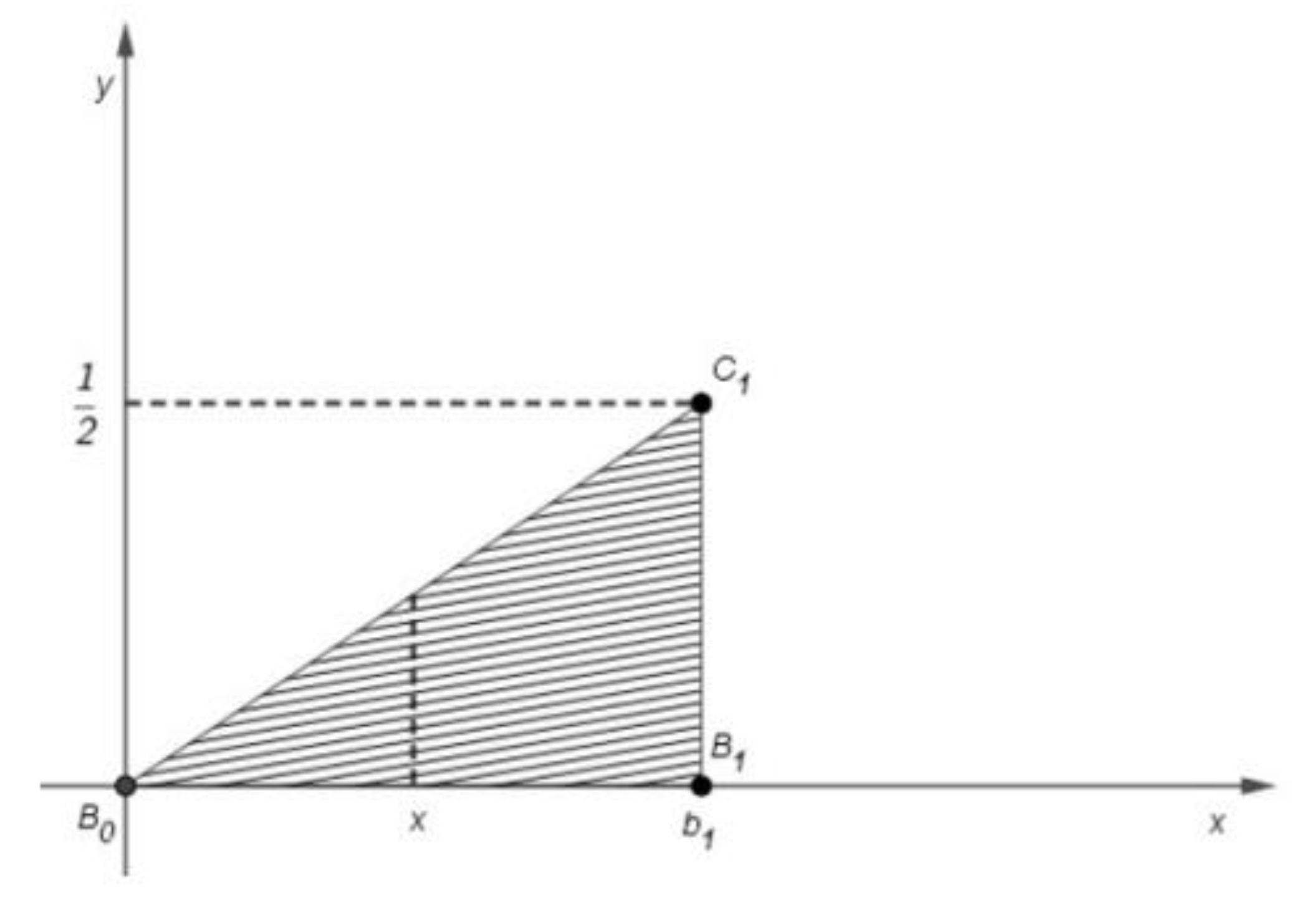
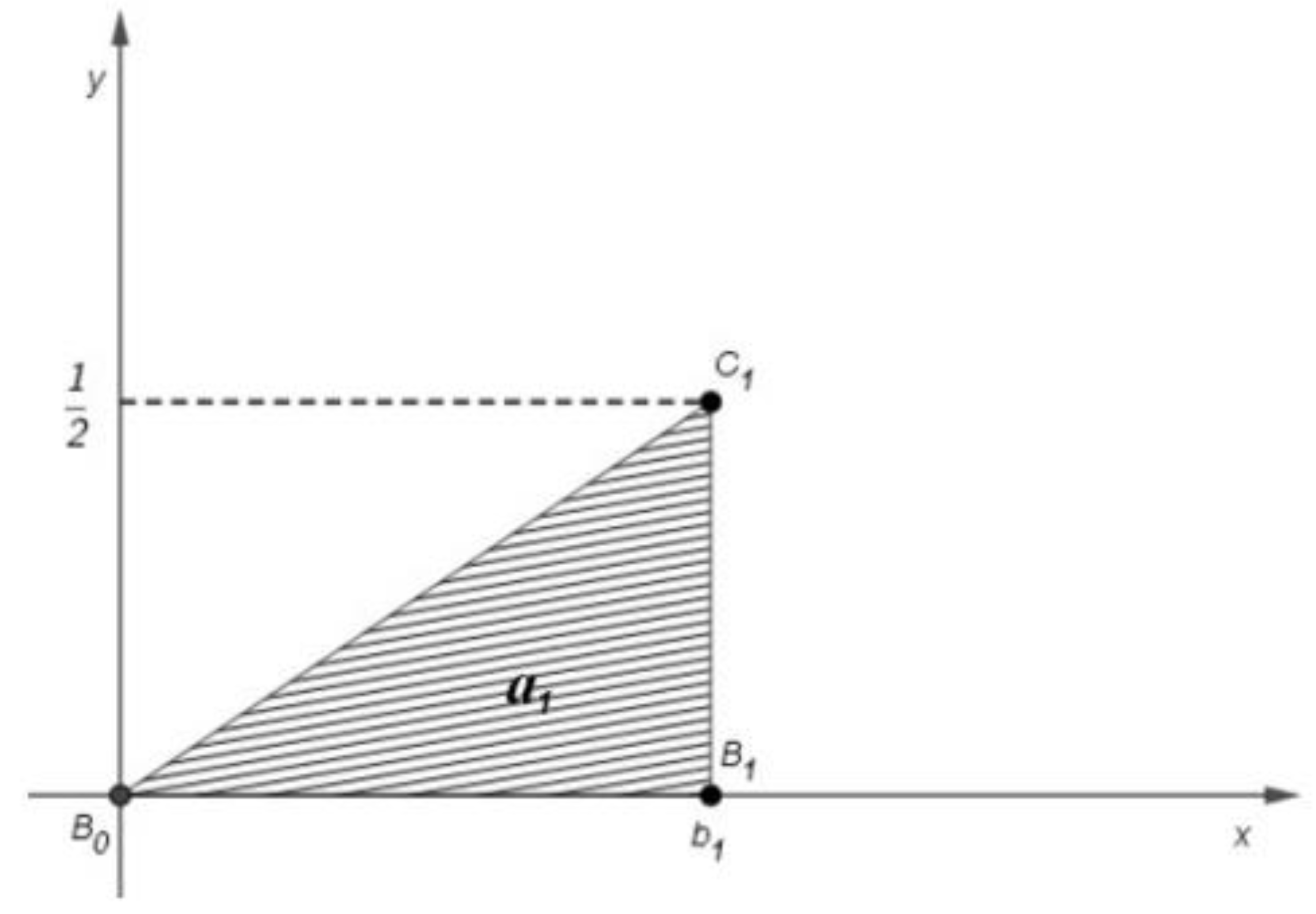
Let be a sequence, such that . Our goal is to construct a distribution function and an increasing sequence , such that for every n. Consider the points in the coordinate system, where , and (see Figure 1).
Figure 1.
Points in the coordinate system.
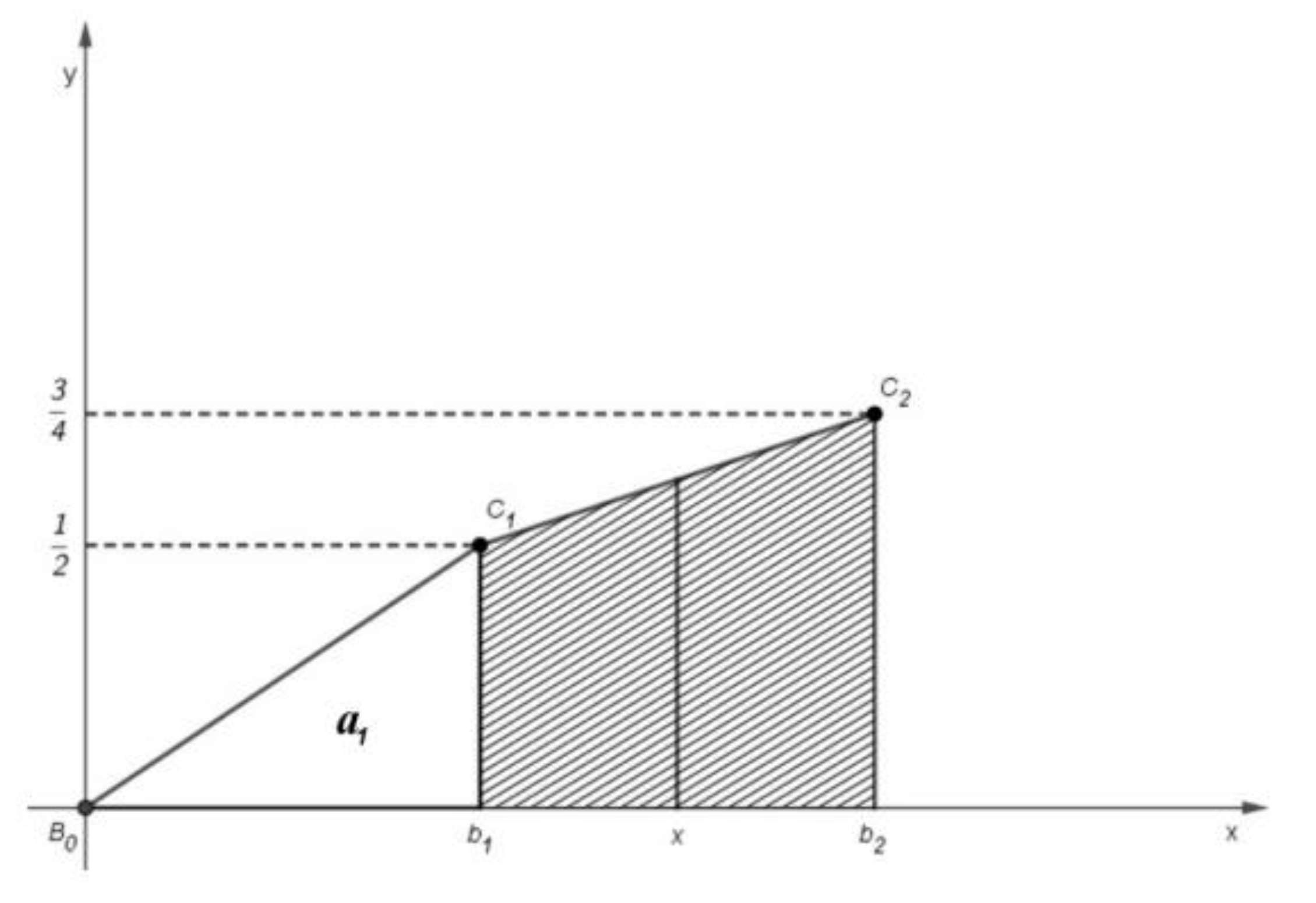
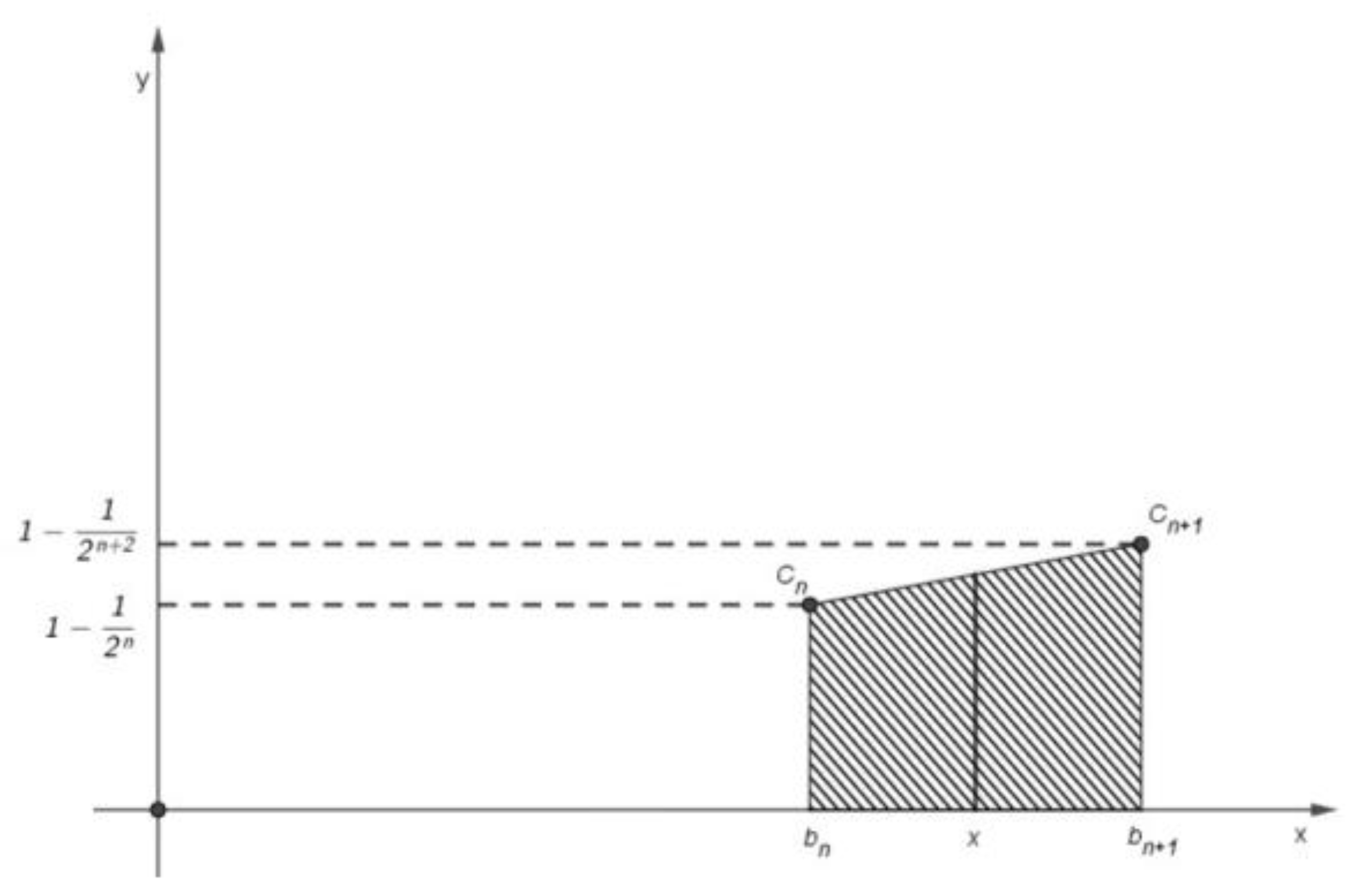
Denote the area of the triangle, defined by these points by . Clearly, Let x be a point in the interval Then, is the area of the triangle, defined by points and (see Figure 2).
.
Figure 2.
The area of the triangle, defined by points .
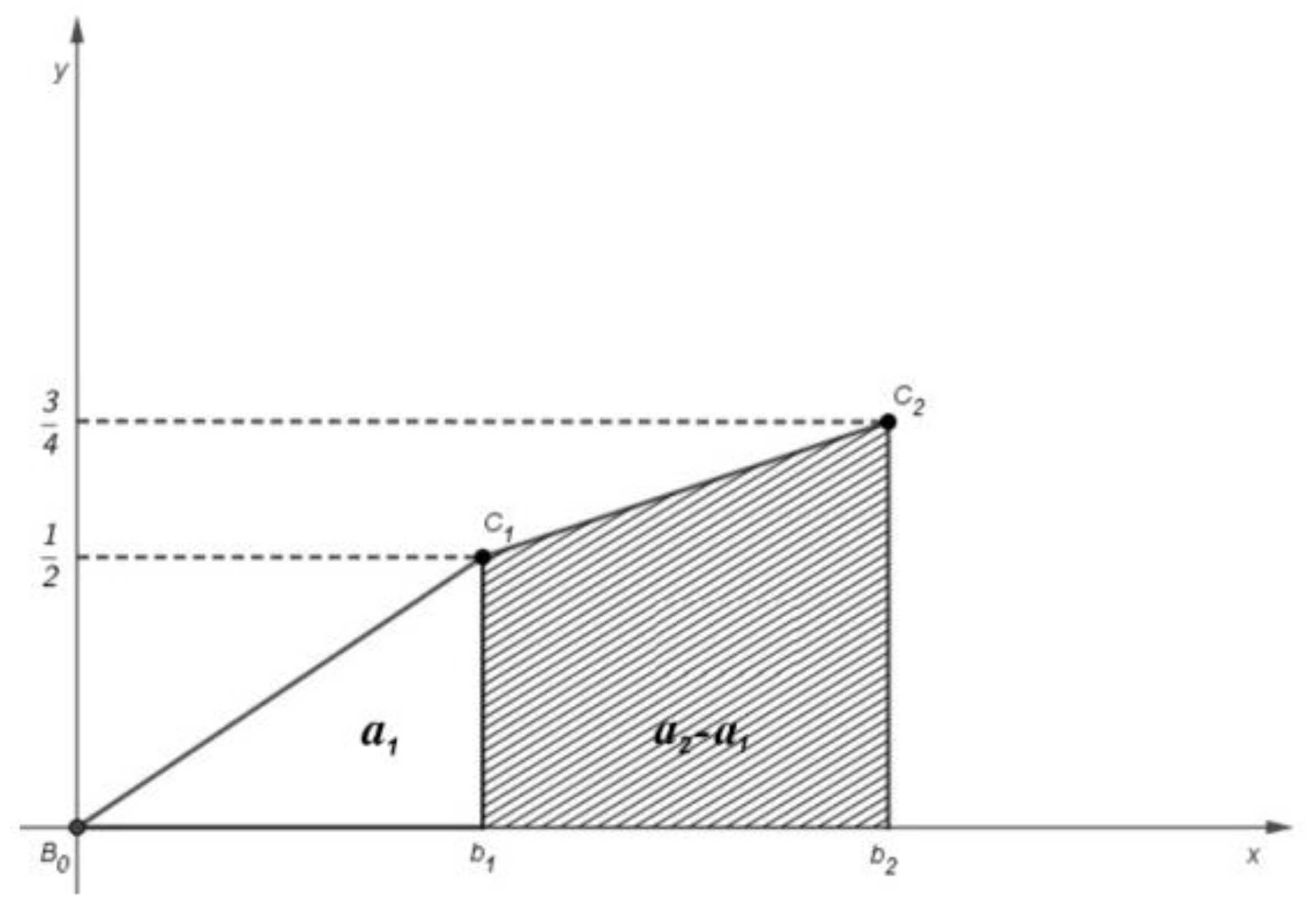
The constructed point is Consider the points where ; the area of the trapezoid defined by these points is (see Figure 3).
Figure 3.
The area of the trapezoid defined by points .
Hence,
.
Figure 4.
The area of the trapezoid defined by points .
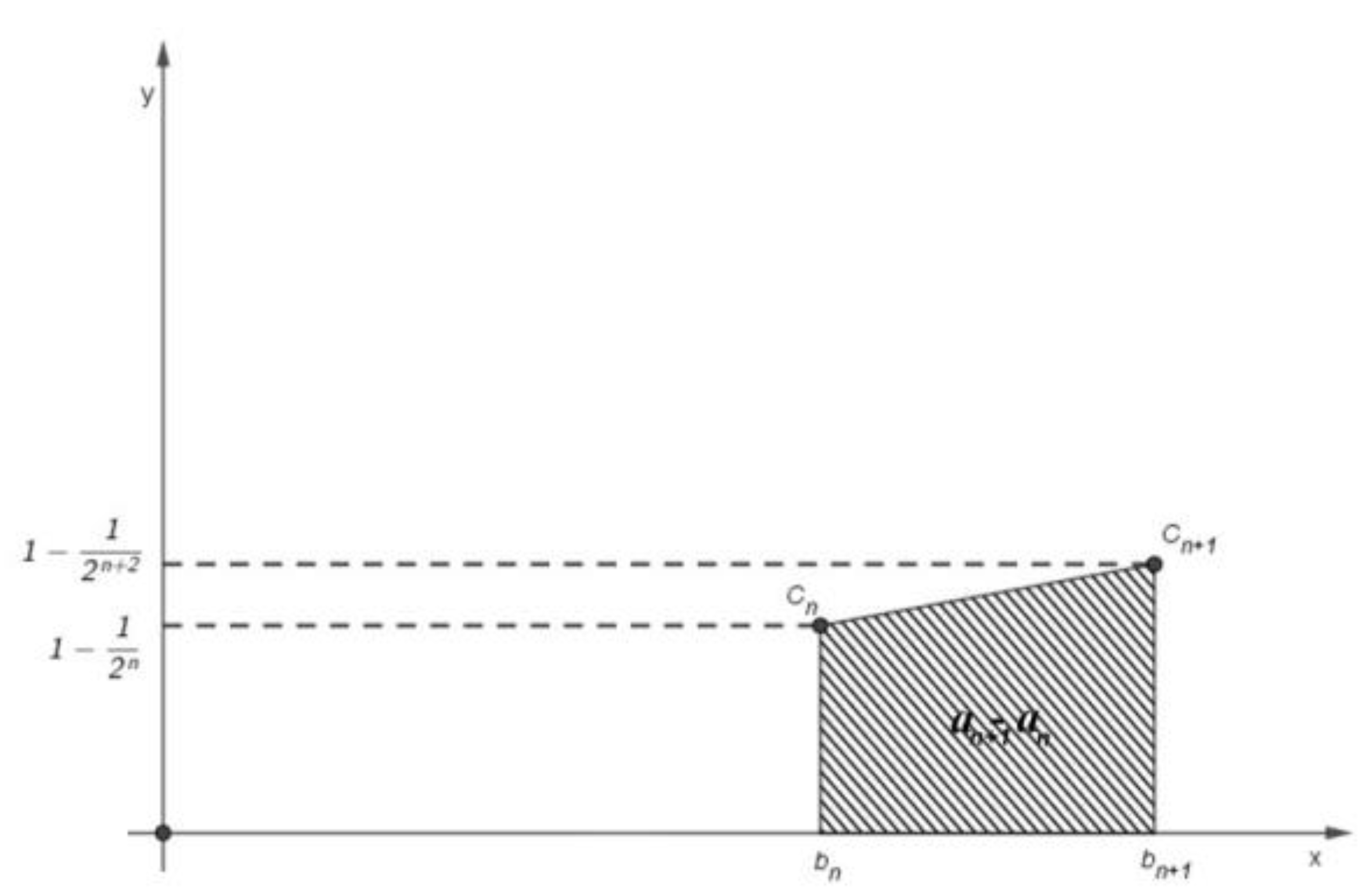
By induction, assume Consider the points and These four points define the area of the trapezoid (see Figure 5).
Figure 5.
The area of the trapezoid defined by points .
Figure 6.
The area of the trapezoid defined by points .
Define function F by using the following properties:
- For all , put .
- If there exists a natural number n and , then
- if for all natural numbers n, then .
It can easily be proved that F is a distribution function. Assume that there exists a probability measure , such that , and in particular, Compute:
Consider:
Then,
Thus, we have found that any increasing sequence from the interval has the supremum.
Now, let be an arbitrary bounded increasing sequence from For any natural n, take Then , and there exists the supremum of Hence, there exists the supremum of , and:
Finally, consider as an arbitrary increasing bounded sequence. Take This means that is non-decreasing, non-negative, and bounded. Therefore, there also exists the supremum of Hence, there exists the supremum of and
□
4. Conclusions
This paper focused on the axiom (D), one of the fundamental axioms in the probability theory. We showed that the axiom (D) is equivalent to the supremum axiom (S) of real numbers. The axiom (D) is crucial for many other important theorems in probability and statistics, such as the laws of large numbers, the central limit theorem, or statistical estimations.
Author Contributions
All the authors contributed the same work.
Funding
This research received no external funding.
Acknowledgments
We would like to acknowledge Renáta Vágová, currently a Ph.D. student at the Department of Mathematics, FNS, Constantine the Philosopher University in Nitra, for drawing the figures.
Conflicts of Interest
The authors declare no conflict of interest.
References
- Teissman, H. Toward a More Complete List of Completeness Axiom. Am. Math. Mon. 2013, 120, 99–114. [Google Scholar] [CrossRef]
- Riečan, B.; Neubrunn, T. Integral, Measure and Ordening; Springer Science & Business Media: Berlin/Heidelberg, Germany, 2013. [Google Scholar]
- Billingsley, P. Probability and Measure; John Wiley & Sons: Hoboken, NJ, USA, 2008. [Google Scholar]
© 2018 by the authors. Licensee MDPI, Basel, Switzerland. This article is an open access article distributed under the terms and conditions of the Creative Commons Attribution (CC BY) license (http://creativecommons.org/licenses/by/4.0/).