Abstract
Neutrosophic sets (NSs) handle uncertain information while fuzzy sets (FSs) and intuitionistic fuzzy sets (IFs) fail to handle indeterminate information. Soft set theory, neutrosophic set theory, and rough set theory are different mathematical models for handling uncertainties and they are mutually related. The neutrosophic soft rough set (NSRS) model is a hybrid model by combining neutrosophic soft sets with rough sets. We apply neutrosophic soft rough sets to graphs. In this research paper, we introduce the idea of neutrosophic soft rough graphs (NSRGs) and describe different methods of their construction. We consider the application of NSRG in decision-making problems. In particular, we develop efficient algorithms to solve decision-making problems.
1. Introduction
Smarandache [1] initiated the concept of neutrosophic set (NS). Smarandache’s NS is characterized by three parts: truth, indeterminacy, and falsity. Truth, indeterminacy and falsity membership values behave independently and deal with problems having uncertain, indeterminant and imprecise data. Wang et al. [2] gave a new concept of single valued neutrosophic sets (SVNSs) and defined the set theoretic operators on an instance of NS called SVNS. Peng et al. [3] discussed the operations of simplified neutrosophic numbers and introduced an outranking idea of simplified neutrosophic numbers.
Molodtsov [4] introduced the notion of soft set (SS) as a novel mathematical approach for handling uncertainties. Molodtsov’s SSs gave us a new technique for dealing with uncertainty from the viewpoint of parameters. Maji et al. [5,6,7] introduced neutrosophic soft sets (NSSs), intuitionistic fuzzy soft sets and fuzzy soft sets (FSSs). In [8], Sahin and Kucuk presented NSS in the form of neutrosophic relations.
Theory of rough set (RS) was proposed by Pawlak [9] in 1982. Rough set theory is used to study the intelligence systems containing incomplete, uncertain or inexact information. The lower and upper approximation operators of RSs are used for managing hidden information in a system. Feng et al. [10] took a significant step to introduce parametrization tools in RSs. Meng et al. [11] provide further discussion of the combination of SSs, RSs and FSs. The existing results of RSs and other extended RSs such as rough fuzzy sets, generalized rough fuzzy sets, soft fuzzy rough sets and intuitionistic fuzzy rough sets based decision-making models have their advantages and limitations [12,13]. In a different way, rough set approximations have been constructed into the intuitionistic fuzzy environment and are known as intuitionistic fuzzy rough sets and rough intuitionistic fuzzy sets [14,15]. Zhang et al. [16,17] presented the notions of soft rough sets, soft rough intuitionistic fuzzy sets, intuitionistic fuzzy soft rough sets, its application in decision-making, and also introduced generalized intuitionistic fuzzy soft rough sets. Broumi et al. [18,19] developed a hybrid structure by combining RSs and NSs, called RNSs, they also presented interval valued neutrosophic soft rough sets by combining interval valued neutrosophic soft sets and RSs. Yang et al. [20] proposed single valued neutrosophic rough sets (SVNRSs) by combining SVNSs and RSs and defined SVNRSs on two universes and established an algorithm for a decision-making problem based on SVNRSs on two universes. Akram and Nawaz [21] have introduced the concept of soft graphs and some operation on soft graphs. Certain concepts of fuzzy soft graphs and intuitionistic fuzzy soft graphs are discussed in [22,23,24]. Akram and Shahzadi [25] have introduced neutrosophic soft graphs. Zafar and Akram [26] introduced a rough fuzzy digraph and several basic notions concerning rough fuzzy digraphs. In this research paper, a neutrosophic soft rough set is a generalization of a neutrosophic rough set, and we introduce the idea of neutrosophic soft rough graphs (NSRGs) that are made by combining NSRSs with graphs and describe different methods of their construction. We consider the application of NSRG in decision-making problems and resolve the problem. In particular, we develop efficient algorithms to solve decision-making problems.
For other notations, terminologies and applications not mentioned in the paper, the readers are referred to [27,28,29,30,31,32,33,34,35].
2. Neutrosophic Soft Rough Information
In this section, we will introduce the notions of neutrosophic soft rough relation (NSRR), and NSRGs.
Definition 1.
Let Y be an initial universal set, a universal set of parameters and . For an arbitrary neutrosophic soft relation Q over , is called neutrosophic soft approximation space (NSAS).
For any NS we define the upper neutrosophic soft rough approximation (UNSRA) and the lower neutrosophic soft rough approximation (LNSRA) operators of A with respect to denoted by and respectively as follows:
where
The pair is called NSRS of A w.r.t and are referred to as the LNSRA and the UNSRA operators, respectively.
Example 1.
Suppose that is the set of careers under consideration, and Mr. X wants to select the best suitable career. is a set of decision parameters. Mr. X describes the “most suitable career" by defining a neutrosophic soft set on Y that is a neutrosophic relation from Y to as shown in Table 1.
Table 1.
Neutrosophic soft relation Q.
Now, Mr. X gives the most favorable decision object A, which is an NS on defined as follows: . By Definition 1, we have
Similarly,
Thus, we obtain
Hence, is an NSRS of A.
The conventional neutrosophic soft set is a mapping from a parameter to the neutrosophic subset of the universe and letting be neutrosophic soft set. Now, we present the constructive definition of neutrosophic soft rough relation by using a neutrosphic soft relation S from to , where Y is a universal set and be a set of parameters.
Definition 2.
A neutrosophic soft rough relation on Y is an NSRS, is a neutrosophic soft relation on Y defined by
The UNSA and the LNSA of B w.r.t are defined as follows:
where
The pair is called NSRR and are called the LNSRA and the UNSRA operators, respectively.
Remark 1.
Consider an NS B on and an NS A on , according to the definition of NSRR, we get
Similarly, for LNSRA operator ,
Example 2.
Let be a universal set and a set of parameters. A neutrosophic soft set on Y can be defined in tabular form in Table 2 as follows:
Table 2.
Neutrosophic soft set .
Let and .
Then, a soft relation S on E (from L to E) can be defined in Table 3 as follows:
Table 3.
Neutrosophic soft relation S.
Let be an NS on , then
Let be an NS on then
Hence, is NSRR.
Definition 3.
A neutrosophic soft rough graph (NSRG) on a non-empty V is an 4-ordered tuple such that
- (i)
- is a set of parameters,
- (ii)
- Q is an arbitrary neutrosophic soft relation over
- (iii)
- S is an arbitrary neutrosophic soft relation over
- (vi)
- is an NSRS of A,
- (v)
- is an NSRR on ,
- (iv)
- is a neutrosophic soft rough graph, where and are lower neutrosophic approximate graph (LNAG) and upper neutrosophic approximate graph (UNAG), respectively of neutrosophic soft rough graph (NSRG) .
Example 3.
Let be a vertex set and a set of parameters. A neutrosophic soft relation over can be defined in tabular form in Table 4 as follows:
Table 4.
Neutrosophic soft relation Q.
Let be an NS on , then
Let and .
Then, a neutrosophic soft relation S on E (from L to E) can be defined in Table 5 and Table 6 as follows:
Table 5.
Neutrosophic soft relation S.
Table 6.
Neutrosophic soft relation S.
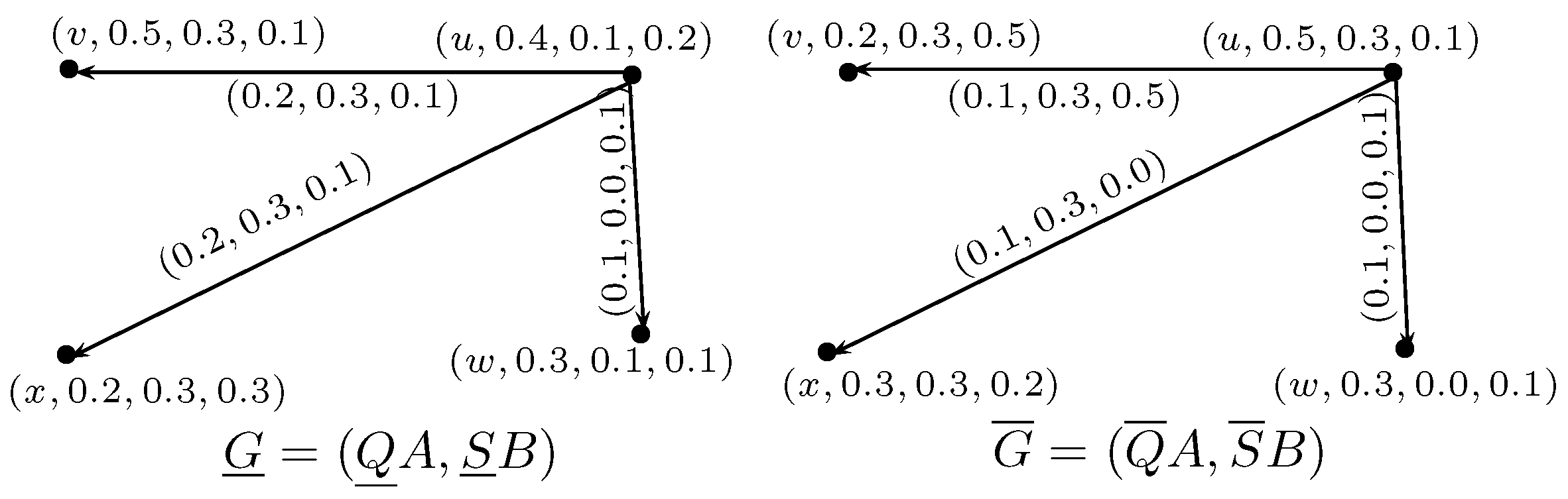
Thus, and are LNAG and UNAG, respectively, are shown in Figure 1.
Figure 1.
Neutrosophic soft rough graph .
Hence, is NSRG.
Definition 4.
Let be a neutrosophic soft rough graph on a non-empty set V. The order of G can be denoted by defined by
The size of neutrosophic soft rough graph G, denoted by defined by
Example 4.
Let G be a neutrosophic soft rough graph as shown in Figure 1. Then,
Definition 5.
Let and be two neutrosophic soft rough graphs on V. The union of and is a neutrosophic soft rough graph , where and are neutrosophic graphs, such that
- (i)
- but
- (ii)
- but
- (iii)
- (iv)
- but
- (v)
- but
- (vi)
Example 5.
Let be a set of universes, and a set of parameters. Then, a neutrosophic soft relation over can be written as in Table 7.
Table 7.
Neutrosophic soft relation Q.
Let and are two neutrosophic sets on , Then, and are NSRSs, where
Let , and . Then, a neutrosophic soft relation on E can be written as in Table 8.
Table 8.
Neutrosophic soft relation S.
Let and are two neutrosophic sets on L, Then, and are NSRRs, where
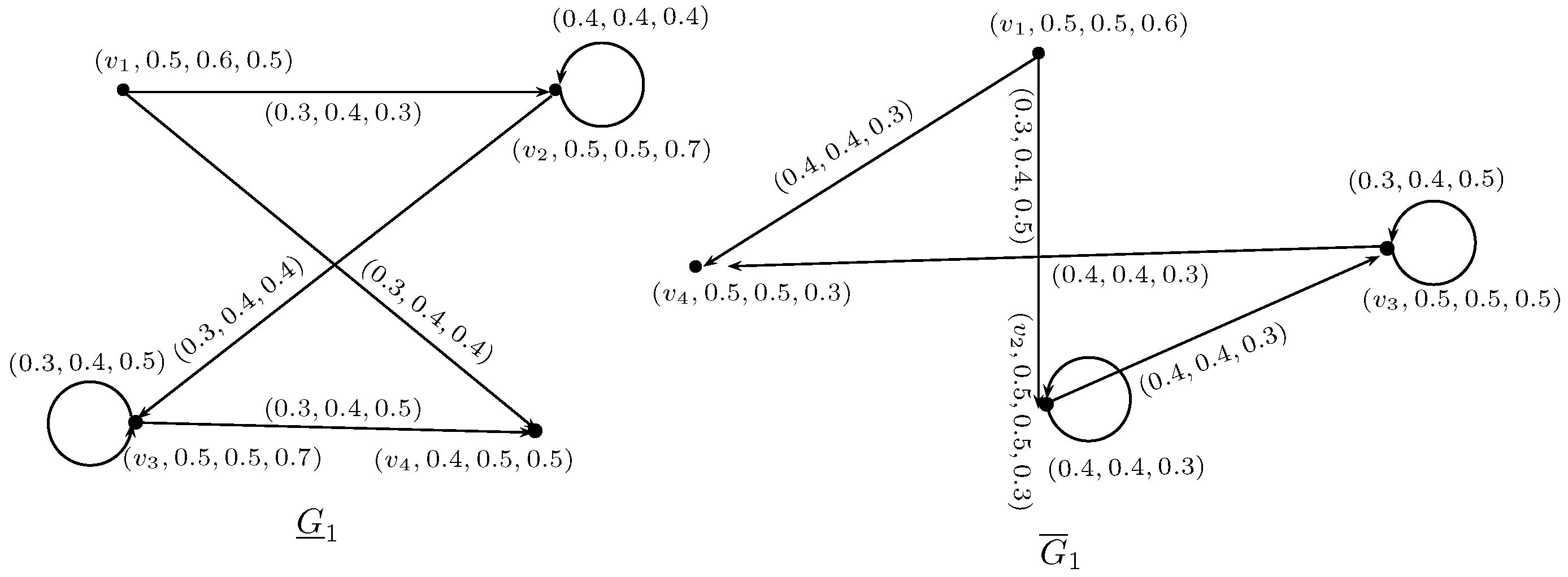
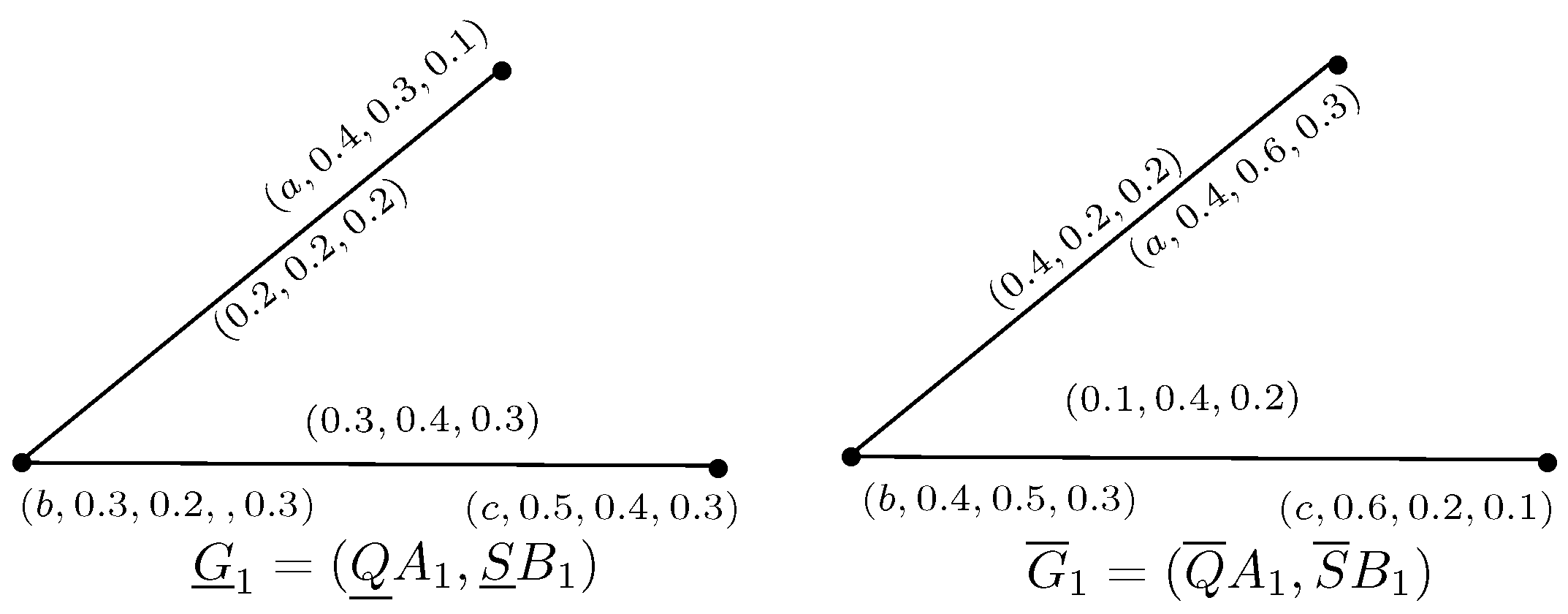
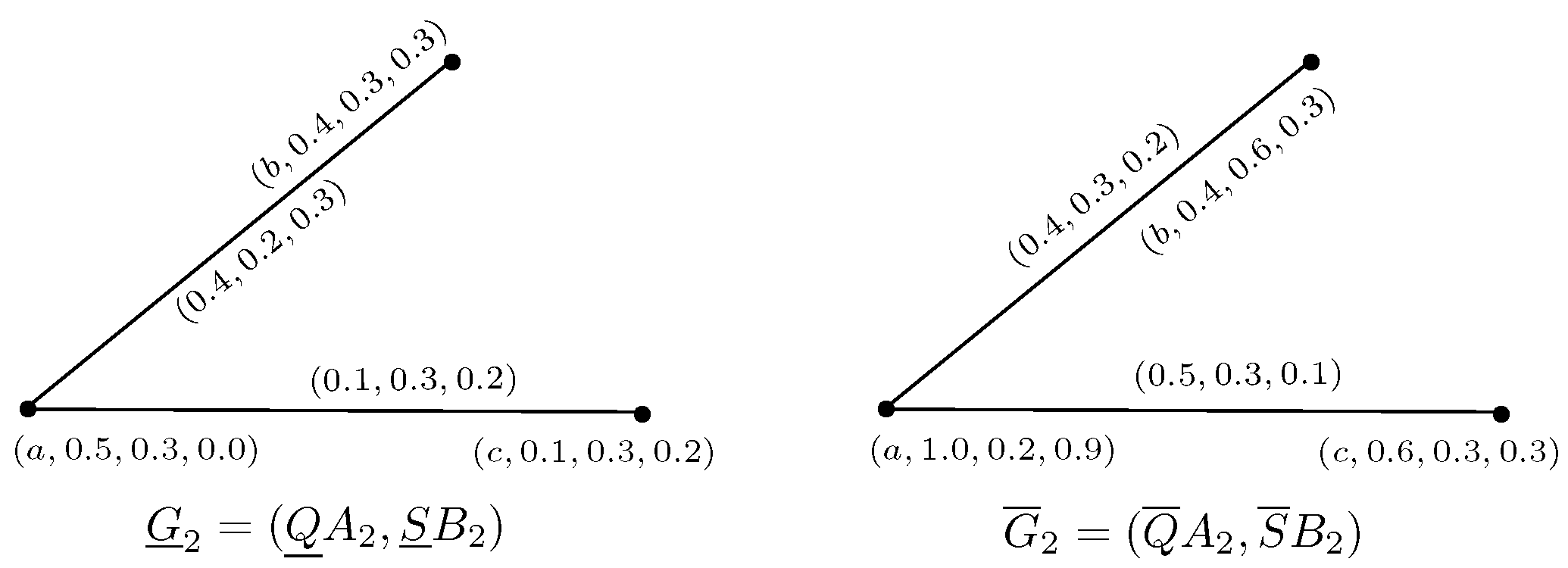
Thus, and are NSRGs, where , as shown in Figure 2.
Figure 2.
Neutrosophic soft rough graph .
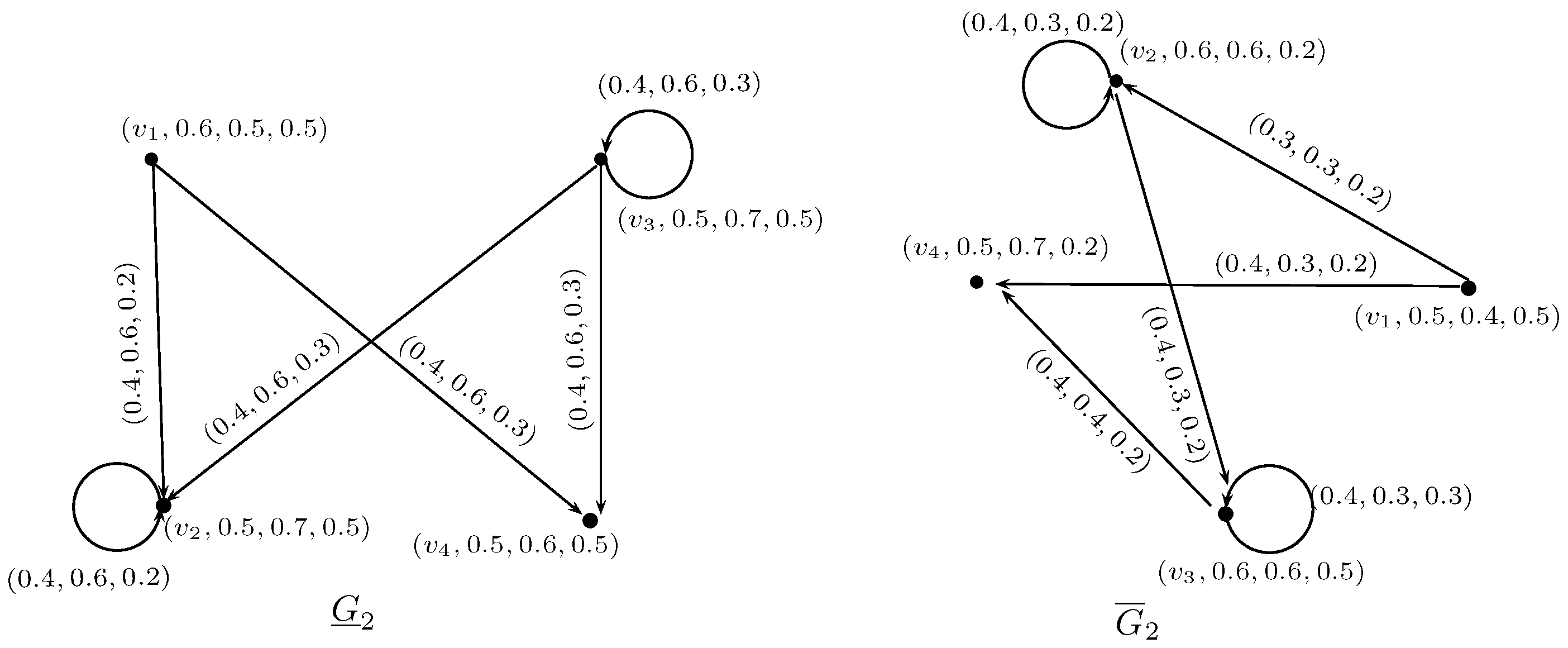
, as shown in Figure 3.
Figure 3.
Neutrosophic soft rough graph .
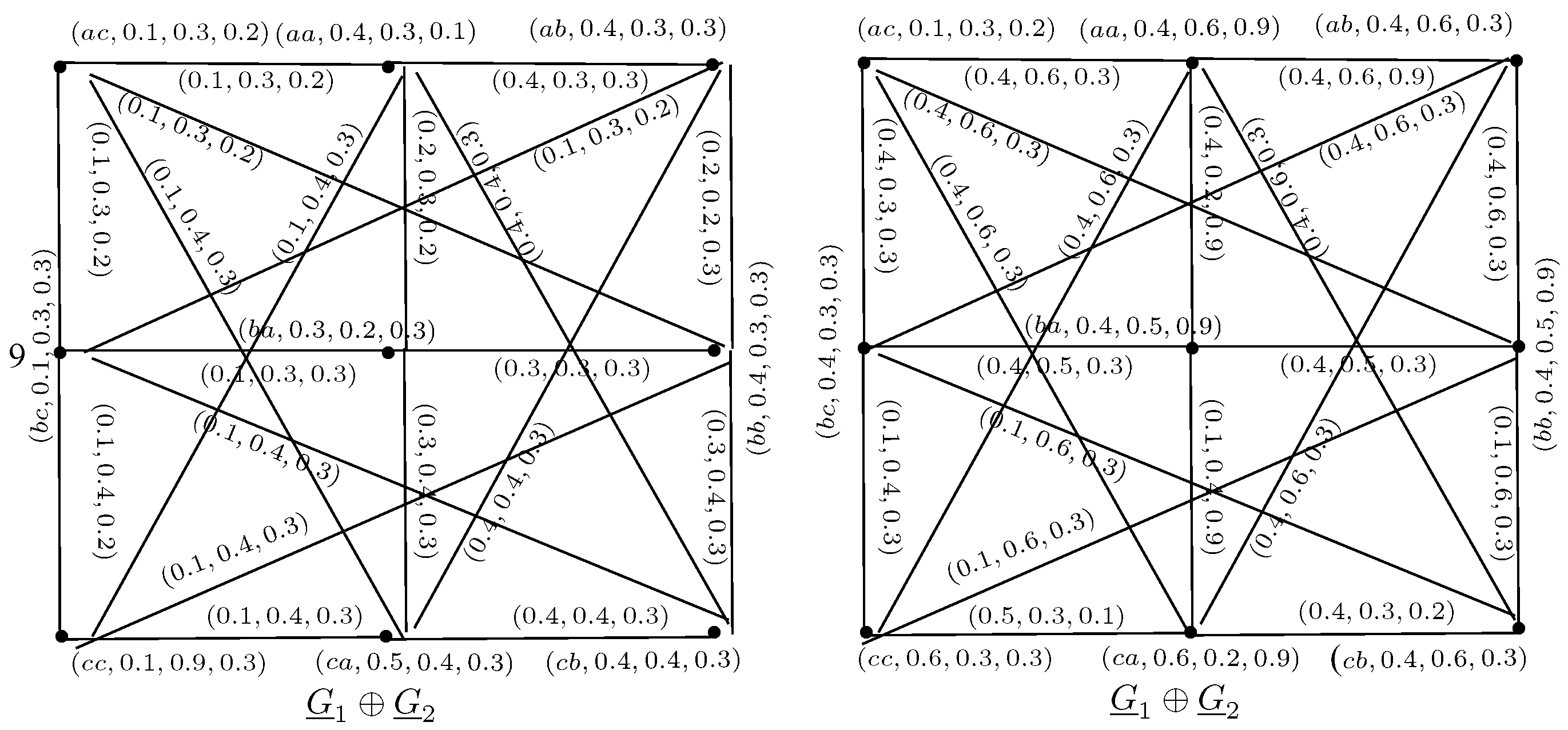
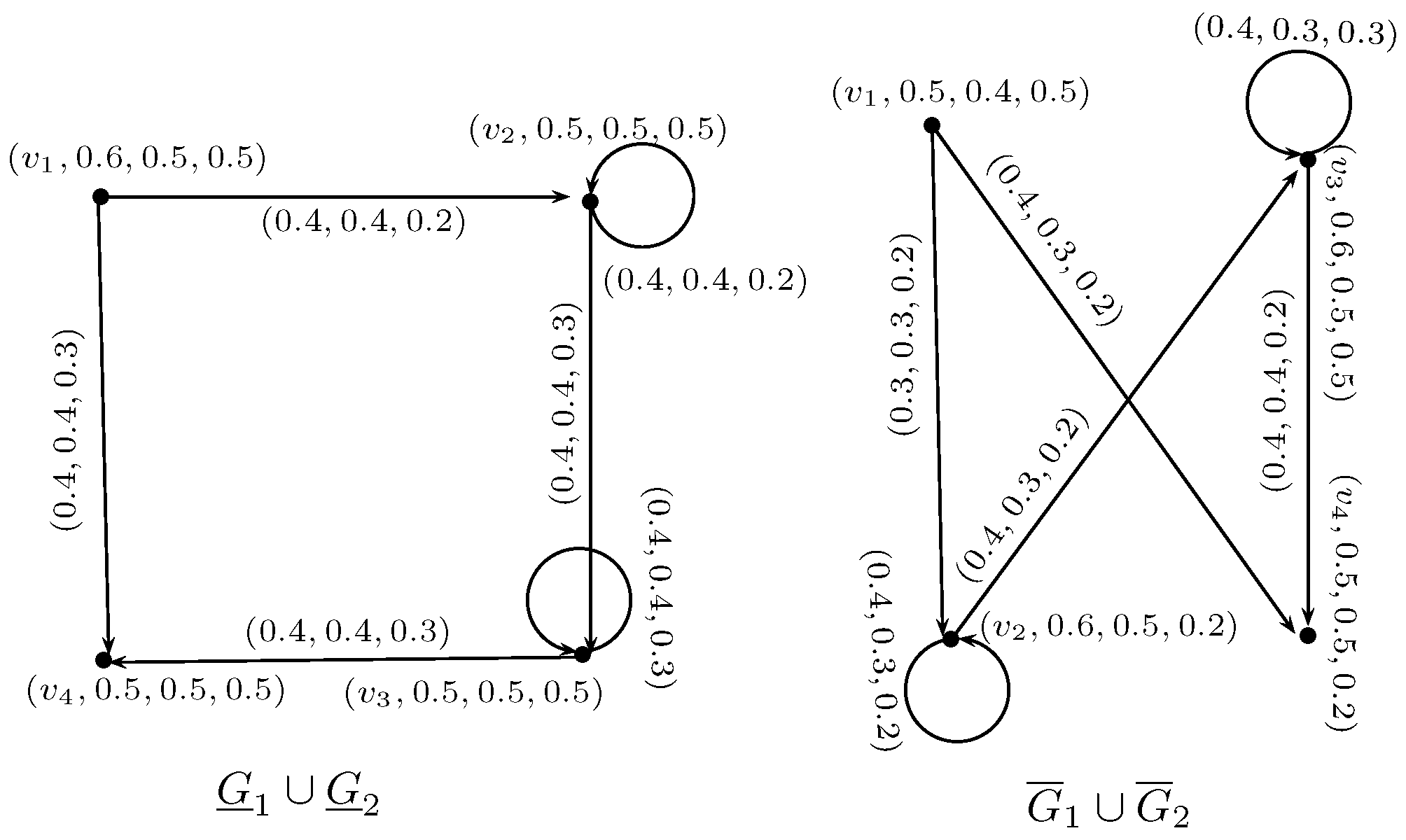
The union of and is NSRG as shown in Figure 4.
Figure 4.
Neutrosophic soft rough graph .
Definition 6.
Let and be two NSRGs on V. The intersection of and is a neutrosophic soft rough graph , where and are neutrosophic graphs, respectively, such that
- (i)
- but
- (ii)
- but
- (iii)
- (iv)
- but
- (v)
- but
- (vi)
Definition 7.
Let and be two neutrosophic soft rough graphs on V. The join of and is a neutrosophic soft rough graph , where and are neutrosophic graph, respectively, such that
- (i)
- but
- (ii)
- but
- (iii)
- (iv)
- but
- (v)
- but
- (vi)
- (vii)
- , where is the set of edges joining vertices of and .
Definition 8.
The Cartesian product of and is a where and are neutrosophic digraph, such that
- (i)
- (ii)
- .
- (iii)
- .
Definition 9.
The cross product of and is a neutrosophic soft rough graph where and are neutrosophic graphs, respectively, such that
- (i)
- .
- (ii)
- .
Definition 10.
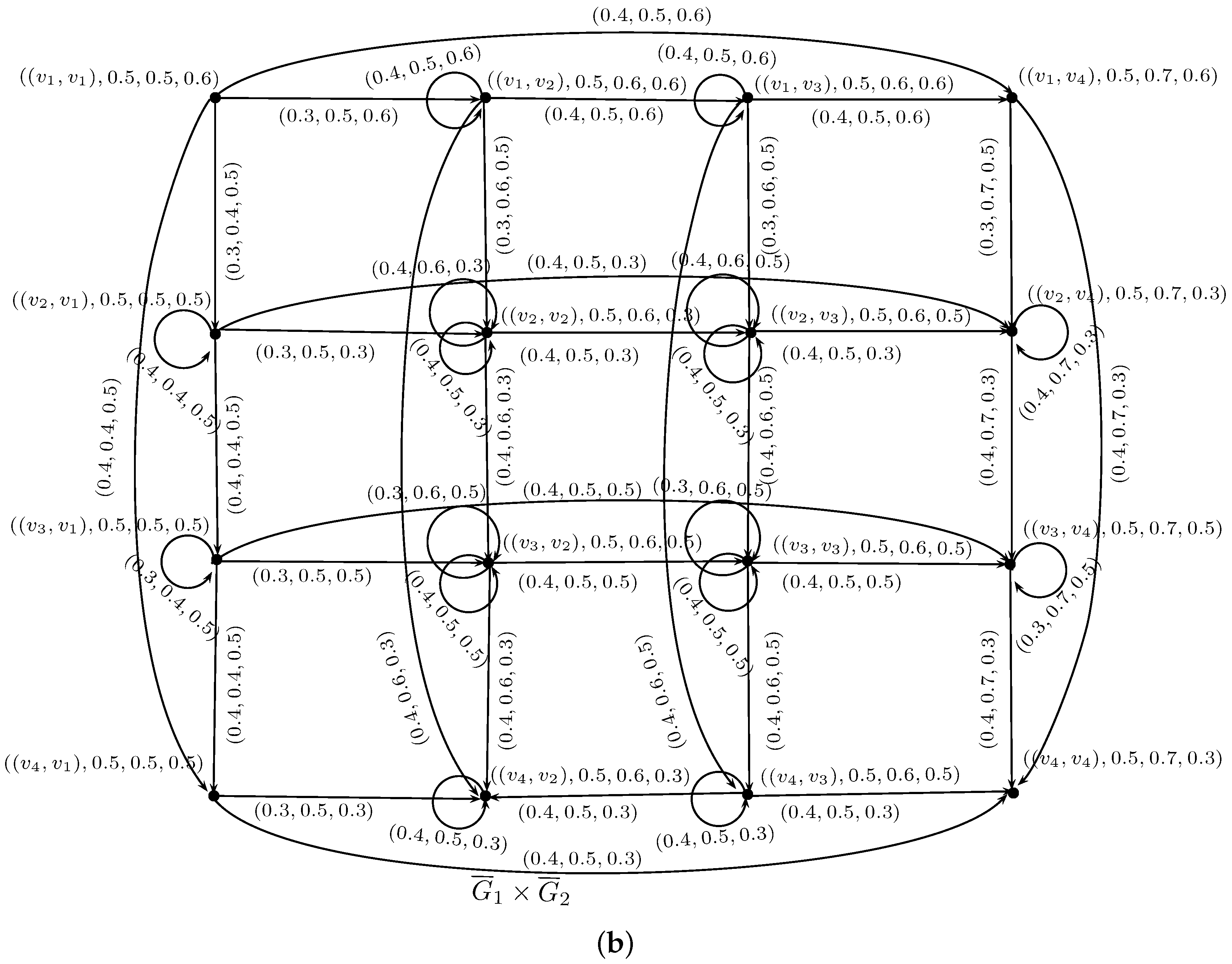
The rejection of and is a neutrosophic soft rough graph where and are neutrosophic graphs such that
- (i)
- .
- (ii)
- .
- (iii)
- ,
- (iv)
Example 6.

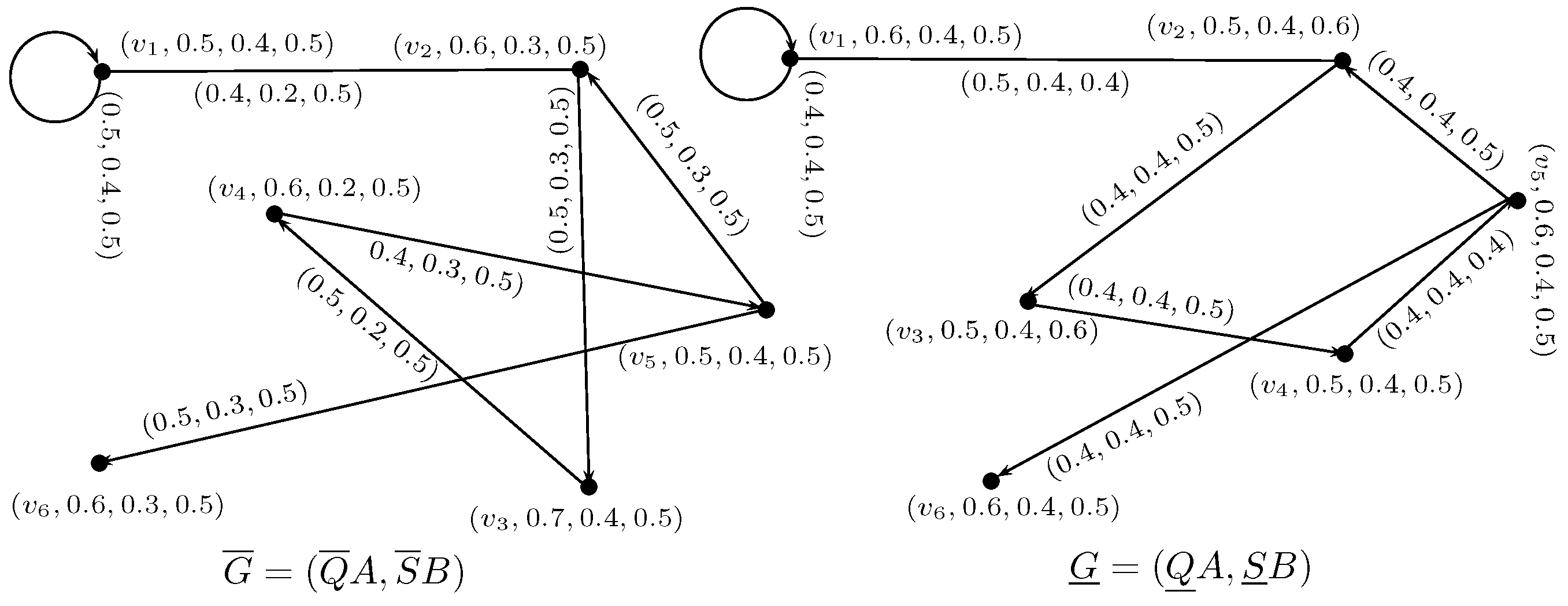
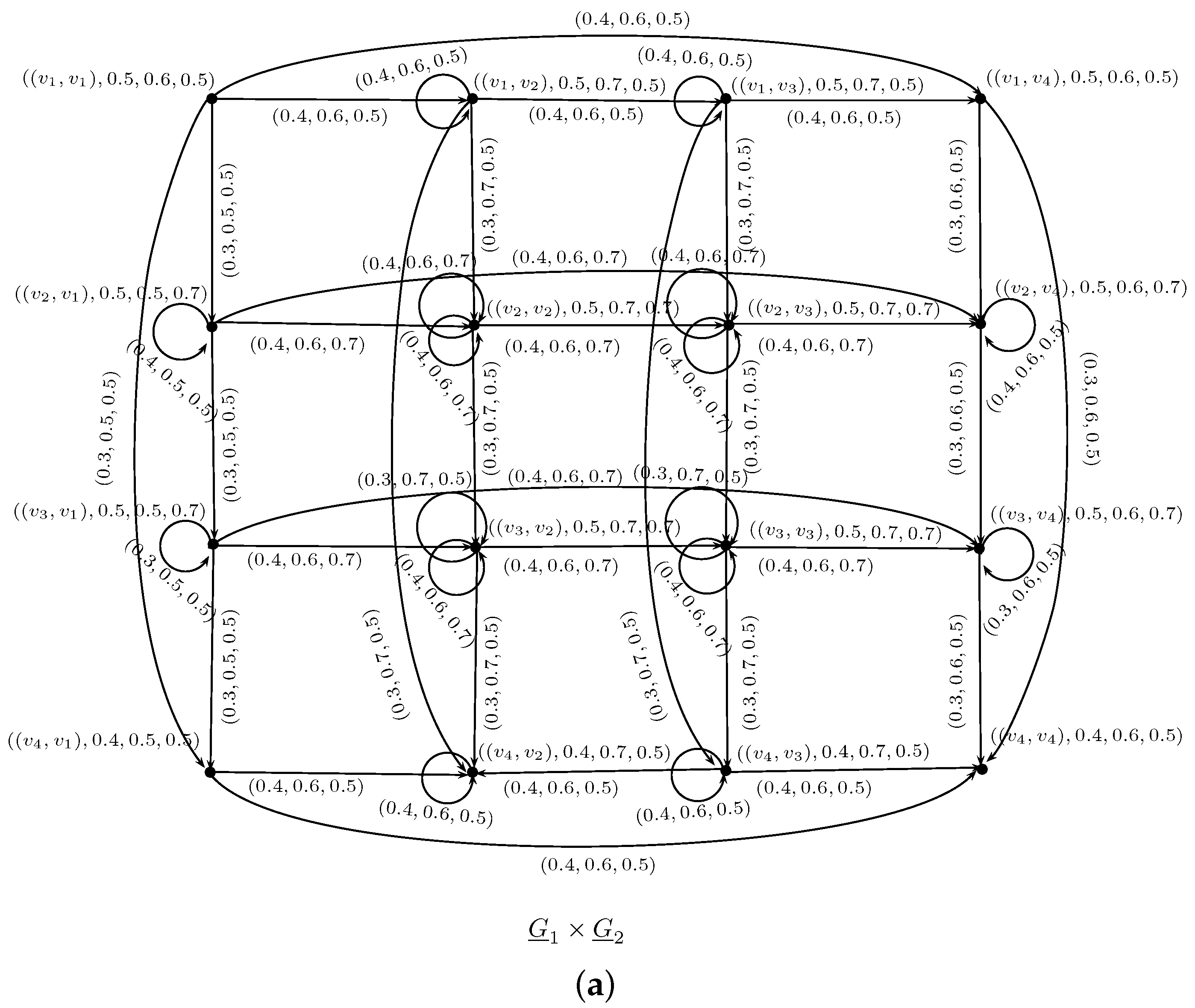
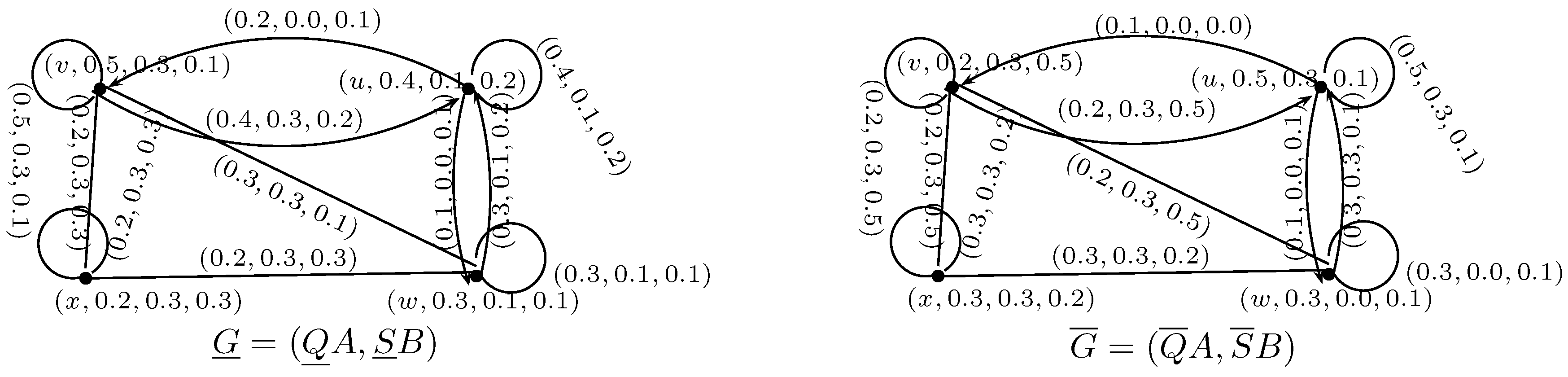
Let and be two neutrosophic soft rough graphs on V, where and are neutrosophic graphs as shown in Figure 2 and and are neutrosophic graphs as shown in Figure 3. The Cartesian product of and is NSRG as shown in Figure 5.

Figure 5.
Cartesian product of two neutrosophic soft rough graphs .
Definition 11.
The symmetric difference of and is a neutrosophic soft rough graph where and are neutrosophic graphs, respectively, such that
- (i)
- .
- (ii)
- .
- (iii)
- .
- (iv)
- .
- (v)
- .
Example 7.
Let and be two neutrosophic soft rough graphs on V, where and are neutrosophic graphs as shown in Figure 6 and and are neutrosophic graphs as shown in Figure 7.
Figure 6.
Neutrosophic soft rough graph .
Figure 7.
Neutrosophic soft rough graph .
The symmetric difference of and is , where and are neutrosophic graphs as shown in Figure 8.
Figure 8.
Neutrosophic soft rough graph .
Definition 12.
The lexicographic product of and is a neutrosophic soft rough graph where and are neutrosophic graphs, respectively, such that
- (i)
- .
- (ii)
- .
- (iii)
- .
Definition 13.
The strong product of and is a neutrosophic soft rough graph where and are neutrosophic graphs, respectively, such that
- (i)
- .
- (ii)
- .
- (iii)
- .
- (iv)
- .
Definition 14.
The composition of and is a neutrosophic soft rough graph where and are neutrosophic graphs, respectively, such that
- (i)
- .
- (ii)
- .
- (iii)
- .
- (iv)
- .
Definition 15.
Let be a neutrosophic soft rough graph. The complement of G, denoted by is a neutrosophic soft rough graph, where and are neutrosophic graphs such that
- (i)
- .
- (ii)
- .
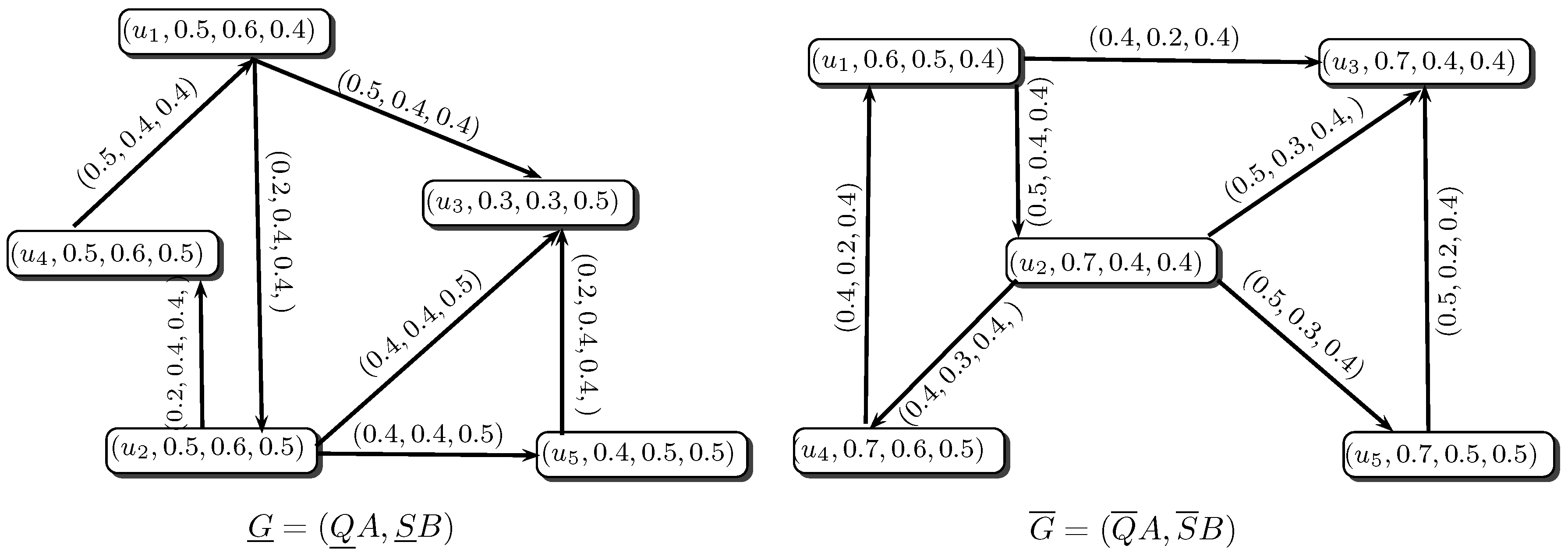
Example 8.
Consider an NSRGs G as shown in Figure 9.
Figure 9.
Neutrosophic soft rough graph .
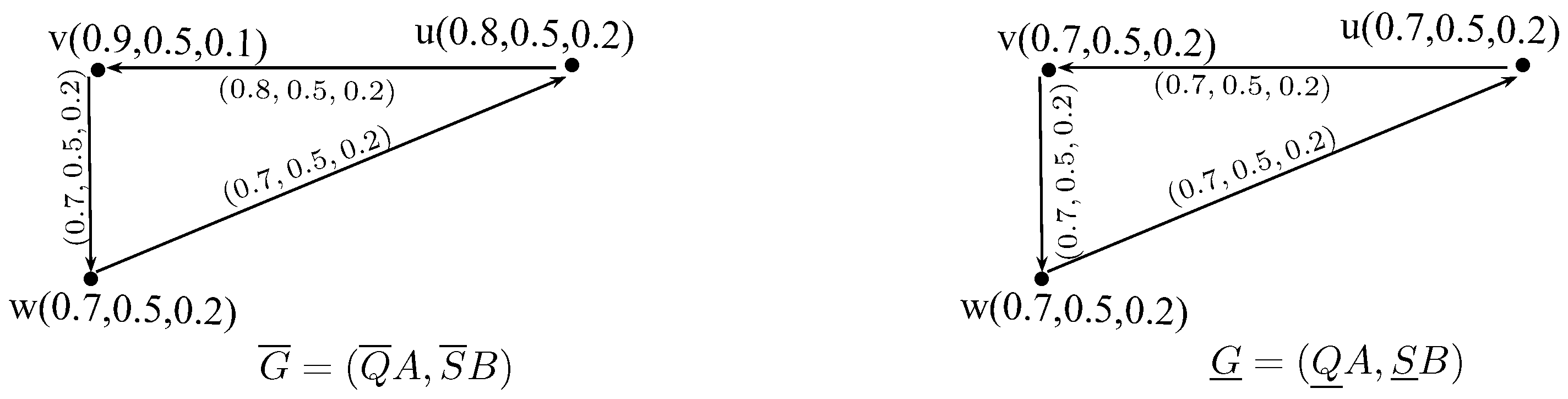
The complement of G is is obtained by using the Definition 15, where and are neutrosophic graphs as shown in Figure 10.
Figure 10.
Neutrosophic soft rough graph .
Definition 16.
A graph G is called self complement, if i.e.,
- (i)
- .
- (ii)
- .
Definition 17.
A neutrosophic soft rough graph G is called strong neutrosophic soft rough graph if ,
Example 9.
Consider a graph G such that and as shown in Figure 11. Let be a neutrosophic soft rough set of V and let be a neutrosophic soft rough set of E defined in the Table 9 and Table 10, respectively.
Figure 11.
Strong neutrosophic soft rough graph .
Table 9.
Neutrosophic soft rough set on V.
Table 10.
Neutrosophic soft rough set on E.
Hence, is a strong neutrosophic soft rough graph.
Definition 18.
A neutrosophic soft rough graph G is called a complete neutrosophic soft rough graph if
Remark 2.
Every complete neutrosophic soft rough graph is a strong neutrosophic soft rough graph. However, the converse is not true.
Definition 19.
A neutrosophic soft rough graph G is isolated, if .
Theorem 1.
The rejection of two neutrosophic soft rough graphs is a neutrosophic soft rough graph.
Proof.
Let and be two NSRGs. Let be the rejection of and , where and We claim that is a neutrosophic soft rough graph. It is enough to show that and are neutrosophic relations on and respectively. First, we show that is a neutrosophic relation on .
If , , then
If , , then
If , then
Thus, is a neutrosophic relation on . Similarly, we can show that is a neutrosophic relation on . Hence, G is a neutrosophic soft rough graph. ☐

Theorem 2.
The Cartesian product of two NSRGs is a neutrosophic soft rough graph.
Proof.
Let and be two NSRGs. Let be the Cartesian product of and , where and We claim that is a neutrosophic soft rough graph. It is enough to show that and are neutrosophic relations on and respectively. We have to show that is a neutrosophic relation on .
If , , then
If , , then
Therefore, is a neutrosophic relation on . Similarly, is a neutrosophic relation on Hence, G is a neutrosophic rough graph. ☐
Theorem 3.
The cross product of two neutrosophic soft rough graphs is a neutrosophic soft rough graph.
Proof.
Let and be two NSRGs. Let be the cross product of and , where and We claim that is a neutrosophic soft rough graph. It is enough to show that and are neutrosophic relations on and respectively. First, we show that is a neutrosophic relation on .
If , , then
Thus, is a neutrosophic relation on . Similarly, we can show that is a neutrosophic relation on . Hence, G is a neutrosophic soft rough graph. ☐

3. Application
In this section, we apply the concept of NSRSs to a decision-making problem. In recent times, the object recognition problem has gained considerable importance. The object recognition problem can be considered as a decision-making problem, in which final identification of objects is founded on a given set of information. A detailed description of the algorithm for the selection of most suitable objects based on an available set of alternatives is given, and purposed decision-making method can be used to calculate lower and upper approximation operators to progress deep concerns of the problem. The presented algorithms can be applied to avoid lengthy calculations when dealing with large number of objects. This method can be applied in various domains for multi-criteria selection of objects.
Selection of Most Suitable Generic Version of Brand Name Medicine
In the pharmaceutical industry, different pharmaceutical companies develop, produce and discover pharmaceutical medicine (drugs) for use as medication. These pharmaceutical companies deals with “brand name medicine” and “generic medicine”. Brand name medicine and generic medicine are bioequivalent, and have a generic medicine rate and element of absorption. Brand name medicine and generic medicine have the same active ingredients, but the inactive ingredients may differ. The most important difference is cost. Generic medicine is less expensive as compared to brand name comparators. Usually, generic drug manufacturers face competition to produce cost less products. The product may possibly be slightly dissimilar in color, shape, or markings. The major difference is cost. We consider a brand name drug “” used for seasonal allergies medication. Consider
is a set of generic versions of “Loratadine”. We want to select the most suitable generic version of Loratadine on the basis of parameters Highly soluble, Highly permeable, Rapidly dissolving. be a set of paraments. Let Q be a neutrosophic soft relation from V to parameter set M, and describe truth-membership, indeterminacy-membership and false-membership degrees of generic version medicine corresponding to the parameters as shown in Table 11.
Table 11.
Neutrosophic soft set .
Suppose is the most favorable object that is an NS on the parameter set M under consideration. Then, is an NSRS in NSAS where
Let and .
Table 12.
Neutrosophic soft relation S.
Let be an NS on L that describes some relationship between the parameters under consideration; then, is an NSRR, where
Thus, is an NSRG as shown in Figure 12.
Figure 12.
Neutrosophic soft rough graph .
In [3], the sum of two neutrosophic numbers is defined.
Definition 20.
[3] Let C and D be two single valued neutrosophic numbers, and the sum of two single valued neutrosophic number is defined as follows:
| Algorithm 1: Algorithm for selection of most suitable objects |
|
The sum of UNSRS and the LNSRS and sum of LNSRR and the UNSRR are NSs and , respectively defined by
The score function defines for each generic version medicine ,
and with the larger score value is the most suitable generic version medicine. By calculations, we have
Here, is the optimal decision, and the most suitable generic version of “Loratadine” is “Triamcinolone”. We have used software MATLAB (version 7, MathWorks, Natick, MA, USA) for calculating the required results in the application. The algorithm is given in Algorithm 1. The algorithm of the program is general for any number of objects with respect to certain parameters.
4. Conclusions
Rough set theory can be considered as an extension of classical set theory. Rough set theory is a very useful mathematical model to handle vagueness. NS theory, RS theory and SS theory are three useful distinguished approaches to deal with vagueness. NS and RS models are used to handle uncertainty, and combining these two models with another remarkable model of SSs gives more precise results for decision-making problems. In this paper, we have presented the notion of NSRGs and investigated some properties of NSRGs in detail. The notion of NSRGs can be utilized as a mathematical tool to deal with imprecise and unspecified information. In addition, a decision-making method based on NSRGs is proposed. This research work can be extended to (1) Rough bipolar neutrosophic soft sets; (2) Bipolar neutrosophic soft rough sets, (3) Interval-valued bipolar neutrosophic rough sets, and (4) Soft rough neutrosophic graphs.
Author Contributions
Muhammad Akram and Sundas Shahzadi conceived and designed the experiments; Hafsa M. Malik performed the experiments; Florentin Smarandache analyzed the data; Sundas Shahzadi and Hafsa M. Malik wrote the paper.
Conflicts of Interest
The authors declare no conflict of interest.
References
- Smarandache, F. Neutrosophic set, a generalisation of the Intuitionistic Fuzzy Sets. Int. J. Pure Appl. Math. 2010, 24, 289–297. [Google Scholar]
- Wang, H.; Smarandache, F.; Zhang, Y.; Sunderraman, R. Single-valued neutrosophic sets. Multispace Multistructure 2010, 4, 410–413. [Google Scholar]
- Peng, J.J.; Wang, J.Q.; Zhang, H.Y.; Chen, X.H. An outranking approach for multi-criteria decision-making problems with simplified neutrosophic sets. Appl. Soft Comput. 2014, 25, 336–346. [Google Scholar] [CrossRef]
- Molodtsov, D.A. Soft set theory-first results. Comput. Math. Appl. 1999, 37, 19–31. [Google Scholar] [CrossRef]
- Maji, P.K.; Biswas, R.; Roy, A.R. Fuzzy soft sets. J. Fuzzy Math. 2001, 9, 589–602. [Google Scholar]
- Maji, P.K.; Biswas, R.; Roy, A.R. Intuitionistic fuzzy soft sets. J. Fuzzy Math. 2001, 9, 677–692. [Google Scholar]
- Maji, P.K. Neutrosophic soft set. Ann. Fuzzy Math. Inform. 2013, 5, 157–168. [Google Scholar]
- Sahin, R.; Kucuk, A. On similarity and entropy of neutrosophic soft sets. J. Intell. Fuzzy Syst. Appl. Eng. Technol. 2014, 27, 2417–2430. [Google Scholar]
- Pawlak, Z. Rough sets. Int. J. Comput. Inf. Sci. 1982, 11, 341–356. [Google Scholar] [CrossRef]
- Feng, F.; Liu, X.; Leoreanu-Fotea, B.; Jun, Y.B. Soft sets and soft rough sets. Inf. Sci. 2011, 181, 1125–1137. [Google Scholar] [CrossRef]
- Meng, D.; Zhang, X.; Qin, K. Soft rough fuzzy sets and soft fuzzy rough sets. Comput. Math. Appl. 2011, 62, 4635–4645. [Google Scholar] [CrossRef]
- Sun, B.Z.; Ma, W. Soft fuzzy rough sets and its application in decision making. Artif. Intell. Rev. 2014, 41, 67–80. [Google Scholar] [CrossRef]
- Sun, B.Z.; Ma, W.; Liu, Q. An approach to decision making based on intuitionistic fuzzy rough sets over two universes. J. Oper. Res. Soc. 2013, 64, 1079–1089. [Google Scholar] [CrossRef]
- Zhang, X.; Zhou, B.; Li, Q. A general frame for intuitionistic fuzzy rough sets. Inf. Sci. 2012, 216, 34–49. [Google Scholar] [CrossRef]
- Zhang, X.; Dai, J.; Yu, Y. On the union and intersection operations of rough sets based on various approximation spaces. Inf. Sci. 2015, 292, 214–229. [Google Scholar] [CrossRef]
- Zhang, H.; Shu, L.; Liao, S. Intuitionistic fuzzy soft rough set and its application in decision making. Abstr. Appl. Anal. 2014, 2014, 287314. [Google Scholar] [CrossRef]
- Zhang, H.; Xiong, L.; Ma, W. Generalized intuitionistic fuzzy soft rough set and its application in decision making. J. Comput. Anal. Appl. 2016, 20, 750–766. [Google Scholar]
- Broumi, S.; Smarandache, F. Interval-valued neutrosophic soft rough sets. Int. J. Comput. Math. 2015, 2015, 232919. [Google Scholar] [CrossRef]
- Broumi, S.; Smarandache, F.; Dhar, M. Rough neutrosophic sets. Neutrosophic Sets Syst. 2014, 3, 62–67. [Google Scholar]
- Yang, H.L.; Zhang, C.L.; Guo, Z.L.; Liu, Y.L.; Liao, X. A hybrid model of single valued neutrosophic sets and rough sets: Single valued neutrosophic rough set model. Soft Comput. 2016. [Google Scholar] [CrossRef]
- Akram, M.; Nawaz, S. Operations on soft graphs. Fuzzy Inf. Eng. 2015, 7, 423–449. [Google Scholar] [CrossRef]
- Akram, M.; Nawaz, S. On fuzzy soft graphs. Ital. J. Pure Appl. Math. 2015, 34, 497–514. [Google Scholar]
- Akram, M.; Shahzadi, S. Novel intuitionistic fuzzy soft multiple-attribute decision-making methods. Neural Comput. Appl. 2016. [Google Scholar] [CrossRef]
- Shahzadi, S.; Akram, M. Intuitionistic fuzzy soft graphs with applications. J. Appl. Math. Comput. 2016, 55, 369–392. [Google Scholar] [CrossRef]
- Akram, M.; Shahzadi, S. Neutrosophic soft graphs with application. J. Intell. Fuzzy Syst. 2017, 2, 841–858. [Google Scholar] [CrossRef]
- Zafar, F.; Akram, M. A novel decision-making method based on rough fuzzy information. Int. J. Fuzzy Syst. 2017, 1–15. [Google Scholar] [CrossRef]
- Peng, T.Z.; Qiang, W.J.; Yu, Z.H. Hybrid single-valued neutrosophic MCGDM with QFD for market segment evaluation and selection. J. Intell. Fuzzy Syst. 2018, 34, 177–187. [Google Scholar]
- Qiang, W.J.; Xu, Z.; Yu, Z.H. Hotel recommendation approach based on the online consumer reviews using interval neutrosophic linguistic numbers. J. Intell. Fuzzy Syst. 2018, 34, 381–394. [Google Scholar]
- Luo, S.Z.; Cheng, P.F.; Wang, J.Q.; Huang, Y.J. Selecting Project Delivery Systems Based on Simplified Neutrosophic Linguistic Preference Relations. Symmetry 2017, 9, 151. [Google Scholar] [CrossRef]
- Nie, R.X.; Wang, J.Q.; Zhang, H.Y. Solving solar-wind power station location problem using an extended WASPAS technique with Interval neutrosophic sets. Symmetry 2017, 9, 106. [Google Scholar] [CrossRef]
- Wu, X.; Wang, J.; Peng, J.; Qian, J. A novel group decision-making method with probability hesitant interval neutrosphic set and its application in middle level manager’s selection. Int. J. Uncertain. Quant. 2018. [Google Scholar] [CrossRef]
- Medina, J.; Ojeda-Aciego, M. Multi-adjoint t-concept lattices. Inf. Sci. 2010, 180, 712–725. [Google Scholar] [CrossRef]
- Pozna, C.; Minculete, N.; Precup, R.E.; Kóczy, L.T.; Ballagi, Á. Signatures: Definitions, operators and applications to fuzzy modeling. Fuzzy Sets Syst. 2012, 201, 86–104. [Google Scholar] [CrossRef]
- Nowaková, J.; Prílepok, M.; Snášel, V. Medical image retrieval using vector quantization and fuzzy S-tree. J. Med. Syst. 2017, 41, 1–16. [Google Scholar] [CrossRef] [PubMed]
- Kumar, A.; Kumar, D.; Jarial, S.K. A hybrid clustering method based on improved artificial bee colony and fuzzy C-Means algorithm. Int. J. Artif. Intell. 2017, 15, 40–60. [Google Scholar]
© 2018 by the authors. Licensee MDPI, Basel, Switzerland. This article is an open access article distributed under the terms and conditions of the Creative Commons Attribution (CC BY) license (http://creativecommons.org/licenses/by/4.0/).