


Abstract
We use the biorthogonal multiwavelets related by differentiation constructed in previous work to construct compactly supported biorthogonal multiwavelet bases for the space of vector fields on the upper half plane such that the reconstruction wavelets are divergence-free and have vanishing normal components on the boundary of . Such wavelets are suitable to study the Navier–Stokes equations on a half plane when imposing a Navier boundary condition.
1. Introduction
Wavelets have proved useful for the numerical analysis of an incompressible flow fluid that can be modeled by the Navier–Stokes equations. The incompressibility requires the wavelets to be divergence-free, at least in dimension three or greater.
Battle and Federbush [1] first constructed an orthogonal basis of divergence-free wavelets for the space of divergence-free vector fields on . The Battle–Federbush divergence-free wavelets are globally supported, and therefore unsuitable for numerical analysis on domains with boundary. It was shown by Lemarié that if a continuous divergence-free wavelet basis is orthogonal, the wavelets cannot be compactly supported [2]. Lemarié [3] also showed that this obstacle does not necessarily arise in the biorthogonal case. He used the existence of biorthogonal MRAs related by differentiation to construct compactly supported divergence-free wavelets. Lemarié’s method can be extended to higher dimensional spaces by using tensor products of univariate functions. His approach was then modified and extended in various works by Urban [4,5]. Those divergence-free wavelets have been used effectively for the numerical simulation of the Stokes equations on rectangular domains [6], and for the analysis of incompressible turbulent flows [7].
A velocity field defined on a domain is said to satisfy Navier boundary conditions if and on where D denotes the strain tensor and and are the unit normal and tangent vectors respectively. We will call the condition the vanishing normal boundary condition. When Ω is the upper half plane , and where and are the standard basis vectors. The study of the Navier–Stokes equations on half spaces with the Navier boundary condition remains a field of intensive research, e.g., [8]. Here we will adapt Lemarié’s technique to provide a construction for a multiwavelet basis of the divergence-free vector fields on the upper half plane that satisfies the vanishing normal boundary condition using the biorthogonal multiwavelets on introduced in [9]. This approach can easily be extended to higher dimensions, but we will work exclusively in to minimize notational complexity.
Strela’s two-scale transform [10] plays a crucial role in extending Lemarié’s divergence-free construction to multiwavelets by providing certain commutation relations between oblique MRA projections and differentiation under suitable conditions on Strela’s transition matrix. To carry out the construction on the upper half plane , it is necessary that the wavelet bases of adapted from those of are also related by differentiation and inherit the commutation relation between oblique projections and differentiation. These constraints plus the vanishing normal boundary conditions force the wavelet bases of to have an appropriate combination of biorthogonality, symmetry, regularity, support and boundary behavior. We will see that this can all be accomplished using the biorthogonal multiwavelet bases of constructed in [9].
2. Biorthogonal Multiwavelets of
We review here in some detail the construction of biorthogonal multiwavelets related by differentiation introduced in [9]. The main tools for the construction are fractal interpolation functions [11] and Strela’s two-scale transform [10].
2.1. Some Preliminaries
Denote by the -closure of the finite shift invariant space spanned by the integer translates of and let Φ denote the vector function . It is standard to denote . If then Φ is called a scaling vector. If, in addition, , , and the integer shifts of form a Riesz basis for , then the nested family is called a multiresolution analysis of of multiplicity r.
The vector function is called a scaling vector and is said to generate the multiresolution analysis . Φ satisfies a matrix–vector dilation equation
for some sequence of matrices , called scaling coefficients.
We define the Fourier transform of a function by
Taking the Fourier transform of the dilation Equation (1), we obtain
in which H is an matrix of periodic functions, called a scaling filter ; in addition .
A vector function is called a multiwavelet associated with the scaling vector Φ if the integer translates are linearly independent and
is a Riesz basis of . Let be the closed linear span of . Then
where the symbol ⊕ denotes the internal direct sum, not necessarily orthogonal. The wavelet vector Ψ can be represented by the following equation
for some sequence of matrices , called wavelet coefficients. In the Fourier domain,
where F is an matrix of periodic functions, called a wavelet filter.
The scaling functions and wavelets will have finite support if and only if there are finitely many non-zero coefficients and .
A multi scaling function is said to have approximation order m if each polynomial is a linear combination of integer translates
for , where the ’s are constant row-vectors of length r.
We say that a pair of vector functions and is biorthogonal if
for all and , where denotes the usual inner product in . If the MRAs and are generated by the scaling vectors Φ and , respectively, then and are said to be a pair of biorthogonal MRAs if Φ and are biorthogonal. If and are the multiwavelets associated with the scaling vectors Φ and respectively, then Ψ and are biorthogonal multiwavelets if
for and In this case, and . If and are biorthogonal multiwavelets then for ,
2.2. Biorthogonal Multiwavelets from Fractal Interpolation
The parametric family of biorthogonal wavelets described here uses ideas similar to those developed by Massopust [12]. Let
Fix . The unique solution of the inhomogeneous equation
is called a fractal interpolation function. We will denote for a certain related value . Define
and let be defined in the same way with w replaced by . Set
and define , in the same way with replaced by and the normalization parameters replaced by corresponding parameters . Set and
and define and similarly. We proved in [9] that
Theorem 2.1. For and ,
- 1.
- and form a pair of biorthogonal MRAs of .
- 2.
- Φ and are piecewise biorthogonal multiscaling functions. Their components , are supported on and symmetric about ; , are supported on and antisymmetric about ; , are supported on and symmetric about 0.
- 3.
- Φ and have approximation order 3.
Let H and be the scaling filter of Φ and , respectively. As in [9], to construct biorthogonal multiwavelets related by differentiation via Strela’s two-scale transform, one needs and to be symmetric. For this reason, we chose , , .
The biorthogonal scaling vectors Φ and are represented by the scaling equations
The biorthogonal multiwavelets and associated with the respective scaling vectors Φ and are represented by corresponding equations
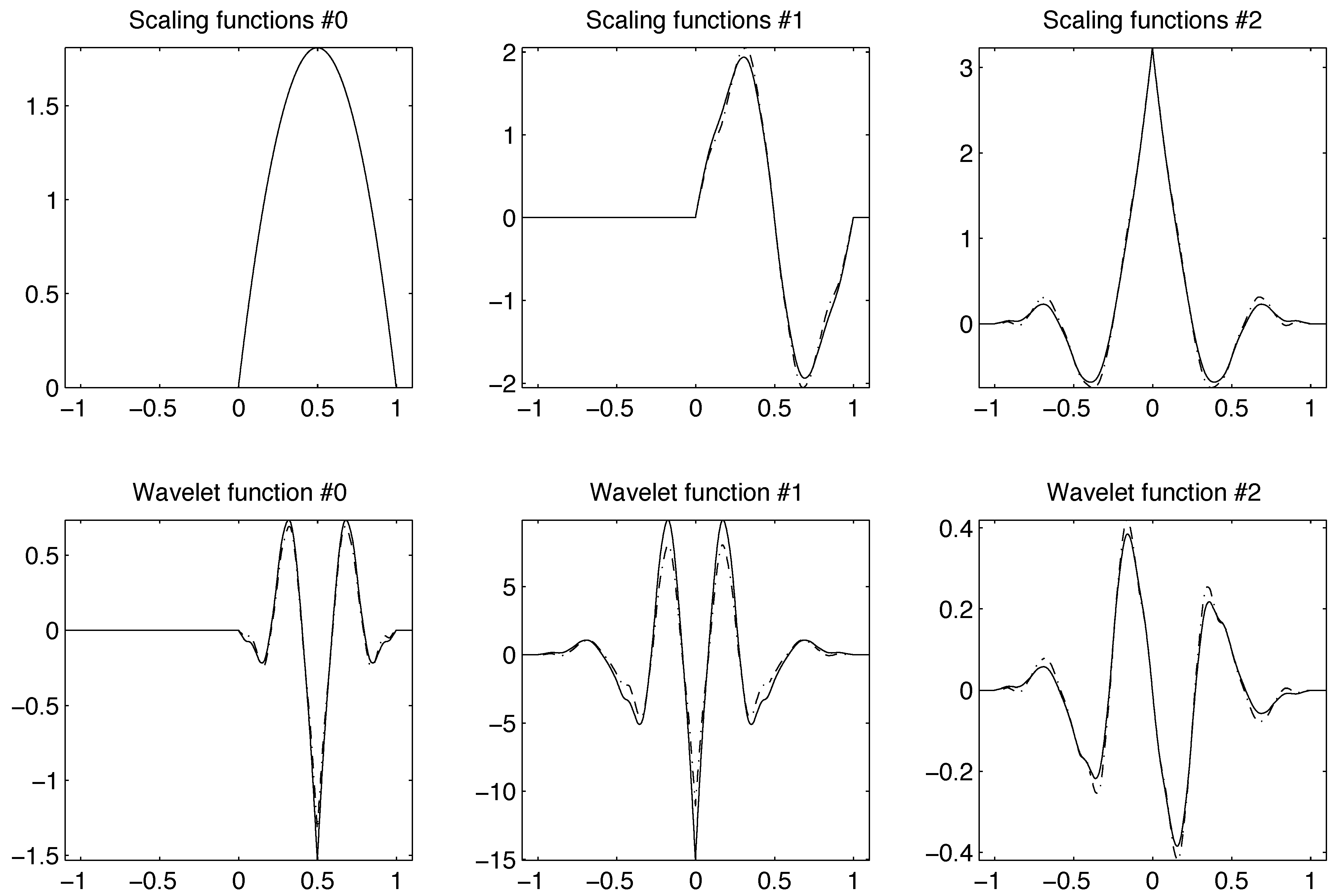
With appropriate choice of coefficients the multiwavelets are also supported on and possess corresponding symmetry properties. The scaling coefficients and wavelet coefficients for the parameter choices , can be found in Appendix A. The components of the scaling and wavelet vectors are plotted in Figure 1.
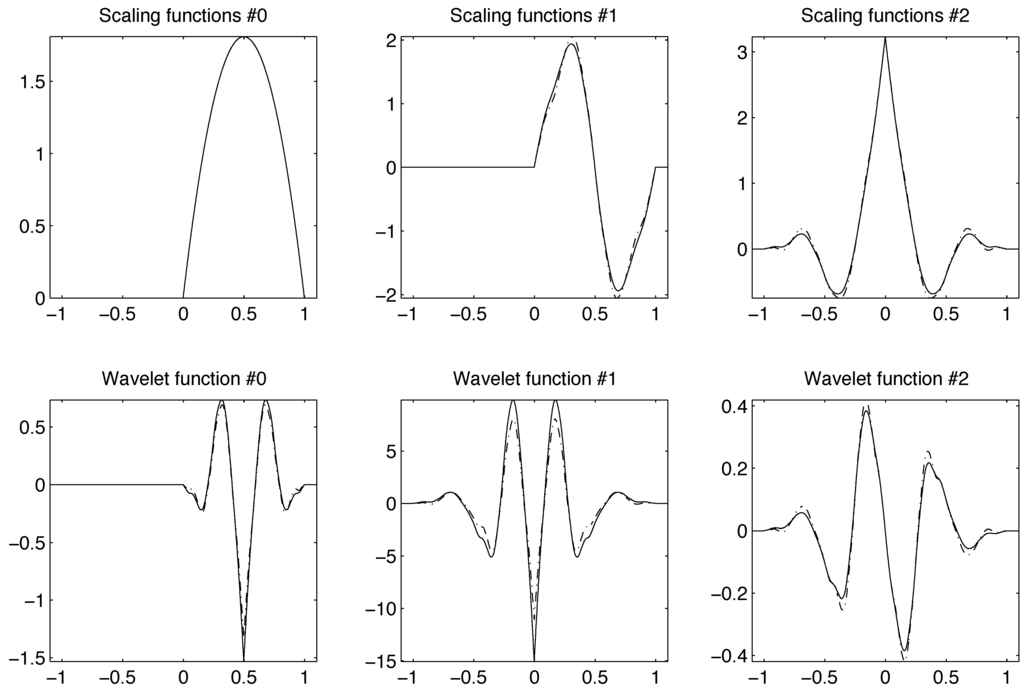
Figure 1.
Scaling vectors Φ (solid) and (dashed) and multiwavelets Ψ and , .
Figure 1.
Scaling vectors Φ (solid) and (dashed) and multiwavelets Ψ and , .
2.3. Biorthogonal Multiwavelets via Strela’s Two-Scale Transform
Strela’s two-scale transform is a method to derive a new scaling filter from a given scaling filter by a transform in which the relative properties of and are encoded in the transition matrix M. Strela proved that if is linear in with a unique zero at and if the kernel of is the 1-eigenvector of then the scaling vector of will have one more order of approximation and regularity than has. Using Strela’s two-scale transform [10], we obtained in [9] new biorthogonal multiwavelets related by differentiation to the ones we constructed from fractal interpolation functions, as explained below.
2.3.1. Smoothing Procedure
The transition matrix and two-scale transform filter
have the properties just indicated. then is the filter of a new scaling vector having one more approximation order and regularity than the original scaling vector whose components appear in Figure 1. By Theorem 2.1, is piecewise and has approximation order 4. One associates to the multiwavelet vector defined by the filter defined by (see Lakey and Pereyra [13])
where is the filter of the multiwavelet derived from Equation (6).
The transition matrix M induces an operator symbol matrix
Here I denotes the identity operator and S is the shift operator , so . We proved in [9] that the smoothed scaling vector and the associated multiwavelet are related to the original ones by the following differentiation relations
where denotes the distributional derivative of f. The components and , of and satisfy the following.
Theorem 2.2. [9] Let and be defined as above. Then
- 1.
- The components of and are piecewise and have approximation order 4.
- 2.
- is supported on and antisymmetric about 0; is supported on and symmetric about ; is supported on and symmetric about 0.
- 3.
- is supported on and antisymmetric about ; is supported on and antisymmetric about 0; is supported on and symmetric about 0.
The smoothed scaling and wavelet filter matrices have the form
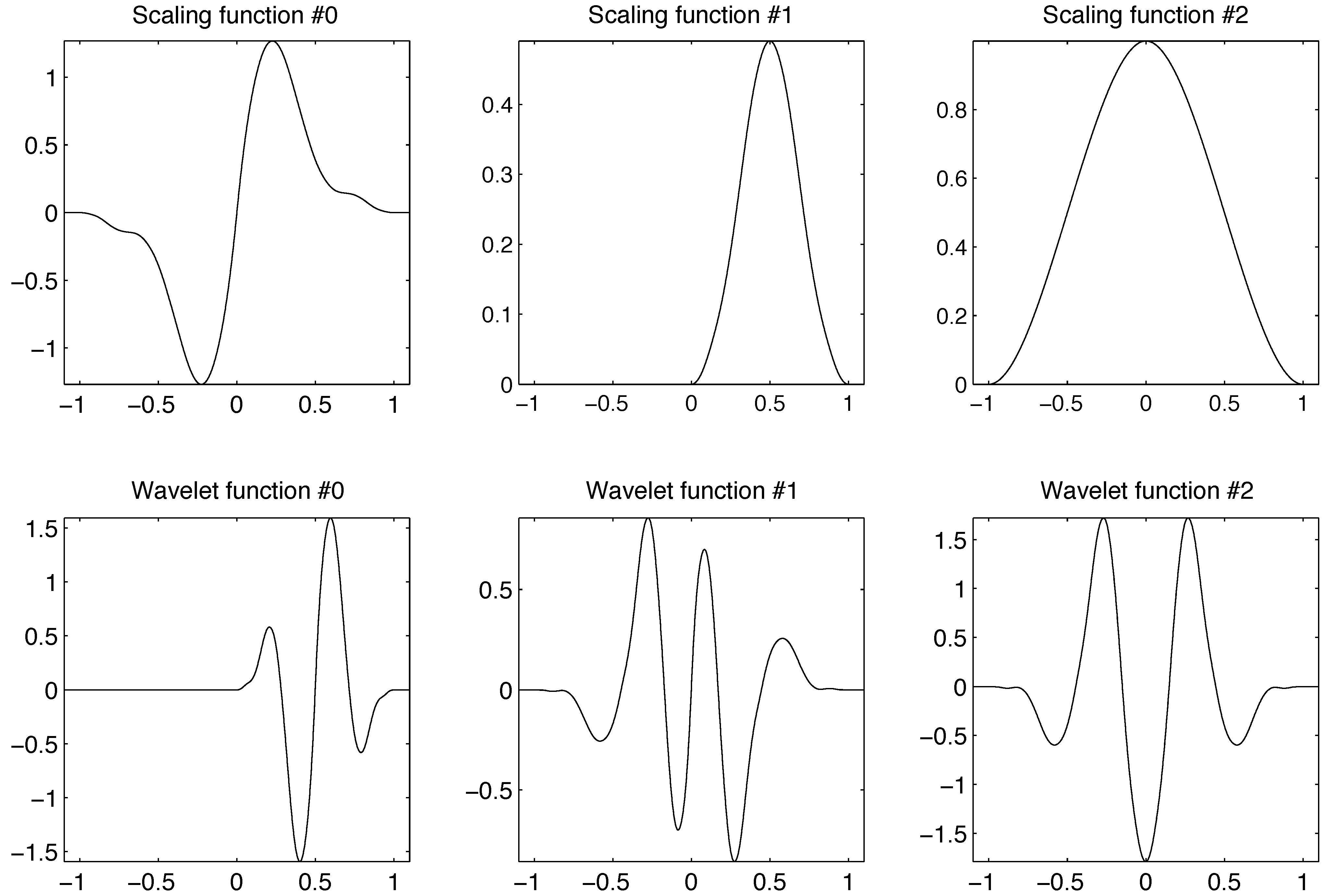
with values determined by Equations (7) and (8). The matrices and corresponding to the parameter choices , are given in Appendix A. The components of the smoothed scaling and wavelet vectors are plotted in Figure 2.
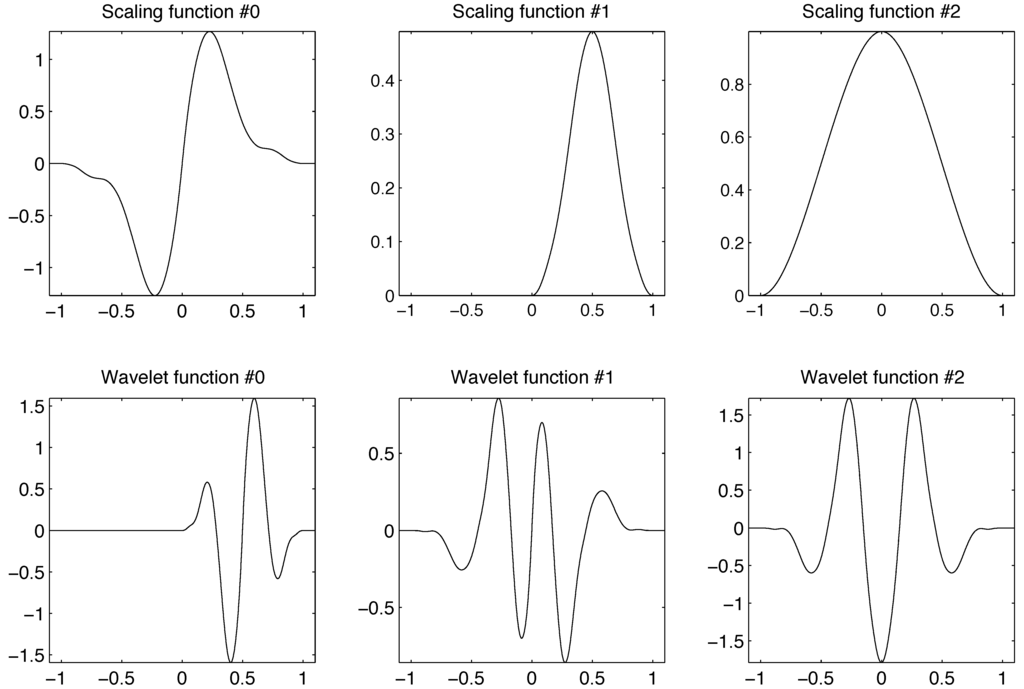
Figure 2.
Smoothed scaling vector and multiwavelet .
Figure 2.
Smoothed scaling vector and multiwavelet .
2.3.2. Roughening Procedure
Following Strela, the scaling vector of the filter defined by
has one less approximation order and regularity than the old scaling vector Φ. Hence, is piecewise continuous and of approximation order 2. An associated multiwavelet can be defined by (see Lakey and Pereyra [13])
It can also be verified that, with the symbol matrix corresponding to N as in Equation (9), the roughened and original scaling vectors and multiwavelets are related by
Denote by and , the components of and respectively.
Theorem 2.3. [9] Let , , and be defined as above. Then, in the exact order given, a component of or and the corresponding component of or have the same support and symmetry. In addition,
The values of the coefficients and of the roughened scaling and wavelet filters
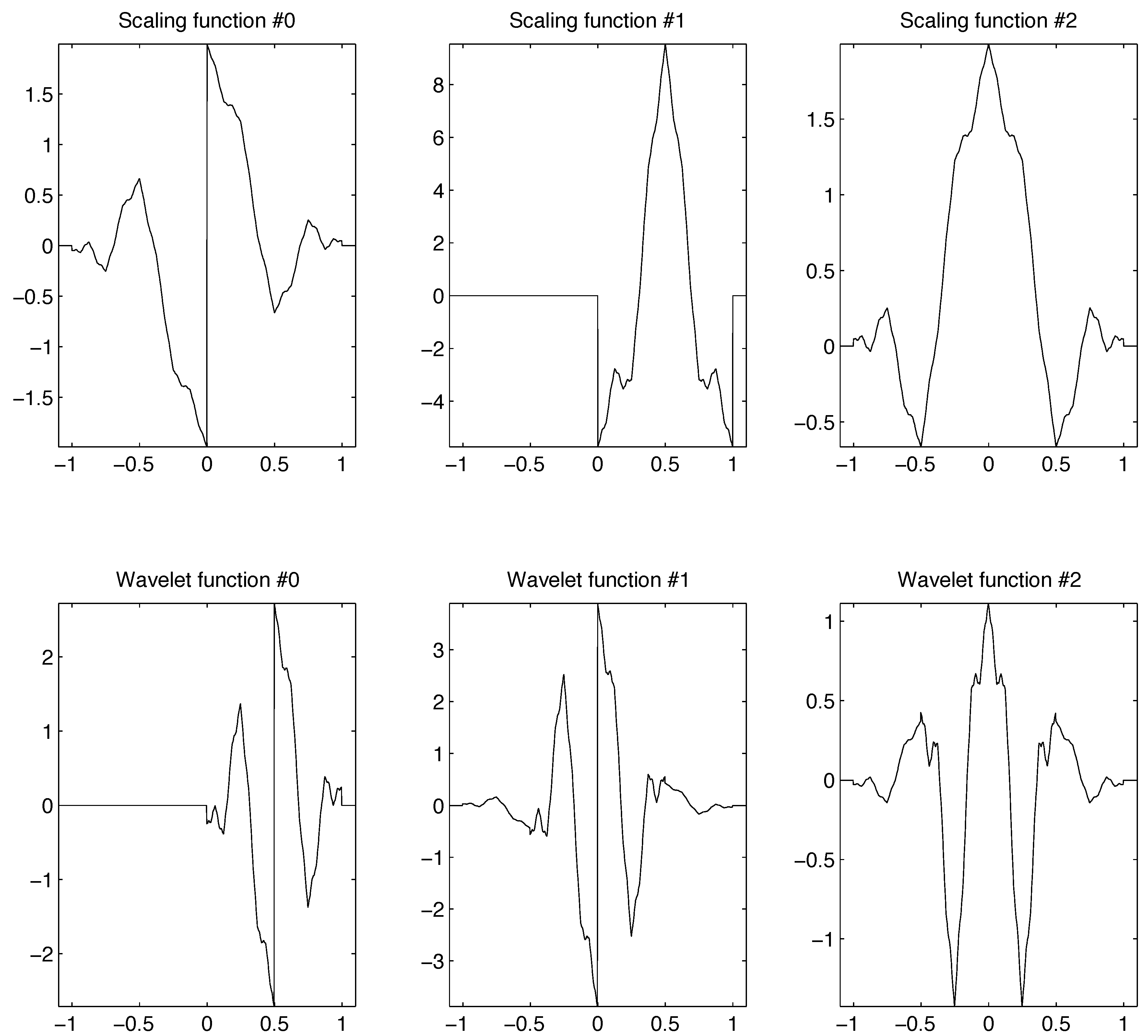
with the same parameter values , are determined by Equations (12) and (13) and are given in Appendix A. The components of the roughened scaling and wavelet vectors are plotted in Figure 3.
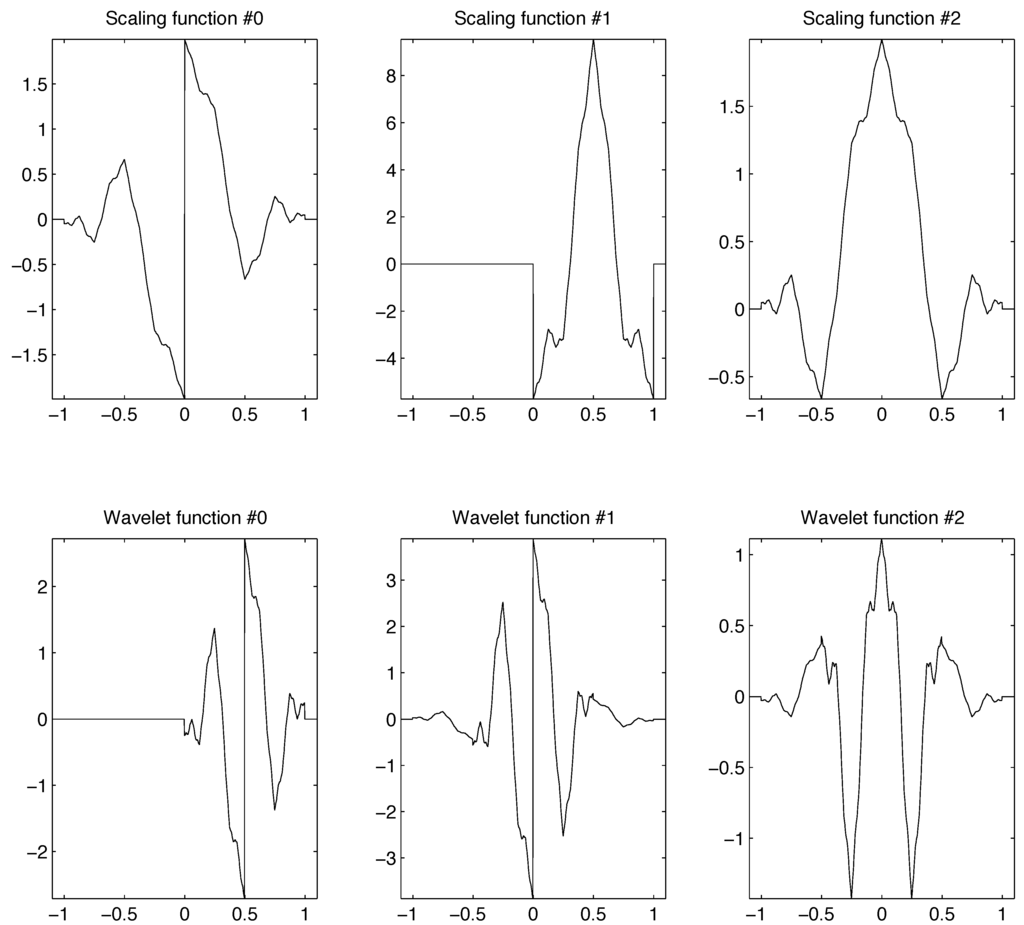
Figure 3.
Roughened scaling vector and multiwavelet .
Figure 3.
Roughened scaling vector and multiwavelet .
Theorem 2.4. [9] The scaling vectors and generate a pair of biorthogonal MRAs of . In addition, and are biorthogonal multiwavelets.
The old and new biorthogonal multiwavelet bases of satisfy commutation relations between oblique MRA projections and differentiation. The commutation relations are crucial in the construction of divergence-free wavelets on .
Denote the oblique projections and from onto the respective approximation spaces and by
Define the oblique projections and from onto the corresponding detail spaces and similarly,
Notice that for a fixed value , the sums in Equations (16) and (17) are finite sums with respect to k due to the finiteness of the support of the scaling and wavelet functions.
Proposition 2.1. [9] For , the following commutation relations hold
3. Divergence-Free Multiwavelets on
To construct divergence-free multiwavelets on the upper half plane , we first need to adapt the biorthogonal multiwavelets related by differentiation on to the half line .
3.1. Biorthogonal Multiwavelet Bases of
We construct a pair of biorthogonal multiwavelet bases of using the original multiwavelet systems , and the derived systems , of . Divergence-free wavelets satisfying vanishing normal boundary conditions can then be constructed through tensor products from a basis of generated from the smoothed multiwavelet system vanishing on the boundary of its support.
Our procedure for constructing biorthogonal multiwavelet bases of adapted from those of can be described as follows:
and
Use the same formulation for and . Let
and similarly for in terms of , respectively. We obtain a pair of biorthogonal MRAs and of such that
and , just as in the case of the whole real line,
- Keep the functions that are originally supported on ,
- For the functions belonging to the original biorthogonal systems of whose support straddles the boundary point 0, truncate the symmetric ones to and normalize them by , and shift the antisymmetric ones to .
- For the functions belonging to the smoothed and roughened systems of whose support straddles the boundary point 0, truncate the antisymmetric ones to and normalize them by , and shift the symmetric ones to .
We perform a similar procedure for the construction of the biorthogonal multiwavelet bases of generated from the new systems and of except that the roles of symmetric and antisymmetric components whose support overlaps 0 are switched. Explicitly, for , let
and
We define similarly for and . Let
and similarly for in terms of , respectively. We get another pair of biorthogonal MRAs and of such that
and
To adapt the differentiation and integration relations between the scaling vectors and multiwavelets on to ones on , we separate the scaling vectors and multiwavelets on into boundary and interior components. We define the boundary scaling vectors and multiwavelets, which correspond to the integer translate , as follows
We define and similarly to and , respectively. The interior components, formulated as below, are the scaling vectors and multiwavelets on with the integer translates , which live completely inside . Let
and similarly for and .
From Equations (10) and (14), and Equations (19) and (21) the multiwavelets on inherit the same differentiation and integration relations as the multiwavelets on . Precisely,
for both interior and boundary components and .
The boundary and interior scaling vectors on are less straightforward. From Equations (9) and (10) and Equations (18) and (20) that define the scaling functions on we obtain
for the respective boundary and interior scaling vectors, where
To establish an analogue of Proposition 2.1 on , we define oblique projections , from onto the respective approximation spaces and and , from onto the corresponding detail spaces and as follows:
For an interval , possibly unbounded, the Sobolev space is the Hilbert space defined by
Define
where is the space of continuously differentiable functions compactly supported in Ω. Note that if then if and only if on .
Proposition 3.1. On the Sobolev space , the following commutation relations hold
The proof of Proposition 3.1 can be found in Appendix B.
3.2. Construction of Divergence-Free Multiwavelets
The following are some basic notions of flux spaces and divergence-free vector fields. Denote
the upper half plane, and
The divergence operator is defined as usual by
where the partial derivatives are understood in the distributional sense. The divergence operator induces the flux space
and its divergence-free subspace
The two spaces of vector fields are Hilbert spaces under the norm
where
We have found biorthogonal multiwavelet systems related by differentiation for both and so that the commutation relations between oblique projections and differentiation are all satisfied. We are now able to construct a wavelet basis for the vector space satisfying the vanishing normal boundary condition , where is the unit outward normal vector to the boundary axis .
We have utilized many notations so far. To avoid confusion, we recall the notations and relations that are necessary for the construction.
- Biorthogonal scaling vectors and and wavelets and on , related by Equation (10).
- Biorthogonal boundary scaling vectors and and wavelets and on , related by related by Equations (22) and (23).
- Biorthogonal interior scaling vectors and and wavelets and , on , related by Equations (22) and (23). These multiwavelet systems establish the commutation relations as in Propositions 2.1 and 3.1.
Our construction of biorthogonal bases of compactly supported multiwavelets on such that the reconstruction wavelets are divergence-free will be divided into the following steps.
Step 1. Compose biorthogonal multiwavelet bases in by tensor products.
We use the standard basis vectors and to index a smoothing direction for tensor wavelets on :
Then
Similarly, we use negated standard basis vectors to index roughening directions for dual tensor scaling and wavelet spaces on :
The decomposition corresponding to Equation (24) holds for the respective indices and .
We define the boundary generators of to be components of the matrices
Here is biorthogonal to , that is, . We have another set of boundary biorthogonal generators of given by
We define similarly biorthogonal interior generators of : and , , where each boundary scaling vector or multiwavelet is replaced by the corresponding interior one. For instance,
Along with the boundary generators, they constitute two biorthogonal bases of as listed below:
- with the duals ;
- with the duals ; .
Step 2. Compose biorthogonal bases of componentwise.
The biorthogonal bases of induce biorthogonal bases of componentwise. In fact, with the dual components form biorthogonal bases of . The following is the list of the boundary matrix generators. The interior generators and their duals are formulated similarly using the appropriate substitution of the boundary vector by the interior vector. Explicitly,
Step 3. Compose the biorthogonal bases in .
We can obtain a biorthogonal basis in from the linear combinations of the vector fields listed above and their integer translates. The following are the reconstruction boundary multiwavelets of the basis:
Because each component of and of vanishes continuously at , these boundary multiwavelets satisfy the vanishing normal condition, that is, their normal component vanishes continuously at the boundary.
We formulate the reconstruction interior multiwavelets similarly, where and the boundary component are substituted respectively by and the corresponding interior component. For instance,
The vectors and , belong to the divergence-free vector space because of the commutation relations between oblique projections and differentiation on both and specified by Propositions 2.1 and 3.1. We prove below that the reconstruction wavelets and , constitute a basis for . Their biorthogonal duals, which serve as the decomposition wavelets, are
for the boundary components. The interior components are defined similarly. For instance
Notice that the decomposition multiwavelets are not divergence-free.
Theorem 3.1. For , the expansion of F in terms of agrees with its expansion in terms of . Thus, the translates and dilates of form a basis for the divergence-free subspace of whose boundary components satisfy the vanishing normal boundary condition.
Proof. It suffices to verify the boundary case. One shows that if a vector field lies in the divergence-free subspace, then its expansion in terms of a complete set of vector wavelets for agrees with its sum of its components in the divergence-free wavelets.
Let . Its boundary expansion in terms of the biorthogonal bases of is represented by the six following vector fields and the components of their shifts and dilates:
On the other hand, the boundary expansion of F in terms of the divergence-free wavelets is represented by the following fields and the components of their translates and dilates:
Under the hypothesis that F is divergence-free, we show that . By definition, we have and . Using the differentiation relations between the scaling vectors and multiwavelets on and , and the commutation relations in Propositions 2.1 and 3.1, we show that and .
Since the y-coordinates of are equal to 0 for , we can assume that . Furthermore, all scaling and wavelet functions on vanish on the boundary of their support. Thus,
This implies . In addition,
The verification for is similar.
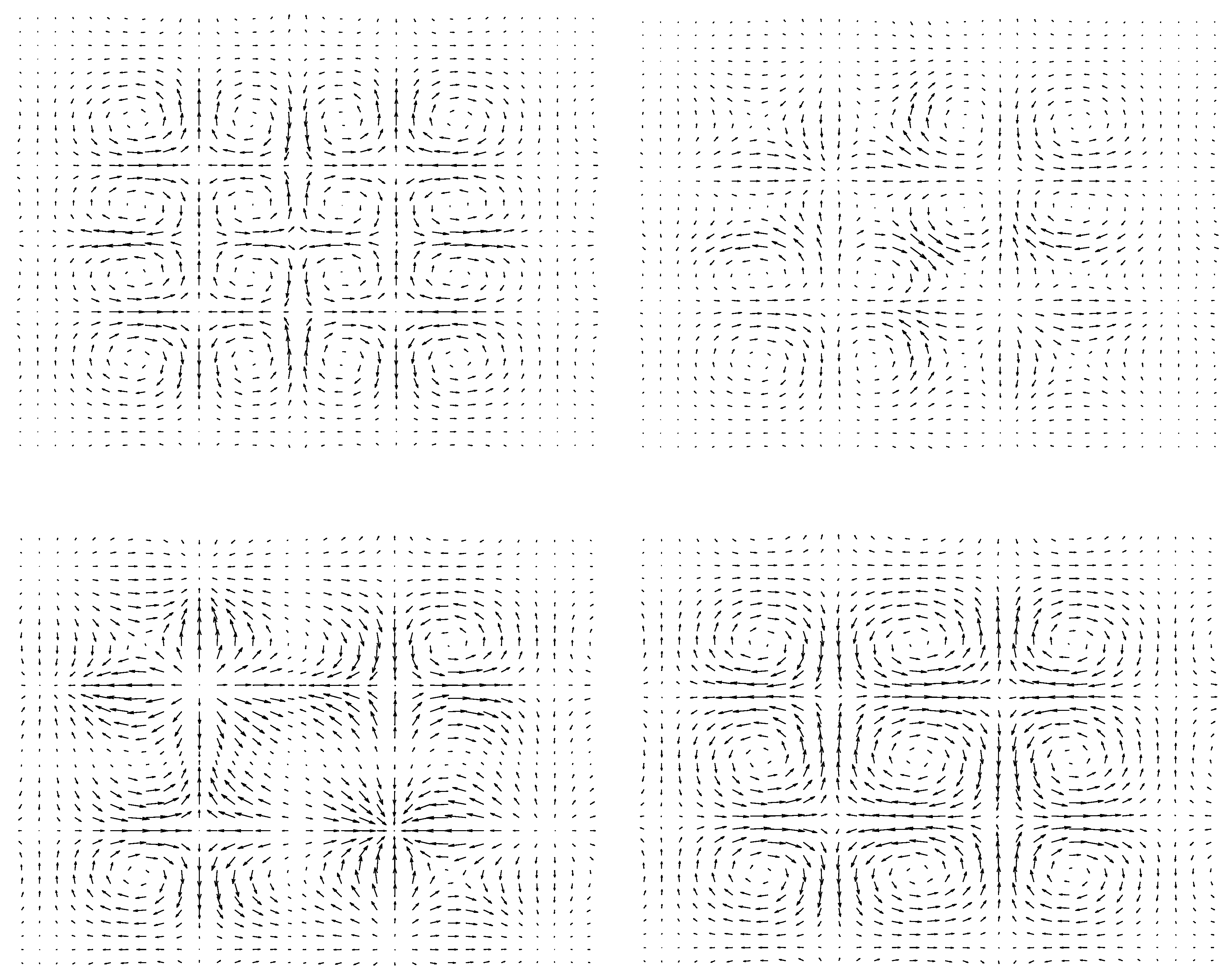
Each one of the divergence-free multiwavelets consists of nine components. Figure 4 plots some of the components of .
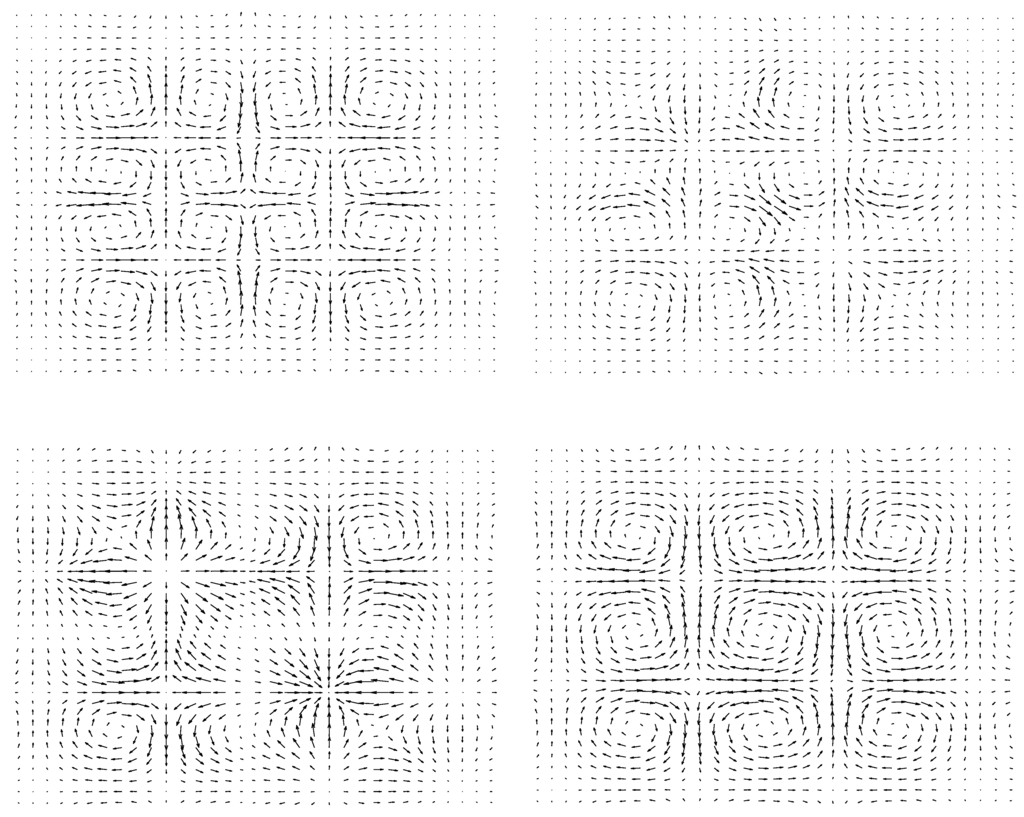
Figure 4.
Some components of .
Figure 4.
Some components of .
4. Conclusions
We have constructed vector wavelet families on the upper half plane such that the reconstructing wavelets are divergence-free and piecewise and form a basis for the closed subspace . In contrast to previous constructions, the boundary components satisfy a vanishing normal boundary condition desirable for applications. The boundary constraints and desire for short supports suggest the use of wavelets built on fractal interpolation functions. To build in the divergence-free property we use certain commutation conditions made possible through Strela’s two-scale transform. Because these wavelets are built via tensor products, analogues can be built in dimensions of three and higher.
A. Scaling and Wavelet Coefficient Matrices
The matrices in Equation (5) under the parameter assignments , corresponding to Figure 1 in Section 2.2 are
The matrices in Equation (6) under the parameter assignments , corresponding to Figure 1 in Section 2.2 are
The smoothed scaling and wavelet filters in Equation (11) corresponding to Figure 2 for the same values are determined by Equations (7) and (8) and have the values
The roughened scaling and wavelet filters in Equation (15) corresponding to Figure 3 for the same values are determined by Equations (12) and (13) and the matrices and have the values
and
B. Proof of Proposition 3.1
Proof. Notice that if , then and . In addition, every component of and is supported on a finite interval and vanishes at the right boundary point of its support.
It suffices to verify the relations for . Let , we have
For each ,
and
For each ,
In addition,
On the other hand,
Since and as in Theorem 2.3, then
In addition,
Therefore,
For each ,
and
Finally, for each ,
Comparing Equations (25)–(28) with Equations (29)–(32), it is clear that
The verification for the case is obvious. Indeed, from the relations in Equation (22), we have
References
- Battle, G.; Federbush, P. Divergence–free vector wavelets. Michigan Math. J. 1993, 40, 181–195. [Google Scholar] [CrossRef]
- Lemarié-Rieusset, P.G. Un théorème d’inexistence pour les ondelettes vecteurs à divergence nulle. C. R. Acad. Sci. Paris Se´r. I Math. 1994, 319, 811–813. [Google Scholar]
- Lemarié-Rieusset, P.G. Analyses multi-résolutions non orthogonales, commutation entre projecteurs et dérivation et ondelettes vecteurs à divergence nulle. Rev. Mat. Iberoamericana 1992, 8, 221–237. [Google Scholar] [CrossRef]
- Urban, K. On divergence–free wavelets. Adv. Comput. Math. 1995, 4, 51–81. [Google Scholar] [CrossRef]
- Urban, K. Wavelet bases in H(div) and H(curl). Math. Comput. 2001, 70, 739–766. [Google Scholar] [CrossRef]
- Urban, K. Wavelets in Numerical Simulation; Springer–Verlag: Berlin, Germany, 2002. [Google Scholar]
- Albukrek, C.; Urban, K.; Rempfer, D.; Lumley, J. Divergence–free wavelet analysis of turbulent flows. J. Sci. Comput. 2002, 17, 49–66. [Google Scholar] [CrossRef]
- Kelliher, J. Navier–Stokes equations with Navier boundary conditions for a bounded domain in the plane. SIAM J. Math. Anal. 2006, 38, 210–232. [Google Scholar] [CrossRef]
- Nguyen, P. Biorthogonal multiwavelets adapted to boundary value problems. Ph.D. Thesis, New Mexico State University, Las Cruces, NM, USA, 2012. [Google Scholar]
- Strela, V. Multiwavelets: Theory and applications. Ph.D. Thesis, Massachusetts Institute of Technology, Boston, MA, USA, 1996. [Google Scholar]
- Donovan, G.; Geronimo, J.; Hardin, D. Fractal functions, splines, intertwining multiresolution analysis and wavelets. Proc. SPIE 1994, 2303, 238–243. [Google Scholar]
- Massopust, P. A multiwavelet based on piecewise C1 fractal functions and related applications to differential equations. Bol. Soc. Mat. Mexicana 1998, 4, 249–283. [Google Scholar]
- Lakey, J.; Pereyra, M.C. Divergence–free Multiwavelets on Rectangular Domains. In Wavelet Analysis and Multiresolution Methods (Lecture Notes in Pure and Applied Mathematics); He, T.-X., Ed.; Dekker: New York, NY, USA, 2000; pp. 203–240. [Google Scholar]
© 2013 by the authors; licensee MDPI, Basel, Switzerland. This article is an open access article distributed under the terms and conditions of the Creative Commons Attribution license (http://creativecommons.org/licenses/by/3.0/).