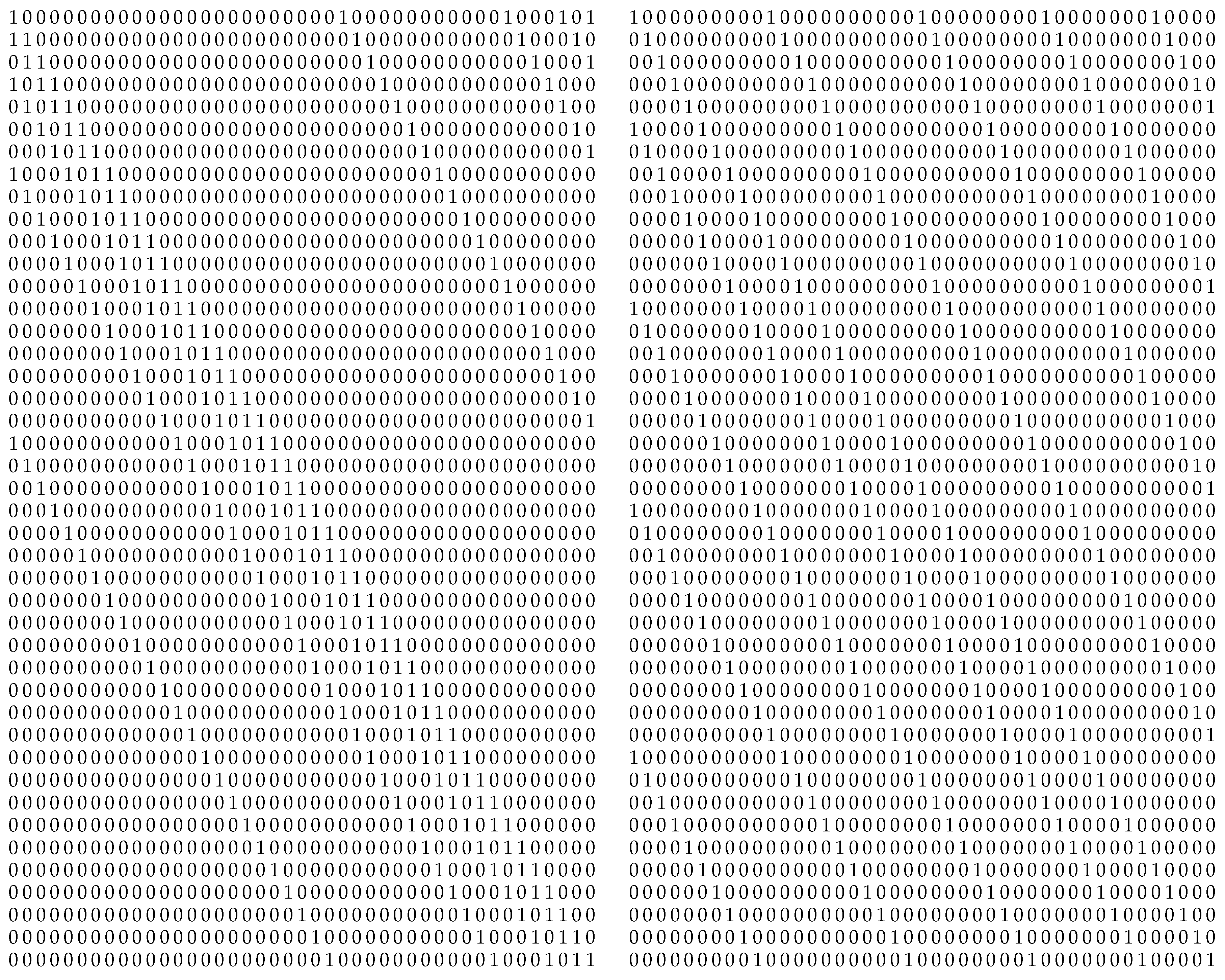
Article

On the Existence of Optimal (v, 5, 1) and (v, 6, 1) Binary Cyclically Permutable Constant-Weight Codes

by
Tsonka Baicheva
1,2,* and
Svetlana Topalova
1,2
1
Institute of Mathematics and Informatics, Bulgarian Academy of Sciences, 1113 Sofia, Bulgaria
2
Centre of Excellence in Informatics and Information and Communication Technologies, 1113 Sofia, Bulgaria
*
Author to whom correspondence should be addressed.
Axioms 2026, 15(1), 35; https://doi.org/10.3390/axioms15010035
Submission received: 3 December 2025 / Revised: 22 December 2025 / Accepted: 31 December 2025 / Published: 1 January 2026

Abstract

The problem of the existence of optimal ( v , k , 1 ) binary cyclically permutable constant-weight (CPCW) codes has been completely solved for codeword weights k < 5 . We consider the smallest open cases, namely k = 5 and k = 6 . We present such codes for small values of the code length v and derive necessary conditions for the existence of optimal ( k ( k 1 ) t + 2 , k , 1 ) CPCW codes. These necessary conditions can be used to construct such codes, as well as to show that optimal codes with some parameters do not exist. In particular, we use them to prove that an optimal ( 92 , 6 , 1 ) CPCW code does not exist.

1. Introduction

1.1. Definitions

Denote by Z v the additive group of integers modulo v. Let C = { c 0 , c 1 , , c k 1 } be a k-element subset of Z v . Then, C = { c i c j | i , j = 0 , 1 , , k 1 ; i j } is the multiset of differences of C, and C + t denotes a t-translate of C, where C + t = { c 0 + t , c 1 + t , , c k 1 + t } for t Z v .
Definition 1.
A ( v , k , 1 ) binary cyclically permutable constant-weight (CPCW) code of size s can be defined as a collection C = { C 1 , , C s } of k-subsets of Z v (codewords) such that any two distinct translates of a codeword share at most one element, and any two translates of two distinct codewords also share at most one element:
| C i ( C i + t ) | 1 , 1 i s , 1 t v 1
| C i ( C j + t ) | 1 , 1 i < j s , 0 t v 1
Everywhere in the text that follows, the abbreviation CPCW means “binary cyclically permutable constant weight”. Originally, a CPCW code was defined as a collection of { 0 , 1 } sequences, but, for some purposes, it is easier to present the codewords as subsets of Z v , and that is why the above definition is widely used too. Condition (1) is called the auto-correlation property and (2) the cross-correlation property. We denote by s the size of C , namely the number of its codewords.
Consider a codeword C = { c 0 , c 1 , , c k 1 } . The auto-correlation property means that all the differences of a codeword of a ( v , k , 1 ) CPCW code are different, and the cross-correlation property means that C 1 C 2 = for two codewords C 1 and C 2 . Since | C | = k ( k 1 ) , the size of a ( v , k , 1 ) CPCW code cannot exceed
v 1 k ( k 1 ) .
CPCW codes that reach this bound are called optimal [1,2].
If the code size is exactly ( v 1 ) / k ( k 1 ) , the optimal ( v , k , 1 ) CPCW code is perfect; that is, all nonzero differences are covered.
CPCW codes are related to many other combinatorial structures. Definition 1, for instance, holds for a ( v , k , 1 ) optical orthogonal code (OOC) too [1]. In this paper, we will use the relation to partial designs.
Definition 2.
Let V = P i i = 1 v be a finite set of points and B = B j j = 1 b be a finite collection of k-element subsets of V, called blocks. D = ( V , B ) is a design (partial design) with parameters 2-(v,k,1) if any 2-subset of V is contained in exactly (at most) one block of B . A 2-(v,k,1) design is also called a Steiner system and denoted by S ( 2 , k , v ) .
Partial designs are also known as packings [3] or packing designs [4]. We call them partial designs following [5]. An automorphism of a 2- ( v , k , 1 ) partial design D is a permutation of its points that maps each block of D to a block of D.
Definition 3.
A 2-(v,k,1) design (partial design) is cyclic if it has an automorphism α permuting its points in one cycle, and it is strictly cyclic if each block orbit under this automorphism is of length v (no short orbits).
A cyclic partial design with the maximum possible number of blocks is optimal.
Definition 4.
A circulant matrix (circulant) of order v is a (0,1) square matrix M = ( m i , j ) v × v with v rows and columns such that m i + 1 , j + 1 = m i , j , i , j Z v .
Perfect ( v , k , 1 ) CPCW codes are equivalent to strictly cyclic 2- ( v , k , 1 ) designs. An optimal ( v , k , 1 ) CPCW code is equivalent to an optimal 2- ( v , k , 1 ) strictly cyclic partial design. The incidence matrix of a 2- ( v , k , 1 ) strictly cyclic partial design contains submatrices, which are circulant matrices of order v. Each such circulant matrix corresponds to the translates of one of the codewords of the corresponding optimal ( v , k , 1 ) CPCW code. An example illustrating this equivalence is presented in Figure 1.
We are not going to define more related structures here. We shall only mention that optimal ( v , k , 1 ) CPCW codes correspond to ( v , k ; ( v 1 ) / k ( k 1 ) ) difference packings, and that perfect ( v , k , 1 ) CPCW codes are equivalent to ( v , k , 1 ) cyclic difference families. An interested reader can find more information, for instance, in [6,7].

1.2. Known Results and the Contribution of the Present Paper

Optimal ( v , k , 1 ) CPCW codes are studied in [2,8,9,10]. There are also many results on CPCW codes that were obtained for related combinatorial objects, like optical orthogonal codes [11,12,13,14,15,16,17,18,19,20,21], difference families [6,22,23,24,25,26], and combinatorial designs [27,28,29,30].
It was proved in [12] that an optimal ( v , 3 , 1 ) CPCW code exists for all v except for v = 6 t + 2 and t 2 or 3   ( mod   4 ) . Direct constructions with explicit codewords are presented in [21] to show the existence of an optimal (v,4,1) CPCW (OOC) code for any positive integer v 25 . The existence of an optimal ( v , k , 1 ) CPCW code for k 5 is still an open problem.
In this paper, we consider k = 5 and 6.
(a)
Optimal (43,5,1) CPCW code
C C
{0, 1, 3, 7, 19}{1, 2, 3, 4, 6, 7, 12, 16, 18, 19, 24, 25, 27, 31, 36, 37, 39, 40, 41, 42}
{0, 5, 13, 22, 33}{5, 8, 9, 10, 11, 13, 15, 17, 20, 21, 22, 23, 26, 28, 30, 32, 33, 34, 35, 38}
Uncovered differences: 0, 14, 29
(b)
Related optimal partial cyclic 2-(43,5,1) design
Figure 1. The corresponding partial design.
Axioms 15 00035 g001
First, we will summarize the known results for optimal CPCW codes or related combinatorial objects for k = 5 and 6.
  • An optimal ( 15 p , 5 , 1 ) OOC with p a product of primes congruent to 1 modulo 4 and greater than 5 exists according to [18].
  • It is shown in [14] that an optimal ( 4 p , 5 , 1 ) OOC exists for prime p 1   ( mod   10 ) , and that there is an optimal ( 4 u p , 5 , 1 ) OOC for u = 2 , 3 and prime p 11   ( mod   20 ) .
  • A proof of the existence of a ( 3 s 5 v , 5 , 1 ) OOC if v is a product of primes congruent to 1 modulo 4 and s is a non-negative integer is given in [16,17].
  • There are also several direct constructions for optimal ( g v , 5 , 1 ) OOCs where 60 g 180 , g 0   ( mod   20 ) , and v is a product of primes greater than 5.
  • A class of optimal ( g v , 6 , 1 ) optical orthogonal codes with v a product of primes congruent to 7 modulo 12 and greater than 7 and g = 15 , 20 , 105 , 140 is obtained in [19].
  • Some combinatorial constructions for optimal ( v , k , 1 ) OOCs using g-regular cyclic packings are derived in [4,20].
Some existence results about CPCW codes with k = 5 and 6 follow from results about cyclic difference families and combinatorial designs.
  • It is shown in [23] that a ( p , 5 , 1 ) difference family exists for p 1   ( mod   20 ) for prime p.
  • According to [26], a ( 20 t + 1 , 5 , 1 ) difference family exists for 1 t 50 except possibly for t = 16 , 25 , 31 , 34 , 40 , 45 .
  • The existence of a cyclic ( p q , 5 , 1 ) difference family whenever p and q are primes congruent to 11   ( mod   20 ) is proved in [6].
  • Existence of a ( q , 6 , 1 ) cyclic difference family for any prime power q 1   ( mod   30 ) with the exception of q = 61 is shown in [22].
  • It was proved in [29] that a cyclic ( 5 p , 5 , 1 ) combinatorial design exists for all p 1   ( mod   4 ) and p 5 .
Nonexistence results for optimal ( v , 5 , 1 ) OOCs with v 22   ( mod   40 ) and for an optimal ( 62 , 6 , 1 ) OOC are presented in [7].
Classification results about ( v , k , 1 ) CPCW codes for k = 5 and 6 or about related combinatorial objects can be found in [25,27,28,30,31]. The results obtained in these works show that, when v grows, the number of nonequivalent codes becomes extremely large. This makes the classifications for the next larger lengths practically unusable.
In this work, we consider k = 5 and 6 and the first values of v for which existence or nonexistence results are not known and try to find an example of an optimal ( v , k , 1 ) CPCW code for these parameters. We conduct this for k = 5 and v 181 and k = 6 and v 151 . We cannot find an optimal code for 9 of the considered parameter sets. We notice that two of these gaps are for v = k ( k 1 ) t + 2 . This motivates us to consider the properties of such codes, and we derive necessary conditions for their existence and prove that an optimal ( 92 , 6 , 1 ) CPCW code does not exist.
The paper is organized as follows: Section 2 demonstrates the basis of our approach. Section 3 presents both the computer-aided and analytical results that we obtain. Section 4 contains final remarks and open problems.

2. Methods

The explicit examples of new optimal ( v , 5 , 1 ) and ( v , 6 , 1 ) CPCW codes are obtained by the algorithm for classification of such codes, which we have used and described in [31]. It implies the construction of an array L with all possible codewords, namely with k-subsets of Z v for which the auto-correlation property holds. We then construct codes by choosing their codewords from L in all possible ways. For that purpose, backtrack search on the elements of L is applied, and some partial solutions are filtered away if there exists an automorphism of Z v that maps the partial solution to a partial solution that has already been constructed.
Our aim in the present work is not to obtain all the codes with these parameters but to find one such code. That is why we let the computation stop after having constructed one code, or after having worked for several days on a personal computer. The fact that we have not succeeded to construct a code with definite parameters does not mean that such a code does not exist.
The necessary conditions for the existence of optimal ( k ( k 1 ) t + 2 , k , 1 ) CPCW codes are derived using a method that is very popular in Design Theory, namely the counting of points and pairs of points in two different ways. The nonexistence of an optimal ( 92 , 6 , 1 ) CPCW code is proved by using these necessary conditions and applying counting of the pairs of points in one more way.

3. Results

3.1. Examples of Optimal ( v , 5 , 1 ) and ( v , 6 , 1 ) CPCW Codes

We present in Table 1 and Table 2 all the previously known existence and nonexistence results regarding optimal ( v , 5 , 1 ) and ( v , 6 , 1 ) CPCW codes with v 181 and 151, respectively. Normal font is used for the v with theoretical results from [6,7,8,9,10,11,12,13,14,15,16,17,18,19,20,21,22,23,24,26,29] and italics for the results from the computer classifications in [25,27,28,30,31]. A normal or an italic v is struck through if the corresponding result (theoretic or computer-aided) shows nonexistence of optimal ( v , 5 , 1 ) or ( v , 6 , 1 ) CPCW codes. A question mark means that nothing is known about the existence of optimal codes with this length.
Table 3 and Table 4 are organized in a similar way to Table 1 and Table 2, but in them the existence results from the present paper are implemented too, and bold font is used for them. The question marks mean that we could not find optimal codes for these values of v and the question of the existence of such codes remains open. In particular, we have not found examples of optimal ( v , 5 , 1 ) CPCW codes for v = 143 , 144 , 146 , 162 , and 167, and of optimal ( v , 6 , 1 ) CPCW codes for v = 122 , 123 , 124 , and 126. These are ( k ( k 1 ) t + c , k , 1 ) CPCW codes with relatively small c. The latter is also small for the optimal codes for which there are no theoretical nonexistence results, but they have been proved not to exist with the help of a computer [31], namely an optimal ( 42 , 5 , 1 ) CPCW code and optimal ( v , 6 , 1 ) CPCW codes for v = 61 , 64 , 65 , and 92. This motivated our study of the properties of optimal ( k ( k 1 ) t + 2 , k , 1 ) CPCW codes.
Table A1 and Table A2 in Appendix A contain all the examples of new optimal ( v , 5 , 1 ) and ( v , 6 , 1 ) CPCW codes. Each codeword contains the element 0 Z v , and therefore this element is not presented.

3.2. Properties of Optimal ( k ( k 1 ) t + 2 , k , 1 ) CPCW Codes

The optimal ( v , k , 1 ) CPCW codes of length k ( k 1 ) t + 1 correspond to 2- ( k ( k 1 ) t + 1 , k , 1 ) designs. They are perfect because their codewords cover all v 1 differences. Optimal CPCW codes of length k ( k 1 ) t + 2 , however, have remarkable combinatorial properties too because they do not cover only one difference. We derive here some necessary conditions for the existence of such codes.
Lemma 1.
The element v 2 Z v cannot be covered by the differences of the codewords of a ( v , k , 1 ) CPCW code of even length. For even v, the element v 2 Z v can be obtained as the difference a b of v 2 different pairs { a , b } .
Proof. 
Let C be a codeword of a ( v , k , 1 ) CPCW code C of even length. Let a , b C . Then, a b and b a must be two different differences from C . Suppose a b = v 2 , and then b a = v v 2 = v 2 , and v 2 appears twice in C , but this is impossible for a ( v , k , 1 ) CPCW code. Since a b = b a = v 2 , the element v 2 Z v can be obtained as the difference a b of the v 2 different pairs { a , a + v 2 } , a v 2 . □
Lemma 2.
The codewords of an optimal ( k ( k 1 ) t + 2 , k , 1 ) CPCW code leave uncovered only the difference v 2 .
Proof. 
Since k ( k 1 ) t + 2 is even, by Lemma 1, the possible differences are v 2 = k ( k 1 ) t . The size of such a code is
v 1 k ( k 1 ) = k ( k 1 ) t + 1 k ( k 1 ) = t ,
and each codeword covers k ( k 1 ) differences. Then, all the codewords cover k ( k 1 ) t = v 2 differences; that is, only one difference remains uncovered. □
An optimal ( k ( k 1 ) t + 2 , k , 1 ) CPCW code corresponds to an optimal partial cyclic 2- ( k ( k 1 ) t + 2 , k , 1 ) design. The translates of each codeword correspond to v blocks of this partial design and to a circulant submatrix of the incidence matrix of the partial design. We next consider some properties of this partial design.
Lemma 3.
The v 2 pairs of points { a , a + v 2 } are not contained in the blocks of an optimal partial cyclic 2- ( k ( k 1 ) t + 2 , k , 1 ) design corresponding to an optimal ( k ( k 1 ) t + 2 , k , 1 ) CPCW code. Each of the remaining v ( v 2 ) 2 pairs of points is in exactly one block of this partial design.
Proof. 
The v 2 pairs of points that are not contained in the blocks of the design correspond to the v 2 different pairs { a , a + v 2 } from Lemma 1. □
Lemma 4.
Denote the rows/columns of a circulant M of an even order v by the numbers 0 , 1 , 2 , v 1 . Let φ be a permutation that rearranges the rows and the columns of M in such a way that they follow each other as 0 , 2 , 4 v 2 , 1 , 3 , 5 , v 1 . Then, the resulting matrix φ M is composed of 4 circulants A, B, C, and D of order v 2 .
φ M = A B C D .
Denote by u A , u B , u C , and u D the number of ones in a row/column of the matrices A, B, C, and D, respectively. Then, u A = u D and u B = u C .
Proof. 
Cutting off the even rows and even columns of M leads to a matrix A of dimension v 2 × v 2 . Let m i , j be the element in row i and column j of M and a i , j be the element in row i and column j of A. Then, a i , j = m 2 i , 2 j .
We want to show that A is a circulant matrix. Addition of the indices of A is modulo v 2 , and of M modulo v. Since 2 i   ( mod   v ) = 2 ( i   ( mod   v 2 ) ) , the addition of the even indices of M can be considered modulo v 2 too. Then, a i + 1 , j + 1 = m 2 i + 2 , 2 j + 2 . M is a circulant, and therefore m 2 i + 2 , 2 j + 2 = m 2 i , 2 j = a i , j . It follows that a i + 1 , j + 1 = a i , j ; that is, A is a circulant matrix.
Similarly, the circulants B, C, and D are obtained by cutting off the even rows and odd columns, the odd rows and even columns, and the odd rows and odd columns, respectively.
The number of ones in each row and column of φ M is the same, and therefore u A = u D and u B = u C . □
Example 1.
We illustrate the action of φ on two arbitrary circulants of even orders 10 and 8.
0123456789
00100010100
10010001010
20001000101
31000100010
40100010001
51010001000
60101000100
70010100010
80001010001
91000101000
0123456789
00100010100
20001000101
40100010001
60101000100
80001010001
10010001010
31000100010
51010001000
70010100010
91000101000
0246813579
00000010110
20000001011
40000010101
60000011010
80000001101
10101100000
31010100000
51101000000
70110100000
91011000000
01234567
001010010
100101001
210010100
301001010
400100101
510010010
601001001
710100100
01234567
001010010
210010100
400100101
601001001
100101001
301001010
510010010
710100100
02461357
000011100
210000110
401000011
600101001
101100001
300111000
510010100
711000010
Lemma 5.
Let M be the incidence matrix of an optimal partial cyclic 2- ( k ( k 1 ) t + 2 , k , 1 ) design D corresponding to an optimal ( k ( k 1 ) t + 2 , k , 1 ) CPCW code. If the permutation φ from Lemma 4 is applied to the rows of M and to the columns of each of its t circulant submatrices, a matrix with 4 t circulant submatrices of order v 2 is obtained. If v 2   ( mod   4 ) , the columns of each of the two rows of submatrices cover all possible v ( v 2 ) 8 pairs of points, and the missing v 2 pairs of points in the partial design have one point from the first and one from the second row of submatrices. If v 0   ( mod   4 ) , there are v 4 pairs of points that are not covered by the columns of each row of submatrices, and all possible v 2 4 pairs of points having one point from the first and one from the second row of submatrices are covered.
Proof. 
By Lemma 4, the permutation φ transforms each of the t circulants of order v to 4 circulants of order v 2 . That is why the incidence matrix φ M of the partial design has 4 t circulant submatrices of order v 2 . If v 2   ( mod   4 ) , then v 2 is odd. That is why, if a is odd, a + v 2 is even and vice versa. Since the first row of submatrices of φ M contains the even rows of M and the second the odd rows, the missing pairs of points { a , a + v 2 } (Lemma 3) have one point from the first row of submatrices and one from the second. If v 0   ( mod   4 ) , then v 2 is even, a and a + v 2 are both even or both odd, and the missing pairs of points consist of two points from one and the same row of submatrices. □
With respect to the number of ones in the four submatrices, φ can transform a circulant of order v to k 2 + 1 types of matrices A 0 , A 1 , A k 2 such that A i has two circulant submatrices with i ones in each row/column and two with k i ones in each row/column.
Example 2.
Types of matrices for k = 5 and 6
For k = 5 , the types of matrices are
A 0 A 1 A 2
0 51 42 3
5 04 13 2
For k = 6 , the types of matrices are
A 0 A 1 A 2 A 3
0 61 52 43 3
6 05 14 23 3
Theorem 1.
For an optimal ( v , k , 1 ) CPCW code with v = k ( k 1 ) t + 2 and v 2   ( mod   4 ) , the following equations hold:
i = 0 v 2 a i = v 2 k ( k 1 )
i = 0 v 2 i ( i 1 ) 2 + ( k i ) ( k i 1 ) 2 a i = v 2 4
i = 1 v 2 i ( k i ) a i = v 2 4
Proof. 
We obtain the equations by counting in different ways the pairs of points in φ M . Denote by a i the number of v × v matrices of type A i that are contained in φ M . Their number is t = v 2 k ( k 1 ) , and this is Equation (3). Equation (4) counts the pairs of points from one and the same row of submatrices. By Lemma 5, their number is v ( v 2 ) 8 . On the other hand, each v 2 × v 2 submatrix of a matrix of type A i covers v 2 i ( i 1 ) 2 + ( k i ) ( k i 1 ) 2 pairs of points. Equation (5) counts the pairs in which the two points are from different rows of submatrices. By Lemma 5, all but the missing v 2 pairs are covered; that is, all such pairs are v 2 4 v 2 = v ( v 2 ) 4 . On the other hand, each v × v submatrix of type A i covers i ( k i ) v such pairs of points. □
Theorem 2.
For an optimal ( v , k , 1 ) CPCW code with v = k ( k 1 ) t + 2 and v 0   ( mod   4 ) , the following equations hold:
i = 0 v 2 a i = v 2 k ( k 1 )
i = 0 v 2 i ( i 1 ) 2 + ( k i ) ( k i 1 ) 2 a i = v 4 4
i = 1 v 2 i ( k i ) a i = v 4
Proof. 
The proof is similar to that of Theorem 1, but, by Lemma 5, the pairs of points from one and the same row of submatrices are v ( v 2 ) 8 v 4 = v ( v 4 ) 8 . All the pairs in which the two points are from different rows of submatrices are covered. That is why their number is v 2 4 . □
Corollary 1.
An optimal ( 20 t + 2 , 5 , 1 ) CPCW code can only exist if t is even.
Proof. 
In this case, v 2   ( mod   4 ) , and Equation (5) gives
4 a 1 + 6 a 2 = v 2 4 .
That is why v 2 should be divisible by 8. □
Corollary 1 is not a new result. It is part of the nonexistence results presented in [7], Theorem 4.6. The next example shows the application of Theorem 1 on an optimal ( 20 t + 2 , 5 , 1 ) CPCW code with even t.
Example 3.
For an optimal ( 82 , 5 , 1 ) CPCW code by Theorem 1:
a 0 + a 1 + a 2 + a 3 = 4
5 a 0 + 3 a 1 + 2 a 2 = 10
2 a 1 + 3 a 2 = 10
There exists a unique integer solution: a 0 = 0 , a 1 = 2 , a 2 = 2 , and the optimal ( 82 , 5 , 1 ) CPCW codes comply with it.

3.3. Nonexistence of an Optimal ( 92 , 6 , 1 ) CPCW Code

Multiple nonexistence results on optimal ( v , k , 1 ) CPCW codes are obtained in [7]. They include the nonexistence of an optimal ( 62 , 6 , 1 ) code. We do not know other theoretical nonexistence results for optimal ( 30 t + 2 , 6 , 1 ) CPCW codes. Our computer-aided classification in [31] shows that an optimal ( 92 , 6 , 1 ) CPCW code does not exist. Using Theorem 2, we shall now prove this without a computer.
Proposition 1.
An optimal ( 92 , 6 , 1 ) CPCW code does not exist.
Proof. 
By Theorem 2:
a 0 + a 1 + a 2 + a 3 = 3
15 a 0 + 10 a 1 + 7 a 2 + 6 a 3 = 22
5 a 1 + 8 a 2 + 9 a 3 = 23
There exists a unique integer solution:
a 0 = 0 , a 1 = 1 , a 2 = 0 , a 3 = 2
It follows that the number of ones in φ M is distributed as
5   1 3   3 3   3 1   5 3   3 3   3
We can see from (15) that the submatrices of dimension 46 × 46 have 1 , 3 , or 5 ones in each row/column. Since 46 is even and v / 4 = 23 is odd, we can use the same ideology as in Lemma 5 and Theorem 1 on the variable-length code corresponding to the first 46 rows of φ M ; that is, we apply to the first 46 rows of φ M a permutation φ such that after its application these rows follow each other as 0 , 2 , 4 44 , 1 , 3 , 5 , 45 , and we apply the same permutation to the columns of the submatrices of dimension 46.
A 46 × 46 circulant with 1, 3, or 5 ones in each row/column can be transformed by φ to one, two, or three types of matrices, respectively. We denote them A 1 , 0 , A 3 , 0 , A 3 , 1 , A 5 , 0 , A 5 , 1 , and A 5 , 2 . The matrix A i , j is of dimension 46 × 46 and has four submatrices of dimension 23 × 23 , two of them with j and two with i j ones in each row/column.
A 1 , 0 A 3 , 0 A 3 , 1 A 5 , 0 A 5 , 1 A 5 , 2 0   1 0   3 1   2 0   5 1   4 2   3 1   0 3   0 2   1 5   0 4   1 3   2
Denote by a i , j the number of 23 × 23 matrices of type A i , j that are contained in the first 23 rows of φ φ M . Since 23 is odd, we can apply Theorem 1 and write an analogue of Equation (5) for a i , j ; thus, we obtain
( i , j ) S j ( i j ) a i , j = 46 2 4 = 11
where S = { ( 1 , 0 ) , ( 3 , 0 ) , ( 3 , 1 ) , ( 5 , 0 ) , ( 5 , 1 ) , ( 5 , 2 ) } . It follows that
2 a 3 , 1 + 4 a 5 , 1 + 6 a 5 , 2 = 11 .
The same result can be obtained by counting the pairs of points such that one is from the first 23 rows of φ φ M and the other from the second 23 rows. The missing 23 pairs of points are among them, and therefore
46 ( 2 a 3 , 1 + 4 a 5 , 1 + 6 a 5 , 2 ) = 23 · 23 23 = 23 · 22 = 46 · 11 .
This results in Equation (17) again. Equation (17), however, has no integer solutions because its left side is even and the right one is odd. That is why an optimal ( 92 , 6 , 1 ) CPCW code cannot exist. □

4. Discussion

The presented examples of optimal ( v , 5 , 1 ) and ( v , 6 , 1 ) CPCW codes might be useful in relevant applications, as well as in future research on the topic. The results for small parameters show that nonexistence of some optimal ( k ( k 1 ) t + c , k , 1 ) CPCW codes with small c can be expected. The solutions of the equations from Theorems 1 and 2 might be useful in further theoretical or computer-aided research on optimal ( k ( k 1 ) t + 2 , k , 1 ) CPCW codes whose existence remains undecided.

Author Contributions

Conceptualization, S.T. and T.B.; methodology, S.T. and T.B.; software, S.T.; validation, S.T. and T.B.; investigation, S.T. and T.B.; data curation, T.B.; writing—original draft preparation, S.T. and T.B.; writing—review and editing, S.T. and T.B. All authors have read and agreed to the published version of the manuscript.

Funding

The research of both authors was partially supported by the Centre of Excellence in Informatics and ICT under Grant No. BG16RFPR002-1.014-0018-C01, financed by the Research, Innovation and Digitalization for Smart Transformation Programme 2021–2027 and co-financed by the European Union.

Data Availability Statement

All the new results are included in the paper.

Conflicts of Interest

The authors declare no conflicts of interest.

Abbreviations

The following abbreviations are used in this manuscript:
CPCW CodeBinary Cyclically Permutable Constant-Weight Code
OOCOptical Orthogonal Code
CDFCyclic Difference Family

Appendix A

Table A1. Optimal (v,5,1) CPCW codes.
LengthCodewords
901 3 7 185 25 33 5213 39 53 699 31 55 67
911 3 7 128 33 49 7314 35 52 7110 23 54 69
921 3 7 1215 35 54 7613 30 55 788 26 36 60
931 3 7 128 27 40 7310 26 48 7814 31 49 70
941 3 7 128 34 50 7714 33 53 7110 31 46 59
951 3 7 159 32 53 8413 41 59 785 29 39 55
961 3 7 1210 36 63 768 25 57 7514 37 52 68
971 3 7 1210 30 53 7013 32 47 688 24 46 72
981 3 7 1216 38 59 788 26 61 7410 27 41 56
991 3 7 1210 34 51 7214 29 57 838 33 55 68
1001 3 7 1214 38 66 8113 36 54 718 30 40 61
1031 3 15 969 49 65 924 37 50 796 41 58 775 30 64 85
1041 3 7 909 27 63 8210 35 47 815 45 65 938 38 51 80
1061 3 8 4311 48 60 7913 34 67 899 45 59 744 20 82 100
1071 3 7 349 23 51 7110 32 50 968 24 37 635 35 54 95
1081 3 7 399 26 56 9310 31 53 958 19 33 685 34 50 62
1091 3 7 318 22 33 659 35 48 585 50 68 9715 53 69 90
1101 3 7 278 42 72 10112 25 40 735 36 52 9610 21 53 75
1111 3 7 2112 41 65 849 44 78 8910 47 62 988 25 63 79
1121 3 7 1610 45 62 888 19 49 7412 44 73 915 28 42 64
1131 3 7 1213 34 58 8410 30 47 7015 31 59 778 27 49 88
1141 3 7 159 41 59 8610 21 52 8117 51 75 955 40 66 89
1151 3 7 258 34 45 1025 28 84 1019 41 61 7112 51 67 100
1161 3 7 178 30 90 1015 36 54 7512 59 78 919 29 64 92
1171 3 7 185 38 66 7410 30 70 8316 42 71 929 31 68 103
1181 3 7 249 27 63 9811 33 61 7712 31 79 935 15 45 58
1191 3 7 1610 30 41 705 43 71 1058 26 72 9512 33 77 94
1201 3 7 2413 39 72 919 46 66 10210 41 53 858 58 73 98
1221 3 21 3310 34 93 1068 36 76 1116 51 58 1134 42 85 995 49 74 105
1231 3 22 538 67 93 1034 17 33 659 55 98 1095 12 49 886 24 51 66
1261 3 25 1226 23 85 1008 38 75 9111 44 72 9212 68 86 999 66 80 116
1271 3 21 544 12 84 899 25 57 9111 41 63 1126 29 68 877 17 31 44
1281 3 82 1194 99 105 1107 21 69 9713 39 55 968 51 75 11115 35 65 109
1291 3 15 10513 36 82 1008 99 109 1206 32 63 854 37 71 785 54 73 89
1301 3 8 756 17 51 10512 35 64 839 27 37 1174 30 73 11415 39 77 109
1311 3 9 554 64 105 11511 33 81 995 12 36 10815 49 68 10613 58 75 102
1331 3 8 1139 27 72 8612 36 62 9610 51 68 1036 39 85 1174 29 42 118
1341 3 7 3712 55 68 949 47 92 11122 57 81 1065 15 46 638 29 62 73
1361 3 7 238 73 82 10014 57 89 10811 60 91 10612 38 78 1155 34 69 86
1371 3 7 1612 36 55 8411 33 50 775 42 63 11710 40 86 1098 49 67 81
1381 3 7 2710 22 66 1279 48 62 10716 84 103 1208 49 81 1235 30 43 80
1391 3 7 288 24 56 8510 33 53 10212 31 46 7613 55 73 11314 65 82 117
1401 3 7 349 26 78 1278 29 43 6610 55 83 1025 64 89 12912 36 80 122
1471 3 9 885 48 72 1134 19 100 12217 37 91 1297 23 49 10113 27 58 90
12 40 76 126
1481 3 44 586 108 119 1414 27 81 8615 45 83 1328 34 84 13112 32 85 124
9 19 37 79
1491 3 18 1274 12 61 7210 26 58 1057 52 94 1155 33 64 839 39 74 112
13 27 56 80
1501 3 36 1105 39 58 1389 81 104 1306 56 63 7111 32 123 13710 52 83 113
4 48 64 132
1511 3 10 564 12 40 7315 39 87 10416 76 110 1305 88 107 13822 45 80 122
11 25 92 124
1521 3 10 9511 33 110 1338 54 91 1256 31 72 935 101 114 1404 28 44 107
14 29 84 134
1531 3 11 3214 44 70 1187 19 62 845 33 94 1339 24 66 826 47 81 99
4 17 40 67
1541 3 10 10011 50 71 1298 49 89 1356 35 67 1265 20 53 13718 56 80 103
4 16 30 82
1551 3 7 6212 36 84 12413 39 57 918 27 38 11417 46 102 1355 21 63 86
22 47 82 127
1561 3 7 875 15 35 1239 55 73 1058 29 57 7116 39 61 9819 66 100 131
17 41 94 130
1571 3 7 159 27 63 13516 48 83 11217 51 98 11911 52 118 13110 30 70 114
19 42 75 99
1581 3 7 339 27 63 1398 43 58 14110 41 57 9421 45 87 13512 77 97 136
11 67 80 129
1591 3 7 3314 42 98 1445 27 71 9511 59 96 11916 54 89 13413 49 107 125
10 53 72 92
1601 3 7 2313 39 91 1398 41 79 1079 27 63 7412 29 43 8710 25 93 128
5 51 101 141
1661 5 39 1403 15 88 1177 35 107 15011 32 116 1299 19 77 952 46 113 121
17 79 109 1426 42 112 152
1681 3 16 1254 38 117 14911 37 104 12910 41 81 1105 52 85 1468 53 73 159
6 18 42 727 21 77 140
1691 3 17 1266 18 80 1027 32 41 705 92 115 1348 76 91 12120 53 81 117
11 24 122 1434 69 79 118
1701 3 16 1167 21 112 1325 27 80 16412 47 72 14110 61 92 1288 74 97 114
18 44 68 1514 32 131 140
1711 3 9 605 15 45 13416 48 121 14412 80 113 14913 39 117 1467 21 84 95
20 44 99 13018 53 124 143
1721 3 10 13011 31 114 1376 57 151 15915 33 62 1005 59 84 13314 30 91 131
22 56 82 1194 96 108 144
1731 3 10 774 12 40 1355 32 144 15719 60 105 1496 23 62 12111 37 83 103
18 65 100 12225 79 110 143
1741 3 7 1275 15 35 11313 36 82 15011 56 84 13312 44 86 1539 34 119 157
8 27 70 9914 53 71 93
1751 3 7 949 27 63 1468 61 77 13410 96 113 12715 34 55 13112 25 51 155
11 33 75 1405 85 128 152
1761 3 8 349 27 72 13014 94 129 15311 49 71 1476 56 97 1404 93 106 123
12 28 137 15610 54 75 161
1771 3 9 835 15 45 614 26 104 16412 50 126 15718 37 106 14227 68 120 149
7 21 54 6523 85 110 134
1781 3 7 1339 27 63 12914 70 92 15312 38 148 1618 90 113 15415 34 74 94
10 72 107 1575 16 103 150
1791 3 7 2210 30 41 7013 39 91 10717 49 76 14114 42 98 1325 23 69 102
24 67 104 12912 57 108 143
1801 3 7 14611 33 77 16619 42 88 13713 39 67 11712 70 127 16315 55 116 164
9 68 106 1628 32 107 128
Table A2. Optimal (v,6,1) CPCW codes.
LengthCodewords
1061 3 7 15 365 45 56 65 8410 26 44 57 74
1071 3 7 12 898 34 47 63 8310 27 41 69 84
1081 3 7 12 378 29 51 69 9310 45 58 77 91
1091 3 7 12 398 28 41 58 8310 24 53 72 88
1101 3 7 12 338 36 54 76 9510 27 47 71 85
1111 3 7 12 298 24 56 66 9613 33 47 74 93
1121 3 7 12 288 31 57 77 9010 47 64 83 98
1131 3 7 12 258 27 43 60 8110 36 51 65 93
1141 3 7 12 2510 30 44 71 868 31 48 67 93
1151 3 7 12 258 37 54 81 9510 26 45 77 92
1161 3 7 12 268 43 60 70 10013 28 49 78 96
1171 3 7 12 2213 33 50 74 928 31 47 77 91
1181 3 7 12 2213 39 57 77 918 24 53 70 95
1191 3 7 12 258 28 43 62 8910 42 59 82 98
1201 3 7 12 228 24 51 74 9213 33 47 78 95
1251 3 19 31 545 47 64 93 1047 41 50 77 1104 67 80 105 119
1271 3 8 51 1136 38 61 96 1084 20 33 60 10110 34 52 88 116
1281 3 10 30 536 21 45 87 1004 18 35 40 728 33 59 71 117
1291 3 9 25 975 15 60 80 9812 52 73 102 1154 23 71 82 99
1301 3 7 15 1079 41 57 75 1195 33 50 72 9310 35 71 84 111
1311 3 23 36 1056 65 73 97 1169 37 54 79 934 11 16 57 87
1321 3 10 26 875 57 74 95 10811 33 73 100 1126 14 50 78 97
1331 3 7 25 955 48 78 105 1259 26 49 68 8011 46 61 75 112
1341 3 7 92 1078 48 66 101 1139 46 63 82 1205 25 84 95 108
1351 3 7 38 618 24 34 56 1075 17 30 50 939 27 66 80 95
1361 3 7 31 478 49 74 88 12410 52 65 103 1255 64 83 109 118
1371 3 7 20 568 46 58 83 1229 44 72 104 11510 26 78 96 123
1381 3 7 15 489 43 64 96 1165 24 62 80 10810 23 49 60 121
1391 3 7 16 5711 42 60 74 11110 48 68 103 1155 22 66 99 118
1401 3 7 15 5911 35 48 86 1125 30 46 79 1139 62 80 109 130
1411 3 7 15 1029 19 35 53 1285 33 60 89 11011 41 58 78 103
1421 3 7 15 469 29 61 87 11410 35 75 86 1085 23 93 106 123
1431 3 7 15 475 27 43 62 1129 29 77 101 11810 55 83 94 120
1441 3 7 15 935 39 81 118 12817 46 73 91 1219 22 50 109 133
1451 3 7 12 338 57 74 111 12513 44 73 97 12016 59 81 99 126
1461 3 7 15 10516 34 54 86 1195 40 62 87 11510 29 55 68 79
1471 3 7 15 4411 39 56 69 905 24 40 72 1059 31 83 93 129
1481 3 7 12 4210 56 88 115 13515 34 51 72 9618 44 73 98 126
1491 3 7 12 1028 34 71 122 13913 32 55 75 9614 30 45 103 127
1501 3 7 12 458 39 87 124 13413 54 69 86 13619 49 72 107 129

References

  1. Chung, F.R.K.; Salehi, J.A.; Wei, V.K. Optical orthogonal codes: Design, analysis and applications. IEEE Trans. Inf. Theory 1989, 35, 595–604. [Google Scholar] [CrossRef]
  2. Bitan, S.; Etzion, J. Constructions for optimal constant weight cyclically permutable codes and difference families. IEEE Trans. Inf. Theory 1992, 41, 77–87. [Google Scholar] [CrossRef]
  3. Stinson, D.R.; Wei, R.; Yin, J. Packings. In The CRC Handbook of Combinatorial Designs, 2nd ed.; Colbourn, C.J., Dinitz, J.H., Eds.; Chapman and Hall/CRC Press: Boca Raton, FL, USA, 2006; pp. 550–556. [Google Scholar]
  4. Fuji-Hara, R.; Miao, Y. Optical orthogonal codes: Their bounds and new optimal constructions. IEEE Trans. Inf. Theory 2000, 46, 2396–2406. [Google Scholar] [CrossRef]
  5. Chu, W.; Colbourn, C.J. Optimal (n, 4, 2)-OOC of small order. Discret. Math. 2004, 279, 163–172. [Google Scholar] [CrossRef]
  6. Buratti, M.; Pasotti, A. Further progress on difference families with block size 4 or 5. Des. Codes Cryptogr. 2010, 56, 1–20. [Google Scholar] [CrossRef]
  7. Buratti, M.; Stinson, D.R. New results on modular Golomb rulers, optical orthogonal codes and related structures. Ars Math. Contemp. 2020, 1, 1–27. [Google Scholar] [CrossRef]
  8. Baicheva, T.; Topalova, S. Classification of optimal (v,4,1) binary cyclically permutable constant weight codes and cyclic S(2,4,v) designs with v ≤ 76. Probl. Inf. Transm. 2011, 47, 224–231. [Google Scholar] [CrossRef]
  9. Moreno, O.; Zhan, Z.; Kumar, P.V.; Zinoviev, V.A. New constructions of optimal cyclically permutable constant weight codes. IEEE Trans. Inf. Theory 1995, 41, 448–455. [Google Scholar] [CrossRef]
  10. Nguyen, Q.A.; Gyöfri, L.; Massey, J.L. Constructions of binary constant weight cyclic codes and cyclically permutable codes. IEEE Trans. Inf. Theory 1992, 38, 940–949. [Google Scholar] [CrossRef]
  11. Baicheva, T.; Topalova, S. Classification of maximal optical orthogonal codes of weight 3 and small lengths. Serdica J. Comput. 2015, 9, 83–92. [Google Scholar] [CrossRef]
  12. Brickell, E.F.; Wei, V.K. Optical orthogonal codes and cyclic block designs. Congr. Numer. 1987, 58, 175–192. [Google Scholar]
  13. Buratti, M.; Momihara, K.; Pasotti, A. New results on optimal (v, 4, 2, 1) optical orthogonal codes. Des. Codes Cryptogr. 2011, 58, 89–109. [Google Scholar] [CrossRef]
  14. Chang, Y.; Ji, L. Optimal (4up, 5, 1) optical orthogonal codes. J. Comb. Des. 2004, 12, 346–361. [Google Scholar] [CrossRef]
  15. Chu, W.; Golomb, S.W. A new recursive construction for optical orthogonal codes. IEEE Trans. Inf. Theory 2003, 49, 3072–3076. [Google Scholar]
  16. Ma, S.; Chang, Y. A new class of optimal optical orthogonal codes with weight five. IEEE Trans. Inf. Theory 2004, 50, 1848–1850. [Google Scholar] [CrossRef]
  17. Ma, S.; Chang, Y. Constructions of optimal optical orthogonal codes with weight five. J. Comb. Des. 2005, 13, 54–69. [Google Scholar] [CrossRef]
  18. Tang, Y.; Yin, J. Combinatorial constructions for a class of optimal OOCs. Sci. China A 2002, em 45, 1268–1275. [Google Scholar]
  19. Wang, S.; Wang, L.; Wang, J. A new class of optimal optical orthogonal codes with weight six. In Proceedings of the Seventh International Workshop of Signal Design and its Applications in Communications, Bengaluru, India, 14–18 September 2015. [Google Scholar]
  20. Yin, J. Some combinatorial constructions for optical orthogonal codes. Discrere Math. 1998, 185, 201–219. [Google Scholar] [CrossRef]
  21. Zhao, C.; Chang, Y.; Feng, F. The existence of optimal (v, 4, 1) optical orthogonal codes achieving the Johnson bound. IEEE Trans. Inf. Theory 2024, 70, 8746–8757. [Google Scholar] [CrossRef]
  22. Chen, K.; Zhu, L. Existence of (q, 6, 1) difference families with q a prime power. Des. Codes Cryptogr. 1998, 15, 167–173. [Google Scholar] [CrossRef]
  23. Chen, K.; Zhu, L. Existence of (q, k, 1) difference families with q a prime power and k = 4,5. J. Comb. Des. 1999, 7, 21–30. [Google Scholar] [CrossRef]
  24. Chen, K.; Wei, R.; Zhu, L. Existence of (q, 7, 1) difference families with q a prime power. J. Comb. Des. 2002, 10, 126–138. [Google Scholar] [CrossRef]
  25. Hetman, I.; Baicheva, T.; Topalova, S. Construction of (v,k,1) cyclic difference families with small parameters. J. Algebra Comb. Discret. Struct. Appl. 2026, 13, 111–119. [Google Scholar]
  26. Julian, R.; Abel, R.; Costa, S.; Finizio, N. Directed-ordered whist tournaments and (v,5,1) difference families: Existence results and some new classes of Z-cyclic solutions. Discret. Appl. Math. 2004, 143, 43–53. [Google Scholar] [CrossRef]
  27. Colbourn, M.J.; Mathon, R.A. On cyclic Steiner 2-designs. Ann. Discret. Math. 1980, 7, 215–253. [Google Scholar]
  28. Colbourn, C.J.; Colbourn, M.J. On cyclic Steiner systems S(2,6,91). Abstr. Pap. Present. Am. Math. Soc. 1982, 5, 463. [Google Scholar]
  29. Hanani, H. Balanced incomplete block designs and related designs. Discret. Math. 1975, 11, 255–369. [Google Scholar] [CrossRef]
  30. Janko, Z.; Tonchev, V.D. Cyclic 2-(91, 6, 1) designs with multiplier automorphisms. Discret. Math. 1991, 97, 265–268. [Google Scholar] [CrossRef]
  31. Baicheva, T.; Topalova, S. Classification of optimal (v, k, 1) binary cyclically permutable constant weight codes with k = 5, 6 and 7 and small lengths. Des. Codes Cryptogr. 2019, 87, 365–374. [Google Scholar] [CrossRef]
Table 1. Optimal ( v , 5 , 1 ) CPCW codes before the present study.
41 42 43444546–6061 62 63–646566–80
8182–878889?101 102 ?105?121
?124125?132?135?141 142 ?
145?161?164165?181 182 ?185
Normal font for theoretical results, italic for computer-aided, strikethrough for nonexistence and symbol ? when nothing is known.
Table 2. Optimal ( v , 6 , 1 ) CPCW codes before the present study.
61 62 63 64 65 66–91 92 93–105?121?151
Normal font for theoretical results, italic for computer-aided, strikethrough for nonexistence and symbol ? when nothing is known.
Table 3. New optimal ( v , 5 , 1 ) CPCW codes.
41 42 42–43444546–6061 62 63–646566–80
8182–87888990–100101 102 103–104105106–120121
122–123124125126–131132133–134135136–140141 142 ?
145?147–160161?164165166?168–180181
Bold font for results in the present paper, normal font for theoretical results, italic for computer-aided, strikethrough for nonexistence and symbol ? when nothing is known.
Table 4. New optimal ( v , 6 , 1 ) CPCW codes.
61 62 63 64 65 66–91 92 93–105106–120121?125?127–150151
Bold font for results in the present paper, normal font for theoretical results, italic for computer-aided, strikethrough for nonexistence and symbol ? when nothing is known.
Disclaimer/Publisher’s Note: The statements, opinions and data contained in all publications are solely those of the individual author(s) and contributor(s) and not of MDPI and/or the editor(s). MDPI and/or the editor(s) disclaim responsibility for any injury to people or property resulting from any ideas, methods, instructions or products referred to in the content.