


Abstract
This research focuses on the approximation properties of Kantorovich-type operators using Frobenius–Euler–Simsek polynomials. The test functions and central moments are calculated as part of this study. Additionally, uniform convergence and the rate of approximation are analyzed using the classical Korovkin theorem and the modulus of continuity for Lebesgue measurable and continuous functions. A Voronovskaja-type theorem is also established to approximate functions with first- and second-order continuous derivatives. Numerical and graphical analyses are presented to support these findings. Furthermore, a bivariate sequence of these operators is introduced to approximate a bivariate class of Lebesgue measurable and continuous functions in two variables. Finally, numerical and graphical representations of the error are provided to check the rapidity of convergence.
Keywords:
Frobenius polynomials; mathematical operators; rate of convergence; Voronovskaja theorem; modulus of smoothness; approximation algorithms; order of approximation MSC:
41A10; 41A25; 41A28; 41A35; 41A36
1. Introduction and Preliminaries
Bernstein (1913) [1] introduced a sequence of polynomials to present the simplest proof for an elegant theorem on the basis of Weierstrass (1885) [2], which is termed the Weierstrass approximation theorem in terms of a binomial probability distribution as follows:
where and . He found that for every bounded function f defined on , where ⇉ depicts the convergence, is uniform.
Kantorovich [3] extended (1) to approximating Lebesgue measurable functions. For and where , the Kantorovich operators are defined as
where and the Kantorovich operators converge almost everywhere with a function on . Nowadays, operator theory connects various disciplines of science like engineering and medical sciences such as robotics, CAGD, HIV research, etc. [4,5,6,7,8,9]. In the past decade, many mathematicians have constructed various modifications of the operators defined by (1) to achieve better flexibility in the approximation properties over bounded and unbounded intervals in various functional spaces, e.g., zger et al. [10,11], Cai et al. [12,13], Aslan [14,15], Acu et al. [16,17,18], Mohiuddine et al. [19,20], Mursaleen et al. [21,22], Bustamante [23], Ozsarac et al. [24], Khan et al. [25], Nasiruzzaman [26], Braha et al. [27], Rao et al. [28,29], and Çetin et al. [30,31]. In view of polynomial classes, which are an active field of research as a special function field, we recall a class of polynomials by Simsek [32] which are termed Frobenius–Euler–Simsek-type numbers and polynomials associated with the generating function as
For , we yield Frobenius–Euler–Simsek-type numbers as
Putting into the above equation, we acquire
For detailed information and applications, see [33,34]. Motivated by the above development in the literature, we introduce a new connection to Kantorovich-type operators involving Frobenius–Euler–Simsek-type numbers as follows:
where and is a positive increasing sequence of real numbers such that and . Now, we discuss some preliminary results to investigate the approximation properties of in (5) as follows:
Lemma 1
Lemma 2.
In light of the generating function introduced in (4), we yield
Proof.
On account of Lemma 1, we can prove Lemma 2 considering and y as . □
Lemma 3.
Let , . Then, we obtain
Proof.
On account of proving Lemma 3 and from the operators in (5), we have
For ,
For , we yield
In light of Lemma 2, we obtain
For ,
Similarly, in light of Lemma 2, we find
□
Remark 1.
The sequence of operators introduced in (5) is linear, i.e., for all and , we yield
Remark 2.
The sequence of operators introduced in (5) is positive, i.e., for .
Lemma 4.
For the sequence of operators given in (5) and , the following equalities hold:
Proof.
Using (5) and the linearity property, we obtain
In light of Lemma 3, we arrive at the desired result. □
This manuscript presents the approximation results for the operators defined by (5). It covers several key aspects: the uniform convergence and the pointwise and Voronovskaja-type theorems which deal with functions that grow at different rates. It also extends the operators to a bivariate case, analyzing their uniform rate of approximation and approximation order. Finally, it examines how these operators perform in different functional spaces to demonstrate their improved approximation behavior.
2. Approximation Properties—Uniform Convergence and the Approximation Order
Definition 1
([36]). Let (the space of a bounded and continuous function). Then, the modulus of continuity is introduced as
and
Theorem 1.
Let be given in (5) and for all . Then, uniformly converges to f on a closed and bounded subset of
Proof.
Based on the classical Korovkin theorem [37], it is enough to show that
uniformly on every closed and bounded subset of . Operating Lemma 3, we quickly reach the required result. □
The next result is the study of the order of approximation of (5) in terms of the modulus of continuity in Equation (6) as
Theorem 2.
Proof.
With the definition of Equation (5), we yield
In view of Equation (7), we have
Using the Cauchy–Schwarz inequality, we yield
On choosing , we yield
Thus, we prove the required result. □
Now, we introduce the Voronovskaja-type theorem to approximate functions with continuous first- and second-order derivatives, using the operators from (5), as follows:
Theorem 3.
Let converge as and Then, we receive
Proof.
To approximate the functions, we first recall the Taylor series expansion:
where is the Peano remainder such that and . Applying the operators defined in Equation (5) to Equation (8), we have
By applying the limit to both sides of the expression in (9), we obtain
The last term of the equation is obtained using the Cauchy–Schwarz inequality:
3. Graphical and Numerical Approaches to a Convergence Analysis
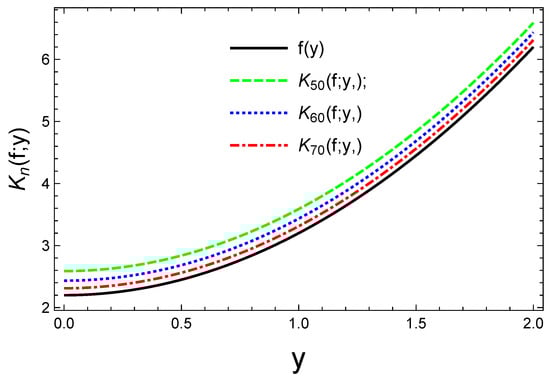
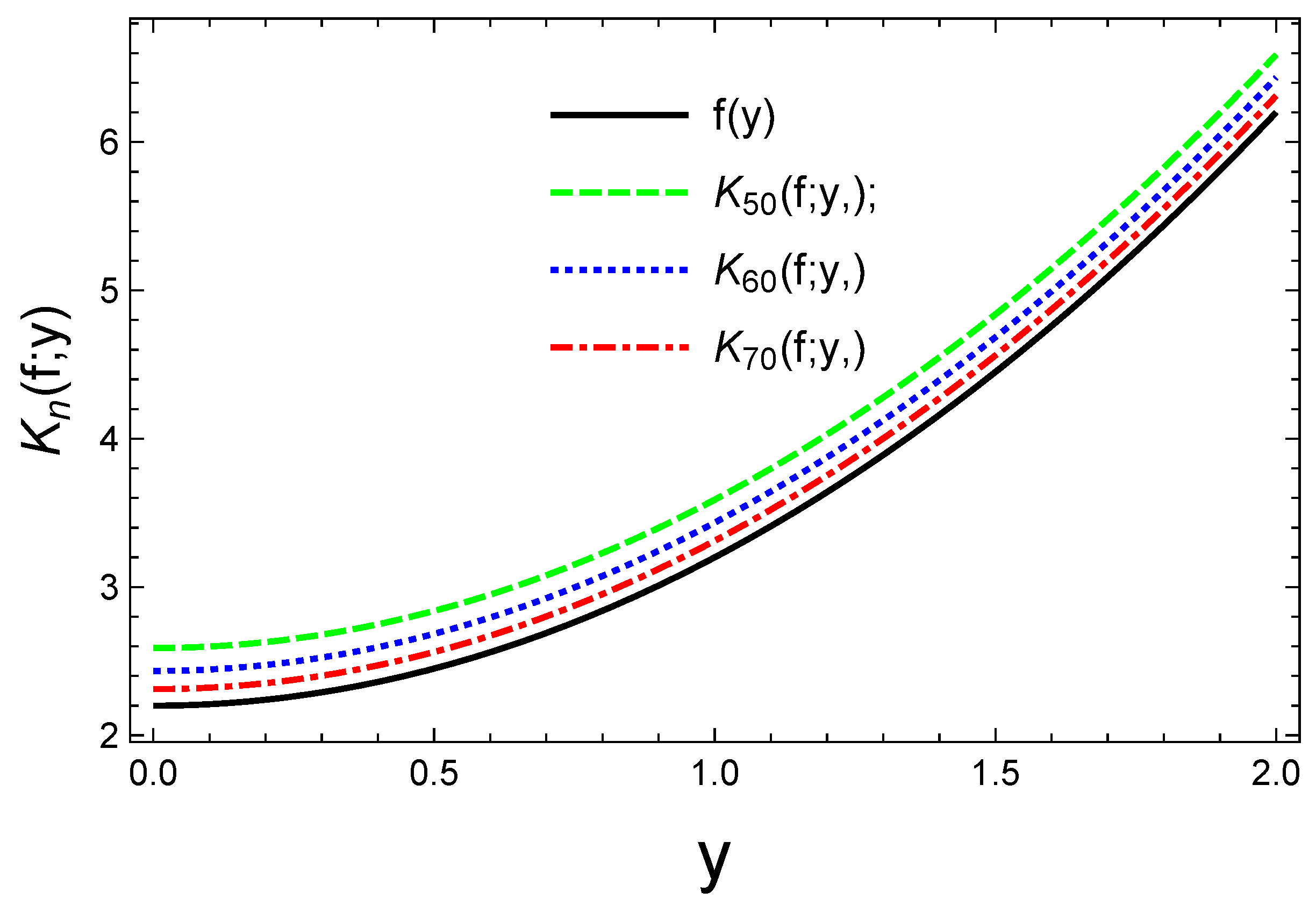
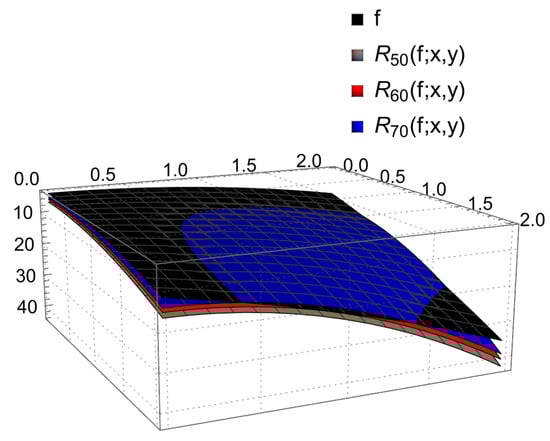
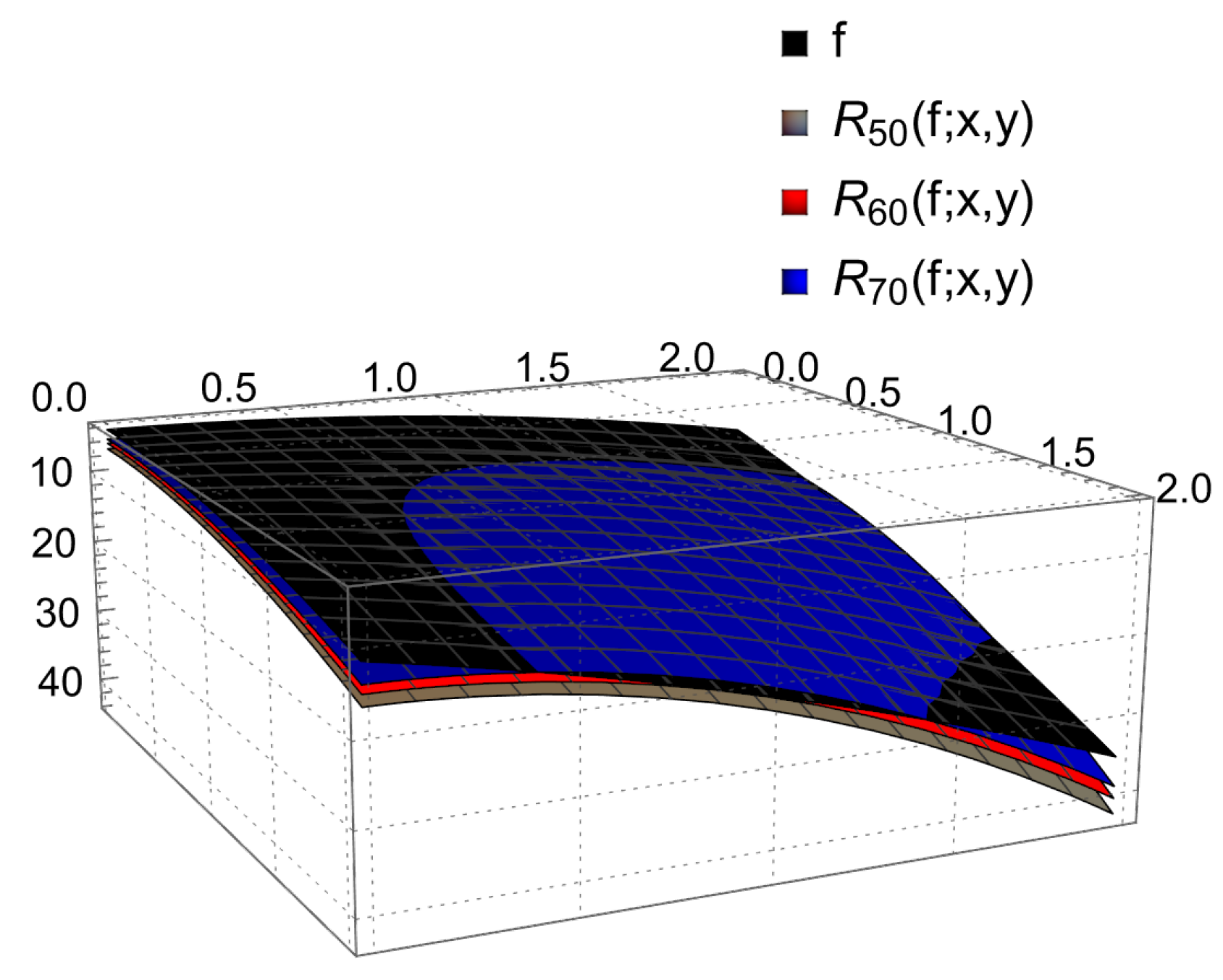
In this section, we analyze the convergence properties of the operators defined in (5) for different values of n, specifically , , and . Figure 1 visualizes the convergence behavior, demonstrating the impact of increasing n on the operator’s performance, while Figure 2 illustrates the approximation error trends. The numerical errors, computed using the formula for the function , are presented in Table 1. These errors provide a quantitative measure of the approximation accuracy for different values of n and highlight the rate of convergence as n increases. From Figure 1, we observe that larger values of n improve the operators’ convergence to , while Figure 2 shows a consistent reduction in the approximation error, demonstrating the effectiveness of the operators for higher values of n. Table 1 further confirms that the error decreases significantly as n increases, validating the theoretical convergence properties. This numerical analysis not only supports the theoretical findings but also offers a practical understanding of the operator’s behavior. By evaluating the errors across different y values, we gain insights into the robustness and efficiency of the operators in approximating , which is essential for applications requiring high accuracy.
Figure 1.
Convergence of operator for .
Figure 2.
Error approximation .
Table 1.
The error approximation of the operators to .
4. Local Approximation Results
Now, we recall a Lipschitz-type space [38], which is defined as
where , and .
Theorem 4.
Proof.
For and , we yield
Since , for all , we yield
This implies that Theorem 4 holds for . Next, we consider a case where , and in view of Hölder’s inequality using and , obtain
Since , for all , we have
Hence, Theorem 4 is proved. □
5. The Bivariate of a Frobenius–Euler–Simsek Polynomial Analog of Szász Operators
In this section, we extend the operators described in (5) to their bivariate form. Let
and denotes the class of two variable functions that are continuous on , equipped with the supremum norm
For all and , we define a bivariate version of as follows:
where are positive increasing sequences of real numbers such that and . We consider the two-dimensional test functions and the central moments for such that .
Lemma 5.
For and the operator given by Equation (13), along with the test functions , we have
Proof.
We prove the above lemma using the concept of positive linear operators and by applying Lemma 3, as shown below:
From the above equalities and Lemma 3, we can easily prove the lemma. □
Lemma 6.
For for then we have the following equalities:
Proof.
Using Lemma 5 and the property of linearity, the required result can easily be proven. □
6. Order of Approximation
To analyze the convergence rate of the operators given in (13), we refer to the result established by Volkov [39]. This result provides a framework for addressing the convergence behavior effectively.
Theorem 5.
Let I and J be compact intervals on the real line. Consider the linear positive operators , where . If
and
and if converges uniformly on , then for any , the sequence converges uniformly to f on .
Theorem 6.
Let be the test functions restricted on . If
and
uniformly on , then
uniformly for all .
Proof.
In light of Equation (5), it is evident for
For , , we obtain
Similarly,
and in light of Lemma 5, we obtain
Using Theorems 5 and 6, we arrive at the desired result. □
In the last result, we deal with the approximation order of the sequence of operators given by (13) as
Theorem 7
([40]). Let be a linear positive operator. For any , any , and any , the following inequality
holds.
Theorem 8.
For and , and , one has
where and .
Proof.
From Theorem 7, we have
Selecting and , we arrive at the required result. □
7. Numerical and Graphical Analyses of Bivariate Operators
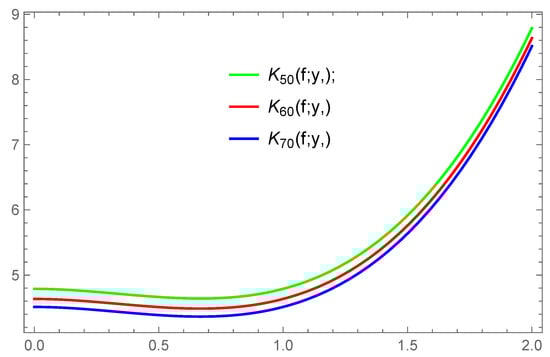
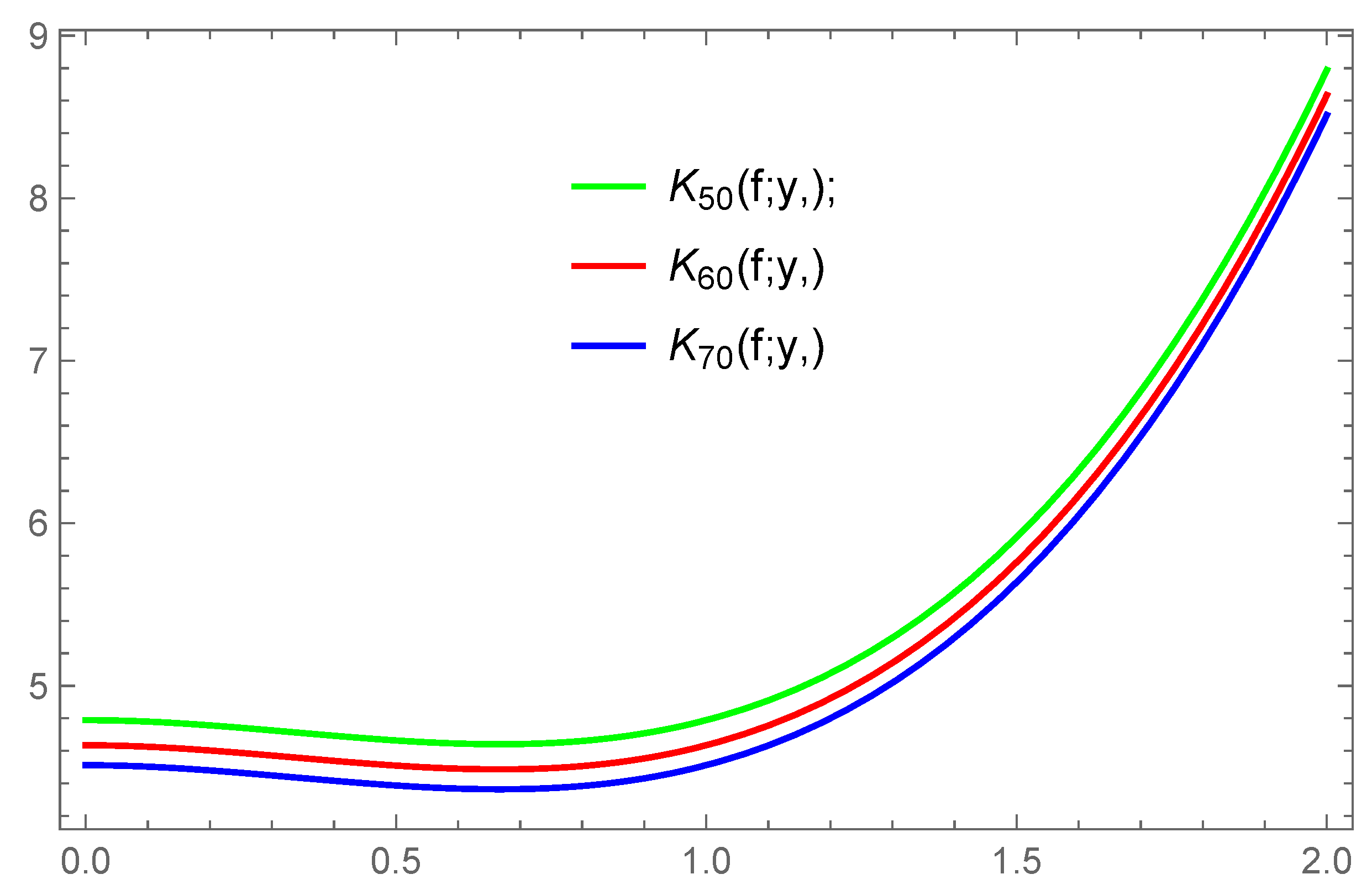
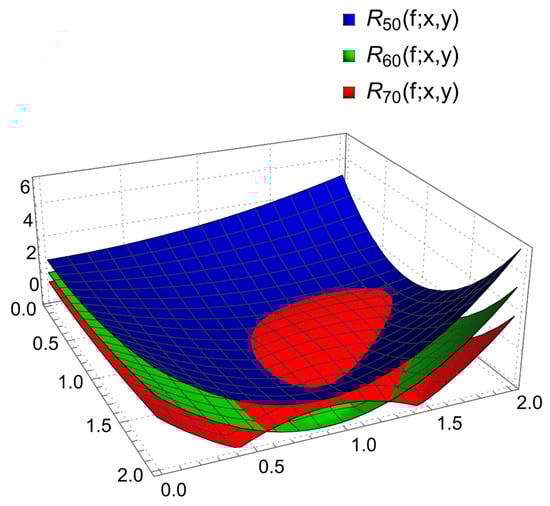
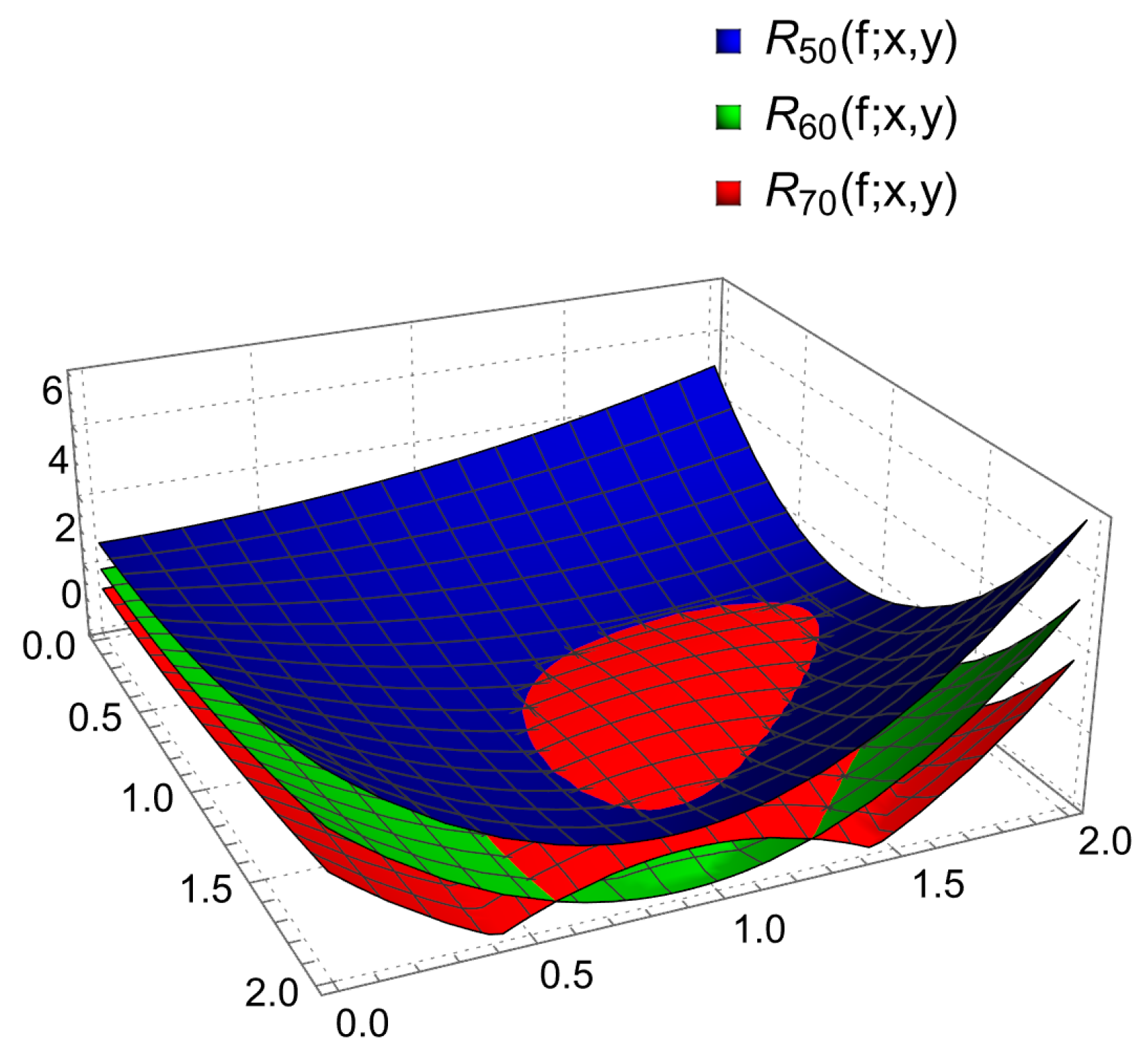
We present graphical and numerical analyses of the bivariate operators defined in (13) to demonstrate their convergence. Using the test function , the convergence behavior is illustrated in Figure 3. To examine the error approximation, we employ the formula , analyzing the error for different values of n and m, specifically and 70. The corresponding error approximations are graphically represented in Figure 4 and numerically tabulated in Table 2. Collectively, the figures and the table provide insights into the behavior and accuracy of the operator as n and m increase, confirming its convergence to the target function .
Figure 3.
Convergence of the operator for .
Figure 4.
Error approximation .
Table 2.
Error approximation table: .
8. Conclusions
In this study, we explored the approximation capabilities of Frobenius–Euler–Simsek polynomials analogous to Szász–Kantorovich operators for Lebesgue measurable functions. Through extensive testing and calculation of the test functions and central moments, we analyzed their uniform convergence and order of approximation. Our investigation included the Korovkin theorem and the modulus of continuity, assessing how well these operators approximated the functions within continuous functional spaces. We also examined Voronovskaja-type theorems for functions with continuous derivatives, supported by numerical and graphical analyses of the errors. Additionally, we developed a bivariate sequence of operators for approximating bivariate continuous functions, discussing the numerical and graphical error deviations.
Author Contributions
Methodology, N.R.; Software, M.F.; Formal analysis, M.R.; Writing—original draft, N.R.; Writing—review & editing, M.F. and M.R. All authors have read and agreed to the published version of the manuscript.
Funding
The APC was funded by the Deanship of Graduate Studies and Scientific Research at Qassim University for financial support (QU-APC-2025).
Data Availability Statement
Data are contained within the article.
Acknowledgments
The Researchers would like to thank the Deanship of Graduate Studies and Scientific Research at Qassim University for financial support (QU-APC-2025).
Conflicts of Interest
The authors declare no conflicts of interest.
References
- Bernstein, S.N. Démonstration du théorème de Weierstrass fondée sur le calcul de probabilités. Commun. Soc. Math. Kharkow. 1913, 13, 1–2. [Google Scholar]
- Weierstrass, K. Über die analytische Darstellbarkeit sogenannter willkürlicher Functionen einer reellen Veränderlichen. Sitzungsberichte KöNiglichen PreußIschen Akad. Wiss. Berl. 1885, 2, 633–639. [Google Scholar]
- Kantorovich, L.V. Sur certain developpments suivant les polynomes de la forme de S. Bernstein, I, II. C. R. Acad. URSS 1930, 563–568, 595–600. [Google Scholar]
- Khan, K.; Lobiyal, D.K. Bézier curves based on Lupăs (p,q)-analogue of Bernstein functions in CAGD. Comput. Appl. Math. 2017, 317, 458–477. [Google Scholar] [CrossRef] [Scilit]
- Raiz, M.; Rao, N.; Mishra, V.N. Szász-type operators involving q-Appell polynomials. In Approximation Theory, Sequence Spaces and Applications; Mohiuddine, S.A., Hazarika, B., Nashine, H.K., Eds.; Industrial and Applied Mathematics; Springer: Singapore, 2022. [Google Scholar] [CrossRef] [Scilit]
- Khan, K.; Lobiyal, D.K.; Kilicman, A. Bézier curves and surfaces based on modified Bernstein polynomials. Azerb. J. Math. 2019, 9, 102–115. [Google Scholar]
- Izadbakhsh, A.; Kalat, A.A.; Khorashadizadeh, S. Observer-based adaptive control for HIV infection therapy using the Baskakov operator. Biomed. Signal Process. Control 2021, 65, 102343. [Google Scholar] [CrossRef] [Scilit]
- Uyan, H.; Aslan, A.O.; Karateke, S.; Büyükyazıcı, İ. Interpolation for neural network operators activated with a generalized logistic-type function. Neural Comput. Appl. 2024, in press. [CrossRef] [Scilit]
- Zhang, Q.; Mu, M.; Wang, X. A modified robotic manipulator controller based on Bernstein-Kantorovich-Stancu operator. Micromachines 2022, 14, 44. [Google Scholar] [CrossRef] [Scilit]
- Özger, F. Weighted statistical approximation properties of univariate and bivariate λ-Kantorovich operators. Filomat 2019, 33, 3473–3486. [Google Scholar] [CrossRef] [Scilit]
- Özger, F.; Ansari, K.J. Statistical convergence of bivariate generalized Bernstein operators via four-dimensional infinite matrices. Filomat 2022, 36, 543–555. [Google Scholar] [CrossRef] [Scilit]
- Cai, Q.B.; Lian, B.Y.; Zhou, G. Approximation properties of λ-Bernstein operators. J. Inequal. Appl. 2018, 2018, 61. [Google Scholar] [CrossRef] [Scilit] [PubMed]
- Cai, Q.B.; Zhou, G.; Li, J. Statistical approximation properties of λ-Bernstein operators based on q-integers. Open Math. 2019, 17, 487–498. [Google Scholar]
- Aslan, R. Rate of approximation of blending type modified univariate and bivariate λ-Schurer-Kantorovich operators. Kuwait J. Sci. 2024, 51, 100168. [Google Scholar]
- Aslan, R. Approximation properties of univariate and bivariate new class-Bernstein–Kantorovich operators and its associated GBS operators. Comput. Appl. Math. 2023, 42, 34. [Google Scholar] [CrossRef] [Scilit]
- Acu, A.M.; Gonska, H.; Rașa, I. Grüss-type and Ostrowski-type inequalities in approximation theory. Ukr. Math. J. 2011, 63, 843–864. [Google Scholar]
- Acu, A.M.; Acar, T.; Radu, V.A. Approximation by modified operators. Rev. R. Acad. Cienc. Exactas Fís. Nat. Ser. A Math. 2019, 113, 2715–2729. [Google Scholar]
- Acu, A.M.; Tachev, G. Yet another new variant of Szász–Mirakyan operator. Symmetry 2021, 13, 2018. [Google Scholar] [CrossRef] [Scilit]
- Mohiuddine, S.A.; Acar, T.; Alotaibi, A. Construction of a new family of Bernstein-Kantorovich operators. Math. Methods Appl. Sci. 2017, 40, 7749–7759. [Google Scholar]
- Mohiuddine, S.A.; Ahmad, N.; Özger, F.; Alotaibi, A.; Hazarika, B. Approximation by the parametric generalization of Baskakov–Kantorovich operators linking with Stancu operators. Iran. J. Sci. Technol. Trans. A Math. 2021, 45, 593–605. [Google Scholar] [CrossRef] [Scilit]
- Mursaleen, M.; Ansari, K.J.; Khan, A. Approximation properties and error estimation of q-Bernstein shifted operators. Numer. Algorithms 2020, 84, 207–227. [Google Scholar] [CrossRef] [Scilit]
- Mursaleen, M.; Naaz, A.; Khan, A. Improved approximation and error estimations by King type (p, q)-Szász–Mirakjan Kantorovich operators. Appl. Math. Comput. 2019, 348, 2175–2185. [Google Scholar]
- Bustamante, J. Direct estimates and a Voronovskaja-type formula for Mihesan operators. Comput. Math. Appl. 2022, 5, 202–213. [Google Scholar]
- Ozsarac, F.; Gupta, V.; Aral, A. Approximation by some Baskakov–Kantorovich exponential-type operators. Bull. Iran. Math. Soc. 2022, 48, 227–241. [Google Scholar]
- Khan, A.; Mansoori, M.; Khan, K.; Mursaleen, M. Phillips-type q-Bernstein operators on triangles. J. Funct. Spaces 2021, 1–13. [Google Scholar] [CrossRef] [Scilit]
- Nasiruzzaman, M. Approximation properties by Szász–Mirakjan operators to bivariate functions via Dunkl analogue. Iran. J. Sci. Technol. Trans. A Math. 2011, 45, 259–269. [Google Scholar]
- Braha, N.L.; Loku, V.; Mansour, T.; Mursaleen, M. A new weighted statistical convergence and some associated approximation theorems. Math. Methods Appl. Sci. 2022, 45, 5682–5698. [Google Scholar]
- Rao, N.; Farid, M.; Ali, R.A. Study of Szász–Durremeyer-Type Operators Involving Adjoint Bernoulli Polynomials. Mathematics 2024, 12, 3645. [Google Scholar] [CrossRef] [Scilit]
- Rao, N.; Farid, M.; Raiz, M. Symmetric Properties of λ-Szász Operators Coupled with Generalized Beta Functions and Approximation Theory. Symmetry 2024, 16, 1703. [Google Scholar] [CrossRef] [Scilit]
- Çetin, N. Approximation and geometric properties of complex α-Bernstein operator. Results Math. 2019, 74, 40. [Google Scholar]
- Çetin, N.; Radu, V.A. Approximation by generalized Bernstein–Stancu operators. Turk. J. Math. 2019, 43, 2032–2048. [Google Scholar]
- Simsek, Y. Applications of constructed new families of generating-type functions interpolating new and known classes of polynomials and numbers. Math. Methods Appl. Sci. 2021, 44, 11245–11268. [Google Scholar] [CrossRef] [Scilit]
- Kucukoglu, I. Generating functions for multiparametric Hermite-based Peters-type Simsek numbers and polynomials in several variables. Montes Taurus J. Pure Appl. Math. 2024, 6, 217–238. [Google Scholar]
- Kucukoglu, I.; Simsek, Y. Identities and relations on the q-Apostol type Frobenius–Euler numbers and polynomials. J. Korean Math. Soc. 2019, 56, 265–284. [Google Scholar]
- Agyuz, E. On the convergence properties of generalized Szász–Kantorovich type operators involving Frobenius–Euler–Simsek-type polynomials. AIMS Math. 2024, 9, 28195–28210. [Google Scholar]
- DeVore, R.A.; Lorentz, G.G. Constructive Approximation; Springer: Berlin/Heidelberg, Germany, 1993. [Google Scholar]
- Altomare, F.; Campiti, M. Korovkin-Type Approximation Theory and Its Applications; De Gruyter Studies in Mathematics; De Gruyter: Berlin, Germany, 1994; Volume 17, pp. 266–274. [Google Scholar]
- Özarslan, M.A.; Aktuğlu, H. Local approximation for certain King type operators. Filomat 2013, 27, 173–181. [Google Scholar]
- Volkov, V.I. On the convergence of sequences of linear positive operators in the space of continuous functions of two variables. Dokl. Akad. Nauk SSSR (NS) 1957, 115, 17–19. (In Russian) [Google Scholar]
- Stancu, F. Aproximarea Funcţiilor de Două şi Mai Multe Variabile Prin şIruri de Operatori Liniari şi Pozitivi. Ph.D. Thesis, University ”Babe¸s-Bolyai”, Cluj-Napoca, Romania, 1984. (In Russian) [Google Scholar]

Disclaimer/Publisher’s Note: The statements, opinions and data contained in all publications are solely those of the individual author(s) and contributor(s) and not of MDPI and/or the editor(s). MDPI and/or the editor(s) disclaim responsibility for any injury to people or property resulting from any ideas, methods, instructions or products referred to in the content. |
© 2025 by the authors. Licensee MDPI, Basel, Switzerland. This article is an open access article distributed under the terms and conditions of the Creative Commons Attribution (CC BY) license (https://creativecommons.org/licenses/by/4.0/).