1. Introduction
Two important branches of mathematics, general topology [
1] and graph theory [
2], are closely related. One of the relationships between graph theory and general topology is constructing topologies on the vertices set and the edges set of a graph. Several studies constructed some topologies via directed graphs and undirected graphs. Most of these constructions were in the theory of simple undirected graphs, in particular on the vertices sets of such graphs. In 2018, the authors of the paper [
3] introduced new constructions of topologies involving incidence topology on the set of vertices for simple graphs
without isolated vertices, which has a subbasis
, where
is the family of end sets that only contain the end points of each edge. Kiliciman and Abdu [
4] used the graphs
to introduce two constructions of topologies on the set
called compatible edge topology and incompatible edge topology. Amiri et al. [
5] constructed the graphic topological space of a graph
as a pair
, where
is an Alexandroff topology on
induced by a subbasis
, which is the family of open neighborhoods
of vertices in
. Nada et al. [
6] introduced a relation on graphs to generate new types of topological structures. In 2019, Nianga and Canoy [
7] constructed a topology on simple graphs by using unary and binary operations, and in [
8], they introduced some topologies on the vertices set in the theory of simple graphs by using the hop neighborhoods of the graphs (see also [
9,
10]). In 2020, for the simple graphs without isolated vertices
, Sari and Kopuzlu [
11] generated a topology on the vertices set induced by the same basis introduced by Amiri et al. [
5] and studied the continuity of functions. The minimal neighborhood system of vertices and the discrete property of topologies for special graphs, such as complete graphs
, cycle graphs
, and complete bipartite graphs
, were also studied. In 2021, Zomam et al. [
12] studied some conditions for a locally finite property of graphs to obtain an Alexandroff property for the graphic topological spaces introduced by Amiri et al. [
5]. In the theory of directed graphs, pathless topological spaces on the vertices set
were introduced by Othman et al. In [
13] in 2022, the relation between the pathless topological spaces with relative topologies and E-generated subgraphs was presented, and the role of pathless topology in the blood circulation of the heart of the human body was studied (see also [
14]). By using C-sets, Othman et al. [
15] constructed a topology on
called
topology. In 2023, Abu-Gdairi et al. [
16] explained the role of the topological visualization in the medical field by giving graph analysis and rough sets using neighborhood systems. For an approximation neighborhood system, Yao [
17] introduced the concepts of lower approximation and upper approximation of any nonempty set as a generalized rough sets by using a binary relation; for similar investigation, see [
18,
19]. Atik et al. [
20] introduced a new type of rough approximation model via graphs and using
j-neighborhood systems. By using an ideal collection, Guler [
21] generated different approximations and compared these approximations.
In this paper, we use an upper approximation neighborhood system of simple graphs
(which was defined in [
20]) to construct a new topology on the vertices set
called an upper approximated G-topology. In
Section 3, we give the concept of upper approximated G-topological space and show the discrete property of complete graphs
, cycle graphs
, and complete bipartite graphs
. Next, we define the minimal operator of vertices in upper approximated G-topological spaces and give some results about the closure operator.
Section 4 introduces relations between continuous mappings in upper approximated G-topological spaces and isomorphism mappings in simple graphs. We study the isomorphic fundamental topological properties such as compactness and connectedness. Further on, we define a new class of connected graphs, called upper connectedness, and a new class of discrete topologies, called upper discreteness. In
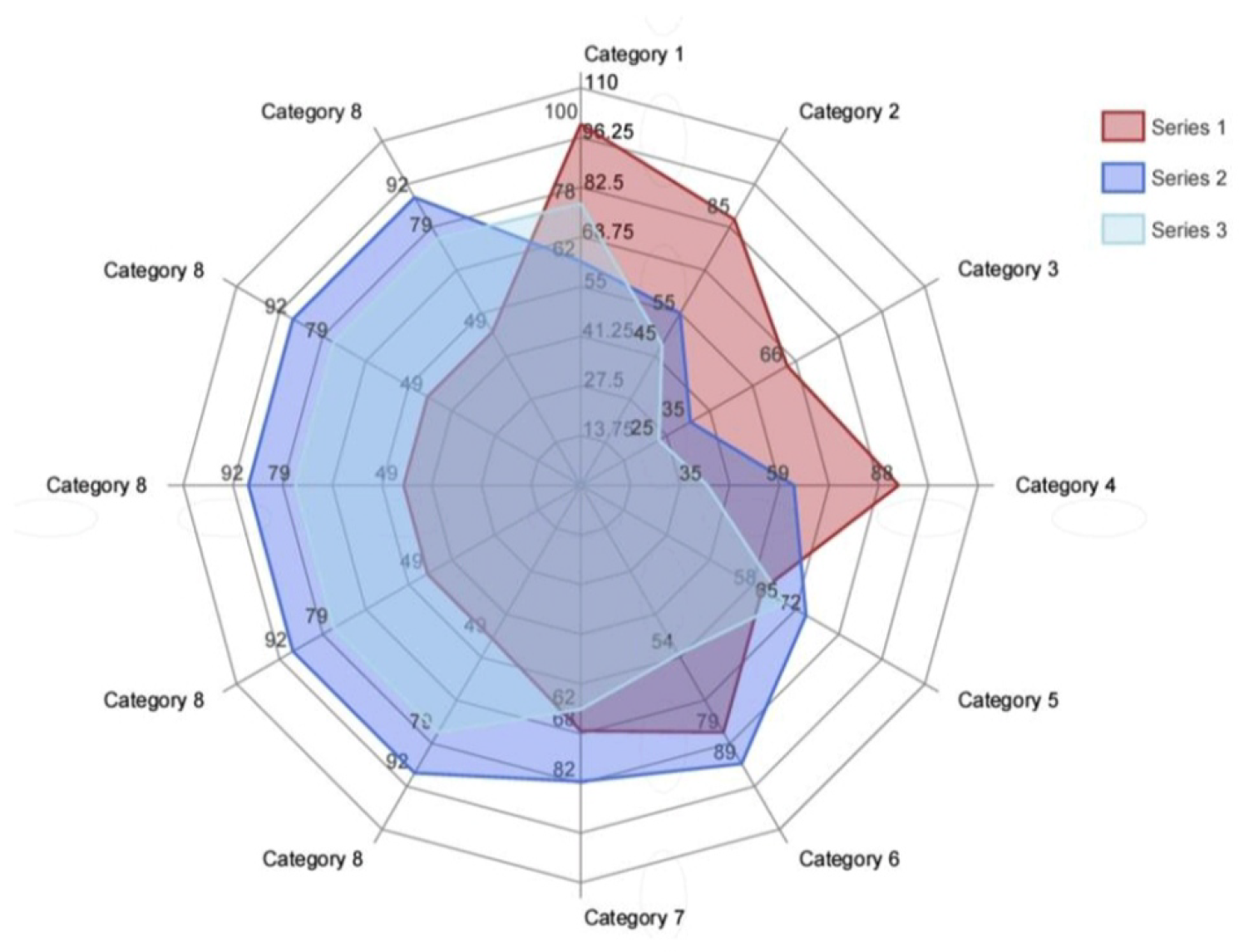
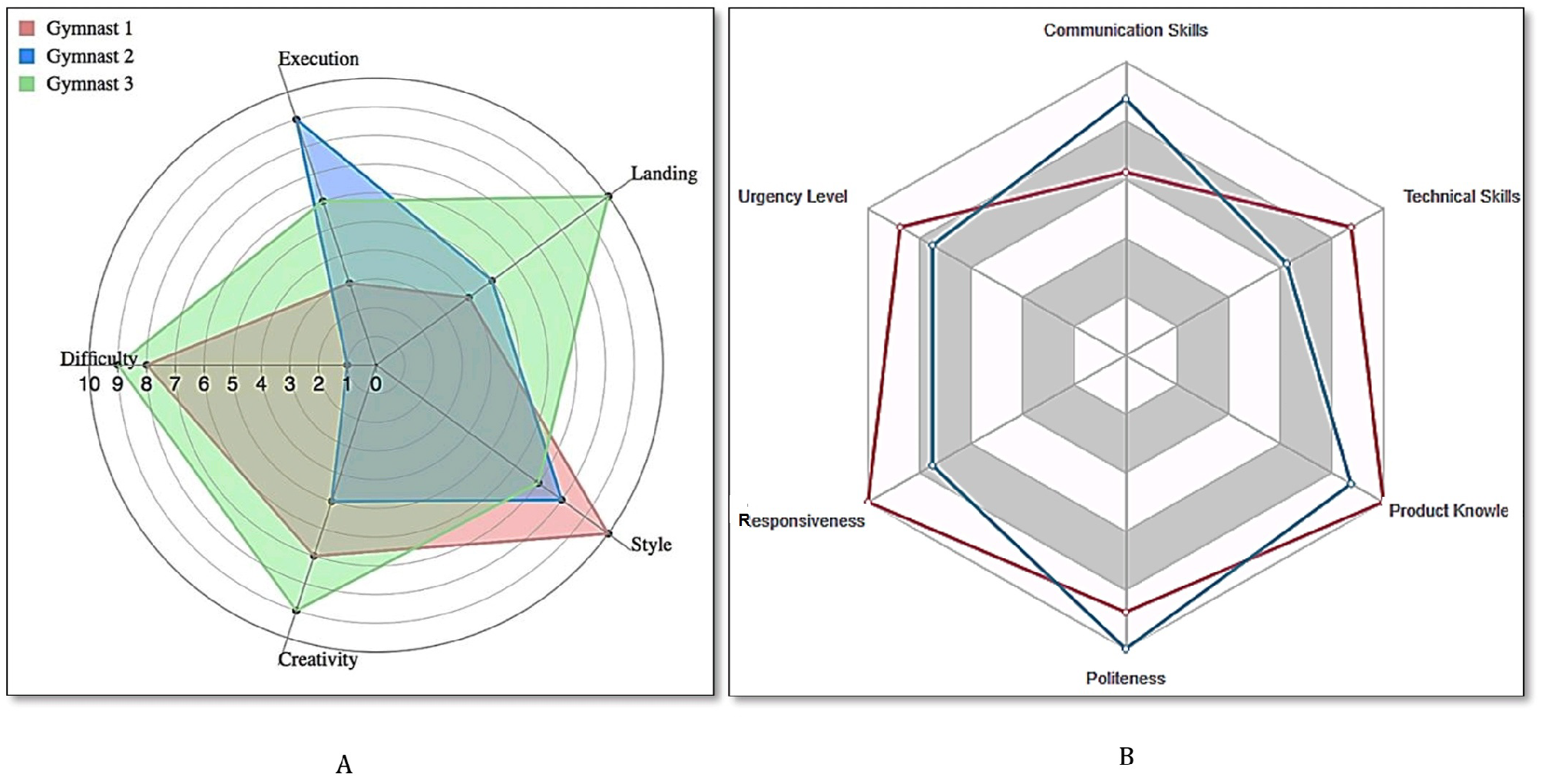
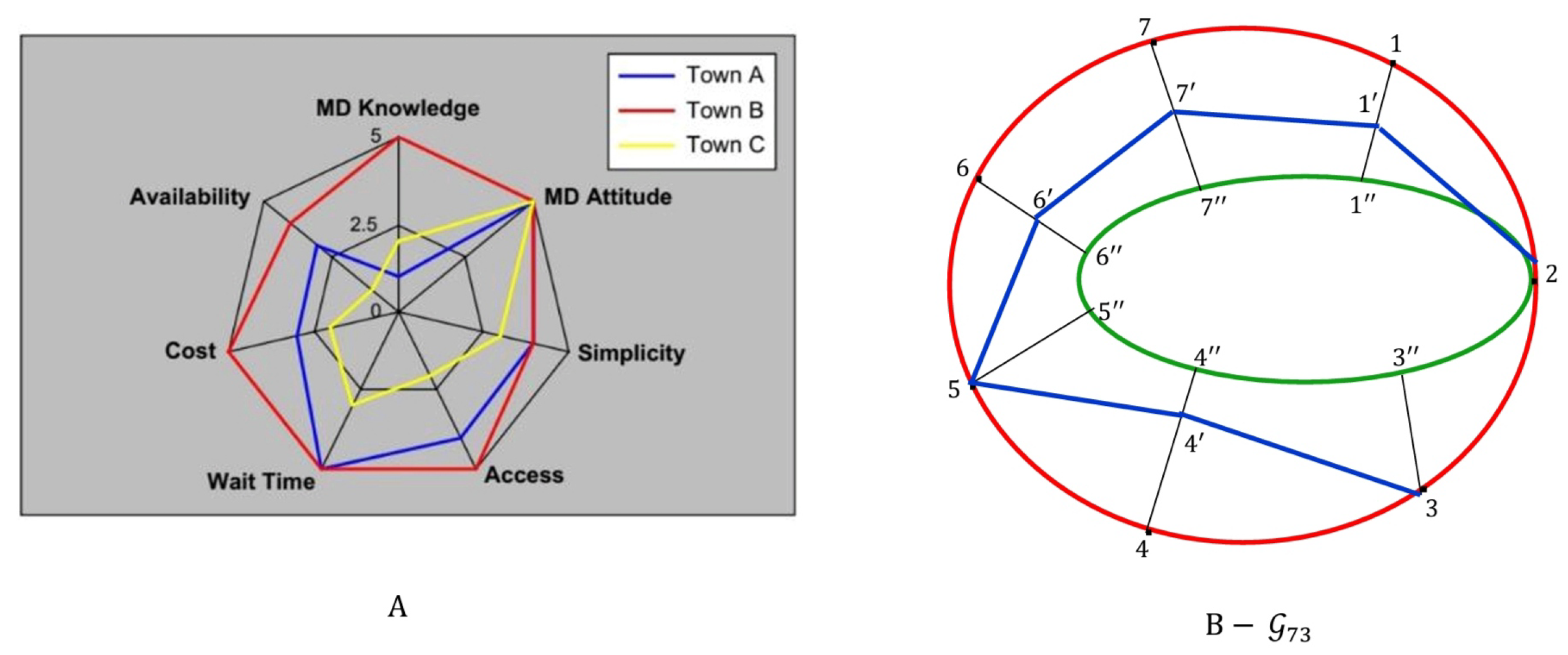
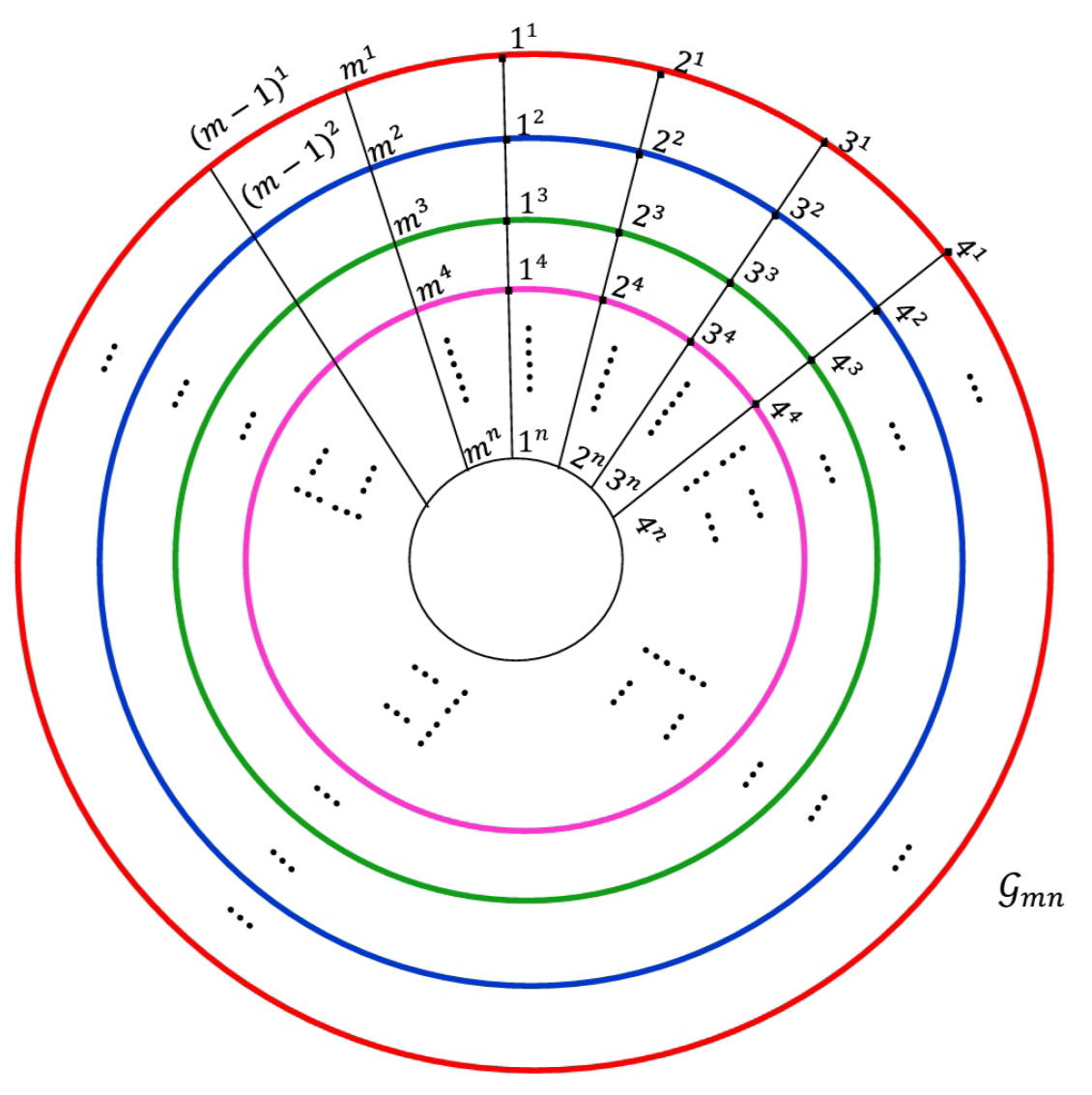
Section 5, we prove that if the number of categories for a radar chart is large enough, then the upper approximated G-topological space for the corresponding graph of this radar chart is disconnected and discrete. Upper connectedness and upper discrete properties for corresponding graphs of radar charts are also studied.
3. The Upper Approximated G-Topologies
Let
be a simple graph. We first structure the neighborhood system for elements of
By using the notions of rough approximation
j-neighborhood systems (which are introduced in [
20]), for any vertex
, define the upper approximation neighborhood
and lower approximation neighborhood
of
x as
respectively, where
. By
, we mean the upper approximation neighborhood system of a graph
, and similarly, by
, we mean the lower approximation neighborhood system of a graph
, that is,
and
, respectively.
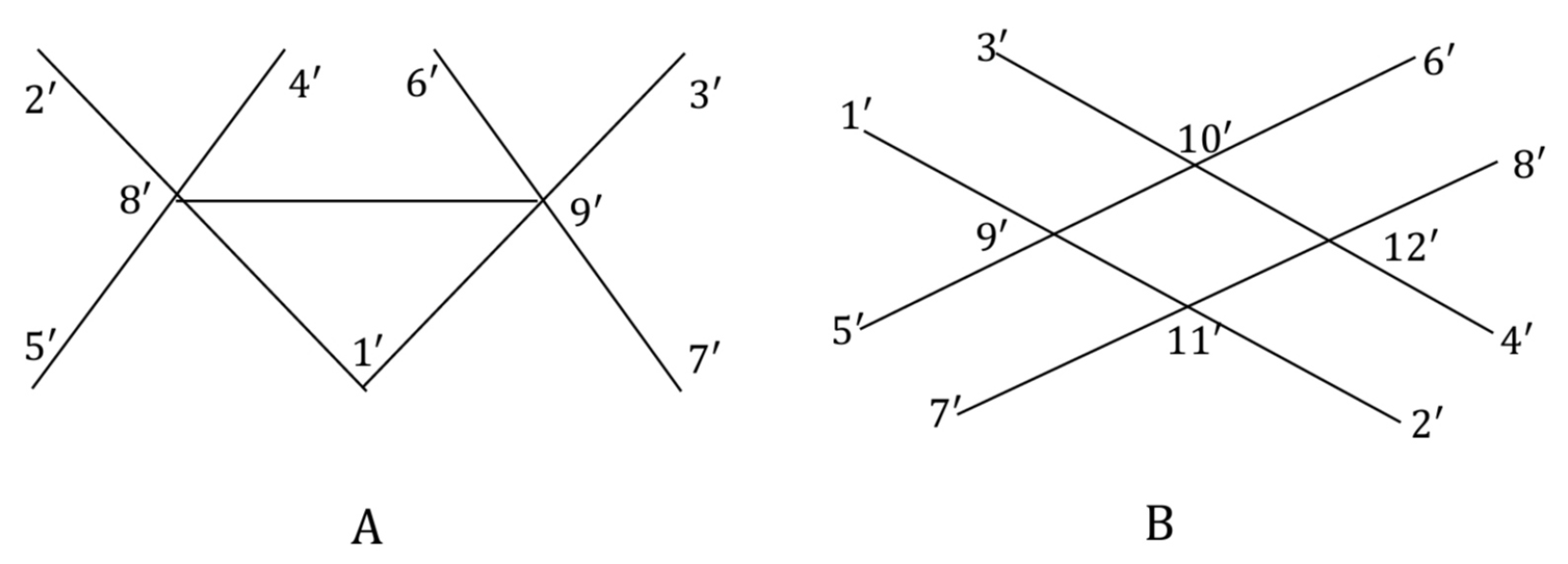
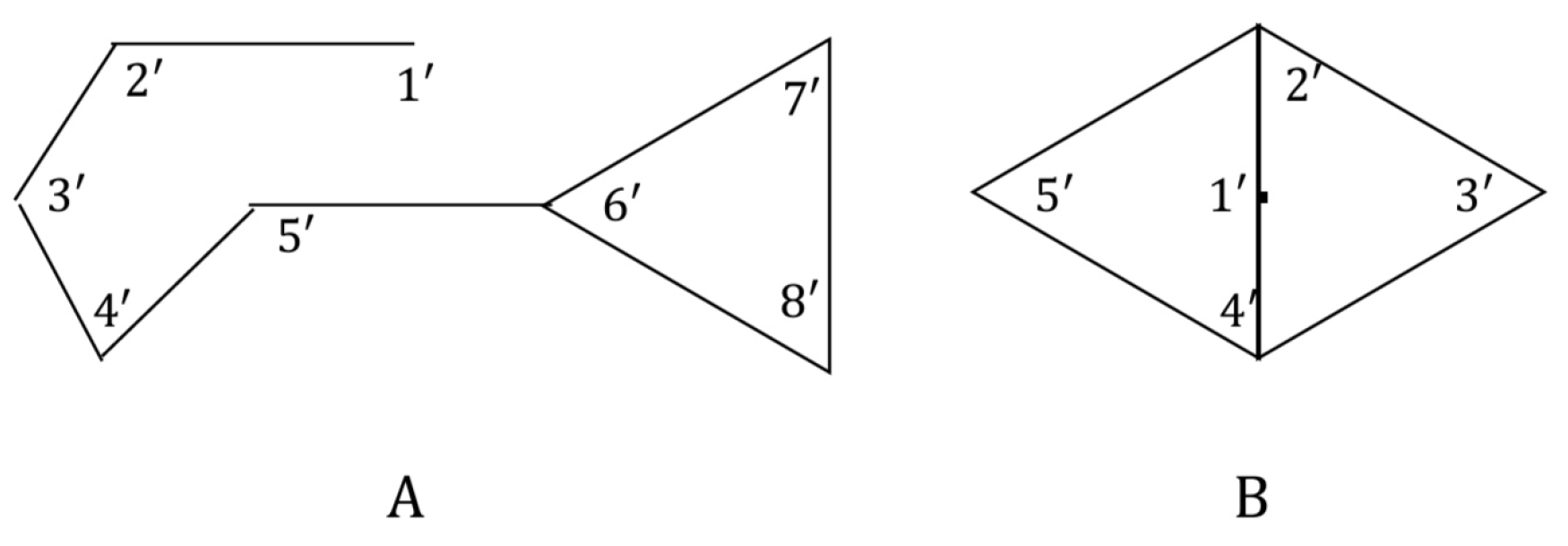
Example 1. Note that the graph in Figure 1A has an upper approximation neighborhood system given by The lower approximation neighborhood system of is given by and for all . In Figure 1B, the graph has an upper approximation neighborhood system given by The lower approximation neighborhood system of is given by Theorem 1. Let be any simple graph. The family forms a basis of a topology on , where is the intersection set of all upper approximation neighborhoods containing x in .
Proof. For the proof, we use a characterization of the base of a topology [
1]. It is clear that
for all
. That is,
. On the other hand, since
for all
, then
, i.e.,
. Now we will prove that for every two elements
, there is
such that
. Let
and
be any two elements in
. If
, then take
to obtain the desired value. Let
. Then, there is at least one
and
. Since
, then
for all
with
. Similarly, since
, then
for all
with
. In all cases, we obtain
. Take
. That is,
.
On the other hand, let , that is, . Hence, for some . Then, , and this implies that for all . So, we have . Hence, and , that is, and . Hence, .
From the two cases, we obtain . Therefore, forms a basis of a topology on . □
For any simple graph, , and the topology in the above theorem which is induced by the basis will be called an upper approximated G-topology of a graph and will be denoted by . From the definitions of the basis and an upper approximation neighborhood system , we conclude that the family forms a sub-basis for an upper approximated G-topological space .
The simple graph
of
Figure 1A in Example 1 has an upper approximated G-topological space
with a basis
, where
In
Figure 1B, the graph
has the upper approximated G-topological space
with a basis
, where
Example 2. The graph in Figure 2A has the upper approximated G-topological space with a basis , where The graph in Figure 2B has the upper approximated G-topological space with a basis , wherefor all . Let be any simple graph. If is an isolated vertex, then it is clear that the set is an open set in the upper approximated G-topological space and also if is an isolated edge, then the set is an open set. Furthermore, if we have an isolated path P in of length two of the form , then the set is an open set. If we have an isolated path P in of length 3 of the form , that is, , then it is easy to see that the upper approximated G-topological space has a basis which is given by .
Theorem 2. Let P be a path of the form where . Then, the basis of is given by for all . Proof. Note that
and similarly,
. For all
, we have
Hence,
for all
. □
Theorem 3. The upper approximated G-topological space of a complete graph is an indiscrete space for all .
Proof. In case , ; then, it is clear that . That is, is an indiscrete space. If and is any vertex, then , that is, . Hence, for all , that is, for all . Hence, is an indiscrete space for all . □
Theorem 4. The upper approximated G-topological space of a complete bipartite graph is an indiscrete space for all .
Proof. In case , ; then, it is clear that and . That is, and . Hence, is an indiscrete space. Let and . Let be any vertex. Since , then or . Let . By definition of the complete bipartite graph , . Now we will show that . Let be any vertex. Then, . So, we have , that is, . Hence, . Then, we have , and hence, . Similarly, if , we obtain . Since x is an arbitrary vertex, then is an indiscrete space for all . □
For a cycle graph with , say , we note that for all . That is, the upper approximated G-topological space of is an indiscrete space. Similarly, if or , then we obtain for all or for all , respectively. That is, the upper approximated G-topological space of is an indiscrete space for . The following theorem shows that the upper approximated G-topological space of is a discrete space for all .
Theorem 5. The upper approximated G-topological space of a cycle graph is a discrete space for all .
Proof. Consider the cycle graph
,
where
. By definition of
and since
for all
, we have
and
Now for all
, since the cycle graph
is a closed path, then from the proof of Theorem 2, we have
Hence,
. This means
is a discrete space for all
. □
The following theorem shows that the Alexandroff topological property will be satisfied for the upper approximated G-topological spaces of locally finite simple graphs, i.e., the arbitrary intersection of open sets is an open set.
In our next work, any simple graph will be locally finite.
Theorem 6. The upper approximated G-topological space of any simple graph is an Alexandroff space.
Proof. Let be any simple graph. Let Z be any nonempty subset of . Let be the collection of all the upper approximated neighborhoods of elements of Z. We will prove that is an open set in . Let . Then, for all . Hence, for all . So, . Since is locally finite, is finite. So, Z is finite. Hence, is an open set. This proves that the upper approximated G-topological space is an Alexandroff space. □
In the class of locally finite simple graphs , by using the Alexandroff topological property of the upper approximated G-topological spaces , we can define an operator from the vertices set into the upper approximated G-topology by is the smallest open set containing x, . It is clear that for an isolated point in any graph G, and if is an isolated edge, then . Furthermore, if we have an isolated path P in of length two of the form , then .
Theorem 7. For any locally finite simple graph , for all .
Proof. By the definition of the family and Theorem 1, is an open set in the upper approximated G-topological space for all . By Theorem 1, is an open set containing x. Since is the smallest open set containing x, then
On the other hand, since is the intersection of all open sets containing x, then let for some subset Q of . Then, for all , and this implies that for all . One concludes that . Hence, So, □
Theorem 8. Let be a locally finite simple graph. For any two vertices , if and only if .
Proof. Let be any two vertices and . By Theorem 7, . Since , then . Hence, .
Conversely, let . By using Theorem 7 again, we can obtain . Then, . It means that for all . This implies that for all . Hence, . □
Theorem 9. Let be a locally finite simple graph. Then, for all , and if and only if is discrete.
Proof. Let x be any vertex in . It is clear that . Suppose that is any vertex. If , then by Theorem 8, and this is in contradiction with the hypothesis. Hence, for all , i.e., is discrete.
The reverse implication is clear, since for all . □
Let
be any simple graph and
. The closure of
X, denoted by
, is defined as the intersection of all closed sets containing
X in the upper approximated G-topological space
. Note that
if and only if for every open set
G containing
x,
(see, [
1]).
Theorem 10. For any locally finite simple graph and for all , for all .
Proof. Let . Then, for each open set G containing , . Since for all , then for all , i.e., for all . Hence, for all . □
From Theorem 10, for any vertex , for all .
Corollary 1. Let be any simple graph, and let . Then, if and only if .
4. On Isomorphic Properties
In this section, we first study the relationship between isomorphic relations for locally finite simple graphs and homeomorphic relations of their upper approximated G-topological spaces. Next, we give some results about some isomorphic properties.
Let
and
be two simple graphs without isolated vertices. The graphs
and
are called isomorphic, denoted as
, if there is a bijective mapping
such that
if and only if
for all
. A mapping
of a topological space
into a topological space
is continuous if
for all
. A mapping
is called a closed if
is a closed set in
for all closed sets
. Recall [
1] that if a mapping
is bijective, closed, and continuous, then it is called a homeomorphism.
Theorem 11. Let and be two simple graphs and be any mapping of the upper approximated G-topological spaces into . Then, γ is a continuous mapping if and only if for all , implies .
Proof. Let imply for all . Let O be any subset of and . If , then for some . Hence, . By the hypothesis, we obtain . Then, Hence, is continuous.
Conversely, let be continuous and be any two vertices such that . By Corollary 1, we obtain , and by continuity of , we have . Thus, by Corollary 1, we obtain . □
Theorem 12. Let and be two simple graphs. Then, a mapping is closed if γ is onto and for all , implies .
Proof. Let O be any closed set in . Since is onto, then there is a mapping such that . Now, we prove that is continuous. Let be arbitrary vertices such that . Hence, . By the hypothesis, we obtain . By Theorem 11, is continuous. Hence, is a closed set, and so is a closed mapping. □
Theorem 13. Let and be two simple graphs. If a mapping is closed and one-to-one, then for all , implies .
Proof. Let be any two vertices such that . Since is one-to-one, then there is a function such that . Since is one-to-one and closed, it is easy to see that is continuous. This implies that , that is, . □
Theorem 14. A bijective mapping of two simple graphs and is a homeomorphism if and only if for all , if and only if .
The following theorem shows that the isomorphic relation of simple graphs without isolated vertices gives us the homeomorphic relation of their upper approximated G-topological spaces.
Theorem 15. Let and be two simple graphs without isolated vertices. If and are isomorphic, then there is a homeomorphism between upper approximated G-topological spaces and .
Proof. Let be a bijective function such that if and only if for all . Let be any two vertices with . Then, we have or . Let . Then, there is an edge which joins x and y in . By the isomorphism of and , we conclude that the edge joins and in , that is, . So, in this case, . Now, in the other case, if , then there is some and . Then, similar to the first case, we obtain and , that is, . Hence, . Hence, for all , if and only if . Then, by Theorem 14, is a homeomorphism of upper approximated G-topological spaces into . □
Note that if there is a homeomorphic relation of upper approximated G-topological spaces, then the isomorphic relation of induced simple graphs need not be satisfied. For example, by Theorem 4, the complete bipartite graph with has an indiscrete upper approximated G-topological space , and by Theorem 3, has an indiscrete upper approximated G-topological space . So, and are homeomorphic, while the graphs and are not isomorphic, since if and , then x and y are joined in but not in .
Recall [
1] that compactness is a topological property. So, by Theorem 15, the compactness is an isomorphic property in the theory of simple graphs. It is clear that the upper approximated G-topological space
of any simple graph
is a compact space if
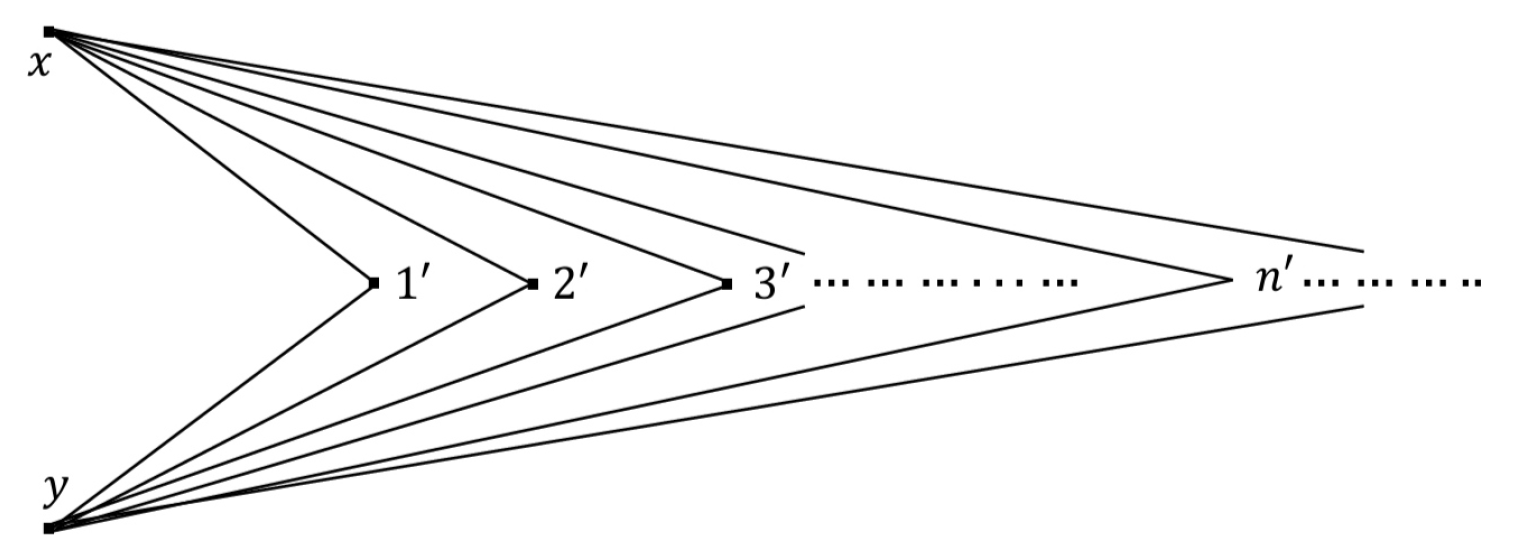
is finite. The upper approximated G-topological spaces induced by infinite graphs need not be compact. For example, in
Figure 3, the simple graph
with an infinite vertices set
has the sub-basis
given by
. The upper approximated G-topology of the graph
is an indiscrete spaces, so it is a compact space.
Also we have that, from Theorem 3, the upper approximated G-topology of a complete graph is a discrete space, and if is infinite, then is not a compact space.
The following theorem shows a relationship between connectedness property of upper approximated G-topological spaces and connectedness property of simple graphs.
Theorem 16. Let be any simple graph without isolated vertices. If the upper approximated G-topological space is a connected space, then is a connected graph.
Proof. Suppose that is a disconnected simple graph. Consider , the family of all components in , where for all . Now for all , . Then, is a nonempty proper open subset of , where . Then, is also a nonempty proper open subset of . This means that is a disconnected space which contradicts connectedness of . Hence, is a connected graph. □
Connected simple graphs need not induce connected upper approximated G-topological spaces. For example, by Theorem 5, the cycle graph is a connected graph, and it has disconnected upper approximated G-topological space , since it is discrete.
By Theorem 3, the complete graph is connected and has connected the upper approximated G-topological space , since it is indiscrete. Also by Theorem 4, the connected graph has connected the upper approximated G-topological space .
Let be any simple graph. Define as the subset of containing all vertices x with , where denotes the number of elements in . A simple graph is called an upper connected graph if the subgraph of , induced by , is connected. If the relative topology is discrete on the set , then the upper approximated G-topological space will be called upper discrete. For any simple graph , if , then we assume is upper connected and that is upper discrete. For the cycle graph , if , then , and so is upper connected with and not upper discrete. If , then , and so is an upper connected graph with , which is an upper discrete space. From Theorem 5, for all , , and hence, is an upper connected graph, and is an upper discrete space. For the complete graph , , , and hence, is upper connected, and is not upper discrete. If , then by Theorem 3, , and hence, is an upper connected graph having the space which is an upper discrete space.
For the complete bipartite graph , if , then , and hence, is upper connected with that is not upper discrete. If , then by Theorem 4, , and hence, is an upper connected graph with upper discrete space ,
Note that in
Figure 2A of Example 2,
. So, we obtain that
is an upper connected graph for which the space
is upper discrete.
In
Figure 2B of Example 2,
. So, we obtain that
is an upper connected graph, and the space
is not upper discrete.
Sari and Kopuzlu [
11] introduced the graphic topological spaces
in the theory of undirected graphs induced by a sub-basis
which is the family of open neighborhoods
of vertices in
and proved that the graphic topological space
of any locally finite graph
is an Alexandroff space. By this property for
, we can define the minimal operator in
as a function
from
into
which is given by the following: for all
,
is the smallest open set in
containing
x. Since
for all
and by the two definitions of graphic topological space
and an upper approximated G-topological space
, we obtain
for all
.
Recall [
1] that in a topological space
, a subset
G is called dense in
M if
, that is, if
for all open sets
O.
Theorem 17. Let be an upper connected graph. Then, is dense in , where is the set of all vertices in with degrees greater than one.
Proof. Let . Since is the smallest open set containing x, then we show that for all open sets O in , and we will prove that for all . Let . Since x is not isolated, then there is such that . Hence, . Hence, . So, there exists some such that . Then, , that is, for all . Therefore, is dense in . □
Theorem 18. Let be an upper connected graph, ζ be the family of smallest open sets of all vertices in , and be the family of all minimal sets in ζ. If is a minimal dense set in , then there is an onto mapping such that for all .
Proof. By the form of , the intersection of every pair of distinct elements of is an empty set. Since in , there is some for all . Since and , then , and it is clear that , that is, . If , then similarly, we obtain that . Hence, . Then, , and we have a contradiction. So, .
Define the mapping of into sending into the single element of . Now, we will prove that is onto. Let . We prove that such that . If , then there is such that is a proper subset of . Then, . In this case, we obtain that , which is a contradiction. Hence, such that . □
Theorem 19. Let be an upper connected graph, ζ be the family of smallest open sets of all vertices in , and be the family of all minimal sets in ζ. If is a mapping such that for all , then is a minimal dense set in .
Proof. It is easy to see that for all , there is such that and . Hence, we obtain , that is, is dense in .
To prove that is a minimal dense set in , let and . Suppose that such that . Then, there is such that and . Since and , that is, , then , and so . This is a contradiction. □