Abstract
In this article, we present an efficient numerical strategy for the two-dimensional nonlinear Schrödinger equation, focusing on its development and analysis. Our approach begins with proposing a nonlinear, energy-conservative, fourth-order, compact, alternating-direction, implicit (ADI) scheme. To boost efficiency when solving the associated nonlinear system, we then implement this scheme using a temporal two-mesh (TTM) algorithm. Under discretization with coarse time step , fine time step , and spatial mesh size h, the numerical scheme exhibits a convergence rate of order in both the discrete -norm and -norm. To facilitate the convergence analysis under fine time discretization, we propose a novel technique along with several supporting lemmas that enable the estimation of the discrete -norm error term over the temporal coarse mesh. Numerical experiments are then performed to validate the theoretical results and demonstrate the effectiveness of the proposed algorithm. The numerical results show that the new algorithm produces highly accurate results and preserves the conservation laws of mass and energy. Compared with the fully nonlinear compact ADI scheme, it reduces computational time while maintaining accuracy.
Keywords:
temporal two-mesh compact ADI method; nonlinear Schrödinger equation; convergence analysis; conservation laws MSC:
65M06; 65M12; 35Q55
1. Introduction
The nonlinear Schrödinger (NLS) equation is a key mathematical model for problems arising in various fields of physics, including nonlinear optics, plasma physics, and quantum mechanics. In this article, we consider the following model of the two-dimensional (2D) NLS problem:
where and denote a bounded domain in with boundary . Here, represents the Laplacian operator acting on spatial variables. The unknown function is a complex-valued wave function. and are sufficiently smooth functions. The trapping potential is real-valued, non-negative, and bounded on . In Equation (1), the real constant parameter characterizes the strength of local interactions between particles: positive values of correspond to focusing effects, while negative values lead to defocusing behavior. The model (1) conserves the total mass and energy such that
and
respectively.
For analytical studies including the derivation, well-posedness, and dynamical properties of the NLS equation, one can refer to [1,2,3,4] and the references therein. For numerical studies, different efficient and accurate numerical methods including the finite difference method [5,6,7,8,9,10], finite element method [11,12,13,14], spectral method [15,16], discontinuous Galerkin method [17], virtual element method [18], Runge–Kutta or Crank–Nicolson pseudo-spectral method [19,20], and meshless method [21] have been developed for the NLS equation. Naturally, each method possesses both advantages and disadvantages. For numerical comparisons between different numerical methods for solving the NLS equation, we refer readers to [22,23,24] and the references therein.
In recent years, significant efforts have been directed toward advancing high-order, compact, alternating-direction, implicit (HOC-ADI) methods to solve the multidimensional (i.e., ) NLS equation, aiming to achieve high spatial accuracy while tackling its inherent multidimensional complexity. Studies [25,26,27,28,29] focus on developing HOC-ADI methods for solving multidimensional NLS equations while utilizing linear Fourier analysis to prove their unconditional stability. Nevertheless, rigorous analyses of error estimates for HOC-ADI schemes solving multidimensional NLS equations have yielded limited results. Gao and Xie [30] proposed a fourth-order compact ADI scheme for a two-dimensional NLS equation and used an induction argument to prove convergence in the discrete -norm under a CFL-type condition. Wang and Guo et al. [31] analyzed a fourth-order compact scheme for the two-dimensional NLS equation, establishing error estimates in the -norm without restrictions on the mesh ratio via discrete interpolation inequalities and Sobolev embedding theorems. Later, by introducing a ‘lifting’ technique and cut-off function technique, Wang and Zhao [32] conducted further studies on the unconditional global -convergence of two fourth-order compact schemes for multidimensional NLS equations. Chen et al. [33] developed a three-level compact ADI scheme to solve the two-dimensional coupled NLS system, proving unconditional convergence in the -norm with temporal order two and spatial order four via mathematical induction. For further details on the HOC-ADI method applied to coupled NLS systems, refer to the references cited in [33]. Additionally, other types of high-order methods exist; see [34] and the references therein. However, the aforementioned HOC difference methods are fully implicit and require solving a nonlinear system at each time step using a nonlinear iterative method, which can be time-consuming. Therefore, to efficiently handle the nonlinearity, most schemes for solving the NLS equation use a linearized extrapolation technique [30] or a split-step (time-splitting) method [5,9,22,24,25,35].
Alternatively, the two-grid method, initially introduced by Xu [36], represents another efficient approach for handling nonlinear problems. The two-grid algorithm first addresses the complex problem on a coarser grid to obtain an initial approximation. This coarse solution then acts as the starting point for a single Newton iteration applied to a finer grid, where it solves a linearized or symmetric positive-definite system. Due to its simplicity and computational efficiency, this method has become increasingly popular for solving the NLS equation in recent years. In [37,38,39,40,41], several two-grid (mixed) finite element (FE) schemes were proposed for solving the NLS equation, and their optimal-order error estimates were analyzed. Two-grid schemes based on finite volume (Zhang et al. [42]) and finite element methods (Chen et al. [43]) were proposed, with thorough convergence analyses supporting their accuracy. The work of Wang et al. [44] established global -norm superconvergence for two-grid finite element approximations of the NLS equation. However, implementing two-grid FE methods often demands sophisticated mesh generation techniques, thereby increasing computational complexity and practical implementation challenges.
Instead, the two-grid FD method simplifies temporal and spatial discretization, making scheme construction more straightforward and calculations more convenient. This renders it more suitable for rapid solving and real-time applications. A spatial two-grid finite difference (FD) scheme for NLS equations is constructed by Ignat et al. in [45], where the equations on the fine grid are linearized but not decoupled. Following the idea of [46], we developed a new temporal two-mesh (TTM) fourth-order compact difference scheme for one-dimensional NLS equations in [47]. The novelty lies in using the fine mesh solution, once obtained, as the initial guess for the linear system. This strategy effectively improves the accuracy of the final numerical solutions. Wang et al. [48] introduced an innovative TTM fitted scheme for the one-dimensional time-fractional NLS equation with nonsmooth solutions and proved its convergence in an -norm of order . Here, is the coarse time step, is the fine time step, and h is the spatial mesh size. Typically, convergence analyses of TTM schemes in much of the literature rely heavily on the mathematical induction and the error bound for , with the latter derived from an optimal error estimate on the coarse time mesh in the discrete -norm. Here, denotes the exact solution at , while represents its approximation on the temporal coarse mesh. However, in two or three dimensions, obtaining an -norm error bound remains challenging. To the best of our knowledge, few studies on TTM compact ADI methods have been published for the multidimensional NLS equations thus far.
Overall, the main goal of this article is to construct new efficient fourth-order compact ADI algorithms for solving the two-dimensional NLS Equation (1) and provide an alternative approach for proving error estimates in both the global discrete -norm and -norm. The proposed algorithm consists of three steps: (1) A nonlinear compact ADI scheme is first established on the time coarse mesh. Since the computational scale of this nonlinear model is relatively small, it is solved via an iterative method. (2) Using solutions from Step 1, Lagrangian linear interpolation generates rough approximations on the fine temporal mesh. (3) One Newton iteration refines the nonlinear term on the fine temporal mesh, yielding a linear ADI system whose solution provides the final numerical results. Therefore, unlike Refs. [37,38,39,40,41,42,43,44], where spatial two-grid algorithms are coupled with finite (volume) element methods, our article develops a temporal two-mesh algorithm based on the compact ADI method. Furthermore, compared to prior temporal two-mesh approaches [46,47,48], we specifically study the fourth-order compact ADI variant for the two-dimensional NLS equation and prove its error estimates on the fine mesh by introducing novel techniques and key lemmas. Notably, our proof strategy differs significantly from those proposed in [46,47,48]. The main contributions or contents of this article are as follows:
- In order to handle the nonlinearity, we adopt the temporal two-mesh technique, which is similar to the two-grid method but focuses specifically on splitting the time domain into coarse and fine grids. Meanwhile, the ADI technique is applied, respectively, to the nonlinear and linear schemes, decomposing multidimensional problems into sequences of independent one-dimensional subproblems.
- To deal with the discrete -norm error term , we introduce a discrete version of the Sobolev inequality [31,49,50] and apply the standard energy method to provide a detailed estimate for this term. Here, denotes the exact solution at , while represents its approximation on the coarse temporal mesh. Notably, our proof avoids the need for a separate, complex derivation of an optimal error estimate in the discrete maximum norm on the coarse temporal mesh.
- We prove convergence results with an order of in both the discrete -norm and -norm. Here, and denote the coarse and fine time steps, respectively, and h is the spatial step size. Additionally, the discrete conservation laws of the proposed scheme are analyzed on the coarse temporal mesh.
- We perform several numerical tests on the focusing and defocusing models to simulate long-term dynamics and blow-up solutions, thereby demonstrating the computational efficiency of our proposed algorithm.These tests confirm that the algorithm produces highly accurate results, conserves discrete mass and energy, and reduces CPU usage.
The rest of this article is organized as follows: In Section 2, some notations are introduced and a temporal two-mesh compact ADI scheme is proposed. In Section 3, some basic lemmas are introduced or proven. In Section 4, discrete conservation laws of the proposed scheme are discussed and an a priori estimate is obtained, then the convergence is proven based on this estimation. Numerical results are reported in Section 5, and some brief conclusions are given in Section 6. Throughout this paper, the symbol C is used to denote a generic positive constant.
2. Notations and the TTM Compact ADI Scheme
For a positive integer , let and . The time domain is covered by the fine mesh . Similarly, for positive integers s and N, let and The coarse mesh is , where and Given a time mesh function on , we denote
Similar notations can also be defined on the coarse mesh .
For spatial approximation, let and be spatial step sizes, where and are given positive integers. Denote , and , where . Given a grid function denote
The notations , and are defined similarly. In addition, for the discretization of the second-order derivatives and , we introduce the following lemma.
Lemma 1
(Ref. [49,51]). Let the function and . Then it holds that for ,
Let be the space of grid functions v defined on with boundary conditions on . Define the discrete inner products and norms via
where denotes the complex conjugate of . We also define the discrete norm as
Using the operator on both sides of Equation (2) and applying Lemma 1, we obtain
where .
Using Taylor expansion and based on the assumption , there exits a positive constant C such that
where can be either or .
In order to construct the ADI scheme, we first rewrite Equation (3) as follows:
Then, adding a small term on both sides of Equation (5), we have
where the truncation error . Together with the fact that , we obtain
Based on Equation (6), a temporal two-mesh compact difference scheme is constructed as follows.
Step 1: For , solve the following nonlinear system to find on the temporal coarse mesh, such that
where and denote the real part and imaginary part of the complex number , and
Step 2: Based on the solutions obtained in Step 1, we use Lagrange’s linear interpolation formula to compute . That is, at time levels , we have
Step 3: According to the solution obtained in Step 2, we construct the following linearized system on the fine temporal mesh to solve , such that
where and denote the real part and imaginary part of the complex number , , and
Here, the extrapolation operator is defined by
If we consider two functions and , the symbols are defined by
The definitions of symbols and are similar to those of and .
Finally, introducing the intermediate variables and , respectively, the temporal two-mesh compact ADI scheme is constructed as follows.
Step 1: For , is determined by solving the following two sets of one-dimensional problems:
where the initial and boundary conditions are
Step 2: Step 2 is the same as Equation (9).
Step 3: For , is determined by solving the following two sets of independent one-dimensional problems:
where the initial and boundary conditions are
3. Some Basic Lemmas
We give some auxiliary lemmas which will be used later.
Lemma 2
(Ref. [30]). For any grid functions , there are
Lemma 3
(Ref. [30]). For any grid function , it holds that
Lemma 4
(Ref. [31,49,50]). For any grid function u defined on and , it holds that
where .
To prove the convergence of the proposed scheme, we provide some key matrices and their associated properties (such as eigenvalues) below. By convention, the symbol in the equations below represents either (coarse time step) or (fine time step).
Let and be two symmetric matrices defined by
Matrices and denote symmetric matrices with the same entries as and , respectively. The eigenvalues of (or ) are given in the form
which implies that . This indicates that the matrices and are positive-definite and invertible. The eigenvalues of (or ) are given in the form
and then .
Furthermore, we denote
where and are -order and -order unitary matrices, respectively. From our knowledge of matrices, we know that , and are also real, positive-definite, and symmetric, respectively. And two discrete norms are introduced as follows:
where the any grid function is .
Lemma 5
(Ref. [31]). For any grid function v defined on , there are
Lemma 6
(Ref. [31]). For any grid function , there are
where and mean taking the imaginary part and the real part of a complex number s, respectively.
Lemma 7.
For any grid function u defined on , there are
Proof.
For the k-th entry of the vector , there is
then
On the other hand,
which implies that . Furthermore, based on (20), we will have . Similarly, can also be proven, and this completes the proof. □
Lemma 8.
For any two grid functions u and v defined on , there are
Proof.
We choose for simplification. Let the discrete functions in vector form be written as
and the matrix form of
where and .
Using properties of the Kroneker product and Lemma 7, we have
which implies that .
Lemma 9.
Suppose that the exact solution , and
Then it holds that
where and are known positive constants, and .
Proof.
To estimate , it is sufficient to give the estimates of and . Notice that
where represents the area of . Similarly, Then,
In the same way as above, one can prove the inequality , and this completes the proof. □
4. Numerical Analysis of the TTM Compact ADI Scheme
For the sake of convenience and without loss of generality, we consider the homogeneous Dirichlet boundary condition in the following theoretical analysis. When , problem (1) can be rewritten as
where .
Furthermore, in the numerical analysis, the subindex is omitted and Equation (6) is rewritten as follows:
Equation (8) can also be written as
Then, using the Kronecker product, the matrix form of Equation (29) can be written as
and the matrix form of Equation (30) is written as
Similarly, the matrix form of Equation (10) can also be rewritten as
Remark 1.
Equation (8) is suitable for computation during implementation. However, since the nonlinear terms in Equation (8) are distributed across different grids in a certain proportion, it is not suitable for theoretical analysis. Thus, in the numerical analysis, we will use the equivalent form of Equation (32).
4.1. Conservation
Theorem 1.
Scheme (8) is conservative in the following sense:
where
and and are the mass with a small negative term and the energy in the discrete sense.
Proof.
Doing the inner product of (32) with , and taking the imaginary part, we get
where Lemmas 6 and 8 were used.
Remark 2.
The addition of the term to both sides of Equation (5) for the purpose of building an ADI scheme introduces an extra term, , into the discrete mass .
4.2. A Priori Estimate
Theorem 2.
Proof.
The proof contains two cases. (I) For the case of , using Lemma 8 and assuming that , we obtain from (34) that
Analogous to the process of (35), taking the inner product of (32) with and taking the imaginary part, we obtain
and for the case of , combining (36) and (39), we have
Then, under condition (a), applying Lemma 8 and (38), we obtain
where the assumption is used.
4.3. Convergence
First, consider the error analysis on the coarse temporal mesh. Denote with . Subtracting Equation (32) from Equation (31) yields the following error equation:
where
Theorem 3.
Suppose that the initial condition φ is satisfied the assumptions (a) and (b), and assume that the exact solution , and . Then
where the positive constant C only depends on the norms of and .
Proof.
The proof contains two cases. (I) For the case of , computing the inner product of (45) with and then taking the imaginary part, we obtain
where Lemma 6 is used. Note that , so we obtain
Applying the Cauchy–Schwartz inequality, we obtain
and
Then, from (48)–(51), we have
Additionally, when , Theorem 2, Lemma 9, and (26) give that
and then according to Lemma 4, we have
Summing up the inequality (52), using Lemma 8, and noting that , we obtain
where and the condition yields . By taking and applying the discrete Gronwall’s inequality, we then have
Theorem 4.
Suppose that the initial condition φ is satisfied the assumptions (a) and (b), and assume that the exact solution , and . Then,
Furthermore,
where the positive constant C only depends on the norms of , and .
Proof.
The proof contains two cases. (I) For the case of , computing the inner product of (45) with and taking the real part, we obtain
Analogous to the proof of (50), applying (53) and (54), we have
Using the Cauchy–Schwartz inequality, we obtain
and
Then, combining (47) with (61)–(64), we have
where Lemma 5 is used.
Based on (65), we then use the mathematical induction method to prove the error estimate of . Due to the fact that , from (65) with , we obtain
Therefore, the conclusion is valid for . Now suppose (59) is valid for , and then we prove that (59) is valid for .
Applying (65) and the triangle inequality, we have
Next, consider the error analysis of the fine temporal mesh. Denote
Here, we also use the symbols , and in the following part, whose definitions have already been given in (11)–( 13), respectively.
Subtracting Equation (33) from Equation (31) yields the following error equation:
where
Notice that
where the second-derivative terms , and , in which the point lies on the line segment between the points and , and the second-order Taylor expansion of functions and about the point were used, respectively.
Theorem 5.
Suppose that the initial condition φ is satisfied the assumptions (a) and (b), and assume that the exact solution , and . Then,
where the positive constant C only depends on the norms of and .
Proof.
Computing the inner product of (69) with and taking the imaginary part, we obtain
where Lemma 6 is used.
According to the smoothness assumption of the exact solution and the inequality , we have
Then it follows that
Similar bounds for and can also be obtained in the same way as above.
Using the Cauchy–Schwartz inequality and (75), we obtain
It follows that
Similarly,
Substituting (77) and (78) into (73) yields
Summing up (79) for n from 1 to m then replacing m by n and using Lemma 8, we obtain
where and yields .
Next, we will give the error estimate of . Using Lemma 4, (47) and (59),we have
In addition, noting that , for , cf. (77) and (78),
Then for , noting that and substituting (82) into (73) at , we obtain, cf. (79),
Finally, combining (80), (81), and (83) yields
By taking and applying the discrete Gronwall’s inequality, we then obtain
This completes the proof. □
Through a similar proof of Theorem 4, we can also obtain the following results.
Theorem 6.
Suppose that the initial condition φ is satisfied the assumptions (a) and (b), and assume that the exact solution , and . Then,
Furthermore,
where the positive constant C only depends on the norms of and .
Remark 3.
To construct the ADI scheme, we add the term to both sides of Equation (5). This modification imposes a mesh ratio condition, , which is necessary for Theorems 3–6. Crucially, this constraint can be eliminated by adopting a temporal two-mesh scheme that does not rely on the ADI method.
5. Numerical Examples
In this section, we present several numerical tests to verify our theoretical analysis regarding the convergence order and discrete conservation laws. These experiments were performed using MATLAB R2019b on a computer equipped with an Intel Core i7 processor and 8 GB of RAM. To solve the resulting nonlinear system (14), an iterative algorithm was implemented as described below.
where and , with . The implementation of the iterative algorithm (88) is shown in Algorithm 1.
Let and denote the errors and , respectively, with time step and mesh size h. The spatial convergence rates in the discrete -norm and -norm are computed by
respectively. The temporal convergence rates in the discrete -norm and -norm are computed by
respectively. Furthermore, to numerically investigate the conversation laws of our scheme, we consider the numerically invariant mass and energy , computed by
Using the first two examples with exact solutions, we assessed the accuracy and convergence rate of the TTM compact ADI scheme (14) and (15) for solving the NLS problem (1). These results were then compared with those from the fully nonlinear (FN) compact ADI scheme (14) on the fine temporal mesh.
| Algorithm 1 Implementation of the iterative algorithm (88) |
|
Example 1.
Taking the coefficients in (1) as , with the potential function given as in the domain , the exact solution is given by
The initial condition and the Dirichlet boundary condition can be immediately taken as and , respectively.
To validate the theoretical second-order temporal convergence rate , we conducted experiments with a fixed spatial mesh size, . The temporal step sizes were varied following the relation . At the final time , Table 1 reports the observed errors, estimated convergence orders, and execution times (CPU) for both the TTM scheme and the FN scheme. Similarly, to confirm the fourth-order spatial convergence , another set of tests was performed using a very small fixed time step () while systematically refining the spatial grid. These results are summarized in Table 2.
Table 1.
Temporal errors and convergence rates in computing Example 1 at time with different time steps under mesh size .
Table 2.
Spatial errors and convergence rates in computing Example 1 at time with different mesh sizes under time step .
- (i)
- The errors produced by both methods exhibit similar magnitudes when assessed under discrete norms. Specifically, under both the discrete -norm and -norm, the observed convergence rates are approximately second-order in time and fourth-order in space. These findings validate the theoretical accuracy established in Theorems 5 and 6.
- (ii)
- As shown by the CPU time comparison, the proposed TTM scheme requires less computation time than the FN scheme. This demonstrates that the TTM scheme is computationally more efficient than the fully nonlinear implicit scheme.
Moreover, Figure 1 illustrates the evolution of the two invariants, the mass () and energy (), which appear to remain constant over time. This figure clearly shows that the proposed TTM method preserves the discrete analogues of the mass and energy conservation laws.
Figure 1.
Numerical mass and energy of Example 1 from to with and , respectively.
Example 2
(Ref. [31]). Consider Equation (1) with and potential function , which generates a progressive plane wave solution:
The initial data is evaluated by taking from the exact solution and the -periodic condition is used.
In the first case, we examine the numerical accuracy by setting and . Similarly to Example 1, Table 3 and Table 4 present the errors, convergence orders, and CPU times for both methods applied for temporal and spatial discretization. The data in Table 3 and Table 4 show that both methods exhibit nearly second-order convergence in time and nearly fourth-order convergence in space. However, the proposed TTM scheme requires less computational time than the FN scheme. These numerical results are consistent with the error estimates provided in Theorems 5 and 6.
Table 3.
Temporal errors and convergence rates in computing Example 2 at time with different time steps under mesh size .
Table 4.
Spatial errors and convergence rates in computing Example 2 at time with different mesh sizes under time step .
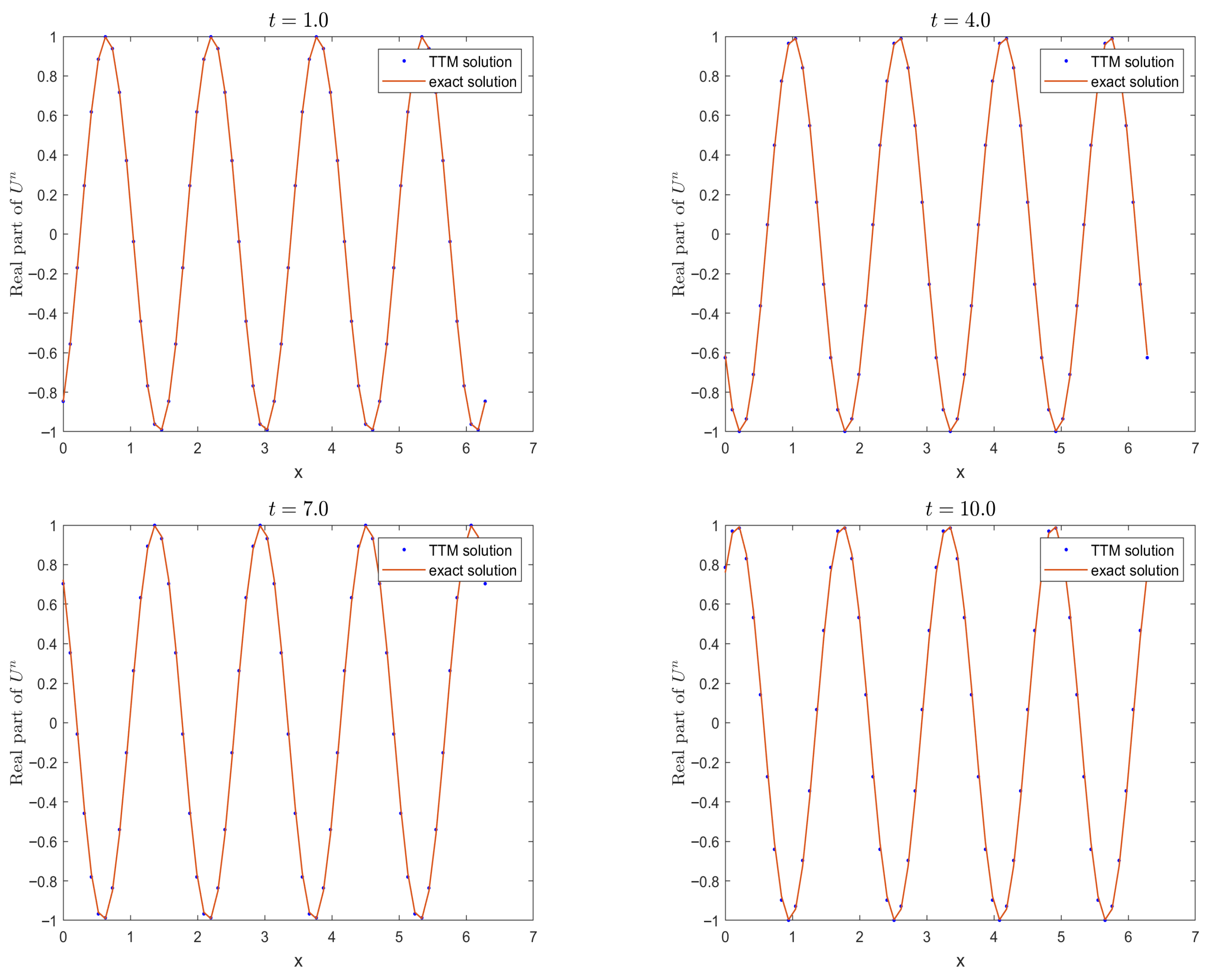
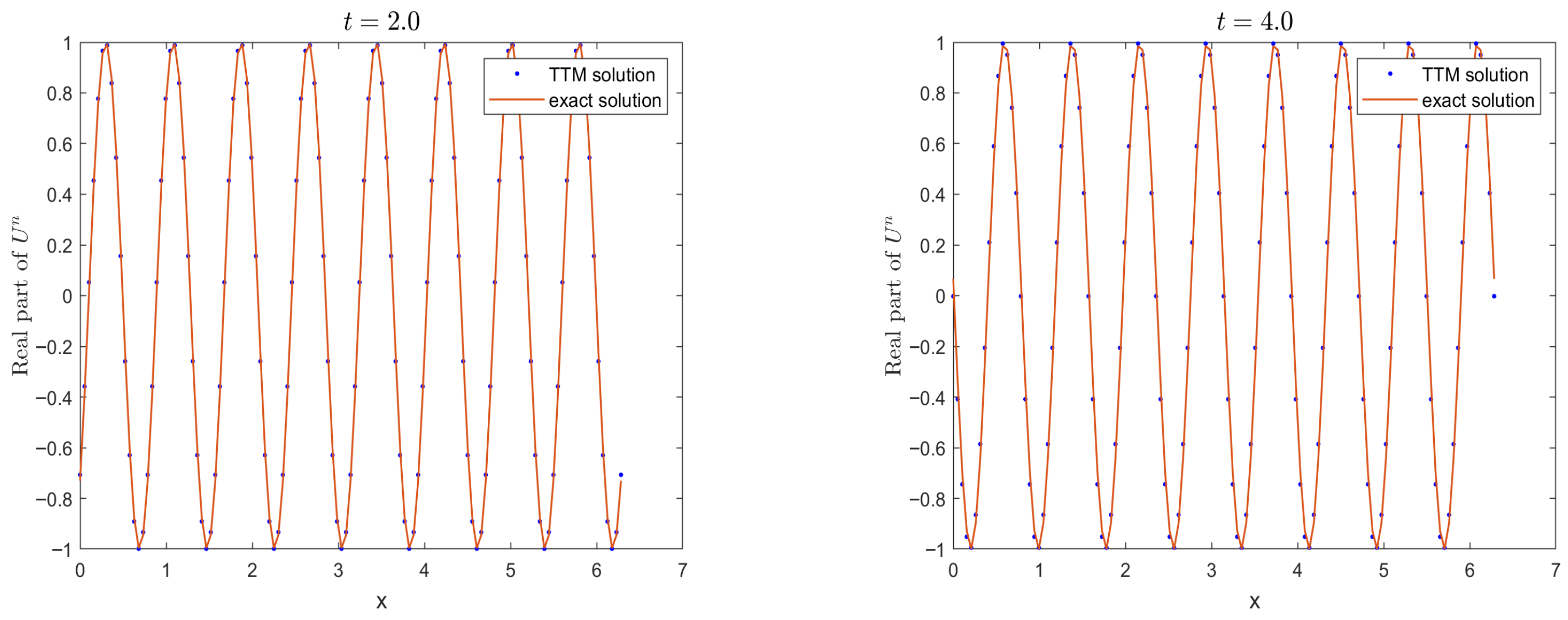
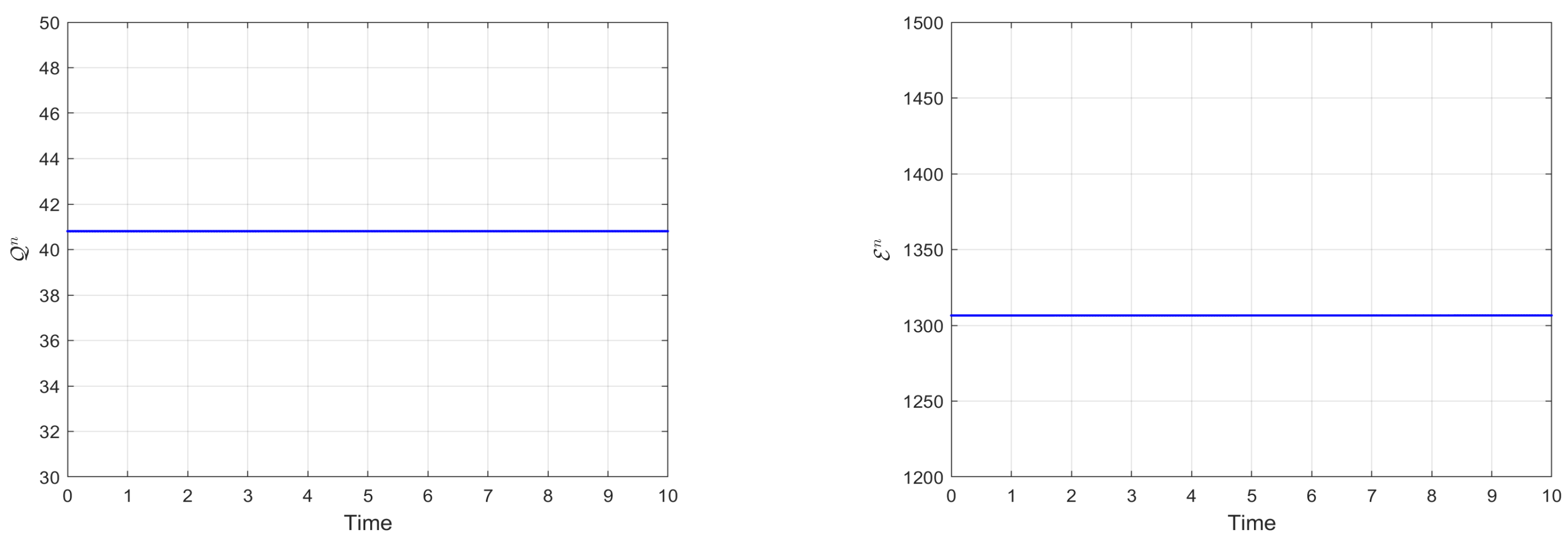
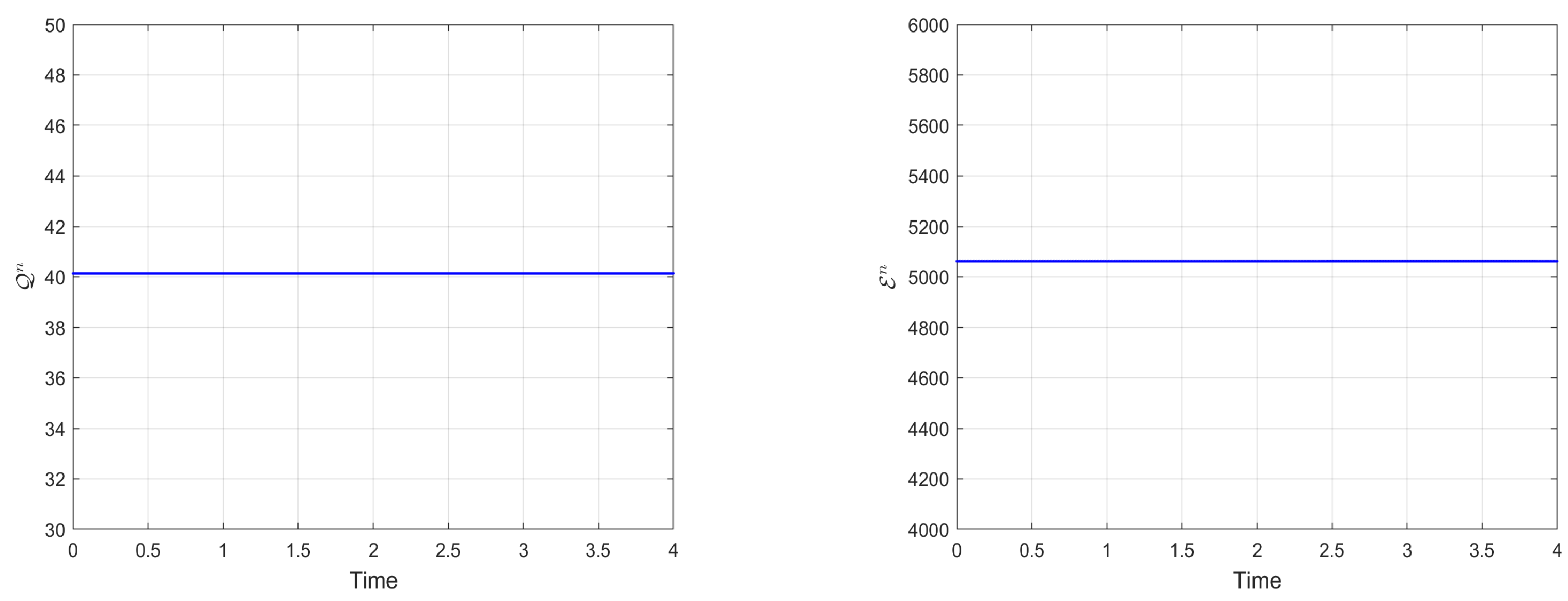
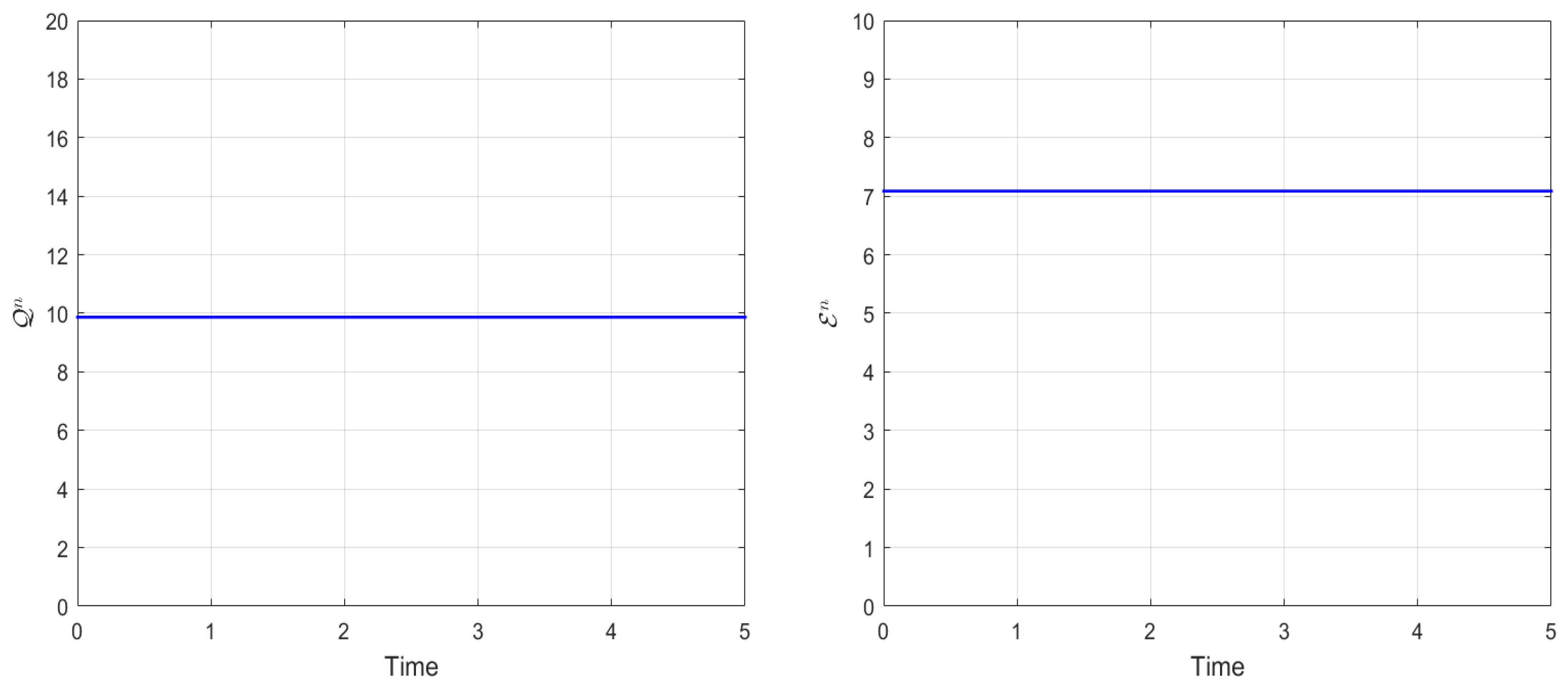
In the second case, we examine the simulation effect of the TTM compact ADI method on long-term behavior in capturing high-frequency waves by letting and at and and at , respectively. Given a spatial step size and temporal step sizes , we compute the numerical approximations for the wave solution . For the parameters and , Figure 2 displays the real parts of both the numerical and exact solutions at times and . Similarly, Figure 3 shows the results for the parameters and at times and . Invariants and for both wave types are tracked in Figure 4 and Figure 5, respectively. These results demonstrate that the proposed method reliably preserves discrete conservation laws and maintains accuracy over extended simulations.
Figure 2.
Numerical simulation of wave with , and at different times, respectively.
Figure 3.
Numerical simulation of wave with , and at different times, respectively.
Figure 4.
Numerical mass and energy with and , respectively.
Figure 5.
Numerical mass and energy with and , respectively.
In the next two examples, we aim to investigate the simulation performance of the TTM compact ADI method in solving problems lacking exact solutions.
Example 3
(Ref. [25]). Consider the Gross–Pitaevskii equation
with trapping potential , the initial condition
and homogeneous boundary conditions on .
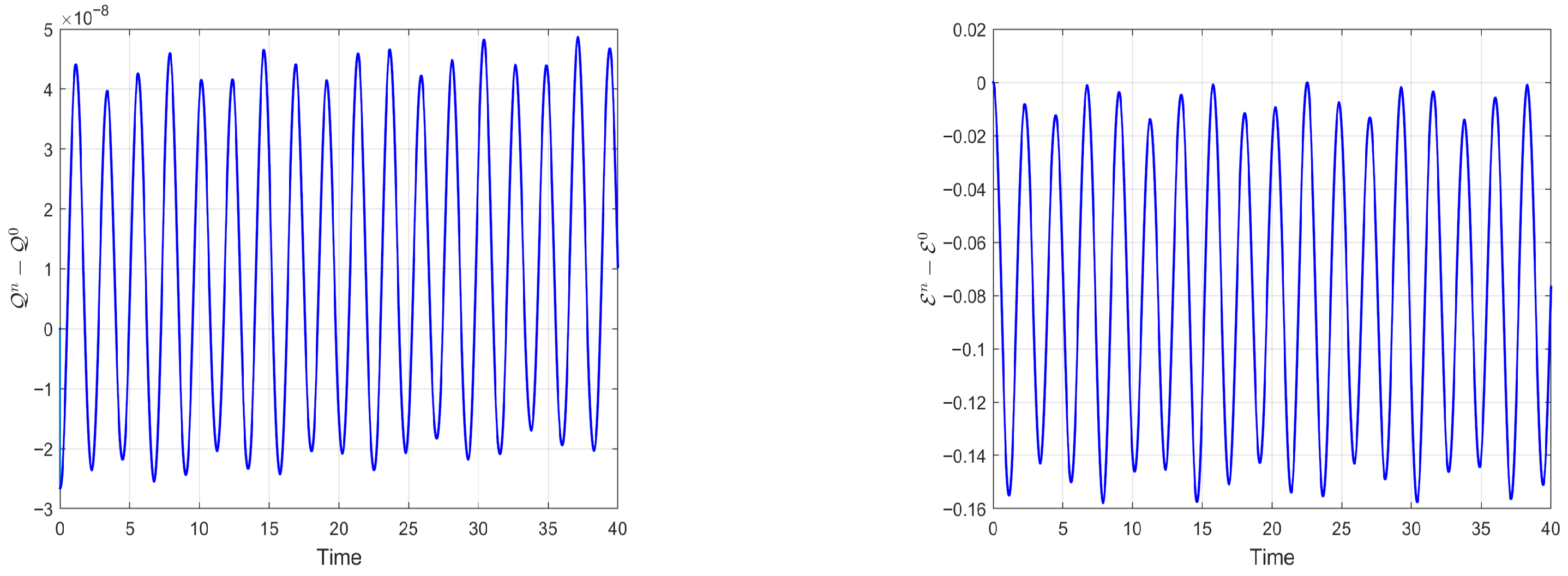
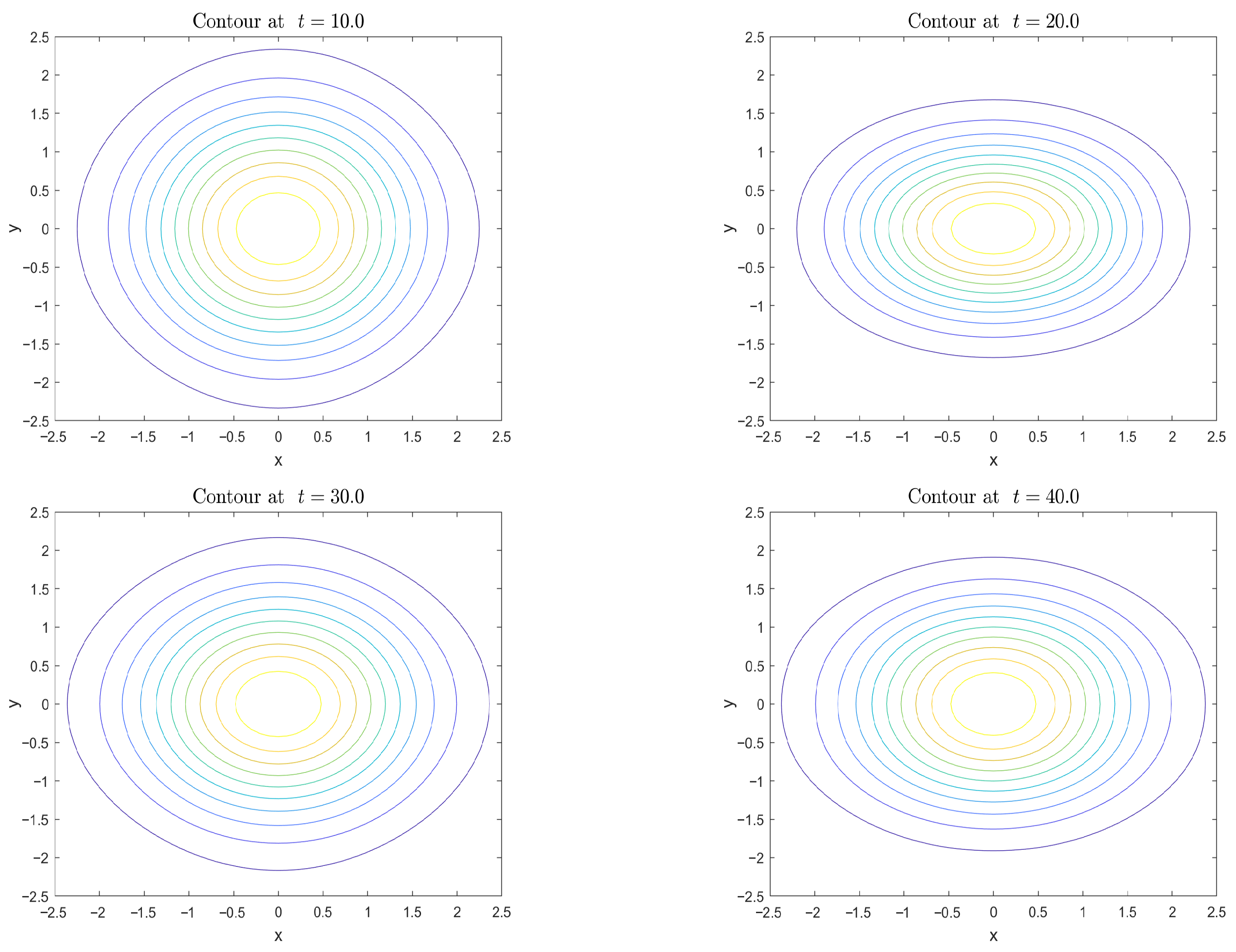
The numerical experiment is performed from to with and . Figure 6 exhibits the contour plots of the wave solution for Example 3 at different times, and the numerical residuals of mass and energy are displayed in Figure 7. From these figures, we observe that the mass is preserved well, while the energy fluctuates quasi-periodically within a small range throughout the simulation. These observations are consistent with the results reported in [25].
Figure 6.
Contour plots of the numerical solution at and 40 with and , respectively.
Figure 7.
Numerical residuals of mass and energy for the Gross–Pitaevskii equation.
Example 4
(Refs. [30,31,32]). Consider the focusing NLS equation
with a singular solution (when ). Here, we consider the initial condition
and the -periodic boundary condition in the domain .
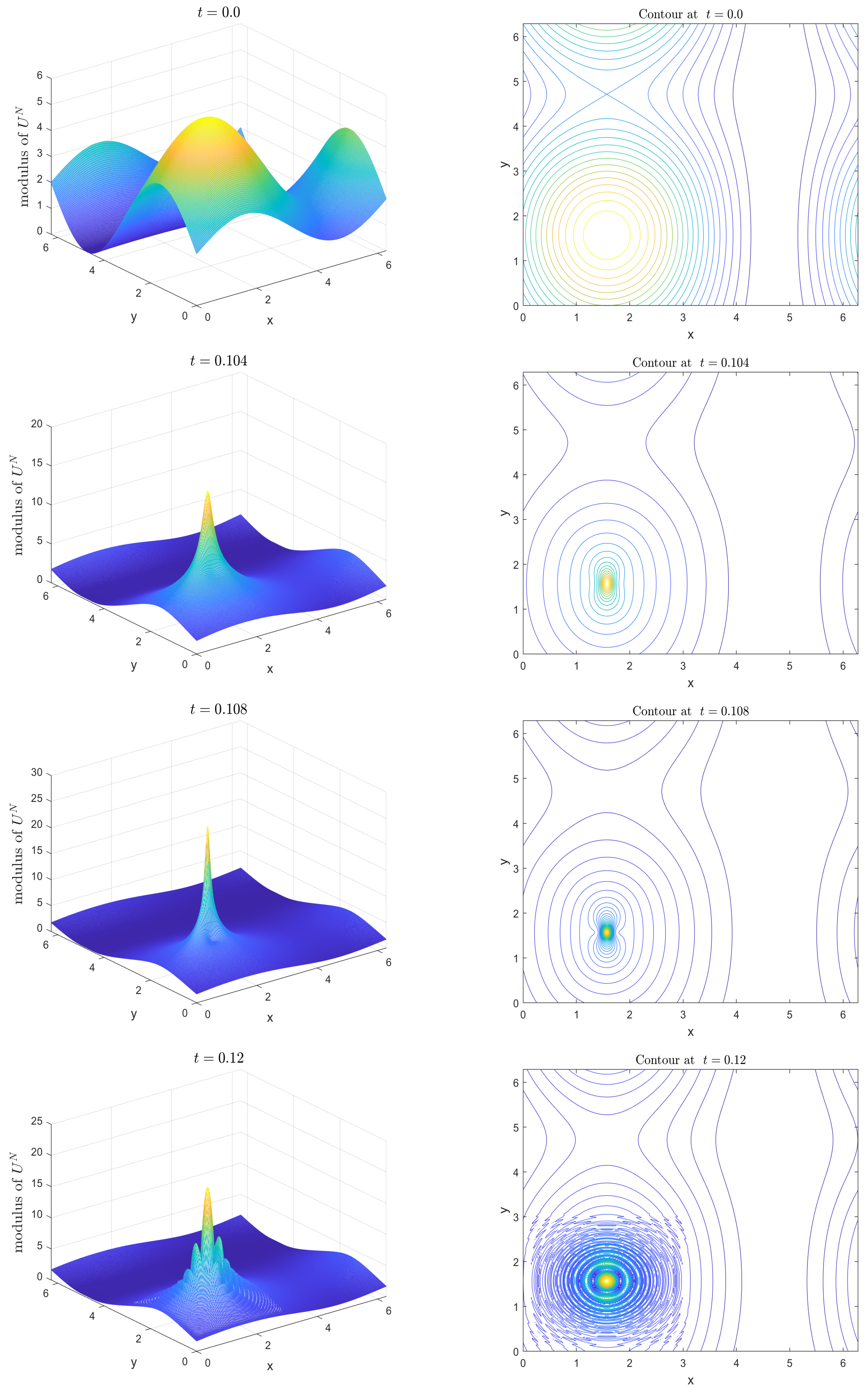
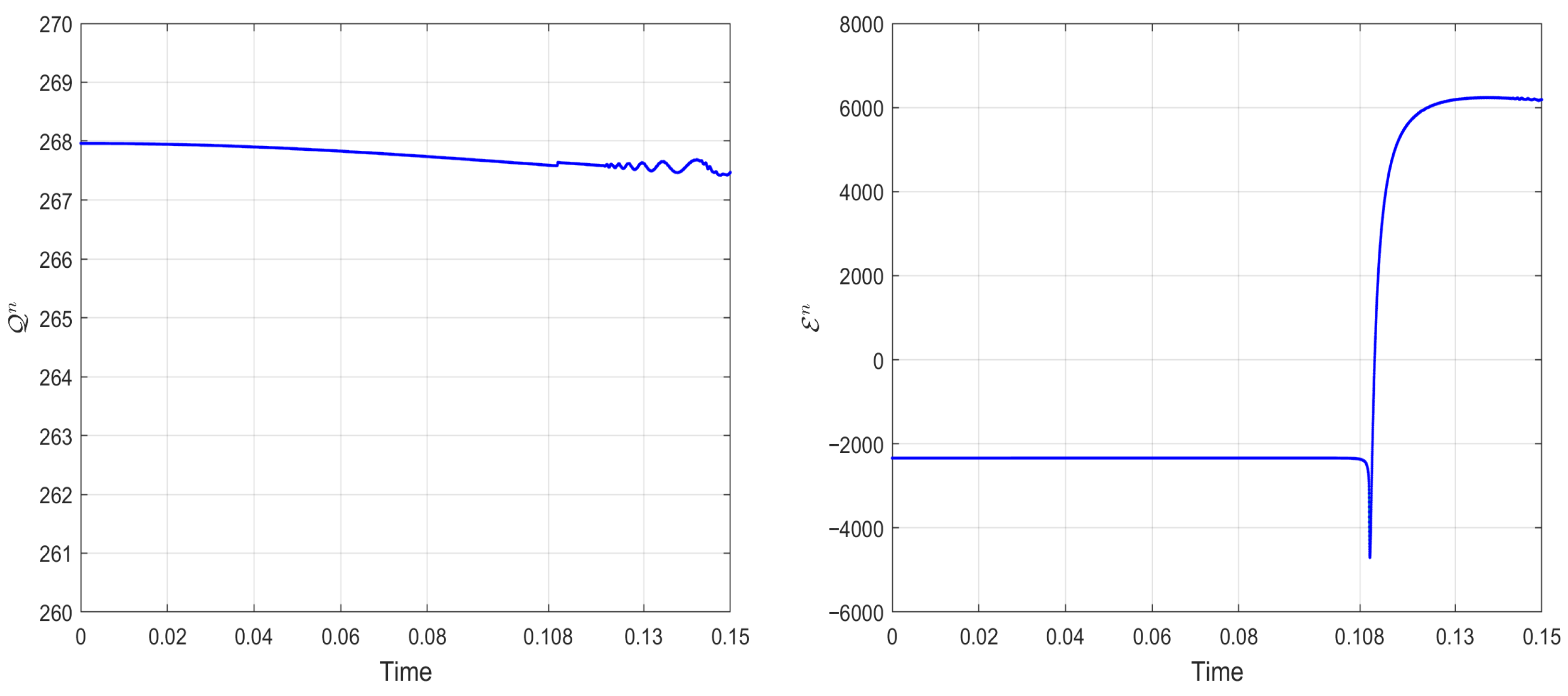
The focusing NLS Equation (90), widely studied in the literature, exhibits a blow-up solution at finite time . To investigate this phenomenon, we apply the proposed TTM method to compute its numerical solution from to , using parameters and . Figure 8 presents the profiles and contour plots of the modulus of numerical solutions for Example 4 at times and . The corresponding numerical mass and energy conservation is displayed in Figure 9.
Figure 8.
Profiles and contours of numerical solutions of Example 3 with and at and , respectively.
Figure 9.
Numerical charge and energy of Example 3 from to with and , respectively.
These figures reveal the following phenomena:
- (i)
- Strong singular solutions emerge at and , while multiple waveforms appear at .
- (ii)
- Until , the numerical mass and energy showed minimal variation. Beyond , however, conservation laws were no longer maintained for either quantity.
The above two phenomena may result from the emergence of blow-up solutions after a finite time. Specifically, the solution starts to blow up at , and the number of waves increases as time progresses. These observations align well with findings reported in [30,31,32].
6. Conclusions
This article proposes a temporal two-mesh scheme based on the fourth-order compact ADI method to efficiently solve the two-dimensional NLS equation. Under this framework, the temporal two-mesh technique treats the nonlinearity, whereas the ADI method resolves the challenges inherent in multiple dimensions. We derive detailed theoretical analyses encompassing discrete conservation laws and optimal error estimates in both the discrete -norm and -norm. The theoretical analyses, including discrete conservation laws and optimal error estimates in both the discrete -norm and -norm, are given in detail. To confirm our theoretical results and illustrate the algorithm’s computational efficiency, we conduct numerical experiments for both focusing and defocusing models. The numerical results demonstrate that the proposed TTM compact ADI method enhances computational efficiency while maintaining accuracy comparable to the fully nonlinear compact ADI method. Future work will extend this TTM compact ADI framework to three-dimensional fractional differential equations and coupled NLS systems.
Author Contributions
S.H.: Writing—original draft, Visualization, Software, Methodology, Formal analysis, Conceptualization, Funding acquisition. E.B.: Writing—review & editing, Methodology, Supervision. C.B.: Writing—review & editing, Validation, Methodology, Visualization. All authors have read and agreed to the published version of the manuscript.
Funding
This research was funded by National Natural Science Foundation of China (12161034).
Data Availability Statement
Data will be made available on request.
Conflicts of Interest
The authors declare that they have no known competing financial interests or personal relationships that could have appeared to influence the work reported in this paper.
References
- Bao, W.; Qu, D.; Zhang, Y. Dynamics of rotating Bose-Einstein condensates and its efficient and accurate numerical computation. SIAM J. Appl. Math. 2006, 66, 758–786. [Google Scholar] [CrossRef]
- Cazenave, T. Semilinear Schrödinger Equations (Courant Lecture Notes in Mathematics); New York University, Courant Institute of Mathematical Sciences, AMS: New York, NY, USA, 2003; Volume 10. [Google Scholar]
- Makhankov, V.G. Dynamics of classical solitons (in non-integrable systems). Phys. Lett. C 1978, 35, 1–128. [Google Scholar] [CrossRef]
- Sulem, C.; Sulem, P.L. The Nonlinear Schrödinger Equation: Self-Focusing and Wave Collapse; Springer: New York, NY, USA, 1999. [Google Scholar]
- Dehghan, M.; Taleei, A. A compact split-step finite difference method for solving the nonlinear Schrödinger equations with constant and variable coefficients. Comput. Phys. Comm. 2010, 181, 43–51. [Google Scholar] [CrossRef]
- Bao, W.; Cai, Y.Y. Uniform error estimates of finite difference methods for the nonlinear Schrödinger equation with wave operator. SIAM J. Numer. Anal. 2012, 50, 492–521. [Google Scholar] [CrossRef]
- Li, X.; Zhang, L.; Wang, S. A compact finite difference scheme for the nonlinear Schrödinger equation with wave operator. Appl. Math. Comput. 2012, 219, 3187–3197. [Google Scholar] [CrossRef]
- Liao, H.; Sun, Z.; Shi, H. Maximum norm error analysis of explicit schemes for two-dimensional nonlinear Schrödinger equations. Sci. Sin. Math. 2010, 4, 827–842. (In Chinese) [Google Scholar]
- Wang, H. Numerical studies on the split-step finite difference method for nonlinear Schrödinger equations. Appl. Math. Comput. 2005, 170, 17–35. [Google Scholar] [CrossRef]
- Rizea, M.; Ledoux, V.; Daele, M.V.; Berghe, G.V.; Carjan, N. Finite difference approach for the two-dimensional Schrödinger equation with application to scission-neutron emission. Comput. Phys. Commun. 2008, 179, 466–478. [Google Scholar] [CrossRef]
- Karakashian, O.; Makridakis, C. A space-time finite element method for the nonlinear Schrödinger equation: The discontinuous Galerkin method. Math. Comp. 1998, 67, 479–499. [Google Scholar] [CrossRef]
- Shi, D.Y.; Wang, J.J. Unconditional Superconvergence Analysis of a Crank-Nicolson Galerkin FEM for Nonlinear Schrödinger Equation. J. Sci. Comput. 2017, 72, 1093–1118. [Google Scholar] [CrossRef]
- Wang, J.L. A new error analysis of Crank-Nicolson Galerkin FEMs for a generalized nonlinear Schrödinger equation. J. Sci. Comput. 2014, 60, 390–407. [Google Scholar] [CrossRef]
- Gong, X.; Shen, L.; Zhou, A. Finite element approximations for Schrödinger equations with applications to electronic structure computations. J. Comput. Math. 2008, 23, 310–327. [Google Scholar]
- Gong, Y.; Wang, Q.; Wang, Y.; Cai, J. A conservative Fourier pseudo-spectral method for the nonlinear Schrödinger equation. J. Comput. Phys. 2017, 328, 354–370. [Google Scholar] [CrossRef]
- Zhang, R.; Zhu, J.; Yu, X.; Li, M.; Loula, A.F.D. A conservative spectral collocation method for the nonlinear Schrödinger equation in two dimensions. Appl. Math. Comput. 2017, 310, 194–203. [Google Scholar] [CrossRef]
- Xu, Y.; Shu, C.W. Local discontinuous Galerkin methods for nonlinear Schrödinger equations. J. Comput. Phys. 2005, 205, 72–77. [Google Scholar] [CrossRef]
- Li, M.; Zhao, J.K.; Wang, N.; Chen, S.C. Conforming and nonconforming conservative virtual element methods for nonlinear Schrödinger equation: A unified framework. Comput. Methods Appl. Mech. Eng. 2021, 380, 113793. [Google Scholar] [CrossRef]
- Bao, W.; Cai, Y.Y. Uniform and optimal error estimates of an exponential wave integrator sine pseudospectral method for the nonlinear Schrödinger equation with wave operator. SIAM J. Numer. Anal. 2014, 52, 1103–1127. [Google Scholar] [CrossRef]
- Dehghan, M.; Taleei, A. Numerical solution of nonlinear Schrödinger equation by using time-space pseudo-spectral method. Numer. Methods Partial Differ. Equ. 2010, 26, 979–992. [Google Scholar] [CrossRef]
- Dehghan, M.; Shokri, A. A numerical method for two-dimensional Schrödinger equation using collocation and radial basis functions. Comput. Math. Appl. 2007, 54, 136–146. [Google Scholar] [CrossRef]
- Bao, W.; Jin, S.; Markowich, P.A. On time-splitting spectral approximation for the Schrödinger equation in the semiclassical regime. J. Comput. Phys. 2002, 175, 487–524. [Google Scholar] [CrossRef]
- Chang, Q.; Jia, E.; Sun, W. Difference schemes for solving the generalized nonlinear Schrödinger equation. J. Comput. Phys. 1999, 148, 397–415. [Google Scholar] [CrossRef]
- Thalhammer, M.; Caliari, M.; Neuhauser, C. High-order time-splitting Hermite and Fourier spectral methods. J. Comput. Phys. 2009, 228, 822–832. [Google Scholar] [CrossRef]
- Kong, L.; Duan, Y.; Wang, L.; Yin, X.; Ma, Y. Spectral-like resolution compact ADI finite difference method for the multi-dimensional Schrödinger equations. Math. Comput. Model. 2012, 55, 1798–1812. [Google Scholar] [CrossRef]
- Tian, Z.F.; Yu, P.X. High-order compact ADI (HOC-ADI) method for solving unsteady 2D Schrödinger equation. Comput. Phys. Commun. 2010, 181, 861–868. [Google Scholar] [CrossRef]
- Xu, Y.; Zhang, L. Alternating direction implicit method for solving two dimensional cubic nonlinear Schrödinger equation. Comput. Phys. Commun. 2012, 183, 1082–1093. [Google Scholar] [CrossRef]
- Eskar, R.; Huang, P.; Feng, X. A new high-order compact ADI finite difference scheme for solving 3D nonlinear Schrödinger equation. Adv. Differ. Equ. 2018, 2018, 286. [Google Scholar] [CrossRef]
- He, D.; Pan, K. An unconditionally stable linearized CCD-ADI method for generalized nonlinear Schrödinger equations with variable coefficients in two and three dimensions. Comput. Math. Appl. 2017, 73, 2360–2374. [Google Scholar] [CrossRef]
- Gao, Z.; Xie, S. Fourth-order alternating direction implicit compact finite difference schemes for two-dimensional Schrödinger equations. Appl. Numer. Math. 2011, 61, 593–614. [Google Scholar] [CrossRef]
- Wang, T.; Guo, B.; Xu, Q. Fourth-order compact and energy conservative difference schemes for the nonlinear Schrödinger equation in two dimensions. J. Comput. Phys. 2013, 243, 382–399. [Google Scholar] [CrossRef]
- Wang, T.; Zhao, X. Unconditional L∞-convergence of two compact conservative finite difference schemes for the nonlinear Schrödinger equation in multi-dimensions. Calcolo 2018, 55, 34. [Google Scholar] [CrossRef]
- Chen, J.; Chen, F. Unconditional L∞ convergence of a compact ADI scheme for coupled nonlinear Schrödinger system. Appl. Numer. Math. 2020, 153, 430–442. [Google Scholar] [CrossRef]
- Jiang, C.; Cui, J.; Qian, X.; Song, S. High-order linearly implicit structure-preserving exponential integrators for the nonlinear Schrödinger equation. J. Sci. Comput. 2022, 90, 66. [Google Scholar] [CrossRef]
- Weideman, J.A.C.; Herbst, B.M. Split-step methods for the solution of the nonlinear Schrödinger equation. SIAM J. Numer. Anal. 1986, 23, 485–507. [Google Scholar] [CrossRef]
- Xu, J. A novel two-grid method for semilinear elliptic equations. SIAM J. Sci. Comput. 1994, 15, 231–237. [Google Scholar] [CrossRef]
- Jin, J.C.; Wei, N.; Zhang, H.M. A two-grid finite-element method for the nonlinear Schrödinger equation. J. Comput. Math. 2015, 33, 146–157. [Google Scholar] [CrossRef]
- Chien, C.S.; Huang, H.T.; Jeng, B.W.; Li, Z.C. Two-grid discretization schemes for nonlinear Schrödinger equations. J. Comput. Appl. Math. 2008, 214, 549–571. [Google Scholar] [CrossRef]
- Wu, L. Two-grid mixed finite-element methods for nonlinear Schrödinger equations. Numer. Methods Partial. Differ. Equ. 2012, 28, 63–73. [Google Scholar] [CrossRef]
- Hu, H.Z.; Chen, Y.P. Numerical solution of two-dimensional nonlinear Schrödinger equation using a new two-grid finite element method. J. Comput. Appl. Math. 2020, 364, 112333. [Google Scholar] [CrossRef]
- Tian, Z.K.; Chen, Y.P.; Huang, Y.Q.; Wang, J.Y. Two-grid method for the two-dimensional time-dependent Schrödinger equation by the finite element method. Comput. Math. Appl. 2019, 77, 3043–3053. [Google Scholar] [CrossRef]
- Zhang, H.M.; Yin, J.H.; Jin, J.C. A two-grid finite-volume method for the Schrödinger equation. Adv. Appl. Math. Mech. 2021, 13, 176–190. [Google Scholar] [CrossRef]
- Chen, C.J.; Lou, Y.Z.; Hu, H.Z. Two-grid finite volume element method for the time-dependent Schrödinger equation. Comput. Math. Appl. 2022, 108, 185–195. [Google Scholar] [CrossRef]
- Wang, J.J.; Li, M.; Guo, L.J. Superconvergence analysis for nonlinear Schrödinger equation with two-grid finite element method. Appl. Math. Lett. 2021, 122, 107553. [Google Scholar] [CrossRef]
- Ignat, L.; Zuazua, E. A two-grid approximation scheme for nonlinear Schrödinger equations: Dispersive properties and convergence. C. R. Acad. Sci. Paris, Ser. I 2005, 341, 381–386. [Google Scholar] [CrossRef]
- Liu, Y.; Yu, Z.D.; Li, H.; Liu, F.W.; Wang, J.F. Time two-mesh algorithm combined with finite element method for time fractional water wave model. Int. J. Heat Mass Tran. 2018, 120, 1132–1145. [Google Scholar] [CrossRef]
- He, S.; Liu, Y.; Li, H. A time two-mesh compact difference method for the one-dimensional nonlinear Schrödinger equation. Entropy 2022, 24, 806. [Google Scholar] [CrossRef]
- Wang, Z.; Xiao, M.; Mo, Y. Time two-grid fitted scheme for the nonlinear time fractional Schrödinger equation with nonsmooth solutions. Commun. Nonlinear Sci. Numer. Simulat. 2024, 137, 108119. [Google Scholar] [CrossRef]
- Zhang, Y.; Sun, Z. Error analysis of a compact ADI scheme for the 2D fractional subdiffusion equation. J. Sci. Comput. 2014, 59, 104–128. [Google Scholar] [CrossRef]
- Zhang, Y.; Sun, Z.; Wang, T. Convergence analysis of a linearized Crank-Nicolson scheme for the two-dimensional complex Ginzburg-Landau equation. Numer. Methods Partial. Differ. Equ. 2013, 29, 1487–1503. [Google Scholar] [CrossRef]
- Chen, X.; Di, Y.; Duan, J.; Li, D. Linearized compact ADI schemes for nonlinear time-fractional Schrödinger equations. Appl. Math. Lett. 2018, 84, 160–167. [Google Scholar] [CrossRef]
Disclaimer/Publisher’s Note: The statements, opinions and data contained in all publications are solely those of the individual author(s) and contributor(s) and not of MDPI and/or the editor(s). MDPI and/or the editor(s) disclaim responsibility for any injury to people or property resulting from any ideas, methods, instructions or products referred to in the content. |
© 2025 by the authors. Licensee MDPI, Basel, Switzerland. This article is an open access article distributed under the terms and conditions of the Creative Commons Attribution (CC BY) license (https://creativecommons.org/licenses/by/4.0/).