Abstract
In the present study, we define hybrid enriched contractions of the Hardy–Rogers type and of the Ćirić–Reich–Rus type in the framework of convex metric space. We demonstrate the presence and the approximation of fixed points for contraction mappings by using Krasnoselskij iteration. The main conclusions of this study are shown to be corollaries or implications of multiple important fixed point theory findings. Some examples have also been provided to show the validity of our results. Towards the end of this paper, we study the solution of the nonlinear equations as an application of our main results.
MSC:
47H09; 47H10; 54H25
1. Introduction
In 1922, Banach established the Banach contraction principle [1], which is a fundamental outcome of fixed point theory on metric spaces. Banach contraction mapping can now be improved in a number of ways, including investigating spaces with more structure than metric spaces, constructing new nonlinear mappings and establishing fixed point results for these new mappings [2,3,4,5,6].
In order to investigate the fixed point problem for nonexpansive mappings, Takahashi [7] introduced the concept of convexity in metric space in 1970. This concept of convexity has been used as a fundamental tool for proving various fixed point problems [8,9,10,11,12].
In 2018, Karapinar [13] developed the concept of an interpolative-type contraction by incorporating the metric fixed point theory with interpolation theory. In 2021, Noorwali et al. [14] studied a hybrid contraction [15,16,17,18,19], which is a combination of the Jaggi contraction [20], the Suzuki contraction [21], and an interpolative type of contraction.
In recent studies [22,23,24,25,26], various authors have used the idea of enriched contraction mapping to generalize multiple contraction mappings within the framework of convex metric space.
The primary goal of the current work is to extend some of the above-mentioned findings for more general case, i.e., that of convex metric space.
We first present some definitions and lemmas that will be helpful in the proving of our main results.
Definition 1
([7]). Let be a metric space. A continuous mapping is said to have a convex structure if there exists and such that
for any .
A metric space endowed with a convex structure W is called a convex metric space and is denoted by .
Zheng et al. [6] introduced the following set of functions to define the concept of - contractions.
Let be the set of all mappings satisfying the following conditions:
- (i)
- is non-decreasing.
- (ii)
- For each sequence ⊂, iff
- (iii)
- is continuous on .
Let be the collection of mappings satisfying the following conditions:
- (i)
- is non-decreasing.
- (ii)
- For each ,
- (iii)
- is continuous on .
Lemma 1
([6]). Let . Then, and for each
In 2018, Karapinar et al. [27] introduced the idea of interpolative Hardy–Rogers-type contraction mapping as:
Definition 2.
Let be a metric space. A mapping is said to be an interpolative Hardy–Rogers-type contraction mapping if there exist some and with , such that
for all .
Debnath and de La Sen [28], in 2019, introduced the notion of interpolative Ćirić–Reich–Rus contraction mapping as:
Definition 3.
Let be a metric space. A mapping is said to be an interpolative Ćirić–Reich–Rus type of contraction mapping, if there exist some and with , such that
for all
2. Main Results
This section aims to define the concepts of hybrid enriched contractions in the framework of convex metric space.
2.1. Hybrid Enriched Contraction of a Ćirić–Reich–Rus Type
In the present subsection, we define the concept of the hybrid enriched contraction of the Ćirić–Reich–Rus type. We use a Krasnoselskij-type iterative process [29] to approximate the fixed point of such a kind of hybrid enriched contraction.
Definition 4.
Let be a convex metric space. A mapping is said to be a hybrid enriched contraction of the Ćirić–Reich–Rus type if there exist θ∈Θ, ϕ∈Φ and such that
for all distinct , and
where , , with and = .
Theorem 1.
Let be a complete convex metric space and let be a mapping such that R is a hybrid enriched contraction of the Ćirić–Reich–Rus type. Then, R has a fixed point.
Proof.
Let us choose an element from the set H. To generate the sequence , let , for every . If there exists an such that , then essentially becomes a fixed point of . However, for the rest of our discussion, we assume that for every , which implies that for all .
We will examine the two distinct instances of and to demonstrate the assumption of the theorem.
Case I: Let . Using (2) with and we get
Assume that , then the use of (3) gives
which is a contradiction. Hence,
Returning to inequality (3), it is easily observed that
This leads us to the inductive conclusion that
The definition of and gives us
which implies
Now, our goal is to establish that is a Cauchy sequence. Assuming, on the contrary, that there exist and corresponding subsequences and of such that and:
where and are selected as the smallest integers that satisfy Equation (6), that is
By (6) and (7), and the triangular inequality, it is easily observed that
Using (8), we have
By using (2), we get
Using limit in Equation (10),
which is a contradiction as Hence, Therefore, is a Cauchy sequence.
As is a complete convex metric space, so there exists such that the sequence converges to and
Using Equation (2) with and .
Assume that .
Take in the above equation,
which is a contradiction as Hence, .
Case II: Let c = 0. Using (2) with and we get
By employing the same techniques as those in the case of we quickly see that forms a Cauchy sequence. Consequently, there exist such that
Use of Equation (2) with and , gives
Assume that
Take in the above equation
Hence, .
By the use of Lemma 4 of [24], we have □
We now present an example to show the validity of this result.
Example 1.
Let H = with the metric = and let Assume that the mapping R is defined as
Since the mapping R is not continuous, it is therefore neither a Banach contraction nor is it an enriched contraction. But the mapping R satisfies the conditions of Theorem 2 with , ,, for all and for all
For , is defined as
Case I For ,
which implies
Case II For ,
which implies
Case III For and ,
which implies
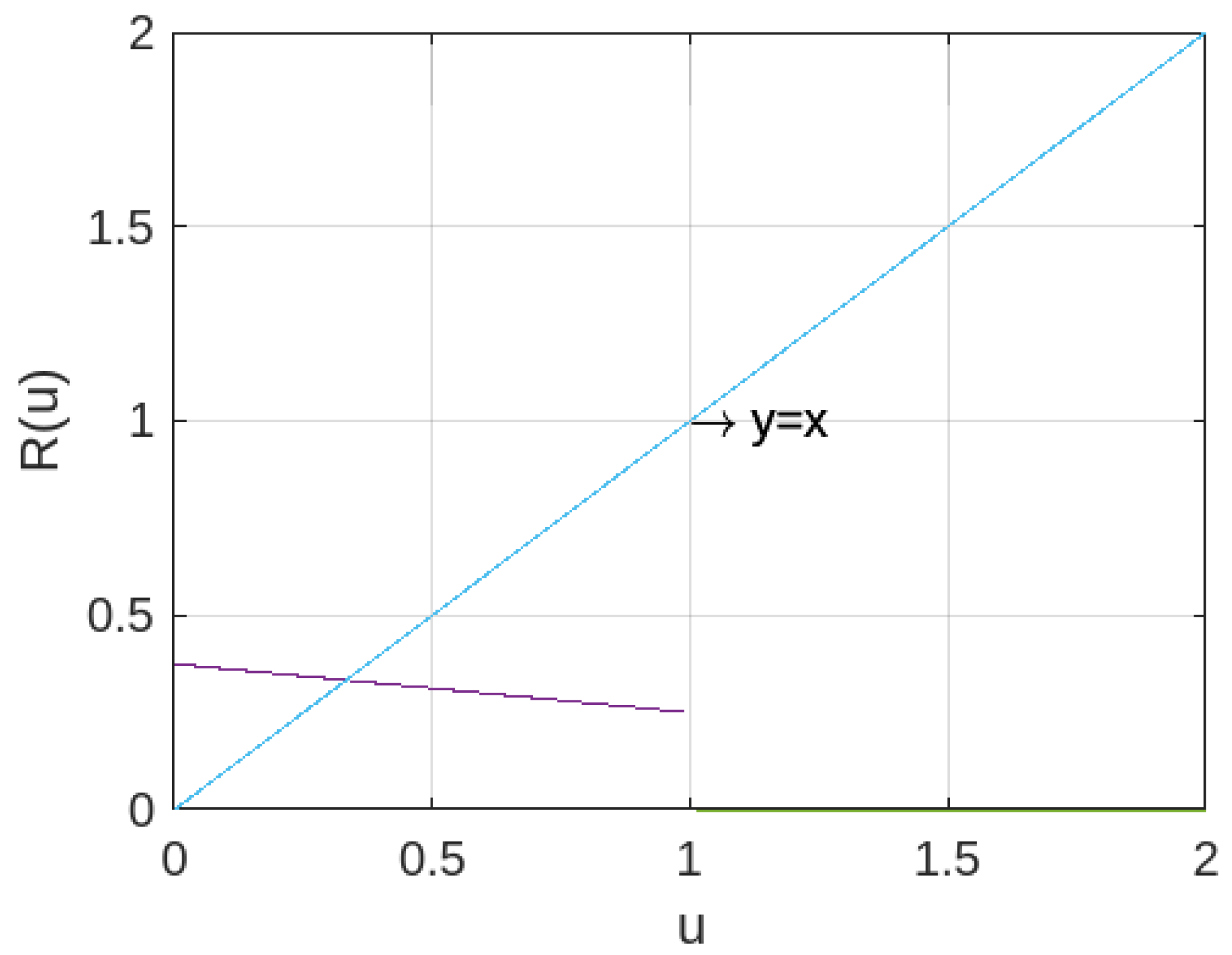
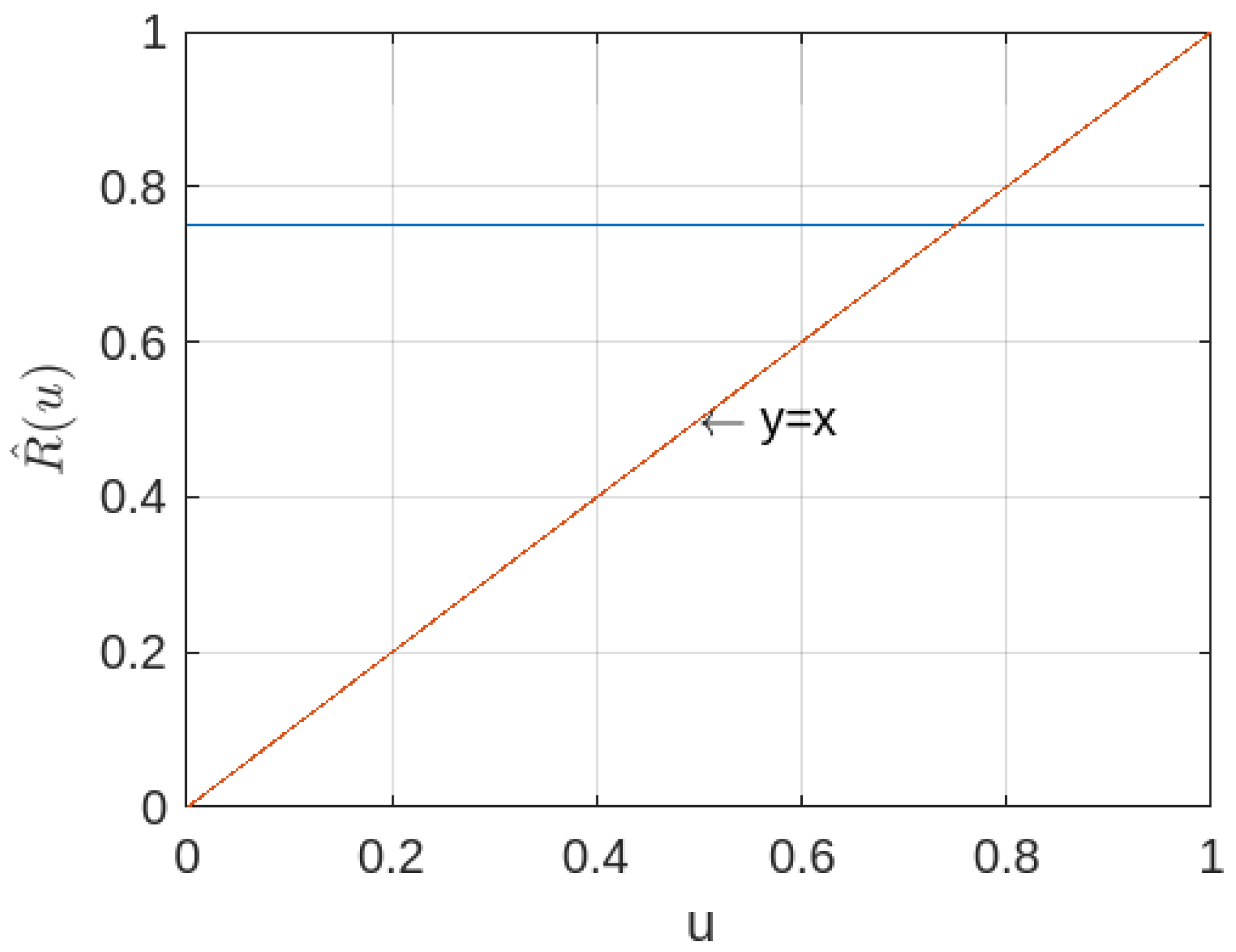
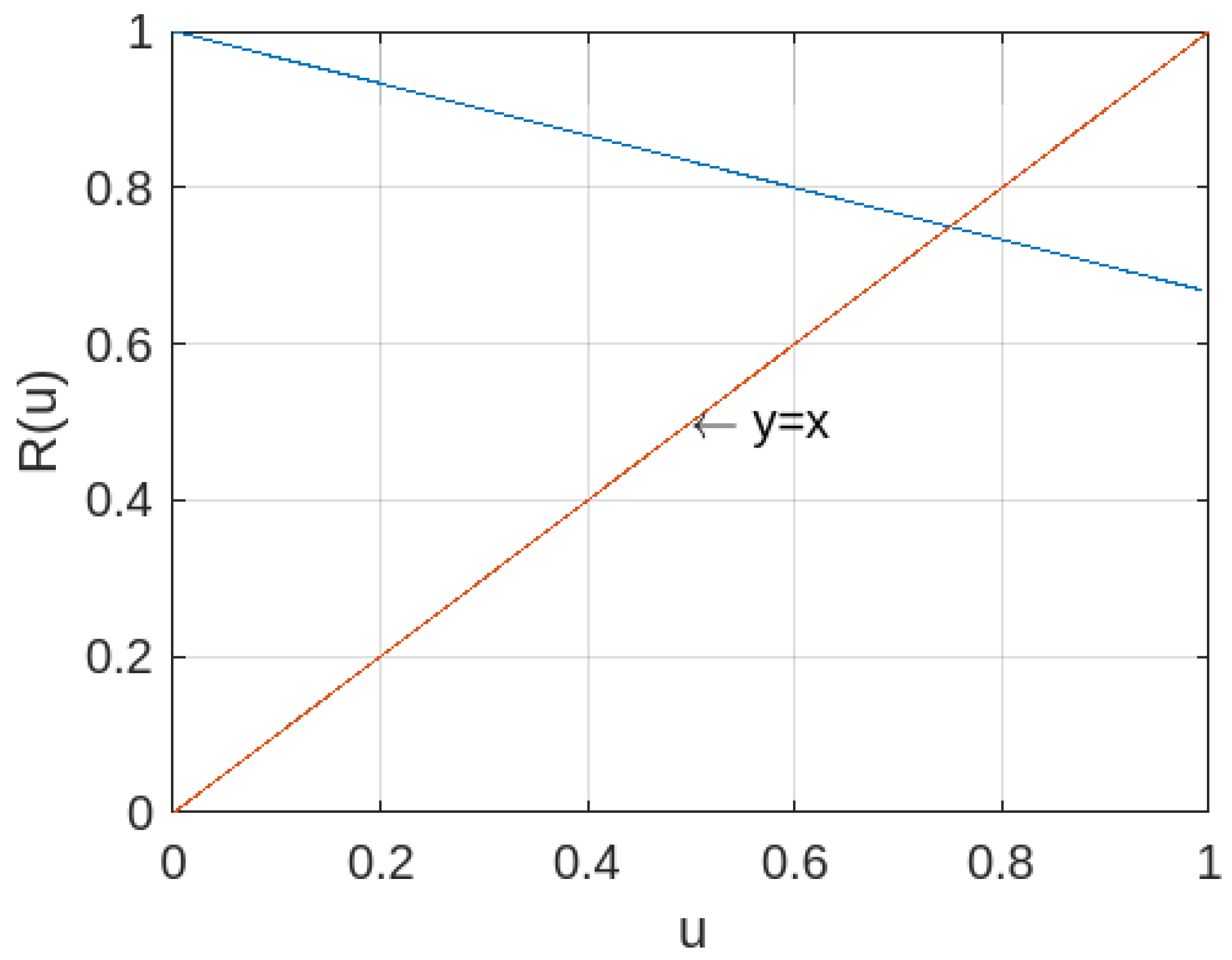
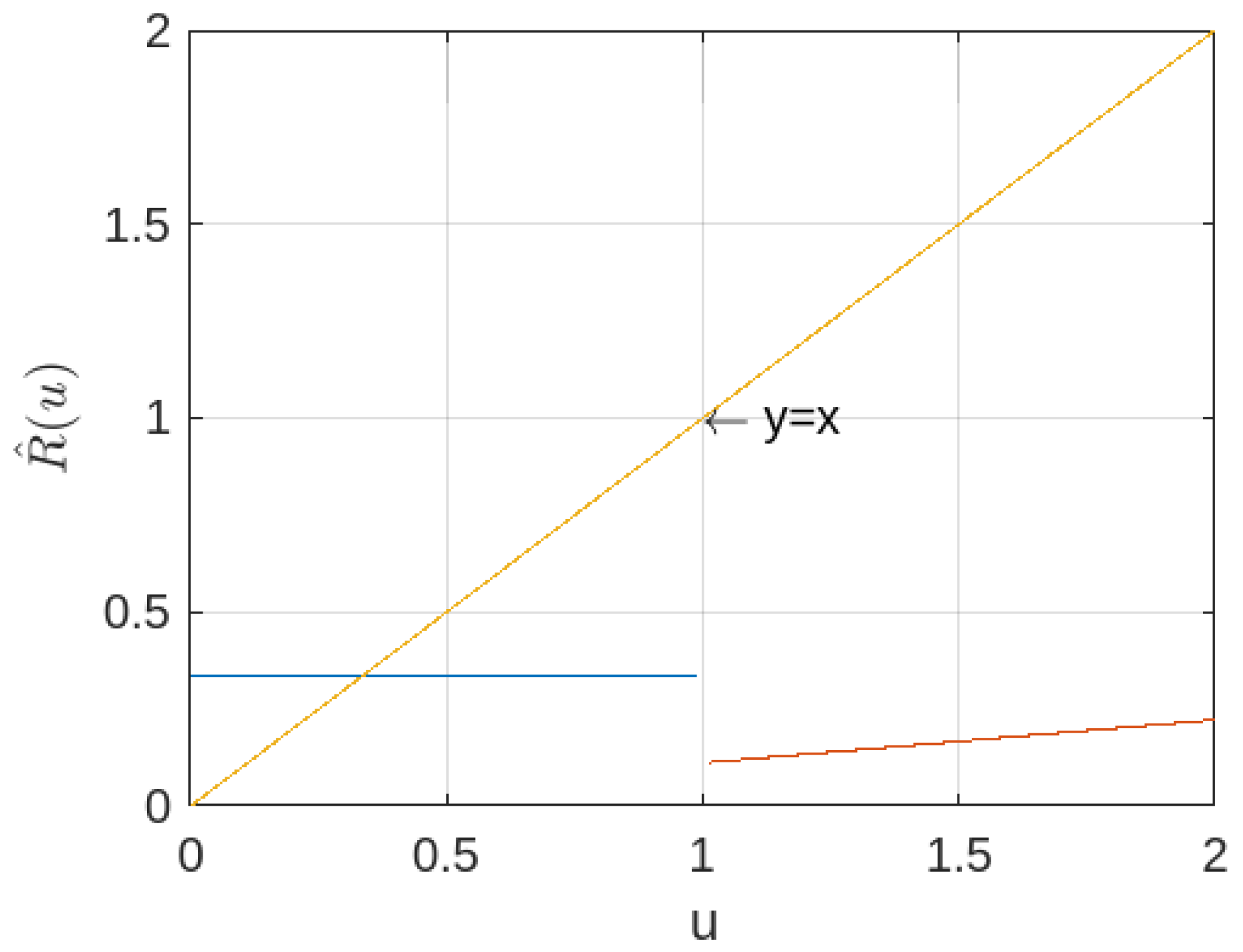
Since satisfies all the conditions of Theorem 2, therefore has a fixed point and is the fixed point of (as shown in Figure 1). By using Lemma 4 of [24], we have (as shown in Figure 2).
Figure 1.
Fixed Point of in Example 1.
Figure 2.
Fixed Point of in Example 1.
We now present the following results, which are direct consequences of Theorem 1.
Corollary 1.
Let be a complete convex metric space. Consider a function such that , for and
where , , with and = . Then, R has a fixed point.
Proof.
Assume that for all and for all and It is clear that ,
As a result, all requirements of Theorem 1 are met. Therefore, R has a fixed point. □
Corollary 2.
Let be a complete convex metric space. Let be a mapping such that the following equation holds:
Then, R has a unique fixed point.
Proof.
Put and in Corollary 1, then the mapping
has a fixed point. Now, suppose that and are two distinct fixed points, then
which is a contradiction. Hence, R has a unique fixed point. □
Corollary 3.
Let be a complete convex metric space. Let be a mapping such that
for . Then, R has a fixed point.
Proof.
Upon putting in Corollary 1 with , and , we get the result. □
Corollary 4
([28]). Let be a complete metric space. Let be an interpolative Ćirić–Reich–Rus type of contraction mapping. Then, R has a fixed point.
Proof.
By putting , and in Corollary 1, we get the result. □
2.2. Hybrid Enriched Contraction of a Hardy–Rogers Type
The present subsection aims to define the concept of a hybrid enriched contraction of a Hardy–Rogers type and to study the fixed point result for such kind of contraction.
Definition 5.
Let be a complete convex metric space. A mapping is said to be a hybrid enriched contraction of a Hardy–Rogers type if there exist θ∈Θ, ϕ∈Φ, and such that
for all distinct , and
where , , with and = .
Theorem 2.
Let be a complete convex metric space and let be a mapping such that R is a hybrid enriched contraction of a Hardy–Rogers type mapping. Then, R has a fixed point.
Proof.
Let us select an element from the set H. For each , let to construct the sequence . If there exist a such that , then becomes a fixed point of . For the remaining part of the discussion, we assume that for each .
The assumptions of the theorem will be proven by looking at the two different cases of and .
Case I: Let . By making use of (17) with and we get
Using (18) and assuming that , we obtain
which is a contradiction. Hence,
Going back to inequality (18), it is clear that
This brings us to the inductive conclusion that
The definition of and gives us
which implies
Now, our aim is to prove that is a Cauchy sequence. On the contrary, assume that there exist and the subsequences and of such that and
where and are chosen as the smallest integers that fulfill Equation (21), that is
Using (23),
By using (17),
Let in Equation (25),
which is a contradiction, as Hence, Therefore, sequence is a Cauchy sequence.
Since is a complete convex metric space, there exists such that the sequence converges to and
Using Equation (17) with and .
Assume that .
Take in the above equation,
which is a contradiction as Hence, .
Case II: Let c = 0. By using (17) with and we get
Assume that , then, using (29), we get
which contradicts our assumption. Hence,
Using the same methods as those in the case of we immediately observe that forms a Cauchy sequence in a complete convex metric space. As a result, there exists a such that
Using Equation (17) with and .
Assume that .
Take in the above equation
Hence, .
By Lemma 4 of [24], we have □
To demonstrate the validity of this result, we now present an example.
Example 2.
Let H = with the metric = . Let Assume that the mapping R is defined as
The mapping satisfies the conditions of Theorem 3 with ,, , and for all
For , is defined as
, for all . Since, R is a hybrid enriched contraction of a Hardy–Rogers type, therefore has a fixed point and is the fixed point of (as shown in Figure 3). By using Lemma 4 of [24], we have, (as shown in Figure 4).
Figure 3.
Fixed Point of in Example 2.
Figure 4.
Fixed Point of in Example 2.
We now present the following results which are direct consequences of Theorem 2.
Corollary 5.
Let be a complete convex metric space. Consider a function such that holds for and
where , , with and = . Then, R has a fixed point.
Proof.
Assume that and for all and It is clear that ,
As a result, all requirements of Theorem 2 are met. Therefore, R has a fixed point. □
Corollary 6.
Let be a complete convex metric space. Let be a mapping such that
Then, R has a unique fixed point.
Proof.
Put and in Corollary 5, then the mapping
has a fixed point. Suppose that and are two distinct fixed points of ; then,
which is a contradiction. □
Corollary 7.
Let be a complete convex metric space. Let be an interpolative enriched Hardy–Rogers-type contraction mapping. Then, R has a fixed point.
Proof.
Put in Corollary 5 with , , and for . □
Corollary 8
([27]). Let be a complete metric space. Let be an interpolative Hardy–Rogers-type contraction mapping. Then, R has a fixed point.
Proof.
Put , and in Corollary 5. □
3. Applications
This section deals with the use of a hybrid enriched contraction to check the existence of a solution of nonlinear equations.
Example 3.
Let be a mapping defined by . Suppose we want to solve then, the root of H will be the fixed point of .
Assume that , . Then,
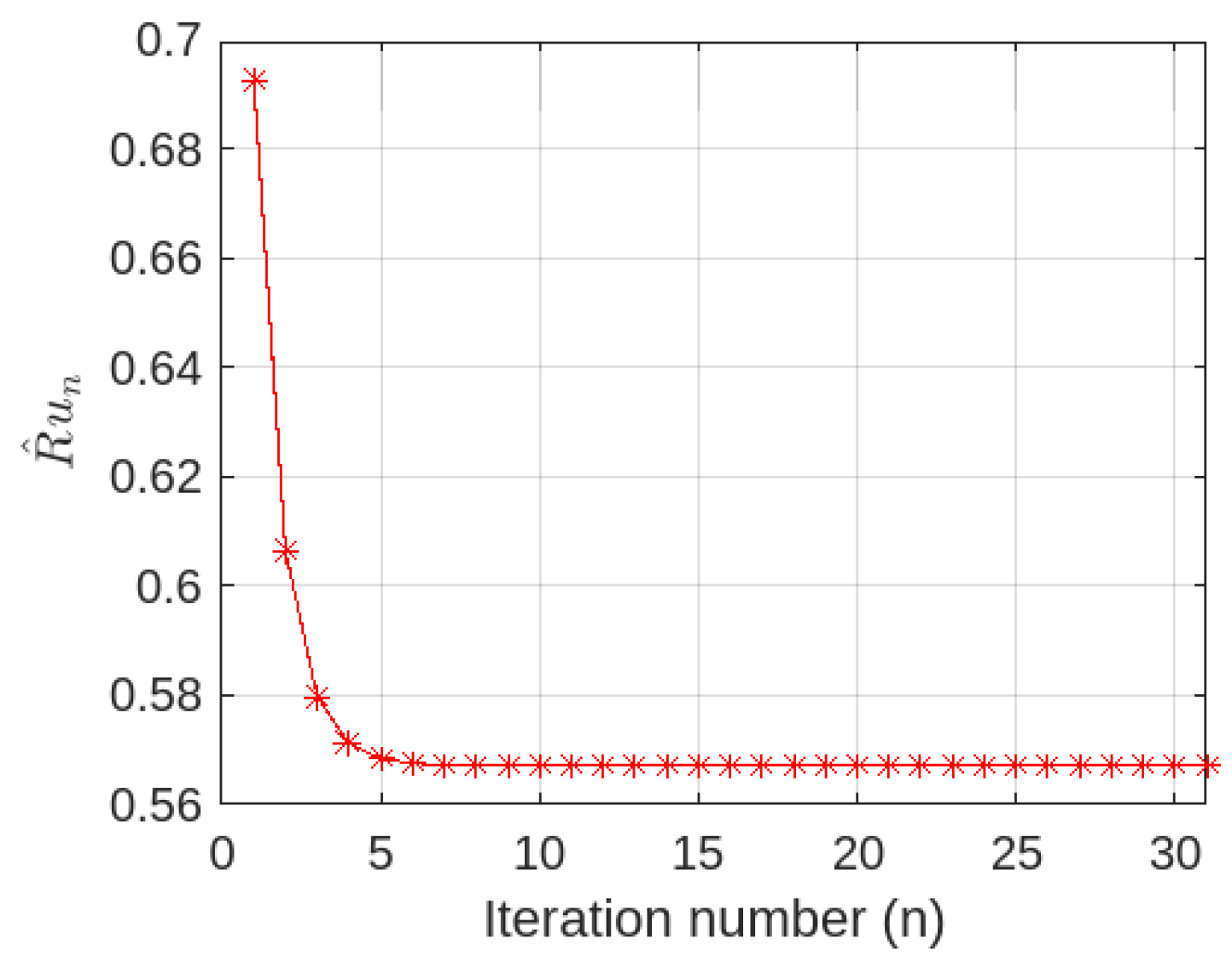
Thus, the mapping satisfies all the assumptions of Corollary 1 with , and . Therefore, the mapping H has a solution. The iteration will converge to the solution of mapping H (as shown in Figure 5).
Figure 5.
Graphical representation of values of corresponding to Example 3 with
Example 4.
Let be a mapping defined by . Suppose we want to solve then, the root of R will be the fixed point of .
Assume that , . Then,
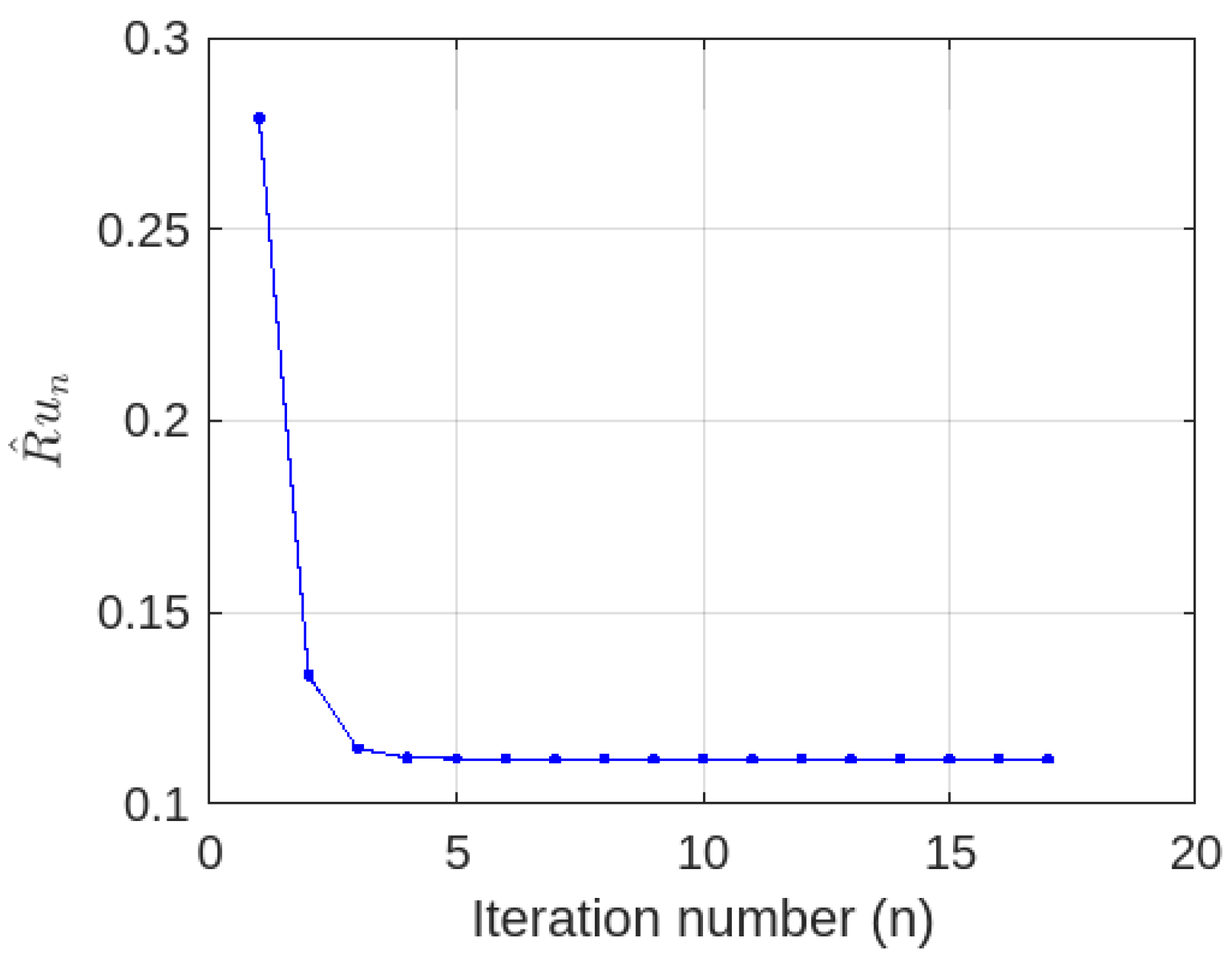
Thus, the mapping satisfies all the assumptions of Corollary 1 with , and . Therefore, the mapping R has a solution. The iteration will converge to the solution of mapping R (as shown in Figure 6).
Figure 6.
Graphical representation of values of corresponding to Example 4 with .
4. Conclusions and Future Scope
In this work, we have investigated the presence and approximation of fixed points for hybrid enriched contractions of the Hardy–Rogers type and the Ćirić–Reich–Rus type in the framework of convex metric space. It is demonstrated that each hybrid enriched contraction in a complete convex metric space has at least one fixed point that can be approximated by means of a Kransnoselskij-type iterative process. Our study extends and generalizes various important related results that already exist in the literature.
The study of existence of fixed points for such kinds of contraction mappings in more spaces would be an interesting topic for future work. Similar results for cyclic contractions are another direction of future study.
Author Contributions
All authors contributed equally in the planning, execution and analysis of the study. All authors have read and agreed to the published version of the manuscript.
Funding
This research received no external funding.
Data Availability Statement
No new data were created or analyzed in this study. Data sharing is not applicable to this article.
Conflicts of Interest
The authors declare no conflict of interest.
References
- Banach, S. Sur les opérations dans les ensembles abstraits et leur application aux équations intégrales. Fundam. Math. 1922, 3, 133–181. [Google Scholar] [CrossRef]
- Hardy, G.E.; Rogers, T.D. A generalization of a fixed point theorem of Reich. Can. Math. Bull. 1973, 16, 201–206. [Google Scholar] [CrossRef]
- Mustafa, Z.; Sims, B. A new approach to generalized metric spaces. J. Nonlinear Convex Anal. 2006, 7, 289–297. [Google Scholar]
- Shukla, S. Partial b-metric spaces and fixed point theorems. Mediterr. Math. 2014, 11, 703–711. [Google Scholar] [CrossRef]
- Reich, S. Some remarks concerning contraction mappings. Can. Math. Bull. 1971, 14, 121–124. [Google Scholar] [CrossRef]
- Zheng, D.; Cai, Z.; Wang, P. New fxed point theorems for θ − ϕ-contraction in complete metric spaces. J. Nonlinear Sci. Appl. 2017, 10, 2662–2670. [Google Scholar] [CrossRef]
- Takahashi, W. A convexity in metric spaces and nonexpansive mappings. Kodai Math. Semin. Rep. 1970, 22, 142–149. [Google Scholar] [CrossRef]
- Beg, I. An iteration scheme for asymptotically nonexpansive mappings on uniformly convex metric spaces. Nonlinear Anal. Forum 2001, 6, 27–34. [Google Scholar]
- Beg, I.; Abbas, M. Common fixed points and best approximation in convex metric spaces. Soochow J. Math. 2007, 33, 729–738. [Google Scholar]
- Fukhar-ud-din, H.; Berinde, V. Iterative methods for the class of quasicontractive type operators and comparsion of their rate of convergence in convex metric spaces. Filomat 2016, 30, 223–230. [Google Scholar] [CrossRef]
- Naimpally, S.A.; Singh, K.L.; Whitfield, J.H.M. Fixed and common fixed points for nonexpansive mappings in convex metric spaces. Math. Semin. Notes II 1983, 11, 239–248. [Google Scholar]
- Talman, L.A. Fixed points for condensing multifunctions in metric spaces with convex structure. Kodai Math. Semin. Rep. 1977, 29, 62–70. [Google Scholar] [CrossRef]
- Karapinar, E. Revisiting the Kannan Type Contractions via Interpolation. Adv. Theory Nonlinear Anal. Its Appl. 2018, 2, 85–87. [Google Scholar] [CrossRef]
- Noorwali, M.; Yeşilkaya, S.S. On Jaggi-Suzuki-Type Hybrid Contraction Mappings. J. Funct. Spaces 2021, 2021, 6721296. [Google Scholar] [CrossRef]
- Alzaid, S.S.; Fulga, A.; Alshammari, F.S. Discussion on Geraghty Type Hybrid Contractions. J. Funct. Spaces 2020, 2020, 6614291. [Google Scholar] [CrossRef]
- Karapınar, E.; Fulga, A. A hybrid contraction that involves Jaggi type. Symmetry 2019, 11, 715. [Google Scholar] [CrossRef]
- Karapınar, E.; Fulga, A. An admissible hybrid contraction with an ulam type stability. Demonstr. Math. 2019, 52, 428–436. [Google Scholar] [CrossRef]
- Mitrović, Z.D.; Aydi, H.; Noorani, M.S.M.; Qawaqneh, H. The weight inequalities on Reich type theorem in b-metric spaces. J. Math. Comput. Sci. 2019, 19, 51–57. [Google Scholar]
- Noorwali, M.; Yeşilkaya, S.S. New fixed point theorems for admissible hybrid maps. J. Funct. Spaces 2022, 2022, 5800790. [Google Scholar] [CrossRef]
- Jaggi, D. Some unique fixed point theorems. Indian J. Pure Appl. Math. 1977, 8, 223–230. [Google Scholar]
- Suzuki, T. A generalized Banach contraction principle that characterizes metric completeness. Proc. Am. Math. Soc. 2008, 136, 1861–1869. [Google Scholar] [CrossRef]
- Anjali; Chugh, R.; Batra, C. Fixed point theorems of enriched Ciric’s type and enriched Hardy-Rogers contractions. Numer. Algebra Control Optim. 2023. [Google Scholar] [CrossRef]
- Berinde, V.; Păcurar, M. Fixed point theorems for enriched Ćirić–Reich–Rus contractions in Banach spaces and convex metric spaces. Carpathian J. Math. 2021, 37, 173–184. [Google Scholar] [CrossRef]
- Berinde, V.; Păcurar, M. Existence and approximation of fixed points of enriched contractions and enriched φ-contractions. Symmetry 2021, 13, 498. [Google Scholar] [CrossRef]
- Panicker, R.; Shukla, R. Stability results for enriched contraction mappings in convex metric spaces. Abstr. Appl. Anal. 2022, 2022, 5695286. [Google Scholar] [CrossRef]
- Rawat, S.; Bartwal, A.; Dimri, R.C. Approximation and existence of fixed points via interpolative enriched contractions. Filomat 2023, 37, 5455–5467. [Google Scholar] [CrossRef]
- Karapınar, E.; Alqahtani, O.; Aydi, H. On interpolative hardy-rogers type contractions. Symmetry 2018, 11, 8. [Google Scholar] [CrossRef]
- Debnath, P.; de La Sen, M. Fixed-points of interpolative Ćirić–Reich–Rus-type contractions in b-metric spaces. Symmetry 2019, 12, 12. [Google Scholar] [CrossRef]
- Krasnoselskij, M.A. Two remarks on the method of successive approximations. Mat. Nauk 1955, 10, 123–127. [Google Scholar]
Disclaimer/Publisher’s Note: The statements, opinions and data contained in all publications are solely those of the individual author(s) and contributor(s) and not of MDPI and/or the editor(s). MDPI and/or the editor(s) disclaim responsibility for any injury to people or property resulting from any ideas, methods, instructions or products referred to in the content. |
© 2024 by the authors. Licensee MDPI, Basel, Switzerland. This article is an open access article distributed under the terms and conditions of the Creative Commons Attribution (CC BY) license (https://creativecommons.org/licenses/by/4.0/).