Quaternionic Fuzzy Sets

School of Electronics and Information Engineering, Taizhou University, Taizhou 318000, China
Axioms 2023, 12(5), 490; https://doi.org/10.3390/axioms12050490
Submission received: 17 April 2023
/
Revised: 5 May 2023
/
Accepted: 17 May 2023
/
Published: 18 May 2023
(This article belongs to the Special Issue Recent Advances in Fuzzy Sets and Related Topics)
Abstract
A novel concept of quaternionic fuzzy sets (QFSs) is presented in this paper. QFSs are a generalization of traditional fuzzy sets and complex fuzzy sets based on quaternions. The novelty of QFSs is that the range of the membership function is the set of quaternions with modulus less than or equal to one, of which the real and quaternionic imaginary parts can be used for four different features. A discussion is made on the intuitive interpretation of quaternion-valued membership grades and the possible applications of QFSs. Several operations, including quaternionic fuzzy complement, union, intersection, and aggregation of QFSs, are presented. Quaternionic fuzzy relations and their composition are also investigated. QFS is designed to maintain the advantages of traditional FS and CFS, while benefiting from the properties of quaternions. Cuts of QFSs and rotational invariance of quaternionic fuzzy operations demonstrate the particularity of quaternion-valued grades of membership.
Keywords:
complex fuzzy sets; quaternionic fuzzy sets; quaternion-valued grades of membership; cuts; rotational invarianceMSC:
03E721. Introduction
In 1965, Zadeh [1] proposed the concept of fuzzy sets (FSs). In the past few decades, following Zadeh’s pioneering work, various extensions of FSs have been given, enriching the contents of fuzzy theories and fuzzy methods. These extensions include interval-valued fuzzy sets [2], intuitionistic fuzzy sets (IFS) [3], Pythagorean fuzzy sets (PFS) [4], Fermatean fuzzy sets (FFS) [5,6], q-rung orthopair fuzzy sets (q-ROFS) [7], (2,1)-fuzzy sets [8], neutrosophic sets (NS) [9], hesitant fuzzy sets (HFS) [10], and complex fuzzy sets (CFS) [11,12]. In these extension of FSs, IFS is obtained by adding a non-membership value. PFS, q-ROFS, and (2,1)-FS have different restrictions on membership and non-membership values. Further, NS is obtained by adding an indeterminacy value. Another method is based on the algebraic extensions of number fields. The extension of crisp sets to FSs is mathematically analogous to the extension of integers to real numbers . In much the same way, Ramot et al’s [11,12] extension of FSs to complex fuzzy sets (CFSs) is mathematically analogous to the extension of real numbers to complex numbers . CFSs have numerous applications in signal processing [13,14], time series prediction [6,15,16,17], decision making [18,19,20,21,22], and complex fuzzy logic systems [23,24,25]. Note that the extension of fuzzy numbers to Buckley’s [26] fuzzy complex numbers is also mathematically analogous to the extension of real numbers to complex numbers .
Of course, the extensions of number fields do not end with complex numbers. As early as in 1843, Hamilton [27] discovered the quaternions as a generalization of complex numbers. Quaternion is an important mathematical tool in physics [28,29], quaternion neural networks [30,31], and computer science [32,33,34].
Interestingly, some scholars attempted to use quaternions in the fuzzy theories and applications. Ngan et al. [35] generalized and expanded the utility of complex intuitionistic fuzzy sets using the space of quaternion numbers. Pan et al. [36] proposed a quaternion model of a Pythagorean fuzzy set. These ideas are one step away from the innovative concept of quaternionic fuzzy sets (QFS). In this paper, as shown in Figure 1, we generalize the FS and CFS to QFS, which is similar to the generalization of real and complex numbers to quaternions. The QFS is characterized by a quaternion-valued membership function. The main advantage of the new concept of QFS is its representation of four composite features, which is more powerful than the representation of CFS.
The motivation of this paper comes from the following two aspects:
- As discussed above, the quaternion is an excellent mathematical tool in a number of different areas. Interestingly, some scholars used quaternions to handle complex intuitionistic fuzzy information and Pythagorean fuzzy information. Therefore, the quaternion is a novel mathematical tool to handle uncertain information.
- CFS provides a way to extend the FS theory based on number fields. Moreover, CFS has been widely applied and is undergoing rapid progress, and it deserves further pursuit. The field of quaternions is another fundamental number field that we cannot ignore, so we continue to extend the CFS theory based on number fields.
Based on the aforementioned considerations, in this paper, as an extension of FS and CFS theories, we first introduce the novel QFS that have not been studied in the literature. Additionally, we introduce several fundamental operations. Comparatively, our proposed QFS and its operations have the following advantages.
- The new concept of QFS is more comprehensive than CFS because the latter is a special case of the former. Both polar representation and Cartesian representation of QFS are given.
- The proposed negation, join, and meet operations of QFSs are also extensions of Ramot et al’s complex fuzzy negation, join, and meet operations. De Morgan’s laws of quaternionic fuzzy negation, union, and intersection are studied. This means that these operations could be interconnected by an algebraic structure.
This article is structured as follows. In Section 2, we present some preliminary concepts of quaternions. In Section 3, we introduce the QFS. In Section 4, we study the cuts of QFS. In Section 5, we define several operations of QFS. In Section 6, we study the quaternionic fuzzy relations. In Section 7, we study the rotational invariance of quaternionic fuzzy operations. In Section 8, concluding remarks are offered.
2. Preliminaries
Quaternions
Quaternions were first proposed by Hamilton [27]. For an review of quaternions, we refer the reader to Refs. [33,34].
Let be the set of quaternions. A quaternion is expressed as
where () and , and k are quaternion units, which obey
The real and quaternionic imaginary parts of q are and , respectively.
For a quaternion h, its “quaternion conjugate” is
and its modulus is .
A polar representation of q is
where represent the three quaternionic phases.
For any two quaternions and , their addition is
their product is
Obviously, the product is noncommutative, i.e., . However, we have .
Their dot product is
Obviously, the dot product is commutative.
3. Introducing Quaternionic Fuzzy Sets
In this section, we give a formal definition of QFS and present two intuitive interpretations of quaternion-valued membership functions.
3.1. Definition of the Quaternionic Fuzzy Set
Definition 1.
Let U be a universe of discourse and be the set of quaternions whose modulus is less than or equal to 1, i.e.,
a quaternionic fuzzy set A defined on U is a mapping: , which can be represented as the set of ordered pairs:
where quaternion-valued membership function is of the form
where all are real-valued, and
The real and quaternionic imaginary parts of are and , respectively.
Note that also could be of the form
where the amplitude term is and three quaternionic phase terms are .
Quaternionic fuzzy sets are generalizations of ordinary FSs and CFSs. If two quaternionic phase terms and are zero, then A is a CFS. If all three quaternionic phase terms are zero, then A is a conventional FS. Similarly, if two quaternionic imaginary parts and are zero, then A is a CFS. If all three quaternionic imaginary parts are zero and is limited in [0, 1], then A is a conventional FS.
Remark 1.
Mathematically, a quaternionic fuzzy set is equivalent to the fuzzy set with the co-domain of
which is a unit four-dimensional sphere.
Remark 2.
Ngan et al. [35] defined the complex intuitionistic fuzzy set using quaternions , which satisfies the following conditions:
and are the degrees of real membership, imaginary membership, real non-membership, and imaginary non-membership, respectively. Kyritsis [37] gave the idea of a quaternion fuzzy subset, but its co-domain is . Moura et al. [38] introduced the concept of fuzzy quaternion numbers, which is a mapping from the set of quaternions to [0, 1]. In the study of quaternion-valued fuzzy cellular neural networks [39,40], they used quaternions , not its subset . It is essential that they [39,40] did not give the idea of quaternion-valued grades of membership. This is entirely different from the QFS including quaternion-valued grades of membership. These works are indeed concerned with quaternions and fuzzy sets, but in a completely different manner than our study in this work.
3.2. Interpretation of the Quaternionic Fuzzy Set
From a mathematical viewpoint, QFS is natural. However, similar to complex fuzzy sets in [11], obtaining intuition of QFS is not a simple task. Both complex numbers and quaternions are not particularly intuitive.
The central issue is the meaning of phase term in membership function. Traditional membership functions may interfere with other membership functions. This interference is dependent on their phase terms. In practice, the amplitude term and phase term of CFSs are used to describe two different features. For example, Ma et al. [16] introduced a complex fuzzy product–sum aggregation operator in which the amplitude term is used to represent the periodicity in the data. Dai [20] used the amplitude term to represent the direction of an object. Different from the interpretations noted above, Ramot et al. [11] gave an interesting interpretation from the idea of quantum mechanics that uses complex-valued functions to describe the state of object. Note that Nguyen et al. [41] also considered the complex-valued “truth values” from the idea of quantum mechanics. Following this way, quaternionic quantum mechanics, as a generation of standard complex quantum mechanics, use quaternion-valued functions to describe the state of object. An analogy to this aspect of quaternionic quantum mechanics offers an interpretation: the interference between traditional membership functions may rely on the quaternionic phase terms.
From another point of view, QFSs are composed of a real part and a quaternionic imaginary part. In this case, the central issue is how to deal with the quaternionic imaginary part. An answer may be obtained from the application of quaternions in color image processing [42,43,44]. RGB images have the red, green, and blue components. Then, the image pixel may be converted to a quaternion pixel by placing the these three components into the three imaginary parts of the quaternion, leaving the real part zero [44]. An analogy to the use of quaternions offers an interpretation. That is, the interpretation of a quaternionic fuzzy proposition is a quaternion of truth value. For example, in a proposition of the form “x is too white ” in which too white means that all the red, green, and blue components are very high. Thus, we can use the form “x⋯A⋯B⋯C⋯” for a proposition, then , , and can be assigned to the terms , and C, respectively.
4. Cuts of Quaternionic Fuzzy Sets
4.1. Method 1
In general, order relations such as “p is greater than q” are undefined for quaternions p and q. Based on the modulus of a quaternion, the ordering of is given by if .
Theorem 1.
The order ≤ of given by the modulus of a quaternion is a pre-order, but not a partial order.
Proof.
We first prove that ≤ satisfies the reflexivity and transitivity conditions, i.e.,
- (1)
- reflexivity: ;
- (2)
- transitivity: and ⇒.
Clearly, for any . If and , then we have and by the definition of ≤, then .Thus we obtain .
Second, we prove that ≤ does not satisfy the antisymmetry condition, i.e.,
- (3)
- antisymmetry: and ⇒.
Consider quaternions i and j, it is easy to check that , but . □
Let U be a universe of discourse, be a quaternionic fuzzy set on U, a -cut of A, for , is defined by
Moreover, a variant of a -cut is the strong -cut defined as
The support of A, denoted by , is defined as , i.e.,
In other words, the q-cut of A is the crisp set that contains all the elements of U in which the moduli of quaternion-valued membership degrees are greater than or equal to the modulus of q.
Example 1.
Let ; consider the following quaternionic fuzzy set:
then
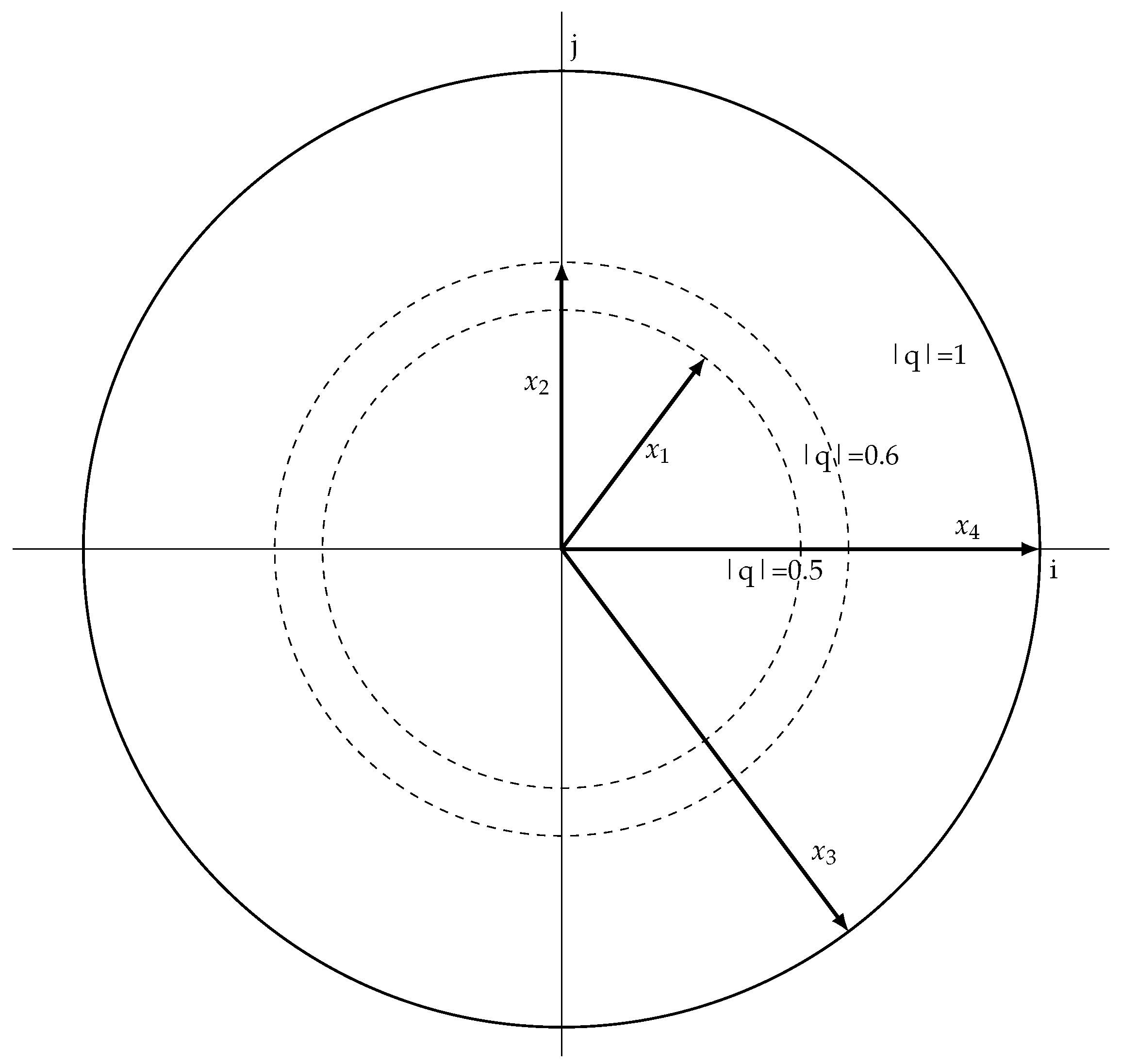
Figure 2 illustrates the quaternionic fuzzy set A and their q-cuts.
The following theorem can be easily proved.
Theorem 2.
Let be a quaternionic fuzzy set on U, for any , if , then .
Properties of cuts of quaternionic fuzzy sets are related to the order on . Unfortunately, ≤ is not a partial order on . In other words, is not a lattice, i.e., there exists such that does not exist. Further, this leads to a special case that there exists two quaternionic fuzzy sets A and B such that but for any . See this in the following example.
Example 2.
Let , consider the quaternionic fuzzy set A in Example 1 and the following quaternionic fuzzy set:
then
It is easy to check that and for any .
4.2. Method 2
As noted in Remark 1, a quaternionic fuzzy set is mathematically equivalent to the fuzzy set with the co-domain of
Naturally, we have the following order ⪯ of , for any two quaternions we say if
Theorem 3.
The order ≤ of is a partial order.
Let U be a universe of discourse, be a quaternionic fuzzy set on U, a -cut of A, for , is defined by
Moreover, a variant of a -cut is the strong -cut defined as
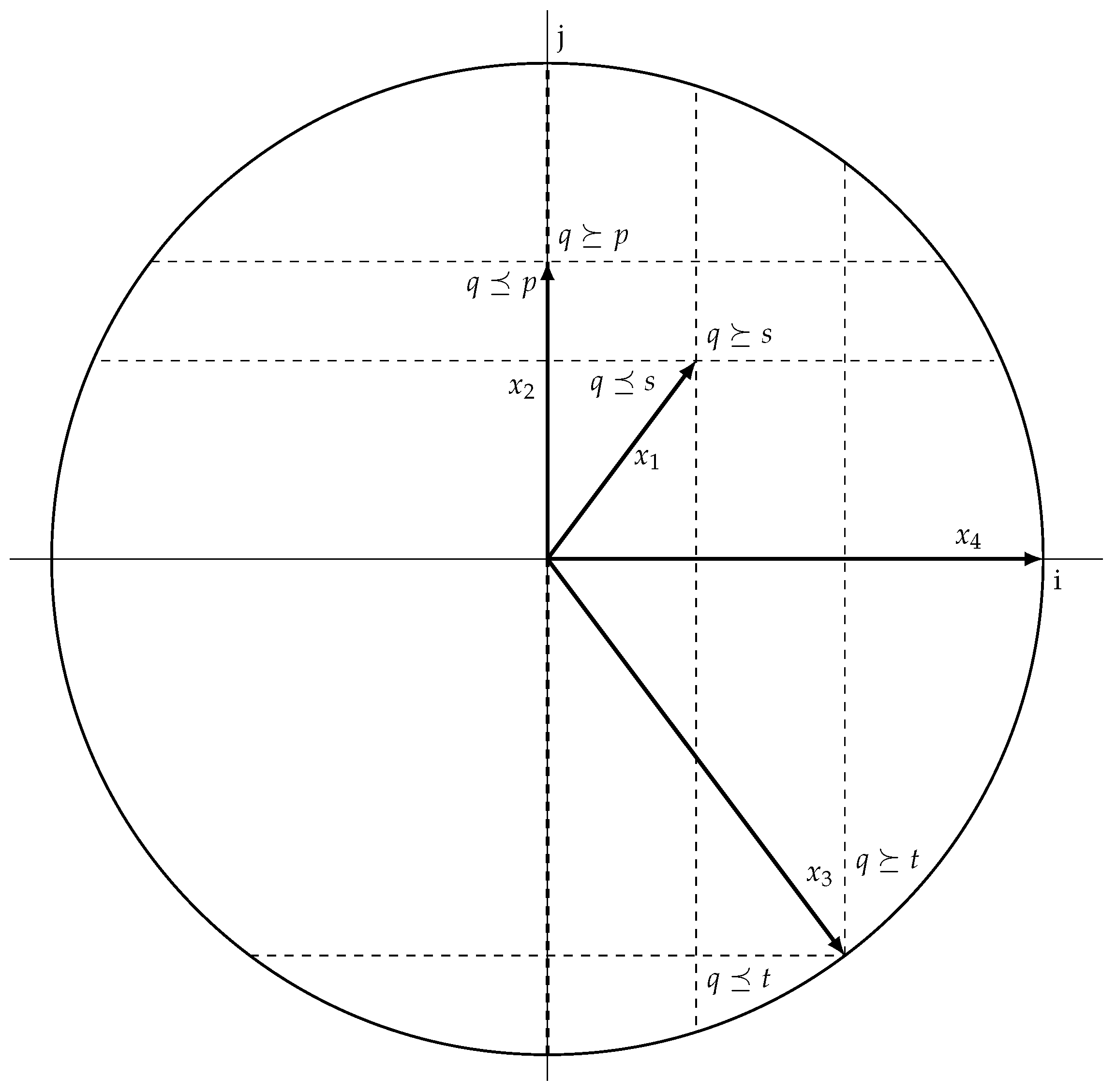
In this method, for any , -cut of A means that for any with membership grade , we have , , , and .
The following theorem can be easily proved.
Theorem 4.
Let be a quaternionic fuzzy set on U, for any , if , then .
Example 3.
Consider the quaternionic fuzzy set A in Example 1 in which A also could be represented as
For convenience, let , , and . Clearly, we only have the relation among .
Then we have
For example, for and , i.e., with
Figure 3 illustrates the quaternionic fuzzy set A and their q-cuts in the i–j plane.
We say has a bottom element if for all . Unfortunately, does not have a bottom element. For example, there does not exist a such that both and hold.
Further, this leads to a special case that there exists a quaternionic fuzzy set A such that there does not exist such that includes all elements of A. See this in the following example.
Example 4.
Let . Consider the following quaternionic fuzzy set:
If for some , then and , i.e., and . However, if and , then . Thus . This is a contradiction.
5. Set Theoretic Operation of the Quaternionic Fuzzy Set
In this section, the operations of quaternionic fuzzy complement, quaternionic fuzzy union, and quaternionic fuzzy intersection are defined. Then, De Morgan’s laws of quaternionic fuzzy union and intersection are discussed. Next, quaternionic fuzzy aggregation is introduced. Finally, rotational invariance is proposed.
A quaternionic grade of membership is restricted to the subset of quaternions , i.e., is limited to [0, 1]. For convenience, we only consider the quaternionic fuzzy operation over .
5.1. Quaternionic Fuzzy Complement
Definition 2.
A function is called a quaternionic fuzzy complement if it satisfies the following two conditions:
- (1)
- Amplitude boundary conditions:
- (2)
- Amplitude monotonicity:
In addition, in some cases, ¬ should satisfy also the following conditions:
- (3)
- Continuity: ¬ is a continuous function;
- (4)
- Amplitude involutivity:
This definition is a generation of crisp, traditional, and Ramot et al’s complex fuzzy complement.
Some examples are as follows: Let , define
Two functions satify the above four conditions.
Example 5.
Let , then
Using the standard fuzzy complement, i.e., , we obtained two functions,
Unfortunately, both functions are not closed over .
5.2. Quaternionic Fuzzy Union
Definition 3.
A function is called a quaternionic fuzzy union if it satisfies the following four conditions:
- (1)
- Boundary condition:
- (2)
- Amplitude monotonicity:
- (3)
- Commutativity:
- (4)
- Associativity:
In addition, in some cases, ∪ should satisfy also the following conditions:
- (5)
- Continuity: ∪ is a continuous function;
- (6)
- Amplitude superidempotency:
- (7)
- Amplitude strict monotonicity:
Two examples are as follows: Let and , then
where ★ represents a t-conorm, and
Both and satify the above four conditions.
Example 6.
Let and , then
5.3. Quaternionic Fuzzy Intersection
Definition 4.
A function is called a quaternionic fuzzy intersection if it satisfies the following four conditions:
- (1)
- amplitude boundary condition:
- (2)
- amplitude monotonicity:
- (3)
- commutativity:
- (4)
- associativity:
In addition, in some cases, ∩ should satisfy also the following conditions:
- (5)
- continuity: ∩ is a continuous function;
- (6)
- amplitude superidempotency:
- (7)
- amplitude strict monotonicity:
Two examples are as follows: Let and
where * represents a t-norm. Both and satify the above four conditions.
Example 7.
Let and , then
Now we consider two famous operations in quaternion theory: quaternionic dot product and quaternionic product.
Lemma 1.
Let , then and .
Proof.
Let and with and . We know , are real numbers. By the Cauchy–Schwarz inequality, we have
Thus ; because of . □
Quaternionic dot product is closed over . However, it does not satisfy condition (1) above.
Quaternionic product is also closed over . It satisfies above conditions (1), (2), (4)–(7). In order to bring the quaternionic product into our study, we introduce the concept of quaternionic fuzzy non-commutative intersection.
Definition 5.
A function is called a quaternionic fuzzy non-commutative intersection if it satisfies above conditions (1), (2), and (4) in Definition 4.
Obviously, we have the following result.
Theorem 5.
Quaternionic product over is a quaternionic fuzzy non-commutative intersection.
5.4. De Morgan’s Laws of Quaternionic Fuzzy Union and Intersection
Theorem 6.
Proof.
Let . Recall the definition , we have
and
□
Note that Equations (40) and (41) do not hold for .
5.5. Quaternionic Fuzzy Aggregation
Quaternionic fuzzy aggregation is specified by a function . Here we define the quaternionic fuzzy weighted arithmetic (QFWA) aggregation operator as
where for all l, and .
Note: The purpose of quaternionic weights is to make the definition as general as possible. In ordinary circumstances, weights are real-valued, i.e., with . In the following, we only consider the real-valued weights.
We show that QFWA aggregation operator is closed over .
Theorem 7.
If , then for any real-valued weights, i.e., with .
Proof.
For any real-valued weights with , since for all l, we have
Thus . □
If for all l, then the QFWA aggregation operator is the arithmetic average of quaternions , denoted by quaternionic fuzzy arithmetic average (QFAA) operator, i.e.,
6. Quaternionic Fuzzy Relations
In this section, we introduce the concepts of quaternionic fuzzy relations.
Definition 6.
Let U and V be two universes of discourse. A quaternionic fuzzy relation is a quaternionic fuzzy subset of the product space ; is characterized by the quaternion-valued membership function , where and .
Then we define the compositions of quaternionic fuzzy relations as follows.
Definition 7.
Let and be two quaternionic fuzzy relations over and , respectively. Their composition is whose membership function is
where ∪ and ∩ are quaternionic fuzzy union and intersection, respectively.
Let U and V be two universes of discourse. A quaternionic fuzzy relation is a quaternionic fuzzy subset of the product space ; is characterized by the quaternion-valued membership function , where and .
Example 8.
Let Q and S be two quaternionic fuzzy relations defined as
Let and , by using and , then
7. Rotational Invariance
In the case of complex fuzzy logic, rotational invariance of complex fuzzy operations is studied in [23,46]. For a complex number , is referred to as the rotated vector of c. We consider c as a two-dimensional vector, and then we just rotate this vector about the origin counterclockwise by radians and obtain .
Now we consider a quaternion ; let and , then . Because , so and maybe are two different rotated vectors of p. We write as the right-rotated vector of p and as the left-rotated vector of p.
In this section, we investigate the rotational invariance of quaternionic fuzzy operations.
Definition 8.
Let be an n-order function; f is right-rotationally invariant if
for any and with .
Definition 9.
Let be an n-order function; f is left-rotationally invariant if
for any and with .
Right-rotational invariance and left-rotational invariance are two different concepts since for some . Right-rotational invariance and left-rotational invariance are equivalent when we limit the values and q to complex numbers . Clearly, right-rotational invariance and left-rotational invariance are generalizations of Dick’s rotational invariance [23] in the case of complex fuzzy logic.
Theorem 8.
If is defined as , then it is both right- and left-rotationally invariant.
Proof.
For any quaternion , we have and . □
Theorem 9.
is both right-rotationally invariant and left-rotationally invariant.
Proof.
For any quaternion , let because , then . Therefore, we have . Similarly, we have . □
Theorem 10.
is neither right-rotationally invariant nor left-rotationally invariant.
Proof.
Consider , . Let then , but . Similarly, we have . □
Theorem 11.
The quaternionic dot product is neither right-rotationally invariant nor left-rotationally invariant.
Proof.
Consider and . By definition, their dot product is . Now, let , consider their right-rotated values and , their dot product is , but . Similarly, we have . □
Theorem 12.
The quaternionic product is neither right-rotationally invariant nor left-rotationally invariant.
Proof.
Consider i and j. By definition, their product is k. Now, consider their right-rotated values and , their product is , but . Similarly, consider their left-rotated values and , their product is k, but . □
Theorem 13.
, , , and are neither right-rotationally invariant nor left-rotationally invariant.
Proof.
Here, we just give the proof of that is not right-rotationally invariant. Consider complex numbers and .
Other cases can be proved in a similar way. □
Theorem 14.
The QFWA aggregation operator is both right- and left-rotationally invariant.
Proof.
For any and with , we have
Thus, the QFWA aggregation operator is right-rotationally invariant.
For any real-valued weights , we have . Then
Thus, the QFWA aggregation operator is left-rotationally invariant. □
Let be a quaternionic vector; is the right-rotated vector of and is the left-rotated vector of . Rotational invariance in the above theorem states that the aggregated result is the right-rotated vector of the aggregated result , and is the left-rotated vector of the aggregated result .
The rotational invariance of quaternionic fuzzy operations are summarized as in Table 1. As can be seen, could be a both right- and left-rotationally invariant complement; is both right- and left-rotationally invariant, but on the other hand, is not a quaternionic fuzzy complement of Definition 2. Quaternionic product, quaternionic dot product, and are neither right-rotationally invariant nor left-rotationally invariant. We need a more comprehensive concept of rotational invariance for quaternionic fuzzy operations. Interestingly, the QFWA aggregation operator is a both right- and left-rotationally invariant operator.
8. Concluding Remarks
A new concept of QFS was introduced in this paper. QFS allows quaternion-valued membership grade with four representative parameters. We gave a discussion of the intuitive interpretation of quaternion-valued membership grade. Several quaternionic fuzzy operations, including complement, union, intersection, and aggregation, were presented. Rotational invariance of these quaternionic fuzzy operations was also studied.
QFS is a promising novel concept. Obviously, many theoretical studies and application development are possible topics for future consideration. We present our views on theories and potential applications.
- (1)
- Geometric properties of complex fuzzy operations are often studied and analyzed by scholars, such as continuity [47] and preserving orthogonality [14]. These properties are important for both complex fuzzy operations and quaternionic fuzzy operations. Moreover, we should consider some special properties only for quaternionic fuzzy operations but not for complex fuzzy operations.
- (2)
- We should consider the quaternionic fuzzy logic for logical reasoning based on QFS. Obviously, a more detailed discussion of the axiomatization of quaternionic fuzzy logic is necessary.
- (3)
- (4)
- Quaternions are a powerful tool for describing the orientation of an object in 3D space; as a result, they are highly efficient and well-suited for solving rotation and orientation problems in the areas of computer graphics, robotics, and animation [33,34]. These areas are also potential applications of QFSs.
Funding
This research was funded by the National Science Foundation of China under Grant No. 62006168 and Zhejiang Provincial Natural Science Foundation of China under Grant No. LQ21A010001.
Data Availability Statement
Not applicable.
Conflicts of Interest
The authors declare no conflict of interest.
Abbreviations
The following abbreviations are used in this manuscript:
| FS | Fuzzy set |
| IFS | Intuitionistic fuzzy set |
| PFS | Pythagorean fuzzy set |
| FFS | Fermatean fuzzy set |
| q-ROFS | q-rung orthopair fuzzy set |
| NS | Neutrosophic set |
| HFS | Hesitant fuzzy set |
| CFS | Complex fuzzy set |
| QFS | Quaternionic fuzzy set |
| QFWA | Quaternionic fuzzy weighted arithmetic |
| QFAA | Quaternionic fuzzy arithmetic average |
References
- Zadeh, L.A. Fuzzy sets. Inf. Control 1965, 8, 338–353. [Google Scholar] [CrossRef]
- Zadeh, L.A. The concept of a linguistic variable and its application to approximate reasoning—I. Inf. Sci. 1975, 8, 199–249. [Google Scholar] [CrossRef]
- Atanassov, K.T. Intuitionistic fuzzy sets. Fuzzy Sets Syst. 1986, 20, 87–96. [Google Scholar] [CrossRef]
- Yager, R.R. Pythagorean membership grades in multicriteria decision making. IEEE Trans. Fuzzy Syst. 2013, 22, 958–965. [Google Scholar] [CrossRef]
- Senapati, T.; Yager, R.R. Fermatean fuzzy sets. J. Ambient. Intell. Human Comput. 2020, 11, 663–674. [Google Scholar] [CrossRef]
- Yazdanbakhsh, O.; Dick, S. Forecasting of multivariate time series via complex fuzzy logic. IEEE Trans. Syst. Man Cybern. Syst. 2017, 47, 2160–2171. [Google Scholar] [CrossRef]
- Yager, R.R. Generalized orthopair fuzzy sets. IEEE Trans. Fuzzy Syst. 2017, 25, 1222–1230. [Google Scholar] [CrossRef]
- Al-shami, T.M. (2,1)-Fuzzy sets: Properties, weighted aggregated operators and their applications to multi-criteria decision-making methods. Complex Intell. Syst. 2022, 9, 1687–1705. [Google Scholar] [CrossRef]
- Smarandache, F. A Unifying Field in Logics. Neutrosophy: Neutrosophic Probability, Set and Logic; American Research Press: Rehoboth, DE, USA, 1999. [Google Scholar]
- Torra, V. Hesitant fuzzy sets. Int. J. Intell. Syst. 2010, 25, 529–539. [Google Scholar] [CrossRef]
- Ramot, D.; Milo, R.; Friedman, M.; Kandel, A. Complex fuzzy sets. IEEE Trans. Fuzzy Syst. 2002, 10, 171–186. [Google Scholar] [CrossRef]
- Ramot, D.; Friedman, M.; Langholz, G.; Kandel, A. Complex fuzzy logic. IEEE Trans. Fuzzy Syst. 2003, 11, 450–461. [Google Scholar] [CrossRef]
- Ma, X.; Zhan, J.; Khan, M.; Zeeshan, M.; Anis, S.; Awan, A.S. Complex fuzzy sets with applications in signals. Comp. Appl. Math. 2019, 38, 150. [Google Scholar] [CrossRef]
- Hu, B.; Bi, L.; Dai, S. The orthogonality between complex fuzzy sets and its application to signal detection. Symmetry 2017, 9, 175. [Google Scholar] [CrossRef]
- Chen, Z.; Aghakhani, S.; Man, J.; Dick, S. ANCFIS: A Neuro-Fuzzy Architecture Employing Complex Fuzzy Sets. IEEE Trans. Fuzzy Syst. 2011, 19, 305–322. [Google Scholar] [CrossRef]
- Ma, J.; Zhang, G.; Lu, J. A method for multiple periodic factor prediction problems using complex fuzzy sets. IEEE Trans. Fuzzy Syst. 2012, 20, 32–45. [Google Scholar]
- Li, C.; Chiang, T.-W.; Yeh, L.-C. A novel self-organizing complex neuro-fuzzy approach to the problem of time series forecasting. Neurocomputing 2013, 99, 467–476. [Google Scholar] [CrossRef]
- Liu, P.; Ali, Z.; Mahmood, T. The distance measures and cross-entropy based on complex fuzzy sets and their application in decision making. J. Intell. Fuzzy Syst. 2020, 39, 3351–3374. [Google Scholar] [CrossRef]
- Selvachandran, G.; Quek, S.G.; Lan, L.T.H.; Giang, N.L.; Ding, W.; Abdel-Basset, M.; De Albuquerque, V.H.C. A new design of mamdani complex fuzzy inference system for multiattribute decision making problems. IEEE Trans. Fuzzy Syst. 2019, 29, 716–730. [Google Scholar] [CrossRef]
- Dai, S. Complex fuzzy ordered weighted distance measures. Iran. J. Fuzzy Syst. 2020, 17, 107–114. [Google Scholar]
- Wang, D.; Zhao, X. Affective video recommender systems: A survey. Front. Neurosci. 2022, 16, 984404. [Google Scholar] [CrossRef]
- Dai, S. Linguistic Complex Fuzzy Sets. Axioms 2023, 12, 328. [Google Scholar] [CrossRef]
- Dick, S. Towards Complex Fuzzy Logic. IEEE Trans. Fuzzy Syst. 2005, 13, 405–414. [Google Scholar] [CrossRef]
- Dai, S. Quasi-MV algebras for complex fuzzy logic. AIMS Math. 2021, 7, 1416–1428. [Google Scholar] [CrossRef]
- Dai, S. On Partial Orders in Complex Fuzzy Logic. IEEE Trans. Fuzzy Syst. 2021, 29, 698–701. [Google Scholar] [CrossRef]
- Buckley, J.J. Fuzzy complex numbers. Fuzzy Sets Syst. 1989, 33, 333–345. [Google Scholar] [CrossRef]
- Hamilton, W.R. On Quaternions, or on a New System of Imaginaries in Algebra. Phil. Mag. J. Sci. 1844, 25, 10–13. [Google Scholar]
- Finkelstein, D.; Jauch, J.M.; Schiminovich, S.; Speiser, D. Foundations of Quaternion Quantum Mechanics. J. Math. Phys. 1962, 3, 207–220. [Google Scholar] [CrossRef]
- Adler, S.L. Quaternionic Quantum Mechanics and Quantum Fields; Oxford University Press: New York, NY, USA, 1995. [Google Scholar]
- Parcollet, T.; Morchid, M.; Linares, G. A survey of quaternion neural networks. Artif. Intell. Rev. 2020, 53, 2957–2982. [Google Scholar] [CrossRef]
- Bayro-Corrochano, E.; Solis-Gamboa, S. Quaternion quantum neurocomputing. Int. J. Wavelets Multiresolut. Inf. Process. 2022, 20, 2040001. [Google Scholar] [CrossRef]
- Dai, S. Quaternionic quantum automata. Int. J. Quantum Inf. 2023, 21, 2350017. [Google Scholar] [CrossRef]
- Voight, J. Quaternion Algebras; Springer Nature: Cham, Switzerland, 2021. [Google Scholar]
- Vince, J. Quaternions for Computer Graphics; Springer: London, UK, 2011. [Google Scholar]
- Ngan, R.T.; Ali, M.; Tamir, D.E.; Rishe, N.D.; Kandel, A. Representing complex intuitionistic fuzzy set by quaternion numbers and applications to decision making. Appl. Soft Comput. 2020, 87, 105961. [Google Scholar] [CrossRef]
- Pan, L.; Deng, Y.; Cheong, K.H. Quaternion model of Pythagorean fuzzy sets and its distance measure. Expert Syst. Appl. 2023, 213, 119222. [Google Scholar] [CrossRef]
- Kyritsis, K. On the relation of Fuzzy subsets, Postean and Boolean lattices. The λ-rainbow lattices. Transfinite Fuzzy subsets. In Proceedings of the VII Congress of SIGEF—Decision Making under Uncertainty in the Global Environment of the 21st Century, Chania of Crete, Greece, 18–20 September 2000; pp. 763–774. [Google Scholar]
- Moura, R.P.A.; Bergamaschi, F.B.; Santiago, R.H.N.; Bedregal, B.R. Fuzzy quaternion numbers. In Proceedings of the 2013 IEEE International Conference on Fuzzy Systems (FUZZ-IEEE), Hyderabad, India, 7–10 July 2013; pp. 1–6. [Google Scholar]
- Xu, C.J.; Liao, M.X.; Li, P.L.; Liu, Z.X.; Yuan, S. New results on pseudo almost periodic solutions of quaternion-valued fuzzy cellular neural networks with delays. Fuzzy Sets Syst. 2021, 411, 25–47. [Google Scholar] [CrossRef]
- Wang, P.; Li, X.; Wang, N.; Li, Y.; Shi, K.; Lu, J. Almost periodic synchronization of quaternion-valued fuzzy cellular neural networks with leakage delays. Fuzzy Sets Syst. 2022, 426, 46–65. [Google Scholar] [CrossRef]
- Nguyen, H.T.; Kreinovich, V.; Shekhter, V. On the possibility of using complex values in fuzzy logic for representing inconsistencies. Int. J. Intell. Syst. 1998, 13, 683–714. [Google Scholar] [CrossRef]
- Subakan, O.N.; Vemuri, B.C. A Quaternion Framework for Color Image Smoothing and Segmentation. Int. J. Comput. Vis. 2011, 91, 233–250. [Google Scholar] [CrossRef]
- Shi, L.; Funt, B. Quaternion color texture segmentation. Comput. Vis. Image Underst. 2007, 107, 88–96. [Google Scholar] [CrossRef]
- Sangwine, S.J. Fourier transforms of colour images using quaternion, or hypercomplex, numbers. Electron. Lett. 1996, 32, 1979–1980. [Google Scholar] [CrossRef]
- Bi, L.; Dai, S.; Hu, B.; Li, S. Complex fuzzy arithmetic aggregation operators. J. Intell. Fuzzy Syst. 2019, 36, 2765–2771. [Google Scholar] [CrossRef]
- Dai, S. A generalization of rotational invariance for complex fuzzy operations. IEEE Trans. Fuzzy Syst. 2021, 29, 1152–1159. [Google Scholar] [CrossRef]
- Hu, B.; Bi, L.; Dai, S.; Li, S. Distances of complex fuzzy sets and continuity of complex fuzzy operations. J. Intell. Fuzzy Syst. 2018, 35, 2247–2255. [Google Scholar] [CrossRef]
- Yazdanbakhsh, O.; Dick, S. A systematic review of complex fuzzy sets and logic. Fuzzy Sets Syst. 2018, 338, 1–22. [Google Scholar] [CrossRef]
Figure 1.
The relations among different concepts.
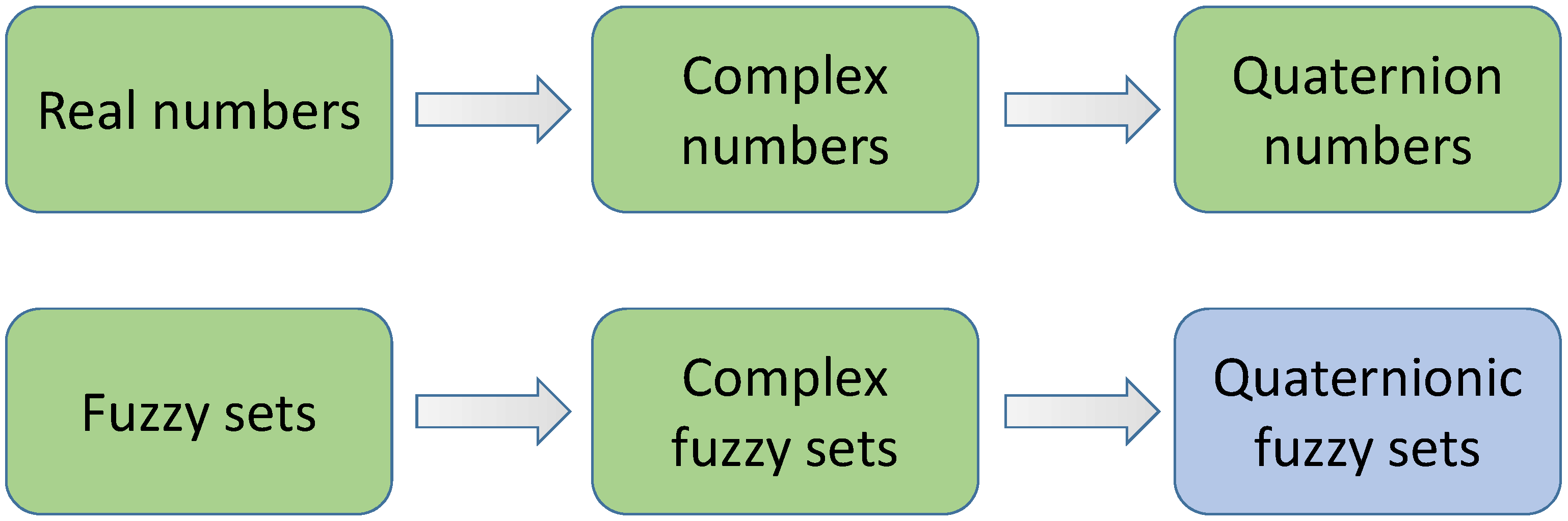
Figure 2.
The q-cuts of QFSs in the i–j plane for Example 1.

Figure 3.
The q-cuts of QFSs in the i–j plane for Example 3.


Table 1.
Rotational invariance of quaternionic fuzzy operations.
| Right-Rotationally Invariant | Left-Rotationally Invariant | |
|---|---|---|
| − | √ | √ |
| Quaternionic product | × | × |
| Quaternionic dot product | × | × |
| √ | √ | |
| × | × | |
| × | × | |
| QFWA | √ | √ |
Disclaimer/Publisher’s Note: The statements, opinions and data contained in all publications are solely those of the individual author(s) and contributor(s) and not of MDPI and/or the editor(s). MDPI and/or the editor(s) disclaim responsibility for any injury to people or property resulting from any ideas, methods, instructions or products referred to in the content. |
© 2023 by the author. Licensee MDPI, Basel, Switzerland. This article is an open access article distributed under the terms and conditions of the Creative Commons Attribution (CC BY) license (https://creativecommons.org/licenses/by/4.0/).
Share and Cite
MDPI and ACS Style
Dai, S. Quaternionic Fuzzy Sets. Axioms 2023, 12, 490. https://doi.org/10.3390/axioms12050490
AMA Style
Dai S. Quaternionic Fuzzy Sets. Axioms. 2023; 12(5):490. https://doi.org/10.3390/axioms12050490
Chicago/Turabian StyleDai, Songsong. 2023. "Quaternionic Fuzzy Sets" Axioms 12, no. 5: 490. https://doi.org/10.3390/axioms12050490
APA StyleDai, S. (2023). Quaternionic Fuzzy Sets. Axioms, 12(5), 490. https://doi.org/10.3390/axioms12050490
Note that from the first issue of 2016, this journal uses article numbers instead of page numbers. See further details here.