


Abstract
Connectivity in graphs is useful in describing different types of communication systems like neural networks, computer networks, etc. In the design of any network, it is essential to evaluate the connections based on their strengths. In this manuscript, we comprehensively describe various connectivity parameters related to interval-valued intuitionistic fuzzy graphs (IVIFGs). These are the generalizations of the parameters defined for fuzzy graphs, interval-valued fuzzy graphs, and intuitionistic fuzzy graphs. First, we introduce interval-valued intuitionistic fuzzy bridges (IVIF bridges) and interval-valued intuitionistic fuzzy cut-nodes (IVIF cut-nodes). We discuss the many characteristics of these terms as well as establish the necessary and sufficient conditions for an arc to become an IVIF-bridge and a vertex to be an IVIF-cutnode. Furthermore, we initiate the concepts of interval-valued intuitionistic fuzzy cycles (IVIFCs) and interval-valued intuitionistic fuzzy trees (IVIFTs) and explore few relationships among them. In addition, we introduce the notions of fuzzy blocks and fuzzy block graphs and extend these terms as interval-valued fuzzy blocks (IVF-blocks) and interval-valued intuitionistic fuzzy block graphs (IVIF-block graphs). Finally, we provide the application of interval-valued intuitionistic fuzzy trees (IVIFTs) in a road transport network.
MSC:
057C2; 03E72
1. Introduction
In 1965, Zadeh [1] initiated the concept of a fuzzy sets (FSs) which became an efficient tool to solve the problems containing uncertainties. After this, the theory of FSs became an important area of research for researchers in various fields of natural and social sciences including medical, engineering, artificial intelligence, management sciences, etc. Due to a wide range of applications of FSs, several generalizations of FSs have been introduced. Zadeh himself introduced the generalization of FSs named interval-valued fuzzy sets (IVFSs) [2]. Afterwards, Atanassov [3] proposed the concepts of intuitionistic fuzzy sets (IFSs). Furthermore, Gargov and Atanassov [4] explored the notion of interval-valued intuitionistic fuzzy sets (IVIFSs) with the aim of amalgamating the view and measuring the complex nature of the human mind with more accuracy. The concepts of IVIFS was extensively applied in different fields like decision making [5], medical diagnosis [6], etc.
A decade after Zadeh’s landmark paper, Rosenfeld [7] and Yeh et al. [8] introduced fuzzy graphs (FGs). Subsequently, the term M-strong FGs was introduced by Bhutani et al. [9]. Some important terms related to FGs were initiated by Bhattacharya [10]. Peng and Mordeson [11] introduced some important operations on FGs. Different terms of FGs like cycles, co-cycles, and fuzzy line graphs were presented by Mordeson and Nair [12]. Mathew and Sunitha [13] initiated the term node connectivity based on different types of arcs of FGs. The term interval-valued fuzzy graphs (IVFGs) was explored in [14]. Cayley-IVFGs were explored in [15]. Sequentially, the term intuitionistic fuzzy graph (IFGs) was explored in 1994 in [16]. Numerous new operations along with their basic properties on IFGs were introduced in [17]. Similarly, the shortest paths in different networks were examined through IFGs in [18]. The order, size, etc. of IFGs were explored by Nagoor Gani et al. [19]. The extension of IFG, named intuitionistic fuzzy competition graphs [20], intuitionistic fuzzy tolerance graphs [21], etc., have also been discussed in the literature. Similarly, the concepts of connectivity in intuitionistic fuzzy incidence graphs and their applications were explored in [22]. The term internally stable set in IFGs was explained in [23]. Some new terms of IFGs were addressed in [24] The concept of a strong-IVIFG was discussed in [25]. The connectivity status of the IFG with applications in banking was introduced in [26]. Intuitionistic fuzzy trees (IFTs) were introduced by Chountas et al. [27,28]. Various terms related to IF-trees such as the radius, distance, and eccentricity were introduced by Thamizhendhi and Parvathi [29]. The study of IFGs and IFTs were also conducted by many researchers [30,31]. Interval-valued intuitionistic fuzzy graphs (IVIFGs) were studied in [32]. Similarly, many generalizations of IVIFGs were explored in [33,34,35]. Recently, some other extensions of FGs with applications in various fields have been explored in [36,37]. In the same vein, many new terms related to fuzzy graphs have been explored in [38,39].
The unique structure of IVIFSs is useful to express the membership and non-membership degrees in terms of intervals, which is more helpful in dealing with uncertainties. Also, expressing uncertain information using IVIFSs can effectively avoid the loss of any information. In our study, we introduce various connectivity parameters related to IVIFGs. These are the generalized forms of concepts related to FGs, IVFGs, and IFGs. Moreover, the notions described for IVIFGs combine the qualitative characteristics of FGs, IVFGs, and IFGs.
The novelty and motivations of our work are as follows.
- We introduce different of strong arcs like -strong, -strong, -arc, -strong, -strong, and -strong. Based on these arcs, we introduce the different types of path and discuss the connectivity of IVIFGs.
- We extend many notions of IFGs towards IVIFGs such as interval-valued intuitionistic fuzzy bridges (IVIFBs), interval-valued intuitionistic fuzzy cut-notes (IVIFCNs), interval-valued intuitionistic fuzzy trees (IVIFTs), interval-valued intuitionistic fuzzy cycles (IVIFCs), etc.
- We can hardly find discussions about the fuzzy blocks and fuzzy block graphs. In our work, we first introduce the concepts of interval-valued fuzzy blocks (IVF-blocks) and interval-valued fuzzy block graphs (IVF-block graphs). Then, we extend these notions as interval-valued intuitionistic fuzzy blocks (IVIF-block graphs) and interval-valued intuitionistic fuzzy block graphs (IVIF-block graphs).
- A traffic control system, computer networking, or any real-life problem involving networking works best in an interval-valued intuitionistic fuzzy environment as compared to the fuzzy, interval-valued fuzzy, and intuitionistic fuzzy environments. As evidence, we provide the application of IVIFTs towards the traffic control system.
The rest of this manuscript is organized as follows: In Section 2, basic useful terminologies are provided. In Section 3, we introduce the notions of interval-valued intuitionistic fuzzy bridges (IVIFBs) and interval-valued intuitionistic fuzzy cut notes (IVIFCNs). Afterwards, the ideas of interval-valued intuitionistic fuzzy trees (IVIFTs) and interval-valued intuitionistic fuzzy cycles (IVIFCs) are discussed in Section 4. In Section 5, first we introduce the notions of interval-valued fuzzy-blocks (IVF-blocks) and interval-valued fuzzy block graphs (IVF-block graphs). Then, we shift these terms towards IVIFGs. In Section 6, we present the application of IVIFTs towards the traffic control system along with numerical calculations. Finally, we conclude our study with future directions.
2. Preliminaries
Definition 1
([1]). A fuzzy set (FS) is a pair , where ϕ is a membership function that allocates values to each entity of V from .
Definition 2
([40]). An IVFS is a pair , where ϕ is a membership function that allocate values in terms of the subintervals of to each member of V.
Definition 3
([41]). An IFS T on U is of the form
where both and are the functions such as and are the membership values and non-membership values of the given entity , respectively, with .
Definition 4
([4]). An IVIFS T on U can be described as
where and are intervals representing the membership and non-membership values, respectively, with .
Definition 5
([7]). A pair is a fuzzy graph (FG) defined on a crisp graph , where , , , and , satisfying for all
Definition 6
([42]). An interval-valued fuzzy graph (IVFG) defined on a crisp graph is , where and are the on V and , respectively.
Definition 7
([16]). An intuitionistic fuzzy graph (IFG) defined on a crisp graph is a pair , where is an IFS on V and is an IFS on , and for all
Definition 8
([43]). An IFG defined on a crisp graph is said to be complete, if for each ,
Definition 9
([43]). In an IFG , a ϕ-path is a set of distinct vertices such that , and a ψ-path if , where . If and , then we call it a path in IFG.
Definition 10
([43]). The ϕ-strength of connectedness among the vertices and in an IFG G is , and the ψ-strength of connectedness among and is . Similarly, = , whenever the nodes u, v are joined by ϕ-paths having the length k. If the nodes u, v are joined by ψ-paths having the length k, then = .
Definition 11
([43]). An IFG described in Definition 7, is said to be
- ϕ-connected, if there is a ϕ-path between each pair of the vertices.
- ψ-connected, if there is a ψ-path between each pair of vertices.
- a strong connected graph, whenever there exists a path in between each pair of vertices.
Definition 12
([44]). An arc in an IFG is said to be
- -strong if and -strong if .
- -strong if and -strong if .
- -arc if and -arc if .
We refer the reader to [44] for further discussions on bridges, trees, etc., of IFGs.
Important note: Throughout this article, we use the notations for and for , respectively. Similarly, we use for and for .
3. IVIF-Bridges and IVIF-Cut Nodes
In this section, we introduce IVIF-bridges and IVIF-cut nodes. We also provide some important results and examples related to them.
Definition 13.
An IVIFG is strong, if for all , is strong, if for all , and . And is complete if for all and
Remark 1.
In an IVIFG, if for any i and j, then there is no edge among the vertices and . However, if , then there is an edge among the vertices and .
Definition 14.
In an IVIFG , a path P in G, i.e., is a sequence of distinct vertices. The path P is called a -path from u to v if , and is called a -path whenever for . We call P a path in an IVIFG if it has both -path and -path. Hence, P is a path of length m. If and , then the path P is a -cycle and -cycle which turns into be a cycle.
Definition 15.
Let be an IVIFG, then it is called a -connected, whenever there is a -path among each couple of the nodes in G, and is called a -connected, if there is a -path among each pair of the nodes in G. Additionally, an IVIFG is strongly connected, if there is a path among every pair of vertices.
Definition 16.
If , then the -strength of connectedness among the vertices is , and the -strength among and is . Similarly, is , whenever the nodes u, v are joined by -paths having the length k. If the nodes u, v are joined by -paths having the length k, then is .
Remark 2.
If there is a path P = -path in an IVIFG from u to v, then the -strength of P among the vertices u and v is denoted by . Also, if there is a path P that is a -path in an IVIFG G from u to v, then the -strength of P among the vertices u and v is denoted by . A path P in between a pair of the nodes u and v is a -strongest path and a -strongest path, if the -strength is equal to and the -strength is equal to , respectively.
Definition 17.
Let be an IVIFG, then an arc in G is called -strong and -strong, if , and . And, an arc in G is called strong if it is either -strong or -strong.
Definition 18.
Let be an IVIFG. Then, an arc in G is -strong, -strong, and -arc satisfies
and is said to be -strong, -strong and -arc if
Example 1.
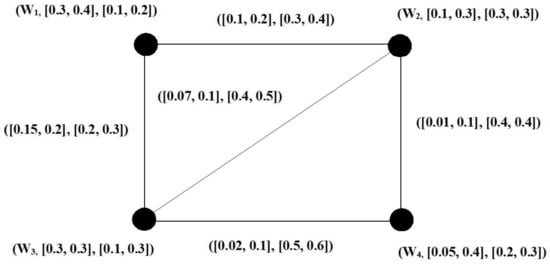
In an IVIFG shown in Figure 1, the arcs and are -strong arcs and -strong arcs, which implies that the arcs and are strong arcs. However, the arc is neither an -strong arc, nor -strong arc, and nor -arc, but it is a -arc. Similarly, the arc is neither an -strong arc, nor -strong arc, and nor -arc, but it is an -strong arc. But, the arc is -arc and -arc.
Figure 1.
Interval-valued intuitionistic fuzzy graph.
Definition 19.
Let be a -path from u to v in an IVIFG . The path P is called a -strong (-strong), if the arcs , where are -strong (-strong). Again, P is a -path, then the path P is called -strong (-strong), if the arcs , where are -strong (-strong).
A path P in G is termed as strong (α-strong), and is either -strong or -strong (-strong or -strong).
Example 2.
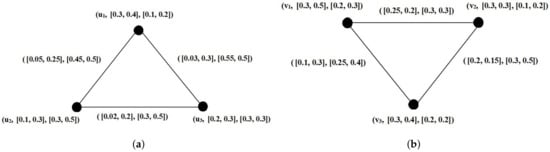
In an IVIFG given in Figure 2a, and . The arc is in G is -strong arc but the arc is neither -strong arc, nor -strong arc, and nor -arcl the arc is -arc, but the arc is neither -strong arc, nor -strong arc, and nor -arc; and the arc is -strong but the arc is neither -strong arc, nor -strong arc, and nor -arc. Similarly, in an IVIFG shown in Figure 2b, the arc is the only -strong arc.
Figure 2.
Interval-valued intuitionistic fuzzy graphs (a,b).
Proposition 1.
If an IVIFG is -connected, then there must exist a -strong path among every couple of vertices of a graph G.
Proof.
It is straightforward. □
Proposition 2.
Let be a -connected IVIFG. Then, there is a -strong path in the set of vertices of graph G.
Proof.
Let G be an -connected IVIFG. Then, there must exist a -path between each couple of the vertices u, v. However, if the arc between u, v is not a -strong arc, then . Thus, there exists a -path from the vertex u to v in which the -strength of P is less than . Here, if a few arcs of the path P are not -strong, then we have the same argument. Lastly, we must have a -path from u to v which is -strong. □
Remark 3.
The converse of Proposition 2 is not true, in general.
Proposition 3.
If a -path from the vertex u to v in an IVIFG is -strong, then this path P in G is a -strongest path.
Proof.
Let be an IVIFG. Consider a path in G which is an -strong and further assume that it is not a -strongest path in G. Consider a -strongest path in G which is expressible as . Hence, for , we have . Moreover, both the paths P and make a cycle, denoted by . In a path P, -arc of is the weakest arc. Assuming an arc be the weakest -arc in the path P. Let be the path in a cycle not including , which is represented by . Consequently, we have , which shows that is not identified to be an -strong arc, which disproves of the supposition. Hence, the path P in G is a -strongest path. □
Remark 4.
The converse of Proposition 3 is not true, i.e., if there exists a -strongest path in G, then it is not necessary to be an -strong path.
Proposition 4.
In an IVIFG , if a -path P from the vertex u to v is -strong, then the path P is a -strongest path in G.
Proof.
Let be an IVIFG. Let in G be -strong, and assume that P in G is not a -strongest path. In an IVIFG, a -strongest path in G, denoted by . Thus, for , . Furthermore, a cycle is formed by both the paths P and . The weakest arc of in the path P is -arc. Let an arc in the path P as the weakest -arc. In cycle , let be the path excluding . Consequently, for an arc not to be an -strong arc, we must have . Which disproves our assumption. Hence, a path P in G is satisfied to be a -strongest path. □
Remark 5.
The converse of Proposition 4 does not need to be true, i.e., it is not mandatory to the -strongest path in G to be an -strong path.
Definition 20.
Let be an IVIFG. An arc , i.e., in G is said to be an interval-valued intuitionistic fuzzy -bridge (IVIF -bridge), whenever an arc in between some couple of the nodes is removed, which reduces the -strength of connectedness among some couple of the nodes. Similarly, if the nodes , that is, and is such that there is an edge in every -strongest path. An arc , i.e., in an IVIFG G is an interval-valued intuitionistic fuzzy -bridge (IVIF -bridge), and whenever this arc is removed, it extends the connectedness strength among a few couples of the nodes. Similarly, the nodes , i.e., and , such that, in every -strongest path, the arc exists. An arc in an IVIFG G is an interval-valued intuitionistic fuzzy bridge (IVIFB), which is either an IVIF -bridge or an IVIF -bridge.
Definition 21.
Let be an IVIFG. When A node , where in G is an interval-valued intuitionistic fuzzy -cut node (IVIF -cut node), and this u is removed, it minimizes the connectedness strength among a few other couples of nodes. Likewise, if the nodes exist where and in such a way that a node u is involved in every -strongest path. A node where in G is an interval-valued intuitionistic fuzzy -cut node (IVIF -cut node), whenever this node u is removed, the connectedness strength among a few other couples of nodes increases. Similarly, there exist where and , so that this u is involved in every -strongest path. A node , where in an IVIFG G is called an interval-valued intuitionistic fuzzy cut-node (IVIFCN) if it is either an IVIF -cut node or an IVIF -cut node.
Example 3.
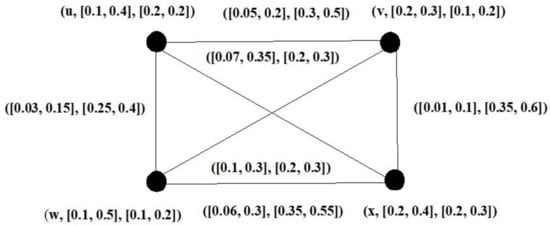
Consider an IVIFG given in Figure 3, where and . Here, the arc is an -arc and -arc, and are -arcs and -arcs, the arcs and are -strong and -strong arcs, i.e., and are strong arcs, while the arc is an -strong and -arc. Consequently, all the arcs in G are strong. Further to this, both the arcs and are neither an IVIF -bridges, nor an IVIF -bridges. Hence, the arcs and do not form IVIFBs. The arcs and are both IVIF -bridges and IVIF -bridges, i.e., both are IVIFBs. The arc is an IVIF -bridge for some couple of vertices as well as an IVIF -bridge for some couple of vertices, which implies the IVIFB. Hence, all the arcs except and are forming IVIFBs. The vertex u is -cut vertex for the pair of vertices v and x, and the vertex x is a -cut vertex for the pair of vertices u and v, and the vertex w is both , and the -cut vertices are for the vertices u and v. Hence, all the vertices u, x, and w are IVIFCNs, except v.
Figure 3.
Interval-valued intuitionistic fuzzy graph.
Theorem 1.
The following statements are equivalent.
- An arc in G is an IVIF-bridge.
- An arc in G is not the weakest arc of any cycle.
Theorem 2.
Let be an IVIF-bridge of an IVIFG . Then, = and = .
Proof.
Assume an arc is an IVIF-bridge and exceeds over ; however, falls behind from . So, there is a strongest path that has a strength that is greater than and less than . Also, every arc of has a strongest path that is has a strength greater than and less than . Along with the arc , the path makes an IVIF-cycle, which considers to be the weakest arc. This contradicts the assumption, i.e., that is an IVIF-bridge. □
Theorem 3.
Let be an IVIFG and be an arc in G. Then, we have the following.
- (i)
- An arc in G is an IVIF--bridge if and only if .
- (ii)
- An arc in G is an IVIF--bridge if and only if .
- (iii)
- An arc in G is called an IVIFB if and only if either or .
Proof.
Let an arc in G be an IVIF -bridge. Then, the nodes exist in such a way that for all in G, there is an arc which is a -strongest P-path. Now, let be a -path from the node r to s, where the arc does not include any of the -paths from the node r to s, and the -strength of it is at its maximum, where the arc is not present.
So, both the paths P and make a cycle , and there is an another -path as which is a . We assert that there exists a -strongest path as in between nodes u and v. Consider the path in between the nodes u and v as a -strongest path, and the -strength between r and s does not reduce after deleting the arc . This proves that our supposition is wrong. Therefore, . Furthermore, the cycle of the weakest -arc is held on ; thus, refers to the fact that . On the other hand, if we assume that , then the -strength of connectedness in between the nodes u and v is reduced by deleting an arc . Hence, the arc in G is IVIF -strong.
Let an arc in G be an IVIF -bridge. Then, the nodes exist in such a way that, for all in G, there is an arc which is a -strongest P-path. Now, let the path be a -path from the node r to s in which the arc is not included, and among all of the -paths from node r to s, the -strength is the minimum, where the arc is not present.
So, both paths P and generate a cycle , and there is an another -path as , i.e., . We claim that there exists a -strongest path in between the nodes u and v. Assuming that the path in between the nodes u and v is a -strongest path, then the -strength between r and s does not increase after deleting the arc . This proves that our supposition is wrong. Therefore, . Furthermore, cycle of the weakest -arc is relying on . Thus, implies that . On the other hand, if we assume that , then the connectedness strength among the nodes u and v increases by removing an arc . Hence, the arc in G is an IVIF -strength.
From parts and , this is evident. □
Corollary 1.
Let be an IVIFG and be an arc in G. Then:
- (i)
- An arc is defined as an IVIF -bridge if and only if this arc is an -strong arc.
- (ii)
- An arc is defined as an IVIF -bridge if and only if this arc is an -strong arc.
- (iii)
- An arc in G is called an IVIFB if and only if either it is an -strong arc or -strong arc.
Corollary 2.
In an IVIFG , every IVIFB is a strong arc.
Remark 6.
The converse of Corollary 2 is not valid and it means there is a strong arc in IVIFG , which does not need to be an IVIFB.
Proposition 5.
Let be an arc in an IVIFG . Then,
- (i)
- If the arc in G is -strong, then .
- (ii)
- If the arc in G is -strong, then .
- (iii)
- If the arc in G is strong, then either or .
Proof.
In an IVIFG , we evidently have .
In an IVIFG , we have . Let an arc in G be an -strong arc, then . If , then we have . Moreover, if , then .
By parts and , it follows directly. □
Proposition 6.
Let be an IVIFG. Then, an arc in G is an IVIF -bridge if and only if in G is not present as a weakest -arc in all the cycles in G.
Proof.
Consider the arc of a cycle as the weakest -arc of in G and the path P from the vertex r to s is denoted by . So, . Anyway, if we have , this further implies that . Finally, the arc is not proven to be an -strong arc. So, it is not defined to be an IVIF -bridge by the Corollary 1. Conversely, this assumes that an arc is not an IVIF -bridge. By Corollary 1, it is not -strong. Hence, . Consider a path P from the vertex r to s in satisfying . As a result, . A cycle is formed by adding the path denoted by P together with the arc . It is obvious that is the weakest -arc in cycle , which disproves our supposition. □
Proposition 7.
Let be an IVIFG. An arc in G is an IVIF -bridge if and only if it is not present as a weakest -arc in all the cycles of G.
Proof.
Consider an arc of a cycle as the weakest -arc of in G and the path P from the node r to s is . So, . However, if we have , this implies that . Consequently, the arc is not proven to be an -strong arc. So, it is not an IVIF -bridge by Corollary 1.
Conversely, assume that an arc is not an IVIF -bridge. By Corollary 1, it is not -strong. Hence, . Consider a path P from the vertex r to s in satisfying . As a result, . A cycle is formed by adding the path P together with arc . It is obvious that is the weakest -arc in cycle , which disproves our supposition. □
Proposition 8.
In an IVIFG G, the arc is an IVIF-bridge if and only if there does not exist any cycle in which is the weakest bridge.
Proposition 9.
Let be an . Then, any vertex is an IVIF cut-node if and only if it is the common node between two .
Proof.
Let be an IVIFG with edges and and assume that the vertex v is an IVIF cut-node. The node v as an IVIF cut-node decrease the strength of connectedness when it is removed. Assume that at least one of the edges incident to v, namely and , is not an IVIF-bridge. Hence, it is possible that such an edge in G is the weakest edge. Thus, by removing vertex v, the strength of connectedness is not decreased. Therefore, both of the given edges and are essentially IVIF-bridges.
On the other hand, assume that, in between two IVIF-bridges and , v is the common node. To prove that v is the IVIF cut-node of the two IVIF-bridges and , we need to show that removing either of these bridges reduces the strength of connectedness. Evidently, if two incident edges are IVIF-bridges, then their removal will decrease the strength of connectedness of the graph. Therefore, it follows that, if v is the IVIF cut-node of the bridges and , then removing either of these bridges will reduce the strength of connectedness. Hence, the converse is also true. □
Theorem 4.
Let be an IVIFG that has a cycle . Then, any node is an IVIF cut-node of G if and only if it is a common node in between two .
Proof.
Let t be an -cut node in G. So, there are two distinct vertices u and v such that either u or v is not t. In this way, the node t lies on each path. Since is a cycle, there is only one strongest path from u to v that includes node v, and by Remark 2, all the arcs on this path are . Hence, in between two , t is a common node.
On the other hand, if two and exist that share a common node at t, then according to Proposition 8, neither of the arcs and can be the weakest in the graph G. Furthermore, if a path exists between nodes u and v in G that does not include the arcs and , then its strength is guaranteed to be less than or equal to the minimum of and and greater than the maximum of and . Therefore, it can be concluded that the path is the strongest among all possible paths connecting nodes u and v in G and = ∧ and = ∧. Hence, t is an -cut node. □
Theorem 5.
Let be a cycle in an IVIFG G. If there is at most one α-strong arc in G, then G does not have an -cut node.
Proof.
The proof is obvious. □
Remark 7.
In general, the converse of Theorem 5 is not true.
Theorem 6.
In an IVIFG G, if there is only one path in between any pair of vertices , , then that path constitutes a strong path.
4. IVIF-Trees and IVIF-Cycles
In this section, we introduce and discuss the terms IVIF-trees and IVIF-cycles along with examples and the necessary results.
Definition 22.
In an IVIFG , a -connected graph G is an interval-valued intuitionistic fuzzy -tree (IVIF -tree) if it contains an interval-valued intuitionistic fuzzy spanning subgraph (IVIFSSG) F and is itself a -tree such that for all arcs not in F, we have . In addition, an IVIFSSG denoted by F is referred to as a spanning -tree of G.
Definition 23.
In an IVIFG , a -connected graph G is an interval-valued intuitionistic fuzzy -tree, also represented as (IVIF -tree), whenever an interval-valued intuitionistic fuzzy spanning subgraph IVIFSSG exists there, which is denoted by , and itself is a -tree such that, for every arc not in , it ensures that . Furthermore, an IVIFSSG is a spanning -tree of an IVIFG G.
Definition 24.
Let be an IVIFG which is strongly connected graph. Then, G is an interval-valued intuitionistic fuzzy tree (IVIFT) whenever an IVIFSSG denoted by is itself a tree such that, for every arc not in , we have as well as satisfying . In addition, an IVIFSSG is a spanning tree of G.
Proposition 10.
If an IVIFG is an IVIFT, then G must be an IVIF -tree, and IVIF -tree.
Remark 8.
The converse of Proposition 10 is not true in general as depicted in Example 4.
Example 4.
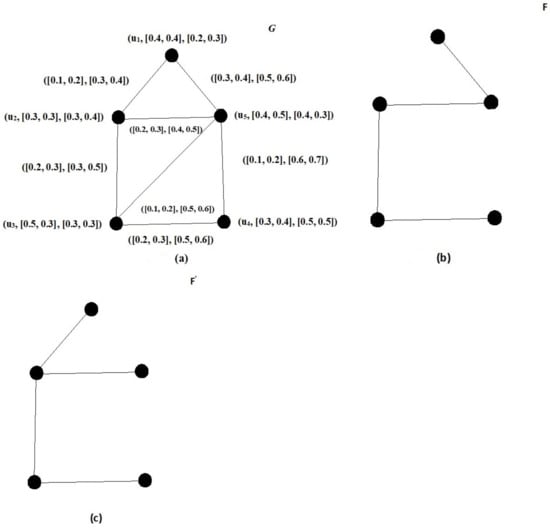
In Figure 4, consider , where and , G is an IVIF -tree and IVIF -tree; however, G is not an IVIFT because a spanning tree does not exist which is equal to both F and .
Figure 4.
Interval-valued intuitionistic fuzzy -tree and -tree G.
Theorem 7.
Let be an arc in an IVIF -tree. Then, an IVIFG G is an -strong if and only if the arc is present in -spanning tree F of G.
Proof.
It is straightforward. □
By Theorem 7, F is an IVIF -tree which includes all the -strong arcs.
Corollary 3.
If an IVIFG is an IVIF -tree, then an IVIFSSG F is a unique spanning -tree.
Theorem 8.
If there is an arc in the IVIF -tree, then an IVIFG G is -strong if and only if the arc is lying in the IVIFG G of the spanning -tree of .
Proof.
Let be an arc in G which is an -strong arc, so by Definition 22, we have . Whenever is not a part of an IVIFSSG , then consequently . Furthermore, the -tree that is an IVIFSSG is an IVISFS of . Therefore, this condition is satisfied . We observe that , which disproves our supposition. Thus, the arc is present in an IVIVSSG . Alternatively, assume an arc be a part of . In an IVIFG G, if the arc is not a -strong, so we have . A cycle is considered as a -cycle that includes the arc . So, in the cycle , there is an arc , not be a part of an IVIFSSG . Then, it follows . We obtain the -path from the node r to s in of G, and consequently , since an IVIFSSG is proven to be a -tree. Moreover, implies that implies that . Hence, the arc in each cycle of an IVIFG G is not proven to be the weakest -arc. Thus, this arc in G defined an IVIF -bridge by Proposition 7. Hence, the arc in G is an -strong. □
Corollary 4.
If an IVIFG G is an IVIF -tree, then an IVIFSSG of G contains a distinct spanning -tree.
Proposition 11.
A unique spanning tree exists in an IVIFT , satisfying .
Proof.
Let G be an IVIFT. Then, a unique spanning tree exists such that, for every arc not included in , we have
and also we have
Then, a unique spanning -tree F exists with , and similarly, a unique spanning -tree exists with . As a result, we obtain a distinct spanning tree with . □
Corollary 5.
An IVIFG is an IVIFT if and only if it is an IVIF -tree and an IVIF -tree together with the condition that .
Proof.
Let an IVIFG be an IVIFT; then, by Proposition 10, G must be an IVIF -tree and IVIF -tree, and by Proposition 11, we have . Conversely, let there exist a spanning -tree and a -tree, represented by F and with with . Then, for an arc not in IVIFSSG equal to F implies and . Thus, an IVIFG G is an IVIFT together with the spanning tree . □
Example 5.
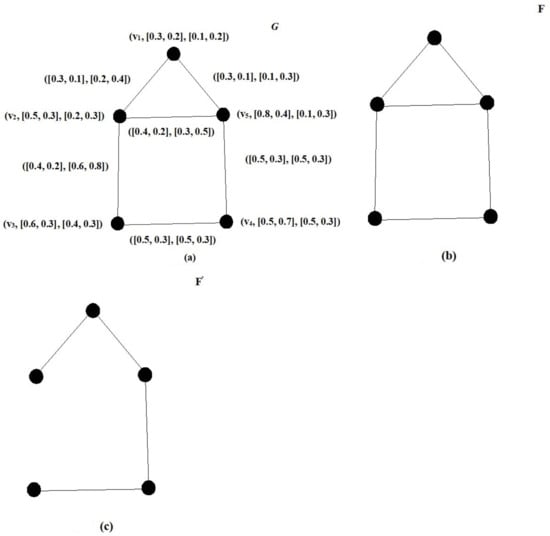
In Figure 5, consider , where and . IVIFG given in Figure 5 does not satisfy the property of the IVIF -tree because it contains -strong arcs; however, it is an IVIF -tree as it does not contain any -strong arcs. Thus, is not an IVIFT.
Figure 5.
Interval-valued intuitionistic fuzzy -tree .
Corollary 6.
In an IVIFT , arc is an -strong if and only if -strong in G.
Proof.
Let be an -strong arc in an IVIFG G. Then, the arc is present in the IVIFSSG F, and by Theorem 7, G is an IVIFT. Therefore, is equal to and is also equal to F, i.e., . It follows that the arc is present in the IVIFSSG . Hence, the arc in G is -strong by Theorem 8. The converse is the same as the above. □
Proposition 12.
Let be an IVIFG. Then:
- (i)
- If is an IVIF -tree and is not in F, then .
- (ii)
- If is an IVIF -tree and is not in , then .
- (iii)
- If an IVIFG is an IVIFT and is not in , then and .
Proof.
Consider a path P in F as a -path from node u to v. All the arcs present in P are -strong by Theorem 7. Consequently, P is -strong. Hence, by Proposition 3, P is a -strongest path. This implies that .
Consider a path P in as a -path from node u to v. All the arcs present in P are -strong by the Theorem 8. As a result, P is -strong. Hence, by Proposition 4, P is satisfied as a -strongest path. which implies that .
The third part of Proposition follows directly from the parts ( and , i.e., as well as . □
Example 6.
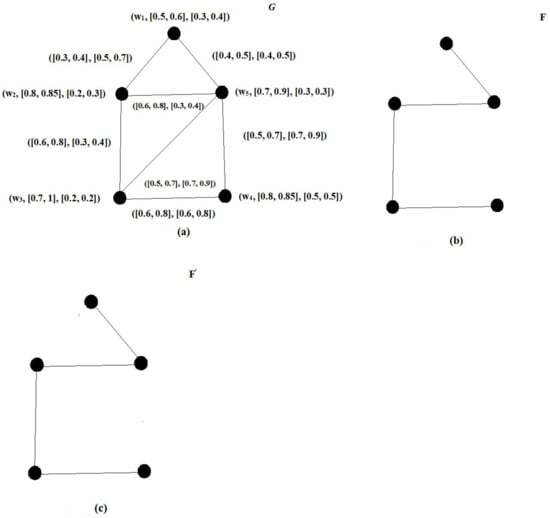
In Figure 6, , where and . An IVIFG is an IVIF -tree as well as an IVIF -tree, and we also have the equality that is . Consequently, G is an IVIFT.
Figure 6.
Interval-valued intuitionistic fuzzy graph G.
The arcs , , and in G are -strong and -strong. However, the arcs , and in G are -arcs and -arcs.
Finally, we analyze several types of IVIFCs and present a few relationships among IVIFTs and IVIFCs.
Definition 25.
Let G be a -cycle. Then, we call G an interval-valued intuitionistic fuzzy -cycle (IVIF--cycle) whenever G includes more than one weakest -arcs. Similarly, an IVIFG G is a -cycle, then we call an IVIFG G an interval-valued intuitionistic fuzzy -cycle (IVIF -cycle), whenever G has more than one weakest -arc. Finally, G is termed an IVIFC, and either it is an IVIF--cycle or an IVIF- -cycle.
Proposition 13.
Let be an IVIFG. Then, we have the following:
- (i)
- If is an IVIF--cycle, then there is no -arc in G.
- (ii)
- If is an IVIF -cycle, then there is no -arc in G.
- (iii)
- If an IVIFG is an IVIFC, then there are no -arcs or -arc in G.
Proof.
If is an -arc lying in G, then is a single weakest -arc, a contradiction to Definition 25.
If in G is a -arc, then in G turns into a single weakest -arc, a contradiction to Definition 25.
The third part of the proposition directly follows from the parts and . □
Theorem 9.
A path P in an IVIFG G is an IVIF--cycle if and only if it is not an IVIF--tree.
Proof.
Let C be an IVIF--cycle. Then, by Proposition 13, no -arcs exist in G. Consider C be an IVIF -tree, then a distinct spanning -tree represented by IVIFSSG F must exist there. If the arc is not present in the unique spanning tree F, then and by Proposition 13, we have . Hence, . Thus, G is not an IVIF -cycle. Conversely, do not let C be an IVIF--tree. Then, arc is a random distinct path such as exists there in G in such a way that we have . This means that there exists no unique weakest -arc. As a result, C is proven to be an IVIF--cycle. □
Theorem 10.
Let G be a -cycle. Then, G is an IVIF--cycle if and only if G is not an IVIF--tree.
Proof.
Let G be an IVIF--cycle, then by Proposition 13, no -arcs exists in G. Let G be an IVIF--tree, then a distinct spanning -tree represented by IVIFSSG exists there. If the arc is not present in the unique spanning tree , then and by Proposition 12 . This implies that . Thus, G is not an IVIF--cycle. Conversely, let G be an IVIF--tree. Therefore, arc in an IVIFG G, a distinct path such as exists in G in such a way that . It implies that in an IVIFG G, no unique weakest -arc exists. Thus, G is proven to be an IVIF--cycle. □
Corollary 7.
If an IVIFG G is an IVIFC, then it is not an IVIFT.
Proof.
Let G be an IVIFC. Then, either G is an IVIF--cycle or IVIF--cycle. Assume that G is an IVIF--cycle; then, by Theorem 9, G, which is an IVIFC, is not an IVIF--tree. Consequently, G is also not to be an IVIFT. Consider G as an IVIF--cycle; then, by Theorem 10, G is not an IVIF--tree, which implies that G is not an IVIFT. □
Remark 9.
The converse of Corollary 7 is not valid.
We can observe the converse of Corollary 7 in the next example.
Example 7.
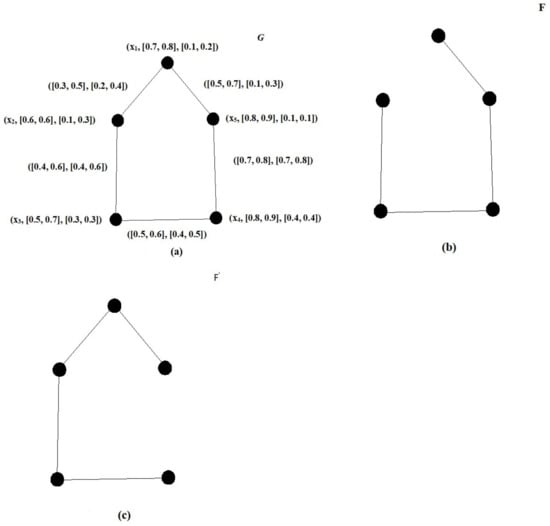
Consider an IVIFG shown in Figure 7, where and . Then, the arcs , and are -strong and -strong; the arc is -arc and -strong; and the arc is -strong and -arc. Hence, a graph G is an IVIF--tree and IVIF- -tree, but this IVIFG G is not an IVIFT as . Moreover, it is not an IVIFC as there is no weakest -arc or weakest -arc.
Figure 7.
Interval-valued intuitionistic fuzzy -tree and -tree G.
5. IVIF-Blocks and -Block Graphs
The structure of IVIFG G can be manipulated in different ways in terms of IVIF-intersection graphs. An -block graph is an important structure based on the IVIF-intersection graph. We can construct an IVIF-intersection graph by considering an IVIF-block in an IVIFG G as a family of sets and generate an IVIF-intersection graph on this collection by considering each set as a vertex. Before introducing the -block graph, first we propose the notion of fuzzy block graphs (F-block graphs) which is missing in the existing literature about fuzzy graphs.
Definition 26.
A fuzzy block graph is the fuzzy intersection graph in which the vertex set consists of fuzzy blocks.
Example 8.
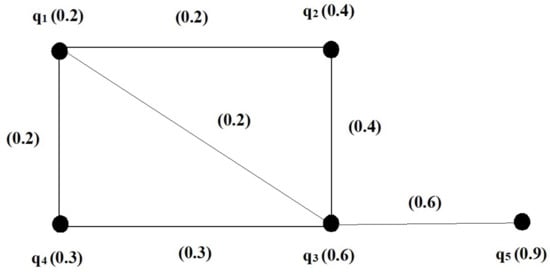
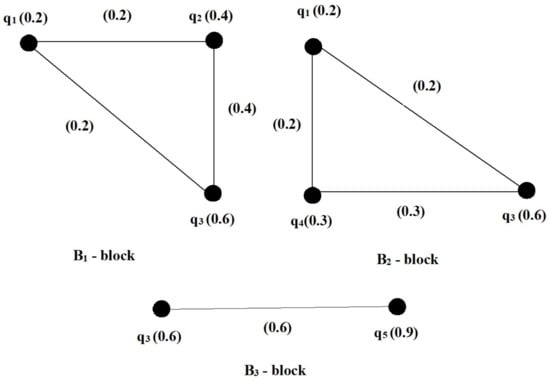
Consider an FG shown in Figure 8.
Figure 8.
A fuzzy graph G.
It is easy to verify that an has three fuzzy blocks, namely , , and given in Figure 9.
Figure 9.
Fuzzy blocks in an FG G.
We have a fuzzy intersection graph , for all , ∈ B and ∈ Z. In , we have
and
where = , = , =
For a fuzzy block graph, we allocate the values under the given conditions:
- (1)
- =
- (2)
- =
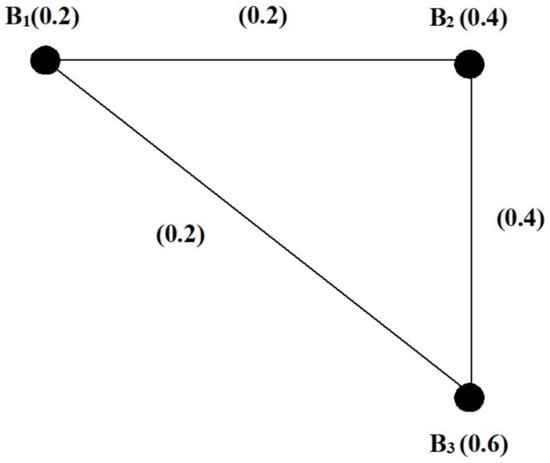
Thus, the values are: = = 0.2, = = 0.4, = = 0.6 and = = 0.2, = = 0.4, = = 0.2.
Using the above values, we have a new graph, a fuzzy block graph shown in Figure 10.
Figure 10.
A fuzzy block graph of G.
Now, we begin our discussion about the term -block graphs.
Definition 27.
In an IVIFG , a maximally connected IVIF subgraph is said to be a block in an if it is induced by a subset of vertices that does not contain any IVIF-cut vertex. If a graph G is the -block, then G is itself an -block in G.
Remark 10.
An IVIFG is an -block if there does not exist any IVIF-cut nodes.
Theorem 11.
A connected IVIFG is a block if and only if, for every two vertices which are not joined by -bridges, these are connected by two non-intersecting and distinct strongest -path.
Definition 28.
An -block graph is the -intersection graph of an IVIFG in which the vertex set consists of -blocks.
Example 9.
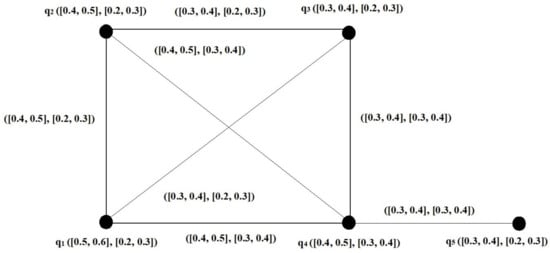
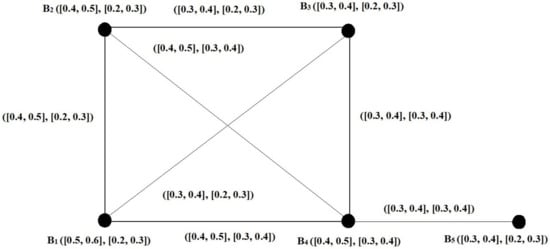
Consider an G shown in Figure 11. It is easy to observe that the vertices and are IVIF-cut nodes. Hence, G itself is not an IVIF-block. However, with the help of IVIF-cut nodes in an IVIFG G, one can analyze the in an IVIFG G.
Figure 11.
An IVIFG G.
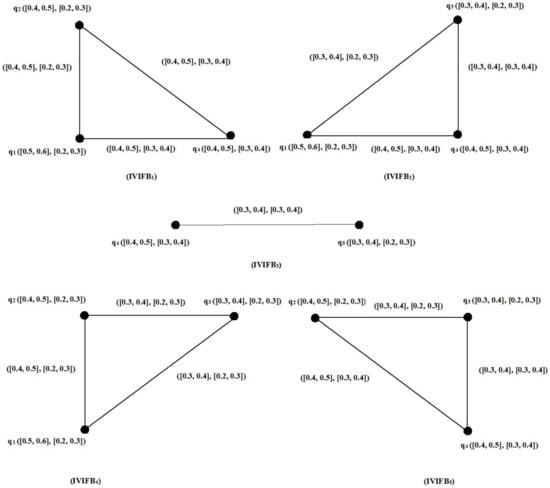
Here, , , , , and shown in Figure 12 are the -blocks in an .
Figure 12.
IVIFBs of IVIFG G.
Next, we produce an -block graph of IVIFG G.
Since we have five IVIF-blocks of an IVIFG shown in Figure 12, we can consider an IVIF-intersection graph, , for all , ∈ B, and ∈ Q. We can compute the values using the conditions of IVIF-intersection graphs given below:
- (1)
- = and = .
- (2)
- = and = .
Following the definition, we have
= = [0.5, 0.6],
= = [0.4, 0.5],
= = [0.3, 0.4],
= = [0.4, 0.5],
= = [0.3, 0.4];
= = [0.2, 0.3],
= = [0.2, 0.3],
= = [0.2, 0.3],
= = [0.3, 0.4],
= = [0.2, 0.3];
= = [0.4, 0.5],
= = [0.3, 0.4],
= = [0.4, 0.5],
= = [0.3, 0.4],
= = [0.4, 0.5],
= = [0.3, 0.4],
= = [0.3, 0.4];
= = [0.2, 0.3], = = [0.2, 0.3], = = [0.2, 0.3], = = [0.2, 0.3], = = [0.3, 0.4], = = [0.3, 0.4], = = [0.3, 0.4].
Hence, the resulting graph shown in Figure 13 is the corresponding -block graph of an G.
Figure 13.
-block graph of an IVIFG G.
Theorem 12.
In an G, = (, ) is an -block graph if and only if every in is a complete .
Proof.
Let be an -block graph and be an in . Let be an incomplete IVIFG, then we have two nodes , in with
Thus, is not a strong and neither nor are -cut-nodes in an IVIFG G. This contradicts the maximality of .
Conversely, let be an IVIFG in which every IVIF-block is complete. Construct using the conditions of the -intersection graph, and then generate a new by adding every vertex of having a number of end lines which is the same as the counting of the nodes of the block which are not the IVIF-cut nodes of G. Thus, it is very clear that is isomorphic to . □
6. Application
Assuming a traffic blockage on a road where we want to control the flow of traffic. By the use of an IVIF-tree, we can select the proper settings for a traffic light based on the traffic conditions. The input variables of this problem are given in the following:
stands for ’North Side’: All the vehicles standing at the northern side of the lane;
stands for ’South Side’: All the vehicles standing at the southern side of the lane;
stands for ’East Side’: All the vehicles standing at the eastern side of the lane;
stands for ’West Side’: All the vehicles standing at the western side of the lane;
Utilizing the aforementioned input variables like north, south, east, and west; the following structure will be helpful to produce an IVIF-tree:
- Whenever is L for low, THEN move to the vertex c;
- Whenever is M for medium, THEN move to the vertex i;
- Whenever is H for high, THEN move to the vertex b;
- Whenever is L for low, THEN move to the vertex e;
- Whenever is M for medium, THEN move to the vertex j;
- Whenever is H for high, THEN move to the vertex d;
- Whenever is L for low, THEN move to the vertex k;
- Whenever is M for medium, THEN move to the vertex g;
- Whenever is H for high, THEN move to the vertex l;
- Whenever is L for low, THEN move to the vertex f;
- Whenever is M for medium, THEN move to the vertex m;
- Whenever is H for high, THEN move to the vertex h.
: IF the aggregate vehicle count at the SS is specified as L, THEN for the northward road, the output is shown by a green light, ELSE, IF the aggregate vehicle count at the SS is specified as M, THEN for the northward road, the output is shown by a yellow light, ELSE, for the northward road, the output is shown by a red light;
: IF the aggregate vehicle count at the SS is specified as H, THEN for the southward road, the output is shown by a green light, ELSE, IF the aggregate vehicle count at the SS is specified as M, THEN for the eastward road, the output is shown by a yellow light, ELSE, for the eastward road, the output is shown by a red light;
: IF the aggregate vehicle count at the WS is specified as L, THEN for the eastward road, the output is shown by a green light, ELSE, IF the aggregate vehicle count at the WS is specified as M, THEN for the eastward road, the output is shown by a yellow light, ELSE, for the eastward road, the output is shown by a red light;
: IF the aggregate vehicle count at the WS is specified as H, THEN for the eastward road, the output is shown by a green light, ELSE, IF the aggregate vehicle count at the WS is specified as M, THEN for the southward road, the output is shown by a yellow light, ELSE, for the southward road, the output is shown by a red light;
: IF the aggregate vehicle count at the NS is specified as L, THEN for the eastward road, the output is shown by a green light, ELSE, IF the aggregate vehicle count at the NS is specified as M, THEN for the eastward road, the output is shown by a yellow light, ELSE, for the eastward road, the output is shown by a red light;
: IF the aggregate vehicle count at the NS is specified as H, THEN for the westward road, the output is shown by a green light, ELSE, IF the aggregate vehicle count at the NS is specified as M, THEN for the northward road, the output is shown by a yellow light, ELSE, for the northward road, the output is shown by a red light;
: IF the aggregate vehicle count at the ES is specified as L, THEN for the northward road, the output is shown by a green light, ELSE, IF the aggregate vehicle count at the ES is specified as M, THEN for the northward road, the output is shown by a yellow light, ELSE, for the northward road, the output is shown by a red light;
: IF the aggregate vehicle count at the ES is specified as H, THEN for the southward road, the output is shown by a green light, ELSE, IF the aggregate vehicle count at the ES is specified as M, THEN for the westward road, the output is shown by a yellow light, ELSE, for the westward road, the output is shown by a red light;
: IF the aggregate vehicle count at the SS is specified as L, THEN for the northward road, the output is shown by a yellow light, ELSE, IF the aggregate vehicle count at the SS is specified as M, THEN for the northward road, the output is shown by a red light, ELSE, for the northward road, the output is shown by a red light;
: IF the aggregate vehicle count at the WS is Low, THEN for the eastward road, the output is shown by a yellow light, ELSE, IF the aggregate vehicle count at the WS is specified as M, THEN for the eastward road, the output is shown by a red light, ELSE, for the eastward road, the output is shown by a red light;
: IF the aggregate vehicle count at the NS is specified as L, THEN for the eastward road, the output is shown by a yellow light, ELSE, IF the aggregate vehicle count at the NS is specified as M, THEN for the eastward road, the output is shown by a red light, ELSE, for the eastward road, the output is shown by a red light;
: IF the aggregate vehicle count at the ES is specified as L, THEN for the northward road, the output is shown by a yellow light, ELSE, IF the aggregate vehicle count at the ES is specified as M, THEN for the northward road, the output is shown by a red light, ELSE, for the northward road, the output is shown by a red light.
We would further need to calculate the an element’s membership degree represented by and non-membership degree represented by in an IVIFT for the “Medium” condition, based on the peculiar traffic situations.
Suppose that, for all the aforementioned input variables, like , , , and , the degree of membership for the “medium” condition is [0.5, 0.6]
: = , = ;
: = , = ;
: = , = ;
: = , = ;
: = , = ;
: = , = ;
: = , = ;
: = , = ;
: = , = ;
: = , = ;
: = , = ;
: = , = .
By utilizing the membership and non-membership values as mentioned above, we can apply the IVIF-tree to determine the correct traffic light setting for any sequence of low, medium, and high traffic situations.
7. Conclusions
In this research work, we developed the theory of connectivity of IVIFGs and provided application towards road map designs. In this context, we initiated the concepts of IVIF-bridges, IVIF-cut vertices, IVIF-trees, IVIF-cycles. Moreover, we have also introduced the concepts of IVIF-blocks and IVIF-block graphs. Throughout, we provided suitable examples and counter examples to furnish our results. We have also provided several inter-relationships among the newly established terms. Many characterizations of IVIFGs have also been provided. Finally, we provided the application of IVIFTs towards road map designing. One can shift all the terms introduced in our study towards interval-valued picture fuzzy graphs, bipolar picture fuzzy graphs, etc.
Author Contributions
Conceptualization, H.G., W.A.K., S.S. and W.A.; methodology, J.S., A.K., W.A., W.A.K. and S.S.; validation, H.G., W.A.K. and J.S.; formal analysis, S.S. and A.K.; investigation, A.K. and W.A.K.; writing—original draft preparation, H.G., S.S. and W.A.K.; writing—review and editing, J.S. and A.K.; supervision, H.G. and W.A.K. All authors have read and agreed to the published version of the manuscript.
Funding
This research received no external funding.
Data Availability Statement
Data is contained within the article.
Conflicts of Interest
The authors declare no conflict of interest.
References
- Zadeh, L.A. Fuzzy sets. Inf. Control 1965, 8, 338–353. [Google Scholar] [CrossRef]
- Zadeh, L.A. The concept of a linguistic variable and its application to approximate reasoning I. Inf. Sci. 1975, 8, 199–249. [Google Scholar] [CrossRef]
- Atanassov, K.T.; Atanassov, K.T. Intuitionistic Fuzzy Sets; Physica-Verlag HD: Heidelberg, Germany, 1999; pp. 1–137. [Google Scholar]
- Atanassov, K.T.; Atanassov, K.T. Interval valued intuitionistic fuzzy sets. In Intuitionistic Fuzzy Sets: Theory and Applications; Springer: Berlin/Heidelberg, Germany, 1999; pp. 139–177. [Google Scholar]
- Dugenci, M. A new distance measure for interval valued intuitionistic fuzzy sets and its application to group decision making problems with incomplete weights information. Appl. Soft Comput. 2016, 41, 120–134. [Google Scholar] [CrossRef]
- Ahn, J.Y.; Han, K.S.; Oh, S.Y.; Lee, C.D. An application of interval-valued intuitionistic fuzzy sets for medical diagnosis of headache. Int. J. Innov. Comput. Inf. Control. 2011, 7, 2755–2762. [Google Scholar]
- Rosenfeld, A. Fuzzy graphs. In Fuzzy Sets and Their Applications to Cognitive and Decision Processes; Academic Press: Cambridge, MA, USA, 1975; pp. 77–95. [Google Scholar]
- Yeh, R.T.; Bang, S.Y. Fuzzy relations, fuzzy graphs, and their applications to clustering analysis. In Fuzzy Sets and Their Applications to Cognitive and Decision Processes; Academic Press: Cambridge, MA, USA, 1975; pp. 125–149. [Google Scholar]
- Bhutani, K.R.; Battou, A. On M-strong fuzzy graphs. Inf. Sci. 2003, 155, 103–109. [Google Scholar] [CrossRef]
- Bhattacharya, P. Some Remarks on fuzzy graphs. Pattern Recognit. Lett. 1987, 6, 297–302. [Google Scholar] [CrossRef]
- Mordeson, J.N.; Chang-Shyh, P. Operations on fuzzy graphs. Inf. Sci. 1994, 79, 159–170. [Google Scholar] [CrossRef]
- Mordeson, J.N.; Nair, P.S. Cycles and cocycles of fuzzy graphs. Inf. Sci. 1996, 90, 39–49. [Google Scholar] [CrossRef]
- Mathew, S.; Sunitha, M.S. Types of arcs in a fuzzy graph. Inf. Sci. 2009, 179, 1760–1768. [Google Scholar] [CrossRef]
- Hongmei, J.; Lianhua, W. Interval-valued fuzzy subsemigroups and subgroups associated by interval-valued fuzzy graphs. In Proceedings of the 2009 WRI Global Congress on Intelligent Systems, Xiamen, China, 19–21 May 2009; Volume 1, pp. 484–487. [Google Scholar]
- Borzooei, R.A.; Rashmanlou, H. Cayley interval-valued fuzzy graphs. UPB Scientific Bulletin, Series. Appl. Math. Phys. 2016, 78, 83–94. [Google Scholar]
- Shannon, A.; Atanassov, K.T. A first step to a theory of the intuitionistic fuzzy graphs. In Proceedings of the First Workshop on Fuzzy Based Expert Systems, Sofia, 1994; Akov, D., Ed.; pp. 59–61. [Google Scholar]
- Parvathi, R.; Karunambigai, M.G.; Atanassov, K.T. Operations on intuitionistic fuzzy graphs. In Proceedings of the 2009 IEEE International Conference on Fuzzy Systems, Jeju, Republic of Korea, 20–24 August 2009; pp. 1396–1401. [Google Scholar]
- Parvathi, R.; Shannon, A.; Chountas, P.; Atanassov, K. On intuitionistic fuzzy tree-interpretations by index matrices. Notes Intuit. Fuzzy Sets 2011, 17, 17–24. [Google Scholar]
- Gani, A.N.; Begum, S.S. Degree, order and size in intuitionistic fuzzy graphs. Int. J. Comput. Algorithm 2010, 3, 11–16. [Google Scholar]
- Sahoo, S.; Pal, M. Intuitionistic fuzzy competition graphs. J. Appl. Math. Comput. 2016, 52, 37–57. [Google Scholar] [CrossRef]
- Sahoo, S.; Pal, M. Intuitionistic fuzzy tolerance graphs with application. J. Appl. Math. Comput. 2017, 55, 495–511. [Google Scholar] [CrossRef]
- Nazeer, I.; Rashid, T. Connectivity Concepts in Intuitionistic Fuzzy Incidence Graphs with Application. Int. J. Appl. Comput. Math. 2022, 8, 263. [Google Scholar] [CrossRef] [PubMed]
- Kahraman, C.; Bozhenyuk, A.; Knyazeva, M. Internally stable set in intuitionistic fuzzy graph. In Intelligent and Fuzzy Systems; Springer International Publishing: Cham, Switzerland, 2022; pp. 566–572. [Google Scholar]
- Shao, Z.; Kosari, S.; Rashmanlou, H.; Shoaib, M. New concepts in intuitionistic fuzzy graph with application in water supplier systems. Mathematics 2020, 8, 1241. [Google Scholar] [CrossRef]
- Ismayil, A.M.; Ali, A.M. On strong interval-valued intuitionistic fuzzy graph. Int. J. Fuzzy Math. Syst. 2014, 4, 161–168. [Google Scholar]
- Bera, J.; Das, K.C.; Samanta, S.; Lee, J.G. Connectivity Status of Intuitionistic Fuzzy Graph and Its Application to Merging of Banks. Mathematics 2023, 11, 1949. [Google Scholar] [CrossRef]
- Chountas, P.; Shannon, A.; Rangasamy, P.; Atanassov, K. On intuitionistic fuzzy trees and their index matrix interpretation. Notes Intuit. Fuzzy Sets 2009, 15, 52–56. [Google Scholar]
- Chountas, P.; Alzebdi, M.; Shannon, A.; Atanassov, K. On intuitionistic fuzzy trees. In Proceedings of the 13th International Conference on Intuitionistic Fuzzy Sets, Sofia, Bulgaria, 9–10 May 2009; Volume 15, pp. 30–32. [Google Scholar]
- Thamizhendhi, G.; Parvathi, R. Intuitionistic fuzzy tree center-based clustering algorithm. Int. J. Soft Comput. Eng. (IJSCE) 2016, 6, 50–65. [Google Scholar]
- Akram, M.; Al-Shehrie, N.O. Intuitionistic fuzzy cycles and Intuitionistic fuzzy trees. Sci. World J. 2014, 7, 654–661. [Google Scholar] [CrossRef]
- Sunitha, M.S.; Vijayakumar, A. A characterization of fuzzy trees. Inf. Sci. 1999, 113, 293–300. [Google Scholar] [CrossRef]
- Mishra, S.N.; Pal, A. Regular Interval-Valued Intuitionistic Fuzzy Graphs. J. Inform. Math. Sci. (JIMS) 2017, 9, 609–621. [Google Scholar]
- Rashmanlou, H.; Borzooei, R.A.; Samanta, S.; Pal, M. Properties of interval valued intuitionistic (s,t) fuzzy graphs. Pacific Science Review. J. Nat. Sci. Eng. 2016, 18, 30–37. [Google Scholar]
- Rashmanlou, H.; Borzooei, R.A. New concepts of interval-valued intuitionistic (S, T)-fuzzy graphs. J. Intell. Fuzzy Syst. 2016, 30, 1893–1901. [Google Scholar] [CrossRef]
- Talebi, A.A.; Rashmanlou, H.; Sadati, S.H. Interval-valued intuitionistic fuzzy competition graph. J. Mult.-Valued Logic Soft Comput. 2020, 34, 335–364. [Google Scholar]
- Arif, W.; Khan, W.A.; Khan, A.; Rashmanlou, H. Some indices of picture fuzzy graphs and their applications. J. Comput. Appl. Mathe. 2023, 42, 253. [Google Scholar] [CrossRef]
- Arif, W.; Khan, W.A.; Rashmanlou, H.; Khan, A.; Muhammad, A. Multi attribute decision-making and interval-valued picture (S, T)-fuzzy graphs. J. Appl. Math. Comput. 2023, 69, 2831–2856. [Google Scholar] [CrossRef]
- Atanassov, K. Interval-valued intuitionistic fuzzy graphs. Notes Intuit. Fuzzy Sets 2019, 25, 21–31. [Google Scholar] [CrossRef]
- Traneva, V.; Tranev, S. On Index-Matrix Interpretation of Interval-Valued Intuitionistic Fuzzy Hamiltonian Cycle. In Recent Advances in Computational Optimization: Results of the Workshop on Computational Optimization WCO 2020; Springer International Publishing: Berlin/Heidelberg, Germany, 2022; Volume 14, pp. 329–348. [Google Scholar]
- Akram, M.; Dudek, W.A. Interval-valued fuzzy graphs. Comput. Math. Appl. 2011, 61, 289–299. [Google Scholar] [CrossRef]
- Lee, K.M.; Lee, K.M.; Cios, K.J. Comparison of interval-valued fuzzy sets, intuitionistic fuzzy sets, and bipolar-valued fuzzy sets. In Computing and Information Technologies: Exploring Emerging Technologies; World Scientific: Singapore, 2001; pp. 433–439. [Google Scholar]
- Philip, A.M. Interval-valued fuzzy bridges and interval-valued fuzzy cutnodes. J. Pure Appl. Math. 2017, 14, 473–487. [Google Scholar] [CrossRef]
- Karunambigai, M.G.; Parvathi, R.; Buvaneswari, R. Arcs in intuitionistic fuzzy graphs. Notes Intuit. Fuzzy Sets 2011, 17, 37–47. [Google Scholar]
- Rao, Y.; Kosari, S.; Shao, Z.; Talebi, A.A.; Mahdavi, A.; Rashmanlou, H. New concepts of intuitionistic fuzzy trees with applications. Int. J. Comput. Intell. Syst. 2021, 14, 1–12. [Google Scholar] [CrossRef]
Disclaimer/Publisher’s Note: The statements, opinions and data contained in all publications are solely those of the individual author(s) and contributor(s) and not of MDPI and/or the editor(s). MDPI and/or the editor(s) disclaim responsibility for any injury to people or property resulting from any ideas, methods, instructions or products referred to in the content. |
© 2023 by the authors. Licensee MDPI, Basel, Switzerland. This article is an open access article distributed under the terms and conditions of the Creative Commons Attribution (CC BY) license (https://creativecommons.org/licenses/by/4.0/).