
Abstract
The number of actuators of an underactuated robot is less than its degree of freedom. In other words, underactuated robots can be designed with fewer actuators than fully actuated ones. Although an underactuated robot is more complex than a fully actuated robot, it has many advantages, such as energy, material, and space saving. Therefore, it has high research value in both control theory and practical applications. Swing-up is a mechanism with two links, which mimics a gymnast performing a horizontal bar movement. Over the past few decades, many sufficiently robust control techniques have been developed for a fully actuated robot but almost none of them can be directly applicable to an underactuated robot system. The reason is that such control techniques require certain assumptions that are valid only for fully actuated robot systems but not for underactuated ones. In this paper, a control system design method for underactuated robots based on operator theory and an isomorphism scheme is first proposed. Bezout identity is designed using isomorphism. The effectiveness of the design method is confirmed by simulation. The simulation results show that the performances, such as robust stability and response time, of an underactuated robot control system are improved.
Keywords:
nonlinear control system; operator theory; right coprime factorization; underactuated robot; swing-up MSC:
93C10
1. Introduction
According to the relationship between degree of freedom (DOF) of a robot and the number of independent control inputs, robots can be devided into three types: fully actuated, redundantly actuated, and underactuated ones [1]. The number of actuators of an underactuated robot is less than its DOF. Despite the higher complicity of an underactuated robot than that of a fully actuated one, it has the advantages of energy, material, and space saving, etc. In some specific cases, if there is precise drive control, it can achieve higher efficiency and better flexibility despite its high DOF [2]. Therefore, it deserves more investigations in theory and practice.
Its typical example is acrobot. An acrobotic robot is a two-link mechanism that mimics a gymnast performing a horizontal bar movement [3]. In recent decades, many sufficiently robust control techniques have been developed for a fully actuated robot but they are not directly applicable to an underactuated robot system. [4] concerns the energy-based swing-up control for a remotely driven acrobot (RDA), which is a 2-link planar robot with the first link being underactuated and the second link being remotely driven by an actuator mounted at a fixed base through a belt. An energy-based control law for swinging up the acrobot is proposed in [5]. The control law is designed and the convergence analysis is carried out based on Lyapunov stability theory. The paper [6] provides a complete analysis of the convergence of the energy and the motion of the acrobot and clearly illustrates several unique characteristics of the closed-loop system of the acrobot under the energy-based control. The combination of the partial linearization control for the swing-up phase proposed by [7] and the robust control for the capture and balance phase is utilized in [8]. The reason is that their deployment requires some assumptions that are true for fully actuated robot systems but not for an underactuated one [3,9]. A major problem is that the stability of the control system cannot be guaranteed when they are applied to the latter. The stabilization analysis in [10] is based on the attractive ellipsoid method (AEM) for a class of uncertain nonlinear systems having “quasi-Lipschitz” nonlinearities. The paper [11] presents a development of adaptive state estimator and output controller based on Attractive Ellipsoid Method (AEM) for the stabilization of the Furuta’s pendulum. The proposed method guarantees that the controlled system trajectories are stabilized within an ellipsoid of a “minimal size”. The proposed method for swinging up and stabilizing underactuated two-link robots in [12] does not need to switch control laws when the system is near to the desired equilibrium point, and as the system approach to this equilibrium, the nonlinear control law becomes an LQR controller. Moreover, nonlinear dynamics is also a factor that needs to be considered. In [13], Zakai and Kushner-Stratonovich equations of the nonlinear filtering problem for a non-Gaussian signal-observation system are considered. Operator theory is a kind of nonlinear control theory which has the characteristics of nonlinear and uncertain unstable elements [14,15,16,17,18,19,20]. In addition, robust stability analysis can be performed only in a time domain without conversion to a frequency domain. Its advantage is that it can be done relatively easily, which indicates the effectiveness of operator theory. Further, an isomorphism is a map from one algebraic structure to another of the same type that preserves some relevant structures and properties uch as identity elements, inverse elements, and binary operations [21]. That is, the robust stability for nonlinear feedback control systems and the output tracking problems are studied. For the problem of factorizing an unstable plant for its nonlinear feedback control systems, its right factorization can be conducted by using an isomorphism approach [22].
In this paper, a control system design method based on operator theory and an isomorphism scheme is proposed to improve the performance of an underactuated robot with instability and uncertainties. That is, operator theory is employed for guaranteeing the robust stability, while an isomorphism scheme is used to avoid the existence of differential controller in operator-based control systems. The application of operator theory and the isomorphism scheme enable a shorter swing-up time. Extensive simulation is performed to validate the effectiveness of the proposed method. In summary, the highlights of our work include: (1) We use isomorphism to design feedback controller to stabilize the system for the first time. (2) We use the new stable term to design Bezout identity. (3) We have applied it in acrobot and obtained good results.
The remainder of this paper is organized as follows. In Section 3, modelling of swing-up and operator theory are introduced. In Section 4, a control system design method for an underactuated robot is presented. The simulations are given to illustrate the effectiveness of the proposed method in Section 5. Finally, conclusions are drawn in Section 6.
2. Notation
In this section, we will present some notations in this paper in Table 1.
Table 1.
Notations.
3. Preliminaries
3.1. Modeling of Swing-Up
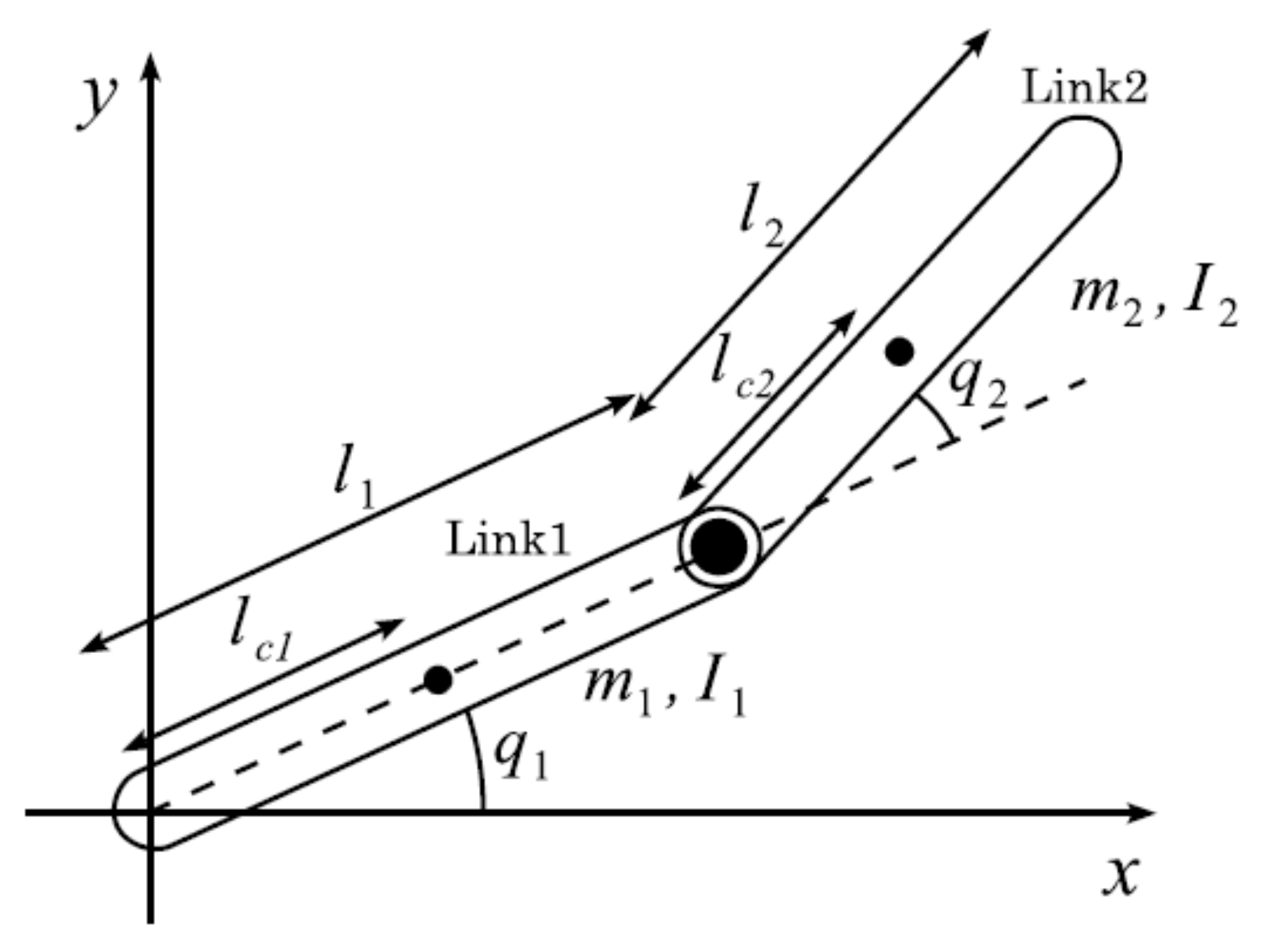
As mentioned above, swing-up is a two-link device that mimics a gymnast performing a horizontal bar movement, as shown in Figure 1. Link1 models a gymnast’s hand, and Link2 models a gymnast’s waist [9]. Driving torque is applied only to the Link1, and the system can rotate freely. Swing-up has only one actuator to drive, but there are two links to be controlled. Thus, it is an underactuated robot system. Table 2 shows each parameter. Then, the equations of motion for each link are derived using the Lagrange equations of motion. Therefore, the motion equations of swing-up are as follows
where , , , , , , , and are shown in the following equations
Figure 1.
Model of swing-up.
Table 2.
Parameter of swing-up.
3.2. Operator Theory
In this section, operator theory [14] is described. Using operator theory, a robust stability analysis can be performed even with uncertainties that are difficult to model in mathematics. Here, a nonlinear control system with uncertainties can be designed in the time domain by operator theory instead of being converted into the frequency domain by using a transfer function in a linear system. A nonlinear feedback system based on operator theory is shown in Figure 2.
Figure 2.
Nonlinear feedback system based on operator theory.
Definition 1.
Let be the set of stable operators from U to Y. Then, contains a subset defined by
Elements of are called unimodular operators.
Let and be two normed linear spaces over the field of of complex numbers, endowed, respectively, with norms and . Let be an operator mapping from to and denoted by and , respectively, the domain and range of A. Let be the family of all nonlinear operators mapping from into . Let be a subset of and be the family of operators A in with . A (semi)-norm on (a subset of) is denoted by
if it is finite. In general, it is a semi-norm in the sense that does not necessarily imply . In fact, it can be easily seen that if and only if A is a constant operator (need not be zero) that maps all elements from to the same element in .
Definition 2.
Let be the subset of with each element A satisfying . Each is called a Lipschitz operator mapping from to , and the number is called the Lipschitz seminorm of the operator A on .
- (i)
- Right factorization: Let the input space be denoted by U and output space by Y. In general, these spaces are different extended linear spaces. Let the plant operator be such that where and . In addition, let W be an auxiliary linear space and let the operator be stable such that , , and let be stable and invertible such that . It follows that the plant P has a right factorization determined by N and
- (ii)
- Right coprime factorization: Suppose there is a right factorization operator N, D in plant P. The Bezout equation is obtained as
- (iii)
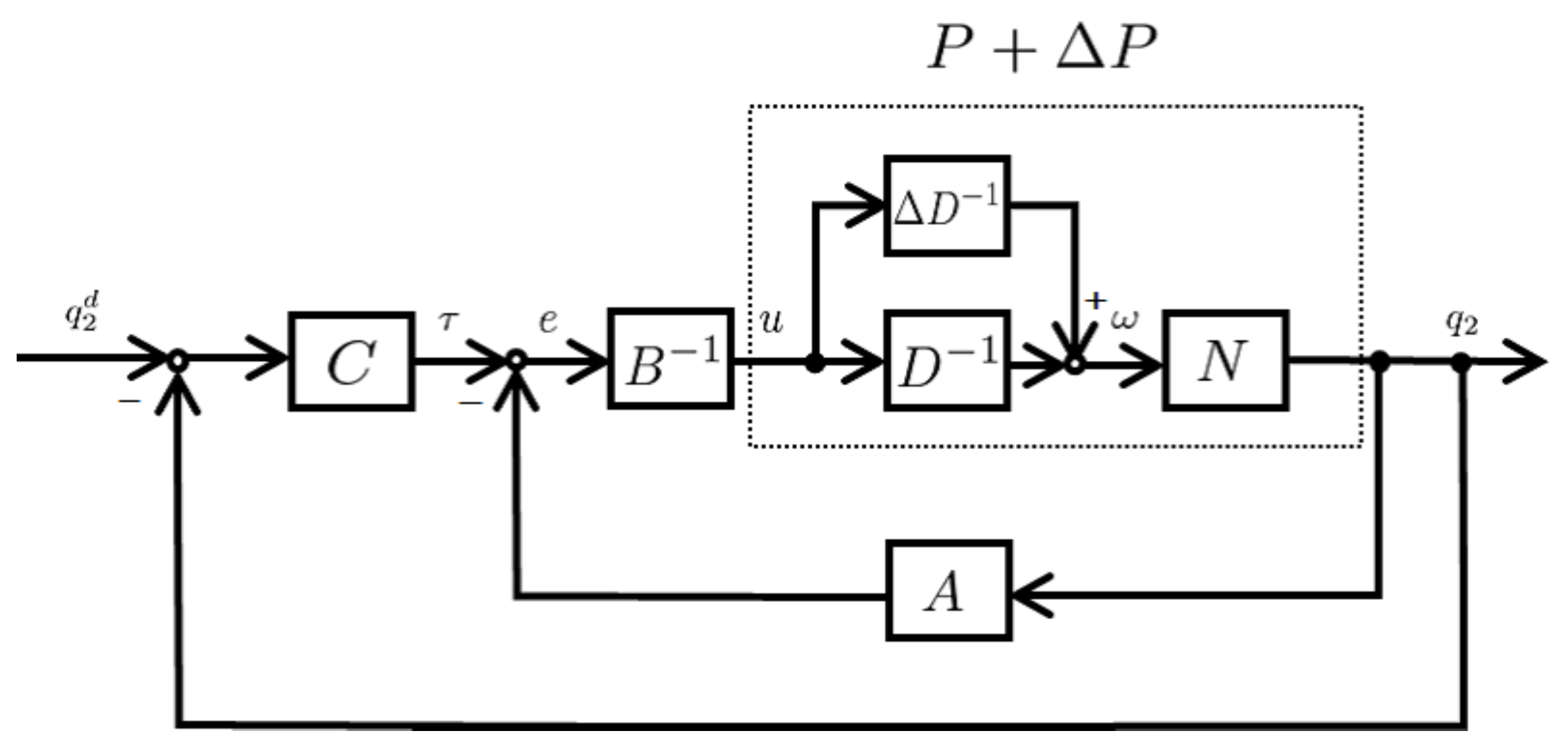
- Robust right coprime factorization: In general, there are uncertainties that are difficult to express in a mathematical model in an actual nonlinear control system. Thus, the nonlinear control system with uncertainties may be unstable. Using robust right coprime factorization to factorize a plant can guarantee the robust stability of a nonlinear feedback system with uncertainties. The nonlinear feedback system with uncertainties is shown in Figure 3. Plant P without uncertainties is the nominal plant, and the actual plant with uncertainties iswhere is unimodular. The nonlinear feedback system with uncertainties can be robust stable if (8) is satisfied.
Figure 3. Nonlinear feedback control system with uncertainties.
4. Nonlinear Control System Design
4.1. Tracking Controller Design of Swing-Up
In this section, we explain the method for determining the target angle and the tracking controller design scheme in the swing-up control system.
4.1.1. Determining Target Angle
The swing-up control can make the second link track the target angle in the direction in which the energy of the first link is amplified. Therefore, the target angle is a time-varying value that changes depending on the state of each link, and it is necessary to change the target angle at any time. If the angle of the second link does not become 0 near the inverted point, it is difficult to stabilize the inverted state. is designed as
4.1.2. Tracking Controller Design
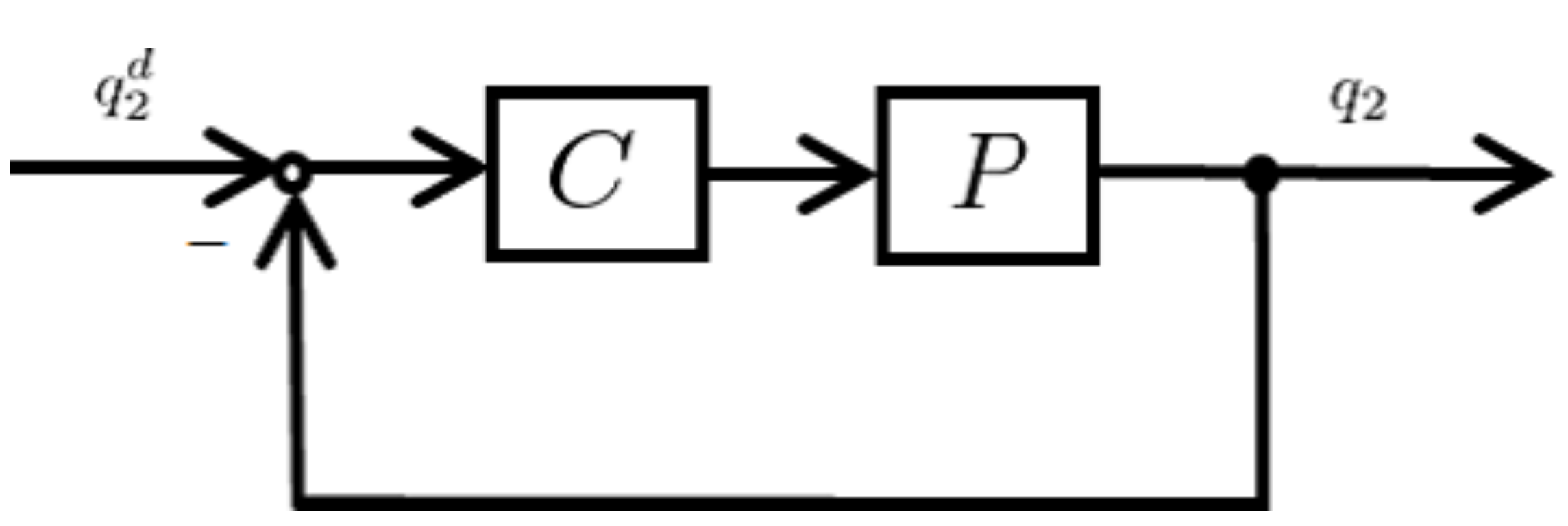
In this section, in order to make track , we design a tracking controller C as shown in Figure 4. The design method of the tracking controller is as follows.
Figure 4.
Feedback system using tracking controller.
First, from (1) and (2), the following equation can be obtained.
As a result, the swing-up control is performed when an input approaches 0. Here, and are design parameters.
4.2. Control System Design Based on Operator Theory and Isomorphism Scheme
Since there are unstable elements in the model equation of the swing-up, the stability of the control system cannot be guaranteed. In this section, the swing-up controller design method using operator theory and isomorphism scheme is proposed.
4.2.1. Right Factorization of the Swing-Up
In actual nonlinear control system, it is common that there are uncertainties in swing-up, which uncertainties are difficult to to be modelled. The uncertainties can be seen as instability elements, which destabilize the system. Here, the instability elements are aggregated in . Right factorization of the swing-up is given by
where
4.2.2. Right Coprime Factorization of Underactuated Robot
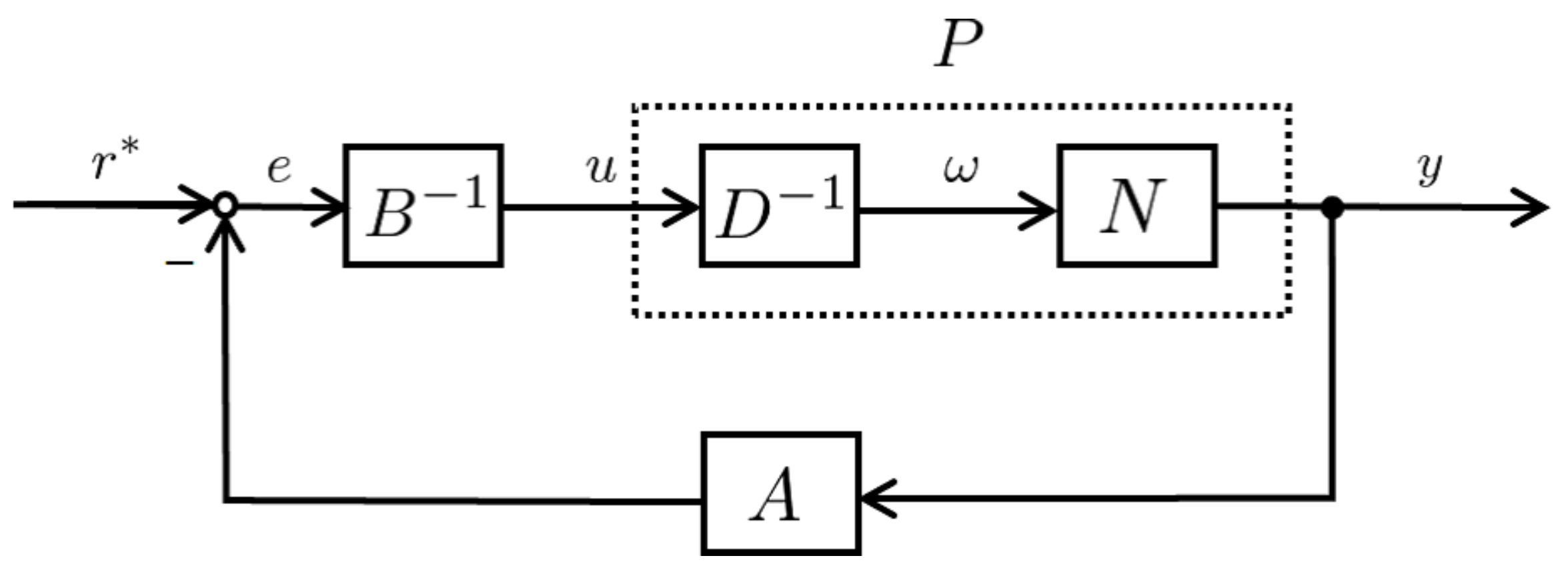
When the operators A and B are designed so that M is unimodular, and the Bezout equation is satisfied, then the operators and N form a right coprime factorization of the plant operator P, and the corresponding nonlinear feedback system is shown in Figure 5. Bounded input and bounded output (BIBO) stability are guaranteed. Operators A and B are designed as follows using a design parameter K
Figure 5.
Nonlinear feedback system based on operator theory.
The controller C that tracks the target value is designed as follows
4.2.3. Robust Stability Condition
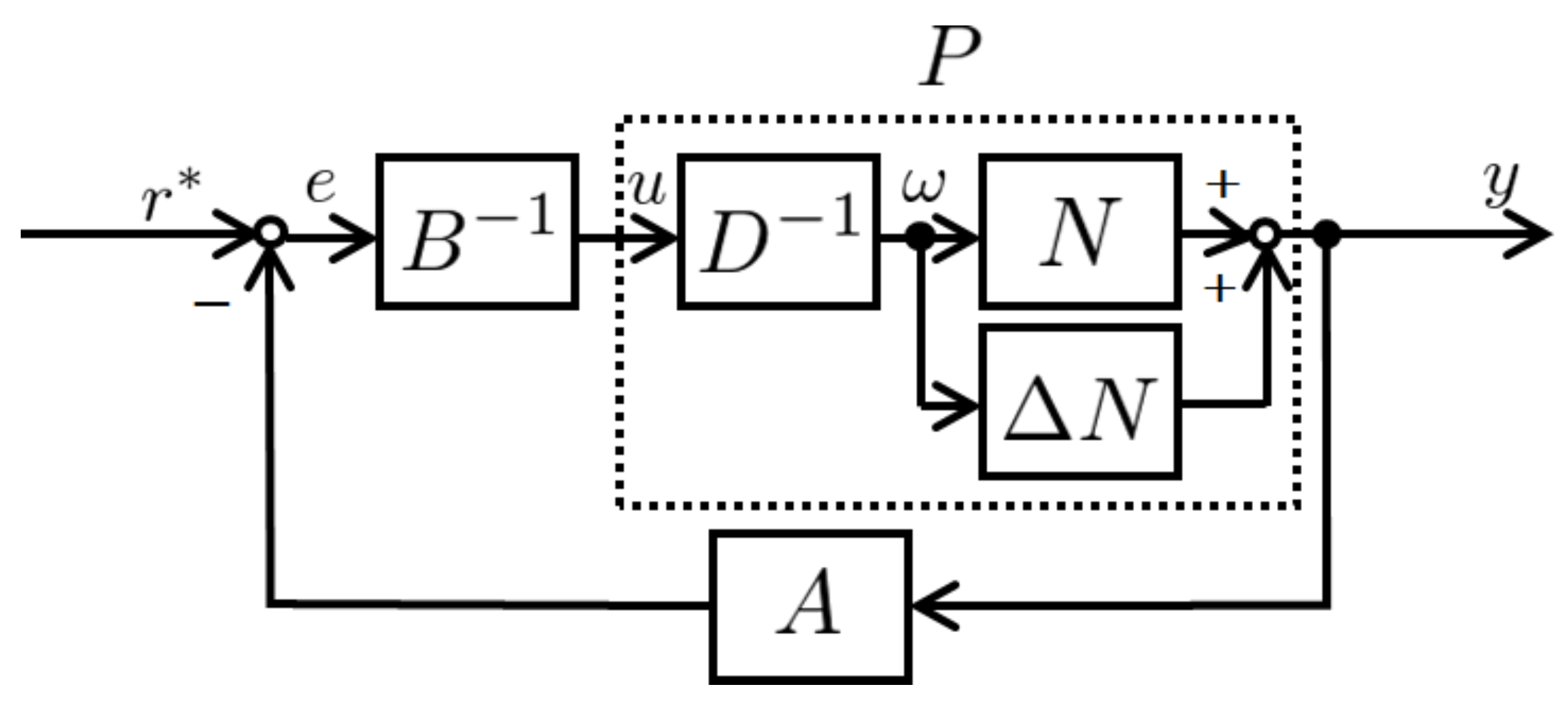
There are uncertainties in actual controlled objects that are difficult to express in mathematics. However, even if there are uncertainties, the robust stablity of the feedback system can be guaranteed if (21) is satisfied. We construct a nonlinear feedback system considering the uncertainties and robust stability. Figure 6 shows the nonlinear feedback system of the swing-up with uncertainties. In Figure 6, is the actual controlled object with uncertainties, where uncertainties are modelled for D as
Figure 6.
Nonlinear feedback system with uncertainties based on operator theory.
4.2.4. Control System Design Based on Operator Theory and Isomorphism Scheme

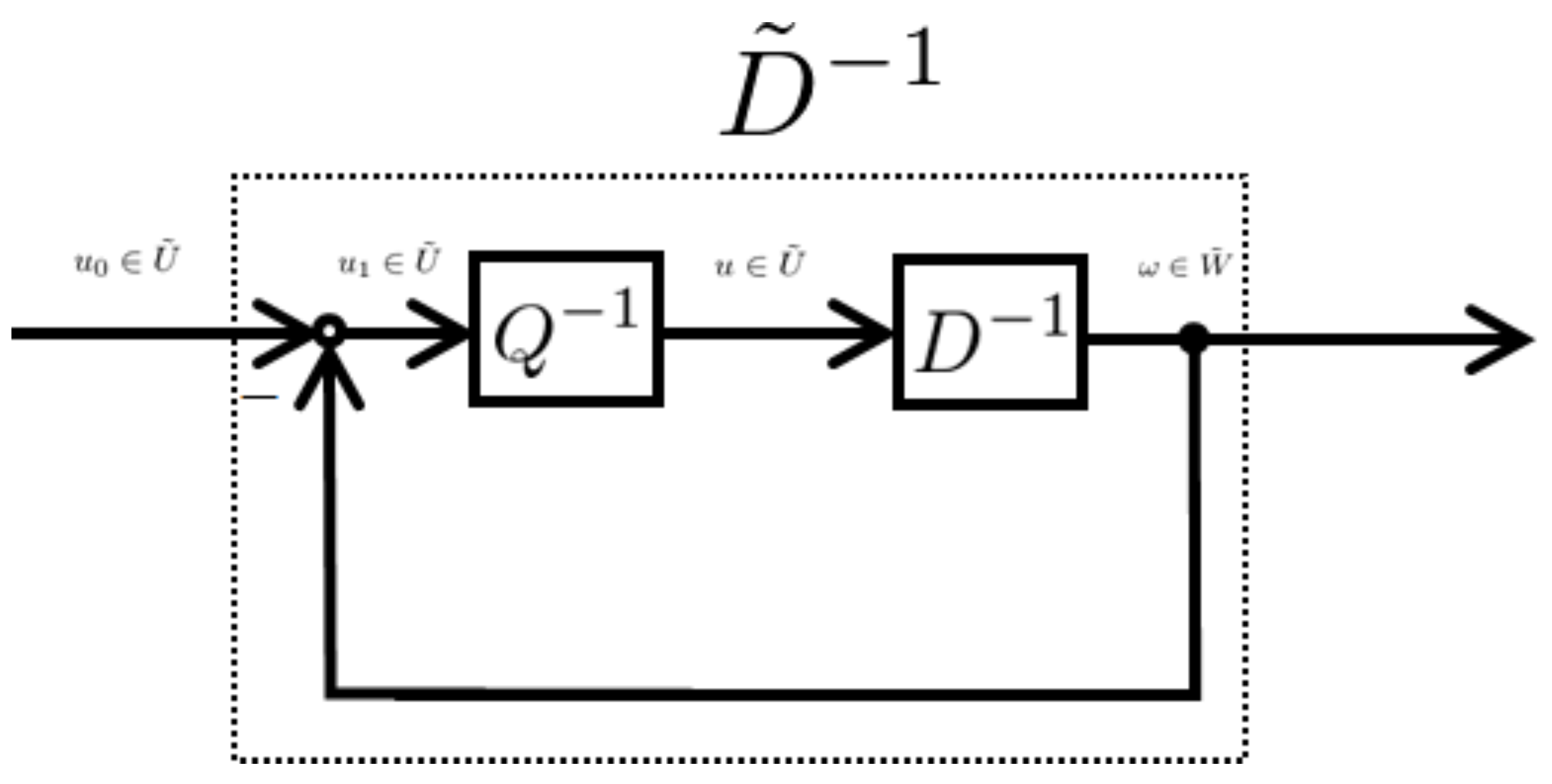
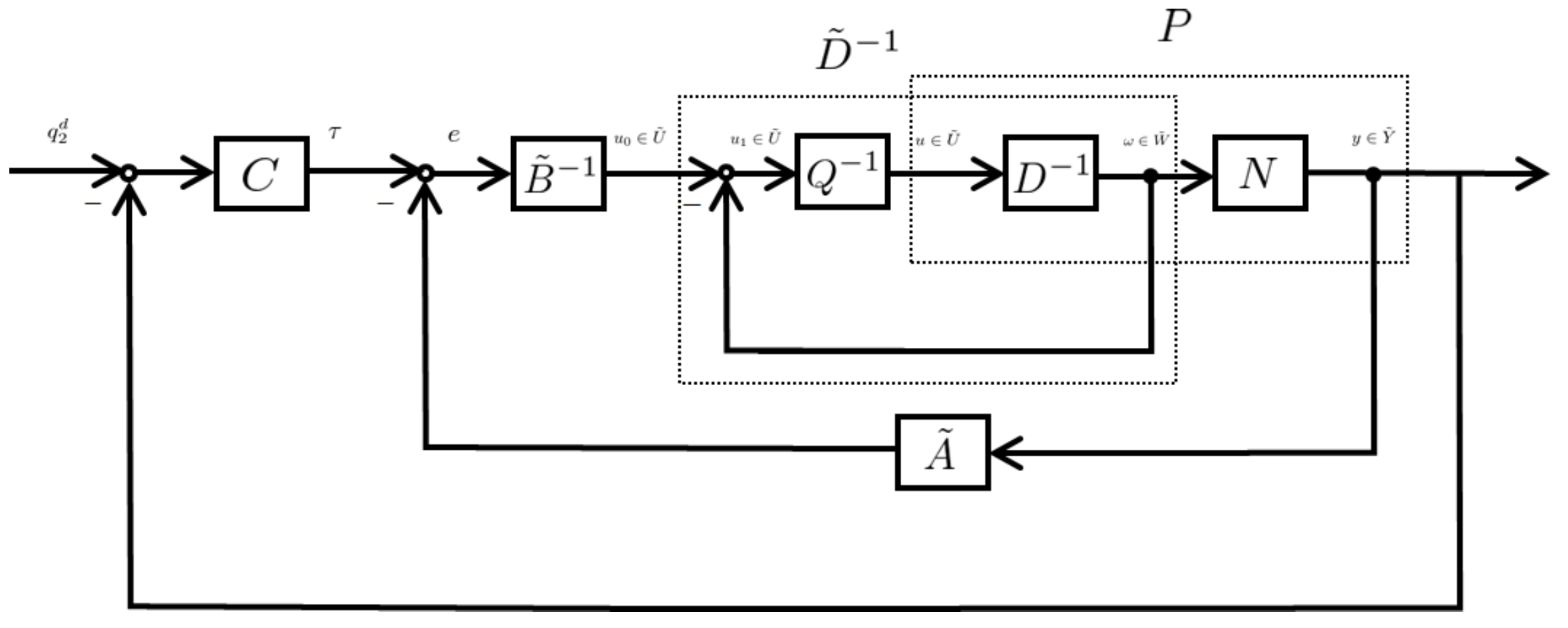
In this section, a control system design based on operator theory and an isomorphism scheme is employed for the swing-up. Suppose that the system is well-posed, using an appropriate isomorphism approach, the right coprime factorization of the unstable plant can be realized. The robust stability of the perturbed nonlinear feedback control systems can be guaranteed based on isomorphism. Besides, the plant output is able to track the reference input by the designed tracking controller [21]. The control system based on this isomorphism scheme can be described as a compensator and a feedback loop designed as shown in Figure 7. It then follows that the operator is stable.
Figure 7.
Nonlinear feedback loop based on an isomorphism scheme.
The compensator is designed in such a way that it stabilizes , the operators N and are equivalent operators, here, and are design parameters. The controllers and satisfying the Bezout equation are designed as follows. From (26), it can be confirmed that is stabilized by the compensator .
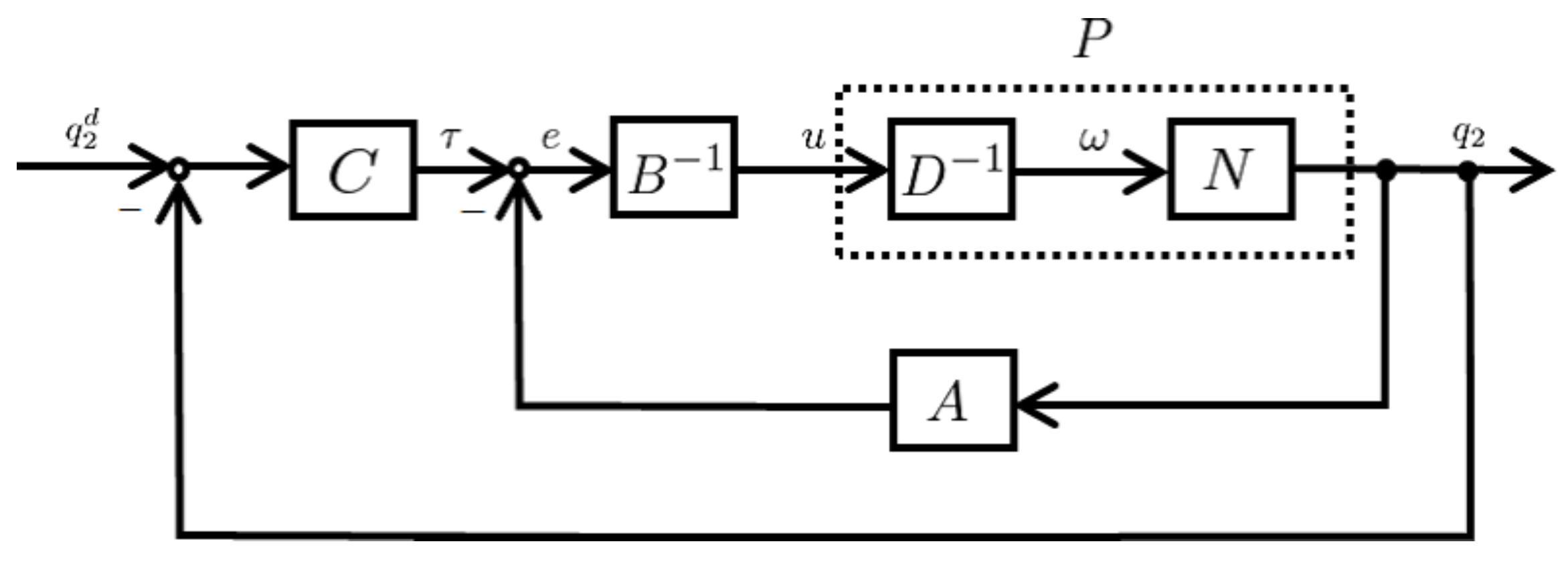
From the above analysis, we can see that there is a differential function in operator-based controller (18). However, by using our isomorphism scheme, it is avoided in (24). As a result, better control performance can be obtained. However, for the control system in Figure 8, when uncertainties exist, based on the argument in Section 4.2.3, the robust stability can be ensured.
Figure 8.
Nonlinear feedback system without uncertainties based on operator theory and an isomorphism scheme.
5. Simulation
In this section, we verify the effectiveness of the control system designed in Section 4 by simulation using MATLAB. Assuming that there are uncertainties in the angle and the magnitude is a constant with value rad. Table 2 shows the mechanical parameters of simulation.
5.1. Control System Simulation Based on Operator Theory
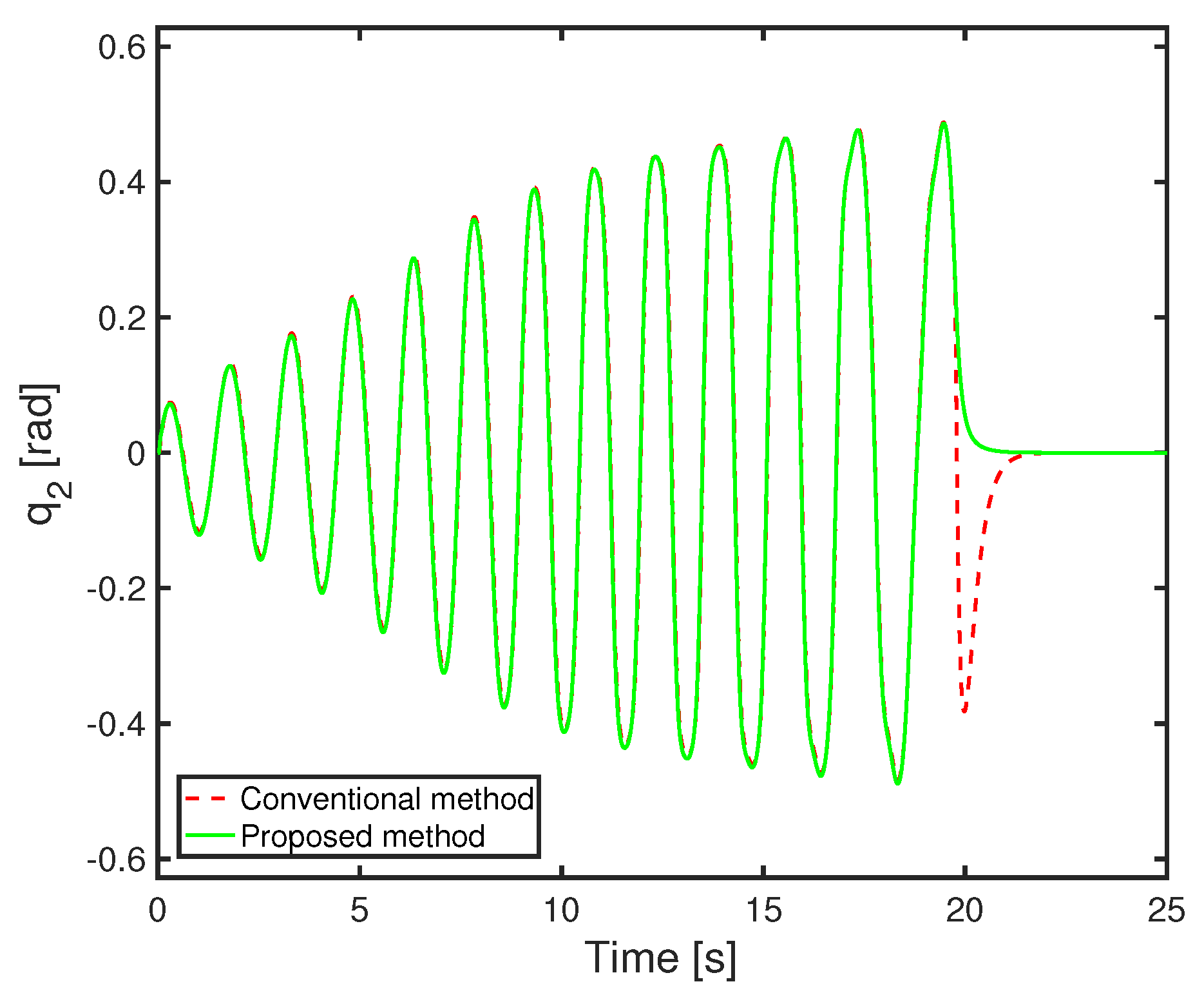
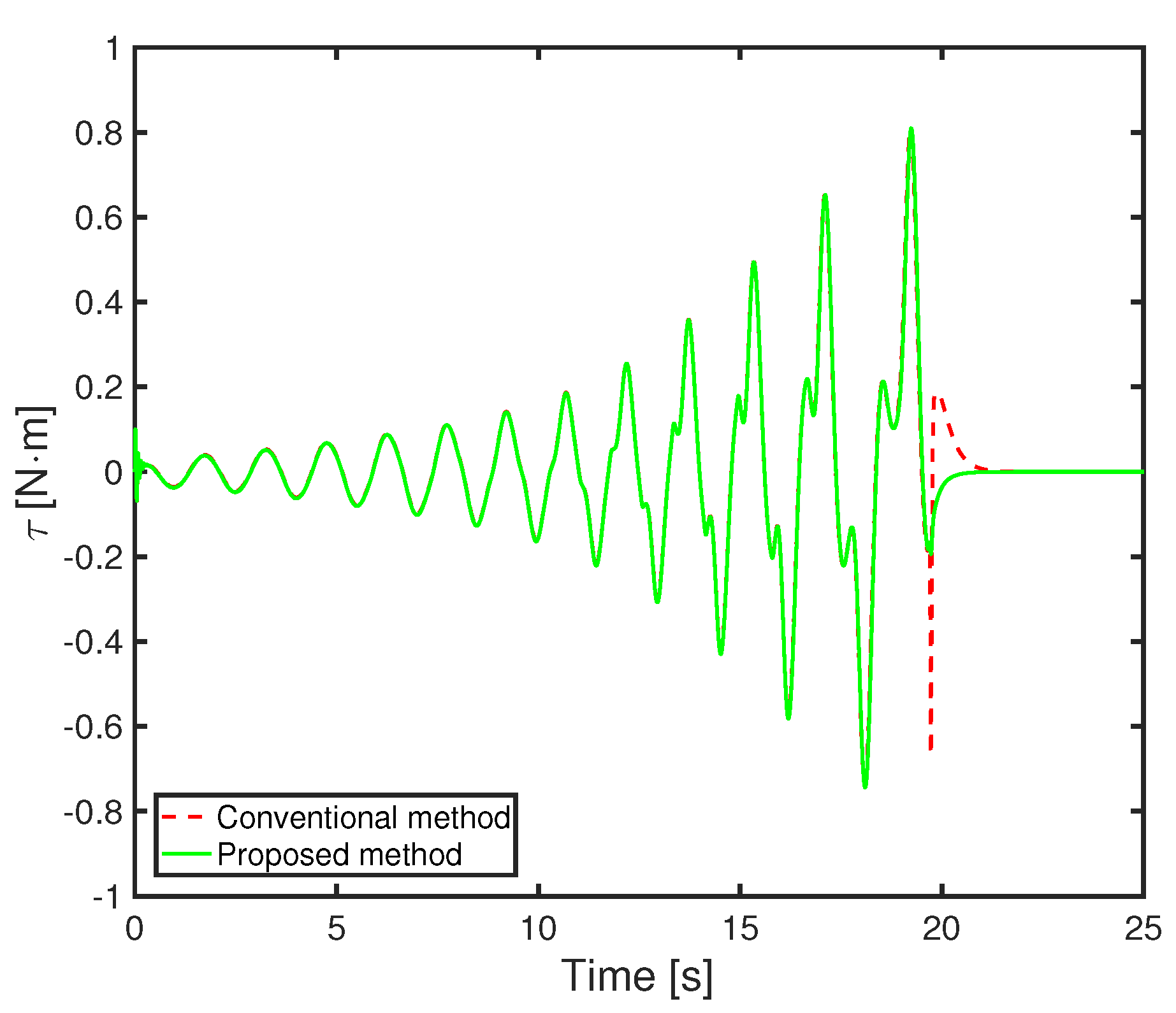
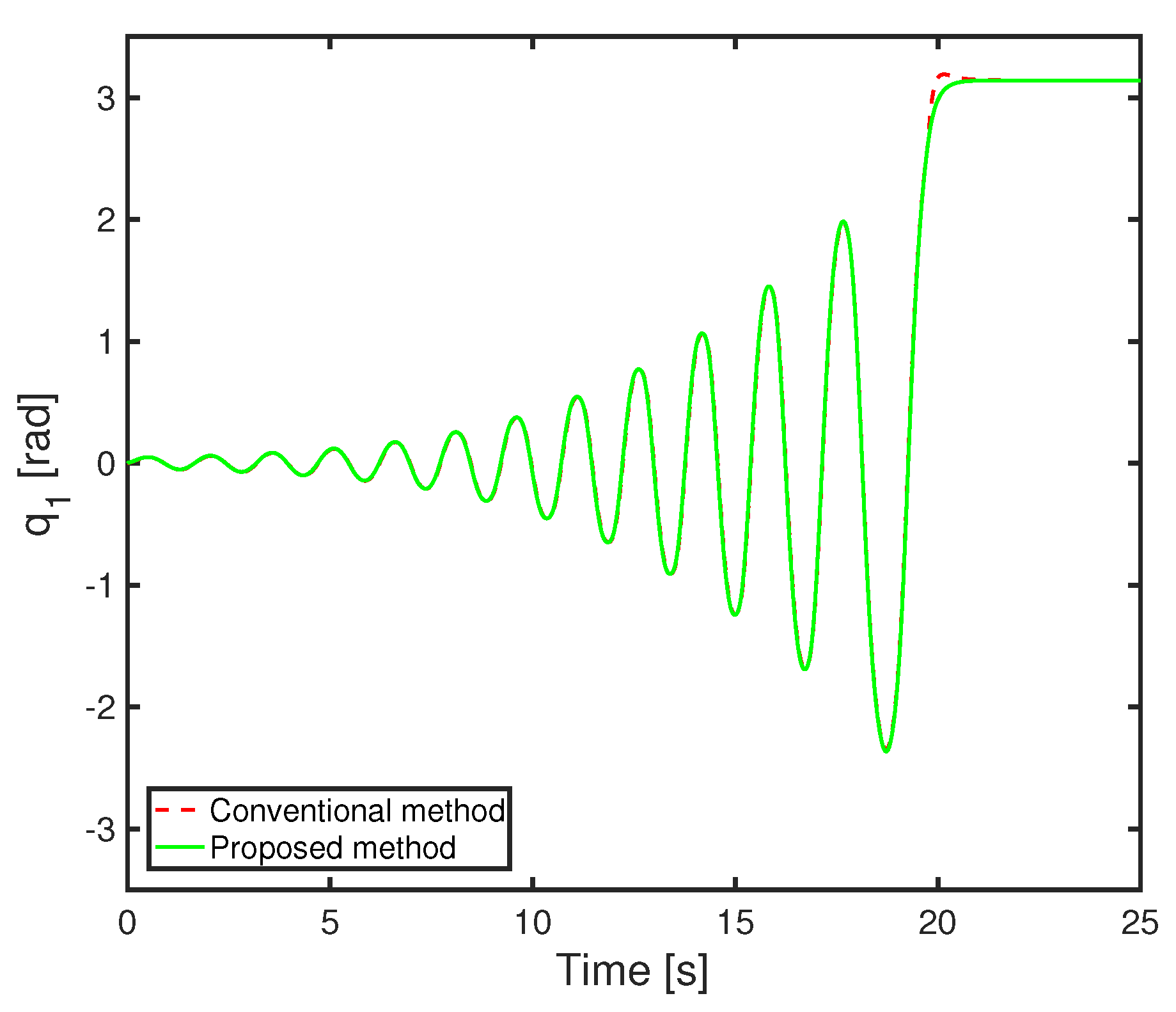
In this section, we show some simulation results based on operator theory. In simulation, the control parameters are the following: , , , = 1, and the initial states are , , and . The simulation results of swing-up control and inverted stabilization control are shown in Figure 9, Figure 10 and Figure 11. From Figure 12, the calculation result of the robust stability condition is always less than 1, and the robust stability of the control system is guaranteed. The simulation results of the conventional method and the proposed method are compared. The simulation results converge to , respectively. It can be seen from Figure 11 that the noise generated in the torque can be reduced when switching to inverted stability. It is clear that the swing-up control has been improved.
Figure 9.
First link angle of nonlinear feedback system with uncertainties based on operator theory.
Figure 10.
Second link angle of nonlinear feedback system with uncertainties based on operator theory.
Figure 11.
Input torque.
Figure 12.
Robust stability assessment of nonlinear feedback system with uncertainties based on operator theory.
From the above, we are able to confirm the effectiveness of the proposed method.
5.2. Control System Simulation Based on Operator Theory and Isomorphism Scheme
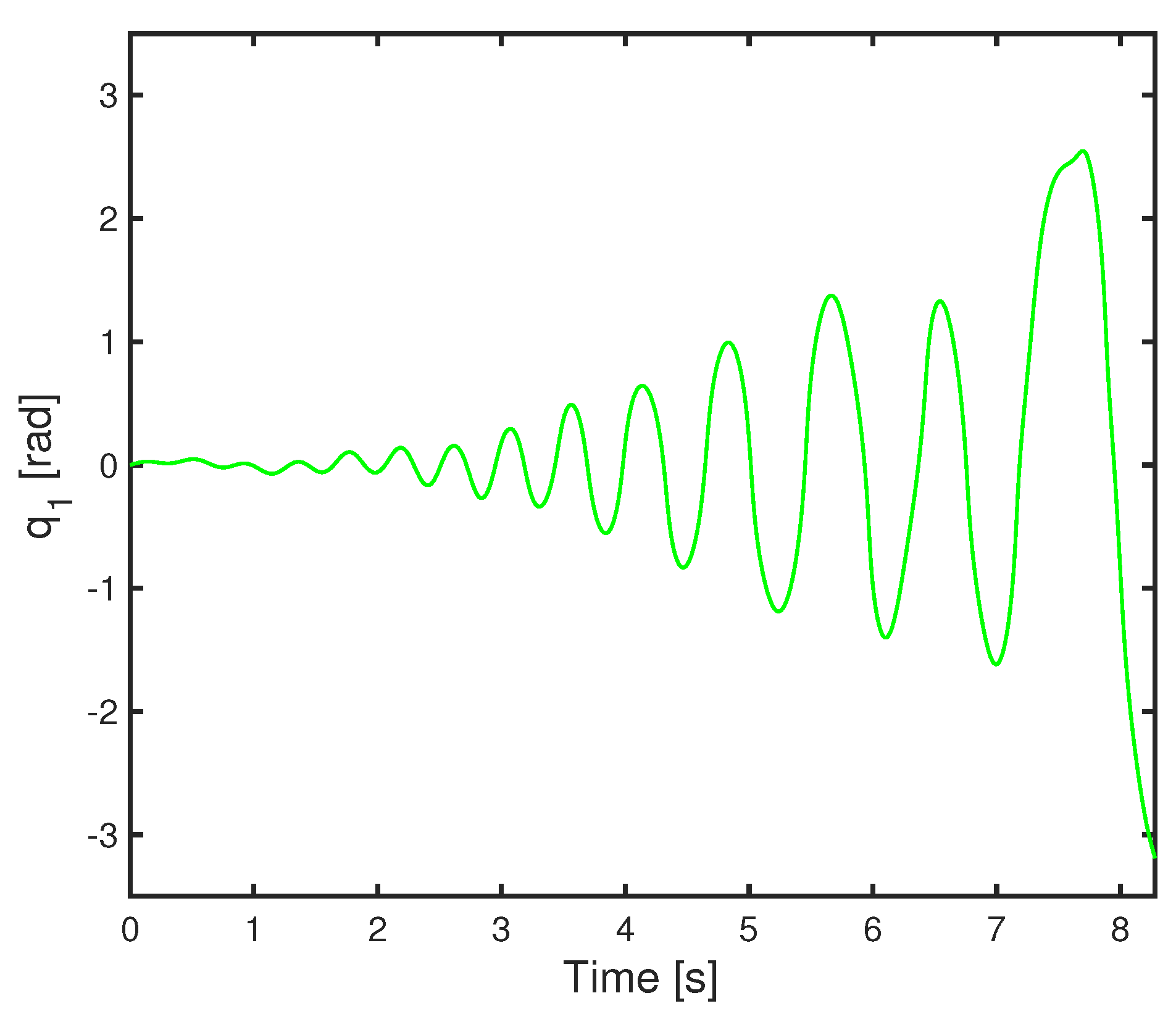
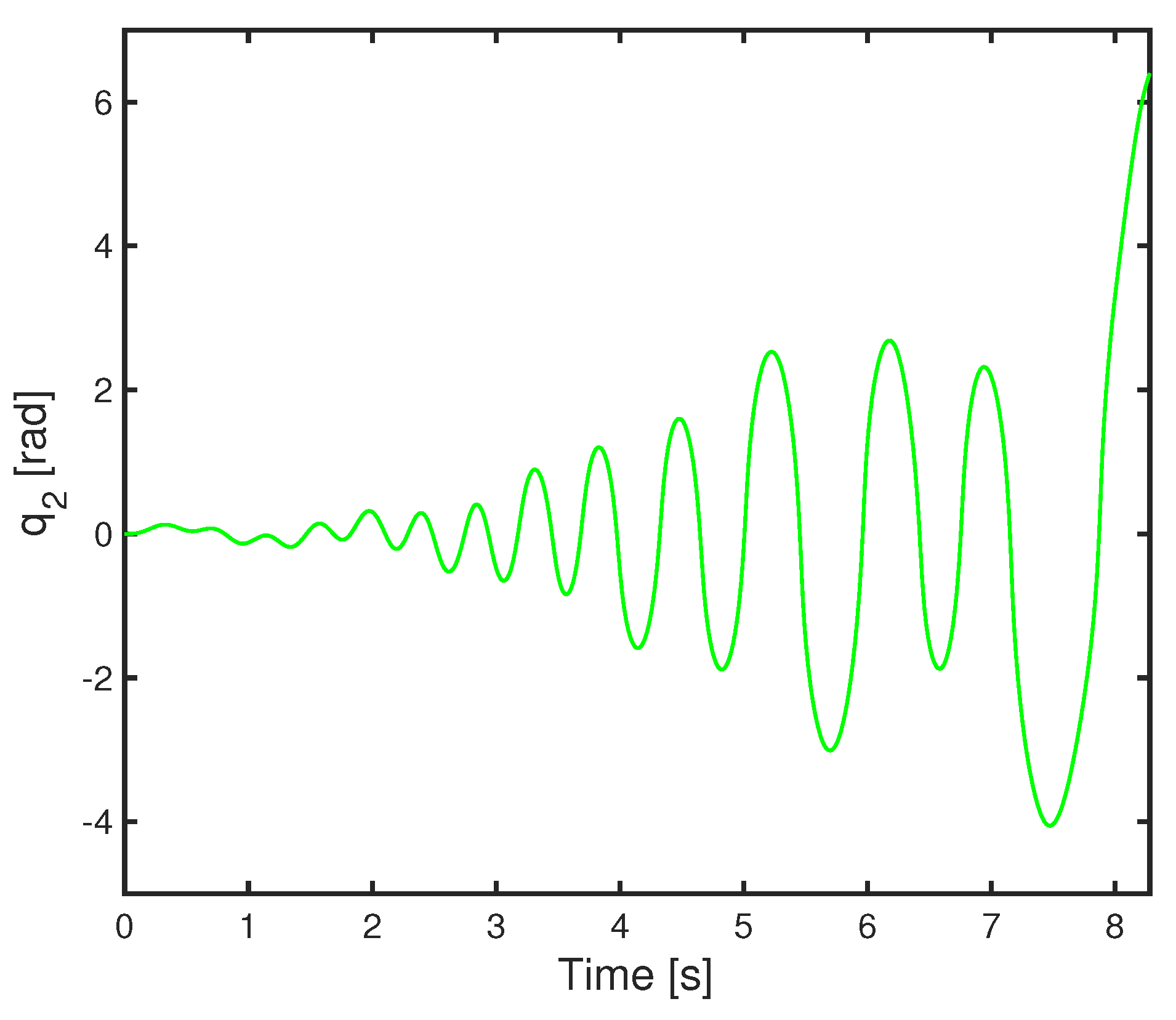
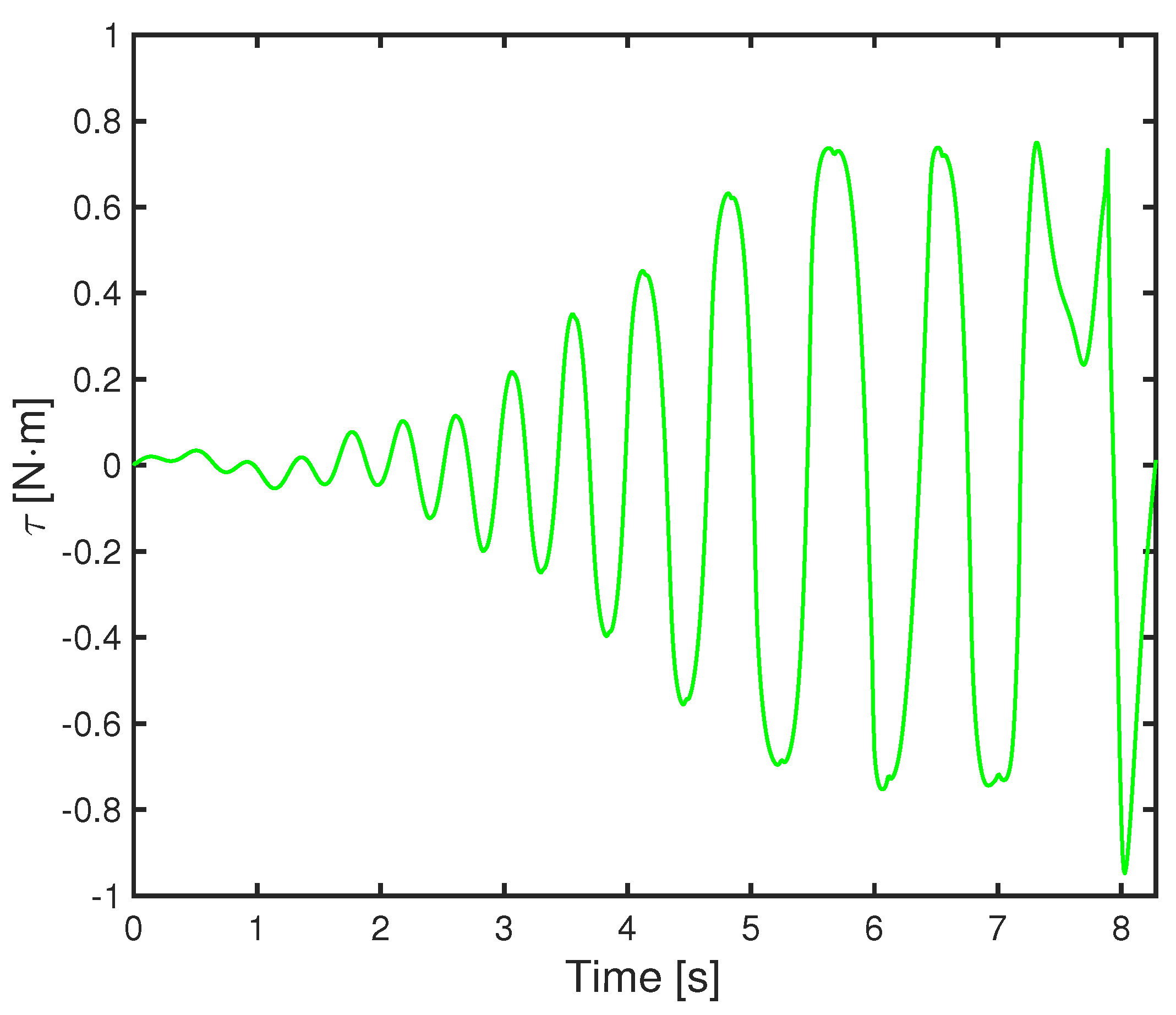
In this section, we show the simulation results based on operator theory and an isomorphism scheme (shown in Figure 12, Figure 13, Figure 14, Figure 15 and Figure 16). In simulation, = 1, = 1200. Based on operator theory, in Figure 9 and Figure 10, the response time is about 20 seconds. While based on operator theory and an isomorphism scheme, in Figure 13 and Figure 14, the response time is about 8 s. The response time of the swing-up is reduced by 12 s after using our isomorphism scheme. If compared with [3], where the response time is around 18 s, the response time by using the proposed method is much shorter.
Figure 13.
First link angle of nonlinear feedback system with uncertainties based on operator theory and isomorphism scheme.
Figure 14.
Second link angle of nonlinear control feedback system with uncertainties based on operator theory and an isomorphism scheme.
Figure 15.
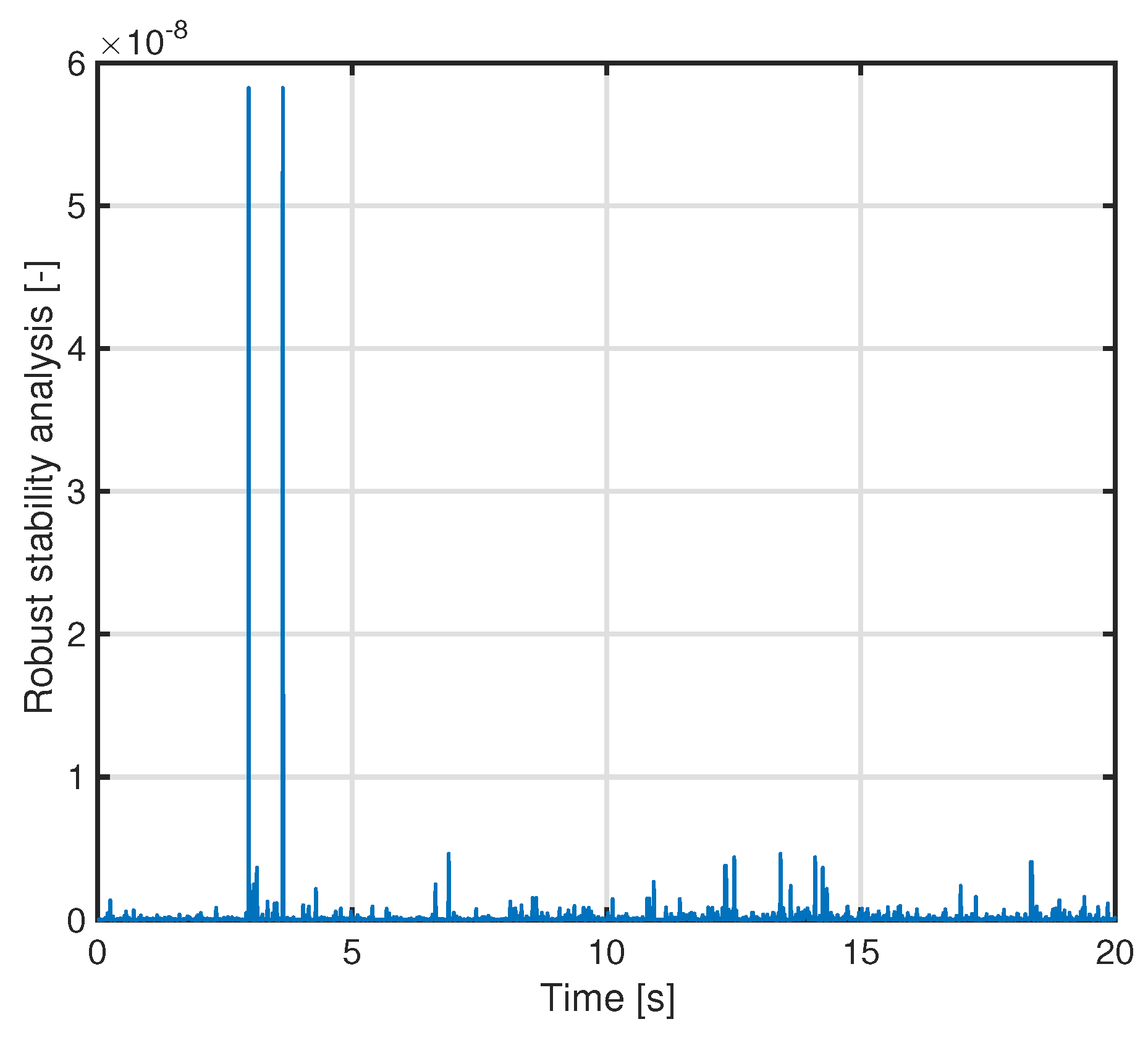
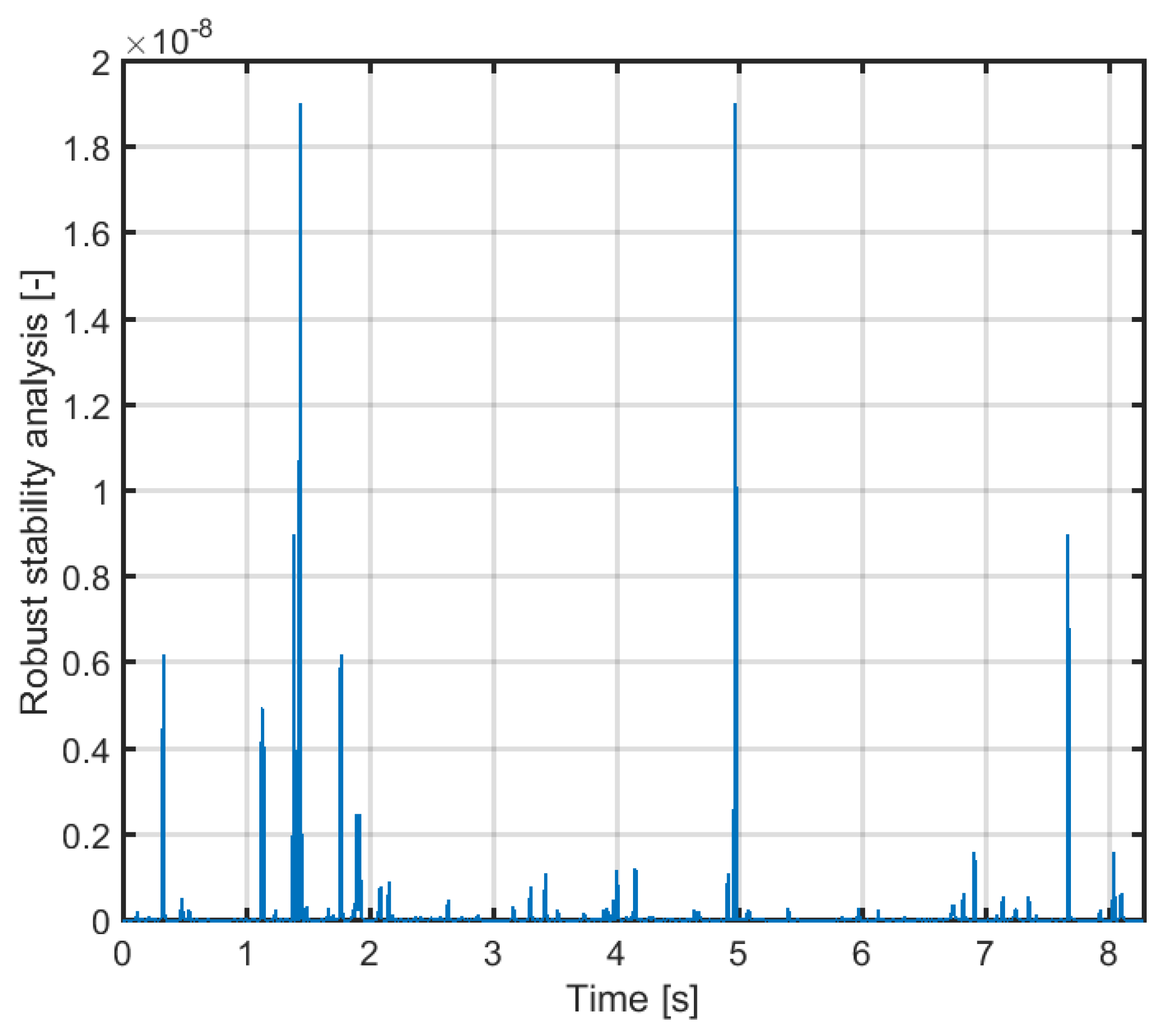
Robust stability assessment of nonlinear feedback system with uncertainties based on operator theory and isomorphism scheme.
Figure 16.
Input torque.
5.3. Robust Stability of a Control System
In this section, the robust stability of the control system is evaluated by calculating the Lipschitz norm (21). The simulation results are shown in Figure 12 and Figure 15. In this simulation, it is assumed that there is uncertainty in the angle and its magnitude is a constant with value rad. From Figure 12 and Figure 15, the robust stability conditions are always less than 1 and the robust stabilities of the control system are guaranteed.
6. Conclusions
In this paper, a nonlinear control system of an underactuated robot based on operator theory and an isomorphism scheme is realized. Performances (robust stability, response time) of an underactuated robot nonlinear control system are also discussed. The effectiveness of the proposed method is verified by simulation. Optimizing the control parameters using some intelligent optimization methods [23,24] and adaptive learning methods [25,26,27] and further improving the tracking performance of an underactuated robot will be our future work. Besides, we will also perform experiments to verify the proposed method in the future.
Author Contributions
M.D. supervised the work and wrote the paper; S.K. finished simulation and the rest work. All authors have read and agreed to the published version of the manuscript.
Funding
This research received no external funding.
Institutional Review Board Statement
Not applicable.
Informed Consent Statement
Not applicable.
Data Availability Statement
Not applicable.
Acknowledgments
The authors would like to thank PhD students Guanqiang Dong and Yuanhong Xu at Tokyo University of Agriculture and Technology, Japan, for their suggestions and comments.
Conflicts of Interest
The authors declare no conflict of interest.
References
- He, B.; Wang, S.; Liu, Y. Underactuated robotics: A review. Int. J. Adv. Robot. Syst. 2019, 16, 1–29. [Google Scholar] [CrossRef]
- Henmi, T.; Wada, T.; Deng, M.; Inoue, A.; Ueki, N.; Hirashima, Y. Swing-up control of an Acrobot having a limited range of joint angle of two links. In Proceedings of the 5th Asian Control Conference (IEEE Cat. No. 04EX904), Melbourne, VIC, Australia, 20–23 July 2004. [Google Scholar]
- Henmi, T.; Deng, M.; Inoue, A. Swing-up controller for the acrobot using skill of human movements. Int. J. Model. Identif. Control 2009, 6, 222–229. [Google Scholar] [CrossRef]
- Xin, X.; Yamasaki, T. Energy-based swing-up control for a remotely driven Acrobot: Theoretical and experimental results. IEEE Trans. Control Syst. Technol. 2011, 20, 1048–1056. [Google Scholar] [CrossRef]
- Xin, X.; Kaneda, M. The swing up control for the Acrobot based on energy control approach. In Proceedings of the 41st IEEE Conference on Decision and Control, Las Vegas, NV, USA, 10–13 December 2002. [Google Scholar]
- Xin, X.; Kaneda, M. New analytical results of the energy based swinging up control of the Acrobot. In Proceedings of the 43rd IEEE Conference on Decision and Control (CDC), Nassau, Bahamas, 4–17 December 12004. [Google Scholar]
- Spong, M.W. The swing up control problem for the acrobot. IEEE Control Syst. Mag. 1995, 15, 49–55. [Google Scholar]
- Xin, X.; Kaneda, M. A robust control approach to the swing up control problem for the Acrobot. In Proceedings of the 2001 IEEE/RSJ International Conference on Intelligent Robots and Systems. Expanding the Societal Role of Robotics in the the Next Millennium, Maui, HI, USA, 29 October–3 November 2001. [Google Scholar]
- Deng, M.; Inoue, A.; Kosugi, M.; Henmi, T. Swing-up control of a cart-type single inverted pendulum with parasitic dynamics. Int. J. Innov. Comput. Inform. Control 2007, 3, 1501–1510. [Google Scholar]
- Ordaz, P.; Poznyak, A. Adaptive-robust stabilization of the Furuta’s pendulum via attractive ellipsoid method. J. Dyn. Syst. Meas. Control 2016, 138, 021005. [Google Scholar] [CrossRef]
- Ordaz, P.; Poznyak, A. The Furuta’s pendulum stabilization without the use of a mathematical model: Attractive Ellipsoid Method with KL-adaptation. In Proceedings of the 2012 IEEE 51st IEEE Conference on Decision and Control (CDC), Maui, HI, USA, 10–13 December 2012. [Google Scholar]
- Ordaz-Oliver, J.P.; Santos-Sánchez, O.J.; López-Morales, V. Toward a generalized sub-optimal control method of underactuated systems. Optim. Control. Appl. Methods 2012, 33, 338–351. [Google Scholar] [CrossRef]
- Qiao, H. Uniqueness for measure-valued equations of nonlinear filtering for stochastic dynamical systems with Lévy noise. Adv. Appl. Probab. 2018, 50, 396–413. [Google Scholar] [CrossRef]
- Deng, M. Operator-Based Nonlinear Control Systems: Design and Applications; Wiley-IEEE Press: Hoboken, NJ, USA, 2014. [Google Scholar]
- Deng, M.; Bu, N. Robust control for nonlinear systems using passivity-based robust right coprime factorization. IEEE Trans. Autom. Control 2012, 57, 2599–2604. [Google Scholar] [CrossRef]
- Umemoto, K.; Matsuno, F.; Deng, M. Control system design for nonlinear plants based on generalized HS Black formula using robust right coprime factorization. In Proceedings of the 2012 International Conference on Advanced Mechatronic Systems, Tokyo, Japan, 18–21 September 2012. [Google Scholar]
- Chen, G.; Han, Z. Robust right coprime factorization and robust stabilization of nonlinear feedback control systems. IEEE Trans. Autom. Control 1998, 43, 1505–1509. [Google Scholar] [CrossRef]
- Bu, N.; Chen, W.; Jin, L.; Zhao, Y. Robust control for uncertain nonlinear feedback system using operator-based right coprime factorization. IEEE/CAA J. Autom. Sin. 2018, 6, 824–829. [Google Scholar] [CrossRef]
- Jin, G.; Deng, M. Operator-based robust nonlinear free vibration control of a flexible plate with unknown input nonlinearity. IEEE/CAA J. Autom. Sin. 2020, 7, 442–450. [Google Scholar] [CrossRef]
- Bi, S.; Wang, L.; Wen, S.; Deng, M. Operator-based robust nonlinear control for SISO and MIMO nonlinear systems with PI hysteresis. IEEE/CAA J. Autom. Sin. 2016, 5, 523–530. [Google Scholar] [CrossRef]
- Bu, N.; Deng, M. System design for nonlinear plants using operator-based robust right coprime factorization and isomorphism. IEEE Trans. Autom. Control 2011, 56, 952–957. [Google Scholar] [CrossRef]
- Deng, M.; Bu, N. Isomorphism-based robust right coprime factorisation of non-linear unstable plants with perturbations. IET Control Theory Appl. 2010, 4, 2381–2390. [Google Scholar] [CrossRef]
- Gao, S.; Zhou, M.; Wang, Y.; Cheng, J.; Yachi, H.; Wang, J. Dendritic neuron model with effective learning algorithms for classification, approximation, and prediction. IEEE Trans. Neural Netw. Learn. Syst. 2018, 30, 601–614. [Google Scholar] [CrossRef] [PubMed]
- Wang, J.; Kumbasar, T. Parameter optimization of interval Type-2 fuzzy neural networks based on PSO and BBBC methods. IEEE Trans. Neural Netw. Learn. Syst. 2019, 6, 247–257. [Google Scholar] [CrossRef]
- Fujita, K.; Deng, M.; Wakimoto, S. A miniature bending rubber controlled by using the PSO-SVR-based motion estimation method with the generalized Gaussian kernel. Actuators 2017, 6, 6. [Google Scholar] [CrossRef]
- Deng, M.; Kawashima, T. Adaptive nonlinear sensorless control for an uncertain miniature pneumatic curling rubber actuator using passivity and robust right coprime factorization. IEEE Trans. Control Syst. Technol. 2015, 24, 318–324. [Google Scholar] [CrossRef]
- Ueno, K.; Kawamura, S.; Deng, M. Operator-Based Nonlinear Control for a Miniature Flexible Actuator Using the Funnel Control Method. Machines 2021, 9, 26. [Google Scholar] [CrossRef]
Publisher’s Note: MDPI stays neutral with regard to jurisdictional claims in published maps and institutional affiliations. |
© 2021 by the authors. Licensee MDPI, Basel, Switzerland. This article is an open access article distributed under the terms and conditions of the Creative Commons Attribution (CC BY) license (https://creativecommons.org/licenses/by/4.0/).