

The Duality between Corings and Ring Extensions


Abstract
:1. Introduction
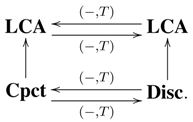
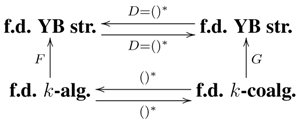
- (i) We propose as a research project the investigation of other connections between the duality of (co)algebras and the Pontryagin duality. (For example, one might try to endow the (co)algebra structures with some topological structures.)
- (ii) At the epistemologic level, the extension of the duality of (co)algebra structures seems to be a model for the relation between interdisciplinarity, pluridisciplinarity and transdisciplinarity (see [4]).
- (iii) This paper explains that taking the dual of some objects can be seen a “continuous” process. Let us visualize this statement by considering an example from geometry. We take a triangular prism: We can see it as two parallel triangles joint by 3 segments. In total it has 5 planar geometric figures, 9 edges and 6 vertices. The geometric dual of the triangular prism has 6 planar geometric figures, 9 edges and 5 vertices. Now, one can start with a triangular prism, “shave” its corners, and then continuously deform that figure in order to obtain the geometric dual of the triangular prism.
2. Notations and Preliminaries
 B, symbols M* , *M, *M* denote right dual, left dual and bidual of M, and A B (M, N) denotes the 𝕂-module of (A, B)-bimodule maps M → N. In what follows we shall concentrate on right dual of M but similar observations can be made for the left dual as well. B (M, N), let ϕ* : N* → M* denote the right adjoint of ϕ i.e., ϕ* (g)(m) := g ◦ ϕ (m). B then M* ∈ Aop Bop with (aopfbop)(m) = bf(am). B is also finitely generated projective as a right B-module, i.e., there exists a dual basis
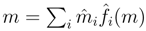
  , such that for any m∈ M,
  . Then B, with the inverse
  . In fact κ is a natural morphism between identity functor in A B and the functor ()** : A B → A B. C then κM,N : M* ⊗ Bop N* → (M ⊗ B N)*, given by κM,N (f ⊗ Bop g)(m ⊗ n) = g(f(m)n), is an isomorphism in Aop Cop with the inverse
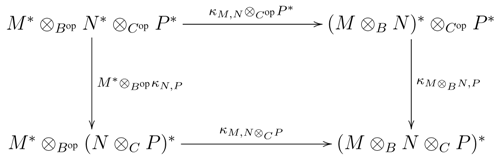
  B, N∈ B C , P ∈C D, where A, B, C, D are algebras. Then the following diagram is commutative:
  B be finitely generated projective as B-module, with dual basis
  , i∈ I, and let N∈B C be finitely generated projective as a C-module with dual basis
  ,
,  , i∈ J. Then M ⊗ B N∈A C is finitely generated projective as a C-module with a dual basis
  B is called a B-coring if there exist morphisms ΔC, εC ∈B B, ΔC : C→ C ⊗ B C, εC : C→ B such that
 B (C, D) is called a morphism of B-corings if (ϕ ⊗ Bϕ) ◦ ΔC = ΔD ◦ ϕ and εD ◦ ϕ = εC. The category of B-corings is denoted by CrgB.
  is called an extension of a ring B if there exists an injective unital ring morphism
  : B → . Observe that ∈B B by . Given ring extensions : B → and : B →P, a ring morphism α : →P is called a morphism of ring extensions if α ◦ = or, equivalently, if α ∈ B B ( , P). The category of ring extensions of B is denoted by RgeB. Bopis a ring extension of Bop with multiplication
 ∈ r.f.g.pRgeB then * is a Bop-coring with comultiplication and counit

 is a (finite) dual basis of . →S is a morphism of right finitely generated projective ring extensions of B, then : S* → * is a morphism of Bop-corings. ∈ r.f.g.pRgeB, κR : → ** is a ring extension isomorphism facilitating this equivalence. →S. Let be any finite dual basis of , and let
  be any finite dual basis of S. For all s∈S*,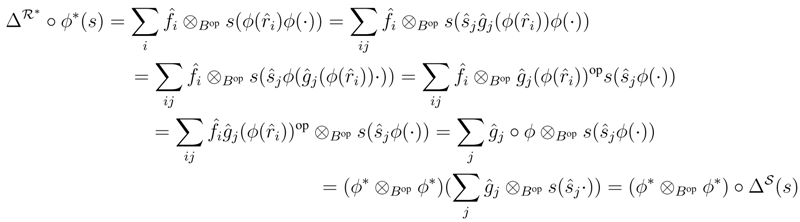

 , be any finite dual basis of C. Observe that
  is a dual basis of C*. Indeed, for any g∈C*,



3. An Extension for the Duality between Corings and Ring Extensions


 ). Furthermore
 Hence (R, φR, 1R, 0) is an object in the category YB strB. →S be a morphism of ring extensions. Then f(1R)= 1S and 0 ◦ f = 0. Moreover
 is a morphism in the category YB strB. = F S, for some , S∈ RgeB, then obviously = S as (B, B)-bimodules, 1S = 1R, and the only thing which can differ is the multiplication. Denote by · the multiplication in , and by ◦ the multiplication in S. Then, as φR = φS , for all r, r´∈ ,
 or S is irrelevant) yields 2(r · r´− r ◦ r´) = 0, hence r · r = r ◦ r´, and so = S as algebras. Therefore F is an embedding.
  be a morphism in YB strB, where , S∈ RgeB. Then f is unital, and
  , hence, for all r, r´∈ ,









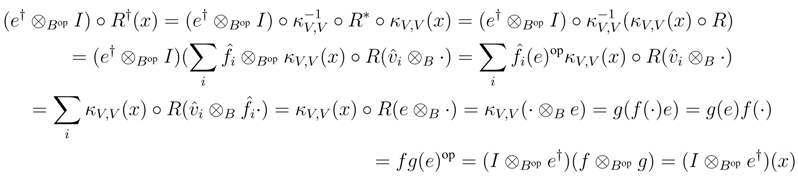
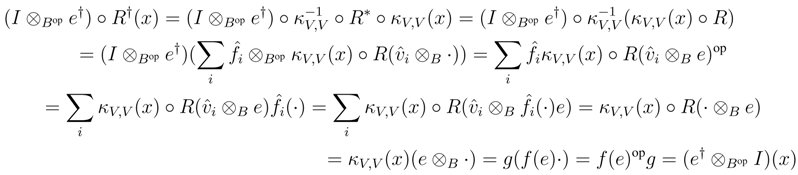
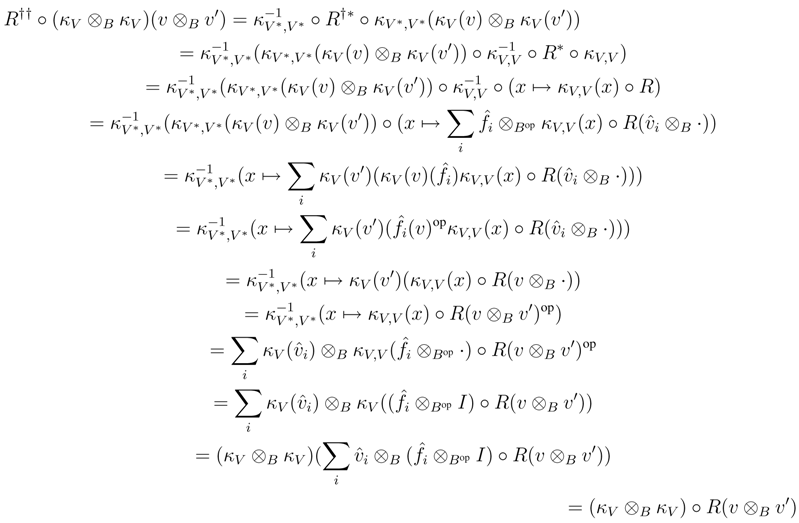
 We shall prove that R† satisfies the Yang–Baxter equation. Observe that

 be a dual basis of V .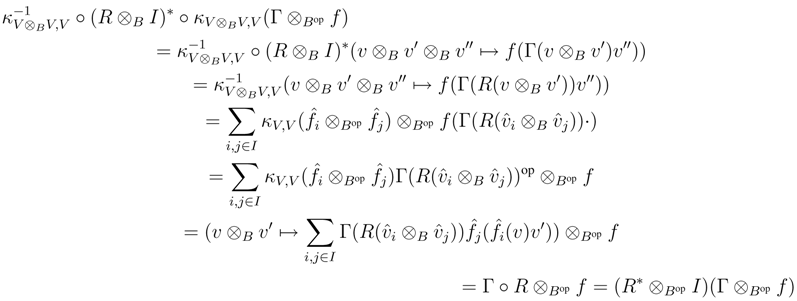







 B, and as V is finitely generated projective, κV is invertible. Therefore it suffices to prove that κV is a morphism in r.f.g.pYB strB. To this end, observe first that
 is a dual basis of V*. Therefore, for all Γ ∈ (V* ⊗ Bop V*)*,
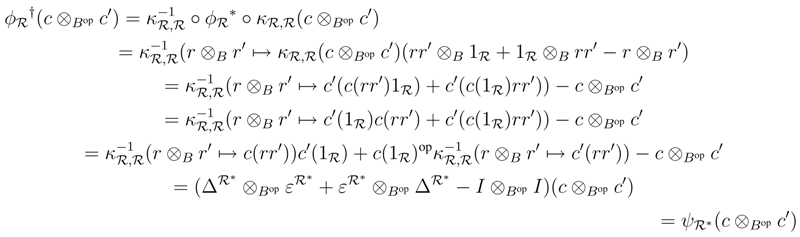
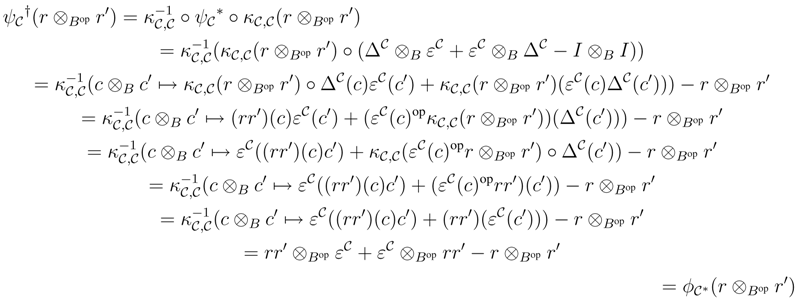
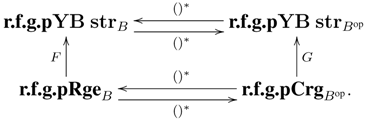
 ∈ r.f.g.pRgeB, C∈ r.f.g.pCrgB. Then
  i.e.,
i.e.,
 *,
*, 
4. Conclusions
Acknowledgments
References
- Morris, S.A. Pontryagin Duality and the Structure of Locally Compact Abelian Groups; Cambridge University Press: Cambridge, UK, 1977. [Google Scholar]
- Nichita, F.F.; Schack, S.D. The duality between algebras and coalgebras. Ann. Univ. Ferrara -Sez. VII -Sc. Mat. 2005, 51, 173–181. [Google Scholar]
- Brzeziński, T.; Wisbauer, R. Corings and Comodules; Cambridge University Press: Cambridge, UK, 2003. [Google Scholar]
- Nichita, F.F. Algebraic models for transdisciplinarity. Transdiscipl. J. Eng. Sci. 2011, 10, 42–46. [Google Scholar]
- Abe, E. Hopf Algebras; Cambridge University Press: Cambridge, UK, 1977. [Google Scholar]
- Dăscălescu, S.; Năstăsescu, C.; Raianu, S. Hopf Algebras: An Introduction; Marcel Dekker, Inc.: New York, NY, USA, 2000. [Google Scholar]
- Sweedler, M.E. Hopf Algebras; W.A.Benjamin, Inc.: New York, NY, USA, 1969. [Google Scholar]
- Sweedler, M.E. The predual theorem to the Jacobson-Bourbaki theorem. Trans. Am. Math. Soc. 1975, 213, 391–406. [Google Scholar] [CrossRef]
- Kassel, C. Quantum Groups; Springer Verlag: New York, NY, USA, 1995. [Google Scholar]
- Lambe, L.; Radford, D. Introduction to the Quantum Yang-Baxter Equation and Quantum Groups: An Algebraic Approach; Kluwer Academic Publishers: Dordrecht, Germany, 1997. [Google Scholar]
- Nichita, F.F. Non-Linear Equation, Quantum Groups and Duality Theorems.
- Nichita, F.F. Self-inverse Yang-Baxter operators from (co)algebra structures. J. Algebra 1999, 218, 738–759. [Google Scholar]
© 2012 by the authors; licensee MDPI, Basel, Switzerland. This article is an open-access article distributed under the terms and conditions of the Creative Commons Attribution license (http://creativecommons.org/licenses/by/3.0/).
Share and Cite
Nichita, F.F.; Zielinski, B. The Duality between Corings and Ring Extensions. Axioms 2012, 1, 173-185. https://doi.org/10.3390/axioms1020173
Nichita FF, Zielinski B. The Duality between Corings and Ring Extensions. Axioms. 2012; 1(2):173-185. https://doi.org/10.3390/axioms1020173
Chicago/Turabian StyleNichita, Florin F., and Bartosz Zielinski. 2012. "The Duality between Corings and Ring Extensions" Axioms 1, no. 2: 173-185. https://doi.org/10.3390/axioms1020173
APA StyleNichita, F. F., & Zielinski, B. (2012). The Duality between Corings and Ring Extensions. Axioms, 1(2), 173-185. https://doi.org/10.3390/axioms1020173