Article

Transforming Low-Value Quartz into Electronic-Grade Spherical SiO2 via a Morphology-Directed Hydrothermal Alkaline Process

1
Key Laboratory of Solid Waste Treatment and Resource Reuse, Ministry of Education, Southwest University of Science and Technology, Mianyang 621010, China
2
Institute of Mineral Materials and Applications, Southwest University of Science and Technology, Mianyang 621010, China
*
Author to whom correspondence should be addressed.
Minerals 2025, 15(12), 1296; https://doi.org/10.3390/min15121296
Submission received: 10 November 2025 / Revised: 4 December 2025 / Accepted: 9 December 2025 / Published: 11 December 2025
(This article belongs to the Section Mineral Processing and Extractive Metallurgy)

Abstract

The conventional production of electronic-grade, high-purity, spherical silicon dioxide (SiO2) faces challenges of high raw material costs and poor control over particle morphology. This study presents an alternative route using low-cost, powdered quartz as a starting material. The quartz was first purified by flotation to remove any associated minerals, such as talc. Subsequently, deep purification was achieved through a hydrothermal alkaline process, which leveraged the distinct leaching kinetics of SiO2 and impurity ions (Al3+, Ca2+, Fe3+) under precisely controlled hydrothermal conditions (10 mL/g liquid-to-solid ratio, 3 mol/L NaOH, 200 °C, 8 h). This step yielded a sodium silicate solution with a purity of 99.999%. Spherical SiO2 particles were then synthesized from solutions of varying moduli via chemical precipitation. The condensation kinetics of silicate anionic species (Qn) during acidification were investigated, revealing how the Qn distribution governs the final particle size and morphology. The optimal product exhibited excellent characteristics: a sphericity ≥ 0.98, a median particle size (D50) of 400–500 nm, and a narrow particle size distribution (polydispersity index, PDI of 0.178–0.192). These properties surpass the requirements for the QYG-H Type 002 grade specified in the Chinese National Standard GB/T 32661-2016 (“Spherical Silica Powder”) and meet the standard for electronic-grade spherical SiO2. This work provides a fundamental insight into morphology control and a feasible technical pathway for the value-added utilization of powdered quartz and the production of electronic-grade spherical SiO2 with a narrow particle size distribution.

Graphical Abstract

1. Introduction

Spherical silica (SiO2) plays a critical role in advanced materials engineering, with applications spanning electronic packaging [1,2], chip substrates [3], and high-performance coatings [4]. Its widespread utilization is attributed to its desirable physicochemical attributes such as its low thermal expansion, low dielectric constant [5], and high chemical inertness. However, the functional performance of SiO2 is strongly contingent upon its purity and morphology. Currently, high-purity spherical SiO2 is primarily synthesized via vapor-phase deposition [6,7] and the sol–gel process [8,9]. The vapor-phase method typically employs volatile silicon sources (SiCl4) as raw materials, and carries out hydrolysis or oxidation reactions in a high-temperature gaseous environment to produce extremely pure, spherical SiO2. However, this method presents notable environmental and economic constraints, including high equipment investment, substantial energy consumption, and the use of highly corrosive and toxic precursors. Moreover, the by-products of the process require rigorous recovery and harmless treatment. The sol–gel method utilizes high-purity organosilicon alkoxides as precursors to generate spherical SiO2 via hydrolysis and condensation reactions in alcoholic solvents. This approach offers advantages such as mild reaction conditions and precise control over particle morphology and size. Nevertheless, it also faces economic and environmental challenges, as high-purity organosilicon alkoxide precursors are costly, and the reaction system involves large amounts of organic reagents, posing risks to production safety and environmental protection. In light of these drawbacks, alternative green and cost-effective strategies based on inorganic silicon sources, such as sodium silicate derived from natural quartz, have attracted growing attention due to their scalability and environmental compatibility.
Powdered quartz, owing to its fine particle size and high SiO2 content, presents a promising low-cost feedstock for sodium silicate production. However, its utilization is significantly constrained by embedded impurities such as Al, Ca, and Fe, which are either incorporated into the quartz lattice or exist as sub-micron inclusions. These impurities adversely affect final SiO2 purity and thereby limit its use in high-tech applications. Conventional purification approaches such as acid leaching, chlorination roasting [10], and calcination quenching [11] exhibit limited efficacy for removing high-valence ions (e.g., Al3+ and Ti4+), largely due to their low mobility during solid-phase transitions [12,13]. In recent years, researchers have employed hydrothermal alkali dissolution technology to prepare high-purity sodium silicate. This technique involves dissolving quartz in concentrated alkali under high-temperature and high-pressure conditions, converting it into soluble sodium silicate while releasing impurity ions from the quartz lattice or inclusions into the alkaline hydrothermal medium. These impurity ions then form insoluble silicates or hydroxides, which precipitate, thereby achieving the separation of impurities from the sodium silicate solution [14,15]. However, in systems with low impurity concentrations, the ion product may fail to reach the solubility product of the insoluble compounds, resulting in an insufficient thermodynamic driving force. At the same time, the low supersaturation leads to slow nucleation kinetics, making precipitation difficult to occur. Furthermore, in a strongly alkaline environment, the released impurity ions tend to form soluble salts or become trapped and adsorbed within newly formed silicate polymers, thus preventing their separation through simple precipitation. To address these limitations, our study introduces a selective impurity suppression strategy that leverages both mineral-phase behavior and hydrothermal chemistry. Powder quartz sourced from Jiangxi, China, was pretreated via reverse flotation to remove talc impurities. We then utilized the kinetic disparity in leaching rates between SiO2 and embedded impurities under alkaline hydrothermal conditions to enhance silica dissolution while concurrently suppressing the solubilization of Al3+, Ca2+, and Fe3+. The precipitation mechanisms of Ca2+ and Fe3+ under a controlled pH and temperature were also exploited to facilitate impurity separation. This targeted leaching and selective precipitation pathway provides a more sustainable and potentially scalable purification technique compared to conventional treatments.
In the subsequent synthesis stage, we employed sodium silicate precursors with varying silica-to-alkali ratios (moduli) to produce spherical SiO2 via chemical precipitation. While most prior studies emphasize external parameters such as temperature, dispersants, and pH [16,17], our work focuses on the intrinsic precursor structure, specifically the Qn distribution of silicate species [18]. While the reactivity and pre-polymerization of Qn units significantly influence silica nucleation and growth [19], this area remains underexplored. Here, it is revealed how manipulating Qn speciation in sodium silicate solutions governs the particle size distribution and morphology of the final product.
This research therefore contributes not only a selective and energy-efficient approach to quartz purification but also to the fundamental role of silicate structural units in controlling SiO2 morphology, offering both a theoretical insight and a practical route for the high-value transformation of low-cost mineral resources into high-purity spherical silica.

2. Material and Experiment

2.1. Materials and Reagents

Powder quartz raw ore from Jiangxi, China, was used, with a SiO2 content of 97.85%. The main impurities were MgO (2.15%) and Al2O3 (0.76%), along with minor amounts of CaO (0.12%) and Fe2O3 (0.05%). Dodecyl amine (C12H27N), hydrofluoric (HF) acid, sodium hydroxide (NaOH), hydrochloric acid (HCl), absolute ethanol (C2H5OH), and ammonium molybdate tetrahydrate ((NH4)6Mo7O24·4H2O) were of analytical grade and purchased from Chengdu Ke long Chemical Co., Ltd.(Chengdu, China.)

2.2. Experimental Procedures

2.2.1. Pretreatment of Powder Quartz Raw Ore

The powdered quartz raw material was passed through a 200-mesh screen to obtain the undersized fraction (designated as JXF). Reverse flotation was then performed using hydrofluoric acid (HF) to adjust the pulp pH to 2.0–2.5. The pH was measured in real time using a calibrated pH meter and was adjusted by the dropwise addition of HF solution under constant stirring, with dodecyl amine (120 g/t) as the collector. This process yielded the quartz concentrate (designated as JXF-F).

2.2.2. Preparation of High-Purity Sodium Silicate via Hydrothermal Impurity Removal from Quartz

The quartz concentrate (JXF-F) was subjected to hydrothermal reaction with 100 mL sodium hydroxide (NaOH) solution under the conditions specified in Table S1. After hydrothermal treatment, the solution and filter residue were collected. The filtrate was labeled as L/S-C-T-t, where “L/S” denotes the liquid-to-solid ratio, “C” represents NaOH concentration (mol/L), “T” indicates reaction temperature (°C), and “t” signifies reaction time (h). The process flow is illustrated in Figure 1a.

2.2.3. Determination of Qn Distribution in Sodium Silicate Solution by Silicomolybdenum Yellow Method

Sample M0, with a modulus of 1.5 (SiO2/Na2O molar ratio), served as the baseline, whereas samples M1–M5, with moduli of 1.3, 1.1, 0.9, 0.7, and 0.5, were synthesized by incorporating varying quantities of 2 mol/L NaOH solution. All samples were diluted with ultrapure water (pre-boiled to remove CO2 and annealed) to eliminate carbonic acid interference.
The M0–M5 samples were rapidly diluted to a total SiO2 concentration of 0.01 mol/L. Then, 2.0 mL of each diluted sample was transferred to a quartz cuvette. Absorbance changes were monitored at 400 nm using an ultraviolet spectrophotometer. Sequentially, the following process was performed: 1 mL of 1.0 mol/L HCl solution was rapidly added, followed immediately by 1.0 mL of 0.2 mol/L ammonium molybdate solution. The cuvette was vigorously shaken to ensure instantaneous mixing. Absorbance (A) was recorded continuously for 30 min with the following intervals: Q0 reaction phase (0–1 min): data points collected every 5 s; Q1 reaction phase (1–10 min): data recorded every 1 min; and Q2 + Q3 reaction phase (10–30 min): data recorded every 5 min. Each sample was tested in triplicate. The (A)–(t) curves were plotted, yielding the standard calibration equation for Q0: A = 66.51C − 0.0029 (where C = SiO2 concentration in mol/L) (see Supplementary Materials, Figure S1).

2.2.4. Synthesis of Spherical Silica Dioxide

A 0.25 mol/L sodium silicate solution was formulated using samples M0–M5 as precursors, in a mixed solvent of 100% ethanol and deionized water at a volume ratio of 1:2.5. A 1.0 mol/L hydrochloric acid solution was introduced to the sodium silicate solution using a peristaltic pump at a rate of 0.5 mL/min. The pH of the reaction mixture was continuously monitored with a calibrated pH meter. The reaction was performed under the following conditions: temperature: 30 °C; stirring: 300 rpm. When the pH approached 10.0, the acid addition rate was reduced to fine-tune and stabilize the system at the target endpoint pH of 10.0. Following precipitation, mechanical agitation was sustained at a constant rate for an additional hour, succeeded by six hours of aging without agitation. The mixture was centrifuged at 8000 rpm for 5 min to isolate the precipitate. The precipitate was progressively washed three times with 100% ethanol and deionized water, then freeze-dried to provide spherical SiO2 samples. The process flow is depicted in Figure 1b.

2.3. Characterization

The chemical compositions of raw powder quartz ore and flotation concentrate were analyzed using an Axios X-ray fluorescence (XRF) spectrometer(Malvern Panalytical B.V., Almelo, The Netherlands). The sample preparation was conducted by pressing the sample into pellets. The XRF conditions were as follows: ceramic X-ray tube (Rh target) and a maximum power of 2.4 kW. The phase composition of raw ore and flotation concentrate, and the phase/crystalline structure of synthesized products were characterized using an X’pert MPD Pro X-ray diffractometer(Malvern Panalytical B.V., Almelo, The Netherlands). The XRD conditions were as follows: Cu target, tube voltage of 40 kV, tube current of 40 mA, emission slit (DS): (1/2)°, scatter slit (SS): 0.04 rad, and receiving slit (AAS): 5.5 mm; continuous scanning mode. The impurity element content in the sodium silicate samples and spherical SiO2 were determined using an inductively coupled plasma optical emission spectrometer (ICP-OES, Thermo Scientific iCAP 6500, Waltham, MA, USA). SiO2 and Na2O mass fractions (wt%) in sodium silicate were measured according to the Chinese National Standard GB/T 4209-2022 [20] with the contents and the derived modulus (M, molar SiO2/Na2O ratio) calculated using the following formulas:
SiO2% = (V1 − V0) × CNaOH × 60.08 × 100/m × 1000
Na2O% = V2 × CHCl × 61.98 × 100/m × 1000
M = SiO2% × 1.03/Na2O%
The modulus was calculated from these values. SiO2 leaching efficiency (αSiO2) was calculated using Equation (4):
αSiO2 = CSiO2 V/mSiO2 × 100%
where CSiO2 is the SiO2 concentration in sodium silicate (g/L), V is the solution volume (L; 0.1 L in this work), and mSiO2 is the mass of SiO2 in flotation concentrate JXF-F (g).
Impurity ion (Al3+, Ca2+, and Fe3+) leaching efficiency (αimp) was calculated using Equation (5):
αimp = Cimp V/mimp × 100%
where Cimp is the impurity ion concentration (ppm), V is the solution volume (L; 0.1 L), and mimp is the mass of impurity ions in JXF-F flotation concentrate (mg).
Absorbance was measured using a UV-Vis spectrophotometer (Evolution 300) at 400 nm and 25.0 ± 0.1 °C. The proportions of Q0, Q1, and Q2 + 3 were calculated using Equations (6)–(8):
Q0 = C0/CSiO2 × 100%
Q1 = C∆/CSiO2 × 100%
Q2 + 3 = (C/CSiO2 × 100%) − Q0% − Q1%
where C0 was determined from absorbance at t = 1 min (A0) using the Q0 standard curve. CΔ was determined from ΔA (A10 min–A1 min) using the Q0 standard curve. C was determined from absorbance at t = 30 min (A) using the Q0 standard curve. CSiO2 is the total SiO2 concentration (0.01 mol/L).
The particle size distribution was measured using a laser diffraction particle size analyzer (Mastersizer 3000, Malvern Panalytical Ltd., Malvern, UK) with obscuration maintained at 5–10%. The median particle size (D50) and polydispersity index (PDI) were determined. The zeta potential and particle size were measured using a Zetasizer Ultra instrument (Malvern Panalytical Ltd., Malvern, UK).. The morphology was characterized using field-emission scanning electron microscopy (SEM, ZEISS Sigma 300, Germany). SEM images were processed with Image-J 1.53S software for threshold segmentation and particle identification (circularity > 0.7). Sphericity (∅) was calculated for 100 particles from eight to ten non-overlapping regions (10 × 10 μm2) per image using Equation (9):
  =   4 π   ×   A P 2
where A is the projected area and P is the perimeter of particles. Values approaching one indicate higher sphericity.

3. Results and Discussion

3.1. Raw Material Analysis and Pretreatment

Figure 2a illustrates the chemical composition of JXF and JXF-F. The unrefined ore JXF comprises 97.85% SiO2, with primary impurities of MgO (2.15%), Al2O3 (0.76%), and minor quantities of CaO (0.12%) and Fe2O3 (0.05%). Post-flotation, the SiO2 purity of JXF-F rose to 99.83%, with substantial reductions in MgO (0.02%) and Al2O3 (0.013%), although the removal of CaO (0.041%) and Fe2O3 (0.03%) was minimal.
Figure 2b illustrates the XRD patterns of JXF and JXF-F, with corresponding quantitative phase analysis results via the Rietveld method. The raw ore is composed predominantly of quartz (86.7 wt%) and talc (6.8 wt%), with an amorphous/other phase content of 6.5 wt%. Following flotation, the talc phase was reduced to below the detection limit (<1 wt%), with its diffraction peaks virtually disappearing, while the quartz content was enriched to 96.5 wt% (amorphous/other: 3.5 wt%). This quantitative result confirms the effective removal of talc. In conjunction with the XRF data, the drastic decrease in MgO and Al2O3 indicates that these impurities were primarily hosted within the talc phase.
Figure 2c displays the particle size distribution and the SEM image of JXF-F. The median particle size (D50) is 39.17 μm, with a distribution range of 17.68–64.45 μm (D10–D90). SEM observations indicate uniformly distributed particles devoid of identifiable impurity phases. Figure 2d presents a microscopic view of JXF-F, revealing that quartz particles are primarily transparent, although they include sporadically distributed star-like micro-inclusions.

3.2. Effects of Hydrothermal Conditions on Leaching Behaviors of SiO2, Al3+, Ca2+, and Fe3+

3.2.1. Influence of Process Parameters on SiO2 Leaching Efficiency

The dissolution of SiO2 from powder quartz in hydrothermal alkaline dissolution systems depends on chemical equilibrium, mass transfer efficiency, and reaction product stability. SiO2 leaching efficiency depends on liquid–solid ratio, as shown in Figure 3a. With higher liquid–solid ratios, leaching increased significantly. The leaching efficiency rose significantly from 6:1 to 12:1. Regarding mass transfer kinetics [21], higher liquid–solid ratios provide more extensive contact between quartz particles and NaOH, ensuring efficient NaOH diffusion to particle surfaces, the reduced localized concentration of sodium silicate near particles [22], and diminished product diffusion resistance. These factors collectively accelerate dissolution. However, when the ratio exceeded 14:1, leaching efficiency plateaued (Figure 3a). This indicates a shift in rate-limiting mechanisms: the process was primarily controlled by mass transfer/diffusion at L/S ratios below 14:1, whereas surface chemical reaction or intrinsic structural limitations became dominant at higher ratios.
Figure 3b shows the influence of NaOH concentration on the leaching efficiency of SiO2. As the concentration of NaOH increased from 2.0 to 3.0 mol/L, the leaching efficiency of SiO2 exhibited a marked enhancement. At this juncture, powder quartz was comparatively abundant in the system, whereas OH served as the rate-limiting component. Increased OH concentration immediately expedited nucleophilic attack on Si-O-Si bonds within the quartz lattice [23].
Exceeding 3.0 mol/L NaOH, the leaching efficiency improved somewhat, suggesting proximity to the saturation concentration, where additional increases in concentration have limited effect on reaction kinetics. Figure 3c illustrates the impact of reaction temperature on the leaching efficiency of SiO2. The positive correlation is consistent with the laws of chemical kinetics [24]: higher temperatures significantly increase the activation energy of reactants, enabling more OH and H2O molecules to overcome the high energy barrier required to break Si-O-Si covalent bonds, thereby substantially enhancing reaction rates.
Furthermore, Figure 3d demonstrates the effect of reaction time. Leaching efficiency initially increased rapidly (0–8 h), plateaued at 8 h (indicating reaction saturation), then gradually declined beyond 10 h. This decline arises from the hydrolysis–condensation of dissolved sodium silicate, the polymerization of silicate ions via Si-O-Si bond formation, and the precipitation of amorphous hydrated silica (SiO2·nH2O) [25]; consequently, dissolved SiO2 concentration decreases and precipitates form a dense passivation layer on unreacted quartz surfaces. This layer impedes OH diffusion and quartz matrix corrosion, suppressing further leaching.

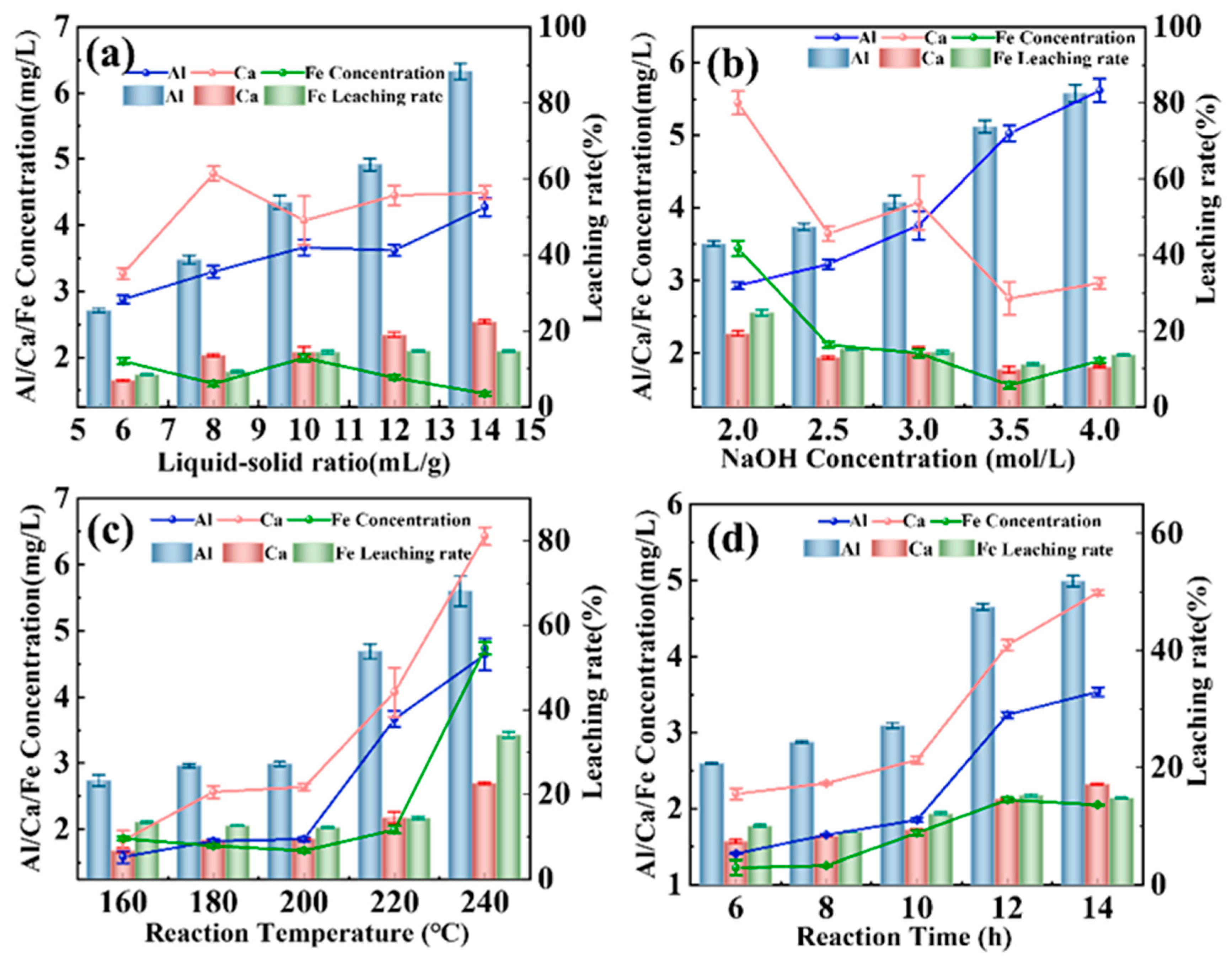
3.2.2. Effects of Process Parameters on Leaching Efficiency of Al3+, Ca2+, and Fe3+

Figure 4 shows impurity ion leaching at different liquid–solid ratios, NaOH concentrations, temperatures, and reaction durations. Like SiO2, Al3+ leaching efficiency improved with the liquid–solid ratio, NaOH concentration, temperature, and reaction duration. Al3+ substitutes isomorphically for Si4+ in the quartz lattice, generating Si-O-Al bonds in the crystal structure [26]. Consequently, Al3+ release requires the OH-mediated cleavage of adjacent Si-O-Si bonds, the exposure of trapped Al3+ sites, and reaction with OH to form soluble aluminate ions. At 8 h reaction time (Figure 4d), Al3+ leaching efficiency remained low while SiO2 leaching approached saturation. This divergence creates an optimal window for selective Al3+ removal from the quartz matrix.
In Figure 4b, it can be seen that the Ca2+ leaching efficiency decreased with increasing NaOH concentrations. This occurs because Ca2+ readily combines with OH under strong alkaline conditions to form Ca(OH)2 with extremely low solubility, thereby reducing Ca2+ leaching. Additionally, high concentrations of silicate ions in the system facilitate the formation of hydrated calcium silicate phases [27]. Thus, elevated alkali concentration not only promotes quartz dissolution but also effectively suppresses Ca2+ leaching. However, under high reaction temperatures (>200 °C, Figure 4c) and prolonged reaction times (>8 h, Figure 4d), Ca2+ leaching increased significantly. This indicates that despite the inhibitory effect of high alkalinity, elevated temperature and extended duration cause Ca2+ migration into the sodium silicate solution, subsequently compromising sodium silicate purity. As shown in Figure 4, variations in the liquid–solid ratio, NaOH concentration, and reaction time had negligible effects on Fe3+ leaching efficiency, which consistently remained low. This occurs because Fe3+ readily forms insoluble Fe(OH)3 precipitates under alkaline conditions. However, when the temperature increased to 240 °C (Figure 4c), Fe3+ leaching rose significantly due to crystalline transformation or partial decomposition of Fe(OH)3, forming more soluble intermediate phases [28]. To suppress impurity leaching while maximizing SiO2 dissolution, optimal conditions were selected: the liquid–solid ratio of 10 mL/g, NaOH concentration of 3 mol/L, reaction temperature of 200 °C, and reaction time of 8 h. Under these conditions, SiO2 leaching efficiency reached 82.96%, and impurity concentrations measured 1.66 ppm for Al3+, 2.33 ppm for Ca2+, and 1.25 ppm for Fe3+. The resulting sodium silicate solution achieved 99.999% purity, meeting the highest-grade specifications of the national standard GB/T 4209-2022, “Water glass for industrial use”, demonstrating effective deep purification.

3.3. Leaching Kinetics of SiO2, Al3+, Ca2+, Fe3+, and Purification Mechanisms

This work used heterogeneous reaction kinetic models based on phase structure and dissolution behavior differences to quantitatively analyze SiO2 and impurity ion leaching during alkaline hydrothermal dissolution of powder quartz. The shrinking core model suited SiO2 leaching data. The Jander diffusion model was used for Al3+ leaching. A time-delayed diffusion model was used for Ca2+ leaching. Rate-controlling stages and selective leaching kinetics were revealed by this method.

3.3.1. Kinetic Characteristics of SiO2 Leaching

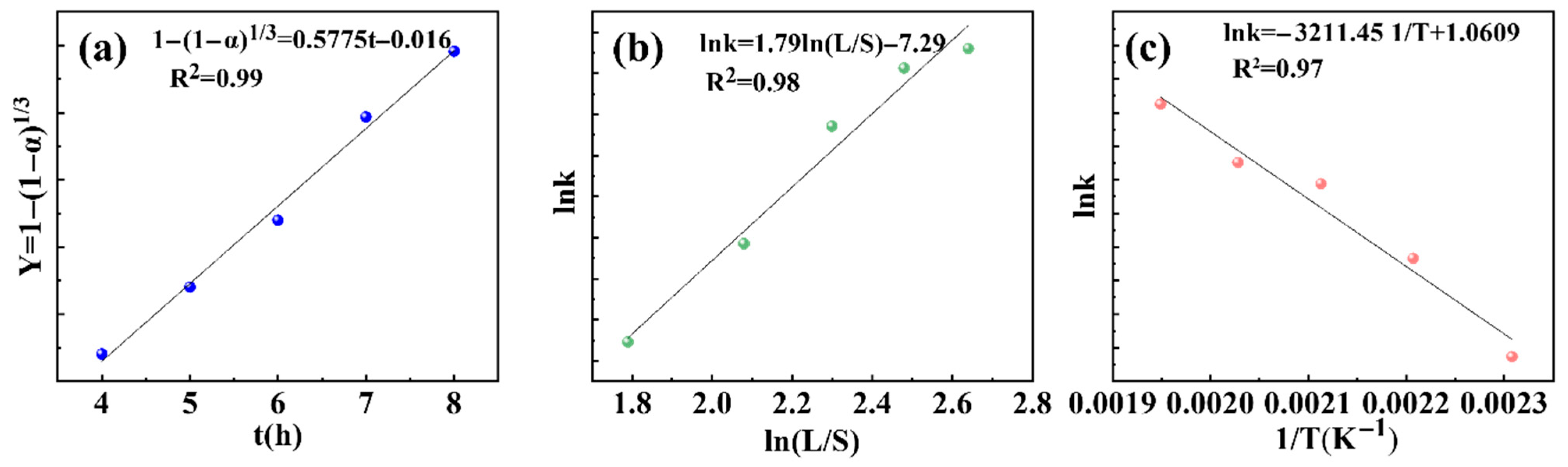
Under optimal process conditions (liquid–solid ratio 10 mL/g and NaOH concentration 3 mol/L, 200 °C), the fitting analysis of SiO2 leaching kinetics was performed (Figure 5a). The results demonstrate that the process conforms to the shrinking core model [29] (Equation (10)), with R2 = 0.99. This indicates that the hydrothermal alkaline dissolution of powdered quartz initiates at the particle surface. As the reaction progresses, the unreacted core continuously contracts, and the reaction interface progressively advances toward the particle interior [30].
1 ( 1 α ) 1 3 = 0.5773 t   ( R 2 = 0.99 )
To further elucidate the controlling step of the reaction, the kinetic parameters under varying conditions were calculated. Figure 5b presents the fitting of the apparent rate constant (k) versus the liquid–solid ratio (L/S) during SiO2 leaching, revealing a significant power–law relationship (Equation (11)). The high reaction order (1.79) demonstrates the substantial enhancement of reaction kinetics by elevated L/S ratios, fundamentally attributed to intensified mass transfer. Sufficient liquid phase not only ensures the rapid supply of reactants to particle surfaces but also effectively reduces the thickness of the diffusion boundary layer formed by sodium silicate products near the interface, accelerating their diffusion into the bulk solution.
k ∝ (L/S) 1.79 (R2 = 0.98)
Fitting the reaction rate constant (k) at different temperatures via the Arrhenius equation (Equation (12)) (Figure 5c) yielded an apparent activation energy (Ea) of 26.70 kJ/mol. Typically, reactions with Ea < 20 kJ/mol are diffusion controlled, while those with Ea > 40 kJ/mol are chemically controlled. This indicates a mixed control mechanism governed by both interfacial chemical reactions and diffusion through the product layer. Due to abundant lattice defects and high-energy surface sites in the powdered quartz raw material [31], these active sites lower the energy barrier for chemical reactions, thereby making the influence of mass transfer more pronounced. This ultimately manifests as a relatively low apparent activation energy and mixed control characteristics.
lnk = 3211.45 · 1 T + 1.069   ( R 2 = 0.97 )

3.3.2. Kinetic Analysis of Al3+, Ca2+, and Fe3+ Leaching

The distinct leaching kinetic models of impurity ions compared to SiO2 are pivotal for achieving selective separation. Figure 6a illustrates the leaching model for Al3+, which conforms to the Jander diffusion model (Equation (13)) [32]. This model typically describes solid-state, diffusion-controlled reactions through product layers, although the bond energy of Si-O-Al is theoretically lower than that of Si-O-Si and thus more readily broken where Al3+ exists as highly dispersed isomorphic impurities within the quartz lattice, making its dissolution challenging. The leaching process involves two sequential steps. (1) Local network destruction: OH in solution disrupts the local Si-O-Al network around Al3+, releasing aluminate ions. (2) Diffusion through gel layer: The dissolved aluminate ions diffuse through a sodium silicate gel layer formed by the repolymerization of dissolved silicon species on the particle surface before reaching the bulk solution. As the reaction progresses, the thickening sodium silicate gel layer significantly increases the ionic mass transfer resistance. Thus, diffusion through the product layer becomes the rate-limiting step for Al3+ leaching.
[ 1 ( 1 α ) 1 2 ] 2 = 0.01772 t 0.04062   ( R 2 = 0.97 )
Figure 6b displays the kinetic fitting results for Ca2+ leaching, which follows the time-delay model (Equation (14)) featuring a distinct lag time (t0). Ca2+ typically exists as microscopic mineral inclusions (e.g., calcite) encapsulated within quartz particles. Consequently, OH must first dissolve the surrounding quartz matrix to access these calcium-bearing inclusions, a process that accounts for the initial lag phase. Subsequently, the dissolution of the inclusions themselves is governed by the Jander diffusion model. However, the leached Ca2+ immediately precipitates in the high-alkalinity medium, creating dual suppression effects through both chemical precipitation and physical diffusion barriers. This results in significantly low leaching efficiency.
[ 1 ( 1 α ) 1 2 ] 2 = 3.4773   ×   10 - 5 ( t t 0 )   ( R 2 = 0.96 )
Due to the insolubility of Fe(OH)3 under alkaline conditions, Fe3+ leaching is suppressed under most reaction conditions. Its kinetics are not governed by conventional solid–liquid reaction models but instead dominated by a dissolution–precipitation equilibrium. At temperatures ≤ 200 °C, this equilibrium favors precipitation, resulting in a low leaching efficiency that cannot be fitted by standard kinetic models. The anomalous dissolution observed at 240 °C indicates a mechanistic shift, likely involving the lattice breakdown of Fe(OH)3 or its transformation into soluble complexes.
Here is the paragraph-formatted version integrating all kinetic analyses and the separation strategy. The distinct kinetic behaviors of SiO2 and impurity ions (Al3+, Ca2+, and Fe3+) during hydrothermal alkaline leaching enable kinetically selective separation through precise reaction time control. SiO2 leaching follows a mixed control mechanism (interfacial reaction + diffusion) with a relatively fast rate and low apparent activation energy (26.70 kJ/mol). In contrast, Al3+ leaching is governed by-product layer diffusion control, adhering to the Jander model, where the dissolution rate progressively slows due to thickening sodium silicate gel layers that impede ionic mass transfer. Ca2+ leaching exhibits the slowest kinetics due to dual suppression effects: an initial time-delay phase (t0) for matrix dissolution to access mineral inclusions (e.g., calcite), followed by instantaneous precipitation in high-alkalinity environments that creates coupled chemical and diffusion barriers.
Fe3+ leaching is dominated by a dissolution–precipitation equilibrium rather than typical kinetic models, with minor dissolution below 240 °C due to Fe(OH)3 insolubility and anomalous dissolution at higher temperatures via lattice breakage or soluble complex synthesis. Limiting the reaction time to ≤8 h optimizes selective extraction by inhibiting impurity leaching (Al3+, Ca2+, and Fe3+) through diffusion resistance, precipitation–diffusion barriers, and thermodynamic equilibrium limitations. This method theoretically supports high-purity sodium silicate synthesis by kinetic discrimination.

3.4. Effect of Silicate Anion Distribution (Qn) on Spherical SiO2 Morphology

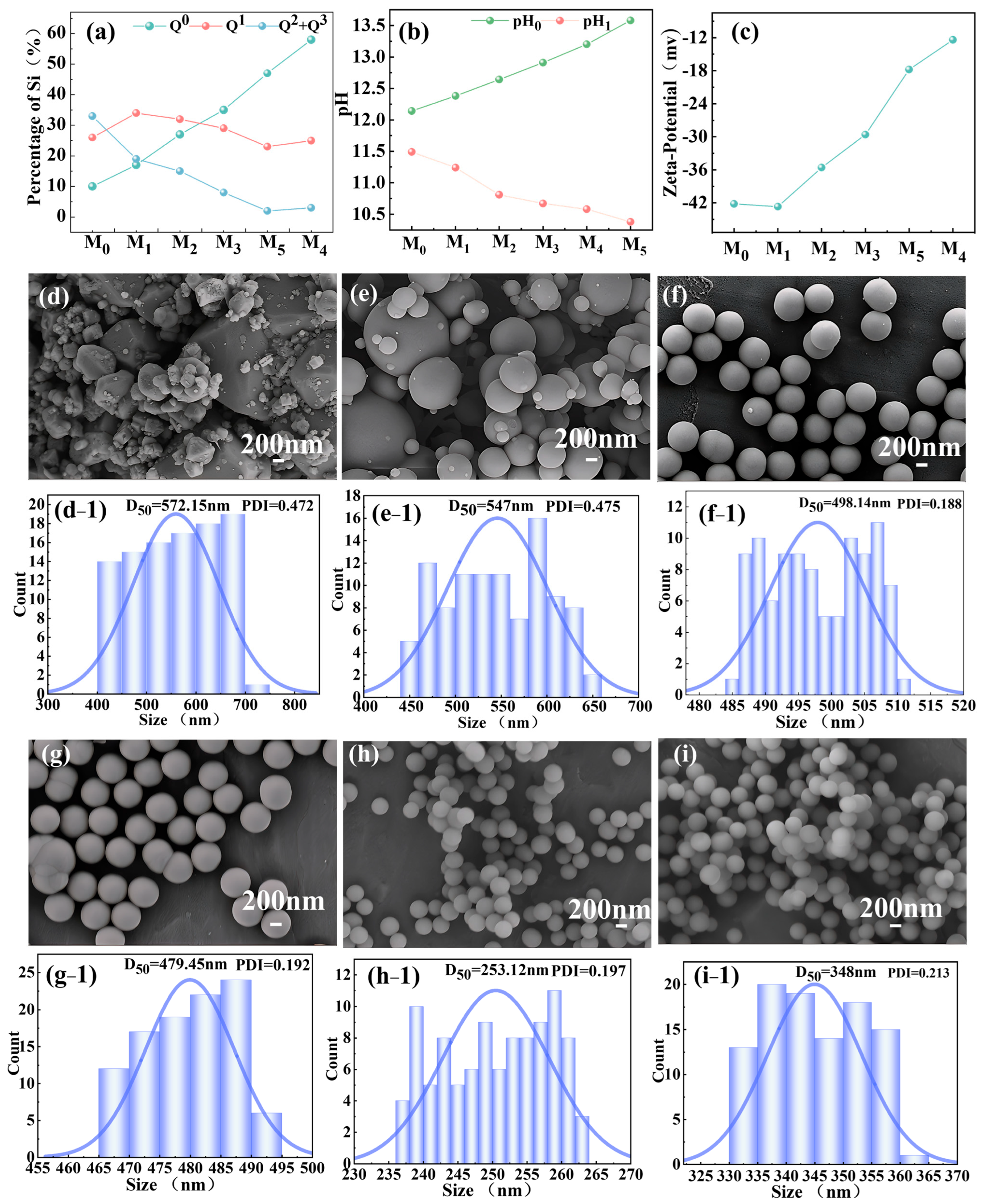
The distribution of silicate species (Qn) in sodium silicate solutions M0–M5 (Figure 7a) exhibits a distinct modulus-dependent evolution. As the modulus decreases, the fraction of monomeric Q0 progressively increases, while dimeric Q1 demonstrates an initial rise followed by a decline, peaking in sample M2 (modulus = 1.1). Conversely, the combined fraction of polymeric species (Q2 + Q3) steadily decreases. This redistribution originates from a dual effect induced by lower modulus: increased Na+ concentration and enhanced alkalinity.
The latter drives alkaline hydrolysis-dominated depolymerization, where high OH concentrations facilitate nucleophilic attack on Si-O-Si bonds [33], destabilizing highly polymerized silicate frameworks (Q3/Q2) and progressively fragmenting them into low-polymerization species (Q1 and Q0). Consequently, the reaction equilibrium shifts decisively toward depolymerization under intensified alkaline conditions.
Si - O - Si + OH     Si - OH + Si - O
Charge Regulation by Na+: In low-modulus systems, elevated Na+ concentration suppresses silicate re-polymerization through dual mechanisms of charge regulation and steric hindrance. Acting as counterions, Na+ compresses the electrical double layer around negatively charged silicate species [34], thereby reducing electrostatic repulsion between silicate anions. However, excessive Na+ simultaneously induces steric hindrance that impedes collision-driven association. Specifically, Na+ coordinates with Si—O groups to form stable (Na)O—Si—O(Na) complexes (Equation (16)) [35], which (i) inhibit Si-O-Si bond reformation through charge neutralization, lowering silicate reactivity by reducing nucleophilicity, and (ii) create spatial barriers that physically obstruct condensation reactions. Collectively, these effects stabilize low-polymerization species (Q0, Q1), preventing their reorganization into higher-order polymeric structures.
Si - O +   Na +     ( Na ) O - Si - O ( Na )
Figure 7d–i show SEM images of spherical SiO2 particles prepared from sodium silicate precursors with different moduli (M0–M5). The results showed that the modulus significantly affects the product morphology and particle size uniformity (evidenced by PDI). Particles prepared from a high-modulus sample (M0) have irregular morphology and severe agglomeration; their PDI is 0.472, indicating a wide particle size distribution (Figure 7d-1). Decreasing the modulus, particles from sample M1 become spherical but show “necking” and severe agglomeration; M1 has the highest PDI (0.475) and the worst size uniformity (Figure 7e-1). When the modulus decreases to 1.1 (M2) and 0.9 (M3), the particles show good sphericity and relatively dispersed states; their PDI values (0.188 and 0.192, respectively) decrease significantly, indicating more uniform size distributions (Figure 7f-1,g-1). With further decreases in the modulus, the particles from samples M4 and M5 are spherical with uniform size distributions (Figure 7h-1,i-1). However, they exhibit severe inter-particle agglomeration and poor dispersion. Furthermore, differences in Qn distribution among the samples cause variations in the nucleation-growth process of spherical SiO2. In the M0 system, Qn is dominated by Q2 and Q3 (33% combined). These highly polymerized structures undergo partial pre-condensation before acid addition, forming multi-scale precursor aggregates. Due to the low alkalinity (initial pH = 12.14) and weak buffering capacity of the high-modulus sodium silicate system, H+ rapidly neutralizes silicate anions during acidification, forming silicic acid monomers. The silicic acid monomers and the pre-existing aggregates exhibit significant differences in condensation rates and interactions [36]. This leads to heterogeneous nucleation. Silicic acid aggregates of different shapes grow anisotropically. This ultimately forms products with irregular morphology, severe agglomeration, and high PDI.
For the M2–M3 systems, Q2 + Q3 account for only 8%–12%, while Q0 (35%–42%) and Q1 (28%–32%) are predominant. The low-polymerization states Q0 and Q1 exhibit uniform reactivity. This avoids condensation imbalance caused by the pre-condensation of highly polymerized silicate species. Therefore, this Qn distribution provides an ideal environment for the homogeneous nucleation of spherical SiO2. The presence of moderate Q2 + Q3 slightly reduces the overall nucleation rate. This allows nucleation and growth to proceed synchronously. The initial pH of this system is 12.64–12.91, with moderate buffering capacity. During acid addition, the pH slowly decreases to the precipitation critical point. This further ensures uniform growth of the nuclei. Simultaneously, the high absolute zeta potential (−35.6~−37.2 mV) (Figure 7c) provides strong inter-particle electrostatic repulsion. This effectively inhibits agglomeration. Additionally, the M4–M5 systems have a high Na+ concentration and strong alkalinity (initial pH > 13). Qn exists mainly as Q0 (50%–58%). Although Q0 monomers have high reactivity and uniform distribution, the strong alkaline system has high buffering capacity. During initial acid addition, H+ only neutralizes OH. pH cannot decrease rapidly. When pH drops to the nucleation critical point, massive Q0 instantly protonates to form silicic acid molecules. The silicate saturation level sharply increases. This triggers “explosive homogeneous nucleation”, generating a vast number of primary nuclei. The total silicate source is fixed. This results in smaller final particle sizes. Additionally, high Na+ concentration compresses the electric double layer on particle surfaces. The absolute zeta potential decreases to −17.5~−19.8 mV. Inter-particle electrostatic repulsion weakens significantly. This intensifies agglomeration, forming chain-like aggregates. A sodium silicate modulus of 0.9–1.1 is the optimal range for controlling spherical SiO2 morphology and particle size. Within this range, Q0 and Q1 proportions are moderate. Homogeneous nucleation achieves high sphericity, narrow particle size distribution, and good dispersion. This provides high-quality precursors for the subsequent preparation of spherical SiO2, meeting electronic-grade standards.
Based on our experimental findings, we propose a “two-step regulation” mechanistic model for the formation of spherical SiO2, centered on the control of the silicate precursor structure, to explain the high sphericity and monodispersity. Firstly, the chemical structure of the precursor solution dictates the uniformity of initial nucleation. When the sodium silicate solution modulus is adjusted to 0.9–1.1, the silicate anions exhibit a balanced ratio of Q0 (monomers) to Q1 (dimers/oligomers). This moderate degree of polymerization endows the precursor with suitable reactivity and steric hindrance, which, upon acidification-induced precipitation, facilitates a near “burst nucleation” event. This process generates a large population of initial SiO2 nuclei with uniform size within a very short timeframe, establishing the kinetic foundation for the monodispersity of the final product. Subsequently, thermodynamic driving forces dominate spheroidization during the growth stage. The newly formed amorphous SiO2 continuously deposits at the solid–liquid interface. The initial nuclei, characterized by high specific surface area, are thermodynamically unstable. The system thus evolves spontaneously toward a lower-energy state by minimizing its total surface energy. For isotropic amorphous SiO2, a spherical shape is the most efficient geometry to achieve this surface energy minimization. Consequently, given sufficient growth time, the particles evolve into well-defined spheres and further densify via isotropic growth mechanisms such as Ostwald ripening and molecular deposition. Moreover, deviations from the optimal modulus range disrupt this synergy. A modulus that is too low (Q0-dominated) leads to excessively rapid reaction kinetics, resulting in disordered aggregation and irregular morphologies. Conversely, a modulus that is too high (Q3/Q4-dominated) suppresses nucleation due to low precursor reactivity, favoring the formation of large, irregularly shaped particles. Therefore, precise control over the silicate solution modulus is the key to achieving high sphericity and monodispersity.

3.5. Physicochemical Properties of Spherical SiO2 Prepared Under Optimal Hydrothermal Conditions

Sodium silicate solution was prepared under the optimal hydrothermal conditions for purifying powdered quartz (liquid–solid ratio: 10 mL/g; NaOH concentration: 3 mol/L; reaction temperature: 200 °C; and reaction time: 8 h). The solution has a SiO2 mass fraction of 6.64% and a Na2O mass fraction of 6.3%. Its modulus is 1.08, falling within the optimal modulus range (0.9–1.1).
Using the sodium silicate solution prepared under optimal hydrothermal conditions as the precursor, spherical SiO2 (SS) was successfully synthesized. The resulting SS particles exhibit high sphericity, with an average sphericity of 0.985 (Figure 8d). They show good dispersion with no obvious agglomeration (Figure 8a). The SS particles are primarily amorphous SiO2 (Figure 8b). The median particle size (D50) is 498.74 nm (Figure 8c), and the PDI is 0.178. This indicates a uniform particle size distribution. The product meets the Grade 002 standard (D50 < 2 μm) specified in GB/T 32661-2016 “Spherical Silica Powder”. The chemical composition analysis results (Figure 8e,f) show that the SS contains significantly lower levels of impurity ions (Al3+, Ca2+, and Fe3+) than the QYG-H standard limits. The SiO2 purity reaches 99.996%. This well exceeds the requirements of the QYG-H standard. The SS satisfies the requirements for high-end, electronic-grade applications.

3.6. Spherical SiO2 Preliminary Analysis of Environmental and Economic Aspects

While a detailed life cycle assessment (LCA) and precise cost analysis are subjects for future pilot-scale studies, a preliminary qualitative analysis of the potential environmental and economic benefits, as well as key waste management challenges, can be drawn based on the intrinsic features of the proposed process.
Raw material cost constitutes the most prominent potential economic advantage. As summarized in Table 1, compared to the vapor-phase method (reliant on high-purity SiCl4) and the sol–gel method (reliant on high-purity organosilicon alkoxides), our process utilizes natural powder quartz as the primary silicon source, which is low-cost and abundant. Although the purification steps add to the process flow, the overall raw material cost is expected to be significantly lower. The core reagent, sodium hydroxide, is inexpensive. Moreover, sodium ions can be partially recovered as by-products via subsequent precipitation and filtration, potentially reducing reagent consumption costs.
Regarding environmental impact, the process is predominantly an aqueous alkaline system, avoiding the use and handling of toxic, corrosive gases (e.g., SiCl4 and HCl) in the vapor-phase method and the volatility and recovery issues of large quantities of organic solvents (e.g., ethanol and isopropanol) in the sol–gel method. However, the process presents specific waste stream challenges. (1) Fluoride-containing (HF) waste stream: Generated from the small amount of HF acid used in the flotation step. The proposed treatment routes include the calcium salt precipitation method (forming CaF2 sludge), or an alkali absorption–precipitation combined method to ensure fluoride discharge compliance. (2) Alkaline waste stream: Primarily from the hydrothermal alkaline leaching and synthesis stages. For such high-pH, high-salinity wastewater, neutralization–flocculation–precipitation is a standard treatment. A more promising strategy is internal process recycling, where the filtered alkaline mother liquor is replenished and reused. This approach would minimize fresh alkali consumption and wastewater discharge, representing a key research focus for future scale-ups.
Compared to conventional methods, our process exhibits a distinct profile in terms of raw material toxicity, reagent hazard, and waste type. Its “green” potential lies primarily in it being a simpler system with fewer hazardous reagents; its “cost” potential is rooted in the inexpensive mineral feedstock. Future pilot-scale studies will focus on optimizing reagent recycling efficiency and quantifying energy/water consumption and waste treatment costs to provide a more precise economic and environmental assessment.

4. Conclusions

This study developed an integrated process for preparing high-purity spherical SiO2 from Jiangxi powder quartz, combining reverse flotation and hydrothermal alkaline leaching for deep impurity removal, followed by chemical precipitation synthesis. We found the following:
  • Efficient purification was achieved under optimal hydrothermal conditions (L/S ratio: 10 mL/g and NaOH: 3 mol/L; 200 °C, 8 h), yielding 99.999% pure sodium silicate with 82.96% SiO2 leaching efficiency.
  • Leaching kinetics revealed SiO2 dissolution followed the shrinking core model under mixed control (apparent activation energy: 26.70 kJ/mol). Differential impurity behaviors included Al3+ was diffusion controlled, Ca2+ was inhibited by chemical precipitation, and Fe3+ was governed by the dissolution–precipitation equilibrium, enabling selective SiO2 separation.
  • Qn distribution of silicate anions critically regulated SiO2 sphericity and uniformity: modulus 0.9–1.1 (balanced Q0/Q1 ratio) enabled uniform nucleation, producing monodisperse spheres. Deviations from this (modulus <0.7 or >1.5) caused aggregation or irregular morphologies.
  • Spherical SiO2 synthesized from modulus 1.08 precursor exhibited ultrahigh purity (99.996%), median size (D50: 498.74 nm), narrow PDI (0.178), and near-perfect sphericity (0.985), Surpassing electronic-grade standards (QYG-H Type 002), it demonstrated industrial viability for narrow size-distribution SiO2.
To clarify the potential advantages of the proposed process, a preliminary comparative assessment against the main alternative methods—vapor-phase and sol–gel—is provided in the table below based on key criteria:
In summary, the process proposed in this study offers a novel route for producing electronic-grade, high-purity spherical SiO2 from low-grade powder quartz, which presents potential advantages in terms of the cost and environmental profile. The approach demonstrates promising features in terms of feedstock affordability and a more environmentally benign reaction system, while retaining excellent control over particle morphology. It provides new theoretical and technical foundations for synthesizing spherical SiO2 with a narrow size distribution.

Supplementary Materials

The following supporting information can be downloaded at: https://www.mdpi.com/article/10.3390/min15121296/s1. Figure S1: Curves of M0–M5 (A) vs. time (t) (a); calibration curve of Q0 standard (b); Table S1: Process conditions for preparation of high-purity sodium silicate.

Author Contributions

Y.Z.: Writing—original draft, investigation, formal analysis. H.S.: Data curation and funding acquisition. T.P.: Investigation. S.R.: Resources and supervision. S.C.: Visualization and writing—review and editing. L.C.: Validation. T.C.: Writing—review and editing. All authors have read and agreed to the published version of the manuscript.

Funding

This research was funded by the National Key Research and Development Program of China, Sichuan Provincial Finance Intellectual Property Special Project and Postgraduate Innovation Fund Project by Southwest University of Science and Technology grant number [2024YFC3907602], [2024-ZS-00016] and [25ycx1067] And The APC was funded by [the National Key Research and Development Program of China (2024YFC3907602)].

Data Availability Statement

The data presented in this study are available on request from the corresponding author due to their relevance to ongoing research projects that have not yet been finalized and published.

Acknowledgments

This work was supported by the National Key Research and Development Program of China (2024YFC3907602) and Sichuan Provincial Finance Intellectual Property Special Project (2024-ZS-00016) Postgraduate Innovation Fund Project by Southwest University of Science and Technology (25ycx1067).

Conflicts of Interest

The authors declare no conflicts of interest.

References

  1. Wang, H.; Zhang, H.; Liang, B.; Tian, M.; Li, X.; Ding, T.; Liu, P.; Yang, Y.; Niu, L.; Zhang, Z. Tri-functionally modified spherical silica for high-performance epoxy resin sealant. Compos. Commun. 2024, 51, 102081. [Google Scholar] [CrossRef]
  2. Jin, B.H.; Jang, J.; Kang, D.J.; Yoon, S.; Im, H.-G. Epoxy-based siloxane composites for electronic packaging: Effect of composition and molecular structure of siloxane matrix on their properties. Compos. Sci. Technol. 2022, 224, 109456. [Google Scholar] [CrossRef]
  3. Dong, T.; Liang, J.; Camayd-Muñoz, S.; Liu, Y.; Tang, H.; Kita, S.; Chen, P.; Wu, X.; Chu, W.; Mazur, E.; et al. Ultra-low-loss on-chip zero-index materials. Light Sci. Appl. 2021, 10, 10. [Google Scholar] [CrossRef] [PubMed]
  4. Sukhinina, N.S.; Masalov, V.M.; Yu, J.; Liu, Q.; Zhokhov, A.A.; Wang, J.; Emelchenko, G.A. A promising white pigment based on hollow spherical silica particles. Colloids Surf. A Physicochem. Eng. Asp. 2025, 726, 137909. [Google Scholar] [CrossRef]
  5. Hou, T.; Liu, X.; Ren, J.; Liu, Q.; Zhokhov, A.A.; Wang, J.; Emelchenko, G.A. Mesoporous hollow silica with controlled particle size for optimizing dielectric properties and coefficient of thermal expansion of polyimide packaging materials. J. Mater. Sci. Technol. 2025, 235, 122–132. [Google Scholar] [CrossRef]
  6. Malekzadeh, M.; Swihart, M.T. Vapor-phase production of nanomaterials. Chem. Soc. Rev. 2021, 50, 7132–7249. [Google Scholar] [CrossRef]
  7. Priyan, S.R.; Kumar, G.S.; Surendhiran, S.; Shkir, M. Size-controlled synthesis of mesoporous silica nanoparticles using rice husk by microwave-assisted sol–gel method. Int. J. Appl. Ceram. Technol. 2023, 20, 2807–2816. [Google Scholar] [CrossRef]
  8. Choi, J.; Lee, W.; Shim, T.; Park, J. Fumed silica-based ultra-high-purity synthetic quartz powder via sol–gel process for advanced semiconductor process beyond design rule of 3 nm. Nanomaterials 2023, 13, 390. [Google Scholar] [CrossRef]
  9. Kamila, R.; Ridwan Akhir, M.P.M.; Patriati, A.; Insani, A. Synthesis of silica particles through conventional sol-gel and sonochemistry methods and the effect of catalyst, water concentration and sample environment to the particle size. J. Phys. Conf. Ser. 2022, 2193, 12044. [Google Scholar] [CrossRef]
  10. Zhan, L.; Wang, Q.; Ku, J.; Shang, H.; Shen, Z. Purification technologies for high-purity quartz: From mineralogy to applications. Sep. Purif. Rev. 2025, 1–18. [Google Scholar] [CrossRef]
  11. Guo, W.; Lu, H.; Zhang, Z.; Jiang, L.; Wu, H.; Liu, D.; Chi, R. Crystal structure transformation and lattice impurities migration of quartz during chlorine roasting. Int. J. Min. Sci. Technol. 2024, 34, 1465–1474. [Google Scholar] [CrossRef]
  12. Lin, M.; Pei, Z.; Li, Y.; Liu, Y.; Wei, Z.; Lei, S. Separation mechanism of lattice-bound trace elements from quartz by KCl-doping calcination and pressure leaching. Miner. Eng. 2018, 125, 42–49. [Google Scholar] [CrossRef]
  13. Zhang, X.; Gong, P.; Zhang, Y.; Li, Y.; Zhou, G.; Yuan, F.; Li, C.; Sun, Z. Influence of inclusions with different morphological characteristic on the deep purification of vein quartz. Miner. Eng. 2025, 234, 109709. [Google Scholar] [CrossRef]
  14. Pan, X.; Li, S.; Li, Y.; Guo, P.; Zhao, X.; Cai, Y. Resource, characteristic, purification and application of quartz: A review. Miner. Eng. 2022, 183, 107600. [Google Scholar] [CrossRef]
  15. Zhao, X.; Zeng, L.; Guo, J.; Zhu, Q.; Huang, Z.; Lin, L.; Chen, X.; Cao, J.; Zhou, Z. Efficient separation and comprehensive extraction of aluminum, silicon, and iron from coal fly ash by a cascade extraction method. J. Clean. Prod. 2023, 406, 137090. [Google Scholar] [CrossRef]
  16. He, L.; Shi, L.; Huang, Q.; Hayat, W.; Shang, Z.; Ma, T.; Wang, M.; Yao, W.; Huang, H.; Chen, R. Extraction of alumina from aluminum dross by a non-hazardous alkaline sintering process: Dissolution kinetics of alumina and silica from calcined materials. Sci. Total Environ. 2021, 777, 146123. [Google Scholar] [CrossRef]
  17. Brinker, C.J. Hydrolysis and condensation of silicates: Effects on structure. J. Non-Cryst. Solids 1988, 100, 31–50. [Google Scholar] [CrossRef]
  18. Zou, H.; Wu, S.; Shen, J. Polymer/Silica nanocomposites: Preparation, characterization, properties, and applications. Chem. Rev. 2008, 108, 3893–3957. [Google Scholar] [CrossRef]
  19. Katoueizadeh, E.; Rasouli, M.; Zebarjad, S.M. A comprehensive study on the gelation process of silica gels from sodium silicate. J. Mater. Res. Technol. 2020, 9, 10157–10165. [Google Scholar] [CrossRef]
  20. GB/T 4209-2022; Sodium silicate for industrial use. Standards Press of China: Beijing, China, 2022.
  21. Zong, J.; Yue, J. Continuous solid particle flow in microreactors for efficient chemical conversion. Ind. Eng. Chem. Res. 2022, 61, 6269–6291. [Google Scholar] [CrossRef]
  22. Hu, G.; Zhang, R.; Tang, X.; Sun, P.; Wang, T. Study on the mass transfer behavior of single CO2 bubbles in sodium silicate solution. Phys. Chem. Chem. Phys. 2025, 27, 13071–13082. [Google Scholar] [CrossRef] [PubMed]
  23. Xiao, Y.; Lasaga, A.C. Ab initio quantum mechanical studies of the kinetics and mechanisms of quartz dissolution: OH catalysis. Geochim. Cosmochim. Acta 1996, 60, 2283–2295. [Google Scholar] [CrossRef]
  24. Faraji, F.; Alizadeh, A.; Rashchi, F.; Mostoufi, N. Kinetics of leaching: A review. Rev. Chem. Eng. 2022, 38, 113–148. [Google Scholar] [CrossRef]
  25. Visser, J.H.M. Fundamentals of alkali-silica gel formation and swelling: Condensation under influence of dissolved salts. Cem. Concr. Res. 2018, 105, 18–30. [Google Scholar] [CrossRef]
  26. Dusselier, M.; Davis, M.E. Small-Pore Zeolites: Synthesis and Catalysis. Chem. Rev. 2018, 118, 5265–5329. [Google Scholar] [CrossRef]
  27. Maraghechi, H.; Rajabipour, F.; Pantano, C.G.; Burgos, W.D. Effect of calcium on dissolution and precipitation reactions of amorphous silica at high alkalinity. Cem. Concr. Res. 2016, 87, 1–13. [Google Scholar] [CrossRef]
  28. Carrasco, G.F.; Portillo, M.C.; Santiago, A.C.; Diaz, A.R.; Mora-Ramirez, M.; Moreno, O.P. Morphological and structural analysis of the Fe(OH)3 and CuS transitions to Fe2O3 and CuO. Optik 2021, 243, 167377. [Google Scholar] [CrossRef]
  29. Wu, J.; Xiao, Y.; Yang, X.; Xu, D.-H.; Zhang, Z.-Y.; Zhong, Y.-J.; Wang, X.-L. Leaching kinetics for magnesium extraction from phosphate rock in the nitric acid method. Miner. Eng. 2022, 189, 107894. [Google Scholar] [CrossRef]
  30. Yu, J.; Sun, H.; Sun, X.; Guo, Y.; Zhang, W.; Li, Y. Kinetic study on low-temperature reduction of hematite in a microfluidized bed: Effect of pore characteristics on reaction rate. Mater. Today Commun. 2025, 46, 112886. [Google Scholar] [CrossRef]
  31. Götze, J.; Pan, Y.; Müller, A. Mineralogy and mineral chemistry of quartz: A review. Mineral. Mag. 2021, 85, 639–664. [Google Scholar] [CrossRef]
  32. Azof, F.I.; Safarian, J. Leaching kinetics and mechanism of slag produced from smelting-reduction of bauxite for alumina recovery. Hydrometallurgy 2020, 195, 105388. [Google Scholar] [CrossRef]
  33. Matinfar, M.; Nychka, J.A. A Review of Sodium Silicate Solutions: Structure, Gelation, and Syneresis. Adv. Colloid. Interface Sci. 2023, 322, 103036. [Google Scholar] [CrossRef]
  34. Qiu, Y.; Ma, J.; Chen, Y. Ionic Behavior in Highly Concentrated Aqueous Solutions Nanoconfined between Discretely Charged Silicon Surfaces. Langmuir 2016, 32, 4806–4814. [Google Scholar] [CrossRef]
  35. Mahadevan, T.S.; Du, J. Hydration and reaction mechanisms on sodium silicate glass surfaces from molecular dynamics simulations with reactive force fields. J. Am. Ceram. Soc. 2020, 103, 3676–3690. [Google Scholar] [CrossRef]
  36. Maliavski, N.; Zhuravlova, O. Calculation of polycondensation equilibria in aqueous solutions of silica and silicates. East.-Eur. J. Enterp. Technol. 2018, 4, 48–55. [Google Scholar] [CrossRef]
Figure 1. Preparation of high-purity sodium silicate via alkaline hydrothermal dissolution of powder quartz (a); controlled synthesis of spherical SiO2 (b).
Minerals 15 01296 g001
Figure 2. Chemical composition of samples JXF and JXF-F (a); XRD patterns of samples JXF and JXF-F (b); particle size distribution and SEM image of sample JXF-F (c); and optical micrograph of sample JXF-F (d).
Minerals 15 01296 g002
Figure 3. Effects of process parameters on SiO2 leaching efficiency: Liquid–solid ratio (a); NaOH concentration (b); reaction temperature (c); and reaction time (d).
Minerals 15 01296 g003
Figure 4. Effect of liquid–solid ratio on leaching efficiency of Al3+, Ca2+, and Fe3+ (a); effect of NaOH concentration on leaching efficiency of Al3+, Ca2+, and Fe3+ (b); effect of reaction temperature on leaching efficiency of Al3+, Ca2+, and Fe3+ (c); and effect of reaction time on leaching efficiency of Al3+, Ca2+, and Fe3+ (d).
Minerals 15 01296 g004
Figure 5. Fitting curve of SiO2 leaching kinetics based on the shrinking core model (R2 = 0.99) (a); relationship between apparent rate constant (k) and liquid–solid ratio in SiO2 leaching kinetics (b); and Arrhenius plot (for activation energy calculation) (c).
Minerals 15 01296 g005
Figure 6. Kinetic fitting curve of Al3+ leaching based on the Jander diffusion model (a); kinetic fitting curve of Ca2+ leaching based on the time-delay diffusion model (b).
Minerals 15 01296 g006
Figure 7. Qn distribution in sodium silicate samples M0–M5 (a); initial pH (pH0) and precipitation pH (pH1) for samples M0–M5 (b); zeta potential of spherical SiO2 prepared from samples M0–M5 (c); SEM image of spherical SiO2 prepared from sample M0-M5 (di); and particle size distribution diagrams of spherical SiO2 prepared from sample M1–M5 (d-1i-1).
Minerals 15 01296 g007
Figure 8. SEM image of SS (a); XRD pattern of SS (b); particle size distribution of SS (c); sphericity distribution of SS (d); comparison of impurity ion content (Al3+, Ca2+, and Fe3+) in SS versus the QYG-H standard (e); and comparison of SiO2 purity in SS versus the QYG-H standard (f).
Minerals 15 01296 g008
Table 1. Comprehensive comparison of different silica preparation methods.
Evaluation CriterionVapor-Phase MethodSol–Gel MethodProposed Method (This Study)
Raw Material CostHigh (e.g., SiCl4)Very High (relies on high-purity organosilicon alkoxides)Low (uses natural powder quartz as the main feedstock, which is abundant and low in cost)
Process Energy IntensityVery High (requires high-temperature vapor-phase reactions)Low to Moderate (ambient/low-temperature solution reactions)Moderate (core purification step requires hydrothermal conditions but avoids extreme high temperatures)
Environmental ImpactHigh (uses highly corrosive, toxic precursors; complex by-product handling)Relatively High (involves substantial organic reagents and subsequent treatment)Low (primarily an aqueous alkaline system, relatively greener reagents, and easier wastewater treatment)
Control over Particle MorphologyGood (can produce high-purity nano-spheres)Excellent (allows precise control over size and morphology)Excellent (effective control over sphericity, size, and monodispersity by modulating silicate solution modulus)
Disclaimer/Publisher’s Note: The statements, opinions and data contained in all publications are solely those of the individual author(s) and contributor(s) and not of MDPI and/or the editor(s). MDPI and/or the editor(s) disclaim responsibility for any injury to people or property resulting from any ideas, methods, instructions or products referred to in the content.