Article

Organic Geochemistry and Petroleum Potential for Cambrian-Silurian Source Rocks in the Baltic Basin Onshore Poland

by
Przemysław Karcz
Polish Geological Institute—National Research Institute (PGI-NRI), 19 Jaworowa Str., 53-122 Wrocław, Poland
Minerals 2025, 15(11), 1170; https://doi.org/10.3390/min15111170
Submission received: 12 September 2025 / Revised: 30 October 2025 / Accepted: 3 November 2025 / Published: 7 November 2025

Abstract

The Upper Cambrian–Lower Silurian sediments of the Baltic Basin represent organic-rich clastic and carbonate rocks that are a key exploration target for hydrocarbons in northern Pomerania, Poland. The source rocks contain an average total organic carbon (TOC) content of 4.1 wt% (range: 0.7–9.6 wt%). The organic matter is primarily in the early to mid-oil window; however, both more mature and overmature organic matter also occur (average Tmax: 445 °C; range: 427–488 °C; average Ro: 1.3%; range: 1.0%–1.8%). These organic-rich rocks were mostly deposited under dysoxic rather than anoxic conditions. Fossils of oxygen-dependent benthic fauna are widely distributed, even in the darkest (black shale) lithologies. Nevertheless, short intervals lacking benthic fossils indicate episodes of anoxic bottom-water conditions. The Furongian–Lower Llandovery source rocks exhibit a low sedimentation rate, ranging from 1 to 19 m/Ma. Geochemically, the organic matter is dominated by type II kerogen. Petrographically, the kerogen consists mainly of graptolites and algae. Due to the predominance of planktonic-origin fauna and thermal maturity, the kerogen is relatively hydrogen depleted (average Hydrogen Index, HI: 169 mg HC/g TOC; range: 1–340 mg HC/g TOC). The present day petroleum potential of these source rocks varies from fair to good and very good. Bitumen analysis revealed a dominance of kerogen components, with only minor admixtures of light and heavy oils.

1. Introduction

Between 2007 and 2012, Poland experienced an intensive period of shale gas and shale oil exploration, which triggered a major boom in both the domestic petroleum industry and the geoscience sector. During this time, more than one hundred unconventional exploration licenses were granted, fueling hopes for energy independence in Eastern and Southern Europe and challenging the long-standing dominance of traditional energy suppliers. Among the identified targets, the Furongian–Silurian shales of the Baltic, Podlasie, and Lublin basins were recognized as the most prospective formations for unconventional hydrocarbon exploration in this part of Europe.
Although this large-scale exploration brought extensive new datasets and analytical results, Polish shales had already been investigated in earlier decades, particularly between the 1970s and 1990s, through several dozen wells. These earlier studies provided valuable lithological, geochemical, and geophysical data [1,2,3,4]. However, those datasets were often fragmentary and lacked a consistent interpretation regarding source rock quality, hydrocarbon generation potential, and regional stratigraphic correlations.
In recent years, research attention has increasingly shifted toward a more comprehensive understanding of the paleoenvironmental and geochemical factors controlling hydrocarbon generation in the Baltic Basin. The Cambrian–Silurian succession represents a unique record of early Paleozoic marine dysoxia/anoxia and the deposition of organic-rich shales along the Baltica continental margin. The composition of organic matter and its preservation conditions reflect major palaeoceanographic transformations from oxygenated shelf settings to dysoxic and anoxic basinal environments associated with the regional deposition of Furongian–Silurian black shales [5,6]. Understanding these transitions is crucial for reconstructing the depositional framework of the basin and assessing the spatial variability of its petroleum potential.
At the same time, regional exploration efforts continue to rely heavily on organic geochemical investigations, including kerogen transformation modeling, thermal maturity assessments, kinetic simulations, biomarker proxies, and redox indicators. Integrating these approaches enables a more reliable evaluation of both source rock quality and hydrocarbon generation history, bridging the gap between geochemical studies, numerical modeling, and field-scale exploration results.
Subsequent exploration campaigns after 2010 [7,8,9,10,11,12] substantially expanded the stratigraphic and geochemical knowledge of the Baltic Basin. Nevertheless, key questions remain concerning the lateral variability of organic matter, the quantitative assessment of hydrocarbon potential, and the delineation of the most prospective intervals within the basin. In recent years, several studies have further advanced the understanding of the Baltic Basin source rocks by applying new analytical techniques and refining models of tectonic and sedimentary evolution [13,14,15,16].
In this context, the present study aims to address these knowledge gaps by integrating both newly acquired and archival geochemical and geological datasets. A key contribution of this work lies in the extensive synthesis of historical Polish data that had not previously been presented in English-language journals. Many of these materials, although fundamental to the understanding of the Baltic Basin, have remained inaccessible to the broader international community. Their critical reassessment provides essential insights into the depositional environments of the Upper Cambrian–Llandovery succession and offers a valuable historical context for interpreting the evolution of source rocks.
In addition to this archival component, the study introduces a large and high-resolution dataset of Rock-Eval analyses derived from several exploration projects, encompassing both conventional and less commonly used analytical modes such as Rock-Eval Reservoir and Rock-Eval Optkin. The integration of these results enables a detailed characterization of source-rock quality, thermal maturity, and hydrocarbon generation potential across multiple stratigraphic intervals. This combination of historical synthesis and modern geochemical data provides one of the most comprehensive regional assessments of the Lower Paleozoic petroleum systems in the Polish onshore sector of the Baltic Basin.
The investigation focuses on five key boreholes, i.e., Żarnowiec IG1, Darżlubie IG1, Hel IG1, Kościerzyna IG1, and Gdańsk IG1 located entirely within the prospective shale-gas zone defined in the first Polish Geological Institute [17] resource assessment. A detailed description of the geological framework and spatial distribution of the studied intervals is presented in the Section 2. Although this study does not aim to reconstruct detailed facies-related mechanisms of organic matter enrichment, it provides a stratigraphically constrained geochemical framework that may serve as a foundation for future paleoenvironmental and sedimentological interpretations.

2. Geological Background

The study area described in this article is located in northern Poland, within the northern part of the Pomeranian Voivodeship (Figure 1). Geologically, it lies in the northwestern part of the East European Platform, within the western segment of the Peribaltic Syneclise (Baltic Depression). The thickness of the sedimentary cover, its stratigraphic subdivision, and the structure of the Proterozoic crystalline basement have been determined based on the analysis of several deep boreholes, including those presented in this study [1,2]. The sedimentary cover reaches a thickness of approximately 3000 to 5000 m, increasing towards the southwest [18,19]. It is characterized by a bipartite structure: the older part, of Ediacaran to Silurian age, was deposited in the Baltic Basin, whereas the younger part, composed of Permian to Mesozoic formations, represents the Polish Basin. These two major sequences are separated by an extensive stratigraphic gap covering the Devonian and Carboniferous periods.
The origin of the Baltic Basin is linked to the progressive development of a rift zone in the late Ediacaran, in the central and northern parts of the Rodinia paleocontinent [20]. This process led to the separation of a significant fragment of Rodinia and the formation of a new continent Baltica [20]. Numerous shallow and deep shelf seas formed along its margins. The initial and oldest sedimentary cycle of the Baltic Basin was dominated by clastic deposits derived from Baltica. This is confirmed by the almost entirely sandy Ediacaran lithosomes documented in the boreholes of the study area. Their profile begins with alluvial fan and braided river deposits, overlain by transitional and shallow-marine sediments [21].
During the Middle Cambrian, the evolution of the Baltic Basin was influenced by the opening of the Iapetus and Tornquist oceans [22]. This event triggered a widespread marine transgression that flooded much of Baltica. As a result, Cambrian deposits are dominated by clastic sediments accumulated in shallow, and locally deeper, shelf environments. The Lower Cambrian is mainly represented by sandstones and siltstones, while the Middle Cambrian is characterized by shales and siltstones typical of an open shelf [23]. In the Late Cambrian (Furongian), a significant lithological change occurred—carbonate and fine-grained clastic sediments began to dominate, including dark bituminous claystones that are lithological equivalents of alum shales. Alternating shallow and deeper shelf conditions persisted in the basin until the Wenlock [24].
From the Early Ordovician onward, a transition to an extensional tectonic regime promoted the persistence of a vast, shallow epicontinental sea dominated by carbonate and silt sedimentation. During the Middle and Late Ordovician, this setting evolved: initially with carbonate sedimentation on a carbonate ramp [22], followed by an increasing dominance of fine-grained clastic deposition in a still shallow shelf basin. By the Late Ordovician, the approaching collisional front between the Avalonia and Baltica plates initiated the closure of the Iapetus Ocean, marking the onset of the Caledonian orogeny. In the study area, this tectonic event left only a subtle imprint in the form of tuffite interbeds within Upper Ordovician deposits (Sandbian and Katian), as this region was then situated in a distal foreland basin [25].
In the Silurian, with the continued progression of the Caledonian orogeny, the passive western margin of the Baltic Basin was disrupted [22]. The convergence of the Avalonian plate with Baltica and Laurentia caused flexural bending of the basement and the transformation of the existing basin into a foreland basin. As a result, during the Ludlow and Prídolí stages, the area experienced a substantial influx of clastic material, deposited in shelf and hemipelagic environments. The primary sediment source was the Caledonian accretionary prism along the Baltica–Avalonia collision zone [25,26].
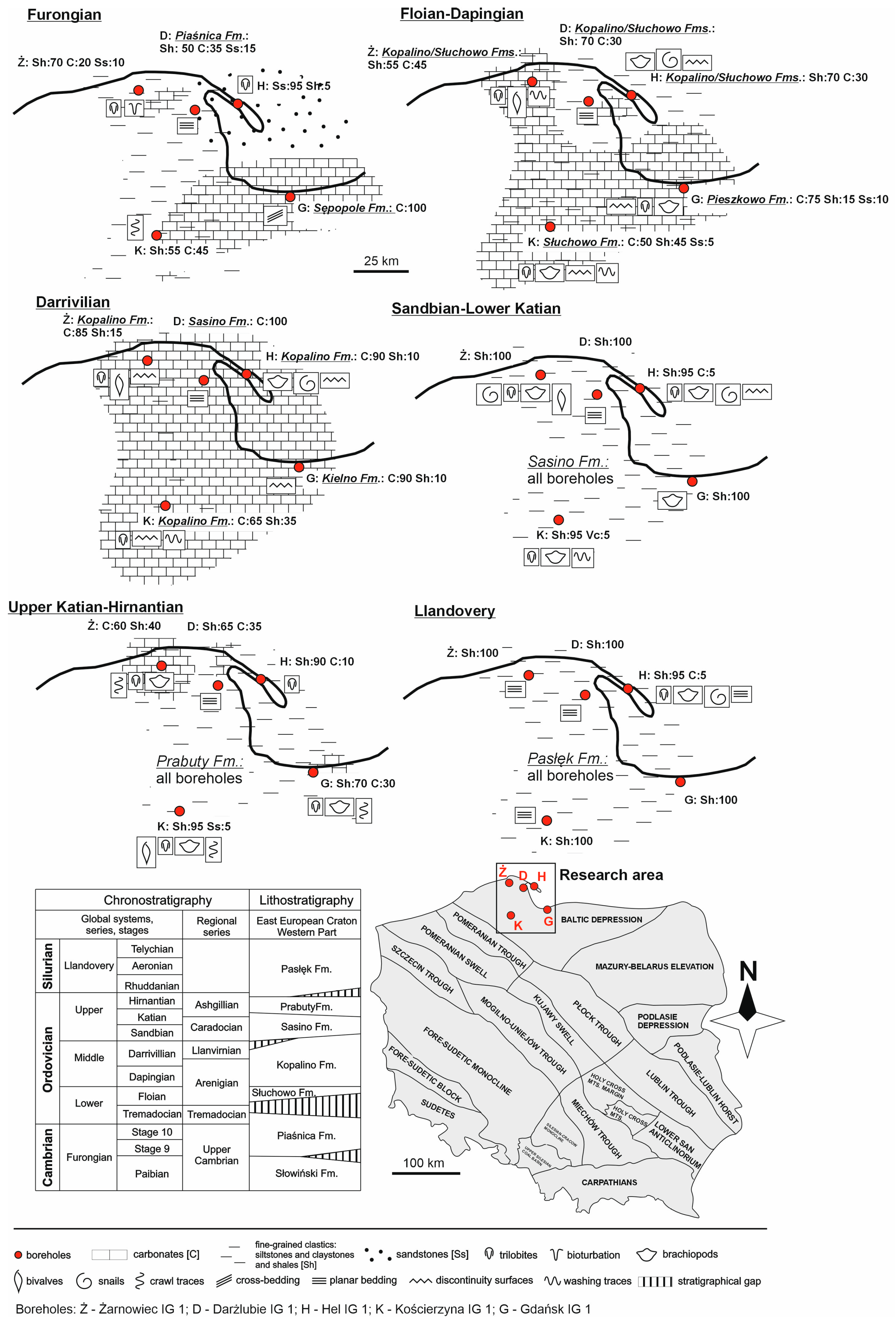
Figure 1. Simplified schematic representation of the dominant lithologies within the study area, illustrating bottom-water oxygenation and high-energy features such as benthic fossils and discontinuity surfaces. The symbols Sh, Ss, C, and Vc denote the approximate volumetric proportions of fine-grained clastics (shales and siltstones), sandstones, carbonates, and volcaniclastics, respectively. These proportions are estimated from cumulative thickness data derived from the five boreholes analyzed in this study (Żarnowiec IG1, Darżlubie IG1, Hel IG1, Kościerzyna IG1, and Gdańsk IG1) and are intended to provide a generalized view of the relative lithological distribution rather than precise volumetric values. The stratigraphic framework for the Furongian–Llandovery interval follows [27], where detailed lithofacies descriptions are provided. A more comprehensive discussion of the geological context is presented in the text of geological setting.
Minerals 15 01170 g001
Throughout the Cambrian–Silurian sedimentation, sea-level fluctuations—primarily eustatic in nature—played a key role until the Middle Ordovician. In the Late Ordovician and Silurian, however, tectonic processes became increasingly dominant, shaping the distribution of lithofacies zones [27].
At the beginning of the Devonian, the waning of Caledonian tectonic activity initiated a widespread marine regression across the Baltic Plate. While a shallow epicontinental sea persisted across much of the basin, the study area experienced a complete retreat of marine conditions. According to [18], the post-Caledonian uplift phase and accompanying regression extended throughout the Devonian, Carboniferous, and part of the Early Permian.
Nevertheless, during the Early Carboniferous, another marine transgression affected Laurussia (a composite landmass of Baltica and Laurentia), covering large parts of present-day Poland and deepening some areas of the marine basin. However, this event is not preserved in the lithological profile of the study area, likely due to the effects of Variscan orogeny and subsequent uplift and erosion. As a consequence, by the Late Carboniferous, most of Poland, including the study area, had transformed into a terrestrial environment dominated by erosional processes.
During the Permian, a new transgression occurred, leading to the formation of the Zechstein Sea, a shallow, widespread, hypersaline basin. This event marked the onset of the Permian–Mesozoic basin, characterized by the deposition of sulfate, halite, and carbonate sediments typical of evaporitic environments.
Structurally, the study area is defined by a relatively simple geological architecture, with an undeformed sedimentary cover and a limited number of faults [9,17,28]. Most of these are Cambrian in origin, with small vertical displacements, and were later reactivated either during the Silurian or in the final phases of the Caledonian orogeny [14]. Some faults are also associated with the thickening of Wenlock and Ludlow sequences [29]. Within the Permian–Mesozoic succession, [29] identified numerous fault zones, some of which may extend into deeper and older strata. These dislocations are likely linked to the Triassic–Jurassic extension and subsidence of the Mid-Polish Trough, with later inversion during the Cretaceous–Paleogene tectonic phases. Additionally, the area is characterized by low to moderate modern heat flow values (30–75 mW/m2; [7,30,31] and a westward-increasing trend in thermal maturity [7].

3. Materials and Methods

This study presents detailed results based on 86 rock samples identified as petroleum source rocks, defined by a petroleum potential greater than 3 mg HC/g rock or total organic carbon (TOC) content exceeding 1 wt%. Additionally, the results from 14 samples from the Kościerzyna IG1 borehole are included; these samples represent overmature source rocks that have already undergone hydrocarbon expulsion and reached their full petroleum potential.
Furthermore, the study includes averaged Rock-Eval data from the Kętrzyn IG1 borehole, located in the far eastern part of the Baltic Basin, beyond the primary study area. These samples, of Sandbian–Lower Katian age, are used to correlate kinetic parameters between immature and oil/gas-mature rocks within the main study region. The publication also considers 186 additional samples classified as non-source rocks. These are not discussed in detail but are included as comparative background data in Appendix A.
All 286 analyzed rock samples originate from several regional oil and gas research projects carried out by the Polish Geological Institute—National Research Institute (PGI-NRI) between 2012 and 2020. A full list of these projects is available in [10,32,33]. Samples were collected directly from drill cores after thorough sedimentological assessment of the Cambrian, Ordovician, and Llandovery sections. While all three stratigraphic intervals were sampled, special emphasis was placed on individual layers and packages composed of dark, dark gray, and black bituminous shales, claystones, mudstones, and siltstones from five boreholes: Żarnowiec IG1, Darżlubie IG1, Hel IG1, Kościerzyna IG1, and Gdańsk IG1. Sampling density varied from a few centimeters to about one meter, depending on lithological changes. The highest sampling resolution was applied within dark shale and carbonate sections, whereas the largest gaps correspond to intervals with missing core material. As the cores were drilled in the 1960s and 1970s using varying recovery techniques, many contain substantial gaps, which limited the ability to implement a fully consistent sampling strategy. Nevertheless, the most geologically significant intervals were successfully sampled.
Rock-Eval analyses were conducted at PGI-NRI using the Rock-Eval 6 apparatus in three operating modes:
Bulk Rock Mode—the standard mode for basic pyrolytic characterization, including pyrolysis and oxidation cycles within temperature ranges of 300–650 °C and 300–850 °C, respectively. This mode provides the full suite of Rock-Eval parameters necessary to evaluate source rock quality. Parameters include:
  • S1—free hydrocarbons released at 300 °C
  • S2—hydrocarbons released from kerogen between 300–650 °C
  • Tmax—the temperature at the peak of the S2 curve
  • HI—Hydrogen Index
  • OI—Oxygen Index
  • PI—Production Index
  • TOC—Total Organic Carbon
  • RC—Residual (non-pyrolyzable) organic carbon
  • PC—Pyrolyzable (productive) carbon
Reservoir Mode—designed for characterizing bitumen and oil content in both solid and liquid samples. The pyrolysis begins at 180 °C to assess light and heavy oils, followed by higher temperatures to detect resins and asphaltenes. Parameters include:
  • S1r—light oils (C1–C15) volatilized at 180 °C
  • S2a—heavy oils (C16–C40) released between 180–350 °C
  • S2b—resins and asphaltenes released between 350–650 °C
  • NSO—total content of resins and asphaltenes based on S2b and RC
  • KERO—kerogen content, based on S2b, RC, and the total production index (TPIR)
  • This mode also provides an estimate of API gravity for oil density evaluation.
Optkin Mode—used for kinetic studies and activation energy distribution analysis. This mode requires thermally immature, organic-rich rock samples with TOC ≥ 2.0 wt% and Tmax values within the late diagenesis zone (i.e., 440–445 °C for Type I, 420–435 °C for Type II, and 425–435 °C for Type III kerogen; after [34]. Immaturity is essential, as the sample must retain its full hydrocarbon-generation potential. The Optkin mode involves triplicate pyrolysis runs at heating rates of 5, 15, and 25 °C/min. These runs are then modeled in the Optkin software (version 3.0.3) to simulate kerogen transformation under varying burial and thermal scenarios. Output parameters include the kerogen transformation ratio, primary hydrocarbon potential and the hydrocarbon generation index.
Volume lithological percentages were calculated using borehole descriptions from [1,18] and [2,19]. These percentages represent the proportion of a given lithology relative to the thickness of specific stratigraphic intervals.
Petrographic analyses of thin sections were sourced from [33], supplemented by descriptions made by the author. Additional lithological data were taken from [1,18] and [2,19]. Thin section images included in this paper represent typical petrographic varieties of source rocks.
Sedimentation rates were estimated using calibrated 1-D basin models created in PetroMod 2014.1 software. For each borehole, stratigraphic thicknesses were assigned to time intervals based on the default PetroMod 2014.1 stratigraphic tables. The models were calibrated using vitrinite reflectance and modern borehole temperature data. After processing, sedimentation-rate curves were extracted and averaged for each stratigraphic unit.
The 1-D lithological and stratigraphic models were constructed by the author using data from the aforementioned sources. The ground surface was adopted as the upper reference boundary of the models, while the total drilled depth of each borehole was used instead of the true vertical depth (TVD). Vitrinite reflectance data were derived from [9,35,36]. Paleobathymetry and erosion history were reconstructed from regional stratigraphic profiles, paleogeographic maps (Colorado Plateau Geosystems, Scottsdale, AZ, USA), and literature such as [7]. Minor erosion events were modeled by the author through extrapolation to boreholes with more completely preserved stratigraphic profiles. Present-day temperature data were sourced from [37], while heat-flow values were taken from [31].
The sampling of drill cores, all work with the Rock Eval apparatus, all modeling work, calculations of lithology volume percentages and calculations of sedimentation rates were performed by the author of the article.

4. Results and Discussion

4.1. Sedimentological and Geochemical Characteristics of Source Rock-Bearing Stratigraphic Units

The base of the Furongian in the study area lies at depths ranging from 2731 m in the northwest, through 3137 m in the east, to 4425 m in the southwest [1,2]. The Furongian section (including Piaśnica and Sępopole formations) is relatively thin, varying from 9 m in the northwest to only 0.5–1.0 m in the east and south. It is dominated by clastic facies: shaly and silty rocks with a high carbonate admixture to the west, sandy facies to the northeast, and purely carbonate facies to the southeast (Figure 1). The distribution of organic carbon is uneven, with low values (0.4–1.2 wt%) in the southeast and the highest values (4.4–5.2 wt%) observed in the northwest.
At the onset of the Dapingian–Floian (Arenig), the coarser-grained Furongian clastics were replaced by shaly facies with an even higher carbonate content (Figure 1). The thickness of the Dapingian–Floian section (Kopalino, Słuchowo and Pieszkowo Fms.) ranges from 18 to 33 m in the northern part of the study area and decreases sharply to about 7 m in the south [1,2]. Organic carbon content varies significantly across the area and reflects facies changes: higher TOC values (1.2–1.6 wt% and 4.8–5.2 wt%) are associated with shale facies in the northwest and northeast, respectively, while lower values (0.1–0.4 wt%) correspond to carbonate-dominated settings.
The Darriwilian (Llanvirn; Kopalino, Sasino Kielno Fms.) section of the Middle Ordovician is 1 to 12 m thick and is composed primarily of organic-rich carbonate facies with TOC values of 1.4–1.9 wt% in the north. Shaly facies of this age are minor. The increasing carbonate trend observed from the Furongian to the Darriwilian ends abruptly with the onset of the Sandbian (Caradoc), when fine-grained, organic-rich shales became dominant throughout the north-central Baltic Basin.
The Sandbian section (Sasino Fm.) consists almost entirely of organic-rich shales, with little to no carbonate content, though calcareous shales and siltstones occur locally (Figure 1). The combined thickness of the Sandbian and Lower Katian (Caradoc; Sasino Fm.) sections is greater along the northern edge of the study area (25–32 m) than in the southeastern and southern parts (13–15 m) [1,2]. TOC content ranges from 1.2–1.6 wt% in the southwest and northeast to 2.2–2.8 wt% in the northwest.
The Upper Katian and Hirnantian (Ashgill; Prabuty Fm.) are dominated by shale facies, with significant carbonate content particularly in the northern and northwestern sectors (Figure 1). While the northwest is clearly carbonate dominated with shale admixtures, the southern part is predominantly shales with minimal carbonate presence. Organic-rich lithologies are found mainly in the north-central area, with TOC values of 3.0–5.0 wt%. The thickness of this section ranges from 5 to 10 m.
The Llandovery (Pasłęk Fm.) marks a period of widespread, monotonous fine-grained clastic sedimentation across the study area, lasting until the end of the Pridoli. This interval is dominated by organic-rich shale facies, particularly in the northwest and northeast, with TOC values between 1.4 and 2.0 wt%. The thickness of the Llandovery section ranges from 40 to 66 m.
The Wenlock is also composed mainly of shales and siltstones, though these are relatively organic-lean, with TOC values of 0.5–0.7 wt%. The section thickens from 127 m along the northern edge to 324 m in the south [1,2].
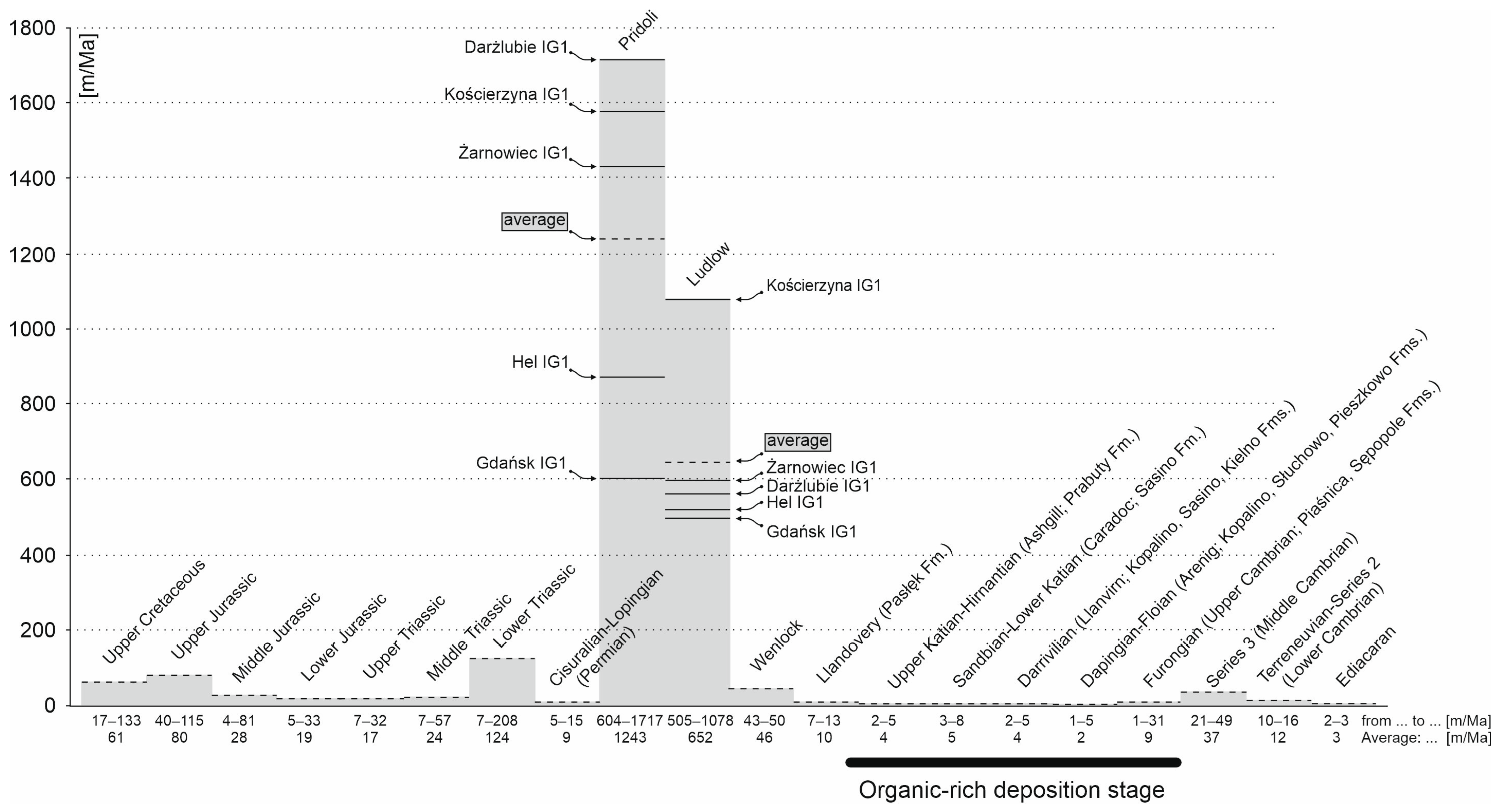
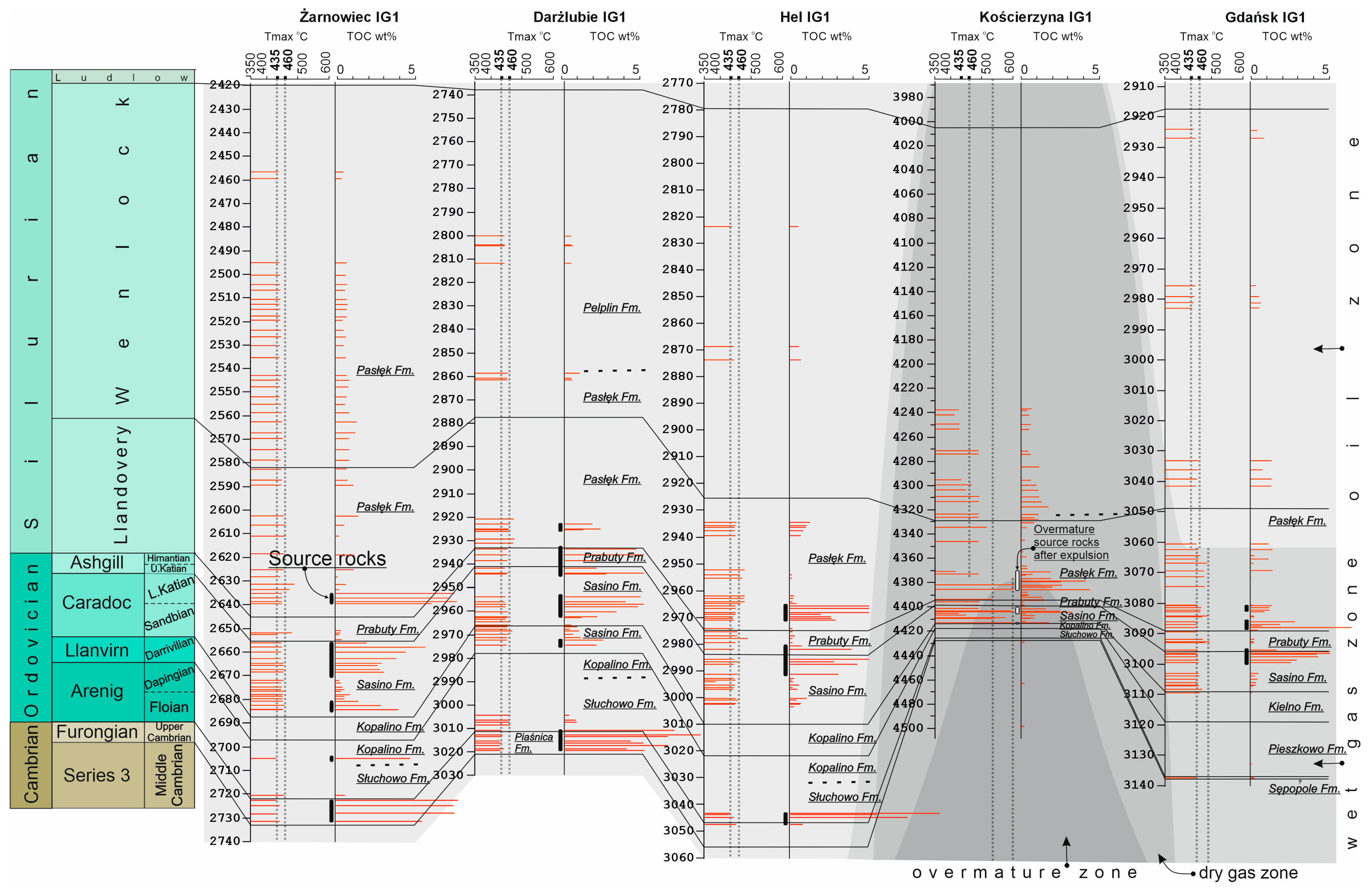
The low variation in thickness of the Furongian–Llandovery deposits across the 80–90 km long and 80 km wide study area suggests deposition in a distal part of the basin (Figure 1), with a uniformly low sedimentation rate (Figure 2). The estimated sedimentation rates for the Furongian to Upper Katian–Hirnantian interval range from 1 to 7 m/Ma, increasing to 19 m/Ma in the Llandovery (Figure 2). Despite the distal setting, the depositional environment was relatively shallow and high-energy, likely limiting the preservation of organic matter. Bottom-water oxygenation likely fluctuated between dysoxic and temporarily anoxic conditions. However, laminated black shales devoid of bioturbation are rare and usually occur as thin intercalations or individual layers (1 to several meters thick), forming source rock intervals within the Furongian, Dapingian–Floian, Lower Katian–Sandbian, Hirnantian–Upper Katian, and Lower Llandovery (Figure 3).
Overall, the stratigraphic sections are dominated by dark-colored siltstones and claystones (dark gray, green, brown, cherry-brown and red-brown). Black and semi-black lithologies are rare and often show signs of reworking by bottom currents and benthic fauna (Figure 1), including bioturbation, trace fossils, and in situ benthic organisms (J. Pacześna & T. Podhalańska, pers. comm.), such as trilobites, brachiopods, bivalves, gastropods, ostracods, and echinoderms. Other sedimentary features indicating a shallow, energetic, and at least dysoxic environment include discontinuity surfaces, washing marks, and cross-bedding (Figure 1; refs. [1,2]). An exception is the Darżlubie region, characterized by fine-grained laminated rocks devoid of bioturbation and macrofossils. These sediments likely accumulated under dysoxic or dysoxic–anoxic conditions, possibly in a basin-floor depression.
The Furongian–Darriwilian interval was dominated by a shallowing shelf environment and an increasing proportion of carbonates, reaching a peak in the Darriwilian. This ~39-million-year period was likely unfavorable for organic matter preservation due to well-oxygenated bottom waters and carbonate-dominated facies with abundant benthic fauna. In the Darriwilian, carbonate deposits covered the entire study area, comprising 65%–100% of the lithology. At the onset of the Sandbian, fine-grained clastics buried the carbonates, likely due to deepening of the shelf. However, this shift did not eliminate benthic fauna or significantly reduce bottom energy. Trilobites, brachiopods, and bivalves remain common throughout the Sandbian, Katian and Hirnantian sections, along with erosional surfaces and scour (washing) marks [1,2].
A more substantial change in bottom-water oxygenation likely occurred in the Llandovery, coinciding with progressive basin subsidence of ~20 m/Ma during the Early Llandovery. This may have increased water column height by several tens of meters, fostering longer-lasting anoxic conditions and bottom stagnation. Additionally, extensive deglaciation at the Ordovician–Silurian boundary [38] likely contributed to a global sea-level rise. The shallow marine depositional environment was likely widespread across the region at the time, extending from Estonia and Lithuania [39,40] to southern Poland [41].

4.2. Stratigraphic Position of the Source Rocks Within the Study Area

The stratigraphic distribution of source rocks in the study area indicates the presence of three to five individual and discrete source rock intervals, typically of limited thickness. Source rocks with fair and good petroleum potential (PP > 3 mg HC/g rock and >6 mg HC/g rock, respectively) are found from the Furongian (Piaśnica, Sępopole Fms.) through the Sandbian, Katian, Hirnantian, and into the lowermost Llandovery. However, their thickness generally varies within a narrow range of approximately 2–15 m. Geochemical data suggest that some source rock intervals form continuous, correlatable horizons traceable between boreholes (Figure 3), whereas others occur as isolated lenticular bodies, possibly exhibiting onlap geometries.
The Furongian source rocks are present throughout the entire stratigraphic section only in the Żarnowiec IG1 and Darżlubie IG1 boreholes. Southward and eastward, this interval thins significantly, measuring less than 1 m in the Gdańsk IG1 borehole, where fine-grained clastics transition into carbonates. Due to limited sampling within the Dapingian–Floian interval, source rock distribution appears sporadic and is restricted to short sections in the Żarnowiec IG1 and Hel IG1 boreholes. This patchy dataset is incomplete and warrants further investigation. A similarly limited sampling applies to the Darriwilian, which was examined only in the Darżlubie IG1 borehole, where source rocks are also thin. In other boreholes, the absence of core samples prevented a more comprehensive assessment. In contrast, the Sandbian and Lower Katian intervals were sampled extensively, allowing for the identification of Sandbian source rocks in the Żarnowiec IG1 and Darżlubie IG1 boreholes, and Lower Katian source rocks across the entire study area. Detailed examination of the Upper Katian and Hirnantian sections revealed source rocks only in the Darżlubie IG1 and Hel IG1 boreholes. However, in the lowermost Llandovery, source rocks are present throughout the entire study area and can be correlated among all boreholes included in this study (Figure 3; Table A1, Table A2, Table A3, Table A4 and Table A5 in Appendix A).
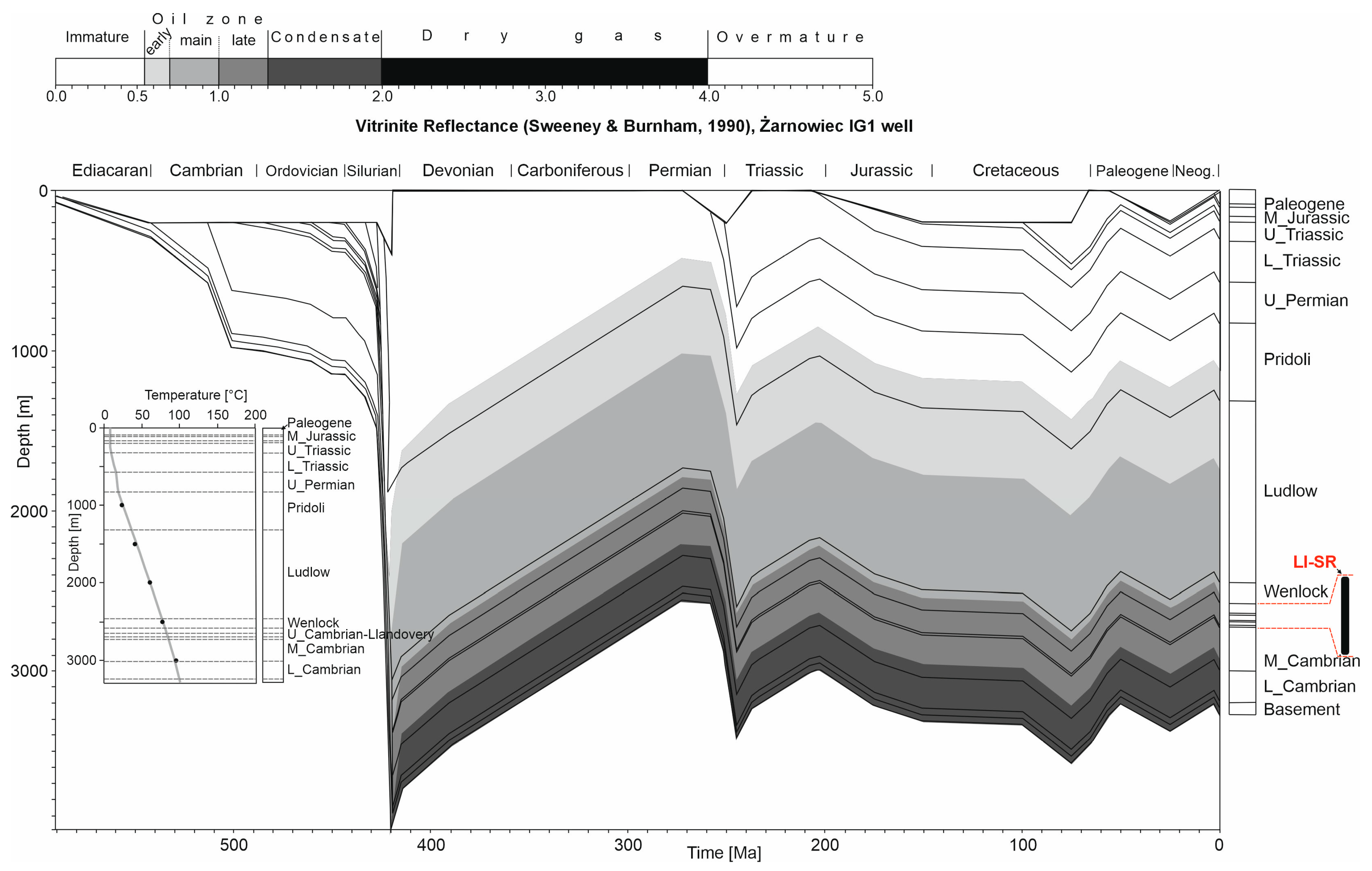
The stratigraphic occurrence of organic-rich rocks suggests that optimal environmental conditions—such as nutrient availability and distribution within the water column, high primary productivity in surface waters, efficient organic matter transport to the seafloor, and bottom-water redox conditions conducive to preservation—were achieved only during a specific phase of basin evolution. This favorable phase began in the Furongian and lasted until the latest Early Llandovery. It was the only period in the geological history of the central-northern onshore Baltic Basin when conditions supported significant organic matter production, accumulation, and preservation. Core descriptions, partially preserved cores, and literature data indicate that no comparable source rocks are present in the older or younger stratigraphic intervals. During the Furongian–Lower Llandovery, the basin was located at approximately 30–40° S paleolatitude. Its morphology characterized by optimal length, width, and depth [7]—along with favorable sediment supply [27], nutrient availability and ocean current distribution, created ideal conditions for plankton blooms and surface-water organic productivity. During this time, the Baltic Basin represented a shallow shelf bordered by land masses to the east, northeast, west, and northwest [7,42], which supplied detrital sediments and nutrients. Subsequently, the Furongian–Lower Llandovery source rocks were affected by the Caledonian tectonic phase [28], leading to basin deepening and rapid burial. This rapid burial, particularly in the Ludlow and Pridoli periods, reached rates of several hundred meters per million years. Tectonic reorganization of the basin, affecting its size, depth and accommodation space, likely diminished basin productivity, while the input of large volumes of clastic material diluted the preserved organic matter (Figure 2).

4.3. Petrographic Characterization of the Furongian-Lower Llandovery Source Rocks

The petrographic characterization of the source rocks in the study area is based on a compilation of publications that provide general lithological descriptions of the stratigraphic sections encountered in the examined boreholes. Foundational sources include the works of [1,2,18,19], which supply lithological and geological information on the analyzed cores. Additional and more recent data are derived from [33], which applied modern thin section analysis techniques, such as SEM and XRD.
The authors of the present article have limited the lithological and petrographic descriptions to intervals classified as source rocks, averaging characteristics across boreholes where appropriate.
The Furongian source rocks from the Żarnowiec IG1 and Darżlubie IG1 boreholes are predominantly composed of claystones (50%–70%) and limestones (20%–35%), with minor amounts of slightly coarser clastic material such as sandstones (10%–15%) (Figure 1). The claystones are typically deeply black and bituminous, interbedded with gray and black limestones. Pyrite occurs frequently in the form of concretions, seams, and disseminated crystals. In the Żarnowiec IG1 borehole, these units are additionally interbedded with sandy limestones and fine-grained muddy sandstones, commonly cemented with calcite. The limestones are usually gray to dark gray, occurring as irregular layers, lenses, and seams, often bituminous and impregnated with pyrite, sometimes forming concretions. In the Darżlubie IG1 borehole, organodetrital and fine-crystalline limestones are more prevalent. Further south and east, the Furongian source rocks, initially dominated by fine-grained clastics, transition into gangue sandstones (Hel IG1), and ultimately into petroleum-nonprospective carbonates in the Gdańsk IG1 borehole.
Due to incomplete sampling, the petrographic characteristics of the Floian and Dapingian sections are fragmentary and do not provide a comprehensive representation. In the Hel IG1 borehole, the Dapingian section is dominated by black claystones interbedded with micritic, fine-crystalline, and organodetrital limestones. Conversely, in the Żarnowiec IG1, Dapingian organic-rich gray-brownish claystones are present only as interbeds within carbonate-dominated sequences of marly limestones. The Darriwilian source rocks, recorded only in the Darżlubie IG1 borehole, consist of black organic-rich claystones with Fe-zooid inclusions, bentonite intercalations, and pyrite.
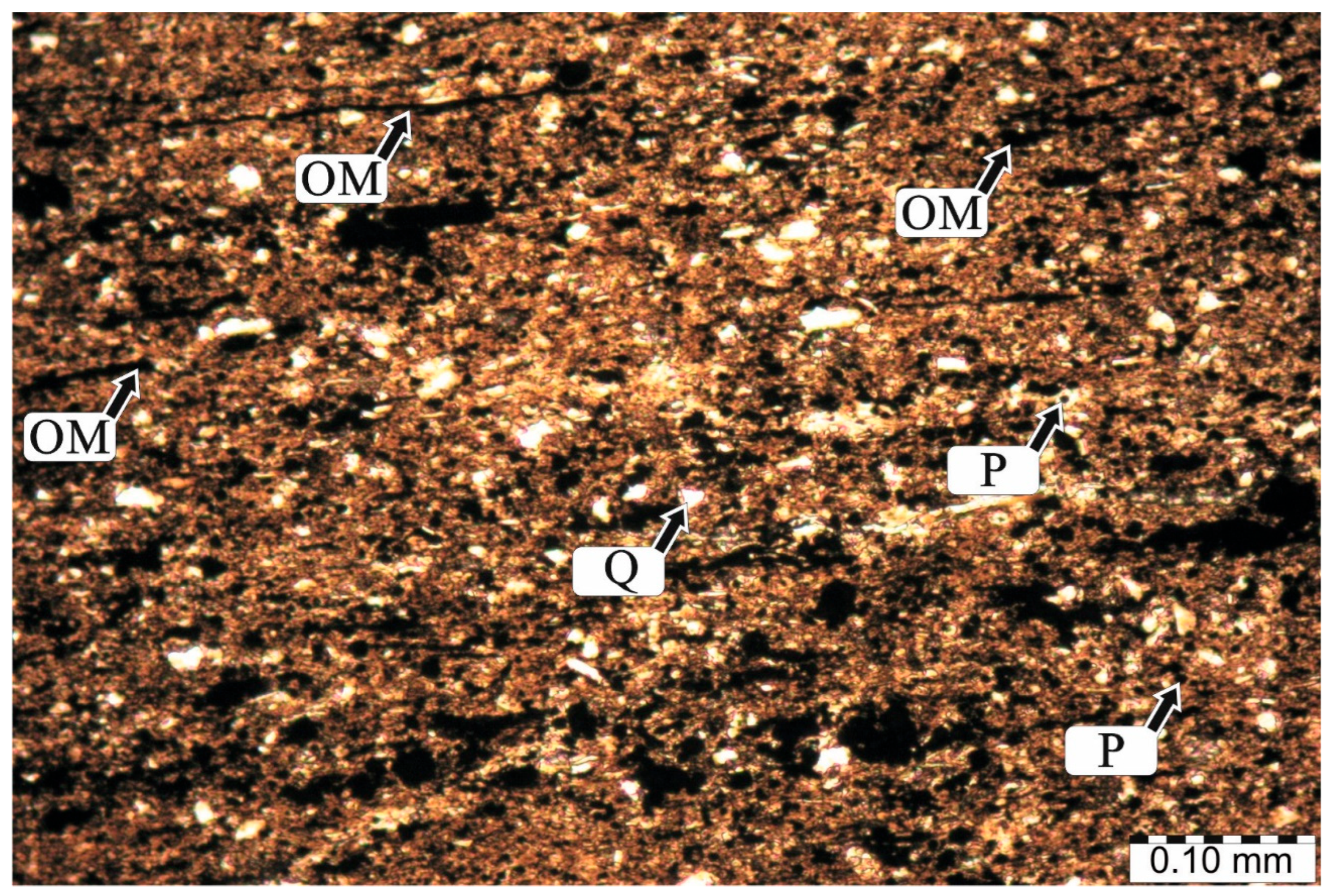
The Sandbian source rocks in the Żarnowiec IG1 and Darżlubie IG1 boreholes are mainly composed of claystones black, strongly shaly, calcareous rocks impregnated with pyrite and interbedded with bentonites. In the Darżlubie IG1 borehole, non-calcareous dark gray claystones with gray-green spots are more common. These rocks are characterized by a directional texture, dispersed organic matter, carbonate micrite, fine rhombohedral dolomite and ankerite crystals, and xenomorphic calcite. Quartz dominates the detrital framework, with feldspars and micas as minor constituents (Figure 4).
The Lower Katian source rocks are petrographically homogeneous across the study area. They consist of very fine-grained, black, bituminous, strongly shaly claystones enriched in pyrite, which often occurs in seams and aggregates (Figure 5). Bentonite laminae are common and occur as intercalations in all examined boreholes. These claystones are occasionally muddy or silty and often calcareous, with abundant carbonate micrite, rhombohedral dolomite, and calcite xenomorphs. Organic matter is present in substantial quantities and occurs in a dispersed form. Quartz silt-sized grains dominate the detrital framework, accompanied by minor feldspar and mica grains, often aligned with cross-bedding structures.
The Upper Katian claystone source rocks, dark gray to black in color were found in the Darżlubie IG1, Hel IG1, and Gdańsk IG1 boreholes. These rocks are typically shaly, bituminous, and occasionally muddy, with common pyrite clusters.
Hirnantian source rocks, identified only in the Darżlubie IG1 borehole, consist of gray to greenish claystones with multiple interbeds of black, organic-rich, shaly, and bituminous claystones.
The stratigraphically youngest source rocks, attributed to the lowermost Llandovery, are present across the entire study area with remarkable continuity. However, they exhibit slight lithological variations between boreholes. In the Żarnowiec IG1 and Darżlubie IG1, the source rocks are gray to greenish, dominated by calcareous and dolomitic claystones with occasional interbeds of black organic-rich shale. In contrast, the Hel IG1, Kościerzyna IG1, and Gdańsk IG1 boreholes feature distinctly dark gray to black, planar-laminated, shaly, bituminous claystones impregnated with pyrite. In the Hel IG1 borehole, these claystones are associated with gray detrital, clayey or marly limestones, which are also shaly and planar-laminated.
Although the main lithological intervals containing source rocks suggest a dynamic and generally oxygenated (oxic to dysoxic) bottom environment, petrographic evidence points to occasional, short-lived reductions in oxygen levels likely reaching dysoxic conditions. While strictly anoxic conditions were probably rare, their localized and short-term occurrence in small depressions on the sea floor cannot be excluded. The interpretation of redox conditions presented here is based on the synthesis of published petrographic and paleontological data [1,2,18,19] rather than on direct geochemical proxies. In particular, the occurrence of benthic, oxygen-dependent fauna in the Furongian source rocks [27] and the sporadic presence of brachiopods in the Sandbian and Katian sections indicate intervals of at least moderate oxygenation. In contrast, the complete absence of benthic fauna and the dominance of planktonic fossils in the Lower Llandovery deposits suggest deposition under persistently dysoxic or possibly anoxic conditions.

4.4. Petrological Characteristics of Organic Matter in Furongian–Lower Llandovery Source Rocks of the Baltic Basin

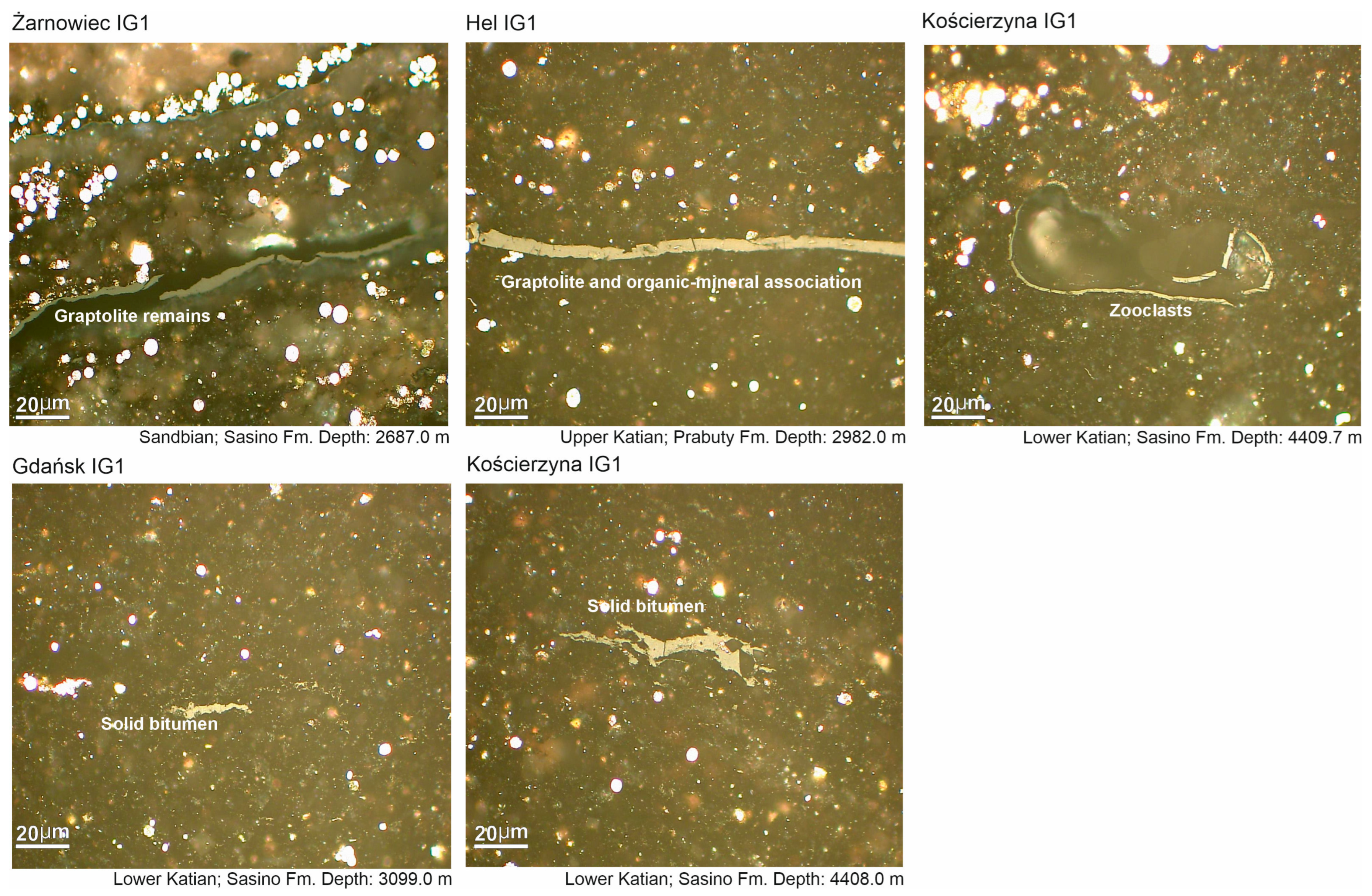
All Lower Paleozoic stratigraphic sections of the Polish part of the Baltic Basin are characterized by a relatively uniform composition of organic matter, dominated by two main components. The prevailing macerals are dispersed zooclasts of animal origin and liptinitic material, consisting of graptolite remains and a mixture of liptodetrinite and alginite [4,9,35,36,43]. The preservation state of the graptolite remains varies significantly—from highly degraded and fragmented specimens, both mechanically and biologically, to well-preserved individual examples [35,43] (Figure 6). Their sizes range from several micrometers to several hundred micrometers. In addition to graptolite remains, oil-related products such as solid bitumen are also commonly present. In the fine-grained sediments of the Furongian–Llandovery interval, organic components are intensely fragmented and intimately mixed with clay minerals, forming organic-mineral associations (Figure 6).
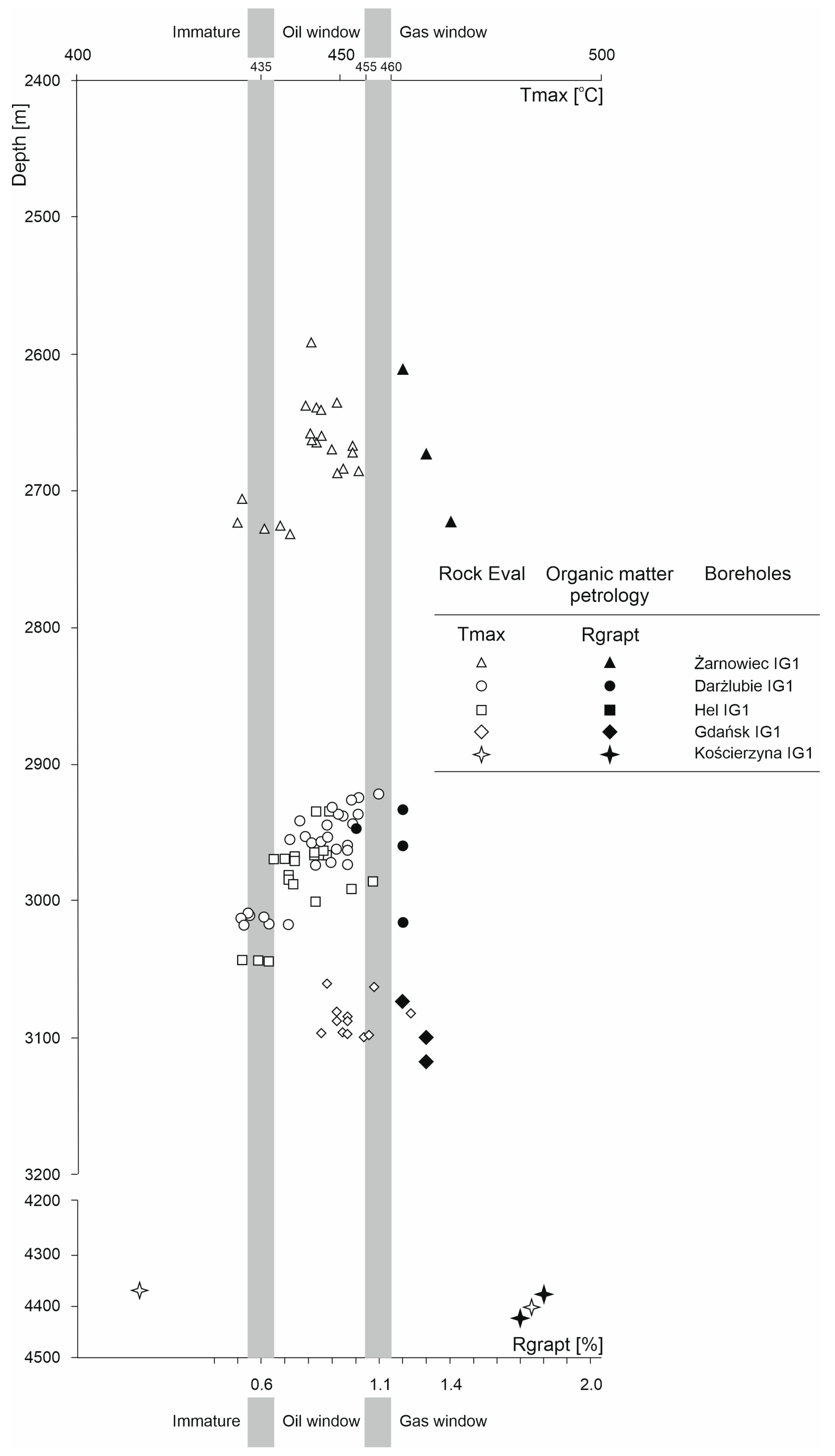
As vitrinite is absent in Lower Paleozoic strata, reflectance measurements have been conducted on graptolite remains [4,9,35,36]. These graptolite-based reflectance measurements are methodologically accepted in [35], but carry a degree of interpretative uncertainty due to the advanced degradation of the organic matter, which is composed of highly transformed, carbonized, chitinous material [44]. Nevertheless, these measurements consistently show a typical increase in reflectance with depth across the study area and in all examined stratigraphic intervals.
Reflectance values in the Furongian section range from approximately 1.2% to 1.4%. In the Dapingian–Floian interval, reflectance is around 1.3%, while younger Ordovician sections, such as the Sandbian–Lower Katian and Upper Katian–Hirnantian, yield values between 1.0% and 1.3% (Table 1). The Llandovery section generally shows values around 1.2%. Overall, these intervals exhibit limited variation in reflectance, with the notable exception of the Kościerzyna IG1 borehole. Here, due to deeper burial of the Dapingian–Llandovery section, reflectance values are higher, ranging from 1.7% to 1.8%, indicating advanced thermal maturity (Table 1).
Published petrographic and palynological data [1,2,18,19] provide evidence for the presence of both algal and graptolitic remains within the Furongian–Llandovery sections, indicating a mixed marine organic input. Based on these observations, it can be inferred that the organic matter had a consistent, dual-source origin dominated by planktonic organisms, mainly graptolites and algae. After the death of plankton in surface waters, the organic material was transported to the seabed, where it became admixed with fine-grained detrital sediments. The abundance of fragmented zooclasts of graptolitic origin and liptodetrinite fragments suggests intense biological and mechanical degradation, likely related to sediment reworking by bottom currents and bioturbation. This interpretation of organic matter origin and degradation processes is proposed in the present study as a synthesis of previously published microscopic and compositional data.
Reflectance measurements on zooclasts suggest thermal maturity levels corresponding to the condensate zone or the boundary between the condensate and dry gas windows. However, these findings are partially inconsistent with observed oil shows and Tmax data from Rock-Eval pyrolysis, which indicate oil window maturity in most of the study area, including the Żarnowiec IG1, Darżlubie IG1, and Hel IG1 boreholes, and condensate zone maturity in the Gdańsk IG1 borehole (Figure 7). The Kościerzyna IG1 borehole is the exception, with Tmax data supporting condensate/dry gas maturity.
Given the absence of vitrinite and the reliance on graptolite remains, the reflectance values may be slightly overestimated, a discrepancy also noted by [3,44,45]. According to our interpretation, such overestimation could have led to the misclassification of some source-rock intervals into maturity zones that are too high. Therefore, the evaluation of thermal maturity in the Lower Paleozoic sections characterized by highly degraded and difficult-to-interpret organic matter requires particular methodological caution. In this study, it is suggested that Rock-Eval Tmax data may provide more reliable maturity assessments. Moreover, applying conversion methods specifically developed for graptolite reflectivity, as proposed by [44,45], could help minimize these discrepancies. The application of the proposed correction factors [44] reduces the reflectance values of vitrinite-like organic fragments from Table 1 by 0.11%–0.22%. As a result, the adjusted reflectance values range from 0.89 to 1.18% for the Żarnowiec IG1, Darżlubie IG1, and Gdańsk IG1 boreholes, placing these samples within the oil window zone.

4.5. Organic Matter Content, Type, Maturity and Petroleum Potential of the Source Rocks

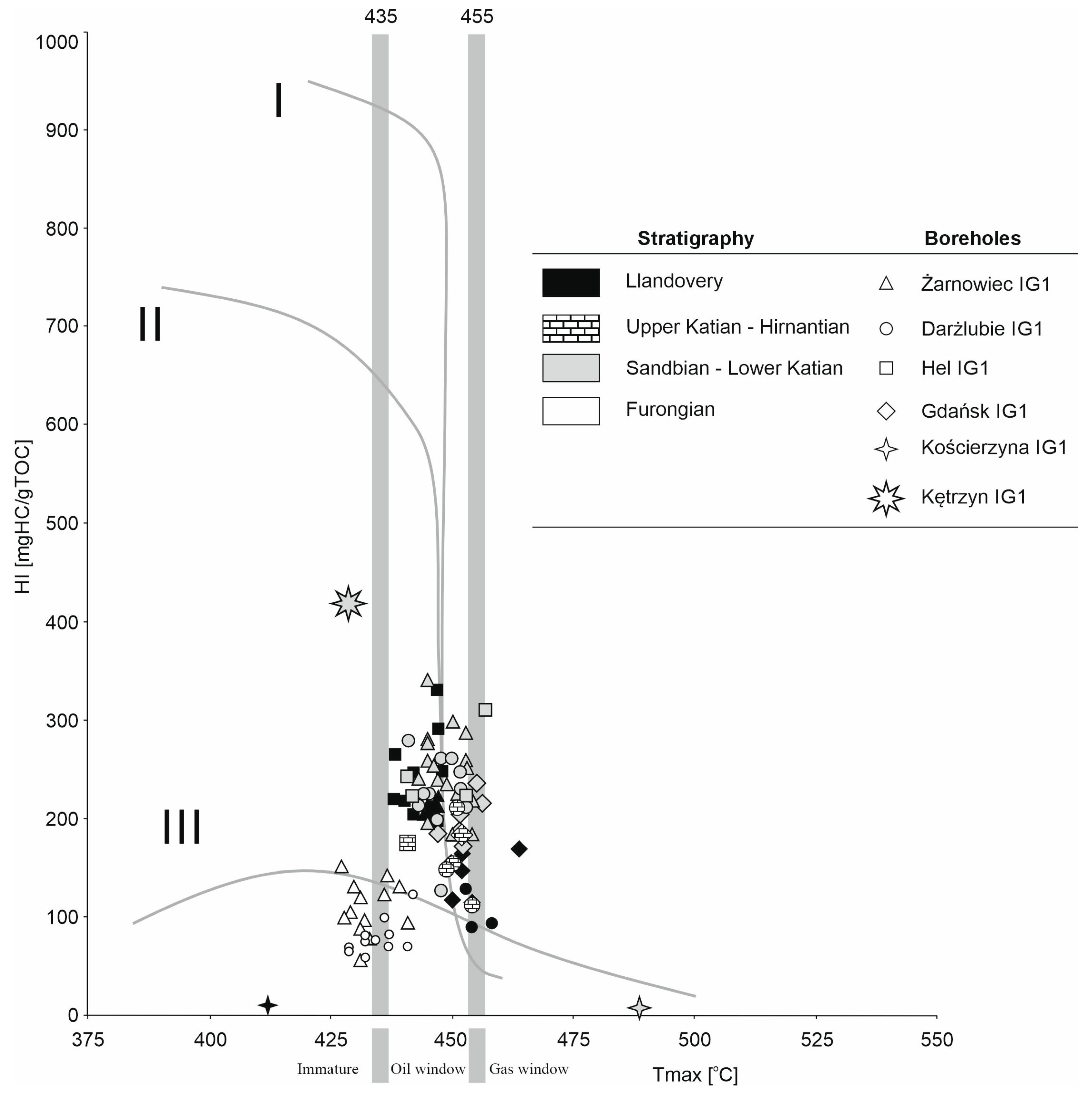
The kerogen present in the Furongian–Llandovery source rocks is classified as type II and consists mainly of marine organic matter, predominantly zooclasts of animal origin, such as the planktonic graptolite remains described earlier with only minor algal components. This homogeneous kerogen composition results largely from the limited contribution of terrestrial organic matter. Variations in kerogen properties are primarily reflected in differences in the hydrogen index (HI), which stem from changing proportions of algal matter to zooclasts (notably in the Furongian interval) and varying thermal maturity (e.g., Kościerzyna IG1; see Figure 8).
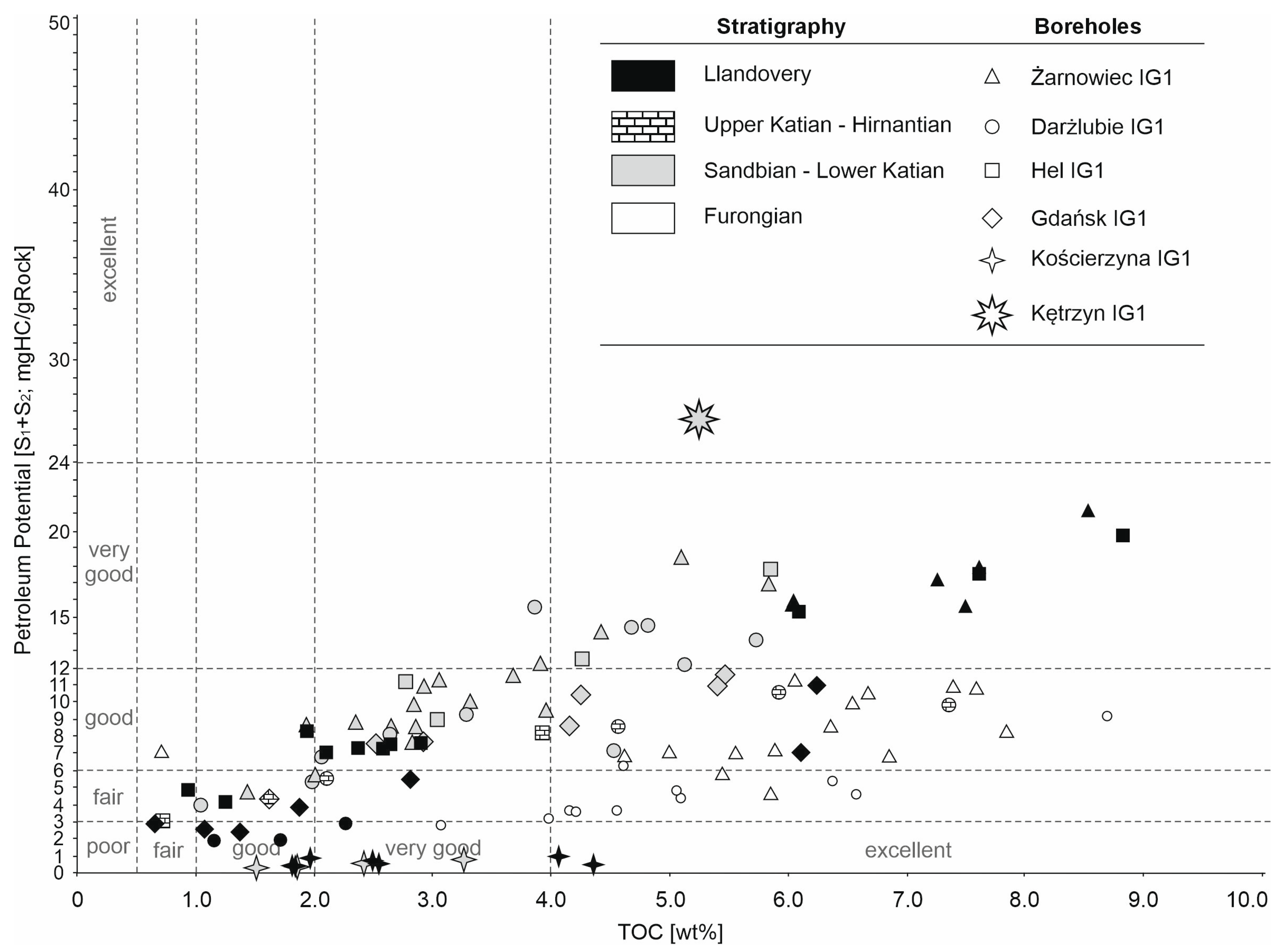
Furongian source rocks from the Żarnowiec IG1 and Darżlubie IG1 boreholes are dominated by highly hydrogen-depleted organic matter of marine origin, with HI values averaging 59–130 mg HC/g TOC. These rocks contain high total organic carbon (TOC) contents: 5.4–7.8 wt% in Żarnowiec IG1 and 4.0–8.7 wt% in Darżlubie IG1. The kerogen exhibits very low oxygen index (OI) values (0–6 mg CO2/g TOC) and high residual carbon (RC) contents, averaging 88%–94%. An upward increase in TOC within the Furongian interval suggests progressive expansion of oxygen-deficient conditions favorable for organic matter preservation (Figure 3). According to the TOC vs. petroleum potential classification (Figure 9), the Furongian section comprises fair to good quality source rocks. However, the coexistence of high TOC (4.0–8.7 wt%), low HI (59–130 mg HC/g TOC), and very high RC (88%–94%) near the immature–early oil window maturity boundary is unusual. This suggests that, despite significant organic content, the rocks may offer only limited petroleum potential. Laterally, the Furongian source rocks thin to about 1 m or disappear entirely toward the south and southeast (e.g., Kościerzyna IG1 and Gdańsk IG1).
The Dapingian–Floian organic-rich interval is present only in the Żarnowiec IG1, Darżlubie IG1, and Hel IG1 boreholes (Figure 3). The kerogen here is thermally mature, at the transition from late diagenesis to early oil window stages. TOC values range from 4.8 to 9.6 wt%, with residual carbon averaging 92%. Despite fair to good TOC values, the HI remains low (61–135 mg HC/g TOC), suggesting limited petroleum potential.
Darriwilian source rocks have been identified solely in the Darżlubie IG1 borehole. TOC values range from 1.0 to 2.9 wt%, with HI values between 96 and 214 mg HC/g TOC. These rocks are thermally mature (oil window) and represent fair petroleum potential (Figure 9).
The Sandbian and Lower Katian source rocks are laterally continuous and occur in all studied boreholes, forming a well-defined organic-rich interval, especially at the top of the Lower Katian section (Figure 3). Compared to the Furongian interval, this kerogen is richer in hydrogen (HI: 127–340 mg HC/g TOC; Figure 8). TOC values range from 1.0 to 5.9 wt%, with OI values between 2 and 12 mg CO2/g TOC and RC contents of 63%–83%. As in the Furongian, an upward increase in TOC is visible. This interval contains good to very good quality source rocks (Figure 9) and is thermally mature, lying within the oil window. Maturity distribution is spatially variable: the oil window dominates in the northern and eastern parts of the study area, whereas maturity increases southward and westward, reaching overmature conditions in the Kościerzyna area. In zones where the rocks are within the oil window, they have good potential for oil generation. Geochemically, the Sandbian–Lower Katian source rocks seem to have better petroleum potential than those of the Furongian. In the Kościerzyna IG1 borehole, the Sandbian–Lower Katian interval is overmature (Tmax: 488–593 °C), with depleted HI (1–21 mg HC/g TOC) and petroleum potential (0.02–0.70 mg HC/g rock), despite TOC values of 1.5–3.2 wt%. The organic matter here is dominated by unproductive residual carbon (av. 98%).
Another organic-rich section, of Upper Katian–Hirnantian age, is mostly limited to the Darżlubie IG1 and Hel IG1 boreholes (Figure 3). The kerogen in this section is thermally mature (oil window) and TOC values range from 0.7 to 7.4 wt%, with residual carbon content averaging 63%–85%. These rocks have fair to good petroleum potential.
The youngest and most laterally continuous source rock interval is found in the Lower Llandovery. This section is present in all studied boreholes (Figure 3) and is characterized by a broad range of TOC (0.6–8.8 wt%) and HI (90–367 mg HC/g TOC). Most of the section lies within the oil window maturity range; however, higher maturity levels corresponding to the wet gas zone are recorded in the Gdańsk IG1 borehole. In contrast, the Kościerzyna IG1 borehole contains fully degraded, hydrogen-depleted kerogen with HI values of only 7–33 mg HC/g TOC (Figure 8). Petroleum potential across the section varies from poor to very good. As in the Sandbian–Lower Katian interval, rocks in Kościerzyna IG1 appear to have already expelled their hydrocarbons, as indicated by low Rock-Eval parameters (S1, S2, PC) and high RC values (av. 98%). These overmature rocks now lack present-day petroleum potential.
To place the obtained results in a broader regional context, the geochemical characteristics of the studied rocks were compared with previously published data from equivalent Upper Cambrian–Lower Silurian formations in Lithuania and Baltoscandia.
Exceptionally good source rocks have been reported in the Upper Cambrian, Ordovician, and Lower Silurian sections of the Baltic Basin in Baltoscandia and Lithuania. Their significantly higher petroleum potential compared to Polish onshore equivalents likely reflects different kerogen characteristics. In these regions, kerogen is enriched in hydrogen-rich phytoplankton, such as Tasmanites [15,16,46,47], G. prisca [48], and microbial mats [42], forming liptodetrinite- and alginite-rich source rocks (up to 20% liptinite; [47]). In contrast, Polish shales are dominated by hydrogen-poor, planktonic and animal-derived organic matter, often mixed with liptodetrinite macerals, resulting in low reactivity. While Lower Silurian shales in Lithuania are considered the main oil source rocks in the region, their Polish equivalents, although petroleum generative, appear significantly less potent. This discrepancy may result from kerogen composition: in Poland, it is dominated by optically vitrinite-like constituents, possibly formed through thermal alteration of liptinite (G. Nowak, pers. comm.; ref. [35]). In the Holy Cross Mountains, located southeast of the Baltic Basin on the East European Platform, organic matter of marine origin (algal and bacterial) has also been recorded in Ordovician–Silurian formations [41]. However, its geochemical parameters are much poorer than those from the Baltic Basin, and it shows no petroleum potential. Other studies, e.g., [49], confirm that maceral composition is critical for petroleum potential in fine-grained rocks, with a high content of fatty acid-rich algae being a key factor in oil generation.

4.6. Bitumen Analysis in the Source Rock of the Study Area

Since most of the source rock intervals are located within the oil window maturity zone, clearly evidenced in the Żarnowiec IG1, Darżlubie IG1, Hel IG1, and Gdańsk IG1 boreholes, the analysis of oil content becomes a key component of the geological petroleum assessment. This information is valuable for both scientific research and industrial applications, as it may influence petroleum exploration strategies, resource estimation, and risk assessment.
Geochemical analyses of light and heavy oil fractions, resins with asphaltenes, and kerogen content indicate that the studied source rocks are only weakly impregnated with bitumen. They do not exhibit the characteristics of commercially viable, oil-saturated reservoirs (Table 2). Within the oil-mature Darriwilian–Llandovery interval, kerogen is clearly the dominant component, while light and heavy oil contents remain low. A further reduction in oil content is observed in the gas-mature section of the Kościerzyna IG1 borehole.
These findings suggest that source rocks in the onshore sector of the Polish part of the Baltic Basin may contain only minor quantities of oil. Detailed geochemical data confirm a kerogen-dominated composition, with high kerogen contents (average 32.70 mg HC/g rock, reaching up to 95.58 mg HC/g rock) and low concentrations of light and heavy oils, ranging from 0.02 to 1.75 and 0.04 to 2.91 mg HC/g rock, respectively. In the Kościerzyna IG1 borehole, a certain amount of resins and asphaltenes was detected, which could indicate a bituminous level (TPIr > 0.4). However, even these values remain relatively low.
Comparison with a reference sample from a known tar-rich interval shows that economically viable oil-bearing rocks should contain significantly higher concentrations of heavy oils (Table 2). Additionally, shale oil reservoirs are typically characterized by much higher amounts of free hydrocarbons (S1 parameter), as demonstrated by [49], which is not observed in the studied shales.

4.7. Kinetic Studies of the Sandbian-Lower Katian Samples from the Kętrzyn IG1 Well

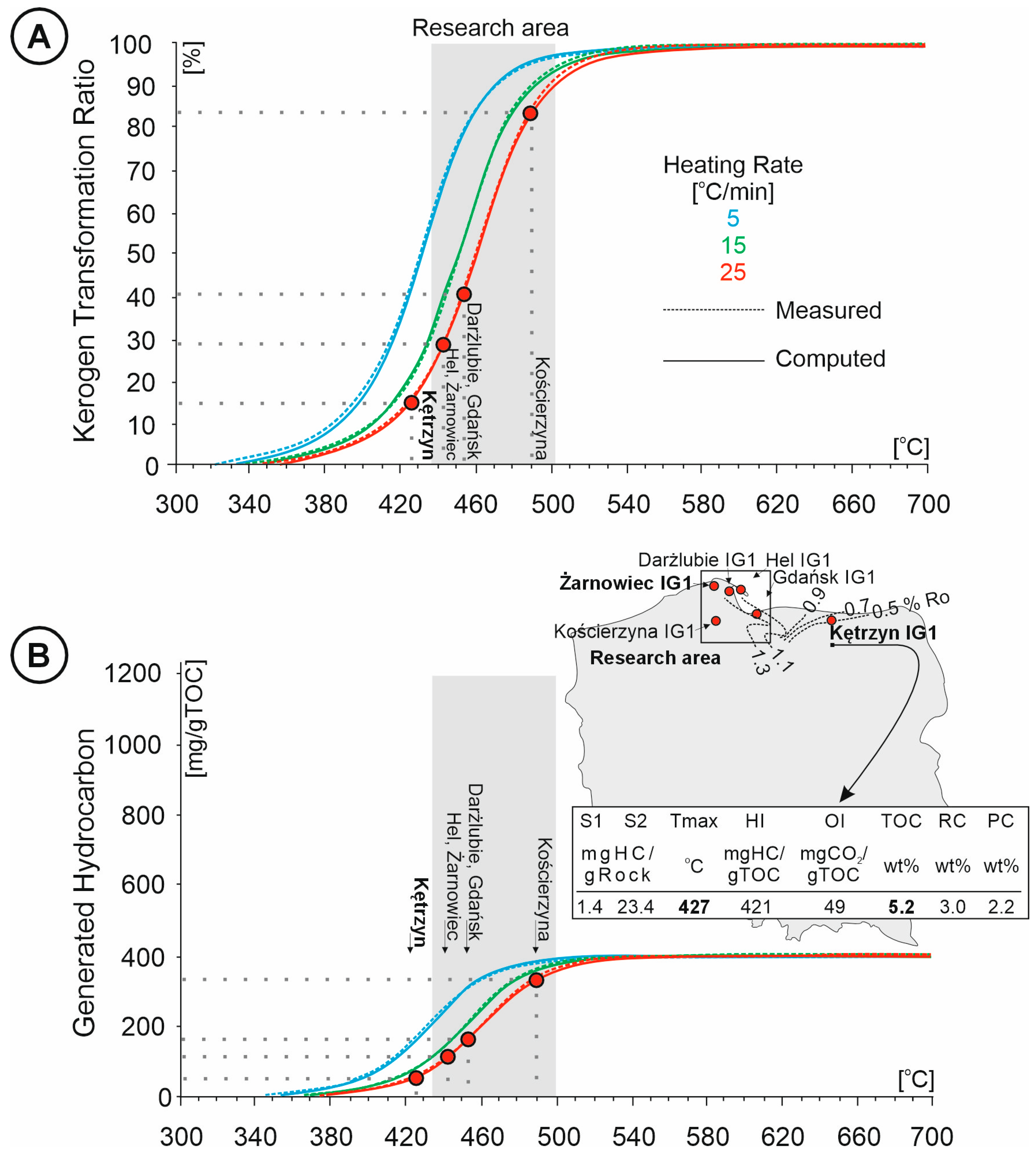
The Kętrzyn IG1 well, which contains organic-rich and thermally immature Sandbian–Lower Katian samples from Sasino Fm., provides an excellent opportunity for geochemical and kinetic investigations. The aim of the kinetic modeling was to simulate how these potential high-quality source rocks (Figure 10A,B) might behave at greater burial depths in the western part of the basin, including the research area [50]. The Optkin kinetic model was applied to evaluate the transformation ratio of kerogen (Figure 10A) and the potential amount of hydrocarbons generated (Figure 10B). Although the Kętrzyn IG1 well is located in the eastern sector of the Polish part of the Baltic Basin, (well east of the study area), the thickness of the Sandbian–Lower Katian interval (Sasino Fm.) is remarkably consistent across several wells (~13 m in Kętrzyn IG1, ~13 m in Gdańsk IG1, ~35 m in Darżlubie IG1, and ~34 m in Żarnowiec IG1). The sedimentological characteristics in these wells are also similar [27,51,52]. In both the Kętrzyn IG1 and the studied cores especially of Katian age (upper part of the Sasino Fm.), the dominant lithologies are shales and mudstones, accounting for approximately 93–100 vol.% of the section. This strong lithological similarity supports the interpretation that the organic-rich interval in the Kętrzyn IG1 represents a lithological equivalent of that found in the study area.
At the Kętrzyn site, the organic-rich Sandbian–Lower Katian interval is thermally immature, with measured values of ~0.5% Ro and 427 °C Tmax. The latter indicates a late diagenetic stage, just prior to the onset of hydrocarbon generation. Additionally, TOC values in the samples exceed the threshold of 2 wt%, which is sufficient for kinetic modeling (Figure 10B, inset). The geochemical data confirm that these samples represent excellent potential source rocks for modeling purposes, with high petroleum potential, elevated TOC content (Figure 9), and a dominance of Type II kerogen (Figure 8).
A 1D burial and thermal history model was developed to identify the primary factor controlling kerogen thermal maturity in the study area. Modeling was performed using data from multiple boreholes, all of which revealed a consistent burial history [32,53]. Each 1D model indicates a phase of rapid burial during the early Wenlock to late Ludlow, lasting approximately 7–8 million years (Figure 11). This episode, likely associated with regional Caledonian tectonic restructuring of the basin [13,52,54], appears to have been the main driver of thermal maturation in the region. Consequently, a high heating rate scenario was selected for the Optkin modeling (Figure 10A,B). A heating rate of 25 °C/min produced results consistent with rapid burial and relatively low kerogen transformation efficiency—unfavorable conditions for hydrocarbon generation.


5. Conclusions

The results of geochemical and modeling analyses conducted on the Lower Paleozoic source rocks in the central onshore part of the Baltic Basin provide a comprehensive picture of their composition, maturity, and hydrocarbon potential. The Rock-Eval pyrolysis results indicate that organic-rich intervals are restricted to a relatively narrow stratigraphic range, spanning from the Furongian to the Lower Llandovery. Within this interval, the most laterally continuous source-rock horizons are identified in the Lower Llandovery and the Lower Katian–Sandbian sections. These intervals, typically 2–20 m thick, represent the main oil- and gas-prone units in the study area. In contrast, other stratigraphic levels, including the Hirnantian–Upper Katian, Darriwilian, Dapingian–Floian, and Furongian, consist primarily of fine-grained rocks with significantly lower TOC values and poor hydrocarbon potential.
Organic petrographic observations reveal that the organic matter is dominated by graptolite fragments, accompanied by minor algal and bituminous components. This composition suggests that the source rocks were formed under conditions limiting the accumulation of hydrogen-rich organic matter. Total organic carbon (TOC) values vary broadly from 1.6 to 7.4 wt%, but the pyrolyzable organic carbon content remains low (0.2–1.4 wt%). Similarly, Hydrogen Index (HI) values ranging from 78 to 249 mg HC/g TOC indicate a generally low hydrocarbon generation potential. The combination of high residual carbon with low pyrolyzable fractions implies that some apparent indicators of high potential may be overestimated at the observed maturity level.
Modeling results suggest that relatively rapid subsidence during the Silurian limited the efficiency of kerogen transformation and hydrocarbon generation. Kinetic simulations demonstrate that a slower, more prolonged burial history would have favored a higher conversion of kerogen to hydrocarbons. Geochemical analyses further indicate the predominance of heavy hydrocarbon fractions (resins and asphaltenes), with light oil components occurring only in small amounts.
Thermal maturity data show a distinct regional trend, with oil-mature source rocks in the northeastern part of the basin and overmature equivalents toward the southwest. Importantly, the compiled geological and paleontological evidence suggests that the depositional environment of the Upper Cambrian–Llandovery succession was periodically colonized by oxygen-dependent benthic fauna. This indicates fluctuating redox conditions that were likely unfavorable for the long-term preservation of organic matter.

Funding

This study was financially supported by the Ministry of Science and Higher Education through statutory research grants [Project Nos. 61.5105.1303.00.0; 61.4104.1301.00.0; 61.2901.1701.00.0]. Final editorial work was supported by PGI–NRI statutory funds (Project No. 68.9012.1961.00.0). The publication fee was subsidized by The National Fund for Environmental Protection and Water Management.

Data Availability Statement

The data used to support the findings of this study are available from the corresponding author upon request.

Acknowledgments

I wish to express my sincere thanks to Grzegorz Nowak for many hours of in-depth discussions on organic matter petrology, thermal maturity data, and maceral identification methodology. Special thanks are also extended to Teresa Podhalańska for providing selected geochemical and petrographic datasets used in this study, originating from Project No. 22.5105.1301.00.1. I am particularly grateful to Dariusz Więcław for his valuable and constructive comments, which significantly improved the quality of this article. The author also sincerely thanks the four anonymous reviewers for their thoughtful and constructive comments, which greatly contributed to improving the clarity, accuracy, and overall quality of the manuscript.

Conflicts of Interest

The author declares no conflict of interest.

Appendix A

Table A1. Rock-Eval pyrolysis dataset from the Żarnowiec IG1 borehole.
No.StratigraphyDataDepthS1S2TmaxHIOIPITOCRCPC
SourcemmgHC/gRock°CmgHC/gTOCmgCO2/gTOC wt%wt%wt%
1Wenlock 2456.500.440.98437217360.310.450.330.12
2Wenlock 2459.500.260.77436209600.250.370.280.09
3Wenlock 2491.500.601.31438250340.320.520.360.17
4Wenlock 2495.500.791.69440257250.320.660.450.21
5Wenlock 2500.700.601.74441275240.250.630.440.2
6Wenlock#12504.300.931.62441236150.360.680.470.21
7Wenlock 2507.200.911.83441320230.330.570.340.23
8Wenlock 2509.200.451.26441266430.260.470.330.15
9Wenlock 2511.200.831.91441296230.300.640.410.23
10Wenlock 2513.100.891.90440264230.320.720.480.24
11Wenlock 2515.500.871.90442297190.310.640.410.23
12Wenlock 2518.100.651.55442250250.300.620.430.19
13Wenlock 2520.100.431.03442268440.300.380.260.13
14Wenlock 2524.150.561.55444336430.270.460.280.18
15Wenlock 2527.050.821.68444277290.330.610.390.21
16Wenlock#12530.100.591.19445321360.330.370.220.15
17Wenlock 2536.100.912.04438329210.310.620.370.25
18Wenlock 2540.301.302.81439310200.320.910.560.35
19Wenlock#12542.601.172.50447329220.320.760.450.31
20Wenlock 2545.501.212.46441296280.330.830.520.31
21Wenlock 2548.401.142.32442307190.330.760.460.29
22Wenlock 2552.700.901.67440255290.350.650.430.22
23Wenlock 2555.900.871.63444282340.350.580.360.21
24Wenlock 2559.500.952.14447257170.310.830.570.26
25Wenlock 2563.501.192.70448205190.311.320.980.33
26Wenlock#12566.800.882.01445173160.311.160.920.25
27Wenlock 2570.550.712.19450261250.240.840.590.25
28Wenlock#12574.500.831.74444249240.320.70.480.22
29Wenlock 2579.550.702.59442316250.210.820.540.28
30Llandovery#12582.700.631.88447335480.250.560.340.22
31Llandovery 2586.470.601.95445251260.240.780.560.22
32Llandovery 2588.210.561.53447215210.270.710.530.18
33Llandovery 2590.400.642.07445189120.231.100.870.23
34Llandovery 2603.600.281.1845284210.191.401.270.13
35Llandovery 2607.370.140.4745790380.220.530.470.06
36Llandovery#12611.400.050.19459101570.200.190.170.02
37Llandovery 2615.840.100.50451111250.170.450.400.05
38Llandovery#12619.500.200.8045772120.201.111.020.09
39Llandovery#12625.800.211.18453108120.151.090.970.12
40Llandovery 2627.800.221.6545314780.121.120.960.16
41Llandovery 2629.670.030.124421721420.180.070.050.01
42Llandovery 2632.680.030.1248894940.180.120.110.02
43Llandovery 2632.701.532.33346367120.400.640.310.32
44Llandovery 2634.980.070.1647176200.310.210.190.02
45Llandovery#12635.501.9113.6745018330.127.496.191.3
46Llandovery#12637.502.3314.8244420440.147.265.821.44
47Llandovery 2638.602.6415.1744619930.157.626.131.49
48Llandovery 2639.602.3513.4344722320.156.034.711.32
49U.Katian-Hirnantian 2651.200.130.2131387850.380.240.210.03
50U.Katian-Hirnantian 2652.200.080.1647554580.350.280.260.02
51U.Katian-Hirnantian 2653.200.200.1947985530.510.220.190.04
52U.Katian-Hirnantian 2654.200.060.17433811270.250.200.180.03
53Sandbian-L.Katian 2656.100.630.70304200750.470.350.230.12
54Sandbian-L.Katian 2657.731.976.6044534040.231.941.220.71
55Sandbian-L.Katian 2659.252.9613.9444723940.175.834.421.41
56Sandbian-L.Katian 2661.702.6911.4144525830.194.423.241.18
57Sandbian-L.Katian#12663.502.289.3044625340.203.682.710.97
58Sandbian-L.Katian 2667.401.916.6645325150.222.651.930.72
59Sandbian-L.Katian 2669.352.187.7944923570.223.312.480.84
60Sandbian-L.Katian 2670.202.558.7145328650.233.052.100.94
61Sandbian-L.Katian 2671.152.557.3345325850.262.842.020.83
62Sandbian-L.Katian 2673.700.070.23452111960.240.200.170.03
63Sandbian-L.Katian 2674.550.360.584441891220.380.310.220.09
64Sandbian-L.Katian 2676.340.420.75446197940.360.380.270.11
65Sandbian-L.Katian 2677.680.400.82445155420.330.530.420.11
66Sandbian-L.Katian 2678.190.310.62454216370.340.290.210.08
67Sandbian-L.Katian 2679.800.871.93451218120.310.890.650.24
68Sandbian-L.Katian 2680.230.961.29449255200.430.510.320.19
69Sandbian-L.Katian 2681.430.581.14451224140.340.510.360.15
70Sandbian-L.Katian 2682.651.563.21451224110.331.431.030.40
71Sandbian-L.Katian 2684.192.445.1745418370.322.832.190.64
72Sandbian-L.Katian 2686.262.217.2245018360.233.953.160.79
73Dapingian-Floian#22705.001.646.53432135100.204.83 0.68
74Dapingian-Floian #12721.000.120.49455124110.200.400.340.05
75Furongian#12723.001.526.804318730.187.847.140.70
76Furongian#12725.001.339.6243913000.127.406.490.91
77Furongian#12727.001.479.3143612310.147.596.690.90
78Furongian#12731.000.725.124419430.125.444.950.49
S1—the amount of free hydrocarbons liberated from a rock at 300 °C; S2—the hydrocarbons released from a rock between 300 °C and 650 °C; Tmax—maximum temperature of the S2 peak; HI—hydrogen index; OI—oxygen index; PI—production index; TOC—total organic carbon content; RC—residual carbon content; PC—pyrolyzable carbon content. Data in bold represent rocks that have been classified as source rocks for hydrocarbons and are described in detail in the text. Data sourced from the following projects: #1—[33]; #2—[55].
Table A2. Rock Eval pyrolysis dataset from the Darżlubie IG1 borehole. For legend, see Table A1.
No.StratigraphyDataDepthS1S2TmaxHIOIPITOCRCPC
SourcemmgHC/gRock°CmgHC/gTOCmgCO2/gTOC wt%wt%wt%
1Wenlock 2796.120.491.06442226350.320.470.330.13
2Wenlock 2800.120.330.78443202380.300.380.290.10
3Wenlock 2804.200.360.90441230420.290.390.280.11
4Wenlock 2804.560.370.88443183240.300.480.370.11
5Wenlock#22857.500.821.27452123150.391.03 0.17
6Wenlock 2858.630.931.91453207190.330.920.680.24
7Wenlock 2860.820.721.36450336540.350.400.220.18
8Wenlock 2861.590.801.36449301550.370.450.270.19
9Llandovery 2918.770.030.134683762190.190.030.020.02
10Llandovery 2920.850.030.174713752140.170.040.020.02
11Llandovery 2922.850.321.614589490.171.721.550.17
12Llandovery 2924.930.852.044549080.292.262.010.25
13Llandovery 2925.300.451.48453129130.231.150.980.17
14Llandovery 2926.150.040.144581921810.210.080.060.02
15Llandovery 2929.150.050.204581781390.190.110.090.03
16Llandovery 2929.200.040.184741721250.180.110.080.02
17Llandovery 2931.120.040.154681281470.210.120.100.02
18U.Katian-Hirnantian 2933.401.746.8144914950.204.573.850.72
19U.Katian-Hirnantian 2936.001.519.0945015330.145.925.030.89
20U.Katian-Hirnantian#22936.701.538.2945411210.167.36 0.81
21U.Katian-Hirnantian 2938.601.074.4245121050.202.111.640.46
22Sandbian-L.Katian 2941.601.094.2244321350.201.981.530.45
23Sandbian-L.Katian 2943.601.4610.7345321030.125.124.091.02
24Sandbian-L.Katian 2944.201.206.8944826040.152.651.970.68
25Sandbian-L.Katian#22953.501.325.7944812740.194.53 0.59
26Sandbian-L.Katian 2953.603.6510.8544422530.254.823.611.21
27Sandbian-L.Katian 2955.904.7610.7744127930.313.862.571.29
28Sandbian-L.Katian 2957.002.2011.3744719830.165.734.601.13
29Sandbian-L.Katian 2958.003.7810.5644522640.264.683.481.2
30Sandbian-L.Katian 2959.901.827.4345222750.203.282.500.77
31Sandbian-L.Katian 2962.101.695.0945224740.252.061.490.57
32Sandbian-L.Katian 2962.651.302.7045026090.321.040.700.33
33Sandbian-L.Katian 2963.200.150.274441891090.360.140.100.04
34Sandbian-L.Katian 2964.300.070.204571061760.270.190.150.03
35Sandbian-L.Katian 2965.700.651.11452269710.370.410.260.15
36Sandbian-L.Katian 2966.300.982.09450264310.320.790.530.26
37Darriwilian 2967.600.490.98450320820.330.310.180.13
38Darriwilian 2968.400.481.6546719380.220.860.680.18
39Darriwilian 2969.600.921.49455285100.380.520.320.2
40Darriwilian 2971.000.912.13449214100.300.990.740.26
41Darriwilian 2972.101.103.91449162100.222.421.990.43
42Darriwilian#22973.701.192.7945296160.302.88 0.33
43Darriwilian 2974.101.673.6244618280.321.991.550.44
44Dapingian-Floian#13004.500.040.20457112300.180.180.160.02
45Dapingian-Floian#13006.500.080.38458127130.170.300.260.04
46Dapingian-Floian#13007.500.120.584589150.170.640.580.06
47Dapingian-Floian#13008.500.040.23458132100.140.170.150.02
48Dapingian-Floian#13010.500.774.344336130.157.146.700.43
49Furongian#13012.500.668.544369800.078.697.930.77
50Furongian#13013.400.464.994327840.086.385.920.46
51Furongian#13016.200.674.134378220.145.054.650.4
52Furongian#13017.500.773.874325960.176.576.160.41
53Furongian#13017.500.553.144376940.154.564.250.32
54Furongian#13018.500.502.734416950.163.993.710.28
Data in bold represent rocks that have been classified as source rocks for hydrocarbons and are described in detail in the text. Data sourced from the following projects: #1—[33]; #2—[55].
Table A3. Rock Eval pyrolysis dataset from the Hel IG1 borehole. For legend, see Table A1.
No.StratigraphyDataDepthS1S2TmaxHIOIPITOCRCPC
SourcemmgHC/gRock°CmgHC/gTOCmgCO2/gTOC wt%wt%wt%
1Wenlock 2823.770.501.21437231430.290.520.370.15
2Wenlock 2868.670.641.56443270370.290.580.380.19
3Wenlock 2873.800.701.61441239320.300.670.480.20
4Llandovery 2934.550.782.1644917090.271.271.020.25
5Llandovery 2935.760.571.70446166190.251.030.830.20
6Llandovery 2936.370.651.64445170180.280.960.770.20
7Llandovery 2937.600.661.87444223290.260.840.620.22
8Llandovery 2939.430.441.47447224270.230.660.490.16
9Llandovery 2952.100.030.154753133050.160.050.030.02
10Llandovery 2954.100.030.154601971550.150.070.060.02
11Llandovery 2955.250.050.144692251540.250.060.050.02
12Llandovery 2961.830.060.1847571420.240.250.230.02
13Llandovery 2962.880.070.1547388500.330.170.150.02
14Llandovery 2963.940.160.17477145810.480.120.090.03
15Llandovery 2964.700.320.66463162580.330.410.320.09
16Llandovery 2965.652.6517.1844719520.138.827.161.66
17Llandovery 2966.702.2315.2944620030.137.636.161.47
18Llandovery 2968.102.4412.7844621020.166.084.811.27
19Llandovery#12968.201.083.07448246260.261.250.890.36
20Llandovery#12968.551.505.83442246100.202.371.750.62
21Llandovery 2968.702.645.6344729040.321.941.250.69
22Llandovery 2969.731.755.6443822060.242.561.950.62
23Llandovery 2970.201.785.7444021850.242.632.000.63
24Llandovery 2970.971.815.8344220250.242.892.250.64
25Llandovery 2974.150.170.314401961770.360.160.110.05
26U.Katian-Hirnantian 2975.200.050.194521602010.220.120.090.03
27U.Katian-Hirnantian 2976.800.150.24445881150.380.280.240.04
28U.Katian-Hirnantian 2976.900.100.2145275770.320.280.250.03
29U.Katian-Hirnantian 2977.670.050.144881321700.270.110.090.02
30U.Katian-Hirnantian 2979.200.060.16448109980.270.150.130.02
31U.Katian-Hirnantian 2980.491.551.50302208330.510.720.450.27
32U.Katian-Hirnantian 2981.801.416.8144117450.173.923.230.69
33Sandbian-L.Katian 2985.423.4814.1544124230.205.854.381.47
34Sandbian-L.Katian 2986.352.608.5645731030.232.771.840.93
35Sandbian-L.Katian 2987.503.019.4844222250.244.263.221.05
36Sandbian-L.Katian 2991.302.186.7545322270.243.042.290.75
37Sandbian-L.Katian 2992.650.250.32441128480.440.250.200.05
38Sandbian-L.Katian 2993.400.040.134461581230.230.080.070.02
39Sandbian-L.Katian 2993.840.070.253841251850.220.200.160.04
40Sandbian-L.Katian 2995.300.470.97445182570.330.530.400.13
41Sandbian-L.Katian 2996.310.080.214421911400.280.110.080.03
42Sandbian-L.Katian 2996.800.320.78440184560.290.430.330.10
43Sandbian-L.Katian 3000.271.232.55446241120.331.060.740.32
44Sandbian-L.Katian 3000.840.461.04454262470.310.390.260.13
45Sandbian-L.Katian 3002.100.911.93449287230.320.670.430.24
46Sandbian-L.Katian 3002.500.621.36444216190.310.630.460.17
47Sandbian-L.Katian 3003.250.430.2429597690.640.250.190.06
48Dapingian-Floian 3043.701.447.404357740.169.648.890.75
49Dapingian-Floian 3043.900.634.284327940.135.435.020.42
50Dapingian-Floian 3044.500.757.9343711110.097.156.430.73
51Furongian 3047.200.311.0744711570.220.930.810.12
Data in bold represent rocks that have been classified as source rocks for hydrocarbons and are described in detail in the text. Data sourced from the following projects: #1—[33].
Table A4. Rock Eval pyrolysis dataset from the Kościerzyna IG1 borehole. For legend, see Table A1.
No.StratigraphyDepthS1S2TmaxHIOIPITOCRCPC
mmgHC/gRock°CmgHC/gTOCmgCO2/gTOC wt%wt%wt%
1Wenlock4237.700.030.0842424610.280.340.320.02
2Wenlock4241.650.030.0941021440.250.430.410.02
3Wenlock4249.650.040.1042519370.290.540.520.02
4Wenlock4253.650.030.0942520440.270.440.420.02
5Wenlock4271.150.020.0748817420.240.400.390.01
6Wenlock4274.150.030.0948815240.280.570.550.01
7Wenlock4284.300.130.14 13230.481.081.050.03
8Wenlock4295.300.060.0943016320.410.580.560.02
9Wenlock4299.300.070.104651190.390.930.910.02
10Wenlock4303.250.080.1544814170.351.061.030.03
11Wenlock4309.150.070.1248911160.351.071.040.02
12Wenlock4313.150.060.094887180.411.261.240.02
13Wenlock4317.300.080.11 7130.421.691.670.02
14Wenlock4323.300.050.084887250.421.021,000.02
15Wenlock4326.150.050.0848810320.400.790.770.02
16Wenlock4327.200.140.13 13330.511.020.990.03
17Llandovery4330.230.090.18 23220.340.760.730.03
18Llandovery4334.100.030.1251441470.210.280.260.02
19Llandovery4344.430.080.18 88540.320.200.170.02
20Llandovery4346.100.020.094882251590.210.040.030.01
21Llandovery4354.240.090.15 160670.360.100.070.02
22Llandovery4358.150.090.16 60420.350.270.250.02
23Llandovery4366.210.110.18 58140.370.310.280.03
24Llandovery4368.200.120.21 58190.360.370.340.03
25Llandovery4370.830.140.124127150.541.841.810.03
26Llandovery4372.560.040.1148817100.250.660.640.01
27Llandovery4373.310.050.14 65180.260.220.200.02
28Llandovery4376.150.140.26 15110.351.821.780.04
29Llandovery4378.520.360.64 1670.364.053.960.09
30Llandovery4379.200.220.41 1790.352.492.430.06
31Llandovery4381.450.120.32 1380.272.532.480.04
32Llandovery4383.150.370.64 33110.371.951.860.09
33Llandovery4385.370.130.41 940.244.344.290.05
34Llandovery4387.220.070.13 39440.350.330.310.02
35Llandovery4389.220.100.18 39330.350.470.440.03
36Llandovery4390.200.070.15 47370.320.320.30.02
37Llandovery4391.100.210.18 1470.541.281.240.03
38Llandovery4393.200.050.1553322160.250.670.650.02
39Llandovery4393.710.180.22 15140.461.421.380.04
40U.Katian-Hirnantian4394.330.140.19 14160.421.421.390.04
41U.Katian-Hirnantian4395.400.040.10489107970.270.100.080.01
42U.Katian-Hirnantian4397.580.100.16 2152110.400.070.050.03
43U.Katian-Hirnantian4398.260.030.15490113690.160.130.120.02
44Sandbian-L.Katian4398.780.080.16 66550.320.250.220.02
45Sandbian-L.Katian4400.740.000.02488160.181.501.500.01
46Sandbian-L.Katian4402.750.190.515932140.272.412.340.06
47Sandbian-L.Katian4403.800.140.50 1620.223.243.180.06
48Sandbian-L.Katian4405.200.050.1942384310.210.220.200.02
49Sandbian-L.Katian4406.370.050.1644620150.230.810.790.02
50Sandbian-L.Katian4408.340.060.235713080.210.780.750.03
51Sandbian-L.Katian4409.220.110.215384590.340.470.440.03
52Sandbian-L.Katian4411.300.080.16 62290.330.260.240.02
53Sandbian-L.Katian4412.400.130.27 1570.321.841.800.04
Data in bold represent rocks that have been classified as source rocks for hydrocarbons and are described in detail in the text.
Table A5. Rock Eval pyrolysis dataset from the Gdańsk IG1 borehole. For legend, see Table A1.
No.StratigraphyDataDepthS1S2TmaxHIOIPITOCRCPC
sourcemmgHC/gRock°CmgHC/gTOCmgCO2/gTOC wt%wt%wt%
1Wenlock#12924.000.210.56440124740.270.450.370.07
2Wenlock#12927.100.490.90444117340.350.770.650.12
3Wenlock 2975.500.300.584451991010.340.290.210.08
4Wenlock 2979.160.420.86443176520.330.490.370.12
5Wenlock 2982.300.631.22442179340.340.680.520.16
6Wenlock#12983,000.350.80437176830.310.460.350.11
7Wenlock 3033.080.911.64454127200.361.291.070.22
8Wenlock 3036.160.761.45453196360.350.740.550.19
9Wenlock 3039.241.031.93451150210.351.291.030.25
10Wenlock#13041.501.051.74447142260.381.230.990.24
11Llandovery 3060.590.671.19448111150.361.070.910.16
12Llandovery#13062.400.812.12457166180.281.271.020.25
13Llandovery 3064.270.110.274601301160.290.210.170.04
14Llandovery 3066.780.040.11481852370.280.130.110.02
15Llandovery#13069.500.250.6547553130.271.241.160.08
16Llandovery 3070.500.030.114593316010.200.030.020.02
17Llandovery 3074.520.030.114732322180.200.050.030.01
18Llandovery 3080.540.040.164522171550.220.070.050.02
19Llandovery#13080.800.701.57450116300.311.351.150.20
20Llandovery#13082.300.491.85464170220.211.090.890.20
21Llandovery 3082.620.250.95461114180.210.830.720.10
22Llandovery 3084.100.070.154871171090.300.130.110.02
23Llandovery 3084.250.090.1646780670.350.200.180.03
24Llandovery 3085.901.034.5845216340.182.812.330.47
25Llandovery 3086.200.090.16470108970.340.150.130.03
26Llandovery#13087.100.902.93450156140.241.881.550.33
27Llandovery 3087.501.081.72308263410.390.660.410.24
28Llandovery 3087.951.799.0945214630.166.245.320.92
29Llandovery 3088.900.550.72306173410.430.420.300.11
30U. Katian-Hirnantian 3089.150.070.19456951630.260.200.170.03
31U. Katian-Hirnantian 3091.900.070.1646981740.300.200.170.02
32U. Katian-Hirnantian 3092.700.070.134891021450.350.130.110.02
33U. Katian-Hirnantian 3092.900.100.1647577990.380.200.180.03
34U. Katian-Hirnantian 3095.301.402.9945218380.321.631.260.37
35Sandbian-L. Katian 3095.801.019.9545118440.095.404.480.92
36Sandbian-L. Katian 3096.501.5410.0544718440.135.464.490.97
37Sandbian-L. Katian 3096.681.297.1745217250.154.173.450.71
38Sandbian-L. Katian 3097.501.708.7645220540.164.263.380.88
39Sandbian-L. Katian 3098.501.566.2545621560.202.912.250.66
40Sandbian-L. Katian 3099.501.735.9445523550.232.521.880.64
41Sandbian-L. Katian 3103.000.911.62455355220.360.460.240.21
42Sandbian-L. Katian 3103.900.600.84457336590.420.250.120.12
43Sandbian-L. Katian 3105.000.490.76452195390.390.390.280.11
44Sandbian-L. Katian 3106.000.200.444521631010.320.270.210.06
45Sandbian-L. Katian 3106.800.260.65452238700.280.280.190.08
46Sandbian-L. Katian 3107.100.050.184551341280.220.130.110.02
47Sandbian-L. Katian 3108.100.030.134652436510.170.050.030.02
48Darriwilian 3109.000.040.164611834230.200.090.060.03
49Furongian#13137.500.070.31446153120.180.200.170.03
50Furongian#13137.800.140.34446121110.290.280.240.04
Data in bold represent rocks that have been classified as source rocks for hydrocarbons and are described in detail in the text. Data sourced from the following projects: #1—[33].
Table A6. Input parameters for the 1D numerical model of the Żarnowiec IG 1 borehole. The most significant erosion event * for the model was estimated based on literature sources [7].
LayerTop [m]Base [m]Thickness [m]Eroded [m]Depo. Start [Ma]Depo. End [Ma]Erosion Start [Ma]Erosion End [Ma]
Q09090 2.580.00
Neogene_Paleogene9011121 66.002.58
Cenomanian11116554~400100.0094.0094.0066.00
Callovian1651727~600166.00163.00163.00100.00
Bathonian17218816 168.00166.00
Bajocian_Aalenian18819810 174.00168.00
Lower Jurassic198320122 201.00174.00
Triassic320574254 252.00201.00
Permian574829255 299.00252.00
Pridoli8291315486~1000–2000 *423.00419.00419.00299.00
Ludlow131524551140 427.00423.00
Wenlock24552582127 433.00427.00
Llandovery2582264563 444.00433.00
Ashgill2645265510 449.00444.00
Caradoc2655268833 458.00449.00
Llanvirn_Landeil268826979 462.00458.00
Arenig2697272225 478.00462.00
Upper Cambrian272227319~100497.00485.00485.00478.00
Middle Cambrian27313005274 509.00497.00
Lower Cambrian30053237232 541.00509.00
Proterozoic3237327639~100650.00635.00635.00541.00

References

  1. Witkowski, A. Profile Głębokich Otworów Wiertniczych Instytutu Geologicznego. Zeszyt 32: Żarnowiec IG 1. In Profile Głębokich Otworów Wiertniczych Inst. Geol.; Polish Geological Institute: Warsaw, Poland, 1976; Volume 32. (In Polish) [Google Scholar]
  2. Modliński, Z. Profile Głębokich Otworów Wiertniczych Instytutu Geologicznego. Zeszyt 54, Kościerzyna IG 1. In Profile Głębokich Otworów Wiertniczych Inst. Geol.; Polish Geological Institute: Warsaw, Poland, 1982; Volume 54. (In Polish) [Google Scholar]
  3. Schleicher, M.; Koster, J.; Kulke, H.; Weil, W. Reservoir and Source Rocks Characterization of the Early Paleozoic Interval in the Peribaltic Syneclise, northern Poland. J. Pet. Geol. 1998, 21, 33–56. [Google Scholar] [CrossRef]
  4. Swadowska, E.; Sikorska, M. Historia pogrzebania skał kambru na podstawie refleksyjności macerałów witrynitopodobnych w polskiej części platformy wschodnioeuropejskiej. Przegląd Geol. 1998, 46, 699–706. [Google Scholar]
  5. Modliński, Z.; Szymański, B. Stratigraphy and Facies Development of the Cambrian and Silurian of the Baltic Basin (Northern Poland). Geol. Q. 2008, 52, 1–24. [Google Scholar]
  6. Nielsen, A.T.; Schovsbo, N.H. The Lower Paleozoic of Scandinavia: Shale Gas and Oil Potential. Geol. Surv. Den. Greenl. Bull. 2011, 23, 1–32. [Google Scholar]
  7. Karnkowski, P.; Pikulski, L.; Wolnowski, T. Petroleum Geology of the Polish Part of the Baltic Region—An Overview. Geol. Q. 2010, 54, 143–158. [Google Scholar]
  8. Więcław, D.; Kotarba, M.J.; Kowalski, A. Origin of Oils Accumulated in the Middle Cambrian Reservoirs of the Polish Part of the Baltic Region. Geol. Q. 2010, 54, 205–216. [Google Scholar]
  9. Modliński, Z. Profile Głębokich Otworów Wiertniczych Instytutu Geologicznego. Zeszyt 128, Darżlubie IG 1. In Profile Głębokich Otworów Wiertniczych Inst. Geol.; Polish Geological Institute: Warsaw, Poland, 2011; Volume 128. (In Polish) [Google Scholar]
  10. Karcz, P. Analiza Pirolityczna Skał Łupkowych Wybranego Obszaru Pomorza Polski w Świetle Rozpoznania Niekonwencjonalnego Potencjału Węglowodorowego Ordowicko-Sylurskiego Interwału Stratygraficznego; Oprac. Arch. Proj. 61.5105.1303.00.0; Polish Geological Institute: Warsaw, Poland, 2014. (In Polish)
  11. Kosakowski, P.; Kotarba, M.; Piestrzyński, A.; Shogenova, A.; Więcław, D. Petroleum Source Rock Evaluation of the Alum and Dictyonema Shales (Upper Cambrian–Lower Ordovician) in the Baltic Basin and Podlasie Depression (Eastern Poland). Int. J. Earth Sci. Geol. Rundsch 2017, 106, 743–761. [Google Scholar] [CrossRef]
  12. Karcz, P.; Janas, M.; Dyrka, I. Polish Shale Gas Deposits in Relation to Selected Shale Gas Prospective Areas of Central and Eastern Europe. Int. Gas Oil J. 2014, 2, 33–45. [Google Scholar]
  13. Mazur, S.; Krzywiec, P.; Malinowski, M.; Lewandowski, M.; Aleksandrowski, P.; Mikołajczak, M. Tektoniczne znaczenie strefy Teisseyre’a-Tornquista w świetle nowych badań. Przegląd Geol. 2017, 65, 1511–1520. [Google Scholar]
  14. Kasperska, M.; Marzec, P.; Pietsch, K.; Golonka, J. Seismo-Geological Model of the Baltic Basin (Poland). Ann. Soc. Geol. Pol. 2019, 89, 195–213. [Google Scholar] [CrossRef]
  15. Cichon-Pupienis, A.; Littke, R.; Froidl, F.; Lazauskienė, J. Depositional History, Source Rock Quality and Thermal Maturity of Upper Ordovician—Lower Silurian Organic-Rich Sedimentary Rocks in the Central Part of the Baltic Basin (Lithuania). Mar. Pet. Geol. 2020, 112, 104083. [Google Scholar] [CrossRef]
  16. Šliaupa, S.; Lazauskienė, J.; Šliaupienė, R. Thermal Maturity of the Silurian “Hot” Shales and Correlation with the Present Geothermal Variations in West Lithuania, Baltic Basin. Minerals 2025, 15, 539. [Google Scholar] [CrossRef]
  17. Polish Geological Institute. Assessment of Shale Gas and Shale Oil Resources of the Lower Paleozoic Baltic-Podlasie-Lublin Basin in Poland. First Report; Państwowy Inst. Geol. Państwowy Inst. Badaw. Warszawa; Polish Geological Institute: Warsaw, Poland, 2012; pp. 1–29.
  18. Witkowski, A. Profile Głębokich Otworów Wiertniczych Instytutu Geologicznego. Zeszyt 63: Hel IG 1. In Profile Głębokich Otworów Wiertniczych Inst. Geol.; Polish Geological Institute: Warsaw, Poland, 1986; Volume 63. (In Polish) [Google Scholar]
  19. Modliński, Z. Profile Głębokich Otworów Wiertniczych Instytutu Geologicznego. Zeszyt 67, Gdańsk IG 1. In Profile Głębokich Otworów Wiertniczych Inst. Geol.; Polish Geological Institute: Warsaw, Poland, 1989; Volume 67. (In Polish) [Google Scholar]
  20. Torsvik, T.H. The Rodinia Jigsaw Puzzle. Science 2003, 300, 1379–1381. [Google Scholar] [CrossRef] [PubMed]
  21. Jaworowski, K.; Sikorska, M. Composition and Provenance of Clastic Material in the Vendian-Lower Most Cambrian from Northern Poland: Geotectonic Implications. Pol. Geol. Inst. Sp. Pap. 2003, 8, 5–59. [Google Scholar]
  22. Nikishin, A.M.; Ziegler, P.A.; Stephenson, R.A.; Cloetingh, S.A.P.L.; Furne, A.V.; Fokin, P.A.; Ershov, A.V.; Bolotov, S.N.; Korotaev, M.V.; Alekseev, A.S.; et al. Late Precambrian to Triassic history of the East European Craton: Dynamics of Sedimentary Basin Evolution. Tectonophysics 1996, 268, 23–63. [Google Scholar] [CrossRef]
  23. Jaworowski, K. Litostratygrafia kambru. In Ocena Perspektyw Poszukiwawczych Złóż Ropy Naftowej i Gazu Ziemnego w Utworach Kambru Syneklizy Bałtyckiej na Podstawie Analizy Basenów Sedymentacyjnych Starszego Paleozoiku; CAG Państwowy Instytut Geologiczny: Warsaw, Poland, 1998. [Google Scholar]
  24. Zdanaviciūtė, O.; Lazauskienė, J. Organic Matter of Early Silurian Succession—The Potential Source of Unconventional Gas in the Baltic Basin (Lithuania). Baltica 2009, 22, 89–99. [Google Scholar]
  25. Jaworowski, K. Profil Dolnego Paleozoiku w Północnej Polsce—Zapis Kaledońskiego Stadium Rozwoju Basenu Bałtyckiego. Pos. Nauk. Państw. Inst. Geol. 2002, 58, 9–10. [Google Scholar]
  26. Poprawa, P. Rozwój Kaledońskiej Strefy Kolizji Wzdłuż Zachodniej Krawędzi Baltiki oraz Jej Relacje do Basenu Przedpola; Pr. Państwowego Inst. Geol.; Polish Geological Institute: Warsaw, Poland, 2006; Volume 186. Available online: https://www.pgi.gov.pl/oferta-inst/wydawnictwa/serie-wydawnicze/prace-pig/6193-prace-pig-2006-tom-186.html (accessed on 1 August 2025).
  27. Modliński, Z.; Podhalańska, T. Outline of the Lithology and Depositional Features of the Lower Paleozoic Strata in the Polish Part of the Baltic Region. Geol. Q. 2010, 54, 109–121. [Google Scholar]
  28. Pokorski, J. Geological Section Through the Lower Paleozoic Strata of the Polish Part of the Baltic Region. Geol. Q. 2010, 54, 123–130. [Google Scholar]
  29. Krzywiec, P. Interpretacja Tektoniczna Profile Sejsmicznych w Rejonie Otworu Wiertniczego Darżlubie IG 1; Profile Głębokich Otworów Wiertniczych Państwowego Inst. Geol.; Polish Geological Institute: Warsaw, Poland, 2011; Volume 128. Available online: https://www.pgi.gov.pl/oferta-inst/wydawnictwa/serie-wydawnicze/profile-otworow-pig/6114-zeszyt-128-2011-darlubie-ig-1.html (accessed on 1 August 2025).
  30. Karwasiecka, M.; Bruszewska, B. Gęstość Powierzchniowego Strumienia Cieplnego Ziemi na Obszarze Polski; Oprac. Arch. Proj. Nr. Inw. 21/98; Polish Geological Institute: Warsaw, Poland, 1997. (In Polish)
  31. Szewczyk, J.; Gientka, D. Terrestrial Heat Flow Density in Poland—A New Approach. Geol. Q. 2009, 53, 125–140. [Google Scholar]
  32. Karcz, P. Bilans Niekonwencjonalnych Zasobów Gazu Łupkowego na Obszarze Północnej Części Kratonu Wschodnio-Europejskiego Polski—Wypracowanie Metodyki Szacowania Zasobów w Oparciu o Ilościowe i Jakościowe Dane Węgla Organicznego w Ordowicko-Sylurskim Interwale Stratygraficznym; Oprac. Końcowe Z Realiz. Proj. 61.4104.1301.00.0; Polish Geological Institute: Warsaw, Poland, 2014. (In Polish)
  33. Podhalańska, T.; Waksmundzka, M.; Becker, A.; Remin-Roszkowska, J.; Dyrka, I.; Feldman-Olszewska, A.; Głuszyński, A.; Grotek, I.; Janas, M.; Karcz, P.; et al. Rozpoznanie Stref Perspektywicznych dla Występowania Złóż Węglowodorów Niekonwencjonalnych w Polsce, Etap I; Podhalańska, T., Ed.; Oprac. Arch. Proj. 22.5105.1301.00.1. Inw. 4878/2016; Polish Geological Institute: Warsaw, Poland, 2016. (In Polish)
  34. Romero-Sarmiento, M.-F.; Pillot, D.; Letort, G.; Lamoureux-Var, V.; Beaumont, V.; Huc, A.-Y.; Garcia, B. New Rock-Eval Method for Characterization of Unconventional Shale Resource Systems. Oil Gas Sci. Technol. Rev. IFP Energ. Nouv. 2016, 71, 37. [Google Scholar] [CrossRef]
  35. Grotek, I. Origin and Thermal Maturity of the Organic Matter in the Lower Palaeozoic Rocks of the Pomeranian Caledonides and Their Foreland (Northern Poland). Geol. Q. 1999, 43, 297–312. [Google Scholar]
  36. Podhalańska, T.; Janas, M.; Becker, A.; Brzeziński, D.; Dyrka, I.; Fabiańczyk, J.; Feldman-Olszewska, A.; Głuszyński, A.; Grotek, I.; Grudzień, T.; et al. Ocena Perspektywiczności Geologicznej Zasobów Złóż Węglowodorów Oraz Przygotowanie Materiałów na Potrzeby Przeprowadzenia Postępowania Przetargowego w Celu Udzielenia Koncesji na Poszukiwanie i Rozpoznawanie lub Wydobywanie Złóż Węglowodorów (22.5004.1502.02.0). Pakiet Danych Geologicznych do Postępowania Przetargowego na Poszukiwanie Złóż Węglowodorów. Obszar Przetargowy “Żarnowiec”; Podhalańska, T., Janas, M., Eds.; Polish Geological Institute: Warsaw, Poland, 2017. (In Polish)
  37. Górecki, W.; Zubel, E.; Strzetelski, W.; Masłowska-Kuśnierz, B.; Mayer, W.; Krach, J.; Kosakowski, P. Atlas Zasobów Geotermalnych Formacji Paleozoicznej na Niżu Polskim: Atlas of Geothermal Resources of Paleozoic Formations in the Polish Lowlands; Akademia Górniczo-Hutnicza im. S. Staszica w Krakowie: Kraków, Poland, 2006. [Google Scholar]
  38. Trela, W.; Salwa, S.; Szczepanik, Z. The Ordovician Rocks of Pobroszyn in the Łysogóry Region of the Holy Cross Mountains, Poland. Geol. Q. 2001, 45, 143–154. [Google Scholar]
  39. Zdanaviciūtė, O.; Lazauskienė, J. Hydrocarbon Migration and Entrapment in the Baltic Syneclise. Org. Geochem. 2004, 35, 517–527. [Google Scholar] [CrossRef]
  40. Śliaupa, S.; Sliaupienė, R.; Zalūdienė, G.; Vaskaboinikava, T.; Bibikava, A.; Evstratenko, L.; Kovkhuto, A. Prospects of Lithuanian Silurian Shale Gas, Baltic Sedimentary Basin. Oil Shale 2016, 33, 357–372. [Google Scholar] [CrossRef]
  41. Mustafa, K.A.; Sephton, M.A.; Watson, J.S.; Spathopoulos, F.; Krzywiec, P. Organic Geochemical Characteristics of Black Shales Across the Ordovician–Silurian Boundary in the Holy Cross Mountains, Central Poland. Mar. Pet. Geol. 2015, 66, 1042–1055. [Google Scholar] [CrossRef]
  42. Hints, R.; Hade, S.; Soesoo, A.; Voolma, M. Depositional Framework of the East Baltic Tremadocian Black Shale Revisited. GFF 2014, 136, 464–482. [Google Scholar] [CrossRef]
  43. Grotek, I. Rozpoznanie petrologiczne i dojrzałość termiczna materii organicznej w utworach kambru, ordowiku i syluru na obszarach bałtyckim oraz podlasko-lubelskim. Przegląd Geol. 2016, 64, 1000–1004. [Google Scholar]
  44. Petersen, H.I.; Schovsbo, N.H.; Nielsen, A.T. Reflectance Measurements of Zooclasts and Solid Bitumen in Lower Paleozoic Shales, Southern Scandinavia: Correlation to Vitrinite Reflectance. Int. J. Coal Geol. 2013, 114, 1–18. [Google Scholar] [CrossRef]
  45. Luo, Q.; Fariborz, G.; Zhong, N.; Wang, Y.; Qiu, N.; Skovsted, C.B.; Suchý, V.; Hemmingsen Schovsbo, N.; Morga, R.; Xu, Y.; et al. Graptolites as Fossil Geo-Thermometers and Source Material of Hydrocarbons: An Overview of Four Decades of Progress. Earth-Sci. Rev. 2020, 200, 103000. [Google Scholar] [CrossRef]
  46. Buchardt, B.; Nielsen, A.T.; Schovsbo, N.H. Lower Palaeozoic source rocks in Southern Baltoscandia. In Proceedings of the International Scientific Conference, Vilnius, Lithuania, 21–24 October 1998. [Google Scholar]
  47. Zdanaviciūtė, O.; Lazauskienė, J. The Petroleum Potential of the Silurian Succession in Lithuania. J. Pet. Geol. 2007, 30, 325–337. [Google Scholar] [CrossRef]
  48. Zdanaviciūtė, O.; Bojesen-Koefoed, J.A. Geochemistry of Lithuanian Oils and Source Rocks: A Preliminary Assessment. J. Pet. Geol. 1997, 20, 381–402. [Google Scholar] [CrossRef]
  49. Liang, C.; Cao, Y.; Jiang, Z.; Wu, J.; Guoqi, S.; Wang, Y. Shale Oil Potential of Lacustrine Black Shale in the Eocene Dongying depression: Implications for Geochemistry and Reservoir Characteristics. Bulletin 2017, 101, 1835–1858. [Google Scholar] [CrossRef]
  50. Karcz, P. Charakterystyka Pirolityczna Utworów Ordowiku i Syluru z Otworu Wiertniczego Kętrzyn IG 1. In Profile Głębokich Otworów Wiertniczych Państwowego Inst. Geol.; Polish Geological Institute: Warsaw, Poland, 2014; Volume 138. Available online: https://www.pgi.gov.pl/oferta-inst/wydawnictwa/serie-wydawnicze/profile-otworow-pig/6104-prof-gb-otw-wiert-z-138-2014-ktrzyn-ig-1-ktrzyn-ig-2.html (accessed on 1 August 2025).
  51. Nielsen, A.T. Ordovician Sea Level Changes: A Baltoscandian Perspective. In The Great Ordovician Biodiversification Event; Columbia University Press: New York, NY, USA, 2004; pp. 84–93. [Google Scholar]
  52. Sopher, D.; Erlström, M.; Bell, N.; Juhlin, C. The Structure and Stratigraphy of the Sedimentary Succession in the Swedish Sector of the Baltic Basin: New Insights from Vintage 2D Marine Seismic Data. Tectonophysics 2016, 676, 90–111. [Google Scholar] [CrossRef]
  53. Karcz, P. Rola Uskoków w Migracji Węglowodorów Zobrazowanych w Modelowaniach Numerycznych w Systemie Naftowym Centralnej Części Basenu Bałtyckiego; Oprac. Końcowe Z Realiz. Proj. 61.2901.1701.00.0; Polish Geological Institute: Warsaw, Poland, 2020. (In Polish)
  54. Modliński, Z.; Jozuas, J.; Kanev, S.; Khubldikov, A.; Laskova, L.; Laskovas, J.; Lendzion, K.; Mikazane, I.; Pomerancev, R. Palaeotectonic Evolution of the Baltic Syneclise during the Early Palaeozoic as Documented by Palaeothickness Maps. Geol. Q. 1999, 43, 285–296. [Google Scholar]
  55. Klimuszko, E.; Grotek, I. Korelacja Geochemiczna i Petrograficzna Materii Organicznej w Utworach Syluru z Lądowej Części Strefy Brzeżnej Platformy Wschodnioeuropejskiej na Obszarze Polski; Oprac. Końcowe Z Realiz. Proj. 2008. Inw. 5324/2008; Polish Geological Institute: Warsaw, Poland, 2008. (In Polish)
Figure 2. Estimated average sedimentation rates (dotted lines) for the study area are shown for the Darżlubie IG1, Gdańsk IG1, Hel IG1, Kościerzyna IG1, and Żarnowiec IG1 boreholes. The formation of organic-rich rocks is associated with the exceptionally low sedimentation rates during the Furongian–Lower Llandovery interval, where the average estimated rate ranged between 2 and 10 m/Ma. Notably, the estimated sedimentation rates for the Pridoli and Ludlow intervals (solid lines) are significantly higher, likely due to intensified tectonic activity during that time in this part of the Baltic Basin. This rapid sedimentation led to the burial of organic-rich strata under thick (~1300–2100 m) successions of fine-grained clastics, ultimately resulting in their entry into the hydrocarbon generation window by the late Silurian.
Minerals 15 01170 g002
Figure 3. Correlation of all analyzed boreholes, showing the stratigraphic and depth positions of source rocks across the study area, with corresponding thermal maturity zones indicated in the background. All Rock-Eval results shown in this figure are provided in Appendix ATable A1, Table A2, Table A3, Table A4 and Table A5. The source rocks highlighted here are marked in bold in those tables.
Minerals 15 01170 g003
Figure 4. Representative Sandbian hydrocarbon source claystone from the Żarnowiec IG1 borehole (depth: 2686.00 m; Sasino Fm.; data after [33]. The rock is dominated by clay minerals, organic matter (black, amorphous-shaped dots and seams—OM), pyrite (black, rounded dots—P), and detrital quartz grains (white dots—Q). The thin section also reveals micro-sedimentological features, including a subtle preferred orientation of the main constituents. Parallel nicols.
Minerals 15 01170 g004
Figure 5. Representative Lower Katian hydrocarbon source claystone from the Kościerzyna IG1 borehole (depth: 4406.00 m; Sasino Fm.; data after [33]. A cluster of pyrite (P) concretions dominates the center of the thin section. Detrital quartz grains (Q) appear as irregularly shaped white spots, forming an open framework. Organic matter (OM), visible as black, banded seams, is concentrated in the lower part of the image. The matrix is clearly dominated by clay minerals. Parallel nicols.
Minerals 15 01170 g005
Figure 6. Representative photomicrographs of hydrocarbon-bearing claystones from the study area in the Baltic Basin, taken under reflected white light with oil immersion. The polished samples show a predominance of graptolite remains and solid bitumen. Graptolites were the only components suitable for reflectance measurements. The background is dominated by organic–mineral associations. White circular features represent pyrite. Photomicrographs provided by I. Grotek.
Minerals 15 01170 g006
Figure 7. Comparison of Tmax and graptolite reflectance (Rgrapt) as maturity indices. A notable discrepancy between Tmax and Rgrapt values is evident. Rgrapt data courtesy of I. Grotek. The Rock Eval results in this figure are highlighted in bold in Appendix A of Table A1, Table A2, Table A3, Table A4 and Table A5.
Minerals 15 01170 g007
Figure 8. HI vs. Tmax plot of Furongian–Llandovery source rock kerogens shows values within the oil window maturity range. The Rock Eval results in this figure are highlighted in bold in Appendix A of Table A1, Table A2, Table A3, Table A4 and Table A5.
Minerals 15 01170 g008
Figure 9. Source rocks from the Furongian–Llandovery interval in the study area display a wide quality spectrum, ranging from fair to very good petroleum potential. In contrast, samples from the Kościerzyna IG1 borehole represent rocks after complete hydrocarbon expulsion. The Rock Eval results in this figure are highlighted in bold in Appendix A of Table A1, Table A2, Table A3, Table A4 and Table A5.
Minerals 15 01170 g009
Figure 10. Modeled curves of kerogen transformation (A) and hydrocarbon generation (B) from kinetic simulations based on the Sandbian–Lower Katian organic-rich rocks from the Kętrzyn IG1 well. The models simulate the kerogen transformation ratio and the volume of hydrocarbons generated under burial conditions representative of deeper and more mature sectors of the Baltic Basin, including the Hel IG1, Żarnowiec IG1, Darżlubie IG1, Gdańsk IG1, and Kościerzyna IG1 boreholes. A heating rate of 25 °C/min was selected based on the 1D burial history of the Żarnowiec IG1 borehole, as shown in Figure 11. The inset presents averaged Rock-Eval results from the Kętrzyn IG1 borehole, based on three organic-rich samples (depth: 1559–1562 m; Sandbian–Lower Katian interval), as published in [50]. The x-axis (°C) represents Rock-Eval Tmax values.
Minerals 15 01170 g010
Figure 11. The 1D burial model for the study area based on stratigraphic, lithological, and thermal data from the Żarnowiec IG1 borehole, after [32,53], illustrates the Silurian tectonic reconstruction characterized by rapid subsidence. This model formed the basis for subsequent geochemical kinetic simulations using thermally immature Sandbian–Lower Katian (Caradoc; Sasino Fm.) samples from the Kętrzyn IG1 borehole to evaluate the petroleum generative potential of the study area. The input data for this model are provided in Table A6 in Appendix A. LI-SR—Lithological interval with source rocks.
Minerals 15 01170 g011
Table 1. Tabulated summary of reflectance measurements from boreholes, correlated with stratigraphy and depth.
StratigraphyŻarnowiec IG1Darżlubie IG1Kościerzyna IG1Gdańsk IG1
Depth [m]Rr (%)Depth [m]Rr (%)Depth [m]Rr (%)Depth [m]Rr (%)
SilurianLlandovery2615.11.2 * 4372.01.8 #3069.01.2 #
OrdovicianAshgill: Upper Katian-Hirnantian 2936.01.2 * ^
Caradoc: Sandbian-Lower Katian2673.21.3 *2953.01.0 * ^ 3099.21.3 #
2957.51.2 * ^
Arenig: Dapingian-Floian 4426.01.7 #3120.01.3 #
CambrianFurongian: Upper Cambrian2722.71.4 *3017.01.2 * ^
#—[35]; ^—[9]; *—[36]. In the reflectance measurements, no distinction was made between graptolites, graptolite remains, bitumen, or vitrinite-like particles.
Table 2. Contents of light oil, heavy oil, and resins with asphaltenes in source rocks from the Darriwilian to Llandovery intervals, based on Rock-Eval analysis in Reservoir mode.
No.No.BoreholeStratigraphyDepthS1rS2aS2bTPIrNSOKERO
mmgHC/gRock mgHC/gRock
11Żarnowiec IG1Llandovery2632.700.581.482.30.477.03
22Żarnowiec IG1Llandovery2639.600.961.7113.710.16 61.42
33Żarnowiec IG1Sandbian-L.Katian2661.700.982.2311.520.22 42.97
44Żarnowiec IG1Sandbian-L.Katian2669.350.772.137.270.29 28.4
55Żarnowiec IG1Sandbian-L.Katian2682.650.651.532.930.4312.69
66Żarnowiec IG1Sandbian-L.Katian2686.260.792.077.10.29 42.27
71Darżlubie IG1Llandovery2924.930.420.831.980.39 24.89
82Darżlubie IG1U.Katian-Hirnantian2933.400.661.467.130.23 50.45
93Darżlubie IG1U.Katian-Hirnantian2938.600.431.034.080.26 22.69
104Darżlubie IG1Sandbian-L.Katian2943.600.501.0710.160.13 48.38
115Darżlubie IG1Sandbian-L.Katian2953.601.432.7111.420.27 50.02
126Darżlubie IG1Sandbian-L.Katian2958.001.752.9110.110.32 46.30
137Darżlubie IG1Sandbian-L.Katian2959.900.601.607.490.23 32.36
148Darżlubie IG1Sandbian-L.Katian2962.100.711.424.950.30 20.15
159Darżlubie IG1Darriwilian2971.000.291.032.130.38 9.67
1610Darżlubie IG1Darriwilian2974.100.561.573.290.39 16.65
171Hel IG1Llandovery2935.760.350.832.710.30 10.93
182Hel IG1Llandovery2965.651.322.3917.580.17 95.58
193Hel IG1Llandovery2966.701.352.1015.220.18 83.50
204Hel IG1Llandovery2969.730.591.675.150.31 24.15
215Hel IG1Llandovery2970.970.711.696.600.27 28.94
226Hel IG1U.Katian-Hirnantian2981.800.691.147.040.21 45.87
237Hel IG1Sandbian-L.Katian2985.421.622.6913.520.24 60.59
248Hel IG1Sandbian-L.Katian2987.501.212.699.830.28 45.22
259Hel IG1Sandbian-L.Katian2991.300.821.907.100.28 30.84
2610Hel IG1Sandbian-L.Katian3000.270.500.972.360.38 9.95
271Kościerzyna IG1Llandovery4370.830.120.150.100.7318.64
282Kościerzyna IG1Llandovery4376.150.110.300.480.4618.31
293Kościerzyna IG1Llandovery4378.520.140.410.630.4743.78
304Kościerzyna IG1Llandovery4385.370.160.380.620.4649.68
315Kościerzyna IG1Llandovery4391.100.110.170.150.6413.46
326Kościerzyna IG1U.Katian-Hirnantian4394.330.120.170.150.6510.32
337Kościerzyna IG1Sandbian-L.Katian4412.400.080.180.290.4818.97
341Gdańsk IG1Llandovery3060.590.350.511.140.435.62
352Gdańsk IG1Llandovery3081.300.290.411.440.33 12.96
363Gdańsk IG1Llandovery3085.900.300.874.560.20 29.67
374Gdańsk IG1Llandovery3087.950.751.748.840.22 67.31
385Gdańsk IG1Sandbian-L.Katian3095.800.460.969.680.13 62.19
396Gdańsk IG1Sandbian-L.Katian3097.500.651.647.480.23 45.26
407Gdańsk IG1Sandbian-L.Katian3099.500.571.435.360.27 25.93
411 #Kuwaiti sandstone impregnated with bitumen7.8438.8862.840.4396.69
422 #Kuwaiti sandstone impregnated with bitumen13.4246.3987.660.41138.11
S1r—quantities of light hydrocarbon (C1–C15) volatilized at 180 °C; S2a—quantities of heavy hydrocarbon (C15–C40) volatilized between 180 °C and 350 °C; S2b—quantities of hydrocarbon compounds generated by cracking of resins and asphaltenes at temperature above 350 °C; TPIr—reservoir production index (S1 + S2a/S1 + S2a + S2b); NSO—resins and asphaltenes content (S2b + (RC/0.09)); KERO—kerogen content (S2b + (RC/0.09) if TPIr < 0.4). #—courtesy of Kiersnowski H.
Disclaimer/Publisher’s Note: The statements, opinions and data contained in all publications are solely those of the individual author(s) and contributor(s) and not of MDPI and/or the editor(s). MDPI and/or the editor(s) disclaim responsibility for any injury to people or property resulting from any ideas, methods, instructions or products referred to in the content.