
The Effect of Clay Plasticity on Thermally Induced Volume Change of Saturated Clay: A State-of-the-Art Review


Abstract
1. Introduction
2. Background on Thermally Induced Volume Change in Clays
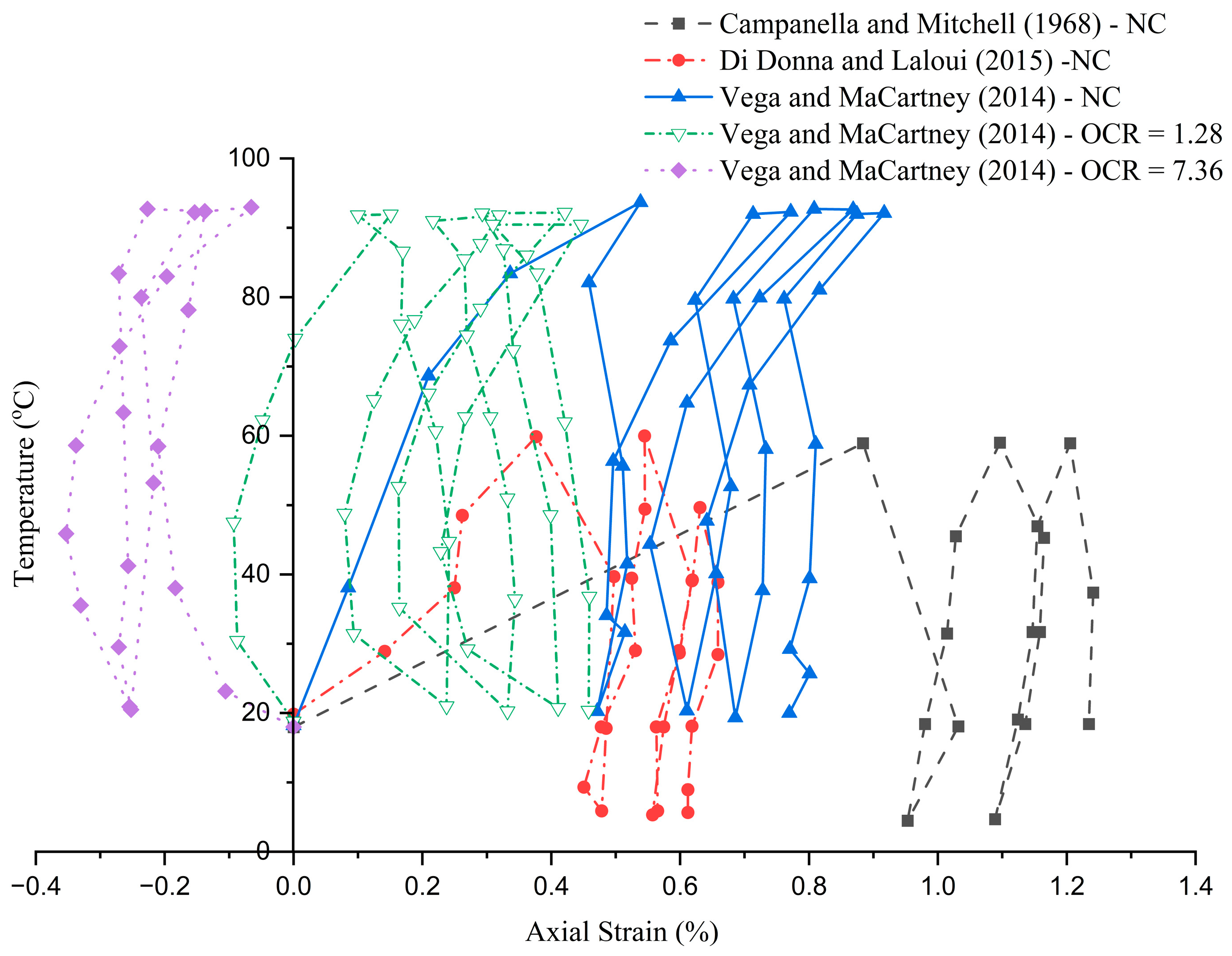
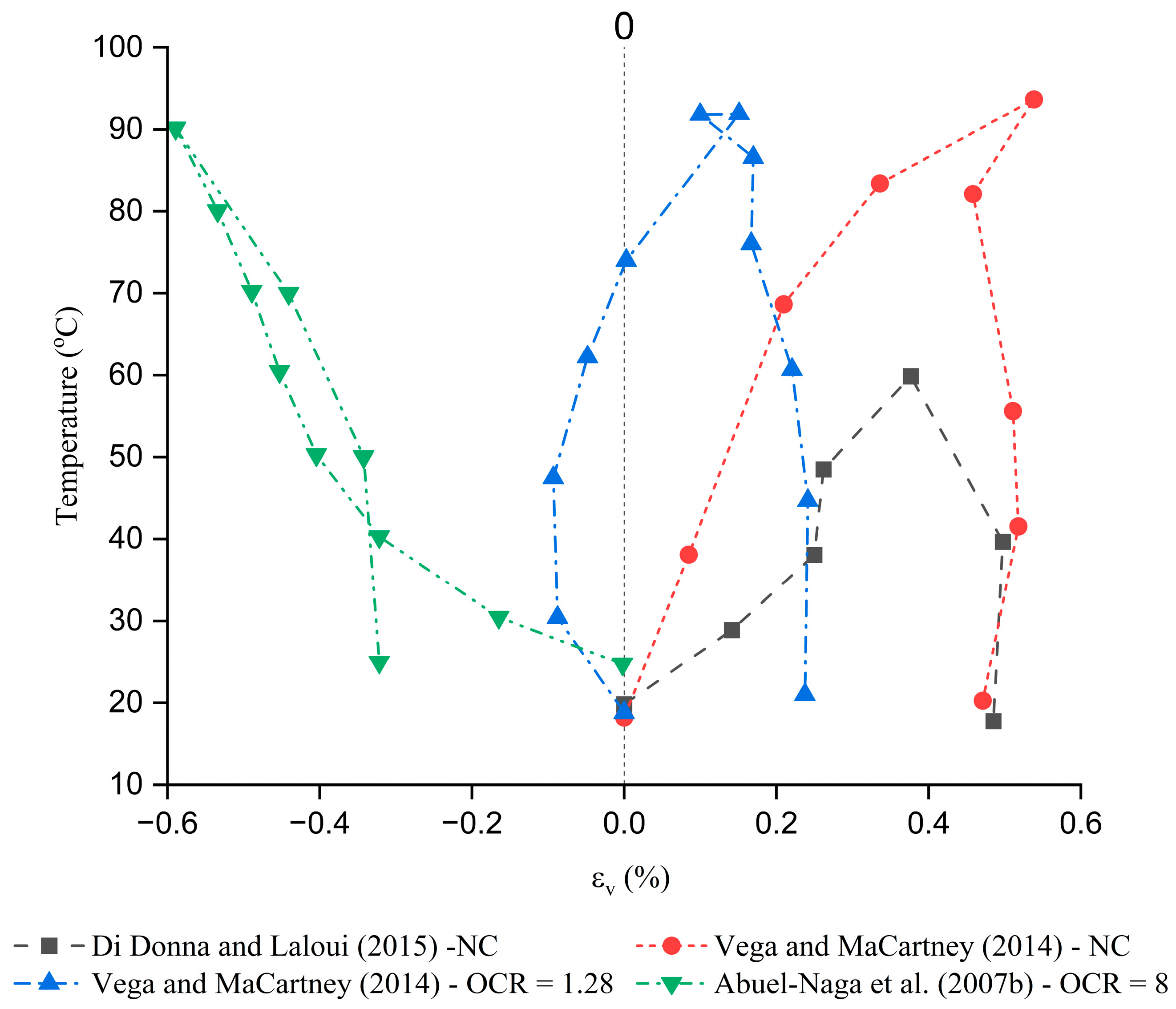
- Normally Consolidated (NC) Clays: Upon drained heating, these soils demonstrate irreversible volumetric contraction, often referred to as “Thermal collapse” [1,3,16,28,33,34,35]. This thermal collapse is shown in Figure 1, which summarises the experimental results reported by Di Donna and Laloui [36] using a natural silty clay, together with those reported by Vega and McCartney [37] using Bonny Silt.
- Lightly Overconsolidated (OC) Clays: These clays exhibit more complex behaviour, as perfectly demonstrated in Figure 1 by the results of Vega and McCartney [37], often showing an initial thermal expansion followed by a thermal contraction (or collapse) [1,3,35]. Various studies have further noticed that the intrinsic characteristics of the clay heavily affect the overconsolidation ratio (OCR) at which the volumetric strain behaviour transitions from contraction to dilation [39].
3. Impact of Clay Plasticity on Thermally Induced Volume Change
3.1. Direct Relationship Between Plasticity and Thermal Volume Change
3.2. Microstructural Mechanisms Influenced by Plasticity
3.2.1. The Physicochemical Debate: Diffused Double Layer (DDL) Theories
- Contraction Hypothesis (Thermal Softening Model): Several studies have argued that increasing temperature decreases the relative dielectric permittivity of water, directly weakening electrostatic repulsion and reducing the DDL thickness [48,51]. The consequent reduction in interparticle spacing was suggested to result in volumetric contraction, which is consistent with the experimentally observed decreases in preconsolidation pressure upon heating [27,53]. This model has been widely used to explain the thermal softening phenomena observed in NC clays, in which heating induces plastic contraction at a constant stress.
- Expansion Hypothesis (Thermo-Elastic Dilation Model): In contrast, other theoretical and early experimental contributions proposed that increased thermal energy enhances ionic mobility within the double layer, potentially increasing repulsive forces and leading to DDL expansion [7,16]. This mechanism causes volumetric dilation, consistent with the reversible expansion often observed in highly OC clays.
3.2.2. Limitations of an Idealised DDL Model
- 1.
- Nonbulk Behaviour of Confined Water: The DDL model assumes that the thermodynamic and dielectric properties of water confined in nanopores are equivalent to those of bulk water [4]. However, this assumption has been disproved by experimental investigations on low-porosity, highly compacted clays. Baldi, Hueckel and Pellegrini [9] demonstrated that the thermal expansion of water confined within clay interlayers deviates significantly from the bulk values. Under high confinement, the hydrogen-bond network and molecular dynamics of water are strongly modified, resulting in reduced mobility and altered dielectric responses [55,56]. Consequently, the conceptual use of bulk-water-based permittivity changes to explain volumetric deformation is untenable.
- 2.
- Inability to Explain Irreversibility: DDL interactions are non-contact and inherently reversible, producing elastic responses upon loading or temperature changes [51]. They cannot independently cause the irreversible volumetric contraction and energy loss characteristics of plastic deformation. The thermal collapse observed in NC clays thus requires an additional mechanism that permits permanent microstructural reorganisation and particle rearrangement. The absence of such a mechanism renders the DDL-based explanation incomplete in cases where heating induces significant irreversible strain [13,57].
3.2.3. Beyond the DDL: Microscale Particle Contacts, Bound Water and Irreversible Processes in Thermal Volume Change
Thermal Softening Through Bound Water Alteration
OCR Controlled Reversible and Irreversible Thermal Deformation
Energy Dissipation and Physicochemical Coupling
3.2.4. Role of Plasticity Index in Thermal Behaviour
3.3. Temperature Effects on Preconsolidation Pressure
4. Thermal Cyclic Behaviour and Plasticity
5. Temperature Effect on Consolidation Creep Behaviour
5.1. Mechanisms Driving Temperature Effects on Creep
- Microstructural changes and particle interactions: Temperature variations cause changes in the internal microstructure of the soil. Higher temperatures can lead to denser soil microstructures and promote the rearrangement of soil particles [54]. The degradation of the adsorbed water layer causes the particles to come closer together, which alters the contact force between them. Temperature changes influence the intensity of interparticle forces and reduce repulsion, making the rearrangement and compaction of soil particles easier and accelerating the process [60,82].
5.2. Influence of Clay Plasticity Parameters
6. Conclusions
Author Contributions
Funding
Data Availability Statement
Conflicts of Interest
References
- Favero, V.; Ferrari, A.; Laloui, L. Thermo-mechanical volume change behaviour of Opalinus Clay. Int. J. Rock Mech. Min. Sci. 2016, 90, 15–25. [Google Scholar] [CrossRef]
- Hamidi, A.; Khazaei, C. A thermo-mechanical constitutive model for saturated clays. Int. J. Geotech. Eng. 2010, 4, 445–459. [Google Scholar] [CrossRef]
- Tiwari, A.K.; Basu, P. Consolidation of Saturated Kaolin Subjected to Intermittent Thermal Loading with Temperature Gradient. J. Geotech. Geoenviron. Eng. 2024, 150, 04024056. [Google Scholar] [CrossRef]
- Wang, H.; Qi, X. Thermal volume change of saturated clays: A fully coupled thermo-hydro-mechanical finite element implementation. Geomech. Eng. 2020, 23, 561–573. [Google Scholar] [CrossRef]
- Abuel-Naga, H.M.; Bergado, D.T.; Bouazza, A.; Ramana, G.V. Volume change behaviour of saturated clays under drained heating conditions: Experimental results and constitutive modeling. Can. Geotech. J. 2007, 44, 942–956. [Google Scholar] [CrossRef]
- Cui, Y.J.; Sultan, N.; Delage, P. A thermomechanical model for saturated clays. Can. Geotech. J. 2000, 37, 607–620. [Google Scholar] [CrossRef]
- Campanella, R.G.; Mitchell, J.K. Influence of Temperature Variations on Soil Behaviour. J. Soil Mech. Found. Div. 1968, 94, 709–734. [Google Scholar] [CrossRef]
- Paaswell, R.E. Temperature Effects on Clay Soil Consolidation. J. Soil Mech. Found. Div. 1967, 93, 9–22. [Google Scholar] [CrossRef]
- Baldi, G.; Hueckel, T.; Pellegrini, R. Thermal volume changes of the mineral–water system in low-porosity clay soils. Can. Geotech. J. 1988, 25, 807–825. [Google Scholar] [CrossRef]
- Burghignoli, A.; Desideri, A.; Miliziano, S. A laboratory study on the thermomechanical behaviour of clayey soils. Can. Geotech. J. 2000, 37, 764–780. [Google Scholar] [CrossRef]
- Cekerevac, C.; Laloui, L.; Vulliet, L. A Novel Triaxial Apparatus for Thermo-Mechanical Testing of Soils. Geotech. Test. J. 2005, 28, 161–170. [Google Scholar] [CrossRef]
- Samarakoon, R.A.; Kreitzer, I.L.; McCartney, J.S. Impact of initial effective stress on the thermo-mechanical behavior of normally consolidated clay. Geomech. Energy Environ. 2022, 32, 100407. [Google Scholar] [CrossRef]
- Sultan, N.; Delage, P.; Cui, Y.J. Temperature effects on the volume change behaviour of Boom clay. Eng. Geol. 2002, 64, 135–145. [Google Scholar] [CrossRef]
- Tsutsumi, A.; Tanaka, H. Combined effects of strain rate and temperature on consolidation behavior of clayey soils. Soils Found. 2012, 52, 207–215. [Google Scholar] [CrossRef]
- Abu-Farsakh, M.Y.; Idries, A.; Chen, S. Evaluating the Effect of Heating–Cooling Cycle on the Clay-Concrete Pile Interface. In Geo-Congress 2022; ASCE: Reston, VA, USA, 2022. [Google Scholar]
- Abuel-Naga, H.M.; Bergado, D.T.; Bouazza, A. Thermally induced volume change and excess pore water pressure of soft Bangkok clay. Eng. Geol. 2007, 89, 144–154. [Google Scholar] [CrossRef]
- Kirkham, A.; Tsiampousi, A.; Potts, D.M. Thermo-mechanical behaviour of a kaolin-based clay soil. Géotechnique 2024, 74, 1742–1751. [Google Scholar] [CrossRef]
- Wang, L.Z.; Wang, K.J.; Hong, Y. Modeling Temperature-Dependent Behavior of Soft Clay. J. Eng. Mech. 2016, 142, 04016054. [Google Scholar] [CrossRef]
- Hoseinimighani, H.; Szendefy, J. A Review on Mechanisms of Thermally Induced Volume Changes in Fine Soil. Minerals 2022, 12, 572. [Google Scholar] [CrossRef]
- Saggu, R.; Chakraborty, T.; Roy, D.; Basu, D. Behavior of Saturated Soils at Elevated Temperatures: A Review. Indian Geotech. J. 2022, 53, 227–256. [Google Scholar] [CrossRef]
- Wang, S.; Gainey, L.; Mackinnon, I.D.R.; Allen, C.; Gu, Y.; Xi, Y. Thermal behaviors of clay minerals as key components and additives for fired brick properties: A review. J. Build. Eng. 2023, 66, 105802. [Google Scholar] [CrossRef]
- Alsabhan, A.H.; Hamid, W. Innovative Thermal Stabilization Methods for Expansive Soils: Mechanisms, Applications, and Sustainable Solutions. Processes 2025, 13, 775. [Google Scholar] [CrossRef]
- Zimar, Z.; Robert, D.; Zhou, A.; Giustozzi, F.; Setunge, S.; Kodikara, J. Application of coal fly ash in pavement subgrade stabilisation: A review. J. Environ. Manag. 2022, 312, 114926. [Google Scholar] [CrossRef]
- Oppong, F.; Kolawole, O. Reassessment of natural expansive materials and their impact on freeze-thaw cycles in geotechnical engineering: A review. Front. Built Environ. 2024, 10, 1396542. [Google Scholar] [CrossRef]
- Vasić, M.; Netinger Grubeša, I.; Awoyera, P.; Barišić, I. Clays in transition: Addressing resource challenges and sustainable innovations in the construction sector. Sci. Prog. 2025, 108, 00368504251376483. [Google Scholar] [CrossRef] [PubMed]
- Kirkham, A.; Tsiampousi, A.; Potts, D. Development of a new temperature-controlled oedometer. E3S Web Conf. 2020, 205, 04015. [Google Scholar] [CrossRef]
- Laloui, L.; Cekerevac, C. Thermo-plasticity of clays: An isotropic yield mechanism. Comput. Geotech. 2003, 30, 649–660. [Google Scholar] [CrossRef]
- Abuel-Naga, H.M.; Bergado, D.T.; Lim, B.F. Effect of Temperature on Shear Strength and Yielding Behavior of Soft Bangkok Clay. Soils Found. 2007, 47, 423–436. [Google Scholar] [CrossRef]
- Graham, J.; Tanaka, N.; Crilly, T.; Alfaro, M. Modified Cam-Clay modelling of temperature effects in clays. Can. Geotech. J. 2001, 38, 608–621. [Google Scholar] [CrossRef]
- Kale, R.C.; Ravi, K. Influence of thermal loading on index and physicochemical properties of Barmer bentonite. Appl. Clay Sci. 2018, 165, 22–39. [Google Scholar] [CrossRef]
- Hashemi, A.; Sutman, M.; Medero, G.M.; Buckman, J. Compressibility and microstructure of kaolin in varying thermo-hydro-mechanical states imposed by energy geostructures. Eng. Geol. 2023, 324, 107248. [Google Scholar] [CrossRef]
- Lu, M.; Sun, J.; Wen, M.; Yang, K.; Li, K. Insight into nonlinear thermal consolidation of saturated clay under coupled thermo-mechanical loading: A unified one-dimensional model. Acta Geotech. 2025, 20, 641–667. [Google Scholar] [CrossRef]
- Zhang, Z. A thermodynamics-based theory for thethermo-poro-mechanical modeling of saturated clay. Int. J. Plast. 2017, 92, 164–185. [Google Scholar] [CrossRef]
- Belmokhtar, N.; Ammari, M.; Brigui, J.; Ben Allal, L. Comparison of the microstructure and the compressive strength of two geopolymers derived from Metakaolin and an industrial sludge. Constr. Build. Mater. 2017, 146, 621–629. [Google Scholar] [CrossRef]
- Zeinali, S.M.; Abdelaziz, S.L. Microstructural evolution of saturated normally consolidated kaolinite clay under thermal cycles. Eng. Geol. 2023, 318, 107101. [Google Scholar] [CrossRef]
- Di Donna, A.; Laloui, L. Response of soil subjected to thermal cyclic loading: Experimental and constitutive study. Eng. Geol. 2015, 190, 65–76. [Google Scholar] [CrossRef]
- Vega, A.; McCartney, J.S. Cyclic heating effects on thermal volume change of silt. Environ. Geotech. 2014, 2, 257–268. [Google Scholar] [CrossRef]
- Romero, E.; Villar, M.V.; Lloret, A. Thermo-hydro-mechanical behaviour of two heavily overconsolidated clays. Eng. Geol. 2005, 81, 255–268. [Google Scholar] [CrossRef]
- Ghembaza, M.S.; Taïbi, S.; Fleureau, J.M. Thermo-hydro-mechanical behaviour of a sandy clay on isotropic paths. Eur. J. Environ. Civ. Eng. 2014, 18, 206–222. [Google Scholar] [CrossRef]
- Spagnoli, G.; Sridharan, A.; Oreste, P.; Bellato, D.; Matteo, L.D. Statistical variability of the correlation plasticity index versus liquid limit for smectite and kaolinite. Appl. Clay Sci. 2018, 156, 152–159. [Google Scholar] [CrossRef]
- Al-Hasab, Z.; Mahmood, R.A.; Al-Saad, H.A. The Effect of Mineralogy on the Geotechnical Properties of Clayey Soils: A Case Study for Al-Qurna District, Basrah, Iraq. Iraqi Geol. J. 2025, 58, 185–201. [Google Scholar] [CrossRef]
- Mighani, H.H.; Tourchi, S.; Lavasan, A.A.; Hosseini, F.; Szendefy, J. Impact of plasticity and stress history on thermal volume changes in clays. Sci. Rep. 2025, 15, 19013. [Google Scholar] [CrossRef]
- Xu, Z.; Chen, Z.; Lang, K.; Zhang, Y.; Dou, J. Effect of temperature paths on the time-dependent isotropic consolidation behavior of lateritic clay. Geothermics 2025, 130, 103329. [Google Scholar] [CrossRef]
- Abuel-Naga, H.M.; Bergado, D.T.; Ramana, G.V.; Grino, L.; Rujivipat, P.; Thet, Y. Experimental Evaluation of Engineering Behavior of Soft Bangkok Clay under Elevated Temperature. J. Geotech. Geoenviron. Eng. 2006, 132, 902–910. [Google Scholar] [CrossRef]
- Jarad, N.; Cuisinier, O.; Masrouri, F. Effect of temperature and strain rate on the consolidation behaviour of compacted clayey soils. Eur. J. Environ. Civ. Eng. 2019, 23, 789–806. [Google Scholar] [CrossRef]
- Ng, C.W.W.; Akinniyi, D.B.; Zhou, C. Volume change behaviour of a saturated lateritic clay under thermal cycles. Bull. Eng. Geol. Environ. 2020, 80, 653–661. [Google Scholar] [CrossRef]
- Mu, Q.Y.; Ng, C.W.W.; Zhou, C.; Zhou, G.G.D. Effects of clay content on the volumetric behavior of loess under heating-cooling cycles. J. Zhejiang Univ. Sci. A 2019, 20, 979–990. [Google Scholar] [CrossRef]
- Towhata, I.; Kuntiwattanaku, P.; Seko, I.; Ohishi, K. Volume Change of Clays Induced by Heating as Observed in Consolidation Tests. Soils Found. 1993, 33, 170–183. [Google Scholar] [CrossRef]
- Shetty, R.; Singh, D.N.; Ferrari, A. Volume change characteristics of fine-grained soils due to sequential thermo-mechanical stresses. Eng. Geol. 2019, 253. [Google Scholar] [CrossRef]
- Del Olmo, C.; Fioravante, V.; Gera, F.; Hueckel, T.; Mayor, J.C.; Pellegrini, R. Thermomechanical properties of deep argillaceous formations. Eng. Geol. 1996, 41, 87–102. [Google Scholar] [CrossRef]
- Casarella, A.; Tarantino, A.; Donna, A.D. Micromechanical interpretation of thermo-plastic behaviour of clays. E3S Web Conf. 2020, 205, 09003. [Google Scholar] [CrossRef]
- Wei, S.; Abdelaziz, S.L. Temperature Effects on the Thickness of the Diffused Double Layer Using Molecular Dynamics. In Geo-Congress 2022; ASCE: Reston, VA, USA, 2022. [Google Scholar] [CrossRef]
- Tidfors, M.; Sällfors, G. Temperature Effect on Preconsolidation Pressure. Geotech. Test. J. 1989, 12, 93–97. [Google Scholar] [CrossRef]
- Di Donna, A.; Casarella, A.; Tarantino, A. A micro-mechanical insight into the thermo-mechanical behaviour of clays. Geomech. Energy Environ. 2024, 38, 100549. [Google Scholar] [CrossRef]
- Brochard, L.; Honorio, T.; Vandamme, M.; Bornert, M.; Peigney, M. Nanoscale origin of the thermo-mechanical behavior of clays. Acta Geotech. 2017, 12, 1261–1279. [Google Scholar] [CrossRef]
- Cheng, W.; Hong, P.Y.; Pereira, J.M.; Cui, Y.J.; Tang, A.M.; Chen, R.P. Thermo-elasto-plastic modeling of saturated clays under undrained conditions. Comput. Geotech. 2020, 125, 103688. [Google Scholar] [CrossRef]
- Hueckel, T.; Baldi, G. Thermoplasticity of Saturated Clays: Experimental Constitutive Study. J. Geotech. Eng. 1990, 116, 1778–1796. [Google Scholar] [CrossRef]
- Wang, Y.; Yin, Z.-Y.; Hu, L.; Wang, Y.; Yin, Z.-Y.; Hu, L. Quantifying water adsorption ability of unsaturated soil by soil water isotherm. Acta Geotech. 2024, 20, 1723–1742. [Google Scholar] [CrossRef]
- Lu, N.; Zhang, C.; Lu, N.; Zhang, C. Separating External and Internal Surface Areas of Soil Particles. J. Geotech. Geoenviron. Eng. 2019, 146, 04019126. [Google Scholar] [CrossRef]
- Houhou, R.; Sutman, M.; Sadek, S.; Laloui, L. Microstructure observations in compacted clays subjected to thermal loading. Eng. Geol. 2021, 287, 105928. [Google Scholar] [CrossRef]
- Robinet, J.C.; Rahbaoui, A.; Plas, F.; Lebon, P. A constitutive thermomechanical model for saturated clays. Eng. Geol. 1996, 41, 145–169. [Google Scholar] [CrossRef]
- Lehmann, P.; Leshchinsky, B.; Gupta, S.; Mirus, B.B.; Bickel, S.; Lu, N.; Or, D. Clays Are Not Created Equal: How Clay Mineral Type Affects Soil Parameterization. Geophys. Res. Lett. 2021, 48, e2021GL095311. [Google Scholar] [CrossRef]
- Cekerevac, C.; Laloui, L. Experimental study of thermal effects on the mechanical behaviour of a clay. Int. J. Numer. Anal. Methods Geomech. 2004, 28, 209–228. [Google Scholar] [CrossRef]
- Pham, T.A.; Sutman, M.; Pham, T.A.; Sutman, M. Modeling the combined effect of initial density and temperature on the soil–water characteristic curve of unsaturated soils. Acta Geotech. 2023, 18, 6427–6455. [Google Scholar] [CrossRef]
- Sheridan, B.; Bagheri, M.; Rezania, M.; Sheridan, B.; Bagheri, M.; Rezania, M. Thermal Creep and Stress Relaxation of London Clay. Int. J. Geomech. 2024, 24, 04024043. [Google Scholar] [CrossRef]
- Cai, W.; Zhu, C.; Lein, W. Measurement and Modeling of Thermo-Hydro-Mechanical Behaviors of Frozen Clays: Frost Susceptibility and Compressibility. Transp. Res. Rec. 2024, 2678, 720–731. [Google Scholar] [CrossRef]
- Guo, Y.; Zhang, G.; Liu, S. Temperature effects on the in-situ mechanical response of clayey soils around an energy pile evaluated by CPTU. Eng. Geol. 2020, 276, 105712. [Google Scholar] [CrossRef]
- Samarakoon, R.A.; McCartney, J.S. Effect of Drained Heating and Cooling on the Preconsolidation Stress of Saturated Normally Consolidated Clays. In Geo-Congress 2020; ASCE: Reston, VA, USA, 2020. [Google Scholar] [CrossRef]
- Moritz, L. Geotechnical Properties of Clay at Elevated Temperatures; Swedish Geotechnical Inst.: Linkoeping, Sweden, 1995. [Google Scholar]
- Boudali, M.; Leroueil, S.; Srinivasa Murthy, B. Viscous hebaviour of natural clays. In International Conference on Soil Mechanics and Foundation Engineering; A.A. Balkema: Rotterdam, The Netherlands, 1994; pp. 411–416. [Google Scholar]
- Marques, M.E.S.; Leroueil, S.; Soares de Almeida, M.d.S. Viscous behaviour of St-Roch-de-l’Achigan clay, Quebec. Can. Geotech. J. 2004, 41, 25–38. [Google Scholar] [CrossRef]
- Eriksson, L. Temperature effects on consolidation properties of sulphide clays. In International Conference on Soil Mechanics and Foundation Engineering; Balkema Publishers, AA/Taylor & Francis: Leiden, The Netherlands, 1989; pp. 2087–2090. [Google Scholar]
- Tanaka, N.; Graham, J.; Crilly, T. Stress-strain behaviour of reconstituted illitic clay at different temperatures. Eng. Geol. 1997, 47, 339–350. [Google Scholar] [CrossRef]
- Bellia, Z.; Ghembaza, M.S. Modelling the volume change of saturated fine-grained soils under cyclic temperatures. Eur. J. Environ. Civ. Eng. 2022, 26, 5617–5633. [Google Scholar] [CrossRef]
- Iodice, C.; Laora, R.D.; Tamagnini, C.; Viggiani, G.M.B.; Mandolini, A. Numerical analysis of energy piles in a hypoplastic soft clay under cyclic thermal loading. Int. J. Numer. Anal. Methods Geomech. 2023, 47, 1175–1201. [Google Scholar] [CrossRef]
- Mu, Q.; Ng, C.W.W.; Zhou, C.; Liao, H.J. Effects of soil fabric on volume change behaviour of clay under cyclic heating and cooling. In Proceedings of China-Europe Conference on Geotechnical Engineering; Springer Series on Geomechanics and Geoengineering; Springer International Publishing: Cham, Switzerland, 2018. [Google Scholar] [CrossRef]
- Zhu, Q.Y.; Zhao, T.Y.; Zhuang, P.Z. Thermal strain response of saturated clays in 1D condition. J. Zhejiang Univ. Sci. A 2021, 22, 182–187. [Google Scholar] [CrossRef]
- Azhar, M.; Somenath, M.; Anh, M.T.; Singh, A.K. Effect of temperature on the mechanical properties of fine-grained soils—A review. Geothermics 2024, 116, 102863. [Google Scholar] [CrossRef]
- Zhu, Q.Y.; Qi, P. Numerical Modeling of Thermal-Dependent Creep Behavior of Soft Clays under One-Dimensional Condition. Adv. Civ. Eng. 2018, 2018, 9827673. [Google Scholar] [CrossRef]
- Chen, Z.J.; Feng, W.Q.; Chen, W.; Yin, J. A thermal elastic visco-plastic model for soft clayey soils. Can. Geotech. J. 2024, 61, 208–227. [Google Scholar] [CrossRef]
- Li, A.; Chen, Z.J.; Feng, W.Q.; Yin, J.H. The Effects of Temperature on One-Dimensional Consolidation and Creep Behaviors of Hong Kong Marine Deposits. Int. J. Geomech. 2023, 23, 04023215. [Google Scholar] [CrossRef]
- Casarella, A.; Pedrotti, M.; Tarantino, A.; Di Donna, A. A Critical Review of the Effect of Temperature on Clay Inter-particle Forces and Its Effect on Macroscopic Thermal Behaviour of Clay. In Challenges and Innovations in Geomechanics; Barla, M., Di Donna, A., Sterpi, D., Eds.; Springer International Publishing: Cham, Switzerland, 2021; pp. 608–615. [Google Scholar]
- Houston, S.L.; Houston, W.N.; Williams, N.D. Thermo-Mechanical Behavior of Seafloor Sediments. J. Geotech. Eng. 1985, 111, 1249–1263. [Google Scholar] [CrossRef]



| Clay Type | Citations | Plasticity Range (PI) | Test Types Used | Temperature Ranges (Cycles) | Other Important Information |
|---|---|---|---|---|---|
| Boom Clay | [13] | 25–50 | Isotropic compression Drained heating/cooling Suction-controlled oedometer testing | 20–100 °C. Includes cycles such as 22–100–27 °C and 20–95–20 °C. | A stiff clay from Mol, Belgium, with a mineralogy of illite, kaolinite, smectite, and quartz |
| Soft Bangkok Clay | [16,28,44] | 60 | Drained/undrained triaxial compression Isotropic/anisotropic consolidation Modified oedometer | 22–90 °C. Cycles include 25–50/70/90–25 °C and 22–90–22 °C | Deltaic-marine soft clay with 54% to 71% smectite group minerals |
| Kaolin/MC Clay/EPK | [35] | 19–35 | Oedometer Triaxial shear | 5–90 °C. Cycles include 8 °C to 45 °C and paths up to 68 °C | Includes >96% kaolinite |
| Illite Clay | [45] | 24–112 | Triaxial testing Oedometer | 10–100 °C. Staged heating is used up to 100 °C. | A clay from Germany and includes 12 reconstituted samples |
| Lateritic Clay | [43,46] | 20.6–21 | Isotropic consolidation Thermal oedometer | 5–70 °C. Cycles such as 20–50–5–20 °C are used for cyclic stabilisation | Contains goethite and hematite, which enhance aggregates and stiffen the soil skeleton |
| Opalinus Clay | [1] | 15 | High-pressure oedometer with thermal volume change monitoring | 20–80 °C | An overconsolidated shale/claystone from Switzerland used for nuclear waste storage studies |
| Loess | [47] | 13–24 | Thermal invar oedometer | 15–70 °C. Subjected to 3–5 heating-cooling cycles to reach stable states | Clay component (kaolinite, chlorite, illite) is more thermally sensitive than the silt/quartz skeleton |
| Bonny Silt | [37] | 4 | Temperature-regulated oedometer Thermal consolidation under cyclic loading | 3–91 °C. Tested over 4 heating/cooling cycles | Classified as low activity, indicating minimal clay minerals |
| Barmer Bentonite | [30] | 208–398 | Temperature-controlled oedometer | 60–200 °C. Involves sustained heating for up to 28 days | From Rajasthan, India, features a large specific surface area and high ion-exchange capacity |
| KSS (Kaolin-based) | [17] | 18.5 | Temperature-controlled oedometer tests at various vertical pressures | 5–70 °C. Includes repeat thermal cycling to observe accumulation of strain | Artificial clay (50% kaolin, 25% quartz silt, 25% fine quartz sand) |
| FEBEX Bentonite | [38] | High | Temperature-controlled oedometer Axial deformation under mechanically unconfined conditions | 25–80 °C | A Spanish bentonite used for buffer experiments has high swelling capacity |
Disclaimer/Publisher’s Note: The statements, opinions and data contained in all publications are solely those of the individual author(s) and contributor(s) and not of MDPI and/or the editor(s). MDPI and/or the editor(s) disclaim responsibility for any injury to people or property resulting from any ideas, methods, instructions or products referred to in the content. |
© 2026 by the authors. Licensee MDPI, Basel, Switzerland. This article is an open access article distributed under the terms and conditions of the Creative Commons Attribution (CC BY) license.
Share and Cite
Vidurapriya, D.; Abuel-Naga, H. The Effect of Clay Plasticity on Thermally Induced Volume Change of Saturated Clay: A State-of-the-Art Review. Minerals 2026, 16, 303. https://doi.org/10.3390/min16030303
Vidurapriya D, Abuel-Naga H. The Effect of Clay Plasticity on Thermally Induced Volume Change of Saturated Clay: A State-of-the-Art Review. Minerals. 2026; 16(3):303. https://doi.org/10.3390/min16030303
Chicago/Turabian StyleVidurapriya, Dinitha, and Hossam Abuel-Naga. 2026. "The Effect of Clay Plasticity on Thermally Induced Volume Change of Saturated Clay: A State-of-the-Art Review" Minerals 16, no. 3: 303. https://doi.org/10.3390/min16030303
APA StyleVidurapriya, D., & Abuel-Naga, H. (2026). The Effect of Clay Plasticity on Thermally Induced Volume Change of Saturated Clay: A State-of-the-Art Review. Minerals, 16(3), 303. https://doi.org/10.3390/min16030303